




Abstract
This research adopts Critical Discourse Analysis as a perspective to explore how kindness was expressed and promoted in university communities and city communities from January to March in 2020 when the Covid pandemic broke out in the UK and provide a window on British culture in which kindness was expressed and promoted through discourse. It combines a qualitative method with a corpus-based quantitative method. It is found that kindness was meant for providing support and showing compassion and inclusion to community members and that strategies in lexis, syntax and metaphor can reproduce or resist the expression and promotion of kindness in communities. During the pandemic, the intentional kindness expressed by community authorities was respect of diversity rather than inclusion of different values or ethnicity and no substantial support was provided to vulnerable members even though authorities were trying to impress the public by claiming that they were making constant efforts to support the community. Case studies revealed that we should caution against the use of passivation and the pronouns like they.
Introduction
This research adopts Critical Discourse Analysis to describe how community authorities intended to express and promote kindness through discourse to the target audience such as international students (e.g. students from China) and East Asian communities at the initial stage of the Covid pandemic. It concentrates on the linguistic strategies adopted by authorities for building an inclusive and supportive community among people with diverse backgrounds and concerns in light of the dynamics of the pandemic. This work can therefore reveal how the value of kindness is deployed by community authorities when public health and safety is being challenged.
Community, traditionally, was defined based on social relations and interaction in a locality. With modernisation, urbanisation and globalisation, ‘community without propinquity’ (Webber, 1964) came into being and community is formed when individuals pursue high levels of interaction, common interests, identity and shared values (Mannarini and Fedi, 2009). It is suggested that community be defined along three dimensions: ecological (space, time), social structural (networks of institutions and interaction) and symbolic cultural (identity, norms and values) dimensions (Hunter, 2018).
In view of the heterogeneity of community, it is argued that community is defined not as a group of co-occurring populations, but as groups of co-occurring individuals of different populations (Looijen and Van Andel, 1999: 218). In this view, a group of individuals may be labelled as members of different communities. For example, international students may be part of the local (i.e. a city/town/village) community if they live off-campus as well as retaining their university community membership. Likewise, students from China in the UK not only belong to their host university community, but may also obtain membership in the East Asian community in that area.
The varied interpretations of community consistently point to the significance of cultivating sense of belonging, for which the concept of kindness is of great use. Kindness describes any voluntary act that protects or benefits others and is not driven by external rewards or punishments (Eisenberg et al., 2006) but is motivated by compassion or concern (Peterson and Seligman, 2004). Acts of kindness are ‘essentially unobligated, often emotionally complex and always deeply social’ (Anderson and Brownlie, 2019: 12).
Recent studies show that adolescents think kind acts involve 10 themes: emotional support, proactive support, social inclusion, positive sociality, complimenting, helping, expressing forgiveness, honesty, generosity, formal kindness such as fundraising and volunteering (Cotney and Banerjee, 2019); and that university students instantiate kindness by being polite, showing care and concern, being selfless, being self-aware or having a positive attitude, helping, improving other’s lives, being inclusive, nice/friendly, showing respect and following the ‘golden rule’ (Binfet et al., 2022: 448). Both groups include helping and being inclusive (social inclusion) as kind acts and believe being kind means being generous or selfless. However, it is claimed that kindness is not ‘a selfless helping’, but how help is offered, that is, ‘with gentleness, respect, amiability and concern’ (Faust, 2009: 297).
Kindness is lubricative (as a ‘social lubricant’, Binfet et al., 2022: 444) as well as reciprocal and contagious (susceptible to ‘social contagion’, Tsvetkova and Macy, 2014). The beneficiaries of kind acts are likely to give a helping hand to others (Fowler and Christakis, 2010) out of gratitude (Bartlett and DeSteno, 2006) and elevation (an emotional response to witnessing acts of virtue or moral beauty) (Algoe and Haidt, 2009: 106). In this way, kindness promotes altruism and contributes to building social connection and cultivating sense of belonging.
Kindness became a catchphrase of British community communication during the coronavirus outbreak when the public health was challenged and so many people suffered. In this research, what is focused on is the kindness expressed and described through public discourse during the pandemic.
Background of the study
The Covid-19 pandemic has been one of the biggest challenges to human survival. China was the first country suffering greatly from the Covid-19 coronavirus in the world. In the UK, March witnessed the rapid spread of the virus, therefore the first national lockdown was put into effect on 23 March 2020 to mitigate the worsening epidemic situation. In view of the highly infectious virus, all of the students, including international students, were advised to go back home because in-person teaching was terminated and they were put at great risk of infection in their journey. What’s worse, international students from China and other residents with East Asian backgrounds who stayed in the UK were subject to racism and discrimination during the first wave of the disease. Some were assaulted and hurt physically and mentally, especially when they were wearing face masks (Lim et al., 2022: 20). Authorities in university and local communities recognised that these vulnerable members were in need of particular care and support.
Data and methodology
During the Covid-19 crisis, through emails and statements, community authorities have disseminated great amounts of pandemic information to members in the name of kindness, with the intention of protecting the public health and safety. Based on official emails and public statements collected from four universities and three city councils in England between 23 January (first day of Wuhan lockdown) and 23 March 2020 (first day of UK lockdown), two corpora (University Corpus and City Corpus) were built (see Table 1). These emails and statements were official in that they were released from a vice-chancellor, a provost and/or a registrar or a council leader to the general public, that is, the students and staff in a university or municipal community.
Corpus details.
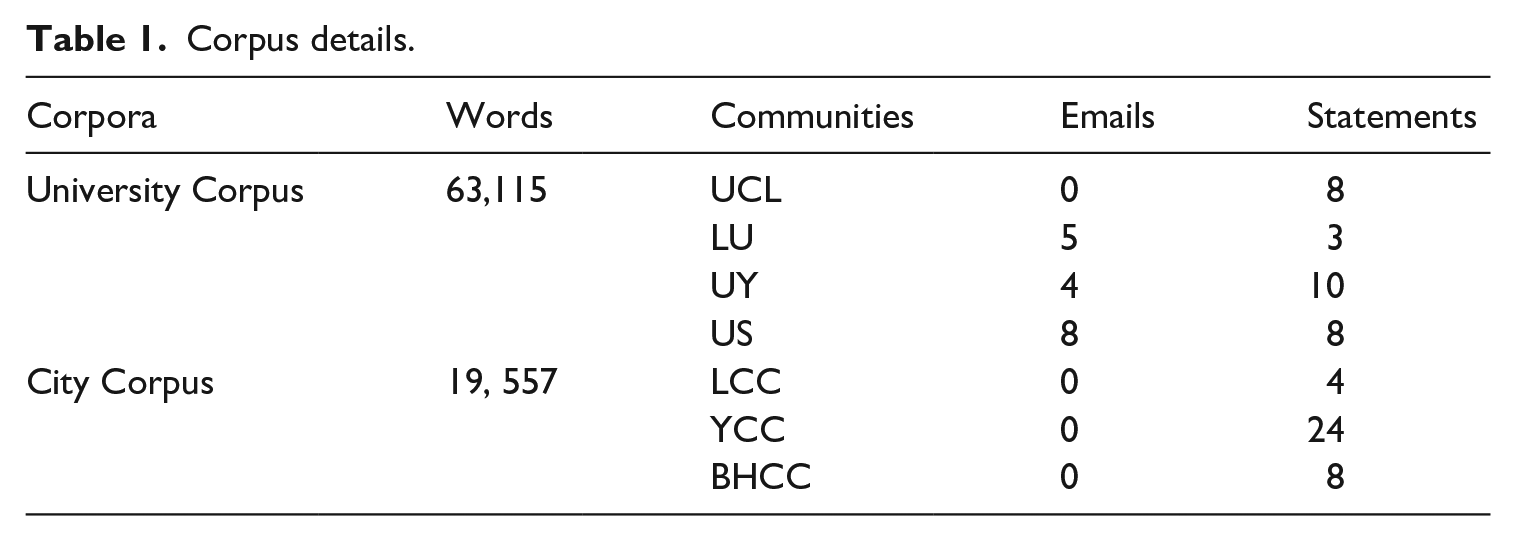
The four British universities were selected for this research because they have a high percentage of international students: University College London (UCL; 54.3%), Lancaster University (LU; 29.8%), University of York (UY; 14.1%) and University of Sussex (US; 26.7%). Moreover, UY and US are the universities with confirmed cases of Covid found in February 2020. Among the four universities, UY and LU are located in the north, while US and UCL in the south. The three city councils chosen for the research are Lancaster City Council, York City Council and Brighton and Hove City Council because they are the communities to which three of the universities belong. Camden Council, to which UCL is affiliated, is absent because no pertinent public statements or emails were available either on its website or on that of London Councils. Despite the differences in scales, members, locations and goals, the chosen communities have members from different ethnic groups, with different cultural values or beliefs. In this context it is meaningful to examine how kindness was adopted by authorities for exercising control and protecting public safety and wellbeing during this health crisis.
The perspective adopted for the research is Critical Discourse Analysis (known as CDA). According to Van Dijk (1993: 250), CDA studies ‘the relations between discourse structures and power structures more or less directly’. Between discourse and dominance, social cognition should be taken as the necessary theoretical (and empirical) ‘interface’. Ideologies are the ‘fundamental social cognitions that reflect the basic aims, interests and values of groups’ (Van Dijk, 1993: 258), ‘such as their identity, tasks, goals, norms, values, position and resources’ (Van Dijk, 1995: 18). They ‘allow members of a group to organise (admission to) their group, coordinate their social actions and goals, to protect their (privileged) resources, or, conversely, to gain access to such resources in the case of dissident or oppositional groups’ (Van Dijk, 1995: 19). In order to enact power, social actors who have privileged access to the discourse may manifest the dominance through context control as well as in some subtle and unintentional ways, such as lexical or syntactic style, rhetorical devices and local semantics. CDA therefore focuses on the discursive strategies used for legitimating control, or otherwise naturalising the social order, and especially relations of inequality (Fairclough, 1985). Situated in public health communication, CDA is of great value in showcasing how community authorities exercise control through discourse and how public discourse maintains or resists the relations of dominance and inequality.
The discourse analysis is corpus-based. With the help of Sketch Engine, corpus data is examined in terms of frequency, collocation, wordlist and concordance (including CQL, Corpus Query Language). These corpus analysis techniques are adopted for disclosing the contextual meaning of kindness and the discursive strategies for expressing or promoting kindness in university and municipal communities in times of health crisis. Furthermore, case studies are conducted with regard to wearing masks and returning home in an attempt to demonstrate what linguistic strategies better express and promote kindness within communities.
Meaning of kindness in community
Language is viewed as an ideological phenomenon, because ideologies can be encoded and communicated through language (Volosinov, 1973). Van Dijk (2012) echoed this by asserting that ‘discourse plays a fundamental role in daily expression and reproduction of ideologies’ (p. 3). Discourse can either contribute to the ‘enactment of dominance in text and talk in specific contexts’ or have impact on ‘the minds of others’ (Van Dijk, 1993: 279). It is suggested that in doing discourse analysis, primary attention should be paid to the discursive ‘properties that express or signal the opinions, perspective, position, interests or other properties of groups’ (Van Dijk, 1995: 22), because all of these are included in ideology which any group may develop in order to cultivate ‘loyalty, cohesion, interaction and operation of its members’ (Van Dijk, 2011: 380). As part of group ideologies, kindness is explicitly or implicitly expressed in community communication. What type of kindness is stressed and pursued, and how effectively kindness is expressed and promoted can be tracked in detailed discourse analysis.
Kindness has two occurrences in University Corpus and one in Community Corpus, as shown below in Examples 1–3. Coordination is adopted for the specification and emphasis of kindness in the context. According to Lang (1984: 19), a coordinate structure is formed based on the hypothesis that conjuncts meet a set of conditions on their structural homogeneity. Conjuncts have two possible relations: compatibility (i.e. semantic non-distinctness, semantic inclusion and mutual independence) and incompatibility (contrariness and contradictoriness). Obviously, coordination used here illustrates the semantic inclusion between kindness and the three words support, compassion and inclusion.
1. Cllr Keith Aspden, Leader of City of York Council, said: It’s now five days since the Covid-19 COBRA meeting was called, and
In Example 1, using coordination, authorities have marked the importance of support from residents and businesses as an act of kindness in community. In addition, exclusive we and passive voice are used to highlight authorities’ recognition of the acts of kindness and the great difference the kind support has made in community. We represents a group or an establishment with the speaker as a central or defining member (Wortham, 1996: 333) and it is divided into inclusive we and exclusive we (Daniel, 2005). Inclusive we signifies the speaker, the group or organisation he or she speaks on behalf of and the audience, while exclusive we doesn’t refer to the audience. The purposeful use of exclusive we displays their authoritative stance in recognising and advocating kindness in communities.
2.
In Example 2, kindness means compassion for Chinese students in the community. The sentence pattern it is important that. . . allows authorities to adopt an objective perspective to make a request. What should be noted here is that compassion is different from kindness because compassion prioritises the experience of those who witness suffering whereas kindness is defined largely by the beholder or recipient rather than the giver. Moreover, compassion grows out of privilege and reaffirming hierarchies and inequalities (Spelman, 2001). Here, compassion is advocated as a particular way to show kindness, but it reveals the inequality between members and highlights the superiority of the we-group.
Additionally, in contrast to the inclusive we (all) and our which contribute to solidarity, the pronoun they reveals that Chinese students have been excluded from the university community. Van Dijk (1995) points out that ‘representation of ideologies are often articulated along an us vs them dimension’ (p. 22) and the use of us and them entails the positive and negative evaluations (Van Dijk, 1993: 264). Obviously, they is a sign of conscious or subconscious distancing, though students from China are marked as our group to whom great concern is expressed in this instance. Authorities othered the Chinese group of members when they were calling on members to show compassion.
3. The time has
Example 3 shows that inclusion is advocated as the third specification of kindness in community. Equating kindness with inclusion, authorities intended to deliver the guidance on stopping racism and discrimination within the community. Similar to Example 2, the first-person pronouns we and our are purposefully used here. As the modifier of the noun values, our, which is related to inclusive we, that is, the audience is included, enables authorities to align members to the shared values and cultivate a sense of community. While exclusive we is employed to depict authorities’ agency in spotting the discriminatory behaviours, authorities’ agency hasn’t been explicitly represented in the specific response to racism and discrimination. Instead, the inanimate time is topicalised so as to collocate with the infinitive to take action. The pattern the time has never been more important to do . . .is used to emphasise the urgent importance of showing inclusion at that point of time. It conveys authorities’ stronger desire to advocate inclusion in community as compared to the pattern it is important to do. . ..
In these three examples, coordination helps define kindness as offers of support compassion and inclusion respectively. Example 1 shows the support from residents and businesses in city community has won acclaim from authorities as an act of kindness. Examples 2 and 3 indicate that compassion and inclusion have been highlighted in view of the needs of the highly vulnerable groups in communities: students from China and Asian communities.
Expression and promotion of kindness in community
Having analysed what kindness has meant in community during the pandemic, we now concentrate on how kindness was promoted when anybody could pose risks to public safety due to the highly contagious virus and when racism and abuse took place in communities.
Showing inclusion
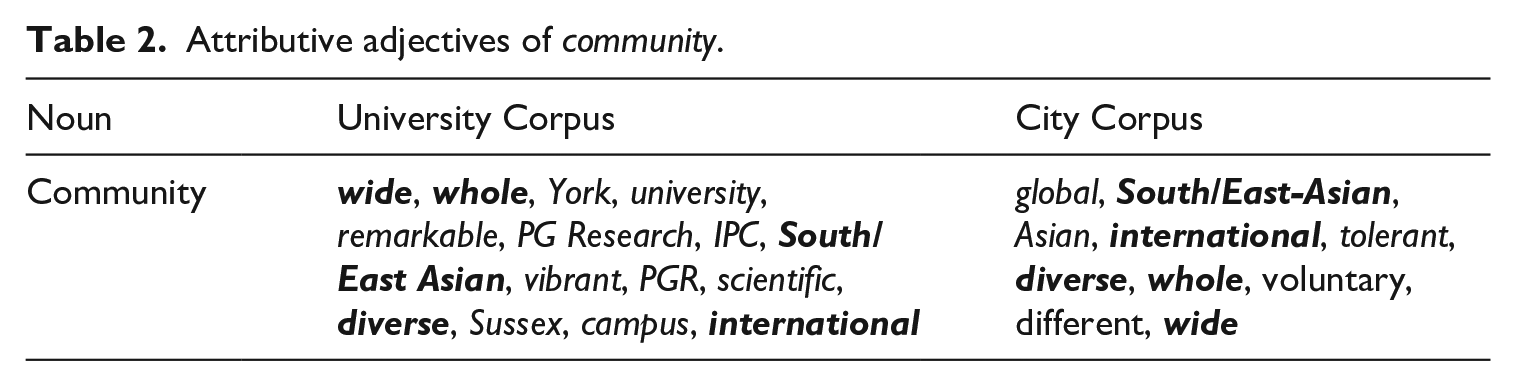
To better understand kindness in community, we can pay our first attention to how community is defined. Adjectives have the inherent function of characterising a person or an object (Dixon, 1999). As attributive adjectives serve as pre-head internal dependent (i.e. part of a nominal) in the structure of the NP (Pullum and Huddleston, 2002: 528) and they can add some evaluative or descriptive information to the modified nouns, we examine the attributive adjectives of community to illustrate how community was described and evaluated by authorities.
As Table 2 shows, wide, whole, South/East Asian, diverse and international (highlighted) appear in both corpora. This suggests that in the surveyed communities diversity and solidarity are the core pursuit and South/East Asian communities have been brought in focus in community communication. In University Corpus, wide and university are used more frequently while in City Corpus global and Asian have higher frequency, as shown in Figure 1 (where the darker and larger a word is, the more frequently it appears in the corpus). This indicates both university communities and city communities paid close attention to diversity and inclusion.
4. The University is
Attributive adjectives of community.
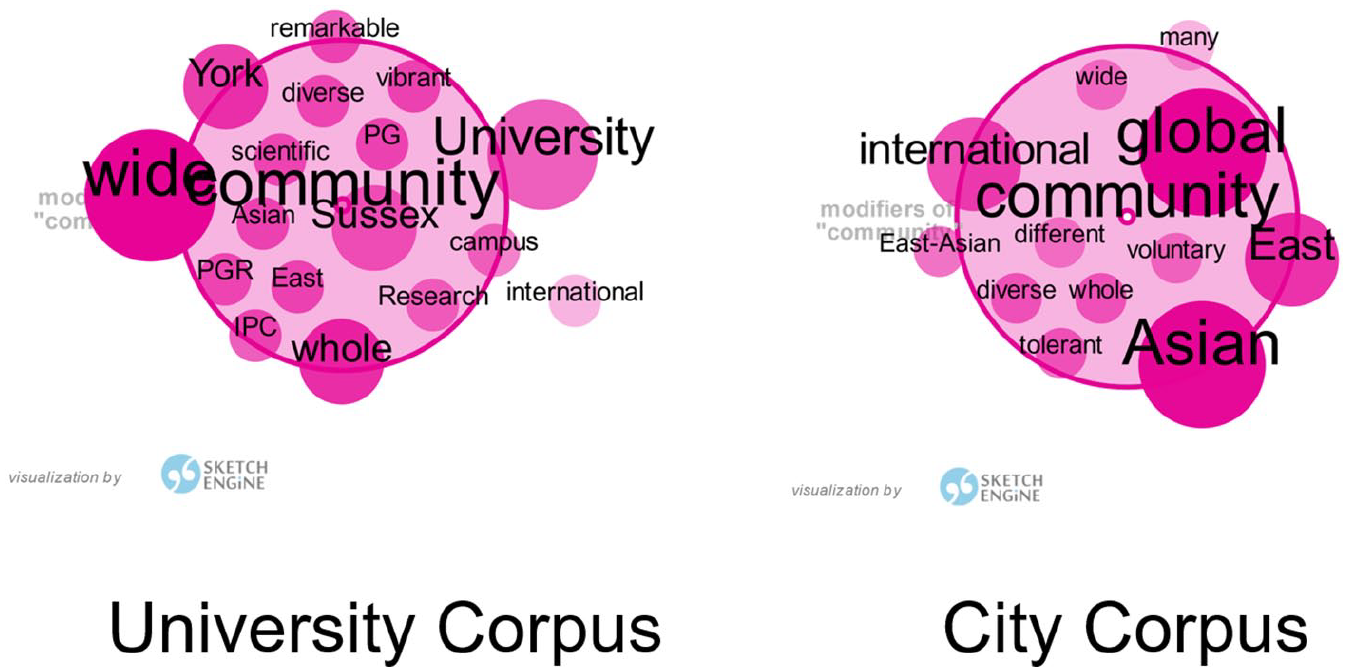
Frequencies of attributive adjectives of community.
Concordance analysis can provide us with a wider view about what is advocated within communities. Example 4 emphasises the importance of inclusion and diversity in university communities by collocating community with global, diverse and inclusive. Additionally, the inclusive we and its variant our were intended for uniting members to show inclusion.
5. I’ve spoken to people from
In Example 5, using the pronoun you and the verb reassure, the city authority was trying to show kindness directly to international communities. The impersonal reference of you embodies a sense of informal camaraderie and a sense of universality (Kitagawa and Lehrer, 1990: 742). What is worth noting here is the adoption of the metaphor in which city is likened to fabric to stress the importance of diversity in the community. In order to promote kindness within the city, the authority mentioned the concerns expressed to Asian communities about the negative impact of the virus on them. By contrast, inclusion was shown to international communities which may include but is not limited to Asian communities. This subtle shift is likely to help authorities articulate their vague stance in supporting Asian communities and avoid any challenge from local communities who may have bias towards Asian communities.
Although authorities claimed that communities were inclusive and diverse, racism, abuse and discrimination did occur during the pandemic and it had severe social impacts. At the initial stage of the pandemic, in the UK, ‘maskaphobia’ (dubbed by The Guardian) prevailed and wearing a surgical mask in public, especially if you looked East Asian, could even invite racist attacks (Weale, 2020).
6. We have been saddened by reports of racism from a minority of the public.
When racism and discrimination took place in British communities, authorities displayed unfavourable attitudes in different ways. As illustrated in Examples 6–8, city authorities have shown their different stances. In Example 6, authorities expressed their sadness about reports of racism and announced the ban for racism in the community. Nonetheless, a passive structure is used for emotional expression and an active voice is adopted for announcing the ban. Although passivation implicates authorities’ negative attitudes towards racism, the ban with this type of behaviour as the topicalised subject doesn’t show any specific actions would be taken to stop racism. Instead, what has been advocated here is just formalistic respect of cultural diversity.
7. The Vice-Chancellor of Lancaster University, Professor Steve Bradley, said: ‘I have made it clear to
In Example 7, authorities are trying to encourage students to report racism and discrimination by quoting a professor. Coordination used in this instance implies that no action would be taken if students who were subject to any form of racism or discrimination didn’t report. Moreover, the frequent use of we, our, they clearly shows the distinction between in-groups and out-groups in the community.
8. Councillor Dr Erica Lewis, leader of Lancaster City Council, said: ‘Our district is stronger for being a diverse and tolerant community. I am deeply concerned to hear that
In Example 8, authorities don’t use the pronoun they or any of its variants to refer to the people affected by racism. Conversely, any residents, those members of our community and everyone are adopted to include the vulnerable group in the community. In this way, support and inclusion are well expressed and advocated.
9. London is a diverse city which is home to a vibrant community from around the world. But like any major city, deplorable incidents like this can occur. During the current outbreak of coronavirus, we are very proud of the way in which our community has responded calmly and is supporting each other. We want to make clear that
Examples 9–11 can depict how university authorities positioned themselves in dealing with racist abuse and hate speech during the pandemic. Similar to Example 6, Example 9 topicalises abuse, racism and hate speech to inform the members of a relevant ban. What’s interesting here is authorities’ explanation for the happening of the saddening incidents: London is a diverse community where the incidents are bound to happen. This naturalises the occurrence of racism, abuse and hate speech in London though it claims the rejection of the deplorable incidents at UCL.
10. There have been some cases in the news of people experiencing bullying and abuse related to coronavirus. We would like to remind everyone that UCL and Students’ Union UCL 11. Unfortunately, there have been some shocking media reports about abuse and racism at other universities linked to the current coronavirus situation. This behaviour
Contrary to Example 9, Example 10 adopts an active voice to show an institutional stance in dealing with bullying or abuse: not tolerate. Example 11 demonstrates university authorities’ unfavourable attitudes towards virus-related racial discrimination. On the one hand, they displayed their intolerance of abuse and racism implicitly through passivation and topicalisation (This behaviour will not be tolerated). On the other hand, they actively encouraged reporting.
The examples from the two types of communities consistently show that authorities suppressed their agency in tackling virus-related abuse and discrimination and they encouraged or requested members to report for getting support. In community communication, what we can see is the promotion of support, diversity and inclusion, but we can’t see description of any specific action to prevent the happening of racism and discrimination. In addition, when delivering regulations, university and city authorities were aware of their domination in the public communication and they favoured the patterns such as it is important that. . . and we want/would like to remind/make clear that. . .. Further examination tells us these two patterns have different semantic prosodies. Subordination in the pattern It is important that. . .carries positive prosody and expresses the shared values in communities, while what is subordinated to we would like to remind/make clear that. . .connotates negative profiles and conveys disagreement. Despite the different semantic prosodies, the two types of sentence patterns were intended for promoting kindness, respect and inclusion within communities, whereby authoritative and dominant position got guaranteed and maintained.
Offering support
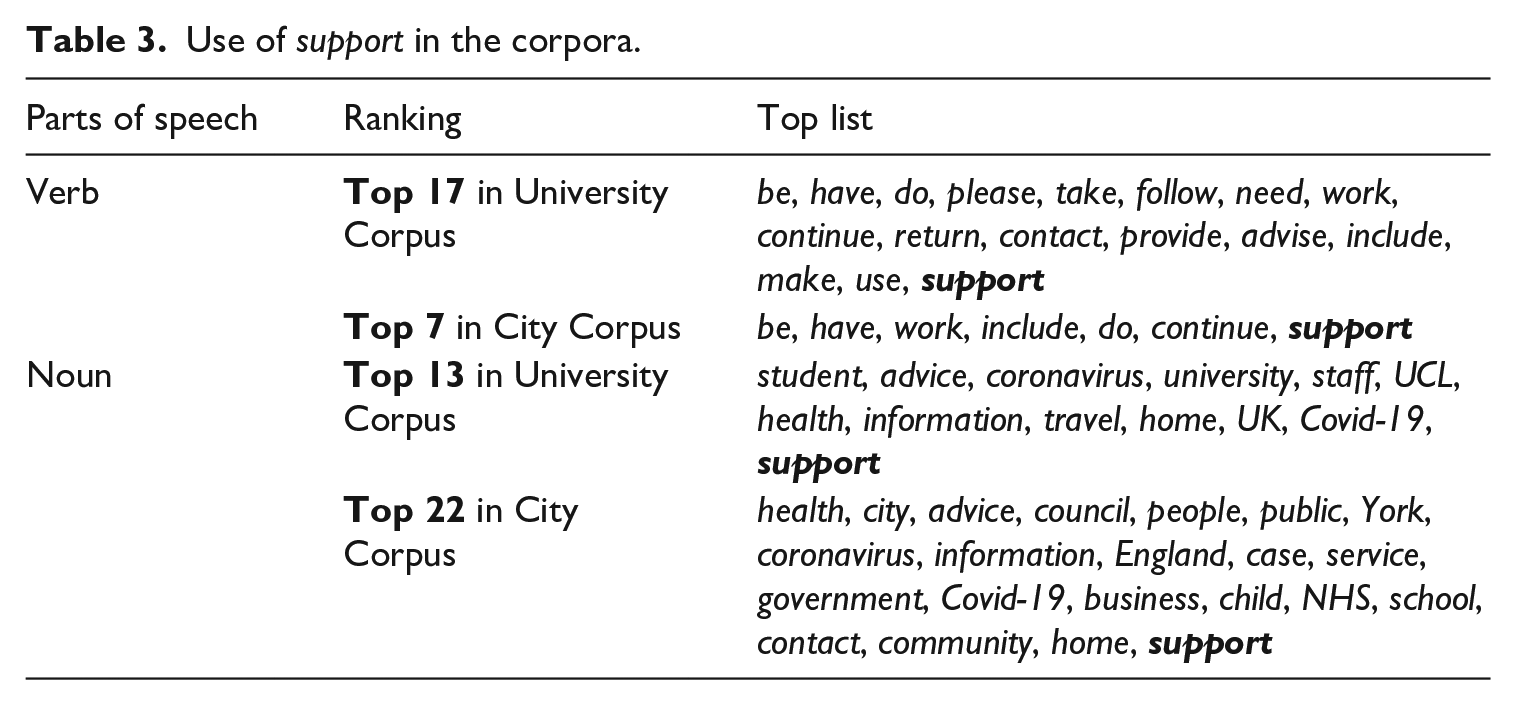
As a word, support has two parts of speech. As a verb, in University Corpus it occurs 106 times (frequency per million words: 1500.63), while in City Corpus it has 61 occurrences (frequency per million words: 2751.84). As a noun, it has 161 instances (frequency per million words: 2279.26) in University Corpus and 55 instances (frequency per million words: 2481.17) in City Corpus. In University Corpus it is used more frequently as a noun, while in City Corpus it has higher frequency as a verb. Whether it is a noun or a verb, support has higher relative frequency in City Corpus than in University Corpus. However, in both corpora it ranks 22nd or higher (its rankings are highlighted in bold) in the word frequency list as each part of speech (see Table 3).
Use of support in the corpora.
In order to figure out how community authorities offered their support and help to members, we can take a close look at the use of modal verbs, as they carry important information about the sender’s attitude to the message and other interpersonal meanings (McCarthy, 1991).
12. We will let you know more details 13. We are grateful for all the support that so many people at Sussex have offered to our students and staff from China. Please know that the University is here to help and support you 14. It is abundantly clear that we are living in unprecedented times and dealing with exceptional circumstances. As a city, we must find our resolve and do 15. Council staff have been adjusting and re-focusing their efforts to support our communities over the coming months, particularly to ensure our frontline services can continue to operate to keep the city moving. I would like to thank the fantastic response of our staff during this crisis, and we will continue to do
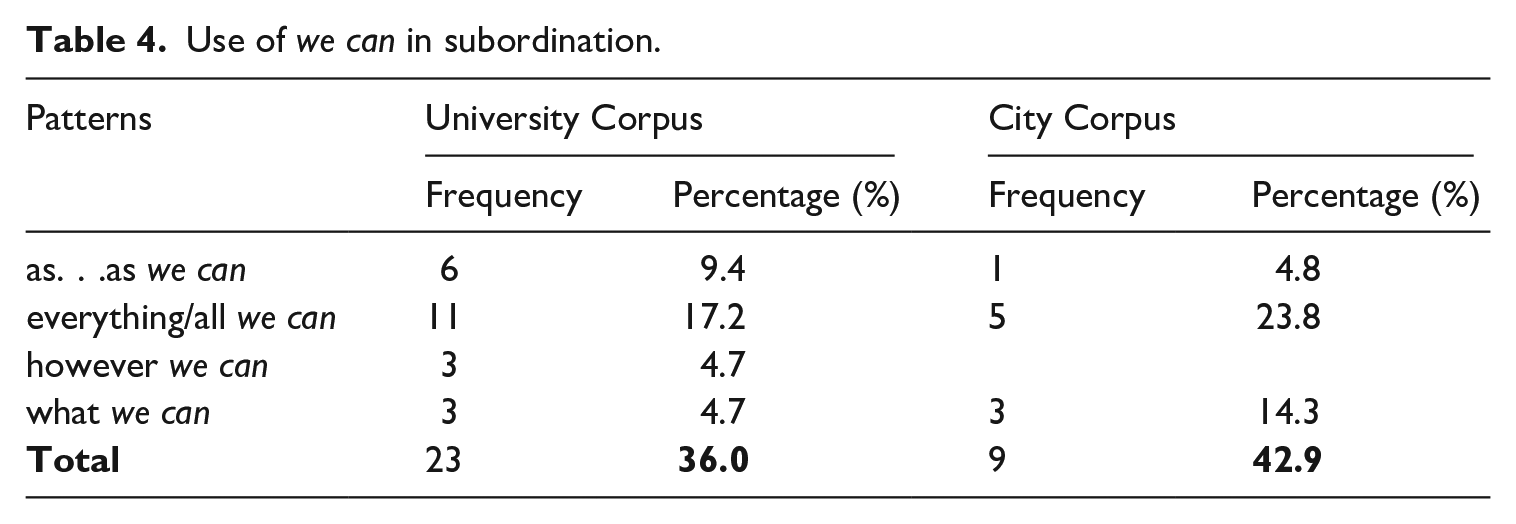
Can is a modal verb employed to express ability, possibility and permission. It is used for making offers and requests. Collocating with the pronoun we, it reflects that authorities were able or likely to support and serve the members during the health crisis. Such expressions as everything we can, however we can and all we can are constantly used to demonstrate authorities’ ability and resolve to support and protect community members. In Example 12, we can appears in an adverbial clause and displays authorities’ active role in information service. The second conjunct in the example further reveals that several weeks was marked ‘soon’ and authorities were actually not so capable of providing more information. Example 13 also depicts the use of can in an adverbial for demonstrating authorities’ sincerity and determination involved in helping and supporting members. On the other hand, can which appears in everything we can and what we can may contribute to constructing authorities’ active image in community support, illustrated in Examples 14 and 15.
We can has 64 and 21 cases in University Corpus and City Corpus respectively. As Table 4 shows, in total, the subordinated we can accounts for 36.0% and 42.9% respectively in the corpora. This means that can was favoured by authorities for expression of attitudes rather than description of actions in response to the pandemic.
16. Please refer to this page for accurate and updated advice about the coronavirus and UCL’s response.
Use of we can in subordination.
Will enables authorities to demonstrate their determination and capability in responding to the health crisis. It can point to either volition or future prediction, or both. Normally it is used with a human subject and it has volitional element though it can also be a future marker (Aijmer, 1985). Will mainly collocates with the animate subjects we and you. In Example 16, we will signals a volitional action in the future. Just because of its vagueness, will becomes preferable to other modal verbs. It has 744 occurrences in University Corpus and 118 in City Corpus, collocating with we 148 and 33 times respectively. It is followed by be and continue more frequently in both corpora.
Next, we turn to the application of tense or aspect to showing support. Semantically, aspect involves the boundedness of events (Radden and Dirven, 2007). Progressive aspect marks an event which is conceptualised as unbounded from ‘inside’ the situation where it is occurring. In addition, progressive aspect contributes to expressing ‘greater immediacy’ and implicating the potential continuation of a situation unless impeded (Radden and Dirven, 2007: 178). In contrast, perfect aspect is used for an event which is bounded from the ‘outside’. Present perfect aspect means that an event has an endpoint which is the conceptualiser’s now. Different from present perfect aspect, present perfect progressive aspect highlights the continuous or interrupted duration of a situation and it has inferential (describing ‘the inferred state following an anterior unbounded event’) and continuative (stressing ‘the durational phase of a situation’) functions (Radden and Dirven, 2007: 217).
17. 18. 19. Since the outbreak of the Coronavirus
In Example 17, a declarative sentence adopts the future progressive tense and helps university authorities to display their agency in responding to the pandemic in the future. In Example 18, a declarative sentence in the present progressive tense describes the event where city authorities make continuous efforts in providing support for members. Example 19 uses the present perfect progressive tense to show the durational phase of authorities’ efforts in protecting the community.
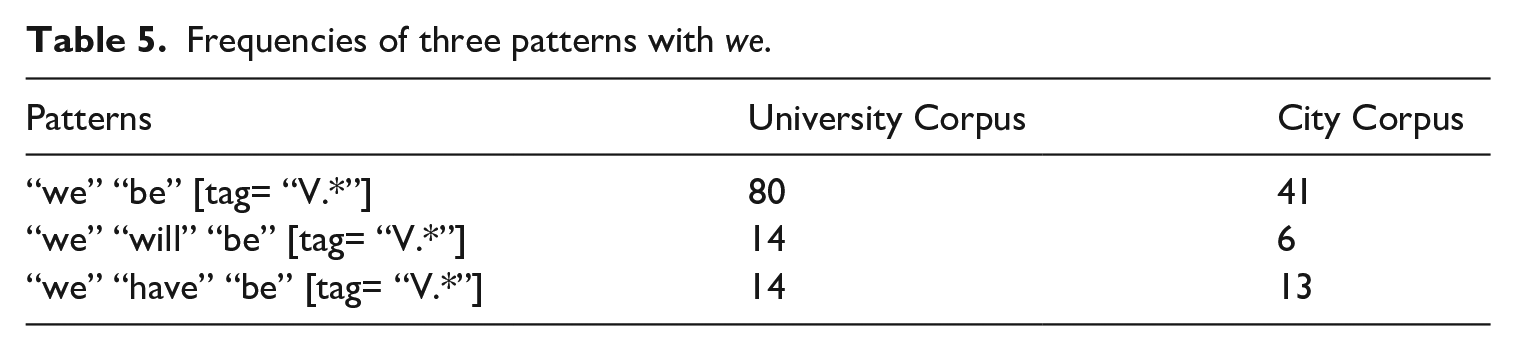
No matter in what aspects, progressive tense effectively reflects authorities’ ongoing attempts to support and serve members when public health is under threat. And frequency counts show that we are doing (“we” “be” [tag= “V.*”]) enjoys the most popularity among the three patterns, illustrated in Table 5. This suggests that authorities were trying to impress the public as an organisation that was making constant efforts to support members and protect the public health and safety.
Frequencies of three patterns with we.
Two case studies on kindness expression
Having explored how kindness is expressed and promoted through discourse in community, we need to check if there is any discursive evidence for expression of and deviation from kindness with respect to specific themes.
Wearing masks
With regard to wearing masks in the pandemic, opinions and practices may vary from member to member in community. In public statements they is constantly used as the synonym of out-groups and negative attitudes are attached to it. In Example 20, face-mask group has been marked as out-group by means of the pronoun their. The initiative was intended to advocate respect and solidarity within community, but it negated the protective practice which is conventional and acceptable in Asian communities by using the evidential structure there is little evidence that. . .. Consequently, the supportive and kind proposal fails to meet the psychological needs of face-mask group, let alone cultivating their sense of community.
20. Should Advice from the NHS and Public Health England states that following hygiene precautions such as thoroughly washing hands with soap and water, covering your mouth and nose with a tissue if you cough or sneeze, and keeping surfaces clean, are the best ways to avoid catching or spreading the virus. However, we know that
In addition, Example 20 exploits the sentence pattern it is important that. . . for delivering the authoritative or persuasive message in community. This pattern, together with its variant it is important to do. . ., is often adopted for formal suggestion or persuasion because it enables authorities to distance themselves from the current situation so as to make a suggestion or guidance as objectively as possible.
21. Should
Conversely, Example 21 can be taken as a better choice for authorities to resolve the dispute of wearing masks in communities. By using the phrase some of our community, authorities have skilfully included face-mask group in community and, to some degree, successfully nurtured their sense of community. Then adopting the nominalised subject (the wearing of a face mask) and the neutral signifier (the wearer), authorities were trying to eliminate misunderstanding about mask-wearing in community. By quoting Public Health England for the use of face masks, authorities eventually displayed their mediating stance: mask wearing is not an obligation but a personal choice and it should be respected.
What is worth mentioning here is that when Covid-19 situation became serious in the UK, more communities started to use I instead of you to refer to the audience (mainly students and staff) so as to give the contextually dependent guidance directly and effectively. As can be seen in Examples 20 and 21, the pronoun I signifies a perspective change in providing specific guidance and moral support. It subtly converts a formal dialogue to an intimate soliloquy so as to facilitate the information delivery and promote kindness expression.
Returning home
Regarding public guidance or advice, authorities tended to adopt passive voice to indicate its formality and objectivity, as shown in Example 22.
22. I want to go home because of the coronavirus outbreak. What is UCL’s policy on this? On 17 March, UCL announced that
However, passivation implies little attention is paid to the emotional needs or mental health of members at this unprecedented time. The advice on returning home cannot gloss over the unequal power relations between university authorities and students. It also effectively suppresses the agentic role of authorities in urging students to leave the campus. In this way, no one should take on the responsibility of publicising the guidance.
23.
In public discourse, personal pronoun you contributes to defining the target audience and constructing a dialogic communication model. As shown in Example 23, using the pronouns you and its variant your to refer to students, authorities stated straightforwardly their advice about returning home. Kindness and concern were intended to express by means of the sentence pattern it is in your interest to do. . .. Nevertheless, activation increases the level of imposition and deviates a little from authorities’ kind intention. It seems to be incompatible with the British culture which highlights personal autonomy and negative politeness. However, it is likely to demonstrate an affective stance and render the persuasion emotional and appealing.
Discussion and conclusion
Kindness is not only a personal virtue, but also a social lubricant and a catalyst for altruism. By expressing and promoting kindness through discourse, community authorities intended to cultivate members’ sense of community and maintain their dominant position. This research explores how kindness was expressed verbally to the vulnerable group of people in community, that is, students from China and East Asian communities, during the health crisis.
Detailed discourse analysis has uncovered what kindness was meant and promoted by authorities in British university communities and city communities during the Covid pandemic. It is found that kindness was instantiated by providing support to community members and showing compassion and inclusion to members with different cultural backgrounds. This justifies young people’s interpretations of kind acts as helping and inclusion (Binfet et al., 2022; Cotney and Banerjee, 2019).
Kindness, especially adolescent kindness, falls into three categories: random or reactionary kindness, intentional kindness and quiet kindness (Binfet and Enns, 2018). Evidently, what community authorities expressed and promoted was intentional kindness, which involved ‘planning, gathering resources, identifying recipients, scheduling, and execution’ (Binfet and Enns, 2018: 35). The intentional kindness was oriented towards Chinese students or East Asian communities and aimed at exercising control on community members and maintaining the public safety at this particular time.
Carefully choosing adjective modifiers of community as well as the pronouns such as inclusive we and impersonal you, authorities strived to emphasise diversity and inclusion and unite members to show kindness and respect diversity. Comparing city to fabric, authorities intended to picture metaphorically a diverse and inclusive community and advocate community diversity and inclusion.
However, we have to differentiate inclusion from diversity. Diversity and inclusion are often loosely conflated, but diversity does not generate inclusion automatically (Johnson, 2011; Sherbin and Rashid, 2017). As the functional partner to diversity, inclusion requires the shift from performative diversity (highlighting quotas and statistics as a measure of diversity) to cognitive diversity (emphasising creating space to diverse opinions and perspectives) (Brix et al., 2022: 267). During the pandemic, mask wearing has become a touchstone of community inclusion. In using the pronoun they and its variants their and them, authorities consciously or accidentally excluded some groups (e.g. students from China or other Asian countries) from a community (e.g. university community) and negate the values or beliefs (e.g. wearing masks is protective) of some members so much so that kindness (i.e. respect and inclusion) couldn’t be expressed or promoted effectively within communities. When discrimination and racism did take place, community authorities, in most times, suppressed their agency to protect the vulnerable groups. They adopted passivation and topicalisation to subtly distance themselves from virus-related racial discrimination and take an objective stance in dealing with the unkind and inappropriate behaviours so as to mediate the complex relationships among members in a safe position. Overall, their authoritative stance in dealing with racism and discrimination was featured by reminders or warnings other than action plans. It is true that this may be interpreted as a respectful speech act which corresponds to the no-imposition British culture, but this fails to satisfy the emotional and safety needs of the target audience. In addition, in the metaphor of fabric, what was highlighted was diversity rather than inclusion because what authorities welcomed was not Asian communities, but international communities.
Kindness can also be seen in providing support. Using declarative sentences in progressive tense with different aspects, authorities underlined their continuous efforts in supporting members. Additionally, modal verbs such as can and will enable authorities to demonstrate their active role in providing support and expressing kindness. The constant use of we can in subordination (e.g. everything we can, as soon as we can) is conducive to displaying authorities’ volition and sincerity involved in giving support to people. However, it cannot show what specific or substantial actions authorities were able or likely to take to help the members. More evidence of attitudinal display other than action-oriented narrative can be found in the subordinated request, advice or warning in such sentence patterns as it is important that. . ., it is important to do. . ., we would like to remind that. . . and we want to make clear that. . .. The verbal kindness were intended to give support to the vulnerable group in the community. However, this British style of persuading values kindness and respect to every member, not just the vulnerable groups of people in urgent need of help and support. Therefore, it may be taken as a kind of lip service and impressed as ritualised kindness.
Just as what Jones (2021) has said, discourse analysis can ‘provide us with frameworks to notice when and how meaning is created, and sometimes to productively intervene’ (Jones, 2021: 3). Based on the two case studies, we can figure out how kindness is likely to be better expressed in discursive practice. It is suggested that we caution against the use of the third-person plural pronoun they and the passive structure in expressing and advocating kindness so as to well protect members’ safety and well-being during the pandemic.
This research is a tentative attempt to explore the expression and promotion of kindness within British university communities and city communities at the beginning of the pandemic from the perspective of CDA. Kindness expression and promotion has been contextualised and targeted towards some groups of members in the community communication during the Covid pandemic. This research has examined a subset of the linguistic ways to convey or advocate kindness. The next step could be to survey the attitudes of the target audience to the official emails and public statements and examine the effectiveness of kind expression in community in terms of the beholders and recipients.
Footnotes
Acknowledgements
I would like to express my heartfelt gratitude to Professor M. Lynne Murphy, Professor Teun A. van Dijk and Dr Roberta Piazza for their careful guidance and timely encouragement. In addition, I am very grateful to the two anonymous reviewers for their insightful and valuable comments on earlier drafts of the article. This work also benefited a lot from discussions with Fatimah Yahya M. Fagehi. Special thanks should go to Kindness UK for supporting me to share a relevant research at ICLASP 17.
Declaration of conflicting interests
The author(s) declared no potential conflicts of interest with respect to the research, authorship, and/or publication of this article.
Funding
The author(s) received no financial support for the research, authorship, and/or publication of this article.
