




Abstract
Global environmental change has provoked changes in how humans experience and perceive their relationship to nature. Such conceptual changes can be observed through language use, and specifically lexical change. This paper investigates how such changes manifest through an analysis of how the terms ‘greenhouse gas’, ‘climate gas’, ‘carbon’, and ‘CO2’ are used in the Norwegian parliament in the time period 1999–2019. We observe a discursive specialization where different discursive dimensions are linked to the different expressions, corresponding to different framings of climate change, including technological, economic, and moral perspectives. Importantly, there is a shift over time where the discursive division of labor between the expressions is consolidated and new framings emerge. We show that a more refined language of GHG expressions is a discursive resource that contributes to making sense of the multiple ways that climate change impacts society.
Keywords
Introduction
Society’s response to climate change is mediated by social and cultural factors (Adger et al., 2013) and the meaning of anthropogenic global warming and environmental change is conceptualized differently across social contexts and changing over time. An example is the historical development of concepts such as ‘environment’, ‘global climate’ (Robin et al., 2013; Warde et al., 2018), or more recently, the concept of the ‘anthropocene’ (Trischler, 2016). These studies also illustrate that conceptual change is often reflected in lexical change, and the relationship between language and climate change has been the subject of recent research in linguistics and the social sciences (see e.g. Nerlich and Koteyko, 2009; Andersen and Gjesdal, 2020; Fløttum et al., 2014; Gjesdal and Lyse Samdal, 2016; Grundmann and Krishnamurthy, 2010; Koteyko, 2010). This research has been based on methods from corpus linguistics and has identified a connection between phenomena of global environmental change and dynamic lexical change. Specifically, recent research has also identified a growth in new expressions related to climate change (Andersen and Gjesdal, 2020; Koteyko, 2010; Nerlich and Koteyko, 2009). One strand of this research has focused on individual expressions corresponding to greenhouse gas (‘GHG’), such as the considerable growth in the use of ‘carbon compounds’ formed around the word ‘carbon’, such as ‘carbon indulgence’, ‘carbon footprint’, or ‘carbon tax’, etc. (Andersen and Gjesdal, 2020; Dury, 2008; Koteyko, 2010; Koteyko et al., 2010; Nerlich, 2012; Nerlich et al., 2011; Nerlich and Koteyko, 2009).
This article studies the emergence of a new vocabulary of GHG expressions and we analyze how they function as a discursive resource to make sense of the multitudes of ways that climate change impacts society. We observe a process of discursive specialization, which we take to be a process of division of labor between different terms, where terms over time come to embody specific perspectives or framings of climate change, such as economic, technical, or moral framings of the issue. We show that discursive specialization is of particular interest to understand the relationship between lexical change and conceptual change and to understand how it functions as an argumentative resource in Norwegian parliamentary debates. We analyze the changing use of lexical expressions denoting greenhouse gases (GHGs) in a corpus of the verbatim reports from the Norwegian Parliament in the time period 1999–2019. The expressions including ‘carbon’, ‘CO2’, ‘climate gas’, and ‘greenhouse gas’ are used in parliamentary discourse as shorthand expressions to refer to the same empirical phenomenon, although they do, strictly speaking point to different referents.
The article zooms in on the Norwegian case, which is an interesting example of climate change discourses due to its heavy involvement in petroleum as well as a political consensus on the gravity of climate change. The reality and severity of anthropogenic climate change was accepted in the late 1980s by most political parties in Norway (Andersen, 2017), and like the other Nordic countries, Norway was an early mover in the international processes (Anker, 2018). An important area of conflict has been the substantial offshore fossil fuel production that is a major factor in the Norwegian economy (Norwegian Petroleum, 2021). The Norwegian climate change debate is dominated by technical and economic issues, while issues related to a more radical societal transformation or the need for a just transition has historically been less discussed (Andersen, 2017). The debates are also characterized by technological optimism, particularly related to the development of carbon capture and storage which has been actively supported by the government and is expected to be operational from 2024 (Merk et al., 2022; Tjernshaugen, 2011). To summarize, Norway has a heterogeneous and conflicted climate change debate balancing between its ambition to be a progressive actor in international environmental policymaking, and its national interest in the petroleum industry (see also Fløttum and Espeland, 2014). This makes the Norwegian case particularly interesting for a study of the discursive, conceptual, and lexical dimensions of the climate change debate.
In order to investigate the discursive specialization of GHG expressions in parliamentary discourse in Norway, the article will examine the following research questions:
How do the GHG expressions develop over time in terms of frequency and number of compound expressions derived from these expressions?
To what extent do the GHG expressions embody different conceptualizations or framings of the climate change issue?
How can we understand this temporal development in terms of its drivers and consequences?
The remainder of the article consists of four parts: We first provide a theoretical framework for the analysis of lexical change in the context of climate change (2). We then present the materials and methods used in the analysis (3). Section 4 combines the results and discussion, while section 5 presents the concluding remarks, limitations, and further research.
GHG concepts: Lexical change and discursive specialization as barometer of conceptual change
The analyses build on previous research in corpus linguistics and corpus-assisted discourse analysis. In an early study of climate change discourse, Grundmann and Krishnamurthy (2010) analyze different framings associated with the terms ‘climate change’, ‘global warming’, and ‘greenhouse effect’. The terms are taken to be linguistic indicators of specific topics, or framings of global warming and they specifically observe ‘scientific’ and ‘political’ framings, as well as moral and action-oriented frames. Similar research has been undertaken by Nerlich and Koteyko (2009), and Koteyko et al. (2010), who analyze carbon expressions. Focusing on the use of metaphorical carbon expressions such as ‘low carbon’ or ‘carbon cowboys’, Nerlich et al. (Nerlich, 2012; Nerlich et al., 2011; Nerlich and Koteyko, 2010) show that such expressions contribute to framings of climate change on the societal level, as well as processes of sense-making among the general public. This perspective is captured by the following quote:
New words and new concepts provide people with new ways of experiencing themselves and their world, with new ways of being and new ways of knowing. Carbon compounds have become efficient tools for making sense of climate change and users engage in numerous creative ways of modifying, varying and extending these compounds to achieve a variety of discursive ends [. . .] (Nerlich et al., 2011: 79).
While Nerlich et al. focus on carbon expressions, we are also inspired by previous research on lexical productivity more generally, and specifically in the form of ‘creative compounding’ (De Smedt, 2012), which argues that sudden bursts in lexical productivity and creativity may be indicative of societal interest and the topicality of the subject in question.
While previous studies have focused on the media and internet discourse, this paper analyzes the role of GHG expressions in parliamentary discourse. This is a particular type of discourse targeted toward public deliberation and decision-making. An important aspect for this study is that continual parliamentary debates provide a valuable source for studying changes over time in political language and culture (Ihalainen and Palonen, 2009: 23). Arguments over a political issue are expressed within a forum that is highly routinized and conventionalized (Ilie, 2015). Previous discourse-oriented studies such as those of Ilie (2015) have largely focused on the rhetorical, text-scale characteristics of parliamentary discourse, while this article zooms in on the lexical level to tease out the discursive construction of climate change in this context.
The meaning we attach to terms such as ‘carbon’ or ‘CO2’ today is influenced by our historical experience of climatic change in a way that people living in the 1960s could not relate to. While ‘carbon’ was and still is an elementary substance, in many contexts the use of this term will also signify a greenhouse gas, and the global problem of climatic change in a way that the term did not signal some decades ago. These shared experiences are the basis for lexical creativity, such as criticizing someone for being a ‘carbon addict’ (Nerlich and Koteyko, 2009) and give rise to more subtle differences between the words used to denote climate change as a political or scientific issue (Grundmann and Krishnamurthy, 2010). In this sense, terms are embedded in networks of meaning, where the meaning of terms evolve in interaction with other terms. New ideas, knowledge, and experiences continuously reshape these networks and, intentionally or not, induce lexical changes. Thus, changing language use can be considered as an indicator of how we conceptualize what we experience. The conceptual historian Reinhart Koselleck captures the essence of this idea by claiming that «not only that history finds expression in certain concepts, but that events only attain the status of history through the process of being conceptualised» (Koselleck, 2011: 20). The discussion on the concept of the Anthropocene is a good example of the kind of processes that he has in mind. Such change is not limited to individual terms, and it will often be useful to study how several terms come to be conceptually interlinked or separated in networks of meaning. For an example, see Zinn’s (2018) linguistically informed historical analysis of the conceptual understanding of the term ‘risk’.
Based on previous studies that have documented a strong growth in the use of carbon compounds and the theoretical approach outlined above, we hypothesize that different GHG expressions conceptually can refer to different dimensions of climate change, so that they are not merely different words, they also embody different conceptualizations of climate change. Because they denote fundamental physical properties of an important political issue, the GHG expressions will collectively form a ‘conceptual and semantic field’ in the political language of climate change. That is, they will all belong to the same semantic field but could refer to different conceptualizations of climate change relevant for the language use context that we study (the Norwegian parliament).
GHG expressions could then be Koselleckian concepts in the sense that the use of a specific word denoting GHG could also function as a discursive signal of how climate change is to be understood in this specific context, and which solutions are considered appropriate.
This way of theorizing temporal lexical and conceptual change also contributes to how we can understand lexical diversification and the explosion of carbon compounds observed in previous studies. They are part of a more complex set of evolving language uses in the context of environmental change. This means that changes in the vocabulary used to discuss climate change could reflect new experiences and understandings of what climate change (also) is about. Discursive specialization can be considered an important part of such temporal processes. Furthermore, discursive specialization does not in itself necessarily signify conceptual change. Discursive specialization could instead «only» reflect that a GHG expression over time becomes more closely related to specific dimensions of climate change policies (economic, technical, moral, etc.) than other GHG expressions. Thus, framing processes, intentional or not, can reinforce discursive specialization.
Material and methods
Material
The data of this study is all of the verbatim reports from the Norwegian Parliament 1999–2019. The reports are available as open data from Stortinget, the Norwegian Parliament, at https://data.stortinget.no/. The verbatim reports contain every spoken utterance in parliament (it is not limited to ‘climate change’ topics), which allows us to identify the use of GHG expression in all types of parliamentary debates.
Methods
The full verbatim reports of the parliamentary debates were imported as text files into the software ‘R’ and quantitatively analyzed using various packages, primarily ‘Quanteda’ (Benoit et al., 2018). To examine the hypothesis of gradual change in language use, our quantitative analysis compares changes between three 7-year periods: 1999–2005, 2006–2012, 2013–2019. This periodization is necessary because the relative frequency of a specific term in a single year will be influenced by the topics of the parliament debates, for example, the proposals and bills debated that year. By analyzing longer time periods such fluctuation is evened out, which allows for the identification of gradual changes in the use and meaning of GHG expressions and how they are used to debate climate change.
In the analysis we use different measures (variation in frequency, compounds, collocates, and a qualitative interpretation of the context of use) to qualify our understanding of the GHG expressions and to identify whether they convey different meanings. The analysis combines this quantitative approach with a qualitative, interpretative approach. The material we study is large, the main corpus consists of just above 73 million words. In total the GHG expressions we study are used more than 15,500 times in the whole period, and almost 6000 times during the last period alone (2013–2019). In order to perform an in-depth qualitative analysis, we created subsamples on the basis of preliminary results from the quantitative analysis.
The selection of the material to be analyzed qualitatively was based on two approaches. First, we used the ‘R’ software to randomly select a subsample from the corpus material, we selected 300 excerpts (100 for each GHG expression) with a 100 word window around the GHG expression. This provided a representative overview of the variation of use for the three GHG expressions. Our second approach to create a subsample suitable for qualitative analysis was targeted toward including the most typical uses of the GHG expressions. To identify this subsample, we first identified the collocating words that are relatively overrepresented before or after each GHG expression. We then used collocates to extract typical phrases from the corpus. The resulting data set was then subject to qualitative analysis by the co-authors separately in order to identify recurring themes that are associated with the different expressions, and finally the results were compared which resulted in a more refined classification scheme. This is turn inspired further quantitative analysis, in particular to identify all the compound expressions of the GHG expressions. An examination of how the compound expression changed over time gave another indication of which dimensions of climate change they were associated with, that inspired further systematically reading and interpretation of the use of compound expressions (Tables 2–4). The analysis is thus based on a back-and-forth movement between a quantitative and qualitative approach.
To further investigate a discursive specialization between the GHG expressions, we performed a keyness analysis of the GHG expressions in each 7-year period. Keyness is a measure that is well suited to compare corpora and to identify how they differ (Gabrielatos, 2018). The comparison is based on the relative word frequencies for the collocations for each GHG expression. We use this to identify the collocates that, within a 7-year period, are used frequently together with one of the three GHG expressions compared, and less frequently together with the two other GHG expressions. For this analysis, the corpora compared consist of a window of eight words before and after each GHG expression. This is a much smaller corpora (200,000 words) that only contains the words just before and after the use of a GHG-expression. The method allows us to identify the top collocates 1 of the GHG expressions in each period, and to trace changes over the period we study (see Figure 1, for full results and explanation of method used, see Supplemental Appendix A.1).
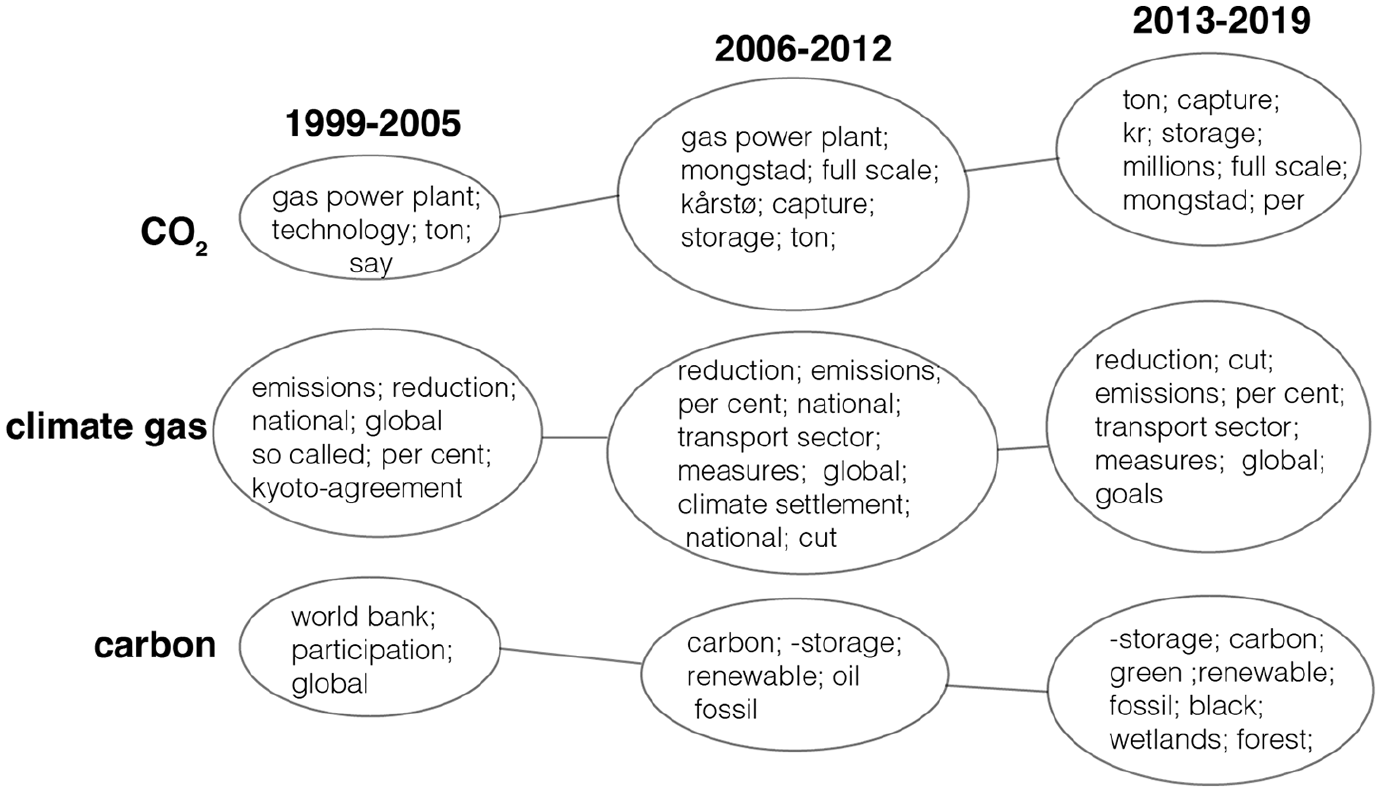
Keyness analysis of ‘CO2’, ‘climate gas’, and ‘carbon’ for each time period, only collocations with BIC value >10 and normalized frequency >3 in target corpus are included. Full results available in Supplemental Appendix A.1.
Results
Four expressions are used in the Norwegian context to refer to GHGs; ‘drivhusgass’ (‘greenhouse gas’), ‘klimagass’ (‘climate gas’), ‘CO2’, and ‘karbon’ (‘carbon’). Table 1 shows the distribution of the GHG expressions used in the Norwegian parliament over the time period. ‘CO2’ is the most common term, but it decreases slightly in the period studied, while the use of ‘climate gas’ more than doubles. ‘Carbon’ has the strongest increase, by 90%. ‘Greenhouse gas’ has a very low frequency and is excluded from further analysis.
Relative word frequency of four GHG-expressions for the three 7-year periods and change between first and last periods in per cent. Relative word frequency per million words in the corpus.
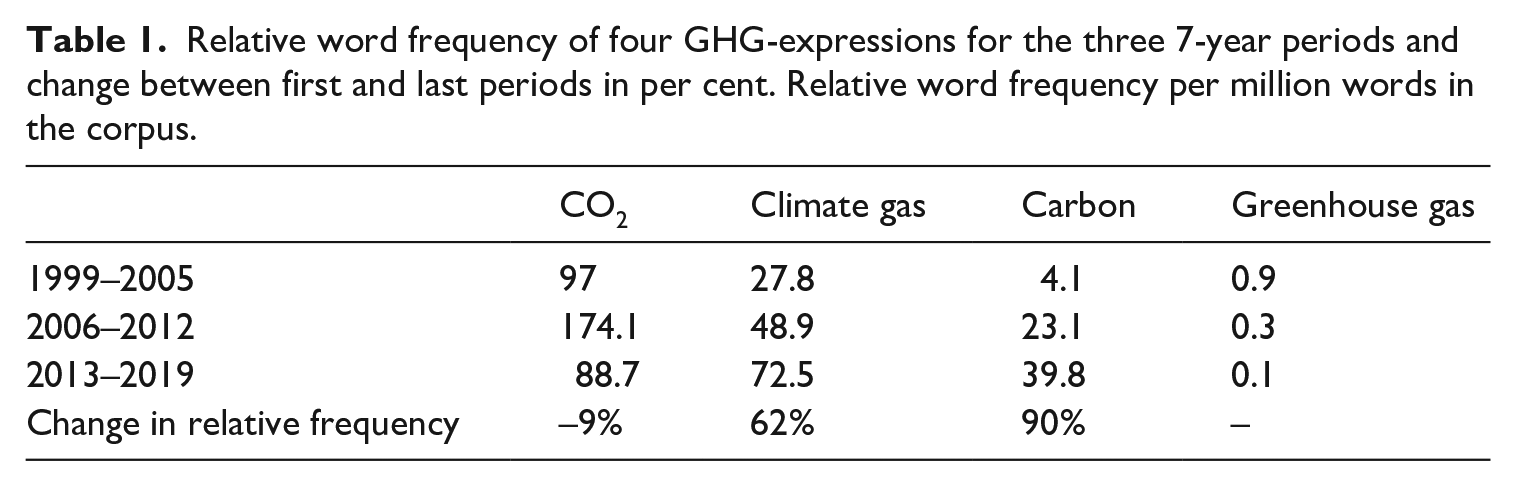
As indicated by Table 1 there is a development over time in the relative frequency of the GHG expressions. In the following we focus on the three most frequent GHG expressions and present the most frequent compounds as well as a qualitative analysis of their orientation toward specific dimensions of climate change (economic, technical, moral etc.).
Patterns of change in GHG-expressions
Table 2 provides an overview of CO2 compound expressions and their development over the period we study. The period 2006–2012 is characterized by heated debates on how to ‘handle’ CO2 from power plants, primarily related to capture and storage of CO2 (CCS) and especially the funding of such plants. Overall, there is little change in the type of CO2 expressions used. As seen in Table 2, ‘CO2’ is typically associated with an economic focus, specifically on economic mechanisms to mitigate climate change, such as ‘CO2 fees’ and (economic) ‘compensation schemes’. There is a focus on budgets, taxes, and costs associated with climate change which connects with an understanding that economic mechanisms are an appropriate tool to regulate and mitigate CO2 emissions. The economic topic is also linked to CO2 quotas as a means of regulating GHG emissions. These findings can be illustrated by the following quote from the minister of the Climate and Environment, where the economic perspective is prevalent and the role of economic mechanisms as incentives for GHG mitigation is underlined:
It is important that we have long term and predictable conditions for Norwegian industry, and particularly a tax system which makes it profitable to cut emissions. That is why it is important when the budget agreement agrees to increase taxes on climate gas emissions to 500 NOK per ton of CO2 equivalents, that the CO2 tax is made more cost efficient by removing exemptions and abolish low rates. It is important that in this way we strengthen the economic incentives to develop and adopt low- and zero emissions solutions. (Vidar Helgesen, Minister of Climate and Environment, the Conservative party, budget debate, Stortinget December 13, 2017, p. 1301)
2
Most frequent CO2 expressions in 2013–2019, absolute frequency, and number of different CO2 expressions for the three periods.
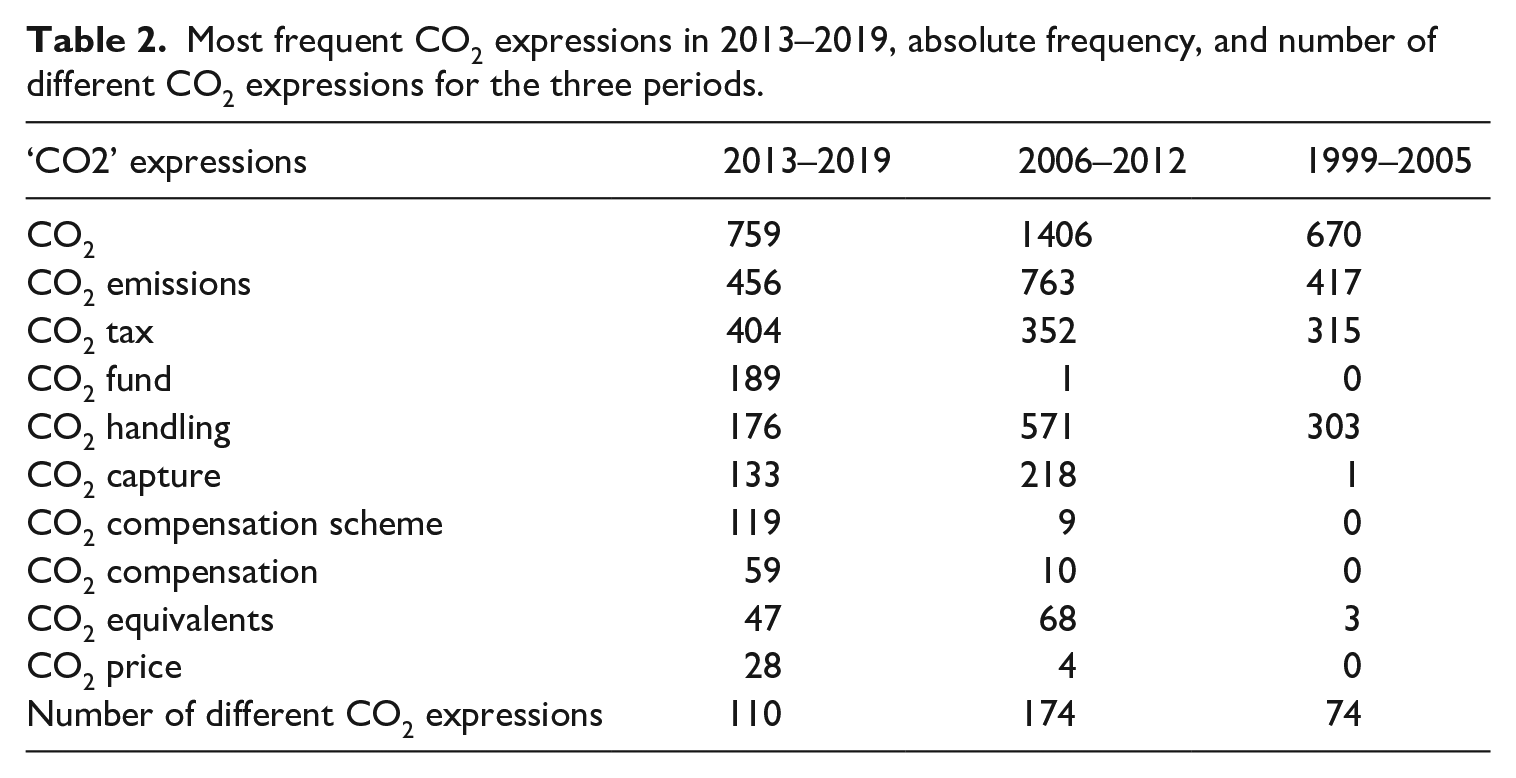
Technology in the form of technological solutions to the mitigation of climate change is a second topic associated with the expression ‘CO2’. Specifically, carbon capture and storage (CCS) is a recurring subject, including the technological, juridical, organizational, and financial aspects of this technology. CCS has been a major issue in Norwegian climate change debates and policy over the period we study and has been widely debated in the parliament. ‘CO2’ is the GHG expression typically used when CCS is debated. The following quote illustrates this perspective, addressing the use of CCS technology to comply with Norway’s obligations under the Paris agreement:
The Norwegian government has signed the Paris agreement that commits us to CO2 emissions to keep global warming well below 2 degrees. CCS is the only technology we know of that can give a considerable cut in emissions from industry. (Sandra Borch, the Centre party, debate on national climate strategy, Stortinget May 3, 2018, p. 3572)
Although climate change debates always to some extent relate to global scale and international agreements, we find that ‘CO2’ is largely connected to a national, Norwegian context, and it is typically used when discussing concrete policy measures in Norway. Thus, ‘CO2’ points to domestic climate policies and a domestic articulation of the climate change issue. However, ‘CO2’ is also used when discussing EU climate policies, especially in the form of the quota system.
While CO2 expressions are characterized by stability, Table 3 shows that carbon expressions change substantially over the period. First, we observe a 90% increase in the relative frequency of ‘carbon’ (Table 1). Second, there is a substantial increase in the number of different carbon compound expressions, such as ‘carbon balance’ and ‘carbon markets’, which is an additional illustration of the growth and success of ‘carbon expressions’.
Most frequent carbon expressions in 2013–2019, absolute frequency, and number of different carbon expressions for the three periods.
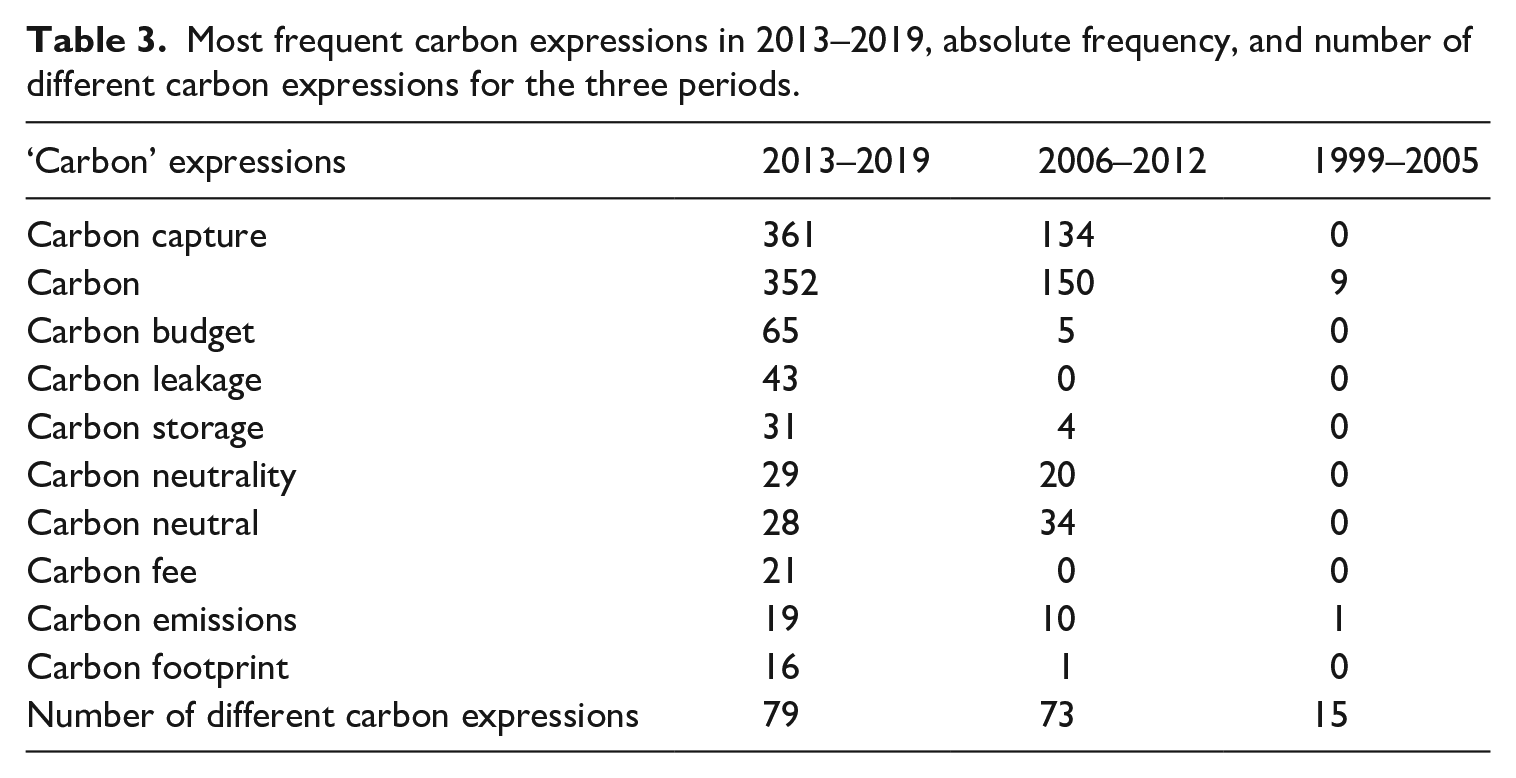
Table 3 shows that the increase starts in the middle period, and grows substantially in the last period. Some frequent and recurrent topics are shared with the ‘CO2’ expressions. For instance, the qualitative analysis indicates that ‘CO2 fee’ and ‘carbon fee’ are used as synonyms. However, the table also indicates a conceptual change in the carbon expressions. In the first period, they are related to economic and technical topics, while in the middle and last period we observe a growth in new compounds that are clearly oriented to the future, framing the issue as being related to a green and sustainable future that is a goal in itself. This includes compounds such as ‘low-carbon society’, ‘decarbonization’ and ‘carbon-neutrality’, as in the following quote: ‘In a future low carbon society, having the most environmentally friendly industry and transport sector will be among the greatest assets’ (Stortinget February 2, 2010, p. 1592).
From around 2010, the expression ‘carbon dioxide’ is used to link this gas to natural processes, and to how plants and other living beings use carbon: ‘This carbon, in the form of carbon dioxide isn’t a poison, it is food for the plants, but in too great concentrations it affects our living environment’ (Stortinget January 17, 2011, p. 2140). This line of reasoning illustrates that many of the new carbon expressions are linked to the concept of a ‘natural balance’. This is true for many instances when ‘carbon’ is used alone but is most explicitly reflected in compounds such as ‘karbonbudsjett’ (carbon budget) and ‘karbonlager’ (carbon storage). These compounds reflect the idea that there exists a natural carbon cycle that is disturbed by emissions from human activity. Further, there is also a distinction being made between ‘green carbon’ and ‘black carbon’, where ‘green carbon’ is found in forests and wetlands and is understood as positive and ‘natural’, whereas ‘black carbon’ or ‘fossil carbon’ is related to fossil fuels and perceived as a negative form of carbon. The focus of these ‘karbon’ compounds is related to an underlying conceptualization of climate change where a natural carbon cycle is disrupted by the current emissions of climate gases. Many of these aspects are captured by this quote:
So, I think that in future discussions, the Parliament should be more precise about the fact that the CO2 that derives from renewable carbon, that is green carbon, isn’t the problem. In fact, it is a part of the solution to use renewable green carbon. The problem is the enormous use of black carbon, that is fossil carbon. You have to distinguish between fossil carbon and renewable carbon. (Per Olaf Lundteigen, the Centre party, debate on a separate climate budget, Stortinget, June 14, 2014, p. 3177).
As illustrated by this quote, ‘karbon’ connects with the natural carbon cycle, and thus with agriculture and forestry, as well as with industry and commerce more generally. The link to the natural cycle is sometimes used to claim that ‘karbon’ is necessary, for example as ‘plant food’. The problem then, is not ‘carbon’ in itself, but the imbalance in the carbon cycle. In addition to these perspectives, that are closely linked to national economic interests, ‘karbon’ is also sometimes related to an international perspective on climate change issues, including Norway’s obligations with regards to international conventions.
All in all, the analysis of ‘carbon’ as a GHG expression shows significant changes over time. First, we observe a radical increase in frequency of use, in the number of compounds, and in the meanings they convey. The qualitative analysis also supports the specialization hypothesis as ‘CO2’ and ‘carbon’ GHG expressions are used to talk about different dimensions of climate change. The analysis also finds that carbon expressions involve new conceptualizations. Importantly, ‘carbon’ seems to represent a break with the national perspective associated with ‘CO2’ by connecting with an international perspective on climate change. In addition, the clear temporal and goal-oriented nature of ‘carbon’ points to a new way of conceptualizing climate change and specifically the solutions. It emphasizes ‘scientific’ or ‘rationalist’ solutions on the societal level, emphasizing carbon offsets, rather than more specific means of emissions cuts as in the case of CO2.
The frequency of use of ‘klimagass’ (‘climate gas’) more than doubles over the time period but the variation in climate gas compounds is low, and this does not change over the period (Table 4).
Most frequent climate gas expressions in 2013–2019, absolute frequency, and number of different climate gas expressions for the three periods.
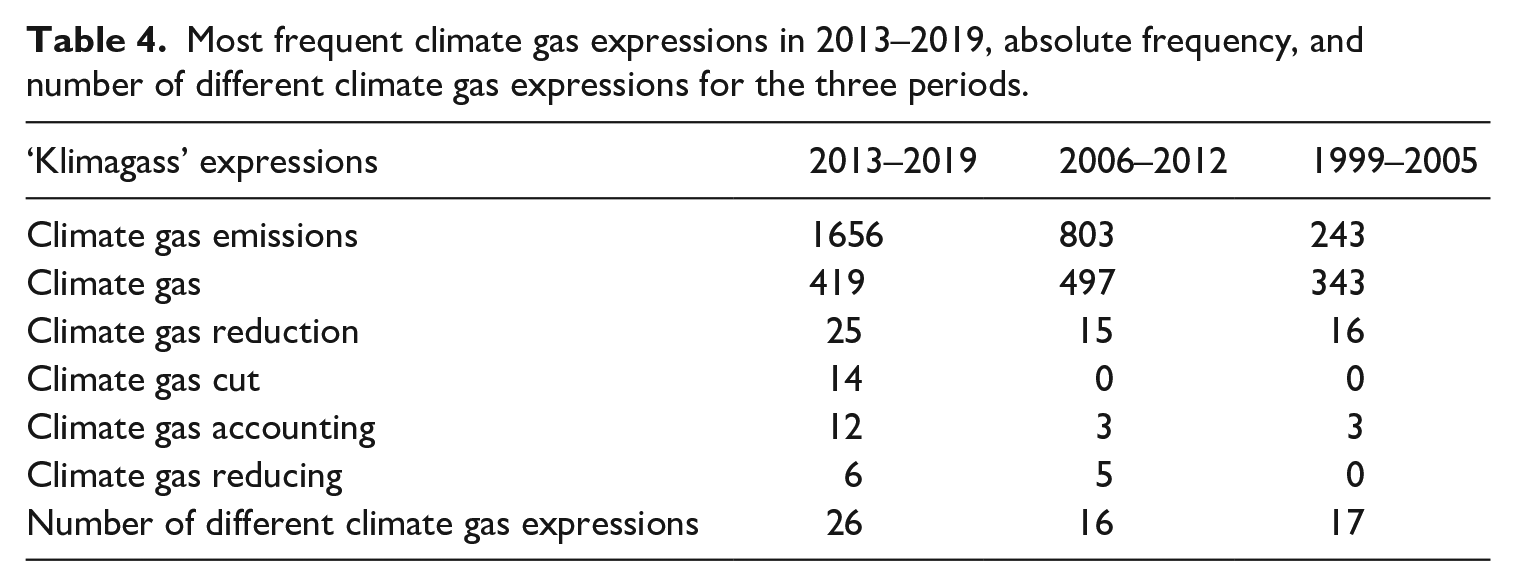
It should be noted that ‘klimagass’ is itself a compound expression, which could be a linguistic limitation to its potential for generating new compound expressions. While the other GHG expressions generate many different compounds and are (in part) used in the context of quite specific discourses (economic, regulative, nature-based solutions), ‘climate gas’ is less productive, and does not seem to have the same type of discursive specialization. Thus, what characterizes ‘climate gas’ as a GHG expression is its general semantic character. This is typically the term used when linking the climate change issue to other policy issues, such as health, employment, rural life, etc., as illustrated by the following quote which links climate change to social inequality:
This should have been a budget to reduce climate gas emissions and social inequality in Norway. It should have been a budget for the many, not the few. (Kari Elisabeth Kaski, Socialist Left Party, budget debate, Stortinget October 8, 2018, p. 197)
The use of ‘klimagass’ is often related to the larger scale debates about the moral and political principles at the basis of climate change policy. In this sense, it is associated with debates that outline the major directions and political choices to be made with respect to climate change and it is also often associated with political conflict. ‘Klimagass’ is also connected to a risk perspective, including the financial risk to companies and the Norwegian pension fund. This emerging risk perspective has also been observed in previous research (Gjesdal and Kristiansen, 2021). In general, this perspective on climate change is associated with a sense of urgency and lack of control, and less associated with concrete policy measures to tackle climate change.
Making sense of the observed patterns of use in the GHG expressions
We will now return to the question of how the GHG expressions develop over time, and to what extent this reflects a discursive specialization. First, there is indication of temporal change, indicated quantitatively by the developments of the relative frequency of each GHG expression as shown in Table 1, and especially visible in the changes observed in the qualitative analysis of the carbon expressions. This observation is further supported by the growth in the number of compound expressions, reflecting the different dimensions of the climate change issue and the policy measures under debate.
To further investigate the changing pattern of use and specialization of GHG expressions, we performed a keyness analysis of the three terms in each 7-year period. In this analysis, the relative word frequencies for the collocations of each GHG expression are used for comparison. The basic idea is that the collocates can be used to measure the ‘aboutness’ for each GHG expression in a time period (Gabrielatos, 2018). In Figure 1 we have included the top collocates for the GHG expression in each period.
The main observations from the keyness analysis can be summarized as follows. For all the GHG expressions, the number of collocates increases, especially between the first and second period. The increasing number of collocates is an indication of discursive specialization, and also reflects major trends in the Norwegian climate change debates, illustrating the relationship between conceptual change and language change. The focus on technology is recurrent. For CO2 expressions, ‘gas power plant’ is a collocate in the two first periods, reflecting the numerous debates on the use of this technology in Norway, which also led to a government change in 2001 (Lipponen et al., 2017). Two of the collocates in the second period are the names of places where these facilities were planned (‘mongstad’ and ‘kårstø’). Three of the other collocates are also linked to debates on whether these power plants should be built with ‘full scale’ ‘capture’ of CO2 for ‘storage’. Several of these are also present in the last period, illustrating the prolonged debates on the development of CCS technology in Norway (Lipponen et al., 2017; Merk et al., 2022). However, for the last period, the collocates for ‘CO2’ also point to the regulation of emissions, including monetary terms (‘millions’, and the abbreviation of Norwegian kroners, ‘kr’) and more technical terms related to regulations (‘ton’, ‘per’).
For ‘climate gas’, ‘global, ‘emissions’, ‘reductions’, and ‘per cent’ are collocates for all periods, and ‘national’ for the first two. This reflects that this expression is related to the general need for emissions reductions, and how such ‘cuts’ can be achieved by different ‘measures’ and relate to ‘goals’ and policies for various sectors, among them the ‘transport sector’. Again, we note that ‘klimagass’ is itself a compound expression, which is likely to constrain the compounding potential and thus may explain the low number of compound expressions.
‘Carbon’ stands out as the expression where the collocations change the most, both in frequency and in discursive orientation. In the first period there are only three collocates for ‘carbon’. In the second period, a new set of collocations emerges: ‘-storage’ (with a starting hyphen) is related to a Norwegian compound expression, ‘karbonfangst og -lagring’, identical in meaning to CCS, and thus related to the technology perspective. Further we see that both ‘renewable’ (‘fornybart’), and ‘fossil’ make it to the list – these are expressions that correspond to the new framings of climate change, and specifically the role of ‘carbon’ as a term used to distinguish between natural and human induced types of carbon. In the last period, the increase is related to the growth of this discourse, as reflected by ‘green’, ‘black’, ‘wetlands’, and ‘forest’. These are also used in relation to more ambitious policy objectives, such as ‘carbon neutrality’ linked to the temporal dimension of carbon expressions identified in 3.1.
Final discussion on findings
Through different analytical measures we have identified a discursive specialization of GHG expressions. We will now look closer at the implications of these findings. First, we argue that the observed changes indicate a discursive specialization reflecting conceptual change. We observe an increase in relative frequency for almost all expressions and an increase in compounds. The keyness analysis shows a gradual discursive specialization supported by the qualitative analysis.
Notably, developments in the expression ‘carbon’ point to the emergence of climate change concepts that did not exist 20 years ago. Through the lexical change associated with carbon, a multitude of new ways of conceptualizing climate change has developed. This is also likely to affect the network of meaning or semantic field of GHG expressions as a whole. As such, the observation of a ‘burst’ in the use of ‘carbon expressions’ is not new and has been observed internationally (see Koteyko, 2010; Koteyko et al., 2010; Nerlich, 2012; Nerlich et al., 2011; Nerlich and Koteyko, 2009). However, our analysis identifies new trends in our materials. Specifically, carbon expressions are associated with two major trends of conceptual change; the idea of global transition to a greener society, strongly associated with a temporal dimension, and a ‘rationalist’ or managerial approach to climate change which sees climate change as a lack in natural balance that needs to be managed.
Second, it should be underlined that these discourses also have a material or social basis, in the sense that they relate to what is at stake when discussing policy measures related to climate change (such as economy, technology, natural processes, international policy, and expertise). Moreover, the differences we observe are not always clear-cut and have partly overlapping meanings.
Our results indicate that the different GHG expressions function as a discursive resource to address different aspects of the climate change issue. The overall development pattern observed over the two decades of debates we study should be interpreted as a general reflection of the complexity of the climate change issue and political ideas and measures to address it.
In addition, as the examples quoted have illustrated, we find that all the GHG expressions studied are used by politicians from all political parties across the political spectrum. As such, it seems unlikely that the choice of GHG expression in general is the result of a strategic choice, or a specific ideological framing of the climate change issue. Rather, our analysis suggests that the use of a specific term could be interpreted as a discursive sign of the topic under debate, for example, ‘CO2’ is typically used when formal regulation or technical issues are debated, ‘climate gas’ when discussing overall societal issues, while ‘carbon’ is most often used when discussing climate change as an environmental problem and with reference to visions of a future society. However, while strategic use of GHG expressions does not seem helpful to understand the long-term development pattern of their use, the choice of GHG expression in a specific debate is relevant for putting forward or making relevant a specific dimension of what is debated.
To sum up, the findings indicate a clear relationship between lexical change and conceptual change in the climate change subject field. While we have not examined the root causes and drivers of the change, we argue that such changes could theoretically be understood as driven by new understandings of climate change as a complex political, technological, and scientific issue that lead to a new language of climate change. The results indicate that different GHG expressions conceptually refer to different dimensions of climate change, and can embody different conceptualizations of climate change. They can be considered to be Koselleckian concepts in the sense that the use of a specific word denoting GHG function as a discursive signal of how climate change is to be understood in this specific context, and which solutions are considered appropriate. This illustrates that conceptual change can be understood and studied through empirically observable linguistic change. While the specific pattern of specialization that we identify in our data could have limited spatiotemporal validity, the perspective on the process of how language develops on decadal timescales has a wider validity. Thus, our methodology serves as an example of how lexical changes can be used to identify more fundamental conceptual changes. On this basis, we argue that medium-term historical analysis – shorter than a century yet longer than a single year or shorter periods is helpful to understand conceptual change in a fast-paced subject field such as climate change.
For further research we think it would be useful to test the hypothesis of the link between lexical change and conceptual change in other domains of complex global environmental change, such as biodiversity with data from other sources, such as web data or media texts (see e.g. Koteyko et al., 2010), and by adding a comparative perspective on parliamentary debates on climate change in different national contexts.
Supplemental Material
sj-pdf-1-das-10.1177_09579265221145394 – Supplemental material for Changing concepts of greenhouse gas expressions: Discursive specialization in parliamentary discourses on climate change
Supplemental material, sj-pdf-1-das-10.1177_09579265221145394 for Changing concepts of greenhouse gas expressions: Discursive specialization in parliamentary discourses on climate change by Anje Müller Gjesdal and Gisle Andersen in Discourse & Society
Footnotes
Funding
The author(s) disclosed receipt of the following financial support for the research, authorship, and/or publication of this article: This work was supported by the Research Council of Norway [grant number 283324].

Supplemental material
Supplemental material for this article is available online.
Notes
Author biographies
References
Supplementary Material
Please find the following supplemental material available below.
For Open Access articles published under a Creative Commons License, all supplemental material carries the same license as the article it is associated with.
For non-Open Access articles published, all supplemental material carries a non-exclusive license, and permission requests for re-use of supplemental material or any part of supplemental material shall be sent directly to the copyright owner as specified in the copyright notice associated with the article.
