




Abstract
Child protection conferences are key meetings in the social work child protection process in England. They provide the context where decisions are made about how best to safeguard and promote the welfare of children and constitute an important opportunity for social work services to work in partnership with parents; yet there is little research about what happens interactionally in these meetings and particularly about parents’ participation. Using interactional sociolinguistics, we analyse the data from three audio-recorded child protection conferences, focussing on sequences where concerns are raised and responded to, to illuminate how parent involvement is accomplished interactionally. We look specifically at the linguistic and discursive features of turns and the management of the floor, connecting the sequential nature of the account sequences to presence and participation. The analysis shows a contrast between professionals’ participation versus parents’ presence in this asymmetrical event, suggesting a marginalisation of parents’ contributions and a mismatch between the principle of partnership working with parents and practice in this area of child protection social work.
Introduction
This article discusses the concept of participation in child protection social work meetings. We specifically focus on the ‘child protection conference’, a key event in the child protection process where a plan about how best to safeguard and promote the welfare of a child who, it has been determined, has suffered, or is at risk of significant harm, is decided. They are important sites for discussion and decision making in relation to concerns about children. These meetings involve parents and professionals from multiple agencies who negotiate and enact their roles within this communicative event. However, we know very little about how these meetings work, as there are few in-depth studies of the meetings themselves (exceptions are: Hall and Slembrouck, 2001; Koprowska, 2016). More specifically, despite the fact that the involvement of parents in these meetings can realise partnership working with families, a core principle of the Children Act 1989 and the value base of social work, there is a lack of research about whether and how parents’ participation is accomplished. Consistent with interactional understandings of institutionality (Drew and Heritage, 1992; Heritage, 1997), we understand this institutional premise of participation as needing to be realised and enacted in interaction. Specifically relevant to our context, we focus on the interactional possibilities for participation in this asymmetrical event and whether these are equal across all actors.
We focus on the whole interactional event of the child protection conference from the start when concerns are raised and discussed, through to the decision making about whether a child should be the subject of a child protection plan which occurs at the end of the meeting. Focussing on the whole event enables us to look at how the interactants negotiate their roles in the interaction and how both presence and participation are accomplished interactionally in the sequential design of the event. We understand participation as locally negotiated and co-constructed and we contrast participation with presence to refer to embodied (physical or online) attendance at an event but remaining peripheral to the unfolding of the event. Because child protection conferences involve descriptions of events and actions relating to concerns about the care of children, they frequently involve requests for, and provision of, accounts. We specifically examine descriptions of concerns about children within this event, focussing on sequences of accounts that illuminate how both presence and participation are accomplished in the interaction. We consider floor management and the recipiency of turns to be particularly important for in/exclusion and we pay special attention to the sequential nature of account sequences and connect this to presence and participation.
In line with our focus on the ‘meso-level’ of the child protection conference, we take an Interactional Sociolinguistic (IS) perspective and draw on audio-recordings of child protection conferences which formed part of a wider study of child protection social work (Lutman-White, 2020). We look specifically at professional and parental contributions to the interaction within the account sequences, attending to the linguistic and discursive features of turns and the management of the floor. Our analysis connects the resources used by interactants to effective participation and we add to existing research about participation by developing the concept of presence, which we understand as contributions which lack the features of participation. In juxtaposing presence with participation, we also contrast the roles of parents and professionals in the interaction and their relative positioning in this event. Our analysis shows that, quite simply, the presence of parents at child protection conferences does not result in them having equal or effective participation in the interaction. This raises questions about the concept of participation in child protection social work and the wider implications of marginalising parental voices in the event. Accordingly, we also discuss the connection between power and participation in this setting in light of our data.
This article is organised into three parts. First, we discuss the child protection conference meeting event and provide an overview of relevant literature on participation in institutional interaction and account sequences. Next, we turn to the methodology and the analysis of the dataset that illustrates presence and participation in the interaction. We close the article by problematising presence in the interaction and discuss areas for further research.
Child protection conferences
Convened under child protection procedures (HM Government, 2018), a child protection conference in England is a critical event in the child protection process. The meeting is held by the local authority to assess all relevant information obtained as a result of a child protection investigation. The conference is mandated to make a decision about whether the child should be subject to a child protection plan and, if so, under which category of harm: neglect, physical abuse, sexual abuse, emotional abuse, and multiple categories (HM Government, 2018).
Child protection conferences bring together the practitioners most involved with the child and family (e.g. social workers, teachers and health professionals) to share information and assessments and aid decision making (HM Government, 2018). Parents are also typically invited 1 to attend the meeting (or part of the meeting) to contribute their perspectives. These meetings are a key site for decision making in the child protection process. They involve the negotiation, between multiple parties, of understandings of the concerns about harm to children and of approaches to addressing these concerns. As such, they constitute sites of negotiation of ideologies around harm and protection and feed into the wider societal moral order.
The involvement of parents in child protection conferences was one of the ways in which local authorities began to work in partnership with parents after the implementation of the Children Act 1989. It reflects one of the core values of the social work profession (BASW, 2012), resonating with social work’s concerns with recognising the impact of discrimination and oppression on service users (Thompson, 2016). However, there can be challenges for social workers in embedding a participatory ethos due to the statutory and involuntary nature of much child protection work and the current context in which a child protection approach is prioritised rather than an orientation towards family support (Holt and Kelly, 2016). The child protection conference is a symbolic event in perpetuating the dominant status quo as we are showing later.
Participation in institutional interaction
Consistent with interactional understandings of institutionality (Drew and Heritage, 1992; Heritage, 1997), we understand this institutional premise of parental participation which is an important feature of child protection conferences as needing to be realised and enacted in interaction. Procedures and practices (HM Government, 2018) for involving parents in child protection conferences make an assumption that presence means participation. Taking an interactional approach, we instead focus on participation as locally negotiated and co-constructed. This approach aligns with a body of conversation analytic and interactional sociolinguistic work in health care that has provided interactional evidence for the practical enactment (or not) of institutional concepts such as patient-centred care, patient choice, and Shared Decision Making (e.g. Arribas-Ayllon and Sarangi, 2014; Land et al., 2017; Robertson et al., 2011; Shaw et al., 2016; Toerien et al., 2013). We extend this exploration of how institutional principles play out in practice into the social work sector.
Relevant to our analysis of the interactional accomplishment of presence and participation in child protection conferences are core analytical concepts from studies of talk and interaction in organisational contexts. Being able to take a turn within ongoing interaction is an important aspect of participation. Importantly, the way that turns are organised shapes possibilities for action and participation (Angouri and Mondada, 2018). Commonly found in organisational meetings is a mediated turn-taking system in which the chair, through their interactional role, has the ability to facilitate or restrict access to the floor (Angouri and Mondada, 2018). Interactants can also attempt to secure the floor through speaker self-selection which can occur in overlap with the current speaker (Bargiela-Chiappini and Harris, 1996; Sidnell, 2010). Accordingly, our analysis focuses on the ways in which the floor is managed by both professionals and parents.
Interaction is not just accomplished by the performance of speaker roles; rather, there is a need for active recipiency on the part of at least one recipient (Mondada, 2007). Displaying recipiency can most obviously involve verbal responses, including those which are very short such as minimal response tokens (Gardner, 2001). Responses to participants’ turns can also embody markers of whether that contribution is accepted and agreed with or whether there is an issue with the prior action (Steensig and Drew, 2008). We consider whether a participant’s contribution is validated and taken forward within the ensuing interaction to be an important facet of participation and we explore in the analysis interactants’ turns and their responses.
Research that has identified the strategies that participants use to shape the content and direction of the interaction in meetings is also relevant to our analysis. Questions and formulations have been widely identified as discursive devices that are significant for influencing the content and direction of the interaction. Questions can be used as control devices to constrain the possible form and content of the response (Ehrlich and Freed, 2010; Holmes and Chiles, 2010), but respondents can also attempt to control the content and direction of the interaction by disaligning or producing a dispreferred response (Pomerantz, 1984), although this involves breaching normative expectations. Formulations afford the participant who produces them considerable control over what is recognised as having been previously discussed, or agreed, or noted as important and what is not affirmed (Holmes and Stubbe, 2015). They play a significant role in fixing meaning (Clifton, 2009) and can be used to facilitate agreement (Barnes, 2007). Questions and formulations are therefore influential devices and consequently we examine their relationship with successful participation in the interaction.
Research into organisational meetings also provides evidence for the connection between interactants’ participation in meetings and the enactment and interactional negotiation of roles, status, expertise, responsibilities and power. Particularly relevant to our specific context is research that considers how authority is enacted in encounters between professionals and lay people. Studies have demonstrated the relationship between enacted authority in meetings and status, role, expertise and responsibilities resulting in the dominance of professional and institutional accounts and perspectives over those of lay people (Hjörne, 2005; Mehan, 1983). The connection between the enactment of professional role, status and power and participation will be shown in the data.
Relevant to our particular setting is a small body of research on interaction in child protection conferences and other child welfare meetings that has revealed the asymmetrical organisation of interaction in these meetings with professionals’ contributions dominating and parents’ participation being constrained (Broadhurst et al., 2012; Hall and Slembrouck, 2001; Hall et al., 1999; Koprowska, 2016). Our research builds on these findings by zooming in on account sequences in order to contrast presence and participation in the interaction. We return to the significance of our findings for future research at the end of the paper.
Accounts
We examine presence and participation in these meetings through analysing the production of accounts. Accounts are a routine part of social interaction; they are frequently provided or requested by interactants (Raymond and Stivers, 2016) and especially in professional settings. This is particularly the case in child protection conferences because these meetings involve descriptions of events and actions relating to concerns about the care of children. We use the term accounts here in a broad sense to mean descriptions or explanations (Antaki, 1994) which (re)present actions and events and which are constructive and constitutive (Buttny, 1993). A major feature of accounts is that they are frequently linked with responsibilities. As Buttny (1993: 18) notes, ‘how an action or event is described is crucial for understanding what has happened and who is culpable’. Accounts are often used as discursive devices to manage the gap between action and expectations or, in other words, to explain and account for unexpected or untoward behaviour (Mäkitalo, 2003; Potter and Wetherell, 1987; Scott and Lyman, 1968). This is particularly the case in institutional settings because of the expectations and responsibilities associated with the participants in these encounters (Bull and Shaw, 1992; Hall et al., 2014).
Specifically relevant to the present study is previous research on the structure and organisation of accounts sequences when there is a gap between action and expectation (e.g. Buttny, 1993; Scott and Lyman, 1968). The components of a sequence include firstly the specification of a problematic situation for which an explanation is required (Scott and Lyman, 1968). The request for an account of the gap between expectation and action may take the form of a blaming/accusation or a complaint, for example. Responses to requests for accounts frequently take the form of excuses and justifications according to Scott and Lyman’s (1968) classic typology of accounts. Excuses detail extenuating circumstances which explain behaviour in a way which seeks to reduce blameworthiness (Aronsson and Cederborg, 2015; Dingwall et al., 1995; Scott and Lyman, 1968). Justifications are accounts which accept responsibility but seek to redefine the concern as non-blameworthy (Aronsson and Cederborg, 2015; Dingwall et al., 1995; Koprowska, 2016; Scott and Lyman, 1968). Lastly, accounts are evaluated by recipients and responses to accounts convey the (lack of) acceptability of the account (Buttny, 1993) and can prompt the production of further accounts and explanations as we will show in our data. Evaluative responses cohere with dominant beliefs and standards (Buttny, 1993; Scott and Lyman, 1968); this is particularly relevant to our research as we highlight the connection between successful and therefore dominant accounts and dominant ideals about children and parenting. This previous research on the structure and organisation of accounts informs our analysis of accounts sequences in our data and we develop it further in our context by connecting the sequencing of accounts to presence and participation in the interaction.
In our analysis we focus on episodes of talk that relate to explicit concerns about children. These descriptions of concerns are types of accounts that involve the projection and negotiation of responsibility for actions. Within these concern sequences gaps between actions and expectations are presented and responded to, with parties to the interaction casting and recasting implications of responsibility. The opportunity to provide an account, where that account occurs in the concern sequence and how that account is treated interactionally is illustrative of interactional presence and participation as we will show in the data.
Data and methodology
This article draws on data from a research project undertaken by the first author on child protection social work involving fieldwork in two English local authorities. We draw here on three audio-recorded child protection conferences which provide 7.5 hours of audio data. Although video data would have enabled an analysis of the embodied negotiation of participation, this has not been possible due to access restrictions. Nevertheless, the study of in situ negotiation using verbal data is appropriate for the framing and methodological orientation we adopt in this paper and for addressing a largely unresearched context. These meetings included a minimum of seven participants and all involved a chair, a social worker, at least one teacher and at least one parent. Other professional groups attending included the NHS, the police and the charity sector. Children and young people did not attend any of the child protection conferences.
Ethical approval for the research was obtained from the Humanities and Social Sciences Research Ethics Committee at the University of Warwick. In one local authority approval was also gained from the Research Governance Panel and in the other local authority approval for the research was given by the Local Safeguarding Children Board. All participants in the child protection conferences gave written informed consent to be involved in the research. The audio recordings were transcribed verbatim using transcription conventions to indicate interactional features of the talk such as pauses and overlap (see Appendix 1). Names and identifying information were anonymised.
Interactional Sociolinguistics (IS) is the main analytic approach used to frame the analysis of the data. IS brings together talk at the interactional level and the broader social and ideological meanings relevant to the professional context (Angouri, 2018). This has been particularly relevant for this project as we focus on the negotiation between professionals and parents in the context of the event that constitutes our focus. As such, a ‘meso-level’ approach, that is one that connects the situated encounter and the organisational order (Angouri, 2018), has been appropriate for the framing of the reading of our data and the focus on the negotiation of the parents’ role in the event. CA and IS share the emphasis on the analysis of the sequential organisation of interaction. IS’s distinctive approach emphasises the brought-along context and background knowledge that is invoked in the interaction and uses the techniques of CA to examine how this unfolds interactionally. In our study, we attend to the broader understandings relating to parenting and the care of children which provide the context for this event and which are indexed in this lay-professional encounter. But also, the considerable CA work on turn-taking informs our analysis of how concerns are produced, responded to and recycled within the account sequences.
In the analysis of the meeting data, we examine parents’ and professionals’ contributions within the account sequences and show a consistent pattern of the stages of account sequences in our data. Drawing on core analytical concepts from studies of talk and interaction in organisational contexts, we pay particular attention to whether and how interactants secure and manage access to the floor within the ongoing interaction. Also of significance, is the recipiency and uptake of turns (Mondada, 2007) and we attend to whether a participant’s contribution is validated in the uptake and taken forward within the ensuing interaction. We focus too on the strategies that participants use to shape the content and direction of the interaction in meetings, examining in particular questions and formulations which have been shown in earlier research to be important strategies for doing interactional control (e.g. Ehrlich and Freed, 2010; Holmes and Chiles, 2010). We use these analytical concepts to explore active and consequential participation in the interaction, contrasting this with presence which we define as being present but remaining peripheral to the unfolding of the event.
Analysis
The four excerpts we present here relate to concerns about children and we use them to illustrate the common pattern of account sequences identified in the dataset. The linguistic design of the meetings was analysed in full and the patterns we present are consistent in the dataset. We argue that those sequences perpetuate the dominant status quo which gives authority to the professionals and marginalises the parents in the child protection conference context. We connect these account sequences to presence and participation in the interaction and provide a representation of the stages of the account sequences following the discussion of four excerpts below.
Excerpt 1 provides a concise illustration of the features of account sequences in our data and their connection with presence and participation. The excerpt comes from the beginning of the meeting where professionals are asked to comment on their concerns about the family.
Excerpt 1
(Transcription conventions are provided in Appendix 1)
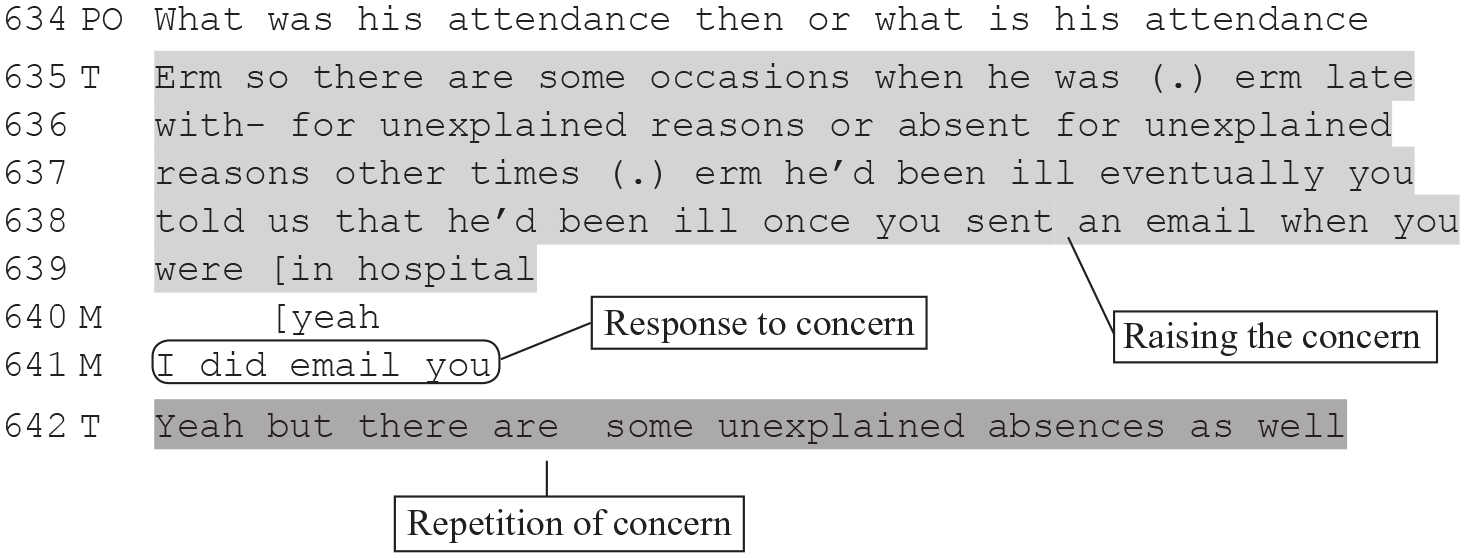
In response to a question by the probation officer (PO) requesting information about the child’s attendance at school, the teacher (T) takes the floor and provides some details and raises the concern. The teacher’s turn identifies that the child has been late for school or absent from school and this has been for ‘unexplained reasons’ (lines 636–637). The significance of the reasons for absence or lateness being unexplained is emphasised by the repetition of ‘unexplained reasons’ twice. Consequently, the teacher’s focus on absence for unexplained reasons identifies the mother’s problematic actions; there have been occasions when she has not taken the child to school and has not provided a reason for this. The teacher’s description of the concern implicitly indexes the responsibilities of parents to send their children to school unless there are accepted reasons for not doing so. Through indexing parental responsibilities that have not been fulfilled, a gap between expectations and actions is identified. The teacher goes on to concede that there have been other occasions when the mother has provided a reason for absence, although there had been delays in doing so: ‘eventually you told us that he’d been ill’ (lines 637–638). The mother (M) begins an attempt to self-select as the next speaker in line 640 which overlaps with the end of the teacher’s turn. In line 641 the mother responds to the concern, focussing on actions she had taken. The teacher then reclaims the floor and repeats the concern that she initially outlined (line 642), that there were unexplained absences from school. Her turn summarises the concern and signals the rejection of the mother’s focus on the actions she had taken through the use of ‘yeah but’ in the turn-initial position (Roberts, 2011; Schiffrin, 1987). As a result, the mother’s attempt to attenuate the concern by focussing on the occasion when she had informed the school about the child’s absence is not interactionally accepted and the professional version of the concerns prevails. This excerpt is illustrative of the ways in which professionals, through their management of the floor and the discursive and linguistic features of their turns, enact participation. In comparison, parents, whose turns display different features and whose contributions are not interactionally accepted, accomplish presence rather than participation.
The next excerpt relates to a speech and language therapy appointment that was missed for a child who had suspected language delay. It contains three distinct but related account sequences. These account sequences are all representative of a common pattern across the dataset. What is notable about the sequences in this excerpt is that they are all connected and show how concerns are recycled and respecified by professionals so that the topic of the appointment remains open and supplementary concerns can be discussed.
Excerpt 2: Excerpt from the initial part of the meeting where the chair has prompted the health visitor (HV) to describe the involvement of the service with the family
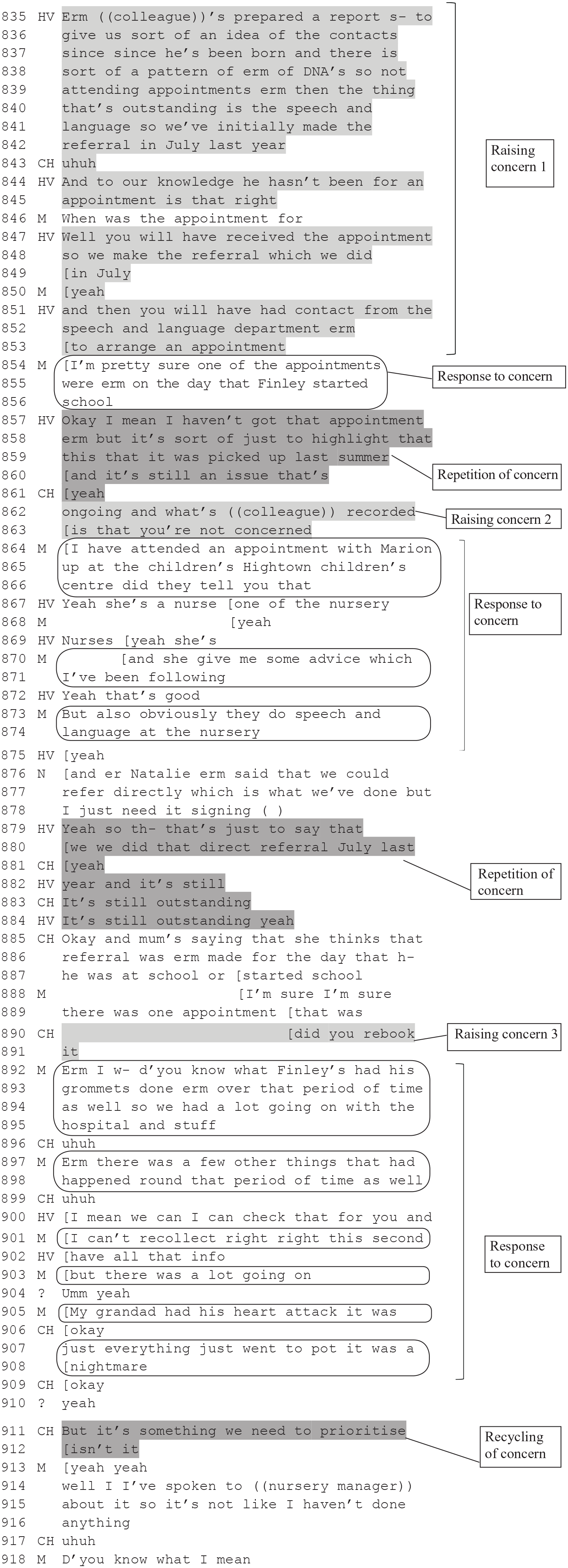
At the start of the excerpt, the health visitor provides a summary of the concerns about the family’s lack of engagement with the health visiting service (lines 835–845). They have missed appointments (DNA = did not attend) and the health visitor identifies a speech and language therapy appointment as outstanding. The health visitor emphasises that the referral was first made in July by repeating this twice (lines 842 and 849) and given that the child protection conference was being held 6 months after this the mother’s lack of action is rendered as problematic. The raising of the concern is followed by a question to the mother, giving her the opportunity to correct erroneous information. The kind of tag question used here is a control device with agreement as the expected answer (Holmes and Chiles, 2010). However, the mother does not provide the preferred response of yes (Pomerantz, 1984). Instead, she asks a question instead about the date of the appointment (line 846), signalling a dispreferred response which is an attempt to control the floor and the direction of the interaction. The mother’s use of a question here is also a powerful move because it shifts the topic to the mother’s interest in the timing of the appointment (Ford, 2010). The mother’s moves confirm previous findings about parents’ resistance in meetings enacted through unmarked and minimal responses or the production of disaligned responses or challenges to authority (Broadhurst et al., 2012). At the same time, failing to produce the expected response also means failing to produce the message design that is recognisable by the bureaucratic organisation (Sarangi and Slembrouck, 1996).
Following the contributions from the health visitor, the mother attempts to secure the floor to explain why the appointment was missed, seen in the overlap in lines 853–854. The mother interprets the health visitor’s ‘erm’ in line 852 as a possible transition relevant place (TRP) and takes the floor. The health visitor continues her turn whilst being aware of the overlap, signalling turn competition (Jefferson, 2004). The mother treats the health visitor’s assertion about the missed appointment as requiring an account for the gap between expectation and action (Scott and Lyman, 1968). Whilst the mother is not explicitly identified by the health visitor as being responsible for the child not attending the appointment, the failure of the mother to fulfil their role responsibilities in relation to the child’s health needs is implied. The mother’s first response (lines 854–856) is to state that appointment clashed with a sibling’s first day at school. This response is in the format of an excuse which seeks to mitigate responsibility and attenuate the concern, confirming previous research on interaction in child protection conferences (Koprowska, 2016). The suggestion is that the mother could not be expected to be in two places at once or miss the sibling’s first day at school.
The health visitor’s response to the mother’s attempt to mitigate responsibility initially indicates that the excuse might be accepted because the turn is prefaced by ‘okay’ (line 857). However, she goes on to repeat the original concerns indicating that the mother’s explanation for why she missed the appointment is not accepted interactionally. This lack of acceptance of the mother’s explanation illustrates that, whilst the mother has pursued opportunities to access and control the floor, her contributions are not ultimately validated.
After the health visitor repeats the original concerns in lines 857–862 she adds a further problem about the mother not being concerned (lines 862–863). This addendum marks the start of a second account sequence which focuses on a slightly different concern but one which is connected to the first concern. The health visitor is suggesting that not only has the mother failed to take the child to the appointment, she is also unconcerned about the child’s speech and language delay. The health visitor draws on an ideal about parents being concerned about their children to position the mother as not fulfilling her parenting role and therefore identifies a gap between expectation and action (Scott and Lyman, 1968). Again, the overlap in lines 863–864 is indicative of the mother’s attempt to compete for the floor. She does not allow for the gist of the health visitor’s turn to be produced, rather she starts to talk whilst the health visitor continues her turn. After the health visitor completes her turn the mother secures the floor to offer an account which responds to the concern and which takes the form of a justification. The mother states that she has taken the child to a different type of appointment to discuss his speech and language delay (lines 864–866), attempting to attenuate the concern by focussing on the actions she has taken. In lines 870–871 the mother further describes the action she has taken by saying that she has been following the advice given at the appointment. Again, the mother competes for the floor and secures it to produce this turn, indicated by the overlapping talk (lines 869–870) and the health visitor’s unfinished turn (Schegloff, 2000).
By talking about the advice she was given and has followed and about the role of the nursery in addressing speech and language difficulties (line 873–874), the mother attempts to build a picture of herself as someone who is taking action to address the problem. This specifically addresses the health visitor’s charge of not being concerned. Yet her attempts to reject or attenuate the concern are not successful when the responses of the health visitor and the chair in lines 879–884 are considered. Here the original concern is reiterated for a second time in a formulation jointly produced by the health visitor and the chair which functions to reject the mother’s explanations and mitigations of responsibility provided so far.
The chair then raises a supplementary concern in lines 890–891 which denotes the start of the third account sequence within this excerpt. In lines 888–889 the mother begins to confirm the appointment clash but cedes the floor to the chair (the mother’s turn is unfinished) who asks, in the form of a direct question, whether the mother re-booked the appointment that was made for the same day as the eldest child’s first day at school (line 890–891). The chair’s turn demonstrates the authority of the chair to gain access to the floor and control it through the use of overlapping talk and the use of questions (Halvorsen, 2018; Holmes and Chiles, 2010). Whilst the chair’s question to the mother does not explicitly indicate a problematic (lack of) action on the part of the mother, it implicitly indicates a gap between expectation and action as thus far in the excerpt nobody has said that the appointment has been re-booked. In response to the chair’s questioning, the mother takes the floor as the selected next speaker and goes on to produce a series of excuses about the difficult time she was having around the time of the appointment (lines 892–895, lines 897–898, lines 901–903, lines 905–908) which increase in the severity of the difficulty reported. The mother’s response does not answer the chair’s question directly with the expected yes or no response. Instead, the trouble at the start of the response (line 892) signal that the mother’s production of excuses is the dispreferred response. These excuses formulated by the mother accept that she did not take the child to the appointment or re-book it but function to mitigate her responsibility for not doing so. She positions herself as being prevented from taking action by external circumstances and therefore attempts to attenuate the concern.
The chair responds to the mother’s series of excuses with minimal response tokens (Gardner, 2001) which can signal impeding disagreement (Pomerantz, 1984). This is the eventual response of the chair in lines 911–912 who begins the turn with ‘but’ which marks the lack of acceptance of the mother’s response to the concern raised (Schiffrin, 1987). The chair’s turn recycles the concern about the mother not re-booking the appointment and focuses on the need to prioritise the appointment, implying that the mother has not done this so far and reemphasising the mother’s lack of action. The mother treats the chair’s comment about prioritising the speech and language delay as a further charge and goes on to formulate herself as being concerned by stating that she has spoken to the nursery about it (lines 914–916) and refocuses the discussion on the action that she has taken.
In this extract, the three concern sequences we discuss are connected. Within a single topic the professionals focus on a number of related concerns and the structuring of the concerns enables them to continue the discussion of this topic. By connecting the related concern to the last part of the previous concern sequence, professionals are able to legitimise continued discussion within the area despite the mother’s attempts to reject or attenuate the concern already having not been interactionally accepted. Formulating a series of connected concerns in this way means that professionals can managed the interactional progression of topics and illustrates further their accomplishment of participation and their ability to claim positions of power.
In this web of negotiation with both the mother and professionals attempting to classify the mother’s (in)actions differently, the professionals’ management of the floor and their use of formulations are central to their enactment of participation. Professionals’ versions of concerns are underpinned by relevant ideals about children’s needs and parenting and mobilising these kinds of ideals is significant in establishing versions which are interactionally accepted and potentially more challenging to refute. Whilst the mother attempts to influence the direction of the interaction by competing for the floor (which is sometimes successful), by responding to questions in a dispreferred way and depicting the problem as less concerning than professionals have, ultimately these strategies are unsuccessful and the mother’s involvement is indicative of mere presence. Violating the established design of accounts in content and format is sanctioned by systems that draw on powerful ideologies, such as the one we are discussing here.
In more detail, the excerpt below illustrates how substantially the versions of parents and professionals can diverge and how professionals’ versions dominate as a result of the rejection of parents’ versions and the indexing of ideals about parenting and parental roles. This excerpt is taken from the middle of the meeting involving a discussion of the father’s issues with drugs and his lack of engagement with the services available to him.
Excerpt 3
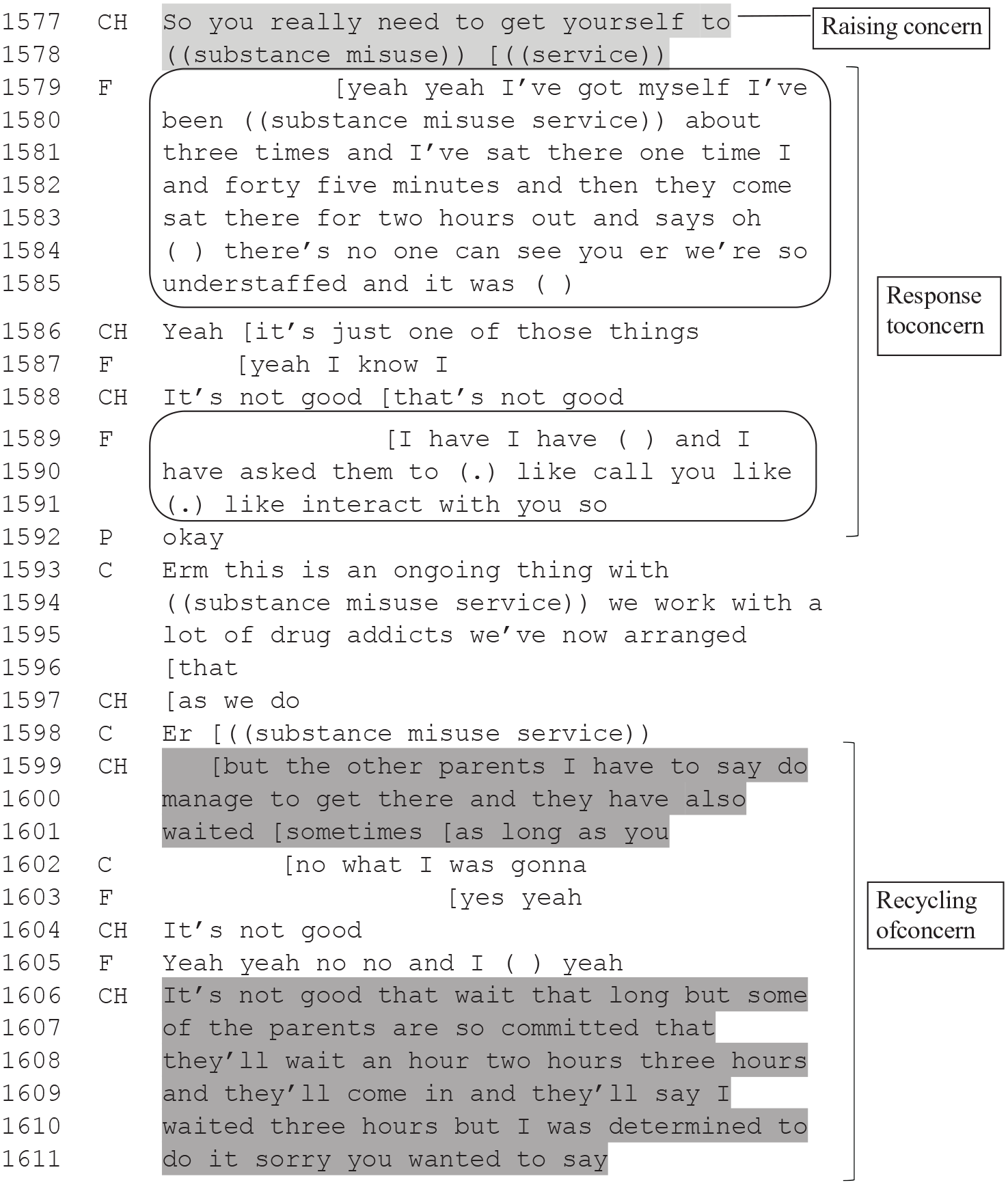
The chair enacts deontic authority (Stevanovic and Peräkylä, 2012) to direct the father to attend a substance misuse service; by implication this is something that has not yet happened (lines 1577–1578). Consequently this raises the concern because the focus is the lack of action on the part of the father. However, instead of agreeing to this directive, the father secures the floor and attempts to attenuate the concern by attempting to mitigate his responsibility by producing an excuse. He outlines his experiences of attempting to access the substance misuse service, proposing that the problem lies with the substance misuse service rather than his efforts to access help for his drug addiction (lines 1579–1585). The chair acknowledges the difficulties with the capacity of the substance misuse service and the father re-secures the floor to produce a justification in lines 1589–1591 which outlines another action he has taken: asking the substance misuse service to contact his probation officer. The father uses this justification to attempt to position himself as some who is taking action to try and resolve his problems.
Despite attempts by the charity worker (C) to support the father’s position, the chair’s turn in lines 1599–1601 with ‘but’ in the turn-initial position signals the lack of interactional acceptance of the father’s version of the concern. The chair formulates the father’s attempts to access the substance misuse service as problematic. This is accomplished by comparing his actions with other parents who wait long periods of time to be seen at the substance misuse service and then emphasising their commitment and determination to be seen whilst also acknowledging the long waiting times (lines 1598–1601, 1606–1611). The chair’s contributions also index ideals about the lengths parents should go to in attempting to address their problems which support the chair’s identification of the father’s lack of action and function to establish the gap between expectations and action.
In this excerpt, the chair’s version of the concern persists as a result of the chair’s management of the floor and the linguistic and discursive features of their turns which are characteristic of participation. The chair’s ‘powerful position’ as ‘meeting controller’ (Angouri and Mondada, 2018: 473) is evident here. In contract, and despite his attempts to propose his own version of the reason why he has not been able to access the substance misuse service, the father’s contributions are not interactionally accepted as demonstrated in the chair’s subsequent turns. His involvement in the interaction is mere presence rather than participation.
The following extract illustrates a rarer additional stage in the account sequence. In this additional final stage, the parents agree with the professionals’ reformulation of the original concern. We discuss here how agreement between professionals and parents about the specifics of the concern is still dominated by professionals and the involvement of parents can still further ratify the professional voice instead of contributing to the unfolding of the event.
Excerpt 4
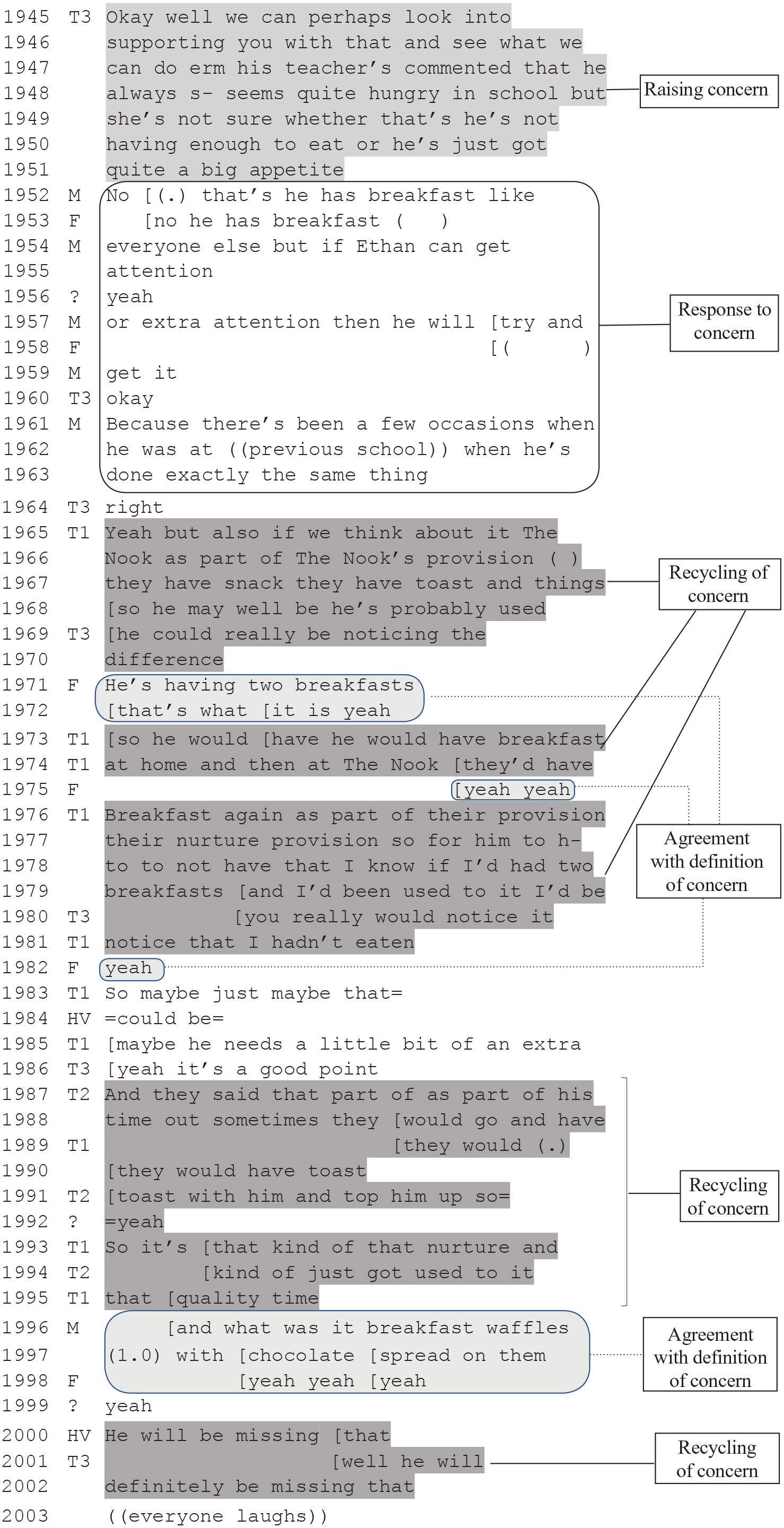
Teacher 3 produces a description of the concern that the child ‘seems quite hungry in school’ (line 1948) and offers two possible explanations for why the child seems hungry at school (lines 1948–1951). This concern identifies a potential lack of action or problematic action on the part of the parents. The parents secure the floor and respond to the concern raised by the teacher by directly rebutting the concern; the parents’ turns in lines 1952–1953 are both prefaced by ‘no’. They also provide a candidate reason for why the child might be saying that he is hungry (lines 1954–1959). The mother’s explanation suggests that the child is saying that he is hungry to get attention which moves the focus to the child as the location of the problem and mitigates the responsibility of the parents. In lines 1961–1963 the mother provides evidence to support her assertion by stating that the child has done ‘exactly the same thing’ in a previous school.
Whilst the two responses of teacher 3 at lines 1960 and 1964 seem to indicate an acceptance of the suggested cause and therefore the parents’ version of the concern, teacher 1 joins the discussion at line 1965. Teacher 1 suggests an alternative explanation that centres around the routines in the previous education provision (The Nook) that the child attended prior to re-entering mainstream school and the frequent provision of snacks. Teacher 1’s turn begins with ‘yeah but’ signalling the lack of interactional acceptance of the parents’ explanation and marking the start of the repetition of the concern, albeit a reformulated version. In lines 1969–1970 teacher 3 agrees with teacher 1 adding strength to this particular explanation. This version constructed by teacher 1 is a situational explanation which moves the location of the problem away from the child but also does not allocate responsibility to the parents. The development of this explanation, in contrast to the parents’ explanation, is underpinned by a child-focussed ideal about children requiring care and protection rather than being the subject of blame. Because of the nature of teacher 1’s explanation, and in contrast to the excerpts considered so far, the parents do not need to try to reject an attribution of responsibility. Instead, the father agrees with this explanation (lines 1971–9172), claiming definitively that this explains the child’s complaints of hunger: ‘that’s what it is yeah’. The father additionally indicates agreement in line 1975. This contrasts with the excerpts presented so far as it represents a fourth step in the account sequence in which the parents agree with the professionals’ redefinition of the problem.
The teachers continue to present a redefinition of the concern in lines 1973–1995. Teacher 1’s so-prefaced formulation in line 1973 summarises the gist of the previous interaction (Antaki et al., 2005), explaining that the child would have had breakfast at home and then a second breakfast at The Nook. Teacher 1 then draws on personal experience to normalise the child’s feelings of hunger (lines 1978–1981) by stating that she would be feeling the same as the child if she had become used to having two breakfasts and then had to get used to having only one breakfast, further strengthening the explanation. T2 joins the discussion and, along with T1, restates the centrality of snacks within The Nook’s nurturing approach and that the child will have become used to this (lines 1987–1994).
Following this, the mother secures the floor, initially in overlap, to continue the parents’ endorsement of the redefinition of the concern and associated explanation provided by teacher 1. Whilst the teachers have previously only mentioned toast and other more general snacks, the mother provides more details of the types of snacks the child was provided with at The Nook (lines 1996–1997). Breakfast waffles with chocolate spread on them is an unusual and desirable snack compared to ubiquitous toast and therefore is likely to be particularly missed by the child.
The dominance of the professionals’ versions of concerns in this excerpt is indicative of their participation. Conversely, the parents’ explanation of why the child is hungry is not interactionally accepted and their involvement in the interaction is characteristic of presence. The parents explicitly agree with the dominant professional version and provide further information to support its development and validation, representing an additional stage in the account sequence.
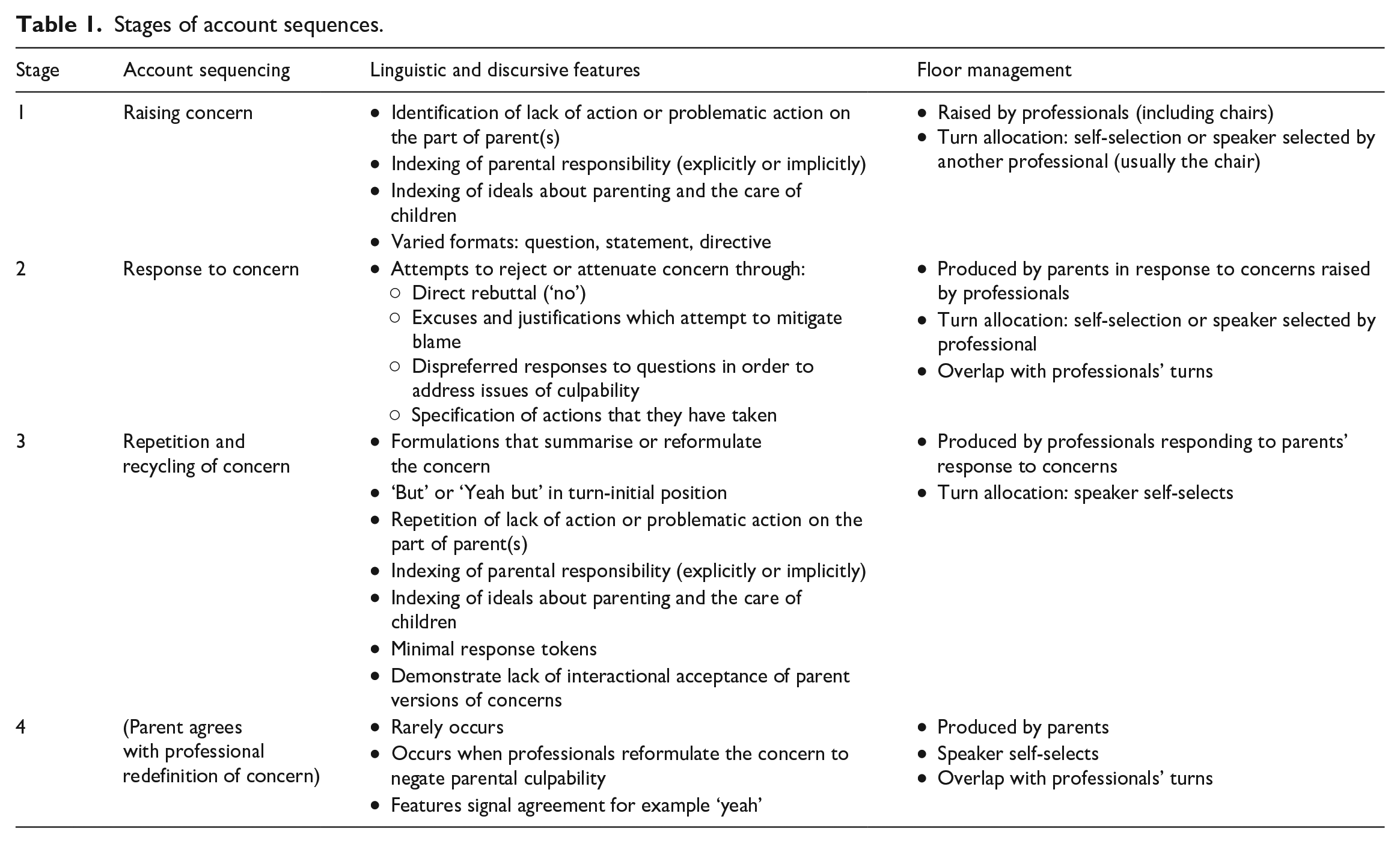
Bringing together the interactional work that the participants do in the account sequences which we have shown in the analysis, and informed by previous research on the sequencing of accounts (e.g. Buttny, 1993; Scott and Lyman, 1968), Table 1 represents the sequential stages of account sequences in our data. It shows the linguistic and discursive features of the turns within each stage and how the floor is managed to transition between stages. By focussing on the stages of the accounts sequences we have been able to illustrate how professionals cumulatively accomplish participation as the stages of the account sequence progress and how parents’ attempts to establish their accepted versions of concerns and effective participation are unsuccessful, resulting in their presence rather than participation. We have shown in the data that the opportunity to provide an account, where that account occurs in the concern sequence and how that account is treated interactionally is illustrative of interactional presence and participation. What is key to both interactional presence and participation is the third stage of account sequences. In this stage, the parents’ versions of concerns are not interactionally accepted as a result of the linguistic features of the professionals’ turns which signal non-acceptance and because the professionals’ versions are repeated and recycled. This stage also serves to (re)establish the dominance of the professionals’ versions and consequently their participation. We discuss the implications of our findings in the last section of the article.
Stages of account sequences.
Discussion and concluding remarks
Through the analysis of account sequences that focus on concerns we have demonstrated how presence and participation are both realised interactionally through participants’ management of the floor and the linguistic and discursive features of their turns. The sequentiality of the accounts is illustrative of the difference between presence and participation through the provision of opportunities to provide accounts, where accounts occur in the concern sequences and the ways in which accounts are treated interactionally. We have shown how it is predominantly professionals who accomplish participation and parents’ involvement in the interaction is, in contrast, resisted and remains peripheral to the agreed decision, characteristic of presence. The analysis of our data has confirmed previous findings relating to the interactional accomplishment of participation and the significance of floor management and the linguistic and discursive features of turns to participation. We add to this work by juxtaposing presence with meaningful and consequential participation. Our findings highlight how presence is interactionally shaped by both the parents’ and professionals’ turns within the account sequences, with the repetition and recycling of concerns by professionals being particularly significant to establishing the presence rather than participation of parents. We have also extended previous studies that have identified the asymmetrical organisation of interaction in child protection conferences and other child welfare meetings (Broadhurst et al., 2012; Hall and Slembrouck, 2001; Hall et al., 1999; Hitzler and Messmer, 2010; Koprowska, 2016) by proposing the concept of presence to illustrate in greater detail the nature of the involvement of professionals and parents in these meetings. This concept could usefully be explored further in other asymmetrical interactional events.
The analysis also illustrated the power relationships that were constructed in the interaction. Our findings show that the asymmetrical power relationships between the parents and professionals that pre-exist the interactional event become relevant and are brought to the fore in the child protection conference. Consequently, the analysis has extended social work knowledge about how power relations between professionals and service users are (re)constructed at the micro-level by providing a greater understanding of how power operates in child protection conferences and of the relationship between power and (non-) participation.
Child protection conferences have a clear decision making purpose. Decision making and problem solving are understood as interactional processes (Barnes, 2007; Boden, 1994; Clifton, 2009; Halvorsen, 2013; Huisman, 2001) and have attracted significant attention in professional settings (see Angouri, 2018 for a discussion). Activities such as outlining the state of affairs or formulating the problem are commonly observed as part of the decision making process as is some sort of assessment of the information presented, either implicitly or explicitly (Halvorsen, 2013; Huisman, 2001). In our context, this is relevant to the account sequences we focus on. Therefore, the participation of interactants in these antecedents of the decision outcome is significant. We argue that participation and decision making are interwoven in these meeting events and this connection is represented in Figure 1. Extrapolating from the analysis, professionals’ more effective participation results in their more extensive involvement in decision making. Conversely, parents’ involvement in the interaction is illustrative of embodied presence and their involvement in decision making is limited. Embodied participation provides legitimation and ratification of decisions taken in an event and as such a detailed analysis is critical in showing the nuances of institutional decision making.
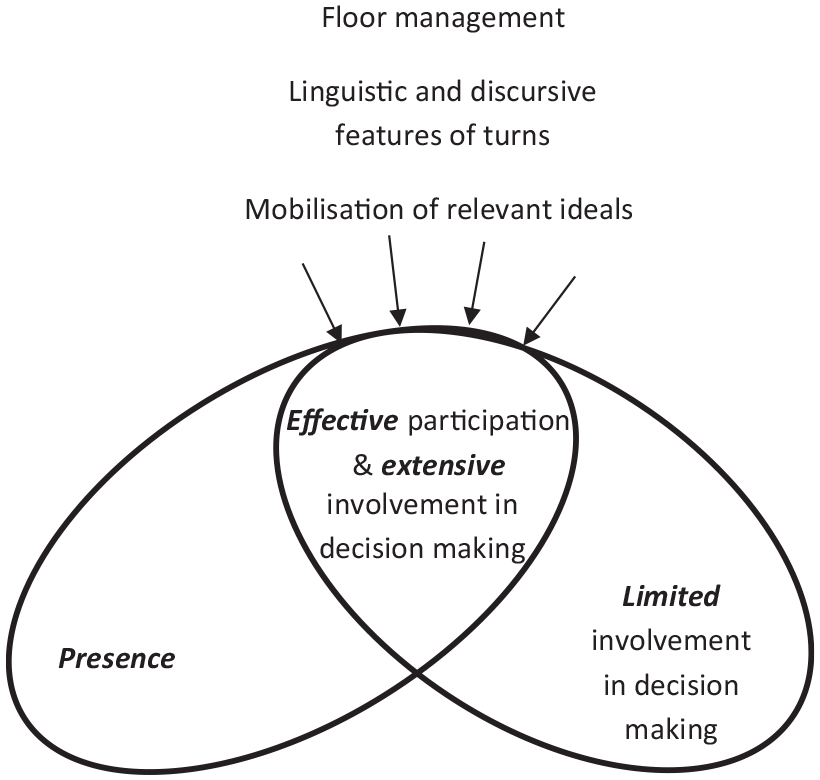
Model of participation in child protection conferences.
Further, our analysis has demonstrated that a person’s presence at a meeting is insufficient to facilitate their equal, or even any, participation; instead, participation is negotiated in situ. We therefore problematise presence in meetings which is conceptualised by the system as participation and further research should continue zooming in on this critical event. Involving parents in child protection conferences is one way in which partnership working can be realised, a principle which is a core part of the Children Act 1989 and the value base of social work. Procedures and practices (HM Government, 2018) for involving parents in these meetings make an assumption that presence means participation; however, our analysis has demonstrated that their presence at these meetings does not result in their involvement in decision making. This suggests that their involvement may remain tokenistic and representative of mere presence whilst under the façade of participation. Our analysis raises questions about whether parents can be fully participating in child protection conferences when the core social work values of social justice, empowerment, self-determination and the promotion of individual rights are considered (BASW, 2012). It is evident that, within this particular event, working in partnership with parents in terms of valuing and taking into account their contributions and the social work commitment to anti-oppressive practice becomes impoverished interactionally. This may also occur in other interactions between social workers and families. Furthermore, the way that parents are positioned results in further oppression of those who may have already experienced adversities and oppression. This suggests a mismatch between practice in this area of social work practice and the core values of social work. The systemic asymmetry and exclusion shown here is a significant societal issue which goes beyond an institutional event, it is directly at the heart of the societal moral order. In closing, we strongly argue for further research into lay-professional interaction in social work and for the issues that our findings raise to be given sufficient institutional attention. This requires a different paradigm, one that brings together researchers, policy makers, social workers and parent organisations. We hope that our paper has contributed to a better understanding of the nuances and complexities involved in child protection and paved the way for others to follow.
Footnotes
Appendix
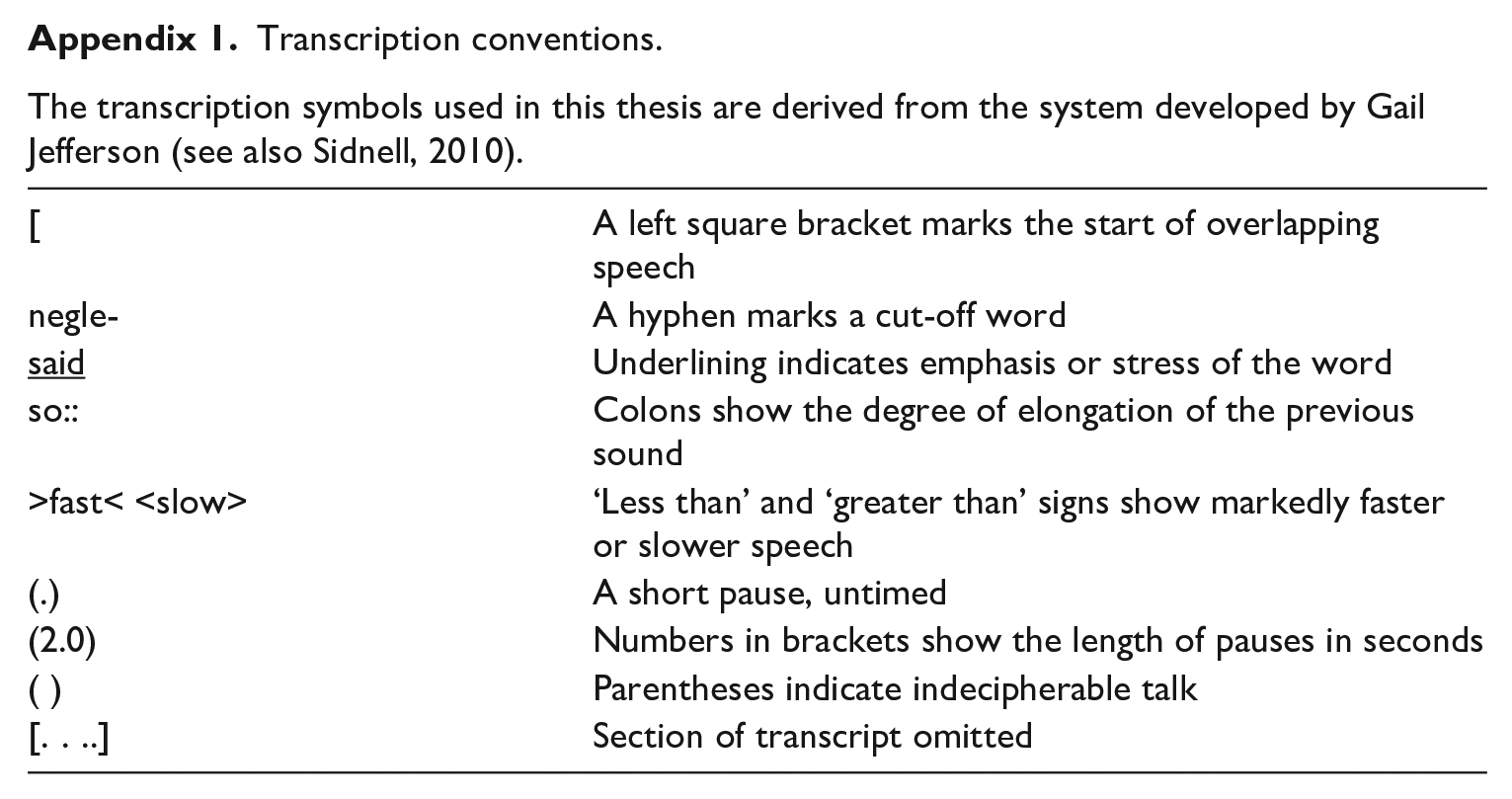
Transcription conventions.
The transcription symbols used in this thesis are derived from the system developed by Gail Jefferson (see also Sidnell, 2010).
| [ | A left square bracket marks the start of overlapping speech |
| negle- | A hyphen marks a cut-off word |
| said | Underlining indicates emphasis or stress of the word |
| so:: | Colons show the degree of elongation of the previous sound |
| >fast< <slow> | ‘Less than’ and ‘greater than’ signs show markedly faster or slower speech |
| (.) | A short pause, untimed |
| (2.0) | Numbers in brackets show the length of pauses in seconds |
| ( ) | Parentheses indicate indecipherable talk |
| [. . ..] | Section of transcript omitted |
Declaration of conflicting interests
The author(s) declared no potential conflicts of interest with respect to the research, authorship, and/or publication of this article.
Funding
The author(s) disclosed receipt of the following financial support for the research, authorship, and/or publication of this article: Eleanor Lutman-White was supported by the Economic and Social Research Council.