




Abstract
Far-right populist parties instrumentalize the media and intervene into processes of mediatization in significantly different ways, depending on socio-political contexts, their position of power, their role in government or opposition and – related to the latter – their specific access to media. In this paper, I focus on one of the many ways propagandistic tools are employed to control the relevant agenda and information being disseminated by both traditional media and online, in other words ‘message control’. Message control illustrates one of many steps of normalization of far-right agenda. The concept of ‘message control’ emerged from the specific propaganda tool developed by the former Austrian Chancellor Sebastian Kurz and his followers and implies launching and thus controlling select information via weekly press conferences, briefings, personal conversations, back-ground conversations (Hintergrundgespräche), and text messages, and to financially subsidize only those media that reported favorably about the activities of Kurz’s government. Thus, a new media logic based on favoritism, nepotism, and clientelism was established and normalized. This stands in contrast to Trumpism, which delegitimized all investigative journalism without explicitly attempting to control it. Former US President Donald Trump constitutes rather a prime example of Löwenthal and Guterman’, as he instrumentalized far-right and extreme-right media channels (such as Breitbart or Fox News) and extensively used Twitter to spread systematic disinformation.
Keywords
Far-right populist media strategies and mediatization
Since the beginning of the 21st century, authoritarianism and ‘illiberal democracies’ are becoming ever more acceptable in the European Union and beyond (Scheppele, 2020a,b; Wodak, 2021a: 225ff). Democratic institutions are being undermined, including media, justice, academia, and education in Hungary, Poland, Turkey, and the USA. 1 Although far-right populist parties call for more ‘direct democracy’, new legislation is quickly implemented without accounting for transparency, expert opinions, minority opposition, and so forth, thereby strategically challenging salient democratic institutions. Illiberal practices have become normalized, employed more and more by conservative parties and their autocratically minded leaders. As Müller (2021) maintains, the main aim is accessing power, frequently without pursuing distinct ideologies and agendas, in other words: Remaining in power by whatever means necessary. 2 Poignantly, he labels this kind of regime as ‘conservativism without qualities’ [Konservatismus ohne Eigenschaften], a reference to Robert Musil’s seminal novel from the 1930s about ‘the typical Austrian’ – The Man without Qualities [Der Mann ohne Eigenschaften].
In illiberal democracies, most breaches of the constitutional order, such as freedom of opinion, assembly, the press, and independence of the legal system (as are occurring especially in Poland and Hungary) are usually not announced explicitly. Quite in the contrary, as stated by Fournier (2019: 366): “The populist rhetoric manipulates the rule of law and the majoritarian pillars of constitutional democracy by convincing a fictional majority that constitutional democracy gives rise to a tyranny of minorities. Populism in action represents the second facet of the populist strategy. It corresponds to a specific constitutional strategy of legal and constitutional reforms aiming at disrupting constitutional democracy”.
As will be illustrated below, (leaders of) far-right populist parties instrumentalize the media and intervene into processes of mediatization in significantly different ways – a phenomenon termed by Mazzoleni (2014: 54) as ‘ideological partnership’ –, depending on socio-political contexts, their position of power, their role in government or opposition and – related to the latter – their specific access to media. In fact, far-right populist leaders and their parties continuously seek to delegitimize independent media altogether (such as Donald Trump) or they might – as owners of (all) relevant media – directly influence media’s content (such as Silvio Berlusconi); some enforce new laws forbidding critical investigative journalism and close independent media tout court (such as Viktor Orbán, Jarosław Kaczyński, and Vladimir Putin; e.g. Borbáth and Gessler, 2021; Maurer et al., 2022). Or they might implement a step-by-step control of media (and thus of mediatization) via bribery, manipulated opinion polls, and other illegal means (such as Sebastian Kurz). Hence, Mazzoleni (ibid.) argues, media ‘are either active players in the political fray or act as tools at the service of political players, be they populists or otherwise’.
In other words, far-right populist politics represent a particular case of mediatization in the sense of the political sphere being ‘submitted to, or [. . .] dependent on, the media and their logic’ (Strömbäck, 2008: 113). These include many rhetorical means such as simplification, polarization, intensification, personalization, stereotypization, emotionalization, and sports- or military-based dramatization, all typical of far-right rhetoric as analyzed elsewhere in much detail in the framework of the Discourse-Historical Approach (Rheindorf, 2020: 627; Wodak, 2021a: 68–77). In addition, scandalization, provocation, victim-perpetrator reversal, conspiracy theories, and calculated ambivalence are employed as discursive strategies to capture and maintain media attention in what has been termed the ‘perpetuum mobile’ of far-right populism (Wodak, 2021a: 25–26).
In this paper, I focus on one of the many ways propagandistic tools are employed to control the relevant agenda and information being disseminated by both traditional media (broadsheets, tabloids, public TV, and radio) and online (Facebook, Twitter, Instagram, YouTube, blogs, and so forth), in other words message control. The concept of ‘message control’ emerged from the specific propaganda tool developed by the former Austrian Chancellor Sebastian Kurz and his followers and implies launching and thus controlling select information via weekly press conferences, briefings, personal conversations, back-ground conversations (Hintergrundgespräche), and text messages, and to financially subsidize only those media that reported favorably about the activities of Kurz’s government. Thus, a new media logic based on favoritism, nepotism, and clientelism was established and normalized (Pilz, 2021). This stands in contrast to Trumpism, which delegitimized all investigative journalism without explicitly attempting to control it. Former US President Donald Trump constitutes rather a prime example of Löwenthal and Guterman’s (2021 [1949]) infamous ‘agitator’, as he supported and instrumentalized far-right and extreme-right media channels (such as Breitbart or Fox News) and extensively used Twitter to spread systematic disinformation.
In view of the above, I claim that the far-right (populist) media strategy draws on traditional forms of propaganda and functions as a catalyst, an instrument of mobilization, distraction, and subsequently, of normalization. Furthermore, I also claim, that the choice of rhetorical means and argumentative schemes depends on the respective socio-political context and the affordances of far-right populist propagandistic aims.
Before analyzing different forms of far-right populists’ propagandistic interventions into processes of mediatization in more detail, I will first elaborate the concept of propaganda primarily following Walton (1997, 2007), while focusing specifically on his concept of orchestration. Simultaneously, I point to the violation of norms and values, the shameless normalization of previously tabooed agendas, and the shifting of the boundaries of the unsayable as a strategic facilitator and predictable consequence of message control. Finally, the limitations of message control will be discussed in times of social media and multiple public spaces. Obviously, an effective top-down control of media proves impossible in liberal democracies due to whistle-blowers, leaking of classified information, or to the breaching of boundaries between backstage talks and frontstage performances (Wodak, 2011).
Propaganda old and new
Even though the distinction between the concepts of ‘propaganda’ and ‘persuasion’ is far from settled, Jowett and O’Donnell (2015) have suggested that the two can be differentiated by considering the intent of those who create the message in question. While the goal of propaganda is to ‘achieve a response that furthers the desired intent of the propagandist’ (Jowett and O’Donnell, 2015: 7), persuasion aims to impact people’s perception of reality in a way that will not only benefit the sender but also those who receive the message. For example, mediated messages of fear during the COVID-19 pandemic urging people to adopt sanitary measures in order not to spread a disease qualify as persuasion, while messages that stoke fear against migrants based on fallacious claims that they should be blamed for spreading the disease must be categorized as propaganda. Nevertheless, propagandists will typically claim that they have the common good of ‘the people’ in mind, that is, that they will protect and save ‘the people’, arbitrarily defined on nativist grounds as an allegedly homogenous Volk (Wodak, 2021a: 67ff.). Hence, the difference between propaganda and persuasion should be based on normative assumptions, on a case-to-case basis (e.g. Ribeiro and Schwarzenegger, 2020: 5). Van Dijk’s (2006: 360) definition of ‘manipulation’ necessarily overlaps with the concepts of propaganda and persuasion; importantly, he emphasizes the relevance of manipulation as a ‘communicative and interactional practice, in which a manipulator exercises control over other people, usually against their will or against their best interests’.
In recent scholarship, the interdependency of (traditional) forms of propaganda, populism, mediatization, and the subsequent normalization of far-right agendas has been frequently emphasized. In many countries, ‘discursive shifts’ (Krzyżanowski, 2020), ‘shameless normalization’ (Wodak, 2021a), ‘radicalization’ (Scheppele, 2020a), ‘contagion’ (Cooper, 2021; Cooper and Aitchison, 2020), ‘mainstreaming’ (Mondon and Winter, 2021), and ‘transformations’ (Ther, 2019) have occurred, leading to widespread and growing normalization of far-right policies. The boundaries of the ‘sayable’ are being shifted, traditional norms and rules of political culture, of negotiation and deliberation, are violated by continuous provocations, disseminated via the media, supported by mainstream conservatives, and thus normalized (Wodak et al., 2021). 3 The specific everyday manifestations of such processes, however, require detailed qualitative (and quantitative) discourse analysis to capture the context-dependent intricacies of normalization processes which differ in distinct ways from the propaganda of totalitarian regimes in the 20th century. Heitmeyer (2018) points to the important contribution of conservative elites colluding with far-right parties and the media in shifting the boundaries of normalcy. According to Heitmeyer, such elites can, on the one hand, repeatedly re-establish and strengthen ‘fundamental values’ even in times of great uncertainty; on the other hand, they can contribute to the relaxation of these very fundamental values. Heitmeyer (2018: 295) demonstrates the emergence of new meanings and interpretations, especially by important actors in public life (‘transmission actors’).
Propagandistic discursive strategies
Vamanu (2019) summarizes a range of approaches to describe, understand, and explain ‘propaganda’ and ‘fake news’, such as from philosophy, cognitive and evolutionary psychology, communication sciences, and discourse analysis (e.g. Ball, 2017; Brown et al., 2021). Due to space restrictions, I will focus solely on the critical argumentation approach by Walton (1997, 2007) as it seems adequate to understand and explain the Austrian government’s form of propaganda, framed as message control.
Walton (2007: 111) defines propaganda as the concerted effort of a social group ‘to get an audience to support the aims, interests, and policies of a particular group, by securing the compliance of the audience with the actions being contemplated, undertaken, or advocated by the group’. Accordingly, Walton (2007: 109) argues that propaganda as a quasi-language game involves a proponent who disseminates propagandistic information and a respondent who receives that information. Ideally, the respondent will acquire the beliefs, develop the attitudes, or engage in the actions the propagandist desires. 4
Walton lists 10 dimensions of propaganda, some of which relate well to the characteristics of message control. First, Walton (2007: 109–110) claims that the message content of propaganda takes the form of an elaborate argument, which can be expressed verbally, pictorially, or both, usually following Stephen Toulmin’s classic model (2003: 90–96). Second, the prima facie plausibility of the claim and the strength of supporting evidence are salient for the discursive construction of propaganda. If the alleged plausibility and evidence do not hold, the argument necessarily becomes fallacious (Helder, 2011: 117). As Vamanu (2019: 202) maintains, pictorial elements are particularly relevant to propaganda, as images tend to elicit powerful emotional reactions (e.g. Richardson and Wodak, 2009). Third, Walton (2007: 110) emphasizes goal-directed communication, which aims to induce the respondents ‘to carry out a particular action or to support a particular policy for action’ and to destroy undesirable aims. The former is known as ‘supporting propaganda’, while the latter is known as ‘undermining propaganda’ (Stanley, 2015: 53).
Fourth, the propagandist always speaks in the name of a higher-order entity, such as a country, a political party, or a corporation. Accordingly, legitimation via authority is appealed to – be these statistics, a prominent public persona, religious beliefs, or the ‘homeland’ and ‘the people’ (e.g. Van Leeuwen and Wodak, 1999). Fifth, as Walton (2007) adds, such legitimation efforts imply indifference to logical reasoning. Thus, a propagandist is not committed to logical reasoning unless s/he believes that doing so will better serve her/his goals. When politicians abandon logical reasoning, they usually engage strategically in fallacious reasoning (Helder, 2011: 128). Such arrogance of ignorance (Wodak, 2021a: 6) can also be linked to – sixth – one-sided argumentation (Walton, 2007: 110–111): a unilateral pattern of propagandistic argumentation that discourages people to deliberate alternative perspectives and deliver counterarguments. Importantly, seventh, in democratic societies persuasion dialog could induce audiences to act in particular ways, ‘to comply with action, or to accept and not oppose a certain line of action’.
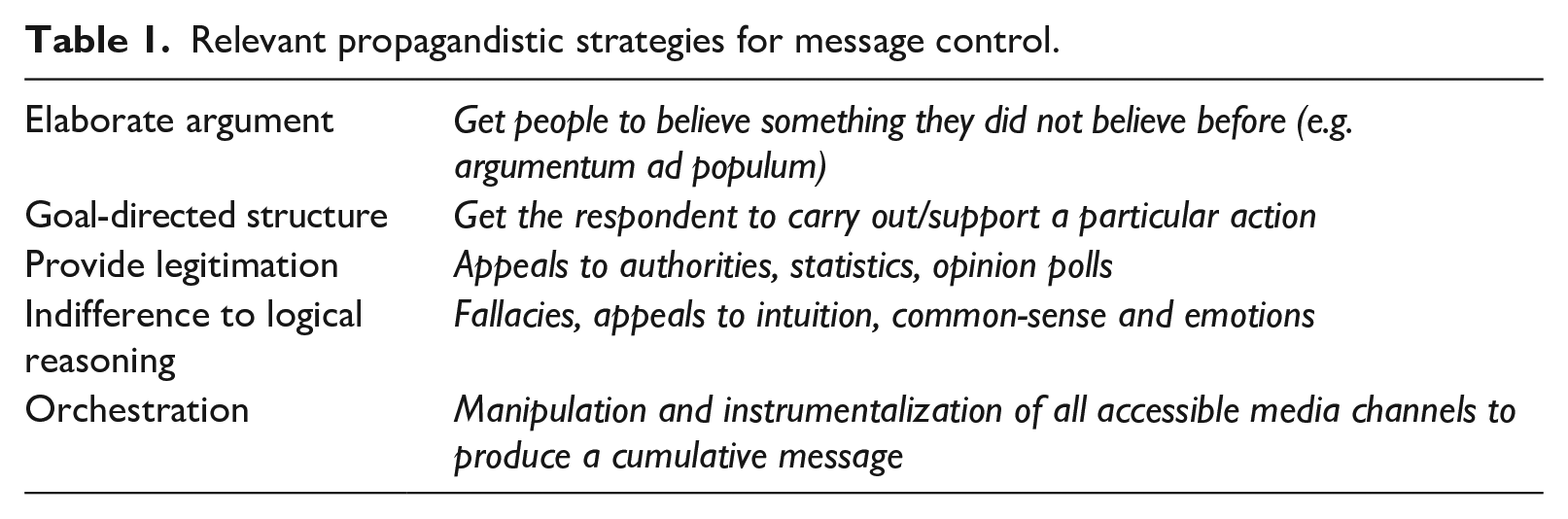
Walton (ibid.) mentions an eighth characteristic: propaganda could justify itself by pointing to the desirable results that would be achieved if the recommended course of action is adopted. For example, the strategy of scapegoating implies that so-called illegal immigrants may harm the environment and put communities in danger, hence deportation measures would have ‘positive’ consequences. Moreover, emotive language – the ninth strategy – is employed (such as metaphors and other rhetorical tropes), evoking resentment, nostalgia, fear, and so forth. Here, Walton (2007: 112–113) refers to propaganda’s eristic aspect. 5 Finally, the strategy of orchestration manipulates different media channels over time with the same agenda to produce a cumulative message (misuse of statistics, opinion polls, repetition, etc.). When analyzing the Austrian government’s message control, 5 from the 10 strategies briefly presented above prove salient (Table 1):
Relevant propagandistic strategies for message control.
Modern agitators: Trump’s twitter propaganda
Far-right populist actors frequently attempt de-legitimizing media who do not report favorably on them, alleging that they collude with or are part of ‘the corrupt elite’. Although Donald Trump may be credited with popularizing the term ‘fake news’ for this goal, he was certainly not the first politician to use it (Kellner, 2017). Online and social media have been instrumental for many populists as they bypass established media and attempt constructing the specific immediacy between populist actors and ‘the people’ that enables strong identification (Rheindorf, 2020: 627). Indeed, the obvious lack of accountability on the Internet might also give rise to ‘uncivil society’ (Krzyżanowski and Ledin, 2017). They are in fact ideally suited for the typical dichotomization of politics and society, more specifically, the rhetoric of hate speech and conspiracy theories.
In fact, Donald Trump represents an unprecedented case in this regard, as he has used Twitter as a major platform of communication (Fuchs, 2018). Trump’s victory on 7 November 2016, is believed to stem – at least partly – from his unconventional, aggressive, and offensive use of social media, specifically Tweets: Trump did not have to rely on media reporting and serious journalism – he was his own journalist. Kreis (2017), Montgomery (2017) and Slotta (2020) provide interesting evidence that Trump’s language is conversational, drawing on the vernacular, highly repetitive, frequently incoherent, simple, and direct, thus strategically emphasizing his polarizing messages. As Slotta (2020: 51) argues, ‘Trump’s “incoherent verbal miasma” may have been a key part of his message’. This strategy allows to appear closer to the people. In this way, they come across as ‘authentic’. Indeed, one could claim that serious journalism has become highly vulnerable as populist politicians now address the public and their followers directly, online.
In their in-depth study ‘How Trump Reshaped the Presidency in over 11,000 Tweets’, New York Times journalists Shear et al. (2019) demonstrate that Donald Trump ‘fully integrated Twitter into the very fabric of his administration, reshaping the nature of the presidency and presidential power’. The authors describe how Trump’s aides at first attempted to restrain his Twitter habit; they even considered asking the company to impose a 15 minute delay on Mr. Trump’s messages. However, after 3 years in office and 11,390 presidential tweets later, many administration officials and lawmakers seemed to endorse Trump’s Twitter obsession, flocking to his social media chief with suggestions. Shear et al. (2019) also describe how, according to their informants, policy meetings were hijacked when Trump had an idea for a tweet, ‘drawing in cabinet members and others for wordsmithing’. Obviously, Trump deployed Twitter to provoke, overrule, or humiliate recalcitrant advisers and preempt his staff. They quote Kellyanne Conway, Trump’s former press secretary and then White House counselor, as stating in an interview: ‘He needs to tweet like we need to eat’ (Shear et al., 2019).
From June 2015 until January 8, 2021, Donald Trump sent over 34,000 tweets (max/day: 200 tweets on June 5, 2020). His most widely disseminated collocates, according to the New York Times, 6 were ‘crooked Hillary’, ‘fake news media’ (attacking traditional quality media) and appeals (hate incitement) such as ‘lock her up’ (directed against Hillary Clinton). Because of space restrictions, I refer readers to Kessler et al. (2020) who analyzed all of Trump’s lies, fallacies, and misleading claims over the years of his presidency.
In sum: Twitter (and other on-line/social media) allow for the construction of parallel discourse worlds, parallel realities. Trump and other far-right populist agitators continue to use Twitter to spread so-called ‘alternative facts’, conspiracy theories, disinformation, and falsehoods. In this way, they have established direct contact with their followers and are able to demonize and delegitimize professional journalism as ‘fake news’ (Fuchs, 2018; Wright, 2021).
‘Message control’ and ‘tabloid-democracy’
In contrast to Donald Trump’s strategy as an agitator, Sebastian Kurz, Austria’s Chancellor until October 9, 2021, was a master of image-building who attempted to control the media. In the 4 years since he first took over leadership of the national-conservative Austrian People’s Party (ÖVP) at just 30 years of age in 2017, he raised it to new electoral heights by integrating hardline immigration rhetoric with personality-driven politics and calls for a ‘new style’ of governing (Karnitschnig 2021a). 7
Elaborating arguments and controlling message content
Message control, as already mentioned above, implies a relentless internal focus on ensuring that positive narratives about the government are disseminated in media and public life. 8 For example, Sebastian Kurz launched his 2017 election campaign with a so-called big lie 9 . He claimed to have closed the so-called Balkan route for refugees traveling to Europe. At every possible occasion, this lie was repeated, and he was acclaimed as the savior of the Occident. This argument is fallacious since – according to facts – Germany’s former prime minister Angela Merkel’s initiated 2016 deal between Europe and Turkey, (more or less) closed the Balkan route when Turkey promised to provide protection to refugees arriving from Syria and Iraq; in return, Turkey received €40 million to support these refugees 10 . Thus, refugees did not have to flee to Austria, Germany, or Sweden, they stayed in Turkey.
Kurz also had a habit of calling up journalists directly or having aides reach out on his behalf when he felt their stories were unfair or too critical about the government’s policies. Once Kurz became Chancellor, he hired 80 PR consultants under the supervision of his personal advisor, Gerhard Fleischmann, who were responsible for implementing his strategic agenda. The same is true for the Ministry of Interior Affairs which also hired 80 PR consultants. In this way, unilateral narratives were disseminated, without critical discussion or counterarguments (Karnitschnig 2021a,b,c). 11 The ORF, the state broadcaster, one of whose news divisions is sometimes critical of the government, remained on stable financial footing, thanks to its financing mix of mandatory license fees from viewers and advertising. But journalists in the ORF reported that the broadcaster faced persistent interventions from Kurz’s government in news coverage. 12
To summarize one of many examples: On July 23, 2020, journalist Alexandra Wachter (W) from the private TV station PULS 24 confronted Sebastian Kurz (K) with stark criticism in the German weekly Zeit stating that Kurz had used impolite and harsh rhetoric during negotiations about the distribution of subsidies in a meeting of the European Council (see Table 2):
Interview Wachter with Kurz, 23 July 2020.
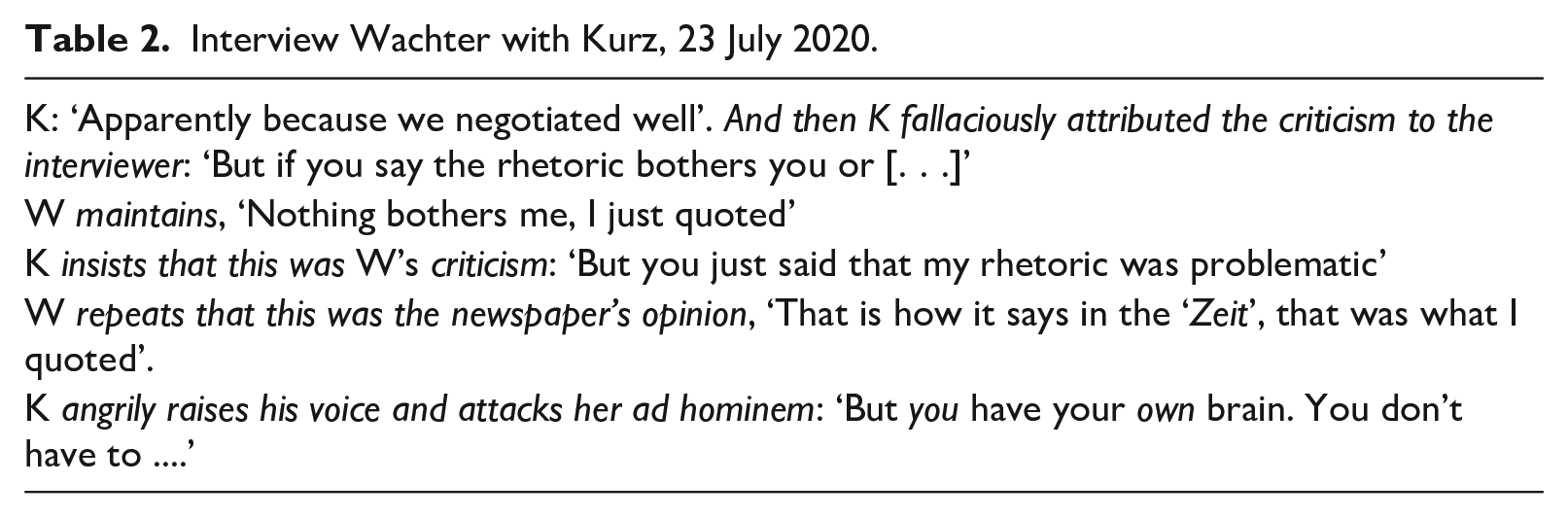
The chancellery intervened and this brief interaction – showing Kurz losing his calm, and offending the interviewer with a patronizing and sexist remark– was cut out of the interview and not broadcast. However, the incident was leaked, the NGO Reporters without Borders triggered a scandal about political interventions into press freedom; 2 days later, the uncut version was uploaded on PULS 24′ homepage 13 .
Goal-directed structure - autocratic pressure
Related to content control via repeated – frequently fallacious – arguments are the many ways in which Kurz and his party sought to subvert or undermine democracy whenever they believed this would serve their political interests. The undermining of checks and balances follows an obvious striving for power, at the same time neglecting previous constitutive principles of the party which had always defined itself as ‘Christian social’ and thus abiding by Christian humanitarian values.
Accordingly, since 2020, Kurz and his followers have repeatedly attacked Austria’s judiciary as politically motivated, specifically by ‘left-wing networks’ and ‘left-wing conspiracies’. 14 However, there exists no evidence for such networks. This accusation was repeated at every possible media event so that – unsurprisingly – many people started to challenge the neutrality of the judiciary. Moreover, after several policy measures implemented during the COVID-19 pandemic were judged illegal by the Supreme Court, Kurz derogatorily maintained that supreme judges’ decisions were only ‘legal quibbles’ and not to be taken seriously. 15
The pressure on media reporting has huge financial implications: Subsidizing government-friendly media and punishing critical media blatantly instrumentalizes the volatile situation of (Austrian) media. Most newspapers, apart from the tabloids, are experiencing massive economic problems due to global and glocal transformations of traditional media logic. Hence, if a newspaper decides to remain critical, it might end up depending solely on its outreach and sales, and not receive any subsidies by the state. In other words, critical media are being strategically starved. In the past, most of the subsidies was spent on advertising, a practice critics see as hidden support for the country’s powerful tabloids, which endorsed Kurz and have received most of the cash; critical media received much less, if they received anything at all. In 2020, for example, the coalition spent €47 million on such advertising, or triple what the previous government did (e.g., Schultheis, 2021). 16
In this context, the concept of ‘tabloid-democracy’ was coined by political scientist Fritz Plasser 17 to describe how the strategic placement of advertisements leads to a symbiosis of government and tabloids. A paradox obviously, because the fourth estate is supposed to take a critical look at those in power. According to journalist Eva Linsinger (2021: 30ff.) from the weekly Profil, the opposite is widespread in Austria. The respective rulers are adored in exaggerated terms. For example, with headlines like ‘Abroad they love the Wonder Boy Kurz’ (OE 24, January 18, 201818), related to some German media and politicians who wished for a similar German ‘wonder boy’. Even when traveling abroad, journalists writing for tabloids were invited to sit in the government’s plane; that was not the case for journalists writing for critical media.
Like Viktor Orbán’s regime, Kurz and his followers also helped wealthy supporters to buy relevant media, especially tabloids. This strategy necessarily guarantees friendly reporting. Thus, René Benko, one of the richest men in Austria and a close friend of Kurz, bought huge shares of the tabloid Neue Kronen Zeitung and of Kurier, the most government-friendly newspaper. Simultaneously, he took the critical online newspaper ZackZack to court, accusing it of libel and demanding €1 million as compensation – a sum which would necessarily destroy ZackZack 19 .
Orchestration and legitimation of political agenda
To attract voters from the extreme-right Austrian Freedom Party (FPÖ), Kurz strategically blurred the boundaries between far-right populist rhetoric and traditional conservative values, thus adopting far-right policies on immigration and contributing to an increasingly polarized political environment. This presents a prime example of coarse civility and of Walton’s strategies of orchestration and manipulation of message content. 20 Instead of discussing and providing solutions for major socio-political problems such as globally rising inequality and youth unemployment or the consequences of climate change for migration politics, refugees and migrants continue to serve as the primary scapegoat and simplistic explanation for all woes.
Accordingly, national-conservative parties present themselves as the ‘soft, politically correct alternative’ to far-right populism and indeed, demagoguery. If, for example, Sebastian Kurz in his role as Chancellor denounced the saving of lives in the Mediterranean as ‘NGO madness’, 21 then such utterances manifest and correspond to the shameless normalization of far-right arguments. Here, the connections and, indeed, overlaps of policies between neoconservative, and far-right ideologies are particularly evident (Krenn 202022). Such utterances were widely disseminated on-line, on social media, in interviews at prime time and in newspapers, via strategies of message control, and resonated with large parts of the Austrian public.
Following the hegemonic media logic, the reporting during the COVID-19 crisis covered the many facets of the pandemic day and night. In contrast to other countries and their governments, the ‘face’ of the crisis in Austria was – until his resignation on October 9, 2021 – Sebastian Kurz; other countries frequently foregrounded experts and medical advisers (Wodak, 2021b). Some figures, collected with the help of the APA Online Manager Library, confirm the omnipresence of the former Chancellor. 23 In fact, from March 9, 2020 to May 10, 2020 Kurz appeared 380 times in the original sound bites, just as often as the Minister of Health (Anschober, Green Party), who was actually responsible for the measures and regulations. The opposition was even less present. Looking at the number of mentions in mainstream media of the respective politicians (outside of their own press releases), Kurz with 1388 outranks all other protagonists by far (Anschober 838, Kogler 485 [both Green Party], Nehammer 172, Blümel 376 [both ÖVP], Rendi-Wagner 250 [leader, Social-democratic Party], Meinl-Reisinger 62 [leader, Liberal Party], Hofer 85 [leader, FPÖ]). Moreover, the amount of speaking time in the main TV news (ZIB I and ZIB II) illustrates the dominance of Prime minister Kurz (see Figure 1, below) who outranks all other politicians in the year 2020, with 15.203 seconds (ca. 4 hours). In this way, the government’s messages were disseminated across all available channels implementing propaganda by orchestration.
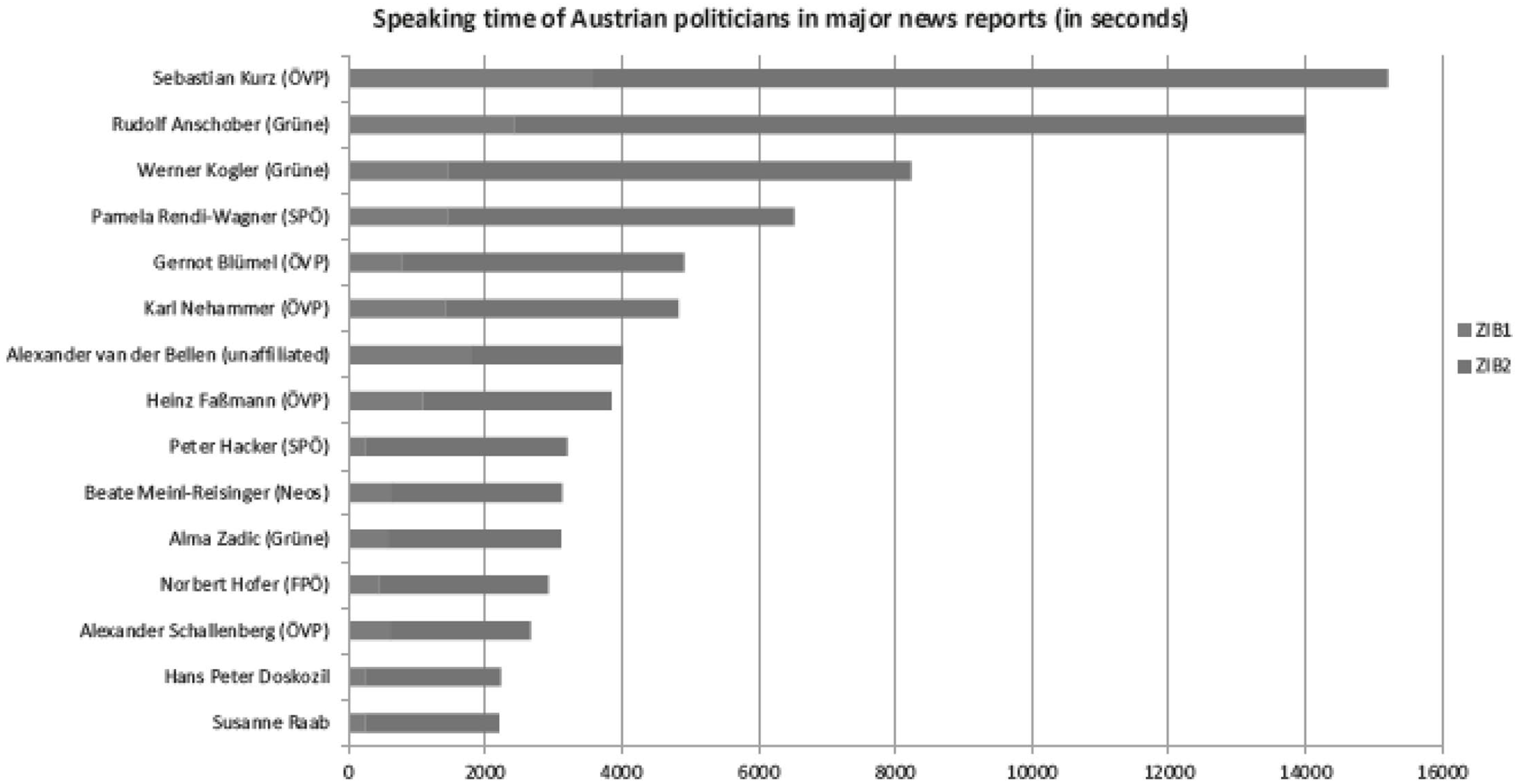
Speaking time of Austrian politicians in the primetime news show of the Austrian broadcasting company (ZIB 1) and late-night news (ZIB 2) in the period of January 2020 until January 2021, according to Der Standard. 24
Another propagandistic strategy consists of inclusion of some and exclusion of others from important news. Thus, Kurz frequently invited selected journalists to so-called back-ground conversations [Hintergrundgespräche] to inform them of the ÖVP’s preferred narrative, simultaneously distracting journalists’ attention from other agendas (the ‘dead cat strategy’ 25 ). Critical journalists were literally not allowed to enter the room. Government-friendly journalists then widely disseminated such ‘mind-closing narratives’ (Grabbe and Lehne, 2017). Moreover, access to information was being severely restricted: government employees were forbidden to speak with the press. Such rules come close to ‘managed democracies’ and their press policies (Wodak, 2019).
As Florian Klenk (FK), a leading critical investigative journalist of the weekly Der Falter stated in a TV discussion (PULS 24; moderator M)
26
with Oliver Pink (OP), a reporter from the center-right broadsheet Die Presse, about the ethos of journalistic profession: “FK: In fact, a background conversation is organized, and it is obvious, so to speak, that they are [inviting] only journalists of trust, we are not invited, but you are invited (pointing to OP). We all still try to come to these background talks, we shouldn’t go there anymore. [. . .] These background conversations are an abuse of the press. He should hold a press conference M: “But why not talk to all journalists, why only to selected ones.” OP: “I have no idea.” FK: “I can answer that. If you want to control the reporting, then you invite only a few . . .”
Klenk describes the rules of the game and appeals to all journalists not to comply with Kurz’s organization of ‘back-ground conversations’. ‘We’ in this brief snippet are the critical journalists; ‘you’ the Kurz-friendly ones. Thus, the massive polarization between different interpretations of what good journalism implies becomes obvious. Only organized resistance to such background conversations might force Kurz to organize a press conference, accessible to all. Later in the 25 minutes discussion, which touched on many aspects of message control, Klenk angrily presents his credo when pointing to the ‘lazy/resigned habit’ of some colleagues who simply reproduce the controlled agenda without investigating further. He argues that this habit must be changed by becoming independent again; one should not become Kurz’ speaker without any reflection of content: “No, it is simply reproduced, yes. I don’t think our job is to be Sebastian Kurz’s microphone. Where one ‘quacks/whips’ [quaggelt] in and it goes out again. We must check whether what he says is true or whether it is not true. That’s our damn job as journalists.”
Klenk’s appeals have not remained unheard. Since the end of October 2021 and the resignation of Kurz as Chancellor, Klenk has received many anonymous threats via social media; moreover, he has been accused of illegally distributing documents concerning the alleged manipulation of opinion polls by Kurz’s party. Klenk published these accusations to gain the support of civil society; one will have to await the outcome of Kurz’ trial, which will certainly imply massive consequences for press freedom in Austria. 27
Limitations of message control: From backstage to frontstage
As new evidence brought to light in October 2021 illustrates, Kurz and his followers allegedly used taxpayer money to pay for manipulated polls inflating their support (Karnitschnig, 2021a,b; Hagen, Marchart and Schmid, 2022). The publication of text exchanges (WhatsApp) from within Kurz’ inner circle has made explicit the lengths to which the former Chancellor was willing to go to steer the media. 28 One of the salient 300,000 (!) backstage WhatsApp messages ‘Who pays, gives the orders’ (‘wer zahlt, schafft an’) 29 describes the leitmotif of the corrupt dealings with the media: Kurz and his team paid; and the respective media published the expected manipulated, positive and uncritical reports. The government coalition which Kurz led until October 9, 2021 earmarked €210 million for media spending until 2024 (Schultheis, 2021).
As this qualitative discourse analysis has been able to trace in detail, different far-right parties and their leaders employ a range of propagandistic strategies accommodated to their respective affordances. In this way, they intervene into the processes of mediatization by directing and regulating frequencies, contents, arguments, and slogans via message control, censorship, bribery, and demagogy. Message control relates to traditional forms of censorship, albeit in the Austrian case, oppression was primarily achieved by inclusion and exclusion from access to information, manipulation, and bribery. On the other hand, the agitator Trump delegitimized quality media and preferred to disseminate his positions via Twitter, himself. Accordingly, he dominated the process of mediatization as all media were forced to discuss and repeat his daily tweets. Both cases were lastly not successful – due to leaks and whistle-blowers; and due to the resilient democratic institutions, which resisted being hollowed out.
The shameless normalization of far-right agendas leads to a step-by-step implementation of authoritarianism in liberal democracies. Investigative journalism has come under strong pressure – via delegitimization of their work, and via financial pressure. Moreover, as recent developments in Hungary, Turkey, Malta, Slovakia, and Poland illustrate, journalists are also threatened with unemployment, imprisonment or assassination (e.g. Scheppele, 2020b). Critically challenging what is otherwise taken for granted should therefore be perceived as a first step to protecting press freedom and independent scholarship.
Footnotes
Declaration of conflicting interests
The author declared no potential conflicts of interest with respect to the research, authorship, and/or publication of this article.
Funding
The author received no financial support for the research, authorship, and/or publication of this article.
