




Abstract
This paper applies the notions of impoliteness and shameless normalisation to potentially impolite behaviours produced by Donald Trump and Silvio Berlusconi in official press conferences. Press conferences, as an activity type, involve relatively clear expectations and norms, so that impolite behaviours theoretically constitute particularly salient violations. We present two case studies involving racist and misogynist insults on the part of Berlusconi and Trump, respectively, analysed in their co-textual, interactional, socio-political as well as historical contexts. We describe the kinds of impoliteness that each politician employs, without any apology, and argue that they involve violations of the traditional moral order that are part of a far-right populist agenda of shameless normalisation. In each case, we examine comments posted in response to YouTube videos of each incident and provide evidence of polarised responses, but with substantial proportions expressing positive evaluations. We observe that impoliteness affords the possibility of presenting authentic and hyper-masculine identities and finish by reflecting on the implications of our findings for the local and global political and cultural landscape.
Keywords
Introduction
On 23 January 2016, Donald Trump – speaking at a rally in Iowa during the US presidential election campaign – commented on the loyalty of his own supporters as follows:
I could stand in the middle of Fifth Avenue and shoot somebody and I wouldn’t lose any voters.
1
Trump subsequently declined to elaborate on this comment, and went on to win the election and become the 45th President of the United States. Ever since, Trump has voiced extremely controversial opinions – daily, if not hourly – and taken decisions that violated traditionally accepted conventions; and indeed, like he predicted, his core voters have remained loyal. Thus, we could legitimately ask: how could such unprecedented behaviour become acceptable?
In this paper, we apply the notions of impoliteness (Culpeper, 2011) and shameless normalisation (Wodak, 2018, 2021) to behaviours that could be described as the verbal equivalent of ‘shooting somebody’, namely, deeply offensive remarks produced by Trump and by Silvio Berlusconi in the context of official press conferences.
Like Trump, Berlusconi was a media and real estate tycoon before becoming a populist right-wing political leader, and rising to the highest office in Italy in the 1990s. Similarly to what Trump suggests, Berlusconi’s political career survived many incidents in which he caused considerable offence and consternation. A well-known example is a heated exchange in the European Parliament on 3rd July 2003 in which Berlusconi told German MEP Martin Schulz that he would recommend him for the role of Kapo (guard) in a film that was being shot in Rome at the time about WW2 concentration camps. 2 By making a casual reference to the Nazi period in German history, this remark caused national embarrassment 3 and an international scandal, but was brushed off and trivialised by Berlusconi as an ironic comment that must have been badly translated. Crucially, Berlusconi never apologised for that remark, in spite of being encouraged to correct his record by the then President of the European Parliament. 4
We are concerned with impolite utterances by Trump and Berlusconi, and the reactions they caused, because of their potential role in a gradual process of normalisation of blatantly offensive verbal behaviour in political discourse that has been observed particularly in relation to far-right populist leaders (e.g. Krzyżanowski, 2020; Montgomery, 2017; Wodak, 2015, 2019a, 2019b).
Culpeper’s (2011: 23) definition of impoliteness – an umbrella term for all kinds of offensive behaviours – is suitable for our purposes, and usefully incorporates the violating of norms and expectations in context (see highlighting below):
Impoliteness is a negative attitude towards specific behaviours occurring in specific contexts. It is sustained by expectations, desires and/or beliefs about social organisation, including, in particular, how one person’s or a group’s identities are mediated by others in interaction. Situated behaviours are viewed negatively − considered ‘impolite’ − when they conflict with how one expects them to be, how one wants them to be and/or how one thinks they ought to be. Such behaviours always have or are presumed to have emotional consequences for at least one participant, that is, they cause or are presumed to cause offence. Various factors can exacerbate how offensive an impolite behaviour is taken to be, including for example whether one understands a behaviour to be strongly intentional or not.
Wodak’s (2021: 6) definition of shameless normalisation explicitly refers to ‘impolite or shameless behaviour’:
The far-right populists’ agendas (and related rhetoric) are reaching or have already reached the political mainstream. Hence, we are confronted with widespread and growing normalisation of far-right policies, of formerly tabooed topics, wordings and impolite or shameless behaviour (i.e. ‘bad manners’). The boundaries of the ‘sayable’ are being shifted, and ‘anything goes’. Traditional norms and rules of political culture, of negotiation and deliberation are transcended by continuous provocations, disseminated via the media, supported by mainstream conservatives and thus normalised. I propose labelling this new characteristic of political culture as ‘shameless normalisation’.
Such normalisation of shameless behaviour is achieved via strategic scandalisation (Wodak, 2019a, 2019b), on the one hand, and via continuous provocation, on the other hand. In contrast to the accidental nature of ‘talk scandals’ as defined by Ekström and Johansson (2008), populist right-wing politicians such as Berlusconi and Trump actively and strategically seek scandalisation. They appear to instrumentalise the fact that, as well as eliciting negative reactions, such incidents are positively evaluated by their supporters, and contribute to a polarisation of societal and political attitudes which their style of leadership relies upon.
We focus on press conferences because, as an activity type, they involve clear expectations and norms, so that impolite behaviours constitute particularly salient violations. The two case studies we present involve racist and misogynistic insults on the part of Berlusconi and Trump, respectively. For each episode, we describe in detail the kinds of impoliteness that each politician employs, and point out how, in each case, they failed to apologise and instead doubled down on the offence. We then consider a selection of comments posted in response to YouTube videos of each incident, and show evidence of polarised responses, with substantial proportions expressing positive evaluations.
Normalisation, we suggest, has to be described with reference to different levels of context, including: each incident itself; immediate reactions to it; the discourse of the relevant politician; the national political culture, discourse and history of that country; and international political discourse. As we move in our discourse-historical analysis from narrower to broader contexts, we have to deal with larger timescales and more complex processes (cf. Reisigl and Wodak, 2016). In turn, this poses greater challenges in providing empirical evidence of normalisation. In our analyses, we provide evidence of (attempts at) the normalisation of each politician’s impolite behaviours in the context of each incident and its immediate aftermath. For the broader contexts and longer timescales, we place these incidents against the background of previous studies of right-wing/far-right populist politics and of processes of normalisation in public discourse (e.g. Rheindorf, 2019; Rheindorf and Wodak, 2018).
In the rest of the paper, we first provide some background on shameless normalisation, impoliteness and press conferences. We then discuss each of our case studies in turn, and finish by reflecting on the role of Berlusconi’s and Trump’s situated impolite behaviours in broader processes of normalisation and of the populist far-right’s struggle for hegemony.
Shameless normalisation: Discursive change and norm change
Historically speaking, socio-political and discursive changes have always been dialectically related and interdependent (Fairclough, 1992). The concept of normalisation draws primarily on Michel Foucault’s Discipline and Punish (Foucault, 1991). There, normalisation involved the construction of an idealised norm of conduct, and then rewarding or punishing individuals for conforming to or deviating from this ideal. Studies of normalisation through discursive changes have not generally focussed on impoliteness as we have defined it above, but on the normalisation processes encompassing the incorporation of fringe ideologies into the mainstream – not only of politics but of popular culture and other fields as well – through recontextualisations and resemiotisations, usually moving from backstage to frontstage, and across fields as well as genres (Wodak, 2021: 60). It is in relation to far-right populist leaders that shamelessness is a particular feature. Let us consider an example:
In April 2020, Hungary’s Prime Minister Viktor Orbán used one of a series of weekly public radio interviews during the Covid-19 pandemic to perform what can be described as a discursive shift in his long-standing antisemitic rhetoric against George Soros. Soros, a well-known Jewish US-American philanthropist of Hungarian origin, is the regular target of accusations of illegal support for refugees and immigrants, amongst other things, as part of broader propaganda about a ‘Jewish world conspiracy’, particularly on the part of far-right groups and parties. Usually, on front stage, Orbán employs subtle antisemitic rhetoric, accompanied however by explicit anti-Soros posters and other campaign materials. In the interview in question, 5 Orbán criticised a recent proposal by Soros that the EU should issue perpetual bonds to mitigate the economic damages caused by the pandemic, 6 as follows:
‘Mit írt? Azt írta, hogy speciális finanszírozásra van szükség. Arra van szükség, hogy az unió kölcsönöket vegyen fel, lehetőleg nagy összegű kölcsönöket, ezeknek a kölcsönöknek az alapösszegét nem is kell visszafizetni a jövőben, viszont olyan kamatot kell fizetni, aminek nincs lejárata, tehát amíg élünk, addig fizetünk. Amíg ezek az államok fönnállnak, addig fizetni fogják’.
‘Nem ezt hívják adósrabszolgaságnak?’
‘A kamatot szeretik ők nagyon’.
‘What did he [Soros] write? He wrote that the special financing is needed. It is necessary for the [European] Union to take out loans, preferably large loans and loans where you don’t even need to pay back the capital in future, but ones where the interest rates never expire, so we pay as long as we live. As long as these nation states exist, they will continue to pay’.
‘Is this not what is called debt slavery?’
‘They really love interest’.
Orbán’s first utterance introduces the theme of moneylending which, in the context of anti-Sorosism, 7 is part of antisemitic rhetoric (Wodak, 2021: 237). Replying to the reporter’s (loaded) question, Orbán goes one step further. The pronoun ‘they’ does not have an explicit antedecent, but strategically alludes to Jews, presenting them as ‘other’ and ascribing a stereotyping characteristic to all Jews. On the one hand, the ambiguity of the pronoun allows deniability, and could still protect Orbán against accusations of antisemitism – an instance of the ‘calculated ambivalence’ strategy (Engel and Wodak, 2013). On the other hand, this was a turning point in Orbán’s rhetoric, as he had never before expressed such blatant antisemitic prejudice on a formal occasion (Szombati and Szilágyi, 2020). Note that being blatant is not the same as being pragmatically explicit. The salience of meaning, as Giora (2003) elaborates, does not depend solely on the explicitness of an expression but can be contextually driven. Orbán’s hateful implicatures are salient in this context. In terms of impoliteness, to be elaborated below, they are analogous in technique to implicational impoliteness, and specifically the strategy of off-record impoliteness proposed in Culpeper (2005: 44), ‘the FTA is performed by means of an implicature but in such a way that one attributable intention clearly outweighs any others’. In this way, antisemitism moves into the centre of official Hungarian governmental discourse in an off-record cloak.
Thus obviously, normalisation does not happen in a linear way, and there is no sudden switch in, for example, far-right discourse from politeness to impoliteness. Rather, as Krzyżanowski and Ledin (2017) illustrate, much ambivalence accompanies the discursive shifts of normalisation, including the development of a borderline discourse ‘between civil (i.e. pro-democratic) and in/uncivil (i.e. anti-pluralist and anti-democratic) ideas and ideologies’ (ibid.: 570). Such oscillation between explicitness and implicitness obviously relates to the far right’s strategy of calculated ambivalence mentioned above. In other words, implicit and explicit expressions of impoliteness, insults and a range of expressions of hate speech can exist simultaneously, in different social fields and genres.
New norms and values and their discursive realisations are rarely accepted without powerful interventions, scandalisation and crises – what Link (2019: 153) calls ‘processes of denormalisation’. Political scandals, highlighting the functioning of democracy, relationships with journalism and so forth, have received scholarly attention (e.g. Ekström and Johansson, 2008; Jiménez, 2004; Thompson, 2000). In this research, the breaching of the kind of norms and moral order we discuss in relation to (im)politeness is well illustrated. Ekström and Johansson (2008: 74) elaborate on the importance of talking heads and quotations for ‘establishing both the moral standard and the public discontent’. In fact, they add that all the scandals they have studied ‘contain quoted voices from, above all, the public and from other politicians who in various ways state that the behaviour of the person in question is morally reprehensible’ (Ekström and Johansson, 2008: 74). We view comments by others as one important source of evidence for the resonance of shameless normalisation, and will provide examples in our analyses.
The central question for talk scandals is ‘what people in a certain position are allowed to say and how they should behave in public talk and discourses’ (Ekström and Johansson, 2008: 64). Ekström and Johansson (2008) note that ‘debates, interviews, press conferences and talk shows include norms that can possibly be broken’. However, they also suggest that this kind of scandal is ‘probably not especially common’, the reason for this being that ‘those in the public eye quickly learn to behave in the media in a way that does not create offence or public indignation’ (Ekström and Johansson, 2008: 68). Ekström and Johansson’s paper was published in 2008. In a more recent paper (Ekström and Johansson, 2019), they point out two key developments. One is the advent of social media as a tool for the communication of politics (one need only think of Trump’s Twitter activity). The more traditional political boundaries of ‘back stage’ and ‘front stage’, and professional journalists doing a ‘big reveal’, are challenged by more direct forms of communication. The other is the advent of politicians for whom “bad manner” in the form of controversial and provocative utterances’ not only attracts attention but forms a ‘populist appeal to the people’ (Ekström and Johansson, 2019: 187). Our Italian data in this paper took place before these developments; our North American data are part of those developments. This paper focusses on the latter idea that politicians may want to be offensive in order to construct a particular kind of identity, one that would appeal to some sectors of the public. Indeed, intentional and strategic provocation and scandalisation fulfil important functions for far-right populist politicians; they dominate the agenda in the media while simultaneously distracting from possibly unpopular policies (Wodak, 2021: 25–26).
In discussions of normalisation it is important to distinguish between changes brought about by the exercise of massive power and threats of punishment in totalitarian/authoritarian regimes, and changes in liberal democratic countries. It is the latter case, which we are concerned with in this paper, where changes happen via power struggles over hegemony, step by step and over time. Labelling all changes as normalisation would constitute an inflationary use of this concept (Wodak, 2021: 57). Link (2018, 2019) maintains that normalisation processes happen in times when the ‘normal democracy’ (Normaldemokratie) cannot sustain the balance, the antagonistic opposition between the traditionally left and right. Furthermore, Heitmeyer (2018) analyses the important contribution of elites and the media in shifting the boundaries of normality. He argues that such elites can, on the one hand, repeatedly re-establish and strengthen ‘basic fundamental values’ even in times of great uncertainty; on the other hand, they can also contribute to the relaxation of these very fundamental values. This is achieved by, amongst other things, ‘the placement of terms or catchy formulas’ (ibid.: 294) that give rise to new meanings and interpretations (ibid.: 295). We would argue that this is where politeness has a key role. For example, in 2018 the Austrian Chancellor Sebastian Kurz justified cutting support for the poorest in society by alleging that, in families with unemployed parents, it was ‘only the children who get up in the morning, to go to school’ (Krenn, 2020). Heitmeyer uses the term ‘coarse civility’ (rohe Bürgerlichkeit) for such utterances, as they convey authoritarian attitudes not by means of abrasive rhetoric, but beneath a thin layer of civilised-polite manners, by means of indirectness and implicitness. In other words, politeness normality is maintained in order to achieve, by stealth, the normalisation of discriminatory values. Our focus in this paper is on, one might say, coarse incivility, on how blatantly impolite discourses are used to shamelessly convey such values.
Impoliteness
In the construction of political scandals, the issue, as Ekström and Johansson (2019: 183) put it, is the ‘establishment of moral codes and the border line between what is deemed acceptable and not’. This is very much the business of impoliteness. Norms lie at the core of Culpeper’s (2011: 23) impoliteness definition given in our introduction. This is not surprising, because (im)politeness involves evaluations (e.g. Eelen, 2001), and as Haugh (2014: 159) puts it, ‘[e]valuations in interpersonal settings [. . .] involve the casting of persons and relationships into particular valenced (i.e. positive-neutral-negative) categories according to some kind of perceived normative scale or frame’. More specifically, in the impoliteness definition we find two different kinds of norms. ‘How one expects them [situated behaviours] to be’ orientates to regular behaviours about which expectations evolve. People tend to positively value the feeling of certainty in being able to predict what will happen next (e.g. Fiske and Taylor, 1991: 97; Opp, 1982), and negatively value deviations (e.g. Kellerman and Reynolds, 1990: 14). ‘How one thinks they ought to be’ concerns ‘social oughts’, that is, social norms that ‘relate to authoritative standards of behaviour, and entail positive or negative evaluations of behaviour as being consistent or otherwise with those standards’ (Culpeper, 2011: 36).
Any discussion of social oughts (or prescriptive norms) inevitably engages the topic of morality. Morality is not shaped by social norms alone but also by broader belief systems or ideologies. Pearce (1989: 104) refers to one’s understandings of morality as a ‘moral order’. In relatively recent years, discussions of moral order in the context of (im)politeness have proved popular,
8
but the notion of moral order has been articulated in studies on facework, mainly by North American scholars, for at least two decades. An elaboration of the concept is given in Domenici and Littlejohn (2006: 7; original emphasis):
The moral order is a socially constructed set of understandings we carry with us from situation to situation. It is moral because it guides our sense of right and wrong, good and bad. It is an order because it is reflected in a patterned set of personal actions. The moral order is a tradition of thought worked out over time within a community. It is normally implicit and sub-conscious, but it is powerful in driving human action (Pearce and Littlejohn, 1997).
People continually engage in practices in their everyday interactions that ‘both sustain the moral order, and overtime act to change it’ (Kádár and Haugh, 2013: 67). This obviously has importance for change in impoliteness over time, thus contributing to the normalisation processes mentioned earlier.
In this paper, we deploy Culpeper (2011) as our analytical framework. Part of that framework concerns impoliteness formulae, expressions and behaviours that tend to occur in or be associated with the specific situations in which participants experience them as impolite. Using considerable quantities of British data, Culpeper (2011: chapter 4) identified the impoliteness formulae displayed in Table 1.
Conventionalised impoliteness formulae (drawn from Culpeper, 2011: 135–136).
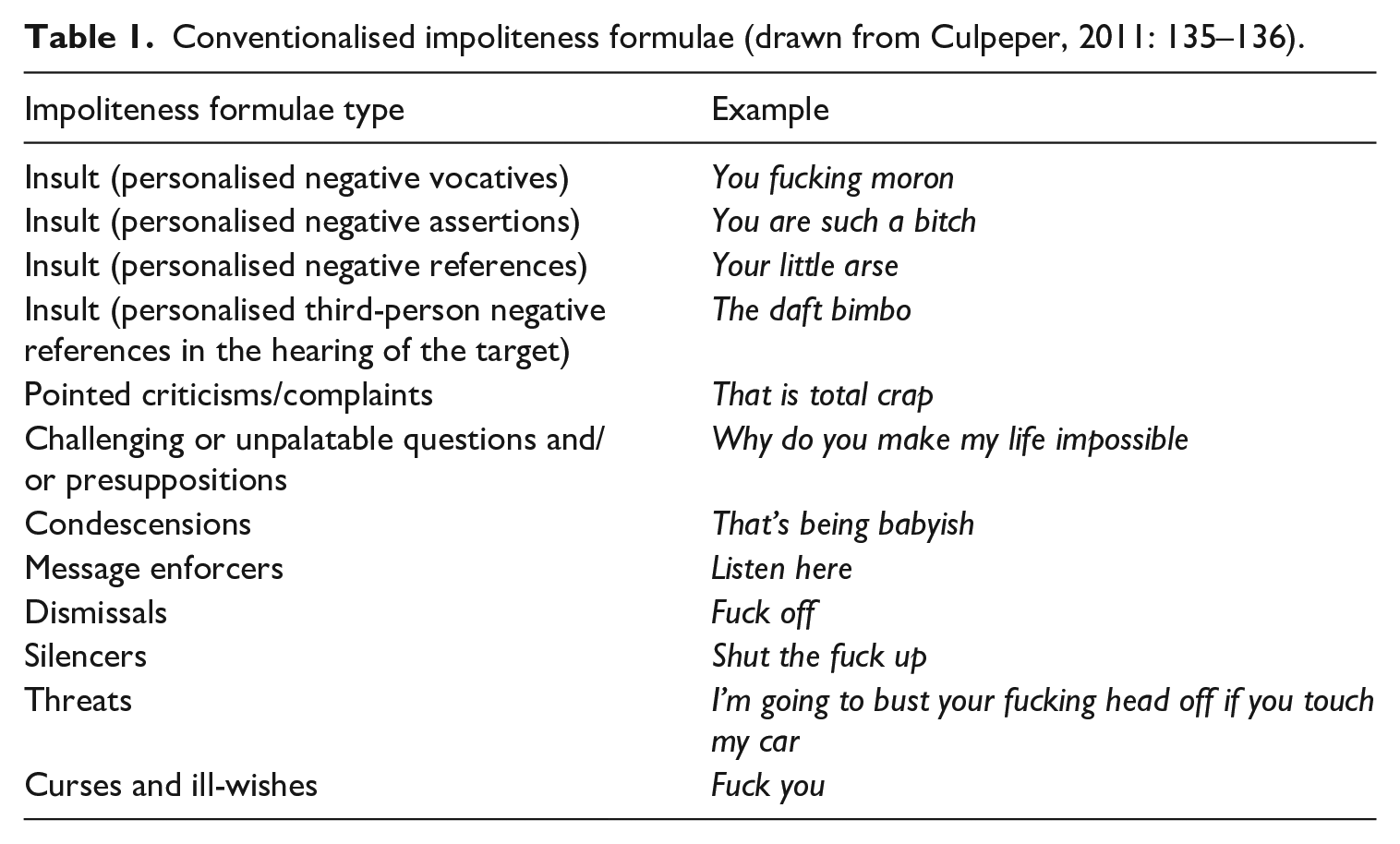
The same types of impoliteness formulae displayed in Table 1 have been found in other languages and cultures (cf. Barreto Filho et al., 2019, for Portuguese data; Kleinke and Bös, 2015, for German data; Lai, 2019, for Chinese data). Obviously, no impoliteness formula guarantees a judgement of impoliteness (it could be a matter of banter) as impoliteness formulae are context-sensitive (see below). Nevertheless, they offer a way into the data.
Although (semi-)conventionalised impoliteness formulae occur densely in at least some types of highly offensive discourse (e.g. the religiously aggravated hate crimes discussed in Culpeper et al., 2017), it is, of course, not the case that impoliteness is only achieved by such formulae. ‘Implicational impoliteness’ is triggered by an expression or behaviour that mismatches either the local context, thus triggering potentially impolite conversational implicatures (in the manner of Grice, 1975), or other conventionalised expressions or behaviours in the same discourse (Culpeper, 2011: chapter 5). The former typically results in what might be thought of as insinuations, innuendos, aspersions, snide remarks and so on; the latter results in sarcasm, (biting) teasing and so on. This kind of impoliteness should not be thought of as automatically less offensive than an impoliteness formula. Making a recipient work out the implied meaning also makes them dwell on that meaning.
The nature of politeness has been studied in a variety of discourses, including political discourses (Tracy [2017] offers a good overview). One of the earliest notable papers on impoliteness and political discourse is Harris’s (2001) study on the British House of Commons. There she notes that the use of particular, but certainly not all, kinds of impoliteness is licenced by the context, and even viewed positively – a fact which is pertinent to our case studies below. This raises the issue of who might be viewing impoliteness positively. In a relatively early impoliteness paper, specifically on ‘varieties of rudeness’, Kienpointner (1997: 272) observes that:
Public debates in parliaments or in a heckler’s shouts during speeches can demonstrate astonishingly rude utterances. In these cases we have to deal with the other subtypes of strategic rudeness, where the participants try to damage the positive and negative face of their opponents in public to reach their strategic goals (e.g. to win an election, to convert people, to make fun of other people, etc.).
Note that Kienpointner (1997) has ‘public’ debates in mind: politicians are playing to an audience, which includes their own supporters.
A note on traditional political press conferences
Political press conferences are institutionalised forms of political communication, characterised by certain norms and rules (e.g. Bhatia, 2006; Ekström and Eriksson, 2018; Kumar, 2005, 2007). These are some of the norms that those politicians can breach in the process of shameless normalisation. Ekström and Eriksson (2018: 345) point out that press conferences are a ‘distinctly formalised frontstage activity’, with politicians often literally on a stage before the public. As Bhatia (2006: 176) puts it, a political press conference ‘is given its recognition from the rules of talk and action: who says what, where, when and why’. Typically, addressors are the politicians, who have been ‘prepped’ in advance by press secretaries, spin-doctors and diplomats; the receivers and hearers the journalists, and of course the general public.
Question-answer sessions are generally perceived to be important ways in which journalists can hold politicians accountable for their actions. In the U.S.A., the president’s ‘sessions with the press are the only established forum where he regularly submits to questions on what he does and why’ (Kumar, 2005: 171). Over time, and especially in the U.S.A., press conferences revolving around short question-and-answer sessions in which a politician meets a rotating pool of reporters have increased (Kumar, 2005: 188). Clayman and colleagues (e.g. Clayman and Loeb, 2018) have focussed on the nature of journalists’ questions, especially their aggressiveness, and how they have changed over time. They found that in the U.S.A. journalists’ questions have become increasingly direct and adversarial. Note that such aggressiveness is not necessarily impolite. Asking tough questions is legitimate within this genre; it is a matter of the journalists doing their job. But what of aggressiveness and the politicians’ talk? Ekström (2009) shows in his analyses how the former U.S. President George W. Bush used jokes and laughter to express hostility, deployed interruptions to control the allocation of turns or responded to hostile questions with hostile answers. Such hostility is typically off record and ambivalent. Moreover, in the final sentence of the paper Ekström (2009: 412) cautions that ‘the short-term achievement of interruptions and jokes can also coincide with long-term negative consequences in terms of the president’s general public reputation’.
Press conferences, then, seem to be exponents of politeness normality, a means of smoothing the paths of governmental agendas. This description of press conferences, however, is characterising the genre before the rise of right-wing and far-right populist politicians such as Berlusconi and especially Trump. It is to the press conferences of those politicians that we now turn.
Normalising impoliteness and the discourses of right-wing and far-right populist leaders
Berlusconi and the press conference
Silvio Berlusconi’s time as leader of Forza Italia and Italy’s prime minister (1994–95, 2001–06, 2008–11) was characterised by the frequency and nature of different kinds of scandals (García, 2011; Newell, 2018): financial scandals, including a conviction for tax evasion; sexual scandals, including allegations of sexual relations with minors; power scandals, including accusations of altering laws for personal benefit, as part of a broader conflict of interests between his media empire and his political office; and, most pertinent to this paper, talk scandals, including gaffes, inappropriate innuendos and insults against journalists and other politicians, such as the one we mentioned in the Introduction. Such talk scandals occurred against the background of Berlusconi’s distinctive approach to political communication, which combined some formal and sometimes archaic lexical choices with a highly personal, accessible and light-hearted style, including jokes, banter, conventional idioms, Sports and War metaphors and story-telling (Amadori, 2002; D’Agostino, 2015; Ruzza and Balbo, 2013; Semino and Koller, 2009; Semino and Masci, 1996). This was in sharp contrast with the impersonal, formal and technical language that had previously characterised Italian political communication, and that used to be negatively labelled as ‘politichese’ – an incomprehensible politicians’ jargon. The dark side of Berlusconi’s accessibility and charisma as a communicator, however, was a distinct lack of restraint (Bolasco et al., 2006), which was particularly evident in his own brand of humour, his reactions to criticism and his attacks on the judiciary, journalists and political opponents.
We now turn to a particular talk scandal that involves two press conferences and that exemplifies lack of restraint and verbally aggressive reactions to criticism.
Analysis of first press conference
On 6th November 2008, Berlusconi held a joint press conference in Moscow with then Russian President Dmitry Medvedev. In the question-answer section of the press conference, he was asked about his perception of the future of relationships between the US and Russia, in view of the election of Barack Obama – the first African-American U.S. President – two days previously. Berlusconi replied:
Obama ha tutto per poter andare d’accordo con lui [i.e. Medvedev]. Perché è giovane, è bello e anche abbronzato.
Obama has all that’s needed to get on with him [i.e. Medvedev]. Because he’s young, he’s handsome and even tanned.
This remark was delivered in an ostensibly light-hearted manner, with a light pat on Medvedev’s arm and a ‘knowing’ look at the audience before uttering the words ‘e anche abbronzato’ (‘and even tanned’).
By focusing on personal, ad hominem (rather than professional) traits that, in his view, Obama and Medvedev have in common, Berlusconi already breaches protocol and potentially patronises both politicians as inexperienced and light-weight, in contrast with himself. Indeed, Berlusconi had, on the previous day, stated that he would be happy to give Obama some advice. The inclusion of ‘abbronzato’ (‘tanned’) as the third quality that Obama and Medvedev share, however, works differently for each politician. For the Russian President, it can be interpreted as a literal description that may have applied at the time – and possibly an appreciative one, given Berlusconi’s well-known concern for his appearance, widely advertised cosmetic surgeries and permanent tan, fake or otherwise (Mazzoleni, 2008; see also Figure 1). For Obama, it is an allusion to a skin colour associated with race – and therefore a deeply inappropriate and offensive remark, particularly in a diplomatic press conference, where Berlusconi participated in his institutional role.
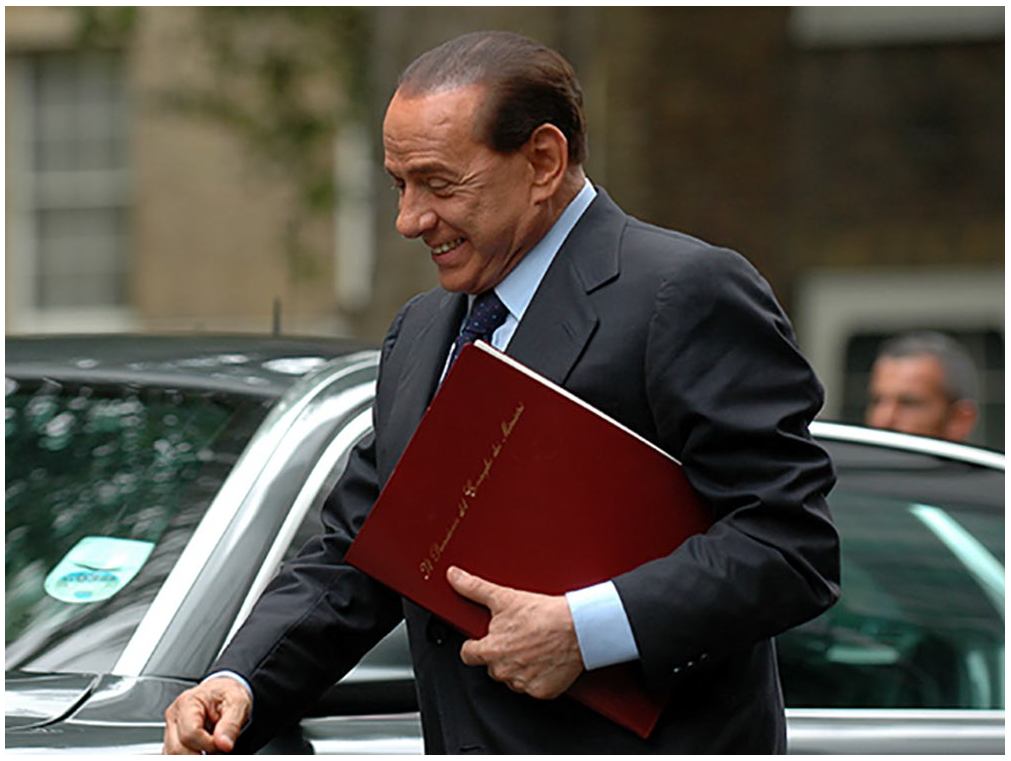
Silvio Berlusconi at number 10 downing street in 2008 (image licenced with CC BY-NC-ND 2.0.).
While studies of impoliteness tend to focus on verbal aggression towards an addressee, Culpeper’s (2011: 135) typology of insults includes ‘personalised third-person negative references (in the hearing of the target)’. Here the public nature of the utterance makes it potentially accessible to Obama as target, although, to the best of our knowledge, there was no official reaction at any point. The negativity of ‘abbronzato’ (‘tanned’) as a reference to Obama is a much more complex issue, however. Obama’s blackness is alluded to, rather than being directly mentioned; and the ‘negativity’ does not stem from a reference to race per se, but from the casual, irrelevant and tongue-in-cheek nature of the allusion to it. In Culpeper’s (2011) terms, this is a case of ‘implicational’ impoliteness. The offence is not conventionalised in the words that are used, but an implication triggered by the use of a particular word (‘abbronzato’) in a specific context.
Reactions to first press conference
Following outraged reactions from politicians and commentators in Italy and internationally, Berlusconi was repeatedly asked about this remark by the media. Later the same day, he responded to journalists mentioning critical reactions with a more general and prototypical third person insult:
Dio ci salvi dagli imbecilli, che purtroppo che ne sono tanti in circolazione
God save us from imbeciles, as unfortunately there are many around
Berlusconi was also reported as saying that his comment was intended as a compliment towards Obama, and that his critics lacked a sense of humour (https://www.repubblica.it/2008/11/sezioni/esteri/italia-obama/italia-obama/italia-obama.html). In Culpeper’s terms, he did not accept that, in context, the description of Obama as ‘abbronzato’ (‘tanned’) amounted to an insult via a ‘negative reference’, but rather claimed that the opposite was the case. Berlusconi’s political allies in Italy similarly described Berlusconi as having launched a ‘charm offensive’ (‘operazione simpatia’) towards the newly elected U.S. President, and dismissed critics as representatives of a ‘gloomy left wing’ (‘sinistra tetra’) (https://www.repubblica.it/2008/11/sezioni/esteri/italia-obama/italia-obama/italia-obama.html).
The remarkable nature of Berlusconi’s allusion to the colour of Obama’s skin is shown, amongst others, by the fact that it is usually included in compilations of Berlusconi’s ‘gaffes’, ‘screw-ups’ or ‘memorable moments’ (e.g. https://www.marketwatch.com/story/berlusconis-gaffes-the-greatest-hits-2013-08-02). A YouTube video showing the relevant snippet of the press conference received 252 comments. We manually coded the first 100 comments for the valence of any evaluative remarks they included on Berlusconi’s description of Obama. In this way, we identified 9 positive evaluations, 49 negative evaluations, 12 ambiguous evaluations and 29 comments on other matters (often mutual insults amongst individuals). Positive evaluations included general expressions of support for Berlusconi, for example: ‘Silvio ti amo! x fortuna che c’è silvio!!!’ (‘Silvio I love you! Thank god we have Silvio!!!); and appeals to a sense of humour, for example: ‘Ma dai smettiamola è solo una battuta!!!’ (‘Please let’s give this a break! It’s only a joke!!!’). Negative evaluations are divided between:
Apologies for Berlusconi’s behaviour, for example, ‘SCUSA A NOME DI TUTTA L’ITALIA!’ (‘Sorry on behalf of the whole of Italy!’);
Implied criticism, for example, ‘secondo me, sarebbe giusto andare in pensione tra i 60 ed i 65 anni’ (‘in my view, it would be right to retire between 60 and 65’; NB: At that point, Berlusconi was 72 years old);
Insults towards Berlusconi, for example, ‘che faccia di cazzo’ (‘what a dick face’);
Expressions of outrage and shame, for example, ‘Mi vergogno di essere italiano’. (‘I am ashamed to be Italian’).
Analysis of second press conference
The following day, 7th November 2008, Berlusconi was asked about his previous comment by a U.S. journalist at another press conference, following an EU summit in Brussels. The exchange proceeded as follows:
Presidente, si rende conto che il suo commento su Obama è offensivo negli Stati Uniti?
Ma no!
Ma si rende conto . . . perché non chiede scusa. Sono Scherer di Bloomberg.
Ti sei anche tu messo nella lista di quelli che ho definito ieri? Bene! Un altro nuovo, un nuovo ingresso!
Perché non chiede scusa? E’ offensivo!
Arrivederci! Ma dai! Ma per favore!
[Berlusconi laughs, stands up and leaves]
Ma per favore, per favore chiedi scusa tu all’Italia. . .non c’è il senso del ridicolo.
Mr President, do you [FORMAL] realise that your comment on Obama is offensive in the US?
No way!
But do you realise . . . why don’t you apologise. This is Scherer from Bloomberg.
Have you [INFORMAL] joined the list of the people I gave a definition of yesterday [IMBECILLI]? Good! A new, a new entry!
Why don’t you apologise? It’s offensive!
Goodbye! Come off it! Oh please!
[Berlusconi laughs, stands up and leaves]
But please, you apologise to Italy . . . there is no sense of humour.
Here the journalist, Steven Scherer, prefaces his request for an apology by spelling out that Berlusconi’s remark about Obama is deemed offensive in the US. While both this negative description of the remark and the request for an apology are face-threatening for Berlusconi, the journalist’s behaviour is consistent with the kind of challenges to politicians that are routinely posed at press conferences, as well as explained by the taboo status of jokes about race in a US context (and beyond). Scherer also follows the conventional norms of press conferences by addressing Berlusconi as ‘Presidente’ (the official title of the Italian Prime Minister is ‘Presidente del Consiglio dei Ministri’, ‘President of the Council of Ministers’) and using third person singular verb forms for Berlusconi, which, in Italian, correspond to the formal version of ‘you’, that is, ‘Lei’ (literally, ‘She’).
Berlusconi responds by using the informal second person pronoun for the journalist, that is, ‘tu’. This form of address breaches both the norms of formal interactions amongst adults (of which press conferences are arguably an extreme example) and the expectation of mutual politeness created by Scherer’s (otherwise unremarkable) use of the formal variant of ‘you’. Berlusconi also dismisses the request for an apology through an exclamative dismissal (‘Ma no!’; ‘No way!’), and indirectly insults the journalist by including him in his previous derogatory description of those who criticised his remark, that is, ‘imbecilli’ (‘imbeciles’). 9 This is once again achieved via implicational impoliteness: via a leading question (‘Ti sei anche tu messo nella lista . . .’; ‘Have you also joined the list . . .’) and a sarcastic, mock congratulatory comment involving a mismatch between the use of words suggesting positive evaluation and the context: ‘Bene! Un altro nuovo, un nuovo ingresso!’ (‘Good! Another new one! A new entry!’). When Scherer repeats the request for an apology and the description of Berlusconi’s original remark as offensive, Berlusconi cuts the press conference short by means of a conventional greeting (‘Arrivederci’/‘Goodbye’) that could also be perceived as sarcastic in context. The following exclamations (‘Ma dai!’/‘Come off it!’ and ‘Ma per favore!’/‘But please!’) are not conventionally impolite but, in context, function as further dismissals (see Fedriani, 2019 for impolite uses of ‘per favore’ in particular). While he is already standing, Berlusconi addresses a retaliatory request to the journalist for an apology to Italy, justified by implying that he has no ‘senso del ridicolo’ (literally, ‘sense of ridicule’). Berlusconi then leaves the press conference.
Reactions to second press conference
Media reactions to this incident were still primarily focused on Berlusconi’s original, and much more remarkable, comment about Obama. However, a YouTube video covering the last part of the second press conference (https://www.youtube.com/watch?v=hekruRq14JU) attracted 421 comments. Based on our coding, the first 100 comments are much more evenly divided, in terms of evaluation, than those for the original press conference, with 27 positive evaluations (e.g. ‘Grande Silvio!!!’; ‘Brilliant Silvio!!!’), 39 negative ones, 7 ambiguous cases and 29 comments on other matters. As with the previous press conference, negative evaluations included expressions of shame, such as ‘Che vergogna!!!!!’ (‘How shameful!!!!’). The owner of the channel where the video was posted also made a reference to shamefulness in the title of the video: ‘Berlusconi vergognoso: insulta giornalista USA e lo aggiunge alla lista degli imbecilli’ (‘Shameful Berlusconi: he insults a US journalist and adds him to the list of imbeciles’).
As a whole, this incident displays a marked contrast between, on the one hand, the norms of press conferences and of a broader international ‘moral order’, and, on the other hand, Berlusconi’s behaviour and justifications for this behaviour. An offensive racist remark about another country’s head of state is first redefined and then justified as a compliment, a typical strategy of blame avoidance (Hansson, 2015). The perception of offense is dismissed as a lack of sense of humour. And those who mention the causing of offence are insulted as ‘imbeciles’ both in an informal interview and in a formal press conference, including, as in Scherer’s case, if they are journalists from the country in question. What is avoided at all costs by Berlusconi is not just an apology but any expression of regret, or of understanding of the perspective of the other side. This is a clear manifestation of shameless normalisation.
As we mentioned at the beginning of this section, this approach to norms of formality and politeness, and to sensitive or taboo topics, is characteristic of Berlusconi’s public figure. On the one hand, he expresses the attitudes of an imaginary average Italian person, who sees no harm in casual, humorous references to race and privileges a sense of humour over adherence to norms that might be dismissed as ‘politically correct’. On the other hand, Berlusconi also embodies the stereotypically macho attitude of the strong leader who stands above other people and the norms that apply to them.
While Berlusconi’s approach generally damaged Italy’s international reputation, domestic reactions mostly proved that it worked for him, as the outrage of his opponents was balanced by increased support from his own base, who perceived him as authentic and as speaking and behaving as an ‘ordinary’ person. Berlusconi’s utterances refer to the ‘common-folks type’ of the ad populum argument, where the speaker can portray himself simultaneously as part of the group and as a fighter for the group (cf. Walton, 1999: 222). This subtype of the argumentum ad populum supports the belief that somebody who behaves like everybody else, like ‘us’, is more credible and trustworthy. Moreover, such talk scandals also add an element of entertainment to politics (cf. politicontainment in Riegert, 2007), and, over time, progressively lower the bar of what is regarded as acceptable in a variety of institutional settings.
Trump and the press conference
Donald Trump, 45th president of the U.S.A. needs less introduction than Berlusconi. Trump is no stranger to scandalisation and provocation. Indeed, the title of a recent and important book makes this clear: Language in the Trump Era: Scandals and Emergencies (2020, edited by Janet McIntosh and Norma Mendoza-Denton). McIntosh (2020: 1) writes in the first page of the book:
Language has been repeatedly enlisted to produce and fortify Trump’s reality, and it has scandalised liberal Americans as it inaugurated the tone of Trump’s presidency – from ‘Make America Great Again’, which critics felt suggested a racist nativist atavism, to the T-shirts at Conservative rallies reading ‘Trump 2016: Fuck Your Feelings’.
Yet, no systematic attention is given to matters of (im)politeness. Neither politeness nor impoliteness are listed in the index, and neither are related notions such as aggressive, antagonistic, offensive or more specific categories such as insults. (Im)politeness is not specifically mentioned in any of the example questions which the volume seeks to address. This is not to say that there is nothing relevant in this book. In the first chapter alone, we see reference to Trump’s ‘abrasive’ (p. 16) style; that his style might ‘aggravate his more hyper-educated and smug detractors’ (p. 17); a reference to his ‘rudeness’ (p. 18) and a description of his language as ‘raw and harsh’ (p. 18). What is lacking is a coherent theoretical framework underpinning these descriptive comments. Casting the net more widely, Trump’s use of Twitter as a vehicle for aggressive impoliteness has in particular received attention, specifically with respect to frequent misogynistic attacks which simultaneously strengthen support from his own base and normalise sexist attitudes and beliefs (cf. Kreis, 2017; Montgomery, 2017; Wodak, 2021). Of particular relevance to our focus on the shameless normalisation of impoliteness is Smith and Higgins’s (2020: 560) suggestion that, over time, his tweets have progressively lost their shock value: ‘this refusal of the political decorousness expected of senior office has been normalised, and the void filled with the language of convivial patronage, prejudice and exclusion’.
Analysis of a press conference
On 1st October 2018, a press conference was conducted outside the Whitehouse in the Rose Garden to highlight the revamped U.S.-Canada-Mexico trade agreement. On the podium, Donald Trump stood behind a lectern; about a metre behind him stood approximately 22 diplomatic officials. In front were the journalists, at least 60 of them. Trump selected the journalist, Cecilia Vega, from ABC News to ask a question. Their interaction was recorded and uploaded to a number of YouTube channels. A transcription of the clip at https://www.youtube.com/watch?v=fm1-74pp9Uc follows:
(1) (2) (3) (4) (5) (6)
The opening of this interaction begins with a conventional positive welcome. Trump’s next move is to allocate a turn to a journalist, thereby initiating the question-answer phase of the press conference. He is well known for viewing many particular media outlets and journalists negatively, often condemning them as purveyors of ‘fake news’. Vega of ABC News is not generally favoured but is selected for a question nevertheless, and thus might have reason to be shocked. However, the long delay in delivering her answer was caused, as other video clips of the same event show, by Vega’s conspicuous attempts to procure a microphone – that is not evidence of shock. Vega denies that she was shocked, I’m not, and thanks the president, presumably for picking her. Thus, a polite interactional backdrop is created for the impoliteness that follows in Trump’s turn. That’s ok appears to be a polite acknowledgement of the thanks. This is followed by I know you’re not thinking. It is plausible that Trump misheard what Vega had said as ‘I am not thinking Mr President’, given the quality of the audio, but it is not clear how that meaning would fit, given that the delay in her response was clearly not caused by inattention. Trump makes a personalised negative assertion, a variety of insult, a particular conventionalised impoliteness formula (Culpeper, 2011: 135). This is immediately followed by an exacerbation of offensiveness: you never do. As Culpeper (2011: 139) observes,] Impoliteness is very much about signalling behaviours that are attitudinally extreme or understanding them to be so. Intensifying an impoliteness formula makes it less ambiguous, less equivocal – it helps secure an impoliteness uptake.
This kind of behaviour dramatically violates the norms of the traditional press conference described earlier. In addition, it violates the locally created context of politeness. Of course, by 2018, Trump’s impolite behaviours are well known, and perhaps beginning to normalise the genre. Nevertheless, Vega’s reaction, I’m sorry, seems to signal disbelief in what she has just heard and is consistent with the idea that the offence has been taken.
Reactions to the press conference
That this interaction was norm-breaking at some level is evidenced by the attention it received. The interaction was played on several talk shows, including Jimmy Kimmel Live, Late Night with Seth Meyers and The View, and elicited gasps of apparent shock from the audiences. This one YouTube clip alone (https://www.youtube.com/watch?v=fm1-74pp9Uc) received almost a million views and attracted 2485 comments (at the time of writing this paper). Of course, these comments do not represent a cross-section of society, but the group of people who are motivated enough to take the trouble to comment. The commenters seem to have been not only shocked by the impoliteness but, in some cases, entertained by it (see Culpeper, 2011: 233–239). This is very clear from the comments, which include ‘Hahahaha’, ‘I love it . . . lol’ and ‘Such a hilarious show’. This particular YouTube video clip is entitled ‘Trump has testy exchange, insults female journalist’. Insults, and possibly testy, position the interaction in the realms of impoliteness. As with talk scandals, it is the discourses evaluating the behaviours that establish moral standards and viewpoints. Note also the use of female. Trump’s attacks on male journalists are also the subject of YouTube video clips, but they are not labelled as attacks on ‘male journalists’. Via Grice’s (1975) maxim of quantity, the implicature is that there is something of particular significance in the fact that the journalist was female. This may be a reference to his well-established pattern of misogynistic attacks demeaning female journalists and/or on women more generally. There may also be an appeal to the prescriptive norm (social ought) that women should be the recipients of politeness more than men, and thus it is more shocking if they are insulted. This would be consistent with the occasional comments below this video clip claiming that the title is a ‘click bait’ strategy emphasising shocking elements to get people to look.
Consistent with talk scandals, some comments on this YouTube clip are negative, such as:
What a freaking jerk Awful awful man! Can’t wait for the future documentaries on him while he rots in jail! This was on (!) of the rudest things ever Wow. . . vile. Unbelievable.
However, unlike talk scandals, these do not reflect the majority. As for reactions to Berlusconi’s press conferences, we coded the first 100 comments below the video clip, according to whether they were positive evaluations of Trump’s behaviour, negative evaluations of Trump’s behaviour, concerning some other aspect of the discourse (typically comments on the official standing behind Trump) or were ambiguous in terms of whether they were positive or negative evaluations. There were 45 positive reactions, 6 negative reactions, 35 comments on other matters (e.g. comments on the officials standing behind Trump) and 14 ambiguous evaluations. Positive evaluations include:
I love when he kicks them, i love his styl I know you’re not thinking, you never do. That’s just great! Great Lmao, man i love this guy Trump
Note that the insult you never do is specifically picked out for positive evaluation. The first comment alludes to an ‘us’ and a ‘them’. ‘Them’ seems to be a collation of ‘liberals’, women and the media, as the following comments illustrate: ‘So many butthurt liberals  ’, ‘Aww. He offended the poor wittle feminist! ’ and ‘Associated press, you are fake news. Right?’. ‘Us’ largely concerns Trump’s political base, with their associated ideology, as is illustrated for example by the occasional use of the MAGA abbreviation (‘Make America Great Again’), the campaign slogan popularised by Trump in 2016. For example, one comment is: ‘I hope 1 day, soon, liberal media does away with the division and toxic animosity they created and gives credit where it’s due. MAGA usususususususususususususus’.
On the face of it, then, Trump’s interaction has the trappings of a talk scandal, with the notable exception that it does not generally elicit negative feedback – significant quantities are positive. It is a case of what would traditionally have been a talk scandal being shamelessly normalised.
Further possible evidence of this is in the production of the White House transcript of this event. The first transcript read (our underlining): ‘That’s okay. I know you’re not
Conclusions
Historian Philipp Ther (2019: 168) poses the following questions ‘Are we sliding, since the annus horribilis 2016, in Europe or the US, back in the direction of fascism? . . . Is Trump a fascist? I think, rather, that he is an American version of Berlusconi, which makes him no less objectionable’. What we have shown in this paper supports claims that both politicians behave in ways that violate the moral order, arguably as part of a deliberate strategy.
It makes sense to reflect on what functions the shameless normalisation of explicit and implicit impoliteness might have. After having discussed many examples of normalisation of far-right discourse in EU member states, Wodak (2021: 68) distinguishes primarily six functions of such behaviour: first, performing authenticity when challenging traditional conversational conventions and norms of political correctness; second, rejecting any content-related, rational dialogue while simultaneously using well-known mechanisms of political propaganda; third, challenging constitutive democratic principles when attacking the freedom of the press and well-evidenced empirical facts; fourth, establishing identification with the party and its agenda by offending and undermining the so-called elites and the establishment; fifth, providing an efficient distraction from intended measures via scandalisation and provocation that might aggravate one’s own electorate (e.g. ‘the dead cat strategy’) and sixth, facilitating the implementation and thus normalisation of exclusionary and undemocratic policies and measures by mainstream political parties.
The fact that the behaviours we have discussed are received positively, and presumably regarded as acceptable, by core followers of Berlusconi and Trump shows that impoliteness offers a strategic means of performing authenticity and thus, facilitates their normalisation. A number of scholars have observed the fundamental connection between impoliteness and emotion (e.g. Culpeper, 2011; Kienpointner, 2008; Langlotz and Locher, 2017). Garcés-Conejos Blitvich (2009: 287), studying impoliteness and identity in the U.S. news media, argues that:
impoliteness, with its connection with ‘true emotions’ and lack of restraint versus the rationality that underlies the uses of politeness [. . .] is strategically used to construct the message as truthful: the interviewer is compelled to say it like it is. [. . .] However, [. . .] impoliteness need not stem from true emotions, but can be strategically used against those interviewees that represent a different viewpoint from the audience’s.
Overall, Trump’s and Berlusconi’s success lies in being able to convey to certain parts of the Italian and U.S. electorate that they are ‘authentic’, ‘real, honest and genuine’ (Cameron, 2020: 161). They are both admired and respected as mavericks, successful business men and alpha-males. Indeed, many voters admire and identify with such personas and do not seem to mind the continuous transgression of taboos and conventions. As Montgomery (2017: 18) puts it in relation to Trump: ‘Trump’s exaggerated and inappropriate claims about himself carried a strong appeal for his core constituency on the grounds that they come across as an authentic form of self-expression: Trump speaks how he feels and says what he means’.
In a study of Trump’s use of banter, however, Deborah Cameron points out that, in spite of its unconventional, norm-breaking aspects, Trump’s behaviour is at least partly conventional with respect to his treatment of women.
Though in many respects it would be fair to describe Donald Trump as an unconventional president, in one respect he has been anything but unconventional: His administration epitomises the values and practices of traditional fraternal patriarchy. In Trump’s White House, as in the locker-room, women continue to be excluded from conversations in which men discuss their bodies and make decisions about their lives. (Cameron, 2020: 166)
From this perspective, Trump’s treatment of the journalist Cecilia Vega is conventional in its sexism, but unconventional in its impoliteness in the specific context of the public press conference. Although the examples we have discussed in relation to Berlusconi do not involve sexist remarks, he also cultivated a hyper-masculine identity that involved the belittling of women as sexual objects, alongside the sexual scandals we mentioned earlier (e.g. García, 2011).
Our discourse-historical analysis has first focused on the ‘narrower’ levels of context, namely, each episode itself and reactions – both positive and negative – in the immediate aftermath. We have then provided direct evidence of normalisation on relatively short timescales, that is: failure on the part of both politicians to acknowledge the offence and apologise during each incident and in subsequent hours and days; and a substantial proportion of positive comments on YouTube videos of each episode, alongside many negative, outraged ones. In Trump’s case, we also noted how the traditional norms of politeness were initially reflected in the record, and only later corrected to what he actually said, reflecting a clash between the old norms and the new. However, evidence of longer-term processes of normalisation can be drawn from other studies. For example, Berlusconi’s use of ‘violent and incendiary language’, of which the racist remark we have discussed is an example, has not only been linked to developments in Italian politics in the 1980s and 1990s (notably the populist style of Northern League’s leader Umberto Bossi), but has also been traced back to the influence of the polarising approach developed by U.S. Republican strategists such as Lee Atwater and Karl Rove as part of a new ‘right-wing American “playbook”’ (Shin and Agnew, 2008: 4–5). As such, Berlusconi can be seen both as a precursor of Trump-style politics and as a ‘product of the export of the very system now in place in American electoral politics’ (Shin and Agnew, 2008: 5). Moreover, the longer-term normalisation of impoliteness in Italian political discourse can be observed, for example, in the subsequent success of comedian-turned-politician Beppe Grillo, who routinely used insults for other politicians, including for Berlusconi himself, such as ‘psiconano’ (‘psychodwarf’) (Bortoluzzi and Semino, 2016).
In this way, far right ideologies and practices have moved and continue to move from the margins into the centre. Thus, we are able to observe the simultaneity of a range of coded and explicit discursive practices that seem to test the stability/flexibility of conventional norms, oscillating between the sayable and unsayable in specific contexts.
Footnotes
Declaration of conflicting interests
The author(s) declared no potential conflicts of interest with respect to the research, authorship and/or publication of this article.
Funding
The author(s) disclosed receipt of the following financial support for the research, authorship, and/or publication of this article: This research was supported by the Economic and Social Research Council, part of UK Research and Innovation (grant reference: ES/R008906/1).
Notes
Author biographies
 for more information.