




Abstract
The increasingly used method of corpus-assisted Critical Discourse Analysis (CDA) has recently been criticised for lacking identifiable and accountable methods in its qualitative analyses. For example, manual concordance analysis (a popular corpus technique involving the ‘close reading’ of text) rarely explicates the qualitative method involved – that is, if any has been used at all. This article seeks to strengthen qualitative concordance analysis in the context of the press representation of protests. In doing so, it theoretically formulates the novel linguistic application of Tilly’s sociological ‘WUNC’ framework, which argues protests and social movements are successful when they display worthiness, unity, numbers and commitment. By mapping prominent CDA theories onto Tilly’s definitions of worthiness, unity, numbers and commitment, the article offers a replicable qualitative approach to the analysis of concordances specific to linguistic research about the press representation of protests.
Keywords
Corpus-assisted CDA and its shortcomings
The often praised ‘methodological synergy’ (Brookes and Baker, 2021: 33) of corpus linguistics (CL) and critical discourse analysis (CDA) is becoming an increasingly popular way of carrying out the critical analysis of texts (Johnson, 2012). Broadly, CL is the method of using large bodies of electronically encoded machine-readable texts to study a specific set of research questions (McEnery and Hardy, 2012: 1). As the texts are electronically coded, computational calculations can be carried out on data, allowing researchers to quickly read, search and manipulate the texts (McEnery and Hardy, 2012: 2), revealing linguistic patterns and frequency information that could otherwise take months to uncover manually (Baker, 2006: 2). CDA is understood as the study of discourse ‘with an attitude’, in that it takes a dissident stance to the study of language, holding that power abuse and inequality can be enacted, (re)produced, legitimated and resisted by text and talk in a social and political context (Van Dijk, 2015: 466, italics in original).
It is thought that combining CL and CDA methods help to remedy the frequent criticism that CDA is prone to researcher bias (Baker, 2006: 11), as according to Breeze (2011: 503), CDA and its varied methods of qualitative analyses lack ‘scholarly rigour’. As such, CDA’s critics comment that its analyses do not include the ‘systematic application of a theoretical model’, but rather incorporates ‘a kind of ad hoc bricolage which takes from theory whatever concept comes usefully to hand’ (Widdowson, 1998: 136). Perhaps understandably, Widdowson (1998) questions the validity of conclusions about a particular text’s ideology when they have been drawn ‘more or less randomly’ by practitioners of CDA who feel ‘intuitively’ that their results provide ideological meaning (Breeze, 2011: 503).
CDA’s critics generally agree then, that to overcome these methodological shortcomings, practitioners should implement objective standards and apply robust scientific methods to their analyses (Breeze, 2011; Rheindorf, 2019; Widdowson, 1998). It is now well established that applying CL procedures to CDA frameworks ‘exploit’ both their strong points (Baker et al., 2008: 283). On the one hand, corpus methods reveal linguistic patterns and frequency information (Baker, 2006: 1–2). On the other hand, CDA’s rich theoretical underpinning allows for ‘in depth finegrained analysis and thick explanations’ (Marchi and Taylor, 2009: 3). Used together, CL’s objective and quantitative approaches can reveal the degree of generality of, or confidence in, CDA’s findings and conclusions (Baker et al., 2008). But what of CL’s widely used qualitative method of manual concordance analysis?
Manual concordance analysis is a procedure by which corpus analysts investigate the occurrences and behaviours of particular words (Weisser, 2016: 80) through a close reading of their concordance lines (the context in which they originally appeared). Like CDA, this qualitative corpus method has come under fire as the means of its descriptive claims are often ambiguous or undocumented. Indeed, even the aforementioned term close reading so often used to describe concordance analysis is very vague, foreshadowing the criticisms of its (often very vague) application. Manual concordance analysis has been criticised for being carried out ‘without explicating the qualitative method involved’ - that is, if any has been used at all (Rheindorf, 2019: 33). As such, when gleaned from close reading, interpretations grounded in CDA seem to operate randomly, moved by the personal whim of the researcher rather than scholarly principle (Breeze, 2011: 498). This lack of explicit analytic criteria leaves manual concordance analysis a ‘readily available but unspecific token statement’ (Rheindorf, 2019: 33) that lacks transparency, replicability and can lead to a high risk of researcher bias (Widdowson, 2004: 109). Critics therefore argue for the incorporation of identifiable and accountable procedures and categorisations often missing in qualitative corpus analysis (Rheindorf, 2019: 33). This article seeks to provide a framework to address some of these criticisms. While it does not claim to remove all aspects of researcher bias – the analyst’s interpretation is a necessary aspect of all qualitative analysis – the article does seek to provide a replicable framework that can be applied to the analysis of concordance lines in research concerning the press representation of protests.
At the same time the use, and criticism of, qualitative corpus-assisted CDA methods have increased, so too has the academic attention protests have received. Corpus-assisted CDA is a popular methodological approach to the analysis of how protests are reported on and represented in the press, and is used widely in contemporary research (e.g. Brindle, 2016; Gupta, 2016; Ming and Ma, 2021; Pérez-Arredondo, 2019; Wang, 2022). This article aims to contribute to this growing literature by providing a robust framework through which such coverage can be critically analysed. In doing so, it transforms Tilly’s (2004) sociological conceptions of worthiness, unity, numbers and commitment (WUNC) to answer:
How can a linguistic WUNC framework be theoretically realised?
How can the linguistic WUNC framework be used in corpus-assisted CDA?
Are linguistic realisations of WUNC used in The Express’s coverage of Brexit-related protests, and if so, how?
Subsequently, the article is divided into two parts. Part one will address RQ1 by explaining WUNC, its previous uses and its applicability to CDA. It will then set out some of the possible ways in which WUNC can manifest in language and grammar to form a theoretical linguistic WUNC framework. In answering RQs 2 and 3, part two will apply the framework to the analysis of The Express’s coverage of Brexit-related protests to demonstrate the framework’s use.
Part one
WUNC
Charles Tilly was a prominent researcher of social movements and his work revolutionised our understanding of protests, social conflict and public contention (Collins, 2010: 5; Krinsky and Mische, 2013: 2). While his work was expansive, this article takes particular interest in arguments from his book Social Movements, 1768–2004 (Tilly, 2004). In this, Tilly (2004: 3) offers criteria as to what constitutes social movements, stating they emerge from a synthesis of three elements:
a sustained, organised public effort making collective claims on target authorities (let us call it a campaign);
employment of combinations from among the following forms of political action: creation of special-purpose associations and coalitions, public meetings, solemn processions, vigils, rallies, demonstrations, petition drives, statements to and in public media and pamphleteering (call the variable ensemble of performances the social movement repertoire) and
participants’ concerted public representation of WUNC: worthiness, unity, numbers and commitment on the part of themselves and/or their constituencies (call them WUNC displays).
This article focuses on the third element: WUNC displays. Throughout his career, Tilly gave numerous closely related definitions of what the concerted public representations of WUNC are. Broadly, worthiness relates to the credibility and dignity of protesters, unity relates to protesters’ oneness in pursuit of a common goal, numbers relates to a protest’s turnout and commitment relates to protesters’ perseverance. Presentations of WUNC are often termed displays and broadcasts because they are a performance – ‘something protesters deliberately seek to portray’ (Wouters and Walgrave, 2017: 366). This is particularly so in the media, where protesters can amplify their message to voters and potential supporters (Tilly, 2004: 84–85).
As a concept, WUNC acts as a theoretical scorecard against which a protest’s potential success, strength and impact can be measured (Tilly, 2006). Consequently, if any of the four components of WUNC are weak or not present, protests lose their strength; ‘entirely unworthy or completely uncommitted participants, regardless of how numerous and/or unified, quite undermine the impact of any demonstration’. However, a high display of one component can compensate for a low value of another; ‘a very small number of highly worthy, unified, and committed persons can produce a larger impact’ (Tilly, 2006: 291). Because of this, disputes over protest actions often centre on the components of WUNC. For example, numbers is contested if a protest’s advocates provide higher estimates of the number of participants than their critics (Tilly, 2006: 291). Notably, Tilly (2006: 292) comments that the frequent fierceness of such disputes indicate that WUNC displays embody effective demonstrations and represent ‘serious stakes’ – they convey crucial political messages that say ‘pay attention to us; we matter’.
Since its inception, WUNC has rarely taken centre stage as an analytical or methodological framework. Even Tilly himself never operationalised WUNC’s components ‘beyond exemplary descriptions’ (Wouters and Walgrave, 2017: 366), and this same exemplary use of WUNC can be seen in other successive research. Many studies only use Tilly’s (2004: 3) aforementioned three-part definition of social movements in their research without expanding on WUNC in further analysis (e.g. Bull, 2007; Kirby, 2010; Rule, 2011). In other studies, only particular elements of WUNC are considered in detail (e.g. Brissette, 2017; Thorson and Wang, 2020). Tilly’s work has therefore been ‘scattered across many publications’ that afford it ‘little resonance’ in research about social movements and protests (Wouters and Walgrave, 2015: 112). Nevertheless, a portion of academic attention has turned to the development of WUNC as a theoretical framework in recent sociological research.
To study the persuasive power of protest in Belgian television news broadcasts, Wouters and Walgrave (2015) undertook the first attempt to measure how protests are narrated in terms of WUNC. Adding ‘diversity’ as a fifth element to the acronym (dWUNC), Wouters and Walgrave (2015) investigated whether news items present protesters as dWUNC, and if so, how. In doing so, they created a physical scorecard on which coders gave demonstrations a numerical score on each dWUNC component. The results found high and low displays of dWUNC in the protest coverage, providing evidence that journalists use elements of dWUNC to narrate demonstrations and construct news stories. Following these findings, Wouters and Walgrave (2017: 363) sought to test the ‘widely cited but untested claim’ that protesters influence powerholders when they exhibit WUNC displays. To that end, they exposed elected politicians in Belgium to manipulated television news items of protests with varying levels of ‘WUNCness’ (Wouters and Walgrave, 2017: 363). Once the politicians were shown the stimulus, they were surveyed about their attitudes towards the salience of the issue, their position on the issue and the actions they intended to take in regard to the issue (Wouters and Walgrave, 2017: 363). The study found that the protesters’ displays of worthiness convinced politicians to agree or sympathise with their claims, high displays of numbers and unity both positively affected the politicians’ salience, position and action beliefs and high displays of commitment resulted in the politicians feeling the protesters deserved attention. Consequently, Wouters and Walgrave (2017) concluded that high levels of WUNC affect politicians’ opinion formation and willingness to undertake action regardless of their political affiliations.
Similarly, to gauge the effects of WUNC, Freelon et al. (2018) sought to quantifiably measure WUNC displays in the Black Lives Matter (BLM) movement on Twitter. While the study is limited to only the last three components of WUNC for Freelon et al. (2018: 993), quantifying worthiness in an online context is ‘prohibitively difficult’, it expands Tilly’s (2004) WUNC framework to characterise and measure social movements on social media. Unity was quantified through the use of hashtags, which indicate ‘a unified message’ (Freelon et al., 2018: 994), numbers were measured by the total number of people tweeting, and commitment was calculated by computing the proportion of people who regularly tweet about BLM. This adaptation of WUNC found that displays of commitment are strongest in attracting the attention of political elites (Freelon et al., 2018: 1005) and that social movements can further ‘policy-relevant goals directly through tweeting’ (Freelon et al., 2018: 1007).
Overall, Wouters and Walgrave (2015) show WUNC displays are used by journalists to shape protest coverage, and both Wouters and Walgrave (2017) and Freelon et al. (2018) emphasise the influence high levels of WUNC can have on decision makers and policy formation. In addition, these studies expand the scope of worthiness, unity, numbers and commitment, and their original experimental designs yield valuable results that operationalise WUNC as a replicable sociological framework (see also Laschever, 2017; Wouters, 2019).
While these studies make great contributions to the application of WUNC in sociological research, WUNC is yet to be applied as a framework elsewhere. Indeed, it has never before been employed in linguistics, let alone been developed as a framework that could be used in corpus-assisted CDA, stand-alone CDA or otherwise. This is surprising, as the concepts of WUNC and CDA appear to greatly complement each other. For instance, Wouters and Walgrave (2017: 366) note that WUNC displays are a ‘performance’. Equally, that language is a ‘performance’ is a well-established tenet in linguistics, most traditionally linked to Austin’s (1994: 12) Speech Act Theory that claims ‘by saying something we are doing something’. This is maintained in CDA, in that it ‘promotes a study of discourse-in-action that poses questions of how talk and text create, perpetuate, and counter relationships of power based in dominance, inequality, and/or injustice within social and political contexts’ (Gasaway-Hill, 2018: 49). In doing this, CDA connects micro-levels (language, communication, text and verbal interaction) and macro-levels of social order (power, dominance, inequality between social groups) to ‘understand, expose, and ultimately resist social inequality’ (Van Dijk, 2001: 352–354). Consequently, because of its ‘emancipatory, socially critical approach’ (Wodak et al., 2009: 8), CDA lends itself to the study of WUNC, as displays of worthiness, unity, numbers and commitment are utilised by protesters to influence powerholders and challenge macro-levels of social order. It seems reasonable then that WUNC could be operationalised in linguistics to create a framework that complements the aims of CDA research. The next section will therefore thematically map WUNC displays onto a theoretical framework rooted in linguistics and CDA.
Formulating the framework
Worthiness
Tilly (2004: 4) argues protests display worthiness when they are attended by ‘clergy’, ‘dignitaries’ (Tilly, 2004: 4) and ‘moral authorities’ (Tilly, 1999: 261). Displays of worthiness can contribute to a protest’s success as they provide decision makers with information about what category or class of people support its aims (Wouters and Walgrave, 2017: 367).
An authority figure’s credibility can be formed, sustained and reinforced by reference to systems of address (Barker and Galasinski, 2001: 74). Van Leeuwen (2008) offers a social actor representation taxonomy that helps to categorise these systems. For example, Van Leeuwen (1996) notes that the press tend to personalise powerful social actors (refer to them as specific individuals), and collectivise ordinary people. When social actors are personalised, they can also be attributed honorifics (for example ‘Dr’), or affiliations, which often specify functional roles in particular institutions (e.g. ‘president’) (Hart, 2014: 35). These ‘titulated’ nominations can be used as a means to legitimate and empower a given social actor (Chaemsaithong and Kim, 2018: 291; Hart, 2014: 35). Opposingly, informal nominations that omit honorifics and affiliations can deauthorise and delegitimate status (Hart, 2014: 35). It follows then that the press could imbue a protest with worthiness by reporting on elite figures using legitimating referential strategies. Conversely, reporting that covers the lack of dignitaries in attendance or does not include legitimating referential strategies may indicate that a protest is unworthy. However, it is important to point out that who is classed as an elite is very much in the eye of the beholder. For example, the presence of a celebrity at a climate change protest would not necessarily make the protest more worthy in the opinion of climate change deniers. Nonetheless, the point here is not that the mere presence of elites imbues a protest with worthiness, but rather the ways in which elites are referred to can linguistically increase or decrease mediated displays of worthiness.
The presence of good and deserving citizens can also indicate that a protest is worthy (Wouters and Walgrave, 2017), particularly if they exhibit ‘evidence of previous undeserved suffering’ (Tilly, 1999: 296). Such good citizens may include ‘mothers with children’ (Tilly, 2004: 4) and other respectable protesters that show they have ‘decorum’ and are ‘disciplined’ (Tilly, 2008: 121, 144) by avoiding violent activity and making demands legitimately through peaceful protest. Peaceful and legitimate behaviours can be expressed through transitive verbs. In CDA, transitive verbs are understood as carrying ideological meaning – when journalists select a particular verb choice to describe an action, they do so by suppressing some other available representational option (Fowler, 1991). As such, if journalists choose to report on the actions of protesters through verbs that indicate violent or disorderly behaviour, their mediated displays of worthiness lessen. Opposingly, if their actions are reported on as peaceful, decorous and disciplined, their mediated displays of worthiness increase.
Unity
Tilly (1999: 261) argues unity is displayed by protesters who express ‘direct affirmation of a common program or identity’ through wearing matching dress, and marching, dancing, chanting, singing and cheering in unison. Direct affirmation of a common goal could be represented through the use of collective pronouns and determiners, as people speaking as members of ideological groups typically use ‘we’ and ‘ours’ to refer to themselves and fellow group members (Van Dijk, 2002: 73). The semantics of the first-person pronoun ‘we’ and determiner ‘our’ entail collectivity, solidarity (Fetzer and Bull, 2012) and consensus (Fowler, 1991), complementing displays that imply protesters are part of a collective that signify a ‘oneness in pursuit of specific goals or demands’ (Campbell, 2011: 44).
Moreover, matching dress, badges, headbands, banners or costumes (Tilly, 2004: 4) could be shown through predication strategies, which refer to the adjectives, prepositional phrases and relative clauses that ascribe particular qualities to social actors (Hart, 2010: 65–66). Collective ‘singing and chanting’ (Tilly, 2004: 4) could be realised through transitive processes that have multiple agentive participants. In contrast, a protest could be shown to have lesser mediated displays of unity if protesters are reported on as wearing unmatching dress, holding banners that express affirmation of different or inconsistent goals, and if they are speaking or chanting alone.
Numbers
According to Tilly (2004: 4, 2006: 291), a protest’s numbers are displayed through filling streets and signing petitions. Because ‘numerical strength aligns with the majoritarian logic of representative democracy’, a protest with an abundance of participants suggests the majority of the public support its views (Wouters and Walgrave, 2017: 367–368). A protest’s numbers can be shown through numerical quantification and collective nouns. Firstly, numerical quantification (aggregation) can be used to report on a protest’s turnout through explicit reference to the number of people in attendance. Often, groups of people are aggregated in the press because in society ‘the majority rules’ (Van Leeuwen, 2008: 37). Newspapers therefore employ aggregation as a ‘powerful tool of social control’ to regulate practice and manufacture consensus opinion (Van Leeuwen, 2008: 37, 2009: 283). Secondly, collective nouns, or collectivisation, can also be used to refer to how numerous groups of people are (Van Leeuwen, 2008: 37) – for example, the collective noun ‘swarms’ suggests higher numbers than ‘few’.
In opposition to aggregation and collectivisation, social actors can be described through individualisation, in which they are referred to singularly (Van Leeuwen, 2008: 37). Individualisation could then be drawn upon in the reporting of a lone protester, rather than a large group or crowd, to infer low displays of numbers.
Commitment
Protesters’ commitment can be defined by ‘persistence in costly or risky activity, declarations of readiness to persevere, resistance to attack’ (Tilly, 1999: 261), and by ‘braving bad weather; visible participation by the old and handicapped; resistance to repression; ostentatious sacrifice, subscription, and/or benefaction’ (Tilly, 2004: 4). Fairclough’s (2003) modality can be considered to explore how these displays may manifest linguistically in the press reporting of protests. Modality can be seen in terms of what speakers commit themselves to ‘with respect to what is true and what is necessary’ (Fairclough, 2003: 164). Expressions of modality indicate different levels of commitment to truth (epistemic modality) and commitment to obligation (deontic modality) in that ‘some are higher in terms of degree of commitment than others’ (Fairclough, 2003: 170). Modality could manifest in ‘declarations of readiness to persevere’ (Tilly, 1999: 261) and ‘resistance to repression’ (Tilly, 2004: 4). For instance, the illocutionary force of declaring readiness to persevere would be boosted by an utterance such as ‘I absolutely will’, in which the epistemic modal adverb ‘absolutely’ intensifies the truth commitment to persevere. In contrast, the illocutionary force of the declaration would be lessened by an utterance such as ‘I perhaps will’, in which the epistemic modal adverb ‘perhaps’ weakens the truth commitment (Fetzer, 2008: 385). Additionally, epistemic verbs that omit adverbs but indicate a high degree of certainty, such as ‘will’ in the utterance ‘I will persevere’, could also convey high displays of commitment. Similarly, the illocutionary force of an obligation to resist repression could be boosted by an utterance such as ‘we must resist’, in which the deontic modal adverb ‘must’ intensifies the obligatory commitment to resist. In contrast, the illocutionary force of resistance would be lessened by adverbs such as ‘could’ or ‘should’, as they express weaker levels of obligatory commitment.
Again, transitive verbs and referential and predication strategies could also convey varying levels of commitment. Transitive verbs may express commitment if they indicate protesters are engaged in ostentatious sacrifice, travelling long distances or braving bad weather. Equally, transitive verbs could express low levels of commitment by describing protesters as lacklustre or as giving up. Moreover, referential and predication strategies could represent high levels of commitment if they describe protesters’ old age, illness or disability.
Summary
To recapitulate, part one has theorised some possible ways elements of language can be mapped onto worthiness, unity, numbers and commitment to analyse the mediated representation of protesters. By doing so, it has suggested that high levels of WUNC can be realised linguistically when the press reporting of protests exhibit:
Part one also suggested that low levels of WUNC can be realised linguistically when the press reporting of protests exhibit:
Now the framework has been theoretically formulated, it can be tested and demonstrated on a dataset to answer:
2. How can the linguistic WUNC framework be used in corpus-assisted CDA?
3. Are linguistic realisations of WUNC used in The Express’s coverage of Brexit-related protests, and if so, how?
Part two
Case study
To demonstrate how the linguistic WUNC framework could be used, this section will analyse The Express’s coverage of pro- and anti-Brexit protests as a case study to investigate the evidence and use of linguistic realisations of WUNC in the dataset.
Brexit – the blend of Britain and exit (Mompean and Valenzuela Manzanares, 2019) refers to the UK’s departure from the European Union (EU). The referendum, which took place on 23 June 2016, asked the electorate whether the UK should ‘leave’ or ‘remain’ in the EU. The referendum resulted in a marginal majority (52%) in favour of leave, causing a grave political and democratic crisis (Rogers, 2019: 9) that led to fierce and fracturing division in parliament, the public and the press. Nationwide discontent felt on both sides of the leave and remain debate led to numerous pro-Brexit (leave) and anti-Brexit (remain) protests. Pro-Brexit protests, attended by ‘Brexiteers’ or ‘Leavers’, largely expressed dissatisfaction with how the government were handling Brexit negotiations and opposed a second referendum. Conversely, anti-Brexit protests, attended by ‘Remainers’, largely rallied for a second referendum and a public vote on the final Brexit deal.
Method
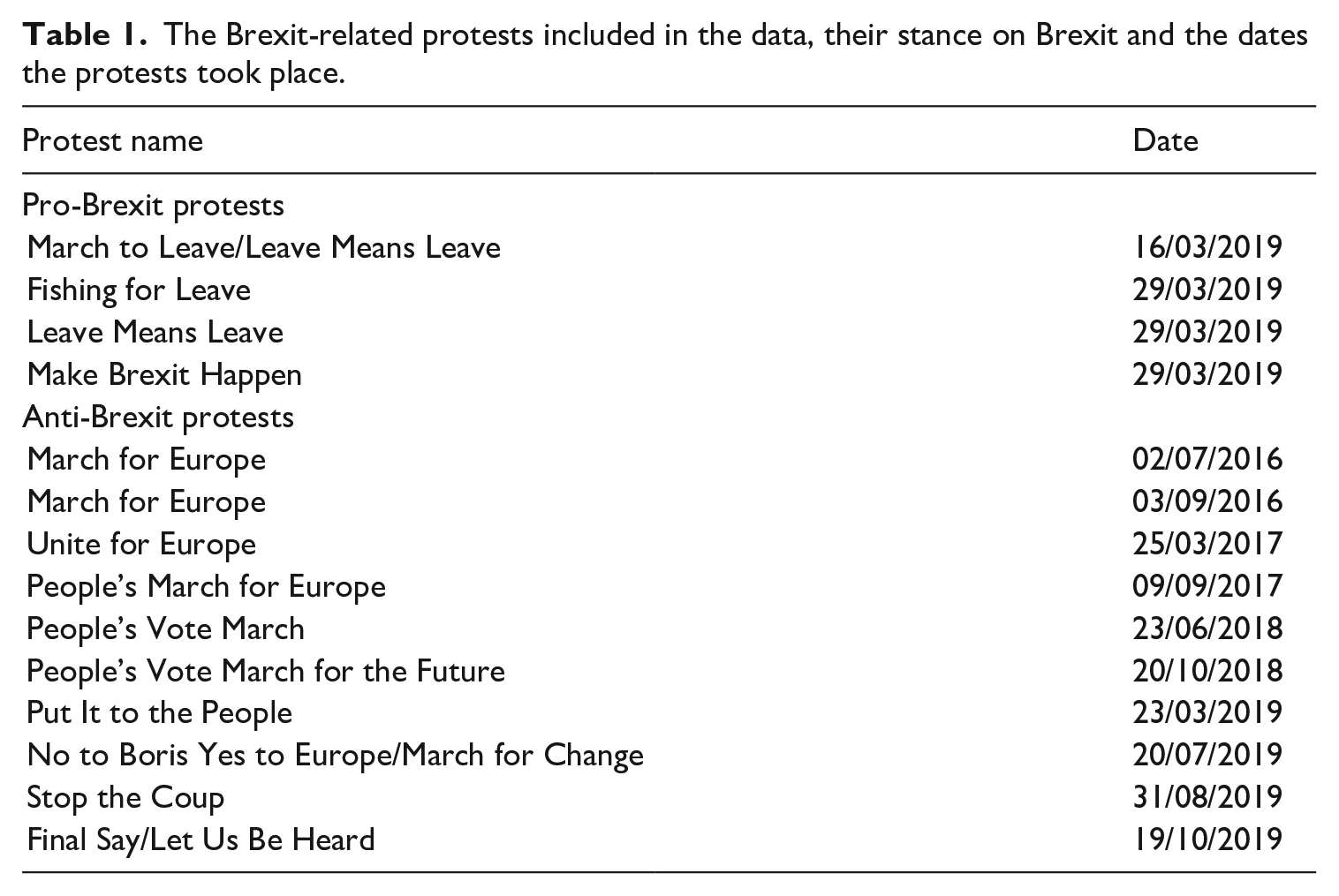
The corpus for this research comprises print and online articles from the pro-Brexit daily national UK newspaper The Express. Using the Nexis UK database, articles that contained at least one mention of any pro-Brexit or anti-Brexit protest in the headline or lead paragraph (Table 1) were downloaded and subsequently divided into two sub-corpora. The first sub-corpus includes articles that covered pro-Brexit protests (henceforth PBP) and the second includes articles that covered anti-Brexit protests (henceforth ABP) (Table 2). Once the data was checked and cleaned, PBP comprised 76 articles and 52,306 words and ABP comprised 121 articles and 81,443 words. While these two sub-corpora are not equally balanced, this does not pose an issue for analytical conclusions. Rather, the imbalance ‘represents the real-life press landscape’ (Brookes and Baker, 2021: 28). While it is interesting to note The Express, as a Brexit-supporting publication, published nearly twice as many articles about anti-Brexit protests than pro-Brexit protests, the lack of coverage may be due to the fact there were only four pro-Brexit protests that took place in the space of 13 days. By contrast, there were ten anti-Brexit marches over the space of three years and three months, giving The Express more to report on.
The Brexit-related protests included in the data, their stance on Brexit and the dates the protests took place.
The number of articles and words comprising each sub-corpus.

To investigate any instances of the linguistic manifestations of WUNC in The Express’s reporting of pro- and anti-Brexit protests, the node protester(s) was searched for using the concordance tool on AntConc (Anthony, 2019), a corpus analysis software package. The PBP and ABP returned 18 and 103 concordance hits, respectively. Concordance lines were only included in the following manual concordance analysis if they featured any of the aforementioned linguistic features that represent protesters as worthy/unworthy, unified/ununified, numerous/few or committed/uncommitted.
The reporting of protester(s) in the PBP
Of the 18 concordance hits in the PBP, only 10 featured elements theorised in the linguistic WUNC framework. Five alluded to worthiness, three to numbers and two to commitment. The remaining concordance lines did not include linguistic realisations of WUNC in their reporting (e.g. ‘Unionist marching band circles Westminster as Brexit protesters rally’).
Worthiness
The extent to which protesters were constructed as worthy varied in the PBP. Two concordance lines attributed pro-Brexit protesters negatively charged transitive verbs and referential strategies:
1. Brexiteer Sunderland marcher in FIERY attack on Remain protesters – ‘Accept DEMOCRACY’.
2. Pro-Brexit ‘Yellow Vest’ protesters were also assembled in Westminster, with some extremists reportedly sharing a meme threatening to riot.
In extract 1, the pro-Brexit marcher is the sayer of the verbal process ‘attack’ – a verb that indicates aggression towards the Remain protesters. Nevertheless, it is important to note that while ‘attack’ is a violent verb, those who support Brexit may believe it is justified, and not a display of unworthiness. Indeed, the verbiage ‘Accept DEMOCRACY’ may indicate it is in fact the Remain protesters who are unworthy – not accepting democracy cannot necessarily be classed as good, decorous behaviour. In this extract, who is worthy and to what extent is not clearly cut. Again, displays of (un)worthiness are ambiguous in extract 2. While the clause in which the node protesters occurs does not indicate any untoward behaviour, the accompaniment ‘with’ shows the assembly includes ‘extremists’ sharing images ‘threatening to riot’. Although the term ‘extremists’ collectivises the protesters using a delegitimising referential strategy, it is preceded by the quantifier ‘some’, showing not all of the protesters fall under the label. Similarly, when analysed transitively, the extremists (actors) are only ‘sharing’ (material process) the ‘meme threatening to riot’ (goal) – they are not themselves threatening to riot. This puts some discursive distance between the protesters and any possible violent action that may occur. In short, while these two extracts do not describe the pro-Brexit protesters as particularly worthy, they are not explicitly reported on as unworthy. As a Brexit supporting publication, these ambiguous constructions may have been employed by The Express to obfuscate any negative action performed by pro-Brexit protesters.
Opposingly, it is interesting to observe that in the two instances in which anti-Brexit protesters are reported on in the PBP, there is no ambiguity in the coverage of their unworthy actions:
3. Brexiteers in Sunderland were ambushed by pro-Europe protesters carrying hearts, during Nigel Farage’s Brexit betrayal march.
4. Remain protester crashes interview 16 TIMES as BBC try to CUT HIM out.
In both extracts, anti-Brexit protesters (‘pro-Europe protesters’ and ‘Remain protester’) are the actors of the aggressive transitive verbs ‘ambushed’ and ‘crashes’. Because Brexiteers are the goals of the ambush, extract 3 implies they are negatively impacted by the anti-Brexit protesters’ misbehaviour. In extract 4, the inclusion of duration (‘16 times’) implies the protester is unrelenting in their disobedience. These concordance lines therefore make clear the actions of the anti-Brexit protesters are unworthy.
Unity
There were no examples of the linguistic manifestation of unity in the PBP sub-corpus.
Numbers
Surprisingly, there was only one reference to high numbers in the PBP. The remaining two concordance lines inferred low numbers. For example:
5. One protester said: ‘I’m very pleased with the turnout today. It sends a message to the political elite that the 17.4 million should be listened to. [. . .]’.
6. A pro-Brexit protester takes part in the March to Leave demonstration in Parliament square.
These concordance lines were difficult to categorise within the linguistic WUNC framework, as they do not include explicit reference to the number of protesters. However, in extract 5 the reported verbiage does indicate the protest’s turnout represents the wishes of the 17.4 million people who elected to leave the EU. In this way, numerical support is more symbolic; meronymy suggests the turnout reflects the wishes of the whole leave-voting population. Moreover, following the linguistic WUNC framework, extract 6 implies low displays of numbers as the protester is individualised. Yet, it does not seem reasonable to suggest that coverage focusing on one protester automatically infers low displays of numbers if the reporting does not discredit the protest’s turnout. Nevertheless, using collectivisation would have increased the mediated display of numbers (e.g. ‘an abundance of pro-Brexit protesters take part in the March to Leave demonstration in Parliament square’).
The lack of explicit reporting on pro-Brexit protests’ numbers is unusual. Turnout is an ‘indispensable aspect of protest coverage’ (Wouters and Van Camp, 2017: 459) and the aggregation of protesters is a crucial representative element in the reporting of demonstrations. However, far fewer people attended the pro-Brexit protests than the anti-Brexit protests; while the remain-supporting People’s Vote March is thought to have stood at around 670,000 people (ITV News, 2018), the March to Leave was made up of a mere 200 (ITV News, 2019). High turnouts may not have been covered in the PBP because there were not any to report on. Furthermore, because a protests’ size is the most important characteristic determining the likelihood of coverage (de Smaele and Kenis, 2020: 186), the low turnouts could also have been responsible for the small number of articles comprising the PBP.
Commitment
Although there are again very few instances in which pro-Brexit protesters are reported on with regard to commitment, when it is reported on it displays high levels:
7. The March to Leave protesters were out in full force in Parliament Square this afternoon.
8. Theresa May warned ‘Brexit FIGHTBACK’ is on as protesters launch 270-mile march to London.
In extract 7, the transitive verb ‘out’ is followed by the manner ‘in full force’, suggesting the protesters are determined and resistant to attack and repression. These sentiments are also evident in extract 8, where the verbal process ‘warned’ and verbiage ‘fightback’ suggest the protesters are resistant to attack. Furthermore, protesters pursuing a 270-mile march implies readiness to persevere as they are travelling long distances in pursuit of their cause (Laschever, 2017: 367).
The reporting of protester(s) in the ABP
Of the 103 concordance hits of protester(s) in the ABP, 72 included linguistic realisations of WUNC. The remaining 31 concordance lines did not feature elements of the linguistic WUNC framework in their reporting (e.g. ‘Protesters wait for the rally to begin’).
Worthiness
Of the 30 concordance lines that alluded to worthiness, 24 report on the anti-Brexit protests as either undeserving or aggressive. When reported on as undeserving, Brexit-supporting celebrities and MPs are positioned as the sayers of verbal transitive processes to deride them:
9. ‘You DON’T speak for Britain!’ Nick Ferrari blasts ‘ELITIST’ anti-Brexit protesters.
10. ‘Wasting your time’ Rees-Mogg warns Brexit protesters will want THIRD EU referendum.
11. Mr Woolfe condemned the ‘anti-democratic’ participants, taking particular aim at celebrity protesters.
These extracts negatively evaluate anti-Brexit protesters, suggesting they are not good and respectable citizens that deserve to get what they want. The verbal processes ‘blasts’, ‘warns’, ‘condemned’ and ‘taking aim’ all indicate the protesters are being chastised for doing something wrong. The verbiage also constructs the protesters as undeserving: they are ‘elitist’, time wasters and ‘anti-democratic’. Elsewhere, anti-Brexit protesters are shown to be cruel and aggressive:
12. POLICE have been called in to escort MPs from Parliament as protesters taking part in the People’s Vote rally shouted abuse at politicians making their way to their cars.
13. Most of the protesters, having spent the first few days demonising apparently stupid, older northern people for not having the sense or sophistication to vote in the correct way, have switched their line of attack to the ‘lying’ of the Leave campaign, principally the latter’s claim that £350 million in savings from leaving the EU could be spent on the National Health Service.
Aggressive verbal processes are ascribed to protesters in extract 12: protesters are shouting verbal abuse at unassuming Brexit-supporting politicians. In extract 13, predication lessens the worthiness of anti-Brexit protesters through the delegitimising description that shows them to be acting cruelly and thinking of themselves as more intelligent than leave voters. Here, The Express’ reporting of anti-Brexit protesters’ hostile actions emphasise a lack of decorum and discipline, lessening their mediated displays of worthiness.
The remaining six concordance lines express higher levels of worthiness, though these are in the minority. Higher levels of worthiness are displayed through the presence of legitimised celebrities in five instances, for example:
14. Celebrity campaigners expected to attend include television chef Dame Delia Smith, Star Trek actor Sir Patrick Stewart, historian Dan Snow and cross-dressing comedian turned political activist Eddie Izzard are also set to be among the ranks of protesters.
The attending celebrities are premodified with honorifics ‘Dame’ and ‘Sir’ and the functional affiliations ‘television chef’, ‘Star Trek actor’ and ‘historian’. While the premodifier ‘cross-dressing’ may not be considered a legitimating referential strategy in the conservative press, ‘comedian turned political activist’ still features functionalisation, drawing attention to Eddie Izzard’s fame. Functionalised labels such as these emphasise the celebrities’ social standing and signal the protest is worthy by way of their support.
Unity
There are 18 linguistic realisations that express high levels of unity in the ABP. These are shown through reports of collective singing and holding signs that indicate pursuit of a common goal:
15. Protesters carrying EU flags and placards called for any Brexit deal be put to another public vote.
16. A sea of blue EU flags filled Parliament square shortly after 1 pm, where protesters sang along to The Beatles’ hit Hey Jude, replacing the title words instead with ‘EU’.
In extract 15, the predicative description ‘carrying EU flags’ show the protesters are united in their pro-EU stance. In terms of transitivity analysis, the sayers of the verbal process ‘called’ are collectivised, indicating multiple protesters are in direct affirmation of a common goal. Similarly, in extract 16 protesters are collectivised as ‘a sea of blue EU flags’ and multiple protesters are shown to be singing in unity, again expressing their pursuit of a shared goal.
Numbers
Anti-Brexit protests’ high numbers are reported on 15 of the 16 times displays of numbers are evident in the sub-corpus. Of the 15 times high numbers are emphasised, 13 use aggregation to premodify protester(s):
17. HUNDREDS of thousands of protesters are expected to flock to the streets of London to call for a Final Say referendum on Brexit.
18. Thousands of protesters to flood streets across UK.
As well as quantifying protesters through aggregation, the transitive verbs ‘flock’ and ‘flood’ also emphasise the sheer scale of attendees as their semantics encode vast numbers. However, while coverage of large numbers can imply consensus (Van Leeuwen, 2008), big groups of people can also be associated with ‘problems and threats’ (Van Dijk, 2000: 45). Research in CDA has long documented how water metaphors used to describe groups occupying space has adverse effects on how the groups are perceived (e.g. Gabrielatos and Baker, 2008). As The Express is a Brexit-supporting publication, large numbers may have been reported on to suggest anti-Brexit protests are a legitimate political threat (Laschever, 2017: 360).
Commitment
While there are only five concordance lines that include linguistic realisations of commitment, they all infer high levels through deontic modality and transitive verbs that express sacrifice and persistence:
19. We will fight to rejoin EU after Brexit, says young protester.
20. Protesters have travelled from across Britain.
In extract 19, the verbiage expresses anti-Brexit protesters’ readiness to persevere. The epistemic modal ‘will’ encodes a high level of truth commitment to rejoin the EU post-Brexit and the material process ‘fight’ suggests the protesters are prepared to resist opposition. In extract 11, the transitive verb ‘travelled’ paired with the distance ‘across Britain’ implies the protesters are engaged in sacrifice or costly activity, committed to their cause by travelling long distances to protest.
Conclusion
The (often praised and increasingly used) combination of qualitative corpus methods and CDA have recently been criticised for not incorporating identifiable and accountable methods in their analyses (e.g. Rheindorf, 2019). In response to this, part one of this article formulated a new theoretical framework that can be applied as an additional methodological intervention in the CDA of concordance lines in the context of press protest coverage. In doing so, Tilly’s (1999, 2004, 2006, 2008) definitions of worthiness, unity, numbers and commitment were related to theories of CDA grounded in language and grammar.
Once the linguistic WUNC framework was theorised, it was applied to The Express’s coverage of pro- and anti-Brexit protests to demonstrate how it could be used in manual concordance analysis. Applying the linguistic WUNC framework to the dataset found linguistic realisations of WUNC were evident in The Express’s reporting, and were used differently in each sub-corpus. Although the BPB comprised only 76 articles, it was surprising that its coverage did not represent the protesters as particularly worthy, unified, numerous or committed. The pro-Brexit protesters’ worthiness was ambiguous; while their negative actions were somewhat obfuscated, they did not show the protesters to be explicitly legitimate. Furthermore, there were no linguistic displays of unity, and very limited displays of numbers and commitment.
It was also surprising that the ABP coverage afforded anti-Brexit protesters high displays of unity, numbers and commitment – although, as discussed, high numbers may have been reported on to infer political threat. Nevertheless, applying the linguistic WUNC framework uncovered revealing findings, that suggest the reporting of Brexit-related protests, at least in The Express, was not as polarising as the Brexit debate itself.
As well as strengthening concordance analysis, the inclusion (or omission) of WUNC in protest coverage has wider implications. Because it is primarily through the mass media the public observe demonstrations, if coverage affords protests high levels of WUNC, it is more likely that a protest will gain sympathy and support (Wouters and Walgrave, 2015: 112). Likewise, if elements of WUNC are frequently discredited or omitted in the reporting of protests, it becomes less likely a protest will achieve its aims. Journalists could therefore choose to lessen or heighten a protests’ mediated displays of WUNC to complement the ideologies perpetuated by particular news media – even if such displays were not exhibited by protesters in reality.
Limitations
It is worth repeating that by introducing a linguistic WUNC framework that can be applied to manual concordance analysis, the article does not claim to remove all aspects of researcher bias as interpretation is a necessary aspect of all qualitative analysis. Indeed, as noted, it was difficult to interpret displays of numbers that did not include explicit reference to aggregation or collectivisation. It was also argued that fairly balanced reporting that focuses on an individualised protester does not necessarily infer low levels of numbers (although it certainly does not infer high levels).
Consequently, a major limitation of this article is that although part one sought to demonstrate a neat fit between WUNC and the linguistic elements it can manifest in theory, more research will need to be carried out to see if they definitively fit in practice, as the framework was demonstrated only to the extent it could be with the (relatively small) dataset. Future research should incorporate larger corpora, which is more likely to reveal more frequent instances of WUNC and draw broader conclusions about the framework’s applicability. This is particularly important as the concordance lines analysed in part two did not reveal evidence of every linguistic conceptualisation of worthiness, unity, numbers and commitment outlined in part one, nor did it investigate or account for the concordance lines that did not adhere to the framework. Subsequent research may also identify linguistic manifestations of WUNC overlooked in part one, or assess the effects of the framework using quantitative corpus methods (e.g. by analysing a feature’s frequency or keyness to evidence high or low levels of WUNC in a text).
That said, while the article acknowledges these limitations and encourages expansion upon the framework, the hope is that the application of WUNC outlined in this article could be used as it currently stands in research of a similar nature.
Footnotes
Declaration of conflicting interests
The author declared no potential conflicts of interest with respect to the research, authorship, and/or publication of this article.
Funding
The author disclosed receipt of the following financial support for the research, authorship, and/or publication of this article: This research was supported by the Arts and Humanities Research Council Midlands4Cities Doctoral Training Partnership.