




Abstract
Previous studies on public opinion expression in communication, political science and discourse analysis are restricted to a censorship-/counter-censorship frame and focus their analysis on events with political agendas. This study explores netizens’ discursive practice by focusing the analysis on netizens’ language use in context per se, rather than from a censorship/counter-censorship viewpoint. It adopts a discursive pragmatic approach to examine a ‘mundane’ trending topic regarding a dispute between two public figures rather than ‘major’ events with acute social and political agendas. This study present evidence that Weibo users criticise public figures through indirect discursive strategies, including parody of name, constructed dialogues and rhetorical questions. It also highlights two prominent sentiments in Weibo public spheres during the COVID-19 pandemic – cyber nationalism and binary opposition between China and the rest of the world. The online backlash against Fang demonstrates how easily netizens can change their views towards a certain event.
Introduction
On 23 November 2020, BBC released a list of ‘100 women of 2020’. It sparked a response from Global Times, a Chinese-state owned media outlet, accusing BBC’s ‘hostile ideology towards China’ as a Chinese controversial writer Fang Fang was on the list. Fang and her Wuhan Diary, which was published daily on Sina Weibo (henceforth Weibo), one of the most popular microblogging services in China, have featured in trending social media topics during the lockdown of Wuhan in early 2020. A few non-domestic media outlets (see BBC, 2020a, 2020b; Wu, 2020) have reported on Fang and her diary, commenting on Weibo users’ polarised views, ‘some call her a truth-teller but others view her as a liar and traitor’ (Siqi, 2020).
During the COVID-19 pandemic, the public’s demand for timely, accurate and comprehensive information is more urgent than ever. Various Chinese Weibo official accounts (e.g. government accounts and media accounts) aimed to keep netizens well-informed and provide them with the determination and confidence to win the battle against the virus. In contrast to traditional media (e.g. newspapers and broadcast media), online media features the integration of producers and receivers of messages (Bruns, 2008). Weibo users bring many issues to the forefront through the discussion of socio-political topics.
Netizens have used online public spheres to engage in trending topics, such as those regarding Fang, by commenting on, forwarding and sharing postings on the Weibo platform. Weibo is the second most popular social media platform in China (DeGennaro, 2019) with up to 516 million monthly active users as of February 2020 (SinaTech, 2020). It has been a major platform for socio-political information dissemination, online expression and activism (Jia, 2019; Poell, 2014; Xiao, 2011). Weibo is a combination of Facebook and Twitter, but it also possesses unique functions. Weibo users can publish up to 2000 Chinese characters in a single post (Li, 2016) and engage with popular topics via hashtags.
Previous studies on netizens’ opinion expression have largely focused on the tension between government censorship and netizens’ censorship evasion strategies. Both automated and manual censorship are used to monitor and filter online public expression (King et al., 2013). Weibo users, however, utilise technology and language affordances to evade online censorship. For instance, Yang (2009) identified four kinds of ‘hidden digital transcripts’ that are used to resist the dominant power practice, including technical means, organisational creativity, online guerrilla war and linguistic strategies. However, previous studies are heavily restricted to censorship and counter-censorship framework, which indicates that netizens’ opinion expression practice serves the primary purpose of evading online censorship. This reveals merely a part of the picture as netizens can engage in discussion of a range of topics with socio-political and cultural agendas in various public spheres on Weibo. The boundary between political and apolitical has also become increasingly fuzzy (Han, 2018). This study explores Weibo users’ critical opinions towards a dispute between two public figures. It does not distinguish users’ discursive practice on this specific topic as political or apolitical, as the dispute per se is entangled with discussions of everyday happenings, social obligations of public intellectuals, national identity and ideological dichotomies against the backdrop of the COVID-19 pandemic.
Online public opinion expression
China is home to the world largest internet population, with approximately 854 million users as of December 2019 (Johnson, 2021). Netizens express opinions online about social, economic, environmental and political events, at all levels from local to international. According to Shao (2018), netizens can express their opinions on the government’s inability to provide acceptable public services and goods (‘performance challenge’) but criticism of the leadership and political power of the state (‘political challenge’) is more likely to face censorship. Different public spheres based on topics represent the foci of netizen’s online opinion expression. Rauchfleisch and Schäfer (2015) have identified seven public spheres on Weibo in terms of the topic per se (thematic, encoded and meta public spheres), the scope of topics being discussed (local, non-domestic public spheres), the mode of delivery (mobile public spheres) and the longevity of topics (short term public spheres). For instance, in thematic public spheres, netizens discuss apolitical life-world problems, such as environmental pollution (Ji et al., 2018) and food safety (Song et al., 2020). Netizens may also engage in discussion of non-domestic issues, such as the 2020 US presidential election.
At the same time, the Chinese government has paid ‘increasing attentiveness to understand, guide, manage, and channel online public opinion’ (Jia, 2019: 22). Scholars depict the online public expression as a game of cat and mouse between users and censors (Wu and Fitzgerald, 2020). Internet users resort to different tactics to counter the sophisticated online censorship as well as voice their opinions. One way is to closely follow political satirists and repost, or comment on their satirical creations (Luqiu, 2017). Netizens also express scepticism of state-sponsored commentors, known as the 50-cent army (五毛党/wumaodang), who write pro-regime posts and comments (King et al., 2017). Meanwhile, netizens have denigrated the beliefs, ideologies and identities of public intellectuals, who challenge the party-state regime and call for democratic reforms in Chinese society, and branded public intellectuals as unpatriotic, ignorant or hypocritical (Han, 2018).
Researchers differ in their views regarding the role of netizens’ online opinion expression vis-à-vis internet censorship. Some hold optimistic views that Weibo facilitates socio-economic changes by disseminating collective actions (Jia, 2019). A strong criticism of the Chinese government’s performance with weak political challenge is welcomed by the regime, as the criticism will help the government to respond to the public’s need, face and fix problems, and provide quality public services (Shao, 2018). However, some scholars treat the influence of ordinary netizens with caution. Nip and Fu (2016) argued that ordinary citizens prominently initiate trending topics, but news organisations dominate opinion expression, and government and party bodies control public opinion calibration. Su (2019) found that opinion leaders generally reinforce ordinary Weibo users’ opinions and attitudes in the discussion about the 2015 Tianjin explosion. Some scholars hold a sceptical view that the Chinese government is growing more adept at harnessing information and neutralising threatening behaviour (Sullivan, 2014). King et al. (2013) identified that online criticism of the government is allowed but collective actions and discussion of controversial issues are silenced. As stated earlier, this study does not position itself in the frame of political or apolitical criticism discourse. The netizens’ discussion about public figures appears in a few public spheres and their attitudes turn out to be ever-changing.
Expressing criticism online
Previous studies on Weibo opinion expression focus on users’ discussions of highly political events which are subject to censorship. These relate to China’s domestic and overseas affairs, examples of which include the East China Sea dispute with Japan (Cairns and Carlson, 2016; Schneider, 2016), the South China Sea dispute (Dixon, 2014; Li and Guo, 2018), and the 2017 Hong Kong Chief Executive election (Zhao and Lin, 2020). Hot topics in the Chinese mainland have also gained mounting attention online. For instance, the Watchgate controversy prompted the criticism of corrupted government officials (Feng and Wu, 2018; Montgomery et al., 2015) and the Tianjin chemical explosion in 2015 illustrated the cover-up of the magnitude of the event (e.g. causalities) by the local government (Zeng et al., 2019).
Research on online expression from the linguistic perspective centres on how users employ discursive strategies to counter censorship and express political criticism on trending events. For instance, Weibo users held the local government accountable for the 2015 Tianjin chemical explosion via using cross-platform eyewitness account, jokes, allusion, irony to challenge the official narrative of the event (Wu, 2018; Wu and Montgomery, 2020). They have identified a corrupted government official in a fatal traffic accident in 2012 and employed creative language techniques to condemn the corrupt conduct of the official, such as expressive particles, direct address terms and irony (Montgomery et al., 2015). Particularly, verbal irony (Zhao and Lin, 2020) and political satire (Luqiu, 2017) are employed to practice self-censorship in commenting on acute political events.
The previous literature about online opinion expression is mostly found in the fields of media and communication (Han, 2018; Jia, 2019) and political science (Gu and Li, 2020; King et al., 2013). The focus of the scholarship is on the cat and mouse relationship between censors and proactive netizens, in particular, how the state oversees and censors netizens’ Weibo interactions, what kinds of online comments get filtered, the dynamics between government and netizens, and how netizens counter online scrutiny (Han, 2015; King et al., 2013, 2014, 2017; Shao, 2018; Zeng et al., 2019). Nevertheless, little research has offered insights beyond the censorship frame. As netizens rely on computer-mediated means to interact with each other, language and discursive strategies may play an important role in the meaning making of social interaction. A handful of studies in linguistics focus on trending topics with profound socio-political significance. The current study examines a ‘mundane’ incident – a dispute between two public intellectuals in Weibo public spheres with no obvious political agenda. However, what makes this incident stand out is its timing and scope: the dispute occurred against the backdrop of a global health crisis and a narrative of the life in the epicentre of Wuhan captivated international audiences.
Data and method
This study draws on a pool of users’ comments under six verified accounts on Weibo related to the dispute between two public figures, writer Fang Fang (Fang) and academician Zhang Boli (Zhang). On 23 January 2020, the Chinese government imposed a strict lockdown in Wuhan to contain the spread of the novel coronavirus. Two days later, Fang started to post her daily account of people’s lives in Wuhan under the lockdown to her more than 4,800,000 followers on Weibo. The diary covered everything from the inconvenience of daily struggles to the panic, fear and frustration experienced by citizens. Nevertheless, public opinion began to turn against Fang when the English edition of Wuhan Diary was offered for pre-sale through Amazon 2 weeks after her diary narrative was completed (Manya, 2020). Fang was branded a traitor and has since faced an angry online backlash. Zhang, a medical doctor who worked on the frontline in Wuhan for 82 days, is one of Fang’s critics. On 12 May 2020, Zhang gave an online speech on the national campaign against the virus during which he criticised people who have expressed ‘distorted values’, including Fang. The following day, Fang asked for an apology from Zhang on Weibo, which sparked an intense discussion.
I first searched #方方要求张伯礼道歉/Fang Fang yaoqiu Zhang Boli daoqian# Fang Fang asks for Zhang Boli’s apology, which had received over 53 million views and 15,000 reactions from netizens by June 2020. Searching for this hashtag directed me to a forum with a large number of posts, including some from Big V (verified) accounts, such as celebrities accounts. Posts with over 1000 comments were selected, among which comments critical of Fang were selected for analysis. This choice was mainly driven by the linguistic vividness, ingenuity and richness demonstrated in these criticisms. Moreover, it would be interesting to see how Weibo netizens respond critically to a ‘doomsday’ narrative of life in Wuhan under lockdown. Ultimately, 1535 entries were retrieved for further analysis.
This study adopts the discursive pragmatic approach to analyse Weibo users’ critical opinion expression. Discursive pragmatic approach is a combination of the interdisciplinary fields of pragmatics and discourse analysis. Both fields of inquiries have the same interest in language use in context (Zienkowski, 2011) despite the core differences in ‘the relative length and complexity of the units of analysis’ (Blitvich and Sifianou, 2019: 92). Pragmatics focuses on smaller units in the form of individual utterances, whereas discourse analysis encompass longer stretches of spoken conversation or written text (Östman and Virtanen, 2011). Discursive pragmatics applies concepts and methods in pragmatics, such as meaning making, deixis and speech act, to the study of a range of discourses in terms of topicality (e.g. racism, environmental issues), genre (e.g. newspaper, political articles), institution (e.g. business discourse, medical interaction) or mode of delivery (e.g. social media discourse) (Zienkowski, 2011). This method explores social media interaction from two perspectives – the meaning making of individual utterances (posts and comments in the case of Weibo interaction) and consideration of socio-political and cultural references. The participants, who actively interact on Weibo via posting, sharing and commenting, are required to have pragmatic competence of other participants’ language outputs as well as the general social and cultural impact and shared background knowledge regarding the particular event (Wu and Fitzgerald, 2020). Posts pertaining to the dispute between Fang and Zhang, comments, and replies to the posts form a sequence of interactional exchange through which communicative agendas are achieved. This study focuses on the meaning making of individual comment threads as well as exploring the socio-political and cultural implications behind certain social interactions. The analysis of criticism discourse is expected to mirror the sentiments permeating the Weibo public sphere during the ongoing pandemic.
Discursive strategies of criticism of public figures
In this section, I have identified three major discursive strategies that Weibo users deploy to criticise public figures. They use parody of address terms to creatively disagree with and ridicule Fang. They also use rhetorical questions and constructed dialogues to strongly disapprove of her speech and actions. In expressing these critiques, Weibo users make the differences between the two public figures salient: their contribution to the national campaign against the virus, the credibility of their sources of information, and their family-country attachment. In turn, these critique strategies and users’ perceptions of differences between Fang and Zhang represent trending sentiments in Weibo public spheres.
Parodying terms of address
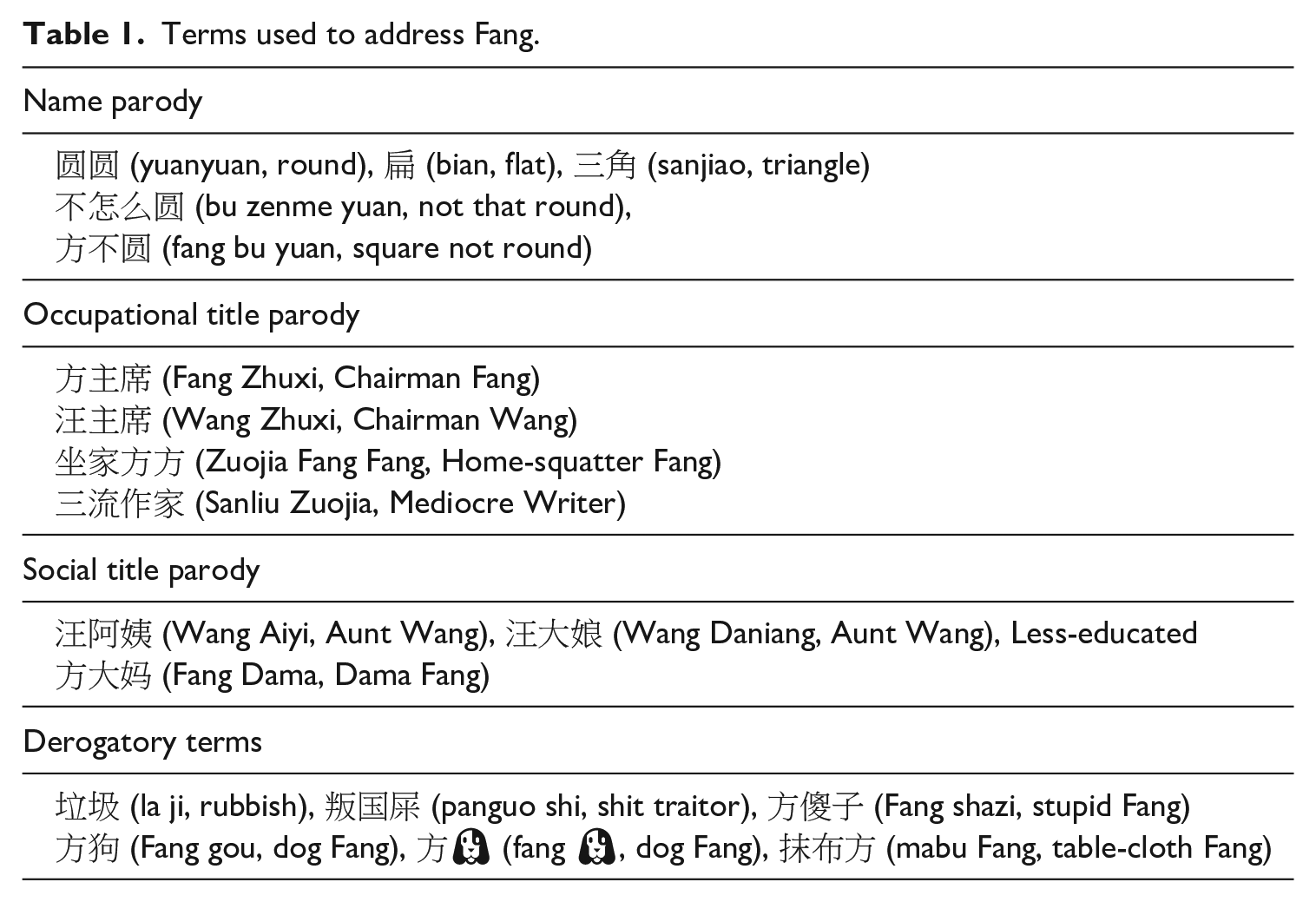
Weibo users address Fang using a variety of parody names (see Table 1). This makes users’ stances and disapproval of Fang salient. In Chinese, 方 (pinyin: fang), besides being a family name, also means ‘square’, so Weibo users ridicule her name as round (圆圆/yuanyuan), rectangular (三角/sanjiao) or even flat (扁扁/bianbian/). Some users go even further to stress the literal meaning of Fang as something not round (方不圆/fangbuyuan). Throughout the dataset, the parody of names collocates with condemnation and insulting of Fang, as seen in (1) and (2). Both users refer to Fang as Yunayuan, condemning Fang being hypocritical and objectionable.
Terms used to address Fang.
Example 1 用户:圆圆老师这张伪善的面具怕是要落下来了 User: Ms Yuanyuna’s hypocritical mask is about to fall. • • ñ赞Like 5月15日 16:58 Example 2 用户:圆圆遗臭万年。 User: Yuanyuan is going to leave a stink forever. • • ñ赞Like 5月14日 10:06
Users also parody Fang’s occupational and social titles. The formal and respectful term of address Chairman Fang/Wang is frequently used negatively; users imply that Fang is not living up to her title. To mock her lack of contribution and reliance on second-hand information, some users take advantage of the homophones 作家 (zuojia/novelist/writer) and 坐家 (zuojia坐means ‘sit’, 家means ‘home’ – the bizarre combination literally means ‘sit at home’) to address Fang as坐家方方/zuojia fangfang/Home-squatter Fang instead of 作家方方/zuojia fangfang/Writer Fang. Others attack Fang’s social roles, labelling her as an uneducated and unfashionable middle-aged woman. The frequently used term is 大妈/Dama, which is associated with middle-aged and elderly women whose loud dancing in public squares often leads to clashes with neighbouring residents. Dama is also associated with these women posting images of themselves waving garish silk scarves in beauty spots (Teng, 2018). Here, netizens use Dama to conjure up images of annoying, unfashionable and uncultured middle-aged women. In doing so, netizens show contempt towards Fang and her diary narratives.
Some users stigmatise Fang using degrading terms such as Rubbish, Stupid Fang and even Shit Traitor (see Table 1) or combining her name with degrading imageries to form ad-hoc names, such as Tablecloth Fang and Dog Fang. Comparing people to animals such as pigs and dogs is offensive (Haslam et al., 2011). In the case of Dog Fang, for instance, it conveys the message that she is sub-human.
In the dataset, the name parody often comes with a noticeable contrast between Fang and Zhang. This contrast stems primarily from their occupations and disproportionate contributions during the pandemic. Zhang, as a medical doctor, was saving lives in the epicentre of Wuhan’s outbreak. He is known in the Weibo public sphere for working in Wuhan for 82 days consecutively and having an operation from overwork. By contrast, users condemn Fang, a well-known writer and the former president of the Hubei Writers’ Association, for damaging the national image of China through her ‘unreliable’ diaries. Based on this information, users have created contrasting terms to address the two figures.
Example 3 用户:一个是在抗疫前线救人的 User: One is the hero who is saving people’s lives on the frontline; the other is the coward who is residing in her illegal villa readily receiving up to 20 N95 masks that even the medics struggle to have. Please tell me how the hell she is comparable to Zhang! • • ñ19 Like 19 5月14日 19:54 Example 4 用户:md,口罩没见捐一个,就一 User: Fuck, We didn’t see her donate a single mask. A household woman only knows only about garbage. How is she qualified to compete with the hero of the epidemic? • • ñ10 Like 10 5月14日 07:35
In (3), the user displays his/her dislike of Fang via address terms regarding their different contributions. Zhang, who risked his life to save other people’s lives on the front line, is referred to as 英雄/hero; Fang, who was depriving frontline medics by readily accepting gifts of N95 facial masks, is referred to as 家里蹲/home-squatter. The employment of two different address terms – one praising and the other condemning – reflects the disparity of contributions made by the two figures. In (4), the user claims that Fang has not donated a single mask and she is nothing but a housewife whose job is to tend to dirty house chores like throwing out the rubbish. Therefore, she has no right to ask for an apology from the hero who has saved people’s lives. Once again, the contrast between Fang’s and Zhang’s contributions affects users’ choices of address terms.
Some users go one step further to question Fang’s Chinese identity by accusing her of collaborating with foreign anti-China forces, as shown in (5) and (6). In (5), the users address Fang as a manipulative airhead who relies on Western forces. The user in (6) even points out that the anti-China force is the United States by saying that Fang will be rewarded by her ‘American Dad’. With or without specifying who the foreign forces are, users identify Fang as a traitor who hurt the feelings of the Chinese people and wronged the nation.
Example 5 用户:疫情期间天天在家关门编那本叫武汉日记的小说,连张院士在干什么都不知道,方方是个神马东西,让 User: She closes her door busing making up a story called Wuhan Diary during the pandemic. She does not even know who Academician Zhang is. Fang Fang is nothing. The manipulative airhead is asking our respected national scholars to apologise to her, excuse me? Lmao. • • ñ赞Like 5月15日 10:49 Example 6 用户: User: Old Fang is running wildly down the anti-China road. Her American dad will definitely reward her. • • ñ赞Like 5月14日 10:58
To conclude, netizens have parodied Fang’s name, social titles, and her occupation to question her role in the nationwide anti-epidemic campaign, the validity of accounts in her diary, and her attachment to the nation. The use of derogatory terms represents netizens’ acute condemnation. Netizens remained vigilant when Fang’s diary reached outside China as they were aware of the global climate where Western countries criticised China for its initial mishandling of the pandemic. The binary opposition of China versus the world is embedded in users’ comments; as one user posted in Chinese on Weibo, ‘Wuhan Diary is a knife handed over to foreigners and a bullet shooting at Chinese’ (Davidson, 2020).
Asking rhetorical questions
Rhetorical questions are ‘not designed to seek for answers but to express one’s angers’ (Feng and Wu, 2018: 106). Weibo users adopt a large number of rhetorical questions to reproach Fang for harming the fight against COVID-19, using untrusted resources, and lacking feelings for her home country. In (7), the user accuses Fang of having double standards – she claims to fight for freedom of speech yet shows no tolerance of different voices from the frontline workers. In (8), the condemnation manifests in all four rhetorical questions. The user notes that Fang claims to be the ‘voice of people’ (Manya, 2020) and her diary to be a window into the current happenings in Wuhan. However, her reaction to Zhang’s comment reveals that she is not documenting life, as she overlooks a widely disseminated post about Zhang’s operation during his work in Wuhan. The user challenges Fang’s hypocrisy by questioning why it took her so long to learn about Zhang’s noble deeds and what kind of information she has been observing. The four rhetorical questions have jointly reinforced the sarcasm and criticism of Fang.
Example 7 用户: User: @Fang Fang Isn’t Chairman Fang an advocate for freedom and democracy? Isn’t she fighting every day for freedom of expressions? Why is she not happy with the first line worker commenting about her? Why is she demanding his apology to avoid it being a blemish on his life? What kind of logic is this? What kind of value is this espousing? • • ñ2 Like 2 5月14日 08:16 Example 8 用户:一个疫情期间住在武汉的人,一个极其关注武汉疫情的武汉人,居然在今天才知道张院士在过去几个月干了什么???居然今天?居然是在今天?那她关注的是疫情,还是关注的是其他什么东西?下作。 User: She lives in Wuhan during the outbreak and she claims to be extremely concerned about the current situation, but she just learned today what Academician Zhang has done in the past few months??? Today? Today? Is she really concerned about the epidemic or something else? How dirty is that. • • ñ180 Like 180 5月14日 20:28
Besides targeting Fang’s double standards, users also denounce her lack of contributions in fighting the virus via rhetorical questions. In (9), the user asks what Fang was doing when Zhang was risking his life on the frontline. It suffices to say that both the speaker (user) and the addressee (reader) ‘share prior commitments to similar and obvious answers’ (Rohde, 2006: 134). That is, the stark contrast of disproportionate contributions is quite obvious to the user and others who engage in the discussion. However, a few follow-up users comment on the thread by literally answering the question, such as She is rushing writing her diary in the loo; she is busy spreading rumours to stigmatise her country. The rhetorical question is redundant in that it does not offer the readers any substantial information, as netizens all know what Fang has been doing during the outbreak; the answer to the obvious question makes the shared knowledge even more acute, strengthening the criticism. Additionally, these rhetorical questions serve not only to express users’ strong feelings, but also encourage engagement and provoke further reactions from other users (Feng and Wu, 2018).
Example 9 用户:方方是谁?张院士在一线抗击疫情时,方方在哪? Tr: Who does Fang Fang think she is? Where is Fang Fang when Academician Zhang is fighting on the frontline? • • ñ19 Like 19 5月14日 18:37 用户等人 用户:灵魂拷问,人家在家里厕所里写日记呢。 User: Great point. She is busy writing her diary from her toilet. • • ñ 1Like 1 5月14日 20:14
Netizens do not expect an answer by asking rhetorical questions, instead these questions resonate with others and draw other netizens’ attention to the implications embedded in the comments. A few sentiments are conveyed through rhetorical questions: (1) two sets of rules as freedom of speech is for Fang herself; (2) intention of writing the diary as only gloomy accounts are captured; (3) Fang’s lack of contribution.
Making constructed dialogues
Weibo users also employ constructed dialogue to mock and criticise Fang. A constructed dialogue is commonly referred to as reported speech or direct quotation to describe a re-creation of actual or imaged speech in storytelling or conversation. As Tannen (2007) notes, constructed dialogues play an important role in both involvement and persuasion in spoken conversations. The narration is more vivid when presented as first person dialogues (‘direct quotation’) than as third-person reported speech (Tannen, 2011). By employing constructed dialogues, users add ‘vividness and immediacy’ (Kuo, 2001) to the concocted conversations between Fang and others who are directly or indirectly involved in this debate. Three types of constructed dialogues are identified in the users’ comments, as displayed in Table 2.
Constructed dialogues.
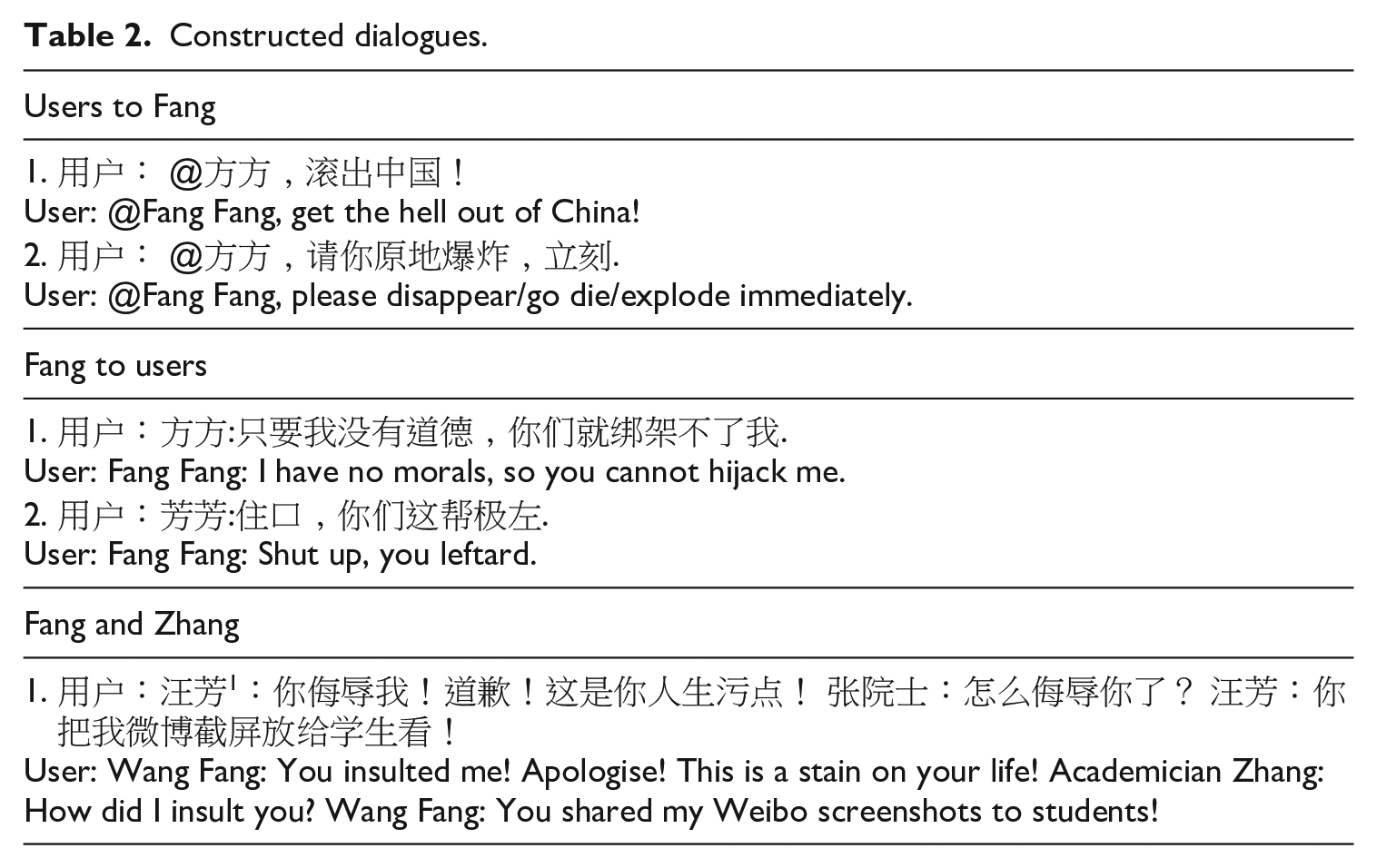
In the users’ comments, constructed dialogues create vivid representations of conversations between the two public figures – Fang and Zhang – or between Fang and other users. However, it is the joint effort of the vividness and sarcastic tone in the comments that make the condemnation even stronger.
As shown in Table 2, when the dialogue is about users addressing Fang, imperatives are often used to express their dislike of Fang and further actions they wish to take towards Fang. The tag sign @ and the second person pronoun 你/you jointly simulate a scene where the user is directly reproaching Fang. For example, the first comment @方方,滚出中国/@Fang Fang, get the hell out of China! reads like the user is scolding Fang and asking her to get out of China, possibly he/she suspects that Fang betrayed her motherland by colluding with foreign anti-China forces. Nationalistic sentiments are prevalent in comments on Weibo posts about Fang. The second type is about Fang addressing the general public, in the format of ‘方方:/Fang Fang:’. Fang’s utterances are made to sound hilarious or nonsensical to ridicule her. For instance, in the first example under ‘Fang to users’, a user re-creates a scene where Fang is addressing her audience by saying I have no morals, so you cannot hijack me. The user, by devising a dialogue, teases Fang for having no moral calibration. The third constructed dialogue happens between Fang and Zhang. Fang is simply demanding Zhang’s apology because Zhang shared her Weibo post to his students. In so doing, the comment implies that Fang is making a fuss out of nothing: why people cannot share her Weibo post since it is already published to the public?
Throughout the dataset, users construct Fang’s dialogues in a way that make little sense or lack morals. The degrading utterances or mockeries pave the way for the criticism of Fang; the vividness and dialogic engagement created by the made-up dialogues strengthens the sentiment.
Discussion
Chinese netizens are making the most of online public spheres to actively engage in the discussion of trending events with political or apolitical agendas. In studying users’ critiques of Fang and her Wuhan Diary, two prominent sentiments surging on Weibo during the coronavirus pandemic – nationalism and binary oppositions of ideologies – have been identified.
Nationalism on Weibo
Nationalism is prevalent among Weibo netizens. Nationalism sentiment ‘typically seeks to occupy online spheres (where possible in alliance with netizens) with discourse couched in nationalistic language, drawing on patriotic tropes, that criticises or blames foreign powers (above all, Japan and the USA), and praises the quality of Chinese leadership’ (Hänska et al, 2020: 578). Nationalistic sentiment has been growing on Weibo as China has come under international pressure over its handling of the initial stages of the outbreak, such as failing to let the disease early warning system function (Gu and Li, 2020) and initially downplaying the severity of the disease (Kelly, 2020). The United States’ then President Donald Trump publicly called the virus ‘Chinese virus’, ‘Kungflu’ and ‘Wuhan Virus’ in the White House Coronavirus Task Force Press Briefing, stoking cyber-nationalism and anti-Americanism on Weibo and other social media platforms. Domestically, public figures who go against the mainstream in Weibo public spheres are likely to face backlash from the so-called patriots. This angry nationalist sentiment has become stronger, as evident when users compare and judge Fang’s and Zhang’s patriotic feelings and suspect and blame Fang for collaborating with foreign anti-China powers. Weibo users claim that Fang, as a writer and an influential public figure, should compose positive stories to boost the nation’s morale during this unprecedented time, rather than seek fame and fortune at the expense of the reputation of the national effort. Users claim that the hearsay and Fang’s critical account of the Wuhan outbreak will only worsen Western misconceptions about China and hand over more ammunition to anti-China forces who seek every means to hold China accountable. These harsh accusations can be traced in the terms that Weibo users have branded her, such as 汉奸/hanjian, 叛徒/pantu, 卖国贼/maiguozei and 叛国蛆/panguoqu, which mean a disgraceful traitor. Terms such as 美国/meiguo/US and 川普/chuanpu/Trump are also mentioned by users. Notably, instead of expressing nationalism through abusing and cursing, Weibo users accuse Fang of lacking contribution, being hypocritical, spreading untrustworthy information by mocking her names and titles, asking rhetorical questions and concocting dialogues. This may show that the online nationalism demonstrated in Fang’s case is only ‘moderate’ (Zhang et al., 2018).
Binary opposition
Nationalism is highly related to binary opposition sentiments, namely, the idea that China is different from other countries in the world due to cultural and political factors. Netizens are on high alert to these differences. They are actively engaged in the criticism of false reports by Western media about China and its handling of the outbreak of the COVID 19 pandemic. In Fang’s case, it was not until the English translated version of Wuhan Diary entered the international community that public opinion began to shift against her and Weibo users started to question her ‘innocent’ motive of speaking for the people under lockdown. Instead, they argued that Fang is knowingly giving Western countries ammunition to target China. Netizens further questioned Fang’s stance-taking, that is, pro-China or pro-Western powers, and loyalty to the nation. The frequently mentioned pair of hero versus traitor shows that Weibo users highlight public figures’ patriotism especially in difficult times. However, this contrast reflects an ideological gap between China and the rest of the world that is perceived by netizens and partially attributable to Western criticism of China’s mismanagement of the Wuhan outbreak. Both nationalism and the sense of duality demonstrate that a vigilance of the Western world is permeating Chinese online public spheres.
The interplay of nationalism and binary opposition in Weibo public spheres also demonstrates how adaptive and dynamic Chinese online opinion expression can be. In the early stages of the Wuhan lockdown, netizens praised Fang for providing a rare glimpse into Wuhan residents’ fears and hopes as well as ‘demanding more transparency and accountability from the Chinese (local) leadership’ (Manya, 2020). Fang was seen as a bearer of truth speaking out against social injustice and abuse of power. However, Fang began to face online backlash after her diary was published to the international audience. Netizens are aware that the ‘dirty laundry’ narratives in her diary are shameful to reveal to other countries. More importantly, these negative accounts will become a handy tool for the West to slander and sabotage China’s efforts to fight the virus. That is why netizens stay highly vigilant of coverage in the Western media and refer to the ideological differences in their comments. The reversal of attitudes demonstrates the volatility of dominating opinion expression on Weibo, which is subject to change drastically as further conditions are met.
Conclusion
This study has explored Chinese public opinion expression on Weibo. It analyses Weibo users’ creative utilisation of discursive tactics to express critical opinions of Fang amidst the COVID-19 pandemic. The most conspicuous one is the rich and varied name parody strategy used to mock Fang’s untrustworthy narratives and her loud speech and quiet actions. Users also ask rhetorical questions and make up direct dialogues between Fang and others in discussion, condemning her lack of contribution, poor credibility, absent patriotism and double standards.
Users’ comments regarding the two public figures show two trending sentiments permeating Weibo public spheres – nationalism and a duality between China and the rest of the world. However, the accusations of Fang may not be righteous. They should not be simply taken as truth, but instead (partially) representing popular opinions held by certain groups during the pandemic. That is, these accusations are endorsed by people who are active in diverse online public spheres in the climate of this global health crisis when China is facing negative news reports and increasing pressure from the international community on its handling of the initial outbreak. The current study takes the long-established scholarship of censorship and counter-censorship practices on public opinion expression as a point of departure and draws academic attention to online public discussion with less acute socio-political agendas. This study enriches research on criticism discourse by introducing netizens’ discussions of ‘mundane’ topics with fewer political considerations. The discursive pragmatic approach offers insights into understanding netizens’ social interactions from the macro-level social cultural background and the micro-level meaning making practice. In so doing, the discursive pragmatic approach reveals how netizens express their opinion in interactional exchanges and the motivation behind their social meaning making process.
Footnotes
Acknowledgements
The author is deeply indebted to the anonymous reviewer for his/her invaluable comments on earlier versions of this study. The author would like to thank PhD candidate Mark Ryan at Lancaster University for his insightful feedback and careful proofreading. The author also gratefully acknowledges discussion with PhD candidate Zhuo Chen in PPR at Lancaster University about trending topics on Chinese social media.
Declaration of conflicting interests
The author declared no potential conflicts of interest with respect to the research, authorship, and/or publication of this article.
Funding
The author received no financial support for the research, authorship, and/or publication of this article.