




Abstract
This study investigates how the lemmas woman, girl, man and guy are used to discursively represent and construct gender identities in an anti-feminist forum on the discussion website Reddit. The lemmas were analysed using corpus-assisted social actor analysis and appraisal theory. Similarities and differences within three sub-communities of the TRP subreddit were considered: Men’s Rights (activists who believe that men are systemically disadvantaged in society), Men Going Their Own Way (who abstain from relationships with women), and Red Pill Theory (primarily pick-up artists).
The corpus was characterised by bare assertions about gendered behaviour, although the masculine gender role was less well-defined than the feminine one. Women and girls were dehumanised and sexually objectified, negatively judged for morality and veracity, and constructed as desiring hostile behaviour from male social actors. Conversely, men were constructed as victims of female social actors and external institutions and, as a result, as unhappy and insecure.
Keywords
Content warning
This study mentions sexual assault and rape. Inspired by Jane’s (2014) discussion of sexist ‘e-bile’, I believe that showing full examples from my data is valuable so that the sexist nature of the data is not masked, and is thus taken seriously. Full examples begin in the Methodology section.
Introduction
This study explores how men’s rights activists, male separatists and pick-up artists represent and construct male and female social actors in relation to each other, what actions and attitudes these actors are ascribed, and how they are evaluated. This article thereby contributes to a growing literature on the online anti-feminist network known as the ‘manosphere’ (an internally applied label, which assigns global status to the movement). According to Ging (2017), the ‘manosphere’ has five distinct groups: men’s rights activists (who believe that men are systemically disadvantaged in society), men-going-their-own-way (who abstain from relationships with women, hereafter referred to as MGTOW), pick-up artists (who seek to have sex with as many women as possible), traditional Christian conservatives and gamers/geeks. Ging (2017) separately considers involuntary celibates (incels), who are unable to find a romantic/sexual partner despite desiring one. Jane (2018) observed that these groups are united by a tendency to threaten women by referencing their perceived physical unattractiveness, sexual history, lack of intelligence, mental illness and misinformed political opinions.
The ‘manosphere’ community of interest for this study, the TRP subreddit, referred to as such to maintain its anonymity, describes itself as encouraging ‘discussion of sexual strategy in a culture increasingly lacking a positive identity for men’ (Van Valkenburgh, 2018: 2) and includes three sub-groups: Men’s Rights, Men Going Their Own Way, and Red Pill Theory (primarily pick-up artists). TRP is characterised by reductive statements about both men and women, discussed below in the Background section. The TRP subreddit had approximately 300,000 regular subscribers before being ‘quarantined’ in October 2018, meaning that the subreddit is labelled as controversial, does not appear in Reddit searches (but is still accessible to those who know the link, and through search engines) and the subscriber count is hidden.
Following participation in the ‘manosphere’, a small minority of members have acted on their beliefs in the offline world in a way which constitutes criminal behaviour. For instance, one pick-up artist, Adnan Ahmed from Glasgow, was jailed in October 2019 for intimidating and assaulting women using pick-up artist tactics (BBC, 2019). There have also been several cases where incels, such as 23-year-old Elliot Rodger from Isla Vista, California, have committed mass murder to express their frustration at others having sexual and romantic relationships when they themselves cannot.
Ging (2017) observes that compared to the many journalistic articles on the ‘manosphere’ which express shock at its content, there are relatively few academic articles conducting empirical analyses. Furthermore, the majority of past literature on the ‘manosphere’ has investigated the content of ‘manosphere’ websites (summarised below in the TRP and the ‘manosphere’ section). By applying a deductive linguistic framework as opposed to a content analysis approach, I investigated how over 200 community members used non-specialist language to interpret the sexist beliefs the community is based on (Van Valkenburgh, 2018).
The article is structured as follows: I begin by discussing the previous research done on the ‘manosphere’, then I outline the corpus-assisted discourse analysis methodology that I used. I then discuss each gendered social actor term individually while considering the differences in use between the three sub-communities. I then conclude with my overall findings, a discussion of the implications of using sexist language, and possible future directions for this research.
Background
TRP and the ‘manosphere’
At the time of writing, two studies have been conducted on the TRP subreddit. Firstly, paying particular attention to scientific rationalisation based on evolutionary psychology and economics, Van Valkenburgh (2018) conducted an inductive content analysis of the 26 readings (approximately 130,000 words) that would-be members are required to be familiar with before participating on the TRP forum, according to the rules of the subreddit. The author found that the community argue that evolutionary psychology concepts (such as men seeking sexual contact whereas women seek commitment) are scientific truths that feminists deny, that feminism is a sexual strategy for women, and that women cannot love unconditionally whereas men can.
Van Valkenburgh (2018) also noted that TRP endorse Sexual Economics Theory, which states that women exchange sex with men for men’s resources. Fetterolf and Rudman (2017) found that endorsing Sexual Economics Theory coincides with high scores on two scales: the 15-item Adversarial Heterosexual Beliefs Scale (Lonsway and Fitzgerald, 1995), which includes items such as ‘it is natural for one spouse to be in the control of the other’; and Glick and Fiske’s (1996) Ambivalent Sexism Inventory, which distinguishes between hostile sexism (negative stereotypes such as women being less capable than men) and benevolent sexism (positive stereotypes such as women being more caring than men).
Secondly, Dignam and Rohlinger (2019) used an inductive content analysis method to investigate 1762 comments from the four most popular posts in the years 2013 to 2016 from the Field Reports (where users share anecdotes of applying manosphere beliefs offline) and Men’s Rights subsections of the TRP subreddit. As well as observing that women were dehumanised by the community, the authors found that members were encouraged to pursue individual acts of self-improvement, and discouraged from political involvement, although supporting Donald Trump was then encouraged for the 2016 US presidential election. Although these studies provide a window into the beliefs of TRP, the community has not yet been analysed using a systematic linguistic framework. This is also true for the past literature which considers the content of the three sub-communities, which is summarised below.
Analysing three men’s rights activist websites, Gottel and Dutton (2016) found that activists argue that sexual violence is a gender-neutral problem, that false rape allegations against men are a widespread issue, that feminists are responsible for silencing men’s voice in discussions on sexual violence, and that rape culture is a fictional concept made up by feminists. Thus, the men’s rights activists of the ‘manosphere’ position themselves as a strongly anti-feminist movement, who argue that the legal system ignores male discrimination.
Turning to MGTOW, these men abstain from relationships with women to varying degrees, such as abstaining from marriage, long-term relationships, short-term relationships, sexual contact and even all contact with women. In their inductive analysis of various MGTOW websites and interviews with community members, Lin (2017) found that MGTOW believe men are trapped in the role of silent breadwinners, and that society is ‘gynocentric’ (centred around women). However, according to Lin (2017), MGTOW do not seek to change this. In addition, they view themselves as empowered individuals who are less anger-driven than the wider ‘manosphere’ community.
Lastly, pick-up artists use formulaic tactics known as ‘game’ to convince women to sleep with them. Dayter and Rüdiger (2016: 338) gathered a corpus of 27 posts, comprising 37,000 words of running text, from the Field Reports section of a pick-up artist forum. They observed that the users were concerned with achieving physical intimacy as opposed to developing a mutual connection, and that the community use terms drawn from sales and marketing for kissing (‘kiss-closed’), getting a woman’s phone number (‘number-closed’) and chatting (‘used the common travellers’ lines’). This research demonstrates that pick-up artist terminology reveals the emotional distance that pick-up artists maintain from their targets.
Similar trends were found in Denes’ (2011) analysis of the pick-up artist guide The Mystery Method: How To Get Beautiful Women Into Bed, as she observed two types of dehumanisation (Haslam, 2006) of women. Firstly, there is animalistic dehumanisation, in which uniquely human attributes such as logical thought and a sense of morality are denied, which results in animal comparisons. Secondly, we find mechanistic dehumanisation, in which individual agency and attributes which require emotion (such as compassion) are denied, which results in object/automata comparisons. Although Haslam (2006) considers these types as independent from each other, they overlap in The Mystery Method to reductively focus on sexual behaviour. Women are described as animals (typically cats) who can be trained to suit the desires of the pick-up artist, which amounts to animalistic dehumanisation. Furthermore, humans, but women in particular, are described as ‘biological machines embedded within sophisticated behavioural systems designed to align with others to maximize their chances for survival and replication’ (Denes, 2011: 415). This amounts to a combination of animalistic and mechanistic dehumanisation, as it is claimed that the sexual behaviour of all women results only from biological drives (hence animalistic), and that these animalistic drives are genetic in origin and solely focused on reproduction (hence mechanistic).
The three sub-communities of the ‘manosphere’ investigated in the previous literature are united by an understanding of biological essentialism which supports heteronormativity, the dehumanisation of women and anti-feminism. However, each sub-community responds to this worldview differently, and thus their conceptualisations of men and women may differ.
Gendered social actors in general corpora of English
Past linguistic research has used a corpus-based approach to analyse representations of gendered social actors. For instance, Pearce (2008) used SketchEngine’s Word Sketch tool (Kilgarriff et al., 2014) to analyse the pre-modifying and verbal collocates (as determined by LogDice score) of man and woman in the 100-million-word British National Corpus. Pearce (2008) found that men were represented in more powerful positions than women, as physically strong, and as responsible for violence and crime, whereas women were more often identified as emotional, as romantic and sexual partners, as victims of physical abuse and sexual violence, and as physically attractive. Furthermore, both Pearce (2008) and Sigley and Holmes (2002) note that the singular man occurred more often than the plural, whereas the opposite was true for woman, suggesting that men are individualised more often than women.
This is further supported by Caldas-Coulthard and Moon (2010), who analysed the top 50 adjectival collocates of man, woman, girl and boy in a 157-million-word newspaper subsection of the Bank of English corpus. Collocates had to occur more than twice, and within a window of three words to the left of the headword. Collocation strength was assessed using two statistical criteria, namely t-scores, which returns high scores for combinations including high-frequency function words, and mutual information, which returns high scores for low-frequency content words (Gablasova et al., 2017). Using the functionalisation, identification and appraisement aspects of van Leeuwen’s (1996) social actor network, they found that across both broadsheets and tabloids, men were individualised, and evaluated (positively overall) in terms of function, behaviour and social status. On the other hand, in tabloids, women were sexualised, judged in terms of their social esteem and stereotyped as either overly emotional or as motherly. Furthermore, girls referred to both children/adolescents and young adults, and girls were sexualised to a greater extent than women and boys, the latter of whom were mostly evaluated for their behaviour. As Pearce (2008) and Caldas-Coulthard and Moon (2010) utilised corpora of the order of 100 million words, these findings reflect public trends of gendered social actor representations. Caldas-Coulthard and Moon’s (2010) work also demonstrates that social actor analysis is a fruitful approach to investigating corpus findings qualitatively.
Sigley and Holmes (2002: 145) found the same trend in their overall word-form frequency analysis of woman, girl, man and boy in five different corpora of 1 million words each (the Wellington Corpus of Written New Zealand English, LOB and FLOB (British English) and Brown and Frown (American English)). They noted that ‘“girl” is three times more likely than “boy” to refer to an adult’, which reflected an infantilisation of adult women. By analysing the collocates within a five word window either word of the headword using WordSmith (Scott, 2019), they also found that girl was used to signal subordinate status, relationships to men, domestic skills and positively evaluated youthful appearance.
These corpus studies demonstrate that it is fruitful to analyse women and girls as separate social actors, to utilise van Leeuwen’s (2008) social actor analysis framework, and to consider both singular and plural word-forms. Furthermore, Sigley and Holmes (2002) demonstrate that an investigation of word frequencies supported by analysis of collocation patterns constitutes an appropriate approach for investigating smaller corpora.
Research questions
As the above previous analyses of ‘manosphere’ communities have been inductive, and often lack a systematic linguistic analysis framework, the present study utilised a corpus-assisted discourse approach (Baker et al., 2008) to investigate the reproduction of gendered stereotypes in the TRP community. This allowed for the quantitative and statistical analysis of a large dataset, which would not be feasible to read closely in its entirety, alongside a critical discourse analysis approach which reveals attitudinal information. The overarching research question is as follows:
1. How does the language of the TRP subreddit constitute online sexism?
Koller (2012) notes that combining social actor analysis with appraisal theory, a framework based on systemic functional linguistics, enables the comprehensive analysis of collective identities. Therefore, these methods were used, alongside collocation analysis, to answer the (further) questions below:
2. Are there differences in how male and female social actors are represented and constructed?
3. How are activation, passivation and agency used to reflect power relations between the social actor groups?
4. How are the viewpoints of social actors supported and refuted?
5. How are social actors evaluated via attitudinal positioning?
Methodology
Data collection
Approximately 70,000 words were collected from the most recent posts from the TRP subreddit (as of October 2018), along with their attached comments from each sub-community. Duplicates and lines of quoted text were identified and removed, resulting in a corpus of 214,269 words in total. The breakdown of the corpus is displayed below in Table 1. The posts were then labelled for the originating thread, individual post number, username number, whether the post was an original post or a comment, the number of times the post had been upvoted, and whether the poster was a moderator or community-endorsed contributor. For example, Example (1) below comes from the eighth post of the MGTOW sub-corpus, is post number 1751 of 2697, was posted by user #723, was a comment, and received two upvotes.
(1) [MGTOW8/1751/723/C/2]
TRP corpus breakdown.
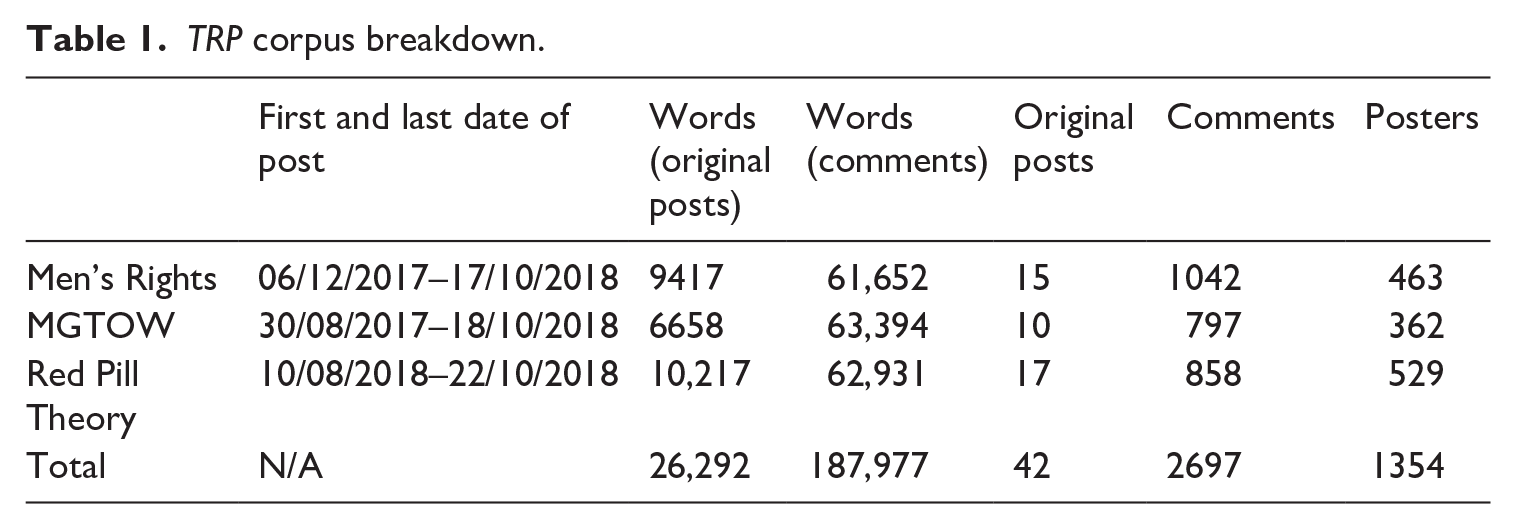
Of the 1354 total posters, 951 contributed only once. Supporting Ging’s (2017) findings, little overlap was found in the sub-communities that users posted in, as only 12 posters posted in all three sub-communities, 42 posted in both Men’s Rights and MGTOW, 15 posted in both MGTOW and Red Pill Theory (hereafter referred to as RPT) and 16 posted in both Men’s Rights and RPT.
Using the log-likelihood measure of ‘keyness’ within AntConc (Anthony, 2019) confirmed the gendered social actor terms women, men, girls and girl as highly statistically significant keywords for the TRP corpus as a whole, with the results shown in Table 2. Although the saliency of women and girls supports both Pearce’s (2008) and Sigley and Holmes’ (2002) findings that female social actors were more often collectivised than male actors in general corpora, Table 2 highlights that men were also collectivised in this manner, and the singular girl was also key. Thus, both singular and plural forms of the chosen keywords were analysed.
Top 20 keywords in the TRP corpus.
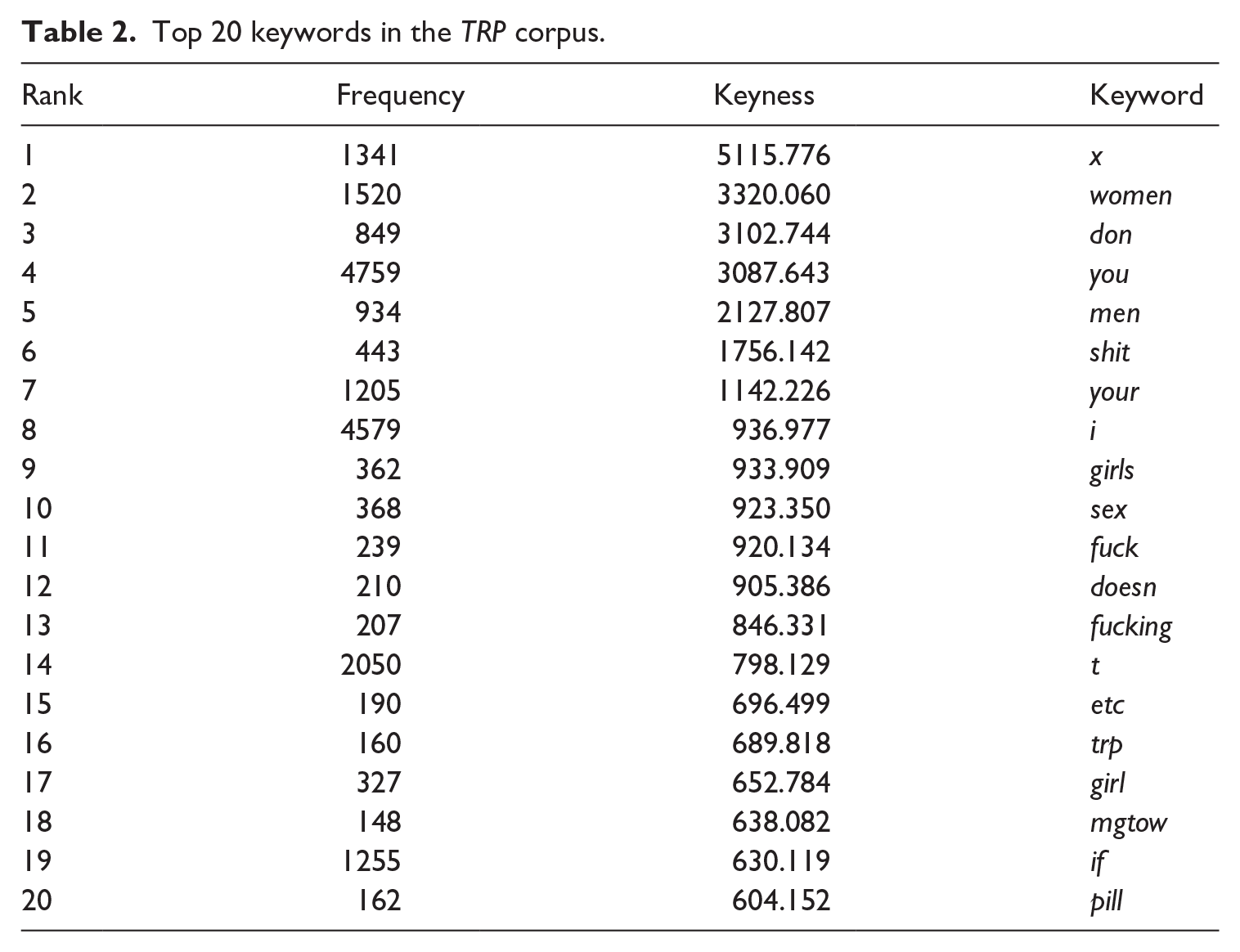
A 1.65-million-word sample of the Corpus of Contemporary American English (COCA) was used as a reference corpus for two reasons: because Reddit’s users are typically from the US (Alexa, 2019), and to capture features that are typical of online language which could carry a specific in-group meaning, which could otherwise be missed if a web-based corpus was used for comparison. However, due to the stylistic mismatch, the comparison contained artifacts denoting informality such as contractions and swearing, as shown in Table 2. Also, ‘X’ appeared instead of apostrophes in the AntConc (Anthony, 2019) interface, and does not refer to kisses nor sex-chromosomes. Furthermore, although differences in relative frequency of most content words are systematically exaggerated when the reference corpus is much larger than the target corpus, this should not affect the relative significance of the results in Table 2 too greatly.
Despite both Caldas-Coulthard and Moon (2010), and Sigley and Holmes (2002) identifying boy as an equivalent word-form to girl for analysis, the lemma boy only occurred 57 times in the corpus, whereas guys was the 31st most significant keyword (frequency 253, keyness 470.153). From this, the lemmas woman, girl, man and guy were chosen for analysis.
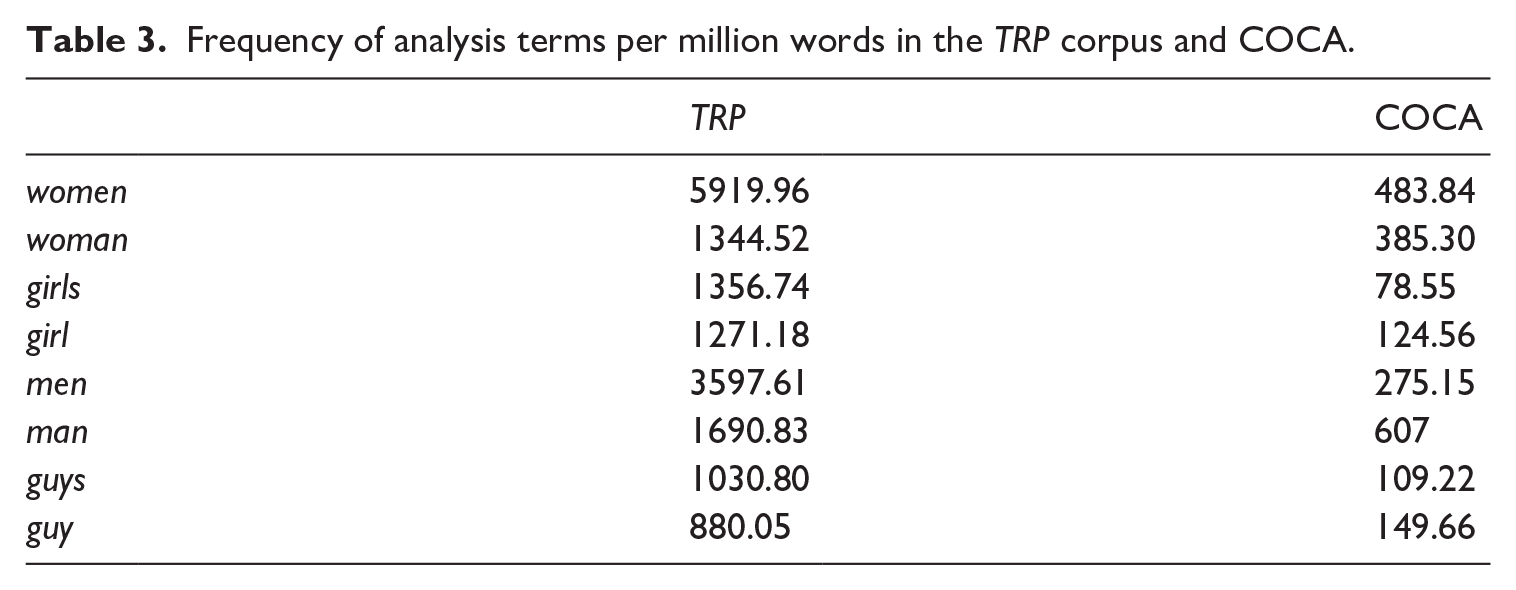
Additionally, a frequency per million words comparison of these terms between the TRP corpus and COCA highlighted that TRP discussed gendered social actors at a much higher frequency than COCA, and collectivised actors were discussed more in TRP than in COCA, which indicated a tendency towards reductive generalisation.
Separate counts were obtained for the singular and plural forms of all four social actor terms in each sub-corpus, giving 24 counts. Separate random 10% samples of concordance lines were then drawn for each of these 24 subsets, using SketchEngine’s shuffle function; the final sample is therefore representative of the full distribution by type and sub-corpus. The resulting distribution of concordance lines analysed is given in Table 4. Context for each concordance line was extended to the entire sentence in every case, with reference to more extensive context where necessary, for coding purposes. All but one instance of the 66 occurrences of girl(s) in this dataset referred to an adult, a tendency much more pronounced than that found by Sigley and Holmes (2002) in general corpora.
Frequency of analysis terms per million words in the TRP corpus and COCA.
Tokens of social actor terms retained for analysis, by sub-corpus.
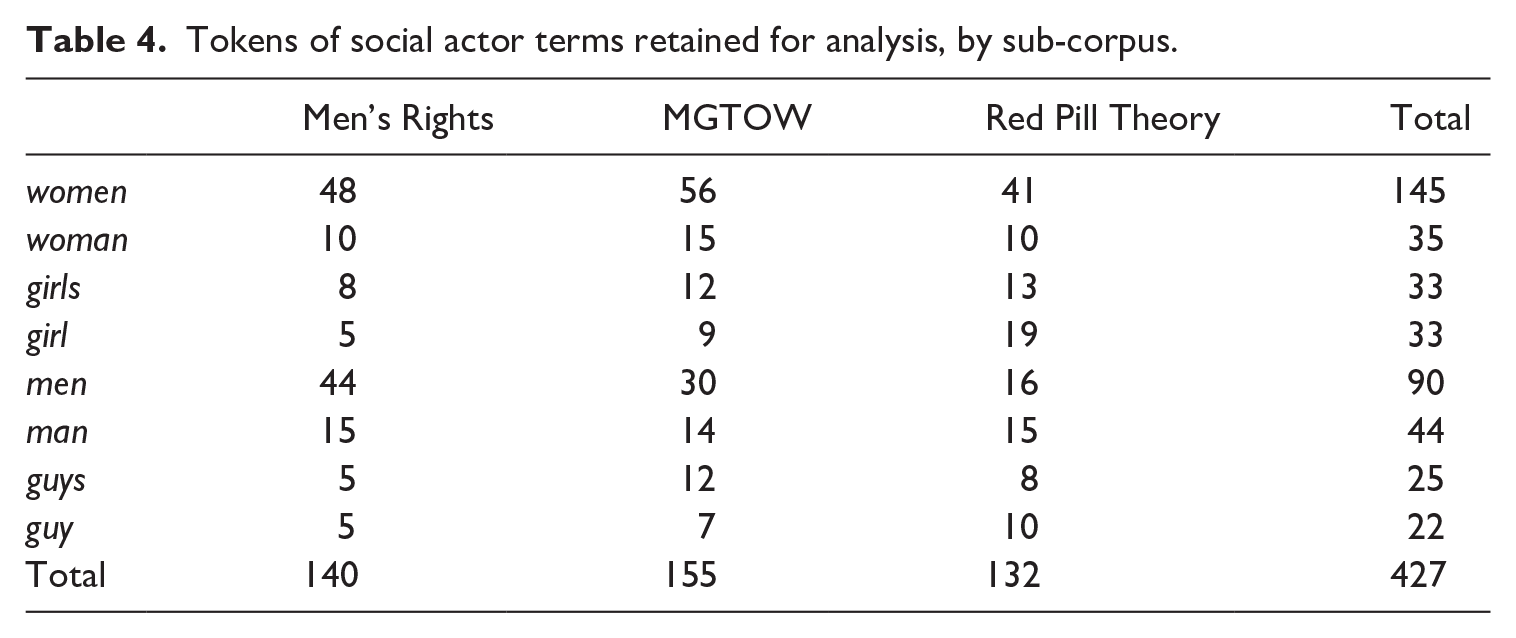
These 427 concordance lines came from 219 speakers (out of a total of 1134), 79 of whom came from Men’s Rights, 73 from MGTOW and 67 from RPT, and who on average posted twice each. However, the same username number was assigned to users who had deleted their Reddit accounts, so their usernames appeared as ‘[deleted]’ (12 in total). Therefore, the true number of posters within the dataset may be higher. These calculations confirm that the below findings were reflective of the communities as a whole, rather than a small number of prolific posters.
Data analysis
Three levels of qualitative linguistic analysis using the overarching Systemic Functional Linguistics approach (Halliday and Matthiessen, 2013) were then applied. This approach considers three metafunctions of language: ideational/experiential (describing one’s experiences in the world), interpersonal (negotiating relationships with others) and textual (organising text in terms of theme/rheme and cohesion to render expression of the first two metafunctions possible).
To consider the ideational metafunction, four factors were considered. Firstly, the transitivity system was applied (Halliday and Matthiessen, 2013: 179–259), by observing the processes that were ascribed to participants (material, mental, relational, behavioural, verbal and existential), the roles they occupy (actor/goal, senser/phenomenon, carrier/token, behaver, sayer and existent), and the circumstances of their actions. Secondly, I considered whether the social actor was represented as semantically agentive (as undertaking the relatively agentive material and verbal processes, as opposed to mental, relational, behavioural, and existential processes which do not have a direct effect on the world; see Barty-Taylor, 2020: 83). Lastly, the activation/passivation and individualisation/assimilation aspects of van Leeuwen’s (2008) social actor network were applied, so that each instance of the gendered social actor terms was coded for whether the social actor occurred as grammatically active or passive, and whether they were represented as individuals or as part of a group. For instance, in Example (1) above, women are grammatically active but have relatively little semantic agency as the process is relational, and women are discussed as a broad social group, thus constituting assimilation.
Turning to the interpersonal metafunction, each gendered social actor term was coded using the appraisal theory framework (Martin and White, 2005). This consists of three sub-systems, the first of which is attitude. This comprises ascribed and authorial affect (attribution of emotion to others or self respectively; specifically (dis)inclination, (un)happiness, (in)security and (dis)satisfaction), judgement (appraising human actors for their behaviour; with normality, capacity and tenacity denoting social esteem; and veracity (honesty) and propriety (morality) denoting social sanction) and appreciation (appraising objects and concepts for impact, quality, valuation and composition). For instance, Example (1) constitutes a negative significance (valuation) appreciation. It should be noted that positive judgements indicate that a social actor is deemed capable/tenacious/normal, but that these judgements are not necessarily evaluated positively. Although Martin and White (2005) explicitly note that judgement is reserved for humans and appreciation is for objects, they acknowledge that appreciation can be used to aesthetically evaluate humans. That being said, it could be argued that appreciation at the expense of judgement could amount to evidence of objectification.
The second sub-system is engagement, which concerns how many viewpoints are represented, and which viewpoints are (dis)endorsed. Lines were coded as dialogically expansive when they discussed a range of opinions, quoted external sources and hedged their assertions, whereas lines were coded as dialogically contractive when a bare assertion was stated, and only one viewpoint was given. Thus, Example (1) above is contractive, as it begins with the bare assertion ‘women are’. Lastly, the graduation sub-system considers how concepts are intensified, mitigated, focused upon or backgrounded, such as in Example (1), where ‘just’ acts as an intensifier.
The following section will firstly consider each social actor term, and then focus on differences which emerged between the three sub-communities. Where possible, these findings were also corroborated by pre-modifying and verbal collocates as determined by Word Sketches (minimum frequency 5), mirroring Pearce’s (2008) methodology. For the sake of brevity, the results section below includes both full concordance line examples, and quotations from concordance lines with the corresponding post label.
Results
Three initial generalisations can be made about the tokens analysed: firstly, all four social actor terms were more often used with reference to groups than to individuals (as shown in Tables 3 and 5), and secondly, the statements made about the social actors were most often dialogically contractive (Table 6). This latter point is also supported by the Word Sketches for these terms: all commonly appear with generalising quantifiers such as many, which co-occurred with women/woman 27 times, girl(s) 7 times and men/man 15 times, and most, which co-occurred with women/woman 17 times, men/man 23 times and guy(s) 12 times. Thirdly, the social actor and appraisal analyses revealed that women/woman and men/man (and, to a lesser extent, girl(s)) referred to gender roles, whereas girl(s) and guy(s) were used to discuss individual anecdotes about specific scenarios, most often dating and relationships.
Distribution of sampled tokens of social actor terms, classified by individualisation/assimilation.

Distribution of sampled tokens of social actor terms, classified by dialogic contraction/expansion.

The singular man was more often individualised than woman, and less dialogic expansion occurred for women/woman and girl(s) than men/man and guy(s). In qualitative terms, the men/man and guy(s) datasets included quotations from external sources with varying opinions about how men/man and guy(s) act. Contrastingly, the dialogically expansive comments in the women/woman dataset brought up differing points of view to refute or sarcastically posit, and the girl(s) dataset quoted the hypothetical speech of female social actors. This indicates that the masculine gender role was less homogenously represented than the feminine one.
Table 7 shows that men/man were the most grammatically active social actor, and all other social actors were more often grammatically passive than active. The unclassifiable category includes examples such as ‘I’m sorry to hear that, man’ [RPT7/2120/808/C/1]. Women/woman and girl(s) were passivated using verbs which described dating and sexual relationships, such as ‘meet’ (10 and 9 times, respectively), ‘approach’ (14 and 5 times, respectively) and ‘fuck’ (16 and 11 times, respectively; e.g. ‘Chasing/fucking women is like a drug’ [MGTOW2/1168/506/C/81]). By contrast, men/man and guy(s) were not passivated in this manner, and shared only ‘want’ (20 and 5 times, respectively), and ‘be’ (82 and 44 times, respectively).
Distribution of sampled tokens of social actor terms, classified by whether the social actor was represented as grammatically active or grammatically passive.
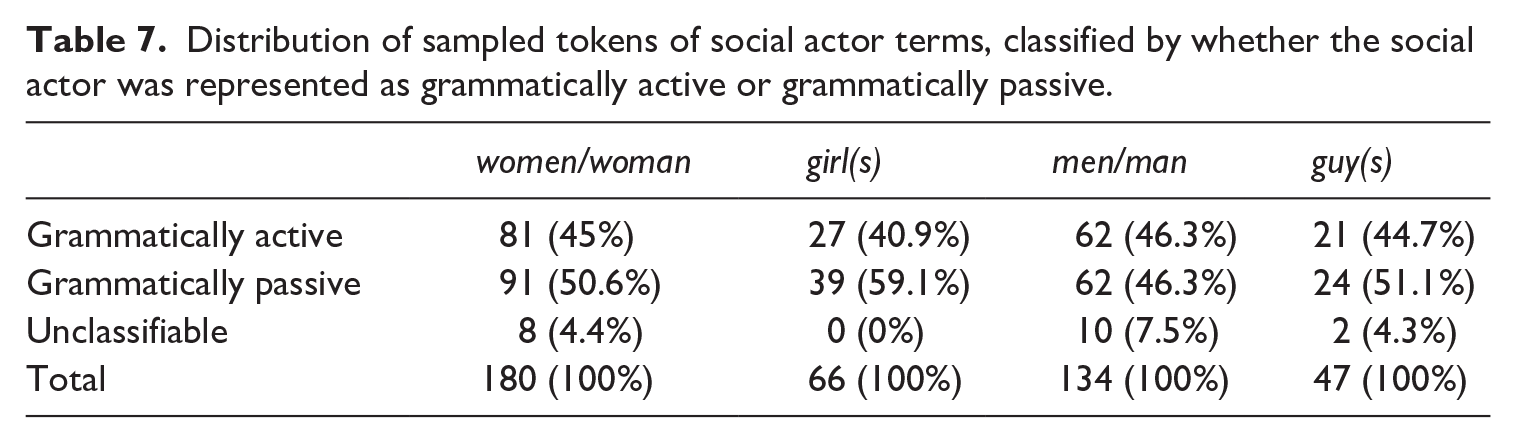
The tokens coded as grammatically active in Table 7 are classified in more detail, according to the semantic category of the processes they appeared in, in Table 8. As social actors could participate in multiple processes in one concordance line, and each process was labelled, totals add to over 100%.
Distribution of sampled grammatically active social actor tokens, classified by the semantic category of processes undertaken.
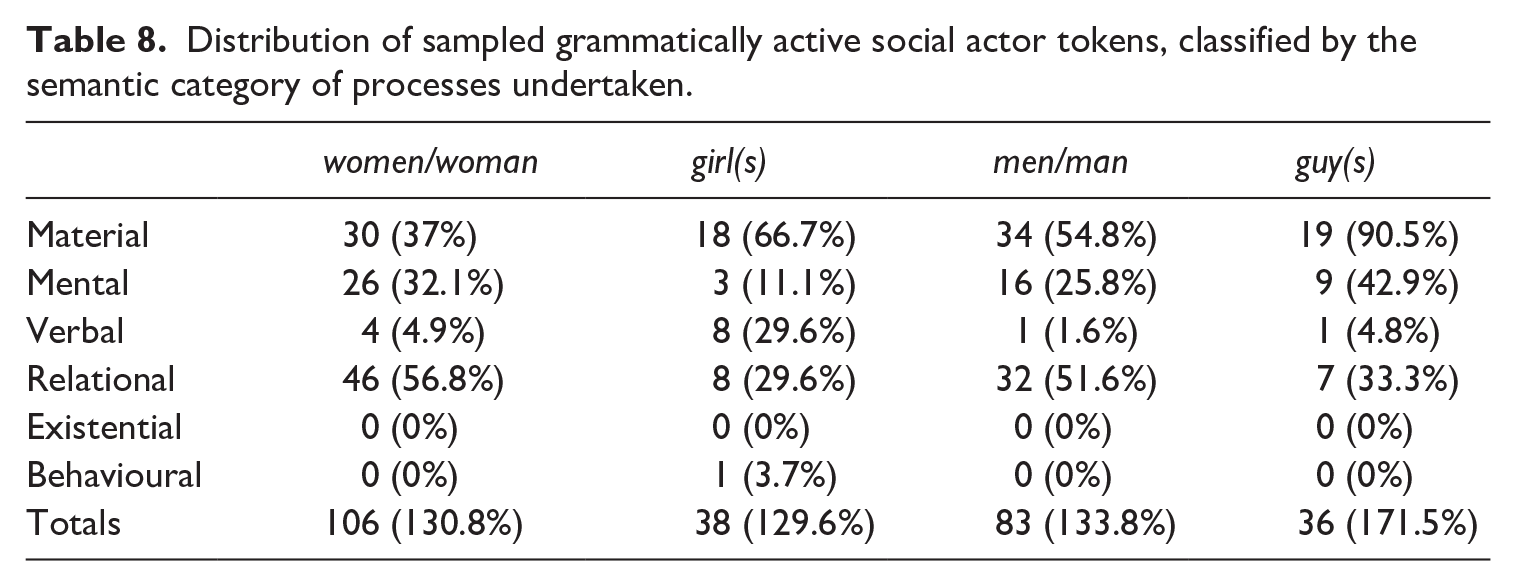
Although women/woman and men/man were more often grammatically active than girl(s) and guy(s), this was accounted for by a greater rate of relational processes. Furthermore, turning to semantic agency (including when the social actor was grammatically passive), women/woman were agentive in 48 (22.2% out of a total 216) processes, girl(s) in 30 (31.9% out of a total 94) processes, men/man in 56 (32.4% out of a total 173) processes and guy(s) in 26 (37.1% out of a total 70). This shows that female social actors were represented as less agentive than male ones.
In terms of attitudinal positioning (Martin and White, 2005), as multiple instances of affect, judgement and appreciation could occur in one line, each instance was labelled individually. As a result, due to the differences in dataset size between the four social actors, the numbers in Table 9 cannot be directly compared, although two general observations were made.
Number of attitudinal positioning occurrences in each social actor dataset.
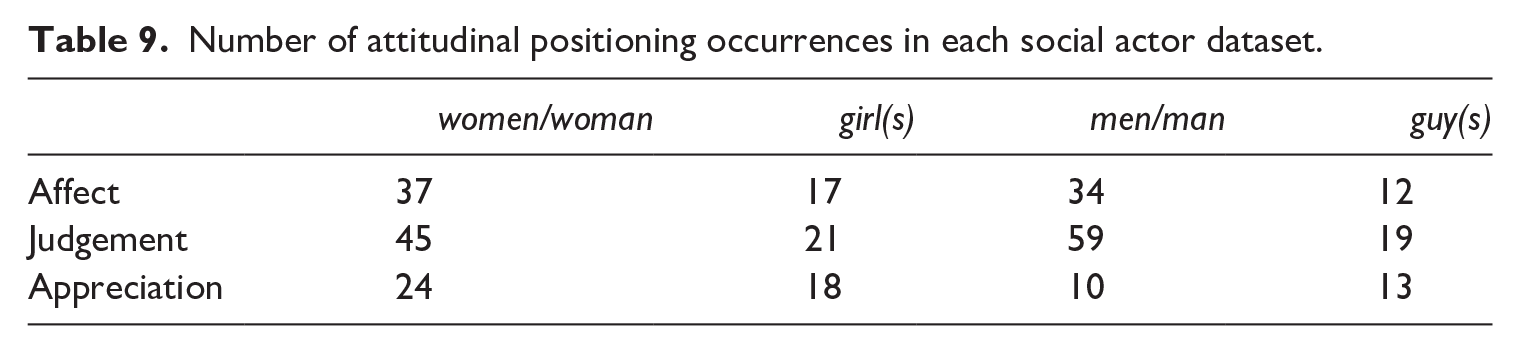
Despite having fewer concordance lines in the dataset than women/woman, men/man were judged more often than women/woman. Also, men/man were appreciated the least of any social actor group, despite having the second largest number of concordance lines in the dataset. As appreciation, in the appraisal theory sense, is typically reserved for objects and abstract concepts, this indicates that male social actors were objectified less often than female social actors.
This was supported by the Word Sketches, which revealed that women/woman, girl(s) and guy(s) to a lesser extent, were pre-modified by adjectives noting physical (un)attractiveness such as ‘attractive’ (8 times for women/woman, 7 times for girl(s)) and ‘hot’ (6, 17 and 5 times, respectively). In comparison, men/man was pre-modified by adjectives which described a hierarchy of men, from ‘real’ (13 times), ‘high value’ (6 times) and ‘strong’ (9 times), to ‘weak’ (5 times).
Having considered the top-line distinctions between each social actor, a more detailed analysis of each social actor term now follows.
Women/woman
Negative construction as immoral, deceptive, incapable and insignificant
Across all three sub-corpora, women/woman were constructed negatively overall (31 judgement instances), including negative propriety (12 instances), negative veracity (7 instances) and negative capacity (11 instances). These negative properties were presented as innate (as shown by the use of absolute quantifiers such as ‘all’ or ‘never’): women/woman were described as selfish or exploitative, as in (2); and deceptive, as in (3); and incapable of controlling such behaviour. Several examples, Example (4), explicitly ascribe the behaviour of women/woman to an assumed biological urge of ‘hypergamy’ (seeking a partner with the highest social status).
(2) And if a man is a beta, a woman really [RPT1/1890/33/C/4] (3) All women [MR10/735/121/C/34] (4) Unconditional love is something a woman [MGTOW5/1618/584/C/7]
It should be noted that the term ‘hypergamy’ originated in the 19th century specifically to describe a cross-caste marriage pattern in India, where a woman could only be ‘married up’ to a man from a higher-caste if her family could offer an increased dowry. By using the original technical term, which signals objectivity and academic rigour through neo-classical compounding, to instead refer to an assumed universal female trait and to imply (greater) female agency, the original meaning is inverted, and co-opted as a pseudo-scientific term.
Only the MGTOW sub-corpus included some minority of positive propriety judgements (5 instances), and these reference hypothetical women, who are described as modestly dressed, as in (5), as well as ‘feminine, loyal and low drama’ [MGTOW2/1265/545/C/3].
(5) I could potentially find a [MGTOW5/1406/593/C/26]
Across the sub-corpora, interacting with women/woman was evaluated as insignificant (7 instances), when compared with other aspects of the lives of male social actors, as in (6).
(6) Building out your purpose and yourself is [RPT5/2058/861/C/2]
Negative significance appreciations were most prevalent in the MGTOW sub-corpus, highlighting the separatist nature of this community of the ‘manosphere’.
Dehumanisation and objectification
As seen in (7), assumed biological drives lead to both animalistic and mechanistic parallels, in that women are both predetermined to view partners as an animalistic ‘mate’, and lack the ability to act otherwise due to their ‘programming’.
(7) You need to know that women don’t work like that. Their [RPT7/2116/889/C/6]
Evidence for objectification was also found in the prevalence of aesthetics appreciation, which accounted for 11 appreciation instances. Negative aesthetics was referenced across all three sub-corpora (4 instances), as women/woman were described as physically unattractive, for example, ‘fat’ and ‘unfuckable’ [RPT17/2720/822/C/5]. Although women/woman were more often appreciated for positive aesthetics in Men’s Rights and MGTOW, this framed women/woman as sex objects whose intellect does not matter in comparison to their ‘hot’ and ‘feminine’ appearance [MGTOW2/1265/545/C/3].
Negative construction as irrational and unhappy
Women/woman were also constructed as emotional through representations of mental processes and affect. Approximately a quarter of the processes where women/woman were grammatically active were mental ones. This was supported by the woman Word Sketch, which showed that many verbs used where women/woman were grammatically active were affective (‘love’ occurred 10 times, ‘hate’ 5 times), cognitive (‘know’ 11 times, ‘think’ 7 times, ‘feel’ 10 times) and desiderative (‘want’ 34 times). In comparison, no mental processes were found in the corresponding collocates of girl(s), ‘want’ and ‘need’ occurred 9 and 13 times respectively in the men/man dataset, and ‘think’ occurred 5 times in the guy(s) dataset.
These verbal collocates overlap with instances of affect, which were equally positive and negative, with inclination accounting for 15 positive affect instances. Emotional needs of women/woman were ascribed to ‘hypergamy’, and to an assumed underlying drive to seek dangerous partners such as criminals and psychopaths, an attraction termed ‘hybristophilia’, as in (8). This was held to be a mate-selection mechanism similar to ‘hypergamy’, and was given a similarly pseudoscientific label. This assumption was further used to justify abusive behaviours towards women/woman, on the basis that ‘women love to be lead [sic] into shit’ [RPT10/2221/846/C/4], thus excusing the behaviour of perpetrators.
(8) [RPT15/2551/887/C/15]
Women/woman were also constructed as unhappy and insecure across the corpus (7 and 4 instances, respectively), with women described as ‘miserable’ five times in Men’s Rights and MGTOW. In three cases, no reason was given to support this representation, although in the MGTOW sub-corpus, one user claimed that ‘feminism has made women miserable’ [MGTOW5/1420/584/C/1], and another claimed that the unhappiness stemmed from having ‘failed to find a mate in their peak’ [MGTOW3/1334/573/C/11]. In RPT, women’s/woman’s unhappiness was caused by men behaving in a way they do not like, which was also expressed in ascribed dissatisfaction (5 instances).
Lastly, insecurity was ascribed to left-wing women/woman who are said to use feminism as a coping mechanism for physical unattractiveness [RPT17/2720/822/C/5], as well as to how women/woman should be made to feel by the male in-group, as in (9).
(9) The only method to keep women somehow in control is [MGTOW6/1664/5/C/3]
This suggests that some portion of the ‘manosphere’ seeks to control women.
Girl(s)
Negative construction as immoral, deceptive, unhappy and insignificant
Much like the women/woman dataset, across all three sub-corpora, girl(s) were judged negatively (14 instances), including negative propriety (6 instances) and negative veracity (4 instances). Girl(s) were depicted as exploiting male social actors for their ‘resources’ [RPT16/2638/31/C/1], acting ‘rude’ when rejecting the in-group [RPT7/2130/876/C/2] and ‘compelling’, ‘allowing’ and ‘encouraging’ men to commit rape, by ‘dressing like a slut’ [MGTOW7/1674/683/C/1]. The latter example constitutes the same victim-blaming and perpetrator-excusing logic mentioned with reference to ‘hybristophilia’ in the women/woman findings. There was one positive propriety judgement in the girl(s) dataset, which occurred when the girl was submissive in comparison to a man, as in (10).
(10) If the man wins the quibbling dominance-sorting banter, then she will be the [RPT7/2107/834/C/4]
Turning to negative veracity, girl(s) were constructed as lying about their virginity in Men’s Rights [MR13/878/295/C/8], lying to other girl(s) and to an in-group member about being pregnant in MGTOW [MGTOW8/1698/432/C/16], and lying about how interested a girl is in dating an in-group member in RPT [RPT6/2081/874/O/11].
Across the corpus, girl(s) were ascribed unhappiness (7 instances). In Men’s Rights, external factors such as ‘society’s idea of what they should be’ [MR14/976/440/C/24] were to blame for girl(s)’ unhappiness. However, girl(s) were ‘jealous of’ other female social actors in MGTOW [MGTOW5/1524/627/C/4] and hostile towards them in RPT, as in (11).
(11) Like, i was out with a female colleague once, and i met the girl at the bar and [RPT16/2669/1036/C/1]
Lastly, as in the women/woman dataset, girl(s) were deemed insignificant (5 instances) in both MGTOW and RPT, to remind the in-group that girl(s) ‘aren’t everything’ [RPT13/2465/1013/C/1].
Objectification
Half of the girl(s) appreciation instances were accounted for by aesthetics, and positive aesthetics appreciations were more common than negative ones for girl(s) (4 vs 2, respectively). This was supported by the pre-modifying collocates of girl(s) in the Word Sketch, which referenced physical (un)attractiveness, for example, ‘hot’, ‘attractive’ and ‘ugly’, and occurred more often in the girl(s) dataset than in the women/woman dataset. Although girl(s) were individualised more often than women/woman, individualised girl(s) were discussed exclusively in relational contexts. This suggests that girl(s) were constructed as sexual objects more often than women/woman.
Furthermore, the RPT sub-corpus included three examples of positive convenience, to show that girl(s) were in abundance, as in (12).
(12) Because there’s [RPT16/2659/1090/C/1]
Agentive in dating contexts
Where girl(s) were ascribed positive capacity (5 instances), these instances described ideal qualities in a dating partner. For instance, girl(s) were represented as being able to ‘talk about evolutionary biology, technology, exercise science, etc.’ [MGTOW2/1264/544/C/8], and as being ‘fun’ and ‘teasing’ in-group members [RPT10/2206/888/C/5].
Furthermore, the RPT sub-corpus accounted for the greater percentage of dialogically expansive concordance lines and verbal processes in the girl(s) dataset than in the women/woman dataset, as ‘shit tests’ (female social actors asking male social actors questions in dating contexts to determine the male social actor’s social value) were discussed at length. As illustrated in Example (13) below, these posts provided the hypothetical voice of a female social actor asking questions, and the in-group posters provided hypothetical answers.
(13) Bonus: [RPT10/2214/877/C/12]
Men/man
Construction as victims of women and society
Men/man were constructed as wrongly victimised in the Men’s Rights sub-corpus, at the hands of both female social actors and external institutions, with the two occasionally conflated. This was shown through positive propriety judgements (5 instances in Men’s Rights, 9 across the three sub-corpora) to show that men/man were being treated unfairly, as in (14).
(14) [MR3/256/125/C/27/E]
Additionally, inclination instances in the men/man dataset (6 out of 8 occurred in MGTOW) argued that if men/man desire physically and emotionally intimate relationships with female social actors, they could be manipulated as a result, as in (15).
(15) [MGTOW5/1559/584/C/1]
Across all three sub-corpora, when men were constructed as capable (16 instances), men’s/man’s capabilities were framed in opposition to women/woman. For instance, in (16), the in-group deemed it ‘strong’ to control a woman’s emotions.
(16) a [RPT1/1871/33/O/336]
Contrastingly, when men/man were constructed as incapable (13 instances), these instances reference being unable to retaliate, for example, men being ‘enslaved to women ad infinitum’ by ‘Western law’ [MR7/612/298/C/3].
This adversarial relationship construction coincided with affect, where 23 instances were negative, and as with women/woman and girl(s), unhappiness occurred across all three sub-corpora (11 instances). For example, posters in Men’s Rights discussed men being ‘5-10x more likely to commit suicide’ [MR2/181/110/O/122], and posters in MGTOW discussed in-group men being ‘angry’ at ‘disloyal and immoral’ female social actors [MGTOW2/1237/531/C/10].
This unhappiness was accompanied by insecurity (6 instances) in both Men’s Rights and MGTOW. Men/man were described as ‘afraid of a #metoo backlash’ [MR2/181/110/O/122] and ‘scared’ of out-group men who defend female social actors, as in (17). However, the poster expresses disapproval of this insecurity through the use of ‘please no’.
(17) And please no ‘I’m not scared of chicks [MGTOW8/1676/541/O/541]
Contrastingly, no instances of insecurity occurred in RPT. Although unhappiness also occurred in RPT, these instances referenced feminists who were directly quoted as viewing men as ‘wallowing’ [RPT1/1871/33/O/336], which was introduced to be mocked. Thus, men/man were constructed as unhappy by the in-group, who were taken seriously, and a constructed view by RPT posters of an out-group of feminists.
Construction of how men are believed to be appraised by out-groups
Posters argued that they were being objectified and deemed insignificant by a constructed view of an out-group of feminists, and female social actors in general. As well as being supposedly viewed as ‘wallowing’ in RPT as discussed above, another direct quotation on behalf of a feminist asserted that ‘all men are trash’ [MR1/153/90/C/2], although this negative significance appreciation was read resistantly.
More generally, one poster in RPT claimed that men/man are expected to ‘be in shape, have money, know game, be social, funny’ [RPT17/2706/1114/C/7] by female social actors, thus combining positive capacity judgements and positive aesthetics appreciations. Furthermore, another poster in RPT claimed that female social actors viewed men who have female friends as less masculine, for example, ‘gay or a dickless asexual’ [RPT16/2609/797/C/2].
Hypothetical quotations were also used to provide the constructed opinion of out-group men/man, who consider ‘complain[ing]’ to be ‘weak’, such as in (18). However, by using the metaphor ‘take the bait’, the poster asserts that ‘complain[ing]’ is more assertive, and thus stronger than not complaining.
(18) These men take the bait and think: ‘dammit, [MR1/178/108/C/1]
Construction as immoral (with perceived reason)
Eight out of the total 13 negative propriety judgements across the corpus excused instances where men/man act immorally, by claiming that ‘women choose men who make them feel insecure’ [MGTOW6/1625/657/O/79], or that women act in an equally immoral way, as in (19).
(19) [RPT1/1899/785/C/1]
Other negative propriety judgements were hypothetical arguments, which the in-group made on behalf of other social actors. For example, in Example (20), out-group men were referred to as ‘white knights’ for defending a woman, and the in-group man who shared a personal relationship anecdote was described as ‘abusive’. The use of quotation marks in the comment indicated that this opinion was read resistantly.
(20) Next day she takes off as there are plenty of [MGTOW6/1654/671/C/1]
These negative propriety judgements absolved in-group men of responsibility when they were rejected by female social actors, when they were labelled as ‘abusive’ by out-group male social actors known as ‘white knights’, and when men manipulated women to further a physical relationship. This mirrors previous examples of victim-blaming and perpetrator-excusing logic found in the women/woman and girl(s) datasets. Although just over half (30) of men/man judgement instances were negative, a relatively lower rate than for women/woman and girl(s), all but four of these were framed as out-group perceptions of the in-group, or resulting from the actions of female social actors and public institutions.
Differing approaches to female social actors
The relatively greater rate of dialogically expansive concordances in the men/man dataset, compared to the female social actors, was partly due to in-group men/man differing in their approaches towards gender relations, depending on which community they posted in. For example, MGTOW posters disagreed over whether having a relationship with women beyond intercourse was pointless [MGTOW5/1608/653/C/1], while RPT posters disagreed over whether men/man need to ‘lift’ (i.e. body-build) to attract girl(s) [RPT16/2654/797/C/0]. This range of in-group opinions, plus instances of out-group disagreement with in-group assertions (see Example (21)) about gender roles indicated that posters were able to see themselves as individuals.
(21) you don’t wanna take responsibility for your sexist thought. [MGTOW5/1419/5/C/0]
Guy(s)
Specific scenario use
Guy(s) was used to reference male social actors in specific scenarios, as opposed to discussing the masculine gender role. For example, guy(s) was used by posters to discuss their personal experiences, as in (22).
(22) I was a D1 athlete and looked the part of an alpha but internally [MGTOW1/1085/5/C/10]
Similarly to the dialogically expansive lines from the men/man dataset, differences found in the use of guy(s) reflected the approach of the three sub-communities. For example, positive capacity judgements occurred across all three sub-corpora (5 instances), and discussed guy(s) having ‘lots of money’ [MGTOW5/1603/584/C/1], being ‘confident’ with women [RPT16/2674/1098/C/1], and able to ‘sue for false termination’ [MR10/741/157/C/3]. However, these were the only similarities in judgement between the three sub-corpora, and no similarities in affect were found.
‘Nice guys’
All three sub-corpora distinguished between nice guys and ‘nice guys’. In positive propriety judgements (4 instances) in MGTOW and RPT, guy(s) were constructed as ‘nice’ and ‘gentle’ as in (22) above, and ‘nice’ to their own detriment [RPT3/1999/822/C/2]. Contrastingly, ‘nice guys’ were described as treating female social actors well for the sole reason of expecting something in return, and then experiencing unhappiness and dissatisfaction when female social actors did not reciprocate their attention, as in (23). ‘Nice guys’ were discussed using negative propriety and veracity judgements (3 instances) for lying to female social actors about their intentions, and then harassing them, whereas guy(s) were broadly not judged for negative propriety nor veracity.
(23) You’d be amazed what a [RPT1/1876/622/C/11/E]
Relational contexts
Much like girl(s), guy(s) were constructed in relational contexts, particularly in RPT, which accounted for much of the dialogic expansion in the guy(s) data. Posters in RPT hypothetically and literally quoted guy(s) and potential dating partners in ‘shit tests’, and out-group male social actors were dis-endorsed in RPT for their approaches to romantic and sexual relationships. For example, in Example (24), out-group guys were represented as desiring romantic relationships without a sexual component, and this opinion was presented as a ‘claim’.
(24) ‘No way, [RPT12/2402/383/O/108/M]
In these relational contexts, guy(s) were appreciated positively overall (7 instances), and 10 instances referenced aesthetics. Men’s Rights and MGTOW solely referenced aesthetics, with ‘bigger muscle guys’ more positively evaluated than ‘skinny guys’ [MGTOW2/1221/527/C/10]. However, one poster in RPT also used negative effectiveness appreciations to argue that a guy being ‘boring/lack of personality/beta’ can negate the effectiveness of being a ‘super hot jacked guy’ when flirting [RPT16/2669/1036/C/1].
Discussion and conclusion
To summarise, the corpus as a whole was characterised by assimilations and bare assertions about the behaviour of both female and male social actors, although the masculine gender role was represented less homogenously than the feminine gender role. The terms women/woman and men/man were used to discuss essentialised gender roles, whereas girl(s) and guy(s) were used to discuss individuals in specific scenarios, particularly dating contexts.
Women/woman were judged negatively for features that were represented as innate to all women, namely selfishness, being manipulative, ‘hybristophilia’ and a TRP co-option of ‘hypergamy’. Women/woman were also dehumanised through animalistic and mechanistic means, and reduced to their physical appearance and their value in the eyes of male social actors.
Girl(s) were overwhelmingly represented in relational contexts, mirroring Sigley and Holmes’ (2002) findings. Girl(s) were constructed as exploiting men/man, and were blamed for manipulating men/man into assaulting them. Instances of agency in the girl(s) dataset were accounted for by girls acting in dating contexts, although some agentive instances such as ‘shit tests’ were representations by in-group members rather than literal quotatives. Furthermore, girl(s) were appreciated for positive aesthetics and convenience.
Men/man were constructed as victimised at the hands of female social actors and external institutions, and as unhappy and insecure as a result, particularly in the Men’s Rights sub-corpus. Although female social actors were represented as less semantically agentive than male social actors, and men/man were the least appreciated social actor, the in-group argued that female social actors appreciated them for aesthetics and significance. Additionally, where men/man were judged as immoral, this was justified as being provoked by female social actors. Although Pearce (2008) and Caldas-Coulthard and Moon (2010) found that men were more often evaluated in terms of their behaviour than women, which was also true within the TRP corpus, they also found that men were more often constructed as more powerful than women in general corpora of English, which was not true for the TRP corpus.
Lastly, guy(s) was used as a generic term to refer to male social actors in specific scenarios, most often relational contexts. However, the term ‘nice guys’ was used to describe out-group social actors who expect affection from female social actors for treating them well.
Since Pearce (2008) and Caldas-Coulthard and Moon (2010) noted that women and girls were described as emotional and as sexual objects in general corpora of English, this suggests that the conceptualisations of female social actors in the TRP corpus reflect popularly held opinions. However, these opinions were extended by posters in TRP. The negative propriety and veracity judgements which characterised the women/woman and girl(s) datasets demonstrate that overall, TRP is a hostile sexist community. Furthermore, across the datasets, victim-blaming and perpetrator-excusing logic, including the pseudo-scientific terms ‘hypergamy’ and ‘hybristophilia’, was used to justify harmful actions towards female social actors, such as rape. Although a link between online words and offline action is not inevitable, it would be naïve to argue that some members of the ‘manosphere’, like those mentioned in the Introduction section, could not be encouraged to act in a hostile manner towards women, having read generalisations about female social actors characterised by pseudo-scientific language presented as fact. Thus, the implications of enabling such language should be carefully considered by online platforms such as Reddit.
Turning to limitations of this research, the use of corpus linguistic methods has been limited due to the relatively small size of the corpus, and the data thinning required to qualitatively focus on the key gendered social actor terms limited the precision possible for more detailed numerical results. Additionally, the constraints imposed by concordance context prevented analysis of the in-group discussion as a polylogue. Future directions for this research include analysing the interactions between in-group users on the comment threads, which would enable an analysis of socialisation and interactive mechanisms for radicalisation. Future research could also consider the functions of references to different parts of the ‘manosphere’, as the community names MGTOW and TRP appeared as keywords in the TRP corpus.
Footnotes
Acknowledgements
The author would like to thank Dr Veronika Koller at Lancaster University for her continued guidance and support, and the anonymous reviewer for their invaluable comments on an earlier iteration of the present study.
Declaration of conflicting interests
The author declared no potential conflicts of interest with respect to the research, authorship and/or publication of this article.
Funding
The author received no financial support for the research, authorship, and/or publication of this article.