




Abstract
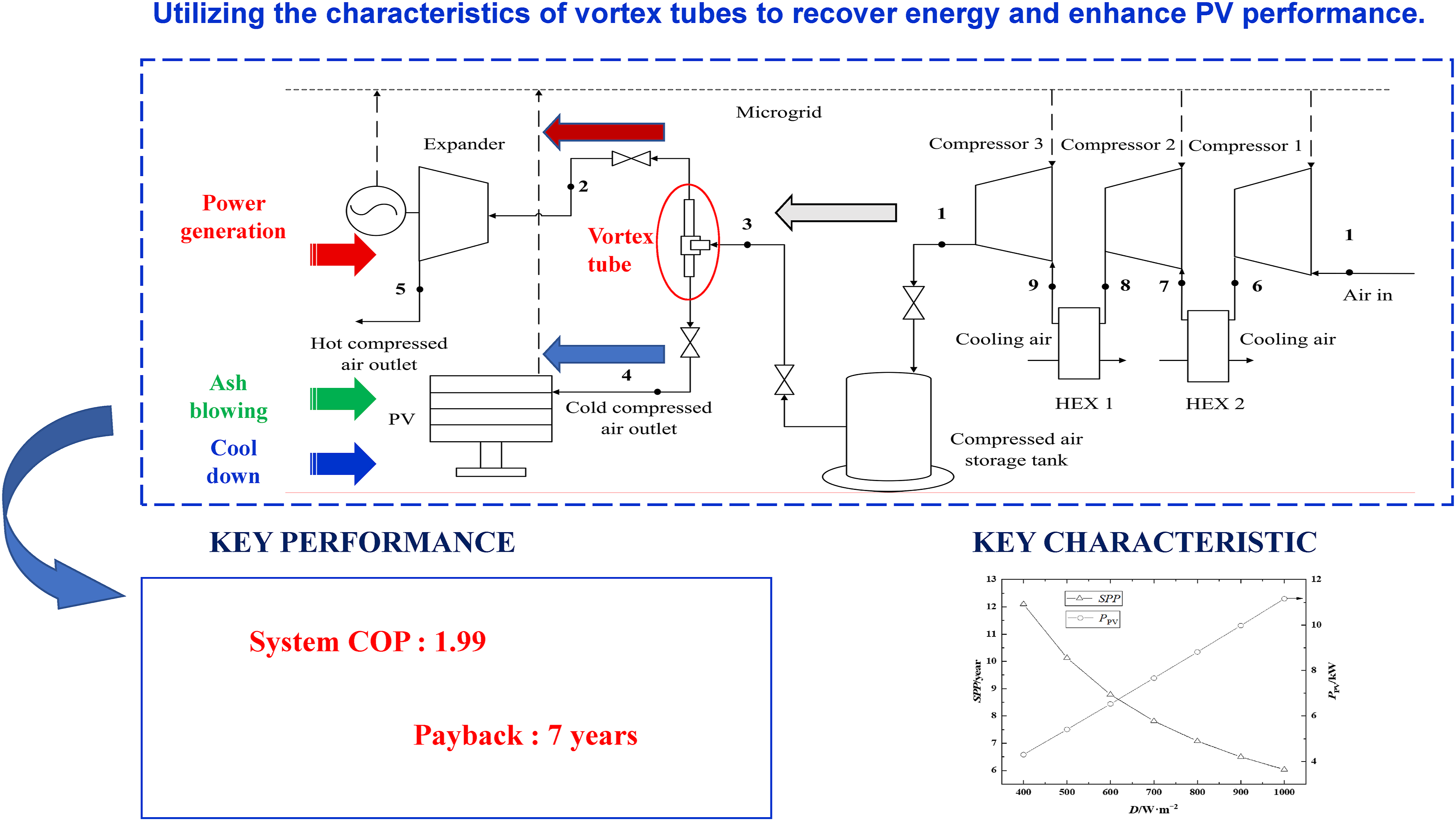
To overcome the three critical bottlenecks restricting large-scale photovoltaic (PV) deployment—grid-side intermittency, source-side thermal degradation, and environmental soiling losses—this study proposes a novel trigeneration system integrating Photovoltaics, Compressed Air Energy Storage, and Vortex Tube cooling (PV-CAES-VT). Unlike conventional binary coupling approaches, this system establishes a “one-source, three-use” thermodynamic loop where compressed air serves as an energy storage medium, a cooling fluid, and a pneumatic cleaning agent. A unified thermodynamic and economic model was developed to quantify the system’s performance, revealing that the recovery of pressure exergy for active cooling significantly enhances PV conversion efficiency. Under base-case conditions, the system achieves a Coefficient of Performance (COP) of 1.99, with a Levelized Cost of Energy (LCOE) of 0.1308 $/kWh and a Static Payback Period (SPP) of roughly 7 years. Exergy analysis identifies the vortex tube and PV cooling interface as the primary sources of irreversibility, collectively accounting for over 52% of total exergy destruction. Parametric analyses demonstrate that the system exhibits “sun-chasing” characteristics: while robust against ambient temperature variations, its thermodynamic and economic performance improves substantially with higher solar irradiance. This work confirms the feasibility of using steady-state compressed air for multi-domain synergistic optimization, offering a sustainable pathway for high-efficiency renewable energy integration in arid, high-irradiance regions.
Get full access to this article
View all access options for this article.