




Abstract
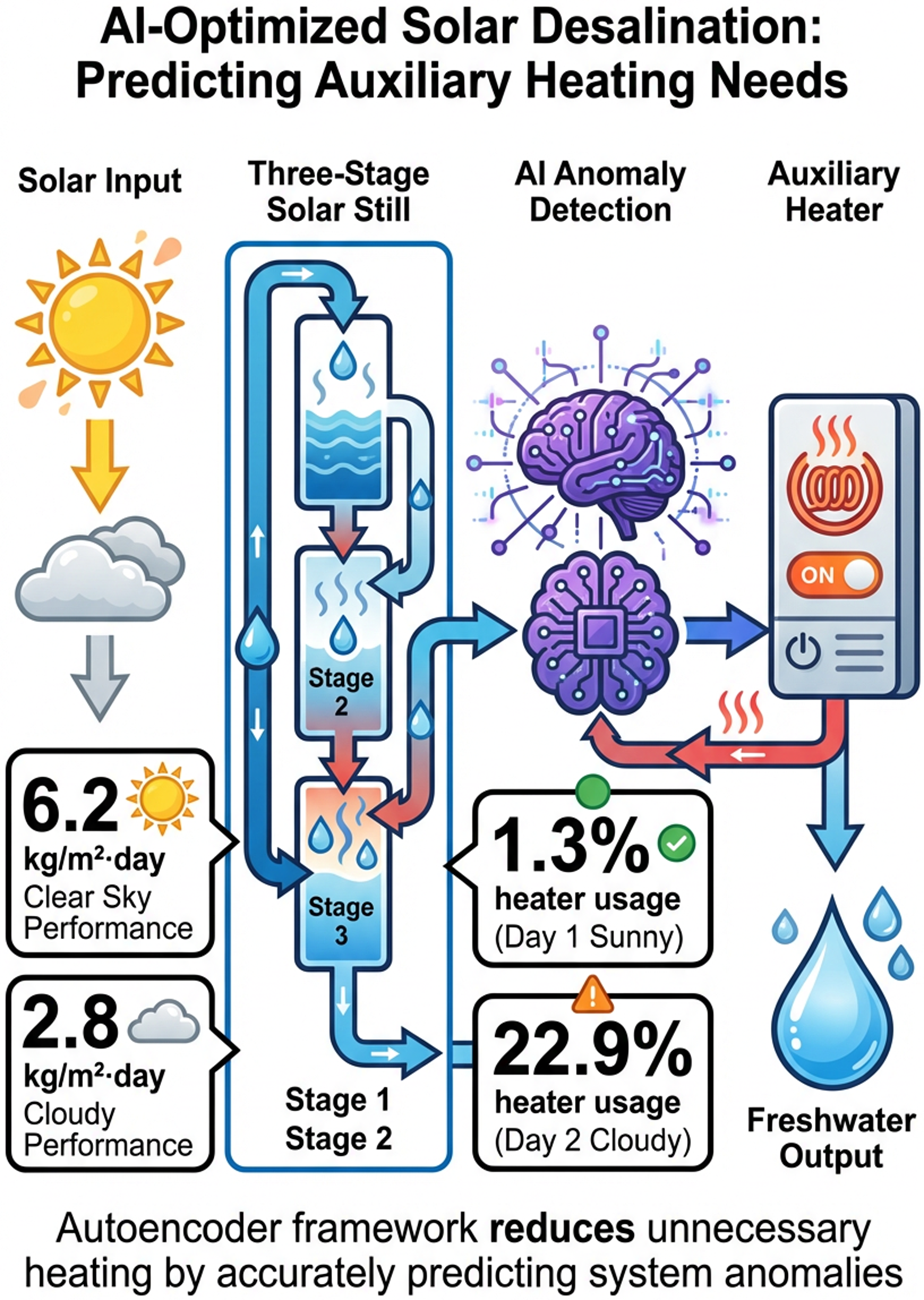
Solar-powered desalination systems offer a promising method for reducing freshwater production costs, however, their performances are highly sensitive to fluctuating weather and operating conditions. This study investigates a residential-scale, three-stage solar thermal desalination system and introduces an unsupervised autoencoder-based anomaly detection framework for identifying periods where an auxiliary electrical heating is required under suboptimal conditions. The system was experimentally tested over 2 days, one clear sky conditions and one partly cloudy. Distillate production reached a maximum of 6.2 kg/m2·day under clear sky conditions and decreased to 2.8 kg/m2·day during cloudy intervals. A seven-feature autoencoder was trained using data from the clear sky day to learn normal operating behavior, and subsequently evaluated using data from the partly cloudy day. Reconstruction error was used to derive a severity index value that quantifies deviations from normal operation, allowing accurate and adaptive intervention scheduling for an auxiliary heater. Results also showed that auxiliary heating would be required for only 1.3% of operating time on under clear sky conditions, compared to 22.9% during intermittent cloudy conditions, thus, reducing unnecessary energy consumption and improving the reliability of the system.
Get full access to this article
View all access options for this article.