




Abstract
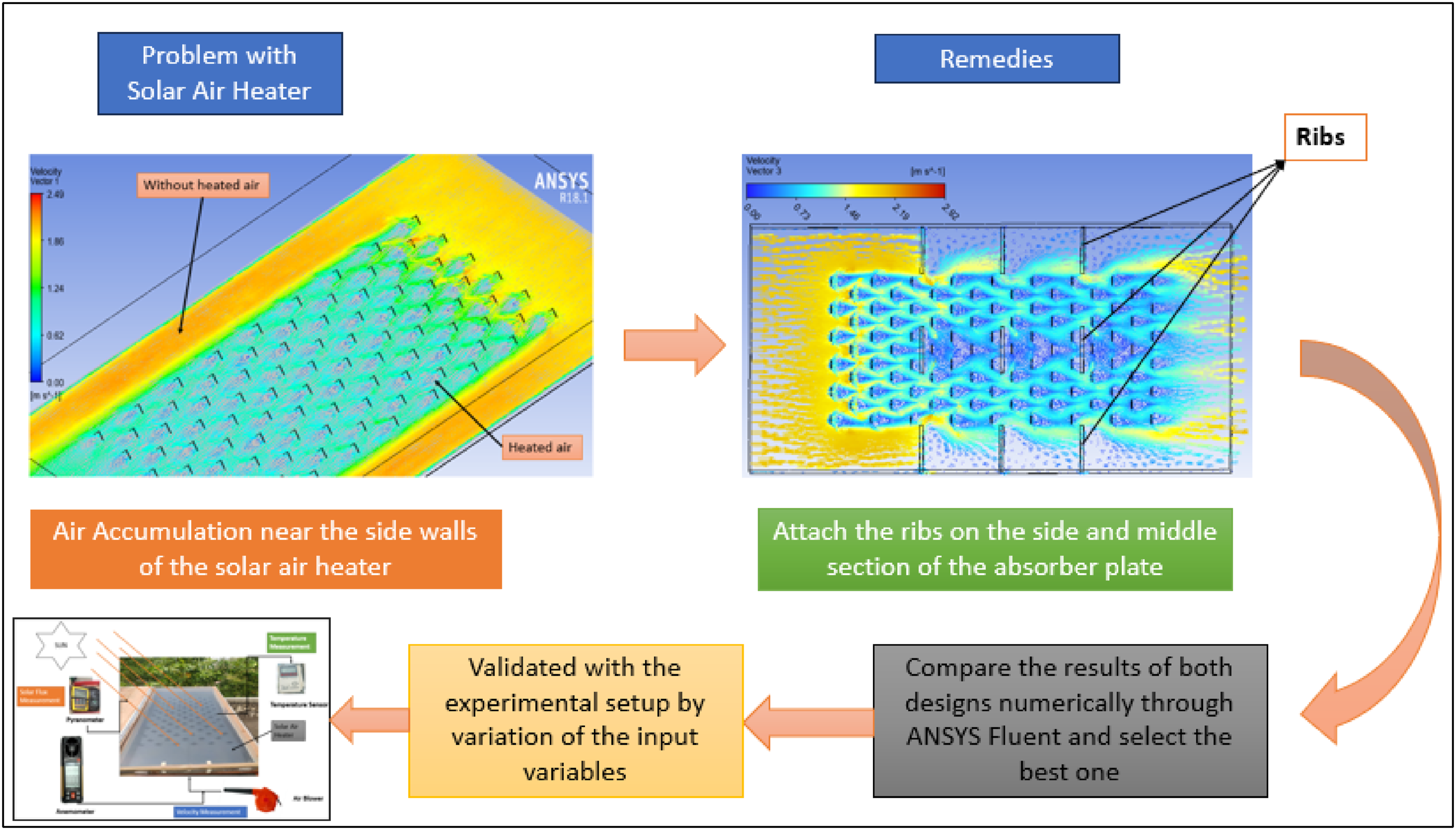
This research article investigated the effect of the triangular fins and triangular fins with ribs by the ANSYS Fluent-2018. Ribs are added at the side walls of the solar air heater to divert the flow on the teethed portion of the absorber plate, which was hidden in previous research designed of the roughened solar air heater. The comparison between the two designs of the solar air heaters was done based on the thermal performance factor. The best design is selected and validated experimentally. The outcomes of the study showed that the triangular fins have a higher thermal performance factor than the triangular fins with the ribs due to lower pressure drop in the triangular fins. However, triangular fins have a lower Nusselt number as compared to triangular fins with ribs. The Reynolds Number and pitch to height ratio were chosen as important parameters which investigated the performance of the triangular fins solar air heater through numerically. The friction factor, Nusselt Number, and the Thermal Performance Factor (TPF) are reduced as the pitch to height ratio increases. The rise in Reynolds Number reduces the friction factor, but the Nusselt Number and TPF increase for a triangular fin solar air heater. The maximum value of the Nusselt Number and TPF obtained are 114.95 and 1.89 for the Reynolds Number 10,000 and P/h ratio of 1. The minimum friction factor reached 0.023 at a Reynolds Number of 10,000 and a P/h ratio of 3. The numerical results are validated with the experimental results on the date 11/03/2025. The maximum outlet temperature of air, thermal efficiency, and exergy obtained through the experimental observation are 72.25°C, 77.18%, and 3.4% at noon at a mass flow rate of 0.08 kg/s. The numerical results are validated with the experimental results within an accuracy of 5%.
Get full access to this article
View all access options for this article.