




Abstract
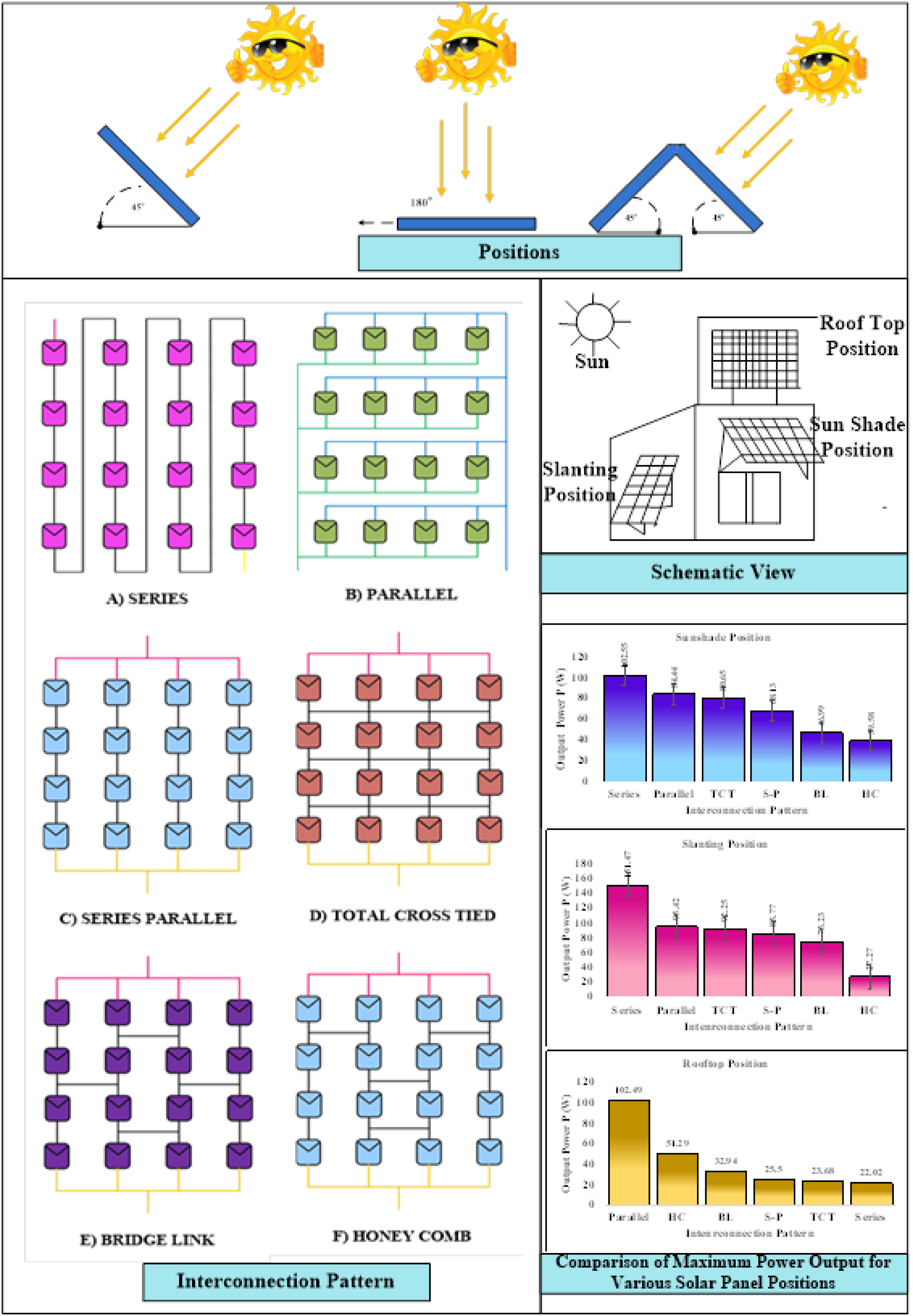
As a naturally abundant and renewable resource, solar energy makes photovoltaics a highly sophisticated choice for future energy systems. The Building Integrated Photovoltaics (BIPV) refers to the integration of solar panels into building structures. Today, the building industry is expanding to meet the norms for almost Zero Energy Building. To enhance the power generation, the panels are placed at different positions and connected with various interconnection patterns. Photovoltaic modules are incorporated into the building to generate electricity and make some changes in the infrastructure of the building. It appears to be one of the best options because it takes up less area and turns building envelopes to generate electricity. BIPV is used to generate electricity on the roofs, exterior walls, windows, and doors of residences and commercial buildings. By identifying the optimal placement of panels with different interconnection patterns the output power will be enhanced. By way of examination in the sunshade position, series connection appears to be the best because at the range of (500 W/m2) irradiation the maximum power (Pm) becomes 102.55 W. In slanting position, series connection appears to be the best because at the range of (500 W/m2) irradiation the maximum power (Pm) becomes 151.47 W. In the Rooftop position, the parallel connection seems to be the best because at the range of (500 W/m2) irradiation the maximum output power (Pm) will be 102.49 W. The application of RSM for optimization produced statistically significant models, as evidenced by p-values of 0.0362 for output power and 0.03 for the temperature coefficient. The respective R2 values of 0.8433 and 0.85 confirm the model’s reliability and predictive accuracy. BIPV technology enhance photovoltaic output, supporting customized solar energy solutions for different architectural setups.
Keywords
Get full access to this article
View all access options for this article.