




Abstract
Coal power plants have been a major source of undesirable emissions. Despite the technological advancements in renewable energies, coal units are still in-service in many developed and developing countries due to their reliability, adequacy, and flexibility for power delivery. There are some promising technologies for cleaner operation during power production from coal, including supercritical boiler (SC) design and carbon capture and storage (CCS), however, the challenging in innovating effective methods is still open to expand the boundary of knowledge in this speciality. This paper introduces a novel and simple method for reducing CO2 emissions and improving the dynamic responses of a 600 MW SC coal power plant by Artificial Neural Network (ANN) technique. A wide-range data-driven feedforward ANN model has been identified and verified for the various operations recorded as closed-loop data-sets, which covers all situations of startup, once-through mode, and even emergency shutdown of the unit. The closed-loop SC plant model has been augmented with an inverse multivariable coordinate NN controller, developed by analogous learning algorithm to improve the plant automation. With precisely selected setpoints, as operational rules, of temperature, pressure, and earliest possible power demand signals, the automated SC plant has been capable to operate with lower coal consumption - and thus lower emissions – than the existing operation strategy during startup, normal operation, and emergency shutdown modes. The improvement in dynamic responses have been quantified through simulations with comparison with existing performance, which have resulted in an overall average reduction of 2.143 Kg/s in coal consumption.
Introduction
Motivation
Greenhouse gases (GHG) allow the sunlight to enter the earth atmosphere, but block the heat radiated by earth through repeated heat absorbing and emitting, causing the well-known undesirable effect of global warming.
1
With the advancement in renewable energies for the aim of energy sustainable and 100% coverage, it is expected that some feasibility questions would entail, which could be economic, technical, and several technological issues.
2
Therefore, it is convinced and urgent that the research work shall continue in the direction of developing more efficient and cleaner fossil thermal power plants through mathematical modelling and simulation.
3
There have been three essential future scenarios for energy resources that present affordable solutions to the climate change by reducing CO2 emissions and ensure sustainability, which are as follows4,5: the first and most popular is to increase the contribution of renewable energies (REs) and gradually replace traditional fossil-fueled units; the second has been to elevate the share of nuclear resources to cover the largest proportion of electricity or the base power demand, and the third is through the production from clean fossil power generation technologies, integrated with carbon capture and storage, to supply electricity in collaboration with renewables. With the fact that the first and second scenarios are still not fully feasible, more research effort should be given to develop more cleaner coal power plants to slow down the effect of global warming and enhance the economic viability of fossil fueled power plants.6,7 Worldwide, coal is the dominant power generation technology and the essential source of emissions.
8
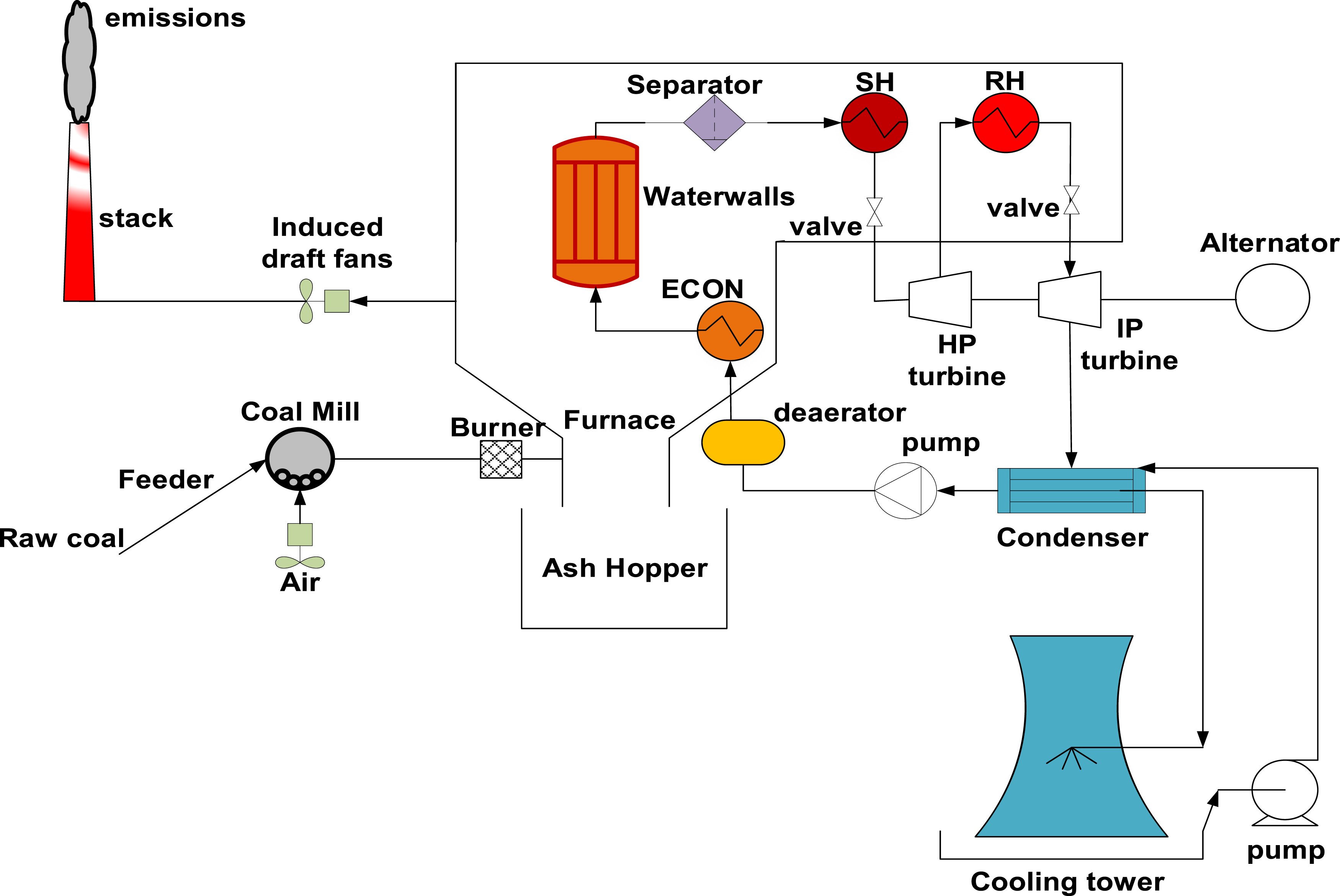
It has been adopted by many developing and developed countries to preserve secure, abundant, and cheaper energy supply. Although the Arab or the Middle East and North Africa (MENA) region has limited coal resources, some MENA countries have started investing in clean coal power generation technologies as they have been modelled to be an economically viable solution in some countries such as Saudi Arabia and United Arab Emirates (UAE).9,10 The principle of power generation from coal is illustrated in Figure 1.
7
The figure generally facilitates understanding of the energy conversion processes, from input coal to output electricity, in supercritical or subcritical coal firing power plants. An easy-to-follow schematic diagram for an SC plant.
7
It is worth mentioning that, there are many design methods for enhancement of energy efficiency and hence reducing emissions and saving coal for coal-fired steam power plants, which include, but not limited to:
Th term clean-coal goes beyond that to include carbon capture and storage (CCS), which highly decarbonizes coal units and has considerable position among the strategies of environmental protection.
24
It is apparently preferable then that energy-efficient fossil fuelled power plants are integrated with CCS to cause zero or near-zero emissions. However, further enhancement shall be obtained through control theory and system identification of operating systems, which allows upgrades of control strategies for the aims of minimum energy inputs.
13
In addition, control system objectives should focus on the grid operational requirements, it is then mandatory to think about robust control strategies that aims for lower emissions and maintain the obligations of flexible power generation concerning the integrity of power system. Any proposed control systems for existing generation units should be simple enough to be quickly and easily taught to power plant operators and preliminary planning engineers, in the light of the aforementioned motivation, this paper proposes a new, cost effective, and practically-feasible control strategy for SC 600 MW power plant that achieves enhanced power plant operation with lower emissions and startup costs. The graphical description of the paper contribution is shown in Figure 2. Artificial Neural Network (ANN) approach has been used to develop an accurate model that has been trained with sufficient and informative set of data, which includes all possible operations under normal and emergency conditions. Graphical description of the research methodology and the core outcomes.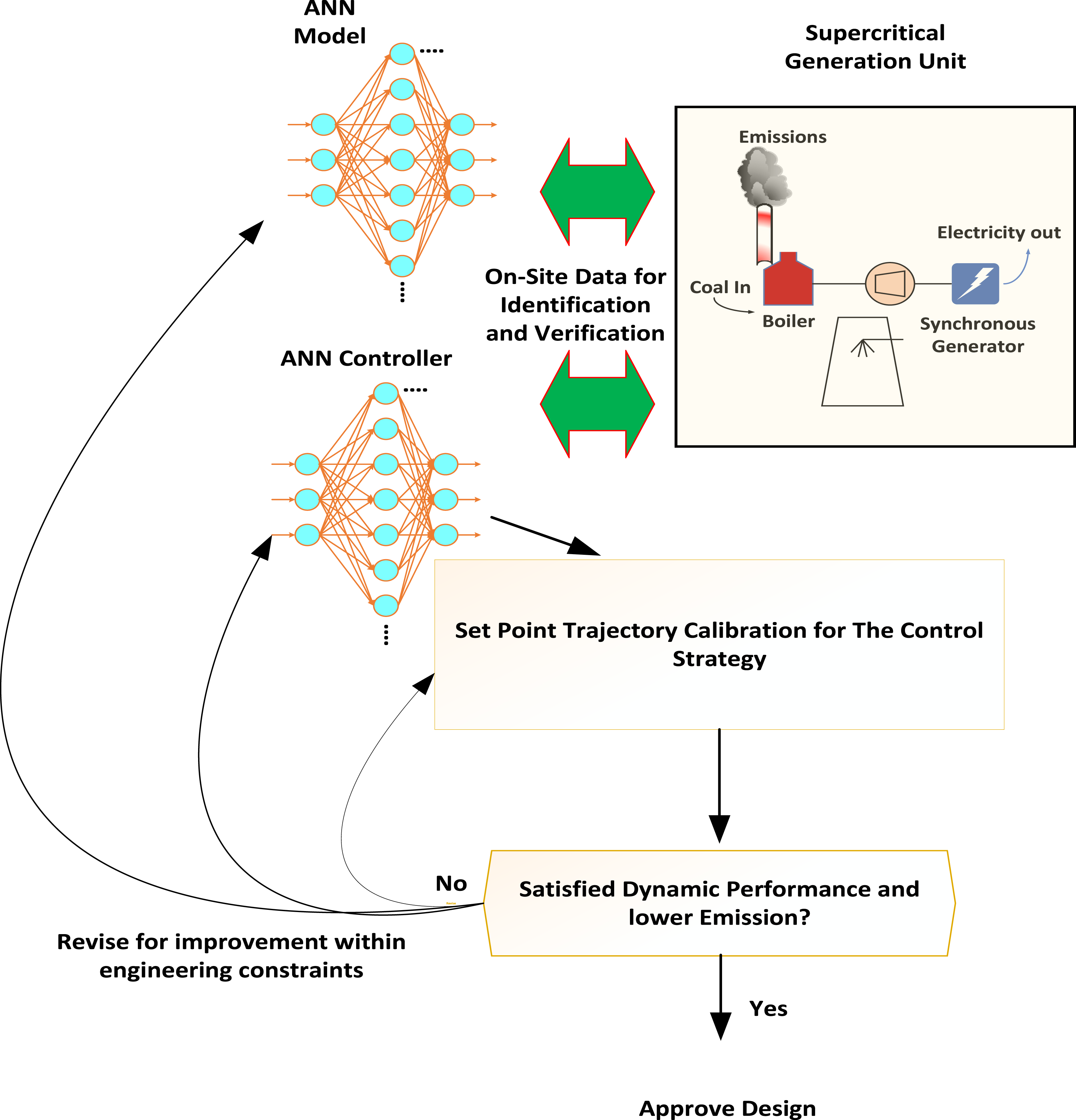
This model that represents the plant with existing loops has been integrated with a MIMO ANN inverse controller that has been built correlate the output measurements to the required control actions. Then, over wide range of scenarios, a significant effort that has been done to decide the best setpoints trajectories for power delivery with lower emissions than existing operation during startup and shutdown in addition maintaining robust load-following capability during once-through mode. The rest of the paper is organized as follows: the next subsection investigates the literature to justify originality and to prove the presented work significance, then another section elaborates onto system modeling and identification, the section following to it represents the proposed control scheme, then the results section demonstrates and discusses the simulation results, and finally the concluding remarks and future recommendation are given in the last section.
Literature review
Literature review summary with the presented work.
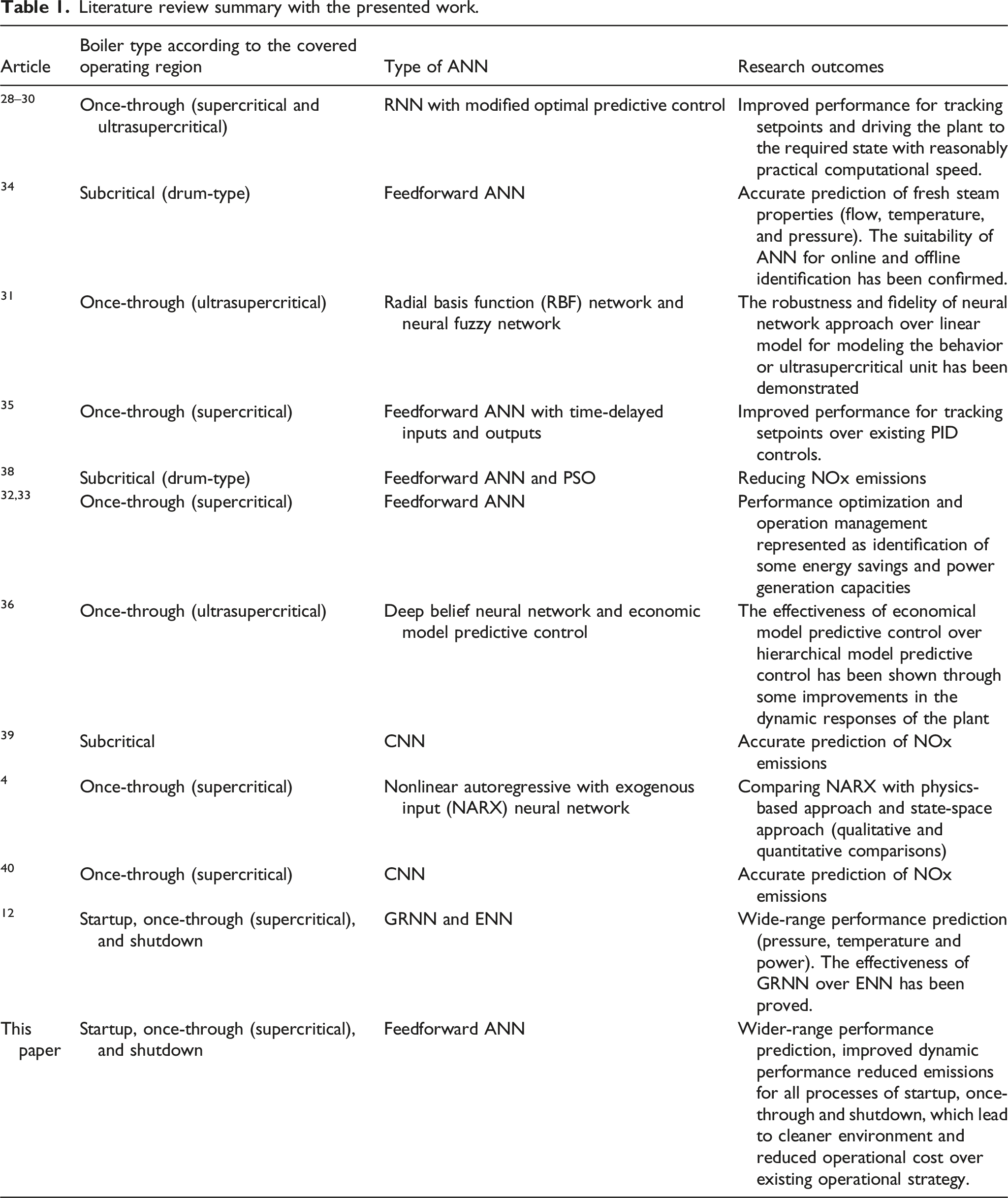
The research gap has been notable in still insufficient research in reducing emissions from coal units for all their multiple processes of startup, once-through, and shutdown using artificial intelligence (AI). The AI solution should be simple and easy-to-teach to operators in power plants and newly-graduate engineers to facilitate practical application in the future. Therefore, feedforward ANN can be a valued choice, especially, when realizing that the target contributions are not in applying newer type of ANN per se, but to reduce emissions and improve dynamic performance of a practical generation unit in startup, once-through, and even emergency shutdown processes. The novel contributions can be then stated as follows: 1. An economically viable and a practically feasible control strategy has been presented for 600 MW supercritical coal-firing generation unit. The control has been based on an inverted ANN control system implementation, which has been applied to a MIMO ANN model of the plant. 2. The controller is capable of startup and shutdown the plant earlier than existing situation, which enhances the operation and reduce the coal consumption and emissions. 3. The controller is capable of tracking the load demand changes during once-through operation and covering the entire range of operation. The reduction of emissions, achieved by the upgraded control system, has been proved also during once-through operation. 4. It has been proved that the decent objective of the next generation of power plant control systems shall not only for setpoint tracking or keeping variables within restrictions, but shall also target more efficient operation that lead to lower emissions.
The next section presents the procedure of modeling and control system development.
Model identification and verification
This section details the steps for the ANN simulator design. It could first start with data description and reference, then the ANN-based model identification and verification of the SC plant model are explained.
Data description
The research has been carried out on a 600 MW supercritical plant.
6
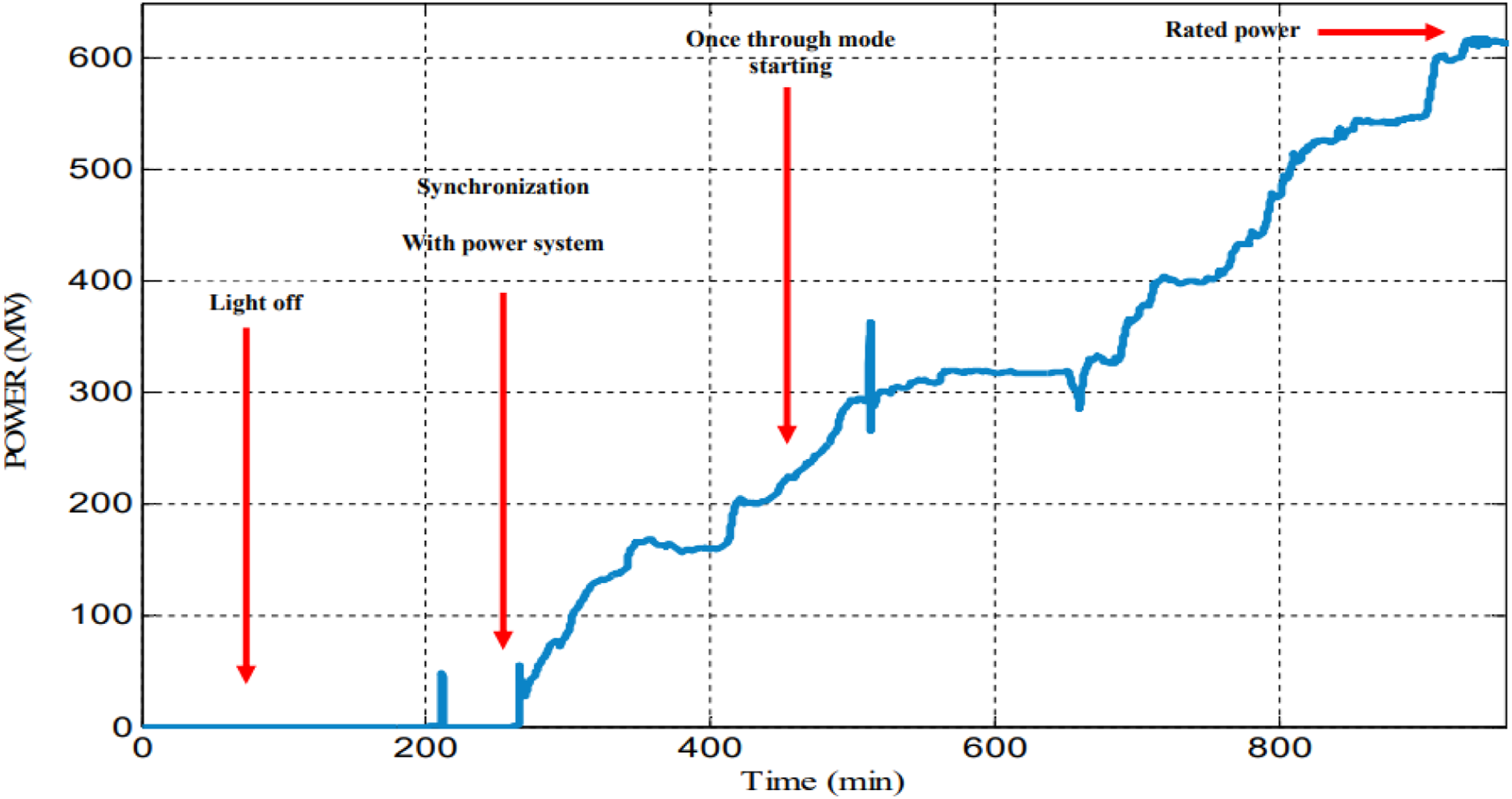
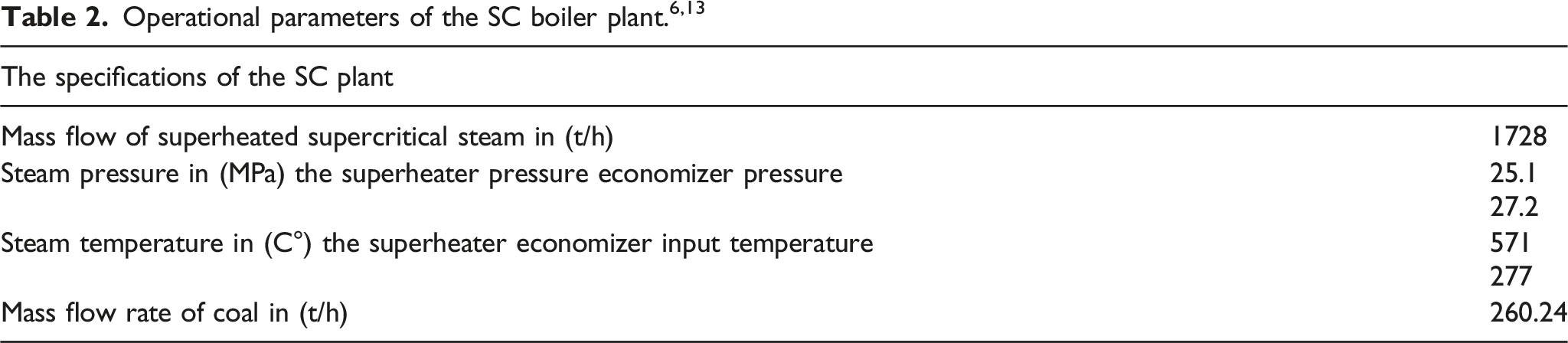
The data signals have been extensively used in many different research applications concerning modeling and control.6,11,14 The data can be used throughout lifespan of supercritical units and has no expiry date as long as this type of plants is still in operation. This is because they are subject to regular maintenance that avoids deterioration in equipment and/or dynamic performance and it is then confirmed that no significant change has occurred on the data in this period. Figure 3 demonstrates wide range sample power signal for the case study, which shows the plant startup, recirculation mode, once-through mode up to the rated power output or boiler maximum continuous ratings (BMCR), and Table 2 shows the plant operational parameters. Power trends of the plant under study.
6
Following to data description, a subsection that presents the identification and validation of the system model.
Model identification and verification
Time-series modeling by ANN has gained considerable attention in power generation fundamentals.
41
The scientific merits of the most salient modeling approaches like the physics-based modeling and ANN modeling were discussed with aspects, which are well-known by people in specialty for each modeling philosophy.4,42 However, the main drawback of ANN simulation performance has been the failure to simulation of some emergency conditions and small power system frequency excursions. This drawback could be handled by training the neural networks with all possible situations and investigating more informative structures of inputs and outputs. This paper resolves the issue of lacking physics-informed decisions done by neural networks through training them with all possible operations, startup, normal operation and emergency shutdown conditions, in order to have broader insight on the system and therefore more accurate time-series outputs. Feedforward neural networks are very popular choice and have been selected to carry out the modeling and control tasks. With aim towards satisfying the multiple and practical objectives of modeling, including training future graduates and power plant operators, feedforward ANN can be a wise choice that sufficiently satisfies the design requirements. Three-Input, Three-Output model structure has been decided to reflect the essential plant dynamic performance, which is shown in Figure 4. The system inputs and outputs.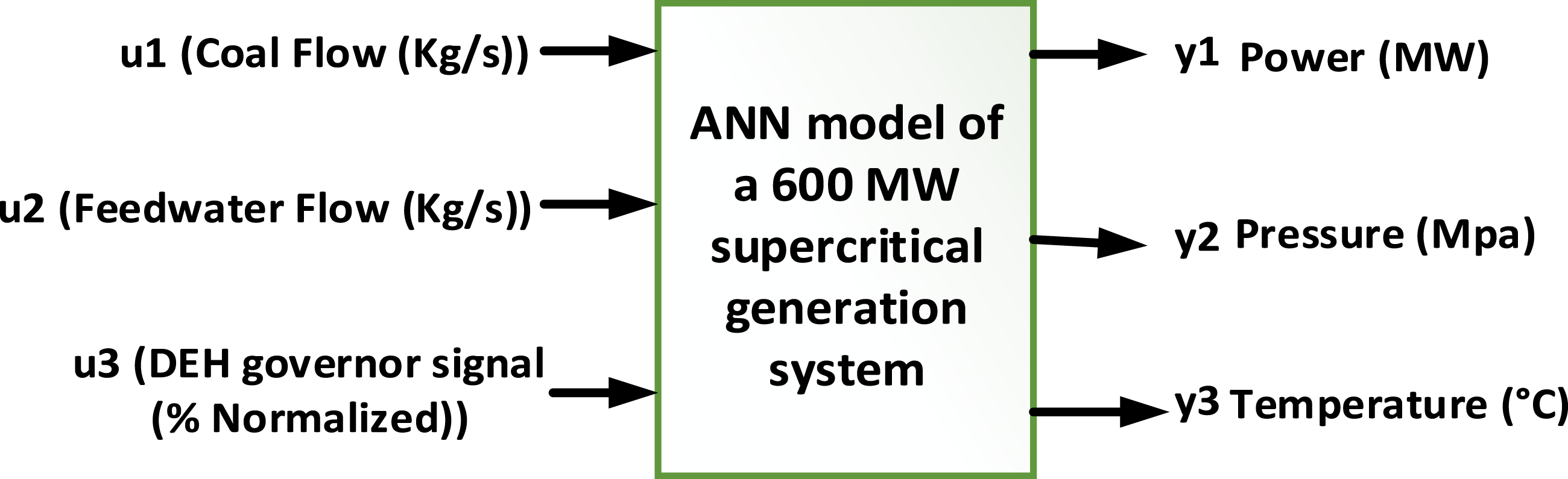
Many structures of ANN have been investigated, with regressions and simulation errors as essential performance indicators, the data has been divided to be 70% for training the network and 30% for testing with Bayesian regularization (BR) algorithm. It has been proved that BR algorithm is an efficient and robust for identification and control.
43
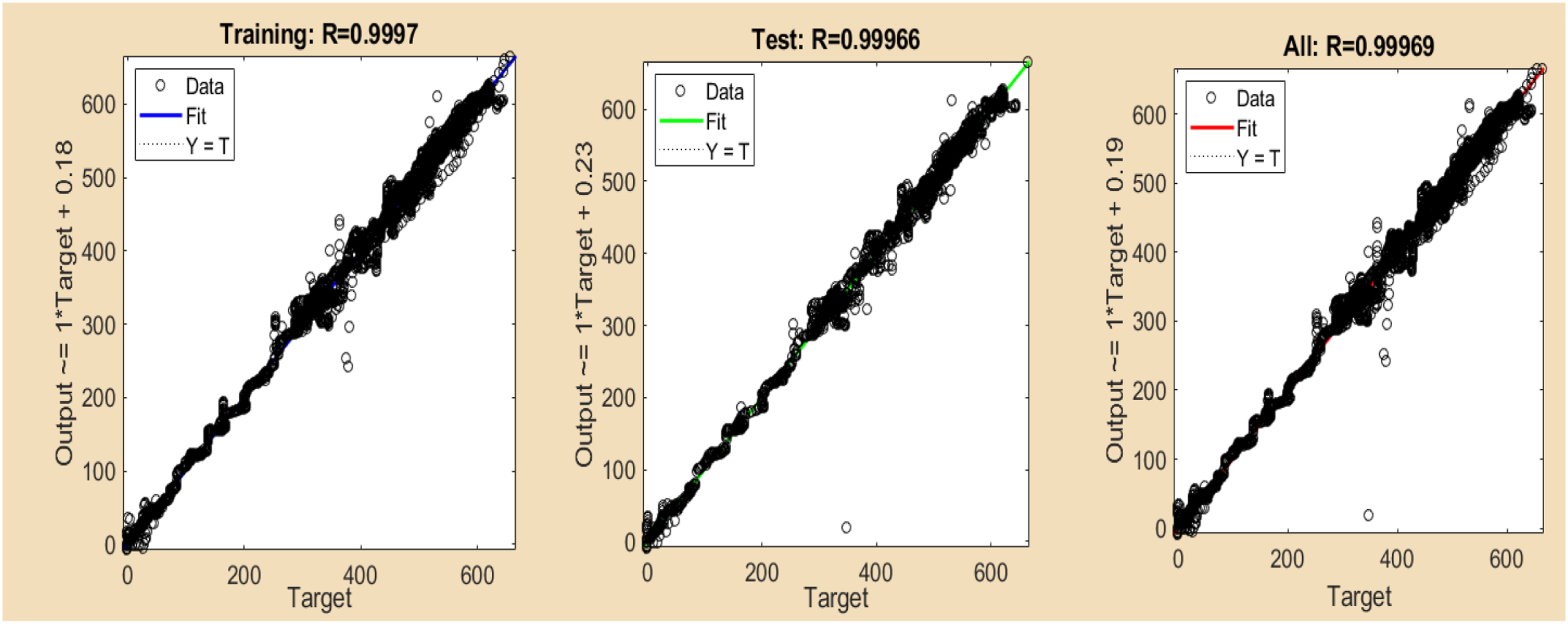
The testing and training samples have been randomly selected, but uniformly distributed among the modes of the set of the operating data, to include all possible situations of startup, once-through, and finally shutdown. A wide time-window has been prepared for the time series identification and verification data sets of the network and several architectures have been evaluated throughout the model design stage. It is found that seven neurons in one hidden layer of the ANN model, which is shown in Figure 5 has produced sufficiently robust performance, which has eventually come up with regressions for training and testing of 0.9997 and 0.9996, respectively, as shown in Figure 6. The ANN model architecture. R-value for training, testing, and all.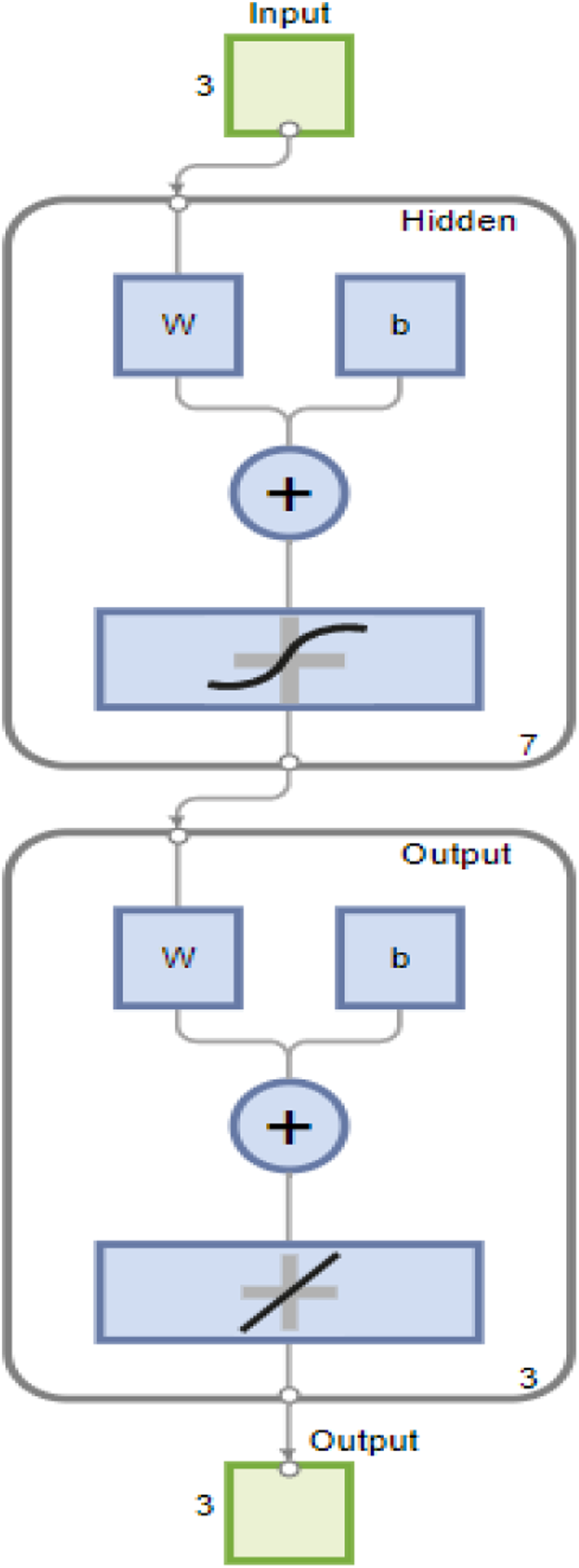
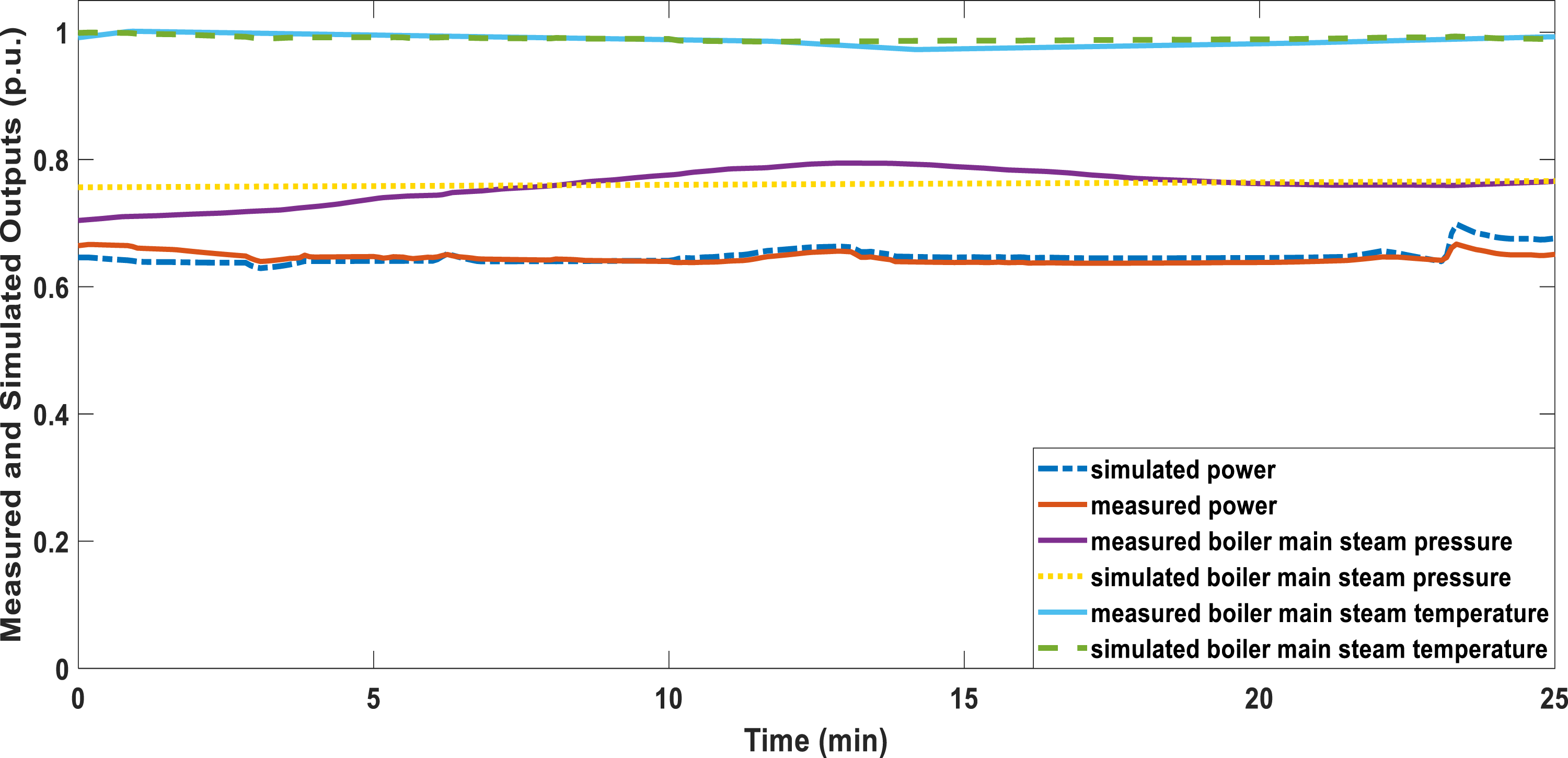
Samples of the time-based simulations have additionally evidenced robust performance of the network model by closely following the main trends of the real power plant in all modes in Figure 7, with 70% of that simulation has been used for training and 30% for testing, where Figure 8 represents additional 100% testing from another different set of data. It is preferable to depict all of them in per-unit (p.u.) system on the same window in order to save more spaces for the control strategy figures. Sample simulations of the three outputs normalized on per-unit system (recirculation during startup and once-through modes (70% training and 30% testing)). Sample simulations of the three outputs normalized on per-unit system (steady state operation from different set of data (short period that has been used for 100% unseen testing data).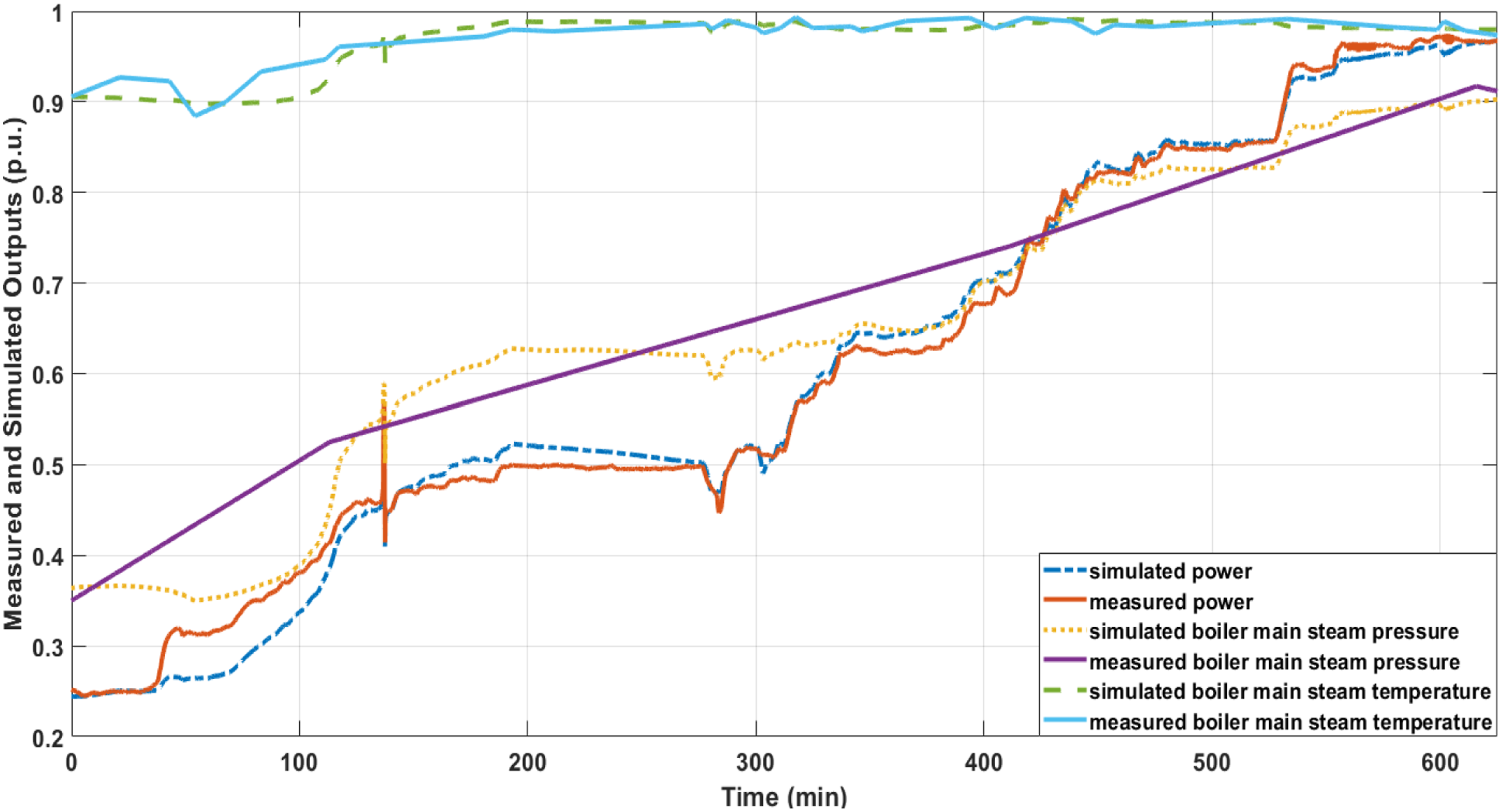
The proposed control system
MIMO inverse control strategy has been adopted in this paper, which is based on feed-forward neural networks, in order to improve the performance of existing unit described in section 2.1. The concept of inverse NN control system has been used for many systems with different schemes.35,44,45 However, unlike what has been already reported in the literature, the controller regulates all processes of startup, once-through operation, and emergency shutdown, which haven’t been covered in the literature with multiple targets of fast load demand tracking and reducing emissions. Thereby, proving the usefulness of control theory in improving the energy efficiency for supercritical generation units and contributing in satisfying the future climate targets without need for the complexity of and in-depth analysis as commonly made in the other models and controllers.6,13,37 The control system basic idea is realized in Figure 9. The proposed control strategy.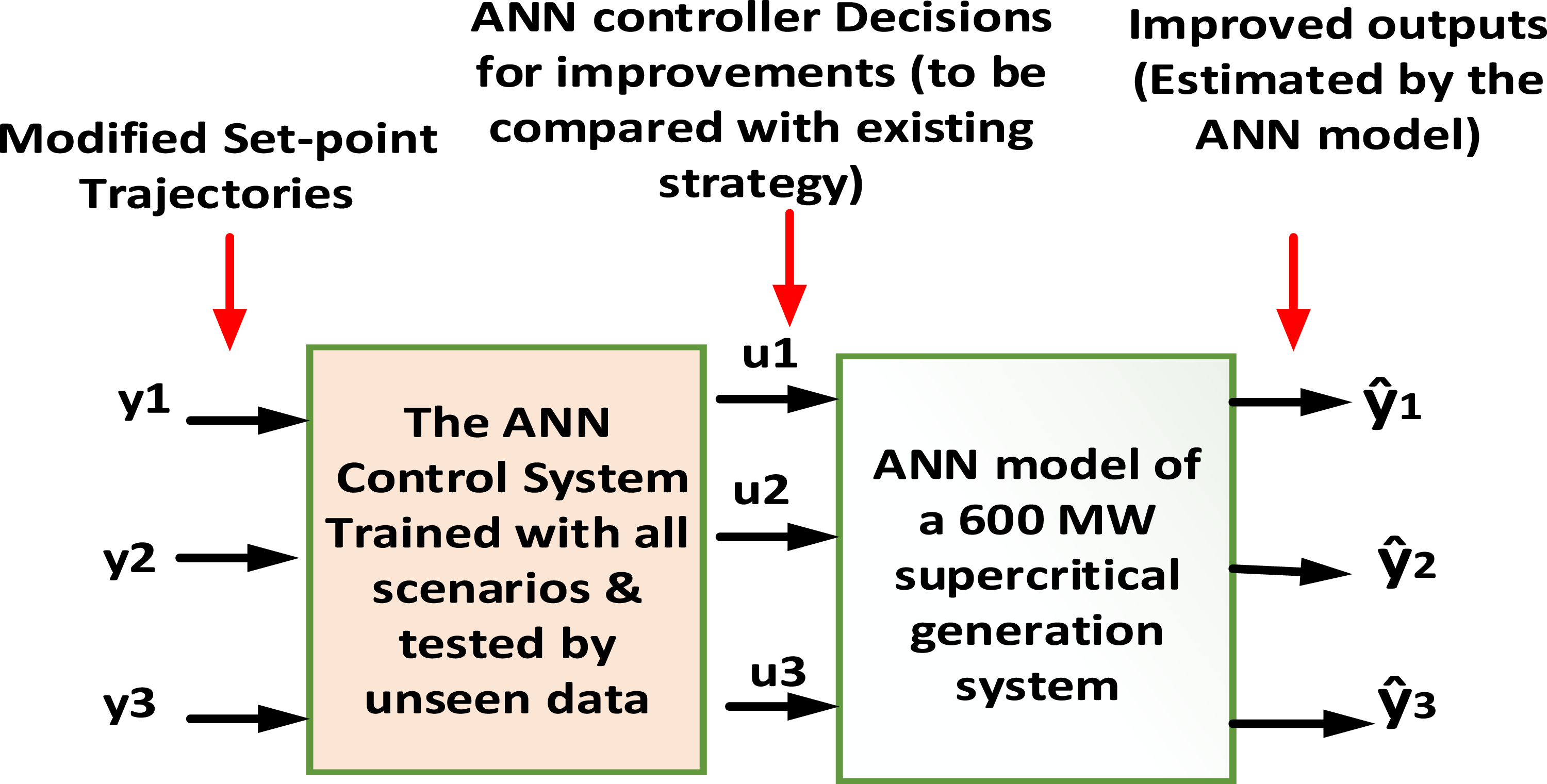
it is important to mention that there are some detailed steps that should be introduced to show the controller design procedure. Regarding the ANN controller development, the same training algorithm - that used for modeling – has been chosen for controller design, which is Bayesian regularization or BR algorithm. Thus, the parameters used to prepare the ANN are: • Training algorithm (BR has been selected). • The number of neurons in the hidden layers, • The number of hidden layers. • The data splitting percentages (70% training and 30% testing).
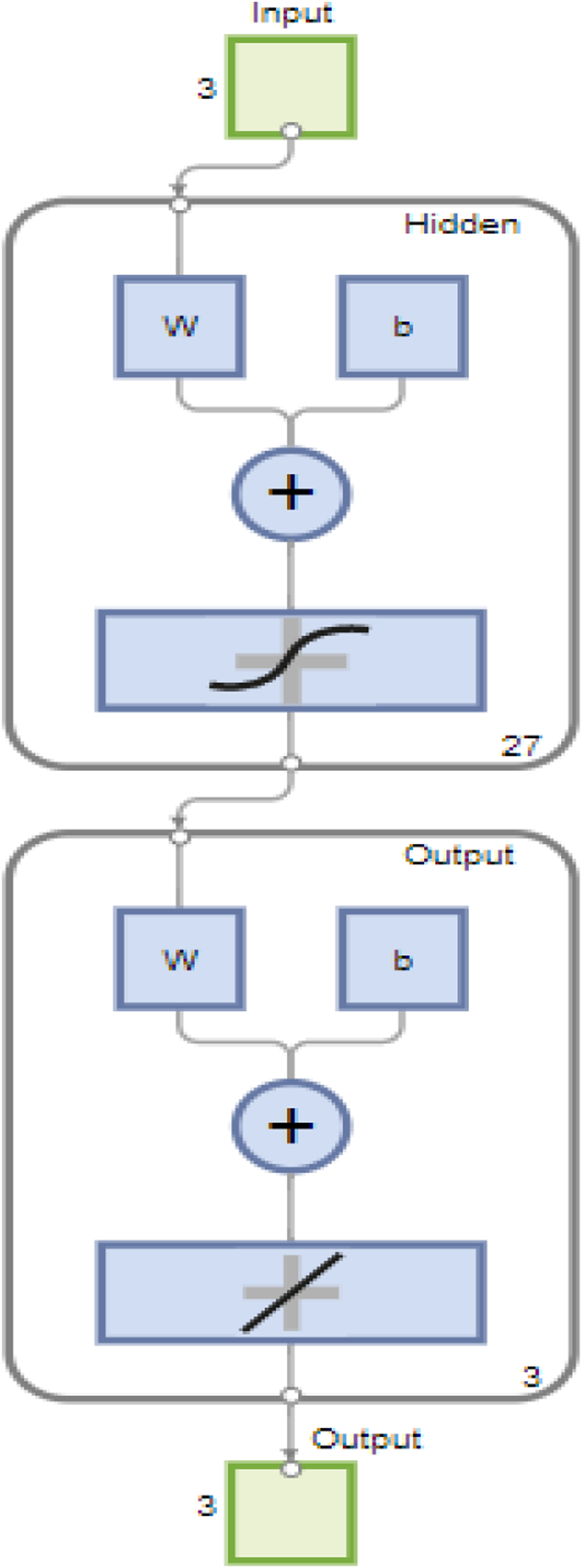
Several attempts with different parameters have been evaluated, which lead to final format of one hidden layer and 27 neurons in the hidden layer, which has been trained by 70% of the data with BR training algorithm and tested by 30%.
Only the best case has been mentioned in order to avoid redundancies in mentioning all other bad cases. The evidence of the ANN controller integrity has appeared in simulation and regression figures (Figure 10). The control system robustness could be evaluated through regressions before practical signal testis. The R-value for the ANN controller has been depicted in Figure 10 and final structure of the designed controller is depicted in Figure 11. Controller R-value for training, testing, and all. The ANN controller architecture.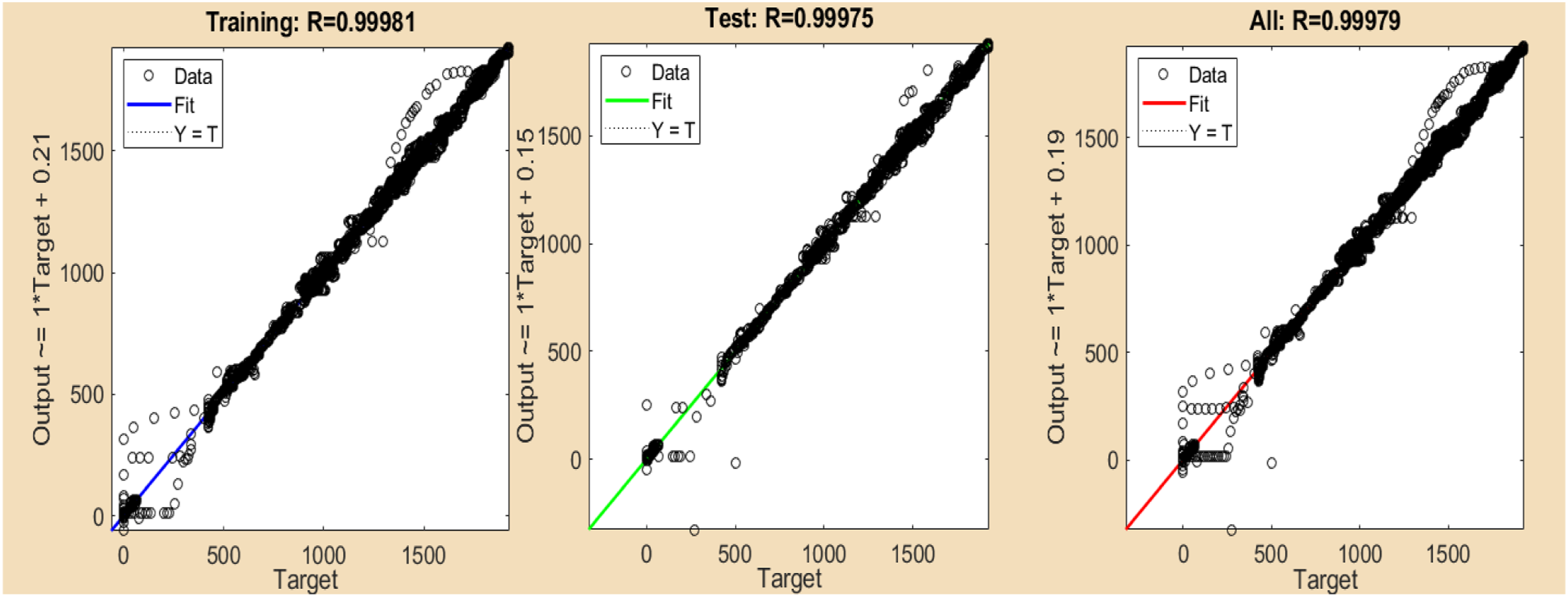
The next section depicts the simulation results to appreciate the practical merits of the controller.
Simulation study
A great deal can be ensured through suitable setpoint trajectories in all operational modes, startup, once-through, and shutdown modes. The setpoints should outperform the existing operational trends in terms of time and smoothness, they are processed by the ANN controller to compute the various references of the local built-in regulators of the coal feeder, the water pump, and the steam valve. Reduced emissions will be eventually obtained due to two reasons, first is the choice of setpoints, second is the improved level of automation from the ANN. The scenarios have been divided into three scenarios, which have been depicted and discussed in the next three subsections.
Shutdown mode
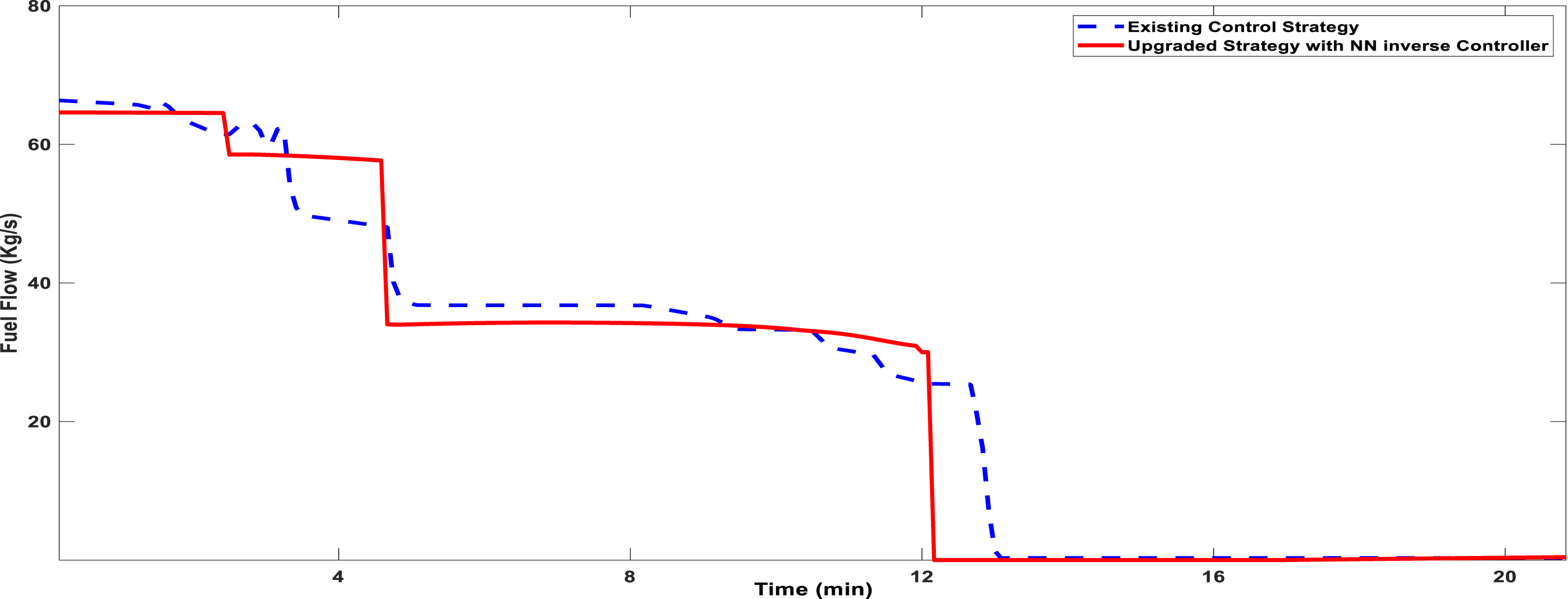
In this mode, the plant has been forced to shutdown faster than the existing shutdown power trend. A setpoint, that is analogous, but just earlier than, existing one has been built in the signal builder in the SIMULINK representation of the system. Figure 12 shows the existing and improved shutdown requests, which proved the feasibility of taking the plant out of grid faster by few minutes. As a result, the coal flow, and hence the emissions, are reduced. One more practical value is the aid of faster renewable energy integration in case of the likely power or from relevant storage. The quantified saving in coal has been 1.184 Kg/s for more than 12 min (Figure 13). Existing and improved power shutdown mode. Existing and improved flow of coal in shutdown mode.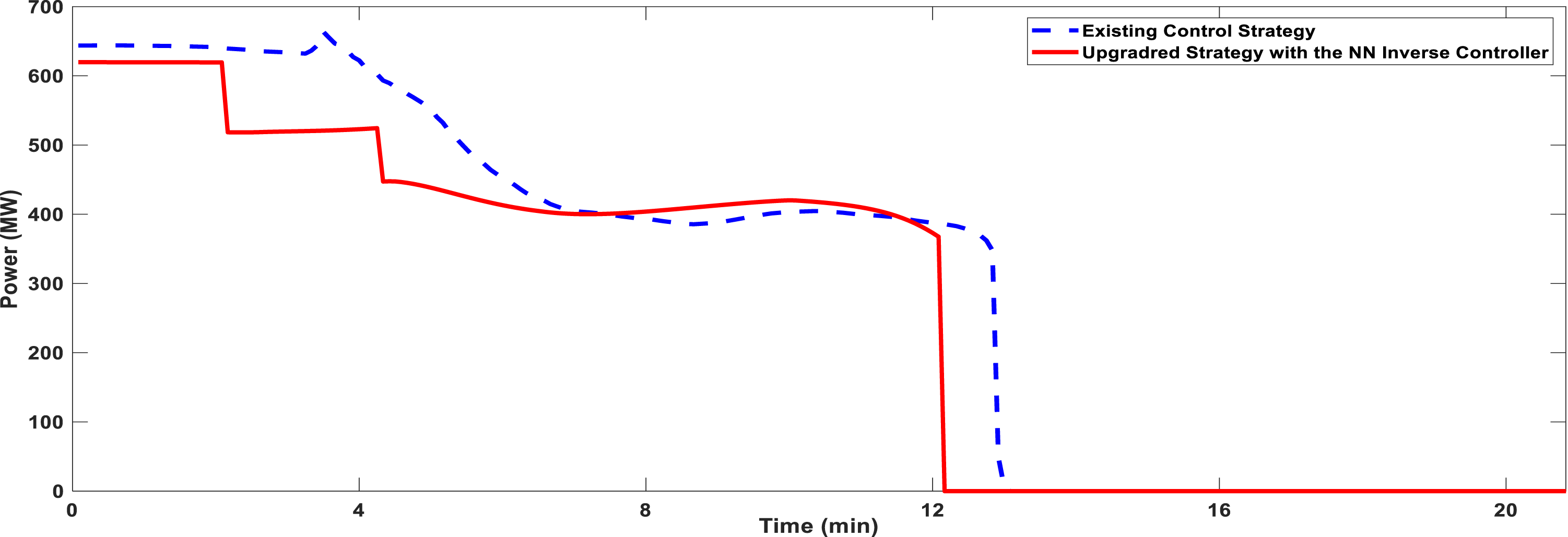
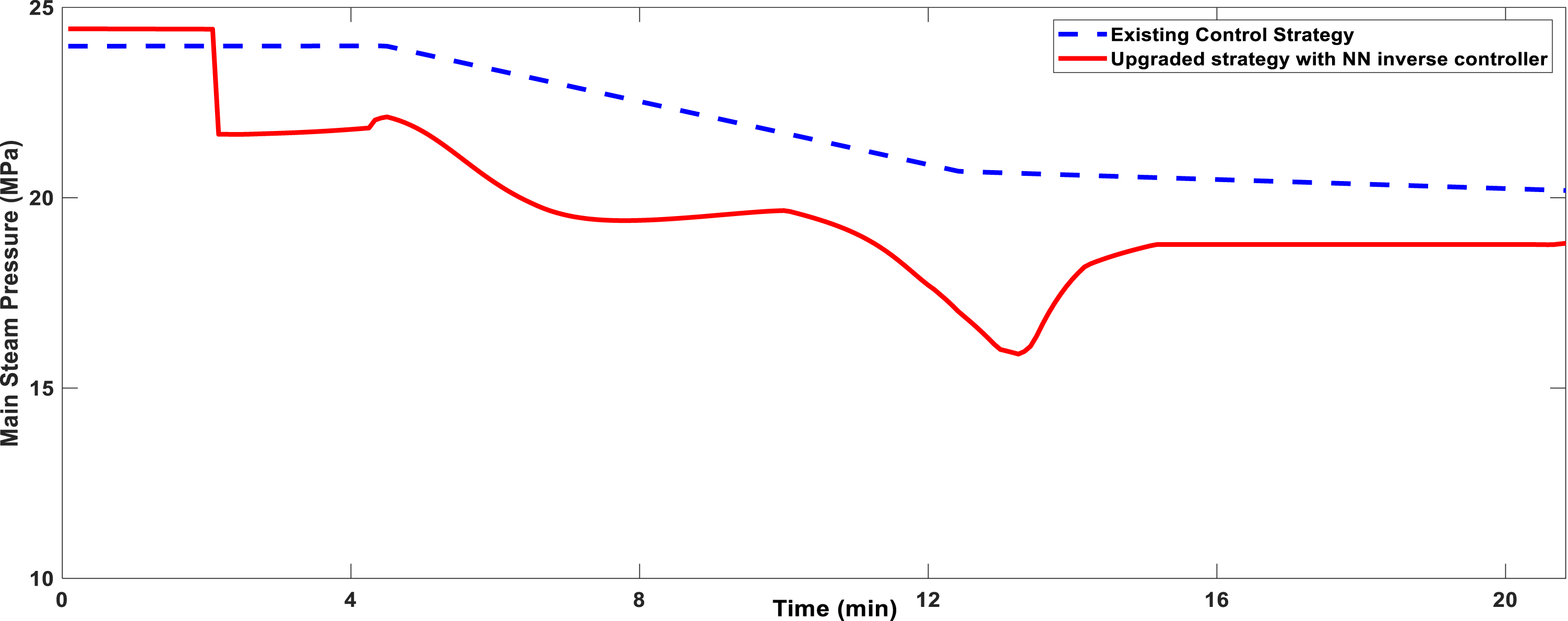
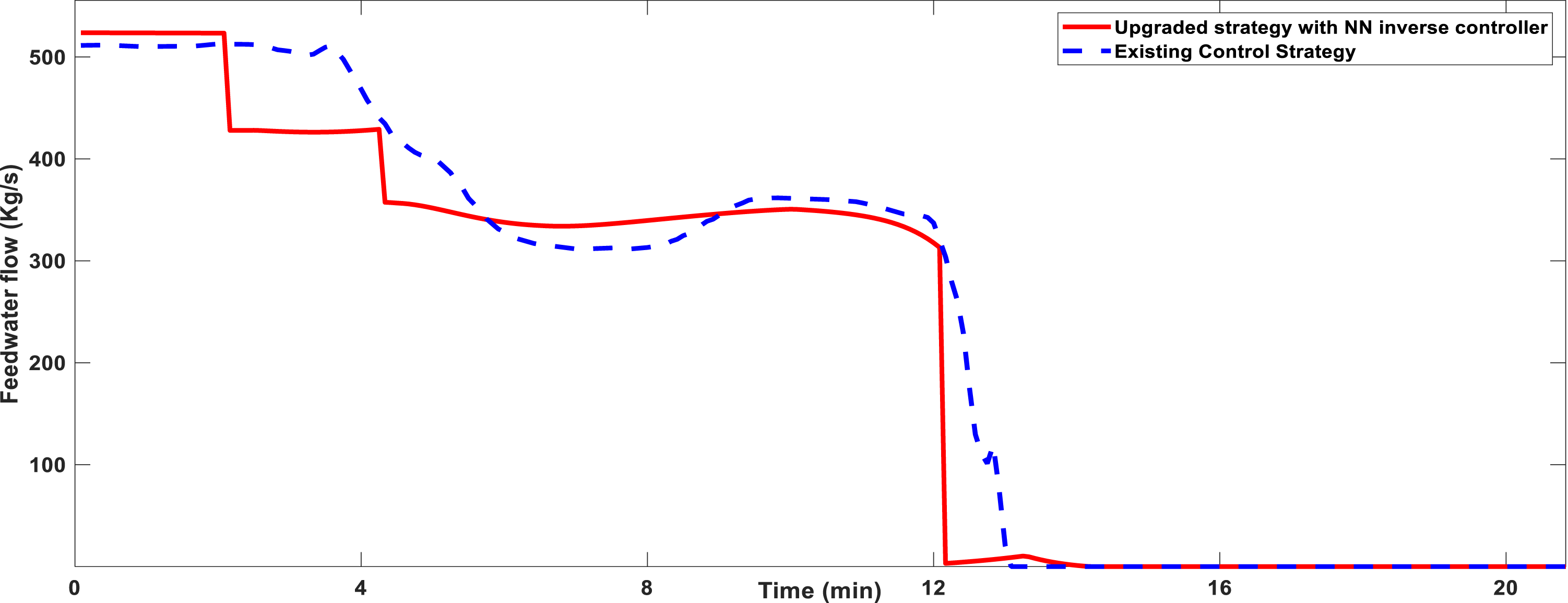
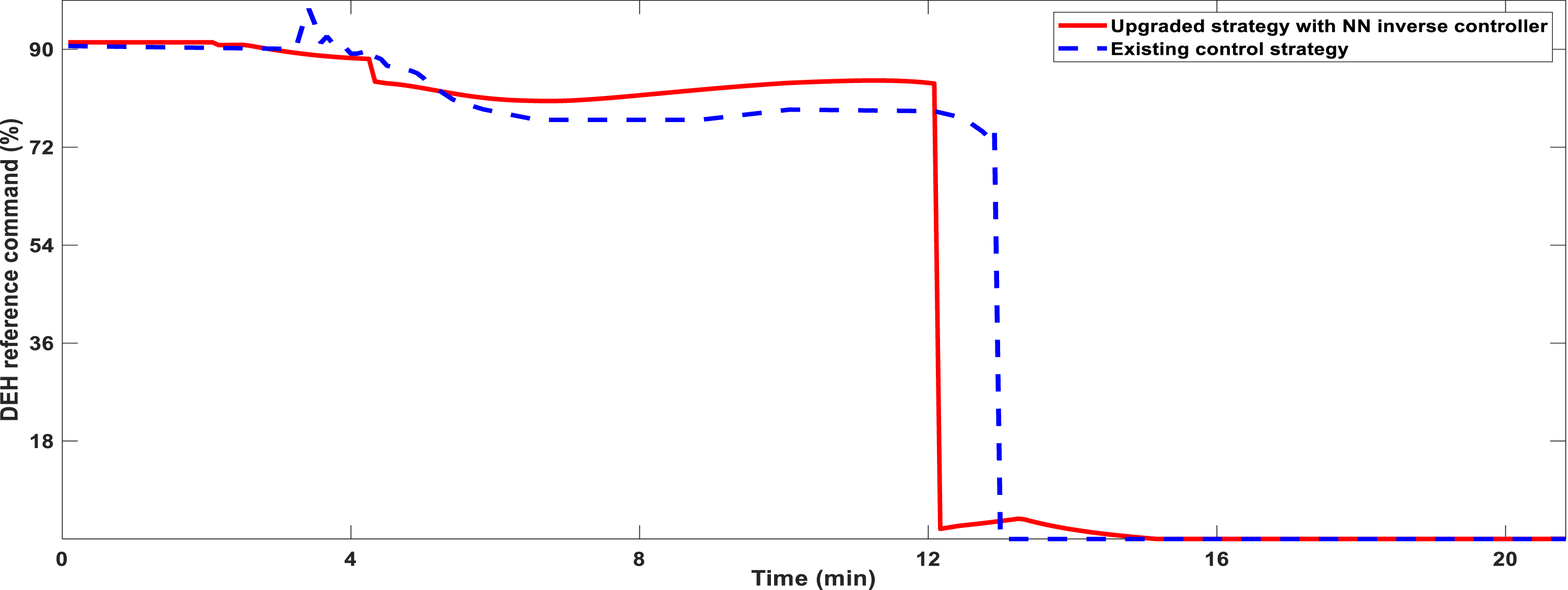
However, the safety cannot be confirmed when overlooking the resultant boiler pressure and temperature. Thus, the safety scenario has been additionally validated by observing the pressure and temperature (Figures 14 and 15), which asserts the practical feasibility of the operational strategy. It is observed that the pressure has dropped to subcritical region, however, this is not important because once-through supercritical boilers are capable of operating on subcritical and supercritical conditions. The other two inputs, which are the feedwater flow and DEH reference signals, have nothing to do rather than faster initiation of closure (Figures 16 and 17). Existing and improved temperature in shutdown mode. Existing and improved pressure in shutdown mode. Existing and improved flow of water in shutdown mode. Existing and improved valve closing in shutdown mode.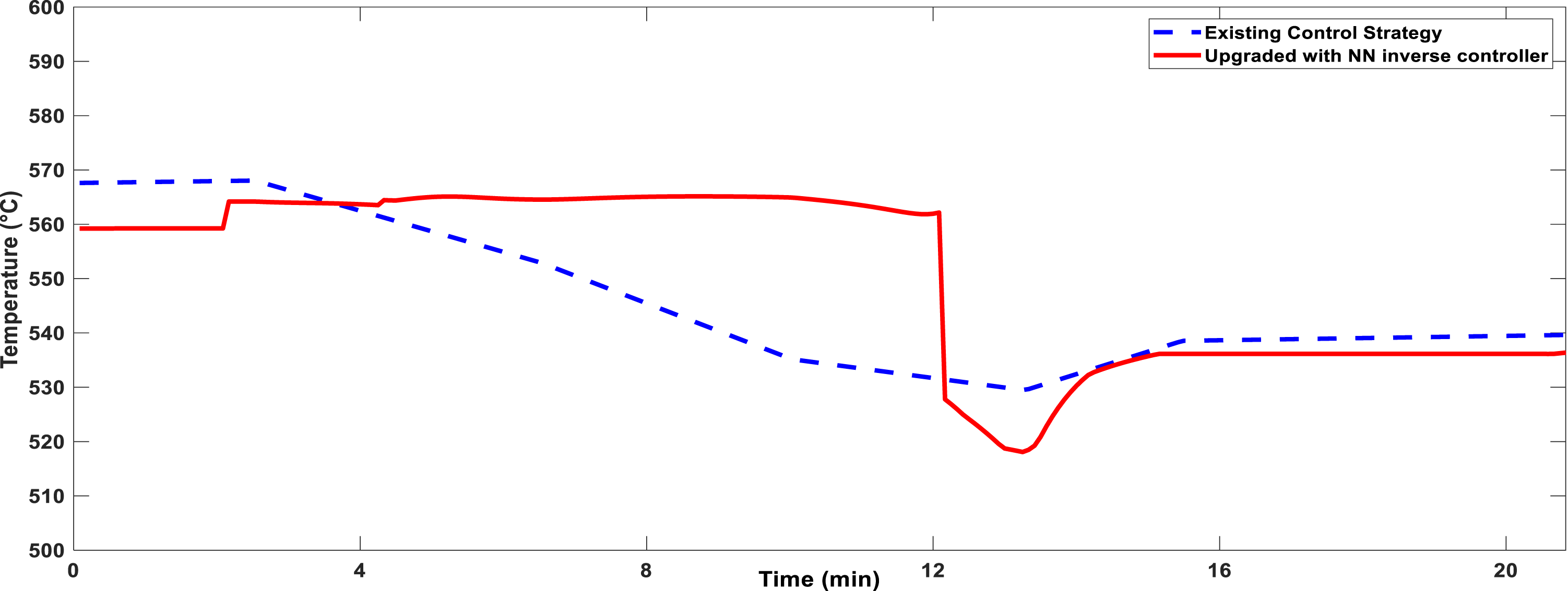
The next part focuses on emission reduction in startup process.
Startup mode
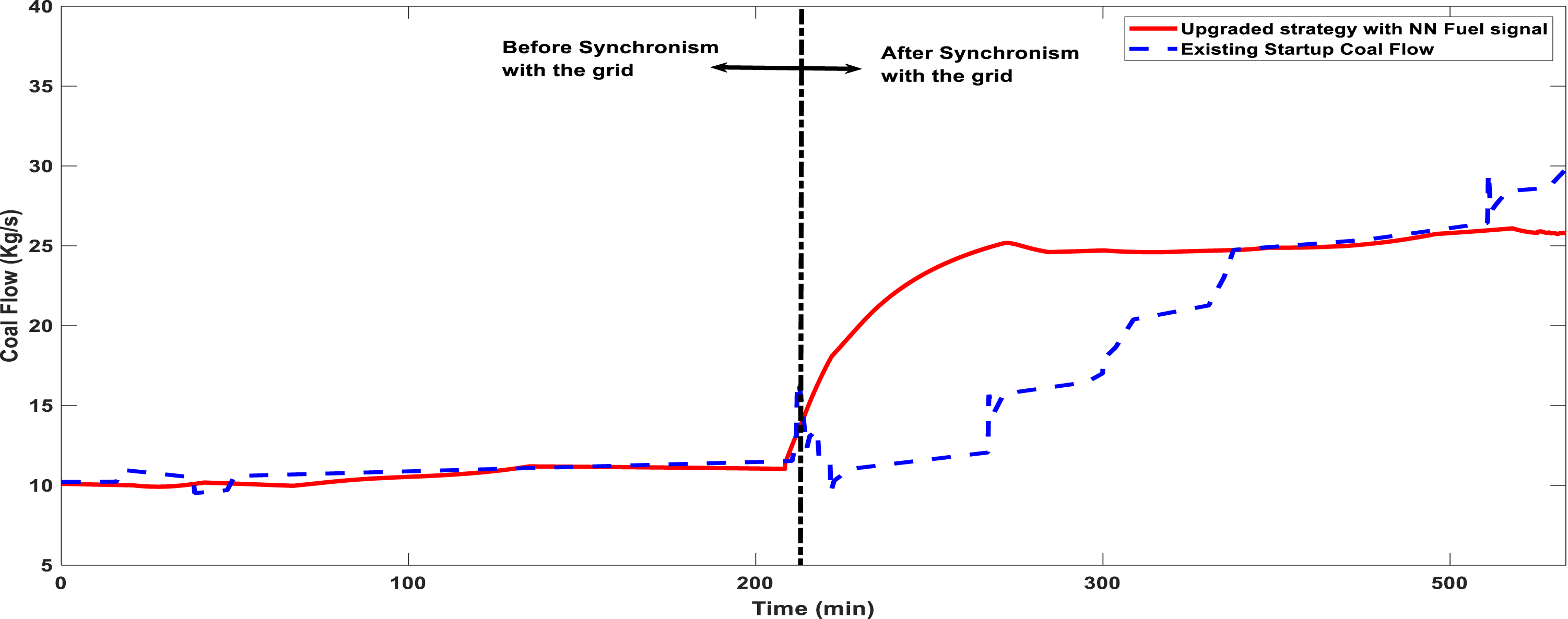
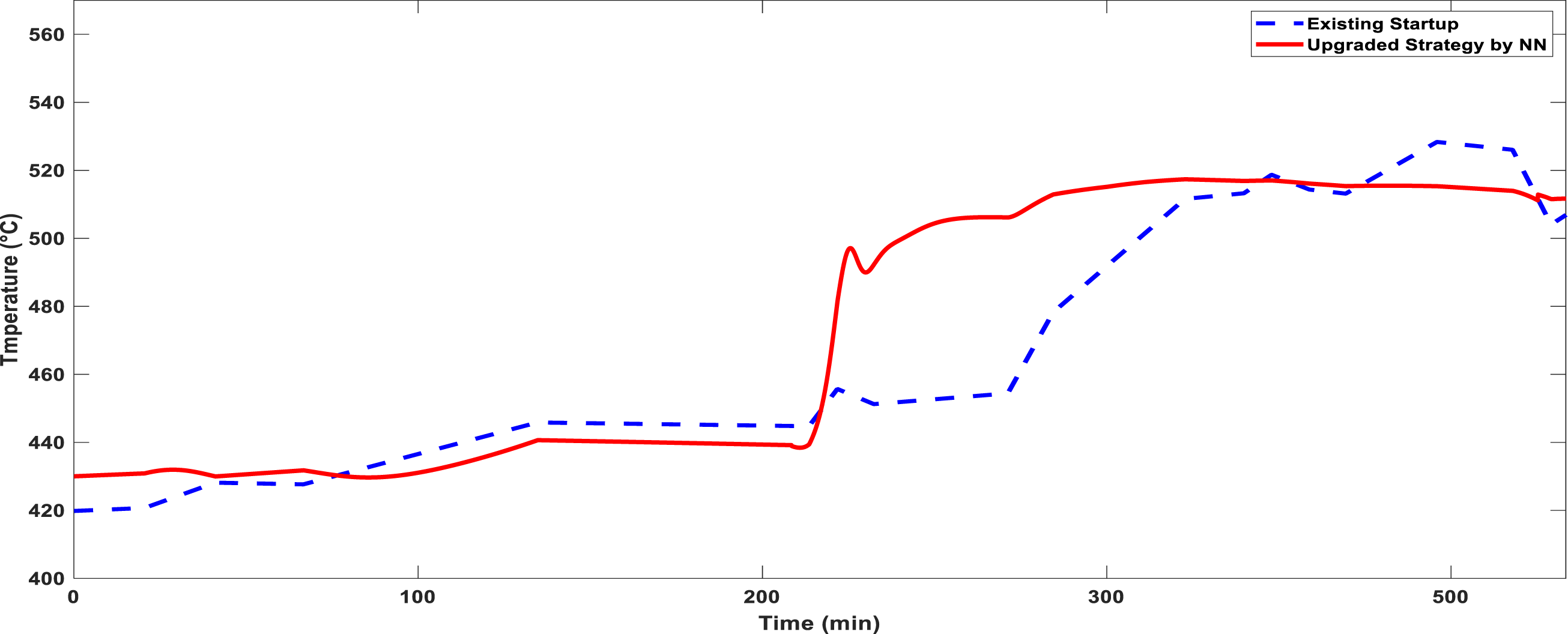
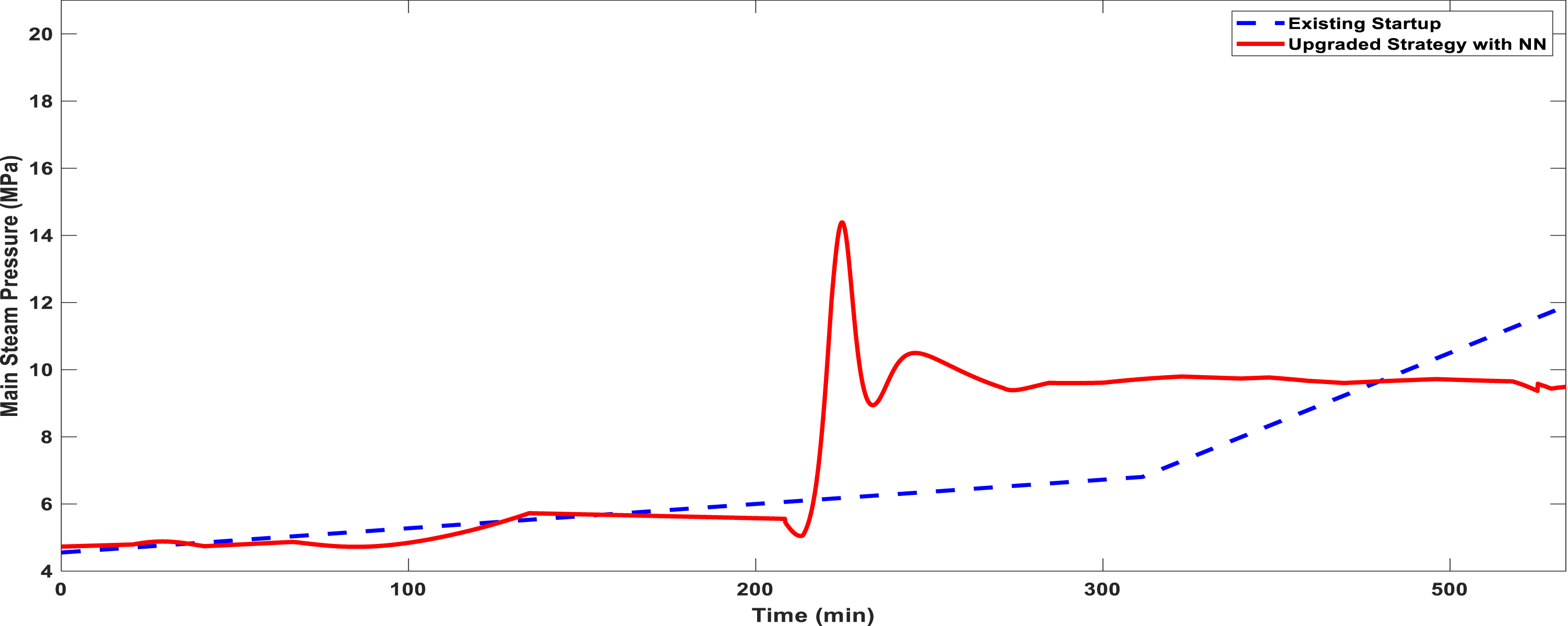
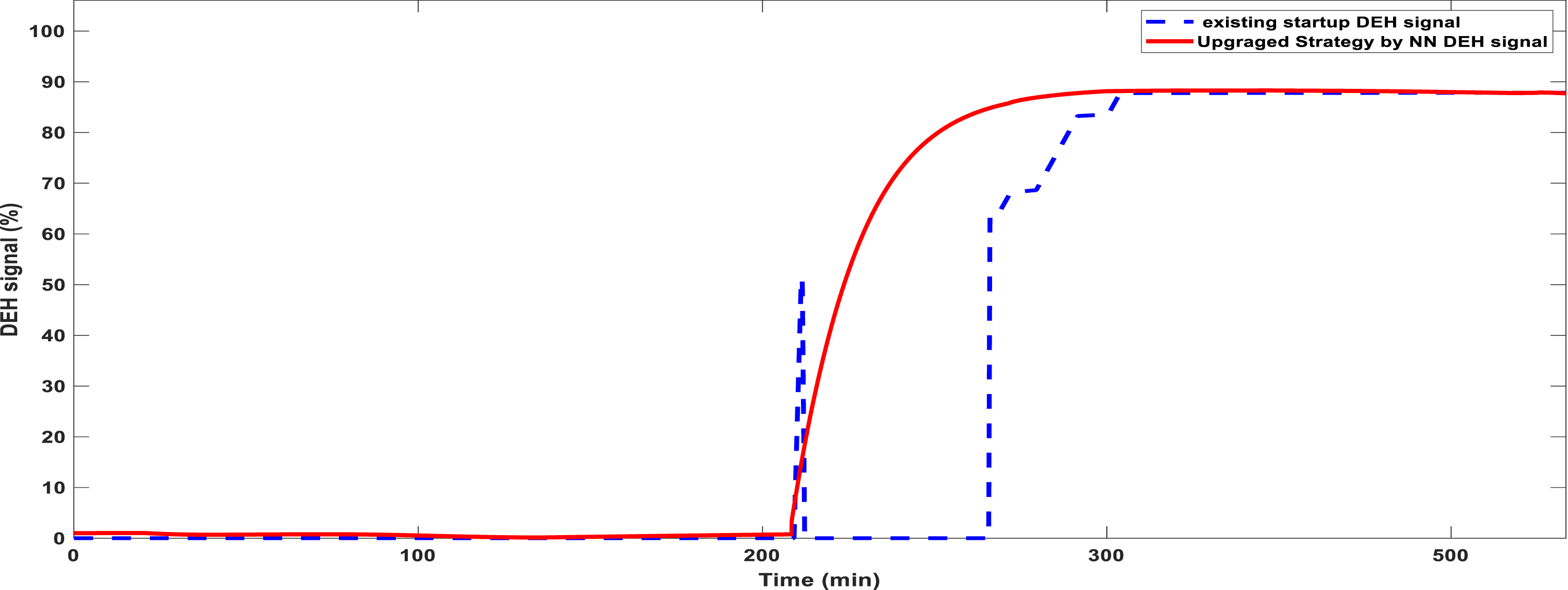
Startup should be made earlier than existing starting, which lead to better flexibility foundation and lower emissions. The automation was upgraded through the NN controller that covers all possible operations. As a result, the plant has been integrated to the grid faster than existing startup time, but reaches the once-through mode at the same time, this trajectory has come up with compromise solution of more flexible power delivery, especially in cases where renewable resources have to be disconnected from the grid for unrelated reasons. Figures 18 and 19 have proved the startup controller performance for achieving these outcomes. To calculate the coal savings, only the interval before gird synchronization should be considered because after that there is a recirculation mode that is regarded as a duty part of the plant flexibility to reach the once-through mode and peak power with faster rate of change and earlier delivery of power to consumers. For about 208 min of startup process before grid synchronization, the average coal saving is 0.288 Kg/s. The coal consumption after integration to the grid with around 1 h has been higher in the improved case, however, this is to attain the faster rate of change of power delivery to the network, which shouldn’t be considered in computation of savings as it can be positively translated to higher flexibility or tracking capability of loading. This also results proving the law of energy conservation for the improved case because no experts would expect better power rates of changes without correspond faster changes in fuel input. One more insignificant penalty has been observed in the temperature and pressure response, with higher, but allowable overshoot and build-up, respectively (Figures 20 and 21). However, this shouldn’t affect the boiler materials because the pressure value has been within allowable safety restrictions and the supercritical boilers are designed to work on subcritical or supercritical conditions. The valve signaling has been subsequently faster to release steam from the boiler to energize the turbine and avoid exceeding operating restrictions of the boiler (Figure 22), and subsequently more water should be fed through the boiler feed pump (BFP) in order to preserve heat balance inside the boiler (Figure 23). The next subsection demonstrates the energy efficiency improvements during once-through operation. Existing and improved startup power. Existing and improved coal signal during startup. Boiler temperature during startup in both cases. Boiler pressure during startup in both cases. Valving during startup in both cases. Feedwater flow startup in both cases.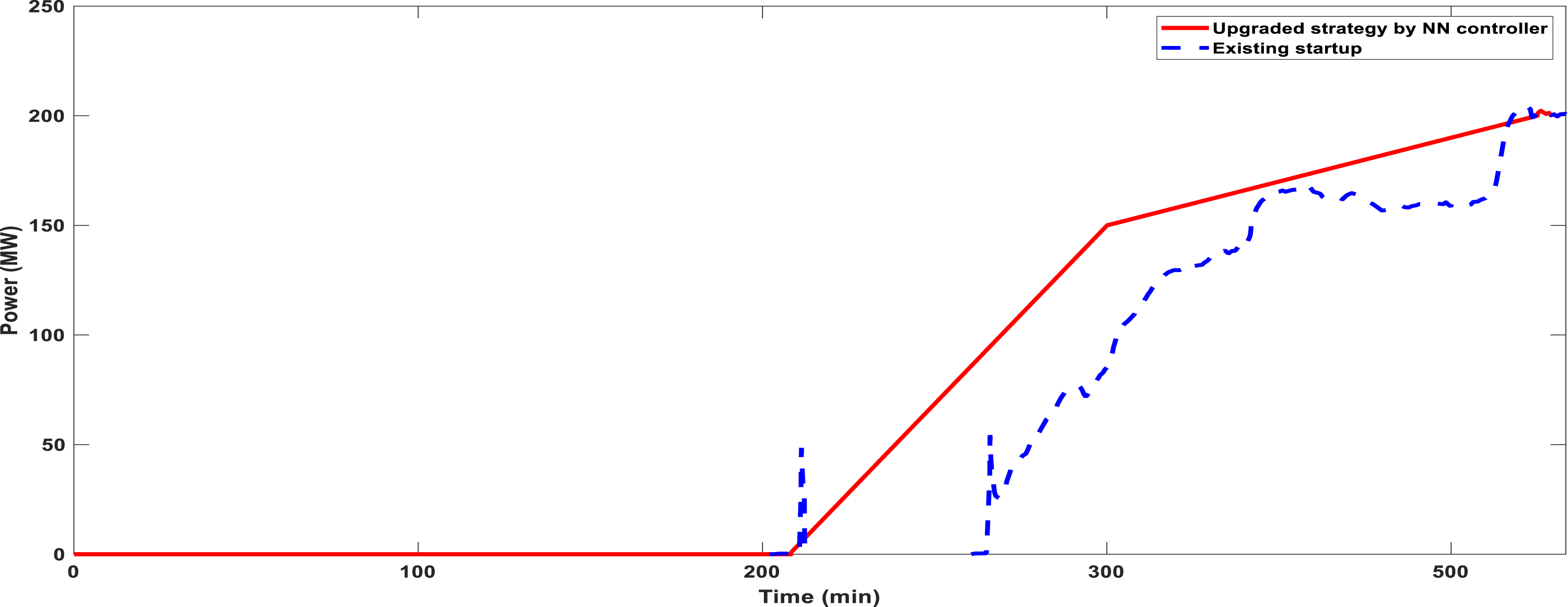
Once-through mode
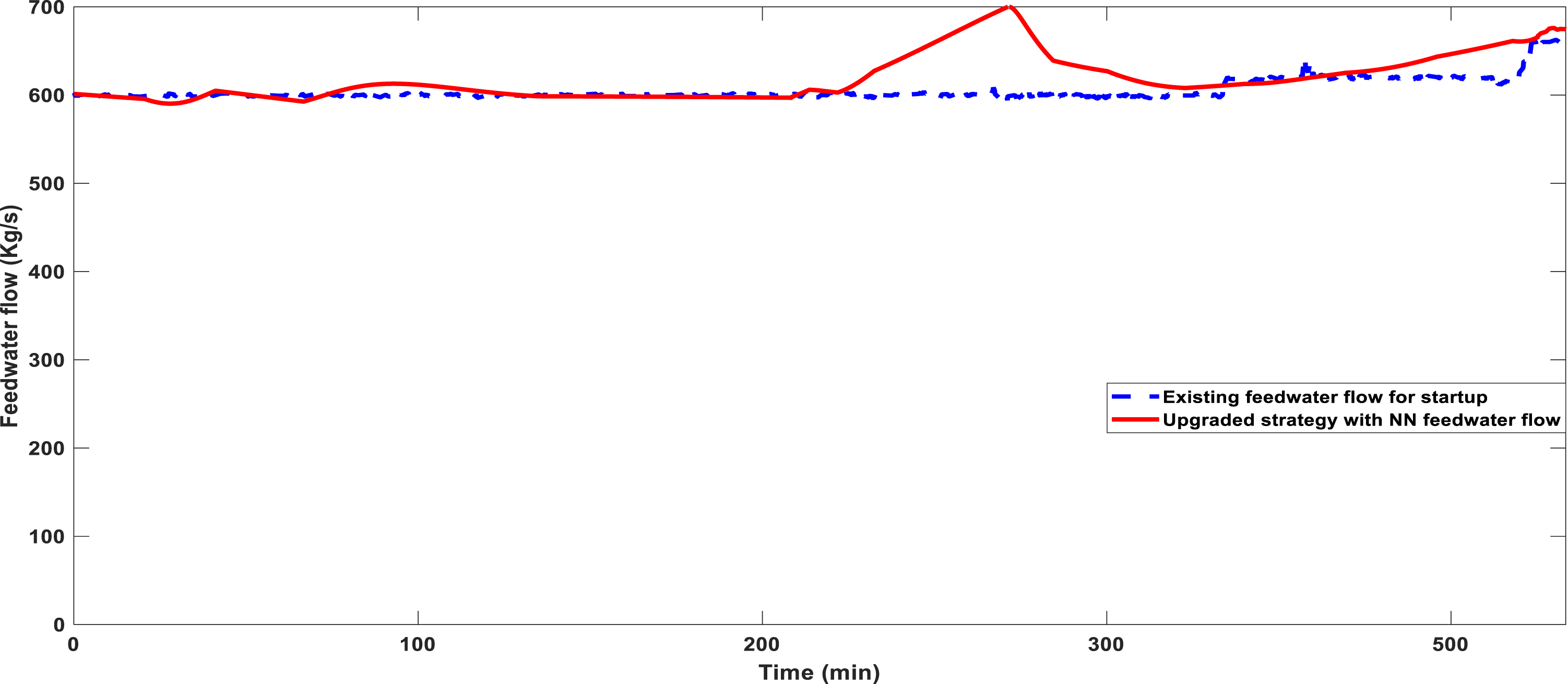
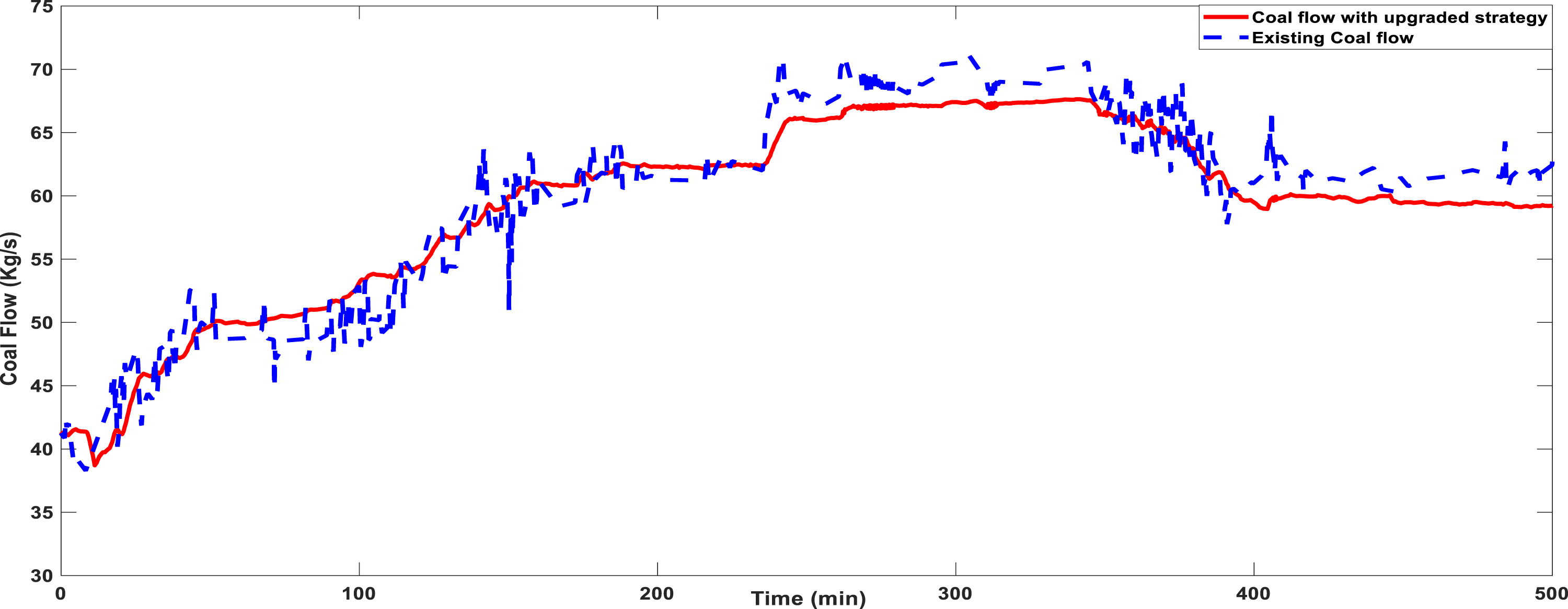
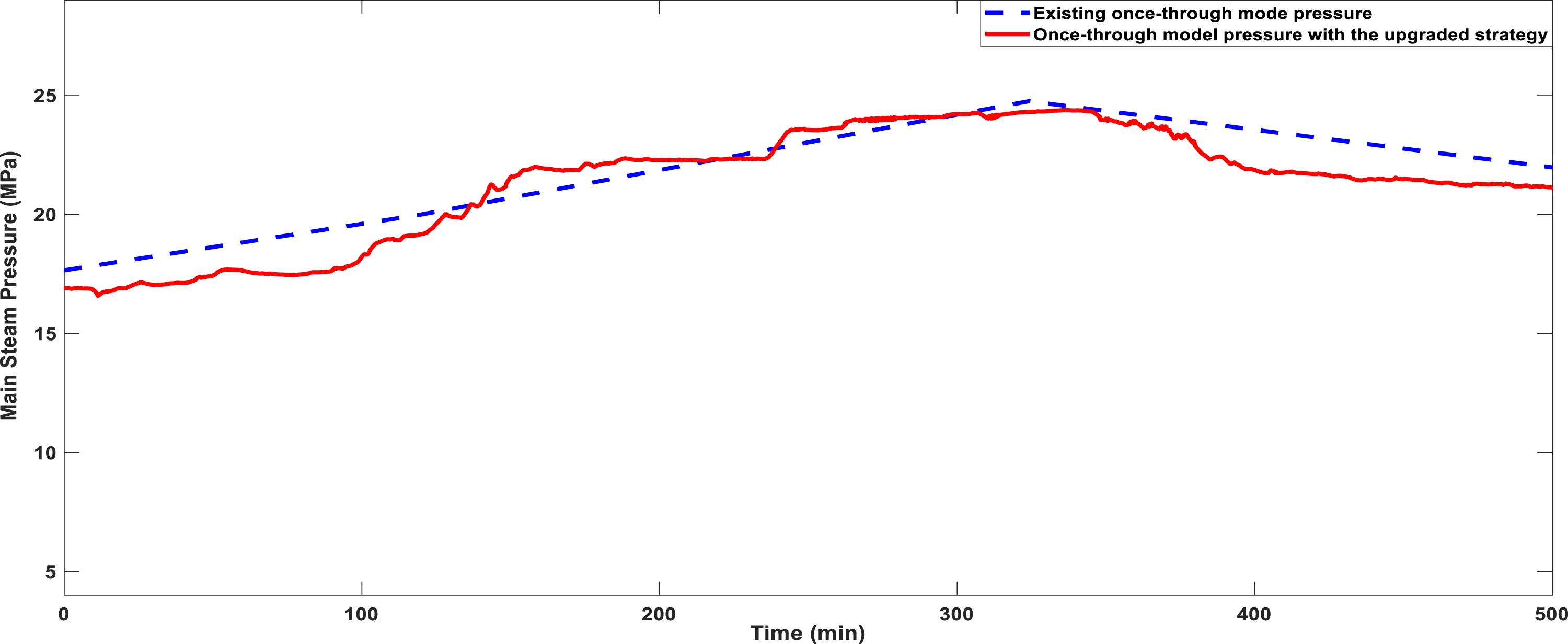
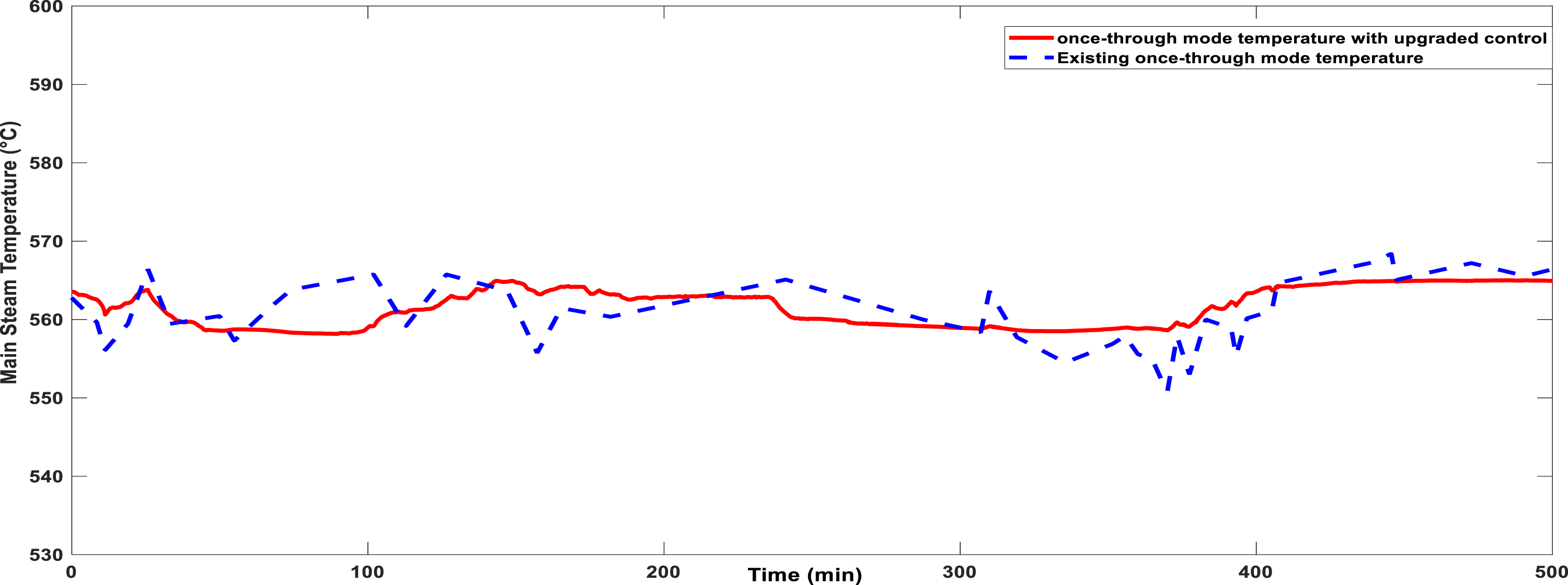
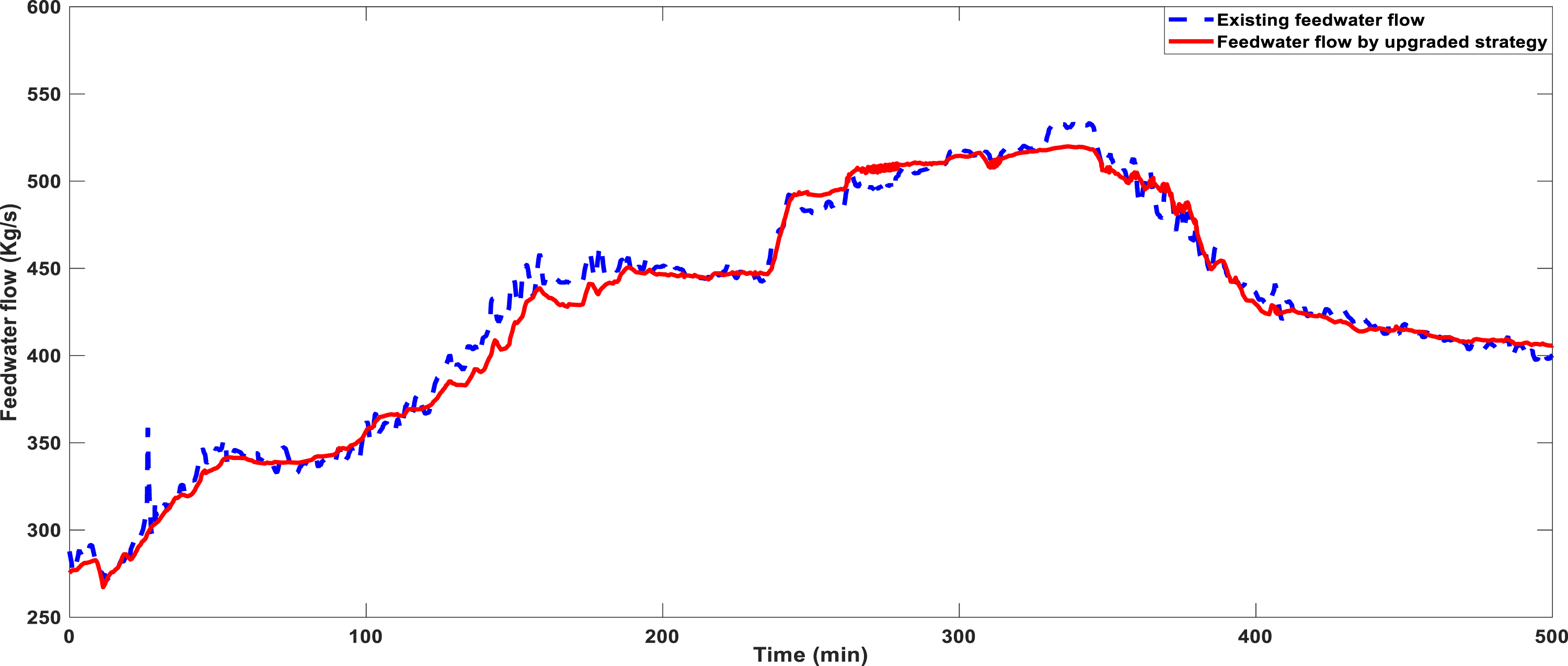
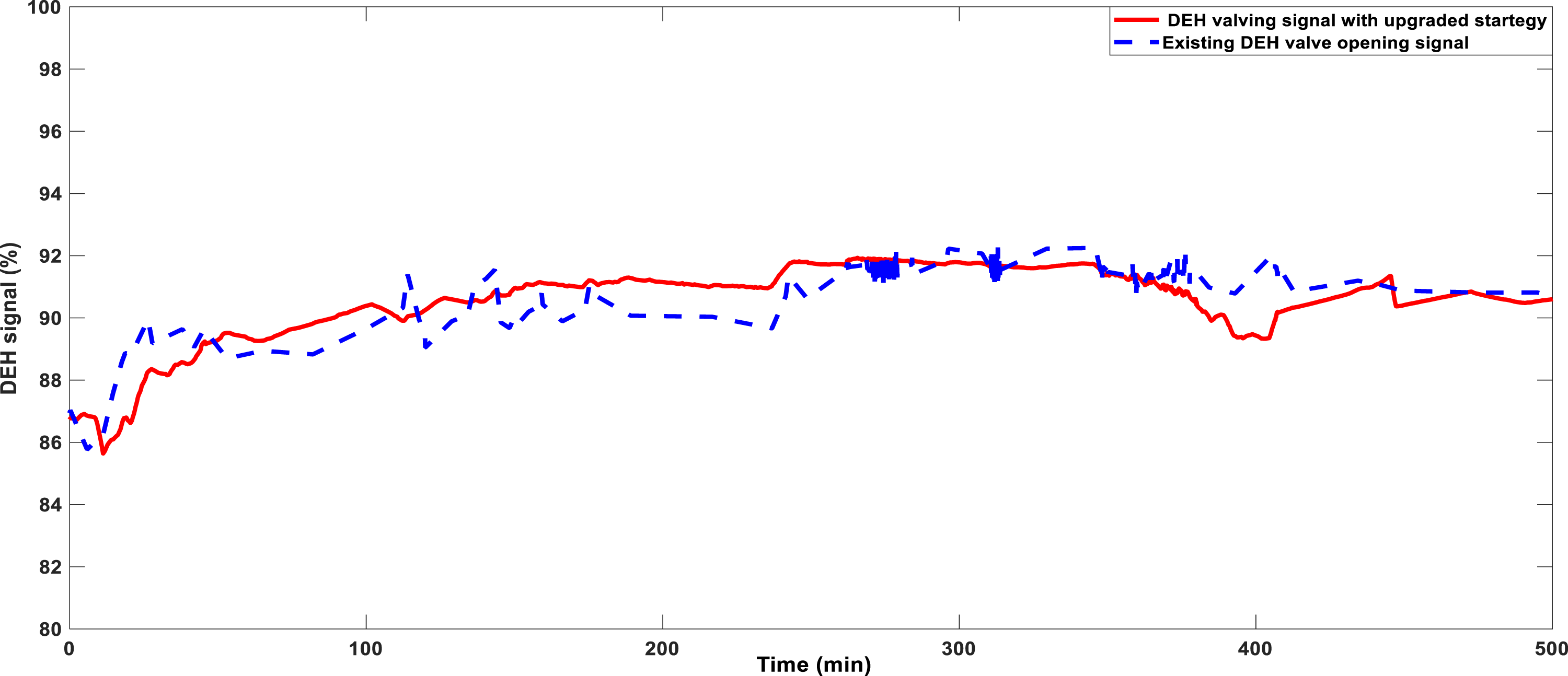
The once-through operation also has a decent share of the overall emission reduction. In control theory, the controlled reference correction, by predictive control or intelligent inverse control, is capable of increasing the speed of the response of the various actuators in the regulatory layer of control.7,13,14,46 The load signal taken from set of data portion representing the once-through operation has been injected as an expected demand signal in order to observe the effect of the upgraded controller on the inputs, especially the coal consumption. As depicted in Figures 24 and 25, which represents the power output and coal flow input, respectively, the load demand is followed smoothly by the inverse controller, and that is also reflected in the coal consumption that has been robustly smoothed and minimized. It is important to mention that not all time intervals the inverse NN controller is superior because in load-rising interval (about the first 150 min), the coal flow is lower in the existing case. However, the assessment should cover the entire interval of load cycle, which includes continuity of rising to the peak value, then down to the base power or may be shutdown. In the peak region, obviously the coal flow signal is smaller in case of the inverse NN control strategy because the system has invested sufficient kinetic energy through other inputs and rate of change of the coal feeder. The situation has shown encouraging performance in load-down interval as well. A s a result, the average coal saving in once-through mode has been 0.7077 Kg/s measured on a long interval of operation of 500 min. Figures 26–29 have shown other output/input combinations of main steam pressure, main steam temperature, feedwater flow, and DEH valving signal, respectively. As can be seen from those responses, the system has been capable of preserving cleaner and efficient operation while keeping safety limits of the boiler parameters. Table 3 summarizes the quantified improvement achieved by the ANN controller for all studied processes. The next section summarizes the paper findings and states some useful recommendations. Existing and improved power response in once-through operation. Existing and improved coal flow in once-through operation. Existing and improved main steam pressure in once-through operation. Existing and improved main steam temperature in once-through operation. Existing and improved feedwater flow in once-through operation. Existing and improved DEH signal in once-through operation. Quantified improvements by the ANN controller.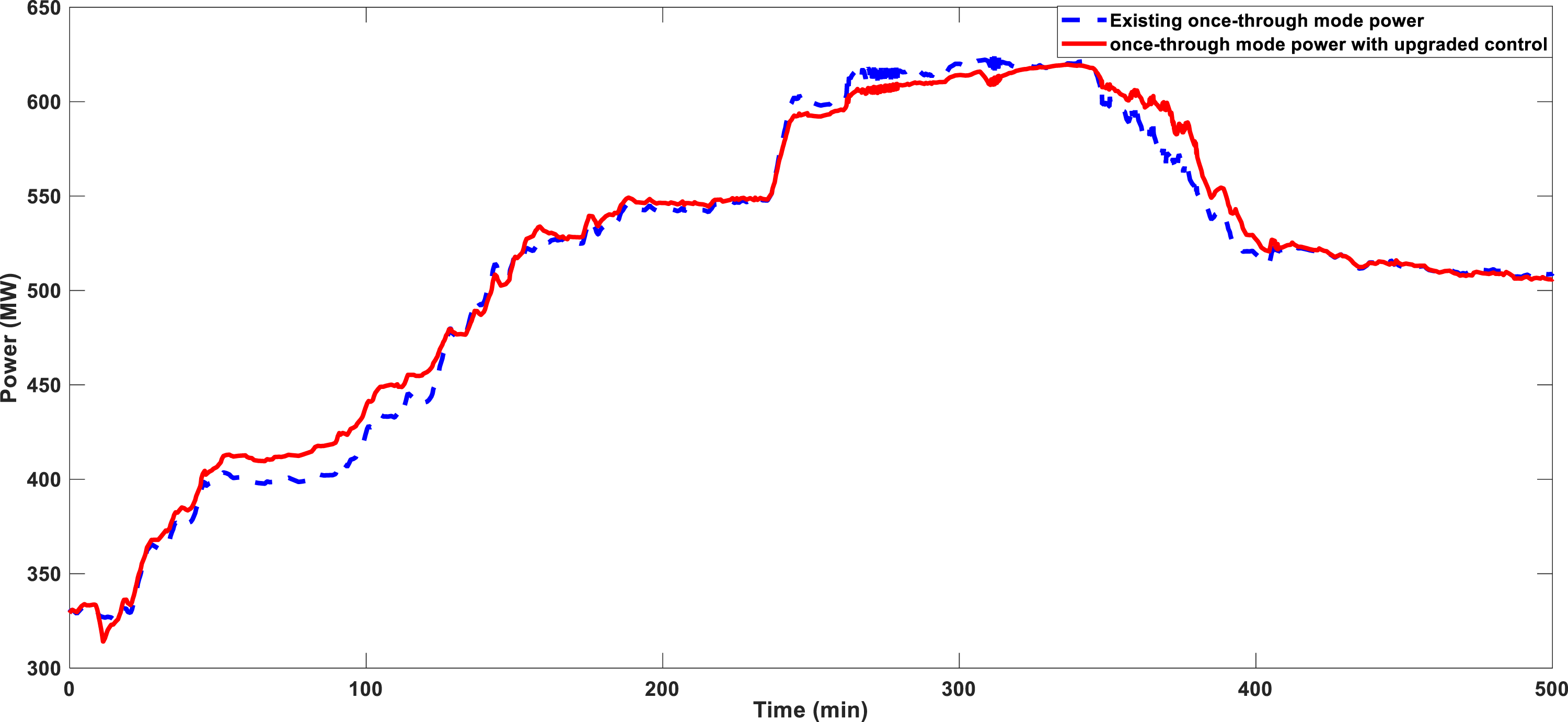

Conclusion
With the advent in renewable energies, it has become increasingly important to expand the level of automation and flexibility in thermal fossil-fueled units for easier integration of other alternative resources and cleaner operation even for those thermal units per se. This paper presents a theoretical foundation for upgrading control strategies of such thermal units for load demand tracing in addition to reduced coal burning, which in turn, reducing the undesirable emissions. Thereby, introducing additional decent objectives to control systems of newly-built thermal units rather than just following the pre-determined setpoints. The simulation scenarios have included all operational rules, of startup, once-through, and shutdown modes of a supercritical generation unit. Despite the well-known cleaner operation regarding the integrity of supercritical power plants, the unit had some opportunities for improvements, which has been eventually handled through the proposed inverse controller. For clarity to the readers, the coal savings have been quantified in terms of the overall average or mean value between the existing and improved coal demands. The savings in all modes has been basically calculated, which proved the control strategy feasibility, the economic, and environmental aspects of the controller. Of course, the same improvement can be obtained by different modeling concepts, like, for instance, physics-based models. The future research may be recommended as follows: - Make use of Long-Short Term Memory (LSTM) for modeling and control. - Make use of adaptive model-based predictive control. - Applying the concept in real-time and practical field tests on a 600 MW supercritical unit. - Extension to ultra-supercritical power plants. - Revaluating the technique on another new set of data of 2022/2023.
The policy recommendations include the compliance with gird codes of various countries adopting this technology in addition to regular revisions of their performance indicators to update their assessment and to suggest enhancements in a timely manner.
Footnotes
Declaration of conflicting interests
The author(s) declared no potential conflicts of interest with respect to the research, authorship, and/or publication of this article.
Funding
The author(s) received no financial support for the research, authorship, and/or publication of this article.
