




Abstract
Inclusion of porous structures in micro-channels enhances heat transfer rates in energy harvesting devices, which signifies as the working fluid becomes a nanofluid. The present study compares the thermal performance of CuO-water, TiO2-water and graphene-water nanofluids in a sinusoidal channel with a porous insert. The flow and heat transfer characteristics are simulated and the effects of volumetric fraction of nanofluids, Reynolds number (Re), porous insert width, and its permeability on the flow and temperature fields are examined. The findings reveal that CuO-water nanofluid results in higher heat transfer rates than those of other nanofluids considered. Graphene-water nanofluid gives rise to lower performance than that of CuO-water nanofluid in terms of convection heat transfer despite the fact that graphene has higher thermal conductivity than CuO. In this case, a decrease in Nusselt number of as much as 6.34% is observed for CuO-water nanofluid among all the cases considered for the Reynolds number of 100. Increasing the permeability of the porous insert slightly enhances (∼0.24%) the average Nusselt number. The porous insert with a small width in the channel improves the heat transfer rates (2.25% increase in Nusselt number), i.e. the average Nusselt number reduces as the porous insert width increases.
Introduction
Heat transfer research pertinent to energy applications has recently accelerated significantly because of increased energy demands. The endeavor of finding the effective solutions to heating problems, which increase productivity and reduce energy consumption, also nurtures their importance. The heat transferring equipment is mainly optimized for achieving high energy efficiencies with the focus on enhanced heat transfer per unit area towards reducing the equipment size. Porous medium enables the provision of large heat transfer area per unit volume due to its inherent structure. This important characteristic of porous medium has brought it under several heat transfer investigations in recent years. Due to the importance of enhanced heat transfer through porous medium and large range of its associated applications, such as compact heat exchangers, catalysts, granular bed reactors, combustion chambers, cooling of electronic components, storage of radioactive and nuclear waste, numerous studies have been conducted and diversity of methods has been reported for heat transfer enhancement. As the magnitude of density of pores in a medium (PPI) increases, the pore size becomes smaller and thereby increases the number of pores per unit length. Several industrial and geophysical applications have been extensively making the use of the porous media inserts in geothermal systems, heat exchangers with solid matrices, cooling of electronic components, drying processes, advanced extraction of oil resources, storage of grains, heat pipes, filters, thermal insulation, nuclear waste storage, pneumatic silencers and advanced recovery of oil resources.1–7
On the other hand, nanofluids are widely used in heat transferring equipment due to their superior thermal properties. Ebrahimnia et al. 8 numerically considered the laminar flow of nanofluid in a smooth pipe. Both pressure-drop and thermal behavior of the flow were studied with a constant heat flux condition at the surface. They reported that increasing the nanoparticles volume fraction enhanced the Brownian motion while increasing the heat transfer coefficient, which was also enhanced by increasing Reynolds number (Re). The convective heat transfer was examined numerically for nanofluid turbulent flow in a pipe by Bianco et al. 9 They used a constant heat flux condition to explore the behavior of aluminum oxide-water nanofluid on the heat transfer rates. It was noted that the heat transfer coefficient increased with addition of nanoparticles in the base fluid, which was more pronounced for increased Reynolds numbers. Santra et al. 10 examined the convective heat transfer for laminar flow of copper oxide-water nanofluid in a two-dimensional channel at constant surface temperatures. They demonstrated that the heat transfer increased with increasing volume fraction of nanoparticles. The flow inside an axis-symmetric sinusoidal tube was experimentally examined by Bian et al. 11 They indicated that both the amplitude and wavelength of the sinusoidal structure affected the thermal flow characteristics. The convection heat transfer due to nanofluid flow in a sinusoidal channel was investigated by Heidary and Kermani. 12 They solved governing equations numerically incorporating the SIMPLE algorithm using the volume of fluid approach. They reported that addition of nanoparticles and using wavy walls significantly increased the Nusselt number (Nu), which further enhanced as flow Reynolds number was increased. The forced convection heat transfer in the fully developed region of a channel with porous insert was examined by Satyamurty and Bhargavi. 13 They demonstrated that the Darcy number of 0.001 and a porosity ratio of 0.8 resulted in the maximum enhancement of heat transfer. In contrast to forced convection case, the free convection heat transfer of aluminum oxide-water nanofluid in a rectangular channel was investigated numerically by Hwang et al. 14 They showed that increasing the volumetric fraction of the nanoparticles enhanced the Nusselt number (Nu). Graphite-oil nanofluid in a horizontal tube heat exchanger was also studied experimentally by Yang et al. 15 It was reported that as the thermal conductivity of the base fluid remained less than that of the nanoparticles, the convection heat transfer enhanced in the heat exchanger.
In the case of porous medium inserts, Shokouhmand et al. 16 reported enhancement of heat transfer by placing the insert at different locations in the channel. They concluded that position of the porous insert highly affected the thermal behavior of the flow. Similar porous blocks were used in a channel for numerical investigation of fluid flow and heat transfer by Heidary and Kermani. 17 They iterated that although increasing nanoparticles concentration and using porous blocks increased Nu; using beyond a certain number of blocks, a saturation limit was achieved, and coefficient of heat transfer did not show the increasing trend. The convection heat transfer enhancement of copper oxide-water nanofluid flowing in a sinusoidal channel was numerically investigated by Ahmed et al. 18 To analyze heat transfer coefficient, nanoparticles volume fraction was varied from 0–0.05 and Re was altered from 100–800. It was reported that increasing amplitude of the sinusoidal channel increased both Nu and the coefficient of friction. Huang et al. 19 used aluminum oxide-oil nanofluid to examine the heat transfer enhancement. They experimented the laminar flow in a double pipe heat exchanger. They noted that the geometric shape and volumetric concentration of the nanoparticles along with their surface properties played important role in heat transfer enhancement. Heat transfer enhancement in non-Newtonian fluid flow in a channel accompanied with the porous blocks was investigated by Nebbali and Bouhadef. 20 Two models were incorporated, and the first model contained a porous block in a channel while in the second model bottom and top of the channel were filled with two porous blocks. They concluded that for the thermal performance, the first model provided superior results whereas the other model resulted in accurate results for the dynamic analysis.
Although various studies have been carried out to examine thermal performance of the micro-channel flow with presence of the porous inserts, the parametric analysis for heat transfer enhancements as well as improvement of nanofluid properties were left for future studies.21–25 The present study is initiated for exploring the behavior of nanofluids in a sinusoidal channel containing a porous block while considering the effects of channel curvature and porosity on the fluid flow and the heat transfer characteristics. The work presented compares the performance of three different nanofluids and investigates the driving features and properties behind their distinctive improved heat transfer behavior. It also examines the effect of porosity and width of porous insert on flow and thermal characteristics. Graphene is one of the three nanoparticles which have been added to the base fluid for preparing the nanofluid, and its inclusion makes this research innovative. It is a promising nanofluid because of its exclusively high thermal conductivity. Hence, the current study represents how effectively graphene addition to water influenced the flow and temperature fields as compared to those of CuO-water and TiO2-water nanofluids.
Mathematical modeling and simulations
Mathematical model considers a nanofluid flow in a microchannel with presence of a porous block towards the heat transfer enhancement. Hence, the conservation equations for incompressible Newtonian fluid are considered assessing the flow and the thermal performance of nanofluids in a sinusoidal channel. The conservation of mass is represented by the continuity equation:
26




The present study utilizes the relation used by Zhou et al.
28
for defining the specific heat (C
p
) of the nanofluids, with the assumption of thermal equilibrium between nanoparticle and nanofluids at nanoscale;

The relation used by Hamilton and Crosser
29
for solid-liquid mixture is used for the thermal conductivities (k) of various nanofluids.

Brinkman model
30
is employed for calculating the dynamic viscosity of concerned nanofluids.

Properties of nanoparticles and base fluid.

Boundary conditions are considered as: at the inlet of the channel, fluid with constant temperature and uniform velocity profile is assumed, while considering various cases with Re variation. Constant pressure boundary is assumed at the exit port, as the channel opens in atmosphere. In addition zero gradients for flow and temperature variables are considered at the exit. The lower wall is assumed as a symmetry for reduction of computational efforts and cost. The upper wall, including the sinusoidal curve, is considered to have a uniform and constant heat flux. At this surface, no-slip and impermeability conditions are considered for the flow (
To assess the heat transfer characteristics in terms temperature variation in the nanofluid, dimensionaless maximum temperature paramete (
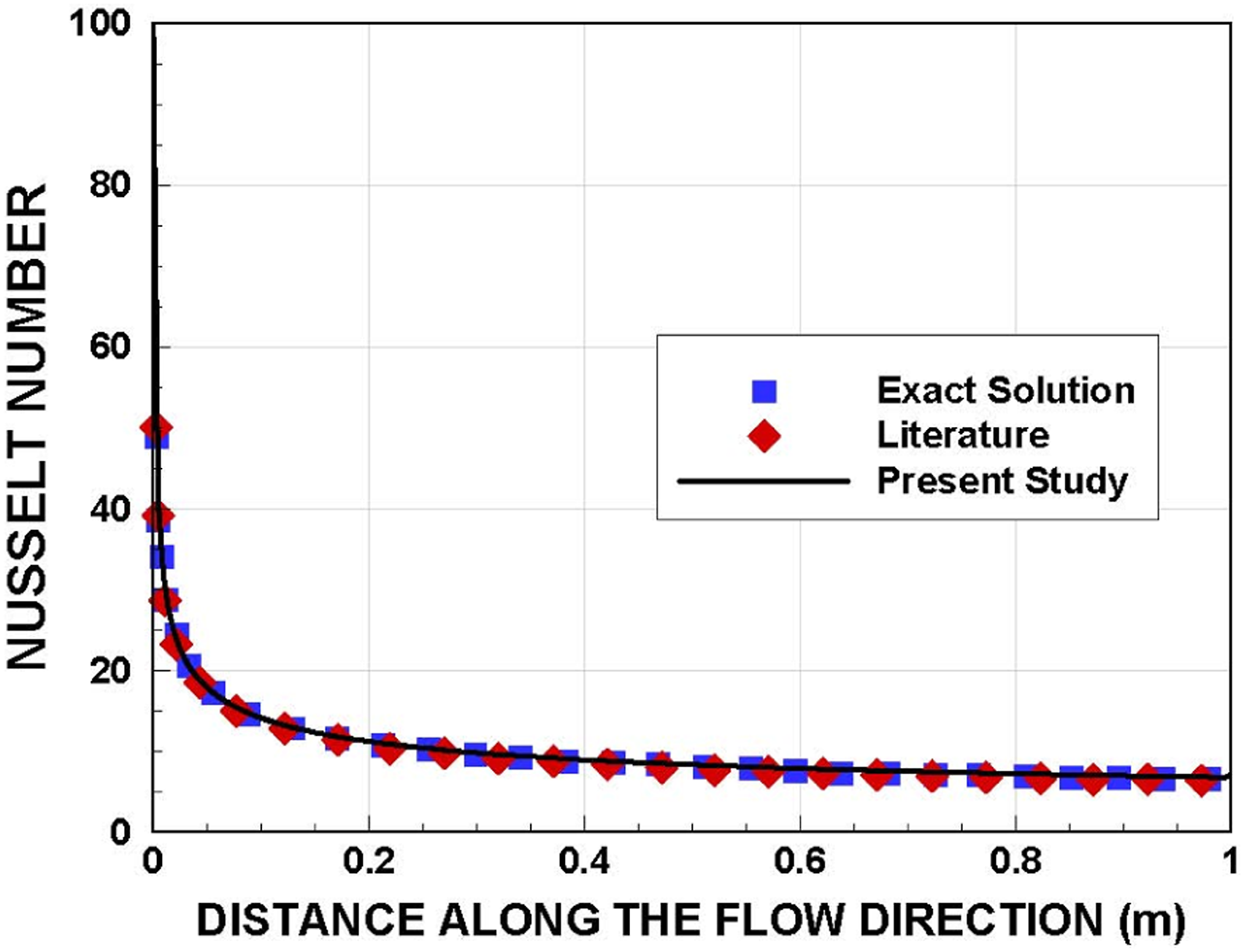
For numerical simulations of flow and temperature in the microchannel COMSOL 5.3 CFD software is used. Figure 1 show a schematic view of the sinusoidal channel and boundary conditions, respectively. The centerline of the geometry is made symmetrical for reducing the number of meshes and computational time, while the wall is treated with constant heat flux. Thermal equilibrium model is used in between solid and fluid phases in the porous medium as it can be utilized for non-reactive flows. The porous insert is placed at the center of the sinusoidal geometry for heat transfer enhancement as shown in Figure 1. The comparison of values of the Nusselt number along the flow direction, which are predicted from the current simulations and obtained from the early work
34
and
26
is shown in Figure 2. It is evident that the predictions agree well with those obtained from the early work
34
and.
26
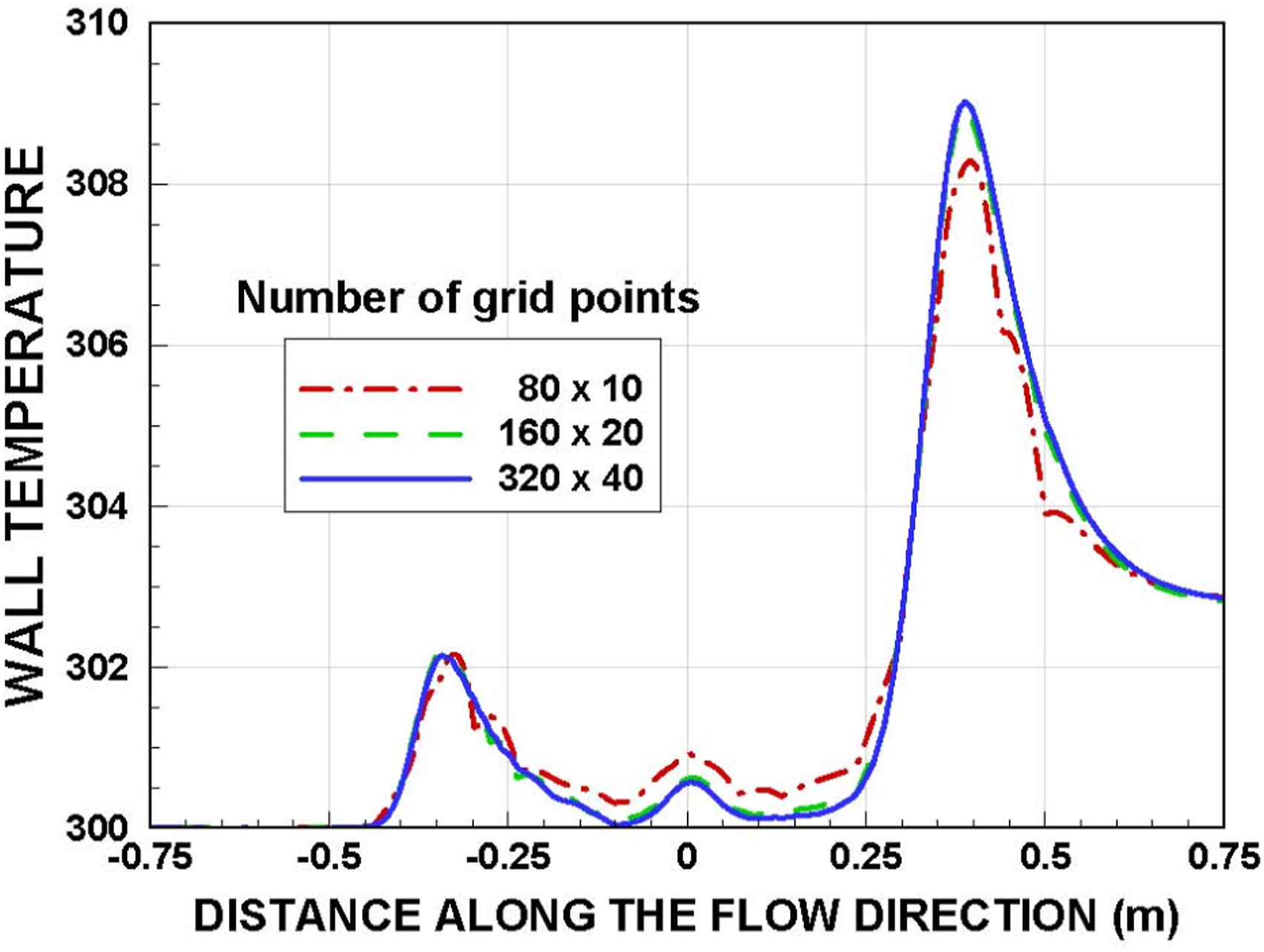
It may be noted that for the case of results presented in Figure 2 the standard code validation case of flow in a pipe with constant heat flux at the wall is considered with water as the working fluid. The diameter of the pipe is considered such that starting with a developed region, eventually the fully developed flow condition is reached before the exit of the pipe. The grid independence tests are carried out to secure the grid independent solutions as represented in Figure 3. The case considered for grid independance test is TiO nanoparticles with The schematic diagram of the considered geometry of sinusoidal channel. Grid independence test conducted with different mesh sizes against temperature profile along the channel. (Re = 500, 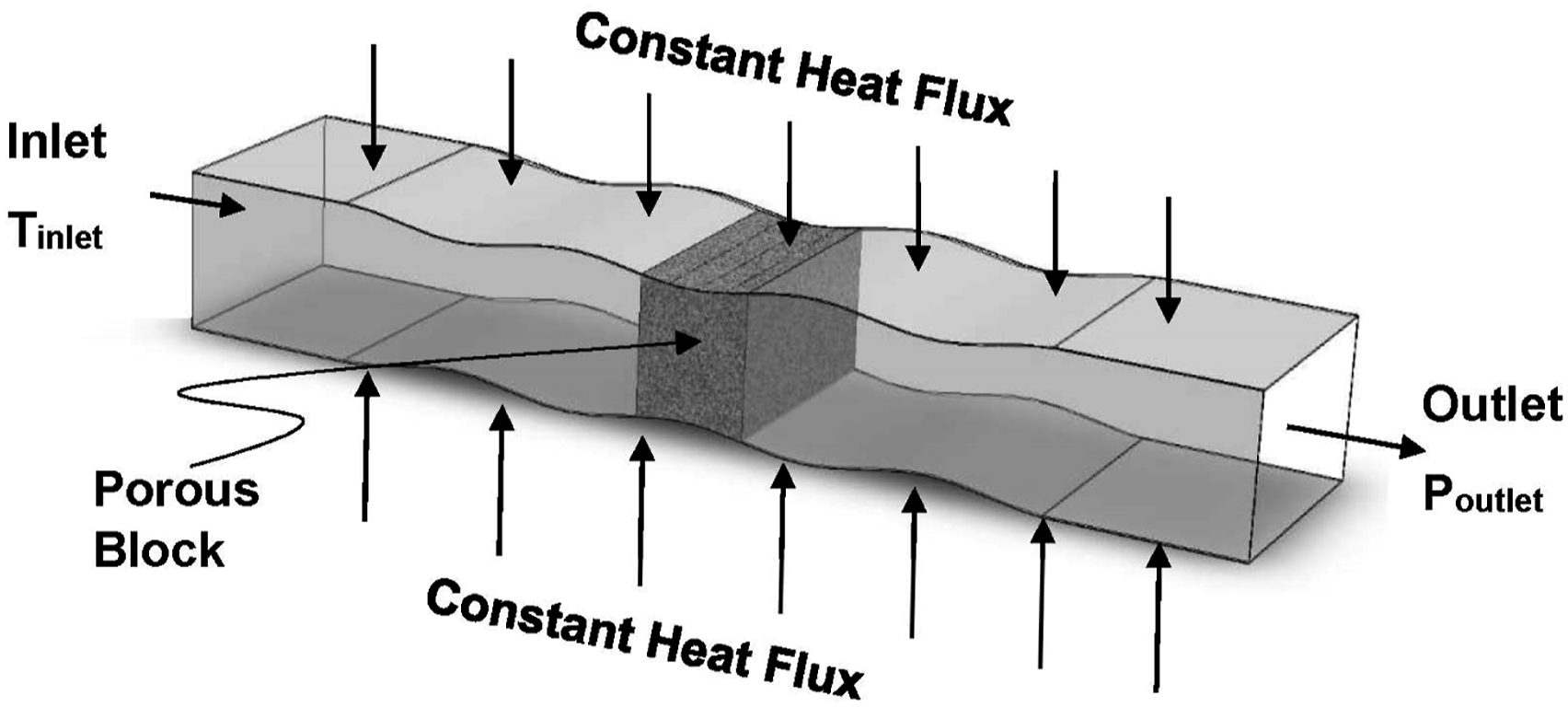
Results and discussion
The performance of nanofluids in micro-channel flow with porous insert is evaluated. A numerical method incorporating COMSOL code is used to assess the thermal response of the nanofluids in a micro-channel. Addition of nanoparticles to the base fluid alters the thermophysical properties of the fluid, which in turn influences the average Nusselt number (Nu). Figure 4(a) shows the effect of nanoparticles concentration ( Variation of average Nusselt number with respect to (a) changing concentration of nanoparticles in the fluid with 2 different widths (w) of porous medium, Re = 100, K = 10−6 m2, (b) changing concentration of nanoparticles in the fluid with different permeabilities (K) of porous medium Re = 100, w = 0.2 m, (c) changing the Reynolds number of the fluids, 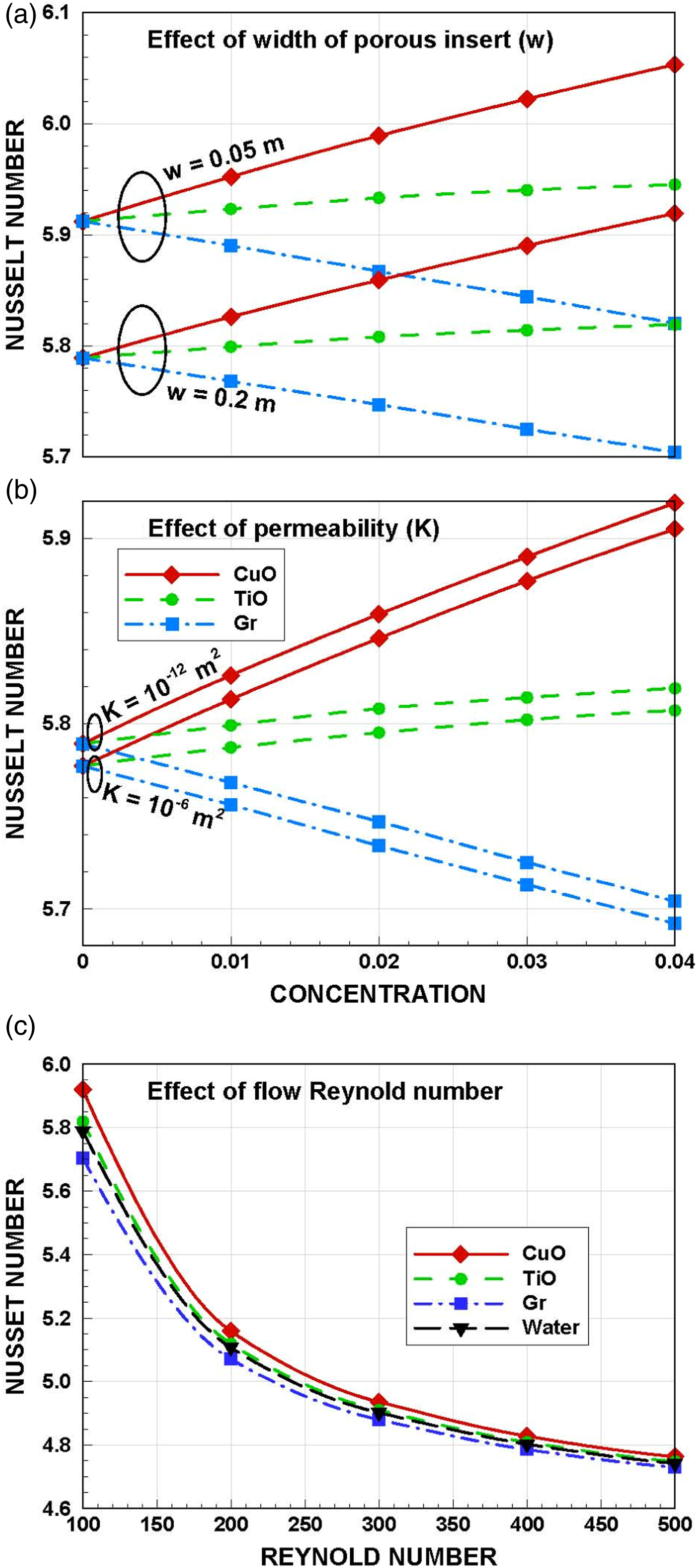
Permabilitiy is a characteristic of porous insert representing the amount of nanofluid being allowed to flow through. The thermal and flow distortions in the fluid flow are dependent upon the permeability of the porous insert. Figure 4(b) compares the variation of Nu with permeability with the presence of the porous insert. It is observed that Nu changes with changing permeability; however, small increment in Nu occurs as the premeability increases substantially. Figure 4(c) compares average Nusselt number (Nu) with different values of Re ranging from 100 to 500 and
Dimensionaless maximum temperature parameter Variation of (a) dimensionless maximum temperature (ψ1), (b) dimensionless fluid bulk temperature (ψ2), and (c) dimensionless fluid temperature at the exit (ψ3), with respect to changing concentration of nanoparticles in the fluid. CuO, TiO, and Gr represent the particles in nanofluid. Re = 100, w = 0.2 m, K = 10−6 m2.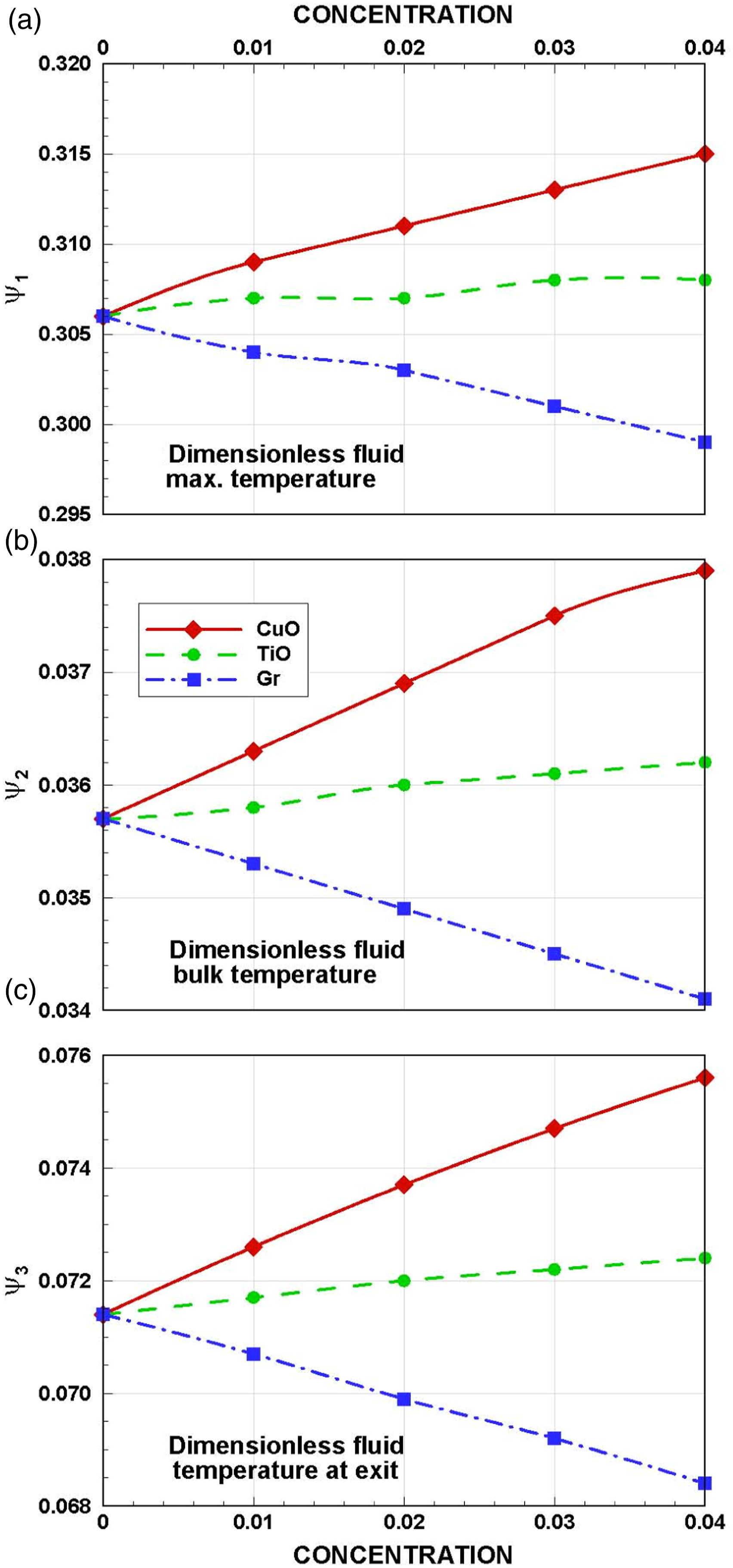
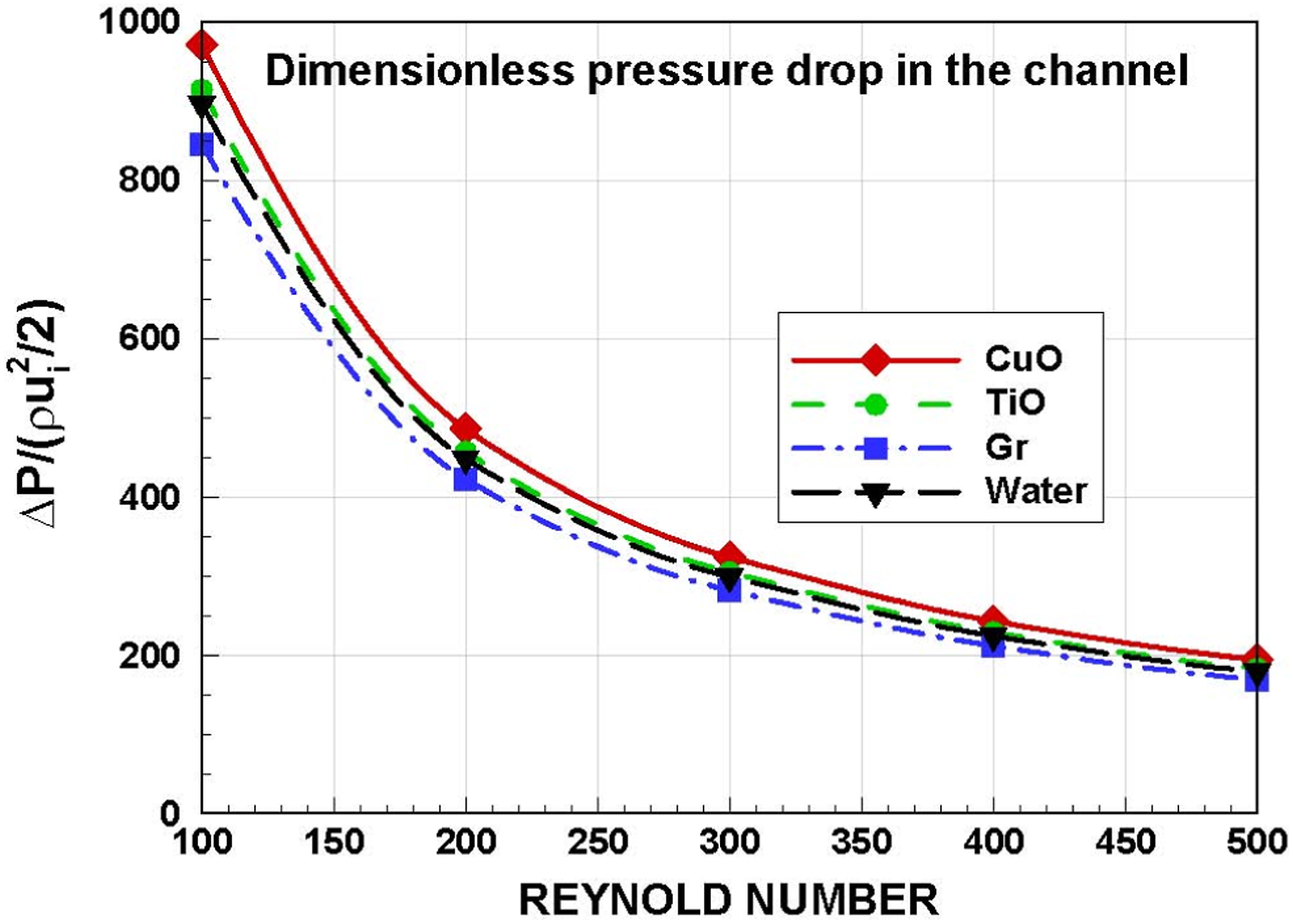
Moreover, the dimensionless fluid bulk temperature Variation of dimensionless maximum temperature (ψ1), with respect to changing Reynolds number of the fluids, Variation of dimensionless pressure drop (ΔP/(ρui2/2)) in the channel, with respect to changing Reynolds number of the fluids, 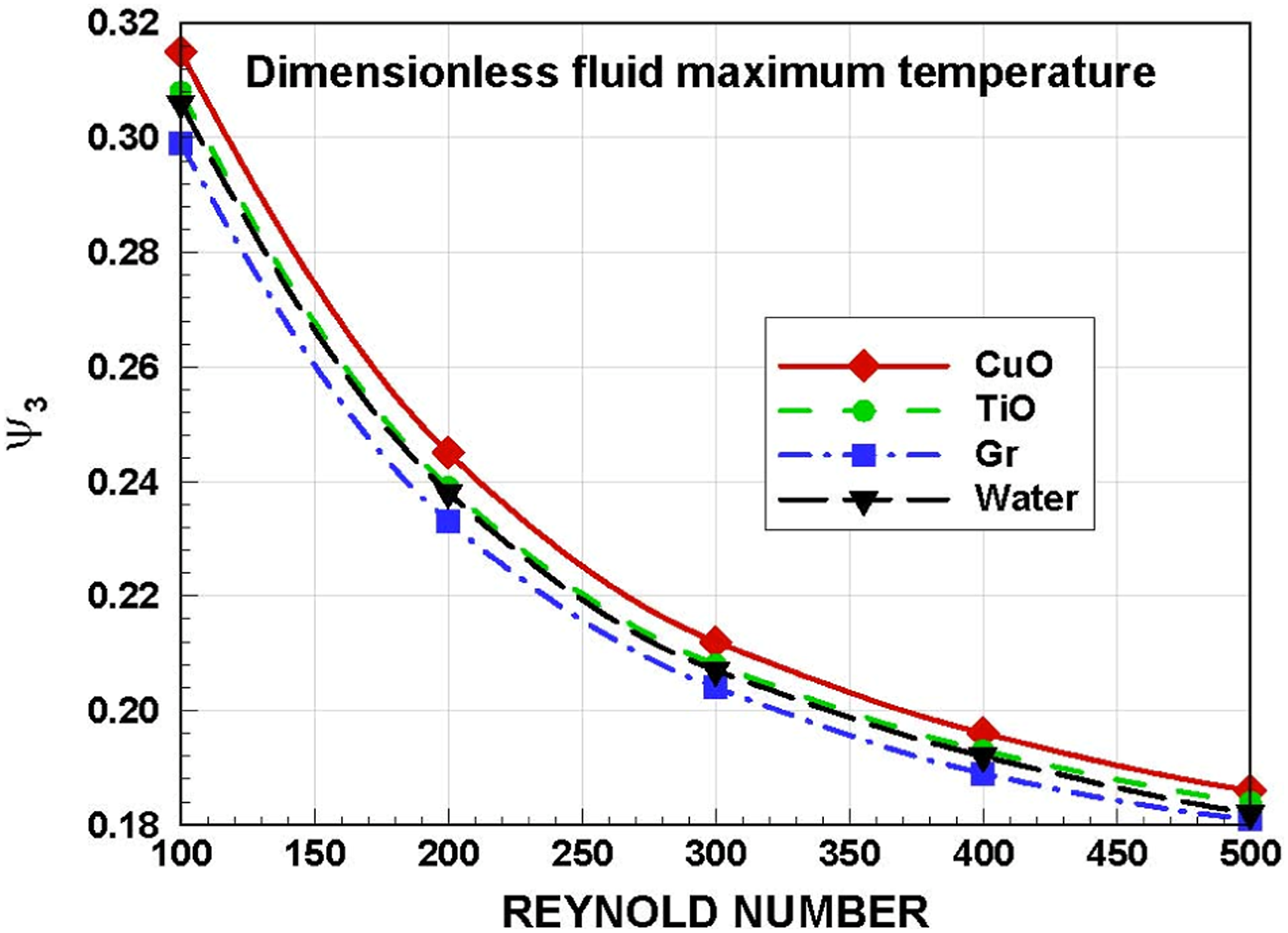
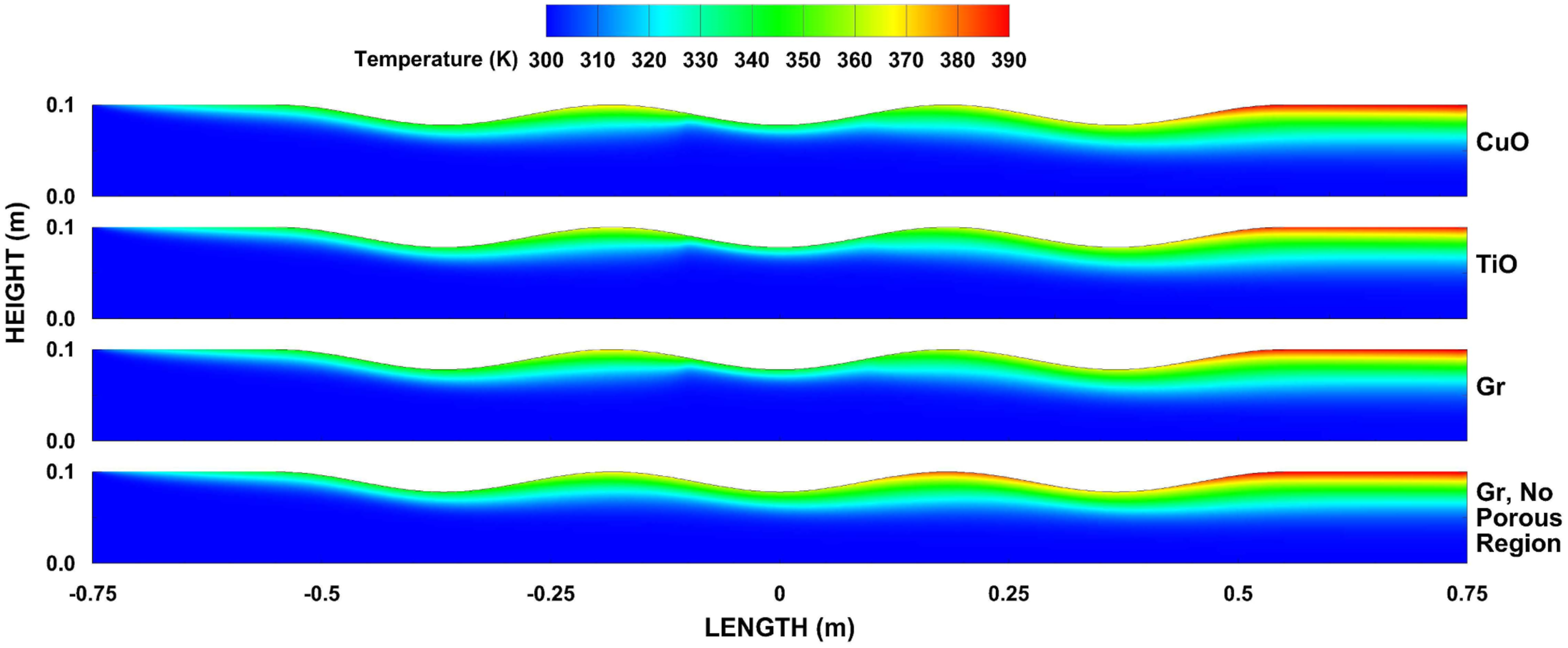
For same porous width, permeability, Velocity contours of the nanofluids, Re = 100, Temperature contours of the nanofluids, Re = 100, 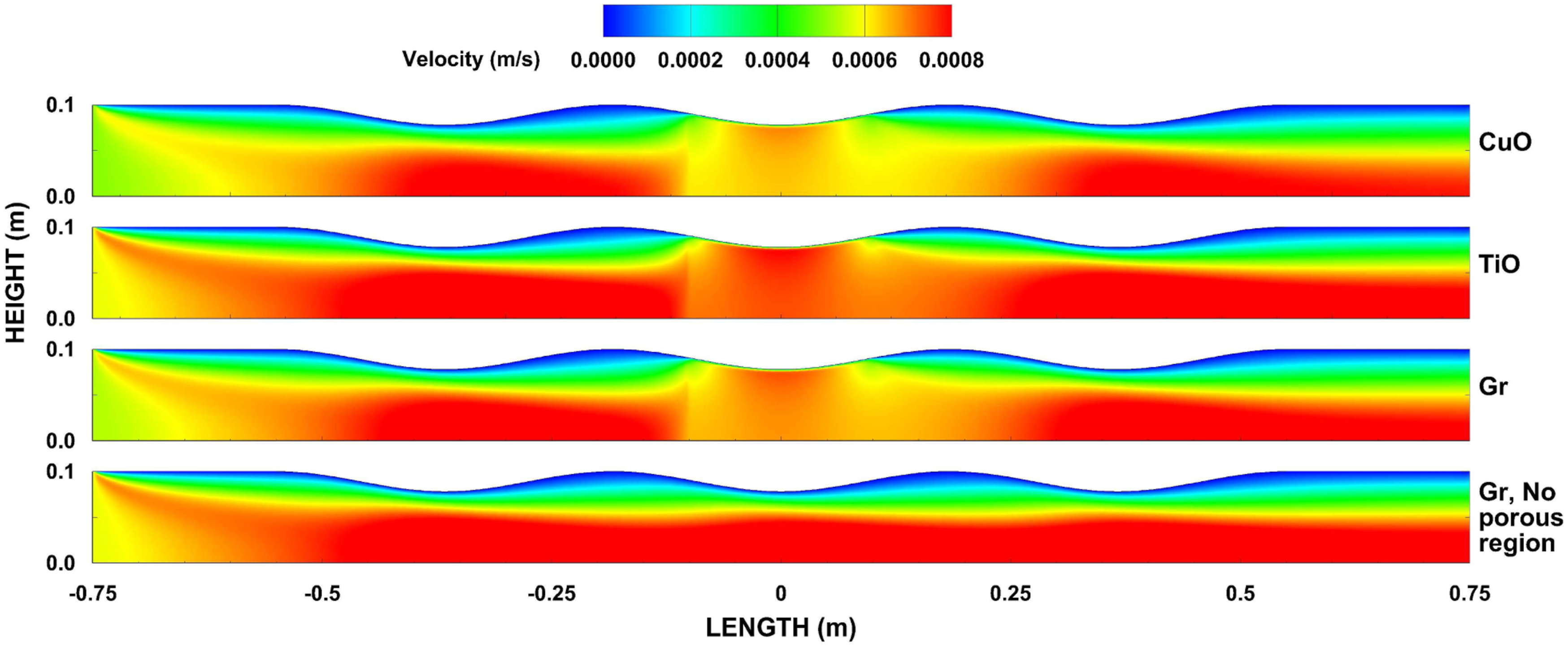
Conclusion
The present study compares the thermal performance of three nanofluids in microchannel flow. CuO-water nanofluid results in higher Nu as compared to TiO2-water and graphene-water nanofluids. The slope of the curve for CuO-water nanofluid resembles sharper change in Nu with increasing volumetric fraction (
Footnotes
Acknowledgements
The authors acknowledge the support of the Deanship of Scientific Research via supporting the project IN171004, King Fahd University of Petroleum and Minerals, Dhahran and King Abdullah City for Atomic and Renewable Energy (K.A.CARE), Saudi Arabia, for the support.
Declaration of Conflicting Interests
The author(s) declared no potential conflicts of interest with respect to the research, authorship, and/or publication of this article.
Funding
The author(s) received no financial support for the research, authorship, and/or publication of this article.
