




Abstract
In this study, we conducted a numerical investigation of the turbulent mixed convection of a hybrid nanofluid (HNF) in a flask equipped with an agitator, which is commonly used in organic chemistry synthesis. The bottom wall and the middle section of the flask were maintained at a constant high temperature Th, while the upper, left, and right walls up to the middle of the flask were kept at a low temperature Tc. The HNF consisted of Graphene (Gr) and Carbon nanotubes (CNTs) nanoparticles (NP) dispersed in pure water. The governing equations were solved numerically using the finite size approach and formulated using the Boussinesq approximation. The effects of the NP volume fraction φ (ranging from 0% to 6%), the Rayleigh number Ra (ranging from 104 to 106), and the Nusselt number (Nu) were investigated in this simulation. The results indicated that the heat transfer is noticeably influenced by the Ra number and the increase in the φ ratio. Additionally, the agitator rotation speed had a slight effect on the heat transfer.
Introduction
Numerous theoretical and experimental studies have focused on the investigation of mixed convection in cavities containing nanofluids and hybrid nanofluids. Selimefendigil and Öztop 1 analyzed the mixed convection and fusion behavior of CNT-water nanofluid in a horizontal annulus under the influence of oriented magnetic field and rotating surface. In this context, authors analyzed the fusion behavior and mixed convection characteristics by varying various factors such as the volume fraction of nanoparticles, the inclination angle of the magnetic field, Hartmann number (Ha), and the rotational speed of the inner wall. Accordingly, their results show that the fused fraction and the Nu value increased by increasing the volume fraction of CNT nanoparticles, whereas an inverse effect has been seen for Ha number values. Also, it can observe that the heat transfer speed is diminished for elevated rotational speed of the inner wall. Moreover, they demonstrated that it can control the melt front propagation by means of the rotation of the inner surface. Akhter et al. 2 studied the mixed convection of Al2O3-Ag/water hybrid-nanofluid in square cavity under the effect of an oriented magnetic field and two roughness rotating cylinders. Consequently, Akhter et al. examined the influences of numerous factors such as the volume fraction of the hybrid nanoparticle, the rotation speed of cylinders, the inclination angle of the magnetic field, and the Ha number on the flow and thermal fields. The obtained results from this simulation indicate that the flow of the mixed convection accelerates with the rotation speed of cylinders, while decreases with elevated values of the magnetic field and the volume fraction of hybrid Al2O3-Ag nanoparticles. They obtained also that the enhancement in the heat transfer reached 261.29% at the maximum value of the rotating speed of rough cylinders.
Ali et al. 3 carried out a numerical study of magneto-mixed convection in a partially heated rectangular enclosure equipped with Al2O3-water nanofluid and rotating flat plate. In this context, authors examined the effect of the length and speed of rotating flat plate on the flow and thermal fields. They found that the high length and elevated rotational speed of the plate generates highest quantity of heat transfer. Additionally, the optimal heat transfer performance has been achieved at concentration of 5% of Al2O3 nanoparticles which is 123.02% more than pure water. Higher magnetic field strength attenuates the fluid motion and hence heat transfer rate significantly. The elevated values of the magnetic field reduce the nanofluid movement and consequently heat transfer rate significantly. Jiang et al. 4 numerically studied the entropy production and mixed convection heat transfer of Fe3O4/MWCNT-water hybrid nanofluid confined in a 3D cubic porous enclosure with wavy wall and two rotating cylinders. The effect of some flow parameters such as the direction of the two cylinders rotations and their positions in the enclosure, the angular speeds of both cylinders, Darcy number (Da), and Hartmann number (Ha) were examined. The results showed that heat transfer increases with higher values of angular speed of cylinders and Da number and lower values of Ha. On the other hand, the entropy generation is mainly related to heat transfer. Despite the abundance of work in the field of mixed convection of nanofluids and hybrid nanofluids, most of these studies have been limited to cases of unpartitioned cavities, and very few studies have been conducted using nanofluids and hybrid nanofluids in partitioned cavities.5–10
In addition, work on the study of convective phenomena within ventilated cavities has mainly concerned simple and regular geometries (square, rectangular, etc.). On the other hand, few studies have dealt with the case of more complex geometries such as that of Tmartnhad et al. 11 The latter numerically analyzed the heat transfer, in a trapezoidal cavity ventilated and crossed by air. Also, the effect of the rotational speed and magnetic field on the mixed convective heat transfer in diverse cavities has been extensively studied by researchers. Accordingly, Alsabery et al. 12 investigated the problem of transitory Magnetohydrodynamic (MHD) combined convection inside a wavy-heated rectangular enclosure containing two internal rotating cylinders applying the heterogeneous nanofluid system. Also, the effect of volume fraction of nanoparticles, Hartmann number on the flow and heat transfer has been examined in this study. Their results reveal that the augmentation of the Nu number is the consequence of elevating the rotational speed of the two cylinders. In addition, Jabbar et al. 13 examined the mixed convection of Cu-water nanofluid in an inclined porous enclosure combined with a dynamic rotating cylinder. In this context, Jabar et al. studied the effects of some parameters such as volume fraction of nanofluid, conductivity ratio, inclination angle, Darcy number, rotational speed, and Richardson number. The obtained results from this study indicate that the increasing in the rotation speed of the cylinder can augment the Nu number in the rate of 223%, whereas the increasing of the thermal conductivity by a ratio of 10 times augments the Nu number by 136%. Furthermore, an opposite effect of the Richardson number (Ri) has been observed on the Nu number. In another study, Alsabery et al. 14 conducted a numerical study of the mixed convection and the entropy generation of Al2O3-water nanofluid inside a wavy-walled enclosure including a rotary cylinder. In their search, Alsabery et al. studied the effect of several physical and geometrical factors, such as the angular rotational speed, number of undulations, the length of the heat source, the Ra number, and the concentration of Al2O3 nanoparticles. The obtained results illustrate that the augmentation of the rotation speed of the cylinder improves the rate of heat transfer for values of the Ra number less than 5 × 10⁵. Also, the Nu number has affected by the number of undulations and the increasing in the volume fraction Al2O3 nanoparticles and the length of the heated wall improves the velocity of heat exchange.
The effectiveness of such processes is often limited by the thermophysical properties of the fluids used. 15 The development of research dealing with nanofluids aims to significantly improve heat transfer by introducing a low concentration of nanoparticles (size less than 100 nm) into a pure fluid.1,16,17 Several studies have been carried out on the mixed convection of nanofluids18–20 whose numerical study focused on the heat transfer within a ventilated square cavity and crossed by a nanofluid (Al2O3-water). The latter varied the location of the discharge opening. It appears that the average Nusselt number increases with the increase in the Reynolds and Richardson numbers and the volume fraction. Shahi et al. 21 and Talebi et al. 22 carried out a numerical study concerning the mixed convection within a nanofluid (Cu-Water) in a ventilated square cavity of which a portion of its base is subjected to a heat flow. Their results indicate the addition of nanoparticles leads to the increase of the average Nusselt number. Recently, there has been a growing interest in hybrid nanomaterials as a means to develop new nanofluids that can achieve the highest rates of heat transfer.23–29 In this context, Kalidasan and Rajesh Kanna 30 considered in their numerical study, the case of a ventilated square cavity with an adiabatic obstacle in its center. The authors were interested in the contribution of the use of a hybrid nanofluid (consisting of nanoparticles of diamond and cobalt oxide in water as a suspending fluid) on the thermal performance of the cavity.
The study of heat transfer by natural convection in the prepared round bottom flask for the composition of organic chemistry, such as the ease of isolation after the reaction, the low cost, and the simplicity of operation, 31 it is of great importance in the study of the mechanisms of chemical reactions. Thus, the objective of the present work consists of a characterization of the turbulent mixed convective heat transfer of hybrid nanofluid in round bottom flask contains an agitator. Accordingly, we numerically study the turbulent mixed convection of a hybrid nanofluid (HNF) in a round bottom flask containing an agitator; It is one of the laboratory flasks used in organic chemistry synthesis. The bottom wall and to the middle of the flask are maintained at a constant high temperature Th with the agitator rotation speed (ω) fixed at 250 rpm. While the upper, left, and right walls to the middle of the flask are maintained at low Tc. The HNF comprises Gr and CNT nanoparticles suspended in pure water. The governing equations are solved numerically using the finite size approach and formulated using the Boussinesq approximation. In this simulation, we investigated the effects of NP volume fraction φ from 0% to 6%, Rayleigh number (Ra) from 104 to 106, the rotation speed of the agitator and the Nusselt number (Nu).
Novelty, originality points, and the practical applications of this work
For most chemical reactions, the reaction rate increases by increasing temperature. So it is always useful to work at optimum temperature. As well as, the use of the catalysts increases the reaction rate. In this context, Graphene (Gr) and Carbon nanotube (CNTs) are used as catalysts for certain chemical reactions (Nanocatalysis), where they have been studied for several years as supports for nanoparticle metal catalysts. So, adding Gr and CNTs nanoparticles in reaction medium and increasing the temperature will increase the reaction rate. Furthermore, the new findings presented in this study are:
•The use of nanoparticles enhances the thermal properties for heat transfer and heat storage of the reaction medium inside the round bottom flask, also enhances the rate of chemical reactions (the thermal activation of chemical reactions);
•The use of Graphene (Gr) and Carbon nanotubes (CNTs) nanoparticles like a catalyst in organic reactions forms the complex interactions and creates nano-regions that enhance reactivity and selectivity of chemical reactions (nanocatalysts).
On the other hand, the practical application of this study is the optimization of the operating conditions of the industrial processes, especially, improving the efficiency of the synthesis reactions of various industrial products. On the other hand, the nanocatalysts allow for rapid and selective chemical transformations, with the benefits of excellent product yield and ease of catalyst separation and recovery. Recently, new applications of nanocatalysts are developing, covering:
Nanocatalysis for various organic transformations in fine chemical synthesis;
Nanocatalysis for oxidation, hydrogenation, and other related reactions;
Nanomaterial-based photocatalysis and biocatalysis;
Nanocatalysts to produce non-conventional energy such as hydrogen and biofuels;
Nanocatalysts and nano-biocatalysts in the chemical industry.
Problem description and mathematical formulation
Figure 1 illustrates the round bottom flask cavity considered in the present study. As shown, the left and right walls have straight and circular surfaces, while the top wall is straight. In addition, the cavity has a height H = 115 mm, diameters D0 = 64 mm, d1 = 32 mm, and flask neck d2 = 32 mm, for the agitator d3 = 3 mm and L = 10 mm.

Geometry of the studied configuration.
The simplifying assumptions used in our study are as follows:
The basic fluid used is a Newtonian fluid, incompressible and which satisfies the hypothesis of Boussinesq.
The nanofluid is assumed to be incompressible and the flow is turbulent, stationary, and two-dimensional.
The thermophysical properties of the hybrid nanofluid are constant, except for the variation of the density, which is estimated by the assumption of Boussinesq.
The mathematical formulations and the numerical solution procedure are described as follows:
Continuity equation
The continuity equation is a fundamental principle in fluid dynamics that expresses the conservation of mass within a fluid flow. It states that the rate of mass entering or exiting a control volume must be equal to the rate of change of mass within the control volume. Mathematically, the continuity equation can be expressed as:

Momentum equation in the (x, y)-direction
The momentum equation in the (x, y)-direction, also known as the Navier-Stokes equation, describes the conservation of momentum for fluid flow in a particular direction. It represents the balance between the rate of change of momentum, the pressure forces, and the viscous forces acting on the fluid. 32


Energy equation
The energy equation, also known as the heat transfer equation or the first law of thermodynamics, is a fundamental equation in thermodynamics and fluid dynamics that describes the conservation of energy in a fluid flow. The energy equation can be written as 32 :

Turbulent kinetic energy
Turbulent kinetic energy refers to the energy associated with the chaotic and irregular motion of fluid particles in a turbulent flow. It represents the fluctuating component of kinetic energy in a turbulent flow field. 32
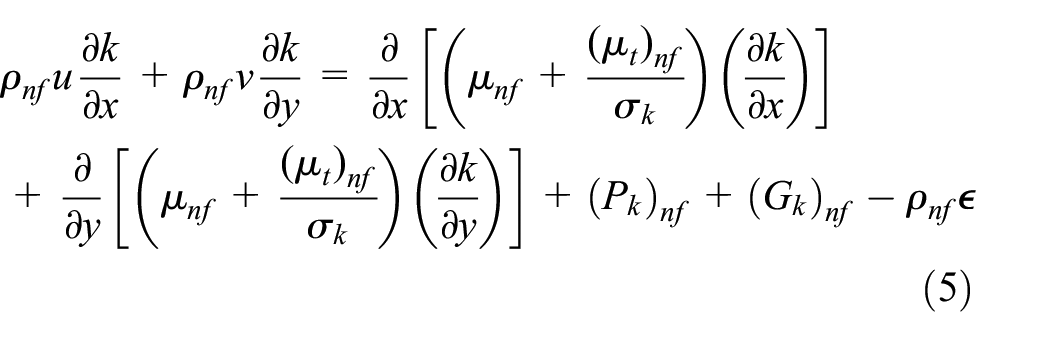
Rate of energy dissipation
The rate of energy dissipation, also known as the dissipation rate, refers to the rate at which mechanical energy is converted into internal energy or heat within a fluid flow. 32

With

Stress production:

Buoyancy term:

Prandtl number:

The eddy viscosity:

The thermo-physical properties of the hybrid were predicted nanofluid using the following models33–36:
Density of the hybrid nanofluid
The density of a hybrid nanofluid refers to the measure of mass per unit volume of the mixture, which consists of a base fluid and dispersed nanoparticles, was calculated based on the volume fractions of the components. 33

Heat capacitance of the hybrid nanofluid
The heat capacitance is typically calculated based on the mass and specific heat capacity of the nanofluid mixture, taking into account the volume fractions and properties of the base fluid and nanoparticles. 34

Thermal conductivity of the hybrid nanofluid
The thermal conductivity of a hybrid nanofluid is influenced by the properties of the base fluid and dispersed nanoparticles, as well as their volume fractions. It is typically calculated based on the effective thermal conductivity model, which takes into account the contributions from both the base fluid and nanoparticles. The thermal conductivity of the hybrid nanofluid plays a significant role in its heat transfer characteristics and performance in various applications. 36

With: M = 3 and

Viscosity of the hybrid nanofluid
The viscosity of a hybrid nanofluid is affected by several factors, including the viscosity of the base fluid, the volume fraction and size of the dispersed nanoparticles, and their interactions with the base fluid. 36

Where the dimensionless numbers are:


The Nusselt number
The Nusselt number is a dimensionless parameter used in fluid mechanics and heat transfer to quantify the convective heat transfer rate from a surface. It is defined as the ratio of convective heat transfer to conductive heat transfer across a boundary or surface. 17

The heat transfer coefficient is expressed as:

Thermal conductivity:

Average Nusselt number:

The boundary conditions are written as:
On the left and right walls:

On the top flask neck:

On the round bottom:

On the adiabatic agitator:
The agitator is adiabatic and ω = 250 rpm.
Code validation and grid testing
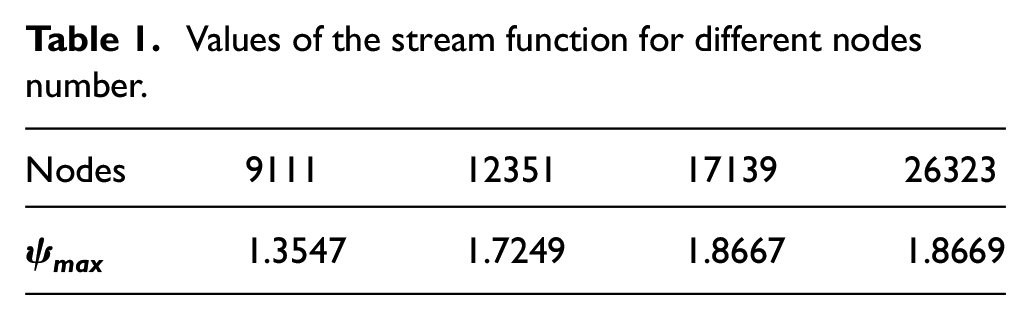
When performing numerical simulations, the accuracy and reliability of the results are influenced by the discretization of the computational domain into smaller elements or nodes. Increasing the number of nodes allows for a finer representation of the flow and temperature fields, capturing more detailed features and resolving smaller-scale phenomena. Therefore, based on the assessment of the numerical simulations of the Gr-CNT-Water mixture (φ = 0.02), Ra = 105 and are presented in Table 1 and the information conveyed by Figure 2, it can be concluded that the chosen node number of 17139 is sufficient for accurately capturing the simulated phenomena within acceptable computational limitations.
Values of the stream function for different nodes number.

A schematic illustration of the numerical grid was provided.
Figure 3 presents a comparison between the results of the present study and those of Guiet et al. 37 The comparison concerns the mean Nusselt number. It is clear that the results of our code are in good agreement with those proposed by Guiet et al.

Comparison of the average Nusselt number between the present work and that of Guiet et al.
Results and discussion
The main purpose of this study was to determine the effect of different parameters such as the volume ratio of mixed nanoparticles (0 ≤ φ ≤ 0.06), the rotational speed of the agitator (250, 275, 300, and 350 rpm) and Rayleigh number (104 ≤ Ra ≤ 106) on the flow behavior and convective heat transfer in a round bottom flask of the resulting CNT-Gr-water hybrid nanofluid. The thermophysical properties of water and the tested nanoparticles are regrouped in Table 2.
Thermophysical properties of fluid and nanoparticles.

Figure 4 shows us isothermal contours, and as expected, in the absence of nanoparticles, the heat distribution is much lower than in their presence. Also, Figure 4 shows that the isotherms conform to the shape of the round bottom flask. This outcome is unsurprising since weak circulation structures are formed under low Rayleigh number conditions, resulting in minimal heat transfer. However, at high Rayleigh number conditions (Ra = 106), the circulation structure’s strength within the cavity intensifies, and heat transfer within the cavity is predominantly controlled by it. Moreover, the isothermal lines are predominantly clustered near the round bottom portion of the hot wall and the left and right portions of the cold circular walls, as expected in the Rayleigh-Bénard experiment. Thus, substantial temperature gradients arise in the bottom portion of the hot wall. In addition, we can clearly see from Figure 4 that the intensity of the buoyancy effect rises when the volume fraction of the hybrid nanofluid increases, and this may be confirmed by the increasing of the circulation shape inside the cavity.

Isotherms for different Ra and volume fraction.
The streamlines contours are depicted in Figure 5. We clearly observe from Figure 5 that the streamlines differ from one case to another according to the proportion of nanoparticles and according to the high value of the Rayleigh number. Generally, we notice an evident difference in the angle and shape of the vortex rotation system.

Velocity streamline for different Ra and volume fraction.
The analysis of Figure 5 reveals important characteristics of the streamlines within the studied system. It is observed that the streamlines generally exhibit symmetrical behavior, indicating a balanced flow pattern.
One significant finding is that increasing the Rayleigh number leads to higher values of the stream function. The Rayleigh number serves as a measure of the balance between buoyancy and viscous forces, with higher values indicating stronger natural convection. This stronger convection enhances the flow patterns and results in higher values of the stream function.
At lower Rayleigh numbers (specifically Ra = 104), the stream function reaches its lowest value, indicating a relatively weaker flow. In this regime, secondary vortexes are formed, which are additional flow structures created within the system. These vortexes contribute to the complexity of the flow pattern.
In contrast, at higher Rayleigh numbers (specifically Ra = 106), the vortexes expand both horizontally and vertically, increasing in size and intensity. This expansion suggests a more vigorous flow characterized by stronger fluid mixing and heat transfer.
Additionally, the presence of nanoparticles and their volume fraction influences the thickness of the thermal boundary layer adjacent to the heated wall. The thermal boundary layer represents the region where heat transfer occurs between the heated surface and the fluid. The nanoparticles in the hybrid nanofluid contribute to the vorticity and flow behavior in these regions, leading to the emergence of vortexes.
The vorticity, or rotational motion, induced by the hybrid nanofluid particles plays a key role in the formation and intensification of these vortexes. The interaction between the fluid and nanoparticles in these regions contributes to the observed streamlines and flow patterns.
Figure 6 provides insight into the distribution of isotherms under different rotational speeds of the mixer, both in the absence and presence of nanoparticles. The Figure 6 reveals variations in heat distribution depending on the rotation speed, and a significant difference in temperature distribution is observed upon the addition of nanoparticles.
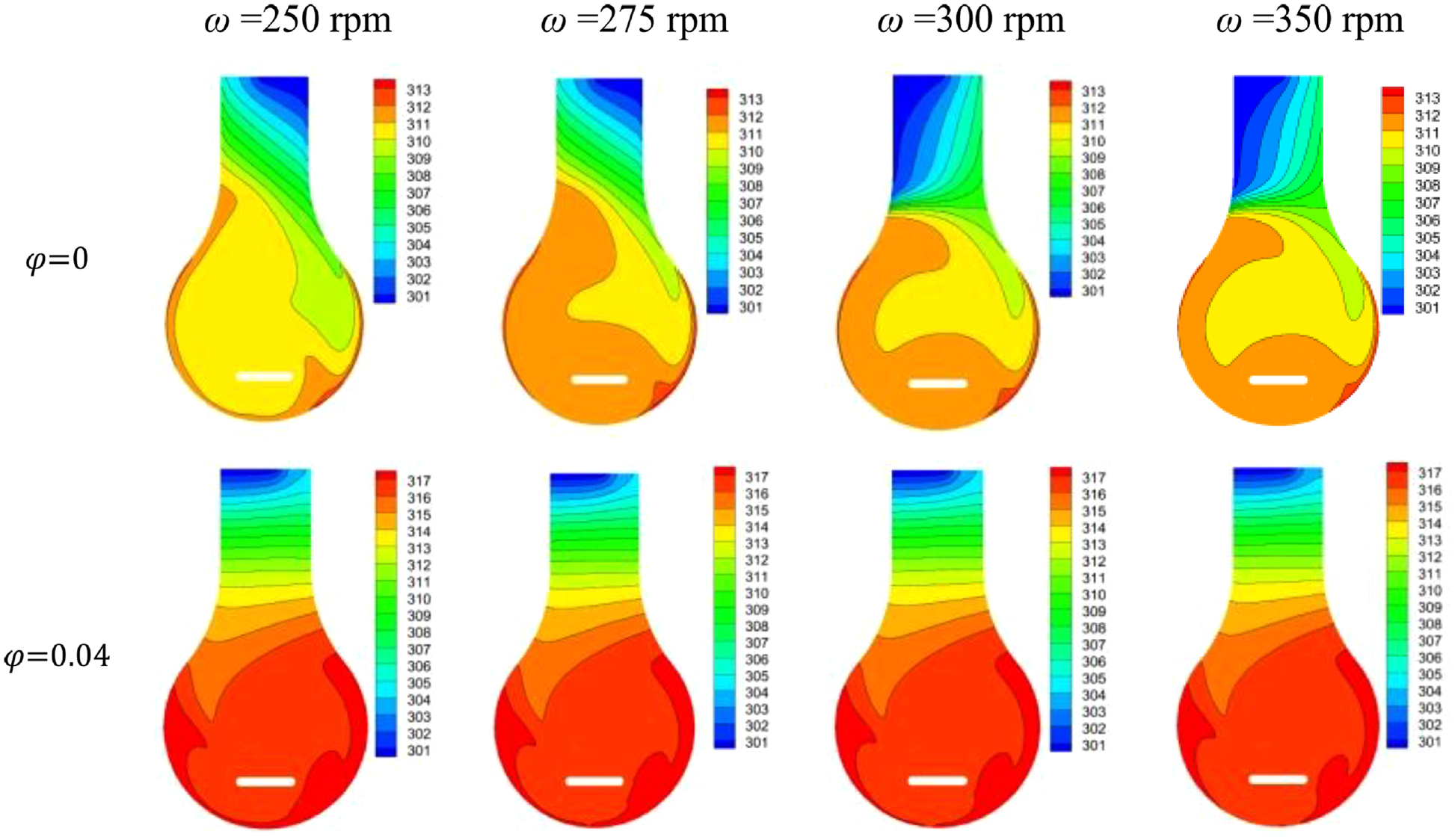
Isotherms for different speeds of rotation of the agitator.
When examining the isotherms, we can observe distinct changes in heat distribution patterns as the rotational speed of the mixer is altered. The presence of nanoparticles further amplifies these changes. The addition of nanoparticles introduces new heat transfer pathways, altering the heat distribution throughout the system.
Moving on to Figure 7, we explore the impact of the agitator’s rotational speed on the velocity streamlines in the absence and presence of nanoparticles. Without nanoparticles, pure water exhibits tangential flow along the agitator toward the wall of the round bottom flask. Due to the influence of reflection and gravity, the liquid follows a tangential path along the normal direction of the agitator, resulting in a circulating water flow from the bottom to the top. Increasing the agitator speed induces the formation of three non-symmetrical vortexes, and the velocity of rotation significantly affects the maximum value of the streamline.

Velocity streamline for different speeds of rotation of the agitator φ = 0.
With the introduction of nanoparticles, the flow exhibits four symmetrical vortexes. Moreover, it is evident that the presence of nanoparticles slightly increases the maximum values of the streamline, indicating enhanced flow velocity. Based on these findings, a rotational speed of 250 rpm was selected as it maximized the streamline value considering the presence of nanoparticles (φ = 0.04).
The observed changes in flow patterns and streamline values highlight the influence of rotational speed and the presence of nanoparticles on fluid dynamics. These insights are essential for optimizing mixing efficiency and heat transfer in systems employing mixers and nanofluids.
Figure 8 provides valuable insights into the variation of the Nusselt number (Nu) with the volume fraction (φ) of nanoparticles for different Rayleigh numbers (Ra). Previous studies have established that the addition of nanoparticles to the base fluid has two opposing effects on intracavity convective heat transfer.

Variation of average Nusselt number Nu with HNP volume fraction φ at different Rayleigh numbers Ra.
The first effect is an increase in Nu, which is attributed to the enhanced thermal conductivity of the mixture resulting from the presence of nanoparticles. These nanoparticles possess higher thermal conductivity compared to the base fluid, facilitating better heat transfer within the system. This increase in thermal conductivity leads to improved convective heat transfer, resulting in a higher Nu value.
On the other hand, the second effect arises from the increase in viscosity caused by the addition of nanoparticles. The viscosity of the fluid is influenced by the presence and concentration of nanoparticles, and this higher viscosity tends to suppress convective motion within the system. As a result, the convective heat transfer is reduced, leading to a lower Nu value.
The dominance of either effect depends on various factors, including the type of nanoparticles used, the strength of the convective flow (Ra), and the specific model employed to estimate the viscosity and thermal conductivity of the mixture.
The findings presented in Figure 8 of this study demonstrate important trends. It is observed that, for a given Ra value, the introduction of nanoparticles leads to a monotonic increase in Nu. This suggests that the increase in thermal conductivity outweighs the viscosity-induced suppression of convective motion, resulting in enhanced heat transfer.
Furthermore, it is demonstrated that Nu increases monotonically with increasing Ra for a given φ value. This observation aligns with the general understanding that elevating the Rayleigh number intensifies the convective flow within the system. The increased convective strength promotes more effective heat transfer, leading to higher Nu values.
Figure 9 presents the relationship between the mean Nusselt number (Nu) and the Rayleigh number (Ra) for different types of nanofluids (NFs), specifically Graphene (Gr), Carbon Nanotubes (CNT), and a hybrid nanofluid consisting of Graphene and Carbon Nanotubes (Gr-CNT).

Variation of Nusselt number with volume fraction of Gr, CNT, and Gr-CNT NPs for Ra = 106.
The graph provides insights into the impact of the Rayleigh number on the Nusselt number and the total heat transfer within the cavity under the given conditions.
Furthermore, the type of nanofluid employed influences the average Nusselt number and the heat transfer characteristics within the cavity. Different types of nanoparticles, such as Graphene and Carbon Nanotubes, have varying thermal properties and interactions with the base fluid. These variations in thermal conductivity and fluid-nanoparticle interactions impact the overall heat transfer performance of the nanofluid.
In particular, it is observed that the hybrid nanofluid consisting of Graphene and Carbon Nanotubes (Gr-CNT) in water exhibits the highest mean Nusselt number among the studied nanofluids at a Rayleigh number of 106. This finding suggests that the combination of Graphene and Carbon Nanotubes provides synergistic effects, leading to enhanced heat transfer performance within the cavity.
The information provided in Figures 8 and 9 enhances our understanding of the relationship between the Rayleigh number, the type of nanofluid, and the mean Nusselt number. These findings contribute to the optimization of nanofluid-based heat transfer systems, allowing for the selection of appropriate nanofluids and operating conditions to achieve desired heat transfer rates.
Conclusion
In this study, the impact of the Rayleigh number, the volume fraction (φ) of nanoparticles, the rotational speed and the type of nanofluid on the flow streamlines, isotherm distribution, and mean Nusselt number was investigated. The main findings are summarized as follows:
The heat transfer performance is enhanced by 13% when increasing the Rayleigh number to Ra = 105 and by 40% when increasing the volume fraction to φ = 0.6. These findings suggest that higher volume fractions, combined with higher Rayleigh numbers, improve the efficiency of heat transfer in the system.
The study revealed that at a rotation speed of 275 rpm, distinct flow circulation cells were observed, and the system exhibited the highest heat transfer performance.
The influence of nanoparticle type and volume fraction on the Nusselt number is more significant than the impact of a high Rayleigh number.
The Gr-CNT hybrid nanofluid offer a significantly superior enhancement in thermal performance compared to graphene nanoparticles or carbon nanotube nanoparticles. This is primarily attributed to their exceptional thermal conductivity and low densities.
Footnotes
Appendix
Handling Editor: Chenhui Liang
Declaration of conflicting interests
The author(s) declared no potential conflicts of interest with respect to the research, authorship, and/or publication of this article.
Funding
The author(s) disclosed receipt of the following financial support for the research, authorship, and/or publication of this article: This research was supported by the General Directorate for Scientific Research and Technological Development (DGRSDT), Algerian Ministry of Scientific Research.
