




Abstract
This numerical study aims at predicting the reflective behavior of different conventional inlet and outlet far-field boundary conditions as well as available non-reflecting boundary conditions (NRBC) implemented in the commercial CFD solver ANSYS CFX. An isolated rotor model of an axial turbine stage with prescribed blade displacement is applied as test case to consider a representative application case, while at the same time provoke an unsteady flow field featuring pronounced flow perturbations in the far-field. Since the reflective behavior of the implemented boundary conditions was found inadequate in the given application case, a zonal treatment of the inlet and outlet far-field, based on a modification of the governing Navier-Stokes equations, is investigated. The applied approach has proven its capability to suppress spurious reflections reliably, while at the same time ensures a preservation of the reference flow conditions within the required domain extensions. The results of a case study considering calculation domains of different spatial extent and different treatments of their respective far-fields suggest variations in the steady flow aerodynamics to be of moderate influence on the predicted aerodynamic damping, while spurious reflections were found to falsify the unsteady aerodynamics considerably.
Keywords
Introduction
Turbomachinery CFD calculations are generally performed on truncated domains, either by considering an isolated blade row, an arbitrary multi-row configuration, or the entire machine. In all cases, there is a need of imposing artificial far-field boundary conditions at the inlet and outlet of the considered computational domain that either mimic the operation of the blade rows in the original multi-row environment, or the flow conditions at the inlet and outlet flanges of the machine.
Numerical reflections at those inlet and outlet far-field boundary conditions are a major source of uncertainty, particularly within the framework of aeromechanical investigations, as the associated spurious disturbances might intermix with the intended ones caused by blade vibration or intrarow interaction phenomena. Consequently, the predicted harmonic blade surface pressure being the primary objective in most aeromechanical investigations might be falsified both in amplitude and phase. A reliable numerical prediction of aerodynamic forcing and damping phenomena thus necessitates a non-reflecting treatment of the applied far-field boundary conditions. This article is addressing these challenges and is based on the following study. 1
The numerical investigation of many physical problems, such as in the field fluid dynamics or electromagnetics, usually requires an artificial truncation of the considered computational domain. This necessitates two basic requirements for the far-field boundary conditions, which are placed at its outer borders: Imposing the intended target conditions, while at the same time allowing disturbances originating within the calculation domain to pass through freely and without artificial reflections. The great variety of such physical problems and the consequently high practical relevance of suitable boundary conditions has led to the development of a multitude of different approaches in the past. The following section is intended to give an overview of the most established approaches in the field of CFD, see Figure 1
Overview of established approaches for non-reflecting treatment of far-field boundary conditions.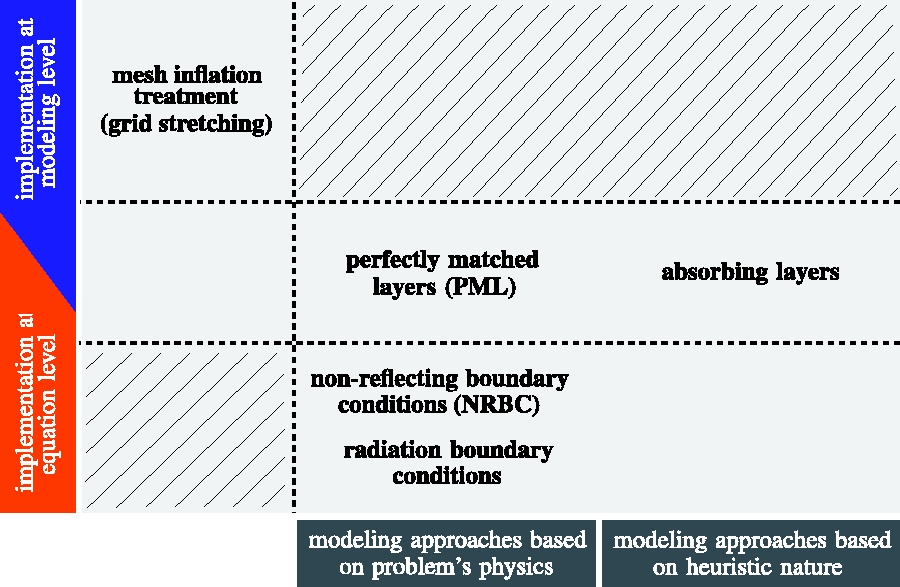
The first group represents boundary conditions in their actual sense, which are placed as a local specification of the conservation variables at the boundaries of the truncated computational domain. Since the underlying modeling approaches of these boundary conditions are derived from the physics of the problem under consideration or suitable approximations, an ideal non-reflective behavior of the boundary conditions can be achieved for specific cases, while being approximate for general cases.
Non-reflecting boundary conditions (NRBC) 2 – 5 achieve such non-reflecting behavior by attempting to zero the amplitude of waves entering the computational domain. In its simplest modeling form, where only one spatial dimension is considered, the necessary distinction into incoming and outgoing waves is made on the basis of a characteristic analysis, which is why this boundary condition type is also referred to as characteristic boundary conditions. However, a limitation of this simplified modeling approach implemented in many commercial solvers to general flow situations is given by the fact that a significantly deteriorated reflection behavior is usually achieved for waves impinging at steep angles of inclination as well as for pressure fluctuations exceeding the acoustic pressure level, which proves to be an even more severe limitation. Analogous higher-order modeling approaches that are mainly based on Fourier/Laplace mode decomposition exist.
Radiation boundary conditions 6 , 7 apply the asymptotic solution of the far-field at infinity to impose appropriate boundary conditions at the boundaries of a truncated computational domain to which a given flow problem was limited for its numerical solution. As a result of this modeling approach, the basic term of such radiation boundary conditions usually represents the Sommerfeld radiation condition. The derivation of such asymptotic far-field formulation requires a detailed knowledge of the given flow characteristics, which makes this type of boundary condition highly problem-specific and less universal. Application cases of internal flows are particularly challenging with regard to the complex radiation patterns that occur.
In the current categorization of different approaches for achieving non-reflecting far-field boundary conditions, the perfectly matched layer (PML) 8 – 10 approach takes on a special position. This approach includes the extension of the computational domain by an absorbing layer with the aim of decaying and thus avoiding reflections of outgoing waves. However, in accordance with the previously presented and contrary to the subsequent approaches, its modeling is directly derived from the physics of the problem rather than on a predominantly heuristic basis. Thus, in theory arbitrary outgoing waves can pass into the adjacent absorbing layer without reflection. Nevertheless, this approach requires some parameters to be adjusted, such as the expansion of the absorbing layer as well as its degree of absorption. Its limitation in practice is primarily attributable to the fact that this modeling approach necessitates large additional equation sets to be solved, which diminish its computational performance. Moreover, deriving the underlying model equations for the nonlinear Navier-Stokes equations is not possible without appropriate assumptions that entail the risk of causing a partially reflective behavior.
Similar to their application within the PML approach, absorbing layers in their general form represent extensions of the computational domain which aim at decaying of outgoing waves in order to reduce or even prevent their reflection at boundary conditions. The modeling approaches applied to alter the governing equations within these layers are manifold, but in contrast to the PML approach predominantly of heuristic nature. These include approaches for imposing artificial viscosity, artificial explicit or implicit damping terms to accelerate the dissipation of flow fluctuations, 11 artificial convection terms for achieving a supersonic flow state, 12 slow-down operators to increase the residence time of flow fluctuations within the layer and with that increasing the efficiency of their dissipation, 13 as well as arbitrary combinations of these. Due to their heuristic modeling approach, this type of absorbing layers usually requires a larger number of parameters to be set compared to the PML approach. Conversely, this adaptability opens the possibility of their application to a wide variety of different flow problems. However, the artificial modification of the governing equations to alter the flow physics causes the interface of the absorption layer to be itself reflective, which is why those influence terms are usually imposed in a gradual manner. 14
In contrast to the approaches described above, the so-called mesh inflation treatment is limited purely to the modeling level. This approach implies an intentional and gradually increasing coarsening of the mesh in the outer areas of the computational domain to dissipate flow fluctuations due to their increasingly insufficient spatial discretization, while leaving both the boundary conditions as well as the governing equations untouched. Consequently, the spatial extent of this inflation zone and the degree of inflation itself represent the model parameters of this approach, which have to be adapted to the respective application case. This means that in the general case where fluctuations with different spatial and temporal scales occur, only a compromise solution can be achieved. Consequently, there is the risk that disturbances with sufficient poor spatial discretization may receive a negative group velocity and thus be reflected back. This approach distinguishes itself by the advantage that it can be implemented purely at the modeling level and can therefore be used for any commercial solver for which there is generally no user access to the code.
Turbomachinery flows represent a particularly challenging application with regard to the non-reflecting boundary condition treatment: The occurring transient flow fields are usually characterized by phenomena of different spatial and temporal scale sizes, ranging from dominant rotor-stator interaction phenomena to turbulent structures, with an equally large variation in the associated pressure amplitude level. Moreover, the local flow behavior can range from subsonic to supersonic, including the occurrence of shocks, which has a significant effect on wave propagation.
Against this background and in view of the properties of the individual approaches discussed previously, the use of absorbing layers appears to be suitable in such application case, as allowing to meet the diversity of possible flow characteristics by adapting their parameter set accordingly. However, the flow conditions specified at the inlet and outlet generally do not represent an equilibrium state of the flow field within the artificial domain extensions required by this approach. This results in changes of the desired inflow and outflow conditions associated with the use of such artificial extensions. Against this background, the following study is intended to apply and validate a zonal treatment approach that combines the absorbing layer concept for a non-reflecting treatment of the far-field boundary conditions with an equally non-reflecting specification of the intended inflow and outflow field.
Investigation strategy
Blade vibration is considered as an initial source of unsteady disturbances, allowing the generation of different acoustic waves varying in pressure amplitude, wave front inclination angle and acoustic state (cut-off or cut-on behavior) when impinging on the investigated far-field boundary conditions. This variety can be achieved by either changing the blade vibration amplitude, the blade vibratory frequency or the direction of propagation of the prescribed traveling wave mode, while at the same time ensuring comparability in the steady flow aerodynamics. Accordingly, this numerical study specifically focuses on investigating the influence of spurious reflections in aerodynamic damping calculations. The investigation strategy pursued is as follows:
In the first part of this study a quasi three-dimensional (Q3D) isolated rotor model with prescribed blade vibration is investigated to quantify the reflective behavior of different inlet and outlet far-field boundary conditions implemented in the CFD solver.
Since the implemented boundary conditions have proven to be incapable of reliably avoiding spurious reflections in the representative test case being considered, in the second part of this study a zonal treatment approach for the inlet and outlet far-field is presented. By applying this modeling strategy to a three-dimensional isolated rotor model with prescribed blade vibration, the influence of changes in the steady flow aerodynamics being caused by artificial domain extensions as well as the influence of spurious reflections at the far-field boundary conditions on the predicted aerodynamic damping is quantified in an exemplary manner.
Test case
A transonic axial turbine stage of a medium-size turbocharger featuring 33 rotor blades at a tip diameter of approximately 400 mm is applied as test case in this study,
15
,
16
as shown in Figure 2
Three-dimensional (3D) model of investigated axial turbine stage and derived quasi three-dimensional (Q3D) isolated rotor model.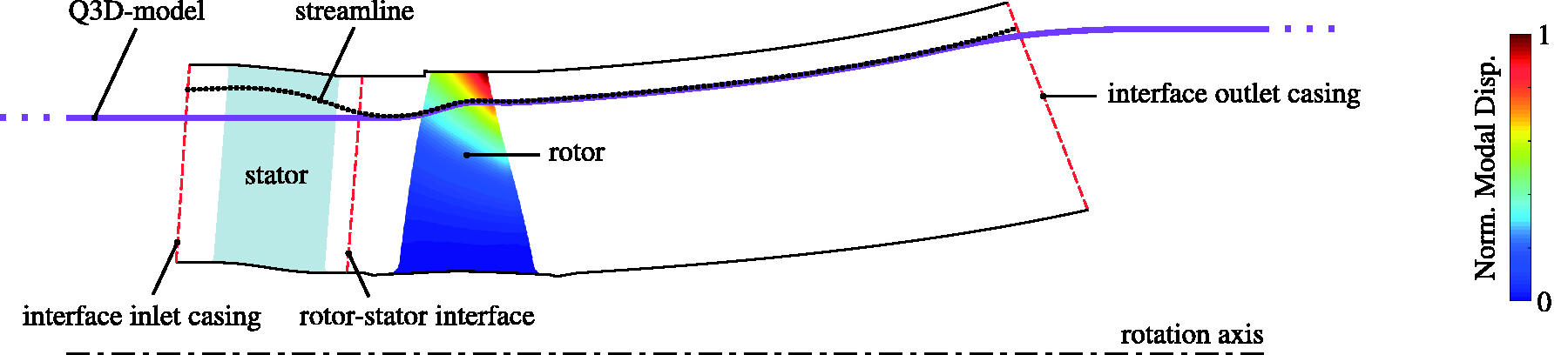
Reflection behavior of implemented far-field boundary conditions
The first part of this study covers the investigation of the reflective behavior of different inlet and outlet far-field boundary conditions implemented in the CFD solver.
Numerical model
A quasi three-dimensional (Q3D) isolated rotor model with prescribed blade vibration according to the first blade bending mode is applied for assessing the reflective behavior of different far-field boundary conditions, as shown in Figure 2. The corresponding slice model represents the mean flow path of a fluid particle at a spanwise position of 85% span for the given operational conditions and is derived by averaging the velocity distribution obtained from a previous 3D steady-state stage calculation in circumferential direction, as outlined in Mueller et al. 16 This modeling strategy ensures the following relevant prerequisites:
First, considering free-slip end walls and neglecting the flow variation in radial direction, slice models in general allow the realization of vast domain extensions at constant radii, while at the same time preserving the steady flow aerodynamics. In the present study, this property is utilized to allow capturing both the emitted and reflected disturbances over a substantial section in the inlet and outlet far-field in order to quantify the reflective behavior of different boundary conditions. For this reason, the investigated isolated rotor model features an inlet and outlet domain extension of approximately 30 axial chord lengths.
Second, the insignificant radial extent of this slice model corresponding to 0.5% of the blade height prevents the applied far-field boundary conditions in their ability to partially compensate impinging perturbations by altering the imposed conservation variables in the radial direction, which allows determining the actual local reflection characteristic of different boundary conditions in this study.
With the aim of investigating the reflective behavior of inlet and outlet far-field boundary conditions separately from each other in order to avoid any mutual interference of their induced spurious reflections and a falsification of the derived reflection characteristics, the strategy of changing the acoustic state of the vibration-induced acoustic traveling wave mode is pursued. This enables the generation of significant perturbations impinging on the applied boundary conditions in one far-field, while at the same time minimizing perturbations in the opposite far-field. Following an analytical approach as proposed by Ghiladi
17
and Lohmann,
18
Figure 3
Acoustic modal analysis of Q3D-model.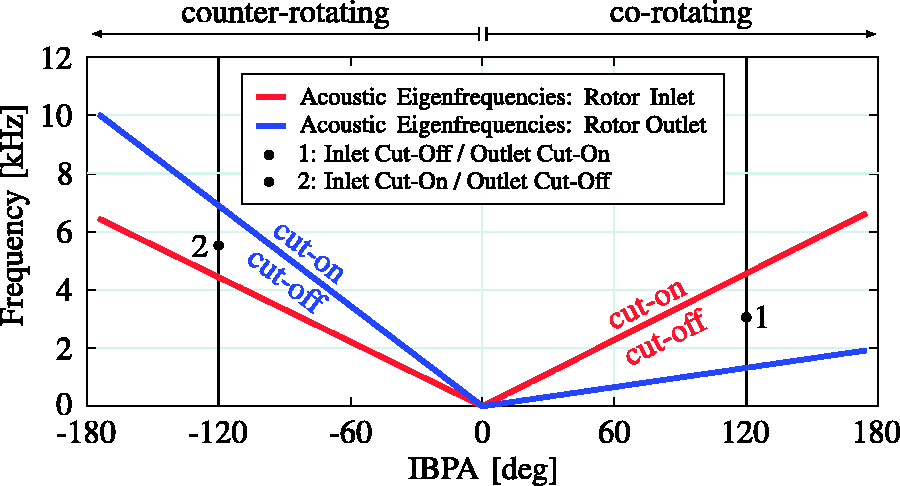
Evaluation methodology
Given the fact that evaluating the harmonic blade surface pressure is the primary objective in most aeromechanical investigations, the reflective behavior of boundary conditions is assessed in representative manner by evaluating the associated perturbations in the static pressure field. For this purpose, the induced reflected acoustic wave is extracted from the resultant harmonic flow field to allow for a quantitative characterization of the reflective behavior by introducing corresponding reflection coefficients:

According to equation (1), R is relating the reflected to the impinging perturbation amplitude at the spatial placement of the respective boundary condition, while Raaa is relating the corresponding mean perturbation amplitudes in the entire far-field. Since a linear superposition of different transient flow phenomena occurring at the same frequency was proven to be of sufficient validity in Mueller et al., 16 an extraction of the reflected (‘R’) harmonic pressure distribution is achieved by subtracting the vibration-induced emitted (‘E’) harmonic pressure distribution in the frequency domain from the resultant superimposed (‘S’) harmonic pressure distribution, as shown in equation (1).
Mesh inflation treatment
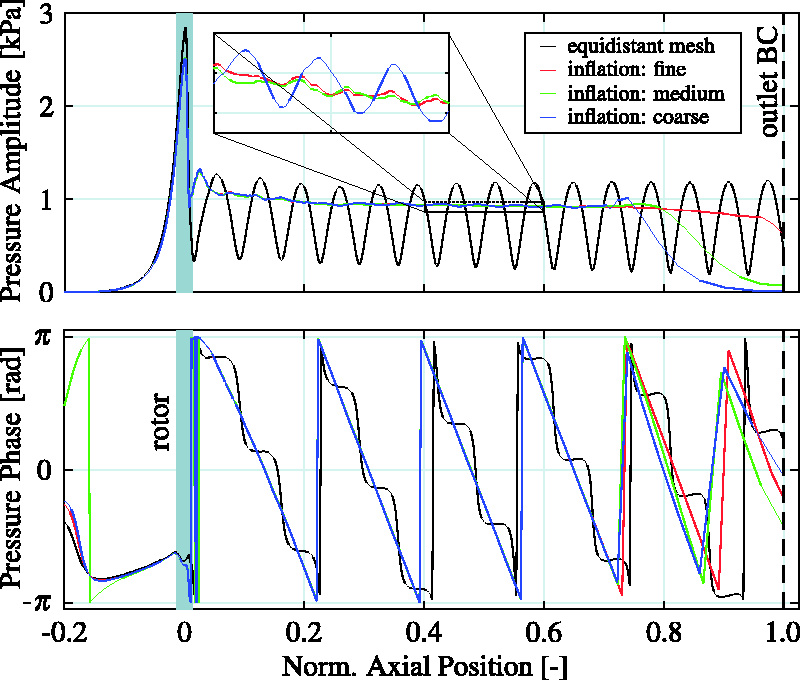
An intentional mesh coarsening in the meridional direction, hereinafter referred to as mesh inflation, is applied to the inlet and outlet domain extensions of the Q3D-model to reliably avoid spurious reflections from entering the calculation domain of interest, and thus to allow an exclusive prediction of the emitted harmonic pressure distribution for both investigated traveling wave modes.
The suitability of this concept is validated by means of a parametric study considering different degrees of mesh inflation for the outlet domain extension. Figure 4
Momentary pressure variation in outlet domain for different levels of mesh inflation.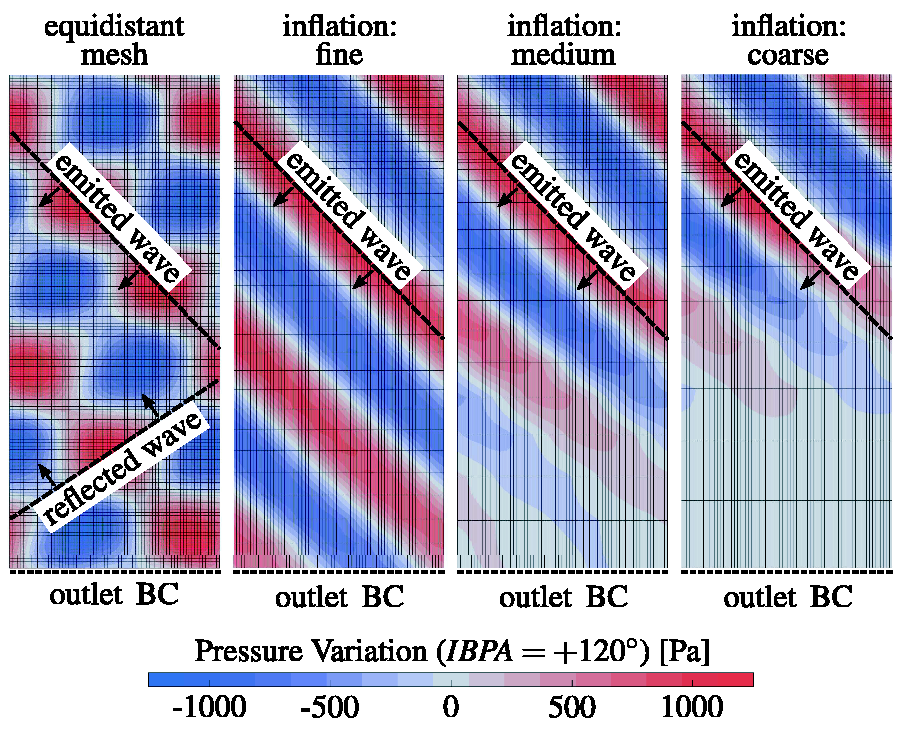
According to Figure 5
Numerical models and emitted pressure variation for traveling wave modes of Numerical models and emitted pressure variation for traveling wave modes of 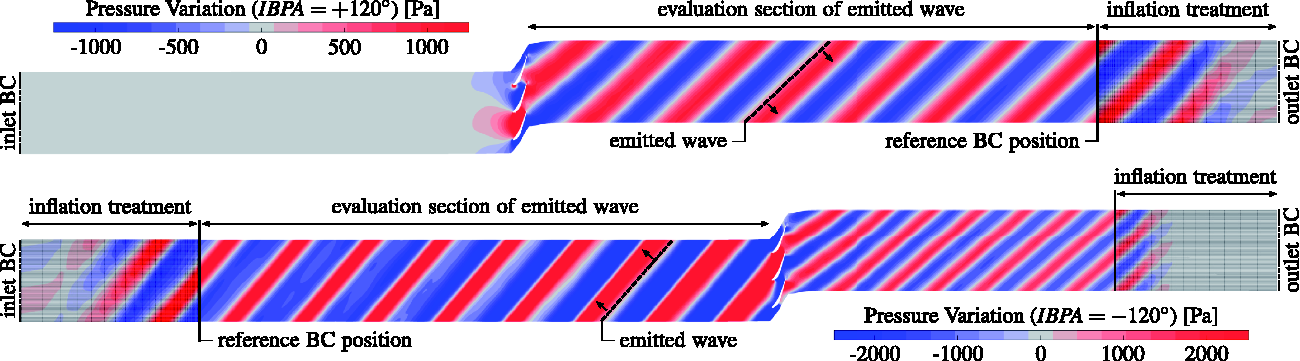
Expectedly, the emitted acoustic wave for the prescribed co-rotating traveling wave mode of
Investigation of boundary conditions
Far-field boundary conditions are prone to cause spurious reflections, as they constrain the flow field in contradiction to its physical nature. In this context, one of the most severe constraints within unsteady CFD calculations is the specification of time-independent far-field boundary conditions. Despite being common practice, a sufficient decay of the unsteady flow phenomena is not achieved for most truncated computational domains or rather might never be achieved, such as in the presence of an acoustic cut-on state.
The reflective behavior of different boundary conditions in general proves to be dependent on their degree of constraint, such that boundary conditions imposing a specific conservation variable are found to be most reflective. Others imposing a composed flow variable, such as the total pressure, enable a certain variation among the individual inter-dependent flow quantities and thus feature a minor reflective behavior. Similarly, the specification of an average static pressure boundary condition proves to be less reflective, allowing for a partial adaption of the boundary condition to the local flow conditions by enabling a certain spatial variation of the imposed local static pressure, while at the same time preserving its mean value. A massflow boundary condition is, in general, characterized by the least spurious reflections, enabling both a variation among the individual inter-dependent flow quantities, as well as a spatial variation of the imposed local massflux. Inlet massflow boundary conditions feature an increased reflective behavior compared to outlet massflow boundary conditions, since an additional specification of the flow direction is required.
Applying the aforementioned evaluation methodology, Figures 7
Reflected harmonic pressure amplitude distribution for different outlet boundary conditions. Reflected harmonic pressure amplitude distribution for different inlet boundary conditions. Reflection coefficients for different investigated inlet and outlet boundary conditions.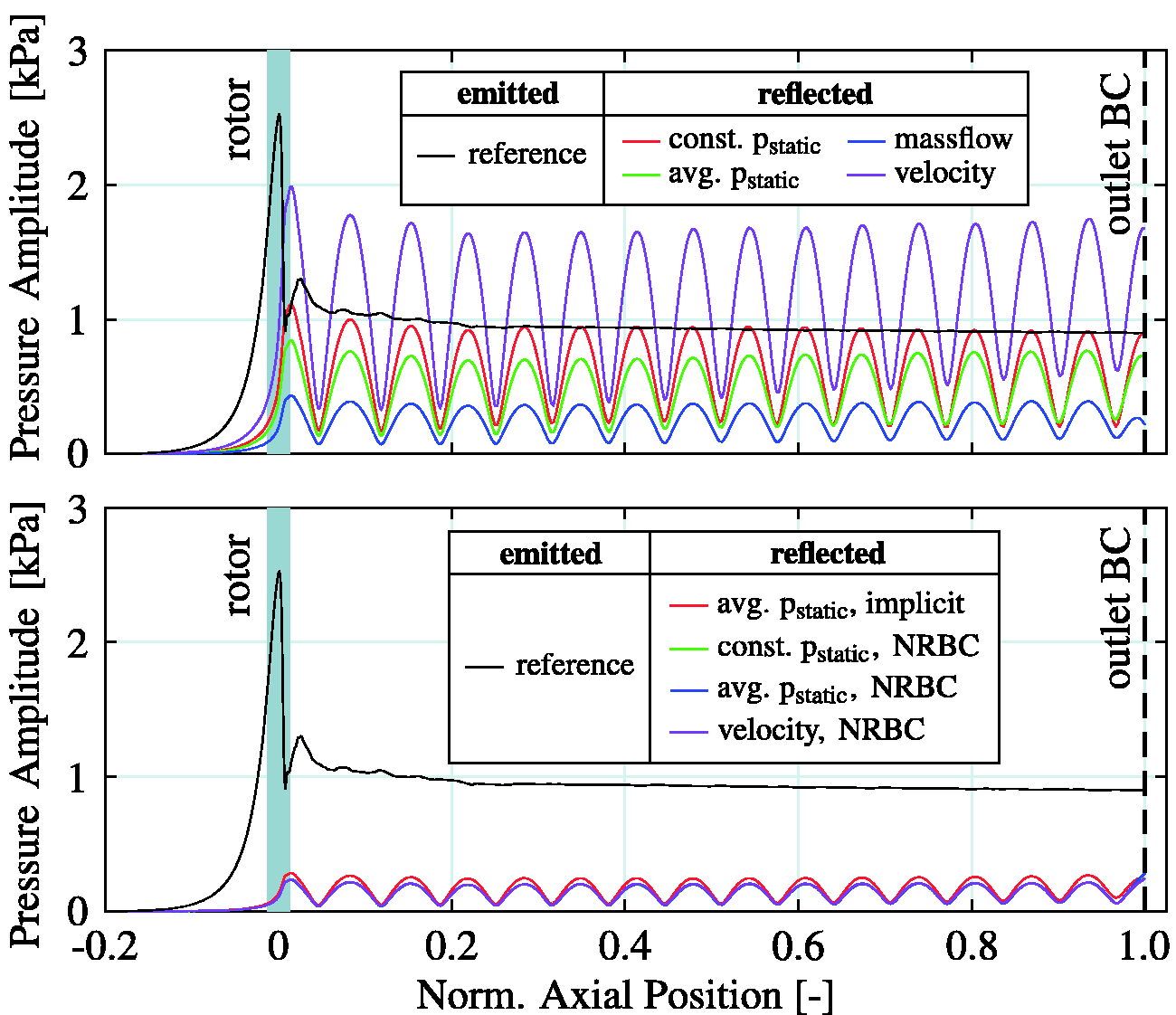
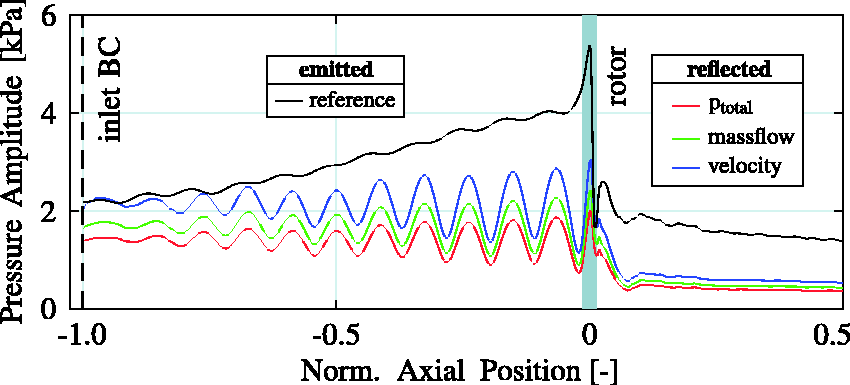
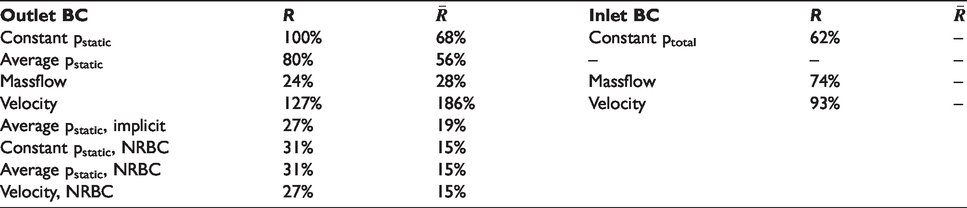
The obtained results suggest that none of the investigated conventional inlet and outlet far-field boundary conditions feature a reflective behavior of tolerable magnitude in the representative test case being considered. In particular, imposing the flow velocity distribution as an outlet boundary condition, the existing reflections at both ends of the outlet section lead to a gradual amplification of the developing acoustic interference pattern, as expressed by a resultant reflection coefficient greater than one. A significant reduction of the reflective behavior is found for the investigated fully implicit treatment of the average static pressure boundary condition, as preventing a lagging of the imposed local static pressure.
The commercial CFD solver ANSYS CFX provides non-reflecting boundary conditions (NRBC) implemented as beta feature. These boundary conditions are based on the Navier-Stokes Characteristic Boundary Condition (NSCBC) approach, applying a modified version of the Euler equations according to Thompson 2 to derive the Locally One-Dimensional Inviscid (LODI) 3 characteristic wave relations by means of a characteristic analysis. However, as it necessitates the negligence of transverse terms, the aforementioned approach proves to be intrinsically one-dimensional, which severely limits the general applicability and efficacy of the derived characteristic boundary conditions to impinging acoustic waves of arbitrary inclination angle.
A fully non-reflecting characteristic outlet boundary condition implies an amplitude of zero for the characteristic acoustic wave entering the computational domain, but prevents the far-field information from propagating into the interior. This results in an ill-posed problem and will cause a drift of the local flow conditions compared to the ones imposed at the respective boundary condition. For this reason, a linear relaxation approach according to equation (2) is introduced,
5
,
21
which specifies the ingoing characteristic wave’s amplitude Lingoing, i.e. the reflection coefficient of the respective boundary condition, proportional to the actual static pressure drift by considering a relaxation factor K. An appropriate selection of K enables a trade-off between the reflective behavior of a characteristic boundary condition and its capability to enforce the imposed reference flow conditions.
22

Applying the solver-specific default value for K, Figure 7 and Table 1 provide the results for different investigated outlet NRBC implemented as beta feature, where an almost identical reflective behavior is found. This property is to be attributed to the fact that for any type of NRBC the applied CFD solver solely exploits the static pressure based on the aforementioned NSCBC approach, while the remaining variables are closed implicitly.
21
For this reason, a subsequent parametric study of the relaxation factor K is exclusively conducted for a constant static pressure NRBC, as shown in Figure 9
Reflection coefficients of implemented NRBC for different relaxation factors K.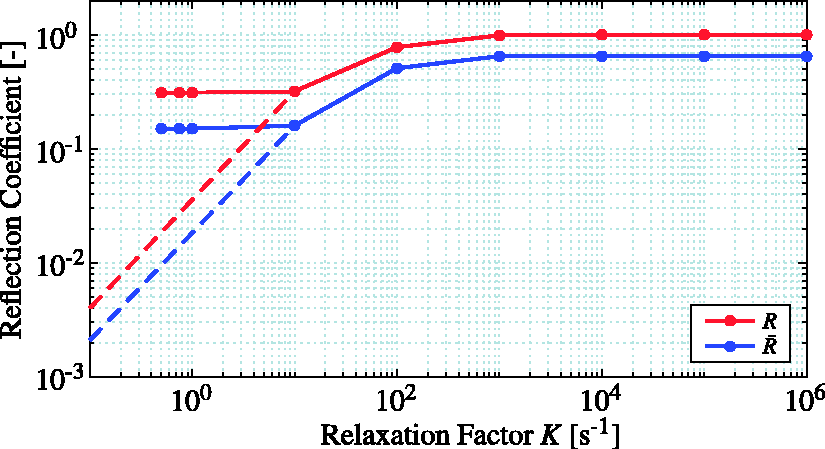
Zonal treatment approach
The following second part of this study covers the proposed zonal treatment approach as well as its application to a representative three-dimensional isolated rotor model with prescribed blade vibration. Furthermore, a case study considering calculation domains of different spatial extent and different treatments of their respective far-fields is conducted.
Problem statement and solution approach
Given the fact that the reflective behavior of conventional far-field boundary conditions and implemented NRBCs was found to be inadequate for the simulation of unsteady flows featuring pronounced flow perturbations at their respective spatial placement, the strategy of eliminating impinging and reflected perturbations within a domain zone located between the calculation domain of interest and the spatial placement of the respective far-field boundary conditions is pursued. For this purpose, a modification of the governing Navier-Stokes equations according to Freund 23 is introduced within the respective domain zones, considering an additional damping and convective term in each of the corresponding conservation equations. A linear relaxation approach is applied to dampen unsteady flow perturbations by driving the flow field towards a quiescent reference target state. By imposing an artificial convection velocity the characteristic propagation speed of the respective perturbations can be altered to influence the effectiveness of the aforementioned damping strategy.
The need to consider sufficiently large domain zones for an adequate zonal treatment of the inlet and outlet far-field requires, in most application cases, an artificial extension of the truncated reference calculation domain. This in turn necessitates a specification of the corresponding far-field boundary conditions at a different spatial location. Thus, in order to ensure the desired flow conditions in the reference calculation domain, it requires either their iterative adjustment to account for the changing flow field within the artificial domain extensions, or applying a measure to preserve the imposed flow conditions along domain extensions of arbitrary extent.
This study intends to utilize the linear relaxation terms considered in the zonal treatment approach proposed by Freund
23
not only to dampen unsteady flow perturbations by driving the flow field towards a quiescent reference target state, but also to utilize the respective source terms considered in each of the conservation equations to preserve specific steady-state reference flow conditions along domain extensions of arbitrary extent. According to equations (3) to (5), a decoupling of the individual conservation variables within the linear relaxation terms is introduced for this purpose. This allows for a separate imposition of the reference flow conditions to each of the conservation variables by selecting adequate relaxation factors.



Consequently, imposing specific steady-state reference flow conditions while avoiding spurious reflections from entering the computational domain of interest, the zonal treatment applied to the inlet and outlet far-field can be interpreted as a type of gradual, spatially distributed non-reflecting boundary condition. As all conservation variables are already imposed within the respective zonal domains, the actual far-field boundary conditions specified at the inlet and outlet of the computational domain solely serve numerical purposes. However, by constraining both the steady-state as well as the unsteady flow field to a certain degree, this zonal treatment approach proves to be intrinsically reflective. The applied strategy for achieving a sufficient non-reflective behavior is twofold: Considering an appropriate blending function which allows imposing the corresponding zonal treatment in a gradual manner, in turn reducing spurious reflections significantly. Additionally, induced spurious perturbations are directly absorbed in the respective zonal domains, allowing for a further reduction of the reflection coefficient.
Adjustment strategy of parameter set
According to the aforementioned solution approach, the linear relaxation terms considered in each of the conservation equations serve multiple purposes. For this reason, their respective effects on the steady-state flow field, e.g. the preservation of specific reference flow conditions, and on the unsteady flow-field, e.g. the absorption of unsteady flow perturbations, can not be segregated, but rather prove to be interlinked, thus necessitating an appropriate adjustment of the parameter set.
First, an iterative adjustment of the relaxation factors by means of a steady-state CFD computation is carried out to tune the respective source terms within the individual conservation equations as small as possible, but as large as necessary, to sufficiently impose the steady-state reference flow conditions within the zonal domains. Given the aforementioned interdependence, this chosen set of relaxation factors furthermore determines the absorption level of unsteady flow perturbations, which proves to be proportional to the degree of relaxation.
Second, since the required absorption level essentially depends on the spatial extent of the respective zonal domain, the actual absorption level is tuned by adjusting the absorption effectiveness within the individual zonal domains. This is achieved by imposing an appropriate artificial convection velocity to the unsteady flow perturbations, allowing an influence of their characteristic propagation speed and thus artificially extending their residence time in the corresponding regions of zonal treatment. For this purpose, only the fluctuating component of the individual conservation variables, being defined as the deviation of the instantaneous flow field from its specified quiescent reference target state, is accounted for in each of the convective terms, as shown in equations (3) to (5). This in turn implies that remaining deviations of the local steady-state flow state compared to its specified quiescent reference target state are treated in the similar fashion, as being considered as time-invariant fluctuations. For this reason, an outwardly oriented artificial convection velocity is imposed which avoids these induced artificial perturbations entering the computational domain of interest and instead ensures their absorption within the respective zonal domains.
Numerical models
With the aim of investigating the influence of changes in the steady flow aerodynamics being caused by artificial domain extensions as well as the influence of spurious reflections at the far-field boundary conditions on the predicted aerodynamic damping, the following isolated rotor models are investigated in the scope of this study, as shown in Figure 10
Overview of numerical models and different far-field treatment. a) A highly truncated computational domain, with imposed conventional far-field boundary conditions. b) An artificial domain extension at the inlet, with zonal treatment of the inlet and outlet far-field. c) An artificial domain extension at the inlet featuring a mesh inflation treatment, with imposed conventional far-field boundary condition at the inlet and zonal treatment of the outlet far-field.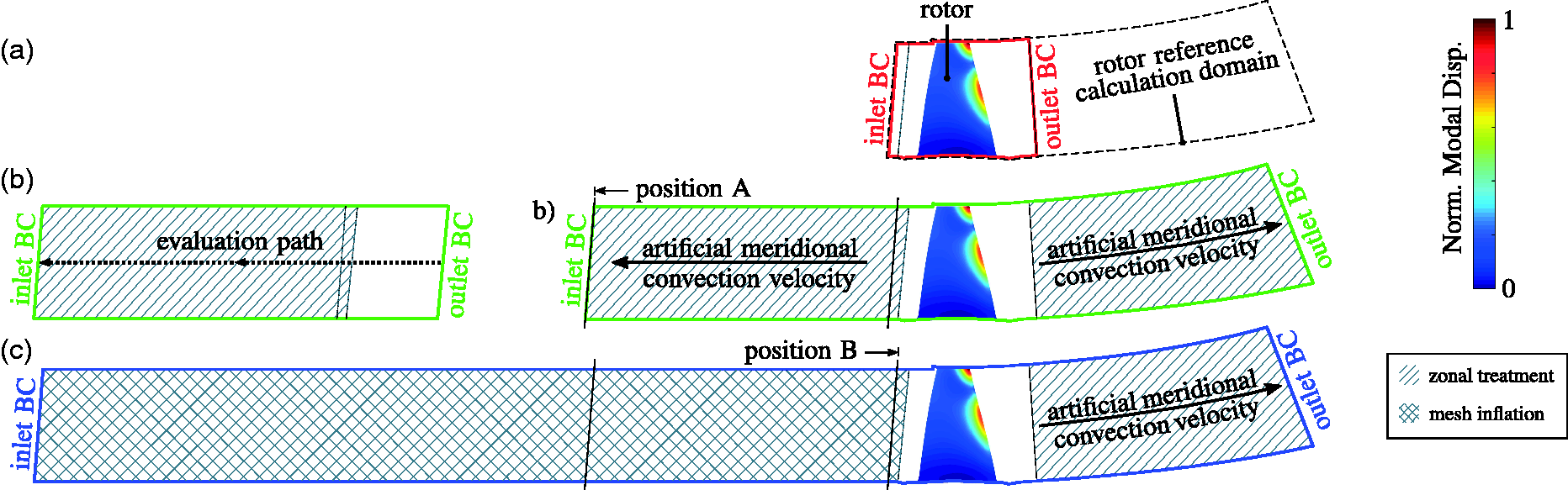
A blade vibration according to the fourth eigenmode at
Validation of suitability for preservation of reference flow conditions
The reference flow conditions for the rotor calculation domain illustrated in Figure 2 are derived from a previous 3D URANS calculation of the entire machine. For their further utilization as time-independent far-field boundary conditions as well as to specify a quiescent reference target state of the flow field within the zonal treatment approach, the respective time-mean flow field is considered, which is further averaged in the circumferential direction.
The given application case is characterized by a fundamental difference with regard to the zonal treatment of the inlet and outlet far-field. While the reference calculation domain is deemed to be of sufficient spatial extent at its outlet, thus allowing to realize the zonal domain for the treatment of the outlet far-field within the respective domain itself, an artificial domain extension is required at its inlet in order to ensure a zonal domain of sufficient spatial extent. Consequently, the flow field within the outlet far-field strives for its corresponding reference flow conditions in a natural way, while the ones within the inlet far-field need to be imposed artificially. In this context, the reference flow conditions for the inlet far-field, being derived at the inlet of the reference calculation domain, represent an equilibrium state of the flow field at the given spatial location and surrounding flow conditions. However, when being prescribed to the entire inlet domain extension, the resulting flow distribution does not represent such equilibrium state, thus requiring adequate source terms in order to achieve an artificial equilibrium state allowing for a preservation of these flow conditions along domain extensions of arbitrary spatial extent. Modeling the respective source terms by means of a linear relaxation approach, a self-adjusting mechanism is obtained.
Given the different requirements for the zonal treatment of the inlet and outlet far-field, a steep blending distribution is considered for the linear relaxation terms within the inlet far-field to sufficiently impose the reference flow conditions along the entire zonal domain, as shown in Figure 11
Blending distribution of linear relaxation and convective terms in inlet and outlet zonal domain.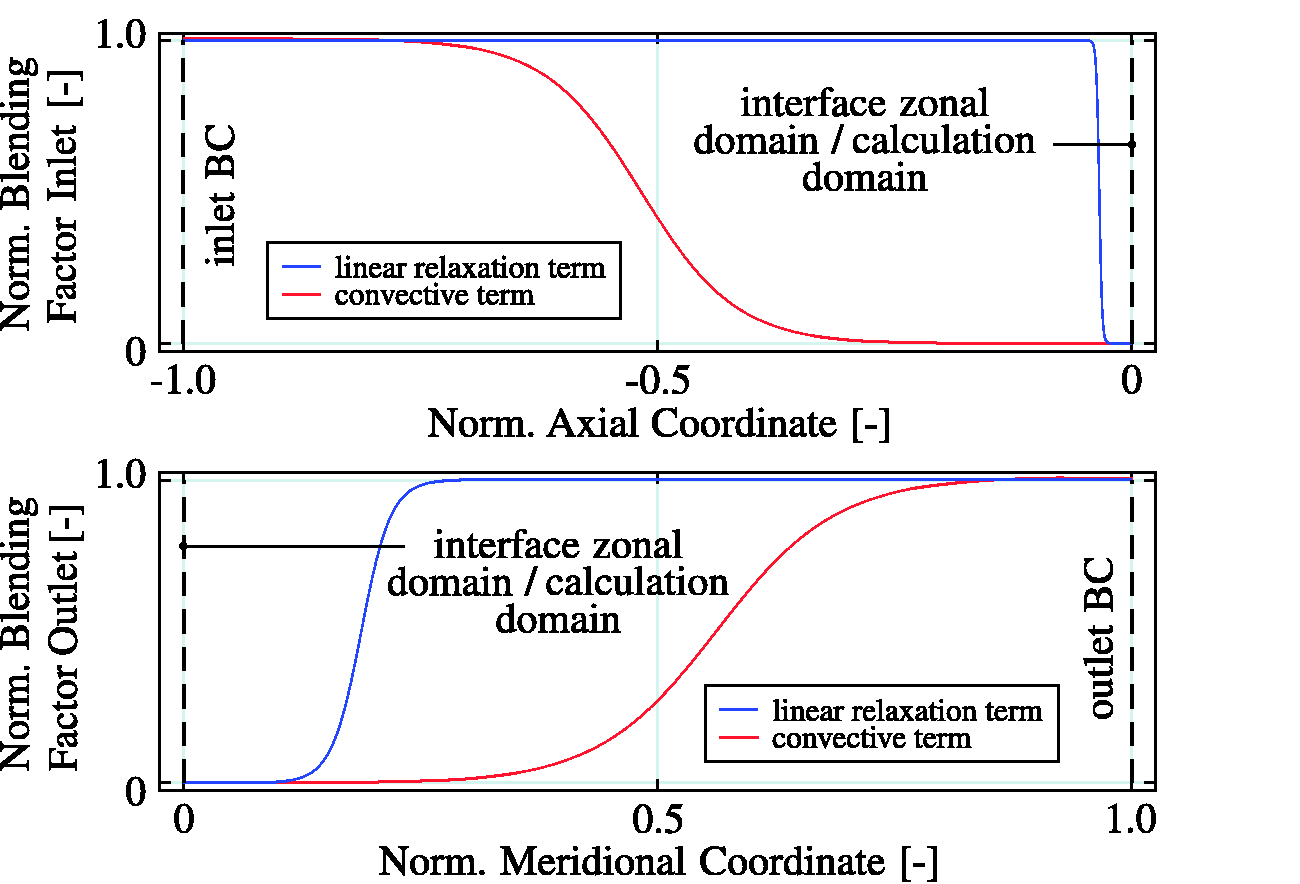
The radial distribution of selected conservation variables, averaged in circumferential direction, is depicted in Figure 12
Radial distribution of conservation variables for different investigated isolated rotor models.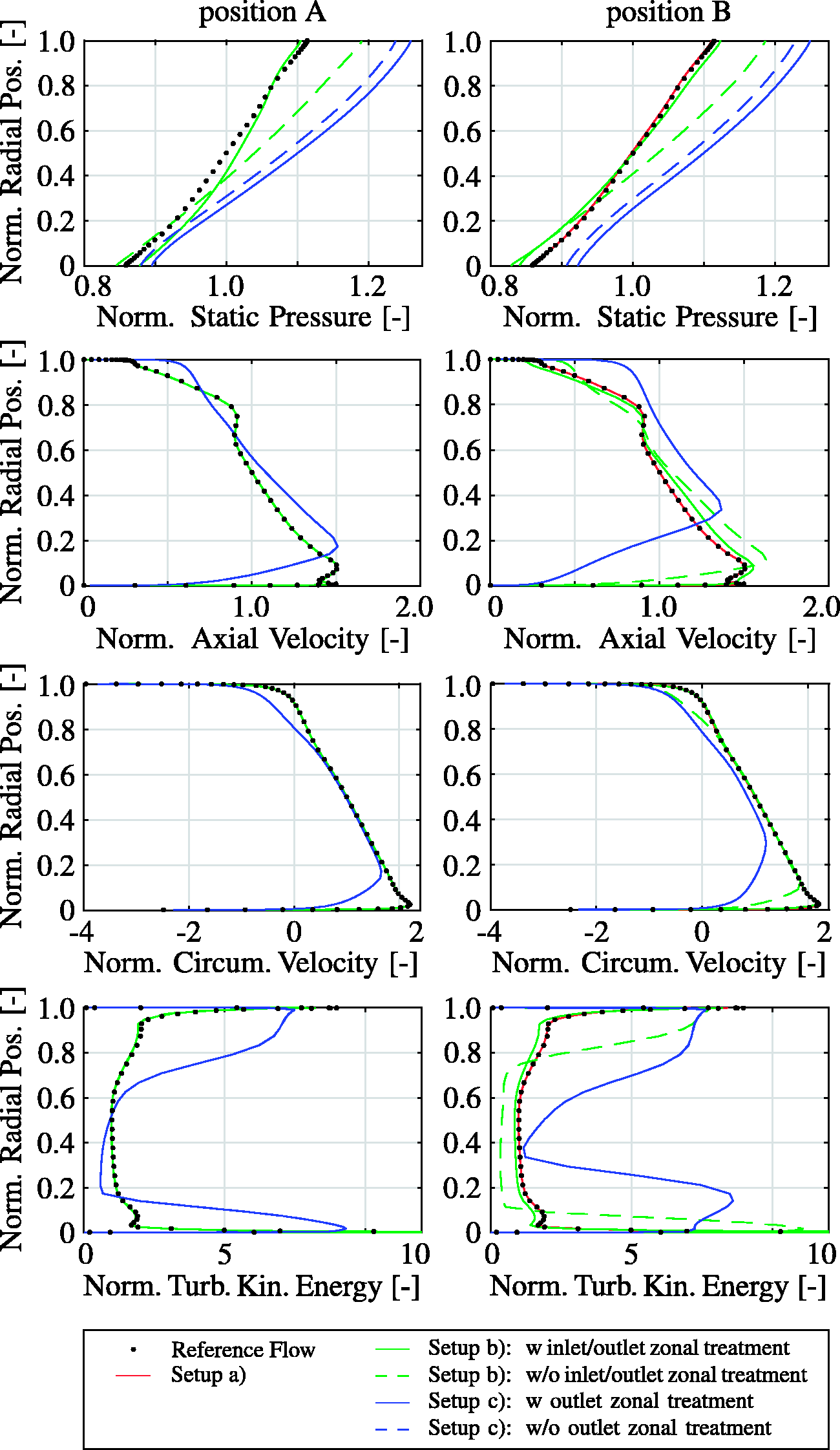
Validation of suitability for absorption of flow perturbations
The applied approach for absorbing unsteady flow perturbations within the zonal domains proves to be intrinsically reflective, constraining the unsteady flow field proportional to the degree of relaxation, as well as to the degree of the imposed artificial convection velocity, both determining the actual absorption level. Since the associated spurious reflections are primarily induced during the gradual imposition of the zonal treatment, the strategy of spatially shifting the corresponding blending distributions for the linear relaxation and convective terms is pursued, as shown in Figure 11. This allows for an absorption of the spurious reflections induced by the imposition of an artificial convection velocity within the zonal domain itself.
The zonal treatment of the inlet far-field requires both a steep blending distribution for the linear relaxation terms, as well as a high degree of relaxation to sufficiently impose the reference flow conditions along the entire zonal domain. Accordingly, this zonal domain is considered as a representative test case to assess the capability of the applied zonal approach of absorbing unsteady flow perturbations in relation to its inherent reflective behavior in an exemplary manner. For this purpose, a numerical setup referred to as b*) is considered, as shown in Figure 10. This setup comprises of the respective zonal domain, as well as an additional domain extension at its outlet to allow capturing spurious reflections over a substantial section before interacting with the applied outlet boundary condition. An initial impact-type pressure perturbation of 5000 Pa amplitude is imposed to the outlet boundary condition to induce a representative unsteady flow perturbation propagating throughout the investigated computational domain.
Both the absorption and reflection behaviors are evaluated by means of a space-time plot, as shown in Figure 13
Space-time plot of the pressure variation for different treatments of the zonal domain.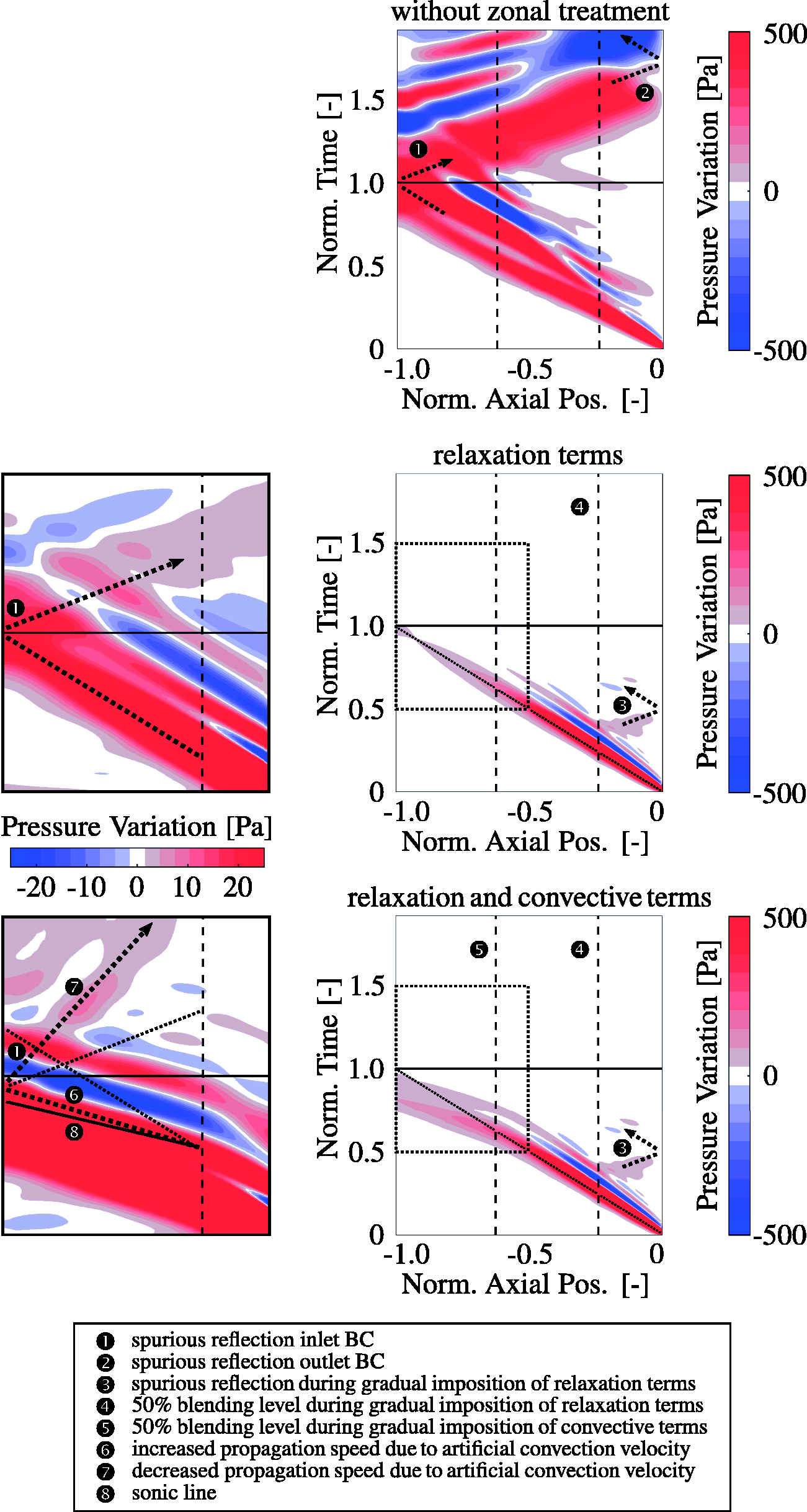
Compared to the reference case, where a zonal treatment of the inlet far-field is omitted, the applied linear relaxation terms prove their capability of absorbing flow perturbations reliably while propagation through the zonal domain. By imposing an additional outwardly oriented artificial convection velocity, the progression gradient of the respective pressure variations is found to change within the space-time plot, thus confirming the altered characteristic propagation speed of both the initial as well as reflected flow perturbations inside the zonal domain. The increased propagation speed of the initial flow perturbations while propagating towards the domain inlet lowers their degree of absorption, as reducing their residence time in the respective zonal domain. However, this strategy allows absorbing reflected flow perturbations more efficiently by significantly decreasing their corresponding propagation velocity, thus reliably preventing them from entering the computational domain of interest. The progression of an artificial supersonic flow state is outlined in Figure 13 and referred to as sonic line, theoretically allowing a deprivation of the reflected flow perturbation’s capability of entering the zonal domain entirely. However, as being prone to provoke numerical instabilities, such artificial supersonic flow was not further investigated in the scope of the present study.
The results depicted in Figure 13 suggest a marginal reflective behavior of the applied zonal treatment approach during the gradual imposition of the respective linear relaxation and convective terms. For the given application case, it is therefore concluded that the applied zonal treatment approach allows reliably absorbing unsteady flow perturbations within the far-field, while at the same time features a tolerable inherent reflective behavior characterized by reflection coefficients of below 2.5%.
Sensitivity of predicted aerodynamic damping
Figure 14
Time-mean and harmonic blade loading as well as predicted aerodynamic work per cycle for different numerical setups.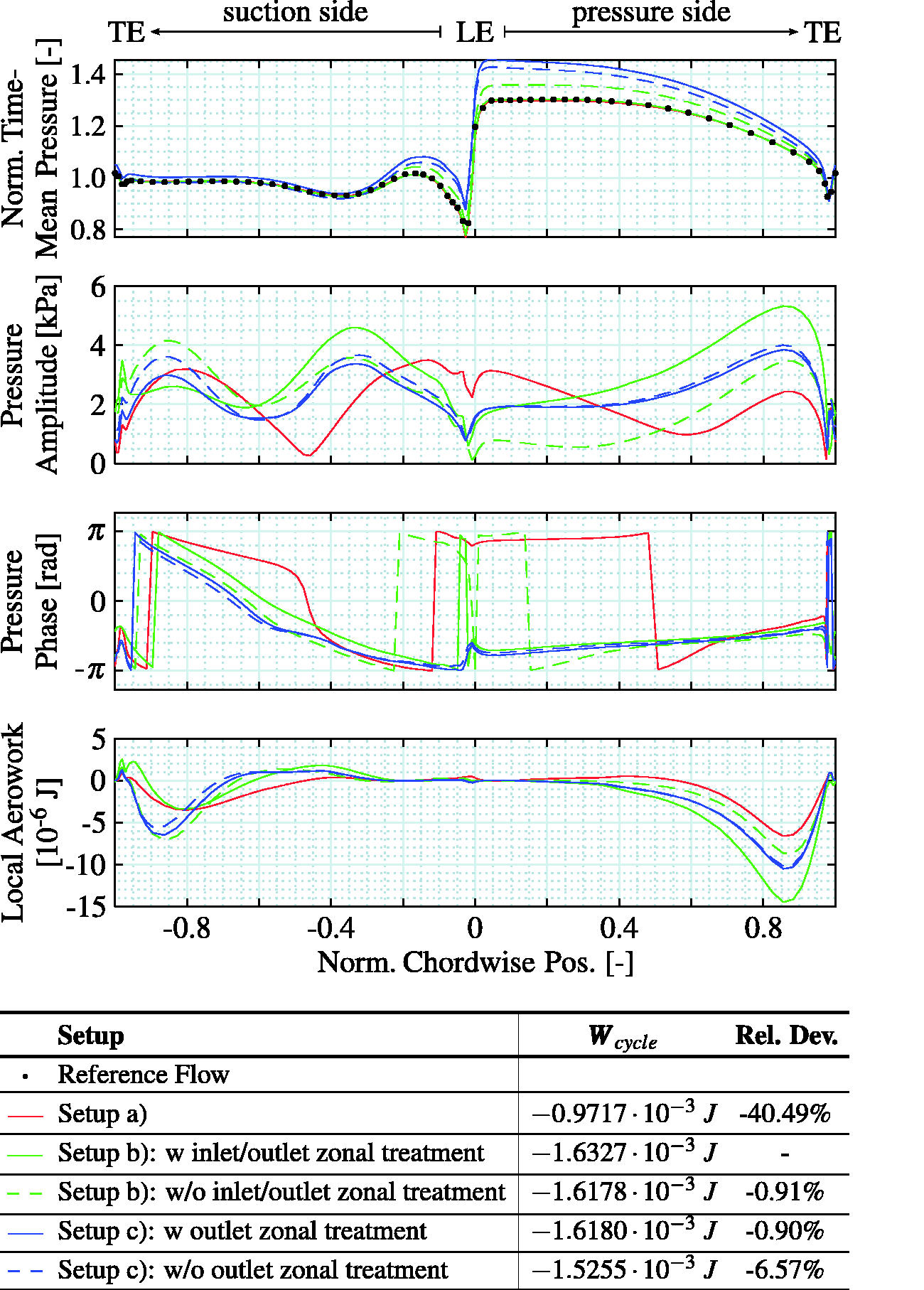
Taking into account a global evaluation criterion such as the overall aerodynamic work per cycle, existing local differences in the harmonic blade loading might mutually compensate each other with regard to their contribution to the resultant overall aerodynamic work per cycle. This is illustrated in an exemplary manner by means of the local aerodynamic work distribution at 50% span. For this reason, the predicted overall aerodynamic work per cycle provided in Figure 14 does not reflect the identified local changes of the unsteady flow field as expected. Accordingly, the relative deviation between the different investigated numerical setups is found to strongly depend on the considered modeshape and can not be generalized.
Conclusion
An isolated rotor model of an axial turbine stage with prescribed blade displacement was applied as a representative test case to investigate the reflective behavior of different conventional inlet and outlet far-field boundary conditions as well as available non-reflecting boundary conditions (NRBC) implemented in the commercial CFD solver ANSYS CFX. Their individual reflection characteristics were assessed by extracting the induced reflected acoustic wave from the resultant harmonic flow field and quantified by means of corresponding reflection coefficients, proving all conventional boundary conditions to be of inadequate reflective behavior for the simulation of unsteady flow featuring pronounced flow perturbations in the far-field, while the provided NRBCs were found to be limited to reflection coefficients of undesirable magnitude.
A zonal treatment approach for the inlet and outlet far-field based on a modification of the governing Navier-Stokes equations was presented and found to be capable for suppressing spurious reflections reliably, while at the same time allowing for a preservation of the reference flow conditions within the required domain extensions. This modeling strategy was successfully applied to the investigated test case within a case study considering calculation domains of different spatial extent and different treatments of their respective far-fields, which therefore allowed quantifying of both the influence of changes in the steady flow aerodynamics, as well as of spurious reflections at the far-field boundary conditions on the predicted aerodynamic damping in an exemplary manner. Since the influence of the associated changes in the steady flow aerodynamics caused by the different numerical setups was found to be moderate, whereas spurious reflections haven proven their capability of falsifying the unsteady flow field drastically, it is concluded that ensuring a sufficient non-reflective behavior is the primary objective with regard to the far-field treatment.
Footnotes
Declaration of Conflicting Interests
The author(s) declared no potential conflicts of interest with respect to the research, authorship, and/or publication of this article.
Funding
The author(s) disclosed receipt of the following financial support for the research, authorship, and/or publication of this article: This work was supported by ABB Schweiz AG, Turbocharging.
