




Abstract
We propose a parameter optimization method of multi-layer nested slit resonator (MNSR) for the converter transformer noise in a high voltage direct current (HVDC) converter station. With the optimization objective of achieving quasi-perfect sound absorption at the target frequencies and the structural parameters of MNSR as the optimization variables, the optimization model of the structural parameters of MNSR is established and then solved by the sequential quadratic programming algorithm (SQP). The theoretical and simulation results of the four validation cases show that the optimized MNSR can achieve quasi-perfect sound absorption at all target frequencies, which is consistent with the optimization objective. The parameter optimization design method provides an efficient method to design a dual-frequency quasi-perfect sound absorber for the converter transformer noise.
Keywords
Introduction
High voltage direct current (HVDC) transmission can achieve long-distance, high-capacity power transmission with low line losses, 1 and has been playing an important role in China’s west-east power transmission and power system networking projects. In particular, the converter transformer is a critical piece in the HVDC transmission, and its noise is a main noise source in the HVDC converter station, which has a great impact on the physical and mental health of substation employees and surrounding residents and becomes an urgent environmental problem to be solved.
The noise generated by converter transformers is dominated by low-frequency harmonics, 2 but traditional sound-absorbing materials, such as porous materials,3–5 have limited efficacy in controlling such low-frequency noise. Recent acoustic metasurfaces provide a promising solution for low frequency noise control.6–10 Broadband absorbers are an alternative, but multi-harmonic frequency absorbers could be a more tailored solution for the converter transformers. Duan et al. 11 designed a tunable multi-frequency absorber using the series connection of multilayer Helmholtz Resonators (HRs), achieving near-perfect acoustic absorption at 110 Hz and 392 Hz. Liu et al. 12 proposed a dual-band absorber with the series connection of HRs and then constructed a broadband absorber that achieved near-perfect continuous absorption within 380 Hz–3600 Hz. The aforementioned literature only utilizes the first-order acoustic cavity modes of the structures, while the multilayer nested slit resonant previously proposed by the authors utilized the first-two orders of acoustic cavity modes of the structure to achieve dual-frequency quasi-perfect acoustic absorption, 13 showing a good application prospect. However, the two frequencies affect each other, developing an efficient design approach to the structural parameters according to the target frequencies is a worthy research topic.
Currently, a number of researchers optimize the structural parameters of metasurface with the developed optimization algorithms to achieve the desired absorption coefficients at the target frequencies. Sun et al., 14 Ryoo et al., 15 and Romas et al. 16 solved the structural parameter optimization model with the sequential quadratic programming algorithm (SQP). Yan et al. 17 employed the particle swarm optimization algorithm to optimize the structural parameters of single-layer honeycomb microperforated plate to construct a broadband sound absorber, and the sound absorption coefficient is all above 0.85 within the range of 1000–3500 Hz. Li et al. 18 optimally designed a convoluted spatial structure based on the genetic algorithm, and can reach a normal incident average absorption coefficient of 0.80 at [342–2000] Hz. In this paper, the SQP algorithm with high computational efficiency and good convergence is chosen to optimize the structural parameters of multi-layer nested slit resonator (MNSR).
In this paper, the theoretical acoustic impedance model of MNSR is first established based on the transfer matrix method. Taking the quasi-perfect sound absorption at the target frequencies as objective and the structural parameters of MNSR as optimization variables, the structural parameter optimization model is established. The SQP algorithm is applied to solve the optimization model, and the accuracy of the optimization model is verified by the finite element method.
Theory and verification
Theory
Figure 1(a) illustrates the structure of the MNSR. Figure 1(b) shows the air domain of the MNSR, which is separated into multiple air passageways by the nested partitions and connected sequentially by the connecting slits. The transfer matrices of the connecting slits, air passageways, and inner cavity will be derived with the equivalent parameter of air. All connecting slits and air passageways are set to be of the same width to simplify the theoretical derivation. The schematic diagram of MNSR. (a) Structural unit, (b) air domain of MNSR.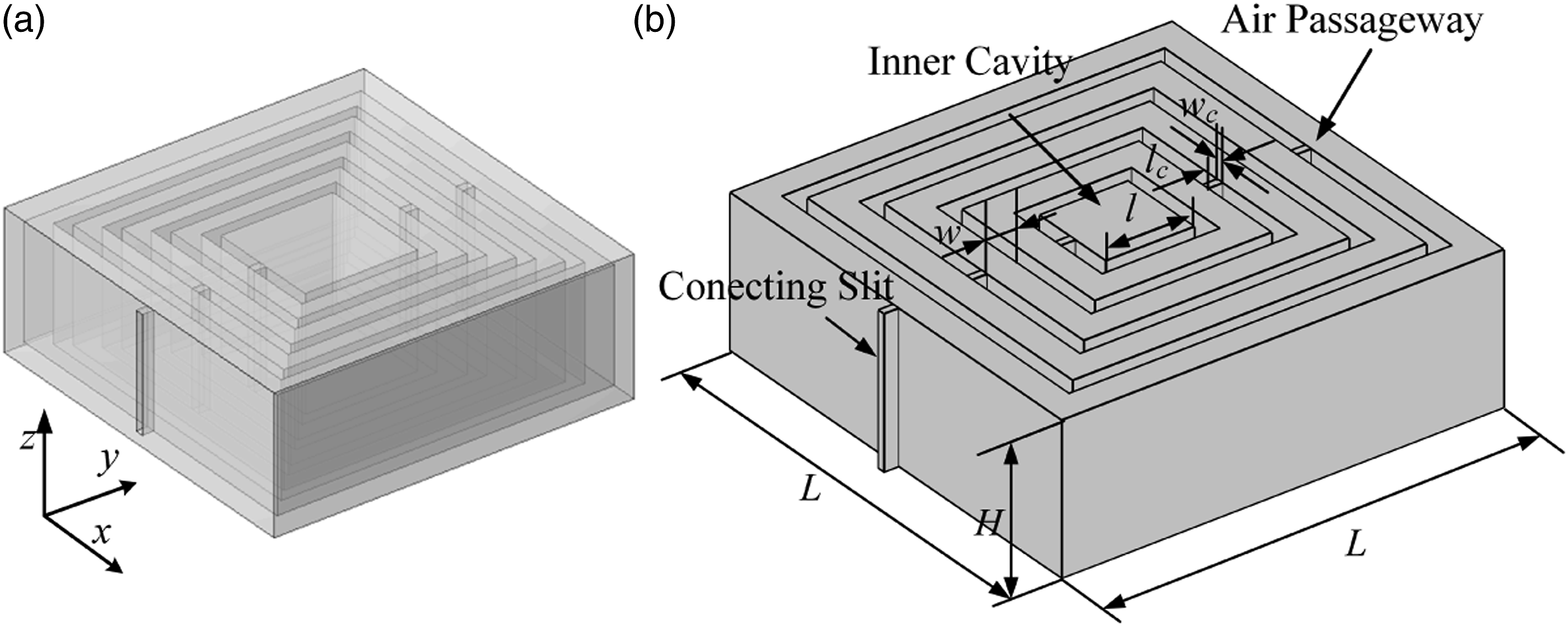
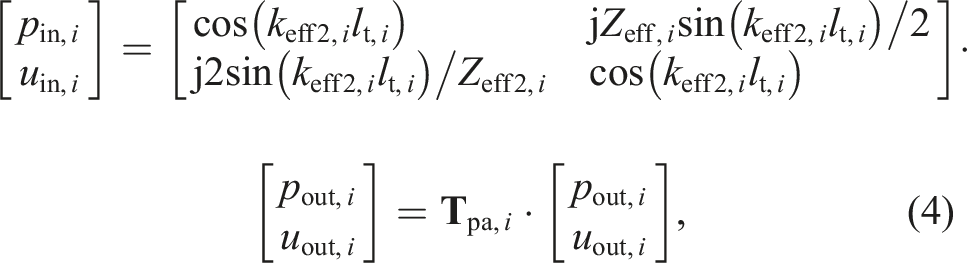
The transfer matrix



The transmission matrix of sound pressure and volume velocity of the incident sound from the left side (
The transfer matrix

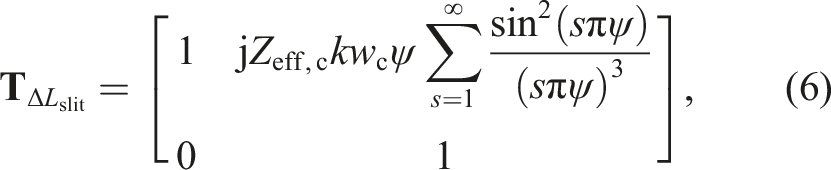
In addition, due to the section mutation between the outermost connecting slit and the air outside the metasurface, it should also include the correction transfer matrix
The transfer matrix


Dual-frequency quasi-perfect sound-absorbing metasurface with MNSR
According to the conclusion of the parametric analysis in the previous study,
13
the length and width of connecting slits and the width of the nested air passageways are taken as the optimization parameters (where
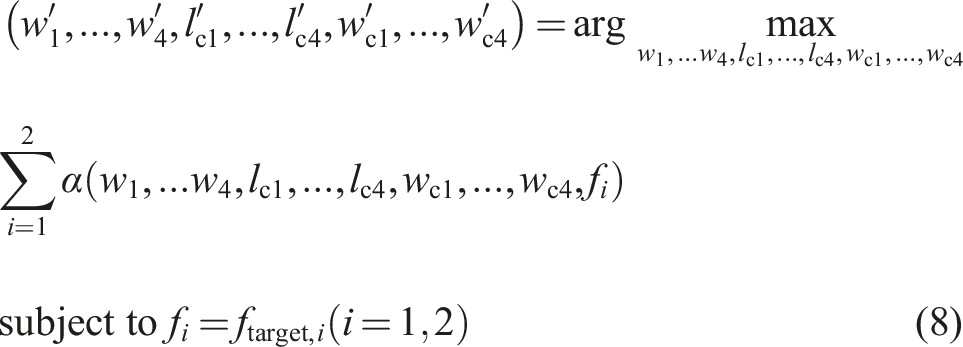
In this paper, the SQP algorithm is chosen to solve this optimization model for its good convergence, high computational efficiency, and powerful boundary search capability. Sequential quadratic programming algorithm converts the original problem into a series of quadratic programming problems, takes its optimal solution as the next search direction of the original problem, and then performs a constrained one-dimensional search for the objective function of the original constrained problem in that direction so that the approximate solution of the original constrained problem can be obtained. Repeating the above process, the optimal solution of the original problem can be obtained, and the specific algorithm flow is shown in the following Figure 2. The schematic diagram of SQP algorithm flow.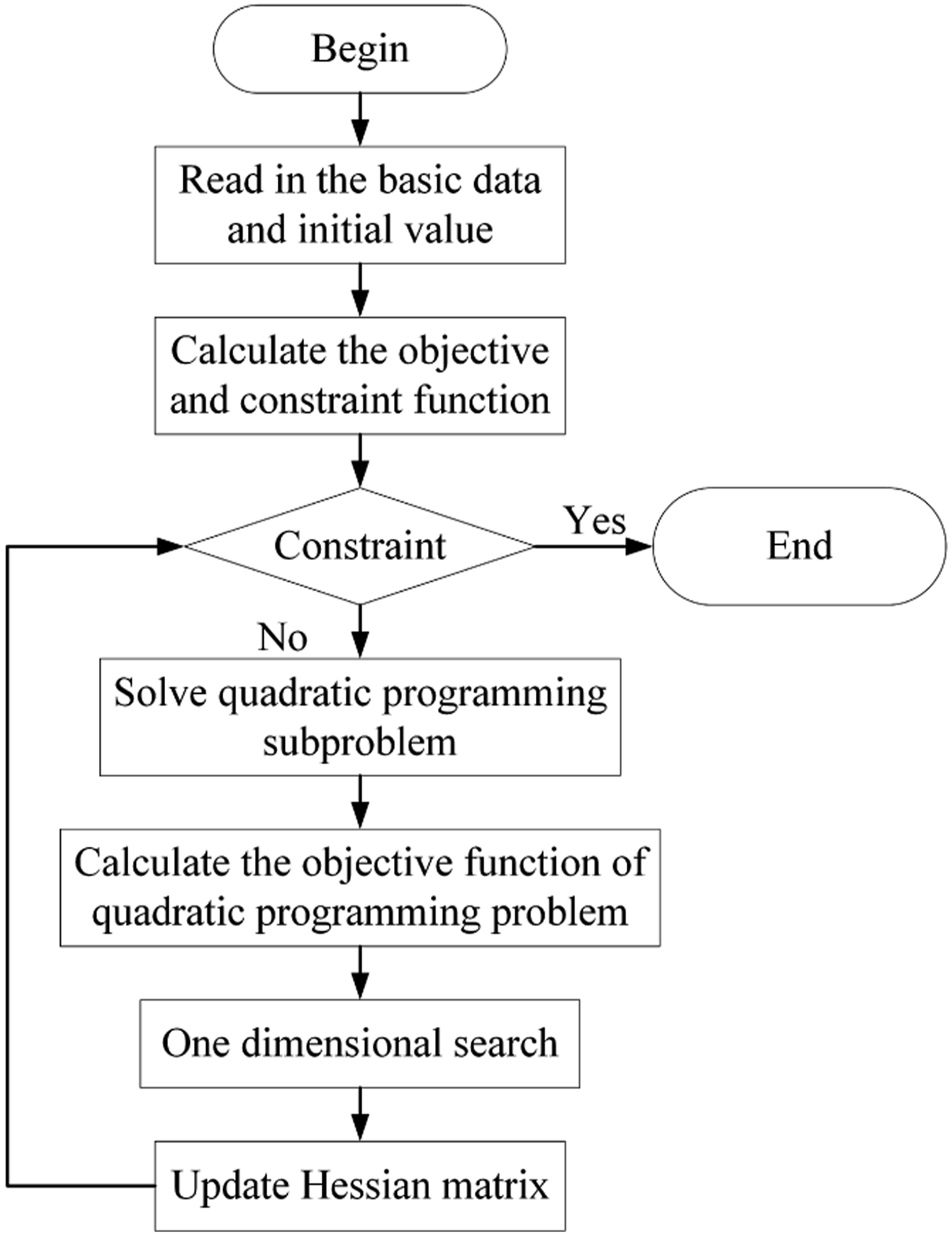
Optimal structural parameters of the cases (in mm).

The simulation validation of the optimized MNSRs is performed using COMSOL Multiphysics 6.1, which is based on the finite element method. The simulation model is modeled using the “Pressure Acoustics, Frequency Domain Interface”, which is used to compute the pressure variations for the propagation of acoustic waves in fluids at quiescent background conditions. The normal plane wave radiation is used to simulate sound sources in the range of 50–700 Hz with intervals of 1 Hz. Acoustic hard boundary conditions are applied at the walls of the structure. Narrow region acoustics are applied to the internal air domain of the MNSR to account for thermal viscosity losses. The free tetrahedral is used to mesh the simulation model. The maximum mesh size of the air domain inside the MNSR and the waveguide are 3 mm, and 5 mm respectively, which meets the accuracy requirement. The absorption coefficient is calculated according to the incident sound pressure and the reflected sound pressure.
The corresponding finite element simulation model is constructed based on the above structural parameters, and the simulation results and the theoretical results are shown in Figure 3 below. Sound absorption coefficient versus frequency for the following cases, (a) target frequencies of 200 and 350 Hz, (b) target frequencies of 200 and 400 Hz, (c) target frequencies of 200 and 450 Hz, (d) target frequencies of 200 and 500 Hz.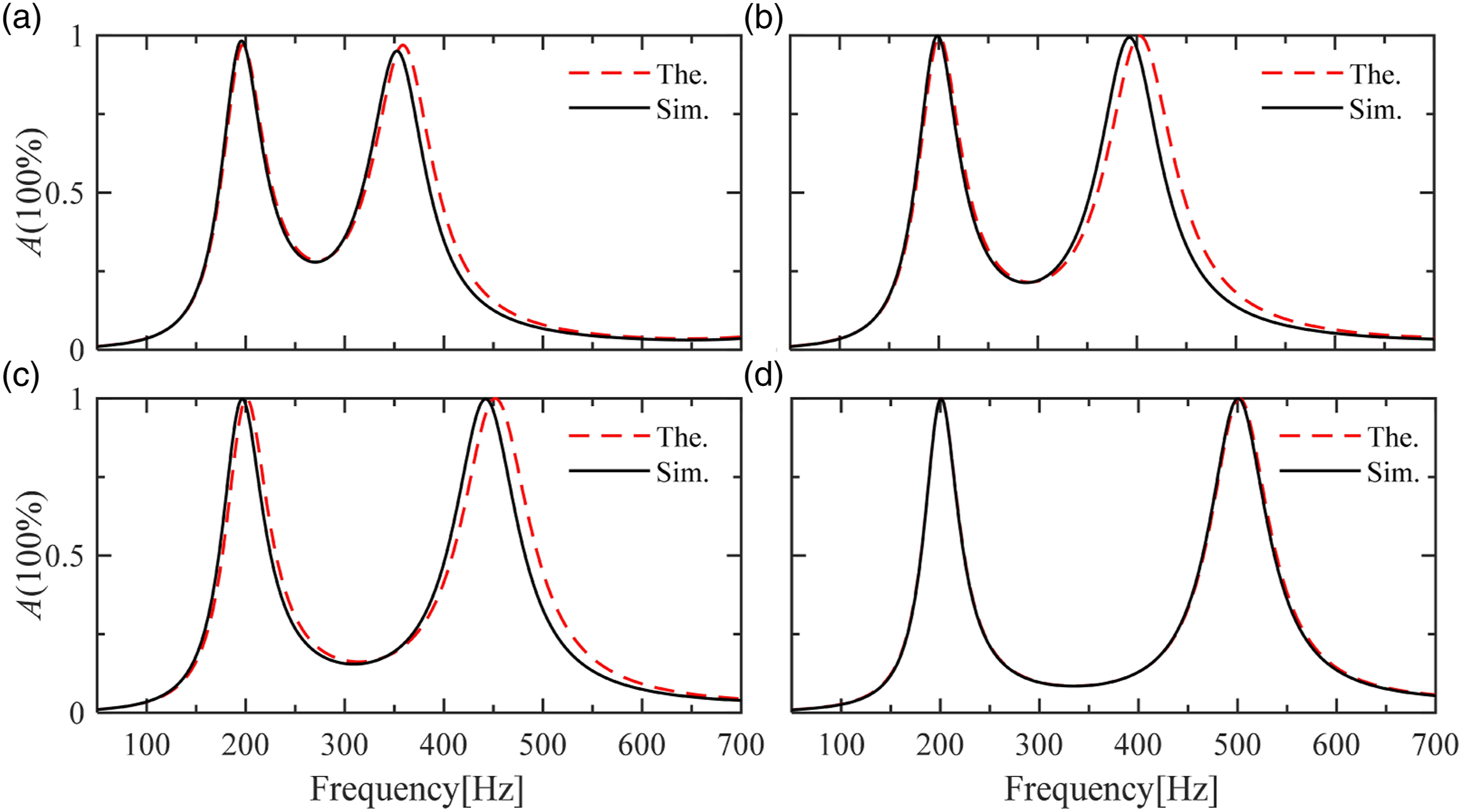
The simulation results of the MNSR with optimized structural parameters are shown in Figure 3. As can be seen from the above figures, the simulation results are well consistent with the theoretical calculation results, indicating that the developed theoretical model can accurately characterize the acoustic response of the MNSR. However, there is still a slight error between the theoretical results and the simulation results due to the fact that the theoretical model simplifies the propagation pattern of sound in the air domain inside the MNSR. Furthermore, the theoretical and simulated absorption coefficients at all preset frequencies are greater than 0.95, which is consistent with the expected results, indicating that the sound absorption performance optimization model of MNSR and its solution method are an effective method to design dual-frequency sound absorber for the converter transformers noise.
Figure 4 depicts the intensity map of the sound pressure of the four optimized MNSRs at resonance frequencies. The sound pressure distribution is denoted by the relative sound pressure The intensity map of the sound pressure of the four optimized MNSRs at their peak frequencies. (a) 200 Hz and (b) 350 Hz in Case1, (c) 200 Hz and (d) 400 Hz in Case2, (e) 200 Hz and (f) 450 Hz in Case3, (g) 200 Hz and (h) 500 Hz in Case4.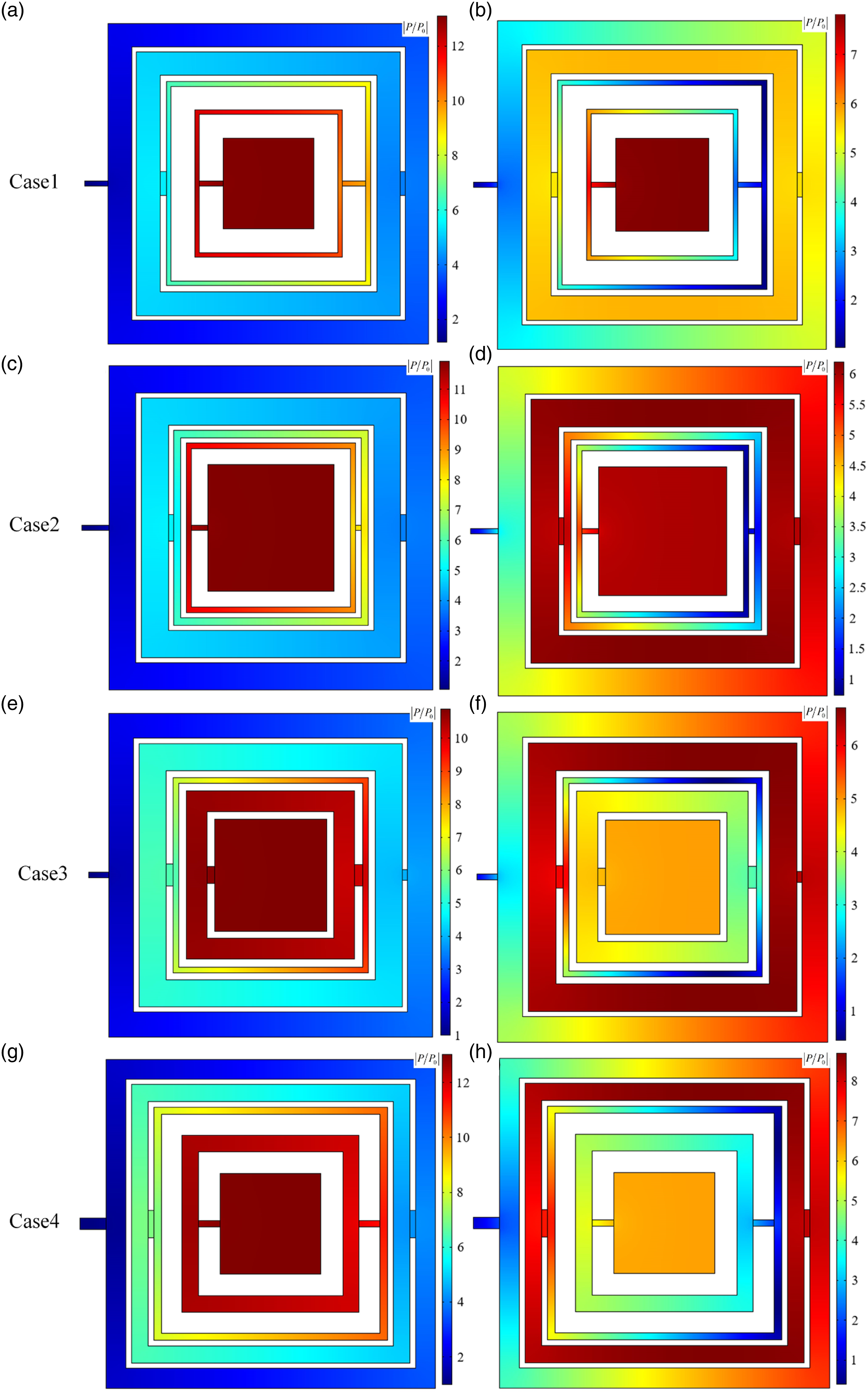
Conclusion
In this paper, a structural parameter optimization method of a dual-frequency quasi-perfect absorber based on MNSR is proposed for the low-frequency harmonic noise of converter transformers in the HVDC converter station. With the optimization objective of achieving quasi-perfect sound absorption at the target frequency and the structural parameters of MNSR as the optimization variables, the optimization model of the structural parameters of MNSR is established and then solved by the SQP algorithm. According to the noise characteristics of the converter transformer, four different cases are set up in this paper to verify the established parameter optimization model. The theoretical and simulation results of all four cases match well, and all achieve quasi-perfect sound absorption at the target frequencies. We hope that the structural parameter optimization method of MNSR can provide guidance for the noise control of converter transformers in HVDC converter stations.
Footnotes
Declaration of conflicting interests
The author(s) declared no potential conflicts of interest with respect to the research, authorship, and/or publication of this article.
Funding
The author(s) disclosed receipt of the following financial support for the research, authorship, and/or publication of this article: This project is supported by the Science and Technology Project of China Southern Power Grid (Grant No. GDKJXM20201968) and Graduate Research and Innovation Foundation of Chongqing, China (Grant No. CYB23019).
