



Abstract
This article examines Michel Ragon's Ma sœur aux yeux d’Asie (1982) to retrace the identity of his métisse, Franco-Cambodian half-sister, Odette Ragon, who occupies a central yet precarious place in the narrative. Drawing on interviews, notably with the author's wife Françoise Ragon, this study shows how Ragon's autofiction constructs largely fabricated versions of his father, his father's experiences in colonial Indochina, and his half-sister, whose voice is ventriloquized by the author-narrator. While the novel appears to grant Odette narrative visibility, it ultimately fails to render her as a decolonial subject, reinscribing the Orientalist and patriarchal dynamics it ostensibly critiques. To address this limitation, this article assembles a photographic counter-archive by reproducing previously unpublished images of Odette. These photographs both intersect with and exceed the novel's narrativized representations, restoring a material continuity to her life while exposing the limits of its fictional framework. By juxtaposing Odette's visual trace with her mediated narrative, this article invites readers to reimagine her as a historical subject beyond the representational confines of autofiction.
French-language novels depicting the experiences of Franco-Asian adolescents are uncommon. Unlike other francophone mixed-race narratives on Southeast Asia, including Bach Mai's D’Ivoire et d’opium (1985) and Kim Lefèvre's Métisse blanche (1989), Michel Ragon's Ma sœur aux yeux d’Asie (1982) presents a multi-layered narrative centered on a Franco-Indochinese métisse, her younger French half-brother, and their father. Known for his writings on family life in Vendée, Ragon has produced numerous works exploring the intersections of art, architecture, and urbanism. Perhaps, his most thematically distinctive novel, Ma sœur aux yeux d’Asie, oscillates between colonial Indochina and wartime France (1940–1943), unfolding largely in an epistolary structure. The narrative is composed primarily of letters allegedly penned by Ragon's father, Aristide, during his military service in Tonkin, Cochinchina, and Cambodia between 1909 and 1922. Ragon himself narrates the novel, framing his father's letters within a mise-en-abîme. 1 The story unfolds as a personal flashback in Fontenay-le-Comte (Vendée) during the summer of 1940 at the onset of the German occupation. By then, Aristide had already died, leaving behind a legacy that his children attempt to piece together. In this frame narrative, Michel, at sixteen, encounters his older Eurasian half-sister, Odette, at his aunt's house, where he spends the summer. Together, they reconstruct their father's harrowing experiences in colonial Southeast Asia. These revelations not only compel young Michel to confront hidden aspects of his family's history but also illuminate Odette's marginal position within both the Ragon family and wartime French society.
Little is known about Odette beyond what the novel reveals. Although the text suggests that she died of tuberculosis in 1943, the Ragon family retains no documented evidence of her death. In several interviews, Ragon offered insights into his father's military service in Indochina but avoided substantive discussion of his own relationship with Odette. Until 1940, she remained an elusive figure in his life, largely because his mother, Camille, prohibited Odette from living with her father and half-brother. Drawing on interviews with the author's wife, Françoise Ragon, and close readings of Ma sœur, this article examines the sources and inspirations through which Ragon constructs a largely imagined colonial Indochina to stage the identities of his father, “Aristide le Cochinchinois,” and his métisse half-sister, Odette. Because much of the novel draws not on his own family's correspondence but on archived letters from other families, both Aristide and Odette emerge as heavily fictionalized figures shaped by the author's inventive inclinations.
This article argues that while Ma sœur appears to grant Odette narrative visibility, it ultimately fails to construct her as a decolonial subject. Her voice remains mediated through Michel's autofictional narration, which reinscribes the colonial and patriarchal structures the text ostensibly critiques. In response, this study advances a decolonial intervention through the construction of a photographic counter-archive: by reintroducing Odette's unpublished images, it seeks not to resolve the tensions between fiction and history, but to expose their limits while restoring a measure of historical presence to a figure otherwise confined within the novel's representational framework. More broadly, this article contributes to ongoing discussions in French and Francophone studies concerning colonial memory, métissage, and Franco-Indochinese cultural formations. By foregrounding the relationship between photography and narrative construction, it also intervenes in visual–cultural debates on the archive, particularly as they relate to the ethical limits of representation and the recovery of marginalized historical subjects.
Despite its thematic richness, the novel has received remarkably little sustained scholarly attention, making it a particularly revealing site for examining the intersections of colonial memory, autofiction, and Franco-Asian identity. Scholars like Catherine Slawy-Sutton (2008: 21) and Thuong Vuong-Riddick (1992: 27) have commented on the novel's Orientalist and exoticist descriptions of Indochina in Aristide's letters. Although Ma sœur bears the markings of an Orientalist text, the novel moves beyond merely framing Odette as an object of Oriental fetishization to stage her as a vehicle for the narrator's own self-reckoning. Ragon's Ma sœur reveals the structural limits of its decolonial ambitions. Her voice, along with her racialized perspectives as a métisse, is subsumed under the authority of the white, male narrator, Michel, who speaks on her behalf rather than allowing her subjectivity to emerge on its own terms. Even in the novel's concluding section, “Le Calepin noir,” which grants Odette her most extensive narrative space, Michel ventriloquizes her voice in this purportedly self-authored section penned by Odette, ultimately reasserting his narrative control over the very perspective it appears to cede.
This article intervenes by assembling a counter-archive that restores visibility to the historical Odette through the reproduction of her unpublished photographs—images that symbolically revivify her and challenge the Orientalist, fictionalized frames through which the novel stages her. These photographs, withheld from public view until now with Françoise Ragon's permission, complicate the novel's representational project. Embedding authentic images of Odette within a narrative punctuated by Michel's and Aristide's Orientalist, objectifying depictions of Indochina would have risked conflating her with the negative ascriptions that describe her and the subjects of her Asian heritage. In this sense, the “lost” photographs remain irretrievable, preserving a critical separation between the historical Odette and the imagined métisse figure that the author constructs. This absence perpetuates Odette's effacement, leaving her presence mediated solely through the narrator's intervention and Ragon's autofictional framing.
As Ariane Kouroupakis and Laurence Werli (2008) observe, autofiction's recuperative power lies in its capacity to offer improbable yet subjectively meaningful representations: “[L]e sujet est […] en mesure de changer de peau et de restituer des représentations certes improbables de soi mais qui se rapprocherait plus de la vérité.” The autofictional genre thus generates a productive tension and aporia: it enables Ragon to confront his own experiences of loss and familial strife, though at the expense of Odette's subjectivity. She becomes not a historical subject in her own right but a figure through which the author's self-reflection is actualized. The novel's recuperative project remains fundamentally Ragon's own; it fails to present Odette as a truly decolonial figure capable of liberation on her own terms—a limitation that this article's counter-archive seeks to address.
However, as Roland Barthes (1980: 32) reminds readers, the photograph is always haunted by death, its eidos inseparable from loss and irretrievability. The Odette who emerges from this counter-archive remains paradoxically present and absent: alive in the reader's gaze yet inaccessible as a fully knowable subject. By juxtaposing Ragon's autofictional narrative with authentic visual traces of Odette's life, this article invites readers to reassemble a more complex, ethically attuned understanding of her subjectivity beyond the novel's representational, staged limitations. In confronting the novel's illusory decoloniality and Michel's interventionist presence, the photographic counter-archive disrupts the narrator's co-optation of Odette's voice and repositions her within history.
Reading autofiction and staged identities in Ma sœur
The novel's use of autofiction contrasts with Ragon's earlier work, L’accent de ma mère (1980), in which the author grounds his narrative in authentic family documents written by his mother. Although L’accent de ma mère offers insight into Ragon's family life, Odette never makes an entrance. Ragon deliberately published Ma sœur only after his mother's death in 1976, aware that she would have disapproved of his fictionalized portrayal of Aristide's experience in Indochina. In an interview with Michel Lambert (1984: 136), Ragon confirms the fictionalization of his father's letters appearing in Ma sœur: [J]e les ai entièrement inventées. […] [J]’ai dû tout imaginer. Je ne disposais d’aucune lettre significative de mon père ni de ma sœur. Je n’avais que la mémoire de cet homme qui est mort quand j’avais huit ans et de cette jeune fille [Odette] que je n’ai vraiment connue qu’à l’occasion des premiers mois de l’occupation allemande, alors qu’elle n’avait plus beaucoup de temps à vivre.
2
In the novel, Ragon's fictionalization of Aristide and Odette departs from strict referentiality, instead giving voice to their intertwined stories that cannot be read in isolation from one another. As Michel and Odette collaboratively reconstruct their father's life in Indochina as part of their summertime project, Odette simultaneously invents her own narrative through Ragon's authorial intervention. As Françoise Ragon (2023) recounts, just as Ragon drew on the colonial archive to construct Aristide's character, he also consulted the Villepinte Archives in search of information about Odette and her time at the Villepinte sanatorium, where she had lived and worked as a nurse's aide. Finding no trace of his sister in the records, Ragon was left with only his own fragmented memories of his half-sibling. Consequently, Odette's story remains unanchored to archival referentiality, effectively severing the historical Odette from the fictionalized character depicted in the novel. The narration also presents two versions of Ragon as author-narrator: the adult Michel, who reflects on his adolescence in Vendée, and the adolescent Michel, who first encounters Odette in 1940. At times, it becomes difficult to discern which voice is speaking, as the novel's flashbacks frequently superimpose the adult Michel's reflections onto his younger self, leaving certain memories of Odette indistinct and unresolved.
In this regard, Michel contends that his memories of his half-sister Odette, whom he claims to be four to five years his senior, remain faint as he shares, “Je cherchais à me souvenir d’Odette. Les images qui me parvenaient demeuraient floues” (Ragon, 1982: 20). 3 The novel introduces Odette during the summer months of July and August 1940 in Fontenay-le-Comte when Michel was sixteen. During this time, the department of Vendée underwent German occupation. Set against the backdrop of the military presence, Michel passes these months at Cousin Gaston's saddlery, where he meets Odette for the first time, referring to her as “la petite Annamite” (Ragon, 1982: 9). Michel describes Odette with cat-like eyes with “un regard félin, un regard d’Asie” (Ragon, 1982: 9–10), strikingly animalizing his half-sister. The title itself, Ma sœur aux yeux d’Asie, functions as a visual framing device, reducing Odette to the signifying surface of her racialized gaze. Like a photographic caption, it fixes her identity within an Orientalist optic that precedes and structures her narrative representation. In his letters, Aristide likewise describes the Indochinese women he meets as “singesse[s]” and “marsouin[s]” (Ragon, 1982: 31), employing language that provokes Odette's shock and indignation. In a manner reminiscent of his father's letters, Michel resorts to Orientalist characterizations of Odette and her métissage, thereby enabling readers to observe her reaction to these representational modes: “Odette jeta la lettre rageusement sur le plancher. […] ‘Alors, tu trouves que je ressemble à une singesse?’” (Ragon, 1982: 31). Odette's discomfort and identification with the objectivized women in her father's letters become apparent as Michel and Odette read the paternal letters together. Odette is never granted an authentic voice to articulate her pain. Instead, it is the male, white author-narrator who attempts to convey the resentment and hurt of his métisse half-sister without ever experiencing the racialized, gendered objectification that she endures.
Despite Odette's marginalized position within the Ragon family, she does not let such negativity impede her meaningful relationship with her brother. The summer of 1940 was indeed memorable for Aristide's children. The moments during which Michel and Odette would read and uncover the details of Aristide's life in Indochina allowed both siblings to become “si proches, si délicieusement fraternels” (Ragon, 1982: 1) as they would assemble the identity of their father from the letters he had left behind. Along with Aristide's debasing characterizations of the Indochinese, Michel is engrossed in literary works, advertisements, and the Guide Officiel de l’Exposition Coloniale Internationale that he purposely hides from Odette for fear of seeing her reaction to the guidebook's stereotyped visual descriptions of Southeast Asia. Later in the novel, Michel catches a glimpse of Odette, who pages through the guide with sadness, presumably heartbroken to be forever separated from her birth country of Cambodia. Odette is trapped in the reality of the “rêve exotique” in which the narrator presents her (Ragon, 1982: 68).
Ironically, it is only during the war—while working as a nurse's aide in the sanatorium where Odette ultimately dies alone—that she experiences a measure of freedom from familial and social marginalization. Odette confides to Michel these sentiments: “C’est seulement lorsque je suis entrée au sana que j’ai commencé à respirer. […] Tout en étant enfermée dans une sorte de caserne, comme papa l’a été presque toute sa vie, eh bien, j’avais l’impression d’être libre” (Ragon, 1982: 37). Odette's solitude in the sanatorium—a space marked by illness, death, and social restriction, far removed from her family and society—paradoxically affords her a semblance of liberty. In this space, she is no longer pathologized as “la seule Fontenaisienne jaune,” tokenized as “[l]eur petite Tonkiki,” or animalized as “[l]eur petite singesse” (Ragon, 1982: 38). She reflects on the lack of freedom that her father endured during his military service, perhaps extending him a measure of empathy as she seeks to make sense of her own feelings of rejection and isolation through the only knowable parent with whom she might identify. Yet, unlike her, Aristide never experiences familial and social rejection on the basis of race.
By staging Odette as an Orientalized figure, Ragon positions her as a metonym for the colonial Indochina evoked in Aristide's letters, establishing a significant parallel between Odette and the Indochinese women depicted therein. In this light, Odette's initial portrayal in the novel as a coquettish adolescent—with “ses lèvres trop rouges,” capturing the heart of a German officer who visits her daily—echoes the dynamic between the Indochinese congaï and their French military lovers as described in Aristide's correspondences (Ragon, 1982: 48, 84). As Aristide writes in a letter: “Les filles, elles, héréditairement, devenaient congaïs à soldats, comme leurs mères” (Ragon, 1982: 161). Aristide progressively begins to overlap the descriptions of Odette with those of her biological mother, Sinoun. As Aristide recounts in another letter, alluding to the Cambodian concubine who will ultimately bear Odette: “Sinoun, […] [a]vec sa robe de cotonnade échancrée sur les côtés, c’est une jolie poupée d’Orient” (Ragon, 1982: 188). Aristide's descriptions of Sinoun are strikingly evocative of Michel's details of Odette: “Ses yeux d’Asie […] [u]n regard qui n’était pas de chez nous. […] Odette portait une robe blanche qui donnait encore plus d’éclat à ses yeux noirs” (Ragon, 1982: 31, 48). Both intersecting descriptions of mother and daughter reinforce their controllable identities (“poupée d’Orient”) and othered nature (“yeux d’Asie”). Aristide leaves Sinoun behind, severing all contact with his Cambodian concubine. Sinoun suffers the similar fate of numerous congaïs whose identities remain unknown and subsumed in what Allan Sekula has called the “shadow archives”—repositories of hidden, subordinate identities of those belonging to pathologized, minoritized, or vulnerable social groups continually effaced from view, including “the poor, the diseased, the insane, the non-white, the female, and all other embodiments of the unworthy” (Sekula, 1986: 10). The identities of Odette and Sinoun remain untraceable within this shadow archive, though Michel does mention the existence of several photographs of Odette but none depicting Sinoun.
The novel's fictionality is nonetheless punctuated by fragments of biographical truth. While most of Aristide's letters from Indochina are fictionalized, Françoise Ragon (2023) recounts in an interview that the episode involving Private Louis Lebesque—a French soldier whom Aristide discovers brutally murdered by Indochinese pirates—is based on actual events. She recounts thus: Ce qui est réel: le seconde classe Lebesque n’a pas été inventé. […] Après avoir lu L’accent de ma mère, une demoiselle âgée et d’origine vendéenne, Mademoiselle Clerc, qui avait des papiers provenant de son père, ancien militaire en Indochine, a demandé à Michel si elle pouvait les lui remettre n’ayant pas de descendants directs. Michel s’en est servi […] et après l’impression se sentait gêné d’avoir utilisé ces souvenirs sous leur vrai nom.
Together, Odette and Michel collaboratively fashion a paternal figure in Indochina that enables Odette to articulate her own experience of isolation—an experience Michel simultaneously seeks to ventriloquize through his narrative. The autofictional narration enables Ragon to reimagine and restage Odette, to whom he felt a “tendresse irraisonnée,” as a paradoxical presence whose absence he seeks to redress by filling the emotional void that she left behind (Ragon, 1982: 48). As Helen Gilbert and Joanne Tompkins (1996: 205) explain: [R]edefining staged identity is to affix the colonised's choice of signification to the body rather than to maintain the limited tropes traditionally assigned to it. […] The post-colonial stage offers opportunities to recuperate the colonised subject's body—especially when it has been […] otherwise rendered ‘incomplete’—and to transform its signification and its subjectivity.
In the novel's epilogue, “Le Calepin noir,” Odette is given her most substantial space to speak, as Michel transcribes her notebook verbatim, “puisqu’il constitue à la fois un complément au portrait de [son] père et à celui de [sa] sœur” (Ragon, 1982: 204). One of the most striking developments in Aristide's character appears in this epilogue where he acknowledges and seemingly regrets his earlier colonialist views of Indochina. A year before his death, he takes Odette to the 1931 Colonial Exposition to visit the sections dedicated to the Angkor temple and Cambodia. Aristide appears disheartened when observing the other French spectators at the exhibition, stating to Odette, “Ils trouvent comique tout ce qui n’est pas coutumier. Moi aussi, j’étais comme eux, à mes débuts à la colonie. Et maintenant ce sont les Français que je trouve souvent comiques. Tristement comiques!” (Ragon, 1982: 210). Recognizing this shift in mindset in her father, Odette questions Aristide's intentions to have brought her to see the exhibition, asking herself “[é]tait-ce le remords de l’abandon de ma mère; […] était-ce complexe, incertitude?” (Ragon, 1982: 215). The “calepin noir,” while ostensibly amplifying a questioning Odette's voice, in reality channels Michel's own narrative ventriloquism: it is the older Michel speaking through Odette's imagined voice to address his younger self, reminding him that, for Odette, visibility and audibility within the Ragon family were possible only through her half-brother.
Rather than a decolonial act of recovery, this narrative strategy underscores the persistence of colonial and patriarchal power, as Odette's subjectivity remains mediated and ultimately overwritten by the white, male narrator. This dynamic reveals how the novel reproduces the silencing and appropriation of racialized voices that a decolonial critique seeks to dismantle. As Odette addresses Michel in her “calepin noir”: [M]aintenant, j’ai compris, je l’avais déjà compris quand nous nous sommes rencontrés, que cette famille est bien peu la mienne, que je n’y suis qu’acceptée, que mes cheveux noirs et mes yeux bridés ont toujours été, […] le rappel de celle qui était restée abandonnée là-bas […] que le seul lien qui m’unit à cette famille, c’est toi. (Ragon, 1982: 212) [T]he fungibility of the […] captive body [makes it] an abstract and empty vessel vulnerable to the projection of others’ feelings; […] the materiality of suffering regularly eludes (re)cognition by virtue of the body's being replaced by other signs of value, as well as other bodies.
In the ensuing section, I propose a counter-archive that resists the novel's ventriloquizing of Odette and instead re-centers her as a historical subject. I propose a decolonial reclamation of Odette's voice and agency by recovering and reproducing her actual photographs in this article from the Ragon family archive. This new archival intervention interrupts the erasures and appropriations of the novel's narrative, enabling readers to encounter Odette beyond the fictionalized Orientalist frame through which she has been mediated. In this sense, the shadow archive assembled here, or as Sekula (1986: 10) notes, “a subordinate, territorialized archive,” gestures toward a decolonial ethics of recognition, reconstituting Odette not merely as an object of Michel's imagination but as a visible, knowable presence within history.
Unveiling the shadow archive: Odette's photographs
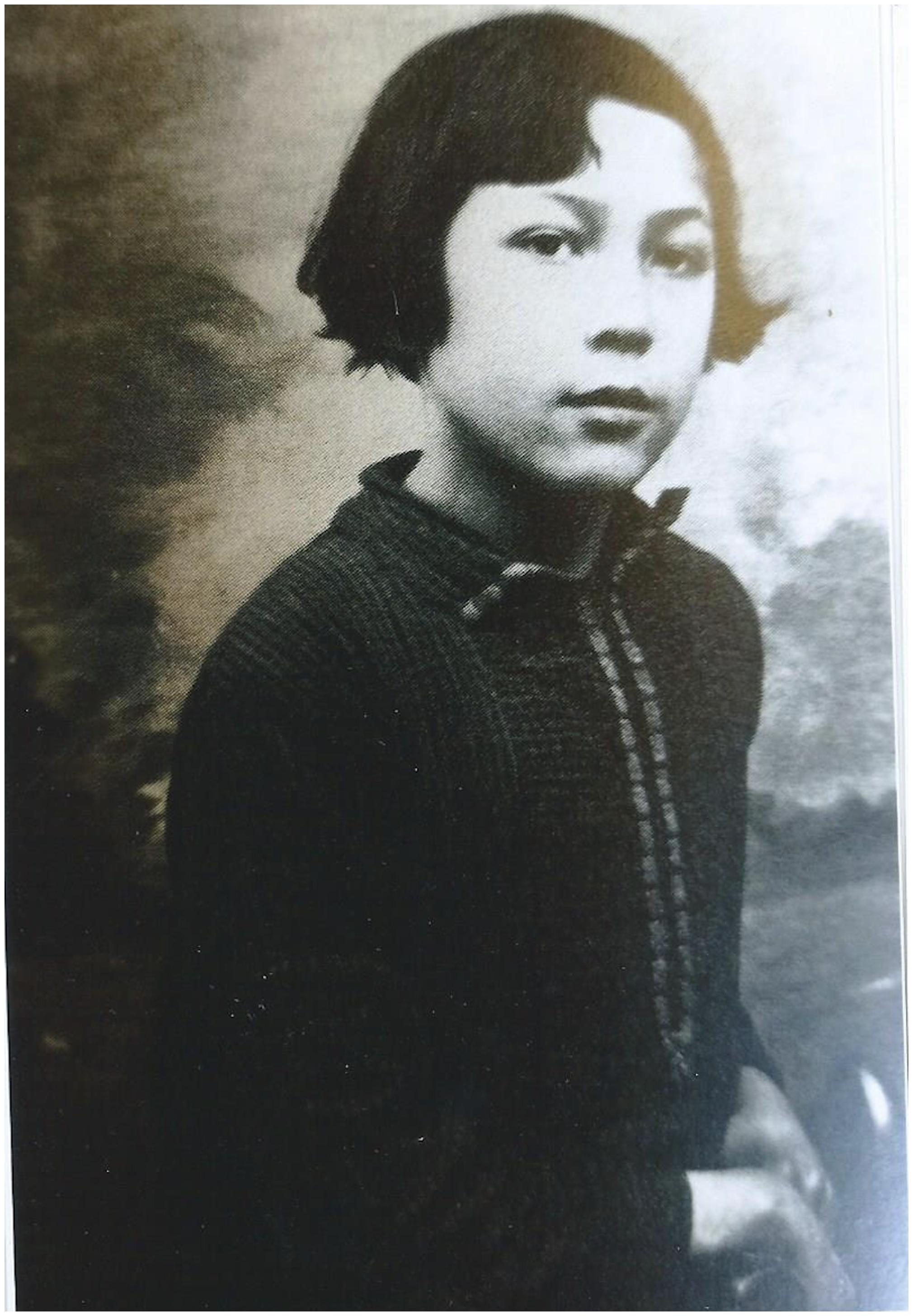
The photographs reproduced in this section establish a visual continuum that both intersects with and exceeds the novel's narrative. While several images (Figures 1, 2, 3, and 5) correspond to photographs described by Michel, others (Figures 4 and 6) fall outside the text's representational frame, collectively tracing Odette's life beyond the limits of his narration. Most of the photographs that Ragon describes prior to “Le Calepin noir” come from his private archive in Paris. In the novel, Michel visits Odette's grave in 1943, but as Françoise Ragon (2023) later confirmed, Odette's tomb was subsequently removed, and Ragon never returned to the cemetery during his lifetime. The fate of Odette's remains is unknown, underscoring her continued effacement from the family lineage. The narrator also includes a striking detail: “J’ai brûlé [les lettres] d’Odette voilà quelques années, après les avoir néanmoins conservées longtemps” (Ragon, 1982: 200). Françoise confirms that her husband had never spoken of such letters to her while he was alive, and she questions the authenticity of these letters’ actual existence. Ragon did keep several photographs of Odette in his archive, and Michel offers readers a window into the content of these photographs before the epilogue. Michel describes in detail one particular photograph of Odette that captures his attention: [Odette] s’est bien encore déguisée, mais en Japonaise, avec une ample robe de soie drapée, voulant imiter un kimono mais qui se rapproche plus d’un sari. […] Sa bouche, trop soulignée de rouge, me rappelle son maquillage de l’été 40 qui me donnait des réactions pudibondes. Odette est magnifique sur cette photo, […] comme une fleur dans son plus bel éclat et qui ne pourra plus, très vite, que s’étioler et mourir. (Ragon, 1982: 204)
4
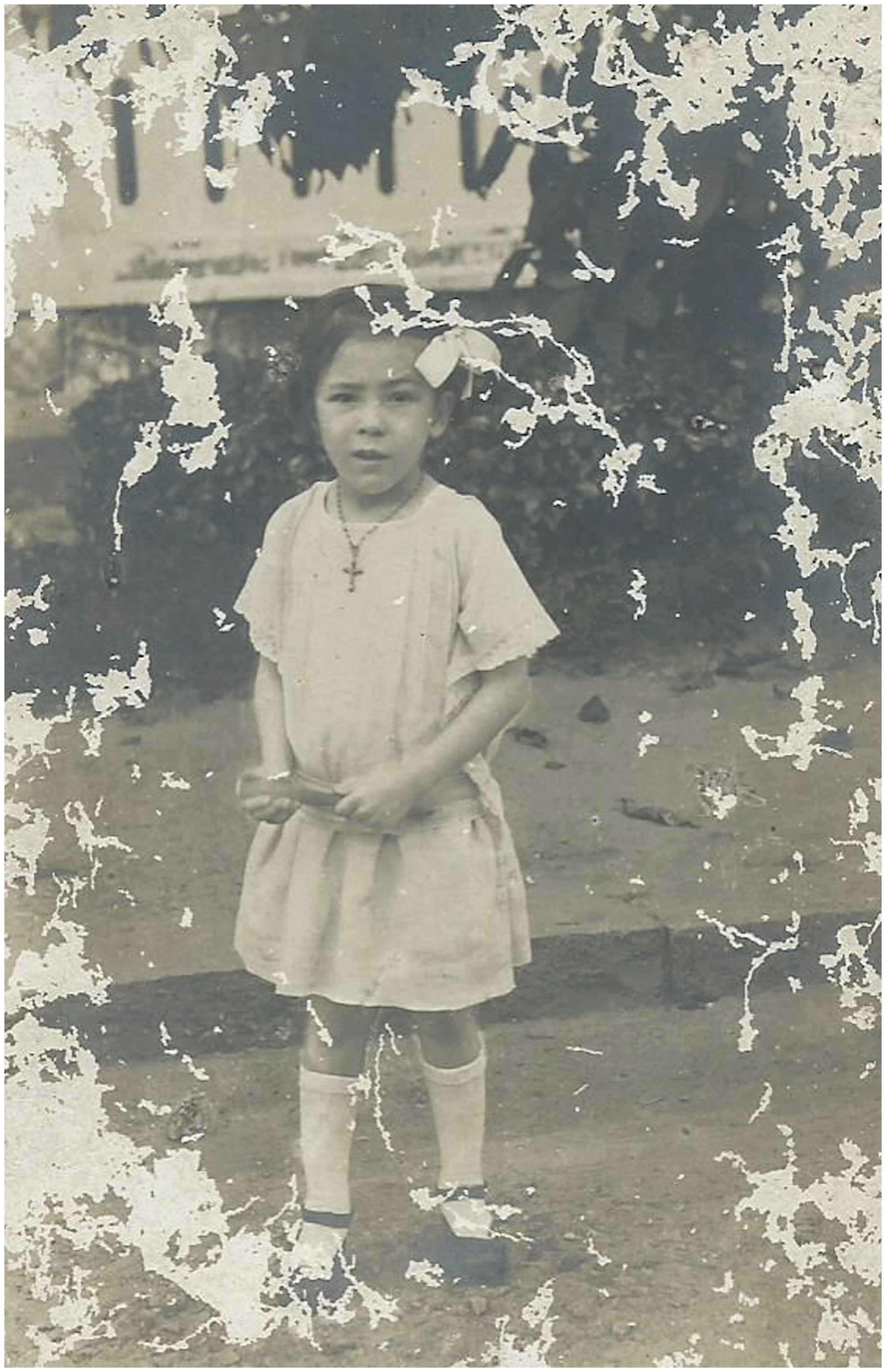
Odette Ragon, presumably three or four years of age, in Phnom Penh. This remains the earliest photograph of Odette. Ragon refers to this image as he receives Odette's photographs during his final visit to Villepinte sanatorium. The narrator describes the little Odette as “environ trois ans, dans un parc tropical, vêtue d’une robe blanche […] un collier autour du cou se terminant par une croix chrétienne. Vivait-elle alors chez les sœurs de la Sainte-Enfance?” (Ragon, 1982: 203). Undated. Archives of Françoise and Michel Ragon.
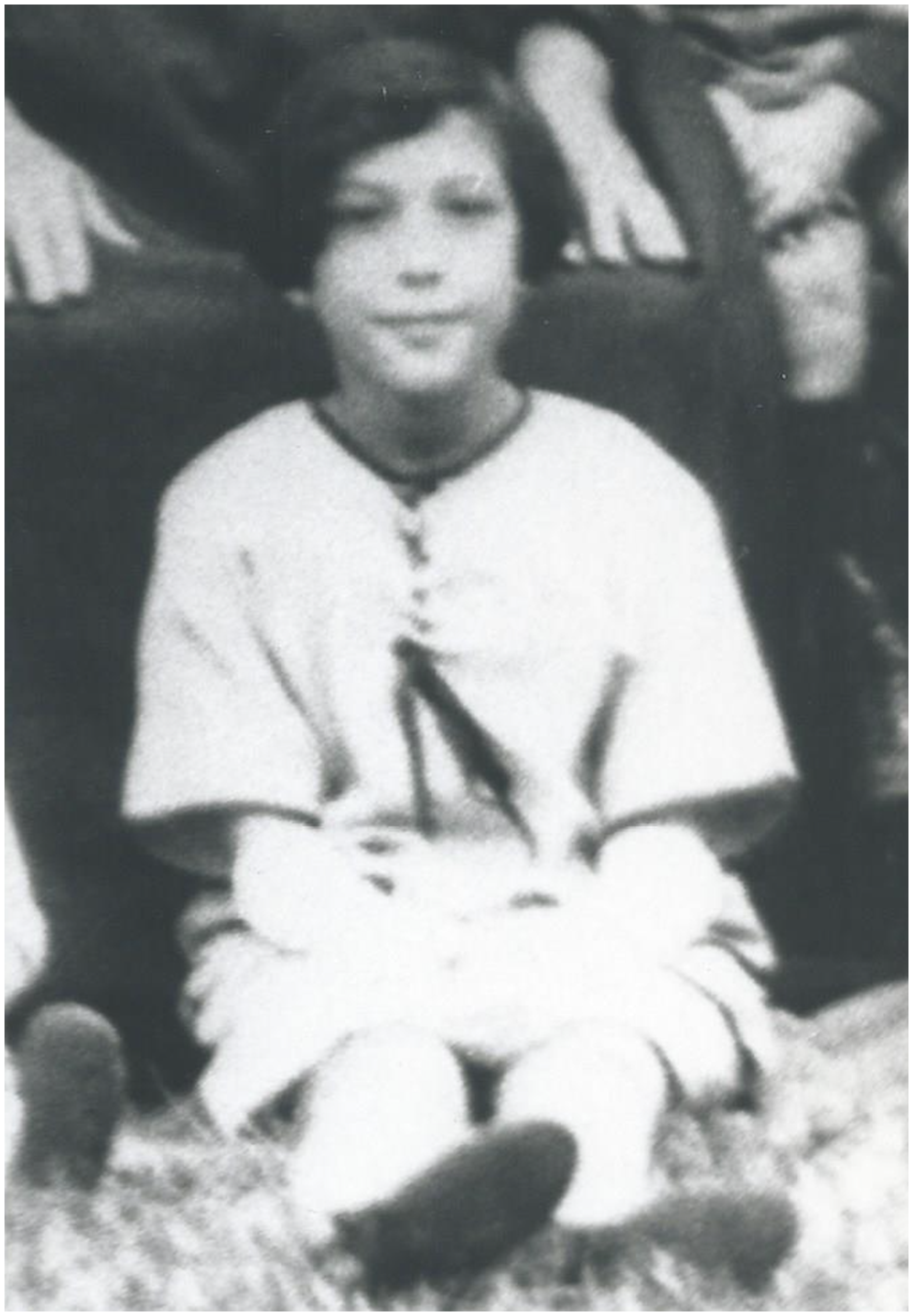
Ragon describes this undated photograph, presumably taken in Cambodia, as a cut-out from a larger photo. This photograph appears third in the series of images that the narrator describes in Ma sœur. In this photograph, Odette “doit être âgée de huit ou neuf ans. Ses traits asiatiques se sont accentués. Sa coiffure à la Jeanne d’Arc les affirme” (Ragon, 1982: 203). Archives of Françoise and Michel Ragon.
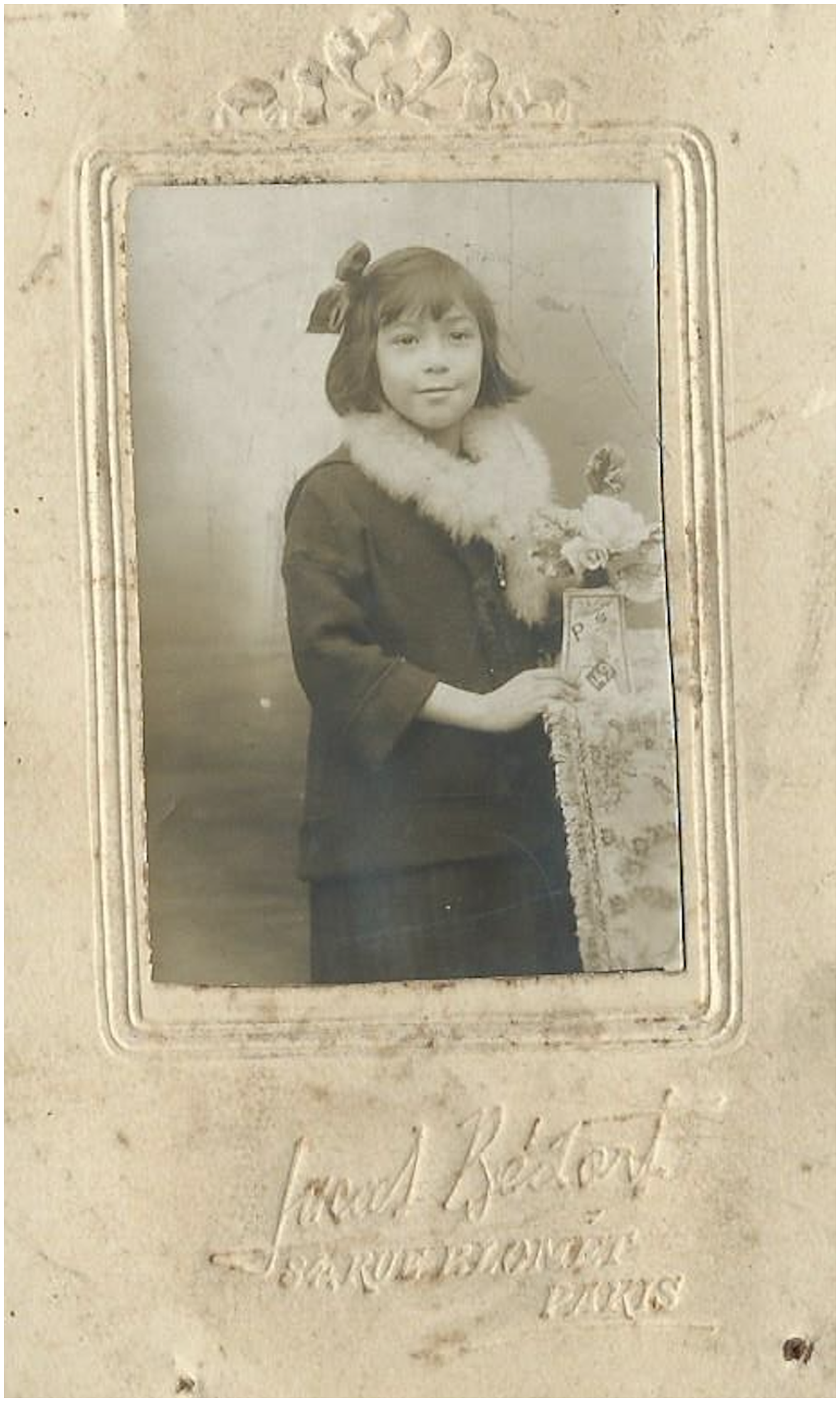
Odette in Paris, taken at the Lucas & Bédart photo studio. Ragon mistakenly attributes this photo to “Lucien Bédart,” misreading the name of the photo studio. The narrator describes this photograph in which Odette wears around her neck “une espèce de renard blanc” while holding “un bouquet de roses” with her “petit sourire espiègle” (Ragon, 1982: 203). Undated. Archives of Françoise and Michel Ragon.
Odette appears on the cover of Ma sœur in an undated photograph, likely taken when she was around fourteen, possibly in Fontenay-le-Comte, where she lived with her aunt Victorine. She is pictured outdoors, holding the handlebars of a bicycle. Archives of Françoise and Michel Ragon.
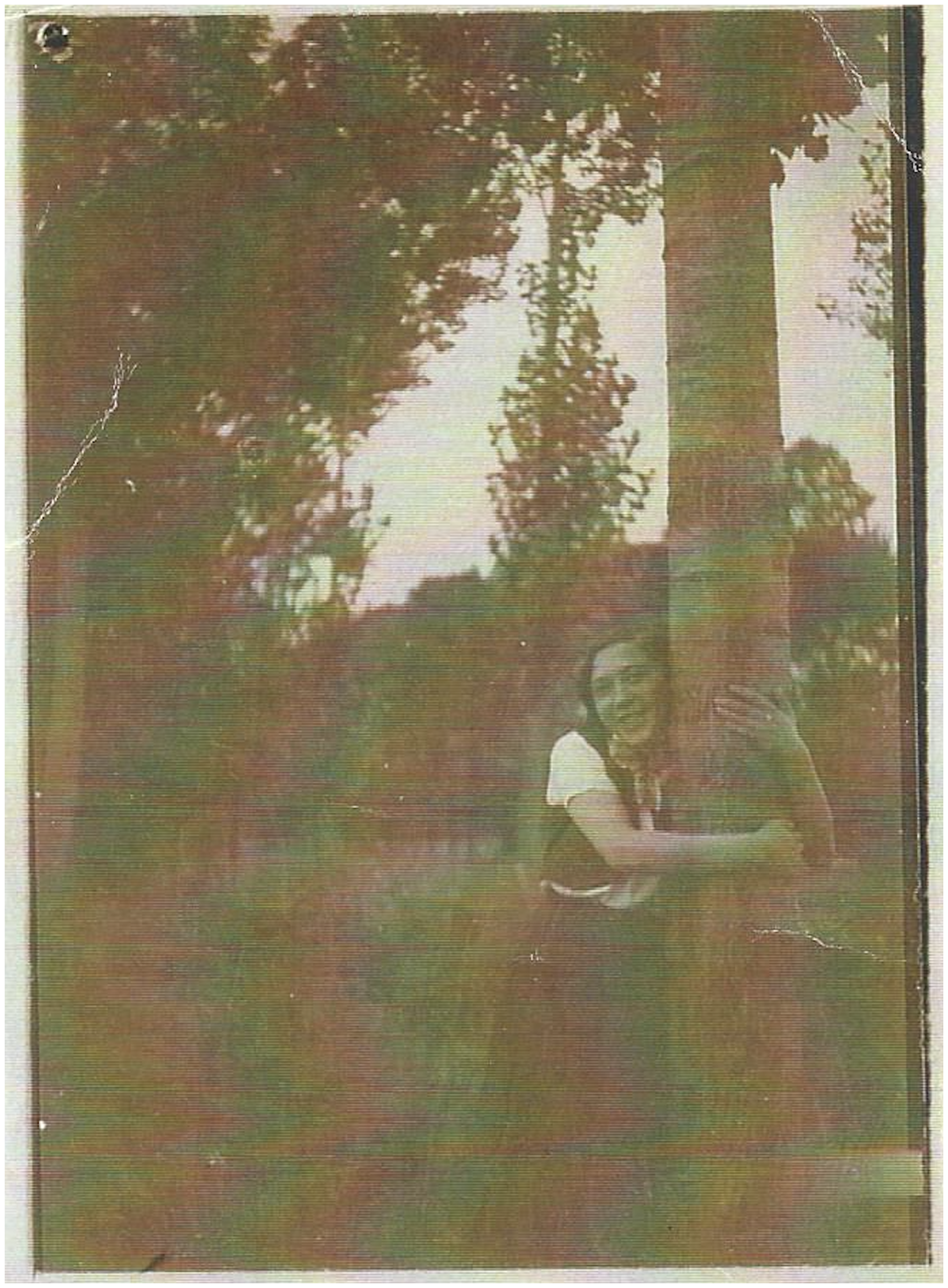
Odette is described in this photograph as “joyeuse, vêtue d’un boléro et d’une longue jupe, un énorme foulard noué en papillon autour du cou” (Ragon, 1982: 203). Location is unknown. Undated. Archives of Françoise and Michel Ragon.
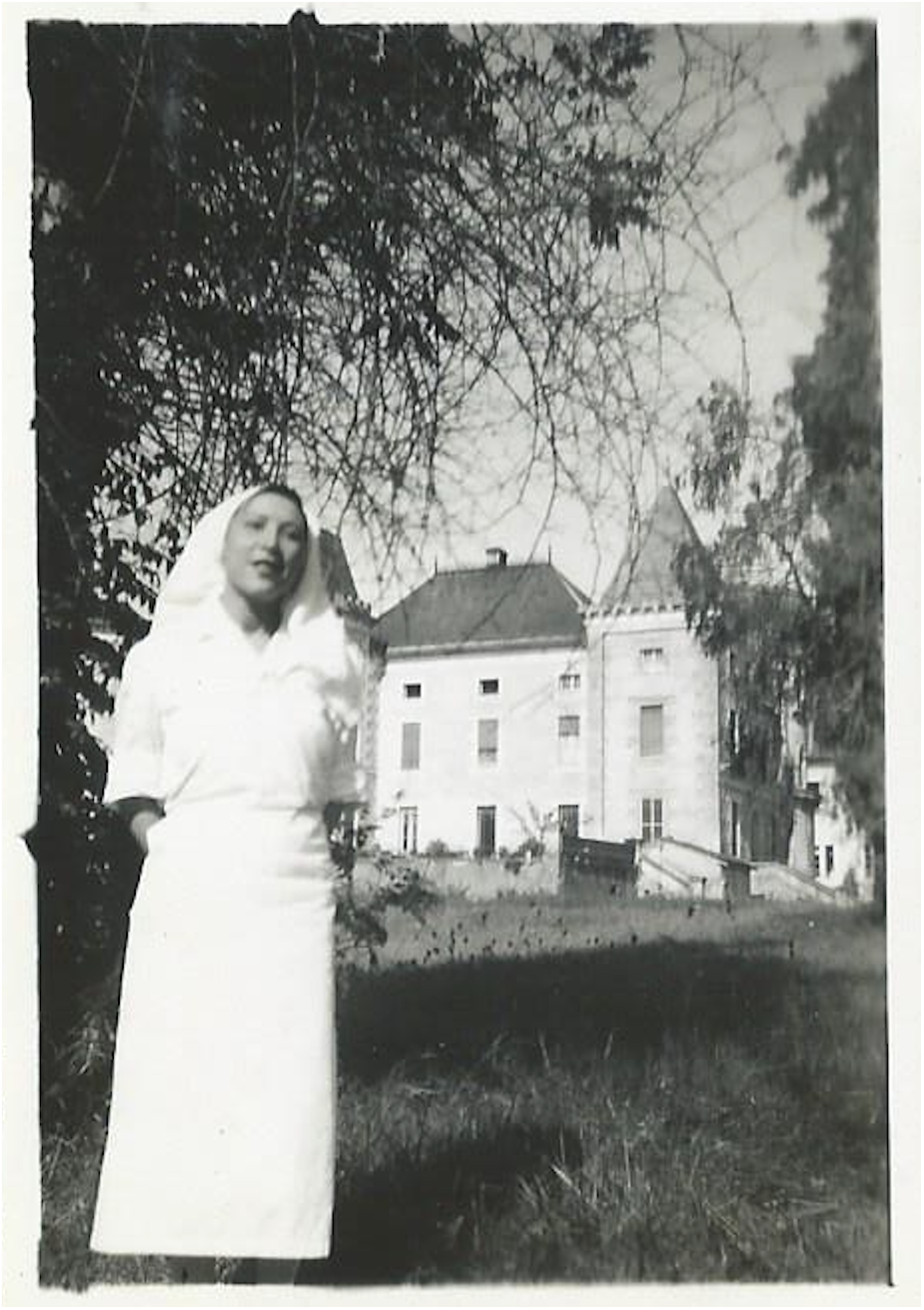
Odette in her nurse's aide uniform at the Villepinte sanatorium, where she perishes from tuberculosis. This is the last known photograph of Odette prior to her death. Undated. Archives of Françoise and Michel Ragon.
This Orientalist framing, however, defines her métissage, which lies at the heart of her melancholy—one that the adult Michel painfully recognizes as he gazes at another photograph of his half-sister. Michel shares this feeling as he describes this other photo of Odette: La photo d’un bal costumé. Elle porte une robe de mariée et ses cheveux sont roulés à l’anglaise. On l’a (ou elle s’est) maquillée pour ne pas ‘faire indigène’. Son visage est d’une telle tristesse que j’ai bien envie de brûler cette photo ridicule. (Ragon, 1982: 204)
It is worth noting that the photograph used on the novel's cover (Figure 4), though not described within the narrative itself, occupies a liminal position between text and archive. It visually precedes the reader's encounter with Odette, effectively framing her through an external image that both anchors and destabilizes the fictional narrative that follows. The final photograph (Figure 6), depicting Odette in her nurse's aide uniform, similarly exceeds the narrative's visual economy, offering one of the only images of her adult life within the sanatorium—an existence that the novel recounts but does not visually substantiate. This final image, poised between documentation and loss, anticipates the relationship between photography and death that Barthes theorizes in La chambre claire.
Barthes (1980: 29, 31, 144) famously contends that the photograph “produit la Mort en voulant conserver la vie’ in as much as it ‘transform[e] le sujet en objet’; […] ce qu[‘on] voi[t], c’est […] Tout-Image, c’est-à-dire la Mort en personne.” The animate, photographed subject is transformed into an inert body, consigned to an unreachable past and tethered to the present only as an aporia—visually preserved yet irretrievably lost. The unpublished, narrativized photographs before the epilogue present Odette's postcolonial, Orientalized body, compelling readers to reimagine her métissage and sartorial choices as staged performances. Her authentic self, masked by exotic silk costumes, is subsumed beneath the lights and lenses of the photographic studio, as well as Michel's own descriptions. Taken together, these images chart Odette's progression from childhood to adulthood, offering a temporal and embodied continuity absent from the novel, which instead fragments her identity through narrative mediation.
Ragon's choice to withhold Odette's photos in the novel is evocative of Barthes's decision not to include the Winter Garden Photograph (la Photographie du Jardin d’Hiver) in La chambre claire. The unpublished Winter Garden Photograph, arguably the most personal and intimate image Barthes engages with, depicts his mother, Henriette Barthes, at the age of five. His profound attachment to her, coupled with the emotional pain of witnessing her decline as her caregiver, rendered the photograph a deeply private site of mourning and reflection. While the image became central to his theorization of photography's inherent relation to death, Barthes ultimately withholds it for fear of violating the intimacy and irreducibility that gave the photograph its theoretical significance. Meditating on the Winter Garden Photograph, Barthes notes how his beloved, ill, vulnerable mother became his own child: [E]lle était devenue ma petite fille, rejoignant pour moi l’enfant essentielle qu’elle était sur sa première photo. […] Elle, si forte, qui était ma Loi intérieure, je la vivais pour finir comme mon enfant féminin. Je résolvais ainsi, à ma manière, la Mort. (1980: 112)
Ragon's relation to Odette has striking parent–child qualities. Like Barthes, Ragon seeks to protect Michel's maternal proxy in the novel by withholding the historical Odette's photographs, thereby avoiding the projection of her authentic image onto the largely fictitious and discursive framework of Aristide's letters. These letters, marked by a “racisme sous-jacent” and a vision of “cette fantastique Indochine,” not only elicit a sorrowful response from the fictionalized Odette but also drive the colonialist tone of the novel, which relies heavily on Aristide's correspondences (Ragon, 1994: 75). In this interpretation, Ragon engenders the true, historical Odette—reminiscent of an ailing mother figure, like Henriette Barthes—precisely through his decision to exclude her photographs from the novel. Like Barthes, who preserves the Winter Garden Photograph's invisibility to maintain the tension between presence and absence, fiction and reality, Ragon excludes Odette's images to sustain these boundaries within the malleable genre of autofiction, presenting her as both real and fictional, present and effaced.
Had the photographs been included, Odette would not have been exempt from potential objectivization, becoming a “product of a comparative synthesis of both types of discourses and a calculation of the degree of veracity that arises from their copresence” (Montémont 2011: 37). As the narrative is already shaped by Orientalist discourses, Odette's visual presence may potentially be read through those same frames. Odette's representation thus occupies an irresolvable paradox: she is doubly constrained by the conditions of her visibility and invisibility. The verifiable existence of Odette's actual photographs—resurfacing from the visual shadow archive and reproduced in this article—nonetheless marks a significant theoretical departure from Barthes's text. In this sense, the photograph operates not simply as evidence, but as a contested site of visibility in which the conditions of historical recognition remain unresolved.
The historical Odette's emergence from the shadow archive authenticates her presence within Michel's narration and relocates her into a new archival framework. This framework reconfigures her postcolonial and decolonial signification as the novel's Other into an identifiable, embodied subject more faithful to the historical Odette. The archive presented in this article thus enables a renewed form of readerly engagement with Odette, offering a paradoxical embodiment: she appears both dead and alive, returning the viewer's gaze and providing a rare, unmasked glimpse of her life beyond the role Michel assigns her in his narrative. In this way, readers are invited to reassemble the two Odettes—historical and fictional—much as Michel and Odette once pieced together their father's voice, letters, and photographs during their fateful summer of 1940. Dislocated from the autofictionality of Ragon's novel, this article's shadow archive opens a posthumous space in which Odette may be reread, reassembled, and re-remembered: the undeniable that-has-been, the living proof of her existence.
In conclusion, this article has shown how Ragon constructs Ma sœur from a breadth of archival sources to reimagine two family members he scarcely remembered: his father and his Franco-Asian half-sister. Both figures embody the phantasmatic Indochina that once fueled the author's childhood curiosities, literary inclinations, and adventurous imaginings. While rare photographs of Aristide during his service in Indochina appear in a special commemorative volume, Autour de Michel Ragon, published by the Musée des Beaux-Arts in Nantes in 1984, Odette's photographs remain absent even from this collection (Ragon, 1984). The photographic inclusion in this article posthumously honors her memory, moving beyond the decolonial failure of the novel that seeks to honor her, enabling readers to glimpse the historical Odette behind the staged, literary figure portrayed by Michel. In so doing, Odette's posthumous reanimation—her “capacity to signal life” via the photographs—can be read against the grain of the autofictionality encasing the narrator's presentation of his half-sister (Hirsch, 2012: 134). Visualizing these photographs, readers may engage in a posthumous counter-archival encounter with Odette. It can thus be said that Odette, to borrow the words of Tina Campt (2012: 18), “move[s] [and] circulate[s] spatially and temporally, traveling between people and forward in time, and taking on a life well beyond those who made and posed in them.” This paradoxically disembodied identity—straddling textual and extratextual spaces and reassembled by readers—ultimately grants Odette a posthumous subjectivity that is both alive and dead.
By assembling images that both correspond to and exceed Michel's descriptions, this counter-archive restores a material continuity to Odette's life that the novel itself cannot sustain. These images recover the historical Odette in an afterlife—an Odette who transcends the materiality of the page, the borders of Cambodia and France, and the confines of fiction and biography, returning to the present as both presence and memory.
Footnotes
Acknowledgments
The author expresses gratitude to Françoise Ragon for permission to reproduce Odette Ragon's photographs. This article was written in memory of Odette Ragon (1916–1943).

Consent for publication
Received permission from Ms Françoise Ragon, widow of now deceased Michel Ragon, to reproduce photographs of Michel Ragon's deceased half-sibling, Odette Ragon. Permission received on August 13, 2023, through e-mail communication (on file).
Funding
The author received no financial support for the research, authorship, and/or publication of this article.
Declaration of conflicting interests
The author declared no potential conflicts of interest with respect to the research, authorship, and/or publication of this article.