



Abstract
In 1934, the painter Balthus (Balthasar Klossowski, 1908–2001) opened his first one-man show in Paris, comprising five erotic and sexually violent scenes involving adolescents and younger children. Over the following decades, he continued to depict girls in ways that art historians and critics have widely discussed as morally problematic. There is no shortage of art historical writing on Balthus, but his work raises a relatively overlooked question for the cultural history of twentieth-century France: how to explain the extraordinary success of an artist whose works depict, in a stylized realism, sexualised scenes involving children? To respond to this question, this article first sketches the limits of interwar French society's toleration when it comes to sexual innocence and adolescence, with a focus on Balthus’s Surrealist milieu. It then interrogates how in 1934 and after, Balthus's work pushed up against those limits and yet largely avoided condemnation. It does so by setting his earlier work against the popularity of the genre of news known as faits divers, and then by examining, in relation to his later work, how his painterly style and approach to depicting adolescents continued to discourage moral questioning. As such, it seeks to approach Balthus anew in an era that demands a more direct scrutiny of any idealisation of sexual exploitation.
In April 1934, the painter Balthus (Balthasar Klossowski, 1908–2001) opened his first one-man show at the Galerie Pierre in Paris, comprising five erotic and sexually violent scenes involving adolescents and younger children. In one of them, titled La Leçon de guitare , a grown woman slings a half-naked girl of ten or twelve backwards over her knee: with one hand she pulls back the girl's hair, while with the other she threatens the pre-pubescent genitals that lie exposed in the centre of the composition. The largest work in the show, La Rue , is a scene of daily life that at first glance seems more suited to the semi-naïve style that broadly charmed critics in the 1930s. Yet in the foreground it included what can only read as a man assaulting a young girl, grasping her firmly by the arm while laying a hand over her groin (Rewald, 1984: 26–7). Art historians and critics have long acknowledged that Balthus’s work is morally problematic, but have largely overlooked the important questions the most troubling aspect of his work raises for the cultural history of interwar France: Why would a young artist launch his career, and how could he continue it with such extraordinary success, by presenting works that depict, in a stylized realism, such sexualised scenes involving children? How did the wider social and cultural significance of Balthus's subject matter coincide with his work and its reception to make him one of the most important artists in twentieth-century France?
As the critic Robert Hughes put it in 1984, ‘two artists in our century have won worldwide fame by creating works whose best-known image is the child as sex object’; the other is Vladimir Nabokov (Hughes, 1984). Balthus himself has attributed this success as an artist in part to having caused a scandal at the Galerie Pierre (Glass, 2000), and looking at the works this is easily believable. But in fact, while Balthus's show sought outrage and publicity, it was not particularly successful in this respect. While one critic recalled shortly afterwards that the show had caused a ‘scandale’, there is scant evidence of one (Barlatier, 1934: 1; Golan, 1995: 199n66). The only critical attention it received in the press was a few paragraphs within reviews of other shows – mostly derisory, but not entirely, as we shall see – plus one significant review by Balthus's friend Antonin Artaud (1934). In an art market well accustomed to the investment opportunity of a succès de scandale, none of the works initially sold (Rewald, 1984: 29).
The daring turn that Balthus took at a critical early point in his career was, then, a serious gamble that almost failed. Nonetheless, not long after his 1934 show at Pierre Loeb's gallery, his work – which belongs to no particular movement but evokes the Surrealist and Neue Sachlichkeit movements as well as Artaud's explorations of cruelty – was praised and bought by the likes of Alberto Giacometti, Albert Camus, André Masson, and Pablo Picasso (Rewald, 1984: 37, 49). This success from the 1930s onward seems almost to have been achieved despite, rather than in virtue of, his work's ongoing eroticisation of adolescents. Once the almost non-existent scandal of 1934 was over, Balthus's later critics sought to mitigate his work's troubling contents. As the Surrealist writer André Pieyre de Mandiargues would observe, looking back from 1975: most of Balthus's contemporary critics tried to downplay his eroticism, ignoring the flagrant evidence right under their eyes (1975: 67). One of Pieyre de Mandiargues's examples, an important 1949 essay by Camus, explicitly dismisses the eroticism of Balthus's children as inadvertent and incidental (1973 [1949]: n.p.). Other essays, including that by James Thrall Soby in his 1938 catalogue essay for Balthus's show at the Pierre Matisse gallery in New York, sought to reassure viewers that the artist's recent use of colour and modelling would vanish any traces of ‘crudeness’ (1938: n.p.). This anodyne reception of Balthus which downplayed the dubious eroticism of his works surely enabled a certain pedigree of purchasers too. Soby was an influential American collector, and by 1938 Balthus's work entered the collection of an American museum when the director of the Wadsworth Atheneum purchased his Nature morte (Tostmann, 2019: 90). His first museum exhibition was at the Museum of Modern Art, New York, in 1956 (Rewald, 1984: 49). Yet for all that that, the works he had shown in 1934 were no more socially acceptable. Soby, who had purchased La Rue in 1937, ended up locking his purchase away in his vault because too many people found it disturbing, and later had it altered so that today this painting hints only ambiguously at sexual violence (Rewald, 1984: 60; Tostmann, 2019: 89).
As Balthus's renown and success continued after 1934, his approach to painting children changed. Perhaps influenced by his critics, his works after this time no longer explicitly represent sexual violence. However, the results are no less disturbing. Rather than depicting sexual predation, they instead index it by obsessively reifying the bodies of young girls who are sometimes nude (most often in his sketches). This includes paintings like Jeune fille endormie, from 1938, better known today by its translated title Therèse Dreaming , which depicts a girl of twelve or thirteen leaning back on a chair, with a golden-skinned leg casually raised to reveal her underwear. In 2017, a petition asking the Metropolitan Museum of Art to either remove this painting or present it differently started debates worldwide.
How then should we explain the success of an artist whose key paintings pertain to a troubling subject, yet did not succeed, even when it was his aim, in provoking a little frisson of a scandal in which critics and viewers might delight in being shocked? The answer, as this article argues, lies in the fact that, throughout his career, the disturbing qualities of Balthus's paintings have been less salient and troubling for his critics than we might initially expect. However, the primary purpose of this enquiry and this argument is not to clarify Balthus's reception, but rather to attempt to approach the artist anew in an era that demands a more direct scrutiny of any idealisation of sexual exploitation (Merlin-Kajman, 2020). For it is not only Balthus's contemporaries that have tended to let Balthus off the hook. As Linda Nochlin observed in 1988, critics writing about the major Balthus exhibition that took place in 1983 and 1984 at the Centre Georges-Pompidou and the Metropolitan Museum of Art seemed concerned to pre-empt and evade negative criticism of his work (Nochlin, 1989 [1988]: 31; e.g., Fouilloux, 1984; Sharp Young, 1984). Despite the feminist protest in the art world more widely, if there was any such feminist criticism of that Balthus exhibition, it left little trace. Yet, continuing in this pre-emptive mode, art historians in the decades that followed that exhibition have understandably sought ways to write about Balthus without either being moralising and censorious, or veering into a reductive psychobiography. The world's leading expert on Balthus, Sabine Rewald, has addressed Balthus's obsession with adolescents, yet her prolific and attentive analysis, begun during the artist's lifetime, has been enabled by interpreting his works as intelligent psychoanalytic parody (in the case of La Leçon de guitare ), or as otherwise ‘ambiguous’ in their possible eroticism. Rewald also typically tempers any suggestions of exploitation by insisting on the artist's empathy, tenderness, intuition, or fine technique (Rewald, 1992, 1998, 2013). Others have deliberately distanced themselves from any readings of Balthus that risk being moralising and might as such, as Mieke Bal has put it, amount to a ‘somewhat cliché judgement’ (2008: 14). For Bal, if the viewer finds his works perverse, it is because through them they have glimpsed the categories and taboos by which society conceals the polymorphous and unruly basis of human sexual desire (2008: 24, 35, 108. Two decades earlier, Sarah Kofman (1985: 91–3) likewise insisted that if viewers find Balthus troubling, it is because adolescent sexuality is troubling in its ambiguity and transitoriness between childhood and adulthood. Only Nicholas Fox Weber's biography of the artist has risked being treated as moralising or of ‘imagin[ing] seductions’, and has been criticised as such (Weber, 1999; Bal, 2008: 113, 136). Far more numerous are studies that either overlook the troubling side of Balthus, or wax lyrical about his special empathy for, and love of, innocence, as if it were a virtue (Rewald 2013: 39 gives a similar assessment of the secondary literature; e.g., Davenport, 2020: 71; Clair, 2001: 16, 38–9, 44). This article attempts to resist this tendency, which has arguably elided the disturbing eroticism of Balthus's images, and aims to show that confronting this subject is hardly a matter of being reductive or moralizing.
Instead, in this article I take a different approach to Balthus that, far from bracketing difficult questions around desire, uses these questions to drive both the social history and interpretation of his work. After all, it is not moralizing to seek to understand how the history of art in France could so prominently feature the production and reception of paintings that often depict ‘impending rape’ of minors, as Pieyre de Mandiargues once described Balthus's work to Rewald (1998: 307). To the contrary, it is the task of feminist criticism. As Nochlin has pointed out in her brief discussion of Balthus, there is an analogy between the attempts by critics to dissuade women viewers from challenging the eroticism of his seductive adolescents, and the compromised position of women under the male gaze. In both cases, ‘her rejection of patriarchal authority is weakened by accusations of prudery or naïveté. Sophistication, liberation, belonging are equated with acquiescence to male demands; women's initial perceptions of oppression, of outrage, of negativity are undermined by authorized doubts, by the need to please, to be learned, sophisticated, aesthetically astute – in male terms, of course’ (Nochlin, 1989 [1988]: 31–2). Yet, notwithstanding recent work on Balthus's photographs that responds to recent changes in the boundaries of the representable in photography (Morel, 2023), there has been little response to Nochlin's call.
This essay begins by establishing that the success of Balthus's disturbing works cannot be explained through the suggestion that such imagery was inherently acceptable in the twentieth century. As such, it explores a key context for the artist’s reception by sketching social attitudes and legal frameworks around sexual innocence and adolescence, using the public reaction in the 1930s to the famous case of the sexually abused teenager Violette Nozière to focus the discussion. Having established a better understanding of the limits of social toleration in interwar France, the essay's second section interrogates how in 1934 Balthus's work pushed up against these limits and yet largely avoided condemnation, by setting it against the popular genre of news known as faits divers that typically raised moral questions but which audiences consumed as pure spectacle. The second half of this essay then shifts its focus from the works Balthus painted for his 1934 show, to his œuvre in the decades that followed, but remains led by the same question of how the perversity of Balthus's paintings could be so overlooked. To answer this question in relation to his works after 1934, the third and fourth sections examine the artist's changed approach to depicting adolescents in those years, alongside his repeated denials that his depictions of children are erotic. In so doing, it shows that Balthus's visual and verbal rhetoric are apiece in the way they deny the interest he evidently pursues in a certain quality of the bodies of his young models. Whereas his works before 1934 posed themselves rhetorically as fictions that did not require their viewers to feel real concern, his works after this date use painterly and rhetorical effects to deny the artist's obsessive investment in his subject matter. As such, by bringing both halves of Balthus's œuvre alongside one another, we can observe how, throughout his career, Balthus's style has functioned to discourage his viewers from seeing those disturbing aspects of his work that are so much more visible in our present cultural moment. As a result we can finally respond to the decades-long critical tendency to avoid the inconvenient aspects of his work.
This essay aims to question what has been consciously and unconsciously overlooked in Balthus, and as such concerns the charged subject of the painting of desire and its reception. For this reason I must clarify that I am not using terms like ‘desire’ here to suggest that any act, sexual or otherwise, is sought, let alone that it might have occurred – there is absolutely no suggestion of, nor evidence of, illicit behaviour. Rather, to use the impeccable phrasing of Jacqueline Rose, desire here refers to a ‘form of investment by the adult in the child, and to the demand made by the adult on the child as the effect of that investment’ (Rose, 1984: 3–4). By foregrounding that demand, my approach differs from that of Mieke Bal and many others who undertake to ‘follow the artists own wish’ (2008: 15): instead mine deliberately counters it. In keeping with this intention, many of the Balthus works to which I refer in this article are not reproduced within these pages, where they would inevitably play the quasi-decorative role of lending colour to black-and-white pages of text. With the exception of the painting I analyse most closely, La Fenêtre, all other images of works by Balthus that are held by major museums and collections can be viewed online using the links in the image list at the end.
Adolescence and sexual innocence in 1930s France: Violette Nozière
To contextualize the reception of Balthus's works in 1934, and his ultimate embrace by major purchasers and critics, it is essential to understand contemporary attitudes to the questions their content might have raised. In early-twentieth-century France, the gap between childhood and adulthood, and the question of sexual innocence in that pubescent period, were subjects wracked with ambiguity in society, the law, and cultural representation. That ambiguity was sufficient to make the subject one of potential intrigue and controversy, but it did not prevent the widespread recognition of the vulnerability of adolescents to abusive sexual predation. Nothing demonstrates this more clearly than the public reaction to the case of the eighteen-year-old Violette Nozière, which gripped Parisians’ imaginations and sparked one of the most controversial trials since the famous Dreyfus affair at the turn of the century.
On the evening of the 21st of August 1933, the same summer that Balthus was painting works that would be exhibited at the Galerie Pierre, Violette Nozière returned home to her working-class neighbourhood in the twelfth arrondissement of Paris, and attempted to poison her parents after supper. What fuelled the public fascination in her case were the further ensuing revelations that, in the months before her crime, she had constructed an entirely fictitious life for herself using money borrowed from a series of older sexual partners, in an attempt to erase her lower-class background. More divisive still was her claim, following her arrest, that her father, whom she had successfully murdered, had sexually abused her from the age of twelve (Maza, 2011).
By the following year, Violette Nozière was the most notorious woman in France. Encouraged by an obsessed news media, booing crowds flocked to watch her whenever she was moved between the court and the prison, and new street ballads condemned her as a ‘monster’, calling her crime a lesson to all young girls (Maza, 2011: 145). Others cried that Violette was telling an important truth about her father's abuses, which she had described in sickening and verifiable detail at her trial. For them, her youth meant that responsibility fell back on her parents for her ‘profaned adolescence’ (Maza, 2011: 126, quoting a 1933 article in Le Populaire).
As a journalist for Paris-Soir wrote about Violette's case, ‘it sometimes happens that exceptional circumstances tease out of daily, ordinary life a psychological problem we examine with dread’ (quoted in Maza, 2011: 106). And as is clear from the wider public reaction to Violette Nozière, it was partly this ‘dread’ and moral ambiguity that made her case so compelling. The concept of adolescence was still relatively new in early-twentieth-century France. This is by no means to suggest that children of twelve or fourteen were ever previously treated as psychologically or sexually mature – not even centuries earlier had this been the case – but it was only around the turn of the century that experts in psychology had addressed the distinctive psychological profile of this phase between childhood and adulthood (Alaimo, 1992: 421–3). This in turn changed public policies, with restrictions on adolescent labour introduced in 1906, and juvenile status in the judicial system for under-eighteens introduced in 1912 (Thiercé, 1999; Neilson, 2014; Alaimo, 1992: 423–34). Social attitudes changed too, as children spent longer in school than the previous generation, and adolescence thus became an age in which it was possible to imagine escaping the social destiny of one's parents (Faron, 2001). Yet the idea of adolescence took time to become entrenched, and uncertainties remained even after the First World War. It was only in 1945 that the age at which non-violent sexual acts against the person were considered as indecent assault under the French Penal Code was raised from thirteen to fifteen, although this by no means meant such acts were treated as acceptable by judges or juries either side of this date (Ambroise-Rendu, 2009: 171–4). As before, the Code specified the age of sexual majority without using the concept of consent, continuing the emphasis on the corruption of innocent minors (Ambroise-Rendu, 2009: 178; as Anne Higonnet (1998) has shown, this emphasis on innocence rather than consent is in keeping with the longstanding treatment of children from the eighteenth century to the late twentieth). By the 1930s, social divisions were already clear in the actions of the courts. While judges in some courts did whatever they could to secure a conviction, others were quick to condemn abused children as prone to sexual vice, calling them vicieuse – a term frequently used by the mass media to condemn Violette (Ambroise-Rendu, 2009: 184–6; Maza, 2011: 37).
While French society may have treated these issues with dread, this was not obviously the case for Balthus's own avant-garde milieu, entwined with the wider Surrealist movement (a movement to which Balthus never strictly belonged, although he was friends with André Breton, Alberto Giacometti, and participated in the magazine Minotaure in 1935; Clair, 2001: 21). Their approach to eros was transgressive, and the beauty they sought ‘convulsive’: shocking, traumatic, cruel (Foster, 1995: 19, 92–3). Their explorations of the realm of erotic desire, by male Surrealists, at least, did not either refrain from exploitation (a topic explored by, among others, Caws, 1991; Chadwick, 1985; Kuenzli, 1991). And yet, despite the many, seemingly unbounded experiments in sexual fantasy of Breton and his associates (their homophobia notwithstanding, on which see Miller, 2020), Surrealist explorations of erotic desire very rarely strayed into exploring the boundaries of adulthood. Their exploitation extended only to distinctly post-pubescent women. Breton was fervently interested in the abstract Surrealist muse known as the femme-enfant that he introduced in 1927, but despite the name, this was a grown woman who had not relinquished her childhood capacity for dream and imagination (Chadwick, 1985: 33, 50; Rosemont, 1998a, p.xlvii). In 1934, Breton and others for a time associated the mythical femme-enfant with the fourteen-year-old Gisèle Prassinos, yet it was her strange semi-automatic poetry that they admired, and Man Ray's photographs of her in a black dress with white collar have the dignified air of a portrait taken at school (Hedges, 1991; Ray, 1934).
Breton and his associates certainly tolerated sexual interest in adolescents, both in themselves and others. In 1928, Breton prompted other male Surrealists to discuss their ‘favourite age for a woman’ as part of his recorded conversations called ‘Recherches sur la sexualité’, and Jacques Prévert's response of ‘fourteen’ went entirely unremarked. Still, Prévert was almost alone: with the exception of Raymond Queneau, the other participants gave minimum ages at least four years higher (Pierre, 1992: 15). Breton claimed he preferred women of ‘twenty-three to thirty’; even so, just a few years later, he published a poem that recounted his sexually prurient response to a fourteen-year-old girl (Breton, 1966: 139–42; as noted by Chadwick, 1985: 43). Its title, ‘Sans connaissance’, presumably refers to the girl's lack of awareness as to what she had stirred in him.
However, if Breton and the Surrealist movement so far seem ambivalent towards the sexual exploitation of pubescent children, less ambivalent was their response to the Nozière case. The trial made an impact on Breton, and in December 1933 he led fifteen other prominent Surrealist artists in publishing the pamphlet Violette Nozières (sic). Art historians have typically discussed the Surrealist defence of the Violette Nozière case by suggesting it above all championed her parricide as a heroic act against the bourgeois family, or by recalling their glorification of crime as a poetic marvel (Rosemont, 1998b: 42–44; Chadwick, 1985: 43; Eburne, 2008: 200–14; an exception is Maza, 2011: 203–27). But it seems to me that, while it is less fitting with the Surrealist project, in fact their pamphlet predominantly condemns the sexual abuse inflicted on Violette by her father. Certainly the revelations of the abuse Violette suffered had revealed the assumed respectability of the bourgeois family as a charade, and Breton's pamphlet did not miss an opportunity to point this out: as E.L.T. Mesens's poem asks, ‘combien de mauvais pères … et mauvaises mères / aux rendez-vous de morale bourgeoise / te nommèrent garce salope / Violette’ (Breton et al., 1933: 26). Yet this is not the main tenor or salient message of the pamphlet overall, which hardly describes her crime. More often, the poems and drawings in Violette Nozières are piteous and angry in showing their disgust at the abuse Violette had suffered, and their empathy for her situation. ‘Papa / Mon petit papa tu me fais mal / disait-elle’, writes Benjamin Péret in his contribution (Breton et al., 1933: 32). In his own poem, Breton also includes a line spoken in Violette's voice (her own words): ‘Mon père oublie quelquefois que je suis sa fille’ (original italics). It continues: ‘L’éperdu / Ce qui tout à la fois craint et rêve de se trahir’ (Breton et al., 1933: 9).
A drawing by René Magritte (Figure 1) also directly confronts and condemns the violation of a teenaged girl by her father, and society's complicity with such abuse. It depicts Violette as physically small and vulnerable, curled up on her father's lap with a trusting expression, even as he reaches up her skirt; a man dressed in the bourgeois uniform of black frock coat and top hat calmly watches on. As Sarah Maza has observed in her careful and extended analysis of this pamphlet, the message of the drawing is clear: Violette was not just exploited by her father, but by a range of men, ‘male authorities, judges, lawyers, doctors, policemen, journalists, whose gut sympathies clearly lay with her dead father’ (2011: 217). It is worth recalling, too, that although in France more widely psychoanalysis remained relatively peripheral in this period (Turkle, 1978: 27–38), as keen readers of Sigmund Freud, the Surrealists (and Breton in particular) would have been familiar with the idea that child sexual abuse would cause lasting psychological damage and neurosis.
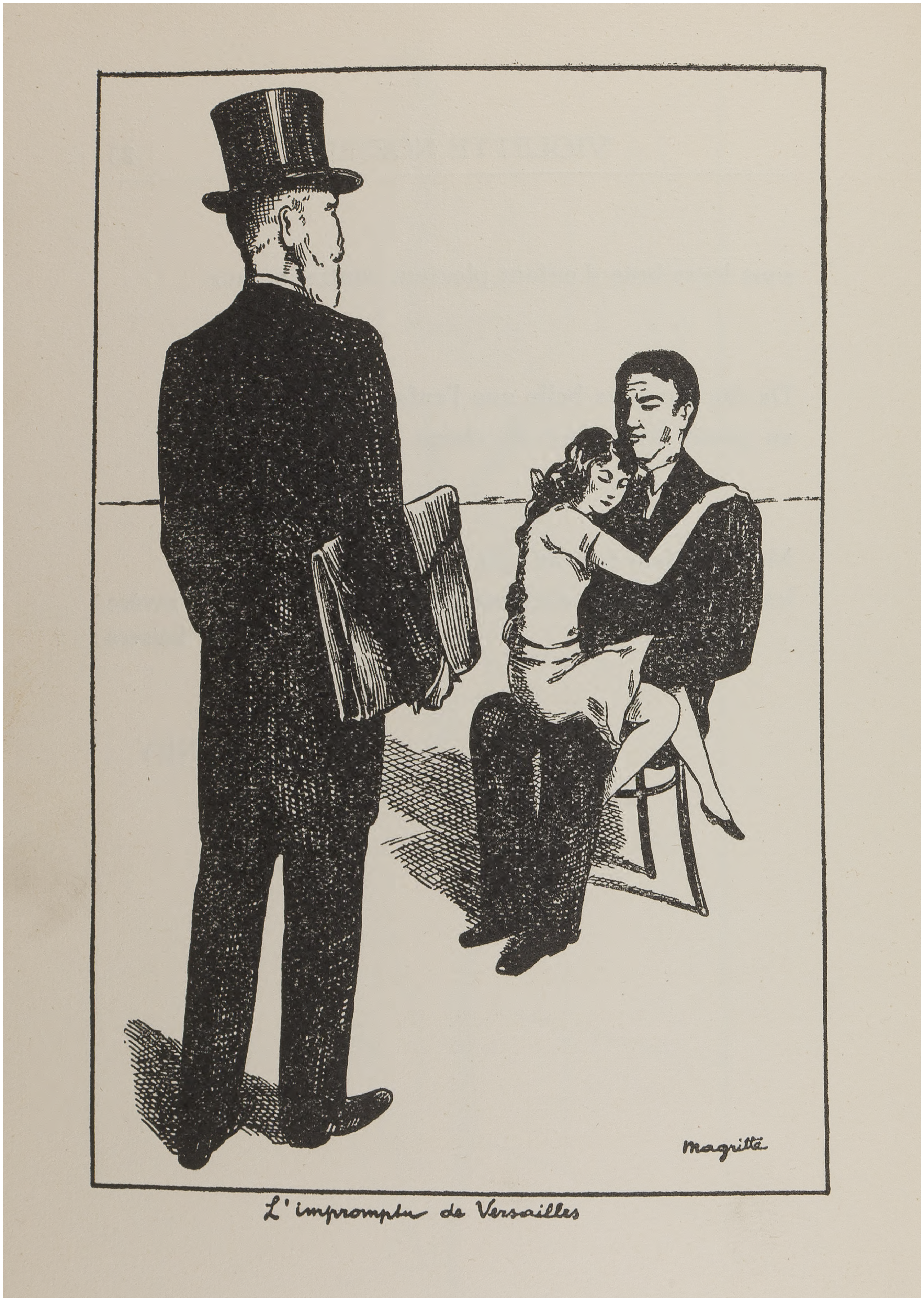
René Magritte, L’impromptu de Versailles, 1933. Lithograph published in Breton, André et al. (1933) Violette Nozières. Brussels: Éditions Nicholas Flamel, p.24. Copyright Herscovici, London/DACS. Image courtesy of the Beinecke Rare Book and Manuscript Library, Yale University.
In short, then, it seems that when came to the vulnerability of adolescents to sexual exploitation and abuse, Balthus's milieu, or at least Breton and the Surrealists were, mostly, at least no more tolerant than the wider population, and also ambiguous about what they would not tolerate. Breton had already declared in 1928 that ‘children have no fathers’ (Pierre, 1992: 62), just as he would later insist in Mad Love that the idea of the family should be buried (Breton, 1937: 137). For him, Violette's parricide and her exploits with lovers must surely have seemed to contain the potential of a heroic attempt to destroy the myth of the bourgeois family – an attempt to forge a life in which nobody could govern her in the name of paternity. Yet, of all the contributors to the pamphlet, it is only Paul Éluard who really expresses this idea. His Violette dreams that ‘un jour il n’y aura plus des pères dans les jardins de la jeunesse’, and instead only ‘les hommes pour lesquels on est toujours toute neuve … les hommes pour lesquels on n’est fille de personne’ (Breton et al., 1933: 19–20). In contrast with Breton's poem, the idea of Violette's availability for endless men for whom she is always brand new and fatherless feels predatory. Even among Surrealists, then, the imagery of Balthus's 1934 was perhaps intolerable and perverse, although also, frequently, tolerated.
Balthus and the fait divers
Balthus could hardly have failed to be aware of the Nozière scandal. He was already friends with Breton by the early 1930s, and his atelier on the Rue de Furstemberg was just around the corner from the geographical centre of much of the intrigue, the Lycée Fenelon which Violette attended. But while it would go too far to suggest that her case may have prompted Balthus's work, what I do want to suggest is that Balthus's gambit in 1934 of presenting morally troubling works in a realist idiom was enabled and legitimated by such news stories as hers. This is not simply to say that his paintings made some sense to his contemporaries for the reason that astonishing stories such as a girl murdering her sexually abusive father could also be found in their daily newspapers. Rather, his paintings came close to reconstructing the same kind of sensationalised news stories that had already primed viewers to treat such realities as a kind of fictionalized entertainment for passive consumption.
In particular, Balthus's paintings in his 1934 exhibition can be understood as sharing a certain formal quality with a type of news item known as the fait divers, of which the Nozière affair is an eminent example. Fait divers might typically recount strange coincidences, crimes petty or otherwise, or any other misdemeanour occurring in the course of what would otherwise be everyday life; as a genre its contents are almost unclassifiable. More fundamentally, what qualified a report as a fait divers is that it could appear in some way astonishing and seemingly inexplicable. This is not because events that counted under the fait divers genre were rare – there is nothing exceptional about crime, including domestic abuse and incest. That certain crimes and events could be presented as astonishing and unpredictable was rather due to their apparent detachment from wider social patterns and certainties, and consequently necessitated a delivery without the sort of context or analysis, whether political or social, that might have suggested an explanation (Walker, 1992). As Roland Barthes observed in his well-known essay on the fait divers, one could consume these news items without knowing anything about the world. Their relationship to causality is unhinged (Barthes, 1972: 186). As a consequence, as Jean Baudrillard later saw, the fait divers sensationalised and turned into pure spectacle what might otherwise require an engaged response to the real world (Baudrillard, 1998 [1970]: 33–4; helpfully analysed by Brancky, 2020: 13–14). Readers thus learn to consume its reports as if they were fiction. And by the late 1920s and 1930s in France, when the fait divers genre was so popular as to almost define an epoch, almost everyone was familiar with this mode of readership (Maza, 2011: 177–80). Hence why the Nozière affair, in which a teenager took vengeance on her abuser, prompted articles in women's magazines, and fuelled gossip and argument across Paris (Maza, 2011: 147–8, 233).
The paintings Balthus showed in 1934 at the Galerie Pierre reconstruct the fait divers genre to a significant extent, both in their contents and their formal strategy. Showing a street, a music lesson, a maid combing a girl's hair, they combine quotidian scenes with the monstrous and shocking – sexual assault perpetrated against adolescent and pre-pubescent children. Take, for example, La Fenêtre (1933, Figure 2), in which a girl with an unexplained bare breast tilts against a high, open window, as if about to fall. It seems to present a moment from a story at once too appalling to be true, yet also oddly reminiscent of the little stories in the daily mass circulation papers like Le Matin, which one need not read for long before encountering a lover thrown from a fifth-floor window in Paris's fourth arrondissement (Le Matin, 1932). Just as La Fenêtre shows the pregnant moment before a fall, La Toilette de Cathy (1933) likewise shows a scene in which we sense a scandal might shortly take place. A brooding male figure, his fist clenched with an anger scarcely contained, sits by a naked female figure with a hairless vulva; only the maid standing between them seems to hold off his violence. Even though this painting emerges from Balthus's project of drawing scenes from Wuthering Heights, it too evokes precisely the sort of domestic violence which filled the pages of newspapers and magazines that were dedicated solely to recounting faits divers – as Dominique Kalifa sums these up, ‘je t’aime je te tue’ (1999: 1348).
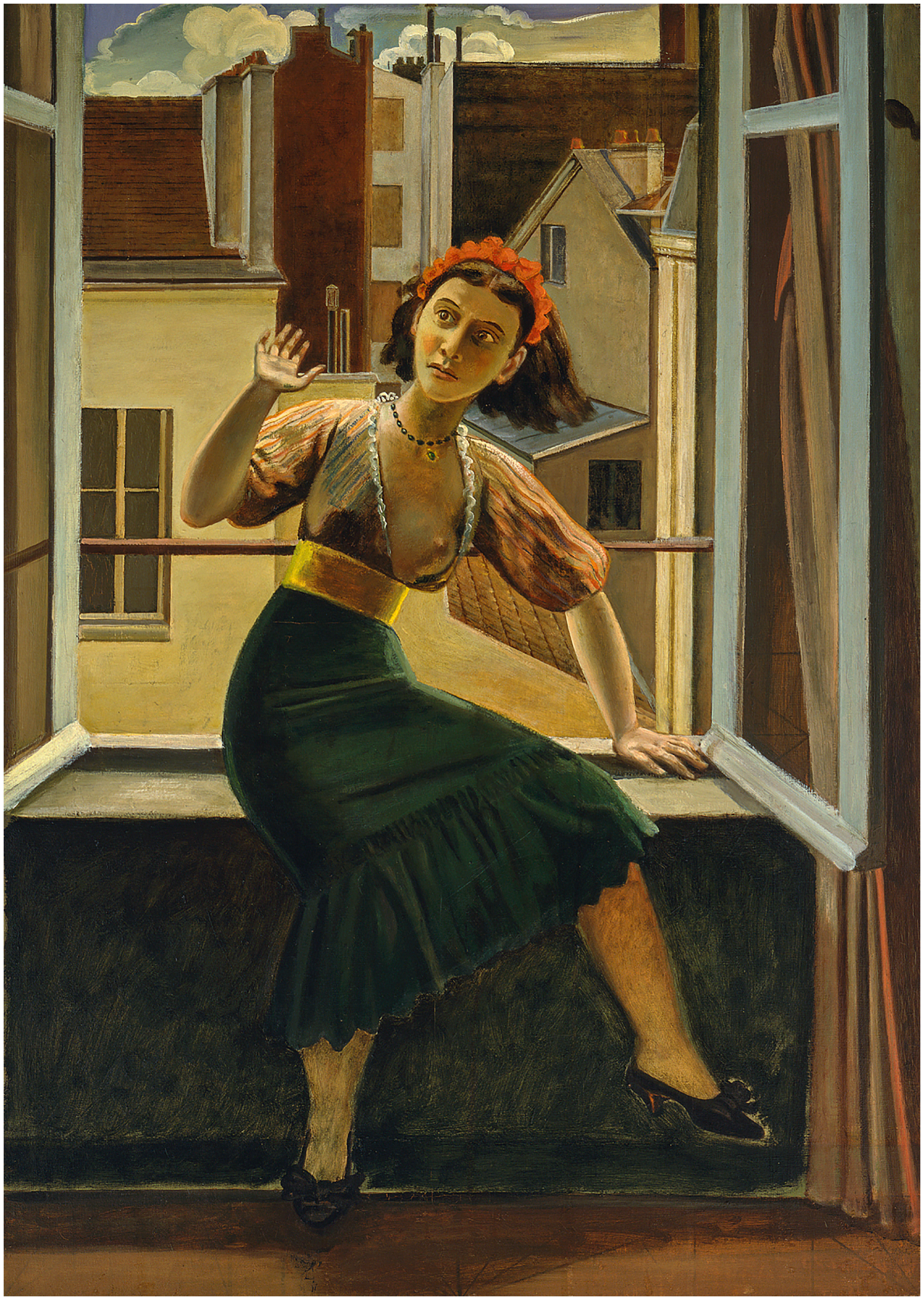
Balthus (1908–2001), La Fenêtre (The Window), 1933. Oil on canvas, framed: 182.9 × 134.9 cm, stretcher: 161.6 × 114.3 cm. Eskenazi Museum of Art, Indiana University 70.62. Copyright Herscovici, London / DACS.
What is more, the flat, naïve realism Balthus used in his 1930s work might be seen to occupy similar cultural ground as the fait divers genre. In the interwar years of ‘returning to order’, such a style was usually reserved for nostalgic representations of French everyday life. Paintings in a slightly rigid, harshly lit realism by the likes of André Derain and Maurice Utrillo promised to represent the traditional bourgeois moral order (Golan, 1995). Likewise this moral order was also the discursive setting of the faits divers as a genre – which, as in Balthus's paintings, is what it upset (Kalifa, 1999). In this sense Balthus offers a parallel in literature to writers like André Gide – a friend and guide for Balthus from an early age – who drew directly on fait divers and so disorientated the reader with a combination of the bizarre and the banal (Maza, 2011: 196–7).
Balthus's semi-naïve realist style was central to the problem that stood out to the critics writing on his Galerie Pierre show. For the problem they found with the ‘étrange … angoissante exposition’ Balthus presented in 1934 was not, in fact, as simple as finding the artist's works ‘morbide’, as art historians typically quote (e.g., Rewald, 2013: 4, quoting Poulain, 1934: 3), or of his dedication ‘au démon de la délectation morose’ (Devau, 1934). Rather, what troubled two of Balthus's very few critics was the inadequacy of his almost artless and semi-naïve realist style to contain the artist's apparent sexual anguish. As the critic Gaston Poulain, wrote: ‘sa technique est simple, son dessin à la fois grossier et appliqué, naïf même ; par contre sa psychologie est celle d’un fanatique, d’un fanatique d’érotomanie. … Son angoisse dépasse son trait’ (1934: 3). And while for Poulain Balthus's sexual anguish exceeded his lines, it is with his tongue firmly in-cheek that André Lhote suggested it is not just the artist's naïve ‘trompe l’œil’ technique that gave these paintings their particular form of precision and rigidity. Rather, Lhote suggests, their style is more shaped by their betrayal ‘d’une obsession sexuelle’, as they register ‘cette confession de certains complexes inquiétants’ (1934: 1045). Disturbing erotic art was not new in the 1930s, particularly as part of defined movements like Surrealism, but within the idiom of semi-naïve realism usually reserved for rustic scenes (examined by Golan, 1995) its motivations seemed difficult to explain on artistic grounds. The result was that Balthus's works seemed like an embarrassing indulgence in personal fantasy that outstripped the artist's technical capacity for expression.
Yet there was also more to their reaction than this. For both Lhote and Poulain also conceded, in their own ways, that the inadequacy of Balthus’s semi-naive style of representation to contain his sexual anguish was also in some way essential – that ‘ces sujets exigent une telle incompatabilité’ (Poulain, 1934). For Lhote, Balthus gives ‘à ses automates passionnés cette précision, cette raideur hystérique, ce hiératisme troublant’, as if his figures’ rigidity and fixed gazes are somehow apiece with the troubling spectacle of seeing ordinary people astonished by events; as if his naïve realism, more precise than life itself, makes his work more dramatic. That is to say, this disbalance between style and content made sense to them. I suggest this is because it ensures that such scenes are consumed as a spectacular hyperreality, much like the various fait divers that took up so many pages of print in this era. It is this paradoxical admission by both critics that means neither Lhote nor Poulain were ultimately as damning of Balthus as art historians generally suggest when discussing the reception of his Galerie Pierre show. And while neither critic gives an explanation as to why they ultimately found something oddly compelling in his bathetic and banal approach to drama, I would suggest it can be understood through the way that Balthus's figurative strategy reconstructs the structure of the fait divers.
What equally stands out in Balthus's Galerie Pierre canvases is a lack of emotional sincerity that contrasts with the drama depicted, and here a similar parallel can be drawn. In La Fenêtre, the girl's body is wooden, her arms stiff, her face expressionless. With its unflinchingly bright lighting and frontally oriented composition, she seems like an awkward and unconvincing actor on a stage. As the critic Waldemar George put it in 1947, the characters in Balthus's paintings seem to mime their roles poorly: ‘ses personnages agissent ou feignent d’agir. Ils miment les sentiments variés qui les agitent’ (George, 1947). Yet this is precisely the oddly sterile banality with which the most bizarre and awful faits divers often played out, and which made them so compelling. Cases like Violette Nozière's were shocking, not because the existence of child abuse was surprising to anyone in the period, but precisely because its events happened to ordinary people, who hardly knew how to act in the face of incredible events. Reading the fait divers sections of newspapers from the 1930s, what is so striking and uncanny is the photographs that accompany them, showing the faces of people involved in these astonishing events, wearing inevitably banal expressions. As a journalist similarly complained about Violette's trial, it would seem badly structured and poorly acted, if only it had been fiction (Maza, 2011: 243–4).
Finally and crucially, the canvases Balthus exhibited in 1934, and many of those he painted later, not only exhibit the certain incongruous banality of the fait divers, but also share the causal isolation that is the fait divers’ hallmark: an apparent contingency and unpredictability, and an irregular, freak nature that makes the scenes depicted astonishing. Whether a girl who falls backwards into an open window with one breast inexplicably bared, or the abusive stripping of a younger child half-naked in broad daylight during a guitar lesson, or the milky, unseeing eyes of the female figure in Alice who does not seem aware of her own vulnerable state of undress, most of his scenes include enough strangeness to encourage their viewers to read their contents as inexplicable one-offs. Only La Rue could seem like a generic enough scene to raise questions about society's toleration for sexual exploitation and abuse. As such Balthus's works elicit their viewer's instinct for a compelling fait divers. They induce their viewer to see them as monstrous and exceptional scenes, disconnected from a bigger picture; to react to them as pure spectacle which would yield no answer to probing social questions.
After 1934: Nobody's daughters
After his 1934 exhibition, Balthus changed his approach. Any dejection he had felt after the Galerie Pierre exhibition was compounded by the rejection of his courtship by the young Antoinette de Watteville (1912–1997), and in the summer of that year he stopped painting for a few months as he suffered a breakdown (Rewald 2013: 4). As the 1930s progressed, his renewed work turned most often to repeated paintings of young girls in interiors, of which the best known is Therèse Dreaming . Typically, the children in these paintings read, sleep, or daydream, and the appearance of small breasts and hairless vulvas is a repeated clear point of visual and narrative focus. Such figures remained the leitmotif Balthus's long career after 1934. This section and the next ask once again how this was tempered by a representational strategy that ensured these works would ultimately receive the accolades they did.
Most crucially, we must confront the fact that the children in Balthus's works do not seem vulnerable or preyed upon. As Mieke Bal has written in defence of Therèse Dreaming , they have ‘enough clout, enough insolence, and enough personality to stand up to intrusive viewers’ (Bal, 2008: 91; within the debates of 2017–18, others such as Elkin, 2017, made similar claims). Across Balthus's work, his solid-limbed young women do indeed seem able to hold their own, even though they are often sleeping or in reverie. This is partly because their absorption or reverie forms part of a composition that in no way acknowledges the beholder's presence, such that there is no sense of voyeurism or predation. They are self-assured because unself-conscious, with no reason to be otherwise. Yet looking more closely at the narrative of these paintings which drives this suggestion of independence raises questions of guardianship that ought to complicate any interpretation.
Balthus's children do apparently fend for themselves: from the mid-1930s onwards, in almost any of his paintings, there is a sense that they live in a world from which parents are banished. Particularly when situated in old, grand château – like Champrovent where he lived from 1940 to 1942, or the Château de Chassy which he bought in 1952 and occupied from 1953 to 1961 – his children seem to live in a world that belongs only to them, their scenery devoid of all reference to concurrent adult life. As with the nonchalant posture of Thèrese Blanchard in Thèrese Dreaming, they recline on sofas and armchairs, and otherwise fill space however they like. There is often a faint suggestion of their living alone in an abandoned château like a character from a children's novel. Like the heroines in classic children's literature, whether Alice's Adventures in Wonderland, Robinson Crusoe, Peter Pan, or the popular nineteenth-century French tale Sans famille by Hector Malot, Balthus's children make their own way without the authority or protection of parents.
When parents do appear in Balthus's œuvre, they do so specifically as limiting forces. In their presence, the childrens’ warm glowing pallor – which, as we will see, Balthus calls an ‘angelic’ quality – turns to grey. This is what is so curious about the portraits of artists Joan Mirò and André Derain with their children, where the fathers seem to domineer over their ashen-faced offspring. In the portrait of Mirò and his daughter, she seems literally to crumple under the weight of her father's hand (Bal, 2008: 76, 80). This is particularly true of fathers; meanwhile mothers and women of fertile age are generally depicted alone, as particularly scrawny, weak, and drab, as in the Portrait de Mme Pierre Loeb (1934). Only once the parents are banished, once the children Balthus paints might be imagined as nobody's daughters, do his children seem to come alive again.
Of course, Éluard's idea of ‘nobody's daughter’ is also how Violette Nozière fantasised her own existence: without parents, without origin, daring, aware of her sexual desirability, and capable of holding her own. Yet it is surely part of the psychic and social conditions that might foreground any critical interpretation of Balthus to recall that this is precisely why society today protects children even from their own fantasies. For a child of twelve or thirteen might appear highly independent, but it comes as no surprise that in the end, both at Violette's interrogation and her trial, the young woman broke down, sobbing and calling out for her mother (Maza, 2011: 118, 240).
Balthus's young models may have in reality longed to be nobody's daughter, just as Violette Nozière did. His depictions of them, however, are paint on canvas. As Jacqueline Rose's book on children's literature reminds us (1984: 1–11), children depicted by adults do not harbour children's fantasies but rather are fantasies, and to think otherwise is to forget that the relationship between the sign and signified is always arbitrary, even if realism tries to persuade us otherwise. If Balthus's children seem to be without need of a guardian, this can be for no reason other than to fulfil an adult's desire.
Balthus's painterly surfaces
Just as the nonchalance and apparent independence of the children depicted in Balthus's paintings has inevitably shaped his reception, so too has the way in which those children are painted. This final section examines Balthus's painterly surfaces after 1934, which are above all known for being highly restrained. With a tightly limited palette, they indulge in no commanding flourishes, no dissolving and fragmenting of light, and innumerable critics have praised them as redolent of late Italian renaissance ‘masters’ (e.g., Bonnefoy, 1959 [1957]: 40, 49–50). But as I will argue, this surface calm plays a crucial role in preempting and shaping the moral questions that his works might raise, by placating both the viewer, and perhaps the artist himself.
First, though, it is necessary to return to Balthus's explicit and repeated disavowal that his depictions of children (including adolescents) after 1934 are in any way erotic. He has always insisted that he saw them ‘comme des anges. Des êtres venus d’ailleurs, du ciel, d’un idéal’ (Balthus, 2016: 71), and in his memoirs and interviews, he repeatedly cites his intention of capturing ‘mes anges dormant à moitié […] ces jeunes filles abandonnées’ (Balthus, 2016: 136). Such protestations have caused writers on the artist to hesitate over the question of the erotic in Balthus, as if his words conflict with his canvases. Yet it must be pointed out that there is no puzzle here at all: this fetishization of childhood innocence is precisely what his pictures should lead us to expect. Hebephilic desire towards children who are in early adolescence is, after all, often not felt in spite of the innocence of children, but is precisely directed at the innocence and purity that they embody. Balthus's insistence that it is ‘leur lente transformation de l’état de l’ange à celui de la jeune fille qui me préoccupe’ is far from the contradiction of the troubling aspect of his work that has long been assumed (Balthus, 2016: 100). To the contrary, his almost obsessive fixation upon pubescent females fetishized as angelic fulfils, psychologically speaking, the definition of what he intends to deny.
In light of this, it is significant that Balthus's surfaces seem to glow in certain places, particularly on the arms, legs, and faces of his young subjects. How Balthus achieves this effect is clear from studies in which the base layer of orange he has used across the entire canvas is visible, burning like embers underneath the surface (as for example in Étude pour ‘Le Salon’ , 1941). In finished works where young girls lounge in grand rooms from which adults have been banished, like Therèse Dreaming or Le Salon (1942), this orange ground gleams through their smoothly brushed skin. Their knees, near the centre of the canvas, emanate a warm sheen, and their cheeks seem to radiate heat. The surfaces of these works show that this is not a mere happenstance of process: often, especially in works from the late 1930s and 1940s, the gleaming skin is seemingly painted with a glossier oil, mixed with a higher oil content than the relatively matt paint used as the top layer for other areas of the picture. This might be read as an attempt to literalize what Balthus sees as the angelic quality that he aimed to imbue in his young subjects. Indeed he tells us so in his memoirs, reflecting that: ‘J’ai consacré toute ma vie à atteindre cette lumière, celle sacrée qui nimbe les crépuscules et les aubes … cette lactance que je crois avoir atteinte dans La Phalène par exemple ou dans La Jeune Fille à la chemise blanche’ (Balthus, 2016: 251; also discussed in Whelan, 2023: 23).
This twilight glow to which Balthus refers is, for him, a heavenly light exuded by the girls he repeatedly calls his ‘angels’, and one which also has a darker aspect. As he directly explains: ‘lorsque je parle des anges, et de la grâce troublante de certaines de mes jeunes filles, faudrait-il encore ne pas oublier l’ange le plus éblouissant de lumière, déchu et splendide, Lucifer! Le trouble adolescent des corps de mes jeunes filles révèle cette ambiguité: lumière des ténèbres et lumière des deux’ (Balthus, 2016: 276–7). In short, when the limbs and faces of Balthus’ models glow and shine, we might read this as a sign of bodies fetishized to the point of being reified as sacred specifically in virtue of their adolescence – or ‘par la tension de leur chair’, as the artist himself has claimed (Balthus, 2016: 254).
Yet, despite the warm-glowing skin of his figures and the warm-toned ground, from the late 1930s onward Balthus's canvases increasingly exude the physically cool quality of a stone wall in shade on a hot day. This is not a metaphor, but rather a description of a specific quality that Balthus takes from his favoured locations for his figure studies: old buildings with unadorned walls. This began with Champrovent in 1940, then in 1953 he borrowed money to buy the fourteenth-century Château de Chassy in Burgundy, and later still he bought the Castello di Montecalvello, always leaving thick, bare stone walls undecorated to serve as backgrounds (Rewald, 2013: 44). Taking these walls as backgrounds, Balthus aligns them with the frontality of his paintings, collapsing the canvas support against his subject. He even uses his own scumbling brushmarks to represent the paint which thinly coats the wall behind the figures, as if turning his entire canvas into plaster (this happens in too many works to enumerate, arguably beginning with Therèse sur une banquette , 1939). Combined with the shallow depth of space in his canvases (discussed in Bal, 2008: 44–57), the overwhelming effect is that his paintings do not just depict but embody the solidity and cool of an old stone building.
It is often said that Balthus's surfaces became stucco-like by 1961, when the artist moved to Rome, but well before that date his surfaces become increasingly matt and rough, taking on the texture of plaster. Combined with a fundamentally cool palette, there is a sense of cold plastered stone that permeates his surfaces, from at least his Trois sœurs series from the 1950s. In very many works, the surface is thickly impastoed, with an opaque and almost uniform mass of paint. Rather than stroke it out, Balthus deliberately left it to congeal and wrinkle – something usually avoided by painters through careful combination of various thinners, oils, and resins. In later works, the impastoed matt paint becomes so thick that due to sheer weight it visibly threatens to crack off the canvas, like an old plastered wall.
Balthus's surfaces after the 1930s thus amount to a cooling off of their subject matter, and we need not look far for what might require cooling off. To preserve the cherished innocence of the warm bodies that so interested him, he directly flattens them into cold stone, while nonetheless ensuring the glow that perhaps relates to his interest in seeking ‘une forme de la lumière intérieure, spirituelle, lumière des anges’ (Balthus, 2016: 279). In this way, his works rhetorically insist that they are holding off from the same interested warmth or glow that they offer up.
In 1934, Balthus's critics complained that his style could not contain his erotomania, but in the years that followed containing desire is precisely what his style seems designed increasingly to do. It could almost appear as if the artist is painting bodies that simply happen to be in reality warm and tender, and has approached them with nothing but a cool and classical sobriety. This re-enacts what Balthus himself has explicitly urged his critics to believe, insisting that any eroticism found in his work is the viewer's responsibility, as if he has merely painted what he sees. In this way, Balthus's late works thus once again count on the viewer forgetting that the figurative painter does not merely depict the world as they see it, but makes it.
Conclusion
Clearly what constitutes eroticism is not straightforwardly a matter of an image's content, but a matter of the effect it seeks to elicit. To some extent, therefore, to call any image ‘erotic’ is to speak both of it and its viewer – but not necessarily to require the viewer's total collusion. Mieke Bal has suggested that Balthus's paintings are erotic because they provoke their viewer into fantasizing along (2008: 116), but I suggest they do quite the opposite. For their fantasies are not fully transparent to their viewer, and the viewer is deterred from reading them as fantasies at all. They contain a calculated rift between what appear to be the artist's desires in making the image, and their effect. A cool quality serves in Balthus's work, throughout his career, as a foil for the warmth of personal interest. In his paintings in the 1930s this was the awkward, emotionally flat and banal quality of faits divers, and as his work developed this same cold quality became increasingly a matter of surface.
Such elusive desire could be argued to produce an image that is all the more erotic – as Barthes says, the erotic must be partly unlocatable (1981 [1980]: 41–2) – but this is not the case, at least not for me. For what can be glimpsed first in the emotionally flat banality of the fait divers-style spectacle, and later behind the seeming independence of his subjects and his cold painted surfaces, is not the thing that is being desired – for that is already exposed to view – but rather desire itself, of a form most viewers do not share.
Balthus was able to become a major artist during the twentieth century not in spite of moral objections to his work, nor because of them, but in their near absence. That absence was made more possible by the ambiguity and complexity of social and cultural attitudes to the sexualization of children, and to sexual violence towards young people, in mid-twentieth-century France. But it is also encouraged by the works themselves. If the artist's desire threatened to be all too obvious in his practice, then in 1934 his works resolved this by turning it into a consumable spectacle; after 1934, they contained it. Crucially, Balthus's works offer a means to better understand the moral ambiguities of his time, although only if we who write on him are willing to disambiguate a little ourselves.
