




Abstract
Gender differences in occupational interests are often assumed to reflect sex differences in empathizing or systemizing preferences. Do such essentialized explanations lead people to provide gender-biased learning affordances that constrain women’s career interests? In Study 1 (N = 292), North American STEM professionals endorsing a biologically essentialized (vs. sociocultural) explanation for gender differences in occupational interests provided women (men) with more empathizing (systemizing) learning affordances in a mock management task. Study 2 replicated these gendered affordances by experimentally manipulating essentialized explanations (N = 379; participants were North American men with management experience in male-dominated fields). In Study 3, North American undergraduate women (N = 300) who received gendered learning affordances reported greater interest in, and possible alignment with, empathizing work assignments, whereas those who received countergendered affordances reported greater interest in, and possible alignment with, systemizing assignments. These results reveal that gender-essentialist beliefs can foster self-fulfilling gender gaps in occupational interests.
Despite increasing gender equity in many Western societies, gender segregation persists across occupations (Charles & Grusky, 2004; Tonoyan et al., 2020; Zhu & Grusky, 2022). If women and men freely choose their careers, what explains these gender differences in occupational interest? Some favor biologically essentialist explanations, asserting that men’s and women’s occupational self-segregation reflects innate sex differences in interests (Baron-Cohen, 2002, 2004; Donovan et al., 2024). Others point to sociocultural forces leading to different ways of socializing boys and girls (Butler, 1990; Klysing, 2020; Schudson & Gelman, 2023). We examined the interplay between these two, proposing that people’s belief in biological essentialism creates a sociocultural self-fulfilling prophecy. Studies 1 and 2 tested the hypothesis that those who favor a biologically essentialist account over a sociocultural account offer more biased learning opportunities to men versus women. Study 3 examined whether these biased learning affordances constrain women’s career choices and self-views.
Explanations for Gender-Segregated Interests
Men’s and women’s occupational choices are linked to their different preferences for jobs involving people versus things (d = 0.93; Su et al., 2009; see also Ceci & Williams, 2011). The explanation for these gendered interests is contested among both scientists and laypeople (e.g., Baron-Cohen, 2004; Wood & Eagly, 2012). For example, empathizing-systemizing theory (Baron-Cohen, 2004) proposes that women are innately interested in empathizing (tuning into other’s feelings or thoughts) and men are innately interested in systemizing (analyzing underlying rules governing systems). Other perspectives focus on how socialization can shape interests (Croft et al., 2015; Lytton & Romney, 1991). For example, endorsing stereotypic gender gaps in STEM interest predicts young girls’ weaker interest in STEM (Master et al., 2021).
In actuality, biological and social factors likely interact to predict gender differences (Wood & Eagly, 2012), but people vary in the explanations they prefer (Lee et al., 2020). For example, experts in psychology believe that gender differences in systemizing and empathizing reflect socialization patterns more than genetic advantages (Aday et al., 2023), yet a sizable minority of Americans attribute gender differences in interests to biology more than society (Parker et al., 2017). Essentialist explanations for gender differences are endorsed more strongly among men (Lee et al., 2020), who are often gatekeepers in STEM fields (Vargas et al., 2023). Thus, we investigate the consequences of these biologically essentialist views for women’s STEM-based training.
Essentialism and biased affordances
Biological essentialism is the view that entities (such as men and women) differ in fundamental, biological, determinative ways (Gowaty, 2018). 1 These biologically essentialized explanations for why group differences exist are distinct from stereotypic beliefs that group differences exist (Brescoll & LaFrance, 2004). Biologically based explanations can increase intergroup biases by reifying identity-based distinctions (Bailey & Knobe, 2024; Bastian & Haslam, 2006, 2008; Chen & Ratliff, 2018; Mandalaywala et al., 2018), but they can also decrease prejudice by minimizing moral blame for those differences (Bailey et al., 2021; Haslam et al., 2002; Kvaale et al., 2013; Peretz-Lange, 2021). More specific to gender, experimental inductions that focus people on biological (vs. sociocultural) explanations increase gender stereotyping of others (Brescoll & LaFrance, 2004) and oneself (Coleman & Hong, 2008), with implications for women’s math performance (Dar-Nimrod & Heine, 2006).
Although it has been argued that biological essentialism can fuel gender-based self-fulfilling prophecies (Fine, 2012), past research has not tested this hypothesis. We theorized that endorsing biological (vs. sociocultural) explanations causes people to provide biased learning affordances to women and men. By reifying differences as immutable, an essentialist frame should prompt people to match men and women with opportunities believed to fit their interests, rather than helping them develop new interests. This rationale does not implicate stereotyping as the mediator between essentialism and learning affordances. Instead, when people endorse stereotypes about gender differences in interest, those who attribute these differences to biological essentialism (vs. sociocultural explanations) will match learning opportunities to those stereotyped interests.
Biased affordances constrain women’s outcomes
We integrated work on psychological essentialism with self-fulfilling prophecy theory to examine whether biased learning affordances provided by biological essentialists constrain women’s choices, interests, and possible selves. Self-fulfilling prophecy theory suggests that people act in ways that confirm others’ expectations (Hollingshead & Fraidin, 2003; Jussim, 1986; Merton, 1948; Skrypnek & Snyder, 1982), but research has yielded small and inconsistent effects (Jussim & Harber, 2005; Jussim et al., 1996; Rosenthal, 2003). Whereas past research often focuses on conformity to stereotype-based expectations during interactions, we focused on the environmental affordances perceivers provide. For example, in Madon et al. (2018), perceivers provided men and women with stereotypically gendered magazines they could choose to read, which magnified observers’ tendency to perceive the magazine readers in gender-stereotypical ways. We examined similar patterns of gendered affordances in the consequential domain of job training and examined effects on women’s own self-views. If biological essentialists communicate gendered expectations by providing women with a constrained set of training opportunities, women will not only experience realistic constraints on their options but might also internalize these expectations into their own self-views and occupational interests.
Overview of studies
Three studies tested the causal process depicted in Figure 1. First, we tested whether measured (Study 1) and manipulated (Study 2) essentialized explanations for gender differences in interests predict gendered situational affordances, as mediated by perceivers’ intention to match or shape targets’ interests. Second, Study 3 employed a quasi–double randomization design (MacKinnon et al., 2007) to test whether targets who receive biased affordances (on the basis of effect sizes in Study 1) endorse different interests and self-views than those who receive nonbiased affordances. We tested these questions in a managerial role-playing task in which STEM professionals assigned interns to client-facing and technical roles in a tech company. All studies received approval from the University of British Columbia Research Ethics Board (No. H22-03011 for Studies 1 and 2 and No. H22-03679 for Study 3). All exclusions, hypotheses, and analyses were preregistered, with minor deviations from preregistrations summarized in Table S14 in the Supplemental Material available online (materials, data, and code are available at https://osf.io/zw3ua).

Self-fulfilling process through which perceivers’ essentialized beliefs shape targets’ interests via situational affordances.
Research Transparency Statement
General disclosures
All study materials, data, and analysis scripts are available for reuse under a Creative Commons CC0 license provided that scholarly credit is provided by citing this article.
Study 1 disclosures
Study 2 disclosures
Study 3 disclosures
Study 1
Study 1 (preregistered at https://osf.io/abw5u) tested whether people’s tendency to essentialize gender differences in interests predicts the affordances they provide. We also distinguished this from the stereotypic belief that gender differences in interests or abilities exist. STEM professionals reported their explanations for gender differences in interests before completing a mock management task requiring them to assign women and men interns to teams responsible for empathizing or systemizing tasks.
Participants and procedure
We preregistered collecting a sample of at least 291 Canadian and American STEM professionals from Prolific Academic to provide 90% power to detect an effect size (r) of .41 (estimated from the relationship between gender essentialism and sexist attitudes in recent research; Lee et al., 2020); we built in a 15% exclusion rate. Data were collected from 302 participants; 9 of these were excluded because they completed no dependent variables. Additionally, participants were automatically screened out at the beginning of the survey if they failed a basic attention check asking them to select “Other” and type a specific phrase. One participant selected “Other,” passing the automatic screening, but typed an incorrect phrase and was therefore excluded from analyses (see the Supplemental Material for details). The final sample size was 292—81 women, 205 men, 5 nonbinary, 1 gender not provided; 22 African American, African, or Black; 29 Hispanic/Latinx/Central 2 or Spanish origin; 5 American Indian, Indigenous, or Alaska Native; 1 Native Hawaiian or Pacific Islander; 3 Middle Eastern or North African; 39 East Asian, 14 South Asian, and 8 Southeast Asian; 188 White; and 3 another ethnicity (participants could select multiple options). Though we did not select participants on the basis of gender, this sample was approximately two thirds men and one third women, reflecting the gender distribution of STEM professionals on Prolific Academic.
Participants were asked to imagine that they had been hired as a project manager at a fictitious tech company (“Pixlio”) and that they had completed a manager onboarding task in which they first read and answered questions about two articles. To justify asking questions about why gender differences in interest occur, we selected one article that described that such differences do occur and can explain women’s underrepresentation in technology (see Fig. S3b in the Supplemental Material). In this way, all participants were given the same stereotypes about interests, allowing us to focus on their varying explanations for those differences. Participants then completed measures of biological essentialism (α = .95) and sociocultural explanations (α = .87, r = −.41, p < .001). Each scale included four items from Lee et al. (2020) related to biological essentialism (e.g., “Many forms of gender-related interests are biologically determined”) and sociocultural explanations (e.g., “The social background a person comes from is strongly reflected in the development of the person’s gender-related interests”). We added one item to each of these four-item measures to tap into perceptions of immutability tied to biological essentialism and sociocultural explanations. See the Supplemental Material for the full materials.
Intern assignment task
Next, participants learned about an intern assignment task (see the Supplemental Material for details) using the following cover story: A local university has partnered with Pixlio as part of a program for first-year students. The program places students in a series of 4-week internships to get a variety of work experience across different fields. Students in this program come from a variety of backgrounds and are not necessarily interested in tech. Six students from this program are starting an internship with Pixlio this week.
On each of 16 trials, participants were asked which of two interns to assign to a given team (N = 8 man-woman critical trials; N = 8 same-gender filler trials; see Table S2 in the Supplemental Material). Participants were randomly assigned to see one of two possible sets of teams that each included four empathizing and four systemizing teams (see the sample set in Fig. 2; results are robust to controlling for set). We developed and pilot tested these team descriptions by using key terms that appear in definitions of empathizing and systemizing used in Baron-Cohen and colleagues’ research (Baron-Cohen, 2009; Baron-Cohen & Wheelwright, 2004; Baron-Cohen et al., 2003; Greenberg et al., 2018; Wakabayashi et al., 2006; Wheelwright et al., 2006). Across two pilot studies (detailed in the Supplemental Material, see Figs. S1 and S2 in the Supplemental Material), we then validated that participants perceived these descriptions as realistic and reflective of empathizing and systemizing as intended. Each intern (3 men, 3 women; see Fig. S4b in the Supplemental Material) was displayed with a photo and a quote about the internship program. After completing the task, participants rated their task strategy (i.e., an intention to match teams to interns’ natural interests or to help interns develop new interests, both rated on 7-point scales, r = .62, p < .001). At the end of the study, participants completed checks of comprehension and suspicion and a demographic survey; they were thanked, debriefed, and compensated for their participation.
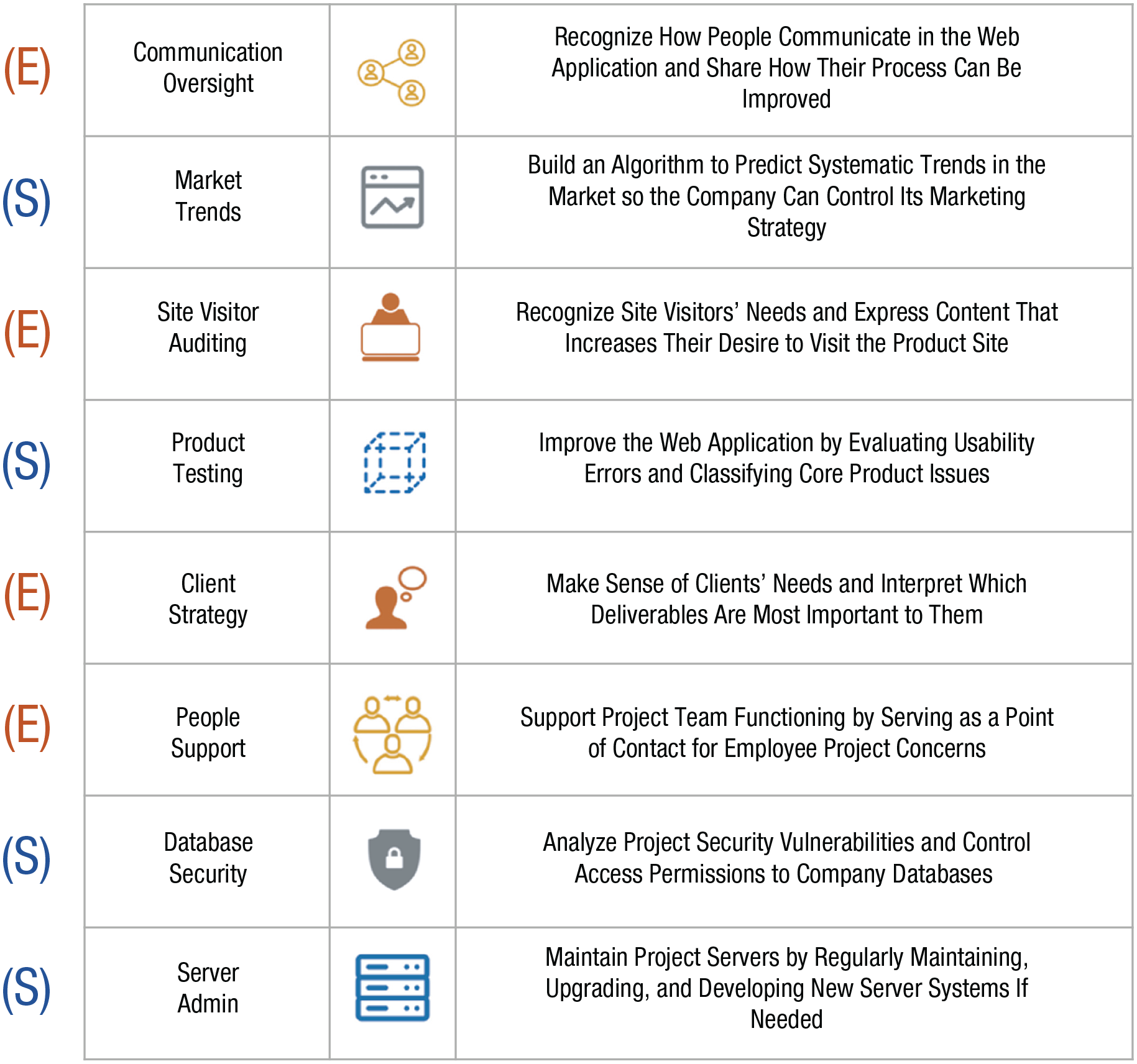
Sample stimuli set used in Study 1 for empathizing (E) and systemizing (S) teams.
Results
Gendered affordances were predicted by endorsement of essentializing beliefs
To test our primary hypothesis, we conducted a binomial regression model predicting the odds of selecting a woman (vs. a man) intern from participants’ primarily biological explanation (operationalized by subtracting sociocultural explanations from biological essentialism, then standardizing scores), moderated by team type (empathizing vs. systemizing). 3 Confirming predictions, participants provided gendered learning affordances, populating empathizing intern teams with more women (than men) compared with systemizing teams, odds ratio (OR) = 2.10, 95% confidence interval (CI) = [1.77, 2.47], p < .001.
In the same model, explanation significantly interacted with team type (empathizing vs. systemizing) to predict learning affordances, OR = 0.63, 95% CI = [0.53, 0.74], p < .001 (Fig. 3). Endorsing biological essentialism more strongly than sociocultural factors predicted providing more gendered affordances (giving more empathizing team assignments to female interns, OR = 1.23, 95% CI = [1.09, 1.40], p = .001, and more systemizing team assignments to male interns, OR = 0.78, 95% CI = [0.69, 0.87], p < .001). When modeled separately, the predictive effects of biological essentialism and sociocultural factors were both significant (see Table S4 in the Supplemental Material). Moreover, effects were robust to controlling for participants’ perceived gender differences in ability and interest as well as participant gender (see Table S5 in the Supplemental Material). Thus, effects are not driven by gender stereotypes about differences in men’s and women’s abilities or interests, but by people’s beliefs about the essential nature of differences in interest.
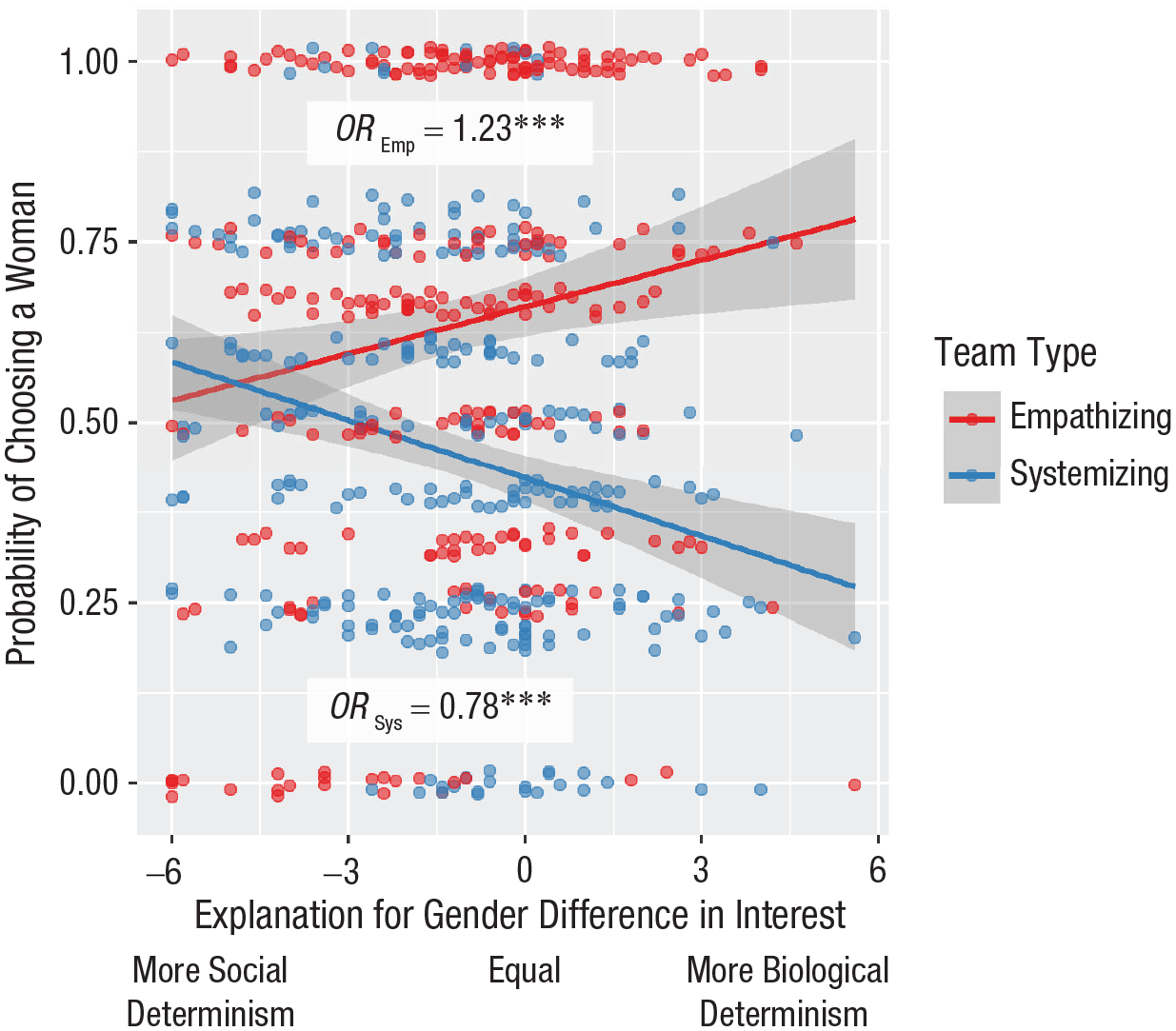
Relationship between the explanation for gender difference in interest and the probability of choosing a female intern, moderated by team type. Bands around regression lines represent 95% confidence intervals, and points are jittered to increase the visibility of overlapping data (Study 1). OR = odds ratio.
Essentialized explanations predict affordances as mediated by assignment strategy
Finally, moderated mediation analyses supported our secondary hypothesis of a significant indirect effect of task strategy on team assignment as moderated by team type (for empathizing: a * b = .005, p < .001, for systemizing: a * b = −0.006, p < .001; see Fig. S5 in the Supplemental Material). Participants who endorsed a biological (vs. social) explanation for interest differences matched interns to inherent interests (vs. fostering new interests; a path = 0.16, p < .001), which in turn, predicted choosing more women for empathizing teams (b path = 0.03, p < .001) and more men for systemizing teams (b path = −0.04, p < .001).
Effects of participant gender
Participant gender was not a focal variable in this study, and thus we did not preregister analyses by gender. However, compared with a combined subsample of women (n = 81) and nonbinary participants (n = 5), men (n = 205) endorsed biological essentialism more strongly than social factors, t(158.14) = 4.24, p < .001, d = 0.55 (see Table S6 in the Supplemental Material). This effect was unchanged by excluding nonbinary participants from analyses (see Table S5 in the Supplemental Material); we grouped women with nonbinary participants because their average scores were more similar to women’s than to men’s (see Table S6 in the Supplemental Material). Notably, participant gender did not moderate the relationship between biological (vs. sociocultural) explanations and gendered affordances, OR = 1.03, 95% CI = [0.70, 1.51], p = .888.
Study 2
Study 1 revealed that, among STEM professionals, endorsing gender-essentializing beliefs predicted providing more gender-biased learning affordances to women and men interns, as mediated by an intention to match interns to their presumed inherent interests. In contrast, those endorsing sociocultural explanations assigned women and men to similar teams. To establish causality, Study 2 (preregistered at https://osf.io/9nf56) examined whether participants who were randomly assigned to receive a persuasive case for a biological or social explanation for gender differences in STEM interest would provide more gendered affordances to men and women. Study 2 recruited only men because of their greater availability, given our recruitment criteria, and because men’s more equivalent endorsement of biological essentialism and sociocultural explanations (observed in Study 1) might make them more sensitive to an experimental induction.
Participants and procedure
We preregistered collecting a sample of at least 414 men with management experience in male-dominated fields (e.g., engineering, construction). This sample size would provide over 80% power to detect the effect of biological essentialism versus sociocultural explanations on team assignment, assuming a 10% exclusion rate and a small-to-medium effect size (e.g., d = 0.30) similar to that found in Study 1. Data were initially collected from 421 people. We excluded data from 17 women and 1 nonbinary individual who participated despite our men-only eligibility requirement as well as from two individuals who completed no dependent variables. As preregistered, participants were automatically screened out at the beginning of the survey if they failed the same attention check used in Study 1 in which they had to type a specific phrase (all participants passed this attention check).
In Study 2, we adapted the manager onboarding task so that participants were randomly assigned to read and summarize only one article ostensibly selected from a larger pool of topics. Depending on condition, participants read a summary of scientific evidence supporting either a biological or sociocultural explanation for gender differences in interests. Pilot testing demonstrated that these articles successfully manipulated biological versus sociocultural explanations and were perceived as believable, persuasive, and clear (see the Supplemental Material). These articles were similar to those successfully used to manipulate biological essentialism versus sociocultural explanations for gender differences in previous research (e.g., Brescoll & LaFrance, 2004; Dar-Nimrod & Heine, 2006).
We excluded an additional 22 participants who failed twice to correctly answer comprehension checks about the article they read, leaving a final sample size of 379—37 African American, African, or Black; 34 Hispanic/Latinx/Central or Spanish origin; 8 American Indian, Indigenous, or Alaska Native; 8 Middle Eastern or North African; 27 East Asian, 27 South Asian, and 4 Southeast Asian; 268 White; and 1 another ethnicity (participants could select multiple options). After these comprehension checks, participants responded to abbreviated measures of biological essentialism (2 items; r = .86) and sociocultural explanations (2 items; r = .82) and completed the intern-assignment task as in Study 1.
We reduced the number of total trials from 16 to 8 (four mixed-gender critical trials, four same-gender filler trials) and used the four teams that showed the strongest effects in Study 1 (two empathizing teams: Client Strategy, People Support; two systemizing teams: Database Security, Server Admin; see Table S1 in the Supplemental Material). After the task, participants rated their task strategy, perceived gender differences in ability and interest, and article perceptions. They provided demographic information and responded to a suspicion check before being debriefed and compensated for their time. For further information about the design and implementation of Study 2, see the Supplemental Material.
Results
Essentialism priming changed endorsement of biological essentialism versus sociocultural explanations
Although not preregistered, initial analyses confirmed that the article manipulation was effective; men in the biological-article condition (vs. the social-article condition) were more likely to endorse biological essentialism, t(356.04) = 12.72, p < .001, d = 1.30, 95% CI = [1.08, 1.53], and less likely to endorse sociocultural explanations, t(339.27) = −9.54, p < .001, d = −0.99, 95% CI = [−1.20, −0.77]; see Table S7 in the Supplemental Material. In addition, those primed with biological (M = 0.68, SD = 1.72) versus social (M = 0.16, SD = 1.75) explanations were more likely to prefer a strategy of assigning teams to match interns’ natural interests (vs. to foster new interests), t(376.90) = 2.96, p = .003, d = 0.30, 95% CI = [0.10, 0.51].
Essentialism priming affected gendered affordances
We conducted a binomial regression model predicting the odds of selecting a female intern (vs. a male intern) from article prime (biological vs. social), moderated by team type (empathizing vs. systemizing). Replicating Study 1, participants provided gendered affordances, populating empathizing (vs. systemizing) teams with more women than men (collapsing across article prime), OR = 5.08, 95% CI = [4.09, 6.34], p < .001.
In addition, article prime interacted with team type to predict affordances, OR = 0.50, 95% CI = [0.32, 0.77], p = .002 (Fig. 4). Those primed with a biological (vs. social) explanation afforded fewer systemizing opportunities to women than men, OR = 0.64, 95% CI = [0.47, 0.87], p = .004. Although in the predicted direction, article prime did not significantly affect affordances for empathizing teams, OR = 1.28, 95% CI = [0.94, 1.75], p = .117.
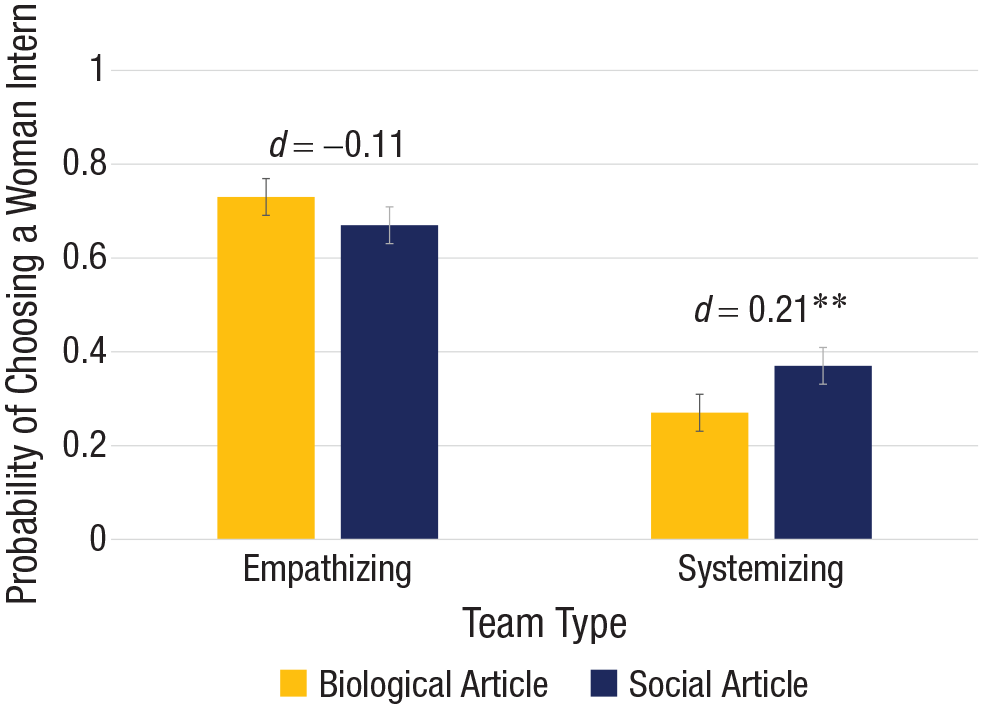
Probability of choosing a female intern by condition and team type. Error bars represent 95% confidence intervals (Study 2).
Essentialized explanations predict affordances as mediated by assignment strategy
Replicating Study 1, a moderated mediation analysis supported our secondary hypothesis that the relationship between article prime and intern choice was mediated by task strategy and moderated by team type (empathizing, a * b = −0.02, p < .001; systemizing: a * b = 0.03, p < .001; see Fig. S7a in the Supplemental Material). Participants primed with a biological (vs. social) explanation for interest differences reported trying to match interns to inherent interests (vs. fostering new interests; a path = −0.53, p < .001), which in turn was related to assigning more men to systemizing (b path = −0.05, p < .001) and more women to empathizing teams (b path = 0.04, p < .001). An additional preregistered moderated mediation model with personal endorsement of biological essentialism versus sociocultural explanations as the mediator yielded an indirect effect for systemizing but not empathizing beliefs (see Fig. S7b in the Supplemental Material).
Study 3
Study 2 established that essentialist explanations for gender differences in STEM interest causally shape the learning affordances men provide. Study 3 (preregistered at https://osf.io/73tfz ) tested whether these affordances, when provided to women, shape women’s interests and self-views. Playing the role of interns, undergraduate women learned about the mock internship task and received a (randomly assigned) set of either gendered or countergendered team recommendations. We assessed how merely receiving these recommended team assignments not only constrains women’s learning experiences but also shapes their interests and possible selves (Markus & Nurius, 1986).
Participants and procedure
We recruited 300 first- and second-year undergraduate women from Canada or North America using Prolific. They received partial course credit or £2.15 to complete an online study—26 African American, African, or Black; 30 Hispanic/Latinx/Central or Spanish origin; 2 American Indian, Indigenous, or Alaska Native; 12 Middle Eastern or North African; 73 East Asian, 32 South Asian, and 18 Southeast Asian; 117 White; and 3 of another ethnicity (participants could select multiple options). We powered this study to provide over 80% power to detect a small to medium effect (d = 0.35). As in Studies 1 and 2, participants were automatically screened out if they failed an attention check in which they had to type a phrase. All participants typed this phrase correctly, so no participants were excluded.
Participants imagined participating in a 4-week internship at a fictitious tech company, “Pixlio.” They learned that a project manager would first use an intake survey to create a set of recommended team assignments for them to choose from (this design feature was deceptive; participants were always randomly assigned to receive either a set of gendered or countergendered teams). The intake survey included 16 items assessing work style (Individual Work Performance Questionnaire; Koopmans et al., 2013) and personality (Ten-Item Personality Inventory; Gosling et al., 2003; see the Supplemental Material). Although the project manager ostensibly created recommended assignments, participants completed baseline measures of their interest in the same four project teams used in Study 2 as well as their possible selves and interest in working for the company (adapted from Brown & Diekman, 2010).
Participants were then presented with 16 recommended teams structured into eight forced-choice trials. On each trial, participants chose between two teams. This procedure ensured that participants thought about the teams, but we also assumed that choosing among constrained options might accentuate resultant effects on self-views. Similar to Madon et al. (2018), we created stimuli sets that reflected actual affordance data from participants in Study 1 who were high (≥ 2 SD; stimuli set for gendered condition) or low (≤ 2 SD; stimuli set for countergendered condition) on biological versus social explanations (see Table S8 in the Supplemental Material for details). Thus, depending on random assignment, women received a team set that included mostly gendered teams (12 empathizing, 4 systemizing, N = 149) or countergendered teams (6 empathizing, 10 systemizing, N = 151).
After making their team choice selections (one of our secondary dependent variables), participants received a visual summary of their original recommended teams and completed our primary posttask dependent measure—interest in each of the teams. They also completed another secondary measure, empathizing and systemizing possible selves (“I could see myself in a role working with [emotions and people / systems and things] at Pixlio”), and an exploratory measure, willingness to stay at Pixlio after the internship (all rated on 7-point scales; see the Supplemental Material for details on all measures). Finally, participants completed a suspicion check, measures of trait empathizing and trait systemizing, measures of gender expression, and demographics.
Results
For team choice, interests, and possible selves, we first computed difference scores to capture women’s relative preference for systemizing (S) over empathizing (E): ES = S − E (positive scores = a preference for systemizing; negative scores = a preference for empathizing).
For ease of interpretation, we present t tests and d scores, but see Table S10 in the Supplemental Material for the preregistered regression analyses that yield equivalent results.
Gendered affordances constrained women’s choices
Recall that women in the gendered condition were afforded more empathizing than systemizing team selections (12 empathizing, 4 systemizing), whereas women in the countergendered condition were afforded more systemizing than empathizing team selections (6 empathizing, 10 systemizing). As a result, the possible range of ES difference scores (ES = S − E) in the gendered condition was −8 (all possible empathizing selections made) to 0 (all possible systemizing selections made), whereas the range in the countergendered condition was −4 (all possible empathizing selections made) to 8 (all possible systemizing selections made). Reflecting these constrained team choices, women who received gendered (vs. countergendered) learning affordances selected significantly more empathizing than systemizing teams, t(262.94) = −10.98, p < .001, d = −1.28, 95% CI = [−1.53, −1.03] (see Fig. 5 and Table S9 in the Supplemental Material). Tests of these difference scores against zero within each condition revealed that women who received gendered affordances selected more empathizing teams (M = −5.19, SD = 3.36), t(147) = −18.77, p < .001, d = −1.54, 95% CI = [−1.77, −1.30], whereas women who received countergendered affordances selected empathizing and systemizing teams equally (M = 0.15, SD = 4.88), t(148) = 0.37, p = .712, d = 0.03, 95% CI = [−0.13, 0.19].
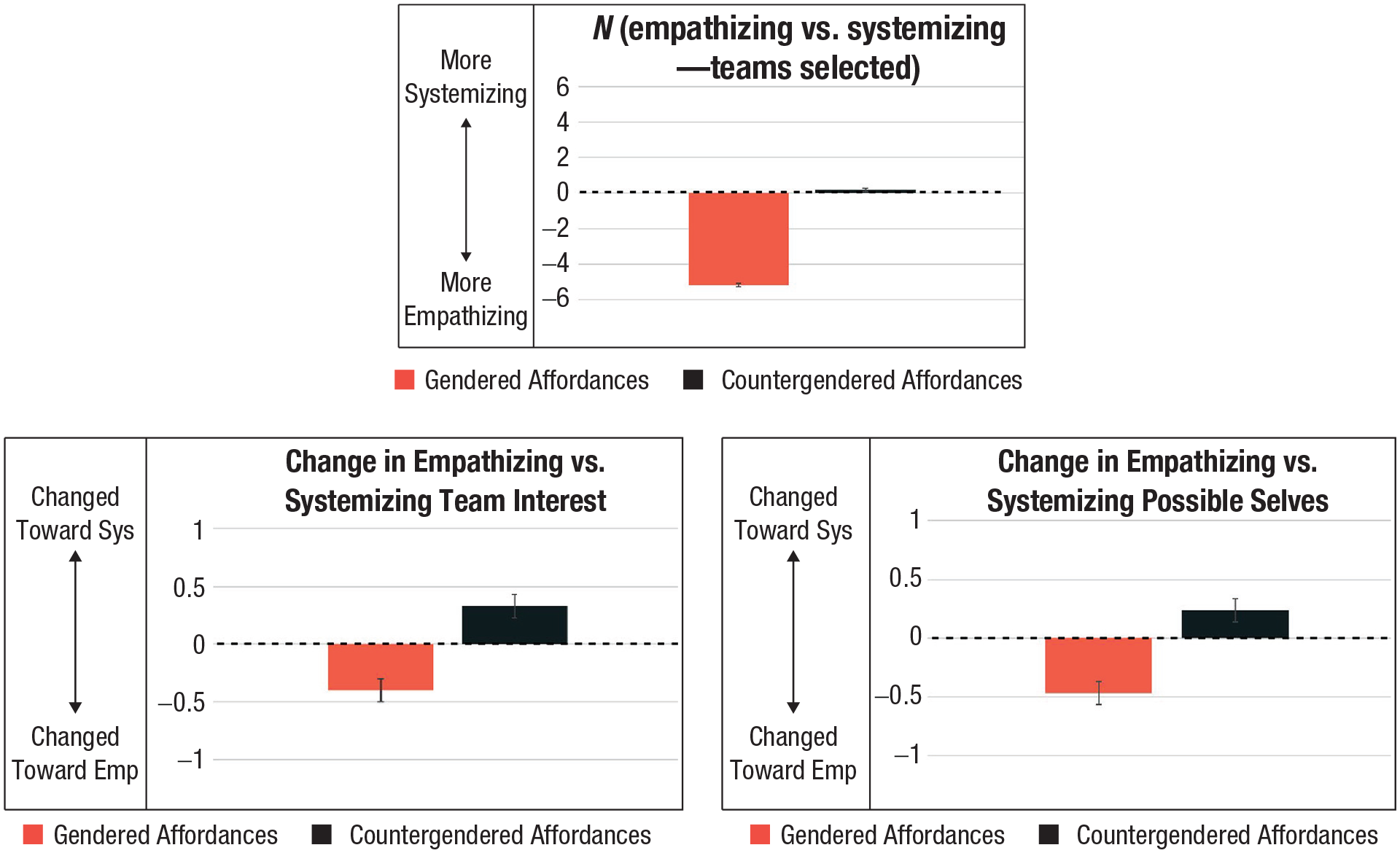
Key outcomes by affordance condition (Study 3). Error bars represent ±1 standard errors.
Of course, this effect is not surprising given that biased affordances create real constraints on women’s options: If they had selected by chance alone, those who received gendered affordances would have selected more empathizing teams than those who received countergendered affordances, simply because they were presented with more empathizing teams to choose from. However, even in the gendered-affordances condition, women could have selected an equal number of empathizing and systemizing teams. The fact that they did not suggests that the biased team assignments provided by participants in Study 1 can constrain women’s choices, as shown here in Study 3.
Gendered affordances changed women’s interests and possible selves
Next, we examined the primary prediction that these gendered affordances would affect women’s team interests, and the secondary prediction that gendered affordances would affect women’s possible selves. These measures, unlike women’s team choices, were independent from the gendered-affordances manipulation. After computing E-S difference scores for interests and possible selves, changes in these variables from baseline were operationalized by subtracting participants’ postmeasure E-S scores from their baseline E-S scores:
Change in E-S interest
Supporting our hypothesis, women who received gendered (vs. countergendered) learning affordances increased their interest in empathizing (vs. systemizing) teams, t(293.40) = −5.69, p < .001, d = −0.66, 95% CI = [−0.89, −0.43] (see Fig. 5 and Table S9 in the Supplemental Material). Specifically, women who received gendered affordances became significantly more interested in empathizing teams (M = −0.40, SD = 1.05), test against zero: t(146) = −4.60, p < .001, d = −0.38, 95% CI = [−0.55, −0.21], whereas women who received countergendered affordances became significantly more interested in systemizing teams (M = 0.33, SD = 1.15), test against zero: t(149) = 3.50, p < .001, d = 0.29, 95% CI = [0.12, 0.45]. 4
Change in E-S possible selves
Similarly, women who received gendered (vs. countergendered) affordances shifted their possible selves more toward empathizing (vs. systemizing), t(276.51) = −3.17, p = .002, d = −0.37, 95% CI = [−0.60, −0.14] (see Fig. 5 and Table S9 in the Supplemental Material). Specifically, women who received gendered affordances shifted their possible selves significantly toward empathizing (M = −0.47, SD = 1.64), test against zero: t(146) = −3.47, p < .001, d = −0.29, 95% CI = [−0.45, −0.12]; however among women who received countergendered affordances, the shift of possible selves toward systemizing was not significant (M = 0.24, SD = 2.18), test against zero: t(149) = 1.35, p = .180, d = 0.11, 95% CI = [−0.05, 0.27].
Gendered affordances and willingness to stay at the company
Finally, in a preregistered exploratory analysis, we examined the effect of gendered affordances on women’s interest in staying at the company. Although there was a weak main effect of affordances on willingness to stay, t(293.3) = 1.99, p = .048, d = 0.23, 95% CI = [0.00, 0.46], this was the only effect that changed in significance (i.e., became nonsignificant; p = .052) when using a more stringent preregistered exclusion criterion (see Table S13 in the Supplemental Material). More importantly, this effect was significantly moderated by participants’ trait empathizing (vs. systemizing) score (E-S traits = Systemizing − Empathizing), β = 0.56, 95% CI = [0.34, 0.78], p < .001 (Fig. 6). When provided with countergendered affordances, women higher on systemizing (than on empathizing) traits became more interested in staying at the company (β = 0.39, 95% CI = [0.25, 0.54], p < .001). However, when provided with gendered affordances, women higher on systemizing traits became less interested in staying at the company (β = −0.17, 95% CI = [−0.33, −0.00], p = .044). It is important to note that systemizing (vs. empathizing) traits did not moderate the effect of affordance condition on change in team interest or possible selves.
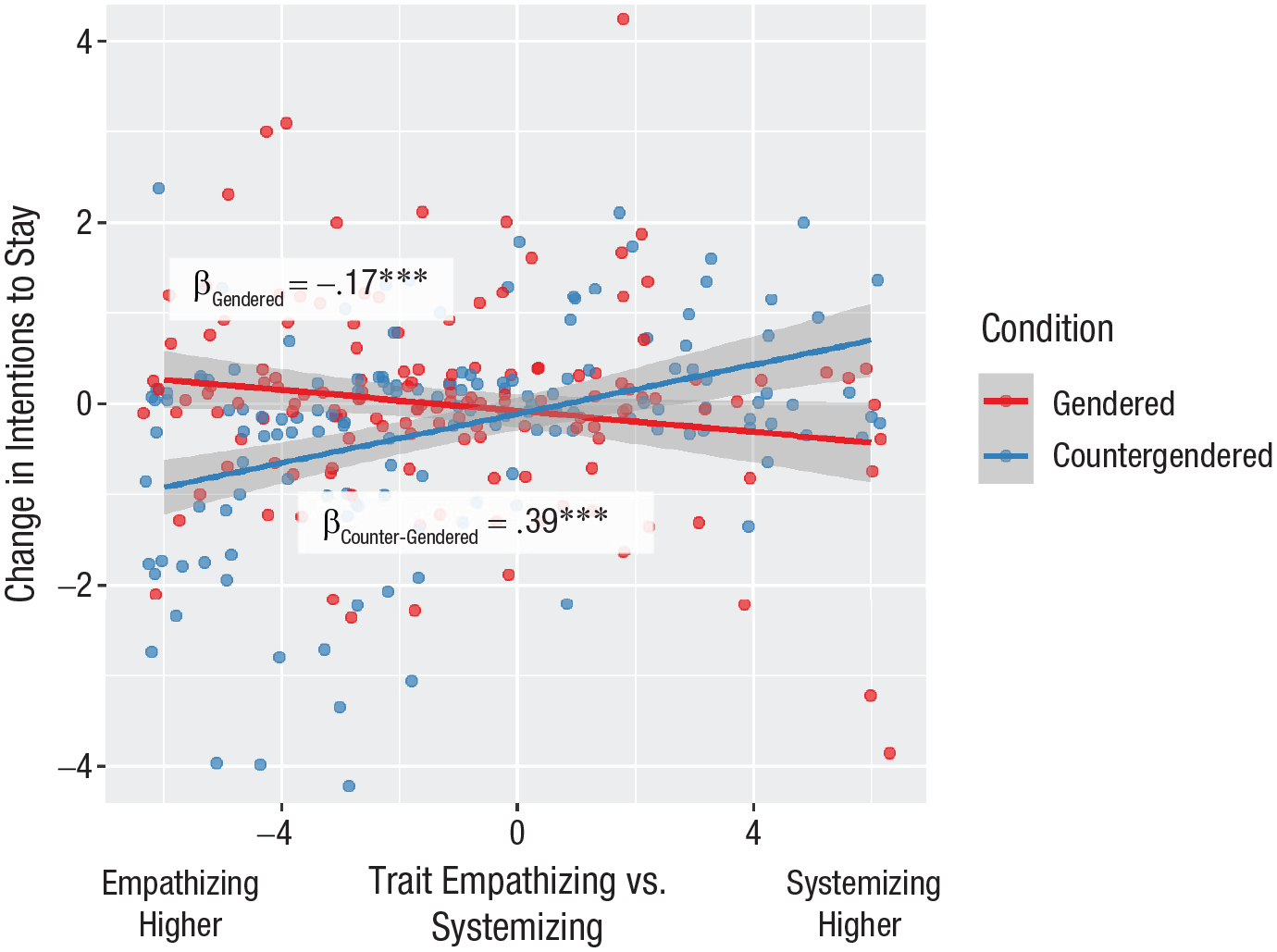
Trait empathizing versus systemizing moderates the relationship between condition and change in intentions to stay at the company (postmeasure minus baseline). Bands around regression lines represent 95% confidence intervals, and points are jittered to increase visibility of overlapping data (Study 3).
General Discussion
Women’s underrepresentation in science has been interpreted as reflecting women’s and men’s different intrinsic preferences that guide their choices (Ceci et al., 2009). Three studies revealed a self-fulfilling process through which perceivers who endorse such essentialized explanations for the gender gap in STEM provide biased learning affordances that constrain women’s choices and self-views. In particular, those who endorsed biologically essentialized explanations for gender differences—either measured (Study 1) or manipulated (Study 2)—provided more gendered affordances to women and men. When gendered or countergendered learning affordances were presented to women in Study 3, these affordances not only directly constrained women’s learning options, they also psychologically shaped women’s relative interest in empathizing over systemizing roles, as well as their possible selves. Although the first effect reflects real-world gendered constraints, the affordance differences on women’s choices could have emerged from chance alone. However, this limitation does not apply to the observation that altering women’s choice set significantly changes their stated interests and self-views. Moreover, the effect of essentialism held when we controlled for stereotypic beliefs about gender differences in abilities and interests, distinguishing this work both from prior research on stereotype-based self-fulfilling prophecies (e.g., Madon et al., 2018; Towson et al., 2020) and from recent nonsignificant causal effects of essentialism that did not examine learning affordances (Bailey & Knobe, 2024).
These findings reveal that countergendered affordances can shape women’s interests. With that said, a fit between environmental affordances and women’s own traits predicts retention. Countergendered affordances led to increased commitment to stay at the company for women higher in systemizing but decreased commitment for women higher in empathizing. This pattern might reflect self-verification strivings to work for a company where one feels understood (Talaifar & Swann, 2020) and highlights how lack of fit leads some women to avoid STEM fields (Schmader, 2023). Alternatively, women’s own gender stereotypes could produce affective forecasting errors (Moons et al., 2017), and stronger countergendered affordances might be needed to offset a lifetime of gendered socialization. Future research should test whether working on teams that are misaligned with one’s traits would in fact lead to higher attrition and whether women’s own essentialized beliefs might moderate these effects.
In Studies 1 and 2, the relationship between essentialism and affordances was stronger for systemizing than empathizing teams. There are at least two possible explanations for this asymmetric pattern. First, the (mostly men) perceivers may have been more sensitive to monitoring women’s systemizing opportunities (as opposed to men’s empathizing opportunities) in a tech field in which women are underrepresented. Alternatively, these patterns might reflect barriers to men’s interest in communal roles (Block et al., 2019; Croft et al., 2015; Vandello et al., 2008), given stereotypes portraying men as less communal than women (Eagly et al., 2020). Future research could examine how gender stereotypes constrain men’s training opportunities for communal occupations dominated by women.
The behavioral-choice paradigm approximated real-world decision-making within a role-playing scenario. Participants were relatively unaware of the study’s purpose; across all studies, less than 8% of participants correctly guessed the hypothesis (effects are robust to excluding these participants; see Table S12 in the Supplemental Material). Such results suggest that demand characteristics are unlikely to explain these findings. However, future research should test these patterns in real-world training contexts.
These studies used samples of participants that would be likely to encounter real-world contexts in which gendered affordances constrain women’s choices. For example, the STEM professionals in Study 1 or men with management experience in male-dominated roles in Study 2 could be involved in shaping women’s opportunities in their organizations, and the women undergraduates in Study 3 will choose their own career-training opportunities. However, participants were drawn from Canada and the United States, so results may not generalize to other cultural contexts. In fact, the association between essentialism and young women’s attitudes toward science is stronger in more developed countries (De Gioannis, 2025).
Learning affordances play an integral role in shaping interest, as informed by perceivers’ beliefs. This finding has implications for educators, employers, and parents responsible for providing young people with training opportunities. When repeated experiences of biased affordances accumulate across perceivers or over time (Madon et al., 2018), they can steer women and men toward different careers, shaping their sense of what is possible. These findings also reveal how those who promote extremely essentialized explanations for interest differences might help to perpetuate gender segregation. When women choose to forego a pathway to STEM, on how many occasions was a previous opportunity to develop that interest never made available to them? Interventions aimed at educating people about sociocultural influences on career interests might help to mitigate the self-fulfilling effects of gender-essentialized beliefs.
Supplemental Material
sj-docx-1-pss-10.1177_09567976251353753 – Supplemental material for Gender Essentialism Leads to Biased Learning Opportunities That Shape Women’s Career Interests
Supplemental material, sj-docx-1-pss-10.1177_09567976251353753 for Gender Essentialism Leads to Biased Learning Opportunities That Shape Women’s Career Interests by Audrey Aday, Holly R. Engstrom and Toni Schmader in Psychological Science
Footnotes
Transparency
Action Editor: Jennifer Gutsell
Editor: Simine Vazire
Author Contributions

Notes
References
Supplementary Material
Please find the following supplemental material available below.
For Open Access articles published under a Creative Commons License, all supplemental material carries the same license as the article it is associated with.
For non-Open Access articles published, all supplemental material carries a non-exclusive license, and permission requests for re-use of supplemental material or any part of supplemental material shall be sent directly to the copyright owner as specified in the copyright notice associated with the article.
