




Abstract
Although over 8 million Native peoples live in the United States, American culture is infused with representations depicting them as people of the past (i.e., the Native-past stereotype). Four studies (total N = 38,009 non–Native American adults who voluntarily visited the Project Implicit website) examined the prevalence of the implicit Native-past stereotype among non–Native individuals and whether this stereotype predicted lower support for Native equity. We developed a Native-past Implicit Association Test to index the implicit Native-past stereotype and document the extent to which people associate Native peoples (vs. White Americans) with the past (vs. the present). Results showed that over two-thirds of non-Native participants demonstrated at least slight implicit Native-past associations (Cohen’s ds > 0.41). Moreover, stronger Native-past associations predicted greater minimization of contemporary Native racism and, subsequently, lower support for policies designed to advance Native equity. This work suggests that the prevalent Native-past stereotype may harm many aspects of contemporary Native peoples’ lived experiences.
Statement of Relevance
Despite their fast-growing population and relentless efforts to advance equity, Native peoples are routinely depicted as people of the past (i.e., the Native-past stereotype) who no longer exist in the American representational landscape (e.g., education, media, and sports). Research, however, has yet to capture the extent to which the Native-past stereotype occupies non–Native Americans’ imaginations, let alone its potential implications for social justice and equity. Our work fills this gap by providing the first empirical evidence that the vast majority of non–Native Americans implicitly perceive Native peoples as people of the past, which in turn predicts lower support for Native equity. These findings shed light on the persistence of disparities facing Native peoples in numerous domains (e.g., public representations, education, or violence): When Native Peoples are frozen in the past, their contemporary experiences with racism and disparities are overlooked and remain unaddressed. This work suggests that reshaping the representational landscape—replacing the limited, historical representations of Native peoples with accurate, diverse, and contemporary ones—is crucial to building a more equitable society.
Despite comprising about 8.6 million individuals and nearly 3% of the U.S. population (U.S. Census, 2023a), Native peoples 1 are represented as historical figures, with their present-day lived experiences both literally and figuratively omitted (Deloria et al., 2018; Eason et al., 2018; Fryberg & Eason, 2017; Lomawaima & McCarty, 2014; Rifkin, 2011; Robertson, 2015; Trimble, 1987; Tuck & Yang, 2012). A close examination of the representational landscape reveals the sheer depth of the problem. K–12 educational standards predominantly teach students about Native peoples in pre-1900s contexts (Sabzalian et al., 2021; Shear et al., 2015). Television and movies routinely fail to depict modern Native peoples (Nielsen, 2023; Tukachinsky et al., 2015). Internet searches for terms like “Native American” primarily yield antiquated images (Leavitt et al., 2015). Finally, thousands of secondary schools, colleges, and professional sports teams still use historicized Native caricatures as mascots (Dai et al., 2021).
As these examples illustrate, the idea that Native peoples exist only in the past—the Native-past stereotype—is deeply embedded and pervasive in American culture. Indeed, like Native scholars (e.g., Deloria et al., 2018; Fryberg & Eason, 2017), Native laypeople recognize the prevalence of this perception in mainstream society (e.g., Dai et al., 2023). For example, a large-scale survey with over 6,400 Native individuals, representing more than 400 tribal nations and all 50 U.S. states, revealed that 77% of respondents felt that the average American thinks there are no “real” Native peoples left, and 87% felt that the average American does not care about the contemporary experiences of Native peoples (Indigenous Futures Survey, 2020).
Despite evidence of the Native-past stereotype in the representational landscape and reports of Native people’s perceptions, there exists limited empirical evidence regarding whether non-Native people associate Native peoples with the past, rather than the present. Prior studies using self-report measures (i.e., agreement with statements that Native peoples are people of the past) found that, on average, non-Native people did not explicitly endorse the Native-past stereotype (Eason & Fryberg, 2024; Lopez et al., 2022). For example, Lopez et al. (2022) observed that although non-Native participants perceived Native peoples as less contemporary than Black peoples, participants disagreed with statements that Native peoples are people of the past.
The disparity between self-report Native-past stereotype measures and actual representations contradicts established social-representation theories, which suggest that available ideas about a group influence people’s thoughts and behaviors toward that group (Moscovici, 1984; Schemer, 2012; Tukachinsky et al., 2015). Given the discrepancy, we posit that self-report measures inadequately capture the extent to which non-Native individuals associate Native peoples with the past. This article introduces an implicit measure to evaluate the extent of this association and its relation to support for Native equity.
We contend that implicit measures may better capture the Native-past stereotype than explicit self-report measures. Specifically, respondents may be hesitant to explicitly agree with statements such as “there are no ‘real’ Native American people left in U.S. society” for at least two nonmutually exclusive reasons. First, there may be social-desirability concerns because the statements seem extreme and potentially even prejudicial. Second, participants have time to deliberately evaluate the statements. Bringing even just one contemporary Native person to mind might be enough to highlight the implausibility and factual inaccuracy of these statements (although it is important to note that people have difficulties thinking of any contemporary Native peoples; see Davis-Delano et al., 2021; Eason & Fryberg, 2024).
Implicit measures circumvent social-desirability concerns and propositional processes because respondents lack the time or mental capacity to deliberate about the potentially prejudicial or implausible nature of associating Native people with the past (Greenwald & Banaji, 1995). Instead, respondents must rely on easily accessible ideas, which are likely to be deeply ingrained in culture (Payne & Gawronski, 2010; Payne & Hannay, 2021). For example, on campuses with more markers of structural racial inequalities (e.g., displaying Confederate monuments and employing lower percentages of non-White faculty), students showed stronger implicit preferences for White over Black people (Vuletich & Payne, 2019). Given the pervasiveness of the Native-past stereotype across numerous domains (e.g., education, media, and sports), non-Native people are likely to have continuous exposure to representations reflecting this stereotype across their life spans. Therefore, we expect that this stereotype is readily accessible and is implicitly endorsed by non-Native individuals.
Associating Native peoples with the past can jeopardize efforts to advance Native equity (Davis-Delano et al., 2024; Lopez et al., 2022, 2024). Specifically, situating Native peoples in the past as historical entities can obscure their current experiences with racism, including disproportionately high rates of poverty (Shrider & Creamer, 2023) and violence (Lucchesi & Echo-Hawk, 2018), and underfunding of schools (U.S. Government Accountability Office, 2022) and healthcare facilities (Ehrenpreis & Ehrenpreis, 2022). In turn, when people fail to recognize or deny Native experiences of racism, they might be less likely to support policies or practices designed to rectify Native inequity (Jost & Hunyady, 2005; Osborne & Sibley, 2013; Sears & Henry, 2005; Yogeeswaran et al., 2018). For example, Lopez et al. (2022) found that White Americans who more strongly believed that a minoritized group (i.e., Native or Black peoples) belonged to the past were more likely to minimize that group’s current experiences with racism, and, in turn, to condone the use of racist caricatures of that group (i.e., redface or blackface). Consequently, we expect that the Native-past stereotype may have broad implications for Native equity across numerous domains, including public representations, education, resource allocations, and sovereignty (Fryberg et al., 2024).
Current Research
The current research addresses two major questions: (a) to what extent do people implicitly associate Native peoples with the past, and (b) does implicit Native-past stereotyping predict people’s support for Native equity? Toward these aims, we developed and validated a novel Native-past Implicit Association Test (Studies 1–4) and estimated the prevalence of the implicit Native-past stereotype in a large national sample (Study 5). Finally, we investigated the extent to which the implicit Native-past stereotype is related to non-Native people’s understanding of Native people’s experiences with racism and their subsequent support for four types of policies aimed at advancing Native equity (Studies 2–5; see Fig. 1 for conceptual model)—promoting accurate representations, teaching accurate information in schools, rectifying resource inequity, and protecting tribal sovereignty. The first two policies focus on representational issues facing Native peoples and serve to increase public awareness of Native issues in other domains (e.g., poverty and violence). The latter two policies ensure that Native tribes and organizations have the resources and autonomy to tackle pressing issues in their communities (e.g., schools and health-care facilities). In sum, this research endeavor can establish the prevalence and potential implications of the Native-past stereotype.
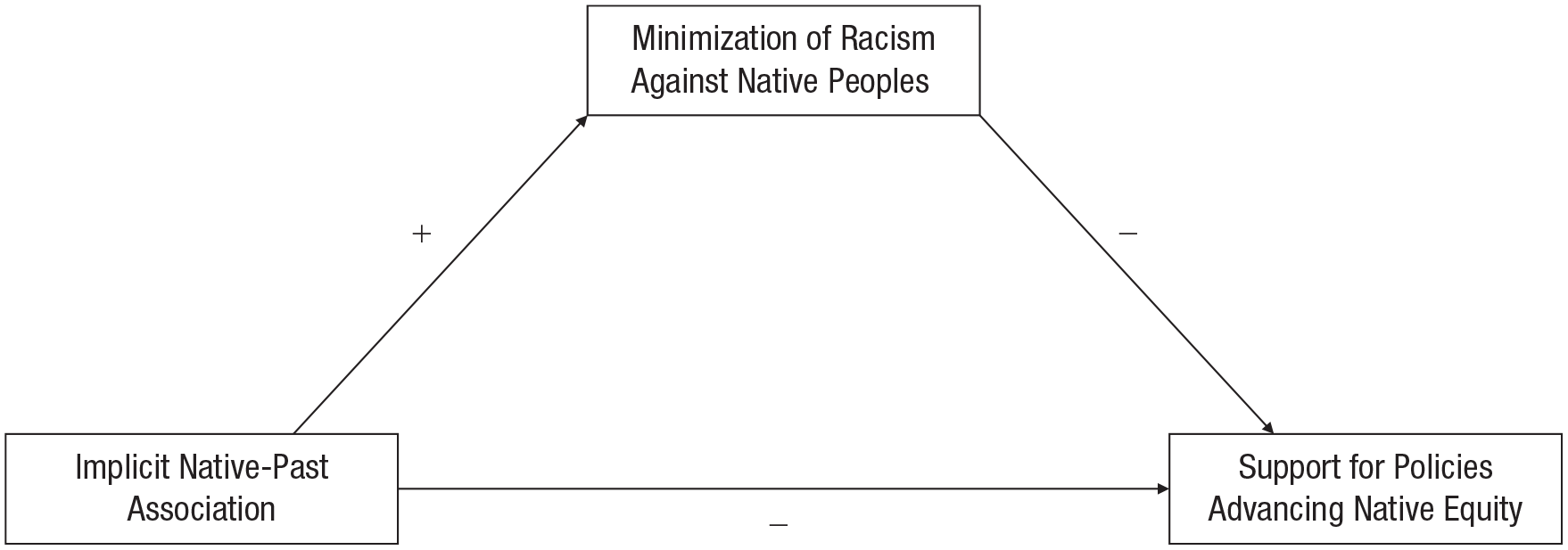
Conceptual model.
For ease of presentation and given the similarity in samples, we first describe the demographics and procedure for five studies together, noting procedural divergences where they occur. We then present the results for each research question.
Research Transparency Statement
General disclosures
Study 1 disclosures
Study 2 disclosures
Study 3 disclosures
Study 4 disclosures
Study 5 disclosures
Method
Participants
Studies 1, 2, and 3
Data collection and data usage of all studies were reviewed and approved by an Institutional Review Board. Participants participated in a study on the Project Implicit research site. As is standard on this site, participants were volunteers who did not receive monetary payments but were instead directed to the site through exposure to media reports, recommendations from family or friends, or assignments from school or work.
Each study had a target sample size of 1,000 participants, a reasonably large sample size to test effects, following the convention that Project Implicit uses for validating new IATs. Responses from minors were excluded because of IRB constraints. Participants who were not U.S. citizens were excluded from the final analyses. This decision was based on the aforementioned theory that individuals may develop implicit biases against Native peoples because of long-term exposure to limited representations of Native peoples that are unique to U.S. society. We also excluded participants who identified as Native American or Alaska Native, whether alone or in combination with other races, from the primary analyses, given that current research focuses on intergroup attitudes and relations—specifically, how non-Natives perceive Native peoples and support Native-related issues. In summary, the number of excluded participants was as follows: nStudy 1 = 36, nStudy 2 = 27, and nStudy 3 = 36. See Table 1 for the final sample sizes and demographics.
Participant Demographics
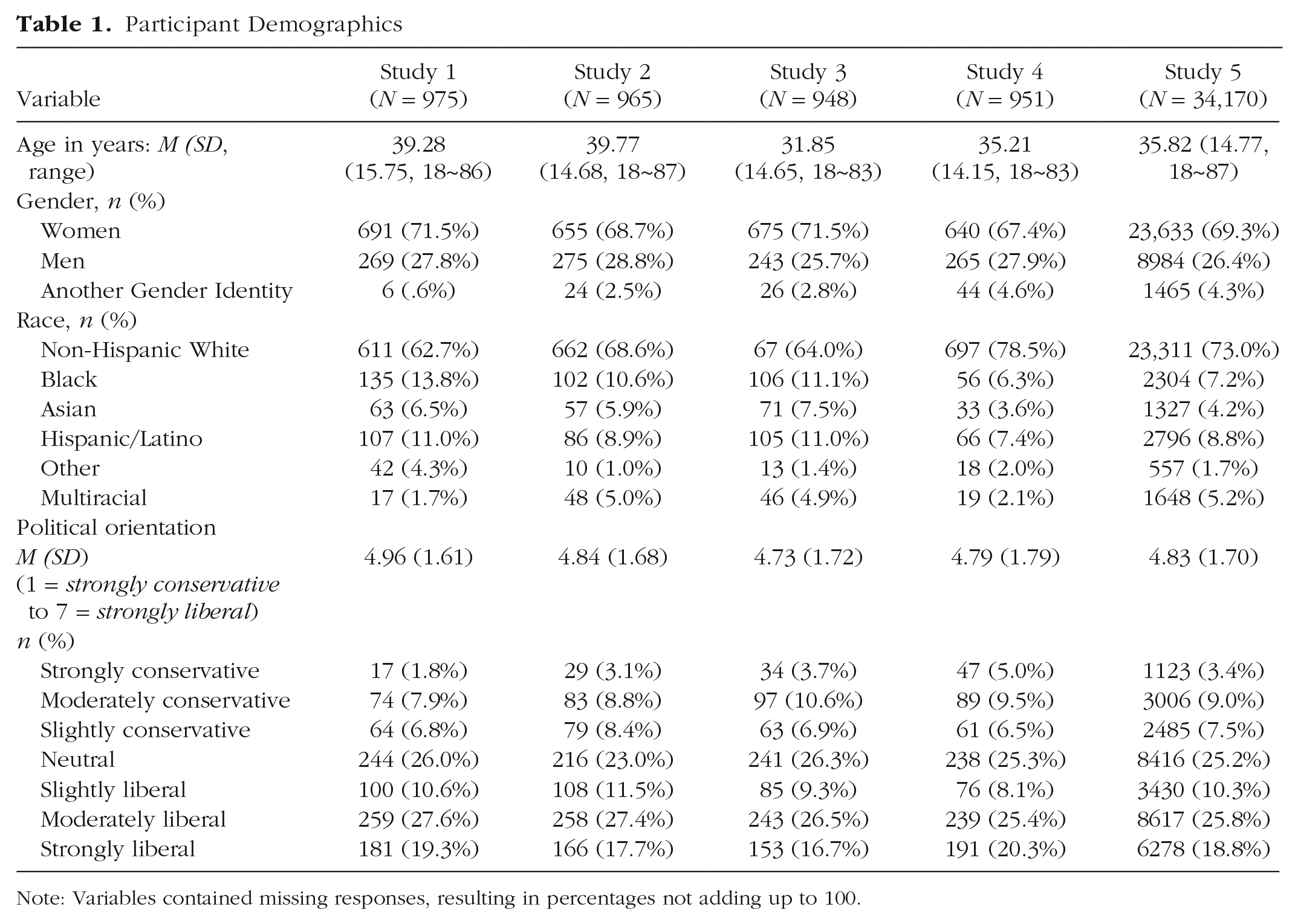
Note: Variables contained missing responses, resulting in percentages not adding up to 100.
Studies 4 and 5
After refining and validating the Native-Past IAT through Studies 1 through 3, the study moved to the Project Implicit demonstration site (https://implicit.harvard.edu/implicit/) on January 29, 2022. Studies 4 and 5 included visitors who visited the demonstration site and participated in the Native-Past IAT between January 29, 2022, and April 23, 2023. This date range was arbitrarily chosen based on our project timeline. As with Studies 1 through 3, participants did not receive monetary compensation; instead, they voluntarily completed the study.
We followed the same exclusion criteria described above and excluded data from 6,055 non-U.S. citizens and 968 participants who identified as Native American, Alaska Native, or Native Hawaiian, alone or in combination with other races, 2 yielding a dataset containing 35,924 participants. We randomly selected 1,000 responses from this larger dataset to serve as Study 4, a preregistered direct replication of Studies 1 through 3 (for more details, see the preregistration and the associated power analyses discussed in the preregistration). Responses from minors were excluded due to IRB constraints (49 were excluded). 3 The remaining participants from the larger dataset, excluding 754 minors due to IRB constraints, were reported in Study 5 (N = 34,170 adults). Study 5 investigates our research questions using a highly powered, large national sample. See Table 1 for the final sample sizes and demographics.
Procedure
Visitors to the Project Implicit website consented to participate in a 15-min survey framed as understanding how people learn new information and make decisions in social and nonsocial contexts, receiving no information about the specific topic of interest (e.g., stereotypes and attitudes about Native peoples). Below and in Table 2, we describe the relevant measures included across Studies 1 through 5. Complete information about the materials is available in the Materials section in the Supplemental Material (https://osf.io/nfh35).
Descriptions and Internal Consistencies of All Measures
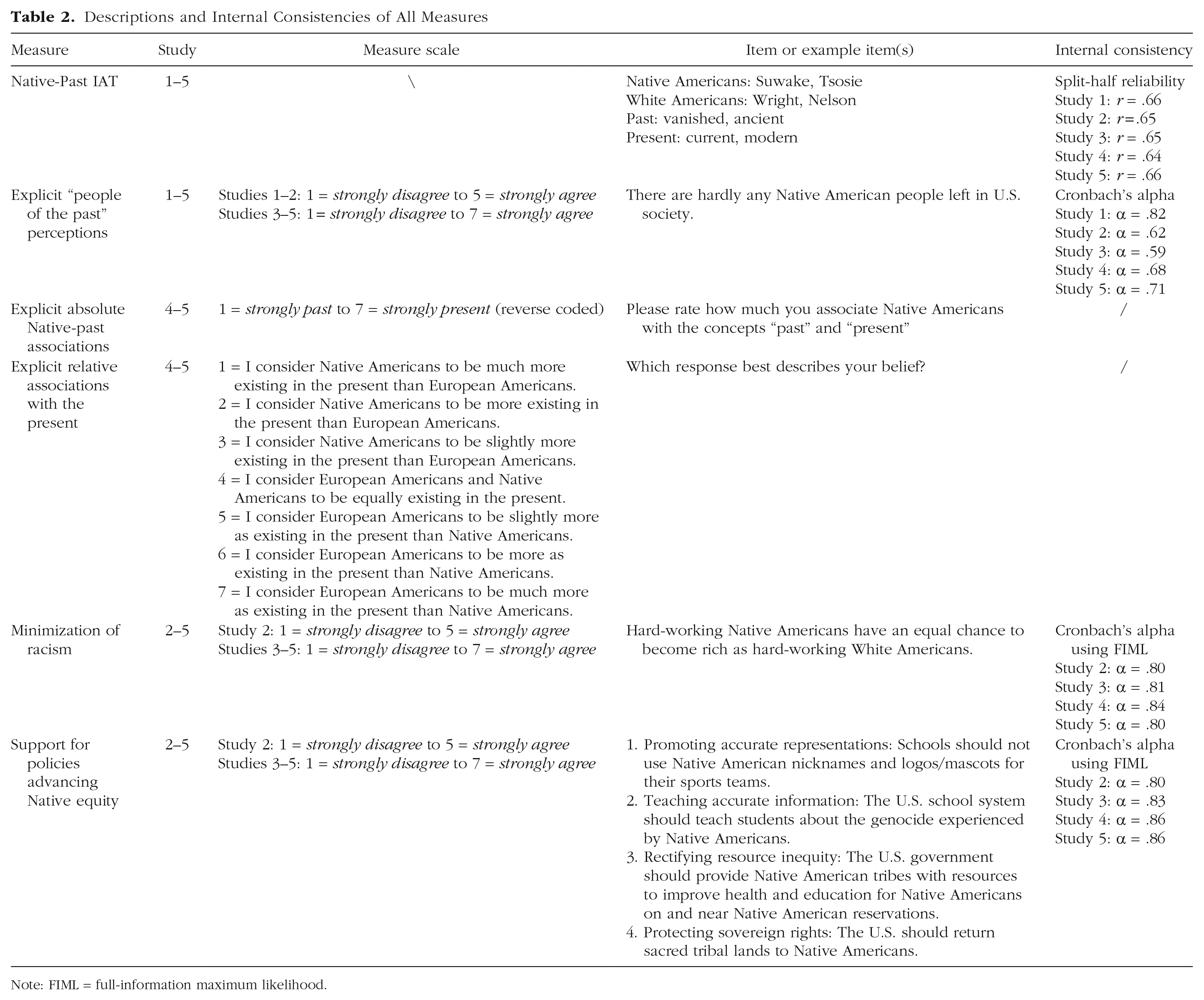
Note: FIML = full-information maximum likelihood.
Because of Project Implicit’s limitation on the number of survey questions administered to each participant, we implemented a multiform planned missing-data design in Studies 2 through 5 to include our explicit measures of interest (Graham et al., 2006). Specifically, we created five sets of questions: a common set and four other sets (see Table 3). The common set contained the Explicit “People of the Past” Perceptions measure and was administered to all participants. Items from the Minimization of Racism measure and the Support for Policies Advancing Native Equity measure were evenly distributed across the other four sets (i.e., sets A–D). Each participant received the measure Native-Past IAT, all items from the common set, and two randomly selected sets from sets A through D (i.e., two Minimization of Racism items and six Support for Policies items).
Format of Planned Missing Data Design in Studies 2, 3, 4, and 5
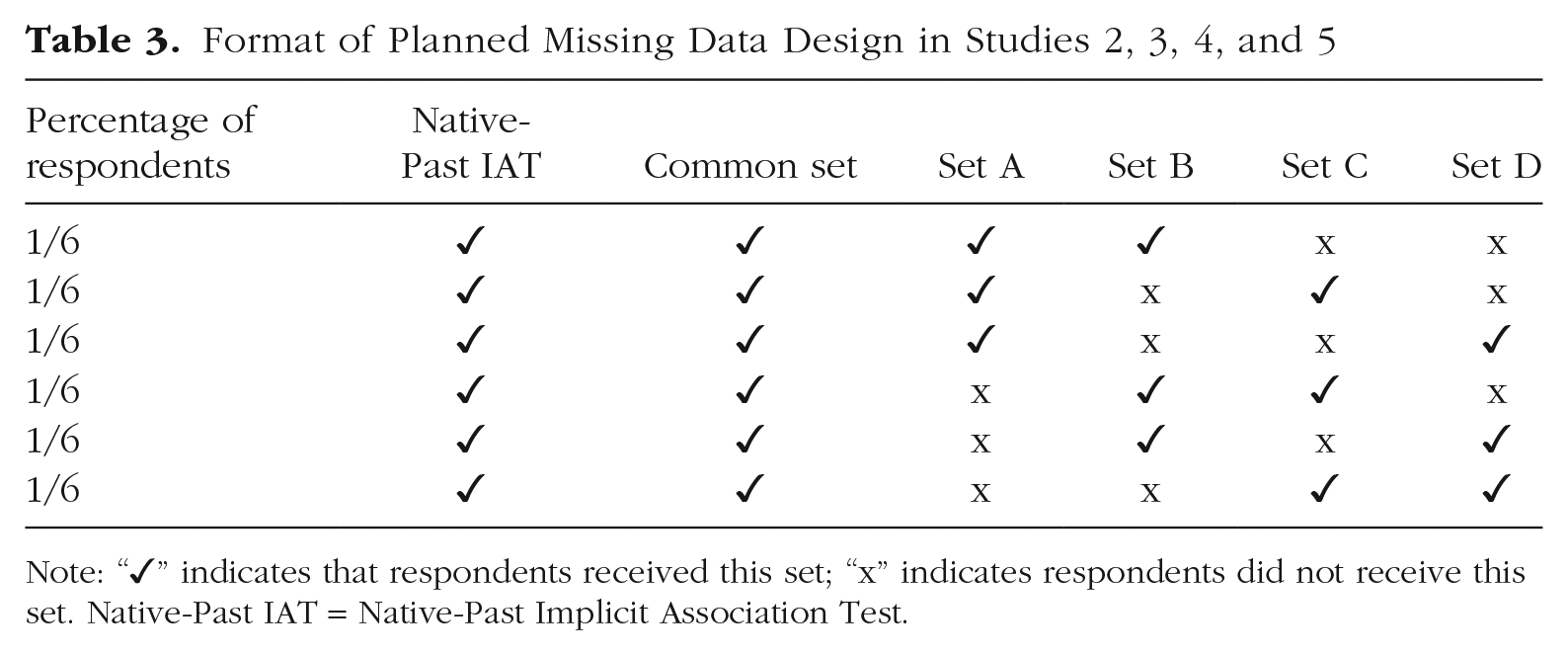
Note: “✓” indicates that respondents received this set; “x” indicates respondents did not receive this set. Native-Past IAT = Native-Past Implicit Association Test.
Materials and measures
Native-Past IAT
Stimuli
We created a Native-past Implicit Association Test (i.e., Native-Past IAT) to index the implicit Native-past stereotype. The concept categories were labeled as Native Americans (stimuli: common Native last names, such as Suwake and Tsosie) and White Americans (stimuli: common White last names, such as Wright and Nelson). The attribute categories were labeled as past (stimulus examples: vanished, ancient) and present (stimulus examples: current, modern). Each category was represented by nine stimuli. For each participant, the nine Native last names were randomly drawn from a corpus of 24 last names, which were common names collected from numerous tribal government and organization websites to represent tribes from various geographical regions across the United States. The nine White last names were randomly drawn from a corpus of 13 last names that were frequently found among White Americans (Comenetz, 2016) and matched the average length of the Native last names.
Starting from Study 2, we replaced stimuli with error rates higher than 5%, or average response latencies greater than 1,000 ms in the previous study. In the final version of the IAT on the demonstration site (i.e., Studies 4 and 5), all stimuli met these two criteria. The complete list of stimuli used in each study is available at https://osf.io/nfh35.
Native-Past IAT task
The IAT followed the standard format, with 140 trials across five tasks. Three blocks were practice-sorting tasks (20 trials each), and two blocks were critical test blocks (40 trials each). One test block (40 trials) was a congruent combination task in which the concept and attribute categories were stereotypically paired (e.g., stimuli for Native Americans and stimuli for the past were categorized using the same key). The other test block (40 trials) was an incongruent combination task in which the concept and attribute categories were stereotypically not paired (e.g., stimuli for Native Americans and stimuli for the present were categorized using the same key). The order of the two test blocks was counterbalanced across participants, such that participants were randomly assigned to either complete the stereotypically congruent combination task first or the stereotypically incongruent combination task first (Nosek et al., 2007).
Scoring
The associative strength between stereotypically congruent categories (i.e., Native peoples and the past, White Americans and the present) is compared with the associative strength between stereotypically incongruent categories (i.e., Native Peoples and the present, White Americans and the past) using the standard D-score algorithm: dividing the mean response latency difference between the congruent and incongruent combination task by the participant’s overall standard deviation using all latencies in the two test blocks (Greenwald et al., 2003). In line with the best practices (Greenwald et al., 2003), we excluded trials with latencies greater than 1,000 ms and participants for whom more than 10% of IAT trials had latencies faster than 300 ms. Larger positive D scores indicated that participants responded faster when Native peoples were paired with the past and White Americans paired with the present, compared to when Native peoples were paired with the present and White Americans paired with the past. In other words, larger positive D scores suggested that participants more strongly associated Native peoples (vs. White Americans) with the past (vs. the present).
Explicit measures of Native-past stereotype
We administered three types of explicit measures to assess the endorsement of the explicit Native-past stereotype. These measures were part of the common set administered to all participants. Although these measures all test explicit endorsement, they conceptualize the construct differently. See Table 2 for additional information about each measure.
Explicit “people of the past” perceptions
In Study 1, 13 items measured the extent to which participants explicitly perceived that Natives were people of the past and had vanished from today’s society. In Studies 2 through 5, because we included additional measures, we reduced this measure to six items to adhere to Project Implicit’s restriction on the number of administered explicit items. We averaged across all items such that higher scores indicated greater “people of the past” perceptions.
Explicit absolute Native-past associations
We included one item in Studies 4 and 5 to measure the extent to which participants explicitly associated Native peoples with the past versus the present. We reverse-coded this item so that the scores were in the same direction as the IAT scores—that is, higher scores indicated stronger explicit associations between Native Peoples and the past (vs. the present).
Explicit relative associations with the present
We included one item in Studies 4 and 5 to measure the extent to which participants explicitly associated Native peoples versus White Americans with the present. Higher scores indicated that participants more strongly, explicitly associated White Americans with the present than they explicitly associated Native peoples with the present.
Minimization of racism
Participants indicated their agreement with four items, assessing the extent to which they minimized Native peoples’ experiences of racism today (see Table 2). We averaged across all items in such a way that higher scores indicated greater minimization of racism that Native peoples experience.
Support for policies advancing Native equity
A total of 10 items assessed participants’ support for four types of policies regarding Native peoples and Native issues that aimed at advancing equity, including (a) promoting accurate representations (two items), (b) teaching accurate information in schools (three items), (c) rectifying resource inequity (two items), and (d) protecting tribal sovereignty (three items; see Table 2). We averaged items within each policy type so that higher scores indicated greater support for this type of policy.
Analytic Plan
To assess the extent to which people implicitly associate Native peoples with the past, we reported five sets of statistics: (a) average Native-Past IAT scores; (b) the proportion of IAT scores above 0 (i.e., equal response latencies to Native-past and Native-present associations), indicating an absence of biased associations between Native peoples and either the past or the present; (c) the proportion of IAT scores above .15, indicating at least a slight bias toward associating Native peoples with the past (Morehouse & Banaji, 2024, p. 4); (d) one-sample t tests comparing IAT scores to 0 and 0.15; and (e) weighted IAT scores from the Study 5 sample with complete demographic information. This last set would provide an approximation of the extent to which a representative sample of the non-Native U.S. population would associate Native peoples with the past.
To assess the relationship between the implicit Native-past association and attitudes concerning policies aimed at advancing Native equity, we first used multiple imputations by chained equations (Raghunathan et al., 2001) with the MICE package (van Buuren & Groothuis-Oudshoorn, 2011) in R (R Core Team, 2018) to address the planned missing data design implemented for the explicit measures. Following Bodner’s (2008) and White et al.’s (2011) suggestion that the number of imputations should be at least equal to the average rate of missing cases, we generated 50 imputed data sets, given that items in sets A through D had an average of 50% missing cases. We then used the imputed data sets to assess how implicitly associating Native peoples with the past was related to the minimization of racism and support for policies aimed at advancing Native equity (see Fig. 1 for the conceptual model). We conducted a set of mediation analyses with IAT scores predicting policy support through the minimization of racism using each of the 50 imputed data sets separately. Finally, we pooled the separate estimates into one estimate and standard error for each policy outcome, which we report in the Results section.
In Study 5, instead of using multiple imputation, which is computationally heavy and time-consuming, we used full-information maximum likelihood (FIML) with the lavaan package (Rosseel, 2012) in R (R Core Team, 2018) to test the proposed model. In large samples, FIML and multiple imputations produce equivalent results and perform equally well compared to analyses using complete data sets (Collins et al., 2001; Lee & Shi, 2021; Lim & Cheung, 2022).
Results
Reliability and Validity of the Native-Past IAT
All versions of the Native-Past IAT demonstrated acceptable internal consistencies, ranging from .64 to .66 (see Table 2). These split-half correlations were within the range of other IATs’ split-half correlations (.52~.77) found by Greenwald et al. (2003), but slightly below the typical range (.7~.9) found by Nosek et al. (2007). However, according to Nosek et al. (2007), a split-half correlation of .66, which was the reliability in the final version used in Study 5, was still considered adequate and better than other latency-based implicit measures. The IAT also had good discriminant validity. Specifically, across all studies, IAT scores were positively correlated with the three explicit measures of Native-past stereotypes (i.e., Explicit “People of the Past” Perceptions, Absolute Native-past Association, and Explicit Relative Associations With the Present), meaning that participants who more strongly explicitly associated Native Peoples with the past were more likely to (a) agree with statements that Native peoples are people of the past, (b) explicitly associate Native peoples with the past, and (c) explicitly associate White Americans (vs. Native peoples) with the present (rrange = .09~.14, ps < .012; see Correlations Between Implicit and Explicit Measures in the Supplemental Material at https://osf.io/nfh35). Of note, the correlations between the implicit and explicit measures were weaker than the average correlations between other IATs and their corresponding self-report measures reported in other studies (|r| = .24~.27; Hofmann et al., 2005; Nosek et al., 2007).
Prevalence of Native-past association: Unweighted analyses (Studies 1–5)
Consistent with our hypotheses, across all five studies, the mean IAT scores were significantly greater than 0 (all ps < .001) and were significantly greater than .15 (all ps < .001; see Table 4 for descriptive and inferential statistics; see Fig. 2 for the distribution of IAT scores). Over two-thirds of participants in each study (range: 67%–77%) showed at least slight associations between Native peoples (vs. White Americans) and the past (vs. the present; i.e., IAT score above 0.15). Together, these results suggest that participants, by and large, more strongly associated Native peoples with the past and White Americans with the present than they associated Native peoples with the present and White Americans with the past.
Descriptive and Inferential Statistics of Native-Past IAT Scores
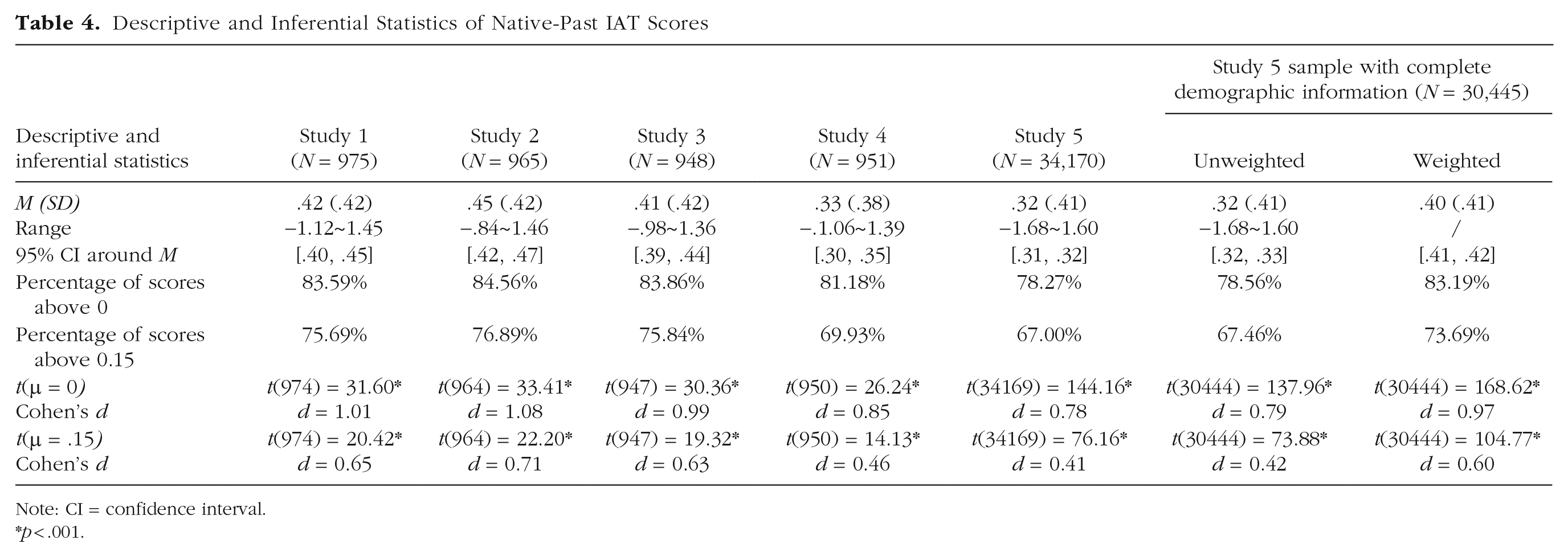
Note: CI = confidence interval.*p < .001.
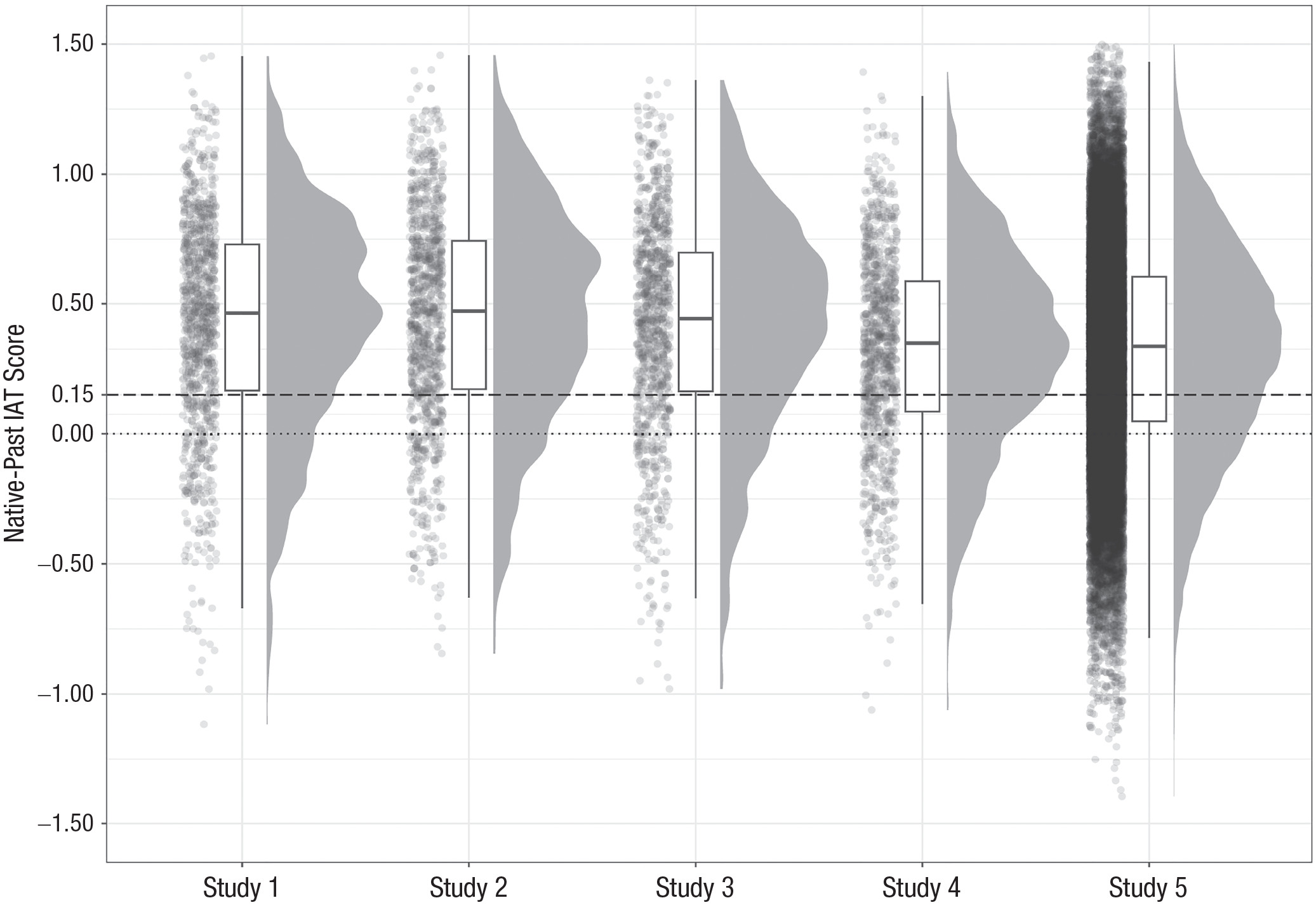
Distributions of Native-Past IAT scores. From left to right, raw data, boxplot, and data distribution are presented for each study. The horizontal dotted line (y = 0) indicates the absence of a biased association between Native peoples and the past or the present. The horizontal dashed line (y = 0.15) indicates the benchmark for at least a slight association between Native peoples and the past.
See Order Effects on IAT Scores and Demographic Effects on IAT Scores in the Supplemental Material (https://osf.io/nfh35) for order and demographic effects (i.e., age, gender, race, political orientation, and education). Also, see State-Level Variations in IAT Scores in the Supplemental Material (https://osf.io/nfh35) for IAT scores by state.
Weighted data from Study 5 sample
Although Study 5 used a highly powered, large national sample, the sample was not representative of the broader non-Native U.S. population. Women, young adults, highly educated people, and liberal people were overrepresented in the Study 5 sample with complete demographic information (N = 30,445) compared to the non-Native U.S. population (Saad, 2021; U.S. Census 2023b; see Table 5 for the estimated demographic distributions in the population versus the IAT data). To approximate the results for a representative sample of the non-Native U.S. population, we followed the raking procedure outlined by DeBell and Krosnick (2009) to adjust the weight for each response with complete demographic information until the sample distributions of race, gender, age, education, and political orientation aligned with the population distributions for these demographic variables.
Demographics of Project Implicit Sample Versus Non-Native U.S. Population
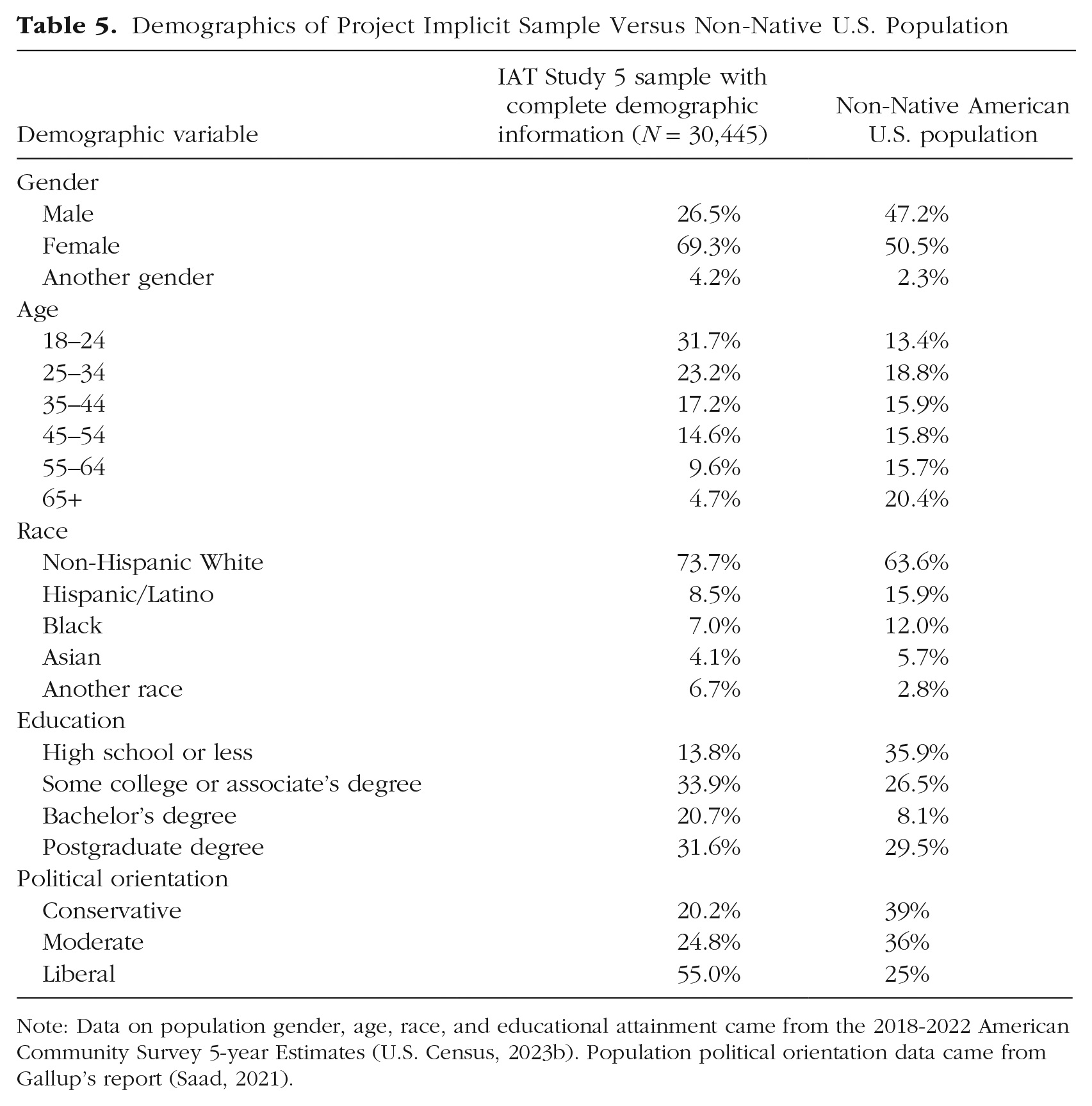
Note: Data on population gender, age, race, and educational attainment came from the 2018-2022 American Community Survey 5-year Estimates (U.S. Census, 2023b). Population political orientation data came from Gallup’s report (Saad, 2021).
Weighting the IAT scores by demographic variables shifted the distribution (see Fig. 3 for the weighted versus unweighted distributions of IAT scores), increasing the percentage of people who showed at least slight implicit Native-past associations (i.e., score higher than .15) from 67% to 74% (see Table 4 for descriptive and inferential statistics of the unweighted versus weighted IAT scores). These results suggest that more of the non-Native U.S. population was likely to implicitly associate Native peoples with the past and White Americans with the present (vs. Native peoples with the present and White Americans with the past) than the prior samples’ estimates.
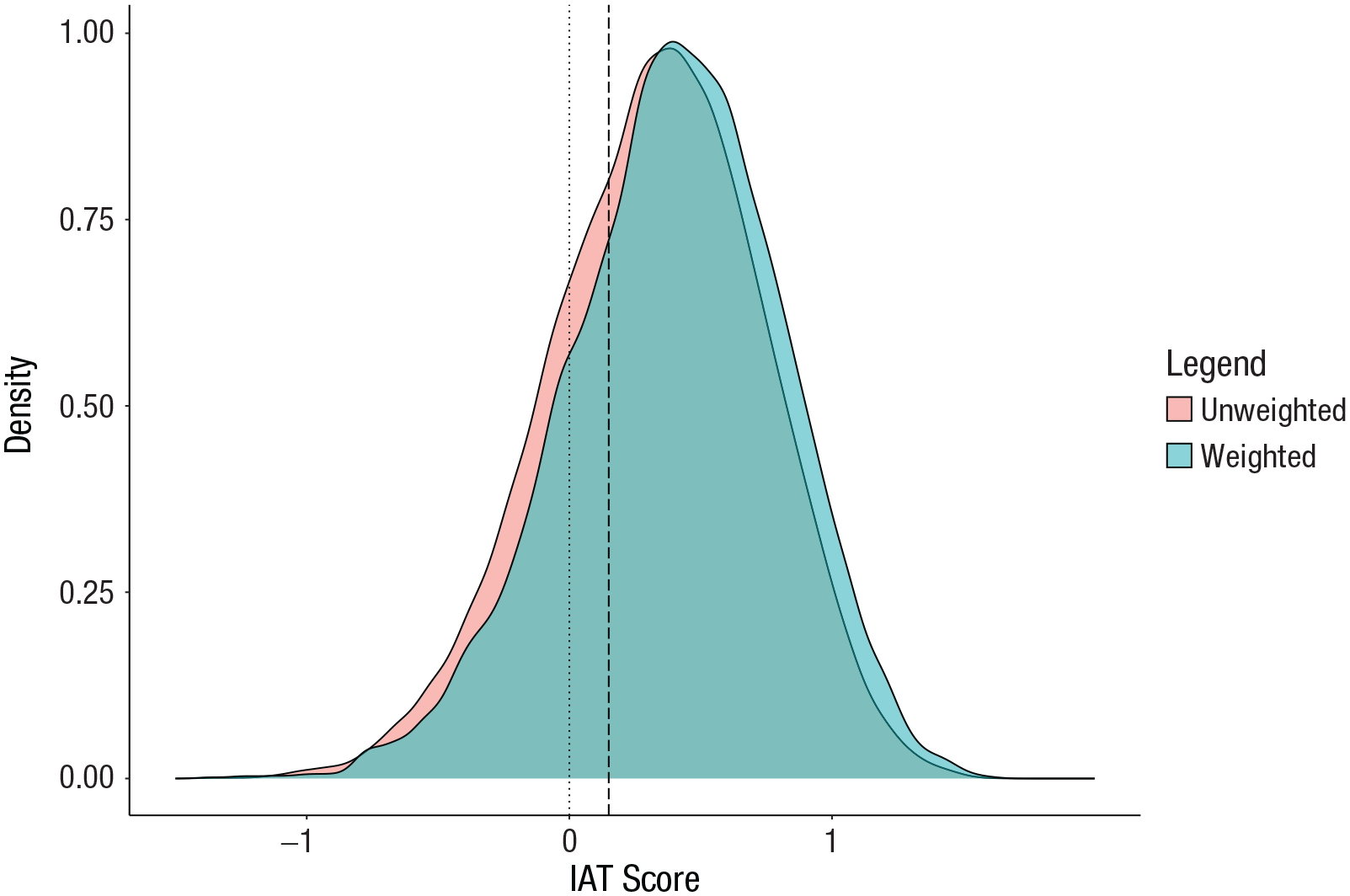
Distribution of unweighted versus weighted Native-Past IAT scores. The vertical dotted line (x = 0) indicates the absence of a biased association between Native Peoples and the past or the present. The vertical dashed line (x = .15) indicates the benchmark for at least a slight association between Native peoples and the past. IAT = Implicit Association Test.
Native-past associations predict minimization of racism and lower policy support
After demonstrating the prevalence of the implicit Native-past stereotype among non-Native participants, we sought to understand the relationship between these perceptions and support for policies that promote Native equity. Specifically, we hypothesized that stronger implicit associations between Native peoples (vs. White Americans) and the past (vs. the present) would be related to greater minimization of the racism that Native peoples experience, which in turn would predict lower support for policies advancing Native equity (see Fig. 1). Models across Studies 2 through 5 yielded consistent results in line with our hypothesis (see Table 6 for model results). Specifically, greater implicit Native-past associations were related to greater minimization of racism (all βs ≥ .14; all 95% CIs did not contain 0) and lower support for all four types of policies (total effect βs ≥ .07; all 95% CIs did not contain 0). More importantly, across all models, the relationship between greater implicit Native-past association and lower policy support were, at least partially, explained by the minimization of racism (indirect effect βs ≥ .06; all 95% CIs did not contain 0). That is, participants who more strongly associated Native peoples (vs. White Americans) with the past (vs. the present) were more likely to minimize the extent to which Native peoples experience racism and, in turn, reported lower support for policies advancing Native equity.
Model Results of Native-Past IAT Scores Predicting Policy Support Through Racism Minimization
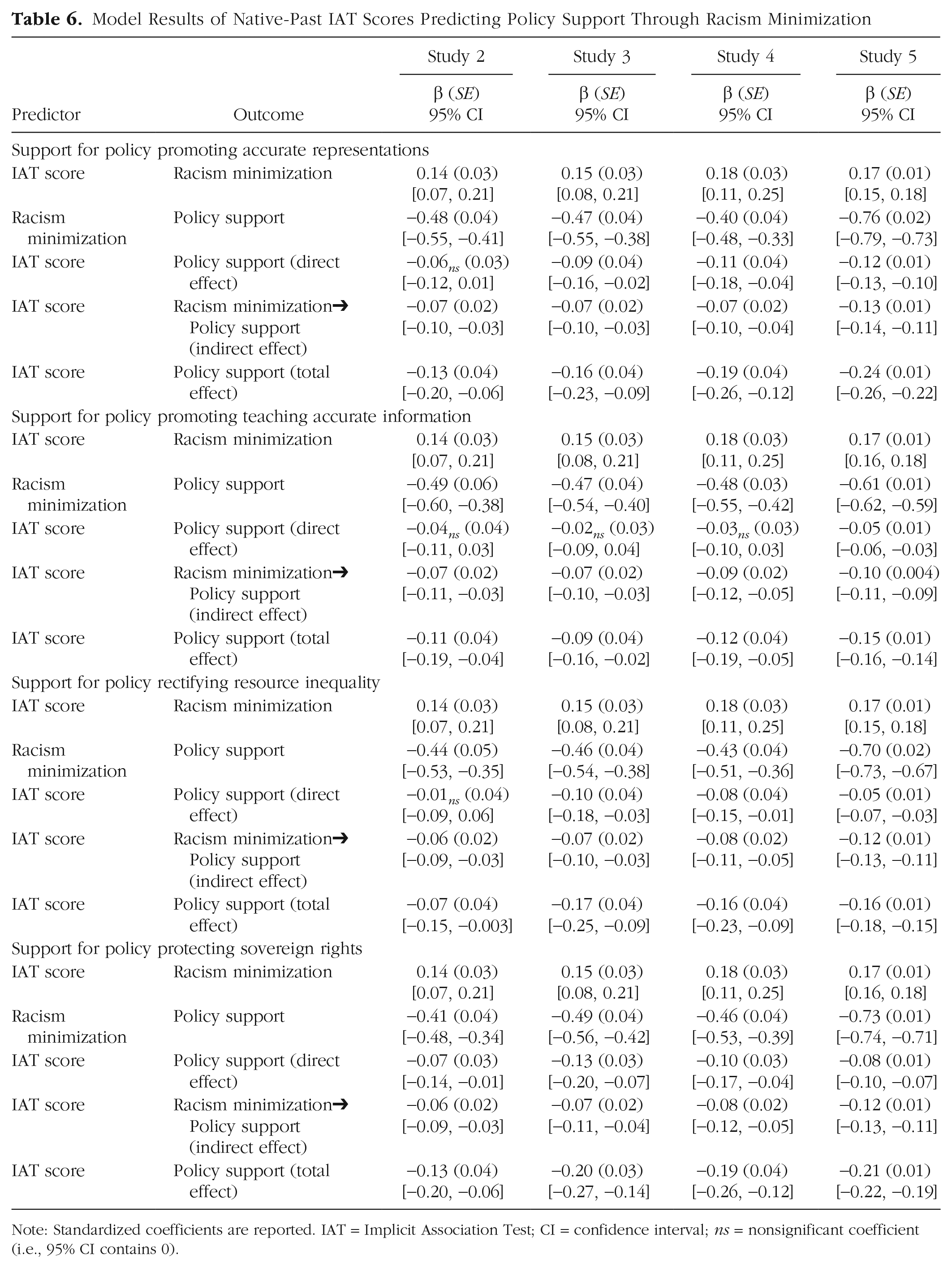
Note: Standardized coefficients are reported. IAT = Implicit Association Test; CI = confidence interval; ns = nonsignificant coefficient (i.e., 95% CI contains 0).
To check the robustness of the models, we controlled for political orientation and explicit Native-past stereotype measures (i.e., Explicit “People of the Past” Perceptions, Absolute Native-past association, and Explicit Relative Associations with the Present). For results, see Primary Models Controlling for Explicit Measures in the Supplemental Material (https://osf.io/nfh35). In these models, although the indirect effects of implicit Native-past association on policy support via minimization of racism were nonsignificant (Study 2), it is noteworthy that Study 2 used an early version of the Native-Past IAT that was still in the process of validation and revision. Nonetheless, and importantly, result patterns and interpretations remained consistent after we controlled for political orientation and explicit Native-past stereotype measures across Studies 3 through 5, which used the third and final versions of Native-Past IAT. These findings suggest that the implicit Native-past association may play a distinct role in policy support above and beyond individual differences in political orientation and explicit Native-past stereotype endorsement.
General Discussion
By developing and validating the Native-Past IAT, we examined the prevalence of the implicit Native-past stereotype among non–Native Americans and its potential implications for efforts to advance Native equity. Supporting our hypotheses, across five studies, including a national sample of over 34,000 participants, we found that over two-thirds of non–Native Americans more strongly associated Native peoples with the past and White Americans with the present than vice versa. Moreover, greater implicit Native-past associations predicted greater minimization of Native peoples’ contemporary experiences of racism, which in turn predicted lower support for policies aimed at promoting Native equity.
This article contributes to psychological literature in three ways. First, although Native scholars theorize that a modern form of bias against Native peoples is the relegation of Native peoples to the past (e.g., Deloria et al., 2018; Fryberg & Eason, 2017), conventional explicit self-report measures used in this work (see Explicit Measures Compared to Midpoint in the Supplemental Material at https://osf.io/nfh35) and prior research (e.g., Lopez et al., 2022) consistently showed that non-Native participants, by and large, remained neutral or disagree with the statements construing Native peoples as people of the past. The Native-Past IAT empirically validates Native scholars’ theories and provides a novel tool for tracking Native-past stereotyping beliefs. Second, our work broadens psychological theories on bias and discrimination. Literature on bias has primarily investigated tangible and derogatory mental representations of groups—as opposed to more subtle or tacit representations—and understudied experiences of Native peoples (Brady et al., 2018; Fryberg & Eason, 2017). By focusing on the collective consciousness that leaves contemporary representations of Native peoples out of non-Native minds, we further demonstrate that there is a unique form of bias that marginalized groups may encounter. Third, we find that denying Native peoples’ existence is closely linked to denying their experiences with racism. Prior research has examined how denying racism against a group (e.g., Black Americans) reduces support for equity (e.g., Jost & Hunyady, 2005; Sears & Henry, 2005). Besides supporting this theory, our model suggests that denying a group’s very existence may compound the persistence of racial inequity.
Our work also makes important societal contributions. Biased representations of Native peoples in individuals’ minds and shared cultural contexts reify a vicious cycle perpetuating Native-past stereotyping (Markus & Conner, 2014). In one direction, living in a culture replete with representations depicting Native peoples as historical figures reinforces the ease with which these ideas come to mind (Bigler & Liben, 2006; Payne et al., 2017). In the other direction, as our findings demonstrate, individuals who view Native peoples as historical figures are more inclined to support practices and policies that reinforce this idea (e.g., retaining Native mascots), while opposing initiatives that challenge this idea (e.g., providing media with incentives to portray contemporary Native peoples). Promoting contemporary Native representations requires both individual-level efforts (e.g., educating oneself on current Native issues) and institutional-level efforts (e.g., incorporating contemporary Native voices in media and education; see Fryberg et al., 2024, for suggestions).
However, as long as the current social structure that subordinates Native peoples remains unchallenged, mainstream representations will continue to reflect and project the views of those in power (Fryberg & Townsend, 2008; Mastro, 2009). Consequently, creating accurate contemporary Native representations may simply not be feasible or may lead to tokenism (e.g., casting a Native actor as a sidekick to a White main character); this approach merely creates an illusion of progress, or a temporary uplift of Native communities. A long-term remedy is needed. Genuine progress requires challenging the oppressive social structure through legislation, policies, and practices that remove systemic obstacles, sufficiently fund Native communities, and uphold tribal sovereignty (see Fryberg et al., 2024, for suggestions). When Native peoples have a say in mainstream institutions, such as media and education, accurate contemporary representations by and about Native peoples can naturally follow.
This work is an essential first step toward unpacking the Native-past stereotype, but it has limitations. First, our studies are cross-sectional. Drawing upon theories in social representations (Moscovici, 1984), system-justifying beliefs (Jost & Hunyady, 2005), and symbolic racism (Sears & Henry, 2005), we have proposed that implicit Native-past stereotyping may lead to racism minimization and subsequently to lower policy support, but causality could flow in the opposite direction. For example, people who deny Native racism and oppose Native equity may justify their standpoints by claiming that Native peoples no longer exist. Future studies should collect causal evidence. Second, White Americans are arguably the most visible group in U.S. society whose contemporary existence is widely recognizable, making this group a suitable comparison group in the current Native-Past IAT. However, this design potentially reinforces the “White default” idea. Future research needs to explore how non-Native people implicitly perceive Native peoples relative to other racially minoritized groups. Third, the IAT literature has shifted from viewing implicit biases as individual beliefs to reflecting systemic cultural biases (Greenwald et al., 2022; Jost, 2019; Payne & Hannay, 2021). Providing initial evidence that what manifests in people’s minds aligns with what exists in cultural environments, we found that states with lower proportions of Native peoples—a proxy for Native visibility in the environments—had higher IAT scores or greater implicit Native-past stereotyping (r = −.28; see State-Level Variations in IAT Scores in the Supplemental Material at https://osf.io/nfh35). Yet our work cannot directly answer whether the implicit Native-past stereotype is a product of the representational landscape. Future research should delve deeper into the cultural, representational, and individual factors influencing the associations of Native peoples with the past. Finally, compared to the non-Native U.S. population, our sample consisted of more female, young, highly educated, and liberal people, which we attempted to address by using demographic weighting and by probing demographic differences in IAT scores. However, because many of our participants voluntarily chose to take the Native-Past IAT over other types of IATs, their worldviews might be intrinsically different from those of the average non–Native American. Further research should carefully examine whether this work’s findings generalize to a sample that is more representative of the U.S. population as a whole.
Conclusion
Native peoples are not frozen in time. They are one of the fastest-growing ethnic groups in the United States, and they continue to be resilient and agentic in the face of ongoing oppression. For example, Native peoples are organizing and participating in activism (e.g., #NoDAPL) and engaging in politics to speak out against unjust treatment and policies; Native organizations are launching campaigns to promote the inclusion of Native voices in public discourse; and Native-led production teams are creating TV shows centered around Native characters and experiences (e.g., Reservation Dogs). But the onus for change does not fall solely on Native peoples. To advance Native equity, all people—ranging from everyday consumers to those with the power to produce and control representations—must disrupt the harmful Native-past stereotype and adopt a more accurate view of contemporary Native peoples, their experiences, and their contributions to society today.
Supplemental Material
sj-docx-1-pss-10.1177_09567976251350958 – Supplemental material for Native Now, Equity Now: Implicit Associations Between Native Peoples and the Past Predict Reduced Support for Racial Equity
Supplemental material, sj-docx-1-pss-10.1177_09567976251350958 for Native Now, Equity Now: Implicit Associations Between Native Peoples and the Past Predict Reduced Support for Racial Equity by J. Doris Dai, Stephanie A. Fryberg and Arianne E. Eason in Psychological Science
Footnotes
Acknowledgements
We want to thank Project Implicit’s Scientific Advisory Board for their valuable feedback on the IAT design. We especially thank Dr. Benedek Kurdi at the University of Illinois for his assistance with and contributions to the research.
Transparency
Action Editor: Antonio L. Freitas
Editor: Simine Vazire
Author Contributions
The second- and third-listed authors contributed equally as senior authors and are listed in reverse alphabetical order.

Notes
References
Supplementary Material
Please find the following supplemental material available below.
For Open Access articles published under a Creative Commons License, all supplemental material carries the same license as the article it is associated with.
For non-Open Access articles published, all supplemental material carries a non-exclusive license, and permission requests for re-use of supplemental material or any part of supplemental material shall be sent directly to the copyright owner as specified in the copyright notice associated with the article.
