




Abstract
Children sometimes learn distracting information better than adults do, perhaps because of the development of selective attention. To understand this potential link, we ask how the learning of children (aged 7–9 years) and the learning of adults differ when information is the directed focus of attention versus when it is not. Participants viewed drawings of common objects and were told to attend to the drawings (Experiment 1: 42 children, 35 adults) or indicate when shapes (overlaid on the drawings) repeated (Experiment 2: 53 children, 60 adults). Afterward, participants identified fragments of these drawings as quickly as possible. Adults learned better than children when directed to attend to the drawings; however, when drawings were task irrelevant, children showed better learning than adults in the first half of the test. And although directing attention to the drawings improved learning in adults, children learned the drawings similarly across experiments regardless of whether the drawings were the focus of the task or entirely irrelevant.
Keywords
Why can children achieve certain learning feats that many adults cannot—like mastering a new language (Birdsong, 1999; Newport, 1990)—when adults outperform children on almost every measure of learning? One explanation is that children’s unlikely prowess in certain learning contexts stems from their superior learning of information that is not task relevant (Plebanek & Sloutsky, 2017), which allows them to take in a broader scope of information than adults. This difference in learning is thought to stem from children’s relatively poor selective-attention abilities and difficulty with filtering task-irrelevant information (Blanco et al., 2023; Blanco & Sloutsky, 2020; Plebanek & Sloutsky, 2017). Although filtering distractors is central to the definition of selective attention, the ability to enhance processing of relevant information is also critical (Petersen & Posner, 2012). And although we know that children, like adults, can enhance processing via attentional selection (Lane & Pearson, 1983; Pozuelos et al., 2014; Wainwright & Bryson, 2002), it is unknown how children’s learning is affected differently for information that is the instructed focus of attention (with no task-irrelevant information present) versus information that is not.
There are several indications that children learn task-irrelevant information better than adults. This includes better detection of changes in task-irrelevant shapes (Plebanek & Sloutsky, 2017: ages 4–5 years), better memory for irrelevant features during visual search (Plebanek & Sloutsky, 2017: ages 4–5 years), better learning of features irrelevant to categorization (Deng & Sloutsky, 2015: 4 years; Blanco & Sloutsky, 2019: 4 years), and better learning of irrelevant visual patterns (Frank et al., 2021: 7–10 years). In one important demonstration, adults and children were told to search for a task-relevant feature (a particular antenna) among aliens. A surprise memory test afterward revealed that children showed better memory for features not cued for search (Plebanek & Sloutsky, 2017). These findings fit with developmental theories positing that reduced cognitive abilities, such as poor selective attention, confer certain learning benefits for children (Blanco et al., 2023; Gopnik et al., 2017; Gualtieri & Finn, 2022; Ramscar & Gitcho, 2007; Thompson-Schill et al., 2009).
Importantly, selective attention involves two separable processes: enhanced processing of selected information, and filtering or ignoring task-irrelevant information (Petersen & Posner, 2012). Whereas previous work has linked changes in filtering processes to children’s learning (Deng & Sloutsky, 2016), we currently lack understanding of how enhancing processing of relevant information shapes children’s learning, if at all. This is staggering, given that a large body of work exists showing powerful attentional-enhancement effects in both adults (Bashinski & Bacharach, 1980; Eriksen & Hoffman, 1974; Jonides, 1980) and children (Lane & Pearson, 1983; Pozuelos et al., 2014; Wainwright & Bryson, 2002) that are observed even when no filtering is required during attentional selection. What is more, the presence of distractors can produce greater enhancement (Awh et al., 2003; Moran & Desimone, 1985), even boosting learning for the attended information (compared with when no distractors are present) in adults (Spataro et al., 2013). Indeed, distractors can either help or hinder learning outcomes depending on the context and level of attentional control (Markant & Amso, 2022). We therefore seek to characterize how learning changes (if at all) when children versus adults are directed to attend to information when no distractors are present compared with when that same information is presented incidentally, as the distraction that learners are told to ignore.
Previous work suggests opposing possibilities. On the one hand, directing children’s attention to the drawings should boost their learning. This is possible because selective-attention systems are functional—although not fully mature—and capable of guiding learning as early as infancy (Ellis et al., 2021; Raz & Saxe, 2020; Werchan & Amso, 2020) and certainly in childhood (Hanania & Smith, 2010). What is more, behavioral (Lane & Pearson, 1983; Pozuelos et al., 2014; Wainwright & Bryson, 2002) and event-related-potential studies (Coch et al., 2005) have demonstrated children’s enhanced processing of attended information specifically.
Statement of Relevance
Kids are amazing learners: They learn language better than adults do and tend to remember details that an adult would deem irrelevant. (“That koi fish was hairy!?”) These unique strengths in learning could be the consequence of children’s worse attention; it could be that attention just matters less for children’s learning. We asked children (aged 7–9 years) and adults to learn about drawings when the drawings were the focus of attention versus when they were irrelevant to other tasks we asked them to complete, and this is exactly what we found. Unlike adults, who learned better when we asked them to pay attention, we found that children learned information equally well when we asked them to focus on it and when we asked them to do something else entirely. These results suggest that a sponge may be a good metaphor for learning during childhood: Children appear to take things in regardless of whether they are trying to or not.
On the other hand, attentional instruction may impact learning less in children than in adults. Along these lines, it is well known that children’s selective attention develops quite slowly well into early adulthood (Amso & Scerif, 2015; Anderson, 2002; Gil-Gómez de Liaño et al., 2020). Further, a recent functional magnetic resonance imaging (fMRI) investigation failed to find evidence of attentional enhancement in 7- to 9-year-olds (Jung et al., 2023). Instead, this study found that attended and unattended information were treated similarly in the child (but not the adult) brain. This suggests that attended information may not be prioritized in children to the same extent as in adults and leaves open the possibility that enhanced processing through attentional selection has less of an impact on children’s learning.
To adjudicate between these opposing possibilities, we presented drawings of common objects as task relevant (hereafter the directed condition; Experiment 1), as opposed to the same objects presented as task-irrelevant (hereafter the incidental condition; Experiment 2). In Experiment 1, children and adults were told to attend to the objects and indicate each time one appeared (Fig. 1a). Participants then completed a surprise picture-fragment completion test, and learning was indexed by how quickly fragments of previously shown drawings were identified relative to novel drawings (Fig. 1b). In Experiment 2, a separate group of children and adults performed a working memory task (dynamically calibrated on the basis of ongoing performance) while the same drawings—now task-irrelevant—were presented (Fig. 1c and 1d), after which they completed the same surprise test as in Experiment 1 (Fig. 1b). We predicted that adults would show better learning than children, but only if the instruction was to pay attention to the objects. When objects were presented as task-irrelevant information, we predicted that this effect could reverse and that children might show better incidental learning than adults. Our critical comparison, however, was across experiments, where we predicted that learning in the context of directed versus incidental presentation conditions—across Experiments 1 and 2—would differ less in children as compared to adults.
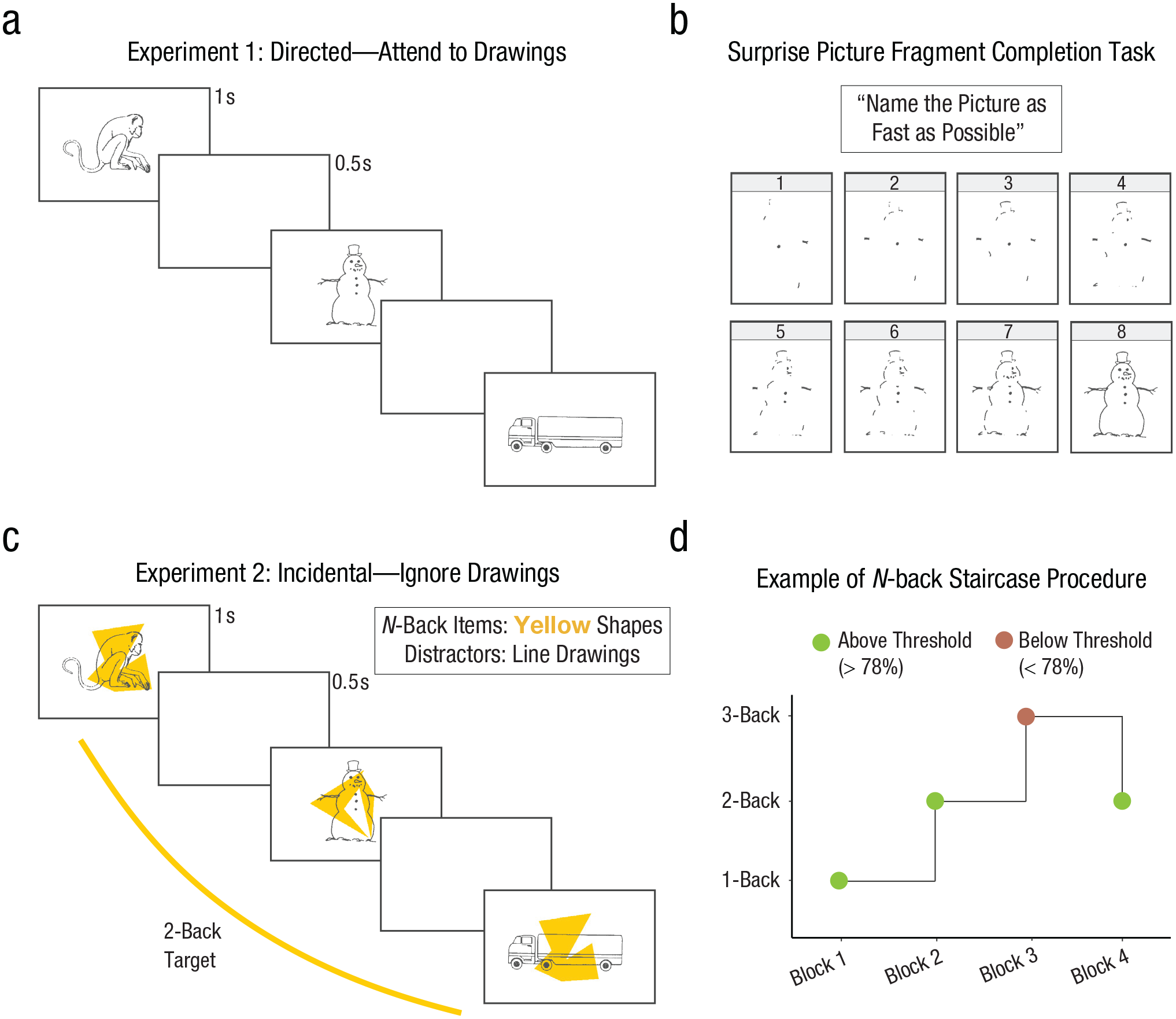
Experiment design. In Experiment 1’s exposure phase (a), participants were asked to attend to line drawings of common objects and press a key every time a drawing appeared (which occurred on each trial). In this experiment, drawings were task relevant. An example of the eight fragment-completion levels is shown in (b); these were used to create the test trials for the surprise picture-fragment-completion task. On each trial, drawings became progressively more complete, and participants had to name the drawing as quickly as possible (numbers depict the fragmentation level). Half of the drawings were shown during exposure (old) and the other half were not shown during exposure (new). Participants were told that this task was to assess their vocabulary. The exposure phase in Experiment 2 is shown in (c): Participants’ task was to complete an N-back task for the yellow shapes. In this experiment, the drawings thus acted as distractors and were superimposed on top of the shapes. Participants were told to ignore the drawings. The experiment was otherwise identical to Experiment 1, and drawings were shown the same number of times and for the same duration. An example of a participant’s N-back staircase trajectory is illustrated in (d). For each block, the N-back level (y-axis) was dynamically titrated to each participant’s performance on the block prior (above the threshold meant increasing the N-back level by one on the next block; below the threshold meant decreasing the N-back level by one).
Experiment 1
Method
Participants
The reported analyses are based on a postexclusions sample of 35 adult participants (15 males, aged 17–23 years; M = 19.1, SD = 3.4; 76% White) and 42 child participants (18 males, aged 7–9 years; M = 7.7, SD = 0.8; 29% White). All adult participants reported their sex and race. One family opted not to disclose their child’s sex, and 14 participants opted not to disclose race. Adult participants were recruited from the University of Toronto, tested in the lab, and received course credit in exchange for participation. Child participants were recruited from the Ontario Science Centre and a database managed by the university’s Child Study Centre. Children were tested both in the lab and at the Ontario Science Centre and received $10 and a small toy (in the lab) or a small toy only (in the museum). All participants had normal or corrected-to-normal vision and had no history of head trauma or neurological or psychiatric illness. Experimental procedures were approved by the local ethics committee, and participants or parents provided written informed consent or assent.
On the basis of the results of Experiment 2 (which was run first in chronological order), we anticipated a medium effect size (Cohen’s d = 0.55). This effect size was based on the t test in the first block of Experiment 2, in which children showed better learning than adults. Our power analysis indicated that a sample of 42 participants per age group would provide 80% power to detect differences in group means (α = .05). Because of COVID-19, we did not reach our full intended sample size for the adult group. However, the achieved sample is still powered (77%) to detect a medium-sized effect (0.55), so we moved our stopping rule to 35 (our obtained sample) prior to data analysis. In addition, we hypothesized (and found) that the developmental difference between children and adults would be much larger in this experiment given that participants were instructed to attend to the drawings.
Stimuli and procedure
Image selection
We used 46 black-and-white line drawings of common objects from a standardized image set (Snodgrass & Vanderwart, 1980) frequently used in the priming literature (Ballesteros et al., 2007; Cycowicz et al., 2000). The 46 images were selected from a subset of 62 of the images used in a prior study that assessed priming in both adult and child samples (Cycowicz et al., 2000). We first removed any images that were not deemed child-friendly (e.g., a gun). We then conducted a norming experiment with a separate group of children aged 5 to 9 years (n = 30). Participants completed only the picture-fragment completion task (no exposure phase), and we measured how quickly and accurately they were able to name the images. Ignoring difficulty (i.e., at what fragment level an image was identified), we included only images that were correctly identified by at least 75% of participants. This led us to select the final 46 drawings that were used in both experiments. The images were divided into two sets of 23 images equated for difficulty. Half of the images were shown during the exposure phase (old) and the other half were used as novel items during the picture-fragment completion task (new). The assignment of these sets as old and new items was counterbalanced across participants.
Exposure phase
Line drawings were presented one at a time in a random order for each participant. Participants were instructed to watch closely and to press the “a” key on a keyboard every time an image appeared (Fig. 1a). Each image was shown for 1.5 s and was followed by a blank screen interstimulus interval for 0.5 s. The exposure phase consisted of 4 blocks of 23 trials in which each drawing was seen once per block for a total of 92 trials. A researcher was present in the room with both child and adult participants to ensure that participants were paying attention and engaged with the task. The total length of the exposure phase was around 3 min (excluding instructions and practice trials, which took approximately 2 min).
Picture-fragment-completion task
Immediately following the exposure phase, participants were asked to complete a surprise picture-fragment completion task (Ballesteros et al., 2007; Cycowicz et al., 2000). Participants were told that the purpose of this task was to test their vocabulary knowledge. On each trial, participants viewed fragments of a drawing that became progressively more complete and were asked to identify the image as soon as possible. For each drawing there were a total of eight fragment levels (1 = the most fragmented, 8 = the least fragmented; Fig. 1b). Each fragmented level lasted for 1.5 s. Adults responded by hitting the space key when they felt they knew the image’s identity. Once the space key was hit, the drawing disappeared, and adults were prompted to type their response. Child participants were instructed to say the name out loud, and then an experimenter who was seated beside them would hit the space key and type in the verbal response. Although different response methods were used for adults and children, learning sensitivity was calculated as a within-subjects difference between old and new items and not as absolute response times (therefore, differences across groups and participants did not affect the results). Twenty-three of the drawings appeared in the exposure phase (old), and 23 were new to the participants (new). Trial order was randomized for each participant, and no drawings ever repeated. This task was divided into two blocks of 23 trials (first block, second block). A screen appeared between blocks that instructed participants to take a 1-min break if needed. Before beginning the task, participants completed three practice trials on drawings not used in the experiment. The total length of the picture-fragment completion test was around 8.5 min (this excludes the instructions and practice trials, which took approximately 2 min and varied depending on the typing speed).
Data exclusion
We restricted our analyses to the surprise picture-fragment-completion trials in which participants correctly identified the image. This is standard practice in the priming literature for fragment-completion tasks (Amer et al., 2016; Ballesteros et al., 2007; Campbell et al., 2012; Cycowicz et al., 2000; Snodgrass, 1989; Snodgrass & Vanderwart, 1980) because the difference between correct identification levels for old versus new images is the critical learning signal. We also analyzed labeling-error rates in both experiments and found they were not measures of learning (they did not differ for old vs. new images). Taking labeling errors into account had no effect on the results, either (Supplemental Note 1, Supplemental Table S1). Two raters independently coded each typed response as either correct or incorrect. A correct answer that was spelled wrong was considered a correct response. Responses were coded liberally for meaning (e.g., “basketball” would be accepted as a correct response for “ball”). Given high interrater reliability (> 98%), one of the rater’s coded responses was randomly selected to be used for all remaining analyses. The total number of incorrect trials excluded was 117 for children and 25 for adults. Picture-fragment-completion trials that were faster than 300 ms were also excluded as implausible (two trials were excluded for adults, none for children). Note that all of these data-exclusion criteria are identical to the preregistered criteria used in Experiment 2.
Experiment 2
This experiment was run first in chronological order. Experiment design as well as exclusion criteria and analyses were preregistered unless otherwise noted. The preregistration can be found on the Open Science Framework (https://osf.io/ad4ty).
Participants
The reported analyses are based on 60 adult participants (14 males, aged 17–23 years; M = 18.8, SD = 1.4; 43% White) and 53 child participants (27 males, aged 7–9 years; M = 8.0, SD = 0.9; 34% White). Three adults opted not to disclose sex, and two opted not to disclose race; two children also opted not to disclose sex, and 18 did not disclose race. Adult participants were recruited from the University of Toronto, tested in the lab, and received course credit in exchange for participation. Child participants were recruited from the Ontario Science Centre and a database managed by the university’s Child Study Centre. Children were tested both in the lab and at the Ontario Science Centre and received $10 and a small toy (museum participants received only a toy). All participants had normal or corrected-to-normal vision and had no history of head trauma or of neurological or psychiatric illness. Experimental procedures were approved by the local ethics committee, and participants or parents provided written informed consent or assent.
Although no prior research has explored our research question (specifically, comparing adult and child participants on a picture-completion task), our preregistered sample size was based on a medium effect size (Cohen’s d = 0.55). This power analysis indicated that a sample size of 60 participants per age group would allow for at least 80% power to detect group differences at the standard alpha error probability of .05; however, we did not reach our full child-sample goal because of COVID-19. Earnest data analysis and exclusion criteria were applied during the pandemic, even though this experiment was run first in chronological order. Because we only realized during the pandemic that we no longer met our target sample size postexclusion (which was preregistered), we decided to not collect more data. All participants met the same inclusion criteria described in Experiment 1. This study was approved by the University of Toronto’s Research Ethics Board.
Stimuli and procedure
Exposure phase with the N-back task
The exposure phase was identical to Experiment 1’s, with one critical difference: Participants engaged in a working memory task (N-back task; Kirchner, 1958) at the same time that the drawings were presented (Fig. 1c). Participants viewed a sequence of abstract yellow shapes upon which the line drawings were overlaid (Vanderplas & Garvin, 1959; numbers 15, 17, 22, and 27 of the 6-point shapes were used, as well as numbers 11, 20, 24, and 26 of the 8-point shapes) and were instructed to hit the “a” key when the current shape matched the shape from n steps prior in the sequence (either one, two, or three steps). Participants all started at a 1-back in the first block. The number of steps (i.e., the difficulty of the working memory task) in each block thereafter was determined online by the participants’ performance in the block prior (Fig. 1d). If the number of incorrect responses in a block was fewer than 6 (> 78% accuracy), the N-back level would increase by one in the subsequent block. If participants were already at a 3-back, they would stay at the same level. However, if the number of incorrect responses was 6 or greater in a block (< 78% accuracy), the level in the next block would decrease by one. If participants were at a 1-back, they would stay at the same level. N-back repeats randomly occurred six times per block. Lure trials were present on very rare occasions (0–2 per block), when an N-back repeat from a level different from the current block occurred. Children and adults did not differ in their ability to correctly reject lures (p = .67; children = 81%, adults = 78%). The exact trial order in which N-back shapes were presented in each block was predetermined. For each of the three N-back levels, there were four possible trial orders (sets 1–4) that could be assigned to a block. One of the four sets at the appropriate level was assigned to the current block in one of two fixed ways that was counterbalanced across participants: Namely, the block would inherit either the lowest numbered set or the highest numbered set. This sampling was done for each participant without replacement, which ensured that the same trial order was never assigned twice to the same participant. Note that this counterbalancing was fully crossed with the counterbalancing of the two sets of drawings that were assigned as distractors during the N-back task (vs. novel at test), creating a total of four experimental conditions. Adding condition as a covariate in our models did not have any impact on the results. As in Experiment 1, the exposure phase was broken into four blocks of 23 trials, for 92 trials total. Importantly, the drawings were shown for the same length of time and for the same number of times as in the first experiment. Unlike the prior experiment, the drawings were not the focus of attention in this experiment and were thus task irrelevant. Participants were told that the line drawings did not matter for the task and to ignore them. In order to reinforce the task instructions, participants completed a practice N-back task with a different set of shapes and drawings before starting the experiment; this practice task included a 1-back, a 2-back, and a 3-back. The total length of the exposure phase with the N-back task was around 3 min (excluding instructions and practice trials, which took approximately 4 min).
Picture-fragment-completion task
This task was identical to that of Experiment 1.
Data exclusion
As described in the preregistration, we excluded participants who scored less than 65% accuracy on the N-back task. An incorrect response included both misses (a failure to identify the repeated N-back target at the appropriate N-back level) and false alarms (falsely identifying a nontarget). This was intended to remove any participants who were not adequately performing the N-back task. We also planned to exclude participants with mean reaction times below 250 ms on the N-back task, but no participant was excluded for this reason. In addition to the preregistered exclusion criteria, we also excluded three children who never hit any keys or hit a key only once during the entire N-back task. We also excluded three children who hit keys more than 30 times, because this was more than 2 standard deviations above the mean number of keys hit in the N-back task (Mkeys = 18.95). We decided to exclude these participants because our preregistered 65% accuracy criterion did not capture these participants who clearly were not engaged in the task. Excluding these six children did not affect the results or the significance values. On the basis of all the criteria above, two adults and eight children were excluded.
As in Experiment 1, we excluded incorrect responses during the picture-fragment-completion task and responses faster than 300 ms. The total number of incorrect trials excluded was 281 for children and 75 for adults; the total number of fast response trials excluded was three for children and two for adults.
Statistical analyses
Linear mixed-effects models
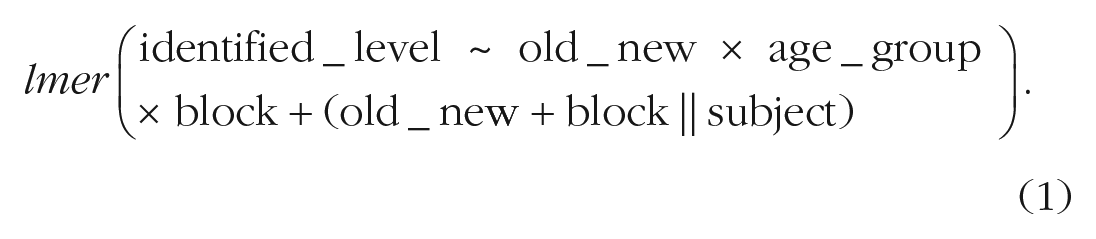
We assessed learning sensitivity, in both Experiments 1 and 2, using linear mixed-effects models (Bates et al., 2015). On a trial-by-trial level, our models predicted the fragment level in which an item could be identified on the basis of whether or not it was seen during the exposure phase (old, new), the age group of the participant (child, adult), and the block of test in the picture-fragment-completion task (first block, second block). Learning sensitivity was defined as significantly faster identification of old relative to new images (a lower identification level). Developmental differences in learning were qualified by an interaction between old-new status and age group followed by comparing learning-sensitivity slopes. We allowed for interactions between all independent variables. Models included random intercepts for subject and random slopes (fixed effects were uncorrelated with || because of convergence issues). Age group (−1 = child, 1 = adult), test block (−1 = first block, 1 = second block), and old-new status (−1 = new, 1 = old) were effect coded. The model for Experiment 1 was run as follows:
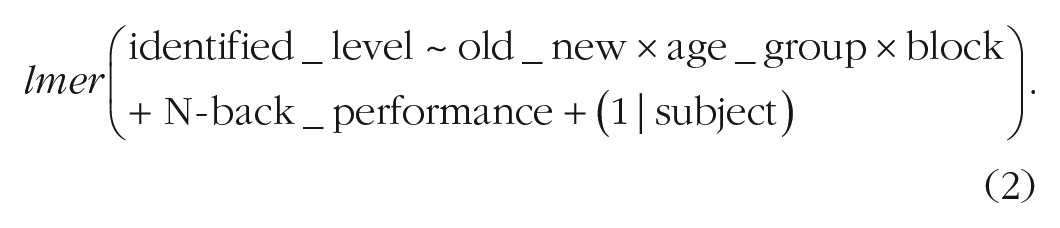
For Experiment 2, a similar model was used with the addition of subject-level N-back performance (d′) as a covariate (mean centered and scaled). We included this term in our model to control for the possibility that age-group differences in learning sensitivity may be due to differences in N-back performance between children and adults. Random slopes were omitted in this experiment because we were unable to estimate random slopes by decorrelating the fixed effects. The model for Experiment 2 was run as follows:
Across experiment analyses, we fitted a model to both experiment’s data that included experiment (effect coded; −1 = Experiment 2, 1 = Experiment 1) as an interaction term. Random intercepts were included, but random slopes were unable to be estimated. The across-experiment model was run as follows:

Linear mixed-effects models were run in R (version 1.4.1106) using the lme4 package (Bates et al., 2015). The lmerTest package was used to obtain p values for models using the Satterthwaite degrees-of-freedom method. The emmeans package (Lenth et al., 2018) was used to obtain estimated marginal means (also known as least-squares means) for post hoc comparisons and to test slopes. For comparisons, Tukey’s adjusted p values were used and degrees of freedom were calculated using the Kenward-Roger method. Only correct trials were included in the models. We report standardized beta values (Lorah, 2018) from the raw model outputs as a measure of effect size (beta values reflect the estimated difference between each label and the grand mean).
Learning-sensitivity score
In addition to the mixed-effects models, we also assessed learning using a preregistered learning-sensitivity index. For each participant, we calculated a learning-sensitivity score as the difference between their mean identification level for new minus old items. A positive score is evidence of learning sensitivity, because it indicates that a participant correctly identified items with less perceptual information faster for items shown during the exposure phase relative to novel items.
N-back performance (d′)
Although we preregistered the percentage of correct trials as a measure of N-back accuracy, we realized that this did not appropriately capture differences in response biases. Therefore, we used d′ as the measure of performance on the N-back task. There was no difference in the pattern of results using these two performance measures, so we report only d′ scores. These scores were calculated for each participant overall and also within each block. Potential extreme values for hit rate and false-alarm rate were addressed using the log-linear method (Hautus, 1995) prior to calculating d′.
Results
Experiment 1: Adults learn better than children when instructed to attend to the drawings
To understand how learning in children and adult differs when information is the focus of the task (the directed condition), we instructed participants to attend to the object drawings during the exposure phase and to press a key every time a drawing appeared (Fig. 1a). Children and adults pressed the button with equal frequency (p = .51; children: 79%, adults: 76%, Supplemental Fig. S1). We also had verbal confirmation from the experimenters that participants were looking at the screen on each trial (the purpose of the cover task was to help encourage this; see the Method section). Performance on the cover task did not correlate with learning in either age group (ps > .54), and taking cover-task performance into account had no effect on the results (see Supplemental Table S2 and Supplemental Note 2).
Using a linear mixed-effects model that included the block of test, we examined participants’ ability to identify object drawings during the picture-fragment-completion test (Table 1, Fig. 2a). Both children and adults demonstrated learning sensitivity: They were quicker to correctly identify old relative to new objects (main effect: p < .0001), something that was present in both test blocks for both age groups (adults—Block 1: ß = 0.72, SE = 0.07, df = 265, t = 10.26, p < .0001; children—Block 1: ß = 0.21, SE = 0.07, df = 296, t = 3.17, p = .009; adults—Block 2: ß = 0.54, SE = 0.07, df = 264, t = 7.64, p < .0001; children—Block 2: ß = 0.31, SE = 0.07, df = 280, t = 4.74, p < .0001).
Mixed-Effects Model Results (Experiment 1)
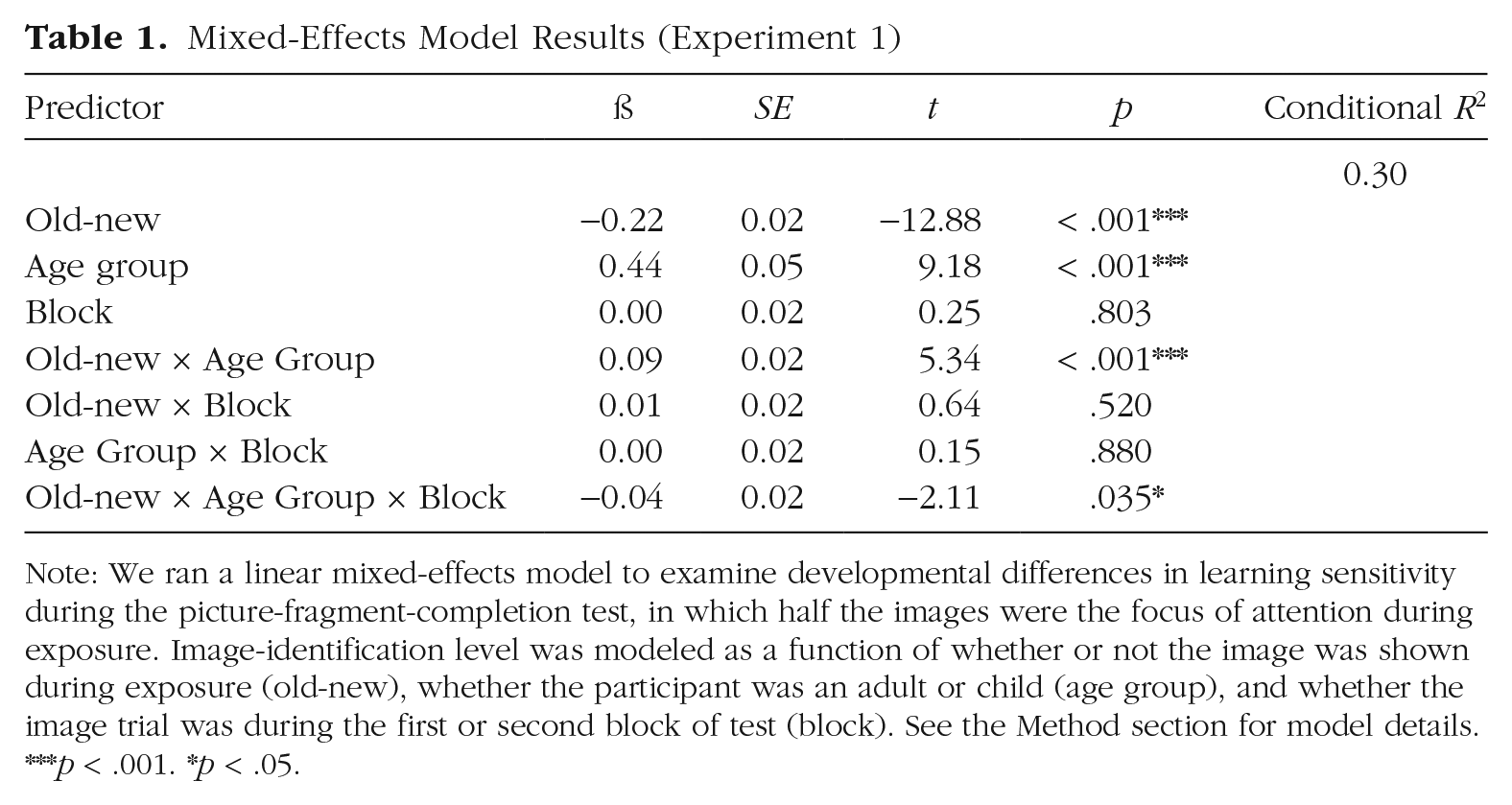
Note: We ran a linear mixed-effects model to examine developmental differences in learning sensitivity during the picture-fragment-completion test, in which half the images were the focus of attention during exposure. Image-identification level was modeled as a function of whether or not the image was shown during exposure (old-new), whether the participant was an adult or child (age group), and whether the image trial was during the first or second block of test (block). See the Method section for model details.
p < .001. *p < .05.
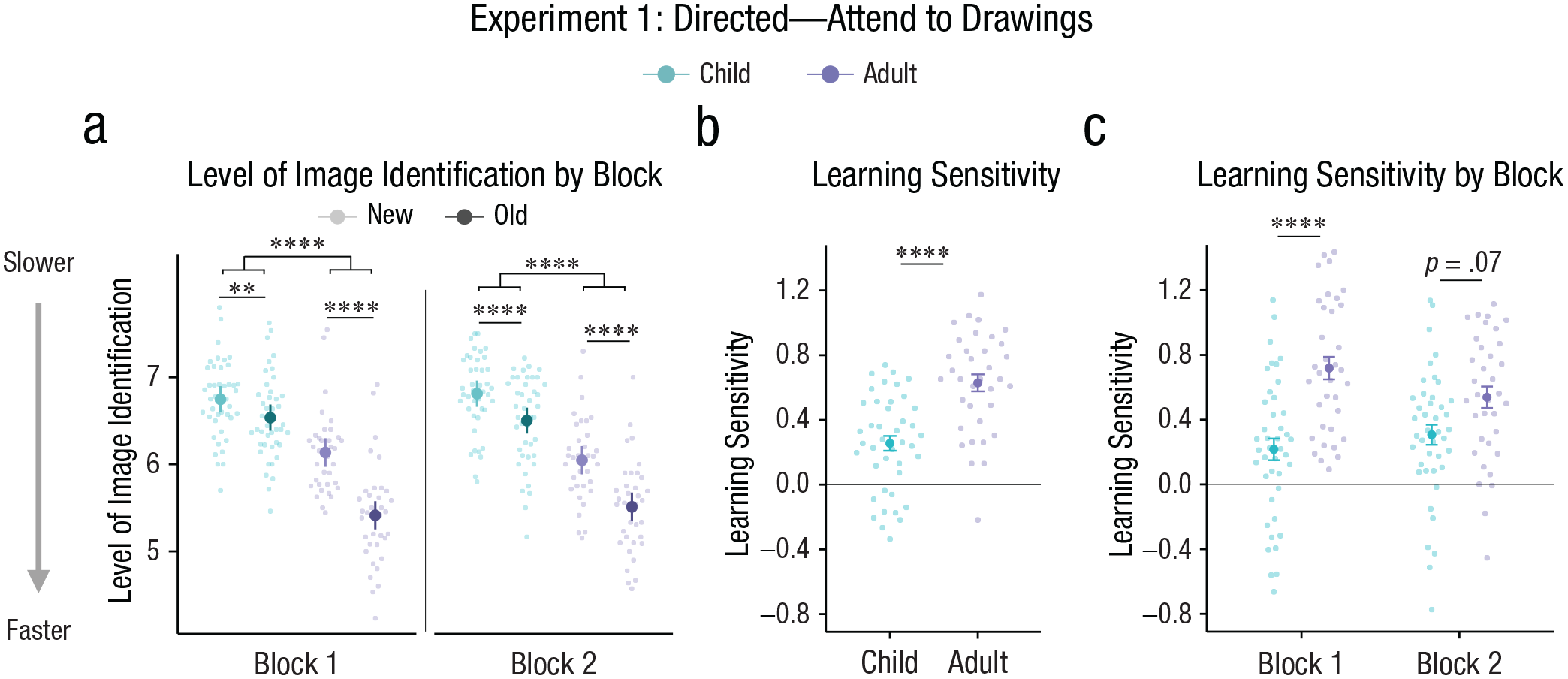
Developmental differences in learning when attention is directed (Experiment 1). In (a) are shown model estimates of the fragment level in which old (darker) and new (lighter) drawings were correctly identified during the surprise picture-fragment-completion test by children (teal) and adults (purple). A lower level (y-axis) means the drawing was identified at a more fragmented state (i.e., identified faster). Significance lines with ticks depict an interaction between old-new status and age group (a difference in the slope between old and new images for children vs. adults). Each dot represents a participant; vertical lines denote 95% confidence intervals. In (b) are shown learning-sensitivity scores for children and adults. Scores were calculated for each participant as the mean identified level for new items minus the mean identified level for old items. A score above zero is evidence of learning (faster identification of old relative to novel items). Each dot represents a participant; error bars denote standard errors of the mean. Learning-sensitivity scores for children and adults in each block of the picture-fragment-completion test are illustrated in (c). ****p < .0001. **p < .01.
We found a significant three-way interaction between a drawing’s type (old or new), participant’s age group, and block (p = .035). There was a significant two-way interaction (p < .00001) between age group and whether an image was old or new, which indicated a developmental difference in learning sensitivity. By contrasting the slopes for old and new images averaged across blocks, adults showed greater learning sensitivity than children (Fig. 2a; ß = 0.18, SE = 0.03, df = 74.3, t = 5.33, p < .0001). This indicates that the difference in identification level for old and new drawings was more pronounced for adults than children. As reflected in the three-way interaction, this developmental difference was robust during the first block (ß = 0.26, SE = 0.05, df = 279, t = 5.27, p < .0001), but only marginal during the second (ß = 0.11, SE = 0.05, df = 271, t = 2.37, p = .09). Changes in learning sensitivity across testing blocks were not significant in either age group (ps > .23). Adults were also overall faster than children at correctly identifying drawings (p < .0001).
In addition to mixed-effects modeling, we examined learning using a preregistered learning-sensitivity score (the difference between participants’ mean identified level for new items minus their mean identification level for old items; therefore, a positive learning-sensitivity score reflects learning, zero reflects no learning, and negative scores indicate faster identification of new items than old items). Learning-sensitivity-score results were consistent with the model results (Figs. 2b, 2c; see Supplemental Note 3). These effects were also observed when looking at response times as opposed to identification level (Supplemental Note 4). In addition to examining differences between children and adults, an exploratory correlation showed that learning-sensitivity scores increased from age 7 to 9 within the child sample (Pearson’s r = .35, p = .03; see Supplemental Fig. S2). Taken together, these data demonstrate that when the task is to pay attention to the drawings, adults learn more than children.
Experiment 2: Children learn just as well as adults when instructed to ignore the drawings
Up to this point, we have established that adults learn better than children when they are instructed to attend to the drawings. This finding is not surprising; adults outperform children on most laboratory tasks for myriad reasons, including better attention, better memory, and a better ability to follow task instructions. Importantly, this experiment establishes a performance baseline for children and adults when the task is to attend to the drawings. In the following experiment, we ask whether children in this age range (7–9 years) learn the drawings better than adults, similar to what has been observed previously (Plebanek & Sloutsky, 2017), using this same measure of learning (an indirect priming measure) when they are told to ignore the drawings and asked to perform an alternate task. We therefore presented the same drawings and asked participants to perform a working memory task (an N-back task) on abstract shape stimuli upon which the drawings were overlaid (Fig. 1c).
Consistent with developmental improvements in working memory (Gathercole et al., 2004), children’s mean N-back level across all blocks was lower than adults’, t(111) = 7.26, p < .0001, Cohen’s d = 1.37, 95% confidence interval (CI) = [0.95, 1.78] (see Fig. 3a). Although we implemented a staircase design to assist in matching performance across age groups, adults still had better N-back performance (as measured by d′) than children, t(111) = 6.62, p < .0001, Cohen’s d = 1.25, 95% CI = [0.84, 1.65] (Fig. 3b). This is because all participants started at a 1-back in the first block, which is easy for most adults. Indeed, looking at performance in the last two blocks of the N-back task (when the participants are situated at an appropriate difficulty level), there was no longer a difference in performance between children and adults (ps > .29; Fig. 3c). In addition, we observed no correlations in either age group between learning-sensitivity scores and overall N-back performance or mean N-back level (ps > .18). There was also no correlation between these N-back measures and the mean identification level for old items (ps > .18). This suggests that any age differences in learning are likely not attributed to children performing worse on the main task (the N-back task). Still, we wanted to control for age differences in on-task performance and therefore included N-back performance (d′) as a covariate in the mixed models described below.
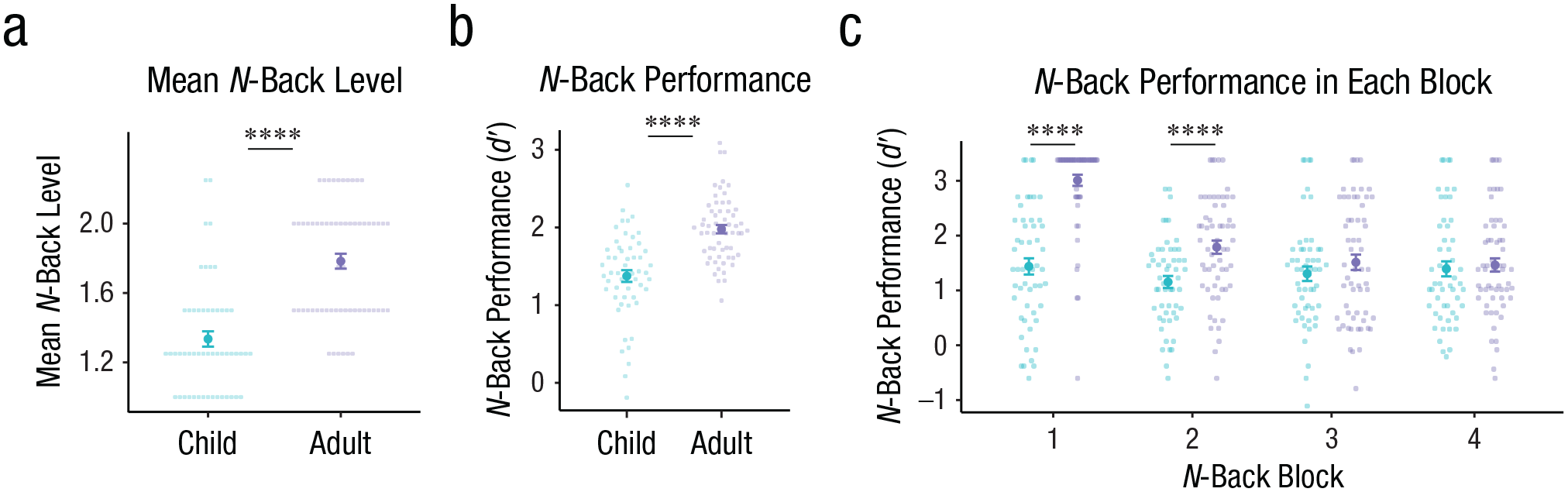
N-back results for Experiment 2. Illustrated are the mean N-back levels achieved by children and adults (a), differences in N-back detection performance (calculated as d′) for children and adults (b), and differences in N-back performance between children and adults in each of the four blocks of the exposure phase (c). Each dot represents a participant; error bars represent standard errors of the mean. ****p < .0001.
We used a mixed-effects model to examine learning sensitivity during the surprise picture-fragment-completion test (Table 2, Fig. 4a). Both adults (ß = 0.17, SE = 0.04, df = 4724, t = 4.38, p = .0001) and children (ß = 0.23, SE = 0.04, df = 4728, t = 5.27, p < .0001) were quicker to identify old relative to new items (main effect: p < .0001). Evidence of learning sensitivity in this experiment demonstrates that both adults and children are processing incidental information in the face of an attentionally demanding N-back task. Strikingly, though, we found no difference in the magnitude of learning sensitivity between children and adults (no interaction between old-new status and age group; p = .32). This is in stark contrast to the prior experiment, in which adults had dramatically better learning than children when these same drawings were the directed focus. This lack of a developmental difference was also observed in our analysis of learning-sensitivity scores (Fig. 4b; see Supplemental Note 5) and in a response-time analysis (Supplemental Note 6). Unlike the prior experiment, in which learning increased from ages 7 to 9 years, there was no correlation between a child’s age in predicting overall learning-sensitivity scores in this experiment (Pearson’s r = .17, p = .24; see Supplemental Fig. S2)—suggesting that learning via incidental presentation does not change during this developmental period.
Mixed-Effects Model Results (Experiment 2)
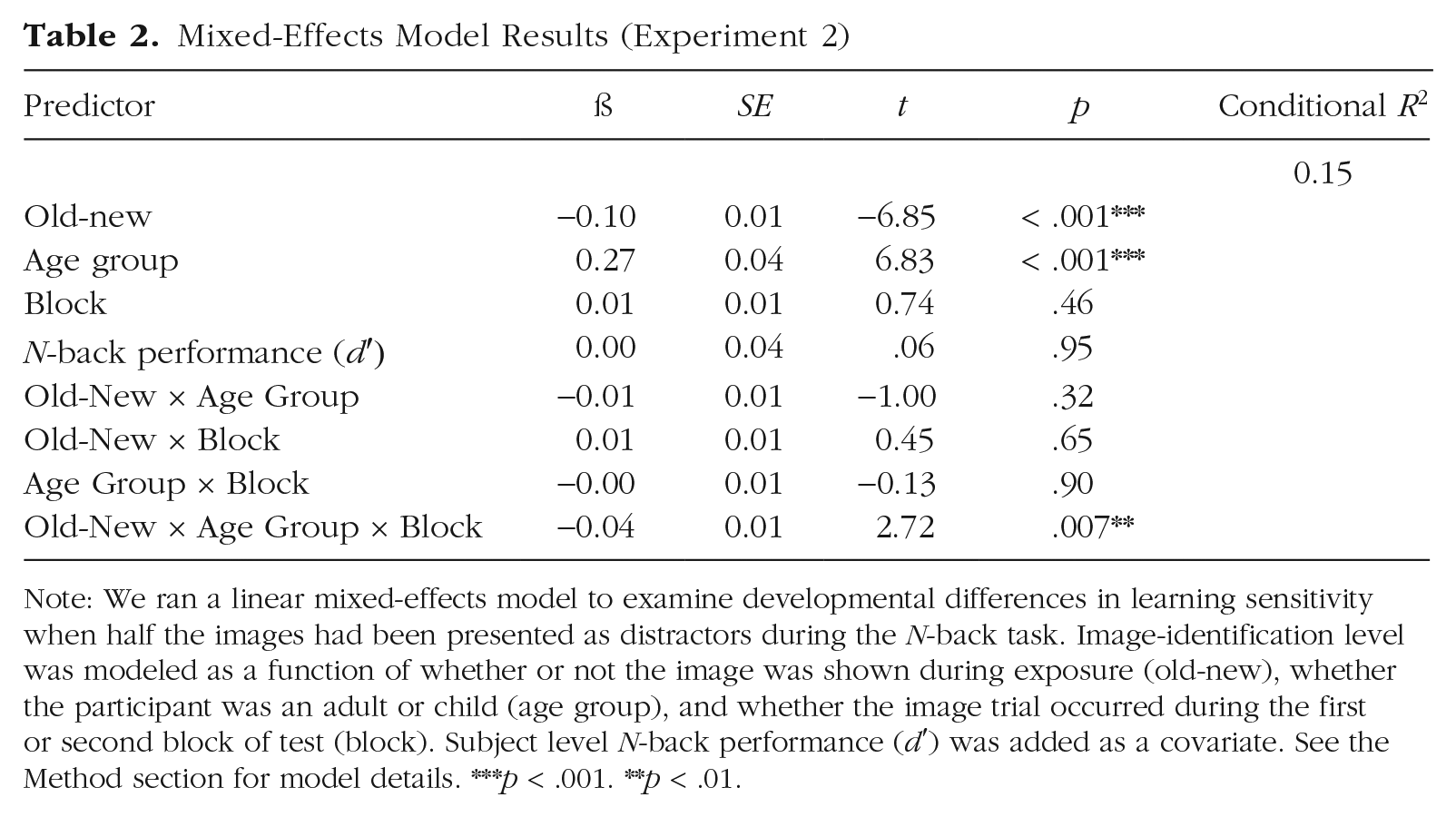
Note: We ran a linear mixed-effects model to examine developmental differences in learning sensitivity when half the images had been presented as distractors during the N-back task. Image-identification level was modeled as a function of whether or not the image was shown during exposure (old-new), whether the participant was an adult or child (age group), and whether the image trial occurred during the first or second block of test (block). Subject level N-back performance (d′) was added as a covariate. See the Method section for model details. ***p < .001. **p < .01.
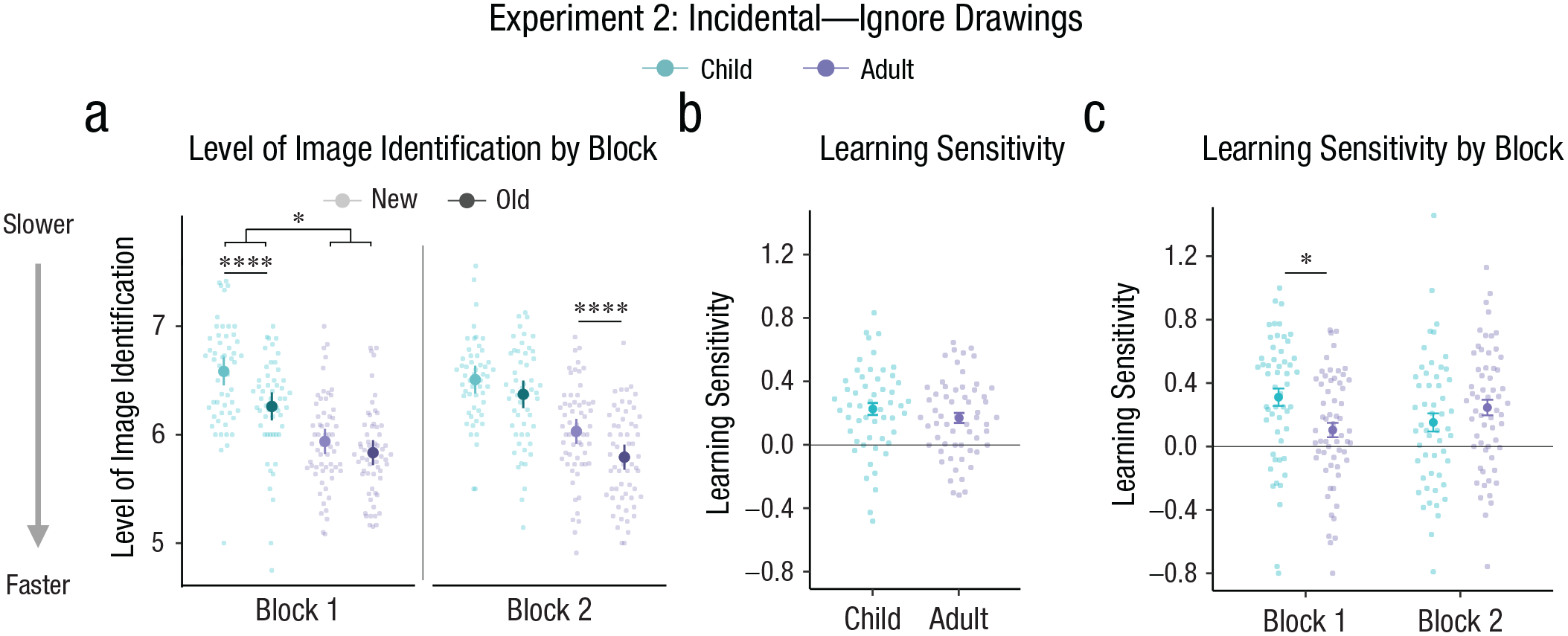
Incidental presentation (Experiment 2). Mixed-effects model estimates are shown in (a) of the fragment level at which old drawings (darker) and new drawings (lighter) were identified (y-axis; a lower number indicates faster identification). Children’s results are in teal, and adults’ results are in purple. Significance lines with ticks depict an interaction between old-new status and age group (i.e., differences in the slope between old and new images for children vs. adults). Each dot represents a participant, and vertical lines denote 95% confidence intervals. Learning-sensitivity scores in children and adults are shown in (b), and learning-sensitivity scores for both groups in each block of test are shown in (c). Each dot depicts a participant, and error bars denote standard errors of the mean. ****p < .0001. *p < .05.
Our model also revealed an interaction between block, age group, and whether an object drawing was old or new (p = .007; Table 2, Fig. 4a). In the first block of test (immediately after exposure), children showed robust learning (ß = 0.32, SE = 0.06, df = 4753, t = 5.15, p < .0001), whereas adults did not exhibit any learning whatsoever (ß = 0.10, SE = 0.05, df = 4740, t = 1.89, p = .24). A comparison of these estimated slopes reflected this developmental reversal: Children learned the incidentally presented information better than adults (ß = −0.11, SE = 0.04, df = 4747, t = −2.62, p = .04). This finding is the opposite of what was observed in the previous experiment— that is, that adults clearly learned better than children—an effect that was strongest in the first block of Experiment 1. In the second block of tests in this experiment, children no longer exhibited statistically reliable learning sensitivity (ß = 0.14, SE = 0.06, df = 4751, t = 2.22, p = .12), whereas adults, curiously, now did (ß = 0.24, SE = 0.06, df = 4740, t = 4.28, p = .0001), although the difference in these estimated slopes between children and adults was not significant (ß = 0.05, SE = 0.04, df = 4746, t = 1.23, p = .61). Though numerically evident, children’s learning sensitivity did not become significantly worse in the second block compared to the first block (p = .14), nor did adults get significantly better in the second block compared to their performance in the first block (p = .32). Note that as in Experiment 1, adults were also faster than children at identifying both old and new drawings overall (ps < .0001). Group differences in learning-sensitivity scores replicated the same pattern of results in each block (Fig. 4c; see Supplemental Note 5).
Comparing across experiments: Adults but not children benefit from attentional direction
To characterize how learning changes (if at all) when children versus adults are asked to attend to the drawings (Experiment 1) as compared to when they are told to ignore them (Experiment 2), we compared learning in both groups across experiments using a mixed-effects model (Table 3). We observed that the ability to identify old versus new drawings (learning sensitivity) significantly interacted with both experiment and age group (three-way interaction: p < .00001) as well as block (four-way interaction; p < .001). In adults, learning sensitivity was substantially better in Experiment 1 when they were asked to attend to the drawings (ß = 0.23, SE = 0.03, df = 8041, t = 7.26, p < .0001) and this effect was present in both blocks (Block 1: ß = 0.31, SE = 0.05, df = 8061, t = 6.91, p < .0001; Block 2: ß = 0.15, SE = 0.05, df = 8062, t = 3.32, p = .02). This shows that attentional instruction boosts learning in adults. Strikingly, and unlike adults, children showed equal levels of learning sensitivity across the experiments (ß = 0.01, SE = 0.03, df = 8045, t = 0.46, p = .97), and this was evident in both blocks of test (Block 1: ß = −0.05, SE = 0.05, df = 8084, t = −1.25, p = .92; Block 2: ß = 0.09, SE = 0.04, df = 8078, t = 1.93, p = .53). Again, learning-sensitivity-score analyses showed the same pattern of results (see Supplemental Table S3 and Supplemental Note 7) and are visualized in Figure 5 (for simplicity we visualize these scores instead of using model estimates).
Across Experiment Mixed-Effects Model Results
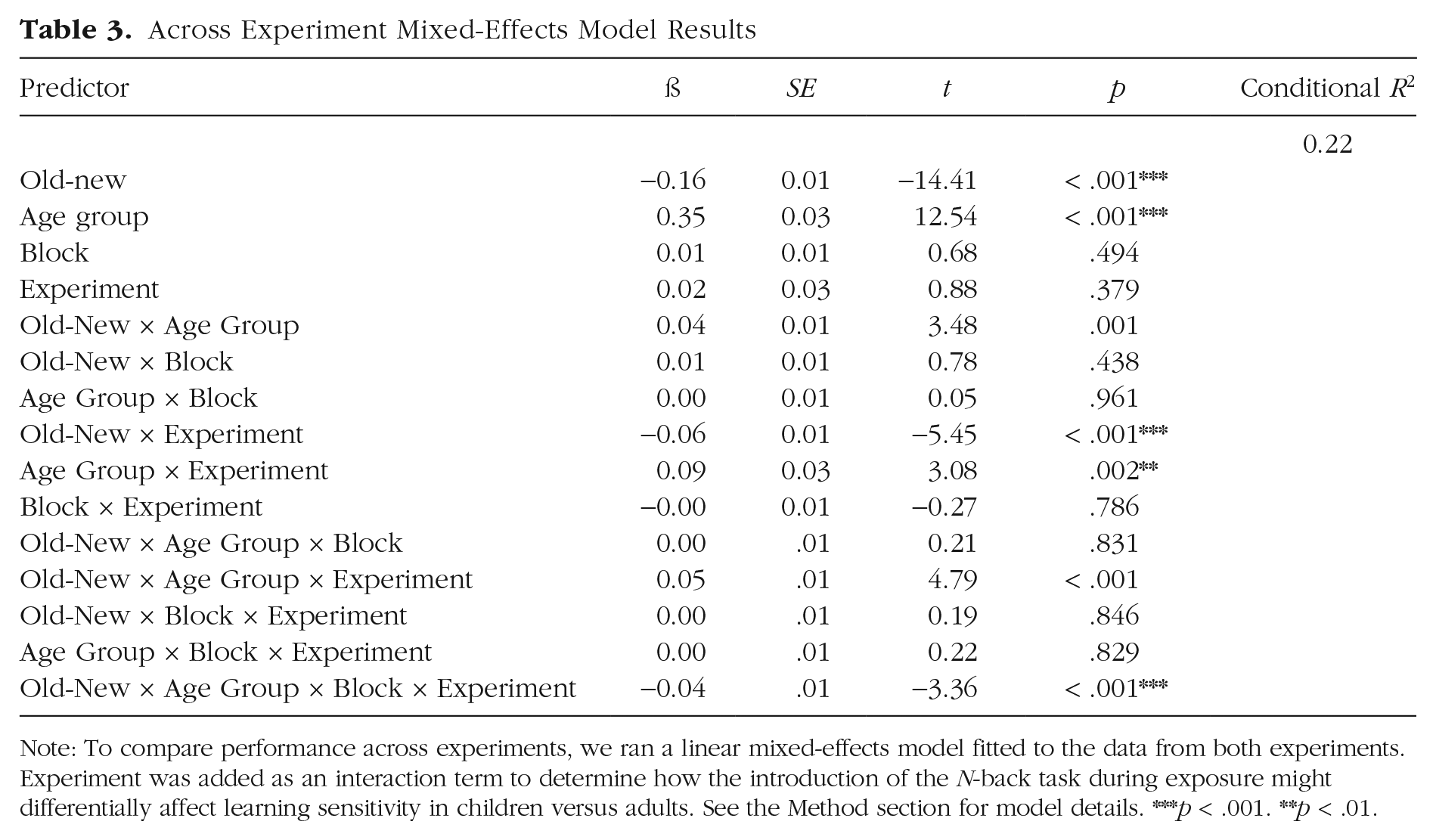
Note: To compare performance across experiments, we ran a linear mixed-effects model fitted to the data from both experiments. Experiment was added as an interaction term to determine how the introduction of the N-back task during exposure might differentially affect learning sensitivity in children versus adults. See the Method section for model details. ***p < .001. **p < .01.
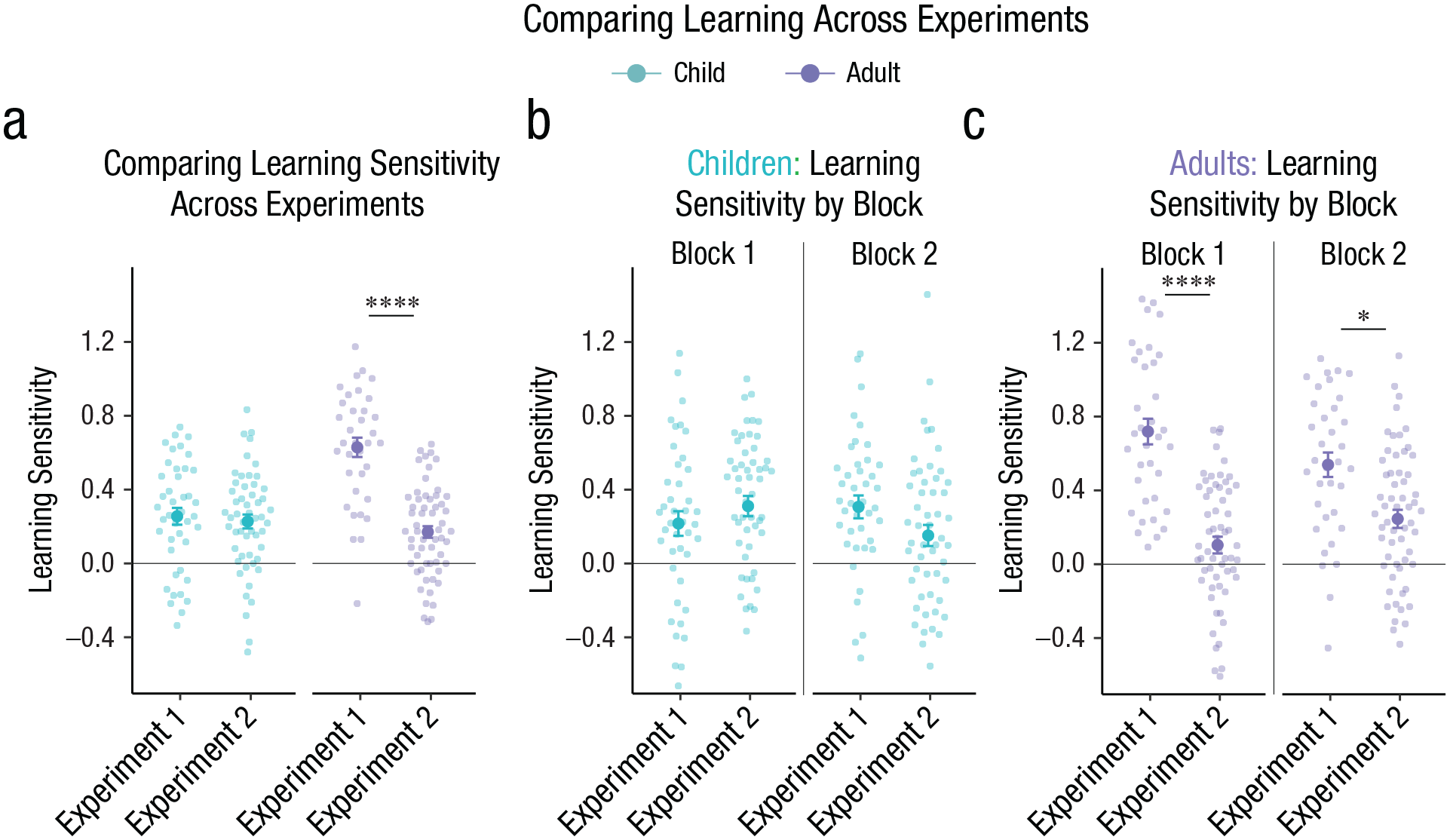
Attentional instruction’s impact on adults’ and children’s learning. Learning-sensitivity scores are shown in (a) for children and adults when drawings were the directed focus of attention (Experiment 1) or presented as distractors during an N-back task (Experiment 2). Children’s learning-sensitivity scores in each experiment in each block of test are illustrated in (b), and adults’ learning-sensitivity scores in each experiment visualized for each block of test are shown in (c). Each dot represents a participant; error bars denote standard errors of the mean. ****p < .0001. *p < .05.
Exploratory analyses (Supplemental Table S4) further revealed that participants made more labeling mistakes in Experiment 2 than in Experiment 1, a difference that was greater for children compared to adults—interaction: F(1, 372) = 5.40, p = .021, partial η2 = .01; children’s Experiment 2 versus Experiment 1 errors: t(93) = 2.38, p = .02, Cohen’s d = 0.49, 95% CI = [0.08, 0.90]; adults’ Experiment 2 versus Experiment 1 errors: t(93) = 2.03, p = .05, Cohen’s d = 0.43, 95% CI = [0.01, 0.85]. Critically, however, this differential error rate did not differ by image status—new versus old (no Age Group × Experiment × Old-New Image interaction: p = .63). This indicates that children’s boost in errors across experiments was unrelated to their learning. Controlling for individual error rates (Supplemental Table S1) and removing outlier participants who made the most errors (Supplemental Note 1) also did not change the finding that children’s learning was similar across Experiments 1 and 2, whereas adults’ was much better for Experiment 1.
These findings demonstrate a striking developmental difference: Instructing adults to attend benefits their learning, something that is not true for children. Instead, children learn task-irrelevant information just as well as if they were told to attend to it in the first place.
General Discussion
When the task was to attend to the drawings in Experiment 1, adults showed better learning than children. When the task was to ignore these same drawings in Experiment 2, children showed better learning than adults, but only during the first test block. And most critically, children’s learning was the same regardless of whether the drawings were the directed attentional focus or were something that children were told to ignore while performing an alternate task.
Our observation of children’s greater learning of the task-irrelevant information in the first block of Experiment 2 extends prior work (Blanco & Sloutsky, 2019; Deng & Sloutsky, 2016; Frank et al., 2021; Plebanek & Sloutsky, 2017), and it does so in three ways. First, our results suggest that children show this unique learning advantage beyond age 5. Because it is well known that that selective-attention systems develop through early adulthood (Gil-Gómez de Liaño et al., 2020), this lends support to the theory that children’s unique learning outcomes are related to the development of selective attention (Blanco et al., 2023; Plebanek & Sloutsky, 2017). Second, we show that children’s better learning of task-irrelevant information is not likely to come at the cost of task performance. Although we were not entirely successful in matching N-back performance across age groups (difficulty was titrated every 23 trials), the reported effects were observed when controlling for N-back performance, and N-back performance did not correlate with learning. Third, we show that children are more likely to be primed by task-irrelevant information. Children’s broader knowledge of irrelevant information is therefore not relegated to any specific form of memory (e.g., declarative vs. nondeclarative) or to any specific way of measuring it. Given that implicit processes—like priming and skill learning—do a lot of the heavy lifting when it comes to learning in childhood (Conway, 2020; Gualtieri & Finn, 2022; Ramscar & Gitcho, 2007; Ullman, 2001), this extension could mean that children’s unique knowledge of distractors characterizes much more of their learning than previously thought. This third extension also aligns with priming studies in older adults, in which greater sensitivity to distracting information has also been shown (Amer & Hasher, 2014; Amer et al., 2016; Campbell et al., 2012; Kim et al., 2007).
It is important to note that we observed greater incidental learning in children during the first test block of Experiment 2 only. Examining data across both blocks of Experiment 2, children and adults showed equal learning—which is remarkable, given the huge learning benefit adults had in Experiment 1. As yet, however, we are not sure why differences were not observed on both test blocks. Numerically, children got slightly worse in the second test block whereas adults got slightly better. We speculate that some combination of children’s fatigue, accelerated forgetting (Brainerd et al., 1985), and vulnerability to interference (Darby & Sloutsky, 2015) may have worsened performance in the second test block. It is also possible that adults realized by the second block that some images had been previously seen; perhaps as a result they applied a different strategy. Of note, age differences were also weaker in the second block of Experiment 1, suggesting that these factors may have been at play in both experiments. These possibilities can neither be measured nor weighted against one another in the current design. We thus caution readers not to overinterpret the fact that children performed better than adults in one test block in Experiment 2.
Our most central finding is observed across experiments in both blocks: Children’s learning did not differ from Experiment 1 to 2, unlike adults, who learned information better when it was the directed focus of attention in Experiment 1. Our data clearly show that directing children’s attention to stimuli does lead to learning—in Experiment 1, children identified old images more quickly than new—but not more so than when this same information was presented as task-irrelevant information in Experiment 2. Much follow-up on this exciting result is needed. First, we need to know where in the process things differ in children most. Do children have difficulty with selecting the information (something that eye tracking may help with), or is the selection simply not boosting learning outcomes to the same levels as adults? Second, because differences in motivation are critical to consider in developmental work (Brennan et al., 2017), future work needs to expand the scope of stimuli to ensure that effects are not driven by any systematic group differences (i.e., in how engaging the stimuli are). And third, because attentional abilities are known to change within the studied 7- to 9-year-old age range (Anderson, 2002; Gil-Gómez de Liaño et al., 2020; Plude et al., 1994), future work needs to unpack possible differences in learning within this age range.
Finally, and perhaps most important, it will be critical for future work to establish the boundary conditions in which attentional instruction does and does not matter for children’s learning. Indeed, selective attention (Hanania & Smith, 2010; Lane & Pearson, 1983) and task instruction (Bonawitz et al., 2011; Kalish et al., 2018) can shape learning outcomes for children. For example, children’s learning of attended information is superior to their learning of unattended distractors (though this is diminished relative to adults, Plebanek & Sloutsky, 2017).
So why did we see no difference in children’s learning across Experiments 1 and 2? We speculate that there are at least two, likely interacting, causes. First, we know that attentional manipulations have a reduced impact on priming as compared with declarative measures in adults (Ballesteros et al., 2006; Parkin et al., 1990). And although attention can also boost priming in children (Ballesteros et al., 2007), this effect—as in adults—could be muted relative to declarative measures. Future work on this is greatly needed. A second critical factor has to do with the fact that there were no distractors present in Experiment 1; in prior work, targets and distractors were presented simultaneously. Indeed, the presence of distractors has been shown to enhance the processing of attended information in adults (Awh et al., 2003; Markant & Amso, 2022; Moran & Desimone, 1985) and even boost adults’ learning of attended information (Spataro et al., 2013). Without this possible boost from distractors, we do not see any difference across Experiments 1 and 2 in children. Further work is needed to understand how the presence of distractors influences attentional and learning processes more broadly across development, focusing on targets as well as distractors. The generalizability of these findings may also be limited to the scope of the sample, which consisted of college students and children from a broad metropolitan area in Canada.
These ongoing questions notwithstanding, our finding that learning is the same when children are asked to both attend to and ignore the very same information is striking. This suggests that instructions play even less of a role in children’s learning than was previously thought. This way of thinking about childhood converges nicely with research showing that children learn more from noisy environments (Lucas et al., 2014) and are more exploratory in what they choose to learn about than adults are (Blanco & Sloutsky, 2020; Liquin & Gopnik, 2022). Together, these findings support theories that children’s reduced cognitive control can be adaptive for learning (Gopnik et al., 2017; Gualtieri & Finn, 2022; Ramscar & Gitcho, 2007; Thompson-Schill et al., 2009). Here we add that developmental shifts in how attention interacts with learning could confer important benefits when it is not always clear what information is most relevant.
Supplemental Material
sj-pdf-1-pss-10.1177_09567976241263347 – Supplemental material for Directing Attention Shapes Learning in Adults but Not Children
Supplemental material, sj-pdf-1-pss-10.1177_09567976241263347 for Directing Attention Shapes Learning in Adults but Not Children by Marlie C. Tandoc, Bharat Nadendla, Theresa Pham and Amy S. Finn in Psychological Science
Footnotes
Transparency
Action Editor: Angela Lukowski
Editor: Patricia J. Bauer
Author Contributions

References
Supplementary Material
Please find the following supplemental material available below.
For Open Access articles published under a Creative Commons License, all supplemental material carries the same license as the article it is associated with.
For non-Open Access articles published, all supplemental material carries a non-exclusive license, and permission requests for re-use of supplemental material or any part of supplemental material shall be sent directly to the copyright owner as specified in the copyright notice associated with the article.
