




Abstract
Across four studies (N = 816 U.S. adults), we uncovered a gender stereotype about dual pathways to social hierarchy: Men were associated with power, and women were associated with status. We detected this pattern both explicitly and implicitly in perceptions of individuals drawn from Forbes magazine’s powerful people lists in undergraduate and online samples. We examined social-cognitive implications, including prominent people’s degree of recognition by individuals and society, and the formation of men’s and women’s self-concepts. We found that power (status) ratings predicted greater recognition of men (women) and lesser recognition of women (men). In terms of the self-concept, we found that women internalized the stereotype associating women with status more than power implicitly and explicitly. Although men explicitly reported having less status and more power than women, men implicitly associated the self with status as much as power. No gender differences emerged in the desires for power and status.
What do Vladimir Putin, president of Russia, and Beyoncé, musician and icon, have in common? They are both part of a select group of people who, according to Forbes magazine, run the world. Putin appears on Forbes’ World’s Most Powerful People list, and Beyoncé appears on Forbes’ World’s Most Powerful Women list. The World’s Most Powerful People list features 75 individuals and is almost exclusively world leaders and CEOs (e.g., Xi Jinping, Bill Gates), and only five are women. The World’s Most Powerful Women list features 100 women, several of whom (e.g., Taylor Swift, Oprah Winfrey) are in the entertainment industry. Although the individuals on both of these lists are undoubtedly powerful, one could argue that they vary in the types of power they wield. For instance, Putin may be considered powerful because of his control over Russia’s people and resources. His power aligns closely with the literature’s definition of power, known as possessing control over valuable resources (Keltner et al., 2003). By contrast, although Beyoncé has amassed her fortune over time, her position relies on her social standing and fan support. In other words, Beyonce’s “power” may be more congruent with the literature’s definition of status, which is being respected in the eyes of others (Magee & Galinsky, 2008). Further, power conveys more masculine stereotypes, whereas status conveys more feminine stereotypes (S. Mishra & Kray, 2022). As such, this disparity between men and women found on Forbes’ lists raises the question of whether Forbes and society more broadly are more likely to recognize men and women in stereotypically consistent manners in that they perceive women as having status and men as having power.
Power and status are two pathways for ascending social hierarchies (Magee & Galinsky, 2008). Although power and status often coexist within roles, they have distinct characteristics and consequences, which previous research has theoretically and empirically disentangled (Anicich et al., 2016; Blader & Chen, 2011, 2012; Fast et al., 2012; Hays, 2013; Hays & Bendersky, 2015; Magee & Galinsky, 2008). Power is a property of the actor that exists independent of others’ evaluations, allowing a focus on egocentric goals. Status is a property of coactors and observers, thus requiring those with status to attune to others’ needs to maintain their status.
These dual pathways to ascending social hierarchies are consistent with theorizing, which posits that people process and understand people along two primary dimensions of social perception: agency/competence and communality/warmth. Martin and Slepian (2021) argued that these dimensions reflect masculinity and femininity, thus enforcing traditional gender roles. For instance, power elicits agency and dominance (Fragale et al., 2011; Keltner et al., 2003), constructs central to masculinity. By contrast, status is associated with feminine stereotypes such as warmth and communality because status accrues via support from others (Fiske et al., 2002; Fragale et al., 2011; Ridgeway & Erickson, 2000). Most relatedly, S. Mishra and Kray (2022) found that power-seeking targets conveyed more masculinity than status-seeking targets, whereas status-seeking targets conveyed more femininity than power-seeking targets. This evidence suggests that the constructs of power and status may be perceived along gendered lines. We predicted that when perceivers evaluated individuals, they would perceive men as having more power than women (Hypothesis 1) and women as having more status than men (Hypothesis 2).
Stereotypes are maintained through cognitive processes. Individuals are more likely to attune to information that confirms stereotypes (Swim & Sanna, 1996) and to recall information that is stereotype-consistent (Chatard et al., 2007; Kulich et al., 2011). Therefore, we speculated that these gendered associations would predict patterns of recognition of individuals (Banaji & Greenwald, 1995; M. V. Mishra et al., 2019): Higher perceived power would predict greater recognition for men but less for women (Hypothesis 3), and higher perceived status would predict greater recognition for women but less for men (Hypothesis 4).
Across four studies, we examined whether people associated power with men more than with women while associating status with women more than with men. We tested whether these patterns would appear in the power and status ratings of successful professionals (Studies 1a, 1b, and 2) using explicit ratings and implicit association tests (IATs). Further, we examined whether perceived power would be more predictive of recognition of men and whether perceived status would be more predictive of recognition of women. Recognition was operationalized as correctly identifying the individual’s name on the basis of a photograph (Study 1a) and as the number of media mentions and social media followers (Study 1b). We also tested whether people explicitly perceived this association (Study 2). Finally, we addressed whether these associations were internalized by examining men’s and women’s self-perceptions and motives for power and status (Study 3).
Statement of Relevance
Social hierarchies consist of power, defined as possessing control over valuable resources, and status, defined as being respected in the eyes of others. We found that people associate power with men more than with women and associate status with women more than with men. This distinction is important because status is more easily lost than power. Specifically, although power often stems from formal processes, status is subject to individual perceptions. Consequently, high-status individuals are expected to be fair and warm and engage in perspective taking to maintain their standing. However, if society continues to associate women with status and men with power, it risks perpetuating a reality in which women, despite their perceived respect, remain marginalized in terms of the tangible resources they control. In other words, this association may confine women to societal roles that afford them prestige without accompanying control over resources, further entrenching gender inequality in social hierarchies.
Open Practices Statement
All preregistrations, data, and code are available on the OSF at https://osf.io/gb2zj. For Studies 1a, 2, and 3, the methods, sample size, and analysis plans were preregistered. Additional measures and deviations across studies can be found in the Supplemental Material available online. All experiments met the ethical requirements and legal guidelines of the University of California, Berkeley Institutional Review Board.
Study 1a
Among professionals identified as “powerful” by Forbes, we tested whether men would have more perceived power than women (Hypothesis 1) and whether women would have more perceived status than men (Hypothesis 2). We also tested whether perceived power would be predictive of recognition for men but less for women (Hypothesis 3) and whether perceived status would be predictive of recognition for women but less for men (Hypothesis 4).
Method
Deviations from preregistration
We would like to highlight deviations from the preregistration. We allowed the study to continue until the semester’s end to maximize the sample size. We preregistered 200 participants (to allow for each target to have 50 ratings) and report the results with only the first 200 participants in the Supplemental Material. The results are identical in direction and significance. We preregistered that recognition would be measured by the following (yes/no) items: “Do you recognize this target?” and “Did you guess this person correctly?” We were concerned that participants might be biased in their evaluations of whether they were “correct” and that their assessment would vary from student to student. Thus, we had two research assistants code participants’ open-ended responses to the item “If yes, please type who you think this is” for correctness. Original responses are also included in the data set. If we used student-reported recognition or correctness as the dependent variables, the key results in Study 1a were consistent in direction and significance with the coded recognition variable. Further, the interrater agreements between coded recognition and participants’ self-reported recognition and coded recognition and participant’s self-reported correctness were 97.3% and 96.7%, respectively. Our analysis plan did not specify the exact tests and models for our analyses. Our intent was to analyze the data consistent with our preregistered hypothesis that women would be recognized (measured using the initial recognition question) for their status whereas men would be recognized for their power, suggesting that society differentially ascribes power to individuals on the basis of their gender.
Participants
We recruited undergraduates at a public research university as part of a course requirement. The survey deadline was determined by the behavioral lab manager. Sample size was determined by course enrollment. The final sample included 245 participants—139 women, 105 men, and one individual who indicated “other.” Ethnic composition was as follows: Asian/Asian American (58.78%), White (20.41%), Hispanic (8.16%), multiracial (6.94%), other (3.27%), Black/African American (1.63%), and East Asian/East Asian American (0.82%). The mean age was 21.23 years (SD = 2.97).
Procedure
The study had a two-cell (target gender: man or woman) within-subjects design: Targets were taken from Forbes’ 2018 World’s Most Powerful People (70 men and 5 women) and 2019 World’s Most Powerful Women (100 women) lists (for discussions of Forbes’ criteria, see Bellstrom & Kowitt, 2020; Dockterman, 2014; Ewalt, 2018; Noer, 2011). Participants saw a random subset of approximately a quarter of the individuals on each list (18 from the World’s Most Powerful People list and 26 from the World’s Most Powerful Women’s list). The order was counterbalanced. After viewing each target photo, participants were asked whether they recognized the target, and if so, to provide an open-ended description of who the target was. Participants were then given each target’s name and title and asked to rate their perceived power and status. Power and status items were presented in a randomized order.
Measures
Recognition
Two independent research assistants manually coded participants’ open-ended responses and created a dummy variable indicating whether participants guessed correctly (coded 1) or not (coded 0). A separate research assistant coded responses that the first was uncertain about. Interrater agreement was 99.3%.
Perceived power
Participants evaluated targets’ power using a composite of six items adapted from Yu et al. (2019): “[Target name] supervises a large number of subordinates,” “[Target name] formally manages many other people,” “[Target name] can provide rewards to others at their own discretion,” “[Target name] has a great deal of power,” “[Target name] has authority to discipline others when needed,” and “[Target name]’s designated role allows them to control a lot of resources” on a scale from 1 (strongly disagree) to 7 (strongly agree; α = .93).
Perceived status
Participants evaluated targets’ status using a composite of six items adapted from Yu et al. (2019): “Others often seek [Target name]’s opinion because they respect them,” “[Target name] has a good reputation among others in their field,” “[Target name] is highly respected by others,” “People look up to [Target name],” “[Target name] is admired by others because [Target name] is seen as competent,” and “Others come to [Target name] because they trust [Target name]’s judgment” on a scale from 1 (strongly disagree) to 7 (strongly agree; α = .96).
Results
We preregistered that we expected to find that women would be recognized for their status whereas men would be recognized for their power.
Recognition
We used a multilevel binomial regression model with random intercepts predicting whether participants correctly identified the individual by target gender. Women were less likely to be recognized than men (Mwomen = .10, SDwomen = .29; Mmen = .20, SDmen = .40), b = −0.89, 95% confidence interval (CI) = [−1.01, −0.78], p < .001.
Perceived power and status
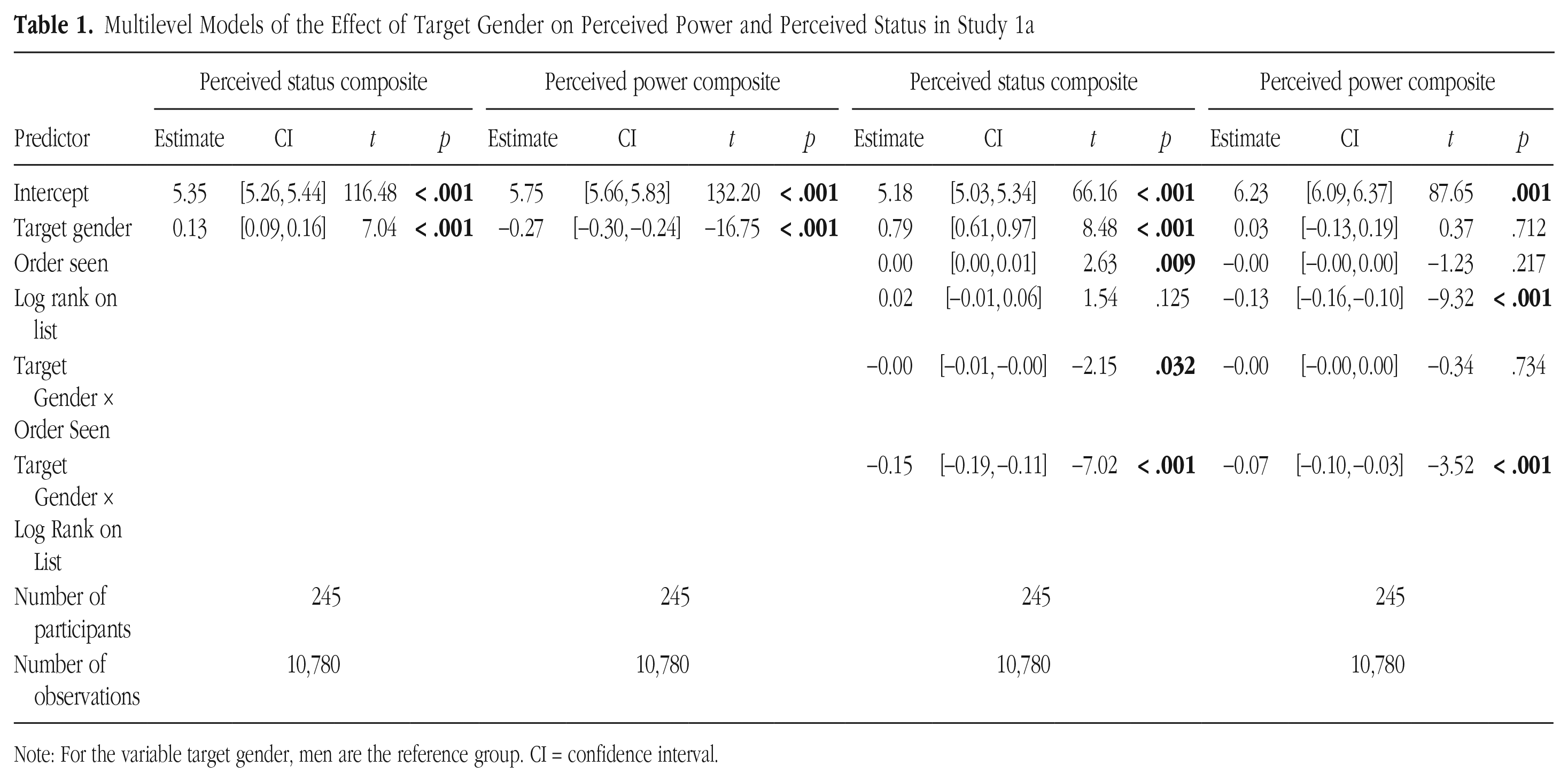
We used a multilevel model with random intercepts for participants predicting perceived power and status by target gender. Table 1 summarizes the results with and without controlling for targets’ rank on lists, the order in which they were seen, and interactions with target gender.
Multilevel Models of the Effect of Target Gender on Perceived Power and Perceived Status in Study 1a
Note: For the variable target gender, men are the reference group. CI = confidence interval.
Compared with women, men were rated significantly higher in power (Mwomen = 5.48, SDwomen = 1.05; Mmen = 5.75, SDmen = 1.02), b = 0.27, 95% CI = [0.24, 0.30], t(10776) = 16.75, p < .001, but significantly lower in status (Mwomen = 5.48, SDwomen = 1.05; Mmen = 5.35, SDmen = 1.28), b = −0.13, 95% CI = [−0.16, −0.09], t(10776) = −7.04, p < .001, supporting Hypotheses 1 and 2.
Power and status predicting recognition
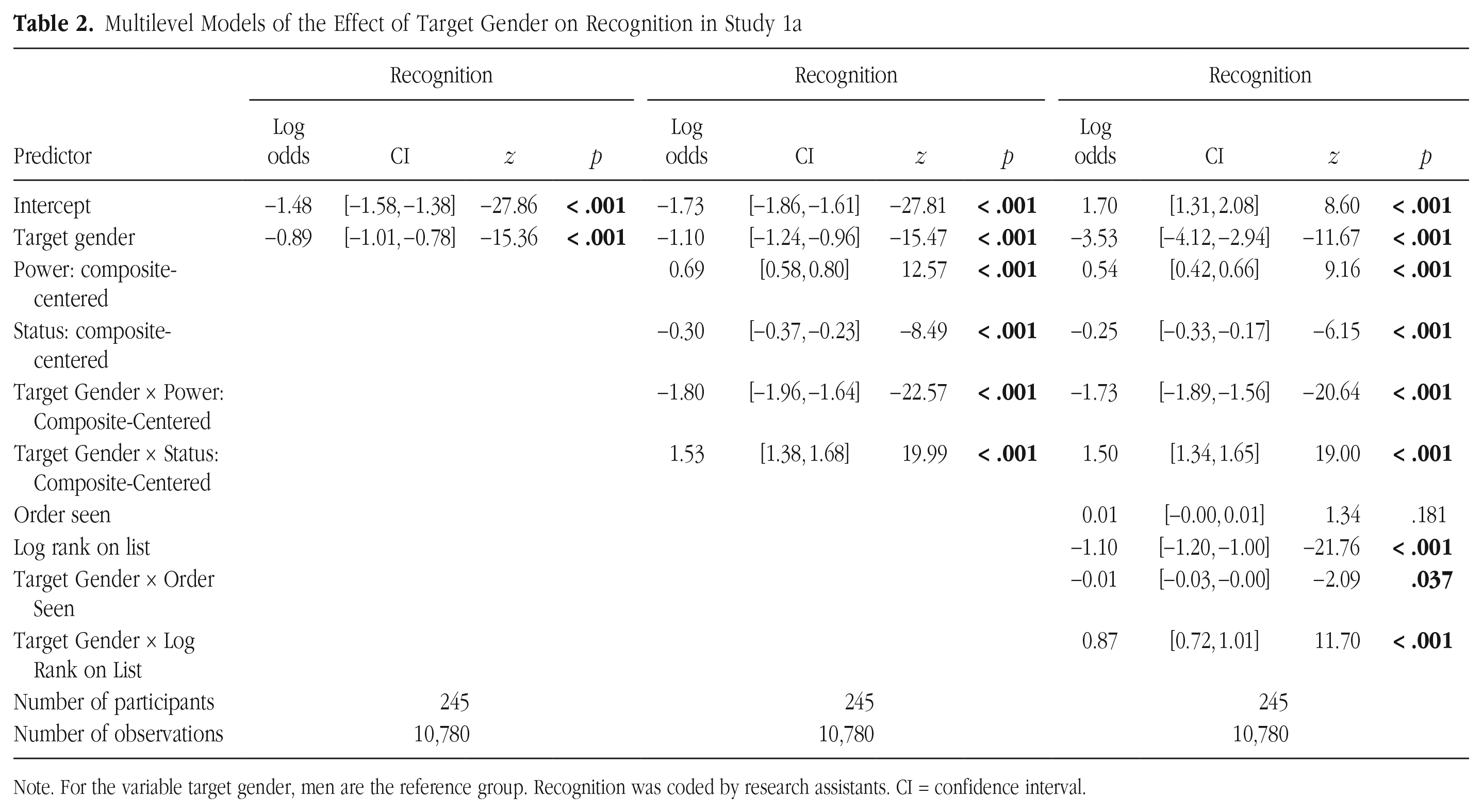
We used a multilevel binomial regression model with random intercepts predicting whether participants correctly identified targets by target gender, perceived power, perceived status, and the respective interactions with target gender included in the model simultaneously. Table 2 summarizes the results with and without controlling for rank on lists, the order in which targets were seen, and interactions with target gender. Three main effects emerged. Women were still less likely to be recognized than men, b = −1.10, 95% CI = [−1.24, −0.96], p < .001. Those higher in status were less likely to be recognized, b = −0.30, 95% CI = [−0.37, −0.23], p < .001, and those higher in power were more likely to be recognized, b = 0.69, 95% CI = [0.58, 0.80], p < .001.
Multilevel Models of the Effect of Target Gender on Recognition in Study 1a
Note. For the variable target gender, men are the reference group. Recognition was coded by research assistants. CI = confidence interval.
Two significant interactions emerged. An interaction between target gender and power ratings, b = −1.80, 95% CI = [−1.96, −1.64], p < .001, indicated that for men higher power predicted more recognition, b = 0.69, 95% CI = [0.58, 0.80], p < .001, whereas for women higher power predicted less recognition, b = −1.11, 95% CI = [−1.23, −1.00], p < .001, supporting Hypothesis 3. In addition, an interaction between target gender and status ratings, b = 1.53, 95% CI = [1.38, 1.68, p < .001, indicated that for men higher status predicted less recognition, b = −0.30, 95% = CI [−0.37, −0.23], p < .001, whereas for women higher status predicted more recognition, b = 1.22, 95% CI = [1.09, 1.36], p < .001, supporting Hypothesis 4. See Figures 1 and 2.
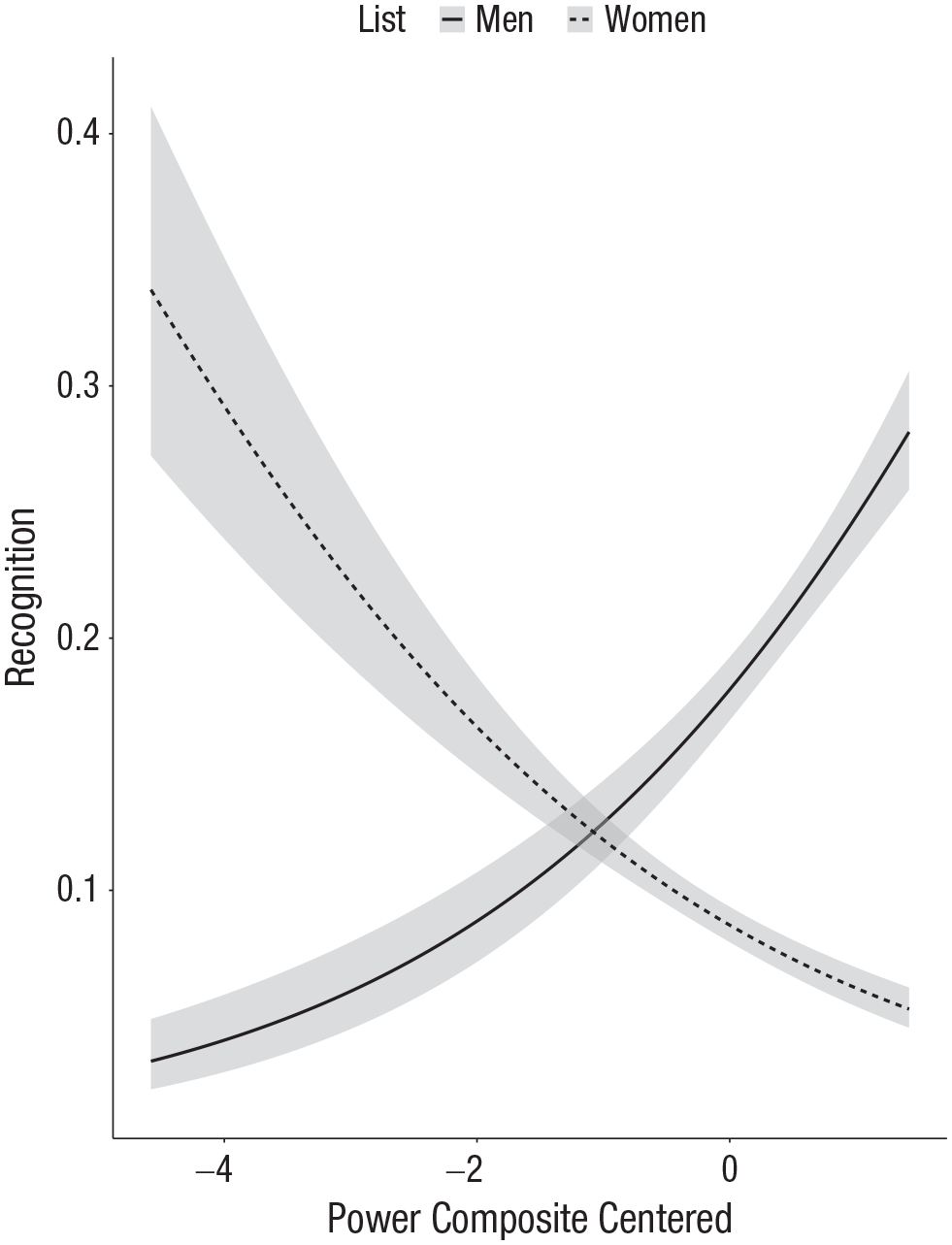
Study 1a: Power predicting recognition. All numeric predictors were grand-mean-centered. Shading represents the 95% confidence interval. 0 = did not recognize; 1 = recognized.
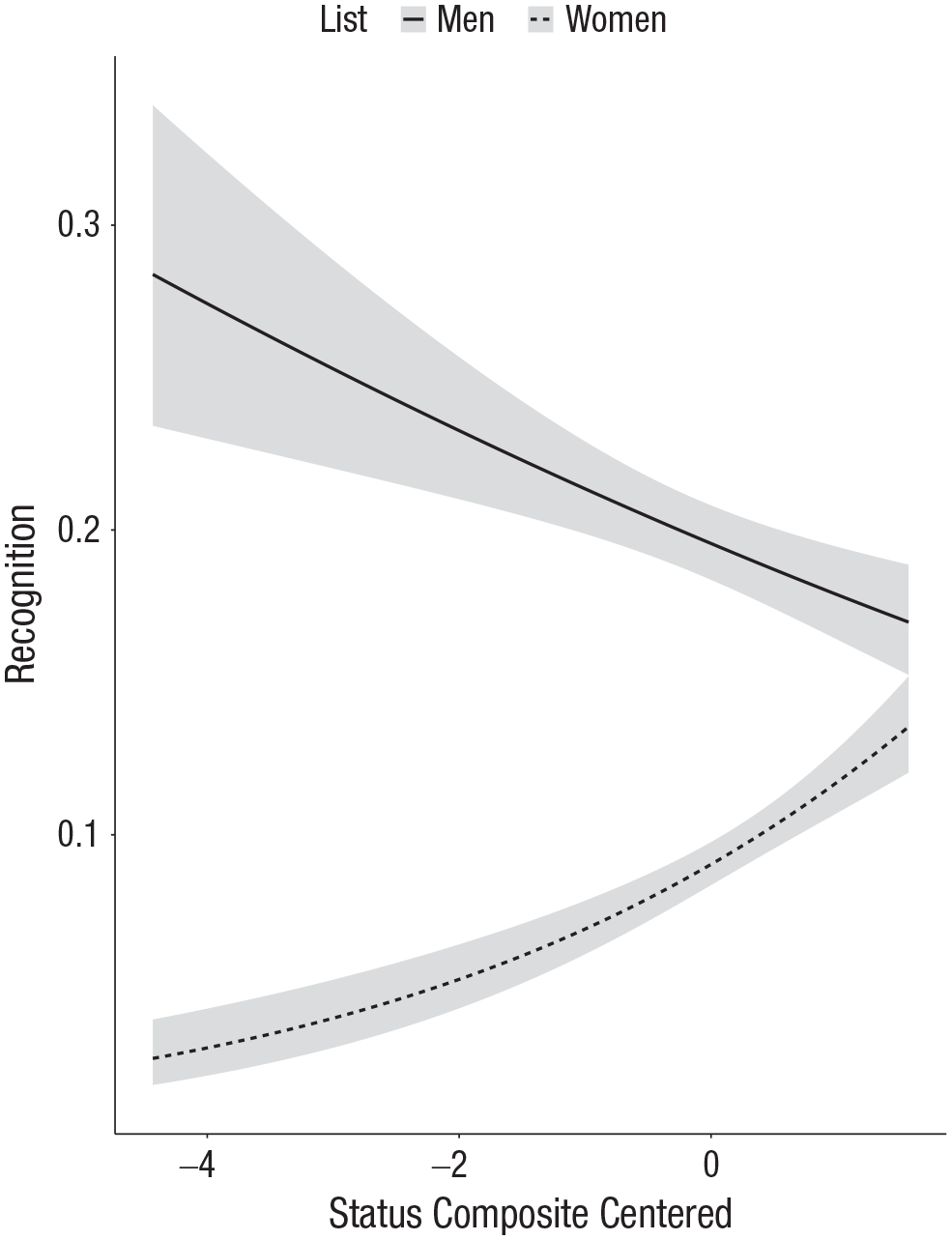
Study 1a: Status predicting recognition. All numeric predictors were grand-mean-centered. Shading represents the 95% confidence interval. 0 = did not recognize; 1 = recognized.
Study 1b
In Study 1a, power and status differentially predicted individuals’ recognition of men and women (i.e., recall of individuals from a photograph), consistent with prior work demonstrating that individuals attend more to stereotype-congruent than stereotype-incongruent information (Swim & Sanna, 1996). In Study 1b, we examined whether this effect generalized beyond individual-level recognition to a broader societal-level recognition captured in archival data sets of targets’ media mentions and social media followers, indicators of the amount of social attention they capture. We tested whether targets’ perceived power and status ratings from Study 1a predicted societal recognition (Hypotheses 3 and 4). Stereotypes are acquired and reinforced primarily through socialization processes, and the media is an essential source of this information (Kakkar, 2024; Leaper & Friedman, 2007). If men with power are more likely to receive social attention whereas women receive attention because of status, this perpetuates gender stereotypes in social hierarchies via socialization.
Method
To measure societal recognition, three research assistants collected three measures of societal recognition of Study 1a targets: media mentions, Twitter followers, and Instagram followers. We built on the results of Study 1a, in which we measured individual recognition, by testing the relationship between target gender and perceived power and status on societal recognition.
Research assistants used LexisNexis, an online media database for strategic news and business research, to record the total number of media mentions of individuals on Forbes’ World’s Most Powerful People and World’s Most Powerful Women lists, including business and personal news from all sources. Data collection occurred in April 2020 and encompassed media mentions from the previous 5 years. Research assistants also identified Twitter accounts for 64 targets (64% women) and Instagram accounts for 78 targets (63% women). All individuals were in the LexisNexis media database. We also included target gender, rank on the list, and power and status ratings from Study 1a.
Results
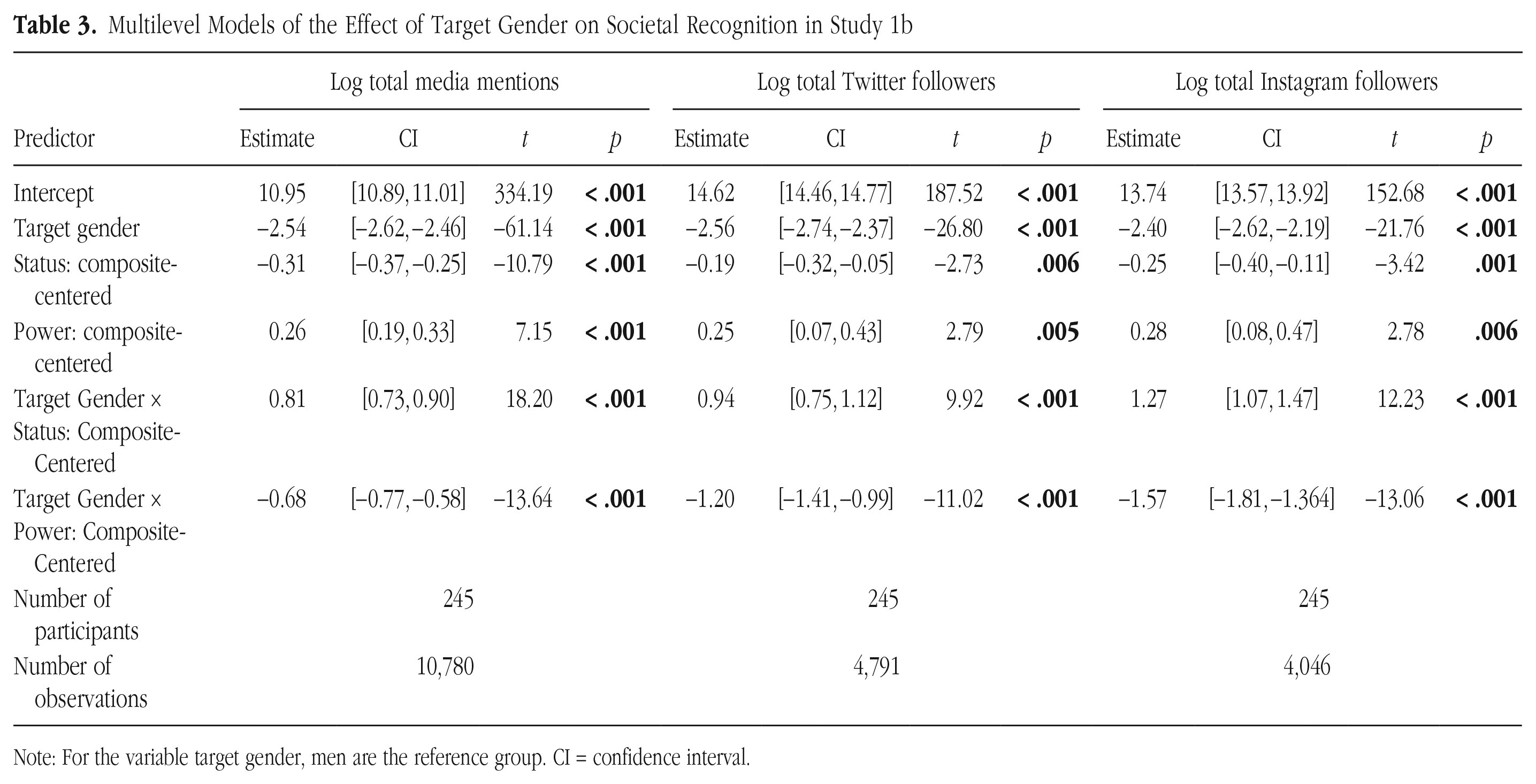
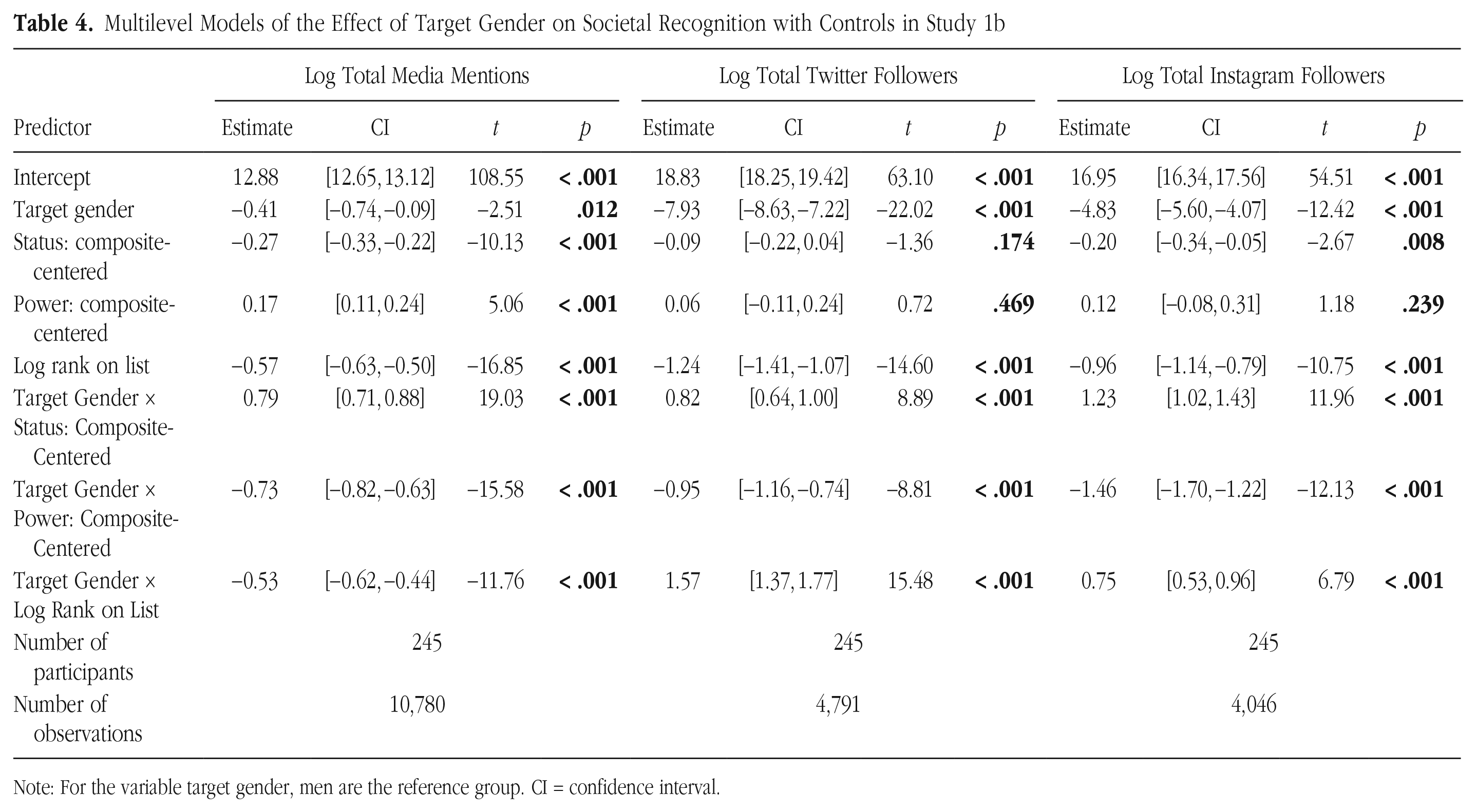
These methods and results were exploratory and not preregistered. For all analyses, we used multilevel models with random intercepts predicting log-transformed dependent measures by target gender, power ratings, status ratings, and respective interactions with target gender. Power and status ratings were individual ratings of each target from Study 1a and therefore Level 1 measures. Online recognition was measured at the level of the target (i.e., Level 2). For results without and with control measures, see Tables 3 and 4.
Multilevel Models of the Effect of Target Gender on Societal Recognition in Study 1b
Note: For the variable target gender, men are the reference group. CI = confidence interval.
Multilevel Models of the Effect of Target Gender on Societal Recognition with Controls in Study 1b
Note: For the variable target gender, men are the reference group. CI = confidence interval.
Media mentions
An interaction between target gender and power, b = −0.68, 95% CI = [−0.77, −0.58], t(10772) = −13.64, p < .001, indicated that for men higher power predicted greater media mentions, b = 0.26, 95% CI = [0.19, 0.33], t(10772) = 7.15, p < .001, whereas for women higher power predicted fewer media mentions, b = −0.42, 95% CI = [−0.48, −0.35], t(10772) = −12.34, p < .001.
An interaction between target gender and status, b = 0.81, 95% CI = [0.73, 0.90], t(10772) = 18.20, p < .001, indicated that for men higher status predicted fewer media mentions, b = −0.31, 95% CI = [−0.37, −0.26], t(10772) = −10.79, p < .001, whereas for women higher status predicted more media mentions, b = 0.50, 95% CI = [0.44, 0.57], t(10772) = 14.71, p < .001.
Twitter followers
An interaction between target gender and power, b = −1.20, 95% CI = [−1.41, −0.99], t(4783) = −11.02, p < .001, indicated that for men higher power predicted more Twitter followers, b = 0.25, 95% CI = [0.08, 0.43], t(4783) = 2.79, p = .005, whereas for women higher power predicted fewer Twitter followers, b = −0.95, 95% CI = [−1.07, −0.83], t(4783) = −15.44, p < .001.
An interaction between target gender and status, b = 0.94, 95% CI = [0.75, 1.12], t(4783) = 9.92, p < .001, indicated that for men higher status predicted fewer Twitter followers, b = −0.19, 95% CI = [−0.32, −0.05], t(4783) = −2.73, p = .006, whereas for women higher status predicted more Twitter followers, b = 0.75, 95% CI = [0.62, 0.88], t(4783) = 11.59, p < .001.
Instagram followers
An interaction between target gender and power, b = −1.57, 95% CI = [−1.81, −1.34], t(4038) = −13.06, p < .001, indicated that for men higher power predicted more Instagram followers, b = 0.28, 95% CI = [0.08, 0.47], t(4038) = 2.78, p = .006, whereas for women higher power predicted fewer Instagram followers, b = −1.30, 95% CI = [−1.43, −1.17], t(4038) = −19.21, p < .001.
An interaction between target gender and status, b = 1.27, 95% CI = [1.07, 1.47], t(4038) = 12.23, p < .001, indicated that for men higher status predicted fewer Instagram followers, b = −0.26, 95% CI = [−0.40, −0.11], t(4038) = −3.42, p = .001, whereas for women higher status predicted more Instagram followers, b = 1.02, 95% CI = [0.87, 1.16], t(4038) = 14.03, p < .001.
Across all three measures of societal recognition, we found support for Hypotheses 3 and 4.
Study 2
We found in Studies 1a and 1b that perceived power (but not status) predicted greater recognition for men, whereas the inverse was true for women. We captured this across individual-level recognition and three measures of societal-level recognition. Further, in Study 1a, perceivers’ explicit ratings of targets’ power and status revealed that women identified as powerful by Forbes were perceived as higher in status than men, whereas men were seen to be higher in power than women. However, one possible interpretation is that perceivers pick up on objective differences in power and status through their prior media exposure to these well-known targets rather than reflecting gender stereotypes. In addition, men were more accurately identified than women, presenting a potential confound for assessing their perceived power and status. To address these limitations, Study 2 measured perceptions of status and power among lesser known targets from Fortune magazine’s 40 Under 40 finance list. Although targets in Study 1a spanned a variety of industries and career lengths, Study 2 held target industry and age group constant. Finally, unlike Study 1a, images presented in Study 2 were standardized, eliminating the possibility of inadvertent visual signals of power and status (other than target gender) influencing ratings.
Another goal of Study 2 was to measure implicit gender stereotyping to account for socially desirable responses (Steffens, 2004). In addition to measuring stereotyping below the level of conscious awareness, we asked participants explicitly about their perceptions of the status and power of men and women broadly.
Method
Deviations from preregistration
We do not have any deviations to note for Study 2.
Participants
We recruited 88 undergraduates from a large research university who completed the survey in exchange for partial fulfillment of a course requirement. As preregistered, we recruited additional students through Prolific to achieve a sample size of 200 undergraduate students, ultimately collecting 204 participants. We believed 200 participants to be a reasonably large sample to test the effect because previous samples for IATs averaged less than 100 participants (Greenwald et al., 2009). On the basis of Greenwald et al. (2003), we preregistered to exclude trials that were longer than 10,000 ms (suggesting inattention) and participants with more than 10% of responses under 300 ms. The final sample included 189 participants (100 women, 84 men, and five individuals who indicated “other”), allowing us to detect an effect size (d) of 0.21 at .8 power. The mean age was 22.25 years (SD = 4.59).
IAT measure
Participants completed an IAT (Greenwald et al., 1998) measuring associations between the categories: men, women, power, and status. The IAT was created and analyzed using iatgen (Carpenter et al., 2019). Participants classified headshots of men and women from Fortune magazine’s 40 Under 40 finance list with words associated with power (e.g., “control,” “force”; Blau, 1964, 1977; Keltner et al., 2003) and status (e.g., “reputation,” “respect”; Berger et al., 1980; Blau, 1964; Magee & Galinsky, 2008; Podolny et al., 2005). Headshots were in a consistent format with the same background and taken from the shoulders up. The IAT was scored according to Greenwald et al.’s (2003) revised method, resulting in a D statistic. Higher scores represented stronger associations between men with power and women with status. Participants completed the additional items after completing the IAT.
Explicit measures
We measured perceptions of societal power and status of men and women as social groups using four individual items evaluated on a scale from 1 (not at all) to 10 (a lot of): women’s societal power (“To what extent do you think women have power in society?”), women’s societal status (“To what extent do you think women have status in society?”), men’s societal power (“To what extent do you think men have power in society?”), and men’s societal status (“To what extent do you think men have status in society?”).
Results
Correlations between implicit and explicit measures in Studies 2 and 3 are included in the Supplemental Material.
IAT measure
As preregistered, we conducted a one-sample t test comparing the average D score to 0. Results revealed a significant implicit association between men and power and women and status, D = 0.30, 95% CI = [0.26, 0.35], t(184) = 12.92, p < .001, supporting Hypotheses 1 and 2. We found no participant gender difference in D score, t(178) = −0.36, p = .72, which was preregistered as exploratory. Here we included only participants who self-identified as a woman or a man.
Because the D score is a relative measure, we conducted a series of exploratory t tests to determine the direction of the effect. Reaction times to power words were significantly faster when paired with men (M = 954.85 ms, SD = 476.89) compared with women (M = 1,138.81 ms, SD = 581.28), t(3588) = −10.57, p < .001. Reaction times to status words were significantly faster when paired with women (M = 1,050.46 ms, SD = 543.78) compared with men (M = 1,213.97 ms, SD = 666.79), t(3580) = 8.20, p < .001.
Similarly, reaction times to images of women were significantly faster when women were paired with status (M = 689.18 ms, SD = 234.0) compared with power (M = 754.92 ms, SD = 335.65), t(3359) = 6.87, p < .001. Likewise, reaction times were faster when men were paired with power (M = 713.09 ms, SD = 329.18) compared with status (M = 767.34 ms, SD = 300.04), t(3695) = −5.26, p < .001.
Explicit measures
We conducted exploratory analyses of these composites. Comparing ratings of men and women, participants rated men as significantly higher than women in both societal power, b = 3.02, 95% CI = [2.72, 3.31], t(188) = 19.99, p < .001, and societal status, b = 1.68, 95% CI = [1.40, 1.96], t(188) = 11.86, p < .001. Therefore, although individuals rated men as a social group as having more power and status than women as a social group, when considering specific targets and considering component parts of power and status, women were more strongly associated with status than men both implicitly (current study) and explicitly (Study 1a).
Study 3
Our final study examined whether the perceiver-based effects observed in the previous studies extended to implicit and explicit self-perceptions. We tested whether women would be more likely than men to associate themselves with status (vs. power) and whether men would be more likely than women to associate themselves with power (vs. status). Doing so enabled us to test the degree to which gender stereotypes about pathways to hierarchy are internalized. Finally, we measured individuals’ self-reported motives for power and status to test whether women prefer status whereas men prefer power, a possible alternative explanation for why women are perceived to be higher in status (and men higher in power).
Method
Deviations from preregistration
We do not have any deviations to note for Study 3.
Participants
We recruited 404 participants from Prolific. We doubled the sample size from Study 2 because we were interested in gender differences in D score. As preregistered, we excluded trials that lasted longer than 10,000 ms (suggesting inattention) and participants who had more than 10% of responses under 300 ms, leaving 382 responses (191 women, 191 men), allowing us to detect an effect size (d) of 0.14 at .8 power. The mean age was 37.91 years (SD = 13.31).
IAT measure
Participants completed an IAT measuring associations between the categories: me, not me, power, and status. The IAT was created using iatgen (Carpenter et al., 2019). Participants classified words associated with the self or “me” words (e.g., “me,” “self") and others or “not me” words (e.g., “not me,” “other”) and power (e.g., “control,” “force”) and status (e.g., “reputation,” “respect”). The IAT was scored according to Greenwald et al.’s (2003) revised method, resulting in a D statistic. Higher scores represented stronger associations between “me” and status and “not me” and power. Participants completed the explicit measures after completing the IAT.
Explicit measures
Self-perceived power
We evaluated participant power using a composite of six items (Yu et al., 2019): “I supervise a large number of subordinates,” “I formally manage many other people,” “I can provide rewards to others at my own discretion,” “I have a great deal of power at work,” “I have authority to discipline others when needed,” and “My designated role allows me to control a lot of resources” on a scale from 1 (strongly disagree) to 7 (strongly agree; α = .92).
Self-perceived status
We evaluated participant status using a composite of six items (Yu et al., 2019): “Others often seek my opinion because they respect me,” “I have a good reputation among those I work with,” “I am highly respected by others at work,” “People look up to me because I am good at my job,” “I am admired by others at work because I am seen as competent in my work,” and “Coworkers come to me because they trust my judgment” on a scale from 1 (strongly disagree) to 7 (strongly agree; α = .94).
Desire for power
Participants completed the six-item power-motive scale (Lammers et al., 2016): “I would like to have more power,” “I would like to have more control,” “I would like to have more responsibilities,” “I would like to have more authority,” “I would like to have fewer responsibilities” (reverse-scored), and “I would like to have less control” (reverse-scored) on a scale from 1 (strongly disagree) to 7 (strongly agree; α = .83).
Desire for status
We evaluated participant desire for status using a composite of eight items (Flynn et al., 2006): “I want my peers to respect me and hold me in high esteem,” “I am not concerned with my status among my peers” (reverse-scored), “Being a highly valued member of my social group is important to me,” “I would like to cultivate the admiration of my peers,” “I enjoy having influence over other people’s decision making,” “It would please me to have a position of prestige and social standing,” “I don’t care whether others view me with respect and hold me in esteem” (reverse-scored), and “I care about how positively others view me” on a scale from 1 (strongly disagree) to 7 (strongly agree; α = .90).
Results
IAT measure
As preregistered, we conducted a one-sample t test comparing the average D score to 0. Results revealed a significant implicit association between “me” and status and “not me” and power overall, D = 0.06, 95% CI = [0.02, 0.10], t(377) = 2.81, p = .005. This pattern reflects participants’ tendency to associate themselves with status and power with others. We found a participant gender difference in D score, b = 0.17, 95% CI = [0.09, 0.24], t(369) = 4.31, p < .001, and investigated this as preregistered. For this analysis, we included only participants who self-identified as women or men. We preregistered that if a gender difference in D score emerged, we would conduct one-sample t tests comparing the average D score to 0 for men and women subsamples. For women, the association with self and status was stronger than self and power, D = 0.14, 95% CI = [0.09, 0.19], t(189) = 5.51, p < .001. For men, we found no significant association, D = −0.03, 95% CI = [−0.09, 0.03], t(180) = −0.99, p = .322. These implicit findings suggest that, compared with others (i.e., “not me”), women associate themselves with status more than power whereas men associate themselves with as much status and power as others.
Explicit measures
Women reported less self-perceived power compared with men, b = −0.33, 95% CI = [−0.63, −0.03], t(380) = −2.14, p = .033, and women reported more self-perceived status compared with men, b = 0.25, 95% CI = [0.01, 0.49], t(380) = 2.09, p = .038. Unlike the implicit measure, which forced a comparison between the self and others, these explicit self-perceptions were measured as absolute judgments without regard to others. In this case, we saw that, compared with women, power was more central to men’s sense of self, and, compared with men, status was more central to women’s sense of self.
We did not find a significant gender difference in reported desire for power, b = −0.14, 95% CI = [−0.37, 0.09], t(380) = −1.22, p = .223, or desire for status, b = 0.21, 95% CI = [−0.02, 0.44], t(380) = 1.79, p = .074, suggesting that gender differences in perceived power and status were not due to gender differences in the desire for either.
General Discussion
The current work demonstrates that society is more likely to recognize women for status and men for power. Extending theory by Martin and Slepian (2021), we provide converging evidence that masculinity and femininity underlie the two pathways to ascending social hierarchies: power and status, respectively. We also found evidence that these stereotypes are reinforced through cognitive processes because these gendered associations predicted greater recognition of successful individuals’ names based on their photos (Study 1a) and the amount of social attention captured in news and social media (Study 1b). Further, greater social attention for stereotype-congruent people may reinforce gender stereotyping in hierarchies through socialization. We found that individuals implicitly associate power with men and status with women, even when they explicitly reported that, as social groups, men have more power and status in society than women (Study 2), consistent with this social-perceptual phenomenon. Therefore, individuals may not be aware that these implicit gender stereotypes are operating.
Paralleling the aforementioned perceiver-based effects, gender differences in self-concept with regard to power and status were also investigated. We found that women associated themselves with status more than power both implicitly and explicitly (Study 3), suggesting that women internalize these gender stereotypes. Although men explicitly reported having more power and less status than women do, an implicit measure forcing men to compare themselves to others revealed that they associated the self with status as much as power. This is similar to the explicit measures in Study 2, which found that, as social groups, men have more status and power compared with women. Although the internalization of societal gender stereotypes concerning pathways to social hierarchy may be greater for women than for men, there were no gender differences in the desire for power or status. This indicates that women’s greater implicit self-stereotyping is not due to an underlying motive for status more than power. Recognizing that the need to fulfill communal expectations limits women’s autonomy, women may not necessarily desire to advance in social hierarchies by pursuing status, even if it is a more readily available pathway.
The current work is not without limitations. Although we leveraged diverse methods and samples, our results may be limited to college students and U.S. adults in their generalizability. Moreover, our findings may hinge on the specific stimuli, materials, and procedures utilized in our research paradigms. Finally, our findings may vary on the basis of perceivers’ surrounding political environments, such that in less progressive societies, the stereotype associating men with power and women with status may be more pronounced.
Power and status both form social hierarchies (Magee & Galinsky, 2008). However, those who rise in the ranks via status face different expectations than those who do so via power. Those with higher status are still expected to be fair, warm, and exhibit greater perspective taking (Blader & Chen, 2011; Blader et al., 2016; Fragale et al., 2011). These expectations are inherently positive; however, expectations of positive interactions may constrain leaders’ ability to leverage their higher rank, especially when those expectations are grounded in gender roles. Further, these expectations reinforce leader behavior as others confer status; generosity can lead to initial status gains (Willer, 2009), and those with high status also act more generously when the hierarchy is perceived as illegitimate (Hays & Blader, 2017). Compared with power, status hierarchies are also marked by diminished control and stability (Hays & Bendersky, 2015). Although women today can increasingly ascend social hierarchies, because of status expectations and unstable hierarchies, women may still be constrained by the avenue through which they rise.
Supplemental Material
sj-docx-1-pss-10.1177_09567976241260251 – Supplemental material for Not All Powerful People Are Created Equal: An Examination of Gender and Pathways to Social Hierarchy Through the Lens of Social Cognition
Supplemental material, sj-docx-1-pss-10.1177_09567976241260251 for Not All Powerful People Are Created Equal: An Examination of Gender and Pathways to Social Hierarchy Through the Lens of Social Cognition by Charlotte H. Townsend, Sonya Mishra and Laura J. Kray in Psychological Science
Footnotes
Acknowledgements
We thank Sophia Baginski, Rebecca Hu, Xuanyi Song, Salem Sulaiman, Prakash Venkataraman, Ashna Wadhwa, Rosie Ward, and Mae Zheng for their research assistance. We also thank the Center for Equity, Gender, and Leadership for supporting this research.
Transparency
Action Editor: Yoel Inbar
Editor: Patricia J. Bauer
Author Contributions

References
Supplementary Material
Please find the following supplemental material available below.
For Open Access articles published under a Creative Commons License, all supplemental material carries the same license as the article it is associated with.
For non-Open Access articles published, all supplemental material carries a non-exclusive license, and permission requests for re-use of supplemental material or any part of supplemental material shall be sent directly to the copyright owner as specified in the copyright notice associated with the article.
