




Abstract
Recent years have brought increased accountability for personal misconduct, yet often, unequal consequences have resulted from similar offenses. Findings from a unique archival data set (N = 619; all university faculty) and three preregistered experiments (N = 2,594) show that the perceived artistic-versus-scientific nature of the offender’s professional contributions influences the professional punishment received. In Study 1, analysis of four decades of university sexual-misconduct cases reveals that faculty in artistic (vs. scientific) fields have on average received more severe professional consequences. Study 2 demonstrates this experimentally, offering mediational evidence that greater difficulty morally decoupling art (vs. science) contributes to the phenomenon. Study 3 provides further evidence for this mechanism through experimental moderation. Finally, Study 4 shows that merely framing an individual’s work as artistic versus scientific results in replication of these effects. Several potential alternative mechanisms to moral decoupling are tested but not supported. Practical and theoretical implications are discussed.
Keywords
Perpetrators of sexual misconduct, racial misconduct, and other forms of personal misconduct are increasingly likely to face professional consequences for their wrongful behavior. However, similar offenses often result in dissimilar professional outcomes (North et al., 2019). What might contribute to this variation? We propose that one factor is the perceived artistic-versus-scientific nature of the offender’s professional work. Drawing on research in moral decoupling (Bhattacharjee et al., 2013), we theorize that work viewed as more art than science (vs. more science than art) is harder to mentally separate from the artist’s (vs. the scientist’s) personal moral character. As a result, this psychological process increases the professional (i.e., work-relevant) costs of misconduct for those perceived more as artists (vs. scientists).
Art Versus Science
Distinct categories of social judgment
Surprisingly little research has examined how categorizing someone or something as “artistic” versus “scientific” affects judgments, even though these labels are prominently used and frequently contrasted in everyday experience. For example, people describe skills and activities as “more art than science” (and vice versa; Mihm, 2022) and people as “artsy” or “science-y” (Feist, 1998; Pearson, 2016). Individuals hold bachelor of arts or bachelor of science degrees; governments allocate separate funding for arts and sciences; marketers frame products as more artistic or scientific (Philipp-Muller et al., 2023). Yet the implications of these categorizations for social judgment remain understudied.
According to prior literature, when people, activities, works, and so on are categorized as artistic, it suggests that they involve emotion, imagination, intuition, or all three (Bullot & Reber, 2013). In contrast, when such objects are categorized as scientific, it suggests they involve cognitive, procedural, and systematic processes (Miceli et al., 2020). Here, we examine how categorizing people and their work as more artistic versus scientific affects the punitive professional consequences they face for their unrelated personal misconduct.
Moral decoupling on professional consequences
Prior work has shown that moral decoupling is an important determinant of the professional consequences a person faces for personal misconduct. Moral decoupling is a reasoning process whereby perceivers cognitively separate judgments of a work’s quality from judgments of its producer’s moral misbehavior (Bhattacharjee et al., 2013). In general, following a person’s misconduct, the less perceivers morally decouple, the harsher the consequences for the individual’s work (Cowan & Yazdanparast, 2021; Lee & Kwak, 2016). Thus, even when perpetrators face equivalent personal punishments (e.g., criminal charges), their professional consequences (e.g., losing employment or market opportunities) will generally be less severe when decoupling is higher. However, as influential as moral decoupling is, little is known about when people are more or less likely to do it. In this research, we hypothesized that work perceived as artistic (vs. scientific) would be harder to morally decouple—and therefore that artist perpetrators would receive harsher consequences for their unrelated personal misconduct.
As noted, works of art are viewed as based in emotions (Bullot & Reber, 2013) and insights (Miceli et al., 2020), attributes tied to a person’s “true self” (Maglio & Reich, 2019; Oktar & Lombrozo, 2022). Moreover, artworks are viewed as extensions of their producers (Moulard et al., 2014; Newman et al., 2014; Smith & Newman, 2014), and inferences about artists’ intentions shape evaluations of art (Jucker et al., 2014; Russell, 2003). In contrast, science is considered impersonal (Merton, 1973) and scientists are stereotyped as lacking emotions (Rutjens & Heine, 2016), making scientific works seem less associated with their producers. Consequently, morally decoupling people’s work from their misconduct should be harder for those perceived more as artists than scientists, leading to harsher professional consequences for artists’ moral misbehavior.
Potential alternative processes
Beyond moral decoupling, we tested other mechanisms for the proposed effect. First, artists’ (vs. scientists’) misconduct could seem worse. For example, people might expect artists to “know better” (e.g., because they’re in touch with their emotions), amplifying the perceived severity of their misconduct and the resulting consequences for their work. Second, people might value art (vs. science) less (e.g., because of science’s contributions to medicine and technology), making them more willing to punish artwork, as this seems less harmful. We tested for, but ultimately did not support, these alternative explanations.
Statement of Relevance
Movements like #MeToo and Black Lives Matter have raised public awareness about sexual, racial, and other forms of personal misconduct, and perpetrators have increasingly been held accountable—but not always equally. Here, we show how differences in people’s professional work (i.e., whether it is perceived as more artistic or more scientific) affect how they are professionally punished for their personal misbehavior, leading to harsher consequences for those whose work is viewed as more art than science (vs. more science than art). This emerges in records of academic sanctions against university faculty for sexual misconduct and across several careful experiments. The effect occurs because people find it harder to separate artistic work from artists’ morality compared to the seemingly more impersonal work of scientists. These findings have direct relevance for understanding both the public’s reactions to personal misconduct (e.g., boycotting, deplatforming) and the professional consequences of such personal misconduct (e.g., losing awards, being fired) as a function of offenders’ professional roles and fields.
Open Practices Statement
Throughout all studies, we report all data sets collected and all manipulations and measures. All materials, measures, data, code, and preregistrations for the experiments can be found in the Supplemental Material available online or at https://doi.org/10.17605/OSF.IO/GVYXM.
Empirical Overview and Method
We tested our hypotheses in one archival data set (the Academic Sexual Misconduct Database; Libarkin, 2022; N = 619) and three experiments that each included an initial study and a preregistered replication (N = 2,594). Study 1 uses four decades of data to show that the more a professor’s academic field is rated as an art (vs. a science), the more severe the professional consequences were for engaging in sexual misconduct. Studies 2 through 4 provide experimental support for this finding and for our proposed mechanism—moral decoupling. For all experimental studies (2–4), we report (a) the initial study, (b) the replication, and (c) a combined analysis to maximize statistical power and the precision of our effect-size estimates (Goh et al., 2016). All studies were approved by the Institutional Review Board and conducted in accordance with all applicable ethical and legal guidelines.
Study 1: Professional Consequences for Sexual Misconduct in Academic Arts Versus Sciences
Our initial test used the Academic Sexual Misconduct Database (ASMD; Libarkin, 2022) of sexual-misconduct investigations at American universities. Specifically, we had external coders provide (a) art versus science (AvS) ratings of faculty offenders’ academic fields and (b) severity ratings of the professional consequences their universities or academic societies imposed. We then examined AvS as a predictor of consequence severity, controlling for relevant factors. Thus, we tested whether professors’ academic AvS ratings predicted the professional consequences they faced regarding their jobs, their funding, or their academic reputations.
Archival data set
Of the 1,192 investigations recorded in the ASMD, we identified 634 where the faculty offender’s academic field and the university investigation’s outcome were available (the other 558 involved nonfaculty, unknown fields, unknown outcomes, or a combination of the three). Most cases (619) involved male perpetrators, and the 15 female cases varied widely in the nature of the misconduct, so we focused our analyses on the former. However, as reported in the Supplemental Material, all conclusions remained the same when female perpetrators were also analyzed. A sensitivity analysis indicated that our final sample size (n = 619; two-tailed, α = .05) offers .80 power to detect a correlation (r) as small as .112.
Normative ratings: AvS and punishment severity
First, we extracted 134 fields from the ASMD and recruited 182 participants from Amazon Mechanical Turk (MTurk; Mage = 37.97 years, SD = 10.94; 32% female) using the CloudResearch platform (Litman et al., 2017) to rate a subset of them (resulting in 44–46 ratings per field). Participants were presented with a brief definition of a field (e.g., “Psychology is the study of the human mind and behavior”) then asked to rate it on an art/science scale (“Is the academic field of [X] more of an art or a science?” 1 = definitely an art, 4 = equally an art and a science, 7 = definitely a science). Examples include fields perceived as very artistic, such as creative writing (1.38); more artistic than scientific, such as photography (2.30); roughly equally artistic and scientific, such as philosophy (4.15); more scientific than artistic, such as psychology (5.73); and very scientific, such as microbiology (6.93). See the Supplemental Material for full details.
Second, 301 participants recruited through MTurk (Mage = 38.33 years, SD = 10.56; 40% female) rated 13 professional consequences extracted from the ASMD by “how severe,” “how much of a punishment,” or “how serious” they were perceived to be. Participants first read that the study was about situations in which a professor was found responsible for committing sexual misconduct and that in such cases, “the offender faced professional consequences in one or more ways.” They were told that that “some of these professional consequences were more [severe/punishing/serious] than others,” and they were then asked to rate the ASMD consequences on that dimension. This produced 100 to 101 ratings for each consequence, which were closely related (α > .99), so we averaged them into a single consequence-severity composite (Table 1). Individuals who received multiple professional consequences were assigned the severity rating corresponding to the most severe consequence they received. Finally, to bolster the reliability of these outcome ratings, we recruited another sample of participants who held advanced degrees (i.e., master’s degrees or PhDs; n = 100; Mage = 42.68 years, SD = 12.22; 50% female) through the data provider Connect (Litman et al., 2017). These coders help to ensure some understanding of the norms of academia in evaluating the consequences’ severity. Analyses using these expert ratings fully replicated our primary findings, so they are not discussed further.
Normative Ratings of the Severity of Professional Consequences Reported in the Academic Sexual Misconduct Database (ASMD)
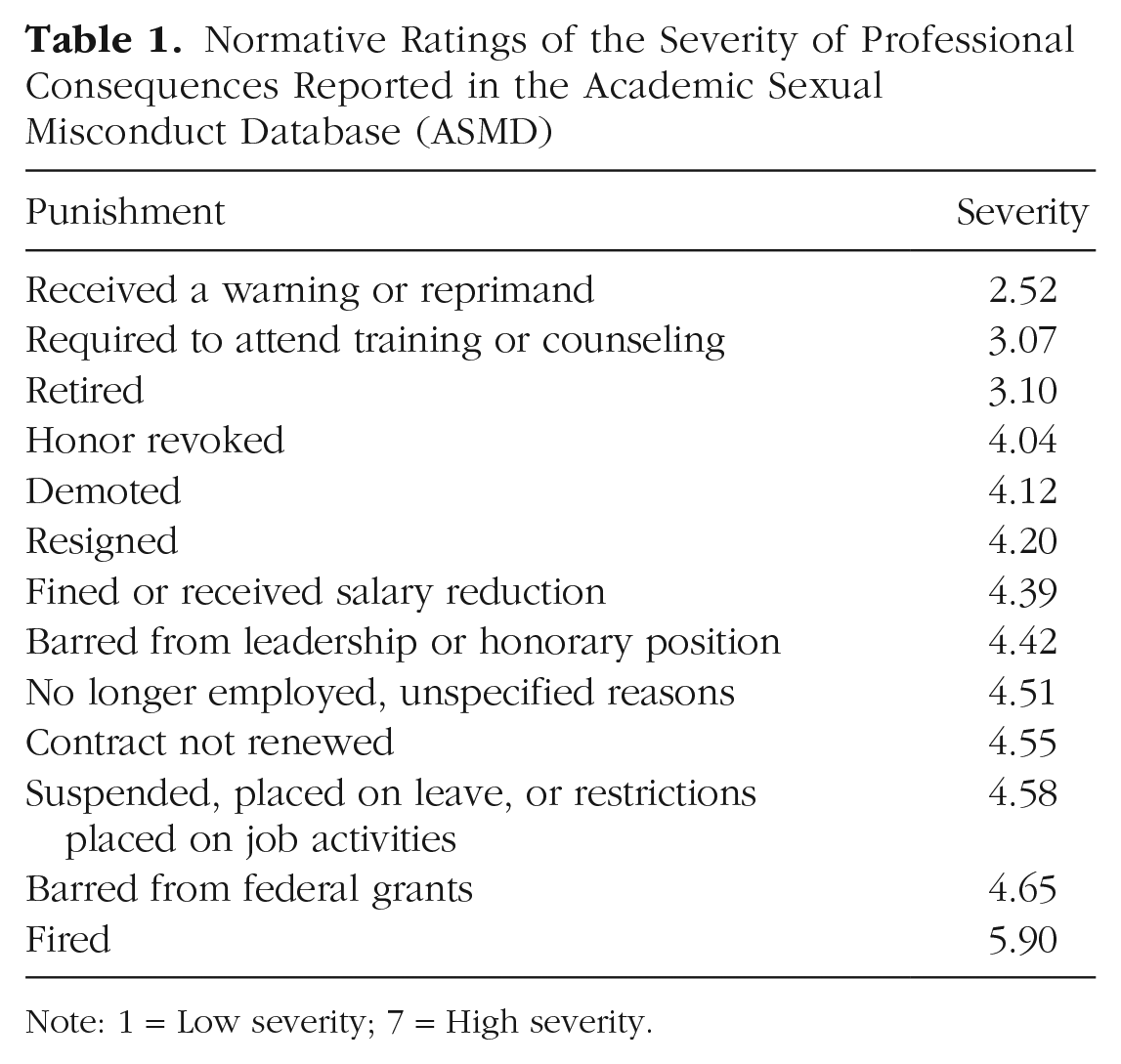
Note: 1 = Low severity; 7 = High severity.
Results
We tested our hypothesis in three ways: (a) conducting a linear regression on the effect of the continuous AvS measure on the professional consequence’s severity; (b) conducting an analysis of variance (ANOVA) on its severity after constructing a dichotomous AvS variable, where scores that fell significantly below (above) the midpoint at the p = .05 level according to a one-sample t test were categorized as art (science); and (c) conducting a similar ANOVA, using a slightly different AvS variable where only scores that differed significantly from the midpoint at the p < .001 level were categorized as art (if below the midpoint) or science (if above it). We also examined the effect’s robustness to controlling statistically for other potentially relevant variables.
All three analyses supported our hypotheses. First, fields’ normative AvS ratings as a continuous dimension significantly predicted the severity of professional consequences, β = −0.111, SE = .024, t(617) = −2.77, p = .006, 95% confidence interval (CI) = [−.112, −.019]. Additionally, the effects of both dichotomous AvS measures were also significant (AvS based on p < .05: Mart = 4.75, SD = 0.94, Mscience = 4.49, SD = 0.92, F(1, 532) = 8.74, p = .003, d = 0.26; AvS based on p < .001: Mart = 4.85, SD = 0.97, Mscience = 4.49, SD = 0.91, F(1, 429) = 12.26, p < .001, d = 0.34).
Next, we returned to the initial regression analysis (treating AvS as a continuous dimension) to test for the effect’s robustness against relevant controls. First, we examined how the wrongness of the misconduct might influence the effect (e.g., maybe artists on average commit worse misconduct). Because details of the misconduct itself are not consistently available, we indexed misconduct wrongness via the presence versus absence of criminal or civil penalties (i.e., legal consequences). This wrongness measure was not significantly related to the severity of professional consequences, r(617) = −.063, p = .120, or to AvS—though scientists were directionally more likely to face legal consequences, r(617) = .067, p = .094. Importantly, controlling for this factor did not diminish the AvS effect on the severity of professional consequences, β = −0.107, SE = .024, t(615) = −2.68, p = .008, 95% CI = [−.111, −.017].
Second, we tested whether offenders’ professional rank played a role (e.g., because high-ranking faculty might be relatively protected from severe consequences and could be underrepresented in more artistic fields). Using job titles provided in the ASMD, we constructed a rank variable with five categories (1 = adjuncts/lecturers/instructors/part-time faculty, 2 = assistant professors, 3 = associate professors, 4 = professors, and 5 = department chairs/deans; excluding several infrequent job titles with unclear ranks). Although rank negatively predicted severity—that is, higher-ranking individuals tended to face lighter professional consequences, r(554) = −.208, p < .001—it was unrelated to fields’ AvS ratings, r(554) = .029, p = .499, and controlling for rank did not eliminate the AvS effect on consequence severity, β = −0.108, SE = .025, t(553) = −2.61, p = .009, 95% CI = [−.114, −.016].
Third, we examined whether differences in sex ratios across fields had an effect, because fields with lower female-to-male ratios (i.e., science, technology, engineering, and mathematics; Wang & Degol, 2017) might simply be more tolerant of sexism or possess other relevant differences in norms and practices. Using 2019 data compiled by the National Center for Education Statistics, we computed the sex ratio of doctoral-level degrees granted that year in each field (data were available for the fields associated with 95% of eligible ASMD cases). Although sex ratio was negatively correlated with AvS ratings—scientific fields had a lower proportion of women receiving doctorates, r(589) = −.113, p = .006—it was unrelated to the severity of the professional consequences, r(589) < .01, p = .937, and controlling for sex ratio left the AvS effect on consequence severity intact, β = −0.116, SE = .025, t(588) = −2.83, p = .005, 95% CI = [−.117, −.021]. Finally, controlling for the year in which the case was concluded (1978–2022) did not diminish the AvS effect, nor was it diminished when we examined all of the aforementioned covariates simultaneously (see the Supplemental Material).
Study 2: Experimental Test of AvS Effect
Study 2 experimentally tested the AvS effect in a context relevant to laypeople and examined moral decoupling as a mediator. That is, we presented a realistic news article based on an actual scandal, varying whether it involved an artist or a scientist. We then assessed support for professional consequences that were relevant to this sample (e.g., boycotting the perpetrator’s work). We report an initial study and preregistered replication.
Participants and design
In our initial study, we recruited 201 MTurk participants, and in our replication, we recruited 401 MTurk participants, both through CloudResearch (Litman et al., 2017). We excluded 5 participants from the initial study (as in the other initial studies reported later) for failing a simple instructional manipulation check (Oppenheimer et al., 2009), leaving 196 for analysis (Mage = 39.18 years, SD = 12.51; 44% female). For the replication (and later replications), we did not include the instructional manipulation check because of apparent inconsistencies in the exclusion rate across our initial studies. We instead preregistered and applied one exclusion criterion: failing to identify the academic field of the target (from a multiple-choice set) immediately after receiving this information. This resulted in a final sample of 371 for the replication (Mage = 41.16 years, SD = 13.28; 50% female). In the Results section, we will report analyses for each sample separately and then a combined analysis to increase power and the precision of our effect-size estimates (Goh et al., 2016). A sensitivity analysis (two-tailed, α = .05) revealed that the combined sample (N = 567) provided .80 power to detect an effect of d = 0.24 or larger in our two-cell (professional field: art vs. science) between-subjects design.
Procedure
The initial study and replication had near-identical procedures. Participants were first asked to read a “real” news article about either a prominent artist or scientist, the content and design of which mimicked an actual news article (Offord, 2021; see Fig. 1). The article reported that a professor of either a scientific field (physics) or artistic field (visual arts) had committed sexual misconduct, and other than varying the artistic versus scientific nature of the professor’s field, all other information was held constant.
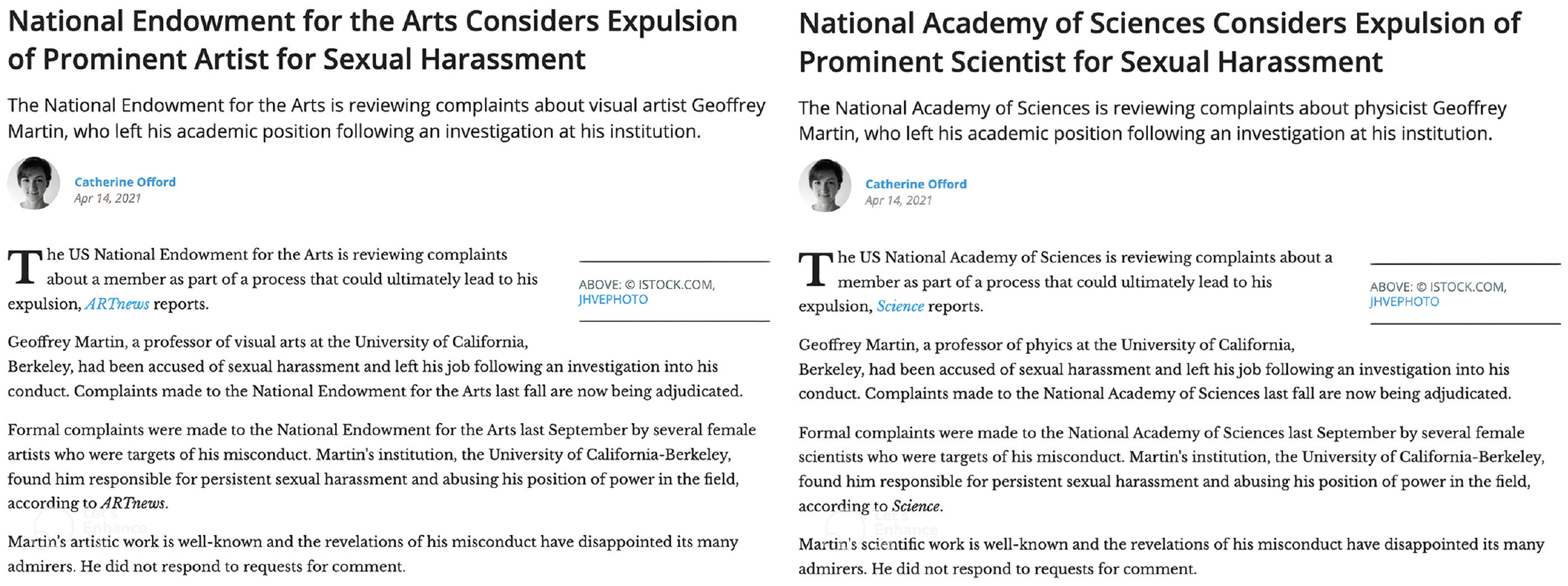
Study 2 experimental stimuli. At left is shown the art condition; at right is shown the science condition.
After reading the article, participants reported their support for various professional consequences for the professor. In these studies, we measured outcomes relevant to this sample that clearly implicated the perpetrator’s work (i.e., their likelihood to boycott the person’s work, to support having the person’s books removed from bookstores, and to support removing the person’s work from college classrooms; 1 = not at all, 7 = very much; α = .89). The replication included these same consequences plus a fourth (support for preventing them from speaking on college campuses; α = .91). In both studies, participants then reported on two items their moral decoupling of the professor’s work from his misconduct (Lee & Kwak, 2016), one descriptive (“This person’s actions do not change my assessment of his work”; 1 = strongly disagree, 4 = neither agree nor disagree, 7 = strongly agree) and one normative (“Reports of wrongdoing should not affect our views of this person’s work”; initial study: r = .89; replication: r = .89). The two items were highly correlated in all studies (rs > .83) and produced similar results, so we combined them in all analyses. Finally, participants reported the perceived wrongness of the misconduct (i.e., how wrong was the person’s negative behavior), which was unaffected by condition (p > .40). Moreover, controlling statistically for misconduct wrongness did not affect any results, so it is not discussed further. Several ancillary measures omitted for space (e.g., the perceived value of the work) are described and analyzed in the Supplemental Material, and that discussion helps to rule out alternative accounts for the phenomenon (e.g., any differences in valuation cannot explain the main findings).
Results
The analyses consisted of two (professional field: art vs. science) between-subjects ANOVAs on work-relevant (professional) consequences and moral decoupling. We also conducted a mediation analysis testing the indirect AvS effect on consequences through moral decoupling.
Initial study
Conceptually replicating Study 1, participants supported greater professional consequences for artistic (M = 4.19, SD = 1.97) versus scientific professors (M = 3.60, SD = 1.74), F(1, 194) = 5.01, p = .026, d = 0.32. In line with predictions, participants also reported less moral decoupling of artists’ work from their misconduct (M = 3.73, SD = 1.85) than scientists’ (M = 4.51, SD = 1.68), F(1, 194) = 9.51, p = .002, d = 0.44. A mediation analysis (Hayes, 2018; Model 4) testing the effect of field (art vs. science) on professional consequences through moral decoupling was significant, b = −0.59, SE = .20, 95% CI = [−.9781, −.2045].
Preregistered replication
Repeating the same analyses, we found participants were more supportive of professional consequences for artists than scientists (Mart = 4.77, SD = 1.77 vs. Mscience = 3.86, SD = 1.76), F(1, 369) = 24.35, p < .001, d = 0.51, and morally decoupled them less (Mart = 3.66, SD = 1.89 vs. Mscience = 4.62, SD = 1.77), F(1, 369) = 25.54, p < .001, d = 0.53. The same test of mediation was also significant, b = −0.33, SE = .07, 95% CI = [−.4703, −.2010].
Combined sample
Including study (initial vs. replication) as an additional factor in a similar analysis on the combined samples, we examined effects on a composite of the three consequence items present in both studies. Artists (vs. scientists) faced harsher professional consequences (Mart = 4.46, SD = 1.90 vs. Mscience = 3.50, SD = 1.85), F(1, 563) = 27.78, p < .001, d = 0.44, and were morally decoupled less (Mart = 3.68, SD = 1.88 vs. Mscience = 4.58, SD = 1.74), F(1, 563) = 29.62, p < .001, d = 0.46. The same indirect effect also emerged, b = −0.33, SE = .06, 95% CI = [−.4479, −.2215]. Neither the AvS effect on professional consequences nor moral decoupling was moderated by study (Fs < 1).
Study 3: Experimental Moderation of the Moral-Decoupling Process
Study 3 tests the proposed mechanism, moral decoupling, through experimental moderation (Spencer et al., 2005). Prior research (Bhattacharjee et al., 2013; Lee & Kwak, 2016) has suggested that misconduct relevant to the work’s content (e.g., plagiarism by an academic) should prevent moral decoupling relative to less work-relevant misconduct (e.g., racial discrimination by an academic). Thus, if moral decoupling (vs. another account) explains the effect, people should support greater professional consequences for art (vs. science) only when the misconduct is low (vs. high) in work relevance.
Participants and design
We recruited 408 participants for our initial study and excluded 21 for failing the instructional manipulation check, leaving a final sample of 387 (Mage = 39.83 years, SD = 12.29; 44% female). The replication collected a much larger sample, resulting in 1,004 participants. Thirty were excluded for the same preregistered reason as the Study 2 replication, leaving 974 for analysis (Mage = 41.08 years, SD = 12.33; 49% female). Combined, the two studies (N = 1,361) provided .80 power to detect an interaction (d) of 0.15 in our 2 (professional field: art vs. science) × 2 (relevance of misconduct to the work: high vs. low) between-subjects design.
Procedure
The initial study and replication had near-identical procedures. Participants first learned that they would be asked to read about a real situation involving a specific individual. They were then presented with information about an individual who was known for producing “an influential work of fiction” (art condition) or “an influential scientific finding” (science condition). All information aside from the artistic versus scientific nature of the professor’s field was again held constant (see the Supplemental Material for the complete stimuli).
The artist was either described as a respected “novelist” (initial study) or “professor of creative writing” (replication), whereas the scientist was either described as a respected “physicist” (initial study) or “professor of microbiology” (replication). This provided some breadth beyond the academic context, because novelists and physicists need not work as academics. Participants then learned of the individual’s personal misconduct, which varied in relevance to the work’s content (Bhattacharjee et al., 2013; Lee & Kwak, 2016). When relevance was low, participants read that the individual had racially discriminated against his employees. When relevance was high, he had plagiarized ideas that belonged to others. Participants then completed the professional-consequence measures, which were the same as in Study 2, with the three items in the initial study (α = .90) and the additional fourth item in the replication (α = .91). Participants in the initial study also completed a manipulation check (about how much it was possible to separate the person’s work from his behavior). To conclude the study, participants in both studies reported their perceptions of the misconduct’s wrongness. In the initial study, wrongness was not significantly affected by the offender’s field (Mart = 6.08, SD = 1.20 vs. Mscience = 6.16, SD = 1.15), t(383) = 0.68, p = .498, or the work-relevance manipulation (Mart = 6.04, SD = 1.22 vs. Mscience = 6.21, SD = 1.12), t(383) = 1.42, p = .157. In the replication, however, the misconduct seemed worse when committed by the scientist (M = 6.24, SD = 1.10) rather than the artist (M = 5.92, SD = 1.31), t(972) = 4.06, p < .001, and when high in relevance (M = 6.20, SD = 1.14) rather than low (M = 5.96, SD = 1.28), t(972) = 3.04, p = .002. Notably, this AvS difference in misconduct wrongness mirrors the directional pattern involving legal consequences in Study 1: Both results are directionally opposite to what would occur if this variable explained the AvS effect. Nevertheless, as in Study 2, we repeated all Study 3 analyses while statistically controlling for wrongness. Because this did not affect the results, it is not discussed further.
Results
We conducted a 2 (artistic vs. scientific work) × 2 (high vs. low relevance of misconduct to the work) ANOVA on support for professional consequences, first separately and then combined with study as a factor. The combined results are presented in Figure 2.
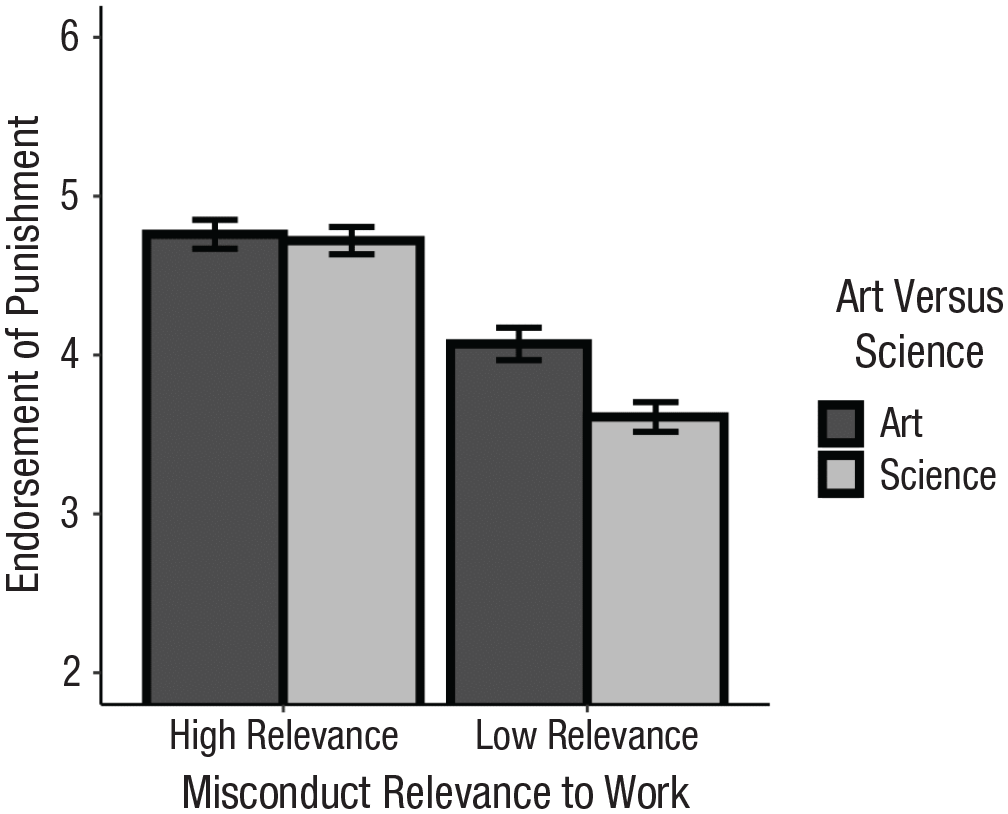
Support for professional consequences in artistic versus scientific fields for individuals who commit misconduct manipulated to be high (vs. low) in relevance to their work. Error bars represent standard errors.
Initial study
The manipulation check confirmed the effectiveness of our inductions. Participants in the low-relevance condition considered it more possible to separate the work from the misconduct (M = 4.16, SD = 1.89) compared to the high-relevance condition (M = 3.16, SD = 1.76), F(1, 381) = 30.31, p < .001, d = 0.57. Additionally, separating art from the misconduct was considered less possible (M = 3.34, SD = 1.74) than separating science (M = 4.00, SD = 1.98), F(1, 381) = 13.63, p < .001, d = 0.38. There was no interaction (p = .495).
We next examined effects on support for professional consequences. Whereas the main effect of AvS was not significant (Mart = 5.03, SD = 1.68 vs. Mscience = 4.72, SD = 1.72), F(1, 383) = 2.15, p = .144, d = 0.16, the main effect of the relevance of the misconduct to the work was that participants more strongly supported punishing the work in the high-relevance condition (M = 5.26, SD = 1.53) than in the low-relevance condition (M = 4.56, SD = 1.79), F(1, 383) = 17.36, p < .001, d = 0.42. More importantly, these effects were qualified by the expected interaction, F(1, 383) = 5.42, p = .020, d = 0.24. As predicted, in the low-relevance condition, support for professional consequences was greater for art (M = 4.88, SD = 1.72) than science (M = 4.24, SD = 1.85), F(1, 383) = 7.29, p = .007, d = 0.28. However, AvS had no effect in the high-relevance condition (Mart = 5.19, SD = 1.68 vs. Mscience = 5.33, SD = 1.37), F(1, 383) = 0.37, p = .544.
Preregistered replication
Here, the main effect of AvS on support for punishing the work was again not significant (Mart = 4.19, SD = 1.81 vs. Mscience = 4.06, SD = 1.72), F(1, 970) = 1.58, p = .209, d = 0.090, whereas the main effect of the work-relevance manipulation was (Mlow = 4.55, SD = 1.67 vs. Mcontrol = 3.69, SD = 1.76), F(1, 970) = 61.98, p < .001, d = 0.51. The two-way interaction showed the predicted pattern, albeit nonsignificantly, F(1, 970) = 2.46, p = .117, d = 0.11. That is, the planned contrasts replicated the initial study: the low-relevance condition revealed significantly greater support for professional consequences for art (M = 3.84, SD = 1.87) than science (M = 3.53, SD = 1.63), F(1, 970) = 3.98, p = .046, d = 0.13, whereas AvS had no effect in the high-relevance condition (Mart = 4.54, SD = 1.69 vs. Mscience = 4.57, SD = 1.65), F(1, 970) = 0.05, p = .826.
Combined sample
Including study (initial vs. replication) as an additional factor in the combined analysis, we examined effects on the three consequence items included in both studies. Replicating the core finding, the main effect of AvS was significant, F(1, 1353) = 5.88, p = .015, d = 0.13, with greater support for professional consequences against art (M = 4.40, SD = 1.86) than science (M = 4.16, SD = 1.79). Support for consequences was also greater in the high-relevance (vs. low- relevance) condition, F(1, 1353) = 58.93, p < .001, d = 0.42. Of most interest, the two-way interaction between AvS and the relevance of the misconduct to the work was significant, F(1, 1353) = 7.68, p = .006, d = 0.16 (see Fig. 2). In the low-relevance condition, support for professional consequences was significantly greater for art than science (Mart = 4.06, SD = 1.92 vs. Mscience = 3.57, SD = 1.76), F(1, 1353) = 13.61, p < .001, d = 0.20, but AvS had no effect in the high-relevance condition, F(1, 1353) = 0.06, p = .807. The three-way interaction with study was not significant, F(1, 1353) = 1.07, p = .301.
Study 4: Framing the Same Work as “Artistic” Versus “Scientific”
In our final study, we show that the AvS effect can emerge from merely framing people and their work as artistic or scientific, ruling out further explanations for the effect and demonstrating its applicability beyond academic contexts. To do this, we designed a realistic news article describing a tennis coach and book author, framed as artistic or scientific, who committed financial fraud. We then examine support for professional consequences against him.
Participants and design
We recruited 204 participants for our initial study and excluded 47 for incorrectly identifying the name of the author or his book title immediately after learning this information (from a multiple-choice set), or failing the instructional manipulation check, leaving 157 participants for analysis (Mage = 38.14 years, SD = 10.85; 49% female). In our preregistered replication, we recruited 603 participants and excluded 94 on the basis of the first two criteria, leaving 509 for analysis (Mage = 44.25 years, SD = 12.88; 51% female). A sensitivity analysis showed that the combined sample (N = 666) provided .80 power to detect a framing effect (d) of 0.22.
Procedure
The procedure mirrored that of Study 2, except that both conditions focused on tennis rather than different fields. Our stimuli were again modeled on real news articles (from tennis.com) and designed to seem realistic (see the stimuli in the Supplemental Material). In the study, participants were sequentially presented with two news articles: The first framed the tennis coach and book author as either an “artist” or “scientist of the game” and his work as “artistic” or “scientific.” Other than language emphasizing this framing (e.g., “his artistic [scientific] life style”; “his artistic intuition [scientific approach]”), the article was otherwise identical across conditions. After learning about this individual, all participants completed the attention checks before reading a second article ostensibly from the same website. This article described the target as having underreported the profits from multiple business ventures, thereby cheating both the government and his coinvestors out of due funds.
In both the initial study and replication, professional consequences were measured with three items (gauging support for no longer buying his tennis books, for stopping the selling of his books at bookstores, or for boycotting his books, using a scale ranging from 1, don’t stop [boycott] at all, to 7, definitely stop [boycott]; initial study: α = .93; replication: α = .93). Moral decoupling was assessed as in Study 2 (initial study: r = .83; replication: r = .88). Finally, we included two questions on the perceived harm from punishing the work (how much impact do the books have on people’s everyday lives, and how much harm would be caused by boycotting the books, using a scale ranging from 1, none at all, to 7, very much). Neither measure was affected by the manipulation in either study (ps > .20), and controlling for them in the analyses did not change the results, so they are not discussed further (see the Supplemental Material).
Results
Initial study
Our analytic approach was the same as in Study 2. As expected, participants more strongly endorsed professional consequences in the art-framing (vs. science-framing) condition (Mart = 4.65, SD = 1.85 vs. Mscience = 3.96, SD = 1.97), F(1, 155) = 5.06, p = .026, d = 0.36. They also morally decoupled the art-framed (vs. science-framed) work significantly less (Mart = 3.82, SD = 1.78 vs. Mscience = 4.45, SD = 1.89), F(1, 155) = 4.62, p = .033, d = 0.35. This mediated the AvS effect on consequences, b = −0.24, SE = .11, 95% CI = [−.4648, −.0254].
Preregistered replication
Participants also more strongly endorsed professional consequences in the art-framing (vs. science-framing) condition (Mart = 4.05, SD = 1.87 vs. Mscience = 3.59, SD = 1.85), F(1, 507) = 7.89, p = .005, d = 0.25. They also morally decoupled the art-framed (vs. science-framed) work significantly less (Mart = 4.30, SD = 1.86 vs. Mscience = 4.64, SD = 1.81), F(1, 507) = 4.24, p = .040, d = 0.18. Once again, this mediated the effect on professional consequences (b = −0.13, SE = .06, 95% CI = [−.2542, −.0080]).
Combined sample
Including study (initial vs. replication) as an additional factor in the combined analysis, participants endorsed professional consequences more in the art-framing (vs. science-framing) condition (Mart = 4.19, SD = 1.87 vs. Mscience = 3.69, SD = 1.88), F(1, 662) = 11.32, p < .001, d = 0.26, and morally decoupled the art-framed (vs. science-framed) work significantly less (Mart = 4.20, SD = 1.85 vs. Mscience = 4.59, SD = 1.83), F(1, 662) = 8.28, p = .004, d = 0.22. This again mediated the AvS effect on professional consequences (b = −0.15, SE = .06, 95% CI = [−.2627, −.0486]). None of the effects were moderated by study (Fs < 1).
General Discussion
Archival data on four decades of academic sanctions against faculty and three preregistered experiments show that professional consequences for personal misconduct are harsher for those perceived more as artists (vs. scientists). This occurs because artistic (vs. scientific) works are seen as more closely linked to their producers, making them harder to morally decouple from their producers’ ostensibly unrelated misbehavior. Alternative explanations in terms of potential differences in the perceived wrongness of the misconduct or in the initial (pretransgression) valuation of the work were not supported (see ancillary analyses on Studies 2 and 3 in the Supplemental Material).
We believe these findings have important theoretical and practical implications. First, these results identify consequential psychological differences in the perception of AvS that affect social judgment and shape meaningful, real-world decisions. Although we focus on the punitive implications of AvS for producers’ work, it is also interesting to consider how it could influence other judgments (e.g., perceptions of work by morally upstanding producers). Second, our research extends the literature on moral decoupling (Bhattacharjee et al., 2013). Little work has examined contextual moderators of moral decoupling, and we introduce AvS as a robust example. The current work also raises interesting possibilities that go beyond morality. For example, might nonmoral attributes (e.g., idiosyncratic preferences) also have more impact on perceptions of artistic versus scientific work (i.e., because they are coupled more with perceptions of art)? Research on decoupling (and related work on moral contagion, e.g., Stavrova et al., 2016) has exclusively considered moral transgressions, so it remains an open question for future research on how decoupling might apply to nonmoral processes.
Complementing these theoretical insights, these findings also offer salient practical implications. For example, considering effects of someone’s personal misbehavior on evaluations of their work is particularly relevant to consumer boycotts and modern-day “cancel culture” (Saldanha et al., 2022). Additionally, our findings suggest that academic and industrial fields could vary in how they handle personal misconduct such that workers in fields or industries associated with higher decoupling (those perceived as scientific) receive lighter professional consequences. This could be one reason misconduct (e.g., sexual harassment) has historically been tolerated in scientific fields (Colwell, 2020): Perceiving science as separable from scientists’ misconduct might allow abuses to go relatively unpunished.
Further extensions from moral-decoupling theory
Throughout, we have focused on AvS differences in professional consequences for misconduct, but what about more personal punishments, such as criminal charges? From a moral-decoupling standpoint, factors that moderate decoupling should only produce differences in professional (vs. personal) evaluations; personal judgments offer no psychological space for decoupling to operate. For example, in Study 1, we found no significant differences in terms of personal consequences (i.e., criminal charges), whereas we did in terms of professional ones. To experimentally test this proposition, we conducted a supplementary study (n = 385; Mage = 39.62 years, SD = 11.64; 49% female). It entailed a direct replication of Study 2 with two key additions: (a) the consequences from Studies 1 (ASMD), 2, and 3 and (b) perceptions of how professional (i.e., work-related) versus personal each consequence was. We then conducted a multilevel model testing AvS and the consequence’s professional-versus-personal relevance on support for the punitive outcome. In short, we observed a significant interaction (p < .001) where the AvS effect increased as consequences were perceived as more professional and decreased as they were perceived as more personal (see the Supplemental Material for details). Altogether, these findings cohere with moral-decoupling theory and further specify where the AvS effect should emerge.
Extending this theorizing, moral-decoupling research suggests another important moderator, namely, the work’s quality (Bhattacharjee et al., 2013). Motivation to morally decouple is typically stronger (weaker) when the quality of the work is high (low). So, when quality is extremely high (or low) for both art and science, the AvS effect might be diminished, because decoupling would likely be quite high (or low) for both (i.e., offering AvS limited space to influence people’s moral reasoning). Likewise, the effect could be attenuated if the quality of an artwork were much higher than that of a contrasting scientific work, because this difference in quality would counteract the typical AvS difference. However, when the quality of artistic and scientific works is roughly equal and not extreme, we would expect the AvS effect to emerge.
Why is art (vs. science) harder to morally decouple?
Another interesting question is why artworks are harder to decouple. Earlier, we suggested that the emotional nature of art (vs. the cognitive nature of science) might contribute; however, other dimensions could also be relevant. For example, Bhattacharjee and colleagues (2013) suggested that work with more subjective (vs. objective) value should be harder to morally decouple. Our findings are consistent with this prediction in that the value of art is seen as a matter of opinion (subjective; Hirschman, 1983), whereas the value of science is seen as a matter of fact (objective; Kuhn et al., 2000). Other differences, such as the perception that artworks are creations whereas scientific works are discoveries, could also be relevant. Although these questions are beyond the scope of the present research, exploratory data on some of these differences are presented in the Supplemental Material.
Beyond dimensions of the AvS categories themselves, it is also worth considering how social differences between arts and sciences—norms, selection for certain personality traits or proclivities, and so on—might reinforce or moderate these outcomes. For example, perhaps tolerating misconduct is less normative in artistic than in scientific communities. Although our experiments and the controls implemented in Study 1 suggest that social factors do not fully explain the AvS effect, they are nonetheless relevant to consider.
Limitations and conclusion
It is important to note that the present research relies exclusively on American participants. Our findings are therefore applicable to the United States and likely to other White, Educated, Industrialized, Rich, Democratic (WEIRD) cultural contexts, but might not extend to others (Henrich et al., 2010). In particular, the results might differ in populations with a more impersonal conceptualization of art and a more personal conceptualization of science than are prevalent in Western cultures (Judge et al., 2020). Still, our findings can inform ongoing discussions in the United States and elsewhere regarding professional accountability for personal misconduct.
Supplemental Material
sj-docx-1-pss-10.1177_09567976231214739 – Supplemental material for Personal Misconduct Elicits Harsher Professional Consequences for Artists (vs. Scientists): A Moral-Decoupling Process
Supplemental material, sj-docx-1-pss-10.1177_09567976231214739 for Personal Misconduct Elicits Harsher Professional Consequences for Artists (vs. Scientists): A Moral-Decoupling Process by Joseph J. Siev and Jacob D. Teeny in Psychological Science
Footnotes
Transparency
Action Editor: Martie G. Haselton
Editor: Patricia J. Bauer
Author Contribution(s)

References
Supplementary Material
Please find the following supplemental material available below.
For Open Access articles published under a Creative Commons License, all supplemental material carries the same license as the article it is associated with.
For non-Open Access articles published, all supplemental material carries a non-exclusive license, and permission requests for re-use of supplemental material or any part of supplemental material shall be sent directly to the copyright owner as specified in the copyright notice associated with the article.
