




Abstract
This research evaluated the hypothesis that the act of offering an incentive produces anticipated social benefits that are distinct from the benefits associated with the incentive itself. Across three preregistered studies, 3- to 5-year-old children in China (total N = 210) were given an opportunity to wait for an additional sticker (Studies 1 and 3) or an edible treat (Study 2). Rewards were dispensed via a timer-controlled box that allowed the experimenter’s apparent ability to learn how long children waited to be manipulated experimentally. Children waited only about half as long when they believed the experimenter would not find out how long they waited. When children were offered three prizes for waiting, anticipated social benefits still drove behavior at least as much as the reward. The findings demonstrate that children as young as 3 years are sensitive to anticipated social rewards when responding to offers of incentives.
Young children are frequently offered rewards for waiting patiently. The way they respond can predict important life outcomes many years later, including academic achievement and stress tolerance (Shoda et al., 1990). Previously, the standard interpretation was that children’s waiting behavior is grounded in a stable capacity to sacrifice an immediate reward for a greater future benefit. However, in recent years there has been a shift toward interpreting it in terms of strategic control in the service of specific goals (Doebel, 2020). One reason for this shift is a growing body of evidence that children’s responses are highly sensitive to manipulations of the social context (e.g., Doebel & Munakata, 2018; Kidd et al., 2013). The present research builds on this foundation by testing a stronger claim about the role of the social context: that the offer of a reward itself can serve as a social cue that influences children’s behavior.
Evidence that manipulating the social context can affect how young children respond to incentives for waiting has been diverse and robust. The manipulations have tended to involve introducing socially relevant information to a delay-of-gratification task. In one approach, the information concerns the behavioral attributes of the individual offering the reward (Kidd et al., 2013; Michaelson & Munakata, 2016; Moffett et al., 2020; Pesch & Koenig, 2018). For example, both Kidd et al. (2013) and Moffett et al. (2020) found that young children were less likely to wait for a reward when the offer was made by an experimenter who had broken a promise compared with one who had kept a promise. In another approach, the socially relevant information concerns whether other individuals are said to have exercised self-control previously (Doebel & Munakata, 2018; Haimovitz et al., 2019). For example, Doebel and Munakata (2018) found that young children waited longer after observing in-group members wait compared with out-group members. In a third approach, the socially relevant information concerns the social meaning of waiting (Gruen et al., 2020; Koomen et al., 2020; Ma et al., 2020). For example, Koomen et al. (2020) found that young children waited longer when the task was a cooperative endeavor in which each participant was paired with a partner and could earn a reward only if both partners waited. In addition, Ma et al. (2020) found that young children waited longer if the experimenter explained prior to starting the task that how long they wait would be conveyed to a teacher or a peer.
The present research examined the possibility that in addition to being responsive to newly introduced social cues, children are sensitive to socially relevant information embedded in the structure of the delay-of-gratification task itself. Specifically, we proposed that when an experimenter offers a reward for waiting, it implicitly signals that waiting is the preferred behavior, given that people typically offer rewards for behaviors they value (see Ho et al., 2019). Therefore, disrupting this signal by informing children that the experimenter will not be able to find out how long they have waited should lead to shorter waiting times, assuming that children (a) care about how the experimenter perceives them and (b) make the inference that the experimenter wants them to wait.
There are reasons to expect preschool-age children to care about how an experimenter perceives them. By age 5 years, children engage in a range of reputation-management strategies (for reviews, see Engelmann & Rapp, 2018; Silver & Shaw, 2018), and even younger children are sensitive to how they are perceived by other people (Asaba & Gweon, 2022; Botto & Rochat, 2018; Ma et al., 2020; Zhao et al., 2018). For example, Asaba and Gweon (2022) found that 3- and 4-year-olds are more likely to reveal their true competence at drawing when they think it will lead an adult observer to think more highly of them.
There are also reasons to believe that preschool-age children are capable of inferring that an experimenter who offers a reward for waiting probably wants them to wait. This possibility is supported by evidence that preschool-age children can make nonobvious inferences about other individuals’ intentions when deciding whether to accept testimony (e.g., Jaswal, 2004) and that even infants are sensitive to the intentions and goals of others (Buresh & Woodward, 2007; Meltzoff, 1995; see Woodward, 2009).
Statement of Relevance
Delay-of-gratification tasks have been widely portrayed as a choice between obtaining an immediate incentive and waiting for a better one. We investigated an alternative possibility: that children’s approach is driven, at least in part, by anticipated social benefits rather than material ones, based on their understanding that people tend to offer rewards only for behaviors they wish to promote. We manipulated the extent to which the offer of an incentive could function as a social signal and found that children waited much less when they thought the experimenter would not find out how long they waited. This research provides an alternative explanation for prior evidence that young children’s waiting times on delay-of-gratification tasks can predict important life outcomes many years later. It also demonstrates that children as young as 3 years can engage in reputation-management strategies that involve subtle inferences about the intentions of other people.
We tested our hypothesis among a sample of 3- to 5-year-olds, using a modified delay-of-gratification task with a between-subjects design. In each condition, rather than the experimenter simply handing the second prize to children who wait for the entire 15-min interval, we used an automatic box (similar to a timed treat dispenser for pets; see Fig. 1) that allowed the second prize to be released automatically at the end of the interval. We focused on a comparison between an unaware condition, in which children were led to believe that the experimenter would not find out how long they waited, and an aware condition, in which children were led to believe that the experimenter would find out.
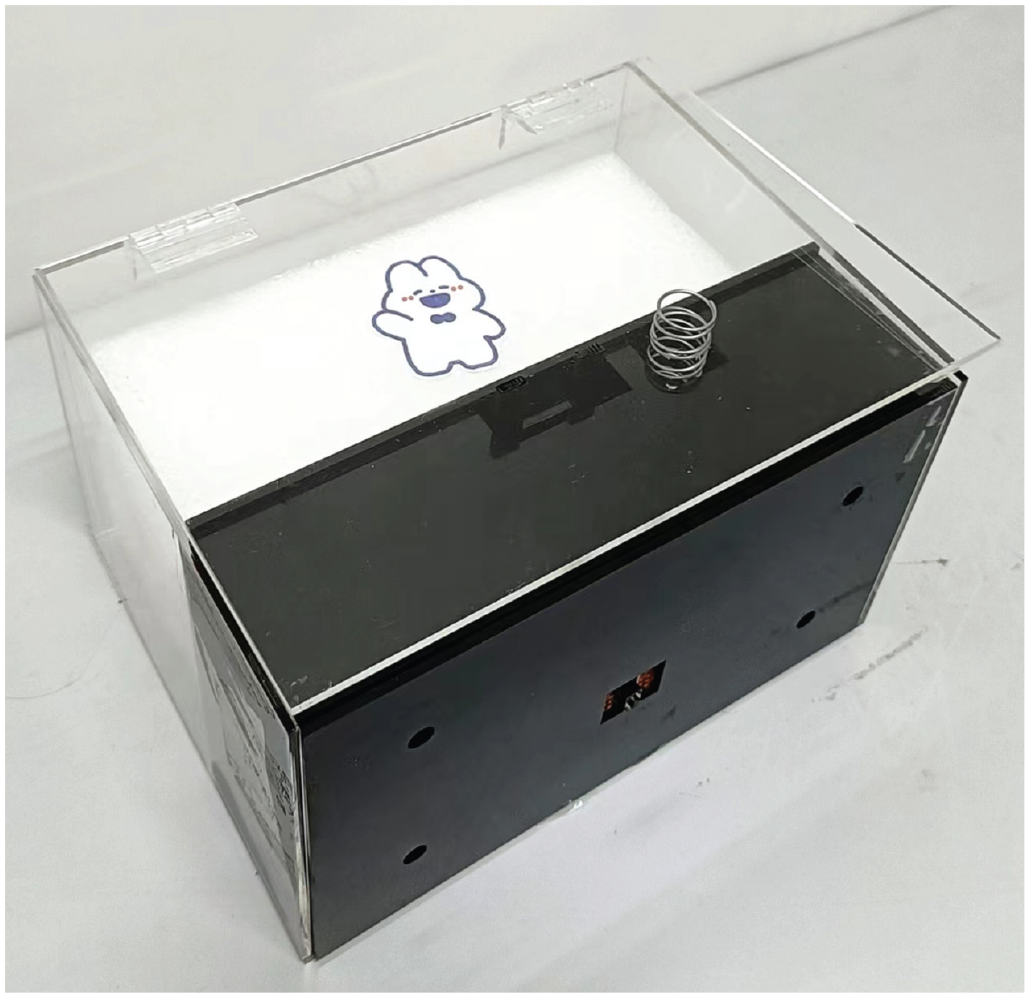
The timer-controlled box that was used to dispense prizes.
A second goal of this research was to measure the effect of the perceived value of the incentive and compare it with the effect of any socially based motivation. To this end, we also included an unaware/additional rewards condition in which the prize for waiting was greater than in the other two conditions.
Open Practices Statement
All data have been made publicly available via the Open Science Framework and can be accessed at https://osf.io/2fmg9/. There are preregistrations for Study 1 at https://aspredicted.org/qs7zz.pdf (unaware and aware conditions) and https://aspredicted.org/4mk6i.pdf (unaware/additional rewards condition), for Study 2 at https://aspredicted.org/z5k26.pdf, and for Study 3 at https://aspredicted.org/wd3pm.pdf. This article has received the badges for Open Data and Preregistration. More information about the Open Practices badges can be found at http://www.psychologicalscience.org/publications/badges.
Study 1
Method
Participants
The final sample consisted of 90 children, ages 3 and 4 years, who attended a public preschool in a large eastern city in China. There were 30 children in the aware condition (age: M = 4.29 years, SD = 0.26, range = 3.83–4.75 years; 17 boys), 30 children in the unaware condition (age: M = 4.33 years, SD = 0.34, range = 3.83–4.75 years; 16 boys), and 30 children in the unaware/additional rewards condition (age: M = 4.39 years, SD = 0.24, range = 3.92–4.75 years; 14 boys). The sample size was determined on the basis of a power analysis that indicated 90 participants would be sufficient to achieve 80% power and a medium effect size. An additional seven participants were excluded (two did not pass the manipulation check, two did not follow the instructions for the inhibitory control task, two chose to stop participating after the inhibitory control task, and one was interrupted by someone who entered the room during the waiting period). The preschool serves middle-class families, and approximately 70% of children at the school had at least one parent who completed college. This research was approved by the institutional review board of Zhejiang Sci-Tech University, and only children who gave their oral assent to participate and had consent from parents or legal guardians were included.
Procedure
This study was conducted according to a preregistered plan (https://aspredicted.org/qs7zz.pdf for the unaware and aware conditions, and https://aspredicted.org/4mk6i.pdf for the unaware/additional rewards condition, which was designed and preregistered during a pandemic-related pause before data collection for any of the conditions could begin). The data for all studies in this article are available online at https://osf.io/2fmg9/.
Children were tested by a female experimenter in individual sessions in a quiet room at their school. The sessions were recorded by a hidden camera for the purpose of measuring children’s waiting behavior. Each session began with a hammer-knocking inhibitory control task (a revised version of the peg-tapping task; see Ma et al., 2020). This task was used as a pretext for offering the child an initial reward and also as a possible predictor of waiting times, given that both tasks appear to involve self-regulation (Ma et al., 2020). The experimenter held a plastic hammer, gave the child a matching hammer, and said, “When I knock the hammer once like this [knocking once], you knock it twice like this [knocking twice]. When I knock the hammer twice, you knock it once. Let’s try that.” The experimenter presented two practice trials, and if the child responded incorrectly, she demonstrated the task again. Children were given two chances to pass the practice trials. The hammer-knocking task consisted of 16 trials in a pseudo-random order, and the dependent measure was the number of correct responses.
After concluding the hammer-knocking task, the experimenter said, “You did a great job at this game, and I want to give you a sticker as a reward.” She then gave the instructions for the delay-of-gratification task, which are shown below: You can get this one sticker right now, or if you wait a while, you can get one more sticker, for a total of two stickers. I have to go to another school now, and I won’t be able to return. I put this extra sticker into this box and locked it. The box will open by itself after a while. If you wait here until the box opens, you can have the two stickers. If you want to stop waiting, you can take this one sticker [pointing to the first sticker] and go back to your classroom. [unaware condition] You can get this one sticker right now, or if you wait a while, you can get one more sticker, for a total of two stickers. I am going to leave now. I put this extra sticker into this box and locked it. The box will open by itself after a while. If you wait here until the box opens, you can have the two stickers. If you want to stop waiting, ring the bell, and I will come back right away, and you will get this one sticker [pointing to the first sticker]. [aware condition] You can get this one sticker right now, or if you wait a while, you can get three more stickers, for a total of four stickers. I have to go to another school now, and I won’t be able to return. I put these extra stickers into this box and locked it. The box will open by itself after a while. If you wait here until the box opens, you can have the four stickers. If you want to stop waiting, you can take this one sticker [pointing to the first sticker] and go back to your classroom. [unaware/additional rewards condition]
In each condition, before leaving the room the experimenter asked the following questions to make sure the child understood the procedure: (a) How many stickers will you get if you can wait here until the box opens? (b) How many stickers will you get if you decide to stop waiting? (c) What should you do if you decide to stop waiting? If children got any answers wrong, the experimenter stated the correct answer and gave them another chance to answer it correctly.
Waiting times, defined as either the number of seconds that elapsed before the child picked up the first sticker and got out of his or her seat or 900 s for children who waited until the box opened, served as the primary dependent measure. At the end of the experiment for the children in the two unaware conditions, a research assistant waited outside the door and asked the child where the experimenter was. All of these children correctly stated that the experimenter had gone to a different school.
Results
We first examined our primary theoretical question about the effects of social motivation by comparing the waiting times of children in the unaware and aware conditions. As predicted, a Mann-Whitney U test indicated that the percentage of children who waited for the full 15-min period (see Fig. 2) was significantly lower in the unaware condition (10%) than in the aware condition (40%; Z = −2.66, p = .008). We also examined whether waiting times varied by condition. Because these values are not normally distributed due to being right-censored for children who waited for the full 15 min, we used a Mantel-Cox log rank test. This difference was significant, Mantel-Cox χ2(1, N = 60) = 11.00, p = .001, with children waiting less in the unaware condition (M = 307.10 s, nonparametric bootstrapped 95% confidence interval, or CI = [207.69, 406.51]) than in the aware condition (M = 587.07 s, nonparametric bootstrapped 95% CI = [471.06, 703.07]).
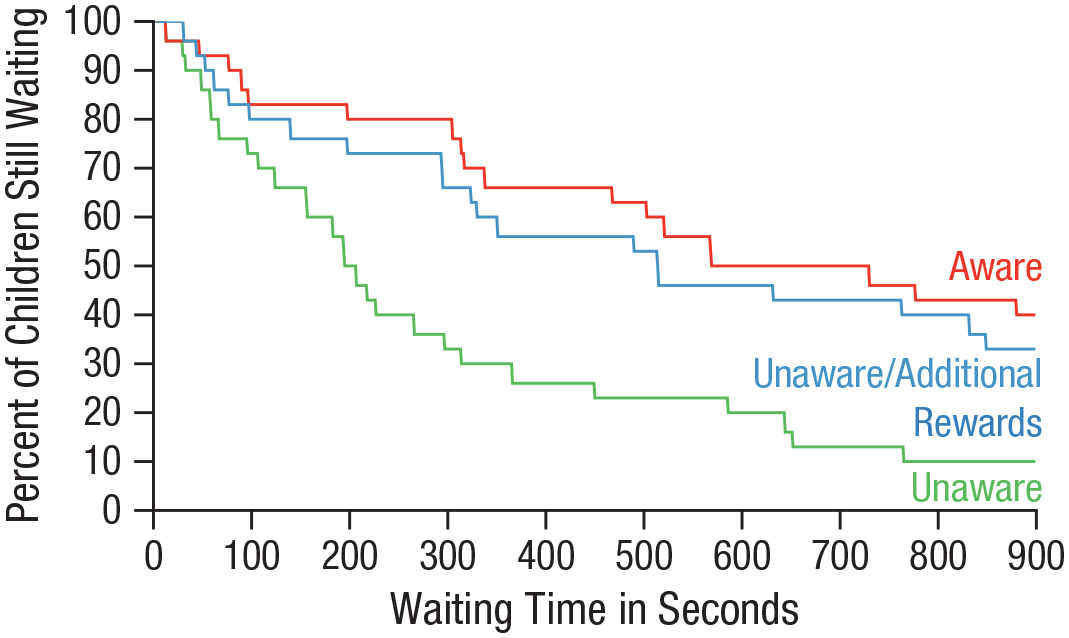
Survival functions for the 900-s waiting period in Study 1, by condition.
Next, we compared children’s waiting times in the unaware and unaware/additional rewards conditions to assess the extent to which they were motivated by extra material rewards. As predicted, a Mann-Whitney U test indicated that the percentage of children who waited for the full 15-min period was significantly lower in the unaware condition (10%), which had only one reward, than in the unaware/additional rewards condition (33%), which had three rewards (Z = −2.18, p = .030). A Mantel-Cox log rank test indicated that the difference between conditions was significant, Mantel-Cox χ2(1, N = 60) = 6.99, p = .008, with children waiting less in the unaware condition (M = 307.10 s, nonparametric bootstrapped 95% CI = [207.69, 406.51]) than in the unaware/additional rewards condition (M = 529.73 s, nonparametric bootstrapped 95% CI = [408.56, 650.91]).
We also examined children’s waiting times in the aware and unaware/additional rewards conditions to compare the effects of social versus material rewards. The percentage of children who waited for the full 15-min period was not significantly different between these conditions (40% in the aware condition; 33% in the unaware/additional rewards condition; Mann-Whitney U test: Z = −0.53, p = .595), and a Mantel-Cox log rank test also indicated no difference between the conditions, χ2(1, N = 60) = 0.41, p = .525.
Finally, we conducted an exploratory analysis to examine the relation between waiting times and scores on the hammer-knocking task. We used a hierarchical Cox regression model that controlled for age and gender, with age and gender entered in the first step, scores on the hammer-knocking task in the second step, and waiting times as the predicted variable. The model was not significant, χ2(3, N = 90) = 2.13, p = .546, which indicates that the hammer-knocking task was not predictive of waiting times across conditions. This may be because the two tests are tapping into different forms of self-regulatory capacity or because waiting times are primarily driven by factors other than self-regulatory capacity.
Discussion
Consistent with our predictions about anticipated social benefits driving behavior, Study 1 showed that children waited substantially longer when they thought the experimenter would find out how long they had waited. The results also indicate that this form of social motivation drove children’s waiting behavior to about the same extent as receiving two additional stickers.
Study 2
The goal of Study 2 was to determine whether the same pattern of results would be seen if children were offered edible treats (in the form of cookies) rather than stickers. This is important to consider in light of the argument that nonedible prizes do not activate the “hot” motivational system described by the dual system model (Metcalfe & Mischel, 1999). According to this model, the “hot” system encourages children to act impulsively, and it can interfere with the more deliberative processing of the “cool” system. The importance of the distinction between edible and nonedible rewards is still unclear, with some studies finding little difference (Ma et al., 2020) and others finding a more substantial difference (Yanaoka et al., 2022). We predicted that, as in Study 1, children would wait longer in the aware condition than in the two unaware conditions and that they would wait longer in the unaware/additional rewards condition than in the unaware condition.
Method
Participants
The final sample consisted of 90 children, ages 4 and 5 years, from the same preschool as in Study 1. As before, there were 30 children in the aware condition (age: M = 4.70 years, SD = 0.33, range = 4.12–5.33 years; 15 boys), 30 children in the unaware condition (age: M = 4.65 years, SD = 0.39, range = 4.10–5.41 years; 16 boys), and 30 children in the unaware/additional rewards condition (age: M = 4.80 years, SD = 0.42, range = 4.10–5.41 years; 15 boys). An additional seven participants were excluded (two did not follow the instructions for the hammer-knocking task, two chose to stop participating after the hammer-knocking task, and three said they did not want any cookies).
Procedure
We conducted this study according to a preregistered plan (https://aspredicted.org/z5k26.pdf) that was the same as for Study 1, except that the rewards consisted of cookies instead of stickers. The cookies were selected on the basis of informal interviews with teachers who said they were the children’s favorite type of treat. To minimize the risk of contamination, we individually wrapped the treats in transparent plastic bags.
Results
As in Study 1, we first examined our central theoretical question by comparing waiting times in the unaware and aware conditions. As predicted, a Mann-Whitney U test indicated that the percentage of children who waited for the full 15-min period (see Fig. 3) was significantly lower in the unaware condition (10%) than in the aware condition (43%; Z = −2.90, p = .004). We also used a Mantel-Cox log rank test to assess the difference in waiting times between the two conditions and found that it was significant, Mantel-Cox χ2(1, N = 60) = 13.64, p < .001, with children waiting less in the unaware condition (M = 302.53 s, nonparametric bootstrapped 95% CI = [194.01, 411.06]) than in the aware condition (M = 624.10 s, nonparametric bootstrapped 95% CI = [519.36, 728.84]).
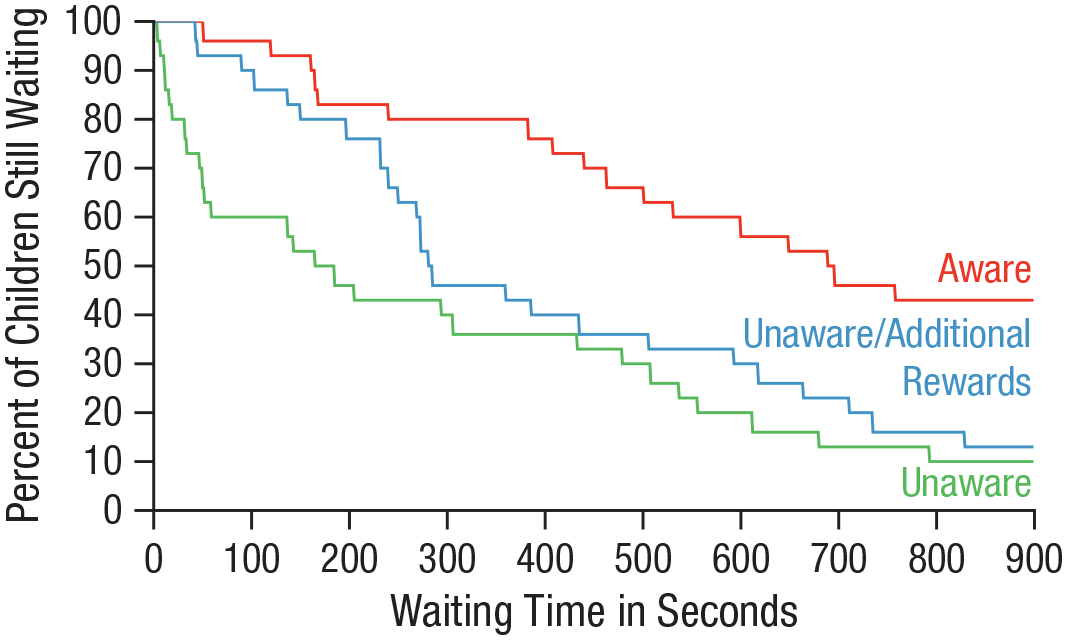
Survival functions for the 900-s waiting period in Study 2, by condition.
Next, we compared children’s waiting times in the unaware and unaware/additional rewards conditions to assess the extent to which they were motivated by extra material rewards. Contrary to our predictions, a Mann-Whitney U test indicated that the percentage of children who waited for the full 15-min period did not significantly differ between the unaware (10%) and unaware/additional rewards (13%) conditions (Z = −0.40, p = .690). A Mantel-Cox log rank test indicated that waiting times in the unaware condition (M = 302.53 s, nonparametric bootstrapped 95% CI = [194.01, 411.06]) were not significantly different from those in the unaware/additional rewards condition (M = 417.90 s, nonparametric bootstrapped 95% CI = [317.87, 517.93]), Mantel-Cox χ2(1, N = 60) = 1.63, p = .202.
We also examined children’s waiting times in the aware and unaware/additional rewards conditions to compare the relative effects of social versus material rewards. The percentage of children who waited for the full 15-min period was significantly greater in the aware condition (43%) than in the unaware/additional rewards condition (13%; Z = −2.56, p = .011). Using a Mantel-Cox log rank test, we found a significant difference between conditions, Mantel-Cox χ2(1, N = 60) = 7.70, p = .006, with children waiting longer in the aware condition (M = 624.10 s, nonparametric bootstrapped 95% CI = [519.36, 728.84]) than in the unaware/additional rewards condition (M = 417.90 s, nonparametric bootstrapped 95% CI = [317.87, 517.93]). These results suggest that the effect of social motivation was substantially greater than the motivation to obtain additional edible treats.
Finally, as in Study 1, we examined the relation between children’s scores on the hammer-knocking task and their waiting times using a hierarchical Cox regression model, and again the model was not significant, χ2(3, N = 90) = 2.83, p = .419.
Discussion
Study 2 provides further evidence that young children are sensitive to anticipated social rewards that are embedded in standard delay-of-gratification tasks. Across the two studies, we also found that children were sensitive to the type of reward being offered: Although adding extra stickers motivated children to wait longer in Study 1, we found no such effect when we used edible treats in Study 2. This suggests that children are more motivated by extra stickers than by extra cookies, perhaps because they anticipate that they can gain additional social benefits by showing their classmates the extra stickers they had received, given that stickers are often used as a reward for academic achievement in China.
Study 3
Study 3 was designed to evaluate the possibility that the extra steps children in the aware condition needed to take if they wanted to end the session early (i.e., ringing the bell and waiting for the experimenter) might have affected their behavior. To address this possibility, we tested participants in a new aware condition that was comparable with the aware condition of Study 1, except that children were told that the experimenter would be waiting outside the door and that if they decided to stop waiting, they would be able to return to their classroom right away.
Method
Participants
The final sample consisted of 30 children, ages 3 and 4 years (age: M = 4.30 years, SD = 0.23, range = 3.80–4.68 years; 15 boys), who were assigned to a single aware condition. All participants attended the same preschool as in the previous studies. An additional three participants were excluded (one did not follow the instructions on the inhibitory control task, one chose to stop participating after the inhibitory control task, and one was interrupted by someone who entered the room during the waiting period).
Procedure
This study was conducted according to a preregistered plan (https://aspredicted.org/wd3pm.pdf). The procedure was the same as in the aware condition of Study 1 except that after the experimenter explained, “You can get this one sticker right now, or if you wait a while, you can get one more sticker, for a total of two stickers,” children were told the following: Now I have to leave the room. I put this extra sticker in this box and locked it. The box will open automatically after a while. If you wait here until the box opens, you can have two stickers. If you want to stop waiting, you can take this one sticker [pointing to the first sticker] and leave the room. Either way, you will need to go outside the room with what you got, where I will be waiting to take you back to your classroom.
Results
As predicted, a Mann-Whitney U test indicated that the percentage of children who waited for the full 15-min period (50%) was comparable with the waiting times in the aware condition of Study 1 (40%; Z = −0.77, p = .440). We also examined whether waiting times varied by condition using a Mantel-Cox log rank test. This difference was not significant, Mantel-Cox χ2(1, N = 60) = 0.45, p = .503, with waiting times in the new aware condition (M = 614.30 s, nonparametric bootstrapped 95% CI = [496.51, 732.09]) comparable with those of the aware condition in Study 1 (M = 587.07 s, nonparametric bootstrapped 95% CI = [471.06, 703.07]).
Next, we compared children’s waiting times in the aware condition of Study 3 with the unaware condition of Study 1. As predicted, the percentage of children who waited for the full 15-min period in the new aware condition (50%) was significantly greater than the percentage of children who waited 15 min in the Study 1 unaware condition (10%; Z = −3.35, p = .001). A Mantel-Cox log rank test indicated that the difference between these conditions was significant, Mantel-Cox χ2(1, N = 60) = 13.55, p < .001, with children waiting longer in the aware condition of Study 3 (M = 614.30 s, nonparametric bootstrapped 95% CI = [496.51, 732.09]) than in the unaware condition of Study 1 (M = 307.10 s, nonparametric bootstrapped 95% CI = [207.69, 406.51]).
Finally, we compared children’s waiting times in the aware condition of Study 3 with the unaware/additional rewards condition of Study 1. The percentage of children who waited for the full 15-min period did not differ significantly between the new aware condition (50%) and the unaware/additional rewards condition of Study 1 (33%; Z = −1.30, p = .194). Similarly, there was no significant difference in waiting times between the new aware condition (M = 614.30 s, nonparametric bootstrapped 95% CI = [496.51, 732.09]) and the unaware/additional rewards condition in Study 1 (M = 529.73 s, nonparametric bootstrapped 95% CI = [408.56, 650.91]), Mantel-Cox χ2(1, N = 60) = 1.69, p = .194.
As in the previous studies, we examined the relation between children’s scores on the hammer-knocking task and their waiting times, and again the model was not significant, χ2(3, N = 120) = 3.75, p = .289.
Discussion
The results of the new aware condition in Study 3 were comparable with those of the aware condition in Study 1. This suggests that in Studies 1 and 2, the differences in behavior between the aware and unaware conditions are best explained by children’s beliefs about whether the experimenter would find out how long they waited.
General Discussion
When children are deciding whether to settle for an immediate reward or wait for a better one, it seems intuitive to view it as a simple choice about immediate and delayed incentives. Here, we tested the possibility that children may instead be deciding whether any social benefits they are likely to obtain by waiting are worth the cost. We tested this possibility with 3- to 5-year-olds in a series of preregistered studies that used a delay-of-gratification procedure. A specially designed box was used to dispense the rewards automatically, which allowed us to experimentally manipulate children’s beliefs about whether the experimenter would find out how long they had waited. We found that children waited longer when they believed the experimenter would find out (as in standard delay-of-gratification tasks).
Previous studies have demonstrated that introducing socially relevant cues to the delay-of-gratification paradigm can extend young children’s waiting times. A number of different manipulations have been found to produce this effect, including specific behavioral tendencies of the individual making the offer (Kidd et al., 2013; Michaelson & Munakata, 2016; Moffett et al., 2020; Pesch & Koenig, 2018), observations of how other individuals have responded to similar offers previously (Doebel & Munakata, 2018; Haimovitz et al., 2019), and the social implications of waiting (Gruen et al., 2020; Koomen et al., 2020; Ma et al., 2020). Rather than introducing overt socially relevant cues, we examined the role of social information that is embedded in the structure of the standard delay-of-gratification paradigm and found that it too can serve to extend children’s waiting times.
The ability to anticipate social rewards rests on a rich set of nonobvious inferences. For example, children in the present study were never told that the experimenter wanted them to wait, as has been done in some versions of the paradigm (Leonard et al., 2014), so they had to infer it based on the presence of the offer and their prior understanding of why people offer rewards.
Our results build on evidence that reputation-enhancing behavior starts in early childhood (for reviews, see Engelmann & Rapp, 2018; Silver & Shaw, 2018) and are consistent with evidence that young children’s beliefs about other people’s states of knowledge can guide their behavior (Asaba & Gweon, 2022; Fast et al., 2022; Leimgruber et al., 2012), even if no potential evaluators are present (Ma et al., 2020; Rapp et al., 2019). In addition, the present work offers a new way to quantify the effects of social motives and compare them with the effects of other types of motives.
The present research can help to explain some puzzling findings, such as a condition in the work by Gruen et al. (2020) in which some young children waited the maximum amount of time for a reward that no one would be able to receive. Our findings are also consistent with evidence pointing to the importance of social influences on children’s decisions about exerting effort (Leonard et al., 2021) and with theoretical accounts of mental effort that emphasize maximizing utility by weighing a wide range of costs and benefits (Kurzban et al., 2013; McGuire & Kable, 2013).
We sought to compare the motivational effects of an offer with the motivational effects of the item being offered by including a condition in which children could obtain three extra rewards for waiting rather than the single extra reward that was offered in the other conditions. In Study 1, in which the rewards were stickers, the extra rewards had an effect on waiting times that was comparable with the effect of the social motivation. In Study 2, in which the rewards were cookies, we found no measurable effect of the extra rewards. These findings indicate that social cues embedded in the structure of standard delay-of-gratification tasks can potentially motivate children at least as much as a tangible reward. However, this does not mean that social rewards will always have as much of an impact as material rewards. The degree to which rewards serve as motivators is undoubtedly going to depend on the type of reward in question and the social context in which the offer is made. For example, a material reward that consists of an item that a child has been wanting for a long time may be a better motivator than the kinds of social rewards that were anticipated in the present research.
Presumably, children in the present research tended to wait longer in the aware conditions because of some kind of cost–benefit analysis related to the anticipated social consequences. However, many questions about the specific nature of children’s expectations remain. For example, did they expect to receive praise? Did they expect the experimenter to share information about their waiting behavior with other individuals, such as a teacher or a parent? Notably, it is also possible that children were motivated by a desire to avoid negative social outcomes, such as the experimenter criticizing them for not waiting.
Further research will also be needed to address larger questions about what drives children’s responses to offers of rewards. There may be individual differences in children’s ability to make social inferences on the basis of such offers and also in the degree to which they are motivated to obtain favorable evaluations from other people (Heyman et al., 2021). For example, some children may be predisposed to interpret incentives as an unwelcome attempt to control their behavior and respond in ways that are designed to preserve their autonomy (Gneezy et al., 2011). One intriguing possibility is that delay-of-gratification tasks can predict long-term outcomes because they pick up on individual differences in the way children interpret and respond to social cues.
The present research was conducted in an urban area of China, and it will be important to assess the extent to which it generalizes to other populations. Prior research suggests that children’s reputation-management strategies can be shaped by their cultural experience (Fu et al., 2016) and that cultural expectations about waiting can vary on the basis of what children are waiting for (Yanaoka et al., 2022). There may also be cultural differences in the types of offers that children tend to receive and in the social consequences of accepting or rejecting them, which in turn may influence children’s expectations when they are faced with an offer. Further research will be needed to assess these possibilities.
The present findings show that children as young as 3 years are capable of anticipating social benefits in response to offers of incentives, and they provide an alternative way of understanding waiting behavior in delay-of-gratification tasks. More broadly, the present work differentiates between social and nonsocial motives that have typically been confounded in previous research and provides a new framework for understanding how people respond to offers of incentives.
Footnotes
Acknowledgements
The children who participated in this study were from Jiangchao Kindergarten in Hangzhou, China. We thank them, their parents, and their teachers for making this research possible.
Transparency
Action Editor: Leah Somerville
Editor: Patricia J. Bauer
Author Contribution(s)
