




Abstract
There is robust evidence that people with higher incomes tend to have higher self-esteem, but little is known about how changes in income and self-esteem are related within individuals. Some theories predict that increased earnings lead to higher self-esteem, others that increased self-esteem leads to higher earnings, and still others that there should be no within-person associations between these variables. We tested these theories in 4-year longitudinal data from more than 4,000 adult participants from a Dutch representative sample. Results indicated significant between-person associations between income and self-esteem, consistent with prior research. Within-person effects suggested that increases in self-esteem are a function of previous increases in income more than the other way around. These links held when analyses controlled for employment status, and they generalized across gender, age, and educational background. Overall, the findings provide evidence for theories that consider self-esteem as both a source and a consequence of personal earnings.
Do people feel better about themselves when they make more money, or do people make more money when they feel better about themselves? The literature on income and self-esteem is extensive, but the nature of the relationship between these two variables is far from fully understood (Bowling et al., 2010; Kammeyer-Mueller et al., 2008; Krauss & Orth, 2022). Previous research found that people with higher incomes report higher levels of self-esteem (Twenge & Campbell, 2002). However, past studies precluded an examination of the within-person links between income and self-esteem over time. The purpose of the present study was to advance our understanding of the underlying dynamics of the income–self-esteem link by disentangling between-person from within-person associations between income and self-esteem in a nationally representative study of Dutch adults who provided annual reports of their self-esteem and income across 4 years.
Theories of Self-Esteem and Income
Different theoretical perspectives offer different explanations for the income–self-esteem correlation. Here, we focus on three groups of theories that conceptualize self-esteem (a) as a function of income, (b) as a predictor of income, and (c) as largely immune to changes in income.
First, social-indicator theory states that a person’s self-esteem is a function of their social status (Pelham, 1995; Pelham & Swann, 1989; Rosenberg & Pearlin, 1978). To the degree that income is a marker of a person’s social status, increases in income should elevate the perceived status of an individual’s self-esteem, whereas income decreases should lead to decreases in one’s perceived status and lowered self-esteem. Similarly, interpersonal theories predict that income shifts should lead to changes in self-esteem if income is considered a marker of a person’s interpersonal value (Sullivan, 1953; Wright et al., 2023).
Second, self-consistency theory (Korman, 1970) states that people with higher levels of self-esteem may seek out jobs that are consistent with their self-appraisals and potentially also pay better. Increases in self-esteem should lead people to pursue available career opportunities that may result in further income increases. In contrast, lower self-esteem may lead people to miss out on career opportunities that could be associated with higher income and promotion prospects. Relatedly, self-broadcasting theory (Srivastava & Beer, 2005) proposes that people with higher self-esteem tend to be better liked by others, potentially resulting in better relationships at work, more career opportunities, and a higher income (Krauss & Orth, 2022).
A third group of theories focuses on the protective strategies of the self by highlighting the relatively small correlation between income and self-esteem in cross-sectional studies (Twenge & Campbell, 2002). According to this perspective, people are motivated to use protective strategies to shield themselves from negative external feedback, including lower income (Campbell & Sedikides, 1999). For example, strategies such as downward social comparisons are thought to buffer people from decreases in self-esteem when faced with negative income shifts. Thus, there should be no meaningful income–self-esteem links at either the between-person or within-person level.
Empirical Evidence
Meta-analytic evidence suggests a small but robust cross-sectional correlation (r) of approximately .08, indicating that, on average, people with higher incomes tend to have higher self-esteem (Twenge & Campbell, 2002). This analysis also indicated significant increases in the income–self-esteem link throughout young and middle adulthood, followed by decreases after retirement age. Twenge and Campbell interpreted these findings as supporting the social-indicator model, in that income should be a more salient marker of a person’s earned status among middle-aged adults, who are more likely to be at the peak of their careers and income. In contrast, young adults may not yet have attained their full earning power, whereas older adults may no longer view income as a major source of self-esteem.
A recent meta-analysis of nine longitudinal studies (Krauss & Orth, 2022) found small prospective effects of income on later self-esteem (β = 0.05) but no significant effects of self-esteem on later income, despite a similar effect size (β = 0.05). These results could, again, be interpreted as supporting the social-indicator model. However, across studies, the average lag between assessments was 2.4 years, and thus potentially too long to detect significant longitudinal associations between changes in self-esteem and income (de Moor et al., 2021). Moreover, several studies included people’s household income rather than their individual income, providing a relatively rough operationalization of theories that highlight the role of individual income as a source or product of people’s self-esteem.
In summary, existing evidence provided insights into the cross-sectional and longitudinal associations between self-esteem and income at the between-person level. People with higher income tend to have higher self-esteem, both when measured concurrently and over time. This link appears to be more pronounced in middle than in young and old adulthood. Overall, these findings seem most consistent with social-indicator theory. However, a core principle of social-indicator theory has yet to be tested: Do income shifts lead to intraindividual changes in self-esteem over time?
Statement of Relevance
Do people feel better about themselves when they make more money, or do people make more money when they feel better about themselves? The link between income and self-esteem is well-established, but the nature of this relationship is far from fully understood. A classic yet unresolved question concerns how changes in self-esteem and income are related over time. Here, we used 4-year longitudinal data to test whether changes in personal earnings lead to changes in self-esteem, and vice versa. Results indicated large effects of income shifts on changes in self-esteem and smaller effects of changes in self-esteem on income shifts. These findings provide important, and hitherto missing, information about how changes in self-esteem and income are related over time and offer critical insights into the functions and consequences of self-esteem.
The Present Study
To understand the dynamics underlying the income–self-esteem link, stable between-person differences in income and self-esteem need to be disentangled from within-person changes in these variables. The goal of this preregistered four-wave study was to examine the between-person and within-person associations between self-esteem and income in a nationally representative sample from The Netherlands who provided annual income and self-esteem data from 2019 to 2022.
We expected higher income levels to be correlated with higher levels of self-esteem, consistent with previous research. Given existing evidence for the social-indicator perspective, we further expected higher income relative to one’s average income to predict an increase in self-esteem relative to one’s expected score at the next measurement occasion. We also examined the reverse within-person effect of self-esteem on income and tested whether these links held when controlling for changes in employment status. We expected the income–self-esteem associations to be more pronounced in middle-aged (35–64 years) compared with younger (18–34 years) and older (65+ years) adults and explored the moderating role of gender and educational attainment given known correlations between these variables and both self-esteem and income (Bleidorn, Arslan, et al., 2016; Orth et al., 2010).
Open Practices Statement
This study used data from the Longitudinal Internet Studies for the Social Sciences (LISS), a publicly available, deidentified dataset that is exempt from institutional review board approval, which has been used by several other studies (see overview at https://www.dataarchive.lissdata.nl/publications). The present research met the ethical guidelines and legal requirements of the University of Zurich. No previous research has used these data to examine the longitudinal links between income and self-esteem. We preregistered the hypotheses and analytic strategy at https://osf.io/vq67w/. All R code, output of the main and sensitivity analyses, and supplementary online material (SOM), including a list of deviations from the preregistrations, are available at https://osf.io/v6w3q/.
Method
Sample
LISS, started in 2007, is a true probability sample of individuals residing in The Netherlands. To account for attrition and to maintain the target of 5,000 households (total of ~20,000 participants), LISS recruits a refreshment sample every 2 years. We intended to use data collected after 2008; however, missing waves and changes in the panel structure required us to restrict our design to four annual assessments of self-esteem and income between 2019 and 2022. Because of ambiguity in the interpretation of the “zero income” response (e.g., some participants who were not willing to provide information about their income falsely indicated that they had no personal income), we included data only from participants with a personal income greater than 0. In addition, participants had to be at least 18 years old and to have provided self-esteem data for at least three waves as well as income data for at least one wave. 1 These criteria resulted in a sample of 4,101 individuals (52% female; age in 2019: M = 56.09 years, SD = 16.16).
Measures
Self-esteem was measured using the 10-item Rosenberg Self-Esteem Scale (RSES; Rosenberg, 1965). Responses were measured on a 7-point Likert-type scale ranging from 1, totally disagree, to 7, totally agree (internal consistency at baseline: ωt = .91).
Income was assessed monthly. For each participant and year, we calculated their personal gross monthly income by averaging their monthly income since the last time the RSES was completed and correcting it for the annual inflation rate. For example, if the RSES was completed in May 2020, then the income estimate was based on the average monthly gross income between June 2019 and May 2020, corrected for inflation. Following previous research (e.g., Deaton, 2008; Denissen et al., 2018; Sanderson et al., 2018), we used the natural logarithm of this income measure in all analyses to reduce heteroskedasticity. In addition to their gross income, participants reported their personal net income and their income in categories (from 1, € 500 or less, to 12, more than € 7,500). We report the analyses and results for these income measures in the SOM (https://osf.io/v6w3q/).
We further included participants’ age classification at baseline (young = 18–34 years old, middle-aged = 35–64 years, older adults = 65+ years), gender (male = 0, female = 1), and educational attainment (no college degree = 0, college degree = 1) as moderator variables as well as employment status (paid work = 0, no paid work = 1) as a time-varying covariate.
Analyses
We estimated random-intercept cross-lagged panel models (RI-CLPMs; Hamaker et al., 2015) using the lavaan package (Version 0.6-15; Rosseel, 2012) in R (Version 4.2.3; R Core Team, 2021). RI-CLPMs allowed us to model the link between stable, trait-like between-person differences in income and self-esteem as well as time-lagged within-person coupling effects between these two variables (Mulder & Hamaker, 2021). We estimated all paths using the observed variables for self-esteem and income. We constrained the unstandardized parameters of the autoregressive effects, the coupling effects, and the within-person variance and covariance to be equal across assessment waves (see Fig. 1).
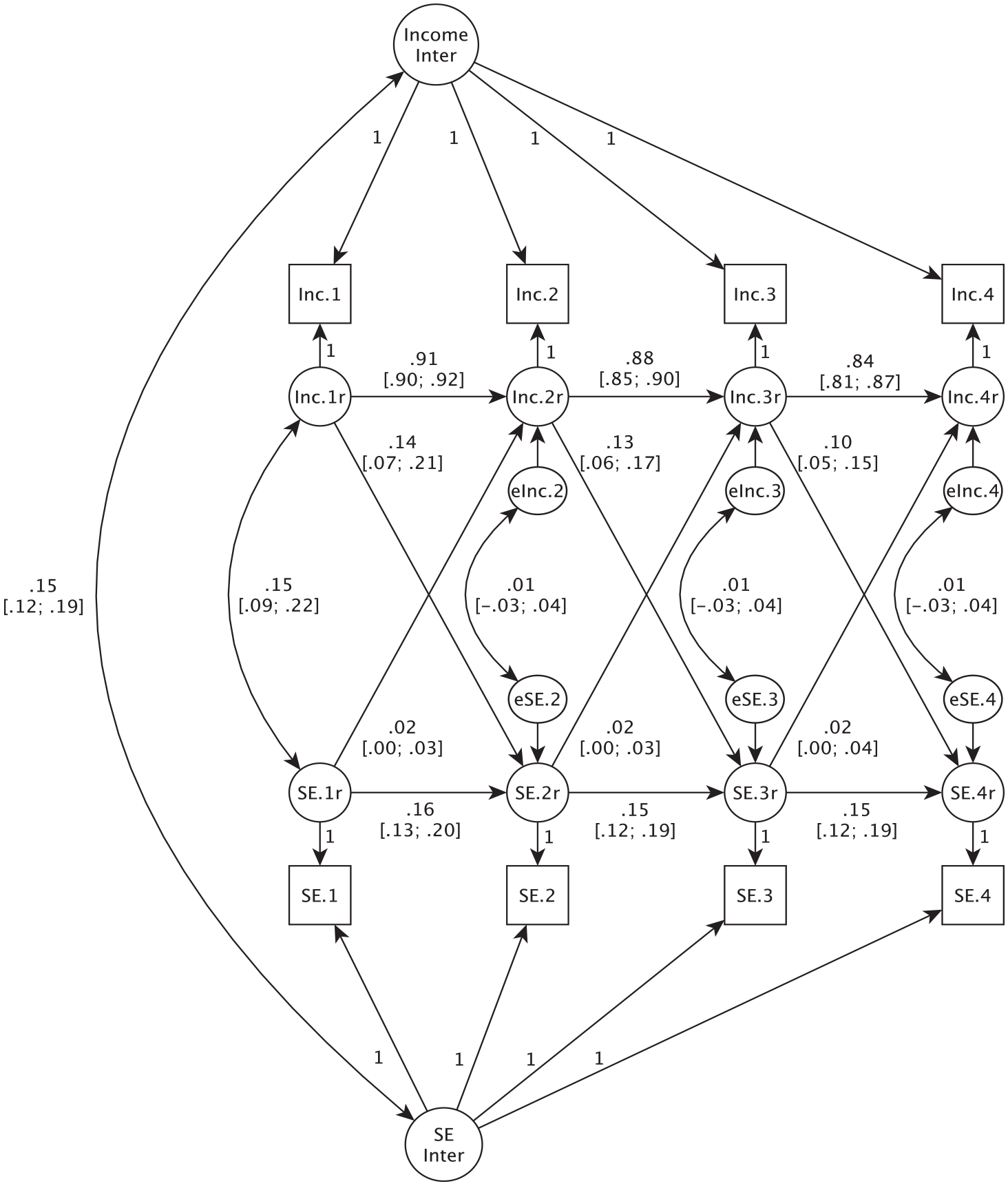
Random-intercept cross-lagged panel model of self-esteem and income. We constrained the unstandardized parameters of the autoregressive effects, coupling effects, and within-person residual variance and covariance to be equal across assessment waves. Values shown are standardized parameter estimates, which can differ across wave. Income Inter = random intercept of average monthly gross income across assessment Waves 1 (2019) to 4 (2022); Inc.1 to Inc.4 = average monthly gross income at assessment Waves 1 to 4; Inc.1r to Inc.4r = within-person residuals for typical monthly income after accounting for random intercept; eInc.2 to eInc.4 = unexplained variances in the wave-specific latent constructs of average monthly gross income at assessment Waves 2 to 4; SE Inter = random intercept of self-esteem across assessment Waves 1 to 4; SE.1 to SE.4 = self-esteem measured at assessment waves 1 to 4; SE.1r to SE.4r = within-person residuals for self-esteem after accounting for random intercept; eSE2 to eSE.4 = unexplained variance in wave-specific latent constructs of self-esteem at assessment Waves 2 to 4.
To test the first hypothesis that higher levels of income are correlated with higher levels of self-esteem, we examined the baseline correlations and specified an RI-CLPM including the covariation between the random intercepts of income and self-esteem. A significant positive correlation would indicate support for this hypothesis, that is, that higher income relative to other people’s income relates to higher self-esteem relative to others’ self-esteem.
We tested the hypotheses that income shifts lead to intraindividual changes in self-esteem and vice versa by including time-lagged within-person coupling effects of income on subsequent self-esteem and vice versa (Hamaker et al., 2015; Mulder & Hamaker, 2021). A positive coupling effect from income to subsequent self-esteem over time would be consistent with social-indicator theory. A positive coupling effect from self-esteem to subsequent income would be consistent with self-consistency and self-broadcasting models of self-esteem. An absence of income effects on self-esteem would be consistent with self-protective models. We reran these analyses including employment status as a time-varying variable in a trivariate RI-CLPM. If the intercept correlation and coupling parameters between self-esteem and income remained unchanged after including employment status, we inferred that employment status had no effect on the links between self-esteem and income.
Finally, we examined the moderating effects of age group, gender, and educational attainment as time-invariant grouping variables in a set of multiple-group analyses (Mulder & Hamaker, 2021). Specifically, we compared multiple-group versions of RI-CLPMs with no constraints across groups (but with constraints across time within each group) against versions in which the intercept and coupling parameters between income and self-esteem were constrained to be equal across groups (e.g., between participant groups with and without a college degree). If the equality constraints held, we concluded that there was no moderation and that intercept correlations and coupling parameters did not differ across groups.
For all analyses, we interpret effects with a p value less than .05 as statistically significant and report 95% confidence intervals (CIs). We determined absolute model fit, with root-mean-square error of approximation (RMSEA) ≤ .08 and comparative fit index (CFI) ≥ .95 indicating good fit (Cheung & Rensvold, 2002). We used MacCallum et al.’s (2006) small differences in fit test for model comparisons, which tests differences in model fit against the null hypothesis that the difference in model fit is small rather than zero, as is done in standard log-likelihood tests. In doing so, MacCallum et al. address the problem that any log-likelihood tests will be significant with a large enough sample size, even if the difference between two models is negligible. In addition, we inspected differences in Akaike information criterion (AIC) and Bayesian information criterion (BIC) values (AICs and BICs > 6 are considered meaningful; Raftery, 1995). We included all available data and used full-information maximum likelihood estimation to account for missing data and maximize statistical power (Allison, 2003; Schafer & Graham, 2002).
Results
Descriptive statistics and correlations
Table 1 shows sample sizes, means, and standard deviations for participants’ self-esteem, monthly gross income (corrected for inflation), and natural logarithm of income. The observed numbers matched the estimated monthly wages in The Netherlands (Statista, n.d.). Histograms of the income and self-esteem distributions are presented in the supplemental R code and output (Section 3: Descriptive Statistics athttps://osf.io/x8zwy). Consistent with previous research and our first hypothesis, results showed a baseline correlation between self-esteem and gross income (r = .17, p < .001, 95% CI = [.13, .20]). We found a similar correlation for net income and income categories (see Table S2 in the SOM).
Sample Sizes, Means, and Standard Deviations for Gross Income and Self-Esteem Across Assessment Years
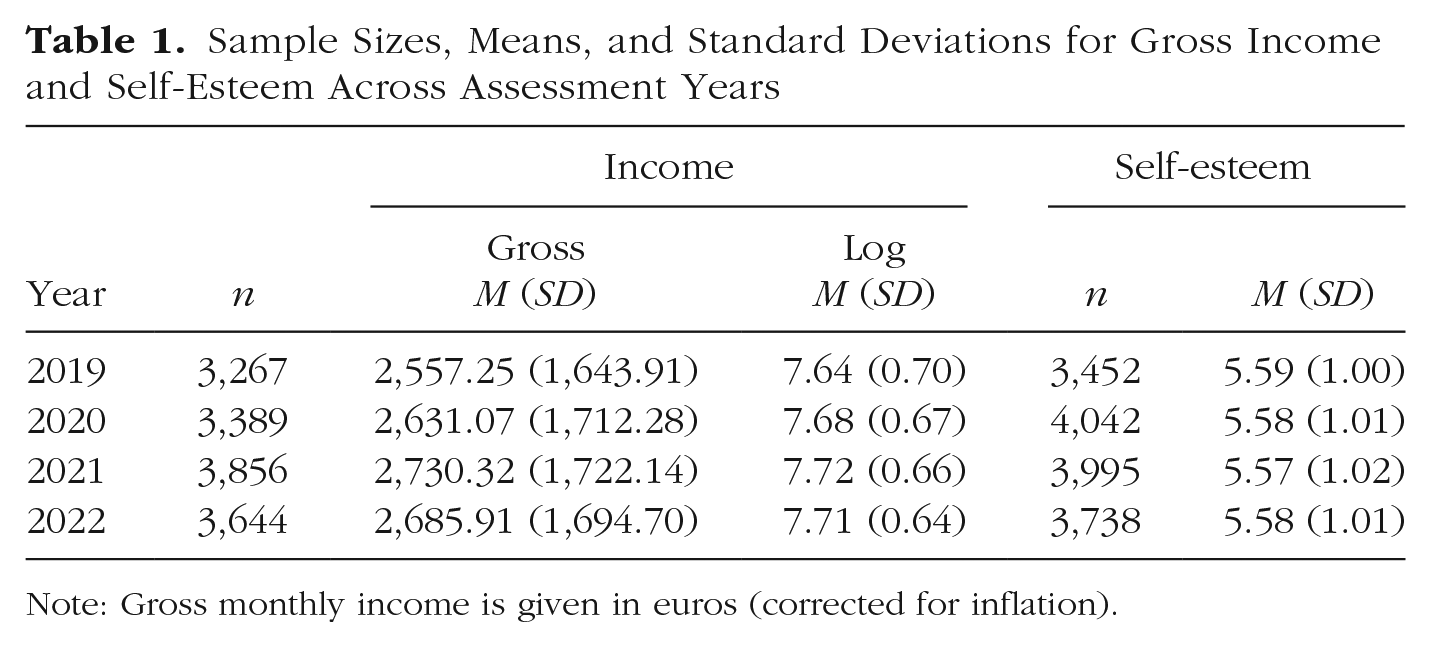
Note: Gross monthly income is given in euros (corrected for inflation).
Between- and within-person associations over time
The RI-CLPM for log income and self-esteem fitted the data well (RMSEA = .049, CFI = .994). The standardized random intercept correlations, within-person autoregressive paths, and cross-lagged coupling estimates are depicted in Figure 1. The within-person autoregressions were statistically significant and large for income (β ~ 0.85) but modest for self-esteem (β ~ 0.15), suggesting that participants who reported higher self-esteem and income in one year relative to their average self-esteem and income levels tended to also report relatively higher income in the following year, and to a lesser degree also higher self-esteem.
Supporting the first hypothesis of statistically significant between-person associations, the correlations between the random intercepts of self-esteem and income were consistent with the cross-sectional results and previous evidence (r = .15, 95% CI = [.12, .19]). Supporting the second hypothesis of statistically significant within-person associations and consistent with social-indicator theory, we found statistically significant within-person coupling effects of income on self-esteem (β ~ 0.12). That is, individuals who experienced an income boost in one year reported an increase in self-esteem in the following year relative to their stable self-esteem level. We also found some support for a statistically significant reverse effect of self-esteem on subsequent income, suggesting that individuals who experienced an increase in self-esteem relative to their average self-esteem level reported a relative increase in income during the following year. However, the effect was substantially smaller in size (β ~ 0.02) and was not significant across all sensitivity analyses (see R code and output, Section 4: Sensitivity Analyses at https://osf.io/x8zwy).
The effect sizes remained unchanged when we included employment status as a time-varying covariate in a trivariate RI-CLPM (RMSEA = .049, CFI = .994), suggesting that these effects were not driven by people’s employment status (see Table S3 in the SOM). We replicated these results when using the log of personal net income (see Table S4 in the SOM) but found no evidence for within-person coupling effects when using a categorical income measure (see Tables S5 and S6 in the SOM), likely because this measure was not suited to capture relatively subtle income shifts.
Moderators
Tables 2 and 3 show the results of the multiple-group analyses, including age group, gender, and educational attainment as time-invariant grouping variables. A first inspection of the parameter estimates suggested potential group differences. Specifically, although the intercept correlations seemed more pronounced in younger and older adults, the coupling parameters appeared to be stronger in middle-aged men without a college degree. However, formal comparison tests indicated no significant differences across genders, age groups, and education groups in any of the model parameters (all pMacCallums > .999; see Table S7 in the SOM). Consistent with this, the differences in AIC and BIC values were also small. In other words, there was no evidence for significant moderating effects of age, gender, or educational background according to the results of MacCallum et al.’s (2006) small differences in fit test.
Multiple-Group Estimates of the Links Between the Random Intercepts of Self-Esteem and Income, by Age Group, Gender, and Educational Background
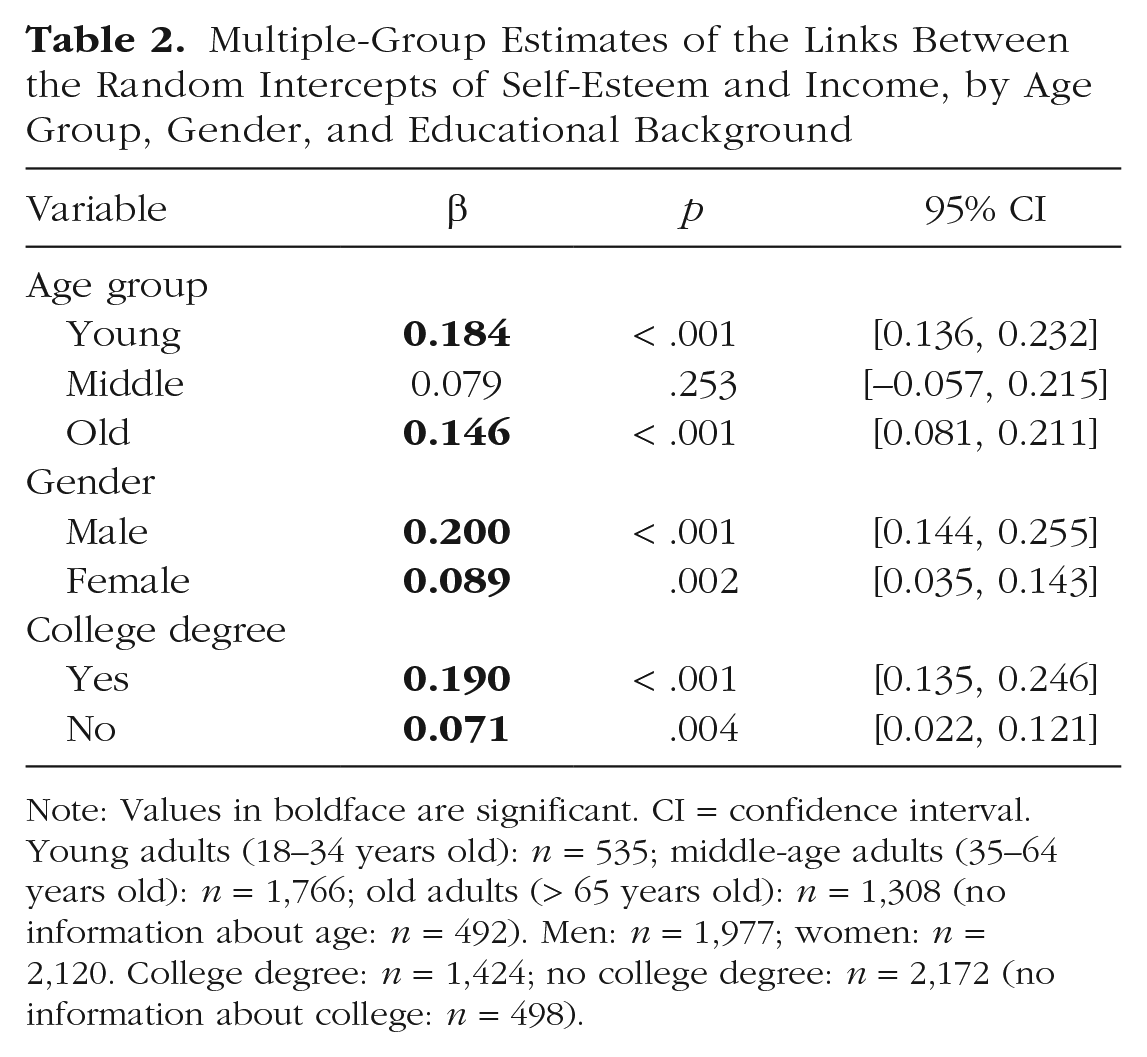
Note: Values in boldface are significant. CI = confidence interval. Young adults (18–34 years old): n = 535; middle-age adults (35–64 years old): n = 1,766; old adults (> 65 years old): n = 1,308 (no information about age: n = 492). Men: n = 1,977; women: n = 2,120. College degree: n = 1,424; no college degree: n = 2,172 (no information about college: n = 498).
Multiple-Group Estimates of Within-Person Autoregressions and Cross-Lagged Effects for Links Between Self-Esteem and Income, by Age Group, Gender, and Educational Background
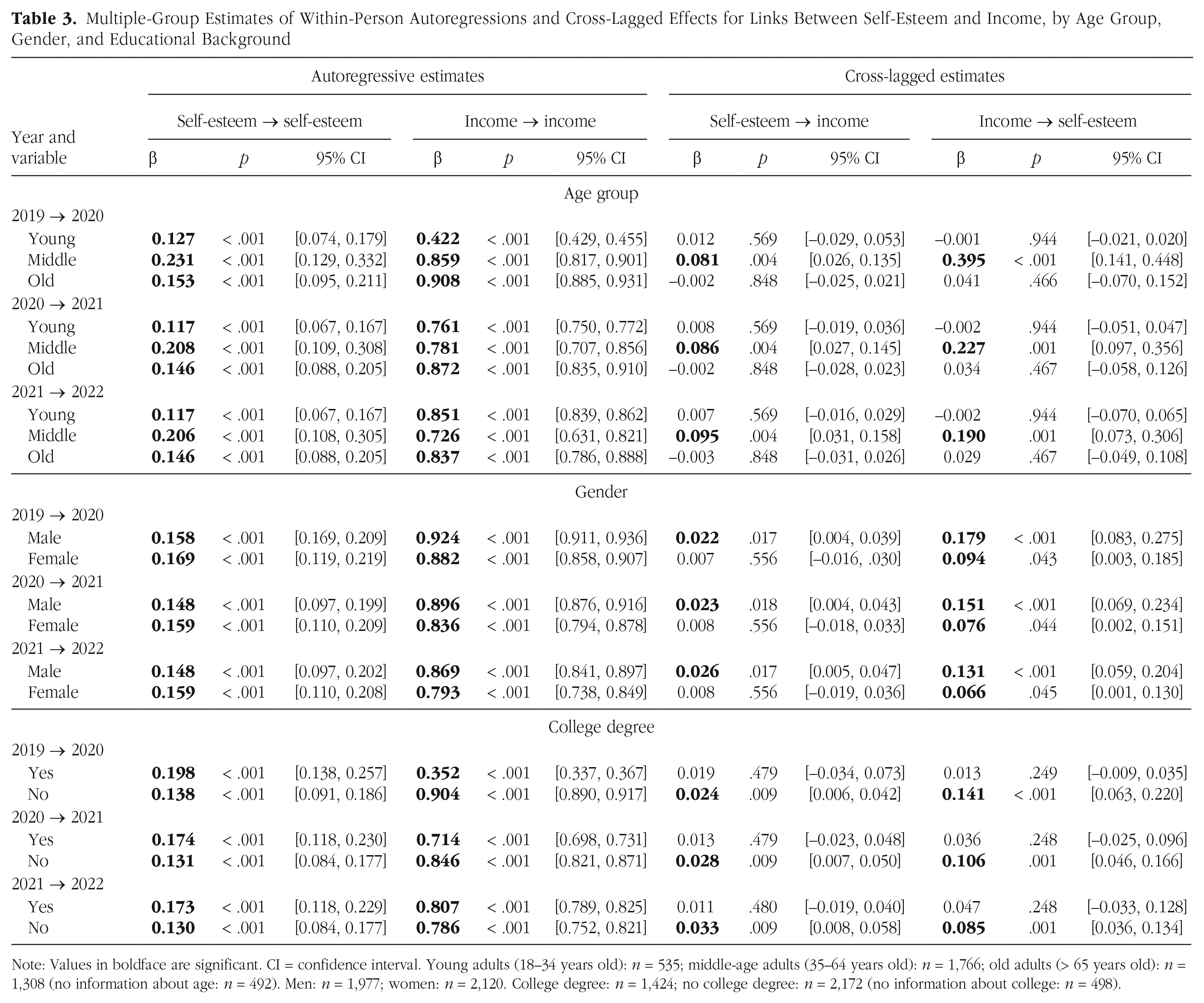
Note: Values in boldface are significant. CI = confidence interval. Young adults (18–34 years old): n = 535; middle-age adults (35–64 years old): n = 1,766; old adults (> 65 years old): n = 1,308 (no information about age: n = 492). Men: n = 1,977; women: n = 2,120. College degree: n = 1,424; no college degree: n = 2,172 (no information about college: n = 498).
Discussion
The sources and consequences of self-esteem have been the content of ongoing theoretical debates and large-scale research endeavors (Orth & Robins, 2022). Existing studies provided evidence that people with higher earnings report higher self-esteem (Twenge & Campbell, 2002). Consistent with these studies, our results revealed a significant between-person association (r) between self-esteem and income of approximately .15, indicating that people with higher income tend to have higher self-esteem compared with people with lower income. The between-person association held when analyses controlled for employment status and generalized across gender, age, and educational group.
A classic yet unresolved question concerns how changes in self-esteem and income are related over time. Critically, previous studies precluded an examination of the within-person interactions between income and self-esteem. Here, we used 4-year longitudinal data to test whether changes in income led to changes in self-esteem and vice versa. The present results indicated a pattern of bidirectional transactions between income and self-esteem over time. Consistent with social-indicator and interpersonal-value theories of self-esteem (Pelham, 1995; Sullivan, 1953), our results showed that personal-income shifts prospectively predict intraindividual changes in self-esteem. This income–self-esteem effect was large compared with typical effect sizes in RI-CLPM in psychology (~75th percentile; Orth & Robins, 2022) and held when analyses controlled for changes in employment status. Providing some albeit less strong evidence for self-consistency and self-broadcasting theories of self-esteem (Srivastava & Beer, 2005; Korman, 1970), we also found a reverse effect, indicating that intraindividual changes in self-esteem predicted income changes over time. However, this effect was small (~25 percentile) compared with empirical benchmarks and was less consistent across robustness checks. Both effects did not differ significantly across gender, age group, or educational background. The lack of significant age effects is inconsistent with earlier findings suggesting that income is a more salient marker of social status in middle adulthood compared with young and old adulthood (Twenge & Campbell, 2002). Instead, the present analyses suggest statistically similar links between income and self-esteem across the life span.
Together, the present findings provide important, and hitherto missing, information about how changes in self-esteem and income are related to each other within individuals. Controlling for the association between relatively stable trait-like differences in self-esteem and income, we found strong evidence that changes in self-esteem can be explained by changes in personal income and, to a smaller extent, vice versa. That is, the observed cross-sectional and longitudinal associations (Krauss & Orth, 2022) between income and self-esteem do not merely reflect stable selection effects of, for example, people with high self-esteem selecting or being selected into well-paid occupations, but also reflect dynamic transactions that seem to generalize across gender, age group, and educational background.
Complementing previous research, these results offer further insights into the functions and consequences of self-esteem. The finding that people’s self-esteem changes in response to personal-income shifts highlights the status indicating functions of self-esteem; the finding of income shifts in response to changes in self-esteem supported the self-broadcasting functions of self-esteem. Even though the effects were modest in absolute size, we argue that the overall pattern of results is not consistent with self-buffering perspectives that consider self-esteem as largely immune to income changes. In contrast, the present findings suggest that self-esteem is malleable to contextual changes, including shifts in personal earnings (Bleidorn, Buyukcan-Tetik, et al., 2016; Orth & Robins, 2014).
Limitations
This study had several limitations. First, our data came from The Netherlands, a Western, educated, industrialized, rich, and democratic (WEIRD; Henrich et al., 2010) country. As in other WEIRD countries, income is considered a key indicator of well-being and a means to achieve higher living standards and status in The Netherlands (Organisation for Economic Co-Operation and Development, n.d.). However, longitudinal data from other cultures are needed to examine the extent to which these findings generalize to populations with different income distributions and backgrounds. For example, it is possible that income effects on self-esteem are different in less affluent cultural contexts (Berkessel et al., 2021).
Second, we planned to include 11 waves of data but had to restrict our analyses to the most recent four waves because of sampling issues in the LISS (see the SOM). Studies including future waves of this ongoing study will be able to test the robustness of the results across further assessments. Continued research is also needed to test potential long-term effects of international crises, such as the COVID-19 pandemic, on the link between income and self-esteem. Such postpandemic studies will be important for testing the degree to which COVID-19 might have represented a shock with enduring implications, such as the possibility that people think differently about their income and its importance for the self.
Third, we included data only from participants with personal incomes greater than 0 because of ambiguity in the interpretation of the “zero income” response (some participants who were not willing to provide information about their income falsely indicated that they had no personal income). It thus remains open whether the results will generalize to people whose income increased from or declined to zero.
Finally, the present four-wave design allowed us to examine the transactions between self-esteem and income across 1-year lags. However, it may be that income–self-esteem transactions manifest over even shorter intervals (de Moor et al., 2021). Intensive longitudinal designs with frequent assessments of personal shifts in self-esteem and income are needed to shed further light on the timeline with which changes in self-esteem unfold in response to income shifts and vice versa (Hopwood et al., 2022).
Conclusion
The present study is the first to show that changes in personal earnings prospectively predict intraindividual changes in self-esteem and, to a smaller extent, vice versa. In a representative Dutch sample, these income–self-esteem transactions were independent of people’s employment status and generalized across gender, age group, and educational background. Overall, these results provide evidence for theories that consider income as a source and, to a lesser degree, a consequence of self-esteem, highlighting the social-indicator and self-broadcasting functions of self-esteem.
Supplemental Material
sj-docx-1-pss-10.1177_09567976231185129 – Supplemental material for Self-Esteem and Income Over Time
Supplemental material, sj-docx-1-pss-10.1177_09567976231185129 for Self-Esteem and Income Over Time by Wiebke Bleidorn, André Kretzschmar, John F. Rauthmann, Ulrich Orth, Jaap J. A. Denissen and Christopher J. Hopwood in Psychological Science
Footnotes
Transparency
Action Editor: Mark Brandt
Editor: Patricia J. Bauer
Author Contributions

Notes
References
Supplementary Material
Please find the following supplemental material available below.
For Open Access articles published under a Creative Commons License, all supplemental material carries the same license as the article it is associated with.
For non-Open Access articles published, all supplemental material carries a non-exclusive license, and permission requests for re-use of supplemental material or any part of supplemental material shall be sent directly to the copyright owner as specified in the copyright notice associated with the article.
