




Abstract
Although relationship theories often describe infidelity as a damaging event in a couple’s life, it remains unclear whether relationship problems actually follow infidelity, precede it, or both. The analyses of dyadic panel data of adults in Germany including about 1,000 infidelity events showed that infidelity was preceded (but not followed) by a gradual decrease in relationship functioning in perpetrators and victims. There was little evidence of rebound effects in the aftermath of infidelity, with the exception of unfaithful women and individuals with lower initial relationship commitment who returned to the pre-event level of well-being or even exceeded it, providing support to the expectancy violation theory (vs. the investment model of infidelity). By showing that well-being starts to decline before infidelity happens, this study provides a differentiated view on the temporal dynamics of infidelity and well-being and contributes to the literature on romantic relationship dynamics and major life events.
Keywords
Sexual infidelity, also referred to as extradyadic sexual involvement, cheating, or unfaithfulness (Hall & Fincham, 2009), represents one of the most harshly condemned relationship transgressions (Gallup, 2008), and couples often report it as a reason for separation or couple therapy (Allen & Atkins, 2012; Amato & Previti, 2003; Betzig, 1989). It is indeed true that infidelity is correlated with a range of problems in individual and relationship functioning. However, such correlations fall short of establishing whether infidelity leads to relationship trouble or represents a consequence of relationships that are unhappy in the first place—a question that has been subject to theoretical debate for decades.
Relationship theories often describe stressful events in a couple’s life, such as infidelity, as core determinants of psychological distress and relationship dissatisfaction (e.g., the vulnerability-stress-adaptation framework; Karney & Bradbury, 1995; Lavner & Bradbury, 2010). Consequently, couple counseling approaches to infidelity often focus on managing the couple’s painful emotions in the aftermath of infidelity (Peluso & Spina, 2008). On the contrary, other work, including the investment model of dating infidelity (Drigotas et al., 1999) and emerging findings from personality psychology on developmental changes around major life events (Denissen et al., 2018; Luhmann et al., 2012), hints at the possibility of infidelity being a consequence, rather than a cause, of poor relationship functioning.
There have been only two studies using longitudinal data that attempted to establish whether infidelity is an antecedent or a consequence of poor well-being. These studies came to opposite conclusions: Hall and Fincham (2009) found baseline psychological distress to predict later infidelity (but not the other way around), whereas Previti and Amato (2004) showed early instances of infidelity to predict later marital dissatisfaction (but not the other way around), when controlling for initial divorce proneness. In the present research, we used a large nationally representative sample of Germans followed for up to 12 years (8 years on average; focal relationship tracked for 5 years on average) and applied advanced longitudinal data analysis techniques (discontinuous change models; Singer & Willett, 2003) that allow for a better description of event-related changes and can thus contribute to settling the theoretical debates regarding the role of infidelity in relationship functioning.
Infidelity Might Be Followed by Declines in Well-Being
Unfaithful partners might experience lower psychological well-being because of a feeling of guilt, a compromised moral self-image and dissonance, the stress of concealing infidelity, or relationship strain in case one’s infidelity is discovered by one’s partner (Allen et al., 2005; Foster & Misra, 2013). Indeed, infidelity has been associated with increased psychological distress and depression in perpetrators (Allen et al., 2005; Hall & Fincham, 2009; Wenger & Frisco, 2021). From the perspective of the victims, infidelity represents a major violation of trust and might cause anger, a lack of self-esteem, and even major depressive episodes (Allen et al., 2005; Cano & O’Leary, 2000; Shackelford et al., 2000; Shrout & Weigel, 2018; Whisman, 2016). Having an unfaithful partner might have negative consequences even if the affair never comes to light. For example, the cheater’s preoccupation with the undisclosed affair might divert attention from the primary partner (Allen et al., 2005).
Declines in Well-Being Might Precede Infidelity
Infidelity might also represent a consequence (rather than a cause) of relationship trouble. For example, the investment model of infidelity highlights the role of individuals’ commitment to their relationship as a major factor determining whether they will engage in infidelity (Drigotas et al., 1999). Indeed, falling out of love predicts not only the likelihood of unfaithfulness but also longer affairs and more public displays of involvement with the affair partner (Selterman et al., 2019, 2021). Individuals with lower relationship satisfaction, and more sexual and communication problems, tend to have an increased likelihood of perpetrating infidelity (Allen et al., 2008; DeMaris, 2009; Maddox Shaw et al., 2013; Scott et al., 2017).
Can poor relationship and personal well-being be an antecedent of becoming a victim of infidelity as well? Although this question has not been explored in the infidelity research, the well-being literature showed that unhappy people are less likely to be preferred as social and romantic/marital partners (Botwin et al., 1997; Stavrova & Luhmann, 2016). Hence, one’s partner’s unhappiness might be associated with a stronger willingness to look out for alternatives. Likewise, a deterioration in personal and relationship well-being could precede the events of both cheating and being cheated on.
Statement of Relevance
Infidelity is largely believed to have damaging consequences for personal and relationship well-being. Yet the empirical literature remains inconclusive regarding whether infidelity leads to relationship problems, represents a mere symptom of troubled relationships, or both. Longitudinal analyses of about 1,000 infidelity events showed that infidelity events were preceded by a gradual decrease in relationship well-being in both victims and perpetrators that, in contrast to most other negative life events, did not recover in the follow-up years. The only exceptions were individuals with lower initial commitment and unfaithful women who returned to their initial well-being—or even exceeded it. By highlighting how changes in relationship well-being precede infidelity behaviors, the study contributes to the academic literature on the role of infidelity in relationship functioning and can potentially inform counseling practice.
The Present Research
We used a nationally representative sample of German adults followed for up to 12 years (8 years on average; focal relationship tracked for 5 years on average) to examine the temporal dynamics of personal and relationship well-being surrounding the event of infidelity from the perspective of victims and perpetrators. We capitalized on the strength of this study design in a number of ways. First, we applied discontinuous change models to track well-being changes in people who experienced infidelity; this allowed us to establish whether a decrease in well-being precedes and/or follows infidelity experiences. Second, we compared these changes with a propensity-score-matched control group (couples who did not experience infidelity throughout the study period), which allowed us to make sure that the observed changes were a result of infidelity rather than a reflection of normative changes in couple relationship development. Third, we made use of the dyadic data structure and explored how infidelity affects both partners’ well-being. Fourth, by tracking the development of both relationship-related (e.g., relationship satisfaction) and personal (e.g., life satisfaction) well-being, we sought to establish whether the negative impact of infidelity extends beyond relationship-related feelings but also individuals’ personal well-being and could therefore have a long-term impact on an individual’s life, even after the relationship ends.
Open Practices Statement
The data and study materials are available at https://www.pairfam.de/. The analysis plans were preregistered (https://osf.io/vmjk5). The list of deviations from the preregistration and analysis scripts can be downloaded from https://osf.io/fqm84/. The work was reviewed and approved by the ethics review board of the School of Social and Behavioral Sciences at Tilburg University.
Method
We used the data from the Panel Analysis of Intimate Relationships and Family Dynamics (Release 12.0; Brüderl et al., 2020), a longitudinal study on partnership and family dynamics conducted in Germany since 2008. The data are collected annually from a nationwide random sample of more than 12,000 persons (referred to as “anchors”) of the three birth cohorts 1971–1973, 1981–1983, and 1991–1993 as well as their partners, parents, and children (if applicable). This data set provides a (self-report) measure of cheating behavior, relationship satisfaction, and psychological well-being in both the anchor and step-up (children of anchors after they reach age 16 years) data sets. Although the interviews are conducted face to face, sensitive questions (relationship characteristics, infidelity) are self-completed by the participants (using tablets or drop-off paper-and-pencil questionnaires). A detailed description of the study can be found in the work by Huinink et al. (2011). The present analyses are based on the data collected between 2008 and 2020 (12 waves). On average, there were about 8 assessment years available per individual and about 5 assessment years available per couple (see Table 1).
Propensity-Score-Matched Sample Characteristics
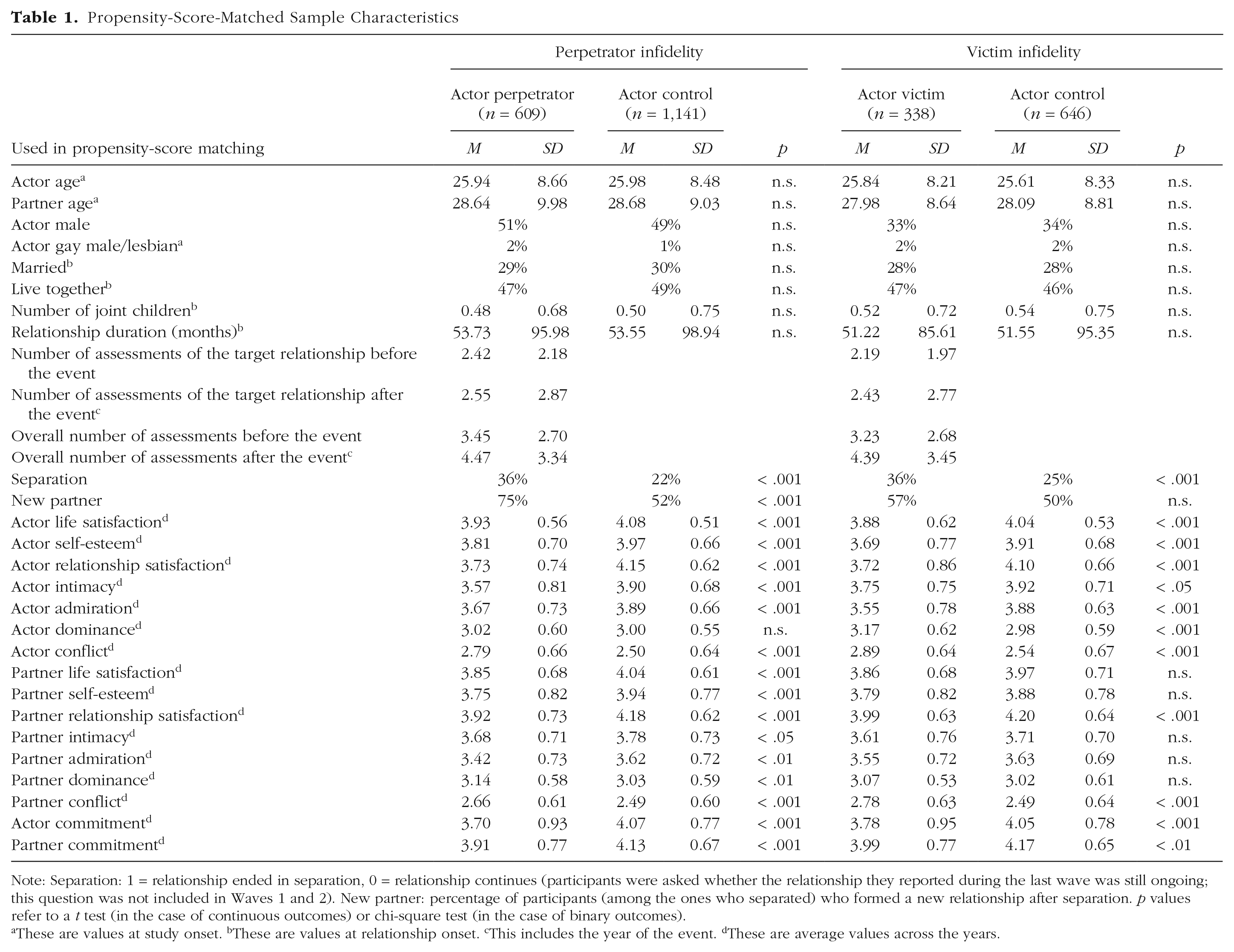
Note: Separation: 1 = relationship ended in separation, 0 = relationship continues (participants were asked whether the relationship they reported during the last wave was still ongoing; this question was not included in Waves 1 and 2). New partner: percentage of participants (among the ones who separated) who formed a new relationship after separation. p values refer to a t test (in the case of continuous outcomes) or chi-square test (in the case of binary outcomes).
These are values at study onset. bThese are values at relationship onset. cThis includes the year of the event. dThese are average values across the years.
Participants
We selected individuals (N = 14,216) who reported being in a committed relationship in at least one wave (“In the following, I’ll ask you about intimate relationships. Do you currently have a partner in this sense?” yes/no).
Infidelity sample
We selected participants in a committed relationship who experienced an infidelity event. The study distinguished between three types of infidelity: participants unilaterally committing infidelity (perpetrator infidelity), participants reporting that their partner unilaterally committed infidelity (victim infidelity), and participants reporting that both they and their partner committed infidelity (mutual infidelity). Given that mutual infidelity events were relatively rare (n = 111, resulting in insufficient power; for sensitivity analyses, see the Supplemental Material available online), we decided to focus on unilateral perpetrator and victim infidelity events here and report the analyses of mutual infidelity in the Supplemental Material. We also removed the cases that reported different types of infidelity events (e.g., perpetrator and victim) in different waves within the same relationship (n = 43). We focused on the first reported infidelity event per individual. For most participants, the infidelity event happened only once (i.e., in one wave) during the study (81% of perpetrators and 91% of victims; the maximum number of infidelity waves per participant was four for victims, or 0.3% of participants, and six for perpetrators, or 0.3% of participants). Overall, the analyses of actor outcomes were based on the data from 947 individuals (609 perpetrators and 338 victims). Because not all partners completed the study, the data basis for the analyses of partner outcomes ranged between 860 and 864 individuals, depending on the outcome (559–562 partners of perpetrators and 301–302 partners of victims). More details about the sample characteristics are provided in Table 1.
Control sample
To ensure that the control sample is as similar as possible to the infidelity sample, we used propensity-score matching (Thoemmes & Kim, 2011). This method calculates a propensity score that reflects an individual’s likelihood of experiencing an event based on the individual’s baseline characteristics (e.g., sociodemographics). Each individual who experienced the event is then matched with at least one individual who had the same propensity score—that is, the same likelihood of experiencing the event—but did not experience it. Comparing individuals in the infidelity sample with the propensity-score-matched controls allowed us to rule out potential differences between individuals/couples who experienced infidelity versus individuals/couples who stayed faithful (e.g., coresident status or relationship duration).
First, we selected participants in a committed relationship who did not report infidelity throughout the study period. Because participants could have multiple relationships during the study time, we randomly selected one relationship for each participant. Second, following Austin (2010), we applied the nearest neighbor propensity-score-matching procedure with replacement (ƙ = 2; matching each individual in the infidelity sample to two individuals in the pool of potential control participants; this method has a number of advantages, such as increasing power and reducing random pruning). Matching was based on the following variables: actor and partner age and gender, actor and partner education level and employment status, actor income, marital status (married vs. not married), coresident status (living together vs. not living together), relationship duration before the study began (in months), number of joint children, and number of waves the participant contributed (1–12). For all time-varying variables, the matching was based on the values at study onset (e.g., participant’s education level in Wave 1); for relationship variables (e.g., marital status or number of joint children), the matching was based on the values in the wave when the relationship was first reported. We used the MatchIt package (Ho et al., 2011) in the R programming environment. We conducted separate matching procedures for the samples of victims and perpetrators. As a result, each of the 609 perpetrators and 338 victims was matched with control participants (the balance statistics in the full and matched samples are reported in the Supplemental Material).
Measures
Infidelity
Participants responded to the following question: “Did you or your partner have an extra-marital affair during the past year?” (1 = Yes, I did; 2 = Yes, my partner did; 3 = Yes, both my partner and I did; 4 = No). This question was posed only to the actor (not the partner); in Waves 1 to 3, it was included annually, and in Waves 5 to 11, biennially. In Waves 2 to 11, the previous interview date (rather than “past year”) was used as the reference point.
We used this variable to create two types of infidelity events:
Perpetrator infidelity: To indicate an event of committing infidelity unilaterally, we created a dummy variable with values of 1 (cheated; Response 1) versus 0 (neither I nor my partner cheated; Response 4).
Victim infidelity: To indicate an event of being cheated on by a partner, we created a dummy with values of 1 (my partner cheated; Response 2) versus 0 (neither I nor my partner cheated; Response 4).
Relationship and personal well-being
For the present analyses, we selected the indicators of personal and relationship well-being that were measured annually (in all waves, from 1 to 12). The respective scales were completed by both members of each couple. We refer to the measures completed by actors as actor well-being and to the measures completed by partners as partner well-being. Because only actors (but not partners) were asked about infidelity, note that in case of perpetrator infidelity, partners might not be aware that they were cheated on. Given that not all partners completed the study (see the Participants section), we conducted separate analyses for actor and partner well-being. All variables were standardized (by subtracting the sample mean and dividing by the standard deviation in the long format, i.e., across all observations) before the analyses were conducted. The analyses included two indicators of personal well-being (life satisfaction and self-esteem) and five indicators of relationship well-being (relationship satisfaction, intimacy, admiration, dominance, and conflict).
Life satisfaction was measured with one item: “All in all, how satisfied are you with your life at the moment?” (0 = very dissatisfied, 10 = very satisfied; rescaled to range from 1 to 5 for consistency reasons). To measure self-esteem, we included a short, three-item self-esteem scale in the data set (Rosenberg, 1965): “Sometimes I believe that I’m worthless,” “I like myself just the way I am,” and “All in all, I am pleased with myself” (1 = not at all, 5 = absolutely; Cronbach’s α = .77, both actor and partner responses).
Relationship satisfaction was measured with two items that originated in the Relationship Assessment Scale developed to measure satisfaction in dyadic relationships (Sander & Böcker, 1993): “[Name of current partner] can fulfill my needs very well” (1 = not at all, 5 = absolutely) and “All in all, how satisfied are you with your relationship?” (0 = very dissatisfied, 10 = very satisfied; rescaled to range from 1 to 5 for consistency reasons). We combined these items into a scale of relationship satisfaction (correlation between the items: r = .46 in actors and r = .51 in partners, p < .001).
We used four subscales (with two items each) of the Network of Relationships Inventory (Furman & Buhrmester, 2009) to measure relationship intimacy, admiration, dominance, and conflict: Intimacy (“How often do you tell [name of current partner] what you’re thinking?” and “How often do you share your secrets and private feelings with [name of current partner]?”; r = .58 in actors and r = .59 in partners, p < .001), admiration (“How often does [name of current partner] express recognition for what you’ve done?” and “How often does [name of current partner] show that he/she appreciates you?”; r = .65 in actors and r = .66 in partners, p < .001), dominance (“How often does [name of current partner] get his/her way when you can’t agree on something?” and “How often does [name of current partner] make you do things his/her way?”; r = .49 in actors and r = .38 in partners, p < .001), and conflict (“How often do you and [name of current partner] disagree and quarrel?” and “How often are you and [name of current partner] annoyed or angry with each other?”; r = .66 in actors and r = .64 in partners, p < .001). Responses were given on a scale ranging from 1 = never to 5 = always.
The analyses of relationship well-being (relationship satisfaction, intimacy, admiration, dominance, and conflict) were based on the values from the waves during which the participant was in the focal romantic relationship (i.e., affected by infidelity in the infidelity sample vs. not affected by infidelity in the control sample). The analyses of personal well-being (life satisfaction and self-esteem) were based on the values from all the waves in which participants took part, including the waves in which no romantic relationship was reported. This allowed us to examine whether the impact of infidelity experience extends beyond the relationship in which infidelity happened. These analyses additionally controlled for whether in each specific wave, the focal relationship was still ongoing (separation status1: 1 = separated, 0 = relationship ongoing) and whether the participant had a romantic partner at all (relationship status: 1 = yes, 0 = no). These variables were coded in the same way in the infidelity samples as well as in the control samples.
Analytic strategy
Because the data have a nested structure with measurement waves nested within persons, we used multilevel regression with participants as random effects. In addition, as a result of the one-to-two matching procedure, the same participants in the control sample could be matched with several participants in the infidelity sample and matched participants were clustered within matching sets. To account for this additional clustering, we included the matching set as a random effect as well (Austin, 2011).
To examine the temporal dynamics of relationship and personal well-being around the event of infidelity, we used discontinuous change models (Singer & Willett, 2003). We indexed time in 1-year intervals. However, from Wave 5 onward, the infidelity event was recorded biennially, so we set the time point of infidelity events in the middle of the 2-year period.
For each type of infidelity event, our analyses included the following event-related variables:
The event selection variable (1 = experienced the event, 0 = did not experience the event) captured differences between individuals who did not experience the event during the study period (e.g., committed infidelity) and those who did in at least one wave.
The post-event baseline change variable is a dummy variable with values of 0 for waves before the event and values of 1 in the wave when the event happened and all the waves after that. The coefficient of this variable reflects a sudden baseline shift in well-being after the event (i.e., difference in well-being during all the years before and all the years after the event).
The linear anticipation variable has negative values on all the waves before the event (e.g., Year 3 before the event = −3, Year 2 before the event = −2, year preceding the event = −1) and 0 on the wave when the event happened and all the following years. The coefficient of this variable captured linear change in well-being during the time preceding the event.
The linear socialization variable has values of 0 on all the waves preceding the event and positive values on the waves following the event (e.g., year when the event happened = 0, Year 1 after the event = 1). The coefficient of this variable reflects the linear change in well-being following the event.
All the time variables had a value of 0 for individuals in the control sample; the model coefficients therefore reflect changes in personal and relationship well-being in the infidelity sample, above and beyond any changes that could be experienced by the propensity-score-matched control sample.
Because infidelity prevalence and its perceived justifiability might differ across sociodemographic groups (e.g., gender, age, relationship type; Fincham & May, 2017), the models included the linear (grand mean centered) and the quadratic terms of age, 2 actor gender (1 = male, 0 = female) and sexual orientation (1 = gay male or lesbian, 0 = heterosexual), two indicators of relationship status that were entered as time-varying predictors (married/civil partnership vs. not and living together vs. not; i.e., “Do you live together with [name of partner] in the same dwelling?” yes/no), and the number of waves in which infidelity was reported (0–6 in the perpetrator sample and 0–4 in the victim sample). To account for testing effects, we also included a variable that indicated the respective wave number of each participant (0 = first assessment, 1 = second assessment, etc.).
To look for potential nonlinear developmental trends, we tested two sets of models for each outcome and infidelity type: Model A included only linear anticipation and socialization terms, and model B included both linear and quadratic terms of anticipation and socialization effects. We compared the model fit using the chi-square test and report the results of the best-fitting model (the model fit statistics are reported in the Supplemental Material).
Given the relatively high number of tests, we made p-value adjustments. Following the preregistration, we distinguished between more general indicators of personal and relationship well-being (life satisfaction and relationship satisfaction, respectively), which we refer to as primary outcome variables, and more specific indicators (self-esteem, intimacy, admiration, dominance, and conflict), which we refer to as secondary outcome variables. We took a p value of .10 as a starting point (for details, see the preregistration). For the primary outcomes, given two dependent variables and four focal predictors (event selection, post-event baseline change, linear anticipation, and linear socialization), we considered the coefficients associated with a p value of .0125 (.10/2/4) or smaller as statistically significant. For the five secondary outcomes (self-esteem, intimacy, admiration, dominance, and conflict), we considered the coefficients associated with a p value of .005 (.10/5/4) or smaller as statistically significant.
Results
Means, standard deviations, and zero-order correlations among the variables are presented in Table 2. Both members of the couples who experienced infidelity during the study period were more likely to report lower levels of personal and relationship well-being and higher levels of relationship conflict, on average across the years.
Zero-Order Correlations
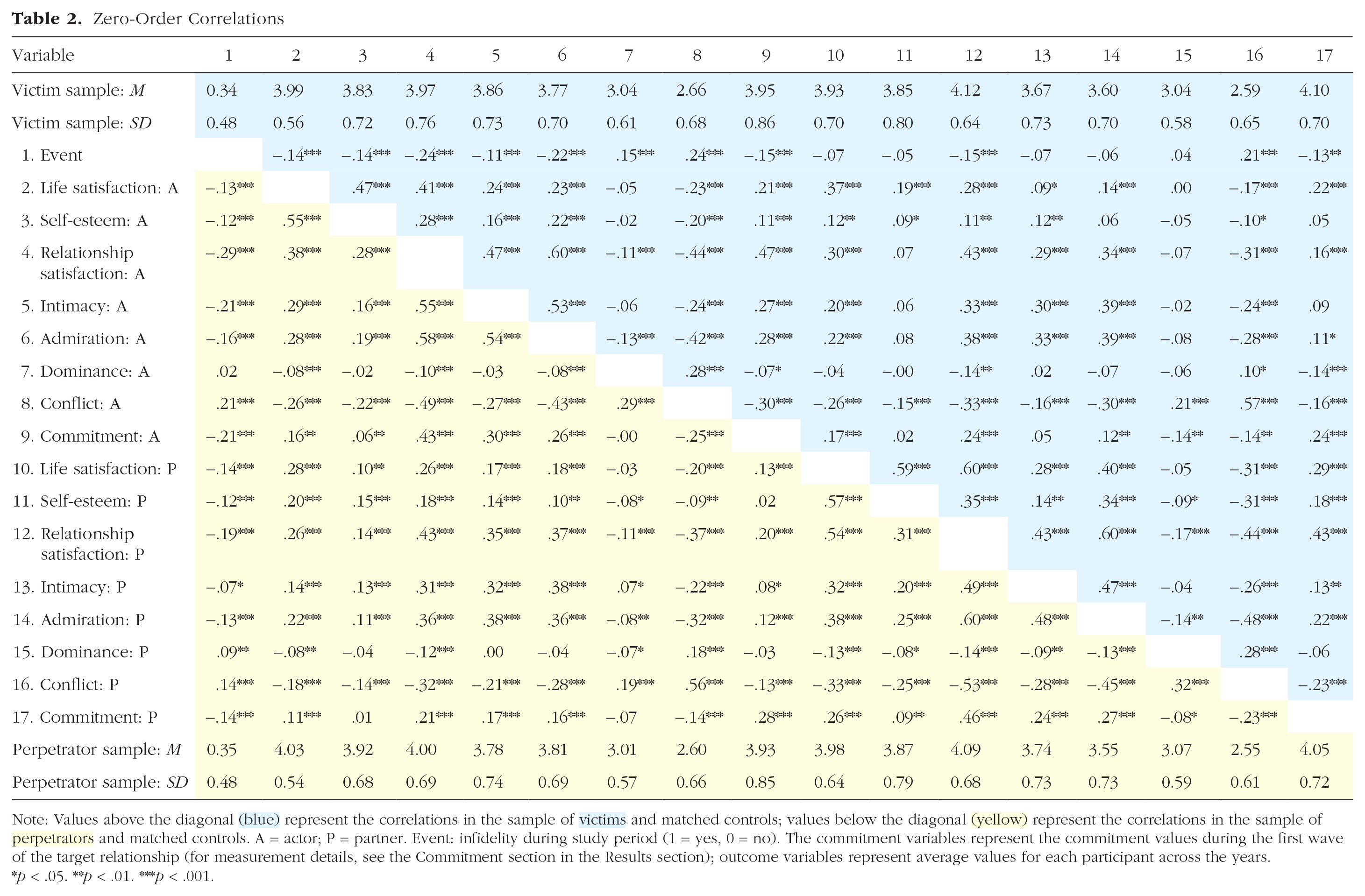
Note: Values above the diagonal (blue) represent the correlations in the sample of victims and matched controls; values below the diagonal (yellow) represent the correlations in the sample of perpetrators and matched controls. A = actor; P = partner. Event: infidelity during study period (1 = yes, 0 = no). The commitment variables represent the commitment values during the first wave of the target relationship (for measurement details, see the Commitment section in the Results section); outcome variables represent average values for each participant across the years.
p < .05. **p < .01. ***p < .001.
Discontinuous change models
Model coefficients are presented in Tables 3 to 6.
Discontinuous Change Model, Perpetrator Infidelity (Actor Reported Having Cheated on Partner), Actor Outcomes
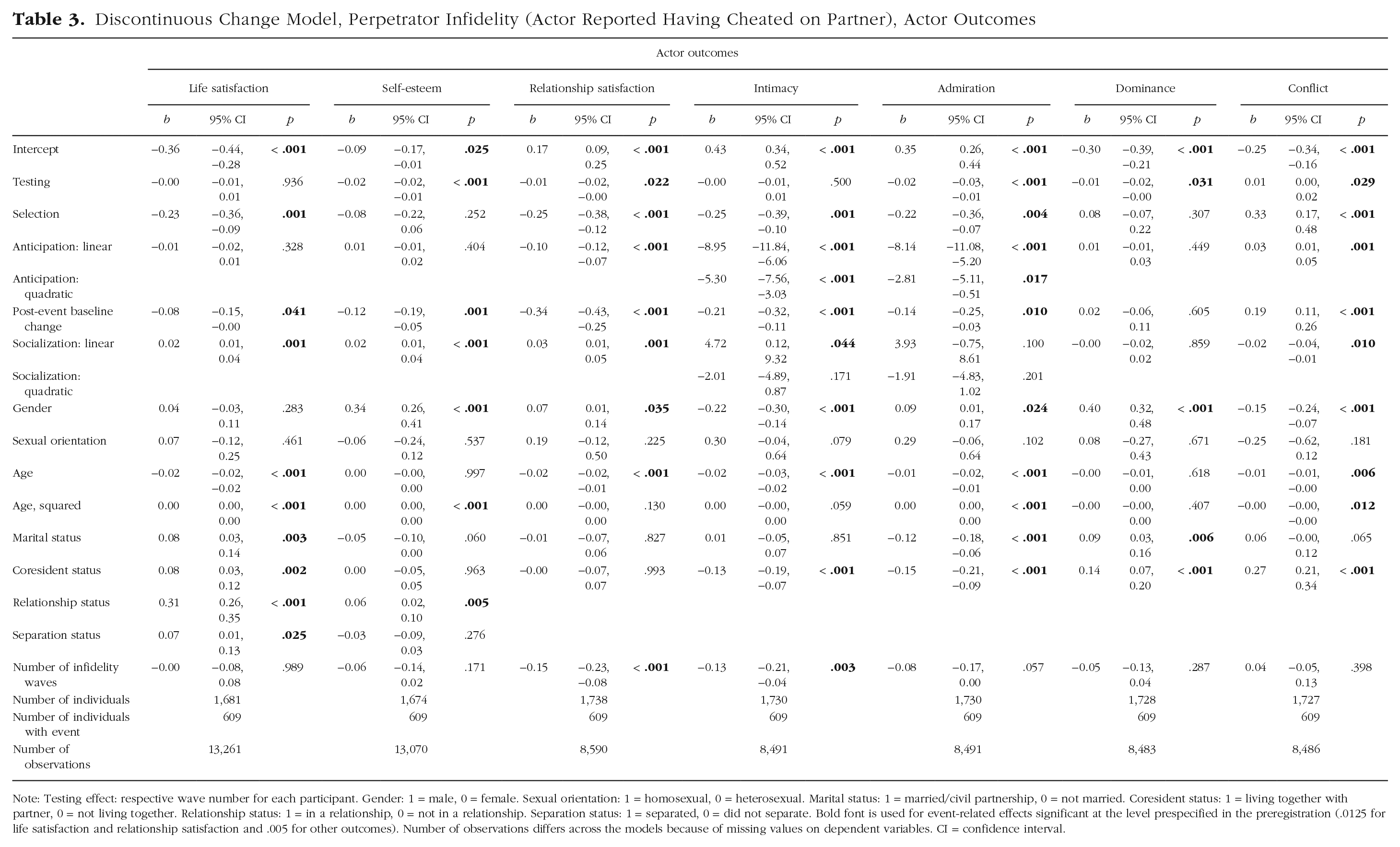
Note: Testing effect: respective wave number for each participant. Gender: 1 = male, 0 = female. Sexual orientation: 1 = homosexual, 0 = heterosexual. Marital status: 1 = married/civil partnership, 0 = not married. Coresident status: 1 = living together with partner, 0 = not living together. Relationship status: 1 = in a relationship, 0 = not in a relationship. Separation status: 1 = separated, 0 = did not separate. Bold font is used for event-related effects significant at the level prespecified in the preregistration (.0125 for life satisfaction and relationship satisfaction and .005 for other outcomes). Number of observations differs across the models because of missing values on dependent variables. CI = confidence interval.
Discontinuous Change Model, Perpetrator Infidelity (Actor Reported Having Cheated on Partner), Partner Outcomes
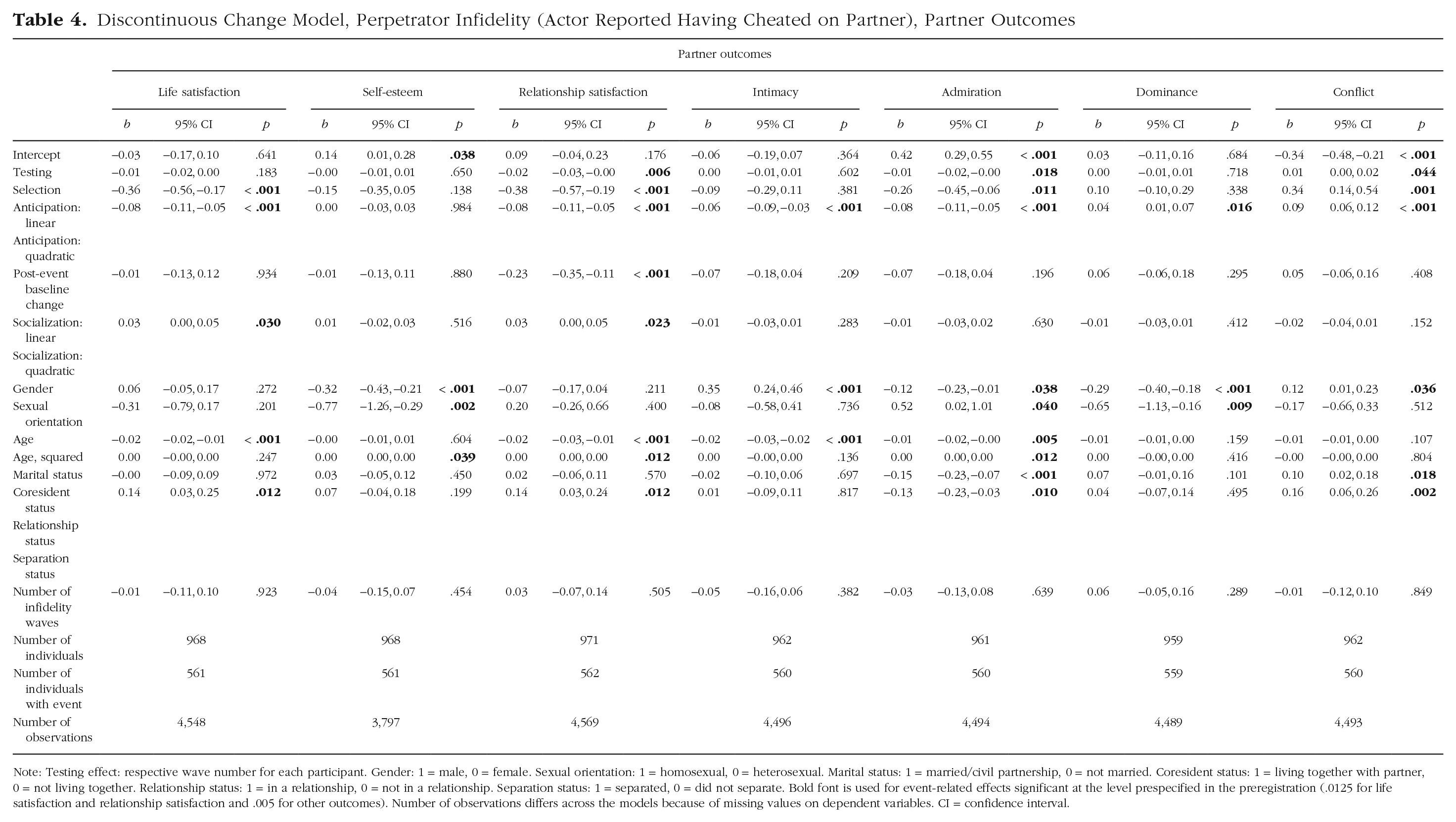
Note: Testing effect: respective wave number for each participant. Gender: 1 = male, 0 = female. Sexual orientation: 1 = homosexual, 0 = heterosexual. Marital status: 1 = married/civil partnership, 0 = not married. Coresident status: 1 = living together with partner, 0 = not living together. Relationship status: 1 = in a relationship, 0 = not in a relationship. Separation status: 1 = separated, 0 = did not separate. Bold font is used for event-related effects significant at the level prespecified in the preregistration (.0125 for life satisfaction and relationship satisfaction and .005 for other outcomes). Number of observations differs across the models because of missing values on dependent variables. CI = confidence interval.
Discontinuous Change Model, Victim Infidelity (Actor Reported Being Cheated on by Partner), Actor Outcomes
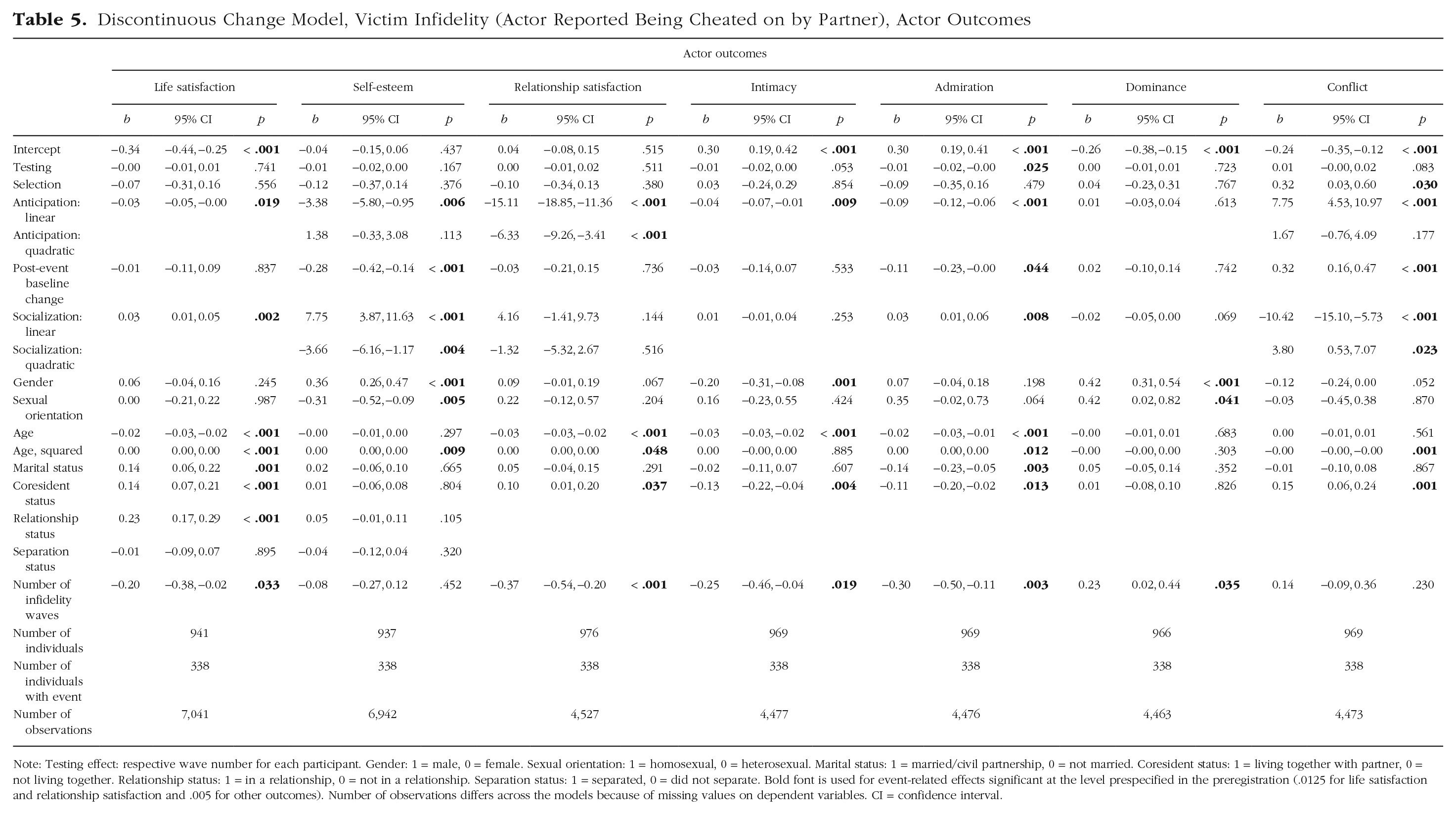
Note: Testing effect: respective wave number for each participant. Gender: 1 = male, 0 = female. Sexual orientation: 1 = homosexual, 0 = heterosexual. Marital status: 1 = married/civil partnership, 0 = not married. Coresident status: 1 = living together with partner, 0 = not living together. Relationship status: 1 = in a relationship, 0 = not in a relationship. Separation status: 1 = separated, 0 = did not separate. Bold font is used for event-related effects significant at the level prespecified in the preregistration (.0125 for life satisfaction and relationship satisfaction and .005 for other outcomes). Number of observations differs across the models because of missing values on dependent variables. CI = confidence interval.
Discontinuous Change Model, Victim Infidelity (Actor Reported Being Cheated on by Partner), Partner Outcomes
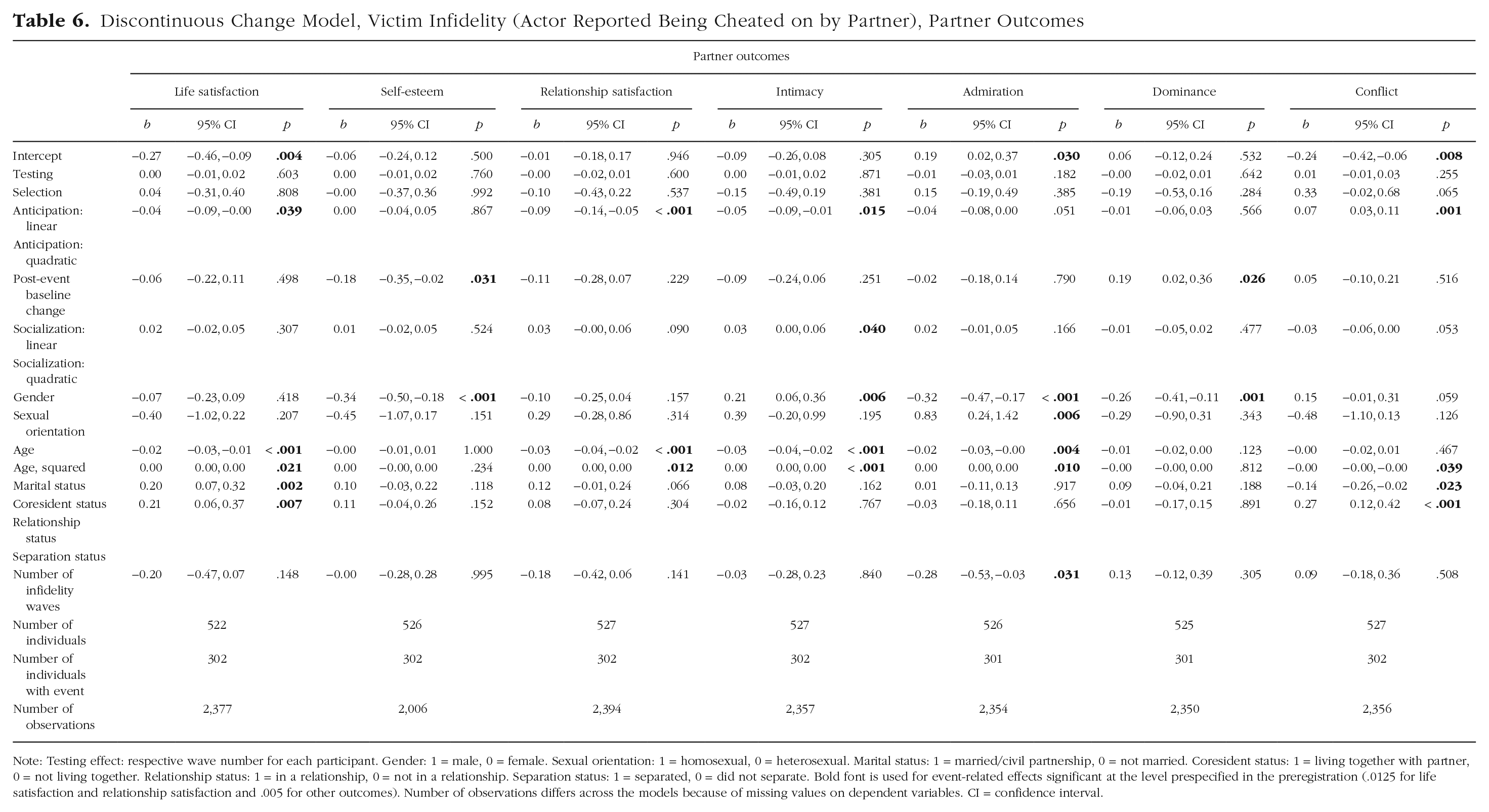
Note: Testing effect: respective wave number for each participant. Gender: 1 = male, 0 = female. Sexual orientation: 1 = homosexual, 0 = heterosexual. Marital status: 1 = married/civil partnership, 0 = not married. Coresident status: 1 = living together with partner, 0 = not living together. Relationship status: 1 = in a relationship, 0 = not in a relationship. Separation status: 1 = separated, 0 = did not separate. Bold font is used for event-related effects significant at the level prespecified in the preregistration (.0125 for life satisfaction and relationship satisfaction and .005 for other outcomes). Number of observations differs across the models because of missing values on dependent variables. CI = confidence interval.
Event selection
We found strong selection effects in cases of perpetrator infidelity: Individuals who committed infidelity and their partners scored lower on life satisfaction, reported lower relationship satisfaction, and reported higher relationship conflict, on average across the years, compared with individuals in the control sample. Interestingly, neither individuals who reported being cheated on nor their partners differed significantly in any well-being measures from the control sample, on average across the years. Event selection coefficients are shown in Figure 1a.
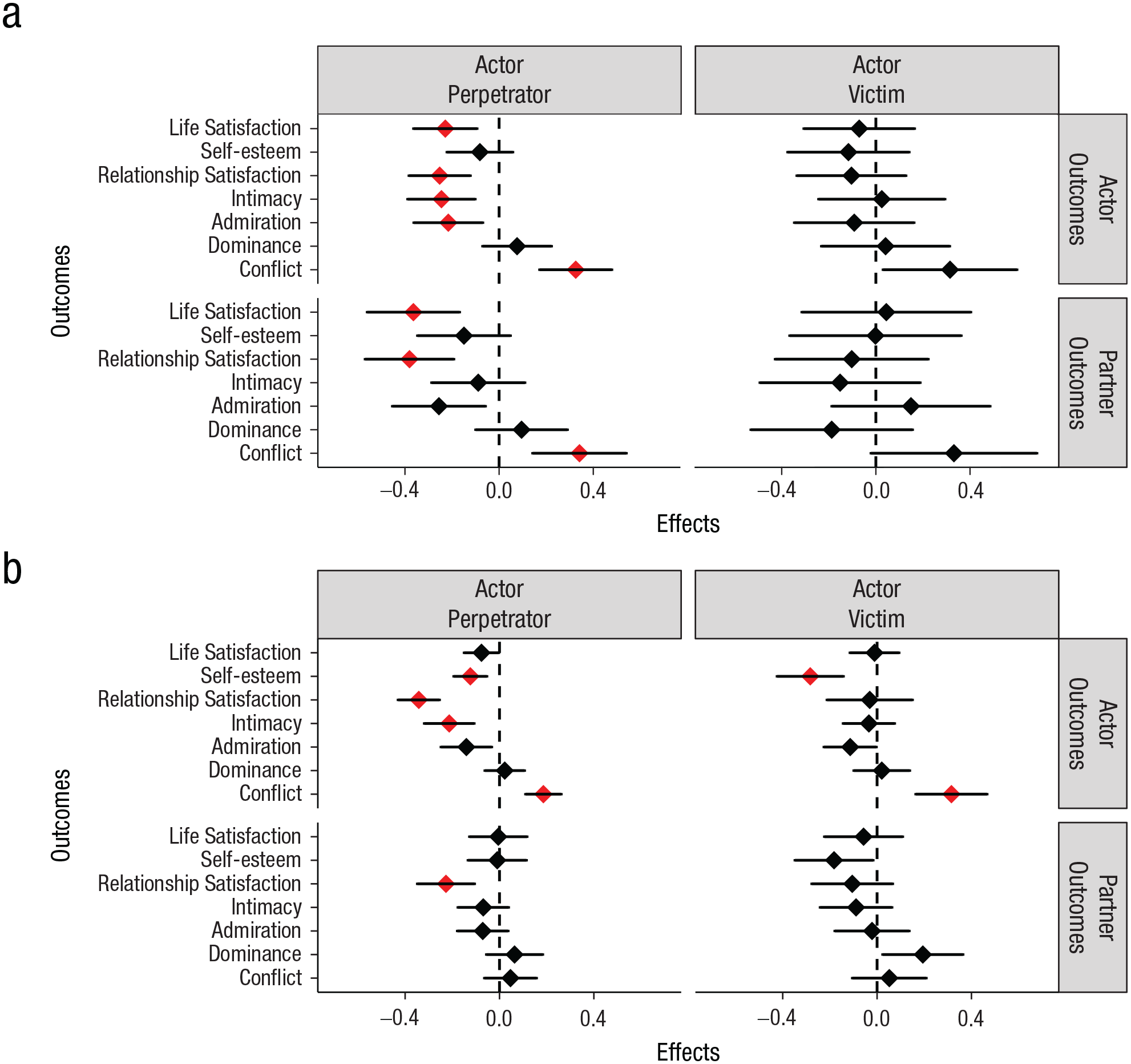
Effects of the selection and post-event baseline change variables on personal and relationship well-being. (a) Selection effect (difference in average well-being between infidelity and control samples). (b) Post-event baseline change (difference in well-being in the years before and after infidelity in the infidelity samples). The dots represent the effects from discontinuous change models (see Tables 3–6). Red dots indicate effects significant at the level specified in the preregistration, corrected for multiple tests (.0125 for primary outcomes and .005 for secondary outcomes); black dots indicate nonsignificant effects.
Post-event baseline change
Perpetrators of infidelity experienced a baseline shift in well-being: During the time after (relative to before) the event, perpetrators reported lower self-esteem, lower relationship satisfaction and intimacy, and more relationship conflicts. In contrast, the evidence for a baseline shift in well-being was less conclusive for victims of infidelity: They reported less self-esteem and more relationship conflict after (vs. before) they were cheated on but experienced no change in other indicators of well-being. We found no evidence for partner effects, with the exception of lower relationship satisfaction reported by cheaters’ partners. Post-event baseline change coefficients are shown in Figure 1b, and average personal and relationship well-being values before and after infidelity are shown in Figure 2.
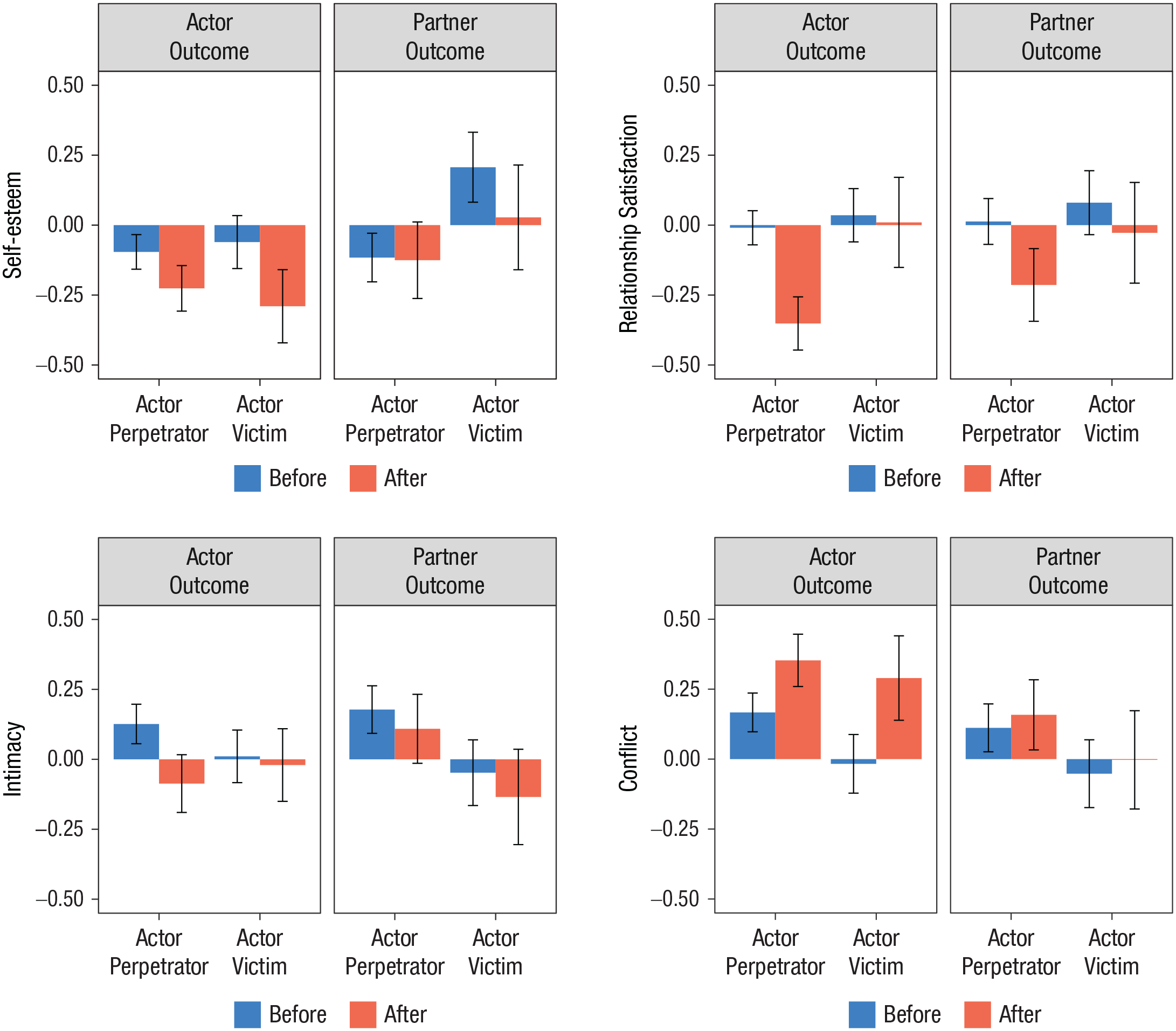
Average personal and relationship well-being before and after infidelity. The graphs show predicted values for the post-event baseline change variable, while holding other variables in the model constant (at means for continuous variables and reference categories for categorical variables; see Tables 3–6; the graphs were created using the SjPlot package). Outcome variables were standardized (in the long format, across all observations); we selected the outcome variables where at least one effect was significant (at the level specified in the preregistration, corrected for multiple tests; .0125 for primary outcomes and .005 for secondary outcomes).
Anticipation effects
For both perpetrators and victims of infidelity, we observed a gradual deterioration in most indicators of relationship well-being that started before the event (see Fig. 3). For most outcomes, this deterioration was linear (the linear specification showed better fit than the quadratic in 23 of 28 models; see Tables S3 and S4 in the Supplemental Material). Both perpetrators and victims of infidelity experienced a decrease in relationship satisfaction and admiration and an increase in relationship conflict prior to infidelity events (perpetrators additionally experienced a decrease in intimacy before they reported having cheated on their partner). The analyses of partner outcomes showed a similar trend: Partners experienced anticipatory deterioration in well-being (decreasing relationship satisfaction and increasing conflict) prior to when the infidelity event was reported by their respective anchors. In some cases, this anticipatory effect took a nonlinear form (e.g., for perpetrators, the decrease in intimacy was preceded by an initial increase; for victims, the decrease in relationship satisfaction was restricted to the years immediately before the event). The patterns of personal and relationship well-being development before infidelity are presented in Figure 3.

Personal and relationship well-being trajectories surrounding infidelity events. (a) Perpetrator infidelity (actor reported having cheated on partner). (b) Victim infidelity (actor reported being cheated on by partner). Zero indicates the event year. For the control sample, it is the year in which the propensity-score-matched participant in the infidelity sample experienced the event. Outcome variables were standardized (using the long format, i.e., across all observations). Data points represent average (raw) outcome values in each assessment year, observed in the infidelity and control samples; point size indicates the number of observations (the legend shows five values: minimum, first quartile, median, third quartile, and maximum). Note that, sometimes, patterns that can be observed in the raw values are not reflected in the model coefficients because they are based on small observation numbers. The confidence bands represent the 95% confidence intervals. The plots were created using the loess smoothing function of the ggplot2 package.
Socialization effects
For most outcomes (23 of 28 models), the linear specification showed better fit than the quadratic (see Tables S3 and S4). As suggested by the coefficients of the socialization effect, for most indicators of relationship well-being (reported by both actors and partners), there was little evidence of rebound effects. With the exception of a gradual increase in relationship satisfaction in perpetrators and a gradual decrease in conflict in victims, neither victims nor perpetrators seemed to bounce back to their initial levels of relationship well-being. However, a more consistent socialization pattern emerged with respect to personal well-being: Both victims and perpetrators experienced a gradual increase in life satisfaction and self-esteem in the years following the event (note that in victims, the increase in self-esteem reversed several years after the event). We detected no partner effects. The patterns of personal and relationship well-being development after infidelity are presented in Figure 3.
Commitment
Prompted by an anonymous reviewer’s suggestion, we explored whether individual differences in initial relationship commitment could represent a source of between-individuals heterogeneity in individuals’ responses to infidelity. On the one hand, according to the investment model, high commitment is associated with relationship maintenance behaviors, such as willingness to sacrifice and to forgive (Rusbult et al., 1991; Wieselquist et al., 1999). Individuals with higher relationship commitment are more likely to forgive their partners after a betrayal (Finkel et al., 2002; Tsang et al., 2006). Alternatively, according to the expectancy violation theory (Burgoon, 1993), highly committed individuals might show stronger negative reactions to the infidelity event because it would be associated with a stronger disappointment for them (compared with individuals with lower initial relationship commitment).
To measure relationship commitment, we included two subscales of the relationship commitment scale in the survey (Grau et al., 2001): future orientation (two items, e.g., “I’m counting on a long-term future together with [partner’s name]”; r = .67 for actor and r = .64 for partners) and tolerance of conflicts (two items, e.g., “If our partnership no longer makes us happy, then separation from [partner’s name] would be the only way out”; r = .53 in actors and r = .49 in partners, p < .001). These items were completed using a scale ranging from 1 to 5 in Waves 1 to 3 and every odd-numbered wave afterward, and they were averaged into a commitment scale.
We tested whether the initial level of relationship commitment (i.e., during the first wave when the relationship was reported) moderated post-event baseline change and socialization effects. We computed a series of models that included the respective interaction effects and the random slopes of post-event baseline change and socialization terms. We used actor commitment values in the analyses of actor outcomes and partner commitment values in the analyses of partner outcomes. The analyses were restricted to the outcome values measured during the waves when the relationship was ongoing. We adjusted the p value to the number of tests (we took .05 as the starting value because of the exploratory nature of the analysis; seven outcomes and two interaction effects: p = .05/7/2 = .004).
In the perpetrator sample, the interaction between actor commitment and socialization term reached the adjusted level of significance in the case of actor relationship satisfaction and admiration (and the traditional < .05 for intimacy and conflict). The pattern of the interaction is shown in Figure 4a (model coefficients are reported in Table S13 in the Supplemental Material). Consistent with the expectancy violation theory, higher (vs. lower) levels of commitment were associated with worse adjustment. Depending on the outcome measure, individuals with a higher level of commitment experienced no change or a deterioration in well-being following infidelity (socialization effects at 1 SD above the mean of commitment: relationship satisfaction b = −0.03, p = .260; intimacy b = −0.02, p = .320; admiration b = −0.04, p = .037; conflict b = 0.002, p = .915). In contrast, individuals who were less committed to the relationship experienced an improvement in relationship functioning following infidelity (socialization effects at 1 SD below the mean of commitment: relationship satisfaction b = 0.05, p = .001; intimacy b = 0.03, p = .012; admiration b = 0.04, p = .009; conflict b = −0.04, p = .003).
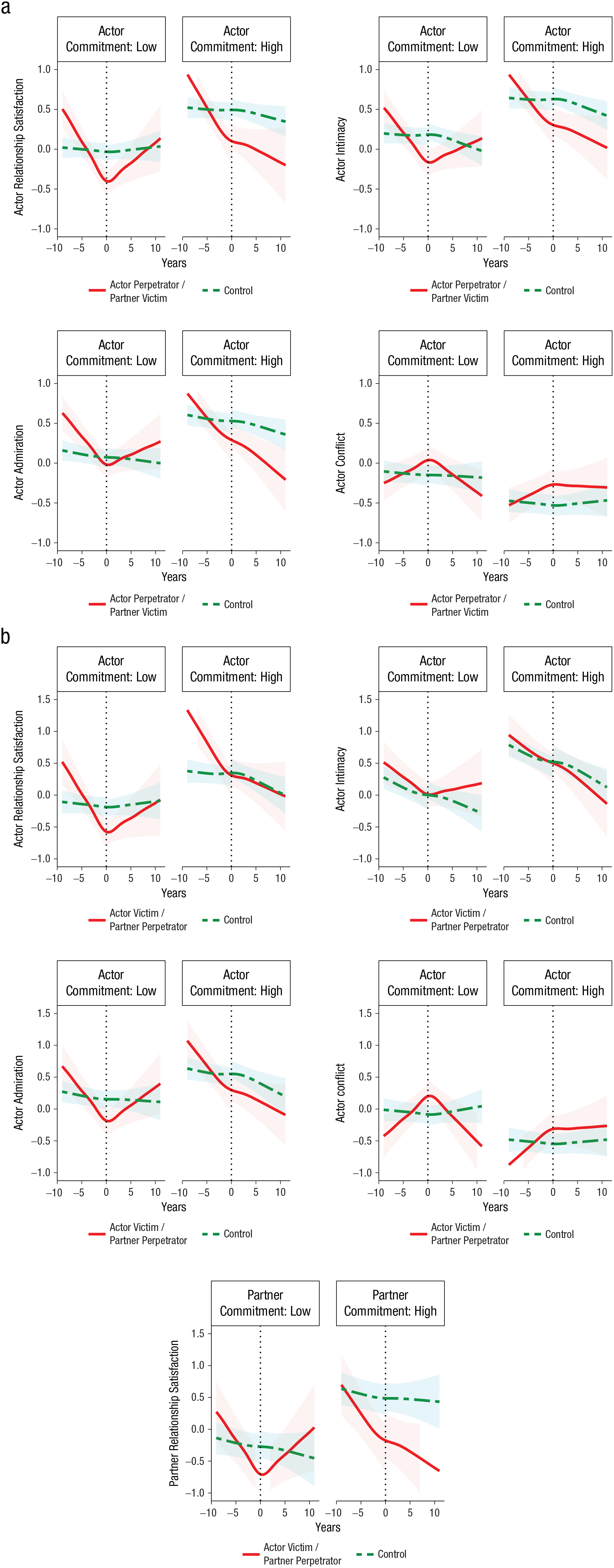
Commitment and well-being trajectories surrounding infidelity. (a) Perpetrator infidelity (actor reported having cheated on partner). (b) Victim infidelity (actor reported being cheated on by partner). Zero indicates the event year. For the control sample, it is the year in which the propensity-score-matched participant in the infidelity sample experienced the event. Low and high commitment reflect 1 standard deviation below versus above the sample mean. The graph shows predicted values for anticipation and socialization variables while holding other variables in the model constant (at means for continuous variables and reference categories for categorical variables; see Tables 3–6). The confidence bands represent the 95% confidence intervals obtained using the SjPlot package. The plots were created using the gam smoothing function of the ggplot2 package.
In the case of victim infidelity, the interaction between commitment and socialization term reached the adjusted level of significance in the case of actor admiration and partner relationship satisfaction (and the traditional < .05 for actor relationship satisfaction, intimacy, and conflict; see Table S13 and Fig. 4b). Similar to perpetrator infidelity, higher levels of commitment were associated with no change in well-being following infidelity (e.g., socialization effects at 1 SD above the mean of commitment: actor relationship satisfaction b = −0.06, p = .316; actor intimacy b = −0.04, p = .100; actor admiration b = −0.02, p = .333; actor conflict b = 0.001, p = .963; partner relationship satisfaction b = −0.05, p = .137). In contrast, lower levels of commitment were associated with an improvement in well-being following infidelity (e.g., socialization effects at 1 SD below the mean of commitment: actor relationship satisfaction b = 0.05, p = .024; actor intimacy b = 0.04, p = .069; actor admiration b = 0.07, p = .001; actor conflict b = −0.07, p = .002; partner relationship satisfaction b = 0.06, p = .020).
Gender
Infidelity prevalence and its perceived justifiability might differ across genders. For example, men are more likely than women to engage in infidelity, and infidelity committed by men is sometimes considered more justifiable than infidelity committed by women (Blow & Hartnett, 2005; Fincham & May, 2017). Therefore, in further exploratory (not preregistered) analyses, we examined whether selection, post-event baseline change, anticipation effects, and socialization effects were moderated by gender. We computed a series of models that included four interaction effects between the event-related variables and gender (Gender × Selection, Gender × Anticipation, Gender × Post-Event Baseline Change, Gender × Socialization) and the four random slopes of the event-related variables. We used actor gender in the analyses of actor outcomes and partner gender in the analyses of partner outcomes. We implemented a p-value adjustment, given the large number of tests (seven outcomes and four event-related variables: p = .05/7/4 = .002).
In the case of perpetrator infidelity, the socialization effect was moderated by gender: The interaction effect reached the adjusted level of significance in the case of life satisfaction and self-esteem (and the traditional < .05 for actor and partner admiration and partner relationship satisfaction). The model coefficients are shown in Table S15 in the Supplemental Material. The pattern of the interaction is shown in Figure 5. Interestingly, a look at actor outcomes suggests that male perpetrators were more negatively affected by the event than female perpetrators. Strikingly, female perpetrators even tended to experience a gradual increase (often in the shape of a rebound following pre-event declines) in personal well-being after the event (e.g., life satisfaction and self-esteem: b = 0.05 and b = 0.05, p < .001; admiration: b = 0.04, p = .027). At the same time, the analyses of partner outcomes of perpetrators point to some rebound effects for male (but not for female) victims. For example, male victims experienced an increase (post-event rebound) in relationship satisfaction (b = 0.07, p = .005), whereas female victims did not (b = −0.01, p = .639). Gender did not show consistent interactions with any other time-related variables. Further moderation analyses (by other relationship configuration variables, such as marital and coresident status) are presented in the Supplemental Material.
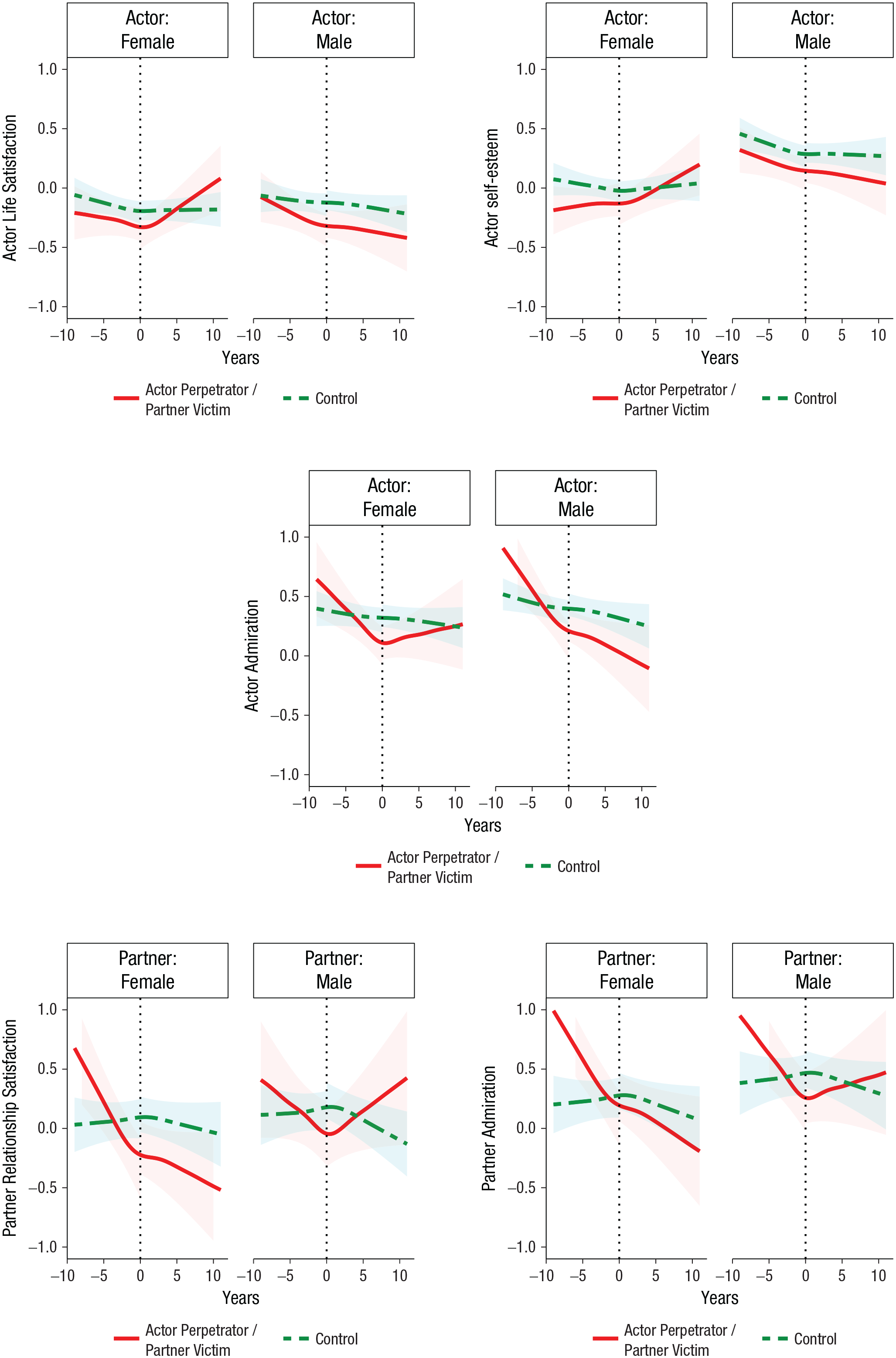
Gender and well-being trajectories surrounding the event of committing infidelity. Zero indicates the event year. For the control sample, it is the year in which the propensity-score-matched participant in the infidelity sample experienced the event. The graph shows predicted values for anticipation and socialization variables while holding other variables in the model constant (at means for continuous variables and reference categories for categorical variables; see Tables 3–6). The confidence bands represent the 95% confidence intervals obtained using the SjPlot package. The plots were created using the gam smoothing function of the ggplot2 package.
Separation
We explored whether the impact of infidelity extends beyond the relationship in which infidelity happened, affecting individuals’ personal well-being even after separation (if separation takes place) and carrying over to the next relationship. Separation was more common in couples affected by infidelity than in the control sample (36% in both perpetrator and victim samples vs. 22% and 25% in the control samples, ps < .001; see Table 1). Also, a nontrivial number of participants reported new relationships following separation (75% vs. 52% in the perpetrator vs. control samples, p < .001, and 57% vs. 50% in the victim vs. control samples, p = .31; see Table 1).
In a set of exploratory analyses, we tested whether individuals’ well-being trajectories after the infidelity event (i.e., socialization) differed across three groups of participants: the ones who stayed with their original partner (reference group, coded 0), the ones who separated from the original partner but remained single (coded 1), and the ones who separated from the original partner and found a new one (coded 2). We computed the interaction effects between the socialization variable and the new relationship/separation status. Some of the interaction effects reached (an unadjusted level of) significance for life satisfaction (but not for self-esteem) in the perpetrator sample (p = .032) and in the victim sample (p = .034; see Table S14 in the Supplemental Material). The pattern of the interactions is plotted in Figure 6. Only participants who separated but did not find a new partner experienced a gradual deterioration in life satisfaction following the infidelity event (although not significant, see Fig. 6 note regarding the sample size), whereas this was not observed in the similar control participants (i.e., separated, not repartnered).
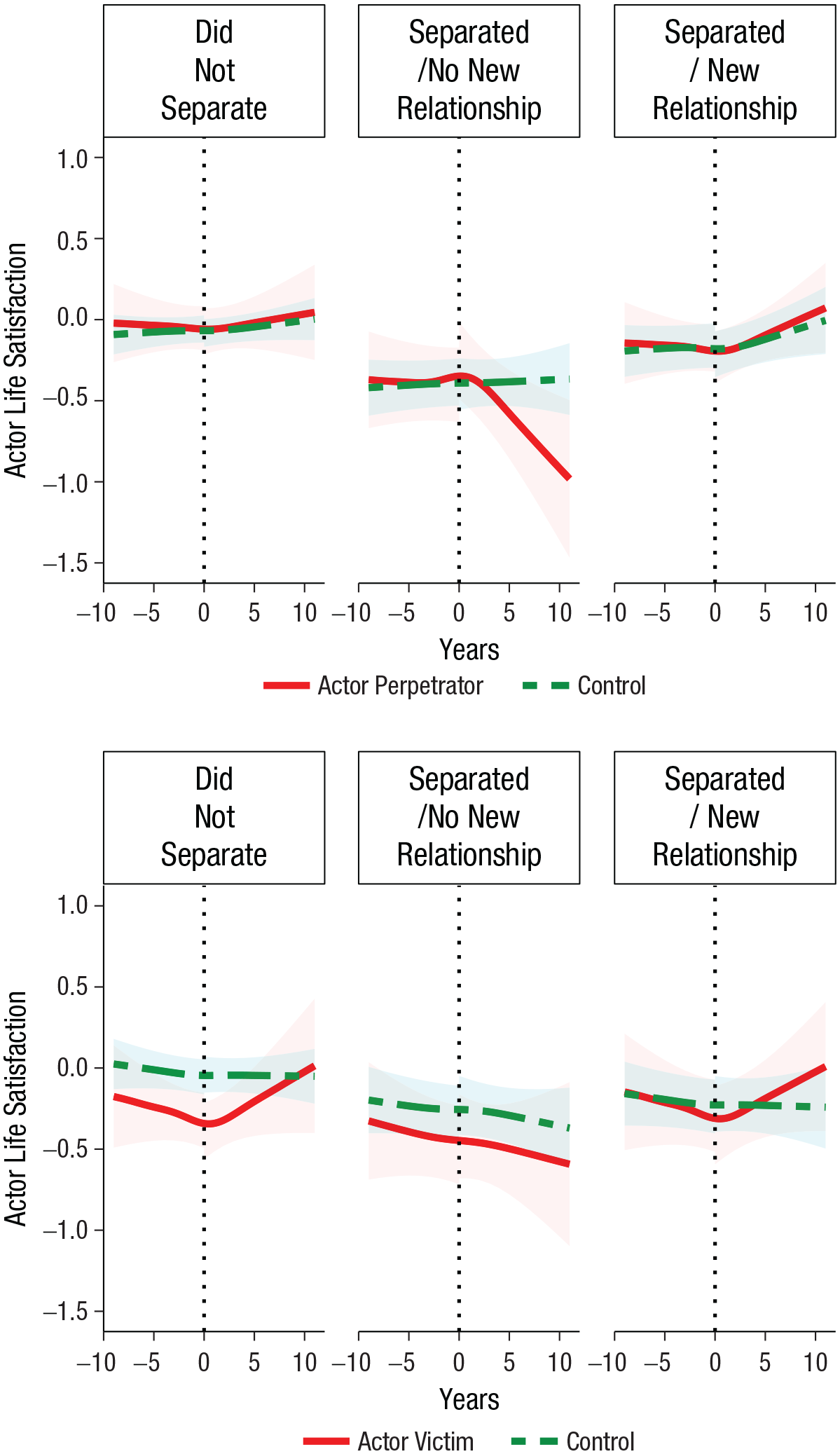
Separation status and life satisfaction trajectories surrounding infidelity. Zero indicates the event (infidelity) year. For the control sample, it is the year in which the propensity-score-matched participant in the infidelity sample experienced the event. The graph shows predicted values for anticipation and socialization variables while holding other variables in the model constant (at means for continuous variables and reference categories for categorical variables; see Tables 3–6). Numbers in perpetrator sample (including controls): did not separate = 1,235, separated/no new relationship = 166, separated/new relationship = 142; numbers in victim sample (including controls): did not separate = 673, separated/no new relationship = 126, separated/new relationship = 280. The confidence bands represent the 95% confidence intervals obtained using the SjPlot package. The plots were created using the gam smoothing function of the ggplot2 package.
Discussion
We used prospective dyadic data to examine the temporal dynamics of personal and relationship well-being surrounding experiences of infidelity. Our analyses provided four main findings that we summarize below.
First, for the first time, we showed that infidelity events were preceded by a gradual decrease in personal and relationship well-being in victims and perpetrators, as evident in both actor and partner reports. In perpetrators, this decline might be a reason for starting an affair or even an intentional distress management strategy (see Scott et al., 2017). In victims, a decrease in well-being might be a result of feeling the partner’s dissatisfaction or represent a causal factor increasing their likelihood of being cheated on. Unhappiness has been associated with poor outcomes in social life in previous research (Lyubomirsky et al., 2005; Stavrova & Luhmann, 2016). Hence, a decrease in personal well-being might make the future victim less attractive, contributing to the infidelity of the partner.
Second, in contrast to what most previous research on other negative interpersonal events (e.g., divorce, widowhood) indicated (Denissen et al., 2018; Lucas, 2007; Luhmann et al., 2012), infidelity events were not followed by steady recovery patterns. Although we detected small rebound effects with respect to some of the outcome variables, neither victims nor perpetrators were able to return to their initial levels of well-being. Potentially, the guilt and social disapproval associated with infidelity renders this event particularly difficult to recover from.
Third, puzzled by the lack of recovery patterns, we explored potential sources of between-individuals heterogeneity in responses to infidelity. We found that individuals who were more (vs. less) committed to the relationship before the event tended to experience a stronger deterioration in well-being after cheating or being cheated on. Their less committed counterparts, on the other hand, seemed to report an upward well-being trend following infidelity. This pattern is consistent with the expectancy violation theory (Burgoon, 1993): Higher commitment could be associated with higher relationship expectations and stronger disappointment when the expectations are violated.
Interestingly, our exploratory analyses detected one more group of participants who seem to recover and even thrive after infidelity, other than individuals with low relationship commitment: unfaithful women. Women (vs. men) are more likely to mention relationship dissatisfaction as a reason for their affair (Barta & Kiene, 2005), and prior research has shown that acts of infidelity committed because of relationship problems can lead to positive psychological outcomes (Beltrán-Morillas et al., 2020). Potentially, women’s affairs are more likely to be a result of partner dissatisfaction, and consequently, the affair may be a wake-up call for their partners, leading to positive behavioral change. These findings add to the small literature exploring the conditions in which infidelity might have positive consequences (Beltrán-Morillas et al., 2020; Thompson et al., 2021).
Finally, the inclusion of actor and partner outcomes in both victim and perpetrator samples resulted in several potentially interesting observations. Negative well-being consequences (i.e., post-event baseline change) appeared more common in perpetrators who reported cheating themselves (i.e., actor well-being in the perpetrator sample) than in perpetrators whose partner reported cheating (i.e., partner well-being in the victim sample) and in victims (see Figs. 2 and 3). Although this could be partially explained by differences in power (for sensitivity analyses, see the Supplemental Material), the nature of infidelity—disclosed versus secret—could have played a role, too. Disclosed infidelity was presumably more common in the victim sample (as it was reported by the victims) than in the perpetrator sample (as it was reported by the perpetrators). This is consistent with the perpetrator sample being almost twice as large as the victim sample, where secret affairs were probably unreported.
Potentially, perpetrators are more negatively affected by infidelity when it is kept secret (i.e., actor effects in the perpetrator sample) versus disclosed (i.e., partner effects in the victim sample). Disclosing infidelity can help some couples find a solution to the relationship problems that led to infidelity in the first place (Atkins et al., 2005). The higher share of secret affairs in the perpetrator sample versus victim sample could also explain why perpetrators and their partners had chronically lower personal and relationship well-being, relative to the control sample, whereas neither victims of infidelity nor their partners differed from the control sample (selection effects; see Fig. 1). It should be noted that in the absence of the explicit information regarding infidelity disclosure rates, this interpretation remains speculative. Future research should test to what extent the perpetrator-victim differences in the present study are a result of differences in disclosure versus perpetrator/victim status.
Limitations and future directions
The reliance on large-scale panel data resulted in many benefits: It allowed us to identify a high number (~1,000) of infidelity events, track them for several years before and after infidelity, and compare the relationship trajectories of participants who experienced infidelity with a large control sample of individuals who did not (~1,500). However, the reliance on these secondary data restricted our ability to influence sampling (e.g., Germany) and measurement decisions, resulting in several limitations. The lack of information regarding whether the infidelity has come to light or not is one of them (as discussed above). In addition, the phrasing of the infidelity measure (“extra-marital affair”) could have left room for different interpretations (e.g., extradyadic sex vs. an online flirt) and included consensual nonmonogamous relationships. Comparing the effects of different infidelity types as well as examining whether changes in different aspects of relationship functioning could lead to different types of infidelity could be an interesting endeavor for future studies.
Conclusion
Infidelity is often considered one of the most stressful events in a couple’s life leading to relationship trouble. The present findings questioned this idea by showing that for both victims and perpetrators, infidelity was preceded (but not followed) by longer periods of decline in personal and relationship well-being. In contrast to most other negative life events and with the exception of individuals with lower initial commitment and unfaithful women, this decline did not recover in the follow-up years.
Supplemental Material
sj-docx-1-pss-10.1177_09567976221116892 – Supplemental material for Estranged and Unhappy? Examining the Dynamics of Personal and Relationship Well-Being Surrounding Infidelity
Supplemental material, sj-docx-1-pss-10.1177_09567976221116892 for Estranged and Unhappy? Examining the Dynamics of Personal and Relationship Well-Being Surrounding Infidelity by Olga Stavrova, Tila Pronk and Jaap Denissen in Psychological Science
Footnotes
Transparency
Action Editor: Paul Jose
Editor: Patricia J. Bauer
Author Contributions
O. Stavrova contributed to the following aspects: Conceptualization; Data curation; Formal analysis; Investigation; Methodology; Visualization; Writing – original draft. T. Pronk contributed to the following aspects: Conceptualization; Writing – review & editing. J. Denissen contributed to the following aspects: Conceptualization; Formal analysis; Methodology; Writing – review & editing.

Notes
References
Supplementary Material
Please find the following supplemental material available below.
For Open Access articles published under a Creative Commons License, all supplemental material carries the same license as the article it is associated with.
For non-Open Access articles published, all supplemental material carries a non-exclusive license, and permission requests for re-use of supplemental material or any part of supplemental material shall be sent directly to the copyright owner as specified in the copyright notice associated with the article.
