




Abstract
What drives people’s perceptions of novel risks, and how malleable are such risk perceptions? Psychological research has identified multiple potential drivers of risk perception, but no studies have yet tested within a unified analytic framework how well each of these drivers accounts for individual differences in large population samples. To provide such a framework, I harnessed the deployment of 5G—the latest generation of cellular network technology. Specifically, I conducted a multiverse analysis using a representative population sample in Switzerland (Study 1; N = 2,919 individuals between 15 and 94 years old), finding that interindividual differences in risk perceptions were strongly associated with hazard-related drivers (e.g., trust in the institutions regulating 5G, dread) and person-specific drivers (e.g., electromagnetic hypersensitivity)—and strongly predictive of people’s policy-related attitudes (e.g., voting intentions). Further, a field experiment based on a national expert report on 5G (N = 839 individuals in a longitudinal sample between 17 and 79 years old) identified links between intraindividual changes in psychological drivers and perceived risk, thus highlighting potential targets for future policy interventions.
Keywords
In the complex modern world, people are confronted with novel risks at an ever-increasing pace. Some of these constitute pure downside risks and almost exclusively imply losses (e.g., the COVID-19 pandemic). Yet many novel risks also reflect opportunities for individuals and society at large—as in the case of technological innovations. One such example is 5G, the latest generation of cellular network technology: With applications such as industrial automation, virtual reality, and next-generation transport connectivity (e.g., autonomous vehicles), 5G is expected to lead to substantial benefits globally—including an estimated contribution of up to 588 billion (U.S.) in global tax revenue from 2020 to 2034 (GSMA, 2018).
Despite these prospects, the current deployment of 5G in many countries around the world has triggered heated debates and unsettledness in the general public (Broad, 2019b; Foster, 2019). For instance, thousands of people protested against 5G in Switzerland, and many have campaigned for a referendum to limit radiation from mobile communications technology (Keystone, 2019a, 2019b). This uproar may come as no surprise in light of alarmist claims that appear in the media, including that 5G “might kill you” (see Broad, 2019a, para. 2). Such statements may spread fear and undermine public trust (Broad, 2019a)—despite typically being aired by networks known for promoting fake news and “selectively reporting the most sensational claims [and] giving a few marginal opponents of wireless technology a conspicuous new forum” (Broad, 2019a, para. 20).
But why do some people appear to embrace this novel technology whereas others dissent? For evidence-based policymaking, scientific insights into the reasons underlying people’s diverging risk perceptions (which often also are at odds with experts’ evaluations; Renn, 2004; Slovic, 1987) are essential in at least two respects.
First, people’s risk perceptions may be strong constituents of their policy-related attitudes (e.g., acceptability of risks, voting intentions). Thus, particularly when being propagated in social networks and the media, extreme risk perceptions of even a few people may have substantial consequences (Kasperson et al., 1988; Moussaïd et al., 2015). It is therefore important to understand who is at risk of adopting overly high and potentially unfounded risk perceptions (e.g., people unaware of basic technological facts). Second, it is important not only to examine which factors are relevant psychological drivers but also to gauge their stability across time—and hence, the potential malleability of people’s risk perceptions (e.g., Schürmann et al., 2019)—to thus identify potential targets for future policy interventions (e.g., information campaigns).
To date, psychological science has accumulated rich insights into specific drivers of risk perception. However, these drivers have not yet been compared, side by side, in a unified framework assessing their relevance in accounting for interindividual differences in risk perception and intraindividual changes in risk perception. This article provides such an analytic framework in the spirit of a multiverse analysis (Steegen et al., 2016)—focusing on 5G as a timely case study—to thus address the following two research questions.
Research Question 1: What Drives Interindividual Differences in People’s Risk Perceptions?
Interindividual differences in risk perception may emerge because of individuals’ idiosyncratic (and potentially dynamic) evaluations of, or knowledge about, a specific hazard—or because of generic and relatively stable characteristics of persons themselves. The distinction between these two groups of psychological drivers is of conceptual and practical importance (e.g., in terms of potential interventions; see Research Question 2).
Hazard-related drivers: psychological evaluations of, knowledge about, and trust in 5G
At the forefront of psychological research investigating risk perceptions, studies implementing the psychometric paradigm (Fischhoff et al., 1978; Slovic, 1987) have examined the role of people’s cognitive and affective evaluations of different hazards. Specifically, hazards that evoke high levels of dread (i.e., the involuntary exposure to hazards and uncontrollability of those hazards) and unknown risk (i.e., unobservable consequences and lack of knowledge) are perceived to be riskier and to involve fewer benefits and, hence, result in less acceptability (Slovic, 1987; Slovic et al., 1984). Focusing on comparing different hazards, this approach has typically relied on average ratings of respondents—thus scaling hazards, not people. Some researchers have warned that average judgments of risk need to be interpreted cautiously (Vlek & Stallen, 1981). Although a few studies have accounted for this advice (Gardner et al., 1982; Pachur et al., 2012), they have typically not implemented the full psychometric approach (but see Siegrist et al., 2005) or recruited large population samples to study individual differences. Still, dread and unknown risk are natural candidates to be considered as drivers of interindividual differences in risk perception of 5G: To the extent that a person pays attention to terrifying statements in the media or is worried about the lack of control over their exposure to radiation from network antennas, 5G will likely lead them to experience high levels of dread. Similarly, some people may perceive high levels of unknown risk because 5G is a novel technology with potentially uncertain consequences (e.g., long-term effects on health).
Statement of Relevance
People’s perceptions of novel risks may diverge strongly—which can have far-reaching consequences in an increasingly connected world, where extreme views are quickly disseminated. For policymaking, it is thus important to understand the correlates and potential drivers of individual differences in risk perception. To this end, this article focuses on the timely and controversial technology of 5G, the latest generation of cellular network technology. Specifically, the studies reported here comprehensively compared variables that previous research has suggested as potential drivers of inter- and intraindividual variability in risk perception, and they analyzed the associations between individuals’ risk perceptions and their policy-related attitudes (e.g., acceptability, voting intentions). In doing so, this work identified potential targets for future policy interventions. At the same time, it illustrates that population-level changes are not easily triggered—implying that careful policy choices will be required to design interventions aimed at partially reconciling highly polarized risk perceptions, such as those that have emerged for 5G.
Another line of research that focused on individual differences from the outset has identified two further factors typically related inversely to people’s risk perceptions: individuals’ degree of knowledge about a technology (e.g., Gstraunthaler & Day, 2008) and trust in the authorities responsible for its regulation (e.g., Siegrist, 2000). Although trust is a multifaceted construct (Siegrist, 2021), it plays an important role in risk management (Slovic, 1993) and when people need to rely on specific institutions to reduce complexity (Siegrist, 2000, 2021). That is, particularly in the absence of sufficient knowledge about a potential hazard, trust may dampen individuals’ risk perceptions (Siegrist & Cvetkovich, 2000). Hence, in the context of 5G, both subjective knowledge (e.g., feeling informed) and objective knowledge (e.g., that radiation primarily results from the user’s device, not the network antennas; Cousin & Siegrist, 2010), as well as trust in the experts and institutions responsible for regulating 5G, may attenuate individuals’ risk perceptions.
Person-specific drivers: psychological dispositions and sociodemographic characteristics
Interindividual differences in risk perception may also hinge on rather static factors not directly related to specific hazards, including personality dispositions, general attitudes, and sociodemographic characteristics. For instance, psychological traits such as risk preference (Frey et al., 2017), openness to new experiences (Costa & McCrae, 1992), and beliefs about the advantages of digitalization may shape a person’s generic preference for progress, thus potentially exerting a stable influence on the risks perceived from novel technologies. Similarly, individuals who report suffering from electromagnetic hypersensitivity (i.e., nonspecific symptoms associated with nonionizing radiation; Genuis & Lipp, 2012) may genuinely perceive any source of radiation as risky. Finally, systematic associations between sociodemographic characteristics (e.g., gender, age) and interindividual differences in risk perception have been observed (e.g., lower risk perception and risk taking in young men; Finucane et al., 2000; Frey et al., 2021). Such indicators may prove useful as predictors of interindividual differences despite not necessarily offering any direct psychological insights.
Research Question 2: How Malleable Are People’s Risk Perceptions, and What Drives Intraindividual Change?
For future policy interventions, it is key to understand the potential malleability of people’s risk perceptions—and to identify psychological drivers that could serve as targets in this respect. Provided that people’s risk perceptions primarily hinge on relatively stable, person-specific drivers, there is little hope for any malleability. The opposite is true to the extent that people’s risk perceptions are shaped by hazard-related drivers (i.e., idiosyncratic evaluations of and knowledge about 5G) because these are—in principle—susceptible to change.
To date, the evidence concerning the stability of potential drivers of risk perception, and the malleability of the latter itself, is still relatively scarce—particularly in terms of longitudinal analyses, despite repeated calls in this regard (Siegrist, 2013, 2014).
Cross-sectional results (Fox-Glassman & Weber, 2016; Sadiq et al., 2019) suggest high stability at the aggregate level, with a pattern of rank-ordered risk perceptions of various hazards practically unchanged across almost 40 years (Fischhoff et al., 1978; Fox-Glassman & Weber, 2016). Longitudinal results (Connor & Siegrist, 2016; Visschers & Siegrist, 2013) indicate that risk perceptions remain fairly stable even after incisive events such as the Fukushima accident (Visschers & Siegrist, 2013); although fluctuations in attitudes concerning nuclear power have been observed, these were related more strongly to changes in perceived benefits rather than to changes in perceived risks (Siegrist et al., 2014).
Method
The ethics committee of the Department of Psychology, University of Basel (No. 021-19-2), approved the studies. The full methodological details of both studies can be found in sections A and C in the Supplemental Material available online.
Empirical approach of Study 1
Study 1 used a population sample in Switzerland (N = 2,919 individuals between 15 and 94 years old) that was representative for gender, four age groups, and the German- and French-speaking parts of the country (for details, see section A.1 in the Supplemental Material). The main goal of this study was to systematically compare a set of candidate drivers of interindividual differences in risk perception as reviewed above (thus addressing Research Question 1). The study harnessed the phase of the initial deployment of 5G in Switzerland when public debates were fierce, culminating in some cantons (i.e., political districts) putting a moratorium on 5G implementation—pending the conclusions of a national expert report on 5G to be released by the Swiss Federal Office for the Environment (Keystone, 2019b). A large heterogeneity in risk perception could thus be expected in the general public.
Because some of the drivers reviewed above may not be entirely independent from each other, an extensive Bayesian model comparison (i.e., multimodel inference; see section A.2 in the Supplemental Material) was conducted to gauge the unique contributions of the predictors to each of three outcome variables: perceived risk, perceived benefit (i.e., personal benefits, benefits for society, benefits for the economy), and policy-related attitudes (i.e., acceptability of risks, voting intention, need for more regulation, need for more research; for the respective measurement models, see section B.1 in the Supplemental Material). Note that the treatment of variables as either predictors (i.e., psychological drivers) or outcome variables is based on mechanisms implied by previous theory; yet the reported effects are correlational and do not necessarily reflect any causal relationships.
Empirical approach of Study 2
The main purpose in Study 2 was to examine the stability of the reviewed drivers and, hence, gauge the potential malleability of people’s risk perceptions—testing to what extent particular drivers may account not only for interindividual differences in large population samples (Research Question 1) but also for intraindividual change therein (Research Question 2). To this end, a cross-sectional sample was collected to validate Study 1 and model mean-level changes in the population (N = 1,013 individuals between 17 and 88 years old) and a longitudinal sample was collected to model intraindividual change (N = 839 individuals between 17 and 79 years old; for a detailed description of the sample recruitment, see section C.1 in the Supplemental Material) approximately 3 months after Study 1 and after release of a national expert report on 5G (for an overview, see Fig. 1). This report (see section C.2 in the Supplemental Material) was published by the Swiss Federal Office for the Environment and explained technical facts about 5G, dealt with the operation of the Swiss mobile radio networks and their regulation, estimated the population’s exposure to radiation, and summarized the scientific findings on health consequences. The report did not conclude with a single recommendation; rather, it sketched multiple scenarios and served as evidence for informing the general public and for policymaking in the Swiss government. In the longitudinal sample, each respondent was randomly assigned to one of four conditions (i.e., the study was a field experiment; see Fig. 1). Specifically, between the two studies, respondents in conditions A to C received excerpts from the expert report by mail (using different information formats; see section C.2 in the Supplemental Material) and respondents in condition D served as controls.
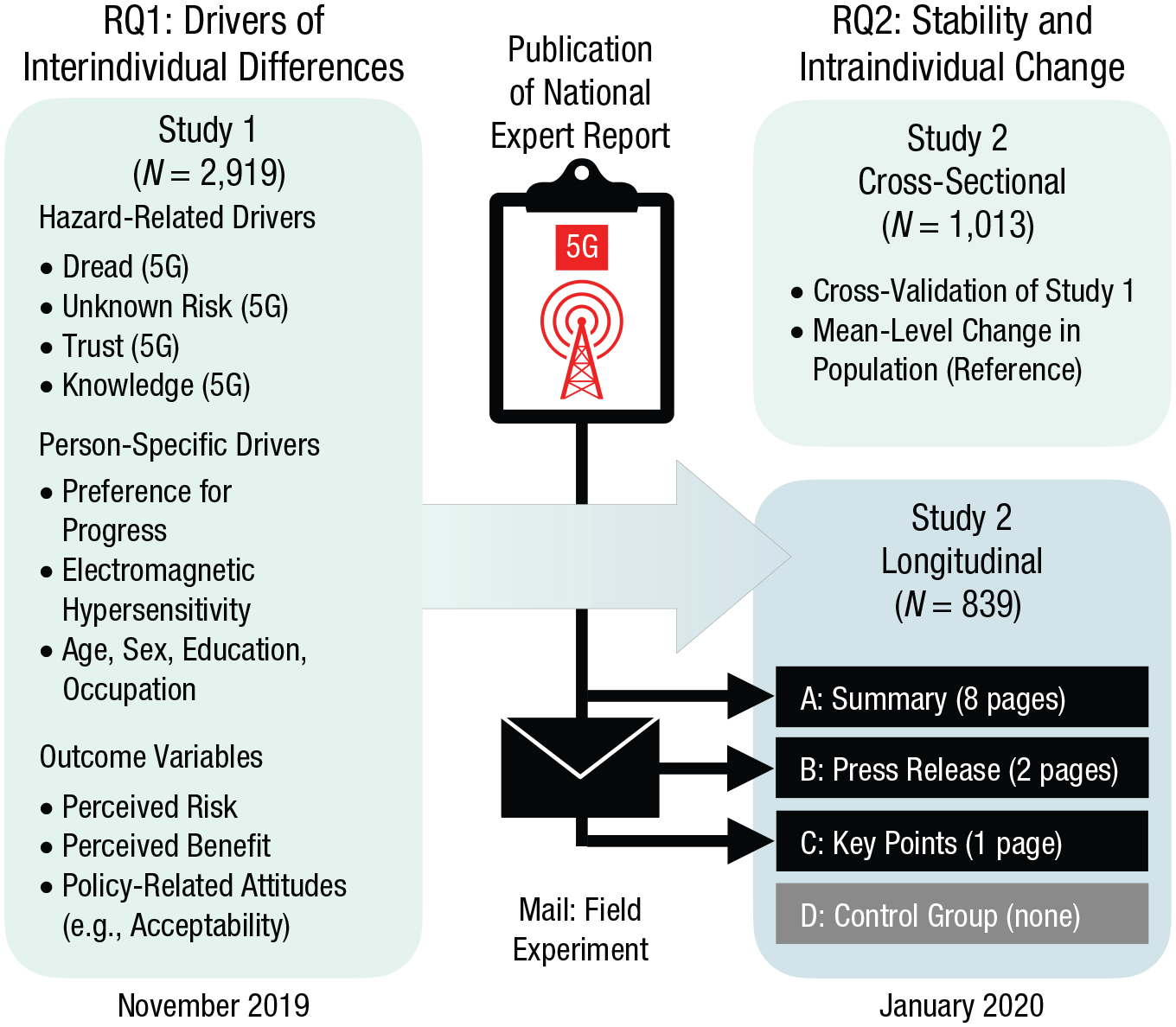
Overview of the empirical approach and samples in Studies 1 and 2. Study 1 addressed Research Question (RQ) 1 and examined the associations between various psychological drivers and three outcome variables. Study 2 was conducted after the release of a national expert report on 5G and addressed RQ2, namely, to investigate mean-level changes in risk perception in the population (cross-sectional sample) as well as intraindividual changes in risk perception (longitudinal sample). Each individual in the longitudinal sample was randomly assigned to one of four experimental conditions in a field experiment. Specifically, each participant in conditions A, B, and C received excerpts of the expert report by mail in one of three different naturalistic information formats (i.e., the executive summary of the report, the press release of the report, and a summary of the report consisting of four key points). Participants in condition D served as a control group and received no information.
Materials and procedure
The studies were conducted online using a responsive mobile-first design (i.e., the study could be completed on all types of devices). All study materials were translated from German to French by the company that implemented the survey, and participants were free to choose their preferred language at the onset of the study. An independent back-translation (Brislin, 1970) was performed to identify potential changes in meaning, but only minor adjustments needed to be made. Table S2 in the Supplemental Material provides an overview of the items used for the main predictor and outcome variables (translated into English), and the full study materials (i.e., including original items and back translations) are available at https://osf.io/6t3du. The materials of both studies were identical (except for some questions at the end of the studies; see below) and were administered using the same procedure.
Informed consent and sociodemographic information
Participants were first informed about the background and purpose of the study and then provided informed consent. Next, they reported sociodemographic information (i.e., gender, age, canton of residence, zip code, level of education, employment status) and indicated whether they owned a smartphone, as well as the type of device they were using to complete the survey. Next, participants rated their general risk perception of 5G and completed the psychometric paradigm (in counterbalanced order; i.e., block-randomized design).
General risk perception of 5G
Participants’ general risk perception of 5G was prompted with the question, “In your personal view: How large are the potential risks of 5G in general?” (inspired by Fischhoff and colleagues’, 1978, approach). Participants responded to this item (as well as all subsequent items) using a continuous slider. Participants’ ratings were represented with values between 0 to 100, but these values were not displayed to participants as labels of the sliders. Rather, the end points of the slider were labeled “very low” and “very high,” and the midpoint was labeled “medium.”
Psychometric paradigm
The psychometric paradigm was implemented in a block consisting of 10 items (presented in a randomized order), which were primarily selected on the basis of the findings of Slovic and colleagues (1985, Table 8). These 10 items consisted of the five items that loaded most strongly on Factor 1 (dread) and the five items that loaded most strongly on Factor 2 (unknown risk). Most of these items were also part of the nine dimensions originally proposed and implemented by Fischhoff and colleagues (1978). To illustrate, an item representing Factor 1 (dread) was, “How easily can the potential risks of 5G be reduced?” and an item representing Factor 2 (unknown risk) was, “To what extent are the potential risks of 5G known to science?”
Attention check
The previous block also included an attention-check question that prompted participants to move the slider entirely to the left. As specified in the preregistration, the data of participants who failed to do so (i.e., a value higher than 10, thus permitting a small margin of error) were excluded from the analysis.
Perception of health risks
The next block tapped participants’ perceptions of health risks (i.e., arguably the strongest concern related to 5G in the general public). Specifically, participants were asked to rate their perception of the health risks of 5G as well as the health risks related to eight additional technologies and activities (e.g., 3G/4G, the current cellular network technology; smoking; vaccination) in order to provide a comparison of the degree of 5G’s perceived health risks with that of other potential health hazards. The nine items were presented simultaneously and in a randomized order to render comparative judgments possible. Furthermore, at the end of this block, participants had the opportunity to freely list any other risks related to 5G (i.e., beyond health risks) that they were potentially concerned about. See section B.4 in the Supplemental Material for the results of the analysis on perceived health risks.
Perceived benefits, trust, knowledge, and policy-related attitudes
The next block contained 14 items (presented in a randomized order) tapping perceived benefits (separately for personal, social, and economic benefits; Fischhoff et al., 1978), trust (single item; see for instance Siegrist, 2000), knowledge (two subjective and four objective indicators), and policy-related attitudes (acceptability of potential risks, voting intentions, need for more regulation, need for more scientific research). Subjective knowledge was measured with a self-rating of 5G knowledge and an item capturing the degree of 5G-related media consumption. Objective knowledge was measured with questions concerning whether the legal regulations are the same or different compared with 3G/4G (i.e., current technology), whether radiation limits are the same or different compared with 3G/4G, and whether the degree of radiation primarily results from 5G antennas or users’ devices. Moreover participants rated their confidence that an active 5G antenna exists (vs. does not exist) in their residential municipality or within a boundary of 1 km (which was verified using a geographic-information-system analysis; see section B.3 in the Supplemental Material for the results of this analysis and participants’ knowledge about 5G coverage).
Person-related characteristics
A final block tapped participants’ general risk preferences (Frey et al., 2017), their openness to new experiences (Costa & MacCrae, 1992), whether they predominantly see digitalization as an opportunity or as a potential risk, whether they feel affected by electromagnetic hypersensitivity, and their political attitude. Participants were not required to respond to the last question.
Study 1: screening for follow-up
At the end of Study 1, participants were prompted to type in a risky real-life situation (unrelated to the research questions in this study and thus not further reported here) and were asked about their willingness to share their address to receive a brief brochure with information concerning 5G by mail (see Study 2).
Study 2: awareness of expert report
At the end of Study 2, all participants were asked about their awareness of the published expert report, and if their response was affirmative, they reported (a) how extensively they had studied the full report or a summary thereof, (b) how well they felt informed by the expert report, and (c) to what extent they believed that their attitudes toward 5G had changed in relation to the expert report (see Fig. S13 in the Supplemental Material). Moreover, a manipulation-check question explicitly asked participants in the longitudinal sample whether they had recently received a letter containing information on 5G from the survey company.
Results
Study 1: drivers of interindividual differences (Research Question 1)
Main outcome variables
The majority of respondents (65%) perceived the risks of 5G as medium to high (i.e., a rating > 50 on a scale ranging from 0 to 100), and the majority (65%) perceived low to medium personal benefits. Conversely, the majority of respondents perceived medium to high benefits for society and for the economy (61% and 76% of respondents, respectively). As expected given the fierce public debates, there was substantial heterogeneity in perceived risk and benefit across respondents (see Fig. S1 in the Supplemental Material).
In terms of policy-related attitudes (see Fig. S1), a slight majority of respondents (57%) perceived the acceptability of the potential risks as low to medium, but the clear majority perceived a need for more regulation and more research (74% and 90% of respondents, respectively). In the event of a national referendum, about half of the respondents (52%) would vote against 5G. There was again strong heterogeneity across respondents.
Associations of psychological drivers with outcome variables
Figure 2 shows the distributions of all continuous predictors (for the respective measurement models, see section B.1 in the Supplemental Material) and their zero-order correlations with perceived risk. To robustly estimate and directly compare the effects of these predictors and those of three noncontinuous predictors (gender and occupation: nominal; education: ordinal) and to gauge their relative contributions in predicting the three outcome variables, I conducted exhaustive Bayesian multimodel inference analyses (see section A.2 in the Supplemental Material) using the BAS package (Clyde et al., 2011) in the R programming environment (Version 3.5.3; R Core Team, 2019). Specifically, all possible model combinations were assembled by including or excluding the 11 predictors as linear additive effects, resulting in 211 = 2,048 models. For policy-related attitudes, perceived risk and benefit were additionally considered as direct predictors, resulting in 213 = 8,192 models. Note that the reporting of political attitude was optional and would have resulted in 488 listwise deletions; given its low zero-order correlation with perceived risk (see Fig. 2), this variable was excluded from this analysis. All of the Bayes factors (BFs) below are reported as logarithms with base 10 and reflect the relative evidence for the best model over the same model without the respective predictor (or vice versa if the predictor was not part of the best model).
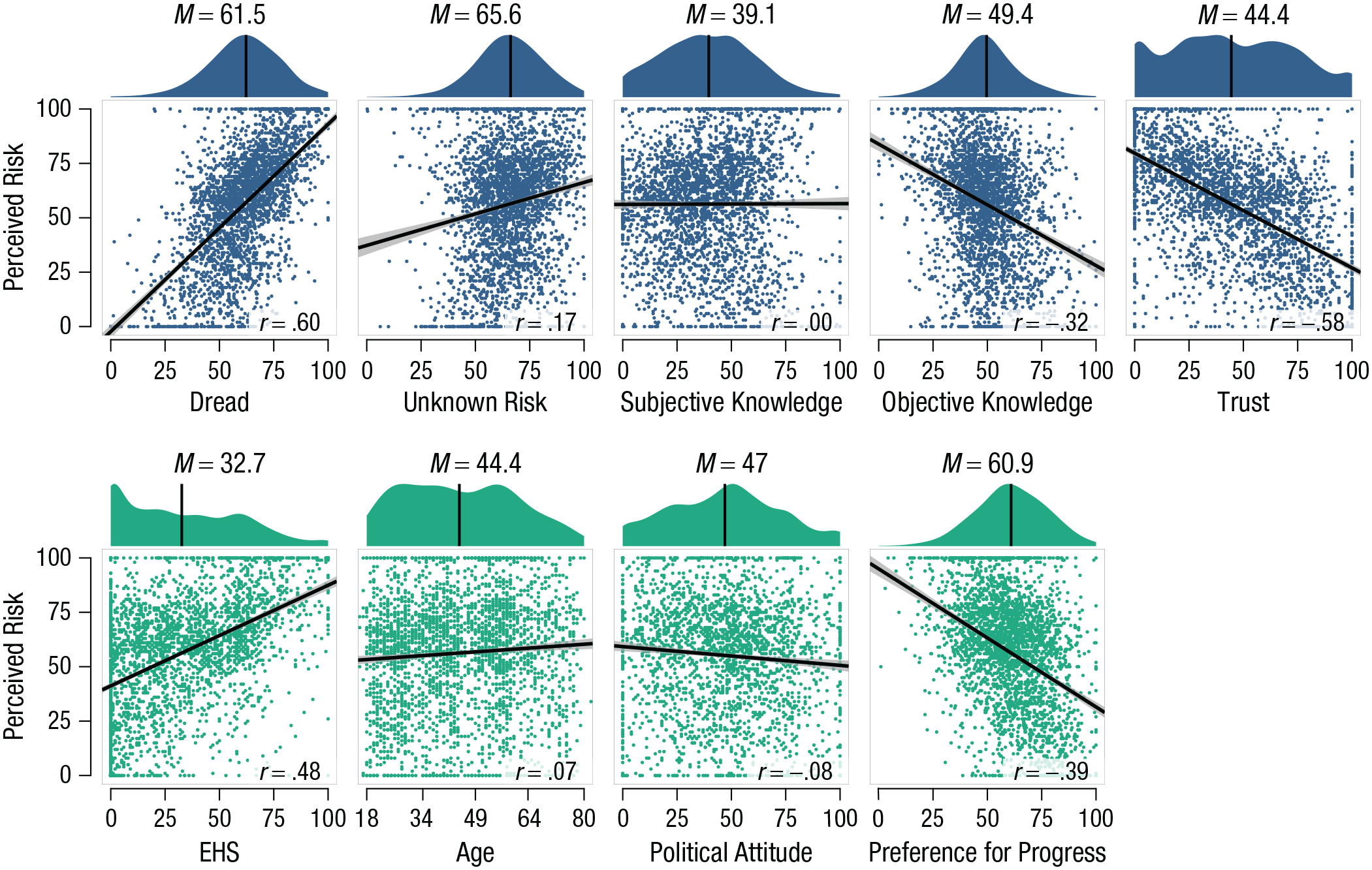
Distributions of responses to scales measuring potential drivers of interindividual differences in risk perception of 5G and scatterplots showing zero-order correlations between each driver and risk perception in Study 1 (N = 2,919). Hazard-related drivers are shown in blue, and person-specific drivers are shown in green. In the distributions, black vertical lines represent means. In the scatterplots, black lines represent best-fitting regressions. The gray bands around the regression lines represent 95% confidence intervals. Predictors modeled as latent variables in the main analysis (e.g., dread) are depicted as approximate scores on the original response scale (see section B.1 in the Supplemental Material available online). EHS = electromagnetic hypersensitivity.
As can be seen from the model-averaged estimates depicted in Figure 3a, dread of 5G and electromagnetic hypersensitivity were positive predictors of perceived risk, whereas respondents’ trust in the authorities regulating 5G, gender (male), objective knowledge about 5G, and respondents’ generic preference for progress were inverse predictors of perceived risk. The three best predictors of perceived risk were trust (BF = 69), dread (BF = 61), and electromagnetic hypersensitivity (BF = 54; see Fig. 3d). All of these BFs represent very strong evidence (Raftery, 1995) that these drivers contribute substantially to predicting perceived risk. There was also very strong evidence that objective knowledge about 5G (BF = 16), preference for progress (BF = 8), and gender (BF = 6) predicted perceived risk, although these BFs indicate that the evidence was weaker than for trust, dread, and electromagnetic hypersensitivity. For the remaining predictors, there was less or even negative evidence that they made meaningful contributions to predicting perceived risk (see Fig. 3d).
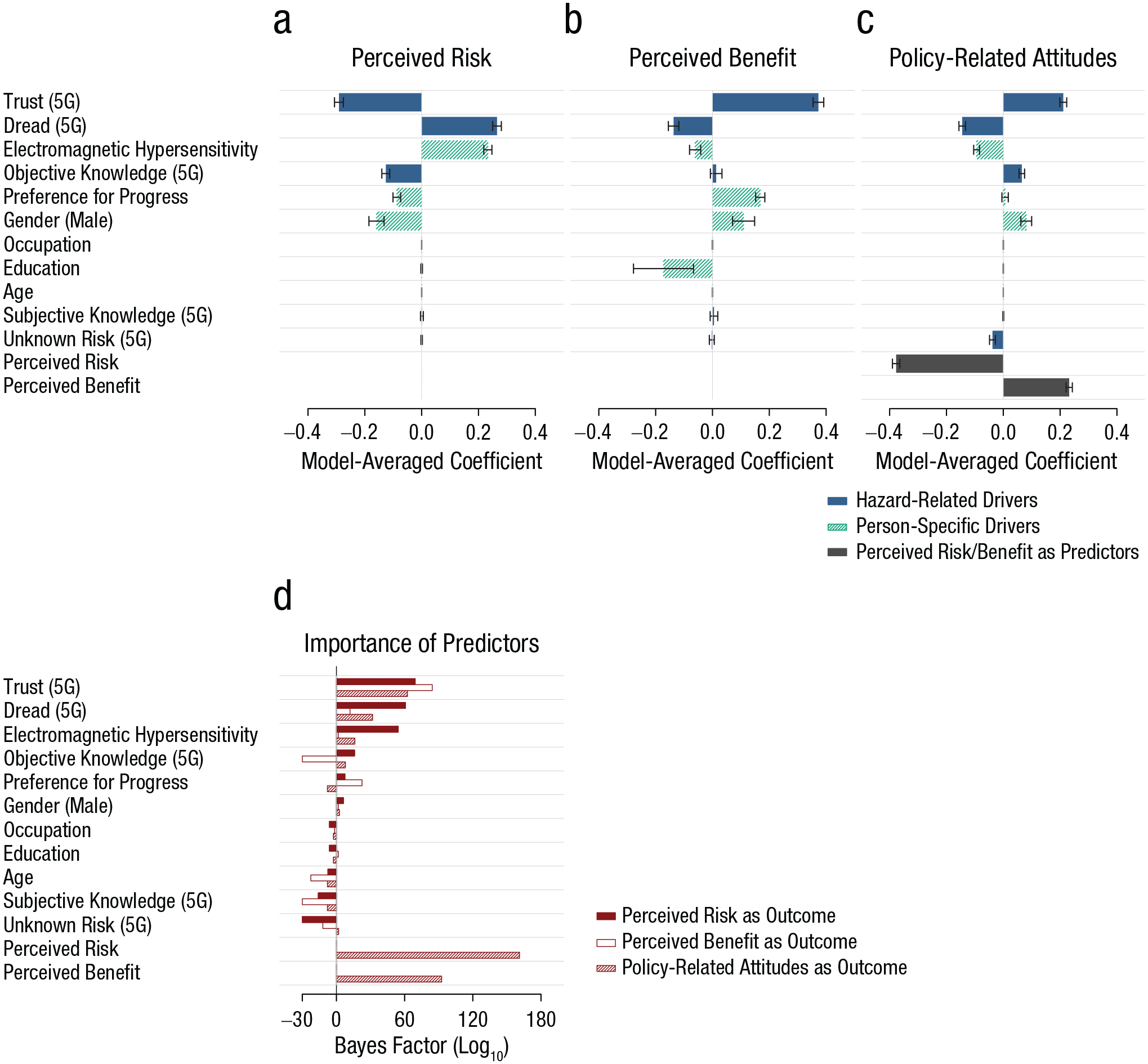
Results of the Bayesian multimodel inference analyses in Study 1 (N = 2,917 after two listwise deletions because of missing values). Model-averaged coefficients are shown for all drivers/predictors, separately for the three main outcome variables: (a) perceived risk, (b) perceived benefit, and (c) policy-related attitudes (for policy-related attitudes, perceived risk and benefit were included as direct predictors). Coefficients are standardized, and error bars depict standard deviations across models. Each predictor’s contribution to explaining interindividual differences in the three outcome variables in terms of log10 Bayes factors is shown in (d). Bayes factors reflect the relative evidence for the best model over the same model without the respective predictor (or vice versa if the predictor was not part of the best model).
For perceived benefits (see Fig. 3b), the pattern of associations was very similar but essentially inverse. Yet trust had an even stronger effect (compared with its effect of predicting perceived risk) and was the most important predictor (BF = 84), followed by a respondent’s preference for progress (BF = 23) and dread (BF = 12; all BFs indicate very strong evidence). Finally, for policy-related attitudes (see Fig. 3c), the associations were again similar to those for perceived risk—but again inverse. Perceived risk and benefit, which were included as direct predictors in this analysis, were the two most important predictors (BFs = 161 and 93, respectively), followed by trust (BF = 62), dread (BF = 32), and electromagnetic hypersensitivity (BF = 16).
Study 2: stability and intraindividual change (Research Question 2)
Cross-validation and population-level change
As a robustness check, the analyses of Study 1 were replicated in the cross-sectional sample of Study 2 and clearly corroborated the results (see section D.1 in the Supplemental Material). This sample was also used to gauge any mean-level changes in the population (e.g., due to the publication of the expert report and the associated media coverage); yet by and large, there were no mean-level differences for perceived risk and benefit or for policy-related attitudes (see section D.2 in the Supplemental Material).
Intraindividual change in the psychological drivers
Figure 4 (lower panel) depicts the distributions of intraindividual change (i.e., from Study 1 to Study 2) in the various hazard-related drivers, separately for the four experimental conditions. The degree of intraindividual change—relative to the variability that occurred between individuals—was quantified by means of intraclass correlation coefficients (ICCs; an ICC of 1 represents no intraindividual variability, an ICC of 0 represents pure intra- and no interindividual variability, and an ICC of .5 represents the same degree of variability between as within individuals; one-way random, single score ICCs(1, 1) were used). The ICCs indicated that there was a considerable degree of intraindividual change for most of the hazard-related drivers, as can also be seen from the dispersions of the distributions shown in Figure 4. To illustrate, in the control group, the ICCs for unknown risk and objective knowledge were as low as .55, and for several of the investigated drivers, intraindividual change tended to be even larger in the three treatment groups (e.g., an even lower ICC of .39 for objective knowledge in the group that received the press release for the expert report).
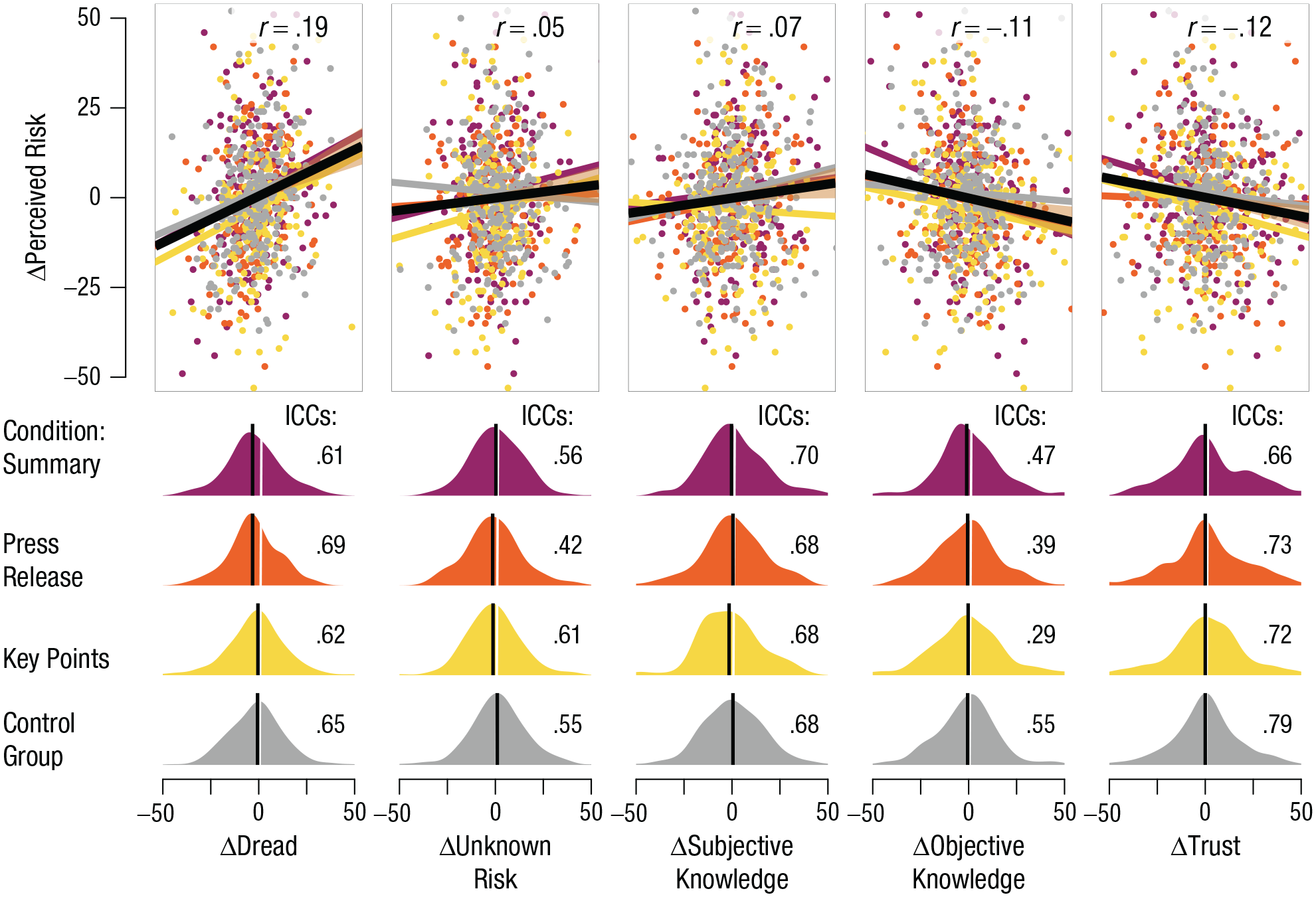
Distributions of intraindividual change from Study 1 to Study 2 in the hazard-related drivers (separately for the four experimental conditions) and scatterplots showing associations between each driver and intraindividual change in perceived risk in Study 2 (longitudinal sample; N = 839). In the distributions, black vertical lines represent the means of intraindividual change (white vertical lines indicate 0, i.e., no intraindividual change). In the scatterplots, a regression line is shown for each condition (matching the colors used in the distributions) and for the overall average (black). Predictors modeled as latent variables in the main analysis (e.g., dread) are depicted as approximate scores on the original response scale (see section B.1 in the Supplemental Material available online). ICC = intraclass correlation coefficient.
As Figure 4 illustrates, the emerged intraindividual changes involved both increases and decreases (i.e., differential effects across respondents), and the respective distributions were centered close to zero. This implies that no pronounced mean-level changes occurred in most of these drivers or across the four experimental conditions. One exception consisted of weak but credible decreases in dread in all conditions except condition C (i.e., four key points of the expert report)—namely, a mean decrease of −2.2 (95% highest-density interval [HDI] = [−3.9, −0.6]) in condition A (i.e., summary of the expert report), a mean decrease of −2.3 (95% HDI = [−4.3, −0.7]) in condition B (i.e., press release of the expert report), and a mean decrease of −1.7 (95% HDI = [−3.1, −0.04]) in condition D (control group).
By definition, person-specific drivers are relatively (e.g., personality dispositions) or entirely (e.g., gender) stable. Thus, as expected, there was no or only little intraindividual variability in most of these drivers (e.g., for age and political attitude, ICCs were 1 and .88; see section D.3 in the Supplemental Material). For this reason, person-specific drivers were not examined in this context and are thus not shown in Figure 4.
Intraindividual change in the outcome variables
There was also a considerable degree of intraindividual change in most of the outcome variables (see Fig. S11 in the Supplemental Material)—albeit to a somewhat smaller degree compared with the various hazard-related drivers. To illustrate, the ICCs for perceived risk were .73, .71, .77, and .76 in the four experimental conditions, respectively. Moreover, the distributions of intraindividual change in perceived risk, perceived benefit, and policy-related attitudes were also centered close to zero, suggesting that no pronounced mean-level changes occurred overall or as a function of the various experimental conditions. The few exceptions consisted of condition A (i.e., summary of the expert report), which resulted in credible increases in perceived benefit for society (mean increase = 3.9, 95% HDI = [1.3, 6.8]) and perceived benefit for the economy (mean increase = 2.8, 95% HDI = [0.2, 5.5]). Moreover, in condition C (i.e., four key points of the expert report), there was a credible increase in the acceptability of the potential risks (mean increase = 2.8, 95% HDI = [0.2, 5.7]).
Associations of intraindividual change in the psychological drivers with intraindividual change in the outcome variables
Figure 4 (upper panel) depicts the associations of intraindividual change in the various hazard-related drivers with intraindividual change in perceived risk (i.e., the main outcome variable). As can be seen, intraindividual changes in dread, unknown risk, and subjective knowledge tended to be positively associated with intraindividual change in perceived risk, whereas intraindividual changes in objective knowledge and trust tended to be inversely associated with intraindividual change in perceived risk.
To systematically test whether intraindividual changes in any of the psychological drivers were reliably associated with intraindividual changes in the outcome variables (i.e., perceived risk, perceived benefit, and policy-related attitudes), I conducted the equivalent multimodel inference analyses of Study 1 but using the intraindividual changes of predictor and outcome variables. According to this analysis, intraindividual change in dread (BF = 1.4; strong evidence) and intraindividual change in trust (BF = 0.2; weak evidence) were reliable predictors of intraindividual change in perceived risk (see Fig. S12 in the Supplemental Material). Note that compared with BFs in Study 1, BFs in Study 2 tended to be lower, at least in part because of the smaller size of the longitudinal sample. For intraindividual change in perceived benefit, there were reliable positive associations with intraindividual changes in trust and objective knowledge (BFs = 3.9 and 0.9; very strong and positive evidence, respectively) and a weak inverse association with intraindividual change in unknown risk (BF = 1.0; positive evidence). Finally, for intraindividual change in policy-related attitudes, intraindividual change in perceived risk was the best predictor (inverse association; BF = 15.0; very strong evidence), followed by intraindividual change in perceived benefit (positive association; BF = 4.5; very strong evidence).
Discussion
The unifying analytic framework presented in this article permitted, for the first time, the integration of a set of psychological drivers that were put forth in previous theories on how people perceive risks, thus clarifying the role of these drivers in shaping individual differences in risk perception. Specifically, an extensive Bayesian model comparison—conducted in the spirit of multiverse analyses aimed at increasing the transparency and robustness of psychological research (Steegen et al., 2016)—revealed that three hazard-related drivers stood out in terms of their associations with interindividual differences in risk perceptions: Dread of 5G was strongly associated with higher risk perceptions, whereas trust in the institutions regulating 5G and objective knowledge about 5G were strongly associated with lower risk perceptions. Two more generic, person-specific drivers (electromagnetic hypersensitivity and gender) were further predictors of interindividual differences. Crucially, changes in risk perception that occurred within individuals across time were primarily associated with intraindividual changes in dread and trust, whereas changes in perceived benefit were primarily associated with intraindividual changes in trust and objective knowledge. Finally, people’s policy-related attitudes proved to hinge strongly on perceived risk (inversely) and benefit (positively) as well as to be sensitive to respective changes in these two dimensions that occurred across time.
Although other drivers of risk perception could be considered (e.g., world views; Peters & Slovic, 1996), and future research should validate the current findings in other contexts, the present results provide a solid empirical foundation for future theory developement as well as for policymaking. Specifically, the current analyses indicated strong differences in people’s risk perceptions of 5G, and a number of psychological drivers accounted well for this heterogeneity in the general public. These observations highlight the need for considering individual differences when accounting for people’s risk perceptions. Moreover, the observed intraindividual changes in hazard-related drivers imply some malleability of people’s risk perceptions. That is, if the goal is to mitigate overly high-risk perceptions of 5G, a promising approach may consist of establishing public trust, fostering people’s knowledge, and (hence) reducing feelings of dread.
In light of the alarmist statements and persistent fake news in the media (Broad, 2019a), this may not be an easy task, however: The current studies demonstrated that substantial population-level effects are not readily triggered, at least not with the relatively mild interventions implemented here (i.e., the primary purpose of the national expert report was of an informational nature). Therefore, in addition to creating stronger and more specific population-level interventions, the designers of future policy initiatives may find it useful to also consider targeted interventions, given that the present field experiment revealed differential effects across respondents. The longitudinal analyses identified which drivers showed intraindividual variability (e.g., trust, objective knowledge, dread), and these could thus be instrumental in such initiatives. Although it may be an effortful process for policymakers to influence drivers such as trust—which is typically created slowly (Slovic, 1993)—this effort could ultimately pay off, because trust may be less fragile (Siegrist, 2021) than initially thought (Slovic, 1993).
As a final word of caution, I am not postulating that high-risk perceptions are inherently undesirable. For societal welfare, critical voices will be essential in public debates, particularly in countries with high levels of participatory democracy (e.g., Switzerland, United States; Slovic, 1993). Yet if alarmist statements and fake news trigger excess fear and undermine public trust, policy action may be required to reconcile lay people’s conflicting risk perceptions—and the present research provides evidence-based insights to facilitate this process.
Supplemental Material
sj-pdf-1-pss-10.1177_0956797621998312 – Supplemental material for Psychological Drivers of Individual Differences in Risk Perception: A Systematic Case Study Focusing on 5G
Supplemental material, sj-pdf-1-pss-10.1177_0956797621998312 for Psychological Drivers of Individual Differences in Risk Perception: A Systematic Case Study Focusing on 5G by Renato Frey in Psychological Science
Footnotes
Acknowledgements
I am grateful to Eva Günther, the members of the Center for Cognitive and Decision Sciences and the Ambizione team at the University of Basel, Elisabeth Lauper Orth, and Maurane Riesen for providing valuable feedback and to Laura Wiles for proofreading the manuscript.
Transparency
Action Editor: Daniela Schiller
Editor: Patricia J. Bauer
Author Contributions
R. Frey is the sole author of this article and is responsible for its content.

References
Supplementary Material
Please find the following supplemental material available below.
For Open Access articles published under a Creative Commons License, all supplemental material carries the same license as the article it is associated with.
For non-Open Access articles published, all supplemental material carries a non-exclusive license, and permission requests for re-use of supplemental material or any part of supplemental material shall be sent directly to the copyright owner as specified in the copyright notice associated with the article.
