



Abstract
Society and developmental theory generally assume that there are wide generational differences in personality. Yet evidence showing historical change in the levels of adult Big Five traits is scarce and particularly so for developmental change. We tracked adult trajectories of personality in 4,732 participants (age: M = 52.93 years, SD = 16.69; 53% female) from the Seattle Longitudinal Study (born 1883–1976) across 50 years. Multilevel models revealed evidence for historical change in personality: At age 56, later-born cohorts exhibited lower levels of maturity-related traits (agreeableness and neuroticism) and higher levels of agency-related traits (extraversion and openness) than earlier-born cohorts. Historical changes in agreeableness and neuroticism were more pronounced among young adults, but changes in openness were less pronounced. Cohort differences in change were rare and were observed only for agreeableness; within-person increases were more pronounced among later-born cohorts. Our results yield the first evidence for historical change in the Big Five across adulthood and point to the roles of delayed social-investment and maturity effects.
Keywords
Terms such as “Baby Boomer” or “Generation X” make us believe that people born at a specific time in history differ in ways that make each generation unique, describable, and predictable. The Big Five personality traits (conscientiousness, agreeableness, neuroticism, extraversion, and openness to experience) provide a well-established integrative framework that captures interindividual differences in human acting, feeling, and thinking (John et al., 2008) that are related to key life outcomes such as longevity, income, and happiness (Soto, 2019). However, beyond the college years, we know little about how personality differs across generational cohorts. Research has demonstrated that the Big Five traits evince distinct developmental trajectories across adulthood. For example, young adults invest efforts and resources into conventional social roles and thereby become more responsible and productive, as indexed by age-related increases in maturity-related traits (higher conscientiousness and agreeableness and lower neuroticism; social investment; Roberts & Nickel, 2017). It remains an open question, though, whether the developmental trajectory of such personality characteristics is modulated by historical context. For example, is Generation X’s conscientiousness increasing more rapidly than Baby Boomers’ conscientiousness? This study used rich longitudinal data from multiple cohorts to examine whether and how age-related changes in Big Five personality traits in adulthood and old age differ across generations.
Personality Characteristics and Historical Change
According to transactional models of human development (Baltes et al., 2006; Roberts & Nickel, 2017), levels of functioning and change in individual characteristics are shaped by genetically mediated age-graded influences and sociohistorical contexts (Elder, 1974; Schaie, 1965). In the realm of personality, we argue that maturation and social investment jointly propel how society and the historical times people are living in shape personality characteristics in at least four important ways.
First, historically changing societal norms and expectations can alter what people value and desire, which then may lead to historical changes in social investments (Hülür, 2017). For instance, later-born cohorts in Western societies are often characterized by more individualized goals than earlier-born cohorts (Krings et al., 2008). Given this shift, work-related goals such as the realization of one’s own career might take priority over family goals. As a consequence, work-related traits might be particularly demanded and fostered. Especially for women, the significance of specific roles might have changed across time, and thus demands and opportunities for individuals to choose these roles have changed as well (George et al., 2011). In line with this argument, it is likely that later-born cohorts show distinct levels of maturity-related traits. The first meta-analytic evidence indeed showed that later-born cohorts showed higher levels of perfectionism (one facet of conscientiousness) than earlier-born cohorts (Curran & Hill, 2019). Similarly, between 1982 and 2007, levels of conscientiousness and agreeableness increased in same-age college freshmen, and levels of neuroticism decreased (Smits et al., 2011).
Second, when societal circumstances change, the transition point into new social roles and necessary investments might also change. To illustrate, because people spend more years in formal education today (Blair et al., 2005), the transition points of job-market entry and of family formation are delayed (Arnett, 2000). Such transitions are associated with changes in personality; for instance, conscientiousness increases when people enter the labor market (Specht et al., 2011). As a consequence, we assume that developmental trends in maturity-related personality traits are also shifted. For example, later-born cohorts show delayed increases in conscientiousness. Initial evidence in line with this expectation has been obtained in cross-cultural research finding that maturity-related traits do indeed differ in accordance with adopted adult roles (Bleidorn et al., 2013).
Statement of Relevance
How people respond to, perceive, and think about their world changes with shifting environmental conditions, opportunity structures, and constraints, sometimes with substantial individual and societal consequences. Yet little is known about how personality traits—defined as individual differences in how people think, feel, and act—change with historical time, particularly after young adulthood. We investigated whether people born between 1883 and 1976 differ in how their personality traits develop as they move across adulthood. We found that later-born people were less agreeable and neurotic but more extraverted and open than their same-age, earlier-born peers. Later-born people also experienced steeper increases in agreeableness across time. Some of these cohort differences were related to historical changes in education and gender-related social roles. This work helps us better understand how societal change can shape what people need, value, and desire, and they refute overly generalized stereotypes that stigmatize people born at specific historical times.
Third, historical changes in perceived control can alter social-investment efforts across cohorts. Previous research has found that later-born cohorts report higher levels of internal control than earlier-born cohorts and maintain these higher levels into old age (Drewelies et al., 2018). Trusting one’s own agency and believing that change is feasible are assumed to be prerequisites for self-regulated personality development (Hennecke et al., 2014). Historical changes in control beliefs might thus enable later-born cohorts to invest into social roles more persistently than earlier-born cohorts, potentially resulting in higher levels of and steeper increases in the agency-related traits of extraversion and openness in later-born cohorts (Du et al., 2021).
Fourth, historical improvements in other key areas of life, such as health and cognitive functioning (Gerstorf et al., 2011), may open up more possibilities for adopting new roles, particularly later in life. To illustrate, empirical studies have found that good health buffers age-related increases in neuroticism and decreases in extraversion (Wagner et al., 2016). Scholars have argued that these late-life personality changes mirror people’s adaptations to age-related losses (Mueller et al., 2017). It is thus possible that the onset of health-related changes in personality is delayed among later-born cohorts because of historically improved health. Consistent with this possibility, research has shown that later-born cohorts of middle-age and older adults show higher levels of extraversion (Mroczek & Spiro, 2003; Twenge, 2001) and lower levels of neuroticism (Terracciano et al., 2005), as well as more pronounced old-age declines in neuroticism (Mroczek & Spiro, 2003).
The Present Research
We investigated cohort-related differences in personality trajectories across 50 years. First, we examined historical changes in trait levels, asking whether people from different cohorts differ, for instance, in how conscientious, agreeable, or extraverted they are. Second, we complemented this view by studying within-person developmental trajectories of personality traits to investigate cohort-related differences in trait change. Drawing on the four assumptions of sociohistorical changes outlined above, we hypothesized role- and time-shifted social-investment effects on historical change in Big Five traits: Later-born cohorts invest strongly in individualized, work-related goals, resulting in higher values in maturation-related traits. These differences might be more pronounced in women because of stronger shifts in female social roles over the past decades. Furthermore, we explored whether there are more pronounced cohort-related differences at some ages because of time-shifted social investment and stronger benefits from historical changes (i.e., in education and health). Regarding change patterns, we expected delayed but steeper changes in maturity-related traits (i.e., increases in conscientiousness and agreeableness) for later-born cohorts. We also expected higher levels and steeper increases of agency-related traits (extraversion and openness) in later-born cohorts. We furthermore explored whether these cohort-related differences in change trajectories are moderated by age.
Method
Ethics approval for the study was granted by the University of Washington (Budget No. 61-2960, electronic private access code [ePAC] No. PAC160797). The Seattle Longitudinal Study (SLS) data have been published previously in a great variety of research, primarily on adult intelligence development (see Schaie, 2013, for an overview of this work). No previous studies have used the Test of Behavioral Rigidity (TBR) scales of the SLS to study cohort effects in personality change.
Participants
The SLS (Schaie, 2013), a long-running study of cognitive and psychosocial development, collected data from age-heterogenous longitudinal samples in the Seattle, Washington, metropolitan area every 7th year between 1956 and 2012. Personality was assessed in 1963, 1970, 1977, 1984, 1991, 1998, 2005, 2008, and 2012. In total, 4,732 participants (age: M = 52.93 years, SD = 16.69; 53% female) provided 11,770 reports about their personality (the age distribution at baseline [from 19–91 years old] is shown in Fig. 1). Data collection was restricted to the original participating population assessed at the first study wave. Overall, the sample was well educated, having an average of 14.17 years (SD = 3.25, range = 3–20) of formal education. Of the 4,732 participants included in this analysis, 2,606 provided data at two assessment waves, 1,750 at three waves, 1,222 at four waves, 743 at five waves, 413 at six waves, 222 at seven waves, and 117 at eight waves; 40 provided data at all nine assessment waves.
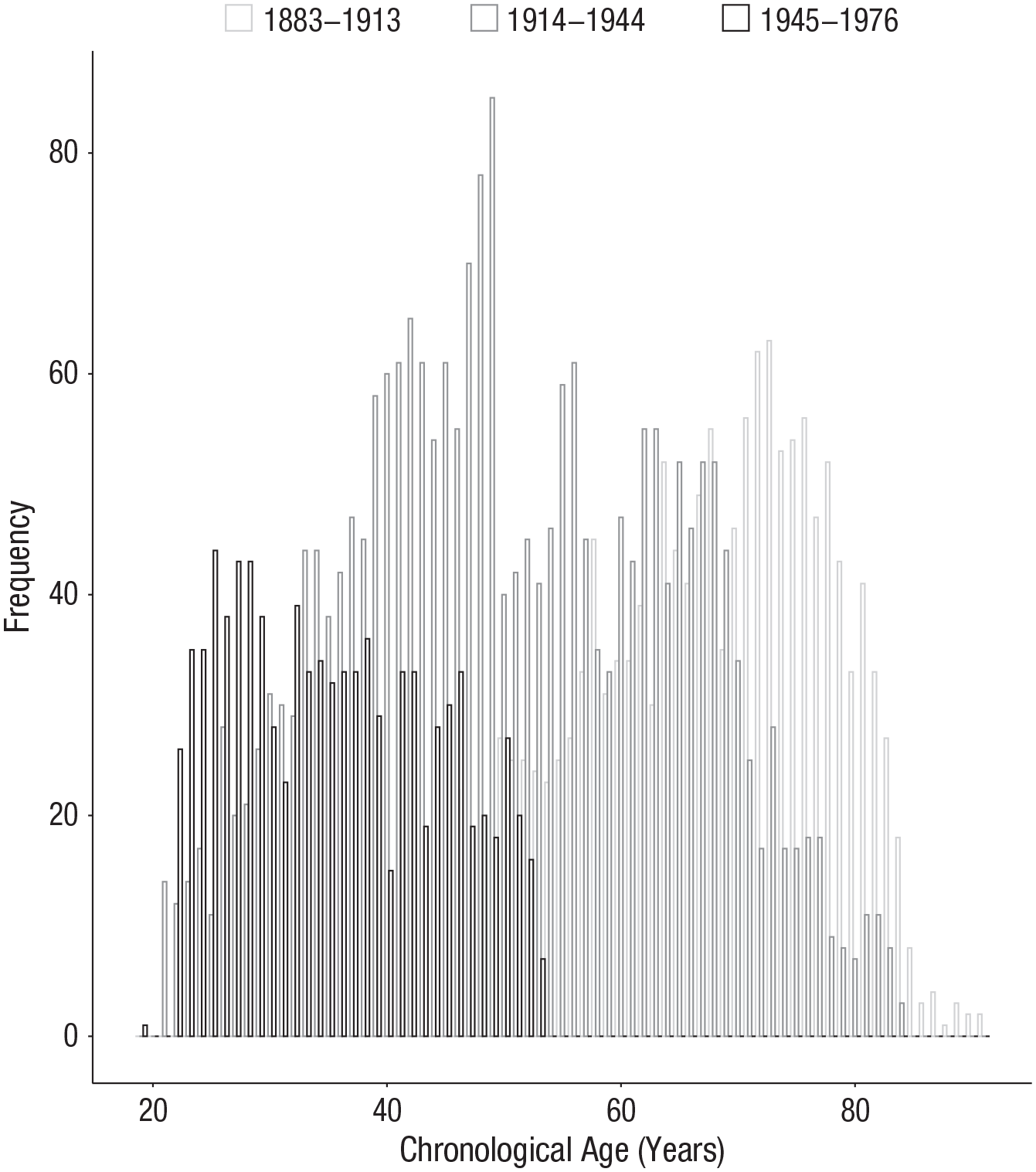
Frequency of chronological age at each individual’s baseline.
Selectivity analyses comparing individuals who completed two or more assessments (n = 2,606) with those who completed only one assessment (n = 2,126) showed that women participated more often than men (Cohen’s d < 0.10). Further, multiassessment participants had more years of formal education (d < 0.50) and were more conscientious (d < 0.15), agreeable (d < 0.22), and open (d < 0.39). Our results may thus not necessarily generalize to less positively selected, that is, less conscientious or educated, segments of the larger population.
Measures
Personality traits
In the SLS, individuals’ personality characteristics were repeatedly assessed using the TBR (Schaie & Parham, 1975), a scale with 75 true/false items (e.g., “I am known as a hard and steady worker,” “I don’t like things to be uncertain and unpredictable”). Although the TBR and its three subscales are somewhat outdated and do not straightforwardly map to modern definitions of personality, the repeated measures provide a rich resource for examining longitudinal change in personality. Making use of this unique resource, we identified a subset of items from the original TBR scales that do map onto the well-established and frequently studied Big Five taxonomy. Because a Big Five scale, the NEO Personality Inventory–Revised (NEO-PI-R; Costa & McCrae, 1992), was included in the SLS in 2005, we were able to do the mapping in an empirical way by examining how responses to TBR items were correlated with the NEO-PI-R scales. The 21 TBR items shown in Table 1 had the highest correlations and provided a reasonable basis for measurement of the Big Five traits in the nine-wave data. The TBR measured agreeableness with five items, openness with five items, extraversion and conscientiousness with four items each, and neuroticism with three items. Similar to previous studies using short inventories on the broad personality constructs (e.g., Brandt et al., 2020), internal consistencies indicated broad representation of each construct (ωs = .52, .40, .38, .44, and .56 for conscientiousness, agreeableness, neuroticism, extraversion, and openness, respectively). Correlations between the newly built TBR-based personality scales and the NEO domains were substantial at both the latent construct and manifest levels, ranging between .72 for agreeableness and openness and .93 for conscientiousness (see Table 2). Additional correlational patterns are shown in Table S2 and in the heat maps in Figures S1 to S5 in the supplementary materials (available at https://osf.io/px57h/). At the item level, the heat maps show that facet correlations within the NEO-PI-R scale are slightly stronger than item correlations within the TBR-based scale, but overall they clearly support the use of the newly built measurement-invariant scales (calculated as sum scores for each of the Big Five personality dimensions) in the longitudinal analysis (in the supplementary materials, see also Table S1 for correlations on scale levels and Table S3 for measurement-invariance testing). For analysis, scores on each dimension were converted to T scores (M = 50, SD = 10) based on all observations.
Test of Behavioral Rigidity (TBR) Items Used to Measure Big Five Personality Traits
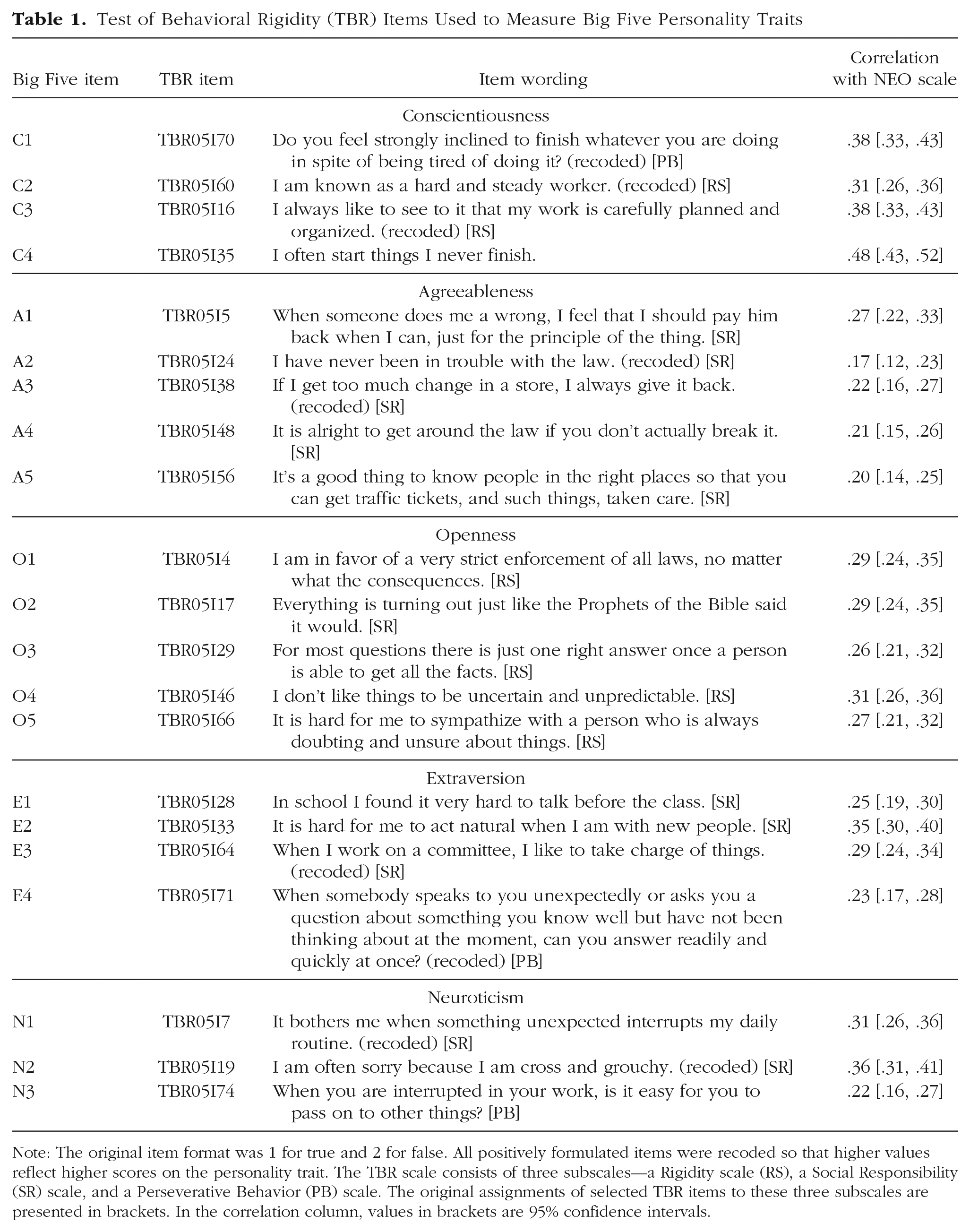
Note: The original item format was 1 for true and 2 for false. All positively formulated items were recoded so that higher values reflect higher scores on the personality trait. The TBR scale consists of three subscales—a Rigidity scale (RS), a Social Responsibility (SR) scale, and a Perseverative Behavior (PB) scale. The original assignments of selected TBR items to these three subscales are presented in brackets. In the correlation column, values in brackets are 95% confidence intervals.
Descriptive Statistics and Correlations for Key Variables in 2005 (Joint Assessment Wave of Test of Behavioral Rigidity and NEO Personality Inventory)
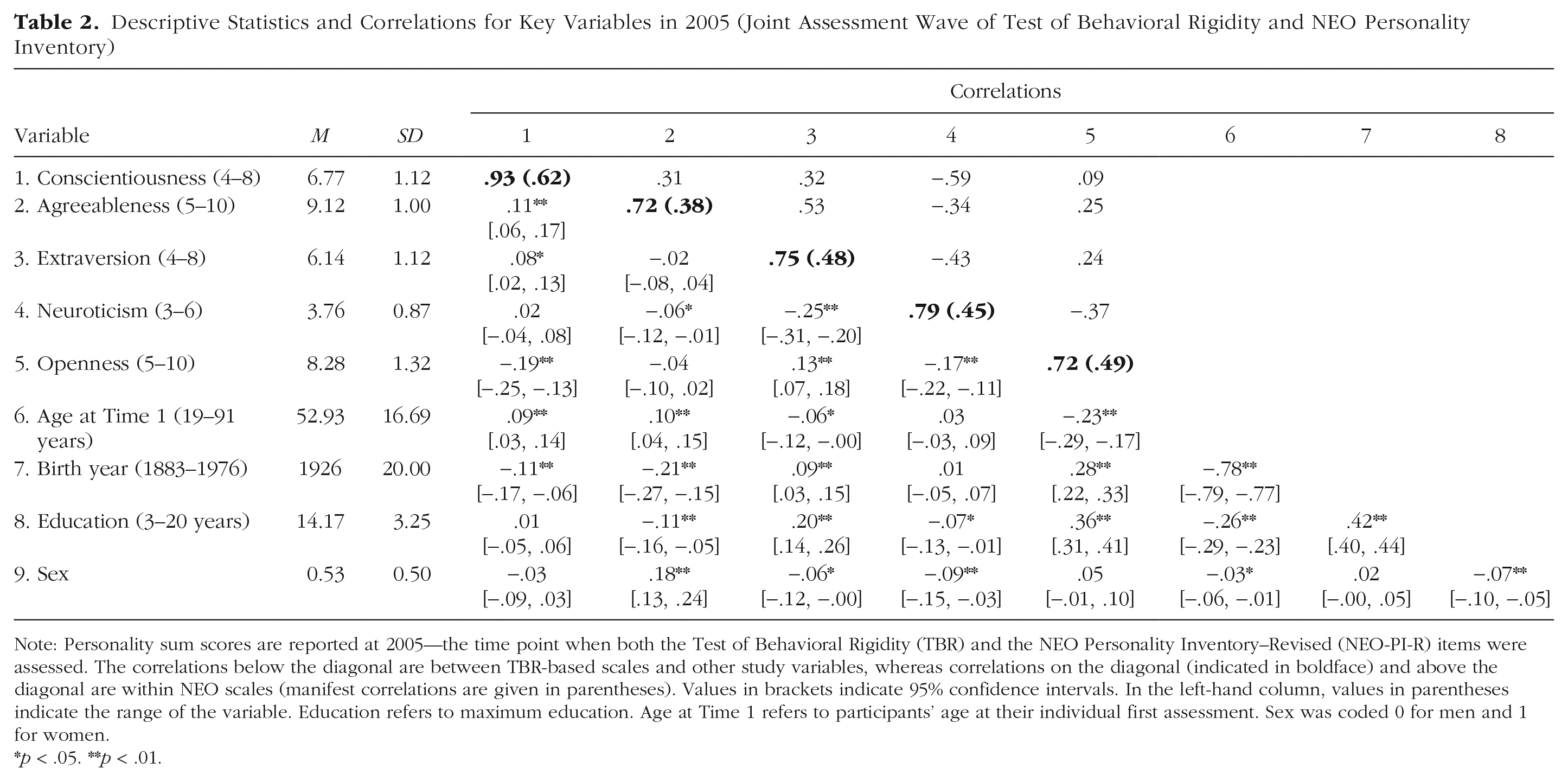
Note: Personality sum scores are reported at 2005—the time point when both the Test of Behavioral Rigidity (TBR) and the NEO Personality Inventory–Revised (NEO-PI-R) items were assessed. The correlations below the diagonal are between TBR-based scales and other study variables, whereas correlations on the diagonal (indicated in boldface) and above the diagonal are within NEO scales (manifest correlations are given in parentheses). Values in brackets indicate 95% confidence intervals. In the left-hand column, values in parentheses indicate the range of the variable. Education refers to maximum education. Age at Time 1 refers to participants’ age at their individual first assessment. Sex was coded 0 for men and 1 for women.
p < .05. **p < .01.
Time in study, age-related differences, and cohort effects
Following previous researchers (e.g., Gerstorf et al., 2019), we created three variables to assess intraindividual change, age-related differences in levels and change, and cohort-related differences in levels and change. First, intraindividual change was modeled using a person-specific time-varying time-in-study variable that captured the number of years since each individual’s baseline assessment, recentered at the midpoint of each individual’s time series, and divided by 7 to match the 7-year interval between successive waves in the SLS design. Second, age-related differences were modeled using a time-invariant variable, chronological age at the midpoint assessment, centered at the average age of the sample (58 years). Third, cohort-related differences were modeled using a time-invariant variable, birth year, centered at the average year of birth in the sample (1926). Of note, statistical analyses were done using year of birth as a continuous variable. However, for illustration purposes in our graphical representations, we display trajectories for three artificial cohort groups by dividing the range of birth years in three equally distanced groups (those born between 1883 and 1913, between 1914 and 1944, and between 1945 and 1976).
Covariates
Covariates were sex (coded as 0 = male, 1 = female) and years of education (coded as the number of years that were necessary for obtaining the final school degree), both of which were sample-mean centered for ease of interpretation.
Analytic strategy
We used separate growth models (Grimm et al., 2016) for each Big Five dimension to study intraindividual change, age-related differences, and cohort-related differences in levels of personality and change in personality, as follows (illustrated for extraversion):

where person i’s score on a given personality trait at observation t, extraversion
ti
, is modeled as a function of a person-specific intercept coefficient,



where γs are sample-level parameters describing how a personality trait differs with age, year of birth, and their interaction, and
All models were estimated using the lme4 package (Version 1.1-23; Bates et al., 2015) in the R environment (Version 4.0.2; R Core Team, 2020) using full-information maximum-likelihood procedures that accommodated incomplete data under missing-at-random assumptions. All analysis code has been made publicly available on OSF (https://osf.io/s8zk5/).
Results
Descriptive statistics and intercorrelations among the measures of interest (in 2005) are reported in Table 2. In line with previous findings (e.g., Löckenhoff et al., 2014), our results showed that women, on average, had higher levels of agreeableness and lower levels of extraversion than men but, contrary to prior findings, had slightly lower levels of neuroticism than men. Also in line with previous findings (e.g., Poropat, 2009), results showed that more time in formal education was associated with higher levels of openness. Greater age was associated with higher conscientiousness and agreeableness and with lower extraversion and openness. Overall, these findings fit very well with previous reports based on more established Big Five inventories, indicating that the newly built TBR-based personality scales worked as expected.
Developmental trajectories and age gradients of personality traits
Results from Model 1 are summarized in the upper portion of Table 3. On average, older participants had higher levels of conscientiousness (γ01 = 0.072, p < .001), agreeableness (γ01 = 0.141, p < .001), and neuroticism (γ01 = 0.037, p < .001) and lower levels of extraversion (γ01 = -0.048, p < .001) and openness (γ01 = -0.170, p < .001) than younger participants.
Results From Growth Models of Personality: Differences by Age (Model 1) and by Age and Cohort (Model 2)
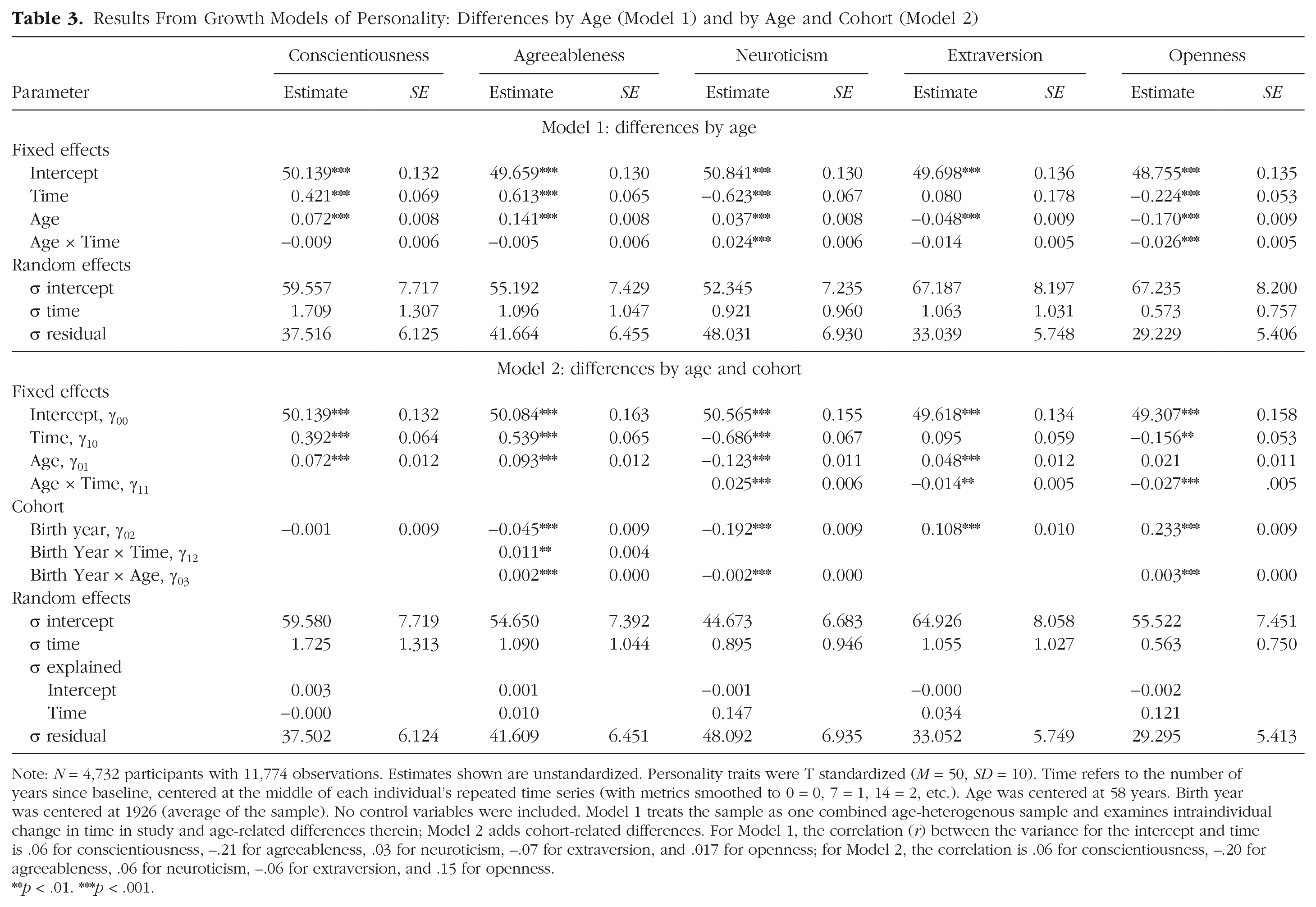
Note: N = 4,732 participants with 11,774 observations. Estimates shown are unstandardized. Personality traits were T standardized (M = 50, SD = 10). Time refers to the number of years since baseline, centered at the middle of each individual’s repeated time series (with metrics smoothed to 0 = 0, 7 = 1, 14 = 2, etc.). Age was centered at 58 years. Birth year was centered at 1926 (average of the sample). No control variables were included. Model 1 treats the sample as one combined age-heterogenous sample and examines intraindividual change in time in study and age-related differences therein; Model 2 adds cohort-related differences. For Model 1, the correlation (r) between the variance for the intercept and time is .06 for conscientiousness, –.21 for agreeableness, .03 for neuroticism, –.07 for extraversion, and .017 for openness; for Model 2, the correlation is .06 for conscientiousness, –.20 for agreeableness, .06 for neuroticism, –.06 for extraversion, and .15 for openness.
p < .01. ***p < .001.
For the prototypical individual in the sample, four of the five Big Five personality traits (the exception being extraversion) exhibited change across the waves of the study. Specifically, conscientiousness (γ10 = 0.421, p < .001) and agreeableness (γ10 = 0.613, p < .001) increased over time in study, whereas neuroticism (γ10 = -0.623, p < .001) and openness (γ10 = -0.224, p < .001) decreased over time in study. The extent of decrease was moderated by age: Older individuals exhibited shallower decreases in neuroticism (γ11 = 0.024, p < .01) and steeper decreases in openness (γ11 = -0.026, p < .001).
Consistent with established differences and trends (Bleidorn et al., 2013; Roberts et al., 2006), results showed that maturity-related traits exhibited within-person increases in conscientiousness and agreeableness and decreases in neuroticism, whereas agency-related traits (openness) decreased across time. Substantial interindividual differences occurred in the levels of all traits and the rate at which traits changed over time (see Fig. S6 in the supplementary materials at https://osf.io/px57h for a random sample of individual trajectories). Several of these effects were moderated by age, and older people experienced weaker decreases in neuroticism and steeper declines in openness.
Cohort-related differences in developmental trajectories of personality traits
Results from Model 2, which additionally allowed for cohort-related differences in personality change, are presented in the lower portion of Table 3. Results indicated substantial cohort-related differences in all personality traits but conscientiousness. Later-born cohorts had lower levels (at age 58 years) of agreeableness (γ02 = -0.045, p < .001) and neuroticism (γ02 = -0.192, p < .001) than earlier-born cohorts and higher levels (at age 58 years) of extraversion (γ02 = 0.108, p < .001) and openness (γ02 = 0.233, p < .001). There were also cohort-related differences in how agreeableness changed over time in study. Later-born cohorts exhibited steeper increases in agreeableness across time than earlier-born cohorts (γ12 = 0.011, p < .01). For some personality traits, the age gradients also differed across cohorts. Later-born cohorts exhibited steeper age-related decreases in neuroticism (γ03 = -0.002, p < .001) and age-related increases (rather than age-related decreases) in agreeableness (γ03 = 0.002, p < .001) and openness (γ03 = 0.003, p < .001).
Model-implied trajectories for all five personality traits are shown graphically in Figure 2. Separately for each of the three cohorts, the short, thick lines indicate model-implied within-person changes across time in study (in 1-year age increments), and the long, thin lines indicate model-implied age gradients. Looking specifically at the trajectories for agreeableness, we see that later-born cohorts had overall lower levels of agreeableness than earlier-born cohorts (solid black lines), that the age gradient increased more steeply for the later-born cohort (long, thin lines), and that all cohorts showed intraindividual change across time in study (dashed short line pointing upward in younger adulthood and downward in older adulthood). In complement, looking at the trajectories for openness, we see that later-born participants reported higher average levels of openness and that this effect was more pronounced for older than for younger participants.
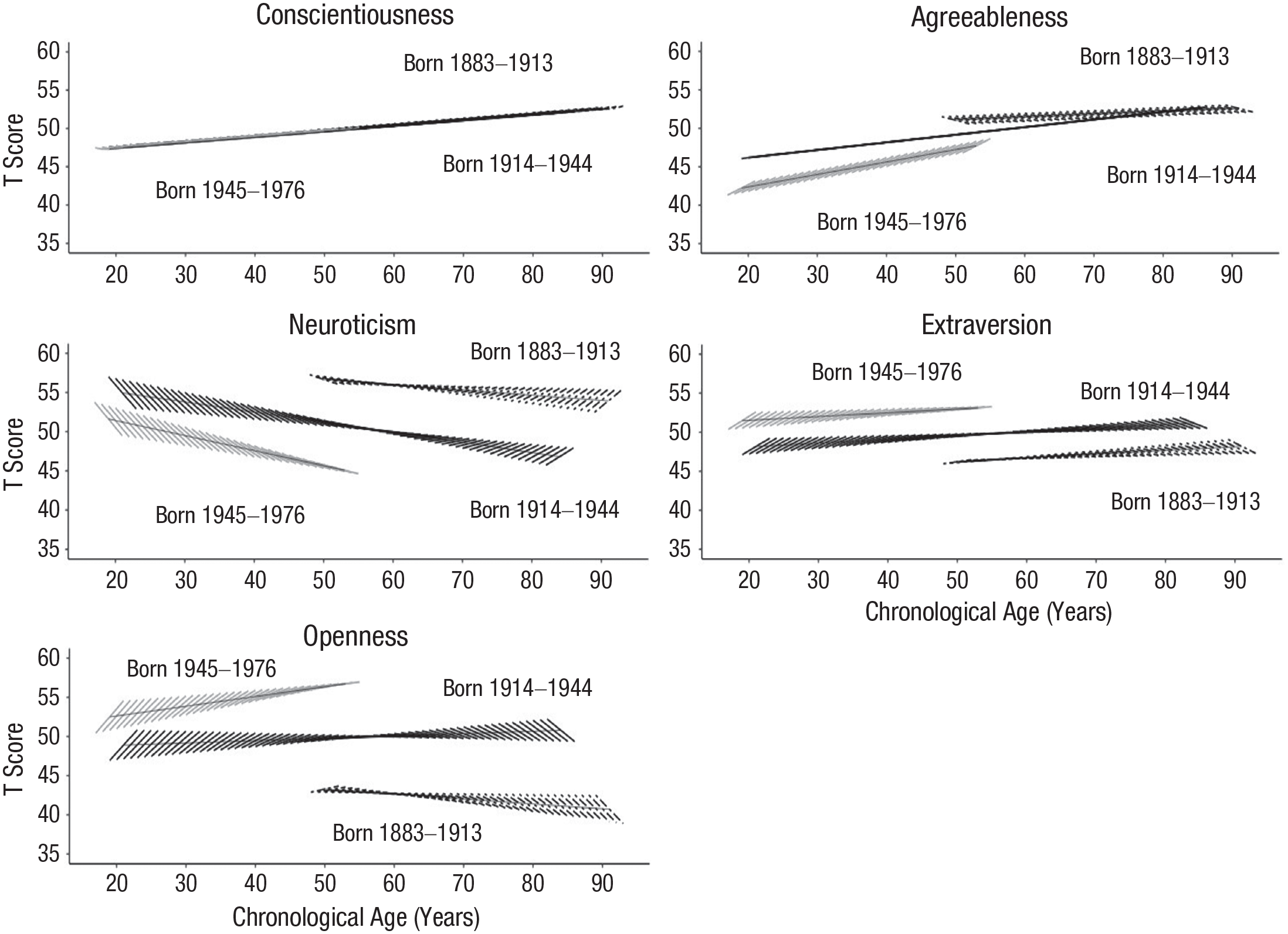
Cohort effects in model-implied personality trajectories, separately for each of the Big Five traits. Results are from growth-curve models demonstrating the model-implied within-person trajectories of personality traits (without covariates). Short, thick lines reflect model-implied within-person changes in 1-year age increments (over 5 years). Long, thin lines reflect the single linear age and selection trend plotted for each cohort separately (born between 1883–1913: n = 1,405; born between 1914–1944: n = 2,386; born between 1945–1976: n = 941).
Following standard practice in multilevel modeling (Snijders & Bosker, 2012), we calculated the relative reduction of unexplained (residual) variance in levels and rates of change between a model that estimated age effects only (Model 1) and a model that estimated both age and cohort effects simultaneously. To illustrate, we took the residual variance (at Level 2 for intercepts, Level 2 for slopes) of Model 1 (e.g., neuroticism: 52.345 from Table 3) minus the residual variance of Model 2 (e.g., neuroticism: 44.673) divided by the residual variance of Model 1 (e.g., neuroticism: 52.345) to determine that the birth-year variable reduced unexplained variance by 14.7%. Overall, birth year accounted for between nearly 0% and 15% of the variance in level and rates of within-person change in personality (small effect sizes); the largest effects were obtained for neuroticism.
Sex and education as explanatory covariates
In a final step, we included sex and education as additional predictors that might explain some of the differences. Results shown in Table 4 were quite comparable with those above except for three effects. First, the age gradient for level of extraversion was no longer significant when models accounted for the covariates. Second, a significant interaction effect between birth year and sex was observed for conscientiousness (γ04 = 0.049, p < .001), indicating that later-born women, but not men, reported higher levels of conscientiousness than earlier-born women. We furthermore found a significant interaction effect between birth year and sex in neuroticism; later-born women again reported higher levels of neuroticism than men (γ04 = 0.040, p < .01). Figure 3 illustrates the developmental trajectories of personality traits for different cohorts as implied by the conditional models. Overall, it appears that the covariates (sex and education) attenuated the cohort-related differences, suggesting that some of the cohort differences were related to historical changes in education and gender-related social roles. Including the covariates resulted in a greater reduction of unexplained variance between Model 1 and Model 3, particularly regarding agreeableness and openness.
Results From Growth Models of Personality: Differences by Age, Sex, Education, and Cohort (Model 3)
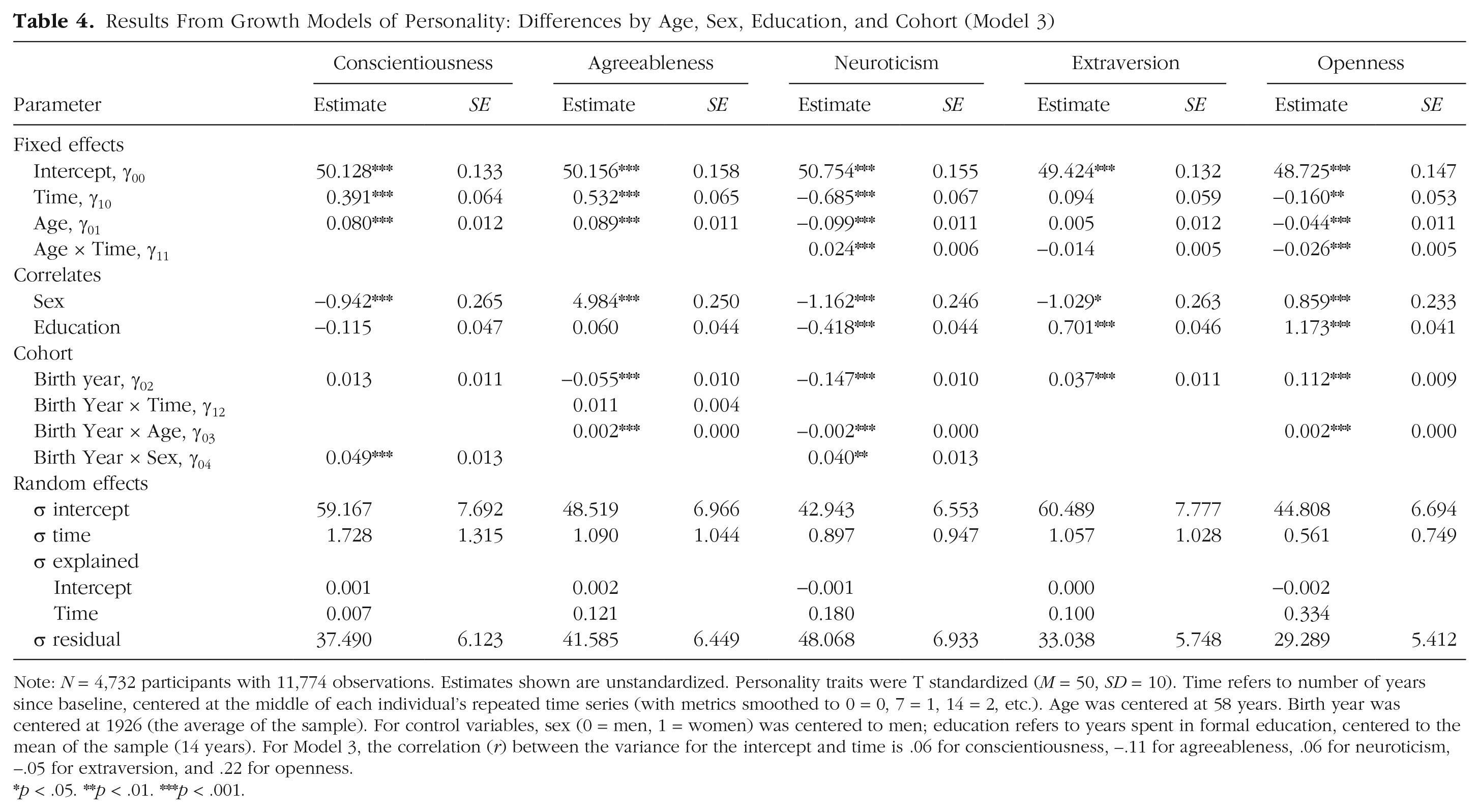
Note: N = 4,732 participants with 11,774 observations. Estimates shown are unstandardized. Personality traits were T standardized (M = 50, SD = 10). Time refers to number of years since baseline, centered at the middle of each individual’s repeated time series (with metrics smoothed to 0 = 0, 7 = 1, 14 = 2, etc.). Age was centered at 58 years. Birth year was centered at 1926 (the average of the sample). For control variables, sex (0 = men, 1 = women) was centered to men; education refers to years spent in formal education, centered to the mean of the sample (14 years). For Model 3, the correlation (r) between the variance for the intercept and time is .06 for conscientiousness, –.11 for agreeableness, .06 for neuroticism, –.05 for extraversion, and .22 for openness.
p < .05. **p < .01. ***p < .001.
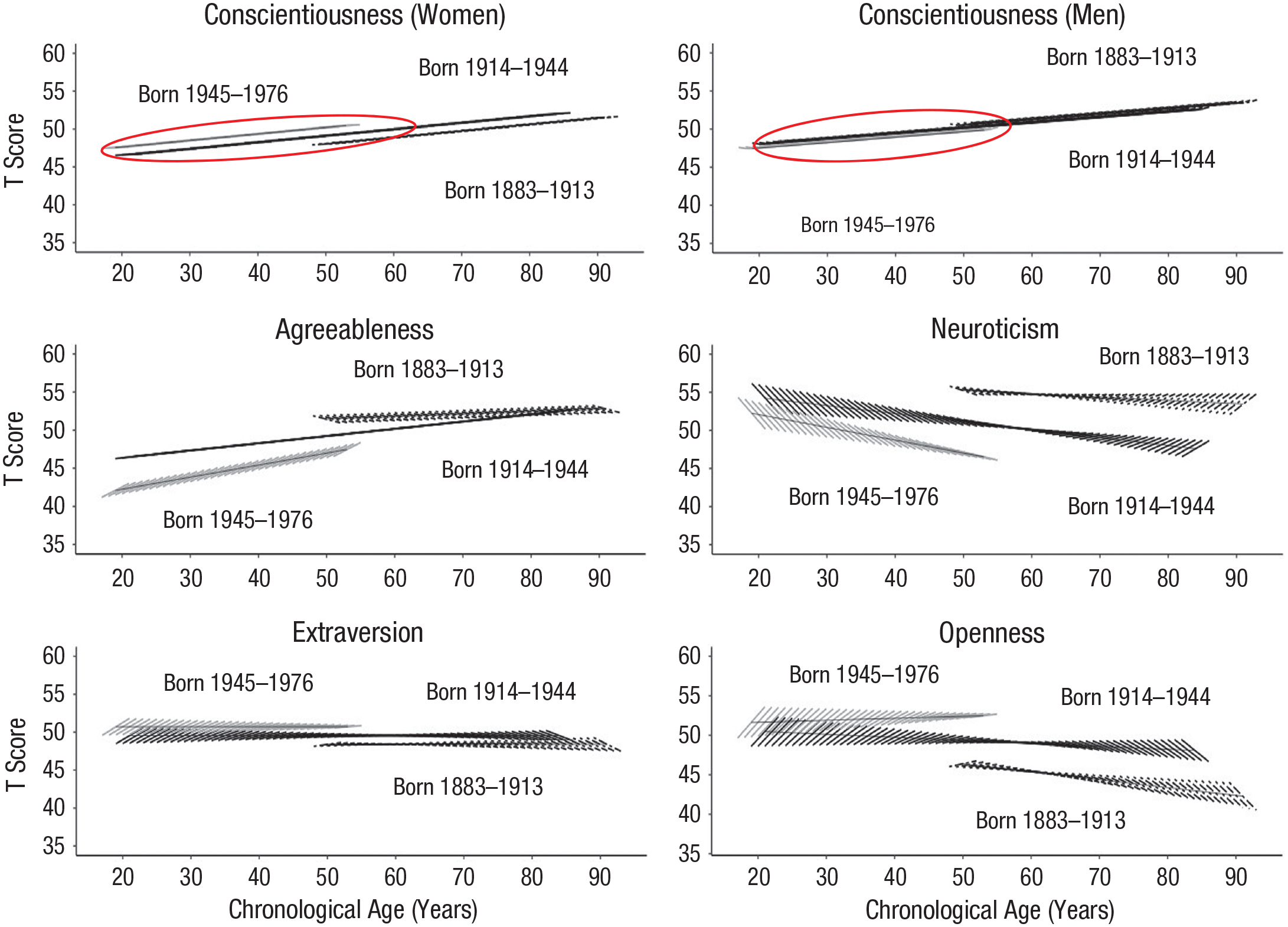
Cohort effects in model-implied personality trajectories including covariates, separately for each of the Big Five traits and broken down by sex for conscientiousness. Results are from conditional growth-curve models demonstrating the model-implied within-person trajectories of personality traits with sex and years spent in formal education as covariates. Short, thick lines reflect model-implied within-person changes in 1-year age increments (over 5 years). Long, thin lines reflect the single linear age and selection trend plotted for each cohort separately (born between 1883–1913: n = 1,405; born between 1914–1944: n = 2,386; born between 1945–1976: n = 941). Red ovals highlight main differences between women and men.
Discussion
We investigated whether people born at a specific time in history differ on average in how they act, feel, and think from same-age people who were born earlier or later—an assumption held by society and life-span theory alike (e.g., Baltes et al., 2006; Elder, 1974; Schaie, 1965). Our results provide evidence for historical changes in levels and to some extent also in developmental trajectories of personality traits. We discuss our results, noting the similarities and differences among maturity-related traits and agency-related traits, and also highlight that the age differences observed for many of these historical changes are in line with propositions on the adaptive role of maturation and social investment across human ontogenesis (Mueller et al., 2017; Roberts & Nickel, 2017).
Three key findings stand out from our results of cohort-related differences in Big Five personality. First, later-born cohorts showed lower levels of agreeableness and neuroticism and higher levels of extraversion. Although findings of neuroticism were in line with our expectations, those for conscientiousness were only partly so: Women, but not men, reported higher levels of conscientiousness among later-born cohorts, which points to stronger changes in social roles across cohorts for women than for men. The relative importance of work-related goals, such as the realization of one’s own career and family goals, might have changed across cohorts, particularly for women. This is also supported by the finding that later-born women participate more in the labor force than earlier-born women (Juhn & Potter, 2006). Increases in extraversion as an agency-related trait might be related to the established finding of more perceived control in later-born cohorts. This nicely aligns with the argument that there is a stronger likelihood of change when one believes in its feasibility (Hennecke et al., 2014). Our findings of historical changes in maturity-related traits are consistent with reports of historical improvements of living conditions and with changes in what people value and desire. By contrast, our results on historical changes in agency-related traits map onto reports of historical increases in perceived control.
We also note that our findings of lower levels of agreeableness among later-born cohorts are at odds with the findings reported by Smits et al. (2011). The different samples (American citizens on average in their late 50 vs. Dutch college freshmen) and measures might disclose age-related or cultural differences in cohort effects. In terms of culture, differences between countries in transitions to the labor force were found to be strongly associated with different maturation patterns across countries (Bleidorn et al., 2013; Chopik & Kitayama, 2018).
Second, several of the historical changes were moderated by age. In line with our expectation, it appears that later-born cohorts start to invest later in age-graded social roles and thus report lower levels in agreeableness than earlier-born cohorts in young adulthood. Prolonged education times that result in later job entries appear to delay increases in agreeableness (Bleidorn et al., 2013). But once job life has started, investments appear to be amplified, as depicted by steeper age-related increases in agreeableness and decreases in neuroticism in later-born cohorts. Later in life, social-role transitions and expectations are less clear (Freund et al., 2009), possibly leading to fewer maturity-related differences. Contrary to our expectation, our results also showed that cohort-related differences in openness were more pronounced among older adults. For such agency-related traits, Freund et al. (2009) suggested that self-regulation is particularly relevant in late life, which explains the larger differences in levels of these traits at older ages.
Third, evidence regarding cohort-related differences in developmental trajectories was weak; only within-person increases in agreeableness were more pronounced in later-born cohorts. Later-born cohorts started at a lower level, and thus further increases are rather likely to occur compared with earlier-born cohorts. Additionally, at the end of life, the differences between cohorts seem to become smaller. At the same time, one might ask why we have not found more evidence for cohort-related differences in within-person trajectories of the Big Five. It seems that time-shifted social investment comes with differences in the levels of maturity-related traits across cohorts but not with differences in the rates at which these traits change. Although cohort-related differences became smaller at older ages, later-born cohorts do not catch up with earlier-born cohorts. Because education times are longer in later-born cohorts, time for work and family goals is compressed into the rush hour of young to middle adulthood. Thus, people are not able to maximize their investment into these goals (Freund, 2020) or need to divide their investment into several roles (child care and work; Evandrou & Glaser, 2004).
Strength, limitations, and outlook
Despite the strengths of a large longitudinal data set covering 50 years of assessment, several limitations need further attention. First, the long-term personality assessments were conducted using an outdated measure (additional NEO-PI-R measures were included in 2005). The mapping between these old items and the frequently studied Big Five taxonomy showed high convergence, but we might not have captured the whole breadth of the original NEO-item content (e.g., neuroticism lacks content such as anxiety and depression, openness is based primarily on nontraditionalism). Because differences in developmental patterns can already be observed when different Big Five inventories are used (Graham et al., 2020), deviations from previous studies may also result from differences in how personality is operationally defined. It is thus pivotal for future research to test the robustness and generalizability of our findings. Relatedly, although we provide code that allows for an analytical replication of results, a lack of comparable data sets limits the experimental replication of results.
Second, although we cover a large age range, other developmentally interesting periods, such as adolescence or very old age, are not represented in our sample. Specifically, most information was available for midlife, limiting the generalizability of our findings and suggesting the need for an investigation of the onset of cohort-related differences. Potentially, cohort-related differences in personality levels in adulthood might emerge because of differential change trajectories in younger ages. Because differential change trajectories between cohorts are assumed to be shaped by the sociohistorical context in which development takes place, the generalizability of our findings to countries other than the United States needs to be further explored.
Finally, our study provided the first evidence for the propositions that joint efforts of maturation and social investment (Roberts & Nickel, 2017) help us to understand how society and historical times can shape personality characteristics. Future studies should test these assumptions more directly either by linking the experiences people make in their daily lives to personality development or by asking for the individual values and desires that potentially guide their investments.
Conclusion
Do generations really differ in how they generally act, feel, and think, and do they develop differentially across the life span? The answer is mixed. People born at different times indeed differ, on average, in how conscientious, agreeable, neurotic, extraverted, and open they are. These differences were more pronounced in younger than older people for maturity-related traits, but the opposite was true for agency-related traits. We found little evidence that the rates by which personality changes differ across historical times. Our results yielded initial evidence for cohort-related differences in levels of Big Five personality characteristics that point to delayed social-investment and maturity effects in later-born adults compared with those born earlier.
Supplemental Material
sj-docx-1-pss-10.1177_09567976211037971 – Supplemental material for Acting Like a Baby Boomer? Birth-Cohort Differences in Adults’ Personality Trajectories During the Last Half a Century
Supplemental material, sj-docx-1-pss-10.1177_09567976211037971 for Acting Like a Baby Boomer? Birth-Cohort Differences in Adults’ Personality Trajectories During the Last Half a Century by Naemi D. Brandt, Johanna Drewelies, Sherry L. Willis, K. Warner Schaie, Nilam Ram, Denis Gerstorf and Jenny Wagner in Psychological Science
Footnotes
Transparency
Action Editor: Karen Rodrigue
Editor: Patricia J. Bauer
Author Contributions
K. W. Schaie and S. L. Willis provided the data. N. D. Brandt, D. Gerstorf, J. Drewelies, and J. Wagner designed and planned the study. N. D. Brandt conducted the data analysis and drafted the manuscript. N. D. Brandt and N. Ram designed the figures. All authors discussed the results, contributed to writing the manuscript, and approved the final manuscript for submission.

References
Supplementary Material
Please find the following supplemental material available below.
For Open Access articles published under a Creative Commons License, all supplemental material carries the same license as the article it is associated with.
For non-Open Access articles published, all supplemental material carries a non-exclusive license, and permission requests for re-use of supplemental material or any part of supplemental material shall be sent directly to the copyright owner as specified in the copyright notice associated with the article.
