




Abstract
Overconfidence is one of the most ubiquitous biases in the social sciences, but the evidence regarding its overall costs and benefits is mixed. To test the possibility that overconfidence might yield important relative benefits that offset its absolute costs, we conducted an experiment (N = 298 university students) in which pairs of participants bargained over the unequal allocation of a prize that was earned through a joint effort. We manipulated confidence using a binary noisy signal to investigate the causal effect of negotiators’ beliefs about their relative contribution to the outcome of the negotiation. Our results provide evidence that high levels of confidence lead to relative benefits (how much one earns compared with one’s partner) but absolute costs (how much money one receives overall). These results suggest that overconfidence creates an inefficient equilibrium whereby overconfident negotiators benefit over their partners even as they bring about joint losses.
Overconfidence is one of the most ubiquitous biases in the social sciences, but the evidence regarding its overall costs and benefits is mixed. For example, on the cost side of the equation, overconfident people often fail for lack of sufficient planning (Shipman & Mumford, 2011; Xiao et al., 1997) and fail to reach negotiated settlements because they think they can get a better deal (Babcock et al., 1995; Bazerman & Neale, 1982; Neale & Bazerman, 1985). On the benefit side, people often defer to their overconfident peers (Anderson et al., 2012; Murphy et al., 2015), in part because overconfidence is persuasive (Schwardmann & van der Weele, 2019; Soldà et al., 2020; von Hippel & Trivers, 2011).For example, overconfident job applicants are perceived as more qualified than applicants who hold accurate perceptions of their abilities (Ronay et al., 2019), and overconfident negotiators generate higher gains when they reach an agreement than those who hold more accurate appraisals of their bargaining position (Heifetz and Segev, 2004). Indeed, the more people demand, the more they get (Galinsky & Mussweiler, 2001; Moore, 2004; White & Neale, 1994), and greater confidence leads to greater demands (Kramer et al., 1993; McGillicuddy et al., 1984; Thompson & Loewenstein, 1992).
One way to reconcile the costs and benefits of overconfidence is to consider whether a contested outcome is perceived in relative or absolute terms. Absolute benefits matter, of course, but relative outcomes loom large whenever people jockey for status, which is determined entirely by how one compares with others (Brosnan & De Waal, 2003; Buss, 1989). As a consequence, people will sometimes reduce their absolute outcomes if that sacrifice enables them to improve their ranking relative to others (Charness et al., 2014). In the case of overconfidence, the costs tend to manifest in absolute terms (e.g., failure or injury), but the benefits emerge primarily in relative or interpersonal terms (Anderson et al., 2012; Murphy et al., 2015, 2018). Although relative and absolute benefits typically go hand in hand, relative benefits can accrue at an absolute cost (e.g., when a competition injures or depletes both parties but yields a clear winner).
In the current investigation, we explored the hypothesis that overconfidence yields relative gains even in the presence of absolute costs. To test this possibility, we examined the costs and benefits of high levels of confidence in a distributive negotiation—a form of dispute resolution in which win-win or pie-expanding outcomes are not possible. Distributive negotiations emerge whenever people compete over assets that have equal value to both parties, and hence negotiators are prevented from arriving at a mutually satisfying resolution in which each party chooses their preferred assets. Although many negotiations have the potential to yield integrative, or win-win, solutions, distributive solutions are nonetheless common, as both sides often fail to recognize win-win opportunities (Thompson & Hrebec, 1996). Such outcomes are particularly likely when competing parties perceive their interests as diametrically opposed (Bazerman & Neale, 1983). For example, despite the fact that both workers and management are highly dependent on the success of their company, they often see their interests as being in direct opposition to each other. When their disagreements are sufficient to lead workers to strike, both parties enter distributive negotiations with the added quality that the time spent to reach a settlement becomes an additional and substantial cost to both parties. This form of “shrinking-pie” negotiation is the canonical model of bargaining in economics (Rubinstein, 1982)—as it captures the costs of both delays and failure to reach a settlement—and is the situation we simulated in the current research.
Such negotiations are an example of mixed-motives games, as they are characterized by a blend of cooperative incentives (reaching a deal) and conflictual incentives (reaching a better deal; Schelling, 1961). This blend of incentives creates a trade-off between being conciliatory and being intransigent. In such a context, overconfidence may simultaneously generate relative benefits and absolute costs. By enhancing intransigence, overconfidence might improve one’s outcome relative to others while simultaneously introducing delays and reducing the chances of a successful negotiation, to the detriment of both parties.
To test this possibility, we adapted an experimental design from the TV game show “Divided” (van Dolder et al., 2015), in which pairs of participants must agree on how to allocate a prize resulting from a joint effort. The prize can be allocated only in unequal portions, in contrast to the common default of sharing any joint outcome 50-50, and participants negotiate over who gets the larger share. To isolate the causal role of confidence in this context, we chose to manipulate confidence rather than measure it as an individual-differences variable. In service of this goal, prior to the negotiation, we provided “noisy” 1 feedback to participants, which indicated that they were likely to have performed either better or worse than their partner.
Statement of Relevance
Overconfidence is a conundrum, as it is both costly and ubiquitous. For example, overconfidence often prevents negotiators from reaching an agreement, resulting in lost opportunities for mutually beneficial solutions. In this research, we tested the idea that overconfidence persists because it provides relative benefits to more confident individuals despite its absolute costs. We designed an experiment in which pairs of participants negotiated over a reward resulting from a joint effort. We found that high levels of confidence led people to earn more than their partners (a relative benefit) but also resulted in lower earnings for both partners (an absolute cost). These results suggest that overconfident negotiators benefit over their partners even as they bring about joint losses, thereby providing a possible explanation for why overconfidence is both common and costly at the same time.
There are two important points to make with regard to our manipulation of confidence. First, our experiment focuses on the form of overconfidence in which people overestimate their performance relative to the performance of others (the second type of overconfidence defined by Moore & Healy, 2008). Second, by manipulating confidence, we removed the aspect of overconfidence that is clearly an error in judgment; our overconfident participants were told that they probably outperformed their partners, and hence they were arguably engaged in a Bayesian integration of the feedback they have received. For this reason, from this point forward, we use the more neutral terms high and low levels of confidence to refer to levels of over- or underconfidence that emerged as a result of our manipulated feedback.
Method
The experimental design and hypotheses were preregistered on AsPredicted (https://aspredicted.org/bj9er.pdf). Note that we have occasionally clarified the hypotheses for expositional purposes, and we relegated the hypotheses and analyses on agreement failures to the supplementary online material (SOM; see Section 2.4 at https://osf.io/2j6ne/). No data point was excluded from the analyses.
Participants
We recruited a total of 298 participants via hroot (Bock et al., 2014). Participants were mainly students from local engineering, business, and medical schools. The experiment was conducted over a series of 21 sessions that involved an average of 14 participants per session, and participation took place in GATE-LAB (Écully, France). Overall, 54% of the participants were female, and the average age was 23 years (SD = 5.48).
Participants were paid the sum of their earnings for each phase of the experiment in addition to a €5.00 show-up fee. The experiment took an average of 1 hr, and the average payoff was €15.71 (SD = 6.72). Participants received their payment in private at the end of the experiment. Our intent was to run 300 participants. With that sample size, the minimum detectable effect size with statistical power at the recommended .80 level was a Cohen’s d of 0.32 for mean comparisons between participants who received a good signal and participants who received a bad signal and a Cohen’s d of 0.46 for mean comparisons between the four possible combinations of signals (Cohen, 1988).
Procedure and measures
The experiment was programmed using oTree (Chen et al., 2016) and was composed of four parts, which we refer to as the individual phase, the partner phase, the manipulation phase, and the negotiation phase. We used the individual phase to match participants in pairs. In the partner phase, both participants in a pair answered general-knowledge questions to build a joint prize. In the manipulation phase, we elicited participants’ beliefs about their performance in the partner phase relative to their partner’s performance. In the negotiation phase, pairs of participants negotiated the allocation of their shared prize. The timeline of the experiment is displayed in Figure 1. Translated experimental instructions are available in the SOM (see Section 1.2 at https://osf.io/2j6ne/).
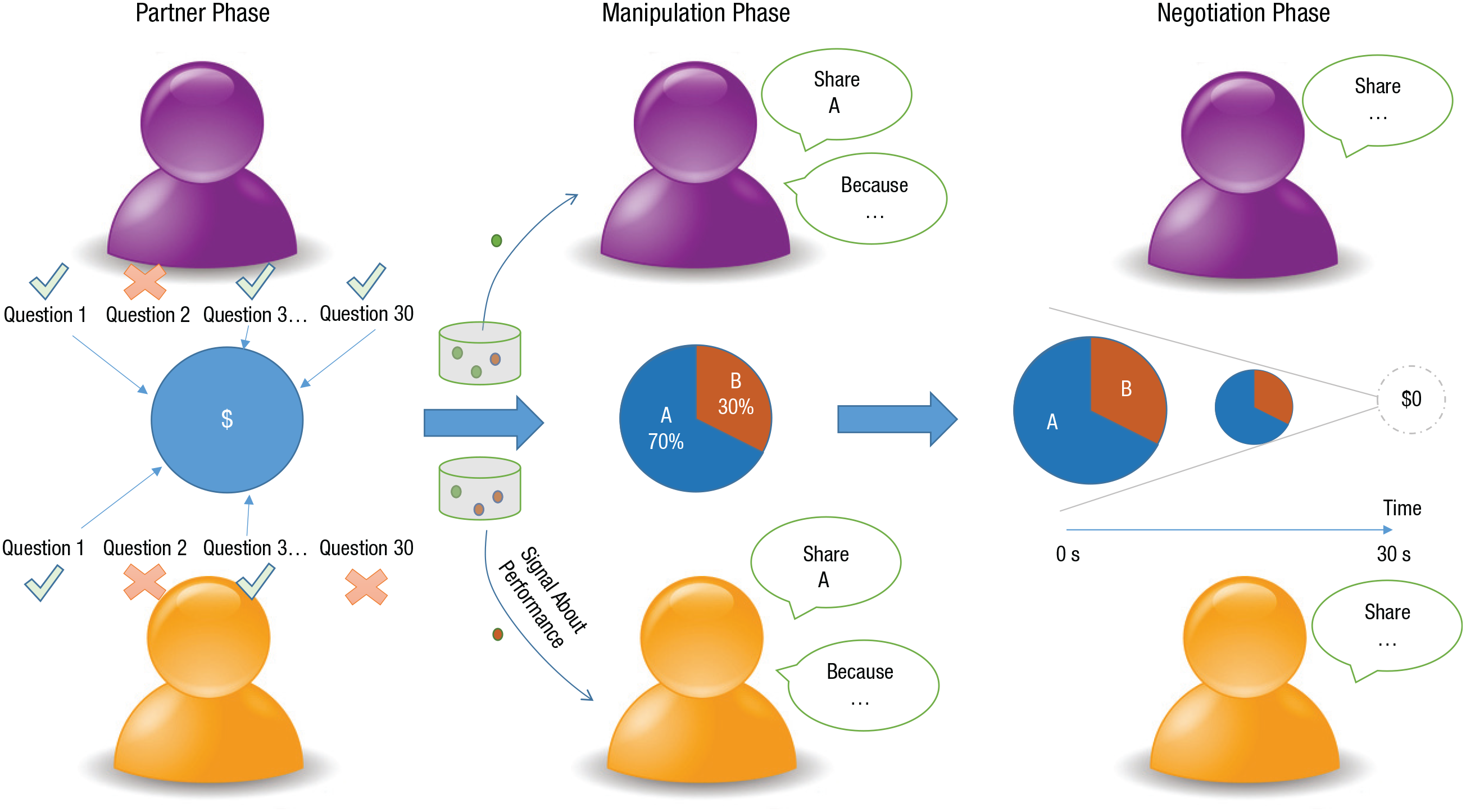
Schematic representation of the experimental design. Participants were assigned to pairs, and each individually took a quiz (partner phase); their correct answers contributed to a joint prize. After the quiz, they received noisy feedback about who was likely the better performer in the pair (manipulation phase). The prize money was then divided into two unequal shares, and participants claimed the share they wanted. If they claimed the same share, they could argue via chat for up to 3 min (negotiation phase), at which point the prize started to shrink. The value of the prize diminished steadily to zero after 30 s if no agreement was reached.
Individual phase
In the first phase, participants answered 10 general-knowledge questions individually. For each question, they chose the correct answer from among four options. Participants received €0.20 for each correct answer. At the end of the individual phase, participants were ranked according to their performance on the quiz. The participant with the highest score was ranked 1, and the participant with the lowest score was ranked n (with n = the total number of participants in the session). Participants were not informed of their rank, and they received information only about their score and their payoff for this stage at the end of the experiment.
Partner phase
In the second phase, participants were matched in pairs according to their rank: The participant ranked n was matched with the participant ranked n − 1, the participant ranked n − 2 was matched with the participant ranked n − 3, and so on until all participants were paired. This pairing procedure was common knowledge among participants and was intended to clarify that both members were able to contribute to the joint prize more or less equally. Participants then answered 30 general-knowledge questions individually. The questions used in both phases of the experiment are available in the SOM (see Section 1.3 at https://osf.io/2j6ne/). As in Phase 1, the questions were the same for all participants, and they had to choose the correct answer from four options. Participants received €0.67 for each correct answer, and the money earned by both participants in each pair was allocated to a joint account. To prevent participants from inferring each other’s performance from the value of their joint account, we randomly drew the productivity p of the pair {i, j} from a uniform distribution U(0.75, 1.25). If we denote ci the number of correct answers of participant i and cj the number of correct answers of participant j from the pair {i, j}, the value v of the joint prize of the pair {i, j} can be computed as follows: v{i,j} = 0.67 × p{i,j} × (ci + cj).
Manipulation phase
After participants completed the 30 general-knowledge questions, we elicited their beliefs about their absolute and relative performance in the partner phase. First, participants were asked to report their beliefs about the number of questions they answered correctly in the partner phase. Participants received €1.00 if their estimate was exact or deviated from their true performance by only one question and €0.50 if their estimate deviated from their true performance by two questions. If the estimate deviated by more than two questions, they did not earn or lose anything. Participants were then asked how likely it was that they outperformed their partner in the partner stage. Participants, without being provided with any incentives, indicated their belief on a scale from 0% to 100% on a slider.
We then manipulated participants’ beliefs about their relative performances by giving them a private noisy binary signal, using a procedure adapted from Schwardmann and van der Weele (2019). The noisy feedback was designed to create random variation in participants’ confidence about their relative contributions, without deception. Participants were shown two virtual urns containing 20 balls of two different colors (red and green) and were told that the computer program would select a ball from one of these two urns. If participants performed better than their partners did in the partner phase, the ball was drawn from the urn with 15 green balls and five red balls. If participants performed worse than their partners did in the partner phase, the ball was drawn from the urn with five green balls and 15 red balls. Therefore, participants who outperformed their partners were more likely to see a green ball, and participants who were outperformed by their partners were more likely to see a red ball.
After the ball was shown to participants, we once again elicited their beliefs about their relative performance in the partner phase. After this final belief elicitation, the value vij of the joint prize was displayed on the screen, and participants were asked to decide how to share their prize during a three-stage negotiation process. Participants had been told that they would split the prize in the partner phase, but they were given instructions only on the details of the split and the negotiation procedure after the last belief elicitation.
Negotiation phase
In the final phase, participants were informed that their joint prize had been divided into two unequal shares. Their task was to reach an agreement on the allocation of these shares. The large share was equal to 70% of the joint prize (0.7vij), and the small share was equal to 30% of the joint prize (0.3vij). The negotiation process was divided into three stages. Participants had the opportunity to reach agreement in each of the three stages. However, vij decreased in Stage 3. The unfolding of the stages was described to participants before they entered the negotiation process.
In Stage 1, participants were asked to claim either the high share or the low share and to write a message to their partner to justify their choice. There was no time constraint in this stage. If the negotiators from the same pair claimed different shares, an agreement was reached: The participant who claimed the large share received 0.7vij, and the participant who claimed the small share received 0.3vij. In this case, the negotiation process ended in Stage 1, and participants did not enter Stage 2 or Stage 3. If both negotiators claimed the large share in Stage 1, they proceeded to Stage 2. Both participants would also enter Stage 2 if they both chose the small share in Stage 1, but this situation never occurred in our experiment.
In Stage 2, participants who did not agree in Stage 1 were given an additional 3 min to try to reach an agreement. During these 3 min, participants could communicate with their partners by means of a chat box. The communication within pairs was restricted in only two ways: Participants were not allowed to reveal the color of the ball that was shown to them or communicate any private information that would remove their anonymity. They were reminded of the amount allocated to each share, their own decision in Stage 1, and their partner’s decision in Stage 1. They could decide to switch from the large share to the small share at any time by hitting the corresponding button on their screen. An agreement was reached when one of the negotiators in the pair switched from the large share to the small share. In this case, the participant who claimed the large share received 0.7vij, the participant who claimed the small share received 0.3vij, and the negotiation ended. If no agreement was reached within the allocated time, participants proceeded to Stage 3.
In Stage 3, participants were given an additional 30 s to try to reach an agreement. For each second spent in this stage, the value of the joint prize and hence the amount in each share decreased linearly and proportionally, such that both shares were equal to zero at the end of the 30 s. On their screen, participants could observe the value of the shares decreasing in real time (i.e., shrinking every second). The shares stopped shrinking when one participant chose the small share. In this case, the participant who chose the large share received the remaining amount allocated to the large share, and the participant who switched to the small share received the remaining amount allocated to the small share. If no one switched before the end of the 30 s, both negotiators received nothing, and the total value of the joint prize was lost.
At the end of the negotiation phase, participants completed a demographics questionnaire in which they were asked to report their gender, age, and risk preferences. We elicited risk preferences by asking participants to indicate how willing they were to take risks in general on a scale from 0 to 10 (Dohmen et al., 2005).
Results
For each pair of participants {i, j}, we had four possible combinations of signals: (a) i received a bad signal and j received a good signal, (b) both i and j received a bad signal, (c) both i and j received a good signal, and (d) i received a good signal and j received a bad signal. The payoffs associated with each of these combinations are displayed in Table 1, separately for absolute outcomes and relative outcomes. Absolute payoffs were measured as the percentage of the initial prize received by each participant after the negotiation. This measure incorporated the possible loss of prize money in the negotiation process: As the prize money shrunk, the sum of absolute payoffs progressively approached zero. In contrast, relative payoffs were measured as the share of the final prize (i.e., the remaining amount of the joint prize at the end of the negotiation) received by each participant. Relative payoffs reflected only how well players did compared with each other, not relative to the initial amount they could have received.
Players’ Payoffs as a Function of Their Own Signal and the Signal of Their Partner
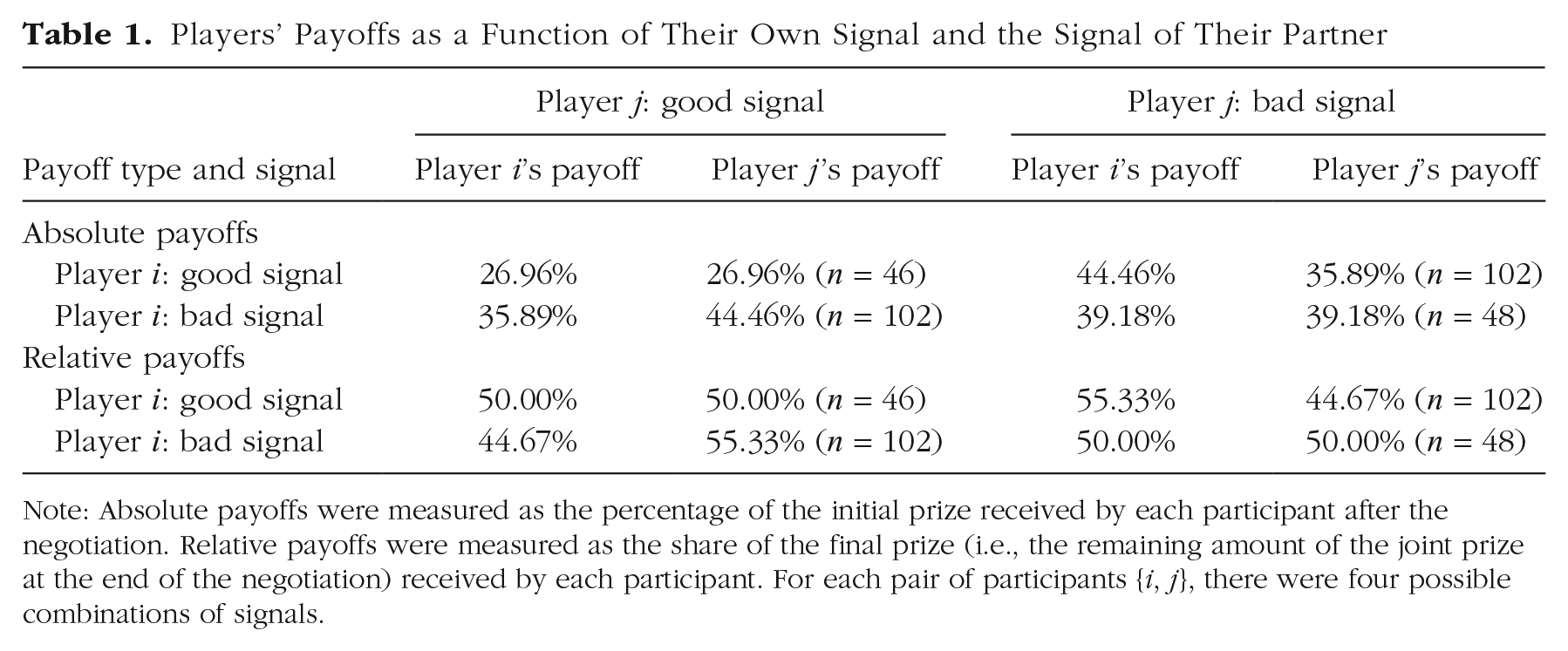
Note: Absolute payoffs were measured as the percentage of the initial prize received by each participant after the negotiation. Relative payoffs were measured as the share of the final prize (i.e., the remaining amount of the joint prize at the end of the negotiation) received by each participant. For each pair of participants {i, j}, there were four possible combinations of signals.
The average absolute payoffs were lower when both participants received good signals than when both received bad signals. For pairs of participants who received opposite signals, the participant with the good signal received more than the participant with the bad signal in both relative and absolute terms.
Identification strategy
Because a participant’s confidence in our experiment is likely to be correlated with unobserved characteristics (e.g., dominance, extraversion, dispositional overconfidence), we cannot rely on raw confidence levels to establish a causal relationship between participants’ confidence and their outcome in the negotiation stage. Instead, to avoid the pitfalls of endogeneity, we used the exogenous variation in confidence that emerged from the noisy component of the signal given to participants. The signal is informative about the true state of the world (i.e., whether the participant performed better than his or her partner) because it is accurate in 75% of cases. Hence, it is no surprise that it shifted participants’ beliefs (see Fig. 2).
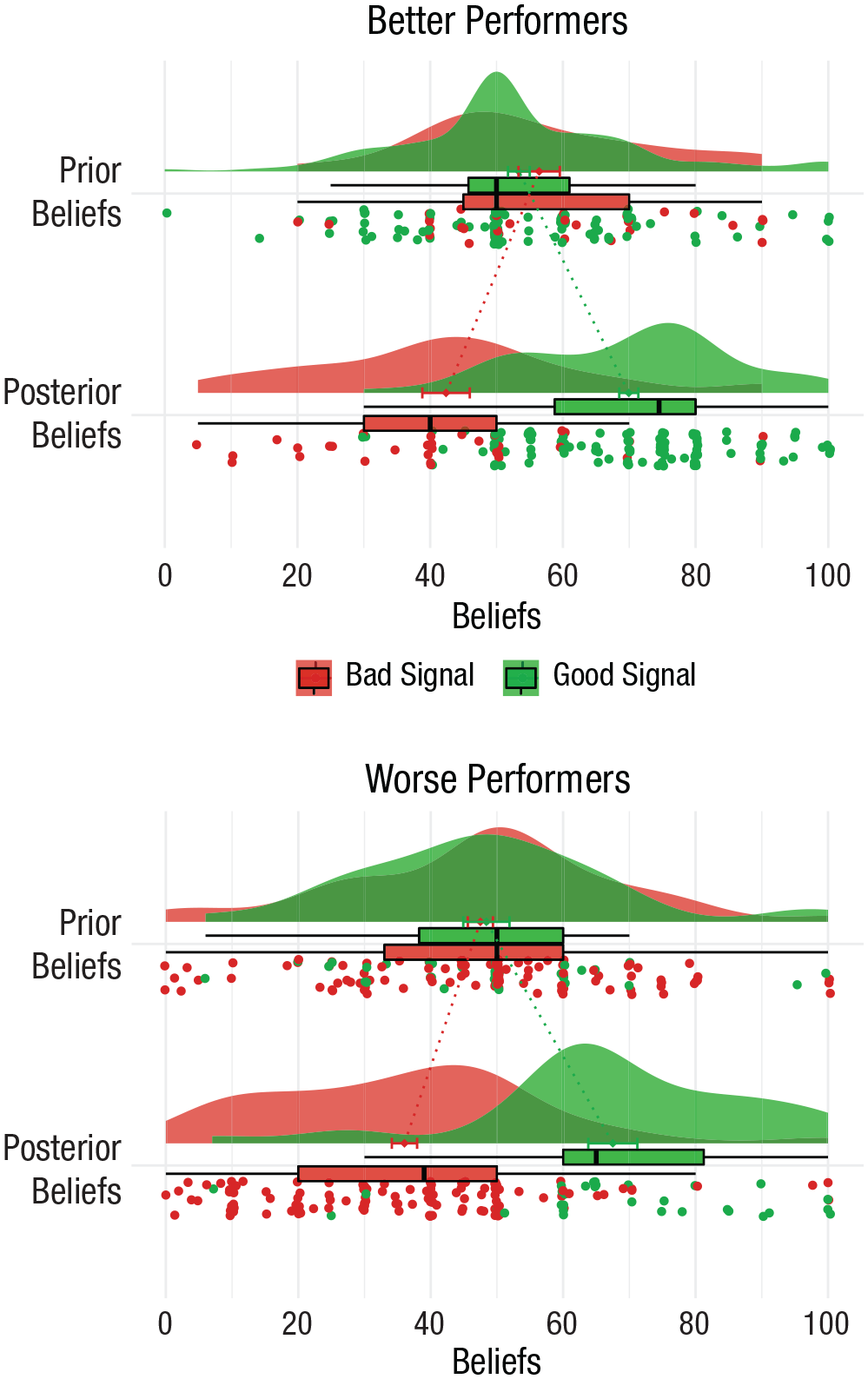
Prior and posterior beliefs of participants who were the better performer in the pair (top) and participants who were not (bottom), separately for when they received a good and a bad signal. Means (with error bars showing standard errors) are shown above each set of horizontal boxes. Dashed lines connect relevant means for prior and posterior beliefs. In each box, the horizontal line indicates the median; the left and right edges of the box indicate the first and third quartiles, respectively; and the whiskers extend 1.5 times the interquartile range. Dots indicate individual data, and the shaded areas show the distribution of the data.
Nevertheless, the signal observed by a participant was completely random and exogenous, conditional on the true state of the world (i.e., a participant randomly got a good signal with 75% probability if he or she was the better performer in the pair and with 25% probability otherwise). Because we knew whether the participant was the better performer, we were able to perfectly control for whether they outperformed their partner by using the noisy signal as an instrumental variable (using two-stage least squares and three-stage least squares regression instead of ordinary least squares regression; see Wooldridge, 2010) for participants’ posterior beliefs. 2 The use of an instrumental variable can be envisioned as a two-step process. In the first step, we regress participants’ confidence on the signals they received (i.e., confidence is instrumented by the signal). In the second step, we regress negotiation outcomes on this estimated measure of participants’ confidence. This process allows us to isolate the causal effect of variation in participants’ confidence that comes solely from the variation in the signal received on the outcome of the negotiation.
Figure 2 shows the distribution of posterior beliefs separately for the better and worse participants and whether they received a good or a bad signal. For both types of participants, we found no difference in beliefs prior to the signal—Mann-Whitney tests (better): z = 0.597, p = .551, 3 Somers’s d = −0.0264, 95% confidence interval (CI) = [−0.117, 0.0643]; (worse) z = 0.114, p = .909, Somers’s d = −0.00484, 95% CI = [−0.867, 0.0770]—and a strong difference in beliefs after they observed the signal—Mann-Whitney tests (better): z = −6.416, p < .001, Somers’s d = 0.271, 95% CI = [0.187, 0.356]; (worse) z = −6.442, p < .001, Somers’s d = 0.264, 95% CI = [0.182, 0.346]. 4
These results show that participants were very reactive to the signal, making it a strong instrument for our subsequent analyses. To ensure that the feedback could influence outcomes only through its impact on private beliefs, we did not allow participants to discuss their feedback directly with their partner. These features of the design ensured the validity of our instrumental analysis.
Negotiation outcomes
Next, we implemented the instrumental-variable strategy described above to assess whether the patterns observed (see Table 1) were due to the causal effect of participants’ confidence on their negotiation outcomes. In service of this goal, we estimated the effect of confidence of both participants i and j from the pair {i, j}, instrumented by the signals received on participant i’s absolute and relative outcome using three-stage least-squares regressions. The marginal effects from the three-stage least-squares regressions of participants’ increase in confidence, conditional on their partners’ confidence on both the absolute and relative payoffs from the negotiations, are displayed in Figure 3.
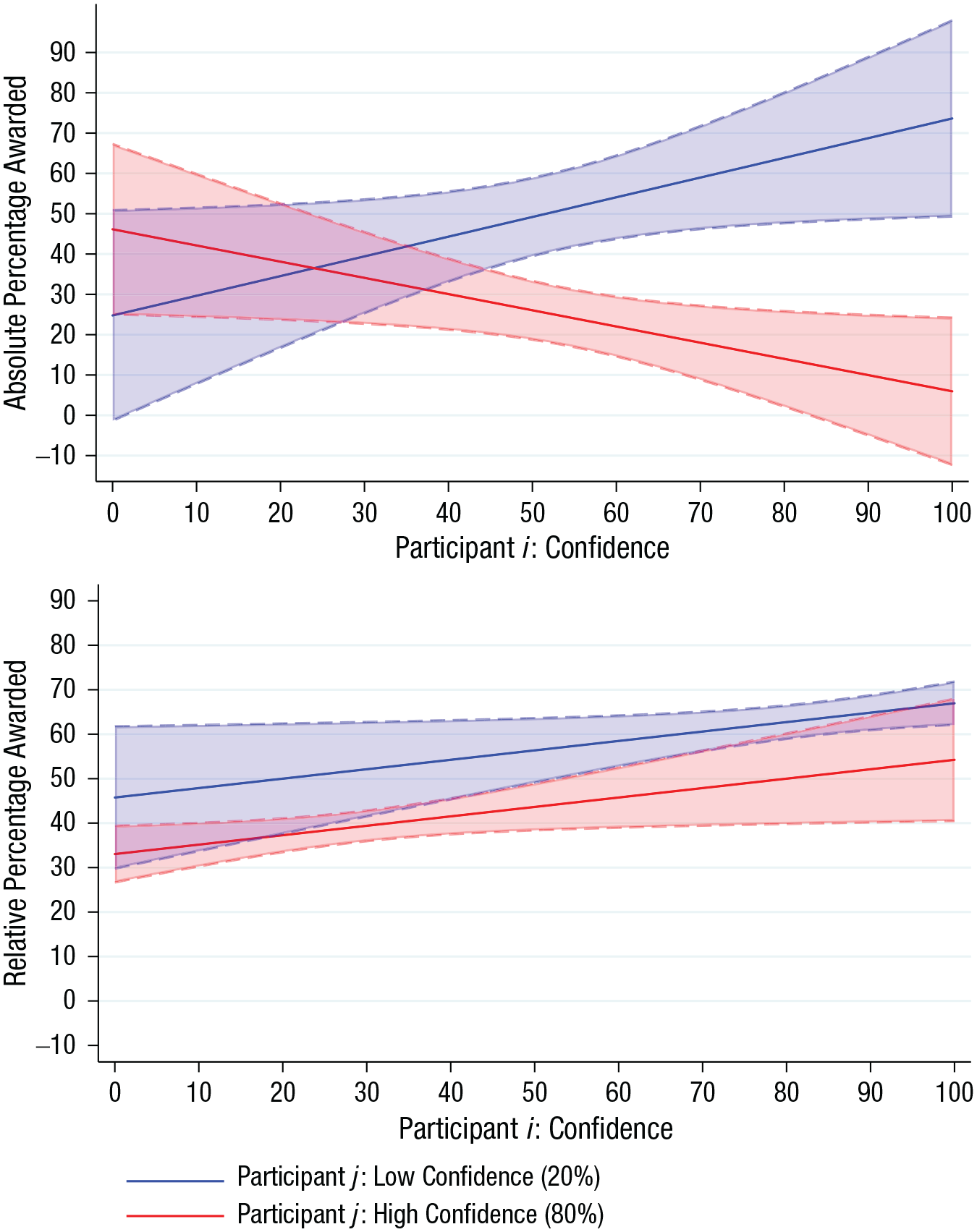
Linear prediction of the effect of participant i’s confidence in their relative performance on participant i’s absolute payoffs (top) and relative payoffs (bottom) when participant j’s confidence in their relative performance was low and high. Error bands indicate 95% confidence intervals. The estimates are from Models 1 and 9 in Table S1 (see the supplementary online material at https://osf.io/gbd8z/).
The upper panel of Figure 3 shows that an increase in participant i’s confidence led to an increase in their absolute payoff when their partner j had low confidence (partner j’s belief = 20%). However, when partner j had high confidence (partner j’s belief = 80%), participant i was penalized for having higher confidence. This interaction between the participant’s confidence and their partner’s confidence was significant (β = −0.0148, 95% CI = [−0.0257, −0.0039], z = −2.67, p = .008), regardless of whether the participant was the better performer of the pair. These results confirm that the pattern observed for absolute payoffs (see Table 1) was driven by variation in confidence generated by the noisy feedback that participants received rather than by some combination of participants’ preexisting beliefs.
In contrast to these findings with the absolute payoff, the relative payoffs were symmetric when both participants had the same degree of confidence (either high or low); the lower panel of Figure 3 shows no interaction. The effect of a participant’s own confidence was significant (β = 0.212, 95% CI = [0.0250, 0.399], z = 2.22, p = .026), and having greater confidence than one’s partner had a positive effect on relative payoffs secured (β = 0.216, 95% CI = [0.188, 0.245], z = 14.69, p < .001), regardless of whether the participant was the better performer of the pair. These estimates confirmed that the pattern observed for relative payoffs (see Table 1) reflects the causal effects of beliefs on payoffs. Overall, these results suggest that higher levels of confidence can be beneficial in relative terms, even when they come at a cost in absolute terms. Table S2.3 (see the SOM at https://osf.io/2j6ne/) shows that these results held when analyses excluded pairs of participants who agreed in Stage 1, suggesting that the results were not driven only by participants who did not interact with their partners.
Agreements
Other aspects of the negotiation process also suggest that high levels of confidence within pairs of negotiators led to conflicts in negotiations and hence to a smaller final prize. Figure 4 displays the percentage of agreements reached in each stage of the negotiation. Overall, 6.04% of the pairs reached an agreement in Stage 1, 36.24% reached an agreement in Stage 2 (1–180 s), and 42.95% reached an agreement in Stage 3 (181–210 s); 14.77% of pairs did not reach an agreement at all. The spikes in agreement around 180 s suggest that, perhaps unsurprisingly, most pairs agreed either at the end of Stage 2 (14.77%) or immediately when the shares started to shrink in Stage 3 (32.89%). Figure 4 also shows that delays or failures to reach an agreement occurred frequently, suggesting that a substantial amount of the initial prize was lost in the negotiation process. Such delays and failures are driven in part by pairs of negotiators who were both high in confidence. The results for absolute payoffs (see Table 1) show that the average percentage of the initial prize awarded at the end of the negotiation among pairs of participants who received two good signals was 26.43% lower than the share awarded to pairs of participants who received signals of opposite valence (Mann-Whitney test: z = 2.453, p = .014, Somers’s d = −0.12, 95% CI = [−0.217, −0.0136]).
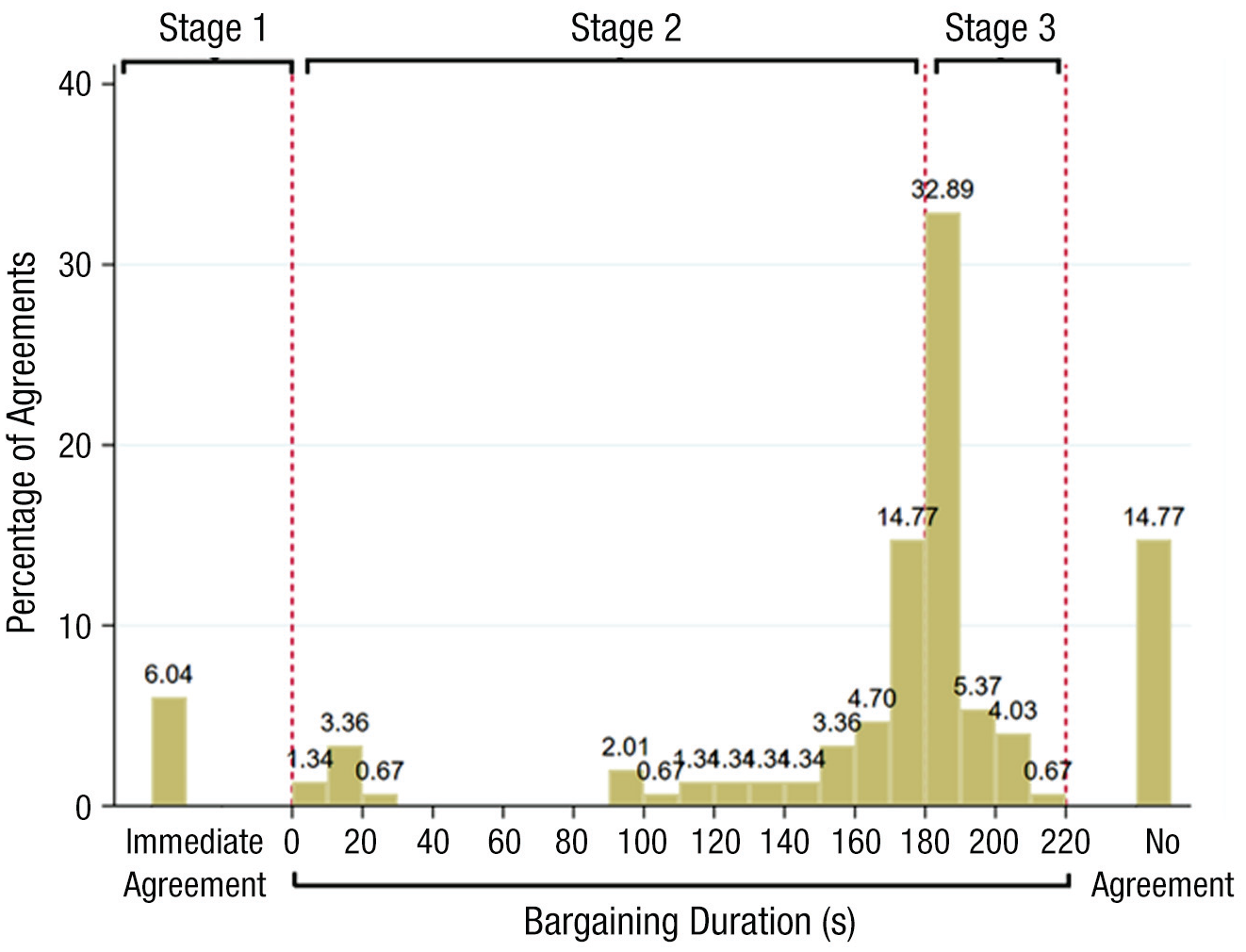
Distribution of the time needed in the negotiation phase to reach an agreement across all pairs (N = 149). In Stage 1, participants only stated their preferred share; in Stage 2, participants could argue about their preferred share; and in Stage 3, the shares shrank to zero over 30 s if participants did not reach an agreement.
To further investigate the causal effect of confidence on the outcome of the negotiation, we estimated the effect of the sum of participants’ beliefs on the percentage of the initial prize that remained to be shared after the negotiation. We instrumented the sum of beliefs with the noisy signals using two-stage least-squares regression, as the noisy signals created exogenous variation in the overall sum of confidence in the pair. Results are displayed in Table 2. Models 1 and 2 show that a 10-percentage-point increase in confidence at the pair level led to a 4-percentage-point decrease in the percentage of the initial prize that was awarded after the negotiation (β = −0.422, 95% CI = [−0.778, −0.0671], z = −2.33, p = .020). Models 3 and 4 show a similar effect when only pairs of negotiators who reached an agreement before the end of the negotiation process were considered (β = −0.363, 95% CI = [−0.599, −0.127], z = −3.01, p = .003), suggesting that losses were not driven only by agreement failures but by delays as well. These results provide evidence that high levels of confidence lead to conflict that is detrimental to the outcome of the negotiation process.
Effects of Confidence on Negotiation Outcomes
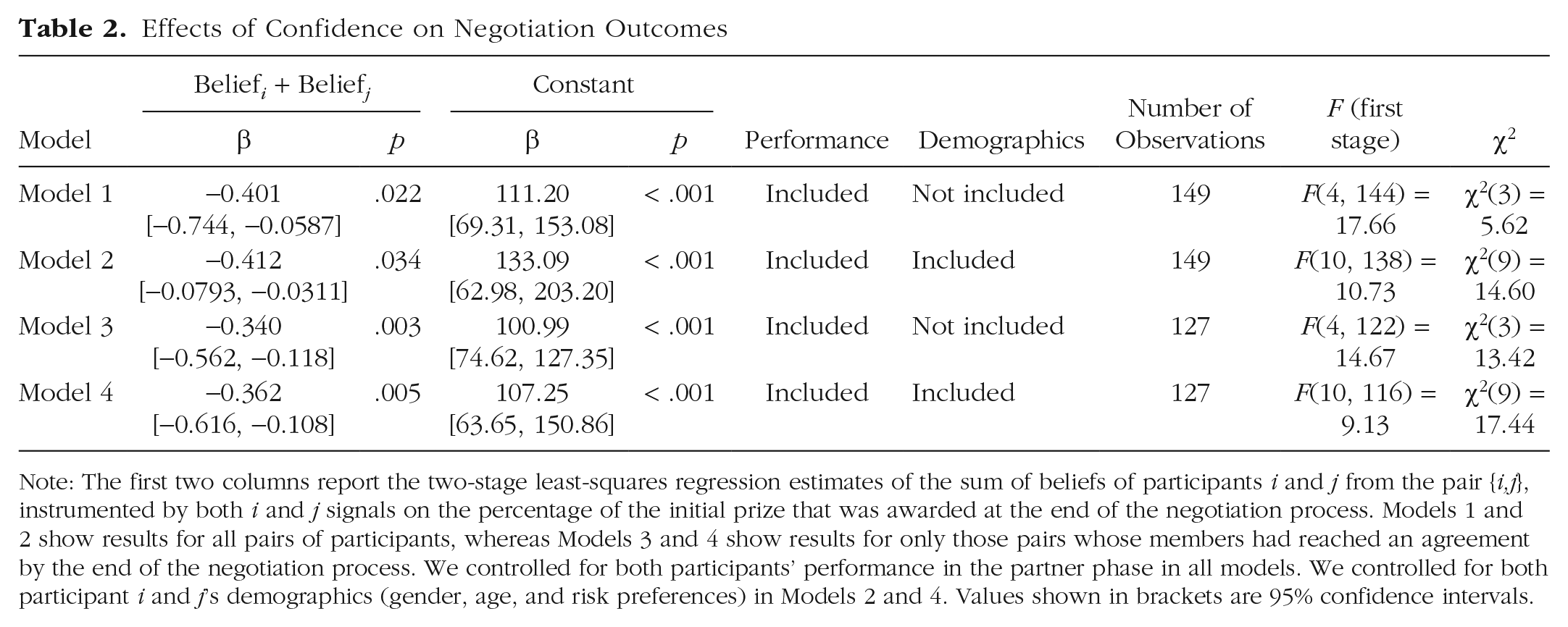
Note: The first two columns report the two-stage least-squares regression estimates of the sum of beliefs of participants i and j from the pair {i,j}, instrumented by both i and j signals on the percentage of the initial prize that was awarded at the end of the negotiation process. Models 1 and 2 show results for all pairs of participants, whereas Models 3 and 4 show results for only those pairs whose members had reached an agreement by the end of the negotiation process. We controlled for both participants’ performance in the partner phase in all models. We controlled for both participant i and j’s demographics (gender, age, and risk preferences) in Models 2 and 4. Values shown in brackets are 95% confidence intervals.
Communication
Finally, it is worth asking how the effects of confidence manifested themselves in the actual negotiation process. 5 To address this question, we coded the initial messages that participants sent each other for the presence or absence of two types of claims, which we labeled entitlement (e.g., “I deserve the larger share because I performed better”) and assertiveness (e.g., “I’m not going to back down and take the smaller share”). Next, three raters evaluated the perceived confidence in the messages on a 6-point scale (0 = not at all confident, 5 = completely confident; κ = .24). These initial messages that participants sent each other can be considered independent, because participants had not yet read what their partners had written. Recall that after that initial message, participants were also given a chance to chat further, and this subsequent chat was coded for confidence on the same 6-point scale. Four findings of note emerged from these analyses.
First, participants’ postsignal self-reported confidence had a positive impact on the likelihood that their messages were assertive and made claims of entitlement, and assertiveness and entitlement in turn mediated the positive effect of participants’ self-reported confidence on rater-perceived confidence in their initial message (see Fig. S2.6 at https://osf.io/2j6ne/). Second, rater-perceived confidence in participants’ initial message was positively associated with rater-perceived confidence in their subsequent chat, and a positive correlation emerged between the perceived confidence in the chat of the two partners (see Fig. S2.5 at https://osf.io/2j6ne/). Third, when we entered assertiveness, entitlement, and self-reported confidence into a regression predicting absolute and relative outcomes, the effects of self-reported confidence remained the same as those reported above (see Table S2.8 at https://osf.io/2j6ne/). Fourth, assertiveness mirrored the effect of confidence, in that people who made claims that they would not back down performed better in relative but not absolute terms.
Discussion
The results with absolute payoffs suggest that when both players have a high level of confidence, the situation is not in equilibrium. When one player is highly confident, the other player is better off being less confident, because under those circumstances they both receive a higher payoff. In contrast, when one player is not very confident, the other player is better off being highly confident, because under that circumstance the more confident player earns more. These findings suggest that in terms of absolute payoffs, high levels of confidence are beneficial in negotiation only when your partner is low in confidence. These findings are broadly consistent with those reported in prior literature, which show that overconfidence is beneficial when you reach an agreement (which is more likely when your partner is low in confidence) but costly when you do not (which is more likely when your partner is also high in confidence). But neither this pattern of findings nor those in the prior literature explains why overconfidence remains so common despite these clear costs.
To answer that question, we must turn to relative payoffs. When we examined the relative outcomes, the situation in which both players had high levels of confidence was in equilibrium because neither negotiator had an incentive to be less confident. If Player i was not confident, Player j was better off being confident, and if Player i was confident, Player j was still better off being confident. Importantly, this positive effect of confidence is independent of whether an agreement is reached, as our experiment captured the type of costs that emerge when overconfidence creates an impasse as well as when overconfidence simply introduces delays. These results demonstrate that the goal to achieve higher relative outcomes will favor the development of overconfidence despite the fact that overconfidence creates absolute costs. Thus, our research clarifies why the obvious costs of overconfidence do not lead people to form more accurate perceptions of their abilities. By focusing on relative rather than absolute outcomes—as people often do (Buss, 1989; Charness et al., 2014; von Hippel, 2018)—overconfident negotiators are prevented from feeling that they have suffered a loss even when they walk away with little or nothing.
Beyond what these results reveal about overconfidence, they also elucidate the interrelationships between competence, confidence, assertiveness, and entitlement. People who received a positive signal reported greater levels of confidence, which in turn led them to be more assertive and make greater claims of entitlement in their messages to their negotiation partners. Assertiveness and entitlement caused their messages to be perceived as more confident, but controlling for assertiveness and entitlement did not impact the effect of confidence on either relative or absolute outcomes in the negotiation. As a side note, it is worth pointing out that the effects of assertiveness were similar to the effects of confidence; people who claimed that they would not back down also performed better in relative but not absolute terms (consistent with the findings of van Dolder et al., 2015). The results also indicate that the effects of confidence can emerge independently of those of competence-based status, as the instrumental analyses removed the effect of being the better performer in the pair, and being the better performer was not predictive of confidence once participants received the noisy signal.
The results of the current experiment also provide a bridge between research on confidence, coordination problems in bargaining situations, and dominance complementarity. Prior research has shown that a clear status hierarchy can benefit negotiators by providing cues on which they can coordinate when they have conflicting goals, thereby avoiding impasses (de Kwaadsteniet & Van Dijk, 2010; Halevy et al., 2011). In contrast, when negotiation partners both see themselves as high or low in status, this coordination advantage is lost. Our results with high and low levels of confidence yielded similar effects with regard to absolute outcomes: If one member of the negotiating pair is confident, absolute outcomes are better when the other is not. Thus, different confidence levels between competing parties can facilitate solutions to coordination problems.
Similar results emerge when people experience dominance complementarity, because dyads and groups tend to perform better when their members vary in dominance than when their members are all high or low in dominance (Ronay et al., 2012; Wiltermuth et al., 2015). Despite these similarities across the literatures on hierarchy, dominance, and confidence, it is notable that levels of confidence showed these complementary effects only with regard to absolute outcomes. In relative terms, people were always better off having high rather than low confidence. Given the similarities among these literatures, our results raise the possibility that hierarchy and dominance would reveal similar relative benefits and absolute costs when all members of a group are high in status or dominance.
Caveats
The current results suggest why overconfidence is common even when it is costly for everyone in absolute terms. However, there are several caveats to keep in mind. First, our negotiation task was explicitly designed to incorporate a shrinking pie, and thus delay was costly to both sides. Given the luxury of more time, it is possible that universally high levels of confidence would have been less costly. Second, our experiment was also designed to increase the probability of disagreement by mandating that the distribution be unfair, because people often reject unfair offers to protect their reputation (Nowak et al., 2000). Of course, many real-life negotiations also result in outcomes that one or both sides regard as unfair, and hence in that sense, the situation we created in the lab is quite common. Lastly, our experiment was also a distributive negotiation with no opportunity for a compromise that would benefit both parties. As noted above, many negotiations are inherently of this type, and many fall into this pattern unnecessarily (Thompson & Hrebec, 1996). But many do not, as opportunities to expand the pie are common when negotiations involve a variety of issues, and people have diverse preferences. Thus, future research might consider whether the current findings would emerge in less contentious circumstances.
Conclusions
The results of the current research suggest that high levels of confidence can result in an inefficient equilibrium in negotiation: People are relatively better off being more confident, independently of whether their partner is also confident. As a consequence, situations in which people focus on relative outcomes are likely to result in strategically inflated self-beliefs. Thus, these findings provide clear predictions that overconfidence should be most evident whenever people prioritize relative over absolute gains (as in status competitions or among people who are particularly attuned to relative standing). Nevertheless, strategically inflated self-beliefs come at a cost, as both partners earn more in absolute terms when they are less confident. By considering both relative and absolute outcomes simultaneously, we provide an explanation for why overconfidence is both costly and ubiquitous, as evolution can select for traits that enhance relative success even at an absolute cost.
Footnotes
Acknowledgements
We are grateful to Joel van der Weele and Marie Claire Villeval for their valuable comments. We also address special thanks to A. Newell for help programming the experiment.
Transparency
Action Editor: Leah Somerville
Editor: Patricia J. Bauer
Author Contributions
All the authors contributed to the study design. Testing and data collection were performed by A. Soldà. A. Soldà analyzed and interpreted the data with input from L. Page, C. Ke, and W. von Hippel. A. Soldà drafted the manuscript, and W. von Hippel, L. Page, and C. Ke provided critical revisions. All the authors approved the final version of the manuscript for submission.
