




Abstract
Growing evidence suggests that the seeds of relationship decay can be detected via implicit partner evaluations even when explicit evaluations fail to do so. However, little is known about the concrete daily relational processes that explain why these gut feelings are such important determinants of relationships’ long-term outcomes. The present integrative multimethod research yielded a novel finding: that participants with more positive implicit partner evaluations exhibited more constructive nonverbal (but not verbal) behavior toward their partner in a videotaped dyadic interaction. In turn, this behavior was associated with greater satisfaction with the conversation and with the relationship in the following 8-day diary portion of the study. These findings represent a significant step forward in understanding the crucial role of automatic processes in romantic relationships. Together, they provide novel evidence that relationship success appears to be highly dependent on how people spontaneously behave in their relationship, which may be ultimately rooted in their implicit partner evaluations.
Keywords
Over the past 50 years, the rate of divorce in Europe has increased sharply by 137.5% (Eurostat, 2017). Having a positive romantic relationship is essential to individuals’ psychological and physiological well-being (Proulx, Helms, & Buehler, 2007; Robles, Slatcher, Trombello, & McGinn, 2014). Nevertheless, it is challenging to maintain flourishing relationships in our societies. For decades, countless studies have attempted to investigate predictors of successful and unsuccessful relationships by massively relying on self-report data (e.g., Le, Dove, Agnew, Korn, & Mutso, 2010). Yet recent findings have demonstrated the crucial role of implicit partner evaluations (i.e., automatic affective associations involving one’s partner) in predicting changes in relationship satisfaction over and beyond what partners are able and willing to reveal (McNulty, Olson, Meltzer, & Shaffer, 2013). Surprisingly, however, the reasons why implicit partner evaluations are so important for long-term relational outcomes are still unclear. Do implicit partner evaluations also have short-term effects on relational processes that are fundamental for blooming dyadic interactions?
To address this question, we integrated research from interpersonal processes and social cognition. We propose that implicit partner evaluations are likely to influence spontaneous behaviors that are hard to monitor during romantic communication (Noller, 2006). More precisely, we used observational data and real-life experiences to investigate whether individuals’ implicit partner evaluations predict their nonverbal behavior in dyadic interactions and whether nonverbal behavior, consequently, affects relational outcomes.
Implicit Partner Evaluations and Long-Term Relational Outcomes
Much relationship research that aimed to study romantic dissolution has heavily relied on explicit measures (e.g., deliberated self-reports) to determine the factors that may either maintain or weaken the bond between partners (Le et al., 2010; Rusbult, Martz, & Agnew, 1998). However, at the explicit level, individuals are often motivated to see their relationship in an overly positive light (Murray, 1999). Because explicit measures are highly susceptible to these motivational biases, they may not accurately capture people’s spontaneous affect and attitudes that seem crucial for our theoretical and empirical understanding of relationship processes (e.g., Joel, Eastwick, & Finkel, 2017).
One way to overcome these limitations is to assess the automatic feelings and associations involving one’s partner using indirect measurements (i.e., implicit measures) that refrain people from monitoring their responses (Baldwin, Lydon, McClure, & Etchison, 2010). Indeed, these measures bypass deliberative reasoning and are more suitable for detecting spontaneous affect and emotional experiences that occur in romantic dyads (Banse, 1999; Hicks, McNulty, Meltzer, & Olson, 2016; Murray, Holmes, & Pinkus, 2010). Consequently, implicit partner evaluations assessed by these measures are only weakly related to explicit evaluations (Hicks, McNulty, & Meltzer, 2017; Scinta & Gable, 2007) and, ultimately, predict diverse long-term relational outcomes (LeBel & Campbell, 2009, 2013; Lee, Rogge, & Reis, 2010) even when self-reports fail to do so (McNulty et al., 2013).
Implicit Partner Evaluations and Short-Term Relational Processes
The aforementioned findings provide compelling evidence regarding the importance of implicit partner evaluations in determining the maintenance of a successful relationship. However, it remains largely unclear why implicit partner evaluations have such a powerful predicting influence on long-term outcomes. According to Fazio (2000), spontaneously activated attitudes, such as those assessed by implicit measures, shape attention, construal, and behavior. In this regard, there is little but encouraging evidence showing that implicit partner evaluations may affect one’s own perception of marital problems over the years (McNulty et al., 2013) or one’s own self-reported positive behavioral tendencies toward a romantic partner (LeBel & Campbell, 2013). Nevertheless, in LeBel and Campbell’s study, the behavioral index was restricted to three self-perceived cues (i.e., saying something loving, showing interest in partner’s day, making an effort to spend time together). Such an index hardly depicts an exhaustive behavioral representation and fails to distinguish spontaneous from deliberate behaviors, which may be crucial to understanding the unique role played by automatic processes (e.g., Dovidio, Kawakami, & Gaertner, 2002). In sum, extremely little is known about the actual (i.e., objectively assessed) and specific (i.e., spontaneous or deliberative) relational processes that are influenced by implicit partner evaluations in real-life settings.
Implicit Partner Evaluations and Nonverbal Behavior
In line with Fazio’s (1990) MODE model, implicit partner evaluations are automatically activated as soon as one’s partner is merely encountered and serve as a driving force to elicit spontaneous behaviors, unless individuals are motivated and able to engage in more controlled responses. Over the course of a relationship, romantic partners experience a great deal of dyadic interactions in which they are usually motivated to be constructive and thus override some of their negative reactions. Yet they may not always be able to do so, and implicit attitudes may especially predict behavior when people cannot control their responses. In dyadic interactions, verbal behavior can easily be controlled in compliance with one’s goals (Vincent, Friedman, Nugent, & Messerly, 1979); however, nonverbal behavior is considered as a spontaneous response that people are less capable of effectively monitoring (DePaulo, 1992). Hence, we suggest that implicit partner evaluations are susceptible to influencing spontaneous nonverbal behavior but not deliberate verbal statements that are likely to be determined by more controlled processes (i.e., explicit evaluations; Dovidio et al., 2002). We further assert that the effect of implicit partner evaluations on actual nonverbal behavior can illuminate why such gut feelings have long-term implications on relational outcomes. Indeed, interpersonal behavior is a major determinant of relationship success (Gottman, Coan, Carrere, & Swanson, 1998), and although subtle, nonverbal responses fulfill crucial relational functions during romantic communication (Noller, 2006). Consequently, we argue that positive implicit partner evaluations may be especially powerful predictors of positive relationships’ long-term outcomes because they regularly promote more constructive nonverbal behavior in daily life.
Research Overview
To date, the reasons why implicit partner evaluations influence long-term relationship outcomes are unclear, and no study has investigated their short-term effects on actual behavior in dyadic interactions. To address this question, we conducted an intensive longitudinal project in which we videotaped couples discussing a topic on which their interests diverged, after which they completed an 8-day diary. We hypothesized that positive implicit partner evaluations would predict constructive nonverbal (but not verbal) behavior during the conversation. We further predicted that the more constructive nonverbal responses individuals display, the more satisfied they would be with their conversation and their relationship in general over time. Finally, we explored whether these processes also affect their partners’ outcomes and behaviors.
Method
Participants
Participants were 129 heterosexual couples and 1 homosexual couple 1 (N = 260 individuals). In line with recent guidance (Finkel, Eastwick, & Reis, 2015), as well as recruitment and financial constraints, the sample size was decided prior to data collection on the basis of the large sample sizes used in previous relationship studies (e.g., McNulty et al., 2013) and combined with a diary design to maximize statistical power. All participants were recruited in The Netherlands via personal approach or through various websites and social networks. They were required to speak fluent Dutch, be childless, and be involved in a romantic relationship that has lasted a minimum of 4 months. An incentive of €80 was granted for participating in the intake part of the study and responding to at least 80% of the diary signals. Participants were also given the chance to win a €200 bonus in a raffle at the end of the study.
Two couples and 1 participant failed to follow instructions at intake. Their data were excluded from all analyses of this data set (e.g., Righetti, Gere, Hofmann, Visserman, & Van Lange, 2016; for an exhaustive overview of past publications using this data set, see the Supplemental Material available online). The remaining sample included 255 participants whose age ranged from 18 to 43 years (M = 23.31, SD = 3.64). At intake, relationship length varied from 4 months to 17 years (M = 33.91 months, SD = 29.01); 34% of the couples were living together, and 2.4% of them were married. Moreover, 63.9% of the participants were students, 33.7% were full-time workers, and 2.4% were both working and studying.
Procedure
Couples were asked to come to the lab for the intake portion of the study. After signing a consent form, partners were separated to different cubicles and asked to complete a task assessing implicit partner evaluations and reply to several questionnaires. Next, partners were reunited in one room and asked to discuss a current divergence of interest between them while being videotaped. A divergence of interest was defined as one in which both partners had different preferences (e.g., one partner likes to visit his or her family on the weekends but the other prefers to spend time with common friends, or one partner wishes to watch an action movie but the other wants to watch a panda documentary). They were instructed to discuss this divergence of interests for 7 min as they would normally do at home and to do so by trying to come up with a solution. After ending the conversation, couples received both verbal and written instructions about the diary procedure, which always started on the upcoming Saturday. Every evening for 8 days after 9:00 p.m., participants received an e-mail containing a link that directed them to a Qualtrics survey. They were asked to fill out a questionnaire about what happened during the day. On average, participants replied to 90.9% of the diary signals. At the end of the study, participants were thanked and debriefed.
Measures
Implicit partner evaluations
In the lab, participants first performed a Single Category Implicit Association Test (SC-IAT; Karpinski & Steinman, 2006), which measured their implicit partner evaluations. The SC-IAT is a computer-based behavioral test that is especially suited to assess the strength of the mental associations with a single attitude object (e.g., romantic partner) that does not have an obvious complementary category (e.g., unspecified nonromantic partner) or for which it is simply not appropriate to be interpreted in comparison to another category (see Karpinski & Steinman, 2006). In this study, participants performed the SC-IAT on a desktop computer using Inquisit 4 Lab (Millisecond, 2015). They were told that words representing the categories positive, negative, or partner would be sequentially displayed in the center of the screen. Their task was to indicate whether these target words belonged to a category located on the top left (response key “E”) or top right corner of the screen (response key “I”). They were instructed to go as fast as they could while making as few mistakes as possible (an error message was displayed every time they failed to do so correctly). We used 45 different target words: The original 21 positive and 21 negative words used by Karpinski and Steinman (2006) and 3 partner-related words (the partner’s first name, last name, and nickname—all provided by the participants prior to starting the test).
Following Karpinski and Steinman’s procedure, we divided this SC-IAT into two blocks, the presentation order of which was counterbalanced between participants. In the compatible block, the partner and positive categories were paired together on the same side of the screen. In the incompatible block, the partner category was paired with the negative category. For each block, there were 24 practice trials and 72 test trials (with an identical proportion of target words presented per category in random order). Finally, to determine the internal consistency of the SC-IAT, we used a split-third method with Spearman-Brown correction (see Karpinski & Steinman, 2006), which revealed an acceptable reliability (adjusted r = .79).
Relationship satisfaction
Explicit levels of relationship satisfaction were assessed at three different time points. First, at intake, participants indicated their general level of relationship satisfaction on a four-item scale (α = .82; Rusbult et al., 1998), which included statements such as “My relationship is close to ideal,” by using a 7-point Likert scale (1 = strongly disagree, 7 = strongly agree). Because this scale measured how partners explicitly evaluated their overall relationship satisfaction at intake, we will use the term explicit relationship evaluation to refer to this measure. Second, at the end of the conversation, relationship satisfaction was assessed by a single item (“I feel satisfied with our relationship”) on a 7-point Likert scale (1 = strongly disagree, 7 = strongly agree). Third, in the diary portion of the study, participants self-reported their daily level of relationship satisfaction every evening for 8 days on the same item by using a 7-point Likert scale (0 = strongly disagree, 6 = strongly agree).
Satisfaction with conversation solution
At the end of the interaction, participants were asked to indicate how satisfied they felt with the solution they came up with (one item: “I am satisfied with the solution that we reached during the conversation”) on a 7-point Likert scale (1 = not at all, 7 = completely).
Videotaped conversation
At intake, once couples completed the implicit and explicit measures, they were invited to discuss a topic on which their interests diverged for 7 min. Their conversation was videotaped to record both partners’ verbal and nonverbal behaviors. Verbal and nonverbal behaviors exhibited during the conversation were coded by trained raters. The 7-min conversations were first divided into 14 sequences of 30 s each. Then, for each 30-s sequence, raters were instructed to code separately the positivity and negativity of the behaviors expressed by each partner on two independent 7-point Likert scales (e.g., “How would you evaluate the positivity of the nonverbal behaviors exhibited by the partner located on the left in this sequence?” and “How would you evaluate the negativity of the verbal behaviors stated by the partner A in this sequence?” 0 = none/neutral, 6 = very high). Nonverbal behaviors were coded by three non-Dutch raters with no understanding of the Dutch language so that they could not be influenced by the verbal content of the conversation. Similarly, to limit nonverbal influences (e.g., body gesture, tone of voice) that would interfere with the verbal coding, we first transcribed verbal behaviors from the videos, and these texts were then read and coded by three Dutch raters. Inspired by previous coding schemes (e.g., Kerig & Baucom, 2004; see Coding System in the Supplemental Material), we asked both verbal and nonverbal coders to evaluate the negativity of the conversation in three subcategories (hostility, withdrawal, dysphoric affect) and the positivity of the conversation in two subcategories (openness, humor/positive affect).
We used two-way random intraclass correlation coefficients (ICCs) as indexes of consistency to assess the reliability of the coders’ mean ratings (Shrout & Fleiss, 1979). The coding of both verbal and nonverbal raters showed satisfying reliability, ICC(2, 3) = .80 and ICC(2, 3) = .75, respectively. More specifically, the reliability for verbal negativity was ICC(2, 3) = .81, and the reliability for verbal positivity was ICC(2, 3) = .67. The reliability for nonverbal positivity and negativity was ICC(2, 3) = .82 and ICC(2, 3) = .54, respectively. Although lower reliability indexes are to be expected when coding complex interpersonal behaviors (e.g., Dovidio et al., 2002), all the present estimates ranged from fair to excellent (Cicchetti, 1994). Moreover, additional Bland-Altman plots (Bland & Altman, 1986) corroborated that agreement between raters was satisfactory when compared two by two (see the Supplemental Material).
Results
Analytic strategy
We used multilevel modeling with random intercepts and fixed slopes to take into account the nonindependent nature of our data (participants nested within couples and multiple time measurements within participants in the diary part of the study; Kenny, Kashy, & Cook, 2006). Because gender did not reliably moderate our effects (and given that one couple was homosexual), we treated dyads as indistinguishable (Kenny et al., 2006). Given the nested nature of our data, we report standardized coefficients as effect-size estimates.
SC-IAT scores were computed on the basis of the scoring algorithm from Karpinski and Steinman (2006). That is, for each participant, practice trials were discarded, responses faster than 350 ms and slower than 10,000 ms were eliminated (0.19% of the data), and error responses were replaced with the participant’s block mean and a penalty of 400 ms. Next, we subtracted the average response latencies of the compatible block from the incompatible block and, finally, divided this value by the participant’s standard deviation for all correct response latencies. Nine participants failed to provide a partner’s nickname, and another showed an error response rate greater than 20%. Moreover, four couples did not take part in the conversation, and three others did not comply with the instructions (failed to come up with or discuss a topic on which their interests diverged). Consequently, we removed these participants from the corresponding analyses.
We did not expect implicit partner evaluations (or explicit relationship evaluation) to influence one distinct valence of the nonverbal (or verbal) behavior differently from the other. Rather, we posit that when discussing a heated topic, higher levels of implicit (or explicit) evaluations would lead to more constructive nonverbal (or verbal) behavior, which can be understood as a larger proportion of positivity than negativity expressed through numerous cues. Moreover, we argue that regardless of the magnitude of each valence, it is the relative difference between positivity and negativity that is likely to influence later relational outcomes. Conversely, we believe that focusing on one isolated valence might bias and restrict our understandings of automatic processes in dyadic interactions because both positivity and negativity can be adequately interpreted only when considered together. Therefore, for both verbal and nonverbal behaviors, we first computed an index of positivity and negativity by averaging the raters’ 30-s coding for these two dimensions. Then we created difference scores by subtracting scores of negativity from those of positivity (higher scores indicate more positivity than negativity). Although we did not expect valence to moderate our effects, we nevertheless report exploratory moderation analyses later in this section and provide ancillary results considering positivity and negativity separately in the Supplemental Material for interested readers.
Finally, as a bootstrapping method, we used the Monte Carlo method for assessing mediation—with unstandardized estimates, 20,000 simulations, and 95% confidence intervals (CIs; Selig & Preacher, 2008)—to estimate the indirect effect of implicit partner evaluations on relational outcomes through nonverbal behavior. Coefficients for indirect effects were computed by multiplying path a’s and path b’s unstandardized estimates. Moreover, to ensure that our effects elicited changes in relationship satisfaction, we performed time-lagged regression analyses in which we controlled for initial levels of romantic satisfaction reported at intake (on the same item or scale to warrant a fair comparison).
Preliminary analyses
At intake, participants generally showed positive implicit partner evaluations (M = 0.21, SD = 0.33, 95% CI = [.16, .25]), meaning that they were faster in categorizing words when partner words were matched with positive words as compared with negative words, t(246) = 9.75, 95% CI for the mean difference = [0.16, 0.25], p < .001 (one-sample t test against zero). In line with previous research (e.g., Hicks et al., 2017; McNulty et al., 2013), implicit partner evaluations were not significantly related to explicit relationship evaluations (M = 5.97, SD = 0.83) at baseline, b = 0.14, SE = 0.15, 95% CI = [–0.14, 0.43], p = .328, β = 0.06. One-sample t tests against zero revealed that during the conversation, participants exhibited greater positivity than negativity in their verbal (M = 0.95, SD = 0.86) and nonverbal (M = 0.47, SD = 0.87) behaviors, t(245) = 17.21, 95% CI for the mean difference = [0.84, 1.06], p < .001, and t(245) = 8.46, 95% CI for the mean difference = [0.36, 0.58], p < .001, respectively. Moreover, partners’ verbal statements, r(123) = .42, 95% CI = [.26, .56], p < .001, and nonverbal cues, r(123) = .68, 95% CI = [.57, .77], p < .001, were positively correlated with each other. Thus, the more constructive individuals were in their verbal and nonverbal behavior, the more constructive their partner was, too. However, interestingly, there was no significant association between the participant’s verbal and nonverbal behaviors, r(246) = .07, 95% CI = [−.06, .19], p = .301, which underlines the importance of coding both behaviors separately. Furthermore, positivity and negativity for both verbal and nonverbal behaviors were moderately correlated, r(246) = −.38, 95% CI = [−.48, −.27], p < .001, and r(246) = −.34, 95% CI = [−.45, −.23], p < .001, respectively.
Implicit partner evaluations and nonverbal behaviors
To investigate the link between implicit partner evaluations and behaviors exhibited in the conversation, we first ran a series of multilevel analyses. Consistent with our hypothesis, results revealed that participants’ implicit partner evaluations were associated with their nonverbal behavior, b = 0.34, SE = 0.12, 95% CI = [0.10, 0.59], p = .007, β = 0.13. That is, the more participants automatically associated their partner with positivity (rather than negativity) at intake, the more they exhibited constructive nonverbal cues when interacting with their partner, and this occurred even after we controlled for their explicit relationship evaluation, b = 0.34, SE = 0.13, 95% CI = [0.09, 0.58], p = .008, β = 0.13. In line with our reasoning, results showed no link between participants’ implicit partner evaluations and their verbal behavior, b = −0.01, SE = 0.15, 95% CI = [−0.31, 0.30], p = .962, β = −0.003. Conversely, and as predicted, the explicit relationship evaluation assessed at intake was not related to nonverbal behavior exhibited in the conversation, b = 0.05, SE = 0.06, 95% CI = [−0.07, 0.16], p = .411, β = 0.05. Interestingly, however, participants’ explicit relationship evaluation did not predict their verbal behavior either, b = −0.002, SE = 0.07, 95% CI = [−0.13, 0.13], p = .979, β = −0.002.
Next, to more directly test whether the association between implicit partner evaluations and nonverbal behavior was significantly different from the corresponding association involving verbal behavior, we nested both behaviors within participants and created a new variable coded −1 for verbal scores and +1 for nonverbal ones. Consistent with our expectations, results showed that individuals’ implicit partner evaluations did not predict general behaviors (i.e., verbal and nonverbal clustered together) in the conversation, b = 0.15, SE = 0.10, 95% CI = [−0.05, 0.35], p = .144, β = 0.05. However, results revealed a marginally significant interaction between implicit partner evaluations and type of behavior, b = 0.18, SE = 0.10, 95% CI = [−0.01, 0.38], p = .066, β = 0.07. That is, participants’ implicit partner evaluations were significantly associated with their spontaneous nonverbal behavior in dyadic interactions, b = 0.33, SE = 0.14, 95% CI = [0.06, 0.61], p = .019, β = 0.12, but not their controlled verbal statements, b = −0.03, SE = 0.14, 95% CI = [−0.31, 0.24], p = .808, β = −0.01.
Finally, although we did not have a priori predictions on how the specific valence of the behavior (i.e., positivity or negativity) would affect our results, we also conducted some exploratory analyses to assess whether the relationship between implicit partner evaluations and nonverbal behavior was moderated by valence. As in the previous analyses, we nested both nonverbal positivity and negativity within individuals and created a new valence variable (coded −1 for negativity and +1 for positivity). Although the main effect of implicit partner evaluations on nonverbal behavior remained significant, b = 0.18, SE = 0.06, 95% CI = [0.06, 0.30], p = .004, β = 0.02, results also revealed a marginally significant interaction effect, b = 0.10, SE = 0.06, 95% CI = [−0.01, 0.21], p = .06, β = 0.01. Simple-slopes analyses showed that implicit partner evaluations were especially related to nonverbal positivity, b = 0.27, SE = 0.08, 95% CI = [0.12, 0.43], p < .001, β = 0.03, but not negativity, b = 0.07, SE = 0.08, 95% CI = [−0.09, 0.22], p = .392, β = 0.01; though this last result may be due to the weaker reliability of nonverbal negativity ratings. Conversely, valence did not moderate the relationship between explicit relationship evaluation and verbal behavior, b = −0.03, SE = 0.03, 95% CI = [−0.08, 0.03], p = .301, β = −0.01 (see the Supplemental Material for ancillary analyses per valence).
Mediation by nonverbal behavior
We further tested whether the nonverbal behavior exhibited in the conversation mediated the relationship between implicit partner evaluations and satisfaction with the conversation solution and with the relationship 2 (following the conversation and in the diary part of the study). All results are displayed in Table 1. We performed mediation analyses even in the absence of significant total effects in the first place, as there is a large consensus that this criterion should not be considered a necessary prerequisite for mediation tests, especially when the relationships between variables are theoretically guided and assumed to be subtle (Hayes, 2009; Shrout & Bolger, 2002).
Results of Multilevel Mediation Models for the Effect of Implicit Partner Evaluations on Relational Outcomes Through Nonverbal Behavior
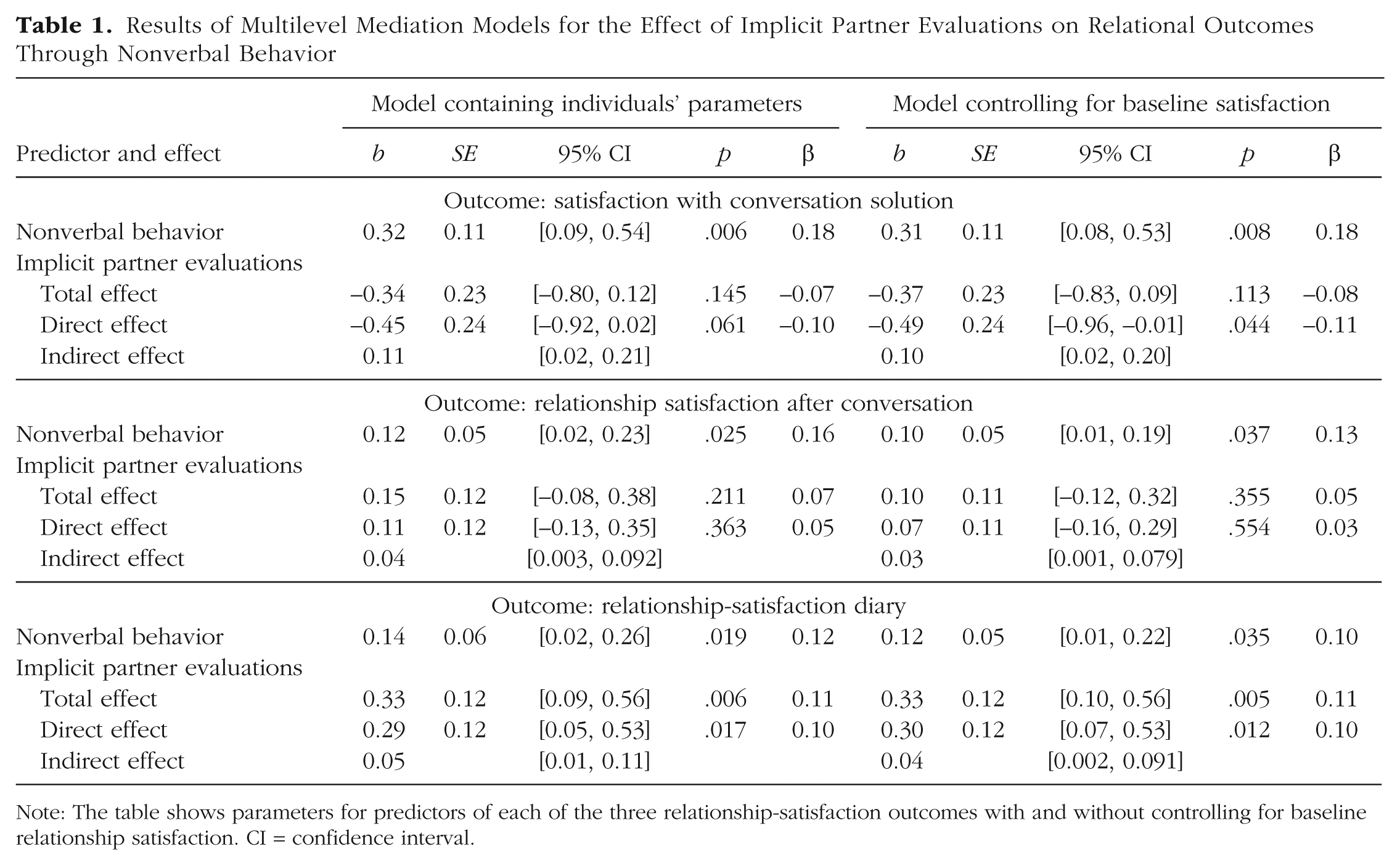
Note: The table shows parameters for predictors of each of the three relationship-satisfaction outcomes with and without controlling for baseline relationship satisfaction. CI = confidence interval.
For satisfaction with the conversation solution, mediation analyses showed a significant indirect effect through nonverbal behavior. Importantly, this result was also significant when analyses controlled for baseline explicit relationship evaluation, b = 0.10, 95% CI = [0.02, 0.20]. Thus, greater implicit partner evaluations were indirectly associated with greater satisfaction with the conversation’s outcome (M = 5.08, SD = 1.50) through more constructive nonverbal cues enacted in the conversation.
Next, we tested our mediation model on relationship satisfaction reported after the conversation. Results revealed a significant indirect effect through nonverbal behavior, which remained significant when analyses controlled for initial levels of romantic satisfaction, b = 0.03, 95% CI = [0.001, 0.079]. Thus, when discussing a heated topic, participants with higher implicit partner evaluations exhibited more constructive nonverbal behavior and in turn reported that they felt even more satisfied with their partner (M = 6.50, SD = 0.68).
Finally, we further examined the effect of implicit partner evaluations and nonverbal behavior on relationship satisfaction over the following week in the diary part of the study. Mediation analyses yielded a significant indirect effect through nonverbal behavior. Importantly, this indirect effect held when we included baseline romantic satisfaction in the model, b = 0.04, 95% CI = [0.002, 0.091], although the direct effect of implicit partner evaluations remained significant as well, b = 0.30, SE = 0.12, 95% CI = [0.07, 0.53], p = .012, β = 0.10. Thus, implicit partner evaluations were positively associated with relationship satisfaction over the course of time (M = 5.20, SD = 1.02), and this effect appeared to be partly explained by a more constructive nonverbal behavior exhibited in the dyadic interaction 1 week earlier.
Partners’ outcomes
We further ran exploratory analyses to investigate whether implicit partner evaluations and constructive nonverbal behavior would also affect partners’ reports 3 of satisfaction. The empirical evidence collected thus far indicates that implicit partner evaluations exclusively predict actors’ perceptions of relational outcomes over time (e.g., McNulty et al., 2013). To our knowledge, however, nothing is known about the effect of the actor’s implicit partner evaluations on the partner’s outcomes. One reason why may be that individuals’ own implicit self-evaluations (McNulty, Baker, & Olson, 2014) and own emotional experiences that become associated with their partner (Hicks et al., 2016; McNulty, Olson, Jones, & Acosta, 2017) shape their own implicit partner evaluations, which therefore strongly influence their own outcomes over time (McNulty & Olson, 2015) but not necessarily those of their partner, which are more likely to be determined by their own implicit evaluations. Yet, following the idea that more positive implicit partner evaluations promote constructive nonverbal behaviors in dyadic interactions, one may expect that partners could also be positively affected by these behaviors. However, if such influences result from more constructive nonverbal interactions, they should affect relational outcomes that are related to the interaction itself more strongly than those assessed later.
As reported in Table 2, we tested whether the actor’s nonverbal behavior mediated the relationship between the actor’s implicit partner evaluations and his or her partner’s outcomes. Results revealed significant indirect effects for both partner’s satisfaction with the conversation solution, b = 0.08, 95% CI = [0.01, 0.18], and their relationship after the conversation, b = 0.04, 95% CI = [0.01, 0.10], though these effects did not remain significant when analyses controlled for partner’s baseline satisfaction. Such findings suggest that actors’ implicit partner evaluations may not only serve their own relational well-being by promoting more constructive nonverbal cues but may also, to a lesser extent, indirectly benefit their partner. However, these influences appeared to be confined to the context of the conversation, as the indirect effects were not significant in the diary portion of the study (see the Supplemental Material for detailed results).
Indirect Effects of Actors’ Implicit Partner Evaluations on Partners’ Relational Outcomes Through Actors’ Nonverbal Behavior
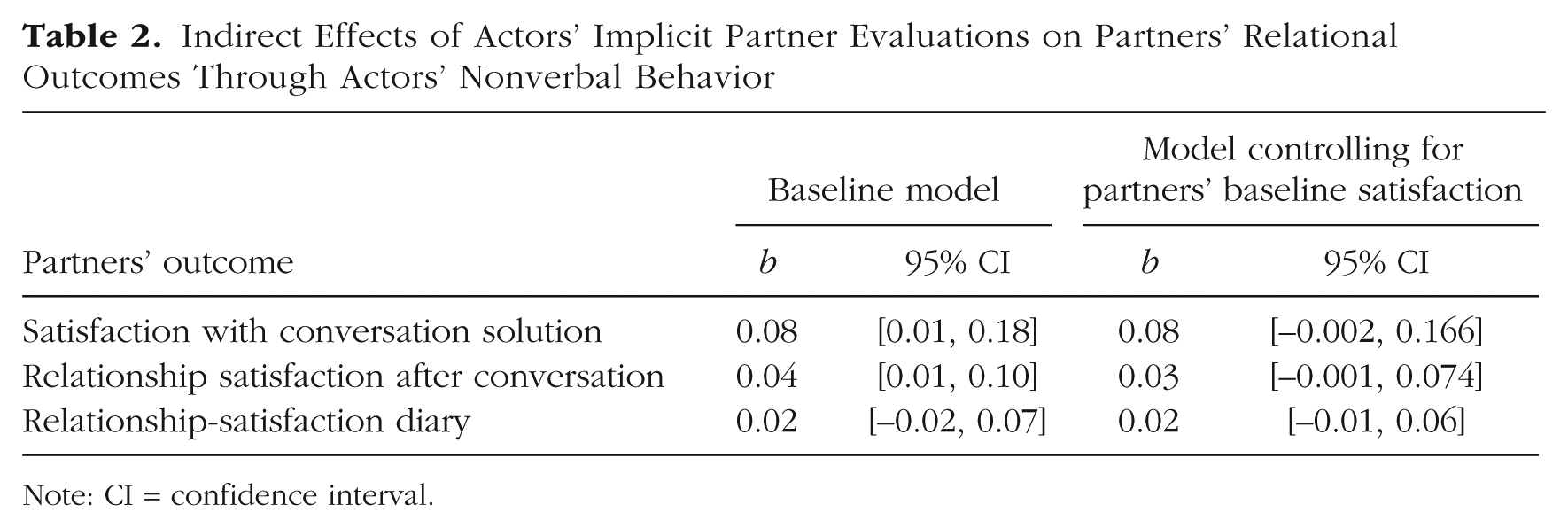
Note: CI = confidence interval.
Finally, to further understand how the partner’s outcomes and behaviors are influenced by the actor’s evaluations and behaviors, we conducted three series of exploratory mediation analyses. First, we tested whether the actor’s implicit partner evaluations influenced the actor’s nonverbal behavior, which in turn influenced the partner’s nonverbal behavior. Although the indirect effect was significant, b = 0.22, 95% CI = [0.07, 0.38], it did not hold when we controlled for the partner’s implicit partner evaluations, b = 0.18, 95% CI = [–0.04, 0.40]. Second, we examined whether the actor’s nonverbal behavior influenced his or her partner’s nonverbal behavior, which in turn influenced the partner’s satisfaction. Results revealed significant indirect effects for partners’ satisfaction with the conversation solution and the relationship as discussed in the diary, b = 0.15, 95% CI = [0.01, 0.28], and b = 0.09, 95% CI = [0.01, 0.16], respectively, even when we controlled for partners’ baseline satisfaction, b = 0.14, 95% CI = [0.001, 0.270], and b = 0.08, 95% CI = [0.001, 0.140], respectively. However, this indirect effect was not significant when we considered relationship satisfaction after the conversation as the outcome variable, b = 0.05, 95% CI = [−0.03, 0.11].
Last, we tested whether the actor’s nonverbal behavior influenced the partner’s nonverbal behavior, which in turn affected the actor’s satisfaction. The only significant indirect effect was observed for satisfaction with the conversation solution, b = 0.16, 95% CI = [0.01, 0.29], although this effect was no longer significant when we controlled for actors’ initial relationship satisfaction, b = 0.14, 95% CI = [−0.002, 0.27]. In sum, participants’ nonverbal behaviors and relational outcomes were predominantly predicted by their own implicit partner evaluations and were not consistently associated with their partner’s implicit evaluation or their partner’s nonverbal behavior.
Discussion
The present research integrated perspectives from interpersonal processes and social cognition to investigate how implicit partner evaluations affect dyadic interactions. In an observational and a diary study involving romantic couples, results showed that more positive implicit partner evaluations related to more constructive nonverbal behavior toward the romantic partner. Consequently, those spontaneous behaviors were associated with higher satisfaction with the discussion’s outcome and the relationship up to 1 week later. All the aforementioned findings held when we controlled for initial explicit relationship satisfaction, which did not predict verbal or nonverbal behaviors. Finally, the link between implicit partner evaluations and partners’ behaviors and outcomes did not consistently emerge in our data.
Our study considerably extends previous research that examined the association between implicit evaluations and interpersonal behaviors. Existing work has mainly, if not uniquely, focused on how implicit attitudes toward a group influence behaviors toward a stranger (i.e., an exemplar of the group) in a single laboratory occasion (e.g., Dovidio et al., 2002). To our knowledge, we provide novel evidence that implicit evaluations of a close other reliably predict spontaneous behaviors toward that specific person. Importantly, by comparison with prior research, our results demonstrate that such effect operates even in a highly decisive context: when partners try to discuss divergent interests that they currently face in their relationship and that have the potential to impact their long-term personal and relational well-being. Indeed, our study suggests that more positive implicit partner evaluations and constructive nonverbal behavior may affect the actual relationship beyond the interaction by gradually improving daily relational satisfaction over the following week.
The current research also provides important insights to the study of dyadic communication. For decades, researchers have principally studied how self-reported traits and dispositions affect the outcomes of behavioral interactions (see Baldwin et al., 2010). Our work, instead, shows that the source of successful communication may be deeply rooted in automatic affective associations, which may be distinct and separable from self-report evaluations. Furthermore, the overwhelming majority of the coding systems used to measure behaviors in interactions rely on categories that predominantly favor verbal over nonverbal components (e.g., Kerig & Baucom, 2004). In contrast, the current work highlights the benefits of adopting a continuous fine-grained coding system that distinguishes between these two behaviors, as they seem to represent distinct processes and have different consequences. Importantly, while prior research has largely focused on the role of controlled behaviors in regulating dyadic interactions, the unique link between implicit partner evaluations and nonverbal behavior reveals that relational outcomes may be impacted by behavioral responses that might slip from individuals’ control. Such findings emphasize the importance of automatic processes for understanding the sources and consequences of romantic communication and for improving dysfunctional interactions (e.g., couple therapies).
Our findings thus provide long-awaited evidence that the reasons why implicit partner evaluations predict relationship outcomes in the long run may rest on their influences on automatic behaviors in daily dyadic interactions. Because one unique aspect of romantic dyads is that partners are very spontaneous toward each other (Collins & Feeney, 2000), nonverbal behavior stands out as a powerful interpersonal process through which implicit partner evaluations exert their influences on relational outcomes over time. How does this process occur? It may be possible that one’s constructive nonverbal behavior may also affect the partner’s behavior, which could then make the overall discussion smooth and make people aware that their relationship is good. However, this dyadic perspective is only partially supported by our data. Another possibility may be that in the short run, individuals may interpret their relationship in light of the micro-expressions and emotions they spontaneously exhibit toward their partner (e.g., Niedenthal, 2007), which are initially triggered by their implicit partner evaluations. For instance, people having more positive implicit partner evaluations would be more likely to enact smiles and approach behaviors, which may elicit positive emotions and in turn make them perceive their interaction as more satisfying. Thus, in the long run, implicit partner evaluations may influence explicit evaluations by the inferences that people draw from their nonverbal behavior toward their partner. Although these interpretations remain speculative, they provide fruitful avenues for future research.
An important limitation is that our findings are correlational, and therefore caution is advised when drawing causal conclusions; however, our longitudinal design and lagged analyses alleviate some concerns regarding causal direction. Nonetheless, our work also carries several strengths that follow recent recommendations for improving research practices (Finkel et al., 2015). Whereas the predictive power of self-report measures has been challenged (Joel et al., 2017), the present multimethod approach provides new insights that may help relationship research move forward. First, we showed the importance of using a reliable implicit measure to assess automatic affective responses involving one’s partner that predict both immediate and subsequent relationship outcomes. Second, we gathered objective ratings of behavioral interactions according to a newly developed fine-grained coding system (see https://osf.io/xtyfa/). Finally, we collected data of real-life experiences from a large dyadic sample through a diary procedure that provides clear and ecologically valid evidence that positive implicit partner evaluations may promote flourishing relationships over time via spontaneous dyadic processes, such as constructive nonverbal behavior.
Supplemental Material
FaureOpenPracticesDisclosure – Supplemental material for Speech Is Silver, Nonverbal Behavior Is Gold: How Implicit Partner Evaluations Affect Dyadic Interactions in Close Relationships
Supplemental material, FaureOpenPracticesDisclosure for Speech Is Silver, Nonverbal Behavior Is Gold: How Implicit Partner Evaluations Affect Dyadic Interactions in Close Relationships by Ruddy Faure, Francesca Righetti, Magdalena Seibel and Wilhelm Hofmann in Psychological Science
Supplemental Material
FaureSupplementalMaterial – Supplemental material for Speech Is Silver, Nonverbal Behavior Is Gold: How Implicit Partner Evaluations Affect Dyadic Interactions in Close Relationships
Supplemental material, FaureSupplementalMaterial for Speech Is Silver, Nonverbal Behavior Is Gold: How Implicit Partner Evaluations Affect Dyadic Interactions in Close Relationships by Ruddy Faure, Francesca Righetti, Magdalena Seibel and Wilhelm Hofmann in Psychological Science
Footnotes
Acknowledgements
We thank everyone who contributed to this project.
Action Editor
James K. McNulty served as action editor for this article.
Author Contributions
R. Faure, F. Righetti, and W. Hofmann contributed to the study concept and oversaw data collection. R. Faure analyzed the data and wrote the manuscript. F. Righetti, W. Hofmann, and M. Seibel commented on the manuscript. All the authors approved the final manuscript for submission.
Declaration of Conflicting Interests
The author(s) declared that there were no conflicts of interest with respect to the authorship or the publication of this article.
Funding
This research was supported by a grant from the Netherlands Organisation for Scientific Research (NWO) to F. Righetti (Veni Grant No. 451-12-024) and by a joint Open Research Area grant to F. Righetti and W. Hofmann (NWO Grant No. 464-15-093 and German Research Foundation Grant HO 4175/6-1, respectively).
Open Practices
The Open Science Framework (OSF) project for this research can be found at https://osf.io/75qw6/. Anonymized data have been made available with restricted access to qualified researchers at https://easy.dans.knaw.nl/ui/datasets/id/easy-dataset:101160. Additional information (e.g., variable names) can be found in the syntax file posted on the OSF at https://osf.io/r54md/. All materials have been made publicly available via the OSF and can be accessed at https://osf.io/xtyfa/. The design and analysis plans for the experiments were not preregistered. The complete Open Practices Disclosure for this article can be found at http://journals.sagepub.com/doi/suppl/10.1177/0956797618785899. This article has received the badge for Open Materials. More information about the Open Practices badges can be found at  .
.
Notes
References
Supplementary Material
Please find the following supplemental material available below.
For Open Access articles published under a Creative Commons License, all supplemental material carries the same license as the article it is associated with.
For non-Open Access articles published, all supplemental material carries a non-exclusive license, and permission requests for re-use of supplemental material or any part of supplemental material shall be sent directly to the copyright owner as specified in the copyright notice associated with the article.
