



Abstract
The reconstruction of Gaza risks being a rapid, top-down and externally driven process that fails to acknowledge existing, endogenous plans, and sidelines local and regional expertise. Short-term, externally oriented planning approaches also tend to downplay consideration of, and investment in, longer-term issues. Key among these is disaster risk reduction, including climate change adaptation. As a counterpoint to these tendencies, in this paper we highlight three existing urban development and reconstruction plans. None are perfect, but each provides useful lessons. Two are focused on Gaza: the Connected Gaza initiative of 2016 was led by Gazan private sector perspectives to present an integrated regional vision and land-use plan emphasizing local participation; Egypt’s plan for Gaza reconstruction, proposed in 2025, also emphasizes designing for Gazan residents. Both remain propositions. The third, the Antakya/Hatay earthquake reconstruction plan, Türkiye, is an example of a deployed reconstruction plan, endogenous to the Middle East and North Africa Region, that similarly emphasizes local participation and could provide lessons for planning Gaza’s reconstruction.
I. Introduction
In recent years, the world has become more uncertain than ever: protracted wars, economic crises, disasters related to natural hazards, and the erosion of democracy and rights have collectively diminished many people’s hopes for the future. Nowhere has this become truer than in Gaza – an area that is arguably facing the most dramatic humanitarian crisis of recent history. Gaza’s physical, natural, economic and social infrastructures have been devastated by the conflict, leading to irreparable trauma, profound losses and widespread violations of human rights. At the time of publication, despite the purported ceasefire, destruction was ongoing, with some 84 per cent of the enclave having been destroyed, and up to 92 per cent of some areas, including Gaza City, destroyed.(1) But even before the current conflict, Gaza faced severe environmental challenges that compounded population vulnerability. For example, the Gaza coastal aquifer – the Strip’s sole natural water source – had become critically depleted and contaminated, with 97 per cent of extracted water deemed unfit for human consumption due to over-extraction at nearly three times the sustainable rate, while large volumes of untreated sewage were discharged daily into the Mediterranean Sea.(2) These pre-existing environmental stresses had already rendered Gaza’s ecosystems fragile, making environmental considerations essential in any reconstruction effort. This commentary explores the role of disaster risk reduction (DRR) and climate adaptation policy as core elements of any reconstruction endeavour, not only in catalyzing collaboration and investment but also in offering pathways to hope.
The paper brings together the perspectives of urban planning and disaster reconstruction and risk assessment experts from Palestine, Jordan, Türkiye and the United Kingdom, developed within the context of a knowledge exchange programme supported by University College London, UK. The viewpoints expressed are those of the authors alone. We review three urban development and reconstruction visioning projects: Connected Gaza, which was developed before the current destruction, offers a perspective initiated by Gaza’s private sector; the Egyptian Plan presents a current proposal for Gaza reconstruction. These are contrasted with a comparison from within the Middle East and North Africa region – an action plan to guide reconstruction following the devastating 2023 earthquake in Antakya, in the province of Hatay, Türkiye. Both Hatay and Gaza face reconstruction from almost total destruction. These visioning processes are presented in turn, and are followed by key implications for wider discussion on the role of science, and inclusive risk science in particular, in large-scale reconstruction programmes, and specifically the prospects for Gaza.
Overall, we ask: what role can climate policy, DRR, forward-looking planning and, more broadly, science and academia play in supporting inclusive and evidence-based visioning and planning in this conversation? We view Gaza’s Palestinian population as having the overwhelmingly greatest stake in the area’s recovery and reconstruction – not merely as beneficiaries, but as decision-makers through community-led participatory processes, where residents co-produce reconstruction priorities, spatial plans and implementation strategies alongside technical experts from the earliest visioning stages. We also accept that these conclusions presuppose the achievement of a lasting peace with popular as well as political consent.
II. Three Urban Visioning Approaches for Gaza
a. A pre-war vision: the Global Palestine, Connected Gaza initiative
Global Palestine, Connected Gaza was a Palestinian private-sector initiative focused on Gaza, but linked to national efforts.(3) The plan was funded by a group of major Palestinian private-sector companies and facilitated by a non-governmental organization, the Portland Trust. It was produced over an eight-month period during 2015/2016 in close coordination with a wide range of local and international stakeholders in both the West Bank and Gaza. Stakeholder groups included planners, academics, businesspeople, youth, women, civil society groups, economists, industry leaders, chambers of commerce and trade associations, the United Nations and other international agencies. The initiative presented an aspirational, long-term development vision for Gaza as a successful city within an interconnected region. This plan aimed to shift the narrative on Gaza from one of isolation to one of hope and opportunity, while also providing a practical framework to guide reconstruction and investment in the short term.
The plan addressed Gaza’s challenges – including eroded infrastructure, environmental degradation and economic stagnation – through an integrated approach. This covered environmental protection, urban development, transportation networks and infrastructure. The plan was underpinned by economic analysis showing the potential transformation and increased prosperity that could result from easing of restrictions on trade and movement. The proposals included in the plan aimed to attract investment from both the international donor community and the private sector, with an emphasis on projects in which the Palestinian private sector could participate.
Although a pre-war artefact, this initiative presents a long-term spatial and economic vision that is also applicable to Gaza’s post-war recovery. However, in the areas of climate change and natural hazard risk, its approach could be stronger. Table 1 presents an assessment of how the initiative incorporated (or overlooked) these dimensions.
Resilience components of the Connected Gaza vision
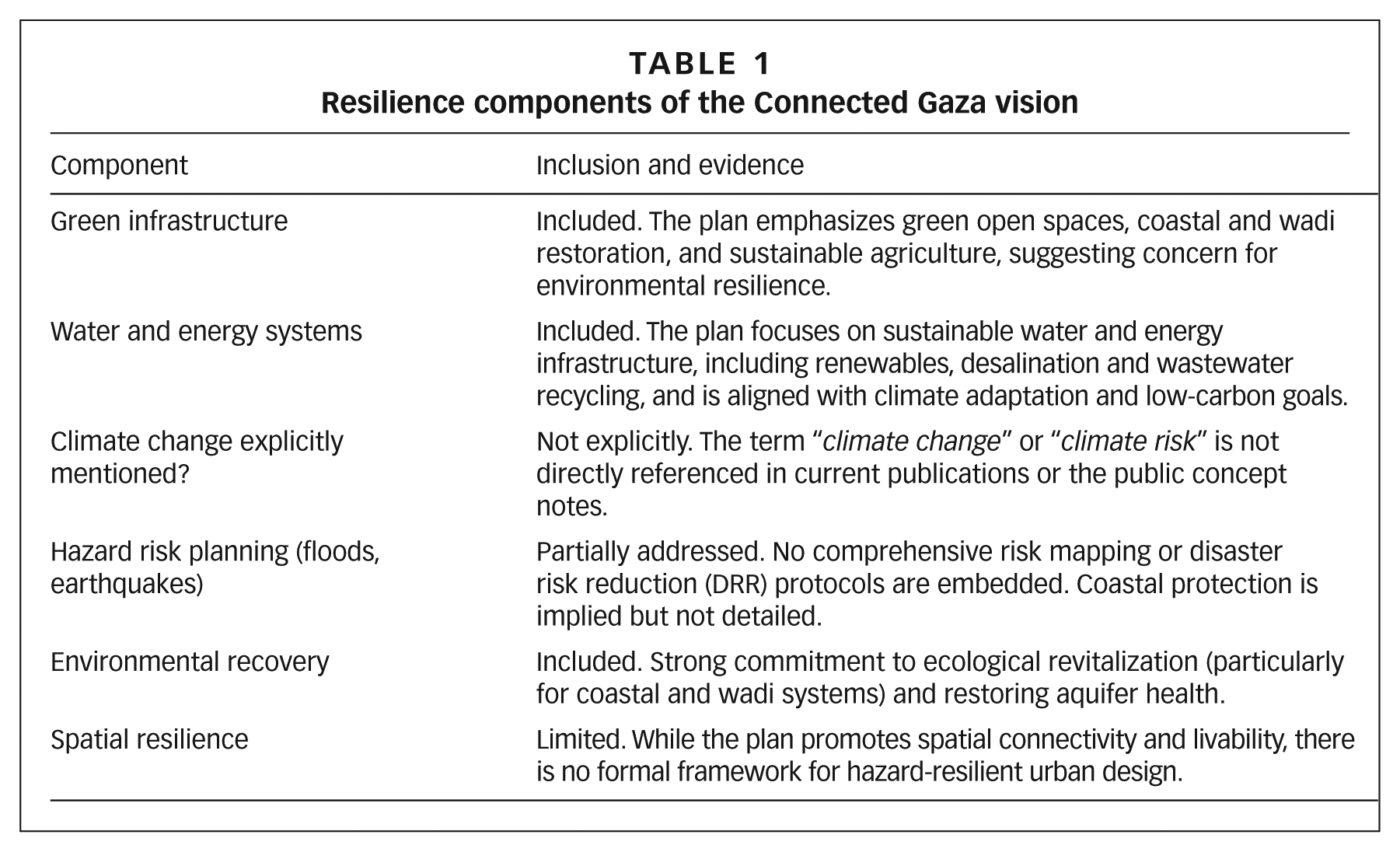
Overall, the plan’s scope reflected a primary interest in economic connectivity as the pathway to regional integration, social cohesion and development. But overlooking environmental hazard and change weakens the resilience of its vision.
b. A vision and plan on the table: the Egyptian Plan
The reconstruction of Gaza, as proposed in the Egyptian Plan, which was developed outside Palestine in the midst of active bombardment in 2025, represents a significant political and financial commitment to restoring infrastructure and revitalizing economic activity following repeated cycles of destruction extending back to before the current conflict. Adopted by the League of Arab States, a confederation of 22 Arab nations, including Palestine, whose mission is to improve coordination on matters of common interest, and individually by Palestine,(4) the plan includes a six-month early recovery agenda and a five-year reconstruction phase.(5) However, it misses a crucial opportunity to “build back better” by neglecting to include marginalized and vulnerable communities and to integrate disaster resilience and climate change considerations.
The plan calls on the international community (states, regional institutions, private sector) to pledge financial support. Because of the high cost (estimated at $53 billion) and the post-conflict context, mobilizing the full amount will depend on political stability, donor willingness and effective implementation mechanisms.
The plan explicitly rejects the forced displacement of Palestinians and affirms that people must be able to remain on their land in the Gaza Strip. It proposes the creation of temporary housing sites for large numbers of displaced persons, referencing seven designated sites to house more than 1.5 million people. The plan mentions using local labour and involving the local population in reconstruction efforts, thereby offering work opportunities for residents rather than for outside contractors alone. While the plan includes a commitment to ensure local people remain on their land, it lacks specific targeted strategies or quotas for very marginalized groups (such as women, people with disabilities, internally displaced persons (IDPs), informal-settlement residents).
The plan calls for major infrastructure rebuilding including water treatment plants, sewage systems, reservoirs and desalination plants, which will help buffer against water-system collapse and climate stresses such as less reliable rainfall and groundwater contamination. It mentions clearing debris and recycling rubble, which is relevant to waste management, and mitigating hazards from unexploded ordnance and damaged infrastructure. The plan also envisions the rebuilding of housing and new planned development over several phases, which could provide an opportunity for incorporating climate-resilient building standards.
In short, the reconstruction plan recognizes resilience and infrastructure recovery as major components – which is positive. However, its treatment of climate change adaptation and disaster resilience appears to be more implicit than explicit, with few publicly disclosed details on how future hazards (climate, geological, sea-level, etc.) will be systematically integrated and monitored.
The plan adopts a state-led, infrastructure-focused approach, prioritizing the rapid rebuilding of physical assets,(6) but it does not outline any mechanisms to ensure that low-income and displaced populations are explicitly considered. The plan explicitly emphasizes Palestinian ownership and inclusion, focusing on leadership, rights to land, no displacement, and inclusion in reconstruction labour. However, it does not propose participatory processes to give affected communities, particularly those most at risk, a voice in shaping reconstruction priorities. This omission raises concerns about equity, as vulnerable groups are often disproportionately affected by post-conflict reconstruction when social protection measures are absent. International best practices, including the Sendai Framework for Disaster Risk Reduction(7) and the Sustainable Development Goals (SDGs 11 and 13), emphasize that post-disaster and post-conflict recovery should be people-centred, inclusive and guided by the Build Back Better principle to strengthen social cohesion and reduce underlying vulnerabilities. The lack of such an inclusive framework in the Egyptian Plan suggests a missed opportunity to leverage reconstruction for social transformation.
Equally concerning is the plan’s failure to integrate disaster resilience and climate change adaptation. Among other emerging environmental hazards, Gaza is highly exposed to multi-hazard risks, including flash floods, sea-level rise, extreme weather, coastal erosion, tsunamis and earthquakes, yet the plan does not mention multi-hazard risk assessments, risk-sensitive land-use planning or the enforcement of resilient building codes. There are no provisions for flood management systems, stormwater drainage, coastal protection or nature-based solutions that could reduce environmental vulnerabilities, nor does the plan incorporate environmental sustainability considerations into urban design. In contrast to Connected Gaza – which treated landscape and water systems as fundamental planning layers – the Egyptian Plan largely ignores Gaza’s existing natural systems. By focusing primarily on rapid reconstruction, the plan risks creating infrastructure that will remain highly vulnerable to future hazards, leading to recurrent losses and wasted investment. This reactive rather than preventive approach contradicts global resilience principles and diminishes the potential for transformative recovery.
Reconstruction in post-conflict settings goes beyond technical and economic aspects; it offers a chance to tackle the underlying social, structural and environmental factors driving risk. Without integrating inclusion and resilience, the Egyptian plan could reinforce existing inequalities, further marginalizing vulnerable communities. To bridge these gaps, three main actions are proposed: first, mainstream social inclusion by implementing participatory processes and targeted aid for at-risk groups; second, incorporate DRR and climate adaptation through hazard assessments, resilient standards and ecosystem-based approaches; and third, align reconstruction efforts with the National Adaptation Plan(8) and international initiatives such as the Sendai Framework for Disaster Risk Reduction and the SDGs to ensure sustainability. Without these elements, the Egyptian Plan will remain a short-term recovery measure, with limited potential to contribute to sustainable and equitable recovery, leaving Gaza’s communities vulnerable to future disasters. In this way, the use of science and inclusive practices as key foundations for building resilience to environmental hazards can be exemplars and catalysts for the adoption of ambitious visions, inclusion and long-term goals across Gaza’s reconstruction programming. Where natural hazards and climate change cross borders there is specific scope for collaboration with Israeli and Egyptian partners – a delicate step towards healing, pride and peace in Gaza and the wider region.
c. Visioning for reconstruction following urban destruction by earthquake: lessons from Antakya/Hatay, Türkiye
On 6 February 2023, earthquakes centred in Kahramanmaraş affected 14 million people across 18 provinces in Türkiye. The earthquakes caused severe destruction in 11 provinces, and more than 50,000 people lost their lives. To address the damage in the earthquake-affected region, the construction of 680,000 housing units and 170,000 workplaces was targeted.(9) By the end of December 2025, a total of 455,000 units had been delivered, including 155,000 in Hatay. Antakya/Hatay’s visioning process has demonstrated that it is possible to incorporate diverse local perspectives and integrate hazard and climate science into planning to build back better, following catastrophic urban destruction.(10)
At the core of this ongoing recovery has been a hybrid planning model that combines top-down institutional coordination with efforts to include affected communities. Led by the Türkiye Design Foundation (TTV) and involving national ministries, international architecture offices, and more than 50 local and national planning teams, the process emphasized cultural continuity, collective memory and spatial resilience.(11)
Through public workshops, field visits and stakeholder meetings, a wide range of actors – from residents and artisans to historians and civil society organizations – have been consulted, marking a shift from conventional technocratic planning to a more inclusive framework. Although participation was mostly consultative rather than contributing to decision-making, it provided space for citizens to voice expectations and influence specific design decisions.
However, there were costs to this consultative approach. In the absence of shared decision-making rights, community representatives had limited bargaining power, which at times led to misalignment of priorities (e.g., location, phasing and public-space programming) and everyday needs, heightening risks of top-down planning decisions, and weakening trust during implementation. Future efforts should move beyond consultation toward co-decision-making in clearly delimited domains, supported by community-controlled micro-budgets, representative settlement-level councils, and a transparent participatory monitoring protocol to close the loop between proposals and adopted decisions. These adjustments can also be operationalized in high-constraint settings such as Gaza through trusted councils and time-boxed co-design workshops to accelerate delivery.
Integrating risk-sensitive urban planning tools was also important in Antakya’s process. Geotechnical micro-zoning, flood risk mapping and updated seismic data informed land-use decisions. Green corridors, water-sensitive urban design and climate adaptation measures were embedded in the master plan titled New City, Ancient Story. These science-based approaches contributed to a framework that prioritized both safety and sustainability while maintaining cultural authenticity.
While the planning in Antakya succeeded in creating visibility and a forward-looking vision, tensions emerged over the need for an urgent response versus the time required for meaningful participation. Moreover, since decision-making power largely remained with centralized authorities, the actual influence of participatory processes, as noted, was limited. Financial constraints and insufficient technological infrastructure further limited the process.(12)
Based on Arnstein’s Ladder of Participation,(13) there is a trade-off between quality of participation, time and cost; and this is a critical component to address in post-disaster planning processes. Figure 1 highlights the potential role of technological and financial interventions (e.g., digital participation platforms, pre-existing data systems or dedicated funding channels) to enable a shift in post-disaster visioning and planning from top-down approaches toward planning models that are more inclusive, flexible and legitimate – without compromising operational effectiveness.
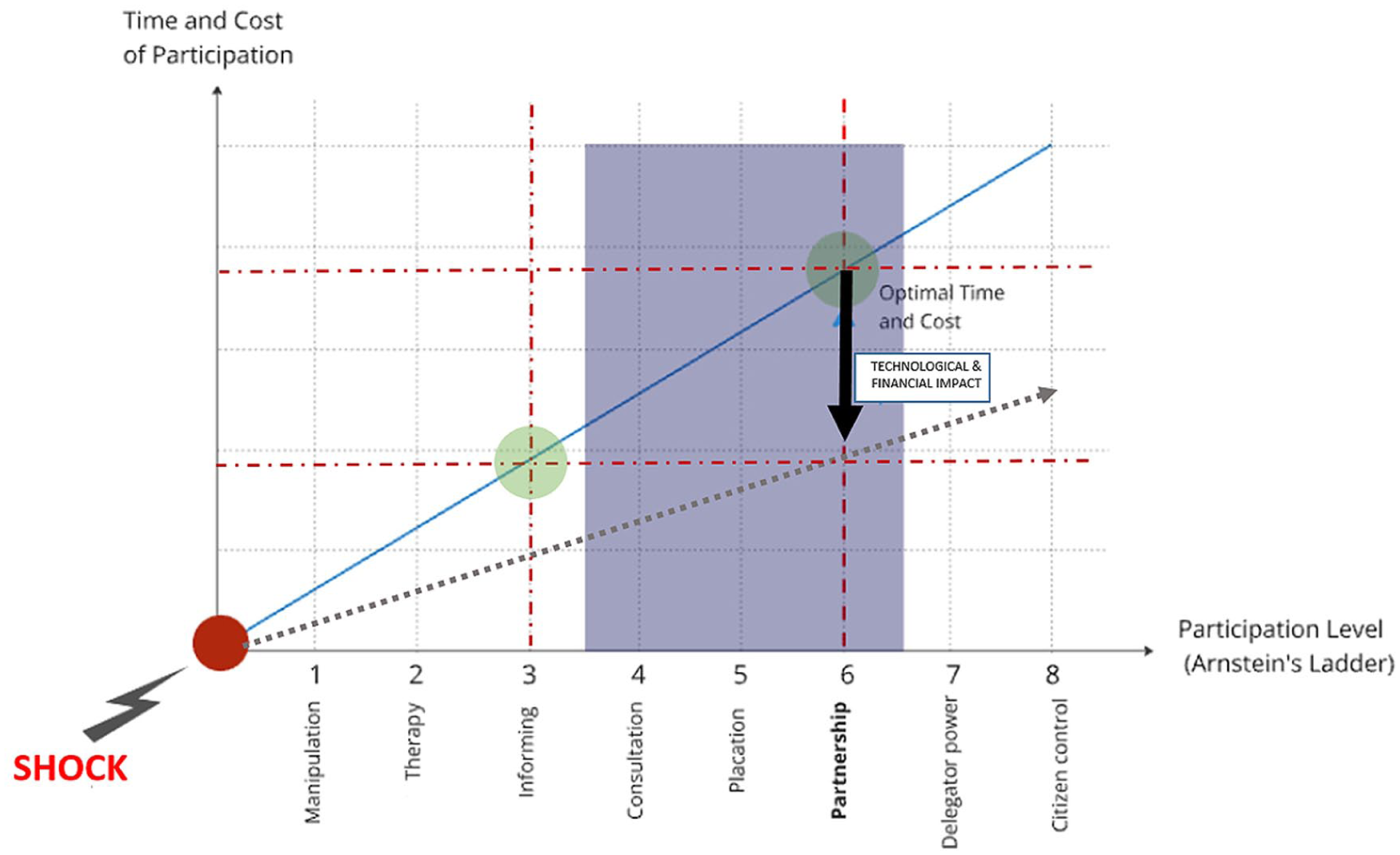
Balancing the level of participation with time and cost based on Arnstein’s ladder of citizen participation(14)
Transposing these debates to the Gaza context renders the tensions still more acute. Where access to safe, minimally adequate shelter and basic services is severely constrained, asking people to remain in tents until comprehensive plans are in place is neither ethical nor realistic; yet sidelining participation risks compounding harm and undermining legitimacy. A pragmatic path is an accelerated, participatory recovery that can proceed on two tracks:
Immediate, life-saving shelter and water, sanitation and hygiene (WASH) delivered through climate-sensitive, no-regret choices (e.g., rubble reuse and locally sourced materials; passive shading and ventilation to mitigate heat stress; and modular energy and water systems that can be upgraded over time);
Light-touch, iterative participation from day one via settlement-level representatives and trusted institutions to generate rapid solutions on longer-term siting, services, safety and cultural needs. This could be expanded at a later date to include a diverse set of community categories.
Taken together, these tracks preserve agency and operational capacity without slowing delivery and, when conditions permit, can convert emergency investments into the foundations of longer-term, climate-resilient recovery. Accordingly, in both Antakya and Gaza, the core issue is not participation versus speed but how to institutionalize early forms of participation, inclusion and transparency under centralized, resource-constrained governances.
Ultimately, Antakya’s case reveals that reconstruction is not merely a technical or physical task, but a deeply social and political process.(15) The foundations of reconstruction must be based on both lived experience and scientific knowledge, shaped by trust, shared ownership and a belief in the possibility of a more just and resilient urban future.(16) Antakya’s experience underscores that even under pressure, it is possible to carve out spaces for negotiation and to embed risk science from the outset. Achieving this, however, requires not only technical and financial capacity but also mechanisms that foster trust, intersectoral coordination, and a long-term vision rooted in justice, resilience and collective memory.
III. Key Lessons
Six key learnings may be of relevance to wider discussion on the role of science in planning large-scale reconstruction programmes, including prospects for Gaza.
a. Academia and science have a crucial role to play in Gaza’s reconstruction
This conflict is unique in many ways, yet – as in other post-crisis settings – solutions must be informed by transparent, inclusive and evidence-based knowledge co-production. Academic institutions and researchers have a responsibility to create participatory, trust-building environments in which interdisciplinary science can contribute to equitable and meaningful reconstruction. Urban labs(17) and citizen science are promising approaches that could be adapted to Gaza, helping build capacity, support livelihoods and enable communities to co-produce knowledge with academics and institutions. A regional example is the Beirut Urban Lab (BUL) at the American University of Beirut that used citizen- and science-based co-design to develop an urban recovery strategy following the Beirut Port blast in August 2020.(18) This model is particularly relevant as it addressed multi-layered trauma, displacement and socio-economic marginalization in a context similar to that of Gaza.
b. Climate and disaster risk should not be secondary considerations
The scale of humanitarian need in Gaza rightly prioritizes issues such as famine, injury and displacement. Yet decisions made on land use and housing or water infrastructures will have lasting impacts on the territory. For instance, decisions about shelter design or land allocation may shape both immediate safety and future sustainability. Even if climate and natural hazard risk considerations appear secondary, they are integral to designing complex, durable solutions.
c. Organizations should explore the psychological power of future thinking
Palestinians have endured decades of hardship. Amid such trauma, imagining a hopeful future is profoundly difficult. Yet it remains necessary. Climate and DRR discourse – so often seen as overly technical, top-down or abstract – can in fact be tools for envisioning transformation if done in inclusive and equitable ways. In contexts like Gaza, where the present is so unstable, the future offers space for creativity and bold imaginations for planning across sectors like housing, health, mobility and livelihoods. Including the aspirations and agency of youth participants through community organizations ensures a particular perspective on the future and lays the groundwork for their continued civic engagement.
d. Understanding local land tenure is central to future planning
The legal, social, and political complexities surrounding land tenure and ownership must be unpacked as early and as clearly as possible in any sustainable reconstruction process. National and local land management frameworks often clash with climate adaptation and DRR goals, potentially undermining long-term resilience. Moreover, many residents (especially tenants and those living in informal settlements) lack secure land tenure or the financial means to purchase land, yet depend on these areas for access to livelihoods and essential services. This challenge is particularly acute for the approximately 70 per cent of Gaza’s residents who are UNRWA(19)-registered refugees. Many lived in camps, now totally devastated, that operated under distinct UNRWA-managed frameworks. Reconstruction must address whether and how these camps are rebuilt, clarify the roles of UNRWA versus Palestinian authorities in planning and service delivery, and ensure that reconstruction choices do not inadvertently undermine refugees’ legal status or right of return. Recovery and reconstruction strategies must therefore consider not only legal frameworks but also social and financial policies that address these realities, to avoid reinforcing existing vulnerabilities or creating new ones. Without addressing these tensions from the outset, even the most visionary planning risks becoming impractical or exclusionary.
e. Reconstruction must balance urgent action with meaningful participation
A key tension lies in the pace of reconstruction. While deep community engagement is essential for legitimacy and inclusion, it can slow down processes and create a more conflictive environment, where there is no shared vision for the future. At the same time, people need to see fast visible progress and hope to rebuild momentum after trauma. Quick wins – such as rapid, but rigorous data collection and the inclusive development of hopeful future scenarios (even if high-level) – can help catalyze concerted action built on local consent. These processes and ways of working can be initiated at the beginning of any reconstruction – even in the location and management of temporary shelter. This helps to establish norms and expectations for planners and those affected. Still, planning frameworks and strategies must remain flexible – as well as transparent and accountable – to adapt as local voices and needs emerge more clearly. Locking in land uses early on, as indicated above, can be damaging for resilience strategies.
f. Existing hazard data must be revisited in light of the war’s impacts
Although hazard and spatial datasets for Gaza exist (some being created or updated via remote sensing), altered land conditions – for instance, through topographic change, debris accumulation and possible soil contamination – could have major implications for housing, agriculture and infrastructure design and for climate change and disaster risk exposure, vulnerability and management. Also, the continuous relocation of IDPs, along with the lack of landmarks and urban references due to the total destruction of some settlements, creates additional layers of complexity when it comes to preserving former ways of living and local heritage reconstruction. A rapid yet robust collection and reassessment of this data is crucial to ensure that reconstruction efforts are climate-sensitive and risk-informed.
IV. Conclusion
In a deep crisis like Gaza’s, it is understandable that most reconstruction attention and funding go to immediate needs like food security, water and shelter – once the situation in the region stabilizes, or even before. But the choices made at the moment reconstruction commences will likely shape the future. For example, where temporary shelters are placed, or how debris or water supplies are handled, could affect how the land is used for decades. Gaza’s environment was already fragile before the current devastation. Concerns based on past experience such as drinking water availability, air quality and risk from high-impact, low-probability events such as a major earthquake will now be compounded by climate change through heat and flash flood hazards. This requires the integration of disaster risk management, including climate change adaptation and mitigation, into the fundamentals of reconstruction planning for Gaza. The foundations for a successful, sustainable post-reconstruction Gaza will be laid early on in the reconstruction practices and scoping phase. This extends beyond physical to social fabric.
Placing Gazan perspectives at the centre of reconstruction visioning, planning and, finally, evaluation, is not only just and effective but also will help heal and allow a renewed sense of ownership. Examples, such as urban labs, provide specific experiences that can be woven into the processes that have already taken place and are reported on in this paper. The plans reviewed here provide a baseline – and signal the diversity of perspectives already on the table as a starting point. The replanning of Gaza does not start with a blank sheet. It begins with consideration of ambitions already expressed, gaps identified and methodologies learnt.
Footnotes
Acknowledgements
For the generous sharing of technical ideas and expertise that have informed this paper, we gratefully acknowledge Professor Iain Stewart, El Hassan Research Chair for Sustainability, Royal Scientific Society, Jordan and Dr Rami Ziara, Director, Center for Engineering and Planning (CEP), Palestine.
Declaration of Conflicting Interests
The authors declared the following potential conflicts of interest with respect to the research, authorship, and/or publication of this article: The corresponding author, Mark Pelling, is co-editor of this special issue of Environment and Urbanization.
Funding
The authors disclosed receipt of the following financial support for the research, authorship, and/or publication of this article: This work was funded from a University College London (UCL) Knowledge Exchange and Innovation Fund, grant KEI2024-02-52.

6.
See note 4.
17.
Urban labs describe a variety of interventions. In common they bring together science and policy makers, often also with citizen or other interests such as funders or private sector groups. Their aim is to convene knowledge exchange and build trust for consensual action on locally challenging issues, including climate change and disaster risk reduction/recovery.
19.
United Nations Relief and Works Agency for Palestine Refugees in the Near East.