



Abstract
The theory that property rights increase household income among low-income households is widely acknowledged, yet empirical studies find scarce evidence of this effect. These studies encounter theoretical deficiencies and methodological challenges of endogeneity and selection bias in making causal inference. This paper examines effects of property rights on income using a control group design and propensity score matching. It employs the continuum of property rights as a conceptual framework, applying it to the case of Zango I social housing project and Paraiso, a slum, in Luanda. Results show the likelihood that property rights increase tenure security and income through the mechanism of home business activities but not through labour market participation or credit access. In contexts where housing projects for low-income groups depend on the informal sector and are located far from city centres, home business activities can be an important mechanism through which property rights may alleviate poverty.
Keywords
I. Introduction
Conventional wisdom holds that property rights institutions are the backbone of the economic structure of society, determining the trajectory of economic growth and development.(1) Formal property rights also ensure that government protects private property since people underinvest if the fruits of their labour might be taken away.(2) Thus property rights institutions are both a prerequisite and a regulating structure for economic growth and development.(3)
However, at a micro-level, evidence supporting the theory that property rights are associated with higher income is scarce, ambivalent and weak. The scarcity of empirical quantitative studies is compounded by problems of determining causality due to endogeneity and selection bias. These problems remain a concern in causal inferences about effects of property rights in general.(4) Further complicating the evidence is that until recently property rights tended to be conceptualized in terms of the simple dichotomy of de jure versus de facto rights, while actually they occur on a continuum in developing countries.(5)
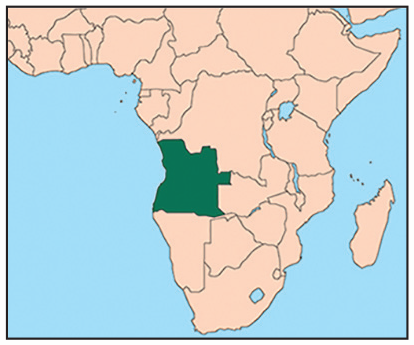
This paper sets out to examine whether property rights increase household income in a post-conflict, authoritarian context. It reports on a study examining the effect of property rights on income in Luanda, Angola, using a control group design and propensity score matching methods to mitigate the impact of endogeneity and selection bias. It employs the continuum of property rights as a conceptual framework and applies it to the cases of Zango I and Paraiso. After mudslides affected Boa Vista, a slum(6) near the centre of Luanda, the government relocated residents to Zango I and eventually provided them with social housing and a formal tenure document known as the guia de entrega. Meanwhile, some Boa Vista residents fought the eviction, refused to move to Zango I and instead moved to other slum areas, including Paraiso, to remain closer to their workplaces and economic opportunities. Paraiso, a slum to the east of Boa Vista, includes residents from other areas, not just Boa Vista. The study used residents of Paraiso who arrived at about the same time as Boa Vista residents were moved to Zango as a comparison group, using propensity score matching methods.
Theory suggests that property rights increase income, first through the mechanism of increased access to credit, which should lead to higher investments; second, by increasing participation in home business activities; and third, by increasing tenure security, which leads to labour market participation.(7) With regard to the first mechanism, despite weak evidence in some contexts, the consensus is that property rights generally do not lead to increased access to credit.(8) Evidence for the second mechanism is contradictory. Boudreaux(9) finds evidence supporting an increase in home business activities and income in a qualitative study of Langa in South Africa, but Muyeba(10) demonstrates that titled households are less likely to participate than households with occupancy rights in Lusaka. Evidence for the third mechanism is ambiguous. One peer-reviewed journal article and two unpublished papers provide some evidence of increased labour market participation and income.(11) To the contrary, several other published works find no evidence.(12) In Lusaka and Cape Town, where formalization of property ownership took place, Muyeba finds unemployment to be so high that property rights make little difference to labour market participation and income.(13) Overall, the literature on property rights and income among low-income communities includes a few peer-reviewed publications, several widely cited unpublished works and a few published but not peer-reviewed quantitative studies, which suggests that much work is needed in this area.
Moreover, the literature is silent on the effects of property rights in post-conflict societies that have authoritarian tendencies, and that are in the process of rebuilding infrastructure and democratic institutions. Authoritarian regimes engage in arbitrary and predatory behaviour, which makes protection of property rights precarious.(14) They also rely on disruptive measures such as evictions, the razing of slums and resettlement to realise their objectives.(15) This adds to the loss of confidence in government protection of property rights. Almost half the global population resides in countries with authoritarian regimes, Angola being one of them.(16) In these states, a weak cadastre system is an impediment to reconstruction and long-run economic change. Seventy per cent of countries have a poorly developed cadastral system – a figure that covers two-thirds of the global population.(17) Angola, a post-war society undergoing reconstruction and democratic transition, is particularly interesting in this regard. Angola has an outdated cadastral system. At the same time it has weak institutions that make it difficult to protect property rights. In Luanda, the colonial cadastre was not kept up-to-date after independence and has been slow to modernise and digitize. An estimated 96 per cent of land transactions take place without exchange in formal property titles – but with exchange in informal documents.(18)
The evidence presented in this paper contends that property rights increase tenure security and income through the mechanism of increased home business activities, but not through increased labour market participation or access to credit. This paper suggests that a still untested mechanism is that of increased gifts from family members, which has been documented in several countries in Africa.(19)
The remainder of the paper is organized as follows. Section II provides background on Luanda, and describes the Boa Vista, Zango I and Paraiso sites, providing justification for the choice of these settlements for case studies. Section III describes the methods used. Section IV presents the results. Section V discusses the implications of the results for the wider body of knowledge on property rights and household income. Section VI concludes.
II. Context: Zango And Paraiso In Post-Conflict Authoritarian Angola
In describing the property rights context in Angola, the paper employs the continuum of property rights as a framework, following Royston.(20) This continuum recognizes the rich complexity of land rights that exist in society, in contrast to the simple dichotomy of de jure versus de facto rights that has characterized previous conceptualizations of tenure security.(21) Payne(22) showed that tenure security exists on a continuum from weak to strong tenure rights. At the weaker end are street homelessness or pavement dwelling, informal tenancy, informal ownership in un-regularized settlement and tenancy in unauthorized subdivisions. Stronger forms range from informal ownership in regularized settlements to ownership in authorized subdivisions, legal ownership with unauthorized construction, tenancy with legal contract, leasehold tenure and freehold tenure rights.(23) The United Nations Global Land Tool Network uses a more widely applicable continuum of property rights that goes beyond urban areas. Both approaches are useful. As section IIa shows, Zango residents in social housing occupy the seventh category of the continuum (tenant with contract from the government) where eviction is unlikely. Paraiso residents occupy the fourth and fifth categories, as tenants in an unauthorized subdivision and occupants in an unauthorized subdivision. These categories remain subject to eviction and their houses are susceptible to demolition in the long-term.(24)
Angola’s land law is based on the Portuguese civil code. The independence movement leader, Dr Antonio Agostinho Neto, who led Angola from 1975 to 1979, established the country as a Leninist Marxist state and declared the state as owner and manager of all land. His government inherited a Code that ignored pre-colonial land tenure arrangements based on local customs.(25)Although President Dos Santos revised Angola’s land law in 1991 and again in 2004, each time he upheld the Code.(26) Notably, the 2004 land law (law 9/04) required landholders to formally register their land before a 2010 deadline when all unregistered land would revert to the state.(27) Three-quarters of the land in Luanda is still held informally,(28) often with no formal records of transactions or formal registration of ownership.(29) However, those in musseques(30) do possess a variety of informal documents that occupants erroneously believe will give them legal tenure, including declarations of sale/purchase or a certificado de residência (certificate of residence) issued by local residents’ committees.(31)
Angola’s housing crisis today has its roots in colonialism, prolonged conflict, post-conflict infrastructure and economic conditions, and widespread evictions. The colonial regime created indigenous neighbourhoods on the outskirts of Luanda and other major urban centres and pushed those who had lived in the urban centres out to the periphery.(32) The conflict years reshaped urban population dynamics and caused housing shortages. The battlefront was concentrated in rural areas, causing four million people to escape to urban areas over the course of 27 years of civil war.(33) After the war, poor economic and infrastructure conditions in rural areas continued to precipitate rapid urban migration.(34) The government was faced with a large and rapidly growing urban slum population. Towards the end of the conflict in 2002 and after, President Dos Santos’s regime began forcibly evicting low-income households from areas earmarked for urban development or prone to natural disasters.(35) Most were moved to peripheral areas to make way for construction of hotels and high-end office buildings.(36) These evictions continue today. The Zango I project was one of those built as a resettlement location as compensation for the displacement.
Despite government interventions, housing supply remains insufficient to meet demand. Post-war housing production accelerated with President Dos Santos’ 2008 commitment to the construction of one million houses by 2012.(37) The country signed an oil-for-housing construction deal with China, leading to the construction of Angola’s largest housing project, Kilamba City, which consists of 20,000 apartments in high-rise buildings for mainly middle- and upper-middle-class residents, along with several other projects.(38) In 2015, 24 per cent of Angolans lived in cities of over one million people.(39) In 2019, Luanda’s population was 8.25 million – over half way to having doubled in the two decades following the war.(40)
a. The case of Zango I
After a heavy downpour in September 2000, mudslides swept away houses built on a hill in Boa Vista, an old musseque located between the port of Luanda and a luxury residential suburb.(41) Several people died, including three children. The following April and May, Boa Vista experienced more mudslides and deaths. This time the government decided to evict people from the hazardous musseque. In early June, the government announced that families who lived in at-risk houses would be moved to a different location and their houses demolished for their safety.(42)
Early in the morning of Sunday 1 July 2001, police surrounded Boa Vista and began to forcibly and violently evict residents, leading to the deaths of two residents and several injuries. Police returned on 6 and 7 July to demolish 117 houses.(43) Between June and September, the government moved over 4,000 families from Boa Vista to Zango I in Viana Municipality, about 30 kilometres (25 miles) southeast of Luanda.
In Zango I, evictees put up tents and iron sheets as they waited for the construction of the houses the government had promised to build for them. Houses were taking three to four months to be completed,(44) and the evicted households waited for three years before the promised 3,000 houses were built.(45) The houses are uniform in size (52 m2) and design – semi-detached structures (see Figure 1) with three bedrooms, a kitchen, a lounge and a bathroom.(46)
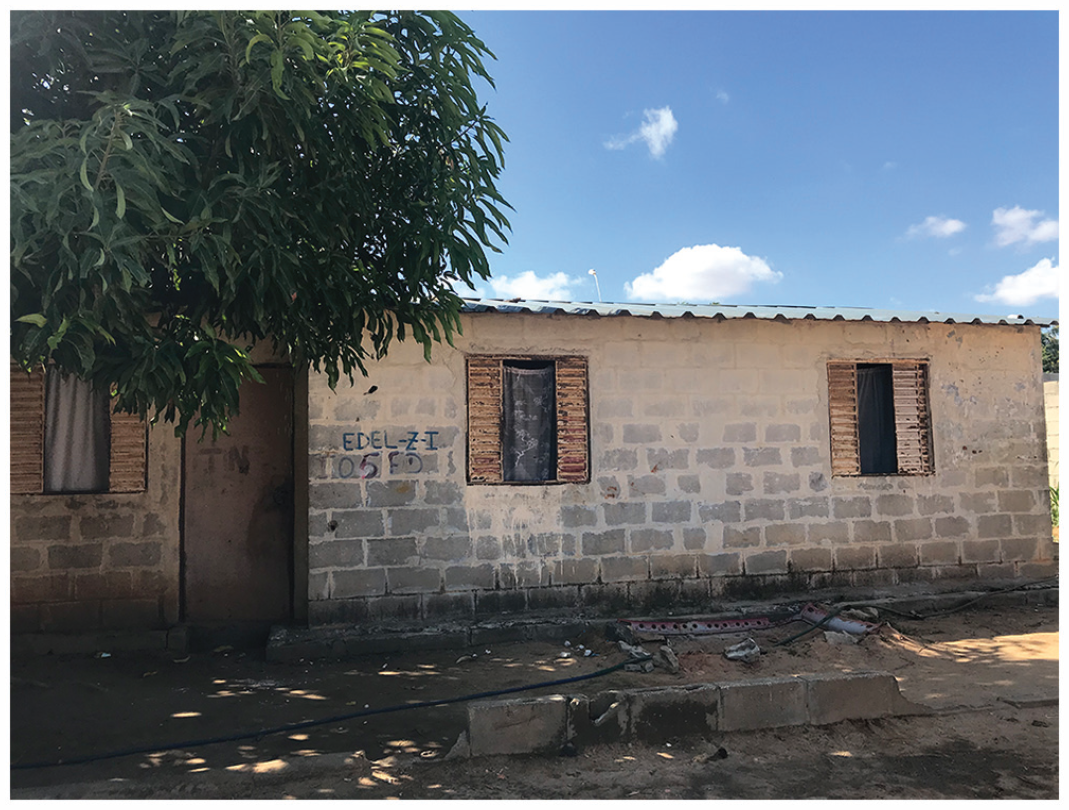
New housing in Zango I delivered in 2006
Upon delivery of houses, the government provided Zango I residents with a document called the guia de entrega, a receipt for the delivery of the house to the beneficiary.(47) This contained a brief note, reading:
I undertake before the State, to respect the following principles in relation to the assigned house: not to sell, rent, abandon without justifiable reason and prior communication to the P.E.H. [Emergency Housing Programme in the Government of the Province of Luanda] and not to use it for purposes other than housing, under penalty of losing it to the State. (Translated from the Portuguese(48))
While the guia de entrega does not limit tenure duration, it does not transfer ownership to the beneficiary. The houses, delivered as social housing, remain the property of the state. The document stipulates that selling and renting out are prohibited, as is abandoning the house without a justifiable reason and advance communication. The document also makes provision for what can be interpreted as usufruct rights: occupants could only use the house for purposes of accommodation. Violating these conditions would result in the loss of the house to the state.(49) From Croese’s research, it does not appear that the government acted on this restriction. In fact, the government went on to allow residents to make basic improvements such as “plastering and painting the interior of the house, laying tiles, installing burglar bars on doors and windows as well as ceilings without prior authorization”,(50) but not to undertake any alterations or other extensive work. Beyond the guia de entrega, there was no formal title.
To date, no formal land or property registry exists for Zango I or in Luanda in general, despite the ongoing delivery of houses as well as land for self-help building.(51)
b. The case of Paraiso
While the government moved some families from Boa Vista to Zango I, others fought the eviction and decided to move to other musseques, including Paraiso, that were closer than Zango to economic opportunities or to their jobs.(52) Paraiso (meaning “paradise”) is a musseque located on the outskirts of the city of Luanda in Cacuaco Municipality.(53) The area used to be informal farmland that began to be used in the early 1980s. In 1992, a large wave of internally displaced persons arrived from the provinces of Huambo and Benguela, Bié, Kuando Kubango and Uíge, fleeing the war.(54) Later, the government settled demobilized soldiers there. It functioned as a refugee camp during this time. In 2000, the provincial governor, Aníbal Rocha, closed the camp down,(55) and in what seemed to be an impromptu speech, he authorized people to build houses there. It is unclear whether this decision was backed by the government, which has neither released a plan nor provided essential services except for an understaffed police station established 16 years later to address extreme crime. The people evicted from Boa Vista who decided to move to Paraiso joined residents from elsewhere who had begun settling there from 1998 onwards.(56) Most of the houses in Paraiso, all occupant-built, are precariously constructed, although many are built of concrete blocks and mortar (see Figure 2). Gastrow(57) has shown that building a brick and mortar house in Luanda, in addition to ensuring aesthetic value, is part of an effort to legitimize settlements.
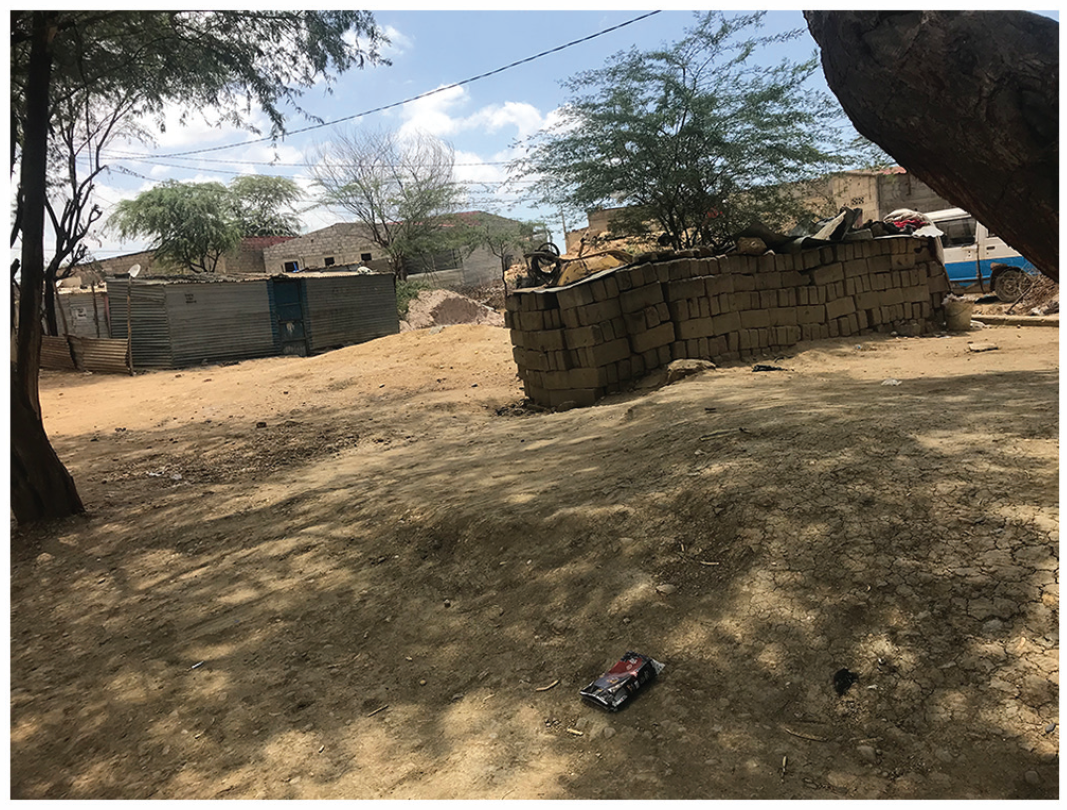
Houses in Paraiso in 2019
Paraiso has grown to be the most populated musseque in Luanda, with about 120,000 residents in 2018.(58) Although the land is still officially in the hands of the government, residents, who keep informal records of their transactions, feel that they own the land.(59) A study carried out by Cain in Paraiso(60) found that 96 per cent of Paraiso residents paid for and therefore own their houses, even though these were informal transactions.
III. A Control Group Quantitative Design And Propensity Score Matching
A control group design makes it possible to examine the effects of property rights on income in Zango I. A key distinction between Zango and the Paraiso residents, who serve here as a control, is that the guia de entrega is a government-issued document formally transferring the use rights of social housing to its occupants, while Paraiso residents hold informal documents.(61) This places residents of the two neighbourhoods in categorically different analytical groups on the continuum of property rights.
The data that inform this study come from a larger quantitative project that was undertaken to investigate multiple outcomes of the Zango I project. That larger study evaluated the effects of Angola’s state-subsidized housing programme in Zango and involved a household survey conducted from 3 to 21 December 2019, 13 years after the first transfer of social housing to families in Zango I, in 2006. The survey was conducted in conjunction with a research organization that conducts Afrobarometer surveys for Angola.
a. Study population and sampling
The study population consisted of the 3,000 household heads that were the original beneficiaries of social housing in Zango I, and the approximately 120,000 dwellers who lived in the musseque of Paraiso.(62)
The targeted sample size for the survey was 650, with respondents from 300 households in Zango I (10 per cent of the number of eligible households) and from 350 households in Paraiso, where an unmatched sample was targeted. The study employed systematic sampling with a random start, a probability-based sampling method that ensured that every person in the study population had an equal and random chance of being selected. Google Earth images of the two areas in 2019 were used to select the random start because there was no publicly available and reliable housing registry of either Zango I or Paraiso that could be used as a sampling frame. A random start was assigned by a field supervisor. Paraiso was divided into eight sectors for data collection purposes in line with Waldorff.(63)
b. Data collection
After the sampling of households was complete, 22 data collectors were trained in a workshop to administer the survey. All were experienced in data collection procedures and use of devices, having been involved in the nationwide Afrobarometer surveys. Each enumerator conducted one practice interview during the training. Then the survey questionnaire was reviewed according to the comments made. The questionnaire included questions on demographics, the dwelling, access to credit, household wealth, income-generating activities, health, social capital, institutional capital and satisfaction with housing and with life in general.
The team was instructed to interview either the household head or a proxy of 18 years or above – there were no other requirements for representation in terms of gender, ethnicity or health. In Zango I, data collectors first confirmed with residents that the household head was an original beneficiary from Boa Vista in 2001 and had occupied the house in 2006. They were also asked what kind of documents or title they had and their year of occupancy, to ensure that only the original occupants were interviewed.
The secure online platform SurveyToGo was used to collect data. The questionnaire was programmed into the platform and was administered with smartphone devices, each of which was password-protected. The data collectors did not have access to the data once they had successfully conducted and uploaded an interview. Data were kept in a secure and encrypted cloud account accessible only by the principal investigator (the author).
The realised total sample size was 634 households (a 97.5 per cent response rate). However, during data cleaning it was found that three of the respondents recounted that their households had moved into Zango I later than 2006, indicating they were not original owners or their dependent proxies. Another 36 failed logic checks. These were removed from the dataset. In the final unmatched dataset, there were 297 observations from Zango I and 298 from Paraiso.
c. Variable description
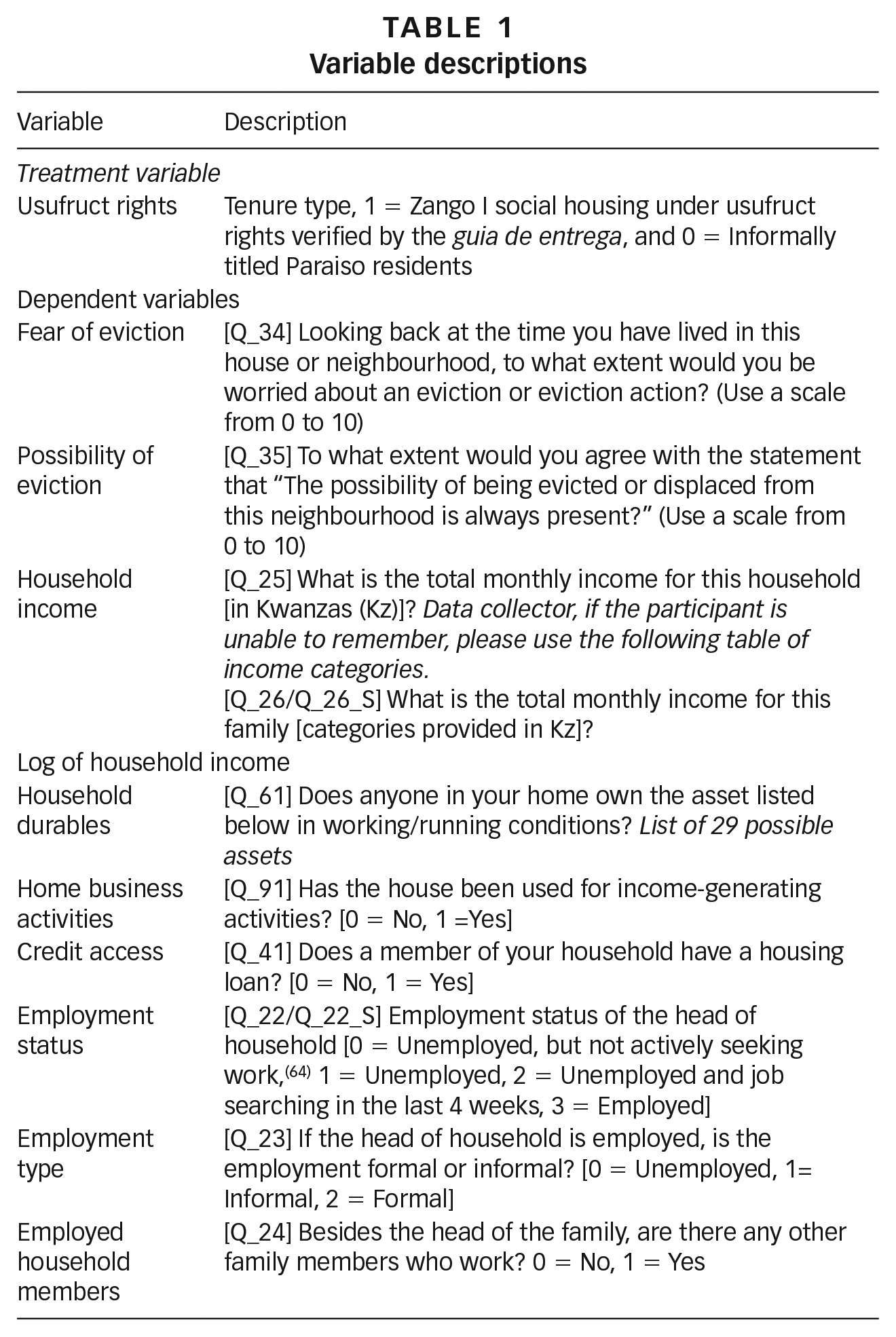
The variables used in this paper are summarized in Table 1.
Variable descriptions
d. Analytical strategy
Ideally, identifying the causal effects of a development intervention would require counterfactual observation, that is, observing the same individuals in the presence of the intervention and without the intervention simultaneously. This is not possible given the impossibility of being in two states of existence at a single moment in time. Researchers solve this puzzle by comparing the average outcome in a group of individuals to the average outcome in another group of individuals who have similar observed characteristics (assuming that those who are unobserved are also similar), but differ only in treatment status.(65) The researcher is then able to attribute the difference in outcomes to the treatment. The ideal approach to ensuring similarity between groups and attributing causal effects is a randomized experiment.(66) Randomized experiments in housing studies are theoretically possible but not always practical. Instead, non-experimental evaluations are used, with the aim of controlling for both observed and unobserved factors influencing the outcome.(67)
In non-experimental approaches, the researcher can use available variables to construct comparable groups and then apply econometric techniques to observe an estimation of the counterfactual and estimate the effect of the intervention. One of the two main non-experimental approaches that solve the problem of random selection in non-experimental studies is matching.(68) Matching uses a statistical technique to construct an artificial comparison group in order to observe the counterfactual. To do this, the researcher identifies subjects that did not receive an intervention but have characteristics which are the most similar as possible to those who received the intervention.(69) The main matching method is propensity score matching. As a statistical technique, propensity score matching reduces a collection of background characteristics to a composite measure, the propensity score, that summarizes the collection.(70) The propensity score is used to find a match for each individual in the treatment group allowing the researcher to compare like with like.(71) Those with similar propensity scores are matched, only differing in treatment status. Conditional on their propensity scores, participants from treatment and control groups will have a similar distribution of measured or observed baseline covariates on the assumption that all possible characteristics are measured or observed. Matching thus approximates to an artificial post-hoc “experiment”.
In this study, propensity score matching was employed in order to ensure the comparability of individuals from Zango to those of Paraiso following Rubin,(72) Rosenbaum and Rubin(73) and Austin et al.(74) The objective of the study was to test whether there were significant differences in tenure security, labour market participation, credit access, home business activities and household income. Given that residency in Zango I and Paraiso was self-selected and that there were people, other than those from Boa Vista, who had migrated to Paraiso, propensity score matching was most appropriate for finding matches in Paraiso for Zango I residents. Although some households self-selected and moved from Boa Vista to Paraiso, there were no records to help trace and isolate these households. The “treatment” and “control” in this case represent two different settlements which faced a range of location-based and other observable/non-observable differences. This means that the propensity score matching improves the comparison for household outcomes across these settlement types.
Before employing matching methods, the dataset was limited to those who had settled in Paraiso from 2001, since that was the year of eviction from Boa Vista. Several matching variables were used in order to ensure that all characteristics were observed. Thus, conditional on their propensity scores, participants from both neighbourhoods had the same distribution of measured or observed baseline covariates. The details of achieving comparability of the groups are described below.
Estimating propensity scores
The analysis involved estimation of an initial propensity score matching model using the matching variables described in Table 2.
Variable descriptions for matching variables
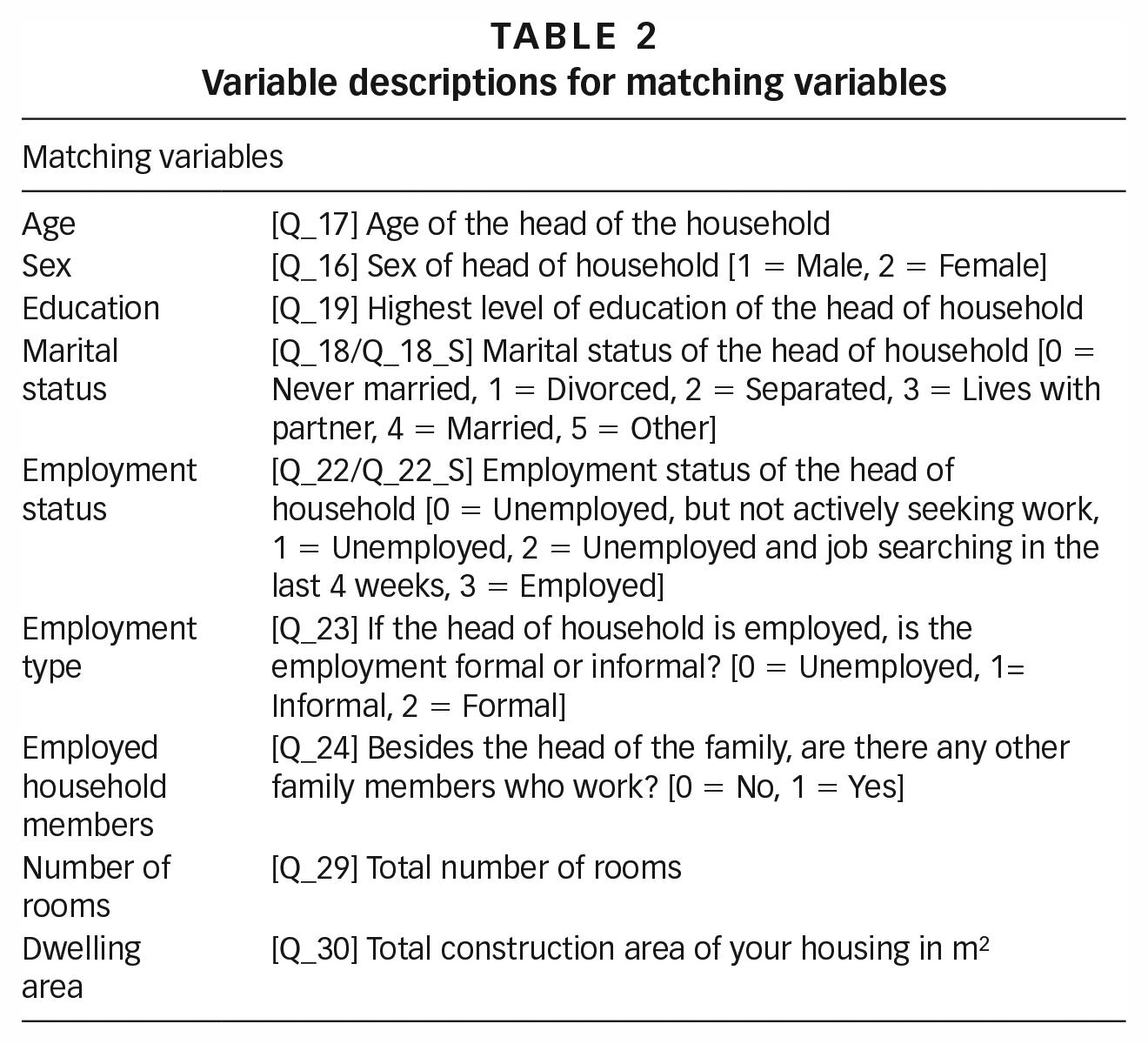
To estimate the propensity score, the analysis employed a probit regression model to predict treatment status – that is, holding of usufruct rights through tenancy with contract from the government for Zango I versus informal tenancy or occupation in un-regularized settlement for Paraiso. The probit model regressed tenure status on baseline characteristics shown in Table 2 in line with Rosenbaum and Rubin.(75) Austin et al.(76) and Rosenbaum and Rubin(77) recommend that models estimating propensity scores should include those variables that affect the outcome or that affect both treatment selection and the outcome. Demographic characteristics are plausible predictors of income in households with stronger tenure rights. Demographic characteristics are also included in the model because of the need to ensure balance on variables that are predictive of these outcomes.
Matching on propensity scores
Participants from Zango I and Paraiso were matched based on similar propensity scores. The ideal in matching is to have fewer observations in the intervention group and more observations in the non-intervention group in order to have a larger pool from which matches for the intervention group can be selected. The realised matched sample size was 162 for Zango I and 214 for Paraiso, which was ideal. Four different matching methods were used in the analysis. These include nearest neighbour, radius, kernel and stratification matching. The study made inferences only within the region of common support. The region of common support in Figure 3 is the area where the bars on the histograms of the propensity scores for the treated and untreated groups overlap. The range of scores for the region of common support was propensity scores 0.15 to 0.92.
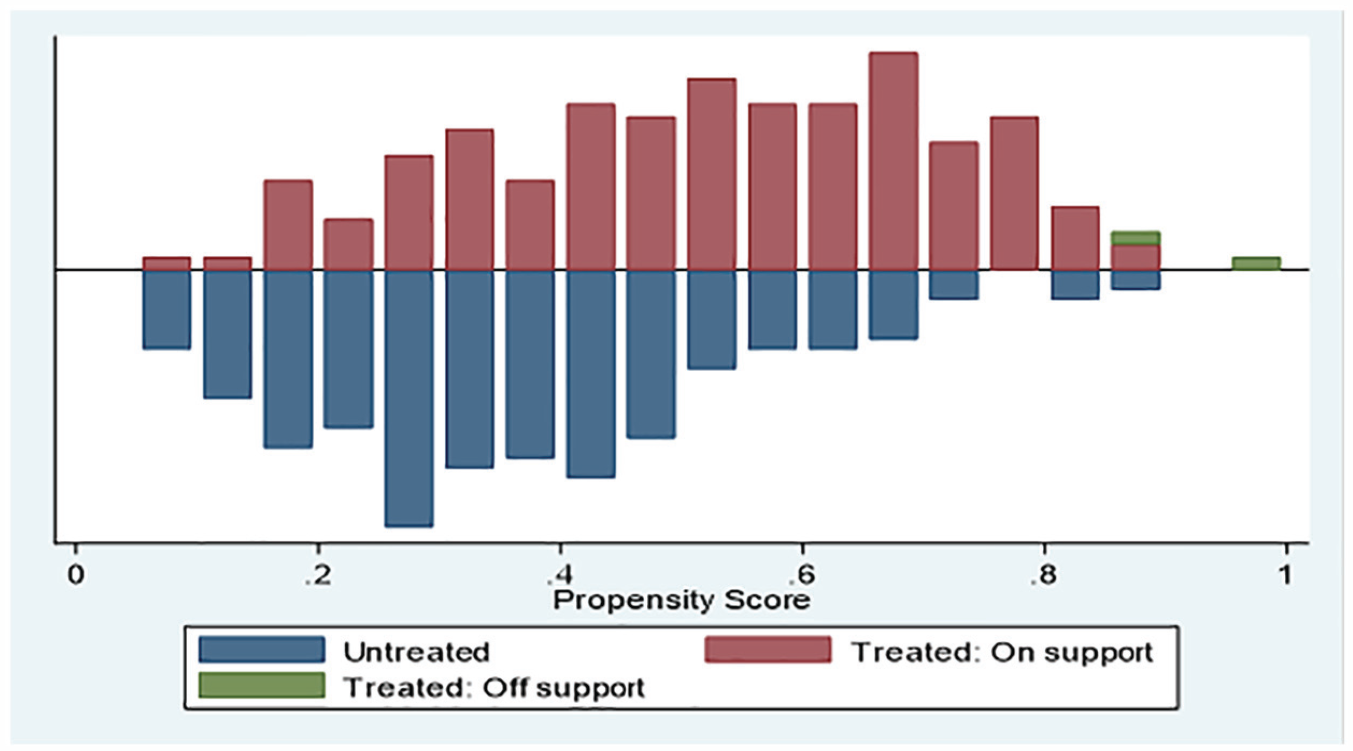
Balance of propensity scores across treated (usufruct rights) and untreated (informal title) groups
Stratification and balance on propensity scores
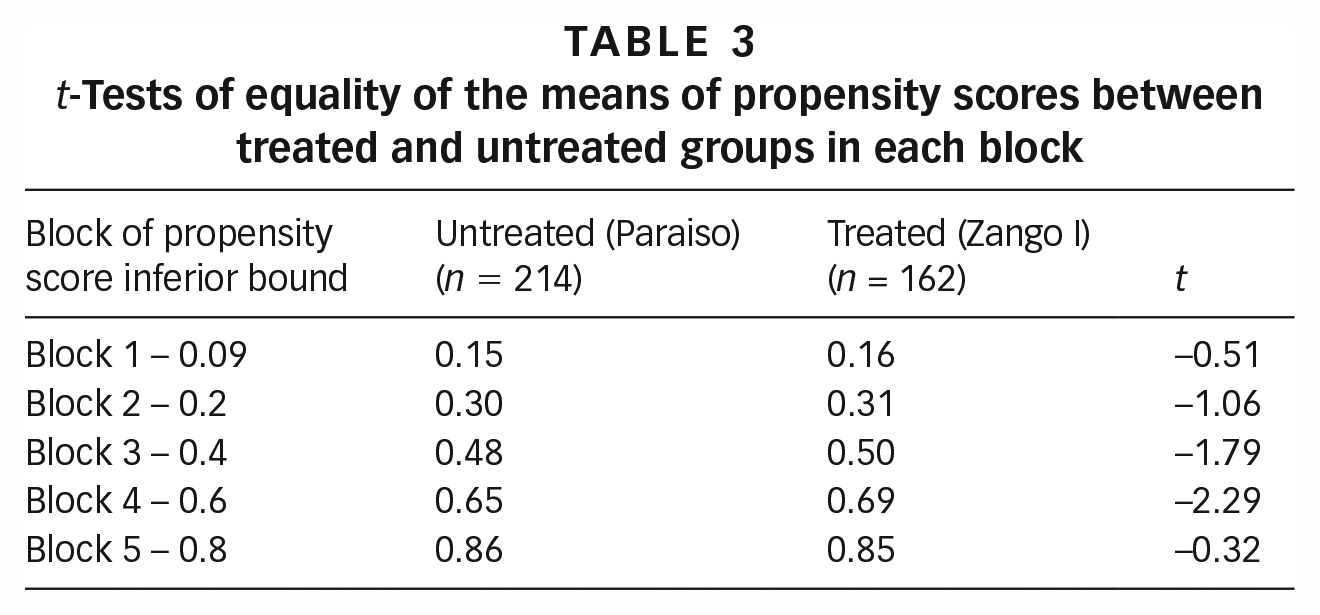
Balancing the data ensures that there are no confounding effects across distributions of propensity scores.(78) Balance is achieved by computing quintiles of the estimated propensity scores such that each quintile has no differences between the intervention and non-intervention groups. When propensity scores are constant within each quintile, it means that the distribution of matching variables is approximately the same between the two groups.(79) Participants in the overall study sample were stratified into five approximately equal-size blocks, that is into quintiles of the estimated propensity scores. The results of the tests of equality of means are shown in Table 3. The mean scores are equal. Thus, the extent of overlap is satisfactory, and balance is achieved across the two samples within each quintile.
t-Tests of equality of the means of propensity scores between treated and untreated groups in each block
Estimating treatment effects
Propensity score matching allows one to estimate the average treatment effect for the treated (ATT) – that is, the average response to treatment for individuals that were assigned treatment. However, in the case of this study the ATT does not necessarily mean a causal relationship exists but indicates the likelihood of a relationship of association between household income and usufruct rights, assuming all factors correlated with the outcome have been included in the model. Unobserved factors are not controlled for in propensity score models. When used, the model assumes that all factors correlated with the outcome are observed. Although theory guides the selection of observed variation, it is impossible to know for sure that there are no unobserved factors. Thus, in this study the interpretation is inferred based on a number of assumptions and contextual information, which will be discussed in the results section. In this analysis, nearest neighbour, radius, kernel and stratification matching techniques are used to derive and estimate the ATT. No specific matching technique is superior to another in the estimation of outcomes.
IV. Results
a. Descriptive statistics
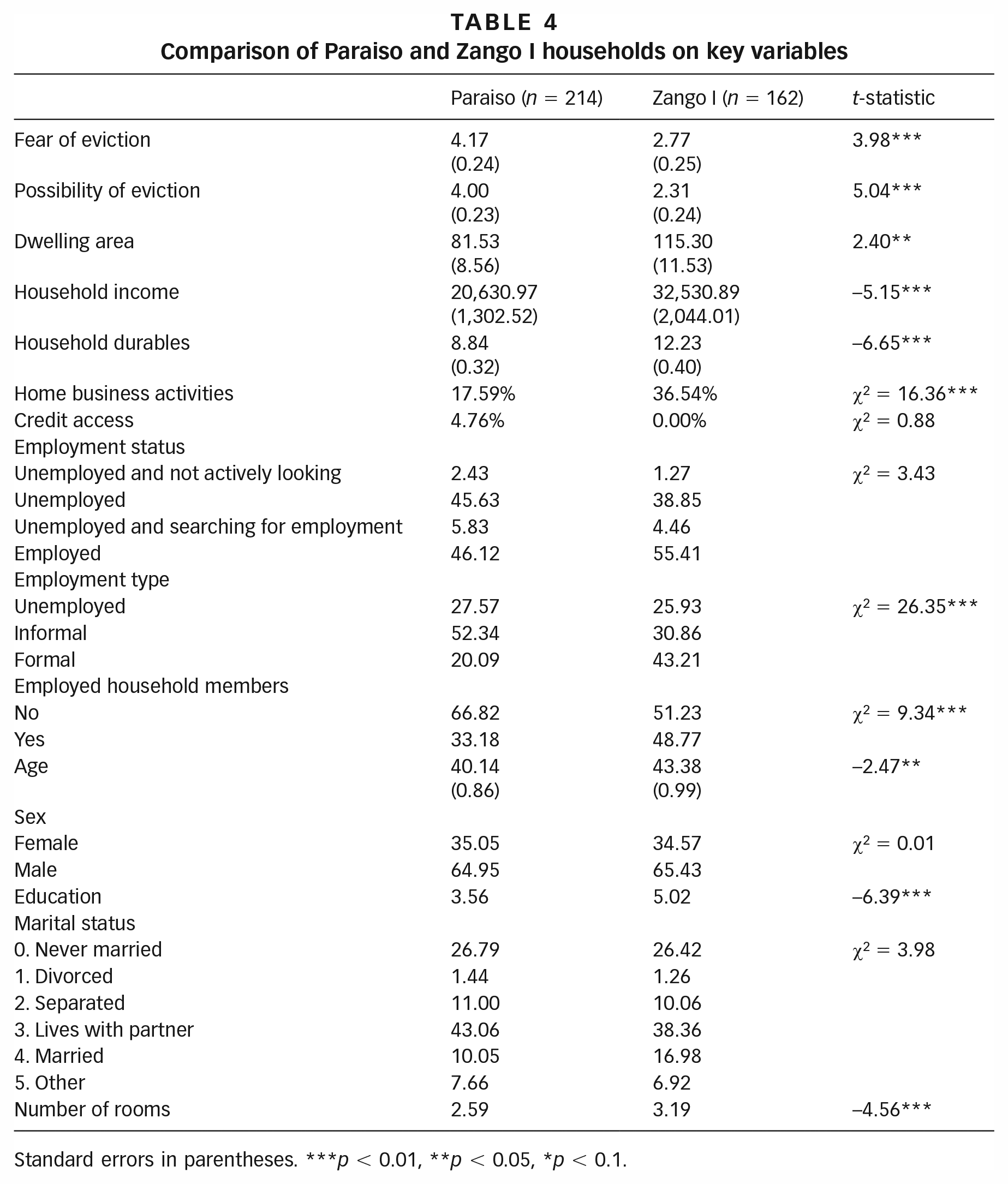
Perception of tenure security is generally high in both Zango I and Paraiso. Table 4 shows that fear of eviction is an average of 4 out of a possible 10 while perception of the possibility of eviction is also 4 out of 10 for Paraiso households. That of Zango I is 2.77 and 2.31 respectively. The scores are lower in Zango I, which may indicate that the guia de entrega as a government document assures households of no eviction action if they follow the guidelines, compared to informal documents among Paraiso households. The scores for Zango I also reveal that fear of eviction and the perception of the likelihood of eviction are present, albeit low.
Comparison of Paraiso and Zango I households on key variables
Standard errors in parentheses. ***p < 0.01, **p < 0.05, *p < 0.1.
None of the households in Zango has accessed any kind of credit, while just under 5 per cent of Paraiso households have. In Angola the banks have not offered credit to housebuilders for many years. Access to credit is not a common feature of the economy. The evidence suggests that property rights do not increase income through the mechanism of credit access. Although there is no expectation that Zango I households should access credit using their social housing due to the restrictions from the guia de entrega, there is evidence that these guidelines are not followed by residents. Sales have taken place in Zango despite restrictions, with anecdotal evidence suggesting that as many as 50 to 70 per cent of original recipients may have sold.(80)
Average household income is significantly higher for Zango I households than for Paraiso households. Zango I households receive an average of Kz 32,500 (US$ 76.91(81)) compared to Kz 20,600 (US$ 48.75) for Paraiso. The evidence also shows that Zango I households participate more in home business activities (χ2(1, 355) = 16.36, p < 0.00), in the formal sector (χ2(1, 376) = 26.35, p < 0.00) and have more family members besides the head of household who are employed (χ2(1, 376) = 9.34, p < 0.00). The comparison also reveals that the average age for Zango household heads is 43 years while that of Paraiso is 40 years, a statistically significant difference of 3 years (t (374) = –2.47, p < 0.05). Zango I respondents also have significantly higher levels of education by 2 years (t (373) = –6.39, p < 0.00), and slightly larger living space on average than Paraiso households.
b. Tenure security
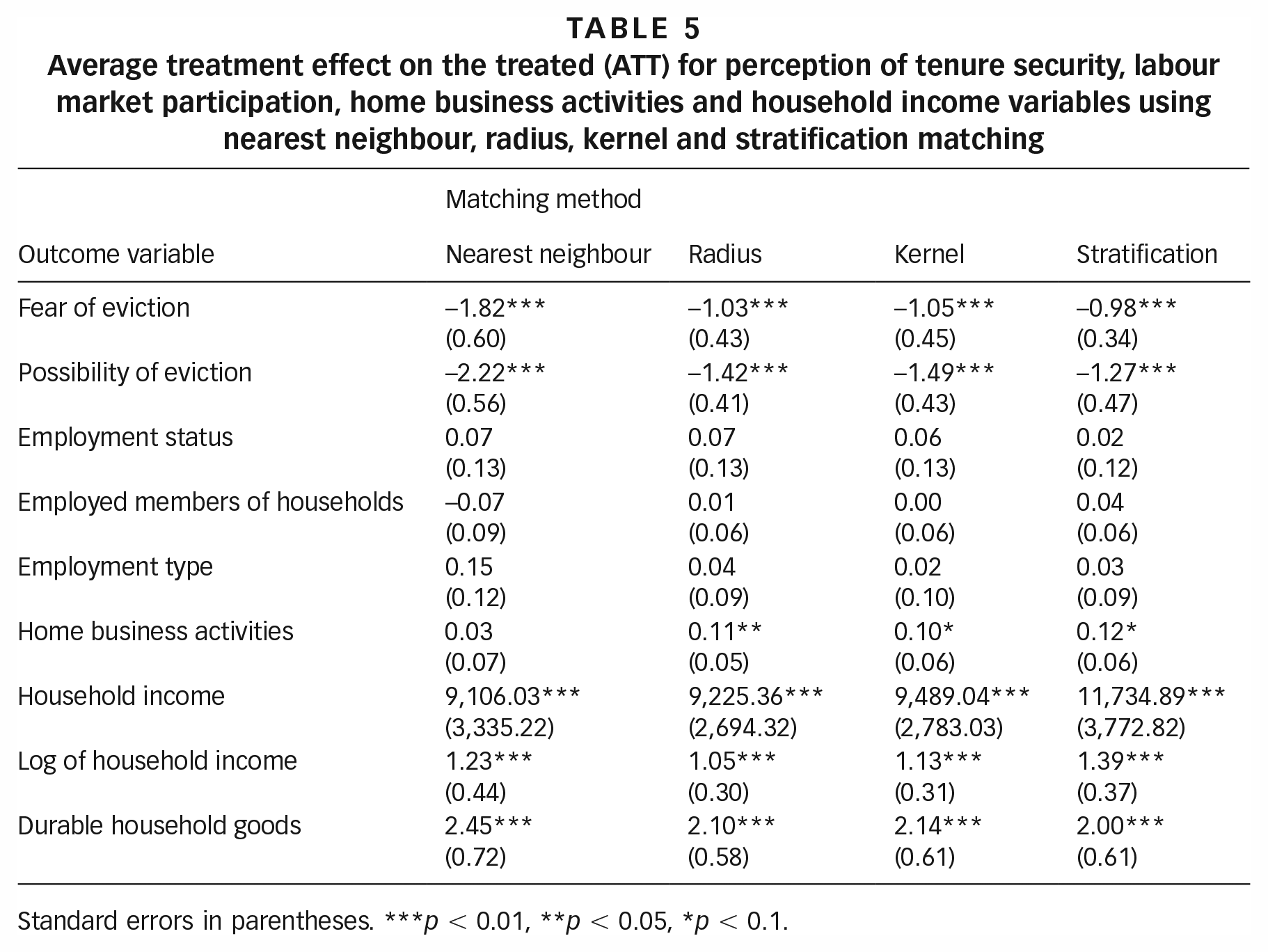
Property rights theory suggests that property rights increase income via the mechanism of increased tenure security, which in turn increases labour market participation and home business activities. What then is the difference in perception of tenure security between Zango I households possessing the guia de entrega and a government-built house and Paraiso households? Table 5 shows average treatment effects on the treated derived using nearest neighbour, radius, kernel and stratification matching.
Average treatment effect on the treated (ATT) for perception of tenure security, labour market participation, home business activities and household income variables using nearest neighbour, radius, kernel and stratification matching
Standard errors in parentheses. ***p < 0.01, **p < 0.05, *p < 0.1.
Zango I residents have greater tenure security than Paraiso residents. On a scale of 1 to 10, scores range from 1 to 2 points higher for Zango I households. The fact that the government moved the families to Zango I and allocated them houses in addition to the guia de entrega provided a sense of security. The question then is whether this difference translates to increased labour market participation, home business activities or credit access.
c. Labour market participation, home business activities and credit access
Table 5 shows evidence that Zango I households are associated with higher participation in home business activities. Radius matching shows that ATT = 0.11, t (334) = 1.97, p < 0.05. Kernel matching demonstrates that ATT = 0.10, t (348) = 1.76, p < 0.10. Stratification matching reveals that ATT = 0.12, t (348) = 1.94, p < 0.10). This means that Zango I has 10–12 per cent more households engaged in home business activities than Paraiso. This is evidence based on radius, kernel and stratification matching. Analysis using nearest neighbour matching shows no significant differences.
Further, Table 5 reveals no significant differences in employment status of the household head, employment status of other members of the household or type of employment. This means that labour market participation is not a mechanism through which property rights impact income in Zango I. It is likely that the labour market participation mechanism does not work for two main reasons. First, as the analysis shows, perception of tenure security is high in both Zango and Paraiso, which means that differences in title and housing status have little impact. Where tenure security is high, households do not need to leave an adult at home during the day to protect the dwelling from eviction. Second, formal employment opportunities are so few that changes in property rights have little chance of leading to labour market participation. Less than 10 per cent of Angola’s labour force is in the formal sector.(82) Almost half of all household heads in the Zango I sample are either unemployed and not seeking employment, unemployed and seeking employment or simply report that they are unemployed. Thus, the evidence so far indicates that the mechanism might be that property rights increase tenure security, which leads to increase in home business activities.
d. Household income
This final results section addresses the question of whether there are significant differences in income between Zango I and Paraiso.
Table 5, in the previous section, presents strong evidence that Zango I households have higher household income than Paraiso households. All four matching methods reveal a higher ATT, ranging from Kz 9,106 to Kz 11,735 (US$ 21 to US$ 28). The analysis shows an ATT = Kz 9,106, t (314) = 2.73, p < 0.01 using nearest neighbour, ATT = Kz 9,225, t (314) = 3.42, p < 0.01 using radius matching, ATT = Kz 9,489, t (314) = 3.41, p < 0.01 using kernel matching, and ATT = Kz 11,735, t (348) = 3.93, p < 0.01 using stratification matching (US $21.54, US$ 21.83, US$ 22.46, and US$ 27.77, respectively). The analysis using log of household income is consistent, showing that Zango I households have more income than Paraiso households. To use alternative indicators of income, the analysis using durable household goods shows that Zango I households have two more than Paraiso households.
The results show a likelihood that the guia de entrega is associated with more income than the informal documents of Paraiso residents. Considering that informal activities are the main way that beneficiaries of low-income housing earn income in Luanda, tenure security provides a certain level of legitimacy and stability above that of Paraiso residents. Services such as supply of water and electricity can provide an advantage to beneficiaries that feeds into home business activities, but such services in Luanda came with formalization of land tenure for Zango I residents through ex-situ formalization in the first place.
V. Discussion
Overall, the evidence suggests the likelihood of a relationship of association between property rights and higher income through the mechanisms of increased tenure security and increased home business activities, but not through labour market participation or credit access. The finding is consistent with what we know about Zango I, a greenfield development with few job opportunities because of its location on the periphery of the city, far from economic opportunities. Home business activities allow for trade among households in order for them to meet their everyday needs for survival. The finding is particularly emphatic in that Paraiso households were closer to the city where they could be nearer to economic opportunities.
It is counterintuitive that there is high tenure security in the two neighbourhoods, albeit significantly higher for Zango I. Since authoritarian states fail to protect property rights, lower tenure security might be expected. However, the evidence here suggests that the situation in Angola is more complex than assumed. Indeed, the fact that informal land and property transactions in Luanda are financial in nature and well recorded, as Cain has shown,(83) even if not through the use of formal title deeds, means that buyers have a strong sense of security. In cases where residents live in state-built housing where there is an active informal housing market, often including state officials themselves, this sense of security is compounded by a sense of complicity and negotiability. As Croese(84) has shown, the informal housing market in Angola is underpinned by a complex relationship between government officials and citizens where government officials benefit from informal arrangements.
The study makes both theoretical and empirical contributions. The employment of the continuum of property rights as a conceptual framework for understanding the distribution of property rights in a context with such a complex relationship between the formal and informal confirms the usefulness of the framework. Second, the employment of a control group design and propensity score matching to mitigate issues of endogeneity and selection bias is a recent methodological development. Only a few such studies have been undertaken within the African context, including recent studies by Muyeba in Zambia(85) and Hailu and Rooks in Ethiopia.(86) Also, few such studies have been carried out in Lusophone African countries, especially within the literature circulating in the English-speaking part of the academy.
With reference to the broader literature, this study shows a high likelihood that in some contexts where housing projects for low-income groups depend on the informal sector and are located far from city centres, home business activities are an important mechanism through which property rights may impact household income. Elsewhere, Boudreaux’s qualitative study in Langa(87) revealed that households were able to engage in such activities because of titles to land and apartheid-era housing transferred to households. That study did not systematically and quantitatively test the relationship and did not have a control. Therefore, this paper makes an empirical contribution to the body of knowledge by systematically testing the theory in Luanda. The findings further suggest that perhaps the job market can absorb labour following formalization of property rights if there are enough formal jobs. Where unemployment is high, property rights have no effect on income through the mechanism of labour market participation.
The study adds to several studies such as those by Field and Torero,(88) Galiani and Schargrodsky,(89) Payne et al.(90) and Piza and de Moura(91) that show only weak evidence to support the credit mechanism as an explanation for increased income. Households rarely borrow from both formal and informal sources of credit.
Future studies need to test other unexplored mechanisms. One such mechanism is that property titling leads to tenure security, which in turn attracts financial gifts from family members, in turn leading to higher income. Moreover, these financial gifts are often directed towards investment, which in turn leads to higher income. Following privatization of public rental housing in Matero, Schlyter’s(92) respondents were successful at lobbying for extended family support as they sought to complete the titling process and expand the dwelling.
VI. Conclusion
This study set out to examine whether property rights increase household income in a post-conflict, authoritarian context. It tests three main mechanisms through which property rights increase income: first, via tenure security and labour market participation; second, through credit access; and third, through home business activities. It uses the case of residents who were evicted from Boa Vista in central Luanda and later awarded occupancy rights to social housing and a document called the giua de entrega in Zango I, and compares them to residents of Paraiso, a musseque east of Boa Vista. The study employed a household survey (n = 634). It uses a control group design and propensity score matching models to achieve comparability of the groups by mitigating selection bias and endogeneity. Zango I households are the intervention group, having received tenancy with a formal contract for occupancy from the government. The Paraiso non-intervention group is composed of tenants or occupants in an unauthorized subdivision. The matched sample was n = 376 with n = 162 for Zango and n = 214 for Paraiso. The study has shown the likelihood that property rights increase income through the mechanism of increased home business activities. It also suggests counterintuitive evidence that post-conflict authoritarian regimes are not different from democratic ones with regard to the workings of mechanisms through which property rights are likely to increase income.
Footnotes
Acknowledgements
Thank you Aaron Schneider, Oliver Kaplan, Abigail Kabandula and Isaac Chinyoka for review and comments. Thanks to Anne Pitcher and Caroline Wanjiku Kihato for their comments on a different version of the paper. Thank you to the three anonymous reviewers. I also acknowledge Ricardo Soares de Oliveira, Claudia Gastrow, Suzana Sousa and Sergio Calundungo for helping connect me as I did fieldwork in Luanda. Thanks to Susan Cossa and my colleagues at the Josef Korbel School of International Studies for comments provided during the Korbel Research Seminar. I am also grateful to Carlos Pacatolo and David Boio and the research team in Luanda for making fieldwork possible as well as all interviewees and respondents.
Funding
Gratitude goes to the University of Denver’s Office of the Provost for funding through the Professional Research Opportunities for Faculty (PROF) fund grant #84379-207421 which made my fieldwork and stay in Luanda possible.
1.
2.
5.
Payne (2001);  .
.
6.
The term “slum” usually has derogatory connotations and can suggest that a settlement needs replacement or can legitimate the eviction of its residents. However, it is a difficult term to avoid for at least three reasons. First, some networks of neighbourhood organisations choose to identify themselves with a positive use of the term, partly to neutralise these negative connotations; one of the most successful is the National Slum Dwellers Federation in India. Second, the only global estimates for housing deficiencies, collected by the United Nations, are for what they term “slums”. And third, in some nations, there are advantages for residents of informal settlements if their settlement is recognised officially as a “slum”; indeed, the residents may lobby to get their settlement classified as a “notified slum”. Where the term is used in this journal, it refers to settlements characterised by at least some of the following features: a lack of formal recognition on the part of local government of the settlement and its residents; the absence of secure tenure for residents; inadequacies in provision for infrastructure and services; overcrowded and substandard dwellings; and location on land less than suitable for occupation. For a discussion of more precise ways to classify the range of housing sub-markets through which those with limited incomes buy, rent or build accommodation, see Environment and Urbanization Vol 1, No 2 (1989), available at .
10.
Muyeba ().
13.
Muyeba (2016, ).
16.
Freedom House (2022); Marshal and Elzinga-Marshal (2017); The Economist ().
21.
23.
24.
30.
The word musseque is the Angolan parlance for urban slum conditions which include lack of adequate housing, water, sanitation facilities and tenure security as described by UN-Habitat.
33.
Cain (2004); .
34.
36.
Cain (2014); .
37.
See Cain (2013), page 12; , pages 92–93.
64.
This category aimed to capture the discouraged unemployed, that is people who are eligible for work but have stopped actively looking because their efforts have not resulted in suitable employment. This is distinguished from those who are unemployed and available and eligible to work, and those who have been actively seeking in the last four weeks.
66.
68.
70.
See Durand-Lasserve and Selod (2009), pages 143–156; , page 443.
80.
Croese (2019); , page 414.
81.
All currency conversions in current US$ with conversion rate from the Angolan Central Bank, Banco Nacional de Angola, at US$ 1.00 = Kz 422.57.