



Abstract
Urban (physical) and business informality and economic circularity may come together in cities of the global South. In this paper we explore the intersection of business and urban informality and circular economy outcomes in community-based clusters of informal businesses. These intersections are revealed in the relationship of businesses to the home, the localization of linkages (including the use of recycled materials) and the relationship of businesses to the local communities in which they are embedded. We draw on data from 203 questionnaire survey returns from five kampung-based footwear and clothing industry clusters in the Indonesian city of Bandung. The research confirms the ambiguity of the relationship between individual business dynamics and the communities in which they are embedded. Our findings suggest some points of policy leverage centred on business and community institutions, and lead on to avenues for research that might elaborate the ambiguous relationship between business and social innovation with respect to sustainable urban development.
I. Introduction
Urban (physical) informality and business informality come together in cities of the global South. Southern urban practice also partly implies circularity of local economies.(1) We might therefore expect processes of business and social innovation to contribute to the circularity of urban economies across the global South. However, commentary on processes of business and social innovation as they contribute to the circularity of local economies has tended to be polarized into contrasting disciplinary-anchored perspectives(2) that have evolved at distinctly different moments. The economics and development studies literature has long emphasized the constraints external and internal to informal businesses. The constraints internal to businesses often reflect the limited growth aspirations and survivalist modalities of business owners.(3) Recent urban planning and geography literature celebrates the social innovation of communities located in informally constructed settlements.(4) The contemporary literature on the circular economy speaks largely to the global North while the literature on Southern urban practice(5) partly emphasizes circular economy principles and outcomes. However, a lack of dialogue between disciplines has meant under-investigation of the intersection(s) (see Figure 1) of business and urban informality(6) and the economic circularity of informality.(7) This lack of attention runs the risk of generating accounts that both over- and under-socialise the relationship between informal business and social structure – over- and under-emphasize, that is, the extent to which business is embedded in local communities.(8)
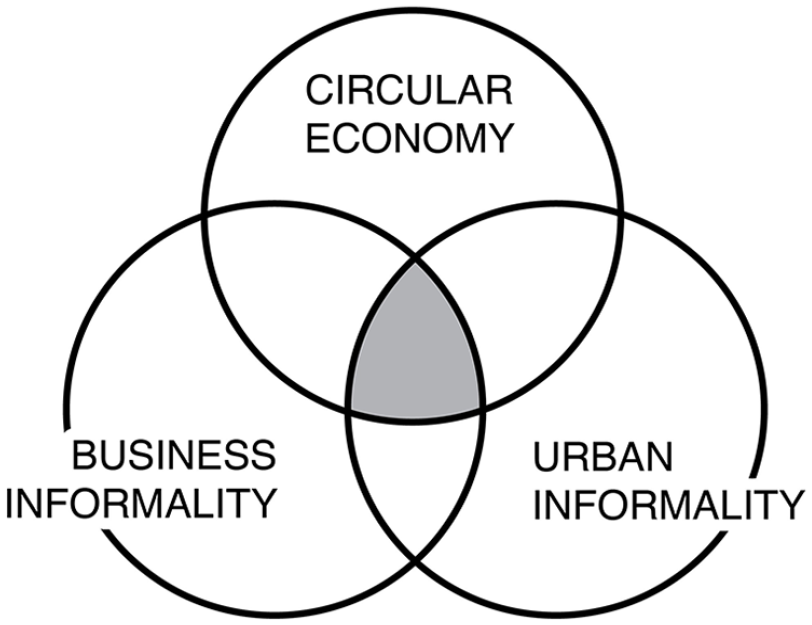
Potential points of intersection between business and urban informality and circular economy innovation
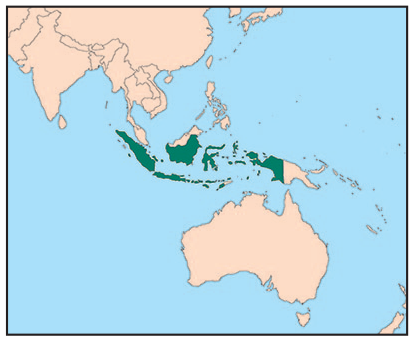
In this paper, by analysing kampung (urban village)-based footwear and clothing industry clusters in Bandung, Indonesia, we examine the intersections between business and urban informality and the potential of business to contribute to circular economy outcomes. We explore the interrelationships in terms of the role of the home as a business premises; the localization of backward (purchasing) linkages, including of recycled materials; and the broader relationships of businesses and their innovations to the local communities in which they are embedded. The research question which motivates the paper is: to what extent and in what ways do business and urban informality and urban economic circularity combine productively in cities of the global South?
In the following section we review literature on business and urban informality and the circular economy with a critical eye to the extent and nature of overlaps between these three facets of Southern urban economies. In Section III we explain the methods used to collect data from 203 questionnaire survey returns from five kampungs in the Indonesian city of Bandung. Our findings, explored in Section IV, urge caution regarding assumptions about the extent and nature of the intersection between business and urban informality and the circularity of urban economies in the global South. The relationship between the dynamics of individual businesses and the communities in which they are embedded is ambiguous in general,(9) and uneven in its specifics, including as it relates to circular economy outcomes. In conclusion, we note the implications of our findings for future research on connections between business and urban informality and circular economy processes and suggest some points of leverage for policy on informal business contributions to circular economy outcomes locally, given the involvement of business with both business and community institutions.
II. The Circularity of Informality?
Business informality is a term applied both to those businesses which are unregistered for tax purposes and those lacking codification/documentation of their practices. Here we concentrate on the former definition, where it is apparent that unregistered businesses make up the vast majority of the stock in countries across the global South.(10) For-profit business innovation has been defined as “the implementation of a new or significantly improved product (good or service), or process, a new marketing method, or a new organisational method in business practices, workplace organisation or external relations”, where “new” means new to the business.(11) However, the economics and development studies literature examining these Southern informal business dynamics underlines the limited capabilities,(12) growth aspirations and survivalist modes of operation of small business entrepreneurs.(13) These constraints internal to businesses – formal and informal alike(14) – are connected to the ability of aggregations of individual businesses to benefit from the external economies that are thought to attend the clustering of industries;(15) to the ability of institutions to unleash these external economy benefits;(16) and to the difficulties of designing such institutional support.(17)
Standing in some contrast, the urban planning and geography literature has focused on the inventiveness and resourcefulness of urban informality – where urban informality refers to settlement and development of land by citizens in the absence of, or with very weak claims to, property rights. In a corrective to strands of global North literature focusing on world cities, Robinson(18) has celebrated the inventiveness of citizens in cities of the global South. Roy(19) has argued the need to replace a preoccupation with the poor physical condition of informally-developed neighbourhoods across cities of the global South with a greater analytical and normative focus on the resourcefulness of communities that is apparent in networks of economic relations and social action. In these accounts, inventiveness and resourcefulness refer to collective acts of social innovation which meet social needs.(20)
Taking these two bodies of literature together we can see that there is an important theoretical and empirical gap, namely: the relationship between the innovation and economies that are internal to individual informal businesses and the external economy innovation that is offered by the informally constructed and organized neighbourhoods in which they are embedded. These relationships can produce what Westlund and Bolton term “entrepreneurship-facilitating” and “entrepreneurship-inhibiting” psychologies apparent in social capital.(21) Empirical and theoretical exploration of this relationship is vital since, crucially, the dynamism and innovation of informal businesses are mediated and confounded by the operation of formal and informal institutions at a local level.(22)
This knowledge gap widens when we consider the potential circularity of Southern urban economies. Circular economy principles have been defined as the “sharing, leasing, reusing, repairing, refurbishing and recycling [of] existing materials and products as long as possible”(23) and partly intersect with definitions of Southern urban practices of squatting, consolidation and repair.(24)
The question arises, then, as to what extent and in what ways do business and urban informality and economic circularity combine productively in cities of the global South. In what follows, we explore this question by considering the relationship between informal businesses and the home as business premises; the local linkages of informal businesses; and connections of informal businesses to the local communities in which they are embedded.
a. Informal business, the home and innovation
In our case study context of Indonesia, as much as 80 per cent of the urban fabric has been self-built by settlers;(25) more widely, the predominance of urban informality across the global South suggests that the home very often doubles as a business premises. Yet, while autoconstruction rivals state provision as a mode of housing production, the extent to, and ways in which, the “sheltering home”(26) contributes to the establishment, maintenance and performance of business remains unclear.
On the one hand, the self-built home represents a low-cost premises from which to start a business, obviating the need for additional rent or purchase of property. Moreover, the ancient Greek etymology of the word “economy”, which emphasises the efficacious arrangement of things in the ensemble of places that make up the home, suggests in the most general terms that the home may afford such an efficacious arrangement of familial and business activities for informal businesses. The labour and financial capital of extended family members, gendered divisions and porosity in daily domestic work may present additional resources on which informal business owners can and do draw. These less visible and under-remunerated sources of labour are significant parts of parallel, local economies alternative to those predicated on businesses innovating and accumulating capital as part of formal economies, global North to South.(27)
On the other hand, the home may hinder informal business innovation including in connection with circular economy contributions. The home as the locus of family as an institution(28) may even rival neighbourhood-based institutions in the development of individual informal businesses. Such businesses, as our exploration of the kampung-based businesses will go on to show, have a propensity both to innovate and to contribute to the circularity of local economies. Moreover, some industrial processes that local governments seek to regulate are incompatible with a home environment such that building and land use planning regulations are as much a threat to the social innovation and circular economy credentials of urban informality as are policies of slum clearance or upgrading. For example, traditional creative manufacturing industries such as Batik in Indonesia have migrated out of urban areas, partly as a result of tighter planning regulations.(29)
b. Industry clustering and local linkages
When considering the productive combination of business and urban informality and economic circularity there is also plenty to ponder in the relationship of industry clusters to the urban informality in which they are embedded. In situations of industry cluster stagnation (in numbers of businesses or total output) or under-development (of economies of scale and output), the collective organization of business under new or reformed institutions connected to communities may be a prerequisite for the successful mobilization of otherwise latent “external economies” – those economies of scale that are external to any individual business and shared among a cluster of many businesses.(30) These external economies are derived from the productivity-enhancing potential of localized (intra-urban and city-wide) backward, forward and horizontal linkages.
Having said this, industry in the global North has long since ceased to be dependent on backward, forward and horizontal linkages as sources of external economies at the city, let alone intra-urban, scale.(31) This in itself has been one reason for the historic failures of regional policies in the UK.(32) Institutionalization has also been on the wane to the extent that the “death of the local economy”(33) was pronounced some time ago in the UK. By the same token, then, in the global South context, it is unclear whether localized industry clustering confers any external economy advantages at all.(34) However, features of industry clustering specific to the global South context – such as excessive price competition and strong (local) ties of community – may also negate the value of external economies and disincentivize business innovation.(35)
The communities in which individual households and businesses are located may adversely affect entrepreneurial preferences for the sorts of innovation taken as the signature of Schumpeterian entrepreneurship.(36) Indonesian evidence suggests that exogenous stimuli associated with migrant entrepreneurs and government policy have been vital to business formation in urban neighbourhoods in which patterns and processes of business innovation lie closer to Geertz’s involution,(37) and where the communities in which industry clusters are embedded may further constrain institutionalization of industry clusters.(38) It is important not to romanticize the embeddedness of informal industry clusters under conditions of urban informality. This includes not making assumptions about how embeddedness and informality may contribute to the circularity of local economies.
c. Business, the community and the circular economy
The social innovation that is associated with the urban informality found across the global South may make itself known in instances of social economy activity, employment and processes of innovation found across global North and South alike. These social (community-based) innovations are systematically under-recorded and under-valued.(39) Here, at the very least, urban and business informality are a partial foundational economy(40) support for the formal business sector.
The innovation that is created and fostered by conditions of business and urban informality may also intersect with the circular economy credentials of informal industry clusters in the global South. Informal Southern practices have been seen to include repair, consolidation and squatting where “repair is . . . foundational to incremental and autoconstructed materialities” that are distinct from programmes of physical upgrading, which are administered formally via the state, or by for-profit businesses.(41) Each of these practices implies an incremental use of the resources that are to hand, and signals a potential connection of both business and urban informality to the circularity of urban and intra-urban (that is, neighbourhood) economies. These practices are especially prominent around waste picking and allied processing(42) and around the securing of basic needs such as shelter, water, food and energy as part of the foundational economy of cities. Nevertheless, it remains unclear how such social innovation overlaps with business innovation in the remainder of urban economies.
For their part, circular economy principles have little to say about urban land use and market dynamics.(43) At a minimum, there is a need to consider how the diversity of urban interstices in morphological and regulatory terms(44) is connected to informal business formation and innovation within these circular economy patterns of societal provisioning. This is in the context of the trade-off between (a) savings that are made in the formation of businesses under conditions of informality, and (b) the additional, ongoing costs of conducting businesses under such conditions.(45) The institutionalization of informal land and property market transactions is seen to “suck up” and transform the original bases of informal urban communities in social innovations and institutionalization that are established on principles of reciprocity and redistribution.(46)
The relationships between business and urban informality and the circularity of urban economies are highly ambiguous and this raises the potential for simultaneous over- and under-socialization of the relationship between informal economic action and social structure.(47) There is enough in the preceding discussion to suggest that the intersections of business and urban informality and circular economy innovations and outcomes resemble something closer to the pattern depicted in Figure 2 than that of Figure 1.
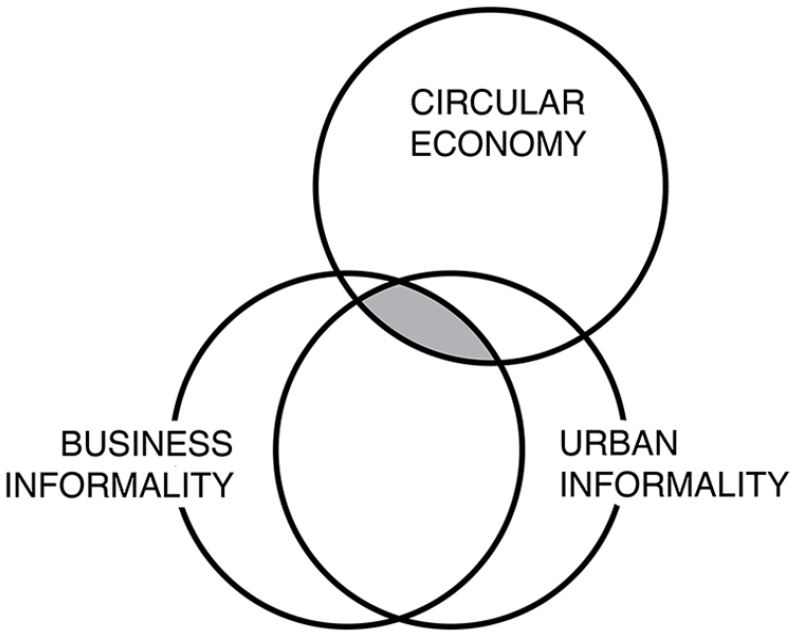
Suggested actual intersections among business and urban informality and circular economy innovation
III. Methods
This paper is based on cases within a single case study research design(48) that centres on the Indonesian city of Bandung. Designed as a loose case study(49) of contrasts within an individual city,(50) this case study is especially appropriate given the paper’s aim to investigate the effects of the relationship between business and urban informality on economic circularity. In Bandung it is difficult to separate the phenomenon of business dynamics from the kampung communities in which those dynamics are embedded. Further, Bandung is regarded nationally as a vibrant and youthful city, well connected to national and international consumer trends, and has been designated a creative city in national policymaking.(51)
Indonesia more widely has high levels of both urban and business informality,(52) presenting a large and diverse number of industry clusters found at the kampung scale.(53) Kampungs are the real and imagined basis of neighbourhood communities as they have been constructed anew by migrants to the city or incorporated into the administrative system of cities.(54)
a. Scoping of industry cluster cases in Bandung
Our study adopted a two-stage approach to analysing the relationship between business and urban informality in the city of Bandung. We began by scoping the major industry clusters that exist across the city, and then focused on the five largest, which are largely synonymous with particular kampungs (see Figure 3).
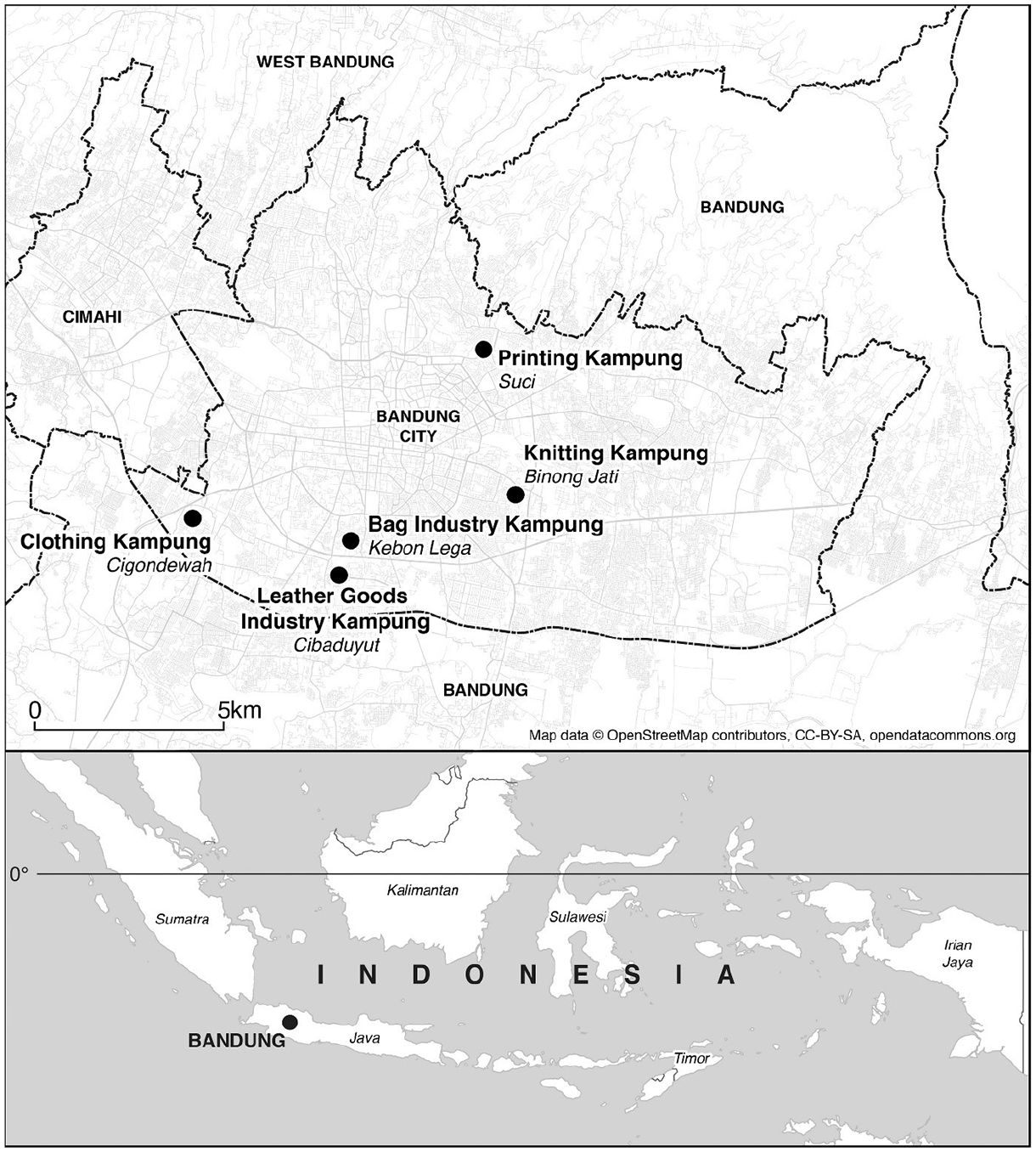
Location of five kampung-based industry clusters surveyed in Bandung
All of the industry clusters we investigated fell into a single broader industry classification of clothes and footwear – a specialization of the city as a whole. The industry clusters featured some of the morphological diversity of urban interstices.(55) All had primarily linear morphologies that followed major roads or rivers with businesses distributed within residential communities.
Cibaduyut
Cibaduyut’s reputation for leather crafts dates back to the 1920s. Craftspersons who formerly worked as employees in existing factories decided to open their own businesses in the same field. In the late 1990s, industry in Cibaduyut experienced a downturn due to the influx of imported shoes. Nevertheless, Cibaduyut has since expanded again as an industry cluster centred on production of high-quality leather products such as shoes, wallets, bags, belts and purses. Similar to the screen printing industry in Kampung Suci, houses where much of the production takes place can be found behind the main road. Houses are both homes and business premises. The leather products are then displayed and sold in the shops on Cibaduyut’s main road. Products from Cibaduyut have been exported to 27 countries abroad, including the United States and Japan. As revealed in our scoping, the challenges currently facing businesses in Cibaduyut are: the expense of raw materials which undermines the price competitiveness of products vis-à-vis those produced in the formal sector; the unstandardized nature of the products which prevents greater exporting in the face of regulatory standards in overseas markets; and a dearth of new leather entrepreneurs as successive younger generations leave the industry.
Cigondewah
With around 40 businesses, this is the smallest, and most geographically defined of the industry clusters that we studied. It also has the lowest skill requirement of the different kampung-based industry clusters studied.(56) It is located in the houses along Gang (Alley) Maklung, which can only be accessed by foot and motorcycle. The main business activity is the sorting and storing of second-hand clothes for collectors (an activity known as pengepul).
Binong Jati
This kampung covers approximately 80 hectares. Its knitting businesses were established in the 1950s, with housewives working part-time to produce knitted items. It rose to fame in the region (Jakarta and West Java) by 1965, survived several economic crises and, by 2017, was composed of roughly 2,000 workers producing 980,000 knitted garments worth IDR 31 billion (approx. US$ 3.1 million) per annum. The industry continues to grow and its markets are across Indonesia and further afield, in Singapore, Malaysia and Nigeria.(57)
Suci Kampung
Screen printing businesses were first established here by local entrepreneurs at the end of the 1980s. By 1990, they had reached 75 in number, with newcomer entrepreneurs arriving thereafter. The physical condition and sense of community of this squatted area improved as it took on an identity associated with screen printing. During the economic and political turmoil of 1997–1998, businesses diversified and expanded their product range from just T-shirts, recovering to experience significant growth in domestic and export markets.(58) The output for an individual home business can reach 500 T-shirts worth IDR 17 million (approximately US$ 1.7 million) per week. In Bandung’s Spatial Planning Regulation,(59) Suci Kampung is identified as an area of high-density housing adjacent to a river, whose main street is identified as an area for service industries, and is occupied by shops. Although Suci Kampung has experienced growth related to the screen printing industry, local infrastructure has not kept pace, leading to deterioration of both the local residential and commercial environment (see Figure 4).
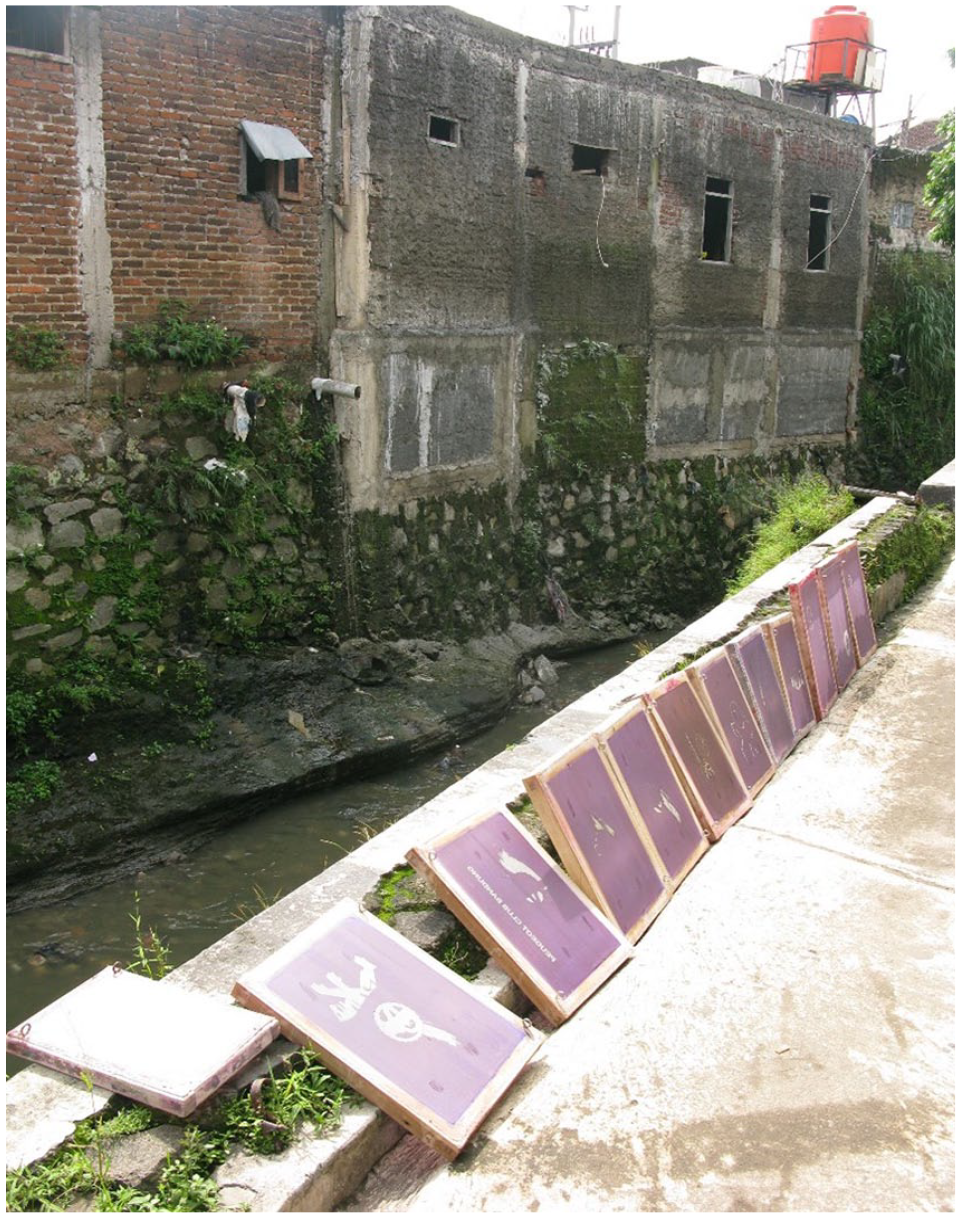
Screens next to the river bank in Suci
Kebon Lega
The bag producers in this area began selling their products in Leuwi Panjang Road, which subsequently became a major road in the city and affected business such that producers moved their businesses to their homes in the kampung. Today, according to the Agency of Cooperation and SMEs in Bandung, there are 53 bag producers, the majority of whom are skilled women artisans,(60) producing 1,271 bags per year. The total investment in this SME (small and medium enterprise) centre reached IDR 1.43 billion in 2015, though growth has been more constrained than for the other kampung-based industry clusters.
b. Questionnaire design
Questionnaire surveys have been used extensively to investigate issues of industry cluster development and business performance across the global South and in Indonesia in particular.(61) The total numbers of responses we received and proportion of total business populations compare favourably to those obtained for surveys of industry clusters in these extant studies, and we can be confident in both cases that we have captured the dynamics of businesses and their relationship to their respective communities. They offer a robust means of assessing and describing trends across potentially large numbers of businesses in some neighbourhood-based industry clusters.
The questionnaire was administered in person by the research team using a questionnaire with 59 (mainly closed and a very limited number of open-ended) questions centred on understanding the extent and nature of innovation undertaken by businesses. The definition of an innovation given to respondents was: “the implementation of a new or significantly improved product (good or service), or process, a new marketing method, or a new organisational method in business practices, workplace organisation or external relations” new to the business, drawn from the OECD manual.(62) The sections of the questionnaire sought information on (i) the business and owners and their characteristics; (ii) growth and change of businesses; (iii) innovation and its nature, sources and impacts; (iv) suppliers, customers and competitors; (v) institutional support and involvement; (vi) the role of and desire for government policies; (vii) business status; (viii) other information (primarily observations on the relationship of businesses to their respective kampungs).
c. Survey sample method
In 2017 we conducted a total of 203 questionnaire surveys across the five industry clusters. Given the scale of some of these clusters we adopted a practical sampling method: deploying quota sampling, with the aim of obtaining maximum accuracy/representativeness in the context of limitations on resources and time. Quota sampling can generate bias in results and for this reason in what follows we present a descriptive analysis of findings, given the lack of reliability of statistical tests. Nevertheless, quota sampling is likely to produce sufficient data and is superior compared to other forms of non-probability sampling.(63) Quota sampling techniques have, furthermore, been considered as more art than science, allowing investigators to prioritize certain characteristics of the populations they are surveying.(64)
Using this technique of sampling to analyse the existence of innovation in informal businesses we used several criteria when seeking respondents for quota samples in each of the five industry clusters in Bandung. The estimated total number of businesses and the number of businesses surveyed in each kampung-based industry cluster are shown in Table 1. The national and local context shaped our scoping of the most relevant industry clusters. We took note of both current policies relating to Bandung’s identity as a recognized creative city, and those polices that are shaped at the kampung level.(65) More specifically, we selected individual businesses which: had investment or a moderate number of workers; were located in the chosen kampung; employed local people in their workforce; and (so as to analyse the extent and nature of innovation over a defined time period), had been established for at least three years. In selecting these businesses, we aimed for a similar quota of surveyed businesses in each kampung.
IV. Business and Urban Informality in Bandung
The average size and age of the businesses (rounded to the nearest whole year) in the five kampung-based industry clusters varied, as reported in Table 1. As described above, several of the industry clusters have histories that stretch back multiple decades. On average, though, businesses surveyed within the Cigondewah second-hand clothing industry cluster were nearly twice as old as those in the Kebon Lega bag-producing cluster.
Survey sample and key characteristics of businesses in kampung-based industry clusters
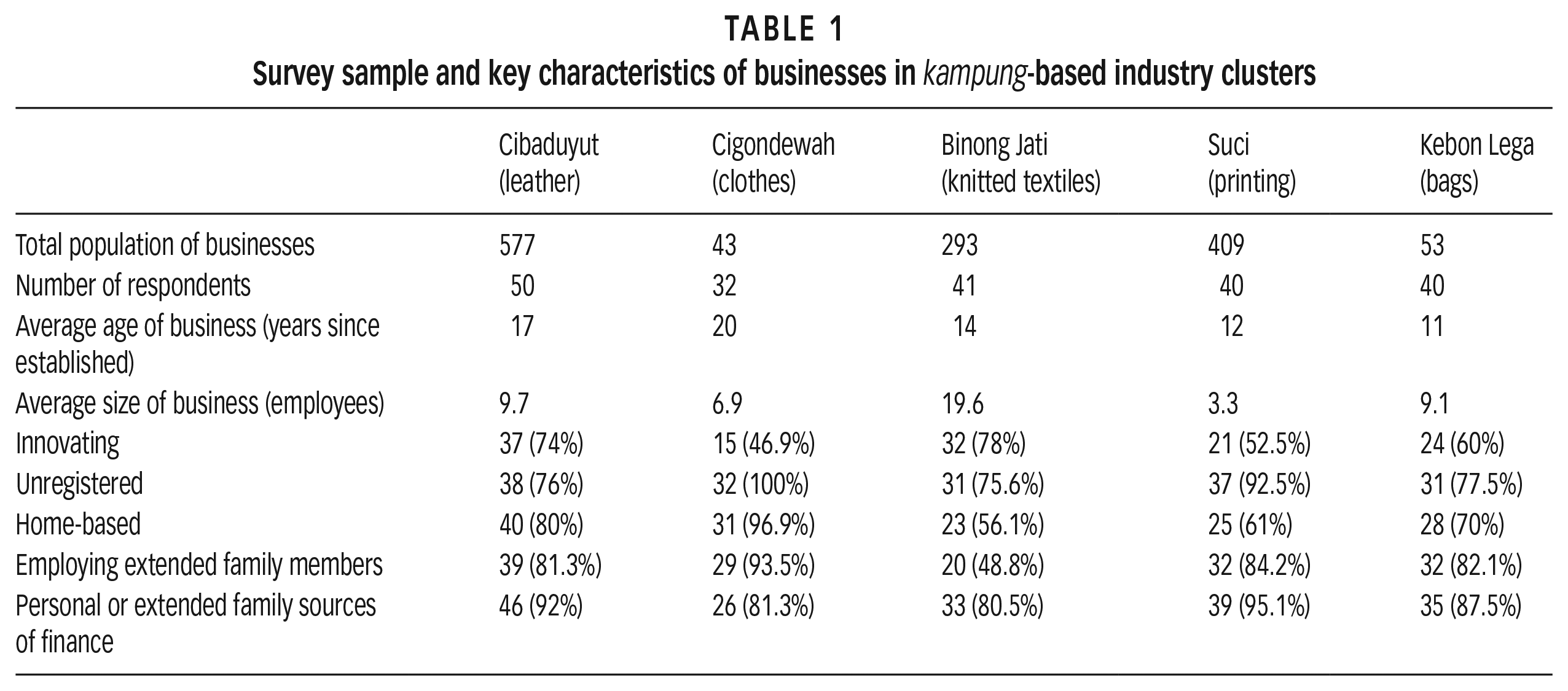
We aggregated the owner, permanent, part-time and outsourced workers to generate a total employment figure for businesses in each of the kampung-based industry clusters. Corresponding with secondary data sources that place the size of the Binong Jati knitted textiles industry cluster at 10,000 workers, we found the businesses in that cluster to be of small to medium size but, as the most industrialized of the clusters studied, show that the cluster also had businesses that were twice the size on average as those of the Suci screen printing industry cluster, where businesses were at a micro scale.
a. Informal business and the home
Table 1 also presents information on the innovativeness of businesses, their status as registered or unregistered businesses, their premises, and the staffing and sourcing of finance from personal or extended family sources. While there are variations across the five industry clusters there are some features that are remarkably similar. For the vast majority (between 80 and 92 per cent) in all clusters, personal or family sources of finance predominate. The vast majority (between 75 and 100 per cent) of businesses in each cluster were also informal in the sense of not being registered for tax purposes. The majority of businesses in all clusters were home-based, although proportions here did vary between 56 and 97 per cent. Businesses were asked if they had innovated using the very liberal OECD definition quoted earlier. Proportions of businesses innovating in the three years prior to survey also varied from just under 50 per cent to 78 per cent. At a basic level these findings confirm the innovativeness of informal, home-based businesses as part of several major neighbourhood-based industry clusters in one city in the global South.
Beyond these broad similarities among industry clusters, the Binong Jati knitted textiles cluster stands out as a little different: it has the lowest propensity of its member businesses innovating; the lowest proportion of its businesses employing extended family members; and, to a lesser extent, a lower proportion of its constituent businesses being home-based. Our meetings with business owners suggested that older machinery had not been replaced due to the cost of purchasing new computerized equipment. Instead, producers relied on donations of equipment from local government and the repair of old manually-operated machines. In turn, this has resulted in a reliance on the recruitment of experienced workers leading to a dearth of younger workers and new entrepreneurs entering the industry and the fresh ideas and innovations (including a greater awareness of environment and circular economy) that come with them.
b. Local linkages
The theory of industry clusters was developed to speak to formal businesses operating in global North conditions. Of Marshall’s trinity of external economy effects,(66) the potential for local backward and forward linkages among businesses has driven a search for evidence of localized linkages in instances of industry clustering.(67) The evidence suggests that industrial clusters across the South may not be able to benefit from localized linkages in the same way as they do in the North, at least not without the creation of appropriate underlying institutions.(68) Even then, there may be no specific advantages open to informal business clusters,(69) while institutionalization itself can be an obstacle to the effective functioning of local clusters.(70)
With that said, the data in the first three rows in Table 2 suggest that – compared with many clusters in the global North – kampung-based industry clusters do have strong local linkages backward (with raw and semi-finished product suppliers), forward (with customers and buyers) and horizontally (with collaborators). The exceptions here are Cigondewah, where no businesses had within-kampung business collaborations; Suci, where only 15 per cent of businesses had an important local supplier; and Binong Jati, where only 17 per cent of businesses had an important local customer. Even so, these figures are high compared with equivalent figures for manufacturing industries typically recorded at regional (let alone city or neighbourhood) scales in the global North. In this broad sense we could say that there is a measure of urban economic circularity in the relationship between business and urban informality.
Local linkages
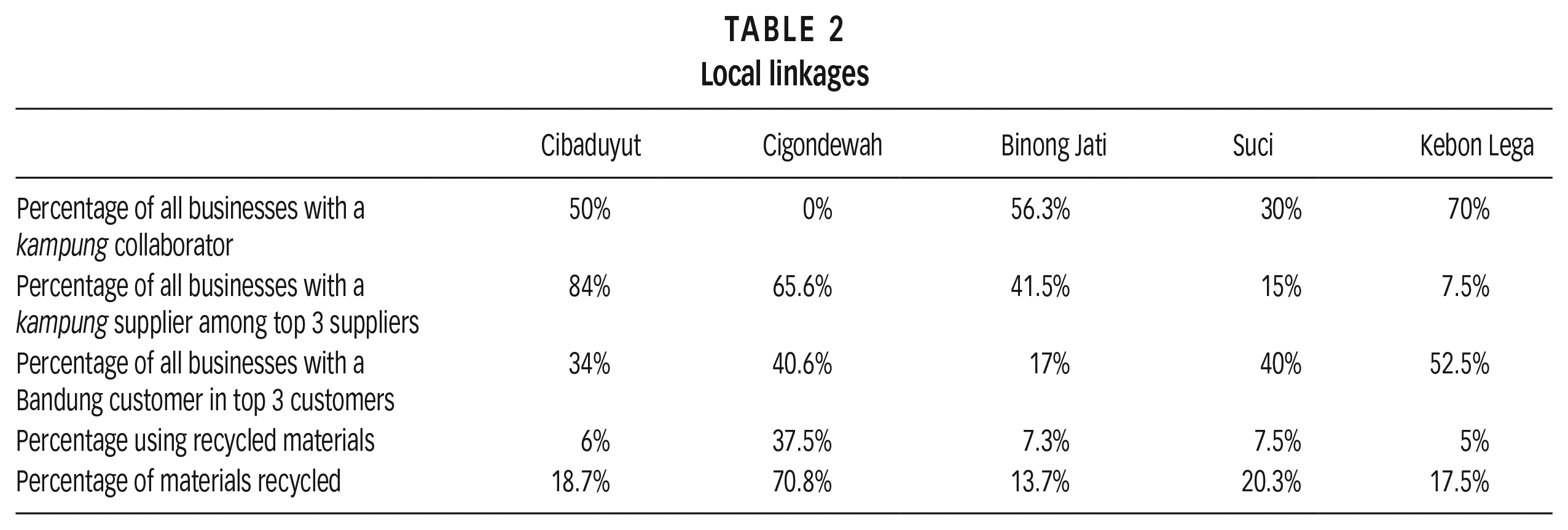
Interestingly, the industry clusters with a high proportion of firms with strong backward linkages tend to have lower proportions of firms with strong forward linkages and vice versa. The proportions of businesses in each cluster with a kampung supplier among their top three suppliers varied from a high of 84 per cent in the case of the Cibaduyut leather cluster to a low of under 8 per cent in the Kebon Lega bag industry cluster. The propensity for firms to collaborate varies. Some industry clusters – notably Cigondewah – appear especially closed in this respect with only two of 32 businesses surveyed having any collaborators. In the other industry clusters a greater proportion of businesses cited collaborative links. Half of the businesses surveyed in the Suci screen printing industry cluster reported having collaborations, reflecting the deliberate mobilization of community to enhance the ties between businesses and to gather and share information. Nevertheless, among those, specifically local (intra-cluster/kampung) collaborative linkages vary even more so, from a high of 70 per cent (for Kebon Lega) to none (in the case of Cigondewah).
One way in which we can explore how business innovation intersects with circular economy outcomes in each of the industry clusters is by examining the use of recycled materials as inputs. Among those firms engaging in the use of recycled materials in each cluster, the proportions of recycled materials in all inputs tended to vary markedly, and the small numbers mean the average figure should be treated with some caution. The propensity of businesses in the industry clusters to use recycled materials generally was low. For example, in the Binong Jati cluster, conversations with the businesses surveyed suggest that threads were reused as raw materials to produce goods other than clothing, such as handicrafts for decoration and car seat filling, and excess raw materials were used to make shuttlecocks.
The exception with respect to the use of recycled materials was the Cigondewah clothes industry, where 12 of 32 (38 per cent) of businesses used at least some recycled materials. Several businesses in the Cigondewah clothes industry cluster claimed that all of their material inputs were recycled, resulting in a high average proportion of 71 per cent of inputs being recycled among those businesses actively using recycled materials. Our results here are consonant with both social media and academic reportage of the Cigondewah industry cluster.(71) The Cigondewah cluster of small businesses, organized horizontally with little in the way of a division of labour, makes use of tie-dyed cloth to produce new and more aesthetically attractive patterns and colours, while the quilting technique also contributes to the variety of interesting new fabrics produced.(72) As noted above, businesses in this cluster collaborate the least with other businesses and this appears to reflect an increased sense of competition among businesses (mentioned by 22 per cent of businesses in the cluster), including possibly competition for sources of recycled materials. It also suggests a lack of any circular economy demonstration effect beyond the cluster.
c. The reciprocal relationships between business, industry clusters and community
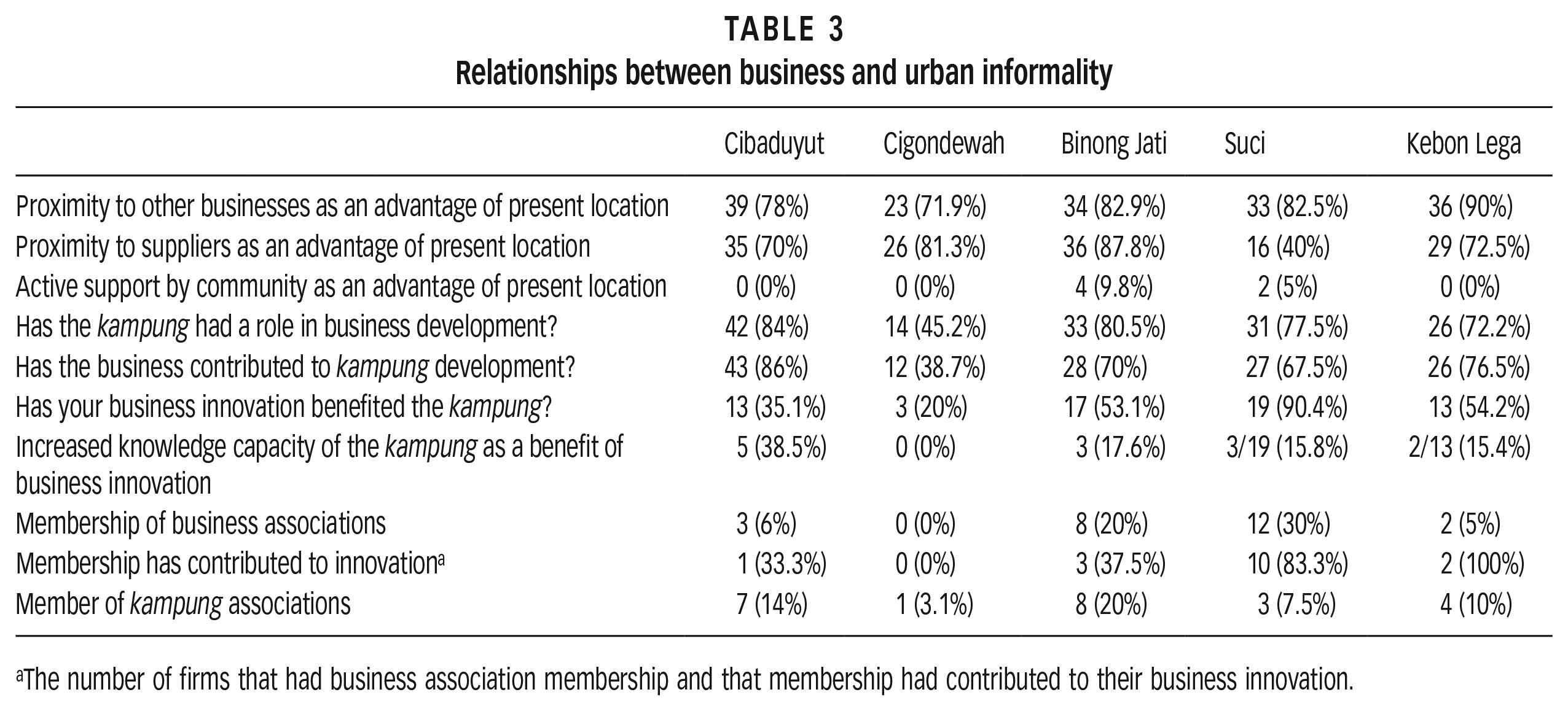
Table 3 presents selected data that speak to the reciprocal relationships between individual businesses surveyed, the industry clusters of which they are a part and the kampung communities in which they are embedded. The results are mixed in what they tell us about the social embeddedness of industry and its effects.
Relationships between business and urban informality
The number of firms that had business association membership and that membership had contributed to their business innovation.
First, our questionnaire asked for the advantages of businesses’ present locations from a predefined list. The proximity to suppliers was mentioned by the majority of businesses surveyed in all clusters except the Suci printing industry and tends to underline the evidence for the generally strong local linkages detailed above.
Second, proximity to other similar businesses and other social businesses was also cited as an advantage of individual businesses’ present locations. Table 3 combines findings regarding the advantages of proximity to both types of businesses (that is, for-profit and social) since tiny minorities or no businesses at all in each industry cluster cited the presence of other similar (competitor) businesses as an advantage; very high proportions of surveyed businesses suggested that the proximity of other social businesses was an advantage. The findings can be interpreted as suggesting that the advantages of what Marshall defined as the “industrial atmosphere”(73) – insofar as it has the potential to drive the innovation of entire groups of businesses – may not be present in the case of these industry clusters. We can interpret the findings as suggesting that it is the broader social basis of the cluster that may be seen to be of value instead. It remains unclear what effect this value attached to the cluster’s social basis has on the innovation of individual businesses and the industry clusters as a whole. Instead, it may be the social conformity of businesses that limits competition in informal business clusters and generates particular entrepreneurship-inhibiting preferences(74) and dynamics such as cut-throat competition and widespread copying.(75) Moreover, the findings that 72–90 per cent of businesses cited proximity to other businesses as an advantage of their present location are hard to square with the very small proportions of businesses that cited active support from the community as an advantage of their present location.
Third, the reciprocal relationship between businesses and the kampungs in which they are socially embedded appears robust with respect to processes of innovation. With the exception of the Cigondewah clothes industry cluster, the majority of businesses indicated both that the kampung had had a positive effect on business innovation and that their business had had a positive effect on their kampung. We asked specifically as to the relationship between innovations made by individual businesses and their impacts on the kampung. In bald terms, the results paint a positive picture of the relationship between business and urban informality. The majority of the benefits cited were improvements to the reputation and environment (or local surroundings) and increased opportunities for the sharing of wealth and collaboration with other businesses in the kampung. These findings serve to underline the social embeddedness of industry. Nevertheless, much smaller proportions of businesses cited increases in the knowledge capacity of the kampung as benefits that were brought to the kampung by their individual business innovations. This suggests that reciprocal relationships between business and urban informality may result in significant inertia with respect to informal business innovation.
Fourth, perhaps most surprising are the findings pertaining to membership of industry associations and its effects on business innovation and membership of kampung organizations. Membership in four of the five industry clusters is very low and would tend to suggest that institutionalization has had little to contribute to the innovation of individual businesses and to the cohesiveness and performance of industry clusters as a whole. The exception here is the Suci printing industry, where industry association membership appears to have had an important effect in stimulating business innovation, and which likely is a reflection of the greater division of labour across several stages of production – design, manufacture of screens, screen printing, steam pressing of items – among many small businesses, often at a micro scale.
V. Conclusion
The challenge of informality is a multifaceted one involving social, economic and environmental dimensions of policy(76) and an analytically interdisciplinary one inclusive of business institutional (including government) and social (community) dynamics. The circular economy credentials of informality are likewise complex and mixed as our findings relating to five informal business clusters in the city of Bandung, Indonesia tend to suggest.
Those findings suggest that businesses are embedded physically and economically in informally built kampungs, maintaining linkages localized at the kampung and city scales. This physical and economic embeddedness ensures some fundamental reciprocity between the economic and social basis of industry and community, with business innovation and development being positively affected by the social bonds and innovation present to a greater or lesser extent in individual kampungs and the effects of business rubbing off on those same communities. However, this does not translate into recycling of materials by large proportions of businesses nor in large proportions of backward linkage inputs among those businesses in kampung-based industry clusters that do recycle.
Surprisingly, while the kampung as a basis for social organisation(77) and institutionalization of industries in Indonesia is widely understood,(78) the informal businesses we surveyed appeared to be embedded socially to a more limited extent than they are physically and economically. The connection to industry and kampung-level institutionalization appears weak, underlining the dangers of assuming too much regarding the institutional bases of industry clustering and the performance of individual businesses or industry clusters as a whole.(79)
In this paper we have looked at some of the intersections between business and urban informality and the circularity of local economies from the perspective of individual businesses. Future research could usefully examine the same intersections from the perspective of urban informality. Such an agenda would include the need to better theorize the mixed or in-between nature of the reciprocal relationship between business and urban informality in global South industry clusters along several dimensions. To name just a few, these dimensions should include growth aspirations, innovation records, location and business networks, industry and community-level institutionalization and their effects.(80) This agenda would need to investigate how the organization, institutionalization and segmentation of local communities in terms of culture, race, ethnicity and religion may impact on business formation, innovation and local economic development. It has the potential to extend into questions of how informal industries are distributed between urban cores and rural hinterlands,(81) including a major silence in the literature on how the physical (morphological) characteristics of,(82) and regulatory and imaginative designs on,(83) urban “interstices” impact upon informal business formation and innovation. Some of these urban interstices present threats to the very existence of business but the “entrepreneurship-inhibiting social capital” of these places may hardly be less significant to local prospects for business innovation in the long run.
Footnotes
Acknowledgements
The authors gratefully acknowledge the funding for this research provided by the British Academy (GF100064). They also express their gratitude to the editor and referees for their comments on previous drafts of this paper.
4.
7.
16.
Schmitz (1995,  ).
).
22.
30.
Schmitz (1995, ).
44.
47.
Cf. Dreifuss-Serrano (2015) and .
52.
54.
61.
See for example Sandee et al. (1994, 2002); .
65.
These include: Presidential Regulation no. 72/2015 amending no. 6/2015 on the Classification of creative economy products in Indonesia; Presidential Regulation no. 142/2018 on Master plan for the national development of the creative economy in 2018–2025 – Guidelines for central and local governments to cooperate and integrate creative economy development; West Java Province Regulation no.15/2017 on Development of Creative Economy; Decree of the Mayor of Bandung no. 1530/Kep.295/DISKUMPERINDAG/2009; Bandung City Mid-Term Development Plan (RPJMD) 2013–2018 and 2018–2023; Strategic Plan (RENSTRA), Agency of Culture and Tourism 2013–2018.