




Abstract
Citywide inclusive sanitation (CWIS) is becoming the dominant paradigm for achieving safe sanitation for all by 2030. Its technical benefits have been explored, but the bargaining over financial and organizational changes CWIS entails have not yet been adequately addressed. Our case study explains the stalled rollout of CWIS in Dhaka, Bangladesh. We analyse policy pathways over the past 30 years through a combined territorial political economy and power perspective to understand their effects on equality. We highlight how donors link the introduction of CWIS to the organization of sanitation through a market; how the utility uses CWIS as an opportunity to avoid costly responsibilities in non-sewered sanitation; and how service co-production through community-based solutions is neglected. CWIS has successfully overcome the dogmatic technological focus in the sanitation system, but for citywide sanitation to be scaled inclusively, the dogmatic focus in the organization and financing of the sanitation sector must also be overcome.
Keywords
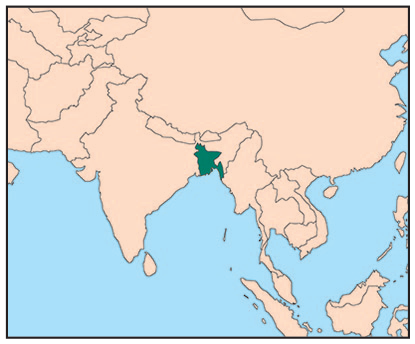
I. Introduction
Achieving universal access to safe sanitation for all by 2030, as Sustainable Development Goal (SDG) 6.2 stipulates, presents a formidable challenge, particularly in densely populated urban low-income communities (LICs). To achieve SDG 6.2, current average progress must increase fourfold.(1) In the sanitation sector, the consensus is that this leap will require radical changes because it cannot be achieved with the conventional approach of large sewerage networks and centralized treatment plants alone.(2) Conventional sanitation requires large quantities of water, involves high investment and operating costs, and demands long planning horizons. Thus, it is considered an unsuitable solution for many so-far-unserved and often informal urban settlements.(3,4)
As a response, the citywide inclusive sanitation (CWIS) concept, in which all city residents have equal access to adequate and affordable improved sanitation services, is promoted as key to achieving SDG 6.2.(5) Core elements of the CWIS approach are not new, particularly non-sewered sanitation systems and the service delivery framework.(6,7) Yet, their combination with sewered sanitation at the city scale make CWIS a possibly transformative approach in the sanitation sector.(8) CWIS has the ability to quickly unite broad support behind its principles and calls to action: from multilateral development banks(9,10) and leading research institutions(11) to global philanthropies,(12) international non-governmental organizations (INGOs), multinational corporations and Big Four consultants.(13) These principles, as spelled out in the Manila Principles on CWIS, include Equity, Environmental and Public Health, Mix of Technologies, Comprehensive Planning, Monitoring and Accountability, and Mix of Business Models.(14)
What unites the diverse actors and their proposals for CWIS is the elemental consensus that three areas need to be revolutionized to achieve the paradigm shift towards CWIS: technology, organization and finance.
CWIS advocates a flexible technological approach that focuses on the integration of sewered and non-sewered sanitation solutions, depending on what is best suited to achieve safe sanitation in any particular context.(15) At the core of integrating technologies is the sanitation service chain concept, which unbundles conventional sanitation into five services that must be provided to achieve safely managed sanitation: containment, emptying, transport, treatment and disposal or reuse.(16)
To achieve optimal organization of the sanitation service chain, CWIS seeks a transition from the top-down and supply-driven approach of conventional sanitation towards more demand-driven and bottom-up approaches that focus on the delivery of services to households by entrepreneurs in a sanitation economy.(17) The market for sanitation needs to be stimulated by generating household demand through sanitation marketing, awareness campaigns and behaviour change interventions(18) and by developing viable business models through purpose-driven start-ups to match sanitation services to households’ willingness to pay.(19)
The introduction of customizable and low-cost technologies and the organization of sanitation through an economy under CWIS move households to centre stage in the financing of sanitation. They are expected to cover the full cost of sanitation through fees, and subsidies are seen as ineffective and expensive instruments that are only appropriate for the very poorest.(20) In addition, entrepreneurs are expected to treat collected faeces for reuse to generate additional revenue.(21) Finally, investment in the sanitation economy is expected to come from the private sector, with start-up funding covered by philanthropy or public funds for leverage and risk mitigation.(22)
A major barrier to the transition to CWIS is the perceived lack of an appropriate legal framework that can accommodate the radical change in technology, organization and financing that CWIS entails.(23) The spatial distribution of sewered and non-sewered sanitation is a city-level policy decision involving municipalities, citizens, utilities and the private sector. It has far-reaching consequences, because it determines the investment needs for all actors involved, the benefits and comfort levels of households, and the distribution of business risks and opportunities between utilities and sanitation entrepreneurs.
The six Manila Principles for CWIS reflect the consensus in the sanitation sector that equity and environmental and public health are the goals of any endeavour. They also endorse a mix of technologies, a holistic and inclusive planning process, and a mix of business models accompanied by constant monitoring as tools with which to achieve equity and environmental and public health.(24) In doing so, they limit questions of accountability to formal regulatory frameworks, and omit the possibility of distributional contention in favour of a technocratic and apolitical conception of synergistic collaboration between “stakeholders”. This is in stark contrast to an approach to co-production(25) that addresses context-specific pro-poor concerns and priorities.(26)
Scholarly research has explored the distributional contention of sanitation in developing cities, highlighting the importance of colonial legacies and the competing interests of middle classes and urban poor,(27) while unpacking the vested interests in the debate on private sector participation.(28) Scholars further point to the pitfalls of apolitical development approaches,(29) yet others describe the ability of community-driven initiatives to sustain success.(30)
However, scholarly research has not yet adequately addressed the negotiations over organizational and financial arrangements that accompany the translation of CWIS concepts into sanitation service delivery at the city scale. Based on the recognition that local contexts are paramount for sanitation outcomes(31) we argue that different actors can be assumed to have different vested interests and their own differing ideas about how to organize and finance service co-production under CWIS. The way competing interests shape policy pathways needs to be critically examined to better understand how CWIS can successfully contribute to greater urban equality and what can cause it to fail.
Dhaka provides an opportune context in which to study the ramifications of combining sewered and non-sewered sanitation in an attempt at implementing CWIS. Dhaka is one of the world’s most densely populated cities and its population has tripled from seven million in 1990 to 21 million in 2020.(32) Some 20 per cent of Dhaka’s population are connected to sewered sanitation, but the main sewage network and the sole sewage treatment plant (STP) are barely functional (see Figure 1 for a schematic map of different sanitation systems).(33) Of the 80 per cent that depend on non-sewered sanitation, most households either have illegal connections to stormwater drains and water bodies(34) or hire “sweepers” who illegally empty septic tanks by hand and dispose of the faecal sludge in the open environment.(35) Sweepers belong to the lowest social class, deprived of most basic rights. Their forebears were brought to Dhaka during the British colonial period, often violently, to clean public places and empty latrines. Since then, this has been the only way for subsequent generations to make a living.(36) Less than one per cent of faecal sludge is emptied by vacuum truck operators.(37) Without any option for treatment, they dispose faecal sludge legally into the dysfunctional sewerage network at designated lifting stations.(38) In sum, nearly all household wastewater and faecal sludge in Dhaka ends up untreated in the open environment, causing serious negative impacts on environmental and public health.(39)
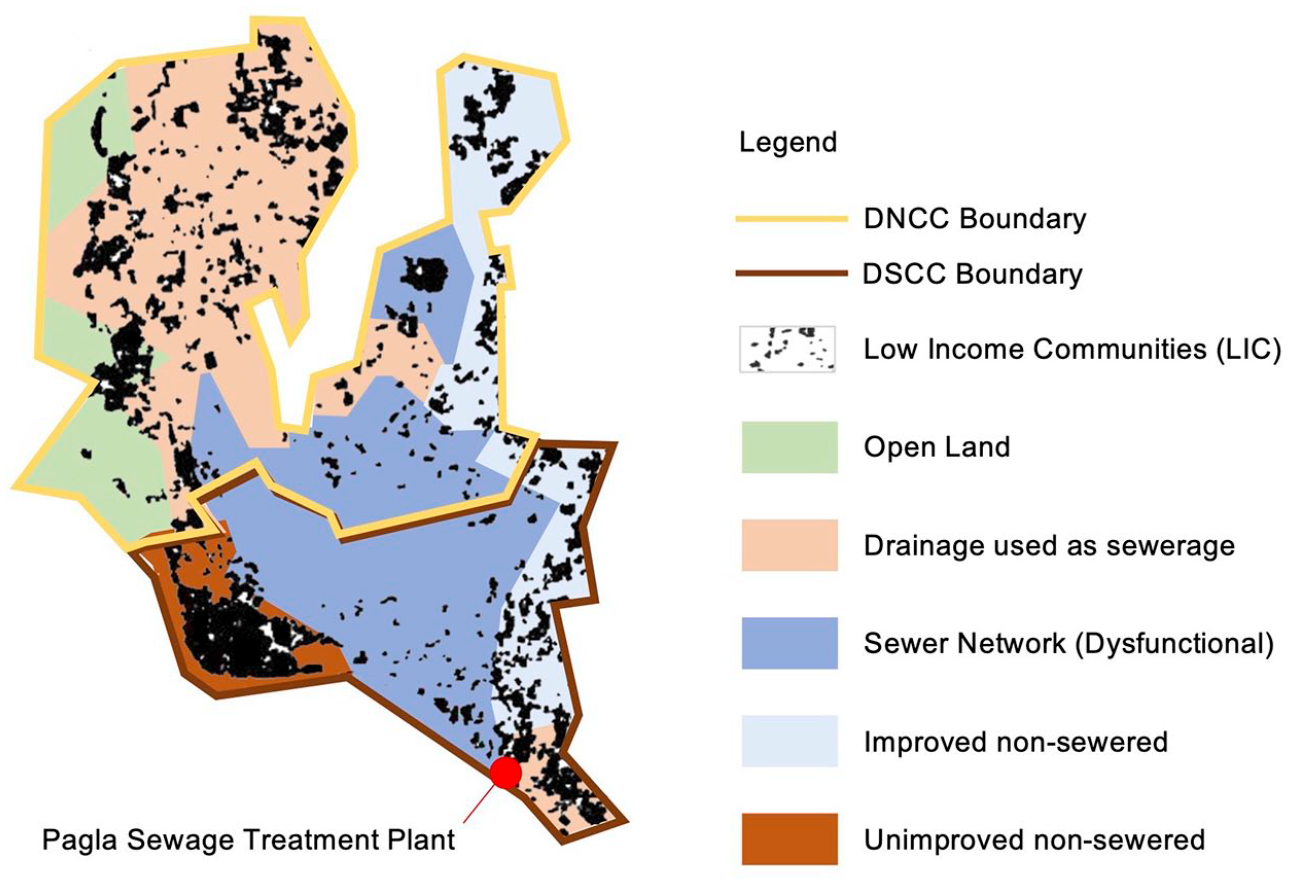
Schematic map of the estimated distribution of different sanitation systems and low-income communities across Dhaka in 2015
Dhaka’s devastating sanitation situation lies in stark contrast to the tremendous progress reported for water supply. In 2005, roughly 30 per cent of the population had no access to an improved water source, but this number decreased to close to zero in less than a decade, despite continued population growth.(40) Water quality can still be a concern, especially in LICs, but progress has been immense, especially compared to sanitation.(41) We trace the bargaining over water policies and sanitation policies in Dhaka from the far-reaching structural adjustment reforms that began with the passage of the Water Supply and Sewerage Authority (WASA) Act in the 1990s through to the adoption of the CWIS concept via the Institutional Regulatory Framework for Faecal Sludge Management (IRF-FSM) today.
We analyse the bargaining over these policies with a focus on equality in line with the understanding in this special issue.(42) We ask where and how are they negotiated, who benefits and who carries the cost; who will obtain new opportunities and who is left with risks. We apply a case-centric, outcome-focused process tracing methodology.(43) We base our analysis on the concept of territorial political economy,(44) which we combine with a power analysis using Gaventa’s(45) power cube framework.
In Dhaka, the adoption of the CWIS concept led not to equal access to safe sanitation but to fierce negotiations over responsibilities for and the regulation of non-sewered sanitation. Through the redrawing of spatial and institutional responsibilities, current policy development shifts the costs of enabling a sanitation economy and organizing the sanitation service chain at the city level from the utility to the municipal government, while entrepreneurs are not willing to enter the business. In effect, the risks are left with sweepers and LIC residents.
The next section details the conceptual framework and the methodology. Section III reports the findings, followed by a discussion and conclusions in section IV.
II. Conceptual Framework And Methodology
a. Territorial political economy
A territorial political economy (TPE) perspective suggests that urban sanitation infrastructure development can be understood as the territorial outcome of political and economic bargains between local and global actors over the improvement of the quality of life in cities.(46) The concept of the bargain is at the heart of TPE theory. A bargain denotes an ideal-typical constellation of technologies, financing mechanisms and organizational arrangements that addresses a public issue;(47) in our case safe sanitation. Applying a TPE perspective allows us to recognize the different underlying bargains that lead to conflicts over the distribution of costs, benefits, risks and opportunities in Dhaka’s sanitation sector. TPE posits that the equitable distribution of the material conditions for a meaningful life(48) can be understood by examining the distribution of costs and risks as well as benefits and opportunities of bargains. Two bargains for sanitation can be identified, which we here call the utility bargain and the enterprise bargain.
The utility bargain is organized around the natural monopoly of conventional sewer networks and centralized wastewater treatment plants.(49) This monopoly is managed by ring-fenced and ideally autonomous utilities(50) along commercial principles.(51) Expansion of access to sanitation is supply-led,(52) with households paying for services through tariffs set by the utility that cover the cost for operation, maintenance and investment.(53) In line with new public management principles, initial subsidies and public funds are phased out and replaced by commercial credit or by public–private partnerships.(54) The government appoints a regulator to ensure environmental and social standards are met.(55)
The enterprise bargain is organized around the sanitation service chain,(56) along which entrepreneurs offer technologies and services for each step(57) in a market environment.(58) The expansion of the sanitation system is driven by household demand(59) and the entrepreneurs’ ability to meet that demand with solutions that customers are willing and able to pay for. The funds to kick-start this sanitation economy come from the global donor community with corporate philanthropists in a leading role.(60) It is expected that, after the start-up phase, entrepreneurs can run their businesses profitably from the revenue they generate.(61) The government’s role is to incentivize and regulate this sanitation economy to guarantee fair competition and ensure environmental and safety standards are observed.(62)
b. Power cube
The power cube framework (PCF) helps to make implicit manifestations of power explicit.(63) The core proposition of the PCF is that power is not constant for any actor but depends on the situation and issue at stake. These can be explored through three analytical dimensions: levels, spaces and forms. Figure 2 uses the analogy of the Rubik’s cube to highlight how the three dimensions are interconnected.
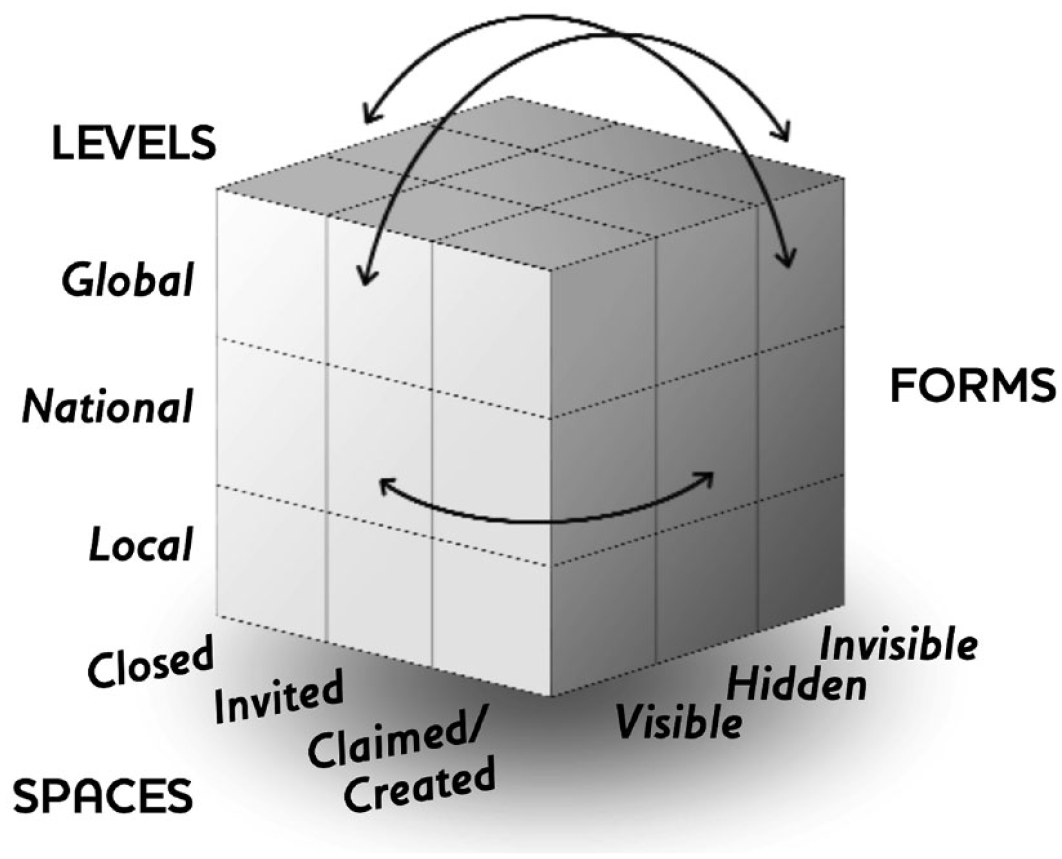
Analytical dimensions of the power cube framework
The PCF enables us to approach policymaking as a process shaped by interest groups, each with different access to power. In acknowledging these power differences, the PCF unmasks the language of “stakeholders” used in donor circles, including in the Manila Principles, which suggests that all actors are on a level playing field and hold equal stakes with which to influence the debate. It also provides the tools to understand parity in participation in decision-making processes needed for urban equality.(64) The PCF levels describe the geographical scales of the main actors and moments in the decision-making processes, ranging from local to global. The PCF spaces describe how arenas for participation and decision-making are socially constructed, focusing particularly on the rules and rights of access to them. A closed space is one that is controlled by an actor group, such as companies or government officials, located behind closed doors, for example boardrooms, and not open to public participation. Civil society often works to challenge and open such closed spaces to create claimed spaces. Participatory and democratic decision-making processes are characterized by their openness to a range of actors and interests and are understood as invited spaces. Finally, the PCF forms describe how power struggles are expressed in decision-making processes. Visible forms of power are the expression of disagreements, for example in debates and reports. Invisible forms indicate the exclusion of issues and actors from debates and agenda-setting. Power is at play in a hidden form in unconscious attitudes towards what can and should be known.(65)
c. Policy pathways framework
In line with the ambition of this special issue to understand the pathways towards urban equality,(66) we term the operationalization of our combined TPE and PCF analysis the “policy pathways framework”. The policy pathways framework provides a visual representation of the concurrent, intertwined and inherently power-laden construction of policies that shape equality outcomes. Figure 3 details an illustrative heuristic to analyse policy pathways from a TPE and PCF perspective. Routes represent bargaining over a particular policy or bargain. Circles represent decision spaces and their power constellations. The x-axis shows development over time, and the y-axis indicates where the dominant actors are positioned between local and global levels. Finally, the line pattern illustrates four generic stages that characterize policy development: inception, design, legitimation and rollout.
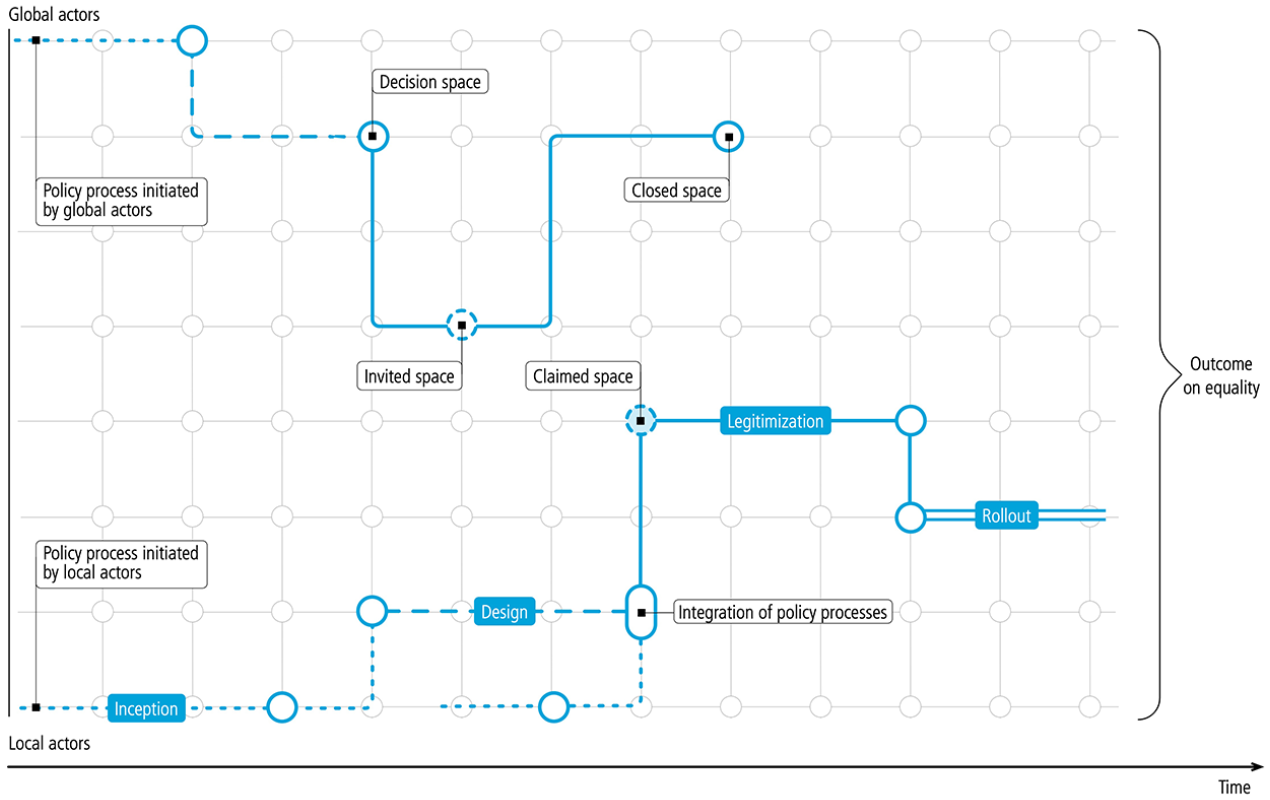
Analytical framework to analyse policy pathways towards equality from a territorial political economy and power perspective
d. Data collection
Qualitative data were collected through 27 semi-structured expert interviews and document analysis between February and November 2021. We selected the interviewees by actor mapping, which identified possible key players, and complemented this procedure with snowball sampling.(67) In addition, text analysis of project documents (from multilateral investments, annual reports from key actors and policy documents) was instrumental in reconstructing the evolution of interest dynamics and the agency of actors over the 30-year period included in our analysis.(68) An overview of the interviews and documents can be found in Tables S1 and S2 available in supplementary material online. Interviews were recorded and transcribed if consent for recording was given; otherwise, extensive summaries were compiled. Transcripts, interview summaries and key passages from documents were coded in NVivo based on a deductive coding scheme informed by the TPE and PCF frameworks with a focus on time and actors; see Table S3 online.
III. Findings
The current situation of water supply and sanitation in Dhaka needs to be understood against the backdrop of the key policy pathways. Figure 4 summarizes four policy pathways that in concert have decisively shaped the organization and financing of water supply and sanitation in Dhaka by displaying the stages through which they evolved, and the power constellation of crucial decision spaces for their development. The pathways are described chronologically in three stages.
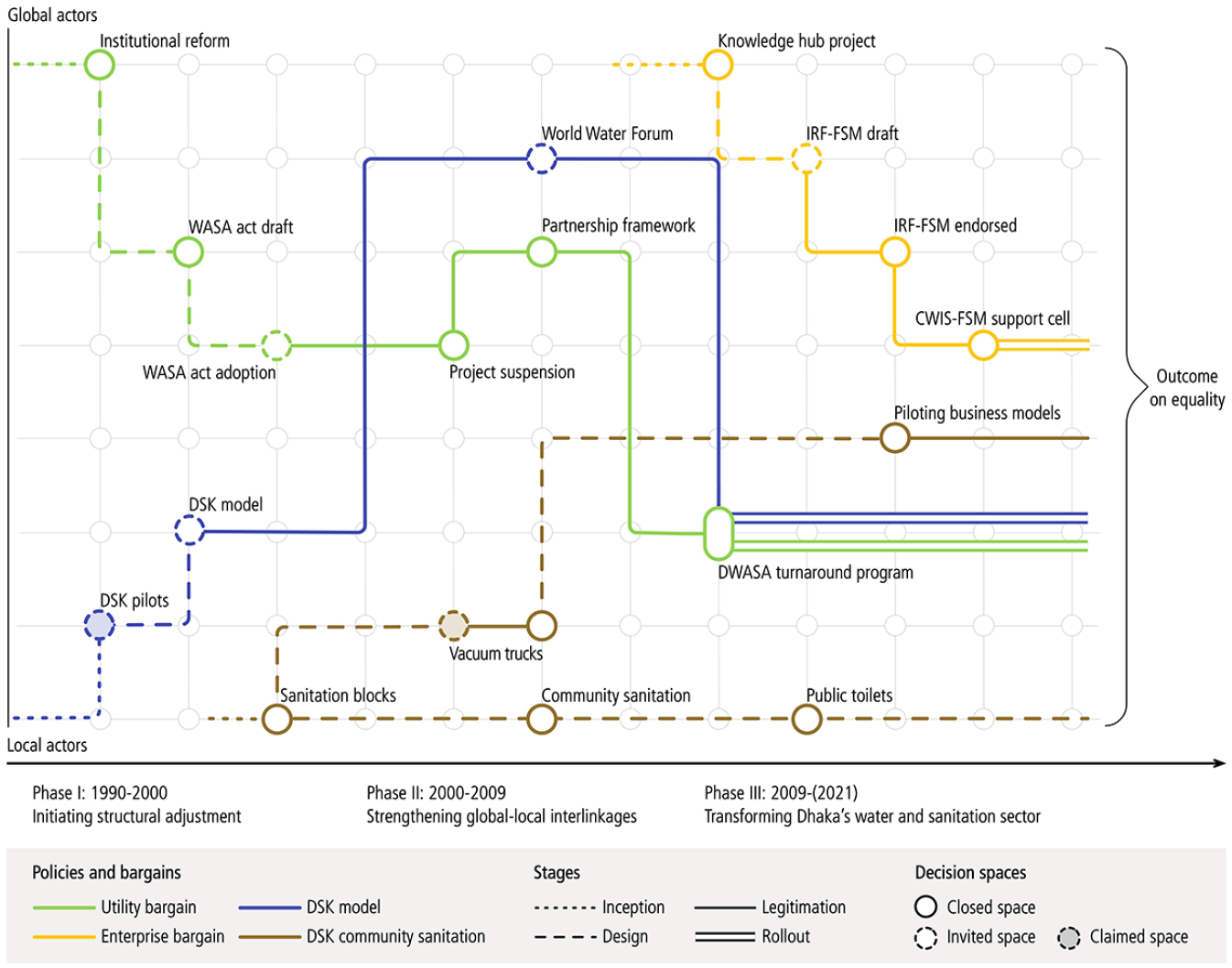
Policy pathways towards urban equality in access to water and sanitation in Dhaka, Bangladesh
a. Phase I: Initiating structural adjustment
Between 1980 and 2000, Dhaka’s population grew on average by 10 per cent annually, reaching 10 million in 2000.(69) The steep population increase and the government’s declining capacity to organize urbanization led to an increased proportion of the population living in LICs with no connections to basic services.(70)
The urbanization of Dhaka in the 1980s and 1990s occurred against the backdrop of a national debt crisis. At the direction of the International Monetary Fund and the World Bank, the Government of Bangladesh (GoB) addressed this crisis with comprehensive structural adjustments, including liberalization, privatization and a reduction in public investment.(71) This was reflected in the water and sanitation sector through the introduction of the utility bargain with the WASA Act in 1996, which aimed to transform the Dhaka Water Supply and Sewerage Authority (DWASA) into a fully commercial utility.(72)
The WASA Act was conceived at a global level and in closed spaces by the World Bank. Its adoption by the Parliament was a condition of the World Bank’s funding of the fourth water supply project in Dhaka, where disagreements manifested in open conflict: visible forms of power.(73) Resistance formed in the Parliament, an invited space in which the population is represented. Substantial modifications were negotiated before the Act was passed into law in 1996. The World Bank’s draft transferred power from the GoB to an independent board to reduce the GoB’s influence and granted full financial autonomy and control over tariffs to DWASA to implement cost-covering tariffs. In contrast, the GoB insisted on two government representatives on the board and retained some control over financial matters by stipulating that tariff increases above a five per cent inflation rate had to be approved by the GoB, along with decisions about cases in which the government had guaranteed investments.(74) With these modifications, the GoB used its sovereign power against World Bank pressure to retain some control over the utility.
Although the World Bank was unable to enshrine the logic of the utility bargain in the WASA Act as it had planned, it approved funding for the fourth water supply project in 1996. Yet the GoB continued to resist its disempowerment by not implementing any WASA Act provisions. In response, the World Bank suspended the project for five months in November 2000 and scaled down or cut various infrastructure components, reducing its financial contribution by 40 per cent.(75) After completion, the World Bank rated the project as unsatisfactory, the lowest possible rating. When the explanations in the final report are considered, the rating is surprising. The report explicitly acknowledges that DWASA completed the key infrastructure component, a one billion litre per day water treatment plant, under budget and on schedule. However, it contends that “the same effort was not put into the measures to develop institutional reforms”.(76) The report goes on to sharply criticize the local World Bank office for failing to enforce the implementation of the WASA Act. First, it notes that the disbursement of the infrastructure components was not linked to the successful implementation of the WASA Act’s provisions. Second, it criticizes the fact that not all infrastructure components were put on hold once it became clear that the implementation of the Act would be resisted.(77) The World Bank’s evaluation suggests that the legitimation of the utility bargain through the enactment of the WASA Act had become more important than the actual implementation of infrastructure improvements.
Parallel to the institutional reform of DWASA, the World Bank promoted non-sewered sanitation to serve LICs, which in their view was to be designed and piloted independently of utilities. For this purpose, the World Bank and globally active donors established the local branch of their international training network (ITN) for off-grid water supply and non-sewered sanitation technologies at the Bangladesh University for Engineering and Technology (BUET).(78) Until 2005, ITN-BUET was mainly concerned with its own establishment, conducting stocktaking studies on urban and rural water supply and sanitation, and redesigning the curriculum for diploma engineers, which until then had only focused on expensive western technologies, to incorporate non-sewered solutions (Interview 2). Over time, ITN-BUET developed into both a vehicle through which the global donor community tested and introduced solutions for LICs in Bangladesh and a central knowledge broker in the development of policies for Bangladesh’s water and sanitation sector (Interviews 1 and 2).
In contrast, radical innovations to improve public health were conceived at the local level by NGOs, with one in particular, Dushtha Shasthya Kendra (DSK), leading the way. At the time of DSK’s establishment in 1988, residents of mushrooming LICs had to rely on illegal water suppliers, which carried the risk of pollution and at up to five times the cost of piped water.(79) Water supply and sanitation became an essential part of DSK’s activities from 1991 onwards, when it successfully claimed a decision space where it lobbied both the then Dhaka City Corporation (DCC) and DWASA to provide formal shared water connections to LICs, regardless of their lack of formal land tenure.(80) DSK designed an agreement with DCC and DWASA whereby DSK bore the risk of infrastructure investment through a security deposit and a guarantee for the payment of all tariffs, in addition to financing operations, maintenance and tariff collection, and acted as a mediator between DWASA and LICs (Interviews 21 and 23).(81) By organizing shared water supply for LICs, DSK transformed itself into a quasi-utility. DSK established and trained community-based organizations (CBOs), to manage the shared water access points and collect revenues. This arrangement for connecting LICs with DWASA’s water network became known and replicated as the “DSK model”.(82) By the turn of the millennium, DSK, with financial support from INGOs, had established over 200 shared water points across Dhaka, serving more than 30,000 people. DSK also became the driving force for non-sewered sanitation in LICs. From 1997 onwards, DSK improved containment infrastructures by introducing shared sanitation blocks to reduce the health threat from effluents in LICs. DSK granted interest-free loans to CBOs for the construction of these blocks, which the CBOs repaid in 24 instalments over a period of 30 months with a six-month grace period (Interview 23).(83)
b. Phase II: Strengthening global–local interlinkages
Phase II is characterized by the scaling up and formalization of the DSK model and the increased and coordinated pressure by actors from the global level to implement the institutional reforms of the WASA Act to legitimize the utility bargain.
DSK’s innovative model was legitimized at the global level when, in 2003, DSK presented its model at the World Water Forum. Thereafter, WaterAid and other INGOs mainstreamed the DSK model in various cities across the globe. Power took an invisible form in the presentation of the model to a global audience, which makes a subtle but important concession to the logic of the utility bargain. Rather than emphasizing that contentions between DSK, DCC and DWASA centred on claiming the human right to water for LICs at the same cost as formal households, the narrative highlighted the slumdwellers’ willingness and ability to pay for water.(84) International success also helped at home, where the DSK model became an integral part of Dhaka’s water system thanks to financial support from global donors. After 16 years of regular bill payments, CBOs were allowed to apply for water connections from DWASA in their own name, without an NGO intermediary and despite the lack of formal land titles.(85) However, neither the international success nor the local progress could be replicated for sanitation. DSK and other local NGOs started to experiment with mechanical emptying of septic tanks, including the local development and production of low-tech vacuum trucks in 2000. Although three series of vacuum trucks were produced (and many also exported), uptake of mechanical emptying in Dhaka’s LICs remained low (Interview 24).(86)
While DSK continued to provide water and sanitation services to LICs, the stand-off between the GoB and the World Bank over enactment of the WASA Act, and the adoption of the utility bargain continued. The attitude of three successive governments towards the WASA Act remained unchanged, and its provisions were not implemented. DWASA continued by and large to operate as it had before the reform by not raising tariffs, and each government retained close control by appointing a new director.
In response, donors joined forces to demand implementation of the WASA Act and thus embed the logic of the utility bargain in Dhaka’s water and sanitation sector. In November 2007, after two years of negotiation, the main donors for water and sanitation in Bangladesh signed a Partnership Framework with the GoB that linked institutional reforms to a roadmap with distinct infrastructure investments from all development partners. Power took a visible form in the adoption of the Partnership Framework, since this was explicitly designed to enforce institutional reforms in line with the utility bargain by demanding joint and time-bound policy actions by the GoB and DWASA to fully implement the WASA Act and turn DWASA into an autonomous commercial operation.(87) While the Framework was not binding, the Asian Development Bank (ADB) went a step further by adding the Framework’s main demands as enforceable milestones in the Sector Development Program it implemented with DWASA between 2008 and 2016. Prior to the release of the first tranche of credit, DWASA had to select a managing director (MD) in a competitive process and the ministry had to issue “Rules of Business” for water and sewerage tariff-setting to increase DWASA’s autonomy and commercial orientation in line with the WASA Act.(88)
c. Phase III: Transforming Dhaka’s water and sanitation sector
Phase III began in January 2009 with the election of the current Prime Minister, and the appointment of the current MD of DWASA in October 2009. The phase is characterized by the new MD of DWASA, who fully embraced the utility bargain and the introduction of the enterprise bargain through the IRF-FSM.
The rollout of the utility bargain determined all strategic priorities of DWASA by aligning the organization and financing of water supply and sanitation. To strengthen its balance sheet and become bankable, it gave the highest priority to revenue collection and water sales. After DWASA fully embraced the institutional reforms from the Partnership Framework, donors funded the technical improvements to increase water production, reduce water losses and enhance metering.(89) DWASA also raised tariffs by five per cent annually, which it could do without GoB approval, and by an additional 17 per cent in 2016–2017 with GoB approval. DWASA has continued to charge all households within a hundred feet of the sewer network, irrespective of connection, a sewage tariff as high as the corresponding water tariff. Even though the sewer network and the STP have been dysfunctional since a devastating flood in 2004, no resistance formed against this practice (Interview 2).(90) DWASA recognized the potential of the DSK model to increase revenues by serving LICs, but with no investment in infrastructure and with no operational risks, as these were borne by NGOs. DWASA introduced NGOs as standard franchise partners for LICs, paying them a commission for supervising CBOs, issuing invoices and collecting revenues.(91) By 2021, NGOs and CBOs were operating over 7,000 shared water points across Dhaka’s LICs, from which over 99 per cent of the tariff was collected (Interview 23). DWASA’s efforts to increase revenue were recognized by the ADB, which singled it out as a model utility for South Asia, particularly for its work with NGOs to serve LICs.(92)
With the autonomy it has gained, DWASA has further reduced its risks and costs, particularly by transferring responsibility for stormwater to DCC, arguing that this responsibility had been illegitimately transferred to DWASA, without remuneration, in 1989 through a circular issued by the ministry, without any political process (Interview 19).(93) Between 2010 and 2020, DWASA lobbied successive city mayors to return all assets and responsibilities for stormwater management to the municipality. This political project, in which DWASA invested significant time and resources, ended in January 2020 with the official transfer of all stormwater assets and responsibilities to the then DCCs (Interviews 5 and 19). By dismantling its entire stormwater branch, DWASA has improved its financial performance without improving the drainage system. This has had negative consequences for public health and the environment, which have had to bear the costs incurred by DWASA’s neglect. In a similar vein, DWASA has neglected sewerage. The additional costs for rehabilitating and operating the existing network are avoided, while sewage tariffs are continuously collected. The effects of DWASA’s embrace of the utility bargain and the subsequent focus on economic returns are reflected in the contrasting performance of two infrastructure projects financed by multilateral development banks. ADB’s Sector Development Program (2008–2016), devoted solely to water supply, was a success, reaching 100 per cent water coverage. In contrast, the World Bank’s Water Supply and Sanitation Program (2009–2016) was a disaster. All sanitation infrastructure components were cancelled due to slow procurement, insufficient capacity and understaffing of the DWASA project team. At project closing, less than half of the planned investment of US$ 165 million had been disbursed. The sewerage masterplan was the only tangible output for sanitation.(94)
From 2016 onwards, bargaining over the responsibilities for non-sewered sanitation and the adoption of the enterprise bargain have taken centre stage. The key bone of contention has been whether DWASA has to accept responsibility for non-sewered sanitation, something it has tried to avoid by all means possible. At the heart of the dispute is the Institutional and Regulatory Framework for Faecal Sludge Management (IRF-FSM). The IRF-FSM was conceived at the global level in the closed spaces of the ADB- and Bill and Melinda Gates Foundation (BMGF)-funded Knowledge Hub Project (2013–2017), designed by ITN-BUET and legitimized through its endorsement by the GoB’s ministry in 2017.
The IRF-FSM is based on the enterprise bargain’s fundamental assumption that streamlining the institutional and regulatory framework is the silver bullet that enables the provision of sanitation services by enterprises in a market. The IRF-FSM claims that responsibilities for non-sewered sanitation are not explicitly regulated in the laws that currently govern DWASA and the DCCs, because neither the WASA Act nor the City Corporation Act use the term “faecal sludge”.(95) It concludes that the responsibility for non-sewered sanitation lies with the DCCs under the City Corporation Act to “develop adequate arrangements for the collection and removal of refuse from . . . public latrines, urinals, [and] drains”.(96) Simultaneously, the IRF-FSM downplays the WASA Act with regard to DWASA’s mandate for the “construction, development and maintenance of sewerage systems” by pointing out that it “does not specifically mention about responsibilities of the Authority with regard to on-site sanitation [i.e. non-sewered] systems or any activity related to emptying of pits and septic tanks, collection, transportation, treatment and disposal and/or reuse of faecal sludge”.(97)
Furthermore, the IRF-FSM explicitly challenges the sewerage master plan recommendations, approved by DWASA’s board in 2016, stressing that these are not legally binding. The master plan suggests establishing a sludge management division at DWASA, which would be responsible for emptying septic tanks, either through its own operation or through service agreements with private operators.(98) However, DWASA management effectively rejected the master plan less than three months after board approval by stating that “understanding the existing legal provisions is crucial for service delivery, e.g. on-site [i.e. non-sewered] sanitation is not DWASA’s mandate, which is also not covered by the WASA Act”.(99)
The legitimation of the IRF-FSM was coordinated through the Policy Support Branch (PSB), a government unit financed by donors and responsible for water and sanitation policy development. The PSB selected working group members, among whom we find DWASA, major international sanitation economy promoters and local NGOs but no senior representatives of the DCCs and ministries (Interviews 5 and 20). The PSB coordinated the process in closed ministry spaces, leading to the minister’s endorsement of the IRF-FSM. As deliberations were not documented and decisions were taken by consensus, power took a rather invisible form. Since the IRF-FSM was adopted, BMGF has established and funded the CWIS-FSM support cell within the ministry and tasked it with ensuring that CWIS principles are adhered to in all sanitation investments by government, both on its own and with bilateral and multilateral actors (Interviews 1, 2, 5, 10, 11 and 28). Rather than clarifying the legal responsibilities through public and democratic processes to amend the WASA or City Corporation Acts, IRF-FSM proponents, claiming a lack of time, focus on convincing senior officials (Interviews 1, 11 and 20). This exemplifies how closed the spaces are in which the CWIS configuration for Dhaka is negotiated.
Yet one of the two DCCs opposes the IRF-FSM. In 2011, for reasons unrelated to sanitation, the DCC was split into two city corporations, one for the north (DNCC) and one for the south (DSCC) of Dhaka. So far, IRF-FSM proponents have convinced DNCC’s mayor to assume responsibility for non-sewer sanitation and to spatially divide responsibilities for sanitation between DNCC and DWASA (Interviews 1 and 5). In contrast, DSCC rejects the IRF-FSM’s design, questioning how the policy was developed and stressing that it was not duly informed of the implications before its adoption. DSCC insists that sanitation is DWASA’s responsibility under the WASA Act, regardless of technology. However, IRF-FSM proponents blame a lack of technical understanding of non-sewered sanitation for DSCC’s rejection (Interviews 1, 2, 5, 11 and 16–19).
The stalemate in the rollout of the enterprise bargain is reflected in the stagnation of the largest investment for sanitation in Dhaka to date. Run under the banner of CWIS, this World Bank-led project allocates two per cent of the US$ 483 million for serving LICs and non-sewered sanitation.(100) Despite this meagre proportion, the non-sewered component is stalling the entire project. DWASA refuses to implement any non-sewered project component with reference to the IRF-FSM, accusing the World Bank of making it a condition for project appraisal although it is against the law (Interviews 16–19). According to World Bank staff, no solution could be found in the first 20 months of the four-year project, although the component is in line with the sanitation master plan. Furthermore, the detailed information on the LICs to be served is based on a report by an INGO with which DWASA is working to test business models for leasing out vacuum trucks to private service providers. Despite substantial investment from global donors in business development since 2015 under the pilot, DWASA has not been convinced to set up its own sludge collection operation nor to enter into service agreements with private operators. Indeed, DWASA has transferred the costs and risks as well as the benefits of any eventual sanitation economy to the DCCs and enterprises (Interviews 12 and 13).(101) After all, when the sewerage system is developed, DWASA will control 90–95 per cent of the market (Interview 19).
As in phases I and II, progress inside LICs has mainly been made by local NGOs. Based on the conviction that a welfare approach with strong subsidies can most effectively reduce the burden of diseases and environmental pollution, DSK has steadily improved community sanitation, mainly by constructing sanitation blocks for communities and schools, and public toilets, using funds from INGOs.(102) While DSK has improved containment infrastructures in LICs, it has refused to adopt the logics of the enterprise bargain and commercialize its service provision for emptying and transportation (Interview 21). Likewise, DSCC has shown a proactive attitude to ensuring environmental and public health after it had to take responsibility for stormwater management. Stormwater drains are de facto open sewers to which non-sewered sanitation systems from LICs and better-off households connect directly. In response, DSCC has outlined options for basic treatment of the water flowing through these drains to reduce pollution risk and reuse the treated water for irrigation of parks during the dry season (Interviews 4–8).
IV. Discussion
Applying the policy pathways framework to the last 30 years of water and sanitation policy development in Dhaka allowed us to identify four distinct yet intertwined policy processes. The introduction of the utility and enterprise bargain was initiated at the global level by donors, while the DSK model and sanitation service co-production were initiated at the local level by NGOs (see Figure 4). Together, they have shaped today’s access to water and sanitation, with strikingly different equality outcomes.
Our TPE analysis revealed how bargaining over priorities and responsibilities has shifted preferences for technology, organization and finance in Dhaka’s water and sanitation sector. The decision space analysis through the PCF has shown how a technocratic notion of stakeholders, viewing all actors involved in the co-production of services as having equal standing and stakes, obscures the actual and unequal distribution of power.
Over the last 30 years, responsibilities and priorities in Dhaka’s water and sanitation sector have been dominated by the utility and enterprise bargains. The strong local entrenchment of the utility bargain has resulted in DWASA’s over-zealous focus on bankability and cost optimization, leading to its denial of responsibility for stormwater management and deliberate neglect of sewered sanitation. The utility bargain, introduced through the WASA Act, funded and drafted by the World Bank, suggested a distribution of roles and responsibilities that would lead to DWASA’s expanded autonomy and commercialization. When legitimization of the WASA Act was sought in the invited space of the Parliament, it accepted only a partial commercialization of DWASA. Even the trimmed-down Act was not implemented by consecutive governments. In 2007, leading donors pushed through the rollout of the utility bargain by adopting a “partnership framework”, which prevented further loans without the WASA Act’s implementation. This quickly proved effective, and DWASA’s efforts to increase its commercial credentials made it a showcase for the utility bargain from 2009 onwards.
When global actors introduced the enterprise bargain in Dhaka through the IRF-FSM, DWASA used its newfound autonomy to shed any responsibility for non-sewered sanitation and its costs in favour of improving its own balance sheet. The conception of the IRF-FSM took place at the global level, led by BMGF and the ADB. The design, led by ITN-BUET, translated the enterprise bargain into distinct roles and responsibilities to achieve CWIS in Dhaka. Most notable is the transfer of responsibility for non-sewered sanitation from DWASA to the city corporations. The legitimization of the IRF-FSM was coordinated by the donor-sponsored PSB through the invited spaces of a technical working group and a policy review committee, and the closed spaces of the ministry to acquire the minister’s endorsement. The working group and committee, composed of representatives from organizations dependent on global donor funding, thus sidelined competing interests. Neither the substantive development nor the process at ministerial level was documented or published. The rollout led to more visible forms of power when affected actors were officially informed of the IRF-FSM’s consequences. DSCC refused to play its intended role, bringing the IRF-FSM process to a standstill. The corporation did not buy into the promise of a profitable sanitation economy and refused to assume the costs of organizing and monitoring the non-sewered sanitation system. IRF-FSM proponents delegitimize DSCC by blaming its lack of expertise while omitting the possibility of competing interests between DSCC and DWASA.
Undeterred by these frictions, transformational innovation emerged locally for service co-production in both water supply and sanitation.
The DSK model for water supply scaled successfully because it could reconcile competing interests between LICs, informal water suppliers, DWASA, the City Corporation and the logic of the utility bargain. At its outset, DSK together with CBOs claimed a decision space where LIC residents could engage in service co-production with local government and the utility. The DSK model was legitimized at global level at the World Water Forum in 2003. Finally, the model was rolled out, after DWASA adopted it as a standard franchise model for supplying drinking water to all LICs in collaboration with NGOs and CBOs. The success of the DSK model lies in the organizational and financial arrangement that bolsters citizen co-production. Yet, although LIC households pay the same price for water as other households, this comes at a cost. LIC residents subsidize DWASA by collecting water from shared locations instead of household connections; NGOs take on substantial costs and risks involved with supplying LICs. This enabled DWASA to supply water to LICs under the utility bargain through outsourcing costs and risks while increasing its own revenue.
In sanitation, DSK and other local NGOs conceived and introduced co-production arrangements with CBOs that substantially improved hygiene and public health inside LICs, including communal sanitation blocks, shared septic tanks, public toilets and non-commercial emptying schemes. Yet, even though NGOs and CBOs claimed a decision space for negotiating disposal of faecal sludge in sewage lifting stations, this did not lead to substantial service co-production with the utility and local government. The main reason was that the global donor community and DWASA became invested in the vision of co-production which replaced shared efforts by communities, NGOs and CBOs with the individual household’s interaction with businesses. To this end, proponents of the enterprise bargain support business development and diversification, sanitation marketing and awareness campaigns to generate household demand, and an enabling regulatory framework via the IRF-FSM.
The current effects on equality are clear. While community solutions substantially improved public health and hygiene inside LICs, service co-production in line with the enterprise bargain has failed to provide positive results. Even worse, it enabled DWASA to avoid any responsibility to service households not connected to sewered sanitation, creating a situation in which neither DCCs nor the utility takes charge of close to 80 per cent of Dhaka’s sanitation system.
V. Conclusion
The TPE and PCF analyses and the policy pathways framework have proven useful theoretical concepts and methodological tools to unbundle the complex policy pathways affecting urban equality in water supply and sanitation. The approach could be replicated in other cities for scientific analysis of policy processes, and its suitability for other sectors could be explored. The methodology can be equally useful for practitioners who aim to understand bargaining over public issues and design pathways towards more equality as part of politically informed programming.
Two conclusions can be drawn that can inform successful and inclusive implementation of CWIS. First, the introduction of CWIS has not stalled because non-sewered solutions are seen as inferior, but because linking them to organizing sanitation as an economy has prioritized the commercial orientation of the utility and the role of households as customers over their rights as citizens to public and environmental health. For CWIS to scale, the flexibility propagated for technical solutions must also apply to the organization and financing of sanitation. Recognizing that public investments and targeted subsidies are integral to realizing public and environmental health will expand the scope for more effective ways to distribute costs of sanitation equitably between socioeconomic groups and generations, regardless of technology.
To realise CWIS, community-based approaches that have successfully improved public health should be recognized and promoted as promising models for co-producing sanitation services in non-sewered settings, rather than experimenting with sanitation economy blueprints. These may include the community-based approach of NGOs and the supply-driven scheduled emptying schemes of municipalities, which can be outsourced to CBOs or the private sector. In practice, this implies that CWIS proponents should make the diversity of viable financial and organizational arrangements for CWIS as easily available as the technologies for non-sewered sanitation. A flexible portfolio of CWIS options, including organization and financing in addition to technology, offers the opportunity to strengthen local actors in legitimizing local solutions vis-à-vis global bargains. CWIS is more likely to succeed when demand-driven, supply-led and community-based solutions are combined in context rather than in principle.
Our study has also shown that synergistic collaboration and co-production in multi-stakeholder approaches towards CWIS is far from given and never free from power dynamics. In contrast to the technocratic ideal of multi-stakeholder platforms, they run the risk of shifting decision-making into closed spaces and perpetuating power in less visible forms. As the Dhaka case shows, such spaces risk reinforcing inequalities rather than providing fertile ground for developing pathways to equality. The multi-stakeholder approach to the IRF-FSM led to shifting costs to actors not deeply engaged in the platform, namely households, enterprises and the DSCC, while leaving the health risks with sweepers and LIC communities.
To prevent CWIS from becoming an umbrella term for the top-down imposition of the enterprise bargain and a sanitation economy, proponents should seek to design service co-production arrangements at the local level in invited or claimed spaces, address distributional conflicts transparently and resolve them through locally available political processes. In this way, CWIS can become different from and better than the status quo in technology, funding, organization and implementation.
Supplemental Material
sj-pdf-1-eau-10.1177_09562478221149915 – Supplemental material for On whose terms: utilities, enterprises or communities? The territorial political economy of water and sanitation sector reforms in Dhaka
Supplemental material, sj-pdf-1-eau-10.1177_09562478221149915 for On whose terms: utilities, enterprises or communities? The territorial political economy of water and sanitation sector reforms in Dhaka by Andri Heidler, Sharmin Khan Luies, Abul Kamal, Mahbub Ul-Alam, Christoph Lüthi and Olivier Crevoisier in Environment & Urbanization
Supplemental Material
sj-pdf-2-eau-10.1177_09562478221149915 – Supplemental material for On whose terms: utilities, enterprises or communities? The territorial political economy of water and sanitation sector reforms in Dhaka
Supplemental material, sj-pdf-2-eau-10.1177_09562478221149915 for On whose terms: utilities, enterprises or communities? The territorial political economy of water and sanitation sector reforms in Dhaka by Andri Heidler, Sharmin Khan Luies, Abul Kamal, Mahbub Ul-Alam, Christoph Lüthi and Olivier Crevoisier in Environment & Urbanization
Supplemental Material
sj-pdf-3-eau-10.1177_09562478221149915 – Supplemental material for On whose terms: utilities, enterprises or communities? The territorial political economy of water and sanitation sector reforms in Dhaka
Supplemental material, sj-pdf-3-eau-10.1177_09562478221149915 for On whose terms: utilities, enterprises or communities? The territorial political economy of water and sanitation sector reforms in Dhaka by Andri Heidler, Sharmin Khan Luies, Abul Kamal, Mahbub Ul-Alam, Christoph Lüthi and Olivier Crevoisier in Environment & Urbanization
Supplemental Material
sj-pdf-4-eau-10.1177_09562478221149915 – Supplemental material for On whose terms: utilities, enterprises or communities? The territorial political economy of water and sanitation sector reforms in Dhaka
Supplemental material, sj-pdf-4-eau-10.1177_09562478221149915 for On whose terms: utilities, enterprises or communities? The territorial political economy of water and sanitation sector reforms in Dhaka by Andri Heidler, Sharmin Khan Luies, Abul Kamal, Mahbub Ul-Alam, Christoph Lüthi and Olivier Crevoisier in Environment & Urbanization
Supplemental Material
sj-xlsx-5-eau-10.1177_09562478221149915 – Supplemental material for On whose terms: utilities, enterprises or communities? The territorial political economy of water and sanitation sector reforms in Dhaka
Supplemental material, sj-xlsx-5-eau-10.1177_09562478221149915 for On whose terms: utilities, enterprises or communities? The territorial political economy of water and sanitation sector reforms in Dhaka by Andri Heidler, Sharmin Khan Luies, Abul Kamal, Mahbub Ul-Alam, Christoph Lüthi and Olivier Crevoisier in Environment & Urbanization
Footnotes
Acknowledgements
The authors would like to thank John Gaventa (Director of the Action for Empowerment and Accountability [A4EA] research programme at the Institute of Development Studies) for his detailed feedback on the use of the power cube framework throughout the research process and for permission to reproduce the original diagram in Figure 2.
Supplemental Material
Supplemental material for this article is available online.
13.
17.
18.
Gambrill et al. (2020); also  .
.
19.
21.
22.
OECD (2019); also Goksu et al. (2017, ).
23.
Saker et al. (2022); also Magawa (2021); .
24.
Narayan (2022); also .
25.
Underlying this text is the understanding of co-production, where citizens, government and non-state actors work together to design and execute basic service delivery bargains, with the community playing the central role.
27.
Chaplin (1999); also .
28.
Bakker (2003); also Bakker (2014); .
29.
Sanchez (2020); also .
30.
McGranahan and Mitlin (2016); also .
37.
DWASA (2016a); also .
39.
Furlong (2016); also .
42.
Cociña et al. (2022).
49.
Larsen et al. (2016); also .
51.
Bakker (2003); also .
53.
François et al. (2010); also .
56.
Trémolet et al. (2010); also .
57.
Diener et al. (2014); also Schaub-Jones (2011); .
58.
Couder and Kibutu (2020); also .
60.
Coates and Knezovich (2020); also .
65.
Gaventa (2007); also .
66.
Cociña et al. (2022).
70.
Hossain (2013); also .
74.
World Bank (2002); also .
83.
Rojas-Ortuste and Mahmud (2015); also .
84.
DSK (1998); also Ahmed (2003); .
94.
World Bank (2016); also .
101.
Bala (2018); also .
References
Supplementary Material
Please find the following supplemental material available below.
For Open Access articles published under a Creative Commons License, all supplemental material carries the same license as the article it is associated with.
For non-Open Access articles published, all supplemental material carries a non-exclusive license, and permission requests for re-use of supplemental material or any part of supplemental material shall be sent directly to the copyright owner as specified in the copyright notice associated with the article.
