




Abstract
This study sheds light on the effects of community resilience and risk appraisal on climate change adaptation behaviour within the context of the resettlement site of Kannagi Nagar in Chennai, India. The residents of Kannagi Nagar, built on flood-prone marshlands, are exposed to the risks of flooding and water scarcity. Data were collected at the household level through a questionnaire and interviews to investigate activities contributing to community resilience, their interrelatedness, and the influence of community resilience and risk appraisal on household adaptation behaviour. Findings show that community resilience – assessed using the five core dimensions of trust, place attachment, collective efficacy, social networks and social support – significantly and positively influences adaptation actions. This implies that only when the inhabitants of Kannagi Nagar are supported by their social networks and have confidence in their community’s capabilities, can greater risk awareness increase the number of adaptation measures taken.
Keywords
I. Introduction
Although climate change is a global emergency, its effects, including sea-level rise and extreme weather events, are experienced more in some places than others. Low-lying, coastal cities are especially affected.(1) In order to ensure safety for their citizens, municipalities around the world draft and carry out local climate change adaptation strategies and build adaptive capacity on the ground.(2) Yet their investments are often based on a limited understanding of adaptive capacity, assessing and supporting mostly the material assets of households while ignoring social–cognitive aspects.(3) Adaptation strategies usually entail technical solutions, such as infrastructure upgrading and early risk warning systems, or nature-based solutions, such as ecological restoration of rivers or mangrove forests as coastal protection structures.(4) Often the most common strategy to provide protection for informal settlement dwellers from extreme weather events is disruptive internal resettlement.(5)
Studies assessing climate change adaptation processes often focus on the effects of tangible and measurable resources, such as infrastructure and income.(6) This asset-based approach tends to ignore the social–cognitive processes that influence adaptation intentions.(7) According to Grothmann and Patt,(8) a lack of risk and adaptation appraisal creates a cognitive barrier for adaptive action. Moreover, the power of the community to initiate and support the adaptive behaviour of its members is undervalued.(9) While the influence of risk appraisal is still debated, the positive role of collective efficacy is clearer. By way of illustration, Thaker et al. show the significance of collective efficacy in enhancing climate change adaptation behaviour in India.(10) However, they emphasize the need for future research on “other critical variables such as values. . .cultural orientations. . .and social capital. . .to test the relative importance of collective efficacy and values in enhancing adaptive capacity”.(11) This underlines the need for more thorough studies on which social aspects influence cognitive triggers for climate change adaptation behaviour.
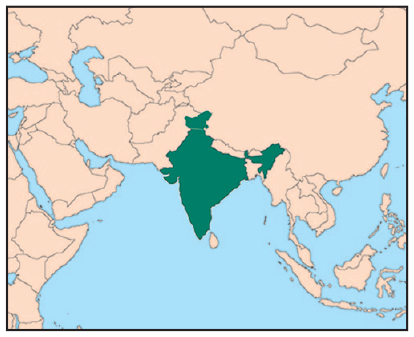
The focus of this case study is the resettlement site of Kannagi Nagar in Chennai, the capital of Tamil Nadu State in India. After the devastating 2004 tsunami and the 2015 flood, the Greater Chennai Corporation implemented several urban renewal projects, with the proclaimed aim of climate change adaptation, which included the eviction of informal settlement residents.(12) One highly controversial initiative was the resettlement of informal settlement dwellers from the Cooum and Adyar riverfronts to the flood-prone marshlands on the city outskirts. This resettlement area, Kannagi Nagar, is located in the Pallikaranai Marsh, around 15–20 kilometres’ south of the residents’ original residences.(13) The swamplands provide essential ecosystem services – collecting and storing water during the monsoon season, in turn minimizing the risk of flooding, and functioning as reservoirs during the dry season, feeding the groundwater table. However, reclaiming this land and building on those multifunctional nature sites made the whole city of Chennai more vulnerable to flooding and water scarcity,(14) with Kannagi Nagar households at still higher risk.
Kannagi Nagar is one of the largest resettlement sites in India and was built in a phased manner from 2000 onwards.(15) More than 15,000 tenements were constructed there by the Tamil Nadu Slum Clearance Board (TNCSB) and people were resettled there, especially after the 2004 tsunami and because of ecological river restoration projects.(16) The fact that the displaced communities were resettled from different places meant a decline in social connectedness and a sense of belonging.(17) The resettlement process disrupted communities and mixed people of different castes, religions and backgrounds in the same neighbourhood.(18) According to a survey of the Housing and Land Rights Network in 2014, almost 80 per cent of the relocated people lost their jobs immediately or dropped out of school because of distance and commuting time and costs.(19) Prejudices about workers from resettled areas kept them from finding new jobs in the city, and the resettlement sites did not offer enough opportunities and amenities.(20)
Social disarticulation is one of the many adverse impacts of the displacement process, manifesting itself in scattered social networks and ruptured patterns of trust and reciprocity.(21) As support networks, so necessary for coping with hazards, are destroyed, resettlement sites become especially vulnerable to hazards. In order for people to adapt to and cope with hazards, social capital is needed as well as financial and tangible assets.(22) The process of coping with disturbances and the ability to adapt to them, based on social assets, can be defined as community resilience,(23) which has been theorized to be a potential catalyser of climate change adaptation behaviour, especially in poorer communities with few alternative support mechanisms and resources.(24) This hypothesis is explored in the present research. The resettlement site of Kannagi Nagar was chosen as an ideal case study site because of its challenging circumstances and its particular combination of contextual, social and cognitive dynamics.
The objective of this study was to improve the understanding of the effects of community resilience and risk appraisal on climate change adaptation behaviour within this context. As briefly discussed above, the study builds on a growing body of literature. It draws especially on Grothmann and Patt’s(25) model of private proactive adaptation to climate change with respect to risk appraisal and adaptation appraisal, and on the empirical research of Thaker et al.(26) concerning collective efficacy in India. The key research question that this paper seeks to address is: How do community resilience and the risk appraisal of resettled households in Kannagi Nagar influence their climate change adaptation behaviour in the face of water scarcity and flooding?
The question was addressed by looking at households’ key climate change adaptation actions, specifically tackling flooding and water scarcity. The study asked which activities contributed to community resilience, how these activities were interrelated, and how community resilience and risk appraisal influenced household adaptation behaviour.
II. Background and Conceptual Framework
a. Adaptation to flooding and water scarcity
Climate change adaptation strategies in the context of flooding and water scarcity can vary by actor (i.e. individual, community, government agency) and in terms of effectiveness (i.e. maladaptation, no adaptation, coping, adaptation).(27) Behavioural changes within a short-term timeframe, which are reactive and implemented ad hoc, are defined as coping strategies. Positive coping strategies make use of available skills, resources and opportunities to improve the current situation and ensure survival.(28) Through incremental changes, social learning and feedback loops, coping strategies can transform into proactive adaptation strategies.(29) Adaptation behaviour is more anticipatory, with a long-term timeframe; it includes shifts in practices, adjustment to trends and increased resilience.(30) The least effective strategies are avoidant maladaptation and negative coping strategies, both of which lead to a decline in the level of resilience. Here the actors are motivated by short-term gains or opt for avoidant reactions like fatalism, denial and wishful thinking.(31) Maladaptive responses and negative coping strategies can be well-intentioned but have unsuspected, negative externalities. The no-response scenario implies keeping the current status from drifting into devastation, but without improving the capacity to adapt to future realities.(32) Decision-making about adaptation behaviour should be conceptualized as a process with iterations, feedback loops and continuous adjustments, and not as a linear sequence.
The various actors that apply a variable range of behaviours include individuals, households, communities and governments.(33) Individuals and households respond to personally relevant events in their vicinity, while communities aim to reduce collective risks, and governments focus on society as a whole.(34) This research focuses on the household level as a unit of analysis. Households’ coping and adaptation actions vary broadly, and a vast literature has explored behaviour tackling both flooding and water scarcity. Typical adaptation strategies in urban contexts include rainwater harvesting and ensuring properly functioning drainage systems.(35) Positive coping strategies include taking out loans from relatives and using barriers to protect from flooding.(36) Adaptation actions that households may take at the communal level include protests and the creation of women’s self-help groups, saving groups for collective investments and support groups that are related to disaster events.(37)
b. Risk appraisal and adaptation appraisal
Grothmann and Patt(38) postulate that relative risk perception is the starting point of climate change adaptation. Only after a risk is acknowledged, and adaptation effectiveness and efficacy considered, can a response behaviour be adopted. Risk appraisal is defined as the assessment of the probability and severity of a disruptive event.(39) Perceived probability refers to the expectation of being exposed to climate change impacts. Perceived severity is the assessment of the potential level of damage that has been brought about by climate change impacts. These assessments are relative to the perception of how severe and urgent other potential problems or challenges are.(40) Singh(41) adds that experience and memory have an influence on risk appraisal but can be affected by cognitive biases. Individual memories of past extreme weather events shape definitions and expectations of future climate risks.(42)
The motivational hypothesis, according to which people undertake precautionary measures to reduce risk,(43) has been criticized for a lack of empirical evidence.(44) While it is apparent that people need to be aware of a threat to react to it, risk appraisal is not a sufficient condition to trigger adaptation behaviour.(45) These findings are in line with Rogers’(46) protection motivation theory, which notes that a high perception of risk needs to be combined with adaptation appraisal in order to lead to a protective response.(47) Adaptation appraisal, as defined by Grothmann and Patt,(48) has three key elements. First there is perceived adaptation efficacy, which is defined as “the belief in adaptive actions or responses to be effective in protecting oneself or others from being harmed by the threat”. Second are perceived adaptation costs, which are “the assumed costs [e.g., monetary, personal, time, effort] of taking the adaptive response”. And third is perceived self-efficacy, that is: “a perceived ability to actually perform or carry out these adaptive responses”.(49) Self-efficacy, according to Bandura(50) and his social cognitive theory, is the primary driver of human behaviour and is essential to consider when exploring people’s differing responses to climate change.(51)
c. The cognitive approach to adaptation behaviour
Historically, adaptive behaviour has been measured by an asset-based approach, building on Scoones’(52) sustainable livelihood framework and Sen’s(53) capabilities theory. Tangible assets constitute the base on which people make decisions, but do not directly translate into adaptive actions. The important bottleneck for adaptation is the cognitive decision-making process, including risk and adaptation appraisal, which can be opaque.(54) A growing body of research from the last decade has established that cognitive factors are crucial to adaptive capacity assessments. The first and best-known theory is Rogers’ protection motivation theory.(55) More recently, Grothmann and Patt(56) developed the Model of Private Proactive Adaptation to Climate Change (MPPACC). As noted above, they postulate that relative risk perception is just the starting point for adaptation behaviour. Risk appraisal is seen by some scholars as a determinant of behaviour.(57) However, while it is clear that people need to be aware of a threat to be able to react to it, risk appraisal is not sufficient to trigger adaptation behaviour.(58) These results are in line with Rogers’ theory and are also reflected in the MPPACC framework, implying that a high perception of risk needs to be combined with adaptation appraisal in order to lead to a protective response.(59)
However, while Grothman and Patt(60) focus on individuals and their self-efficacy, other scholars – including Thaker,(61) Truelove et al.,(62) and Babcicky and Seebauer(63) – focus on the behaviour of the individual within the social context. Inspired by Grothmann and Patt’s(64) framework and building strongly on Bandura,(65) Thaker(66) identified collective efficacy as a community-based predictor of climate change adaptation behaviour, and emphasized that individuals and households do not depend only on their own competencies to cope with challenges and disasters. Rather, they organize themselves into support groups, associations or cooperatives and take collective actions to address common problems.(67) In collectivist cultures, the perception of how effective and resilient the whole community is together might be more accurate in predicting behaviour.(68)
It should be noted that the extent to which India can be characterized as having a collectivist culture is open to debate. Some scholars have emphasized that the mindsets and attitudes of the Indian population depend on the specific circumstances and that generalizations should be avoided.(69) Aldrich(70) argues, further, that the strength of social networks, trust and civic engagement are most decisive in the recovery processes, rather than the scale of the disaster or the amount of financial aid. Other scholars, including Paton and Johnston,(71) Paton et al.,(72) Leykin et al.,(73) Truelove et al.,(74) Faulkner et al.(75) and Rapaport et al.,(76) support the view that community resilience is crucial to disaster preparedness and a measure of the likelihood of successful adaptation strategies. In their framework, Truelove et al.(77) focus on perceived norms and community identification, which include attachment and trust. Babcicky and Seebauer(78) define collective efficacy as a combination of social capital and community efficacy. They conclude that, unlike social capital, collective efficacy affects self-efficacy. This body of literature was used as a starting point for this research, which aimed to use a more diverse set of dimensions related to community resilience as well as revealing its direct influence on adaptation behaviour at the household level.
Based on Magis,(79) Islam and Quek,(80) and Aldrich and Meyer,(81) this study has defined community resilience as a community’s ability to deal with and recover from stresses or disasters through cooperation and strong social cohesion, which reinforce networks of trust and support in times of need and uncertainty. Community resilience can be regarded as a set of interlinked social capacities that can be assembled by community members in various combinations depending on the specific context.(82) This variability makes community resilience a dynamic, emergent and socially nuanced process.(83) Based on Kulig et al.,(84) Norris et al.,(85) Cohen at al.(86) and Faulkner et al.,(87) six social capacity dimensions were selected, namely: visionary leadership, social network, social support, trust, place attachment and collective efficacy. It should however be noted that resilience is a complex construct with multiple interlinked dimensions that pertain to the individual, household and community levels. As a result, any attempt to measure it empirically, no matter how sophisticated, will unavoidably be reductive – a limitation that also applies to this study. Thus, our discrete dimensions may not have fully captured the conceptual complexity and systemic interlinkages that are characteristics of resilience.
Visionary leadership
Faulkner et al.(88) highlighted that leadership is only understood as being supportive of the community’s self-organization and resilience when it is legitimized from within the community. Leadership needs to be generated in response to “community needs rather than formally conferred on people outside of the community”.(89) Fabricius et al.(90) and Stewart et al.(91) underline that good leadership requires the bottom-up establishment of trust between leaders and communities as well as the establishment of trust between community members. Visionary leaders drive advancement in their communities, mobilize social networks, organize towards a shared vision, improve community cohesion and enable self-organization.(92)
Social networks
Social networks are the building blocks of communities and encompass bonding, linking and bridging ties between community members.(93) Although some scholars have defined these linkages as social capital,(94) this research follows Lin’s(95) argument that social capital is not the linkage but the resource that can be accessed based on the strength of those linkages, and that bonding, linking and bridging ties can be considered as social networks. These are defined as networks of societal actors that promote coordination and cooperation to achieve a mutual benefit.(96) Social networks can be measured based on the quality and quantity of ties, as well as membership in organizations and other social groups.(97)
Social support
Another key dimension of community resilience is social support, defined in the words of Norris et al. as “social interactions that provide individuals with actual assistance and embed them into a web of social relationships perceived to be loving, caring, and readily available in times of need”.(98) “Received” social support reflects actual help that is given and is judged most positively when reciprocal.(99) “Perceived” social support is defined by Norris et al. as “the belief that help would be available if needed”,(100) and it positively influences responses to stressors and disasters.(101)
Trust
Trust strengthens relationships and fosters a free exchange of resources.(102) Cacioppo et al.(103) define trust as “the belief that others can be relied upon and the willingness to act on the assumption of the other’s benevolence”. Trust emerges with group homogeneity and a shared history, and from frequent interactions within close-knit networks. The definition of trust used in this research is also based upon World Bank conceptualizations,(104) the conjoint community resiliency assessment measure (CCRAM)(105) and the World Values Survey.(106)
Place attachment
Place attachment can be defined as the emotional, cognitive and economic ties and roots that people have to specific places.(107) If place attachment is high, people care more about their surroundings, plan for extreme events and are more motivated to act on climate change.(108) However, place attachment can also lead to people staying in a place regardless of high risks, for example, of flooding.(109) Murphy et al.(110) and Leykin et al.(111) measure place attachment by analysing residents’ pride in the place (home), their place identity and their place dependence.
Collective efficacy
Community resilience also encompasses the psychological concept of collective efficacy, largely derived from Bandura’s(112) social cognitive theory. The concept originates from self-efficacy, the belief in one’s capacity to successfully manage a task. The understanding that collective efficacy is the aggregated version or the average of community members’ self-efficacy(113) has been recently revised, as it ignores the group’s aspects of coordination and interaction.(114) Based on Bandura,(115) there are four sources of self- and collective efficacy beliefs, namely vicarious experience, persuasive effects, physiological effects and mastery experiences. According to Bandura,(116) people in communities with a higher perception of their collective efficacy are able to manage shared resources more efficiently, are more likely to participate in collective actions, and endure setbacks better. Analysing how people judge their groups’ collective capability to solve problems offers a strong foundation for understanding group achievements.(117)
Against this background, the case study was based on the following framework, which shows how community resilience and its key dimensions influence climate change adaptation behaviour at the household level in conjunction with risk appraisal (Figure 1). The latent variable of community resilience, which is not directly observable, was measured through the six dimensions mentioned above. Risk appraisal, also a latent variable, was measured in terms of three dimensions: perceived probability of flooding and drought, perceived severity of flooding and drought, and degree of change of risk perception. The exogenous latent variables of community resilience and risk appraisal were postulated to influence climate change adaptation behaviour, the endogenous variable that was measured by considering the implemented adaptation actions to deal with flooding and water scarcity. The detailed operationalization of the variables is presented in Annex 1 (in the supplementary information available online).
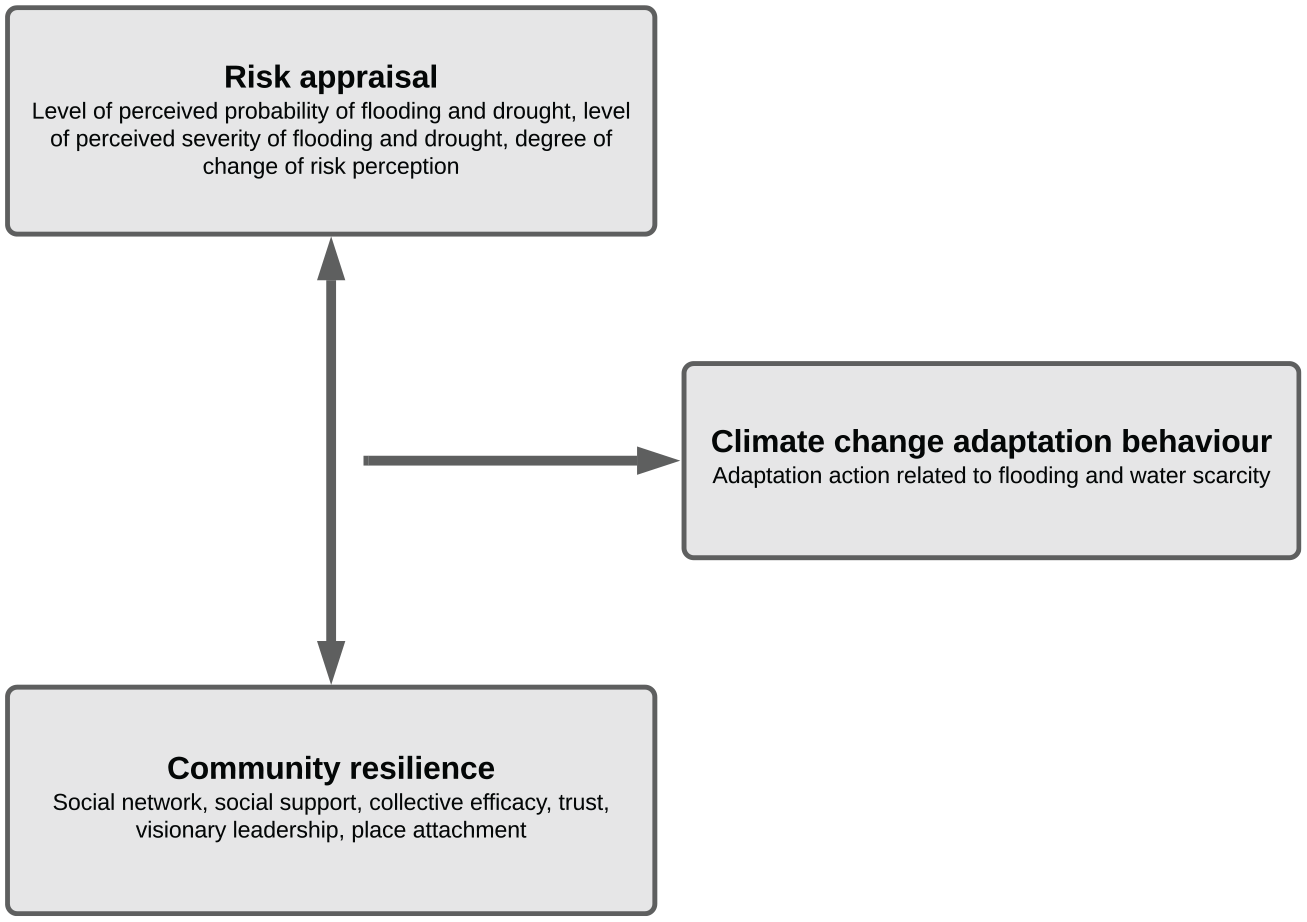
Conceptual framework of socio-cognitive climate change adaptation
III. Methodology
The research applied socio-cognitive theories to the analysis of households’ behaviour related to adaptation in Kannagi Nagar. This settlement, selected for its challenges, is located on the Pallikaranai Marsh, which as noted above provides essential ecosystem services.(118) Urbanization and resettlements of the informally housed have led to degradation of natural drainage systems and amplified flood risks, which are exacerbated by poorly managed sewage, drainage and flood management systems.(119) Climate change has further intensified these dynamics.(120) The increasing demand from Chennai’s growing population has also led to a drop in groundwater levels and the drying out of local rainfed reservoirs,(121) and water scarcity is also a pressing concern in Kannagi Nagar.
A mixed-method approach was used to collect primary data, consisting of a household survey with 150 respondents and additional in-depth interviews with 10 key informants. A random sampling method was used, with households as the unit of analysis. The data were collected in July 2019 with the help of a trained translator, who translated from and to Tamil.
Of the 150 respondents, 63 per cent were women and 37 per cent were men. Men tended to be at work outside of the resettlement site and were more difficult to access. The men who were interviewed were mostly unemployed or dependent on day labour. As a limitation of the study, it should be noted that the gender imbalance may have affected the assessment of the level of community resilience. The age distribution was balanced, with between 20 per cent and 27 per cent of respondents per age group. The education level was low overall but varied: 15 per cent of respondents had finished only primary school, a third had finished lower secondary school, and 18 per cent had finished higher secondary school. Sixteen per cent had no formal education at all, and fewer than 10 per cent had an undergraduate or a postgraduate degree. The residents had been evicted from several different areas in Chennai, mostly from Mylapore, Reserve Bank and Santhome. All the residents came from areas that were highly affected by the 2004 tsunami. This explains why most respondents had been living in Kannagi Nagar for more than 15 years (>65 per cent), as they had been resettled after the tsunami or even before that. Twenty per cent had been resettled or moved to Kannagi Nagar earlier than 10 years ago.
The survey, answered by adult household members, preferably the household head or their spouse, consisted of 44 questions, primarily based on a 1–5 Likert scale. A pilot study with three households allowed for improved wording and intelligibility of the questions.
The conceptual framework and its variables were operationalized into measurable indicators (see Annex 1 in the online supplement). Survey questions were clustered around four key dimensions: 1) demographic control variables; 2) risk appraisal; 3) adaptation behaviour; and 4) community resilience. Adaptation behaviour was the dependent variable, and the independent variables were risk appraisal and the latent variable of community resilience, with its six sub-variables: visionary leadership, social network, trust, social support, place attachment and collective efficacy. Control variables were used to test the effect of demographics, specifically on the relationship between community resilience and adaptation behaviour. The selection of the dependent and independent variables was guided by the theoretical framework.
To ensure a deeper understanding of the underlying motivations and influences of the respondents and to provide a more nuanced interpretation of the phenomena under investigation, 10 additional qualitative in-depth interviews were implemented. Eight were carried out with residents of Kannagi Nagar, selected for demographic diversity. Two were arranged with key informants.(122) Although the study heavily relied on the quantitative survey data, the interviews provided additional insights and validated the quantitative analysis.
The quantitative data were analysed through structural equation modelling (SEM) using IBM Amos software.(123) To compute the variables, three types of analysis were conducted in parallel: exploratory factor analysis (EFA), confirmatory factor analysis (CFA) and Cronbach’s alpha test. The EFA was run in order to group the indicators based on their strong correlations, without applying an a priori theory. This helped to adjust the theoretical framework to the actual correlations, and created a base for SEM analysis. Also, a Cronbach’s alpha reliability analysis was carried out to test the compatibility of the indicators and prove they measured the variable in a consistent way. Confirmatory factor analysis was conducted in Amos to validate the adjusted variables within the structural equation model.
The maximum likelihood (ML) estimation was used to estimate the model parameters.
IV. Findings
Climate change adaptation behaviour has been categorized into actions tackling flooding, water scarcity, and general livelihood strategies. The most frequent adaptation and coping actions in Kannagi Nagar in response to flooding were found to be: first, storing valuables in safe places; second, reading and listening to information about the immediate risk of flooding; and third, supporting community demands for better waste management to diminish clogging. Common adaptation actions addressing water scarcity were reportedly wasting less water and encouraging others to do the same, buying water bottles and storing water in tanks.
Typical positive livelihood strategies included participating in community meetings, action groups and chit funds,(124) while prevalent maladaptive responses included getting loans from moneylenders. Additional actions mentioned by respondents included distributing food, keeping the drains clean, attending swimming courses, renovating the roads and raising the entrance to the house. Households dealt with a range of challenges that were more urgent than a probable future flood. Adaptation to water scarcity was classed as a priority. Chennai faced a severe drought during the fieldwork period, and adequate adaptation behaviour was thus considered pressing and was more visible: “I am using less water, we don’t waste water anymore and store it for a whole week” (interview 2). As soon as a disaster hits, the people of Kannagi Nagar employ strategies to adapt and are in general confident that they will be able to cope.
Above in the methods section, the model used for analysis is described. Most importantly for the analysis below, the model showed the causal relationships between community resilience and its dimensions, as well as among community resilience, risk appraisal and adaptation behaviour. The goodness of fit statistics can be found in Annex 2 (online supplement), and confirm that the model adequately fits the empirical data. Table 1 illustrates the standardized regression weights between all the latent variables in the model, together with their significance levels. This is an essential piece of information to understand not only the extent to which community resilience can be measured by the identified dimensions of a social network – social support, trust, place attachment, collective efficacy and visionary leadership – but also the effects that community resilience and risk appraisal have on adaptation behaviour. The findings are discussed in detail below.
Standardized regression weight and significance levels
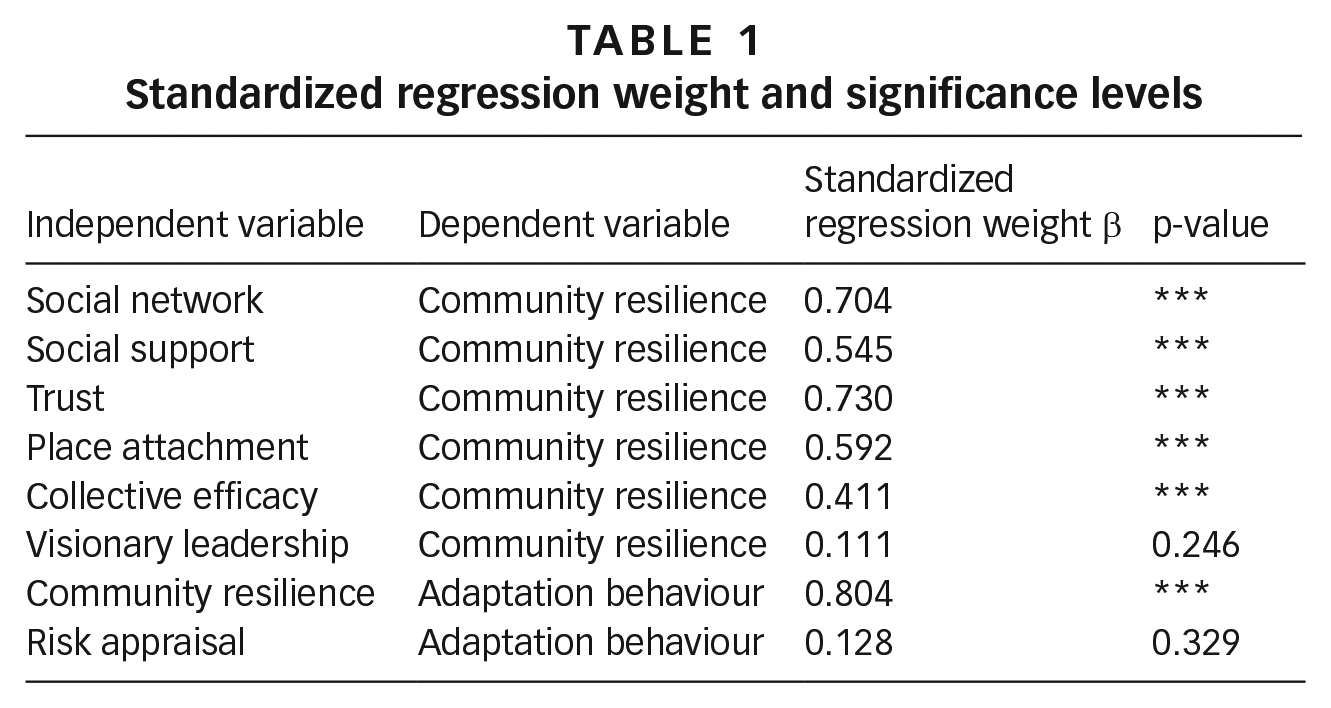
Five of the six parameters had a positive effect on the latent variable, community resilience. The effects of trust (β=0.730***), social network (β=0.704***) and place attachment (β=0.592***) were the highest, followed by social support (β=0.545***) and collective efficacy (β=0.411***). Only visionary leadership had no significant effect (β=0.111 and p>0.1.) The dependent variable, adaptation behaviour, was significantly and positively influenced by community resilience (β=0.804***). This finding supports the notion that community resilience has a strong positive effect on climate change adaptation actions taken by the households of Kannagi Nagar. Besides the confidence in the efficacy of the community and the support networks, the emotional investment in an area plays a crucial role in building adaptive capacity. Community resilience and risk appraisal, in combination, influence adaptation behaviour positively. It should however be noted that risk appraisal alone had no significant relationship with adaptation behaviour (β=0.128, p>0.1). The important implication is that focusing on creating awareness of potential climate change risks will have no clear effect on adaptation actions unless community resilience is strengthened.
These findings confirm earlier observations and theories in the climate change adaptation and cognitive science fields and allow the researcher to derive further insights that add to the existing literature. The following paragraphs discuss the results, which cover adaptation action, targeted at flooding and water scarcity, and the roles of community resilience, visionary leadership, and risk appraisal.
One of the main findings of this research is the significant positive relationship between community resilience and adaptation behaviour. This influence was also highlighted by the residents of Kannagi Nagar: “I learned that the community has to help each other to overcome emergencies” (Interview 3) and “As a single family we can’t survive: we have to work together” (interview 5). Both quantitative and qualitative data showed that a resilient community with strong social assets is essential to successfully cope with negative extreme weather events. Social networks, social support, trust, place attachment and collective efficacy emerged as reliable predictors of community resilience, while visionary leadership had no influence. There was also no evidence of a correlation between visionary leadership and any of the other parameters of community resilience; nor did the variable have a significant relationship with climate change adaptation behaviour.
A possible explanation of the lack of influence of visionary leadership might be that respondents perceived community leaders mainly as service providers rather than enablers of households’ adaptive capacity. The respondents waited for community leaders and government to take action to ensure better livelihoods for them, instead of feeling empowered to act themselves and push for change. This lack of agency could be connected to the forced resettlement and the belief of many residents that now the government was responsible for taking care of them. The top-down, service-provider view of leaders casts them as an external influence rather than inherent to the community. This might explain why the factor of visionary leadership seems disconnected, an independent variable with no effect on the community’s internal resilience or civic engagement.
The correlation between the five other interdependent factors, however, reflects how resilient communities are created. Building social networks of trust and support within families and between neighbours and the bigger community then fuels the attachment to the place itself, in turn intensifying the feeling of collective efficacy. This self-reinforcing cycle is reflected in the statements of two residents. One interviewee, who has a strong and broad support system, said that she felt: “[. . .] closest to the people who live next to me, especially my neighbours. My neighbours will help if needed, they are like family for me. But also, to the people who have been resettled with me.” She participates in communal actions like petitions because she believes: “Everybody is powerful, for example we got the bus to Kannagi Nagar through a petition of the community.” Another interviewee also felt a strong sense of community and collective efficacy: “I am the closest to the people of my area, we are really very close, and we help each other. My street is like my family. I am confident that the community will work together.”
However, other interviewees explained that they were unable to support one another. One believed that people are closest to their own families and some do not feel a sense of community: “People in the community mind their own business and only take care of themselves, not other families. In emergency situations we only help our own family, they need to be safe.” Economic reasons were also mentioned by another interviewee, who explained: “Everybody lives in poverty here, that’s why we can’t help each other.” These statements reflect the strength of competing concerns and the everyday economic struggles of local households, and point to how the lack of a trusting, supportive network can decrease the belief in the power of acting together to adapt to hazards. In summary, these qualitative examples and the analysed quantitative data show that the correlated five factors especially, combined as community resilience, are crucial for the people in Kannagi Nagar in successfully adapting to climate change impacts.
Two further significant findings are based on the quantitative data and supported by the qualitative interviews. The first is that risk appraisal had no significant statistical effect on climate change adaptation behaviour, with a non-significant beta-value of 0.128 in the structural equation model. This suggests that, while people need to be informed about a possible risk to respond to it, the knowledge does not directly lead to enhanced climate change adaptation actions in a resettlement colony. Although all the interviewees seemed concerned about the water crisis and the possibility of flooding in the area, their civic engagement and adaptation behaviour was not predictable based on their knowledge.
The second finding is that, while risk appraisal alone had no influence, it intensified the positive relationship between the community resilience and climate change adaptation behaviour. Thus, in combination with community resilience, risk appraisal becomes effective towards adaptation. This means that if residents have a trusting, broad support system and feel capable of achieving change as a community, they are more likely to take action rather than settling for denial, fatalism or wishful thinking. This finding is illustrated by one interviewee, who was informed about the risks and also seemed to have the support within his community to take tangible action: “I am confident that the community will work together, because we have been living together already for many years. I do worry about climate change, but I don’t know what to expect. But I helped to collect the clothes here in Kannagi Nagar. Lots of people donated clothes. Also, in our 2015 flooding I helped distributing clothes.” In sum, the results of the research on risk appraisal indicate that only if residents feel part of a resilient community, does their awareness of the urgency and severity of risks lead to better adaptation to climate change.
The main relationship within the theoretical framework from community resilience towards climate change adaptation behaviour was tested to see whether it influenced the 13 selected demographic control variables. Possible interpretations of the quantitative data are as follows: length of time since resettlement, unemployment and illness of household members are the strongest positively influential control variables. This might be explained by the fact that if people live for a long time in a community, the importance they place on that community increases and becomes more influential. Also, when more members of a household are unemployed, they might be more strongly intertwined with the community because they have more spare time and have a greater need for support. The strongest negative effects on the relationship between community resilience and adaptation behaviour are related to age, number of household members and level of income. An interpretation could be that older people especially, but also households with more members or a high income, did not need to depend as much on the larger community to adapt to hazards. Richer households can probably better help themselves with their financial assets, and larger households might get more support from their family networks. This also holds true for the elderly, who might depend more on their closest family than on the whole neighbourhood. Thus, the positive effect of a resilient community becomes weaker. No influence was found on the relationship between community resilience and adaptation behaviour from the variables of gender, reason for relocation, caste, marital status, number of children, number of floors or education level.
V. Discussion
After Thaker et al. claimed a positive relationship between collective efficacy and adaptation to water scarcity within a context similar to this study, they flagged the need for “future research on other critical variables such as values, cultural orientations, and social capital to test the relative importance of collective efficacy and values in enhancing adaptive capacity”.(125) Also, Babcicky and Seebauer(126) argued for the necessity of including social capital as a key explanatory variable in the field of flood adaptation. This was the starting point for this research, which aimed to understand the role of the broader concept of community resilience towards climate change adaptation behaviour, theoretically and empirically. Based on the findings of Grothmann and Patt,(127) Lo et al.,(128) Thaker et al.,(129) and Babcicky and Seebauer,(130) this study posed the hypothesis that community resilience, in combination with risk appraisal, positively influences climate change adaptation behaviour.
Regarding the key household climate change adaptation actions, storing valuables in safe places was generally reported as the most frequent in the context of flooding, while the most common in response to water scarcity was to waste less water. Participating in community meetings stands out as the typical positive livelihood strategy on the part of residents. In conclusion, the results illustrate that Kannagi Nagar households were only moderately able to prepare for negative climate change effects, probably due to competing current concerns. This is in line with Grothmann and Patt,(131) who argue that risk judgements are relative to the individual’s assessment of the severity and urgency of their other problems or challenges. Also, Linville and Fischer(132) point out that humans have a limited capacity for worry and that an urgent current concern will decrease worry about other issues, especially those in the future. Further, the results show that actions tackling flooding especially are of a short-term nature, which suggests a resigned acceptance of living with the constant risk posed by nearby marshlands.
Six parameters of community resilience were identified: visionary leadership, social network, social support, trust, place attachment and collective efficacy. This is a combination of factors drawn from work by Norris et al.,(133) Cohen et al.(134) and Faulkner et al.,(135) who theorized and tested for their interconnectedness. This study confirms that in the context of Kannagi Nagar, five of these six factors are strongly correlated and have significant parameters of community resilience. The findings are in line with Samuel et al.,(136) who theorizes, based on Ajzen,(137) Bandura(138) and Sampson,(139) that collective efficacy leads to collective action. They explain how resilient communities are built: social networks of trust and support within families, the neighbourhood and the bigger community, which are also reflected in the attachment to the place, intensify the feeling of collective efficacy and, in combination, create a high community resilience.
However, this study has been unable to demonstrate that visionary leadership is significant to community resilience, as pointed out by Fabricius et al.,(140) Leykin et al.,(141) Evans(142) and Faulkner et al.(143) A possible explanation for this inconsistency is that in Kannagi Nagar, leaders are understood primarily to be service providers rather than enablers. A top-down leadership style makes the leader an external influence rather than an internal community asset that mobilizes the social networks and enables self-organization to elevate resilience. A strong positive influence was established between community resilience in Kannagi Nagar and households’ adaptation behaviour. This result showed that efficacy alone does not make the difference, as researched by Grothmann and Patt(144) and Thaker et al.(145) Nor does social capital, as explored by Lo et al.(146) and Babcicky and Seebauer.(147) Rather, it is the combination of the two, and the broader concept of community resilience, that has a strong positive effect on climate change adaptation actions. Confidence in the power and effectiveness of the community, the trusted networks, the provided help and the emotional investment into an area all play a crucial role.
This study aligns with Long and Perkins,(148) Wickes et al.(149) and Collins et al.,(150) who outline this relationship for civic engagement in general. Paton and Johnston,(151) Pelling and High,(152) and Cinner et al.(153) theorize the positive influence of community resilience, as a combination of social capital and collective efficacy, on climate change adaptation behaviour, but do not test the hypothesis empirically. Risk appraisal had no significant influence here on household adaptation behaviour, which reflects the current risk perception literature and is in line with findings from Bubeck et al.,(154) Lo et al.(155) and Truelove et al.(156) The results show that although a basic awareness of the existence of the risk is obviously needed, it does not act as a reliable indicator for implemented adaptation action. Many people believe that with more knowledge, more action will be taken.(157) In communicating climate risks in practice, this implies that simply spreading knowledge of the risk will not facilitate the adoption of the appropriate behaviour.(158)
VI. Conclusions
This paper has addressed how community resilience and risk appraisal among resettled households in Kannagi Nagar in Chennai, India, influence their climate change adaptation behaviour in addressing water scarcity and flooding. It concludes that community resilience has a strong positive effect on the actions taken by Kannagi Nagar households. However, risk appraisal alone has no significant effect on adaptation behaviour. This suggests that rather than just raising risk awareness, the crucial focus should be building resilient, trusting communities that are well connected, able to help themselves and to believe in themselves and their power to make a difference. Based on the results of this research, community building should be strongly considered in future-oriented, sustainable urban development policies regarding resettlement.
Generally speaking, the study’s findings underline the adversity facing resettled communities and support Cernea’s(159) postulation that social disarticulation has severe negative effects on the livelihoods of the affected households. Especially in times of climate crisis, the negative consequences of fragmented informal networks are intensified, as social capital and confidence in the community’s power are what people especially depend upon to take adaptive action, as determined by this research in the case study site of Kannagi Nagar. Instead of feeling enabled to help themselves, in the context of social disarticulation, evicted citizens become even more dependent on outside help. These findings, based on one very specific case, cannot be generalized.
Further research is needed to investigate the interplay between community resilience and risk appraisal in different local communities. Other factors should also be included in the analysis, such as values and culture. From a methodological point of view, considering that resilience as a construct is relevant from the individual to community levels, multilevel models with parameters that vary depending on the level may generate significant insights. The potential benefits of these lines of research for vulnerable communities exposed to climate risk are tangible.
Supplemental Material
sj-pdf-1-eau-10.1177_0956247821993391 – Supplemental material for The roles of community resilience and risk appraisal in climate change adaptation: the experience of the Kannagi Nagar resettlement in Chennai
Supplemental material, sj-pdf-1-eau-10.1177_0956247821993391 for The roles of community resilience and risk appraisal in climate change adaptation: the experience of the Kannagi Nagar resettlement in Chennai by Sarah Haas, Alberto Gianoli and Maartje Van Eerd in Environment & Urbanization
Footnotes
Supplemental Material
Supplemental material for this article is available online.
2.
10.
12.
14.
16.
28.
29.
33.
Singh (2018);  .
.
37.
42.
Singh (2018); .
45.
51.
54.
68.
70.
Aldrich (2010).
76.
Rapaport et al. (2018).
82.
94.
99.
108.
109.
117.
119.
Jain et al. (2017); CNN (2019); Revi (2008); .
120.
IPCC (2012); .
122.
These key informants were Vanessa Peter, a policy researcher at the Information and Resource Centre for the Deprived Urban Communities in Chennai, and Karen Coelho, an associate professor at the Madras Institute of Development Studies, also in Chennai.
123.
The use of SEM is particularly advantageous to model relationships between unobserved constructs (latent variables) and observable variables. SEM is a very flexible approach based on a system of regression equations that can model complex interactions between variables. Further information can be found for example in Byrne (2016) and .
124.
Chit funds are local savings and rotating schemes that, in the context of this study, were organized informally amongst family, friends and neighbours. They provide for relatively easy access to small amounts of money and represent a very important livelihood strategy for low-income households.
126.
Babcicky and Seebauer (2017).
130.
Babcicky and Seebauer (2017, 2019a, ).
147.
Babcicky and Seebauer (2017).
157.
References
Supplementary Material
Please find the following supplemental material available below.
For Open Access articles published under a Creative Commons License, all supplemental material carries the same license as the article it is associated with.
For non-Open Access articles published, all supplemental material carries a non-exclusive license, and permission requests for re-use of supplemental material or any part of supplemental material shall be sent directly to the copyright owner as specified in the copyright notice associated with the article.
