




Abstract
Citizen participation in the planning and decision-making process in the European post-socialist context is much debated. Still, the involvement of excluded communities in the urban planning process remains understudied. This paper presents and discusses the application of an innovative participatory approach designed to ensure active involvement of an excluded ethnic minority, the Roma community, in the process of formulating and adopting land-use plans for informal settlements in Serbia. By analysing the development of land-use plans in 11 municipalities, we observe that the applied participatory approach enhanced the inhabitants’ active participation and helped build consensus on the planned solution between the key actors. Findings also suggested that further work with citizens, capacity building of planners and administration, and secured financial mechanisms are needed to move citizen participation in urban planning beyond the limited statutory requirements.
Keywords
I. Introduction
A central tenet of urban planning for informal settlements is, in the words of Lasker and Guidry, giving people “who have been excluded from decision making an influential voice about issues that affect their lives“.(1) But how is this objective realized in the practice of planning informal settlements in European post-socialist contexts?(2) There is a growing body of literature critically examining stakeholders’ participation in urban planning in the former socialist states.(3) There is also wide scholarly discussion of the regularization of informal settlements in Eastern Europe and the Balkans, and the issues surrounding it.(4) However, few studies deal with the involvement of low-income and marginalized groups in developing urban plans for existing informal settlements in these regions. In this paper, we present and discuss the application of an innovative approach designed to ensure the active and effective participation of an excluded ethnic minority, the Roma people, in the process of formulating and adopting land-use plans for informal settlements in Serbia.
The Roma are Europe’s largest ethnic minority facing exclusion, discrimination and an unequal access to vital services. As a result, their quality of life lags far behind the average among the majority population.(5) According to an estimate of the Council of Europe, the total number of Roma in Europe lies somewhere between 10 and 12 million, with the majority living in Eastern Europe.(6) In the Balkan countries, they account for 3–10 per cent of the population and many still live in informal settlements. Inadequate access to drinking water and sanitation, poor housing quality, overcrowding, illegal construction and insecure tenure are the hallmarks of most of these settlements.(7) Although Roma settlements have traditionally been part of many cities, their numbers have grown. Berescu indicates that the post-socialist period has seen “an extraordinary increase in size and numbers of Roma ghettos in Central and Eastern Europe”.(8)
The socioeconomic position and living conditions of the Roma have been on the margins of public interest for decades. Over the past 20 years, the Council of Europe and the European Union have encouraged member states and other countries in the region to systematically address the problems of their Roma communities, in order to overcome this gap and improve their life chances and living conditions.(9) While numerous policy documents pledge to improve overall living conditions for the Roma, their implementation is still inconsistent in responding to the whole set of problems, including material deprivation, extremely poor housing conditions and ethnic segregation.(10) The Organization for Security and Co-operation in Europe has endorsed the principle “for Roma with Roma”, meaning that each policy and implementation strategy affecting the Roma should maximize their ownership and be elaborated and implemented with the active involvement of Roma communities.(11) According to this principle, as far as housing and living conditions are concerned, Roma should be involved in designing and implementing housing policies and planning strategies intended to benefit them. How can the active and meaningful participation of Roma be achieved in developing neighbourhood urban plans that directly affect them?
This paper deals with the participation of low-income and marginalized Roma groups in the development of urban plans that directly affect their lives in post-socialist Serbia. Serbia is an interesting context for study, given both its significant Roma population and an accumulated experience in developing urban plans for informal settlements inhabited by this marginalized ethnic minority. This paper documents and analyses the participatory approach designed and applied between 2018 and 2020 to develop and adopt land-use plans for Roma settlements in 11 municipalities,(12) within the programme “EU Support to Roma Inclusion – Strengthening Local Communities towards Roma Inclusion”.(13) We were directly involved in designing an innovative participatory approach and its implementation within this programme.(14)
Section II of this paper presents a brief contextual overview of issues associated with the participation of excluded social groups. Section III introduces the context of public involvement within the Serbian planning system and its impact on Roma settlements. Section IV explains the innovative participatory approach, along with providing brief information on the 11 municipalities and Roma settlements covered by the process. In Section V, we present the implementation of this approach in developing and adopting urban plans for the Roma settlements. Section VI discusses the findings, taking into consideration the concrete impacts, limitations and benefits of applying the designed participatory approach in these settlements.
II. Participatory Urban Planning and Excluded Social Groups: Contextual Overview
Participatory planning is considered to be critically important for effective communication, shared responsibility, conflict resolution, power sharing, partnership, transparency and empowerment.(15) The engagement of citizens or communities may also contribute to improving urban governance and ensuring more resilient responses to complex urban problems.(16) A participatory approach is considered by UN-Habitat to be a powerful instrument for enhancing the involvement and influence of different stakeholders in the planning process, rather than simply establishing a goal to be attained.(17)
Public participation in urban planning is affected by the planning task, the nature of the planning environment and the decision-making system in which it takes place.(18) The involvement of stakeholders in urban planning has a long history and the concept has been refined in theory and practice. It emerged in the 1960s, and became a decisive principle in the communicative planning theories that subsequently emerged during the 1980s and 1990s. Nowadays, it encompasses various approaches and degrees of involvement, from the sharing of information to actual participation in decision making.
Although participation is generally considered important and necessary, in practice, it may often be only consultative or instrumental, providing participants with little real influence over decision making. Some studies indicate that public involvement in land-use planning has remained low.(19) There are also concerns that the currently accepted planning process in most places encourages various actors to participate, but with little or no consideration for their individual socioeconomic background, needs and expectations. Yet, as Mahjabeen et al., among others, have highlighted, “the voices of the traditionally voiceless groups (e.g. the poor and minorities) are critical for plans to succeed in terms of achieving equity, efficiency and sustainability”.(20) Achieving meaningful participation requires some preconditions relating to the legal basis for participation, a planning context and available resources.(21) Nevertheless, the statutory possibility for excluded citizens to take part in planning procedures does not always mean a real and practical opportunity to exercise this right, as they might lack experience or the capacity to articulate their needs, proposals and requests and to contribute to the process.(22) Scholars also draw attention to the challenges faced by administration, urban planners and practitioners in terms of their knowledge, and the methods and procedures they use to increase and secure active citizen engagement in the planning process.(23)
III. Urban Planning, Participation and Roma Settlements in Serbia
a. Public involvement in urban planning in Serbia
Urban planning in Serbia during the 20th century was marked by various types, forms and degrees of public involvement.(24) Public involvement in the planning process and its influence on the outcomes of the plan was particularly endorsed during the 1970s and 1980s in the context of self-management socialism and a decentralized planning system, which was significantly different from the context in other socialist countries in Eastern Europe.(25) The notable level of citizen participation was suspended and lost with the disintegration of Yugoslavia and the prolonged post-socialist transition in Serbia in the 1990s. The transition in the economic sector was also reflected in changes in the legislation and institutional frameworks related to urban planning. In the midst of profound socioeconomic and geopolitical changes, informal settlements of all forms and qualities – from poor housing, through middle-income neighbourhoods, to illegally built luxury villas – emerged and grew.(26) The current practice of the land-use planning of informal Roma settlements and the participation of the marginalized Roma community in developing neighbourhood plans is embedded in this setting.
The Serbian Law on Planning and Construction regulates the system of urban planning, and defines the content of the plan and the adoption procedure, as well as the requisite public involvement in the process.(27) It defines the minimum requirements for citizens’ participation in urban planning, involving the exhibition of the plan for public comment in the early and final phases of plan production, but it says little about how these comments should be addressed. It also presumes that citizens will be ready, willing and able to take part and make constructive proposals that may eventually “influence planning solutions”, in a specific context and at specific decision-making points. The legal instrument of the “early public hearing”, providing an opportunity to citizens to express their opinion on an urban issue in an early phase of plan making, was adopted in 2014, but it is still not implemented properly. Citizens are not equal participants in the planning debate and some scholars see their engagement as unstructured and spontaneous.(28)
Under the circumstances, participatory planning remains a significant challenge, and the traditional concept of the urban plan as a technical document developed from the planning office persists, as in some other post-socialist urban contexts.(29) These challenges to the realization of participatory practice are reflected in the formulation of urban plans covering informal Roma settlements.(30) In many cases, the involvement of the affected Roma community is even lower than the statutory minimum requires. A negative consequence of this Roma exclusion is the adoption of plans for commercial zones, green areas or infrastructure facilities in the sites of the existing Roma settlements, rather than the provision of a basis for their legalization and upgrading.
b. Roma settlements and urban planning
Roma account for 2–4 per cent of the total population of Serbia.(31) In 2015, about 580 settlements inhabited by Roma were mapped in the country, including their exact location and basic information on their physical characteristics and housing conditions (the quality of housing units, the existence of urban plans, the state of infrastructure, etc.). The data were systematized in a geographic information system (GIS).(32) According to this source, about half of the mapped Roma settlements in Serbia were covered by spatial and urban plans. The survey of these settlements did not provide data regarding their legal status and housing; nor did it yield information on the compatibility of planned land use and other planning parameters with the existing structures in Roma settlements. It is noteworthy that most Roma settlements in Serbia have fewer than 500 inhabitants, which means that they are much smaller in terms of size and population than their counterparts in neighbouring countries, including Romania, Bulgaria and North Macedonia. Accordingly, the implementation of measures intended to improve the living conditions of Roma populations should be easier in Serbia.
The urban planning of informal Roma settlements has long been marginalized in Serbia, indicating social exclusion, discrimination and a general lack of recognition of the specific vulnerability of this group.(33) Alongside this formal exclusion, there have been small-scale endeavours, jointly initiated by the residents of Roma settlements, activist groups and professional urban planners, which have shown that a participatory approach in developing urban plans is critical to further sustainable improvement of informal Roma settlements.(34)
Recent national policy documents on Roma inclusion in Serbia have embraced urban plans as an instrument for the legalization of an informal Roma settlement as an entity,(35) while the legalization of individual houses is stipulated by the Law on Building Legalization, which applies to any illegally built structure.(36) The new national Strategy for Social Inclusion of Roma lays down the objective of developing urban plans for at least 50 per cent of Roma settlements (around 300 settlements) by 2025, seeking to regularize and improve them.(37) Over the past 10 years, about 30 such land-use plans for Roma settlements were developed and adopted by various municipalities with extensive financial and technical support by donors and international organizations. Plans were mostly driven by professional planners and without sufficient involvement of the affected Roma in the planning process. The lack of knowledge on the part of urban planners and decision makers, and the lack of methodological guidance from supporting organizations, also affected the extent and quality of citizen involvement in the planning process. These circumstances made it clear that an innovative approach was needed to foster the participation of the inhabitants of informal Roma settlements throughout the planning process and to safeguard their interests. Therefore, we designed a new methodological approach to participatory urban planning with informal Roma settlements and applied it to urban plan development in 11 municipalities in Serbia.(38) This methodological approach and its implementation are the focus of this paper.
IV. Framing the Participatory Planning Approach
The process documented here consisted of several related segments that took place between September 2018 and January 2020. The first step was the selection of municipalities and their Roma settlements for which urban plans needed to be formulated. Along with this was the design of an innovative procedure for involving the inhabitants of Roma settlements in the process of formulating and adopting urban plans. The next step included the organization of training for municipal officials and urban planners with a focus on explaining the designed model. The final segment was the implementation of the participatory model in developing and adopting plans for 11 selected Roma settlements in 11 municipalities in Serbia. The analysis and interpretation of results are based on field notes, internal reports and official municipal reports, and our direct involvement in and observation of the process.
a. Selection of municipalities and Roma settlements
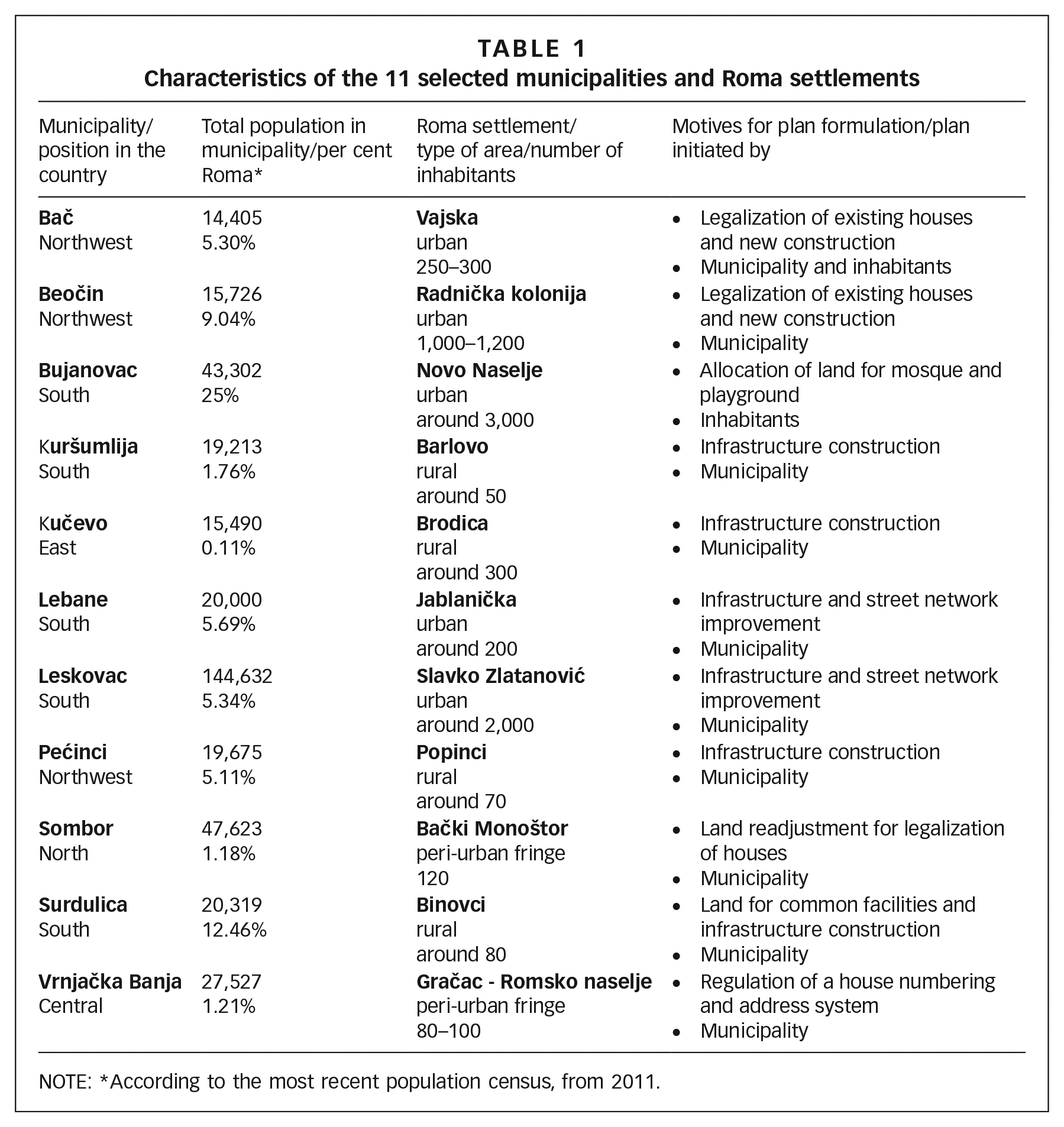
As part of the programme “EU Support to Roma Inclusion – Strengthening Local Communities towards Roma Inclusion”, municipalities were selected, along with Roma settlements for which urban plans had been developed.(39) Out of 23 municipalities that applied to a public call announced by the implementing agency, the Standing Conference of Towns and Municipalities (SCTM), 11 municipalities from different parts of the country were selected, and one Roma settlement within each. The following requirements were taken into consideration in the selection process: the municipalities had to meet the technical criteria and be ready to co-fund the development of the plan. The selected municipalities were mostly located in northwest and southeast Serbia and were marked by various levels of economic development and planning traditions (Table 1). The municipalities in the north were among the most developed and had a much longer tradition of urban planning. Furthermore, the municipalities had different experiences regarding the implementation of programmes aimed at improving Roma settlements. In two municipalities (Leskovac and Sombor), this was a continuation of previous activities, also carried out as part of donor programmes.
Characteristics of the 11 selected municipalities and Roma settlements
NOTE: *According to the most recent population census, from 2011.
The Roma settlements for which plans were developed were selected by the municipalities. They varied in size – the smallest had about 50 and the largest up to 3,000 inhabitants, while the majority of settlements had between 100 and 300 inhabitants (Table 1). Five settlements, including the largest three, were located within the urban fabric (Photo 1), four in rural areas (Photo 2) and two in the peri-urban fringe. Settlements consisted of low houses with one to several home units on small plots. Although they are often described as traditional, it is noteworthy that Roma communities in Serbia, as elsewhere, are not homogeneous. The Roma in the discussed municipalities had different cultural backgrounds (religion, language, etc.); in the north, Roman Catholics prevailed, whereas in the south, they were mostly Muslim and Orthodox, a difference that was reflected in the formats of involvement.
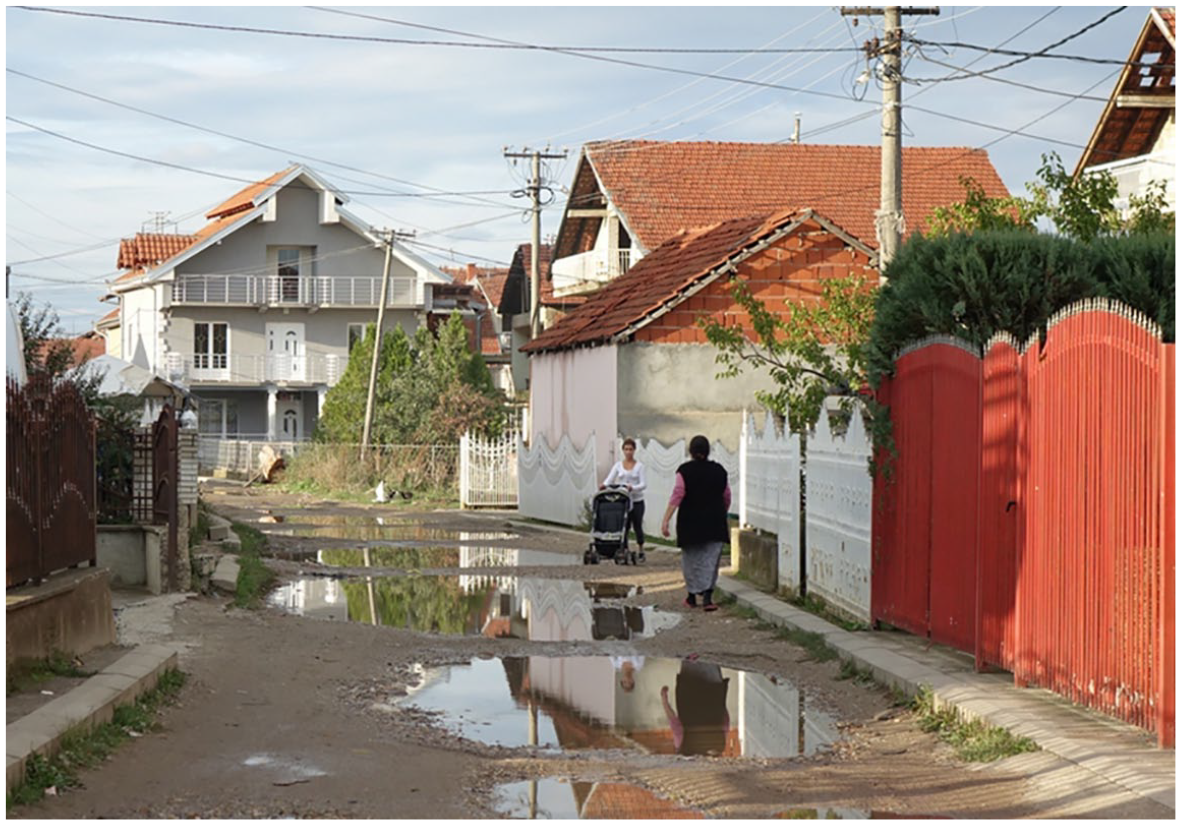
The Roma settlement Slavko Zlatanović in Leskovac
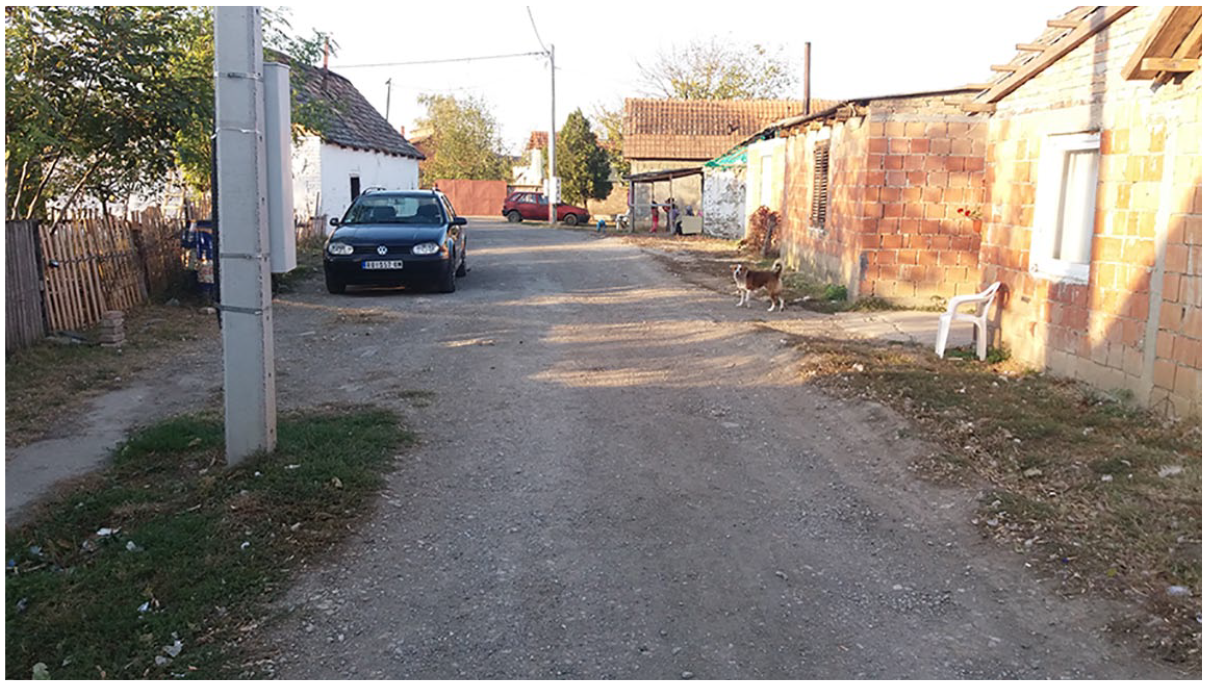
A Roma settlement in the municipality of Pećinci
b. The concept of the novel participatory approach
Along with selecting municipalities and Roma settlements, the concept of a novel participatory approach was developed. In designing this approach, we started from the prevalent understanding that the sustainable improvement of social and living conditions in informal settlements can best be achieved by ensuring citizens’ active participation in formulating, adopting and implementing plans and projects that affect their lives.(40) We also relied on national experts’ experience and our own extensive professional experience in working with Roma communities, advocacy planning, and formulating urban plans in numerous municipalities in Serbia.(41) The approach was created to be flexible, providing guidance for implementing a process and allowing for modifications of the path and tools used.(42) The concept of the formulated participatory approach is described below and its key elements are shown in Figure 1.
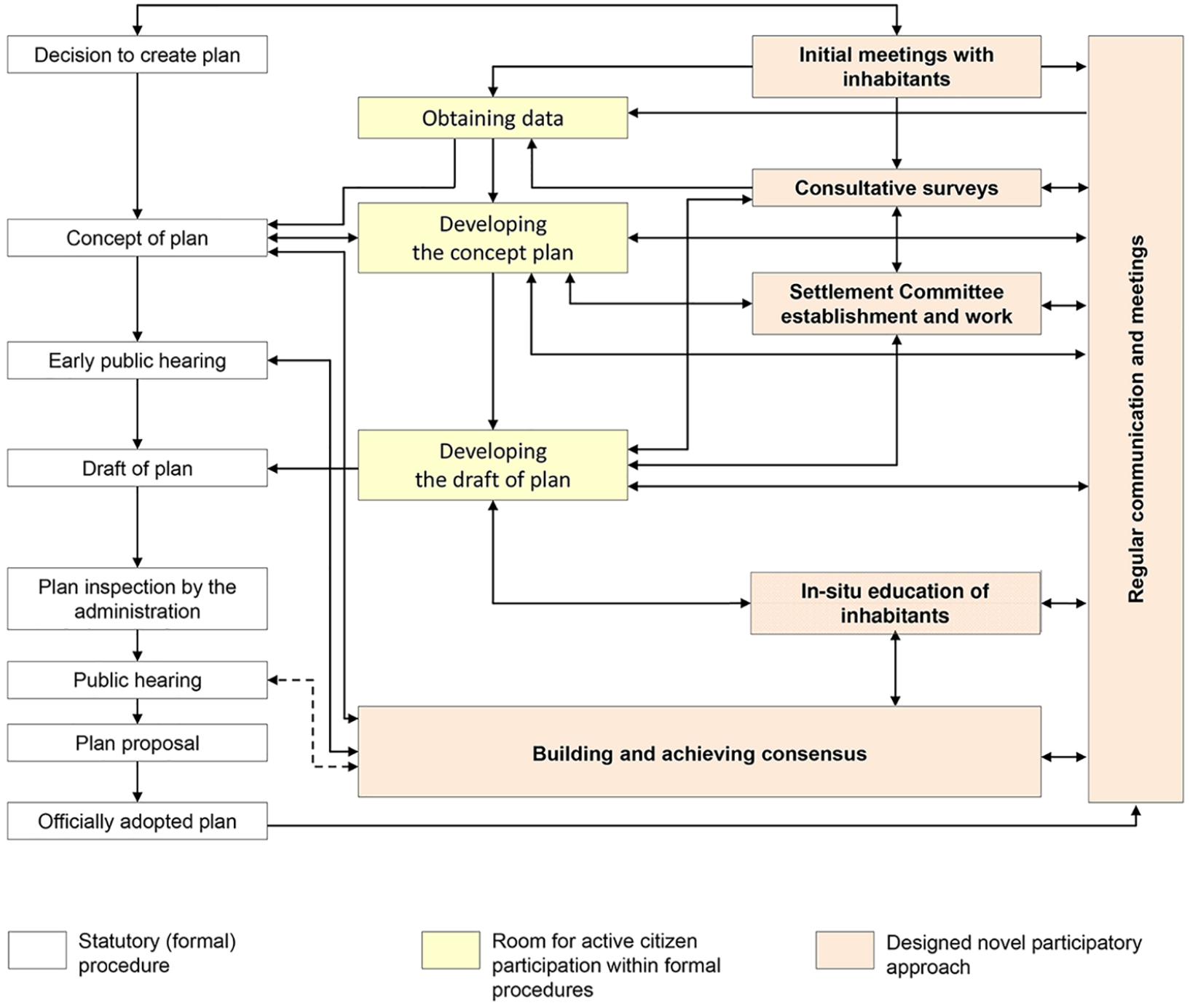
Scheme of a novel participatory approach
Initial consultations with inhabitants
The initial phase of preparing for the decision to develop the urban plan involves the municipality’s organization of kick-off meetings and consultations among the inhabitants of the settlement, municipal officials and planners. This allows inhabitants to influence some important elements of the decision, such as the scope and boundaries of the plan and the issues to be addressed. Initial communications and visits to the settlements by municipal officers and planners make it possible to encourage inhabitants’ timely involvement, explaining the importance, possible outcomes, and personal and community benefits of direct involvement in the entire process. This is also an opportunity for urban planners and municipal officers to get better acquainted with the citizens and the settlement conditions.
Consultation surveys
The development of each urban plan requires appropriate data about the population and the features of the area to be covered by the plan. Data for informal Roma settlements are often missing from official statistics. Accordingly, household and community surveys may be used to make up for the deficit and provide necessary information.(43) Depending on the type of survey, it can provide insight into the social and economic status of the inhabitants, their housing situation, and their needs and desires regarding the future development of the settlement. The survey may also be used for involving traditionally unrepresented groups, particularly women. Following past practice, planners may develop and conduct a survey jointly with some representatives of the settlement or activists from local organizations.(44)
Establishment and operation of the Settlement Committee
Inhabitants may form a Settlement Committee as a liaison body throughout the planning process and to influence the outcomes of the plan. The Settlement Committee members are usually elected from among the existing non-formal community leaders. It is important to ensure representation of men and women, as well as of different groups (youth, different religions, etc.), among the members of the Settlement Committee.(45) The establishment of a Settlement Committee is especially useful for larger communities, where the permanent direct participation of all inhabitants is logistically difficult to ensure, and where it is reasonable to make a shift to a representation model. Furthermore, it is necessary to ensure that the entire community is informed of all decisions made by the Settlement Committee and agrees with them. This occasionally may require a fluid approach to participation, involving both representative and direct participation.(46)
Regular meetings with inhabitants
Urban planners, together with municipal officers and the Settlement Committee, may organize regular meetings with the inhabitants of the settlements throughout the process of drafting and adopting their plans. In accordance with established practice, regular communication and meetings with inhabitants, at least once a week, establish the role of all participants in the process, and provide opportunities for true interactions. Meetings with all residents, although difficult to organize and coordinate, offer to the inhabitants an optimal opportunity to get directly involved in the urban planning process. Direct communication may also include door-to-door conversations. Extensive communication and regular meetings provide an opportunity for professionals to explain to the inhabitants the complex technical elements of the plan, as well as to understand and accept the demands, attitudes, needs and desires of inhabitants and to incorporate them into the urban plan. Another purpose of regular meetings is to provide inhabitants with feedback on how their suggestions are being included in the urban plan.
In-situ education of inhabitants
The objective is to empower citizens to actively take part from the very beginning of the plan development process through to its adoption. The inhabitants can be encouraged to draw a map reflecting their current situation and the planned interventions. Various techniques may be employed, including working meetings, consultations, interviews, surveys, drawings, and public presentations of scale or 3D models, all of which contribute to the involvement of the inhabitants. Urban planners can design various scenarios and options to be discussed with settlement inhabitants, including drawings of various proposals for the street network layout, especially if there is a real need to reconstruct the existing street matrix and thus to adjust the abutting parcels; proposals for defining public spaces and their uses; and proposals for parcelling.
Building consensus
One of the most important results of a participatory process is consensus building among all actors and shared ownership of the final solution.(47) Therefore, it is necessary that all decisions concerning the development and adoption of the plan be made with the participation and consent of the inhabitants of the settlements, relying on democratic principles. Regular meetings of urban planners, representatives of municipal services and administration with the inhabitants of the settlements and the Settlement Committee, as well as constant information exchange and consultations, helps to ensure that the planned interventions would be acceptable for the inhabitants who would be directly affected and benefitted by them. An important item in the process of reaching a consensus is the consent documents signed by settlement inhabitants or members of the Settlement Committees, confirming harmonized and agreed planning solutions, i.e. their consent on the plan concept and draft.
c. Training for planners and municipal officers
Training for municipal officers and planners was an early activity of the programme, organized prior to developing urban plans in selected municipalities. It was necessary to improve their knowledge and capacity because they were important actors in the process of developing plans for informal Roma settlements. Training on Roma settlement issues and especially on a participatory approach in the urban planning of informal Roma settlements was organized for all of them. A joint workshop detailing the methodological procedure and including visits to and interviews with the inhabitants of Roma settlements was attended by 23 representatives of the 11 municipalities. An evaluation carried out during the workshop indicated a low level of knowledge among planners and municipal officers about the problems of Roma settlements and especially about participatory planning. Moreover, half of those involved in the training had never visited a Roma settlement before. In order to prevent possible shortcomings in plan development, the obligation of municipal and planning services to cooperate with the inhabitants of Roma settlements throughout the process was highlighted as an integral part of the terms of reference for plan development. The mandatory elements of the participatory process to be implemented were also specified. In addition, professional support to planners by the SCTM was intensified, just like the monitoring of the entire process.
V. The Implementation of the Participatory Approach and the Outcomes of the Process
The key actors involved in the process of developing urban plans were the municipality and its service providers, professional planners designing the plan and the inhabitants of the Roma settlements (including the newly established Settlement Committees). A specific role was assigned to Roma coordinators, i.e. to members of the Roma minority employed in the municipal administration, responsible for providing support to municipal authorities in the implementation of Roma inclusion policies and programmes, as well as for communication and mediation between the Roma community and the local administration. In addition, the role of representatives from the implementing agency (SCTM) was crucial in providing professional support to municipalities and their planners, monitoring the entire process, and evaluating accomplishments and results.
a. Results and analysis of the participatory planning process in the 11 municipalities (2018–2020)
Apart from making a plan and improving the conditions in Roma settlements, the motivation of the municipalities was also associated with the expected benefits in terms of solutions to other general problems (the basis for expropriation, expansion of the street network, infrastructure construction, etc.). A particularly important motive for plan preparation was the development of a formal house numbering and address system, enabling the inhabitants to obtain personal documents indicating the residence address, because illegal settlements do not exist in the address register.(48)
Only one of the 11 plans was directly initiated by Roma, in a settlement in the municipality of Bujanovac. In addition to the regularization of their settlement, the local Roma community wanted to ensure that land be allocated for a children’s playground and for the construction of a mosque. In the municipality of Bacˇ, the plan was a joint initiative of the settlement residents and the municipality. Here the plan was seen as an instrument for the legalization of existing houses, the construction of new buildings, and the extension of the existing ones.
Each municipality hired a licensed urban planning company to develop a plan for its selected Roma settlement. The methodology for participatory planning, with specified mandatory and desirable elements, was part of the terms of reference. The mandatory elements included: a) establishing a Settlement Committee in large settlements; b) organizing a kick-off meeting in the settlement; c) organizing at least three joint workshops with all inhabitants during the process of plan development; d) reaching consensus between the actors – Roma and municipalities – regarding solutions; and e) verifying the consensus.
The initial consultation meetings among municipal officers, urban planners and the inhabitants of Roma settlements were held in all 11 settlements. Needs and expectations were discussed with the inhabitants and recorded in a separate annex, which formed an integral part of the official decision on plan development and was adopted by the Municipal Assembly.(49) The content of this document was flexible, in that it allowed the inhabitants of the Roma settlements to determine three priorities by voting during a dedicated workshop. This was the basis for defining the focus of the planning intervention. The dominant topics prioritized by the settlements concerned the right to legalize homes, the formation and layout of a street and stormwater networks, and the construction of public facilities for the needs of Roma associations, children’s activities and festivities. The SCTM instigated the organization of kick-off meetings with the inhabitants of Roma settlements. The initial communication with the residents was largely determined by the pre-existing attitudes of local authorities to the problems and needs in the settlement, whether this was supportive or based in ignorance.
Although data were missing, urban planners did not use surveys to collect additional information, because this was not a mandatory element of the process; rather they relied on existing, limited, data or estimates. It was only in one settlement, in the municipality of Sombor, that urban planners conducted a very detailed survey over several days and collected precise data on each family, house and plot. The urban planners also used the survey in Sombor as a platform for establishing communication with the inhabitants and building the mutual trust needed for reaching a consensus on plot readjustment, which was one of the objectives of the plan development. Regarding this, the positive attitudes and extremely high motivation of planners to work jointly with the Roma community were important to develop a robust and functional urban plan.
Settlement Committees were established in the four settlements with the largest populations, in the municipalities of Bacˇ, Bujanovac, Leskovac and Vrnjacˇka Banja. An official decision to establish the committee was made only by the municipality of Leskovac. In this case, along with the size of the community (over 2,000 inhabitants), the fact that plan development was a continuation of previous activities undertaken by municipal authorities in the Roma settlement, and that the inhabitants had previous experience of community representation, played a role in making such a decision. This was the only Settlement Committee with a woman as a member. In the other three cases the committee members were informal community leaders. The Settlement Committee also had the role of facilitator between the inhabitants and urban planners in consultation meetings. Urban planners identified the Settlement Committee as a source of missing information and data. The Settlement Committee was involved in discussions and formal and informal meetings. However, the solutions were checked and decisions confirmed with the involvement of the whole community.
Regular meetings with the inhabitants of Roma settlements were organized in all municipalities. A total of 33 workshops were held, and they were attended by a total of 1,117 residents from the 11 settlements. Most workshops were organized within the settlement, either outdoors or in shared facilities, if available. The key role in facilitating the process was played by the SCTM. According to the terms of reference of the agreement, urban planners were required to have three large meetings, in the form of consultation workshops involving the entire community. The organization of these three mandatory workshops was related to the legal phases in plan development: the preparation of materials for an early public hearing, then the preparation of a preliminary draft plan, and the drafting of the plan. Apart from these mandatory workshops required by the terms of reference, meetings and talks among urban planners, municipal officers and the inhabitants of Roma settlements were organized in only two municipalities. In one municipality only (Sombor), a significant step forward was made, when urban planners had individual meetings, one-on-one, from house to house, with all the inhabitants of the settlement.(50)
Consultation workshops were the key moments through which consensus on planning solutions was built and reached (Photo 3). The first consultation workshop was held during the process of preparing materials for the early public hearing. It provided the setting for the most heated debate, resulting in major interventions in the initial solution presented by planners, and the most fervent conflicts. After the preliminary draft of the plan had been prepared, in which urban planners included the requests and suggestions of the inhabitants of Roma settlements, a second meeting was organized. A detailed planning solution for the settlement was presented and individual cases related to houses, plots, access streets, etc. were explained. Then, the included solutions were checked and additional harmonization was made. At this stage of plan preparation, most residents of Roma settlements were satisfied with the solution. What mattered most to the residents was that their personal interests be taken into account, which usually meant that a particular house would not be demolished, that it would be legalized, that it would be possible to connect it to a water supply system and to ensure the access to the street, etc. There was also a high interest in solutions affecting the entire community, such as the provision of space for the construction of a mosque and a playground for children in Bujanovac or, in most settlements, resolving land ownership issues, as for instance in Bacˇ and Sombor. The third mandatory meeting, organized when urban planners had drafted the plan, was used for the final harmonization of any remaining minor issues.
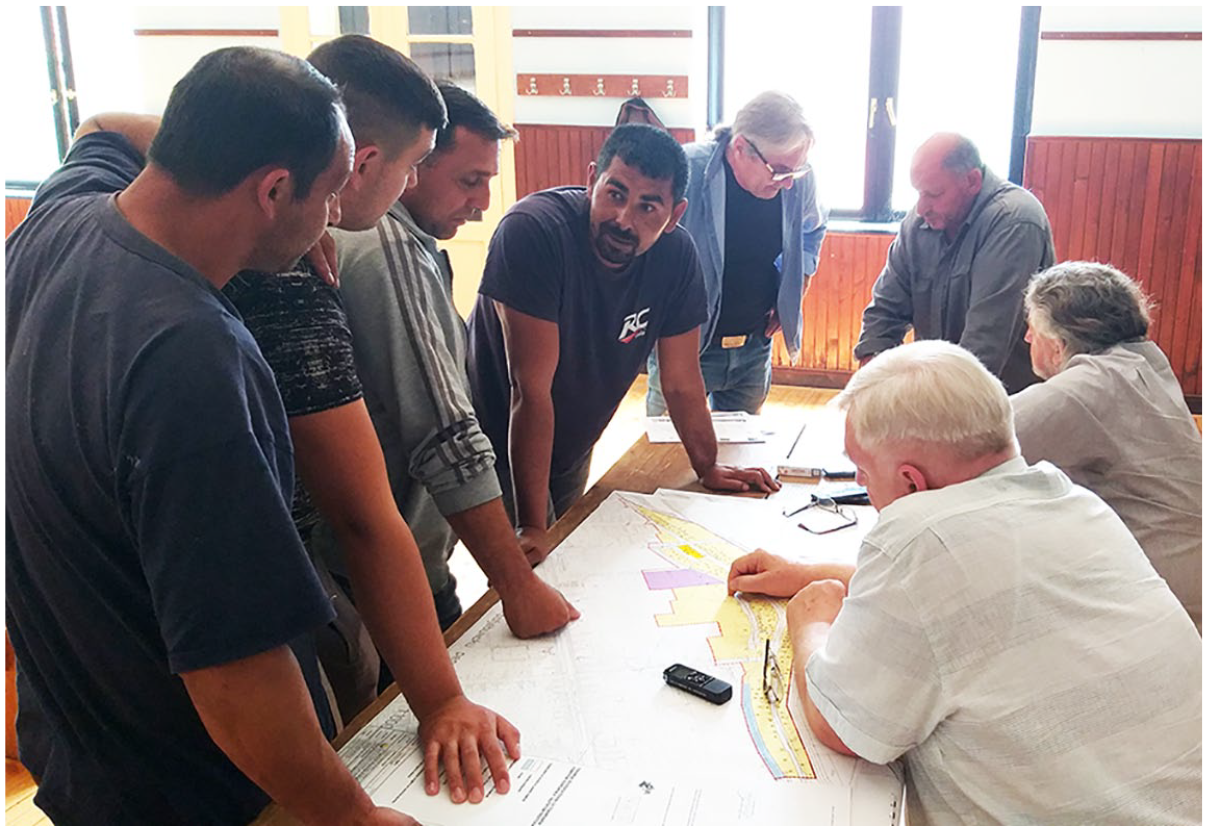
Discussion between the Settlement Committee and planners in the municipality of Bacˇ, Vajska settlement
The Settlement Committee, where it existed, played a significant role as a facilitator between the Roma inhabitants and the urban planners. In Bujanovac, a member of the Settlement Committee took over the role of translator into the Romani language, but he also provided explanations of the technical terminology, predominantly used by urban planners, adjusted to the knowledge of community members (Photo 4). In the settlements where a Settlement Committee was not established, the role of local Roma coordinators, who were municipal officers, was especially important in facilitating the discussion among residents, urban planners and municipal officers.
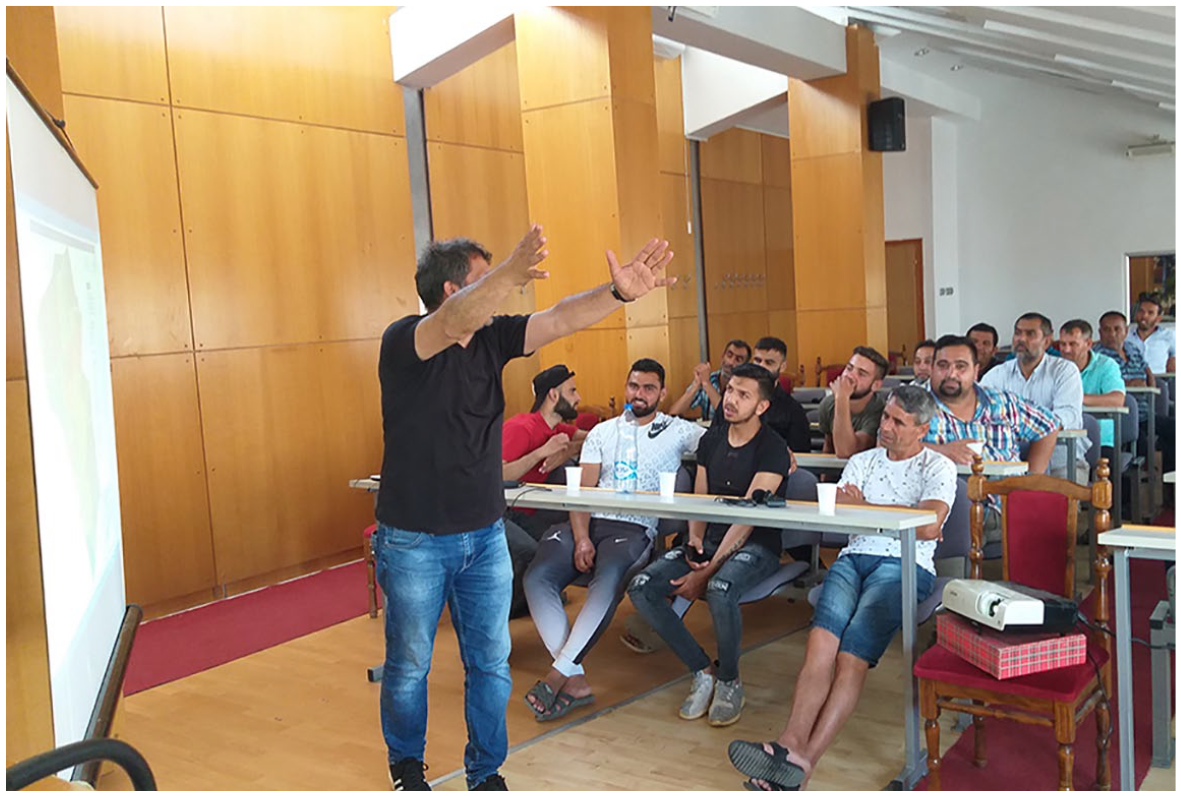
An informal leader explains in the Romani language the draft plan to inhabitants of Roma settlement in Bujanovac
The consensus reached in the course of the process was predominantly verified by an oral agreement between the inhabitants of the Roma settlements and the urban planners. For the residents, the promise of the urban planners was a valid warrant that everything that had been agreed and included in the plan would be officially adopted. Written consent to the negotiated solution was used only in one municipality, Sombor, where the representatives of all 37 households signed the proposal for a new parcelling plan (Map 1). In accordance with the procedure stipulated by the law, all 11 urban plans were adopted by municipal assemblies.
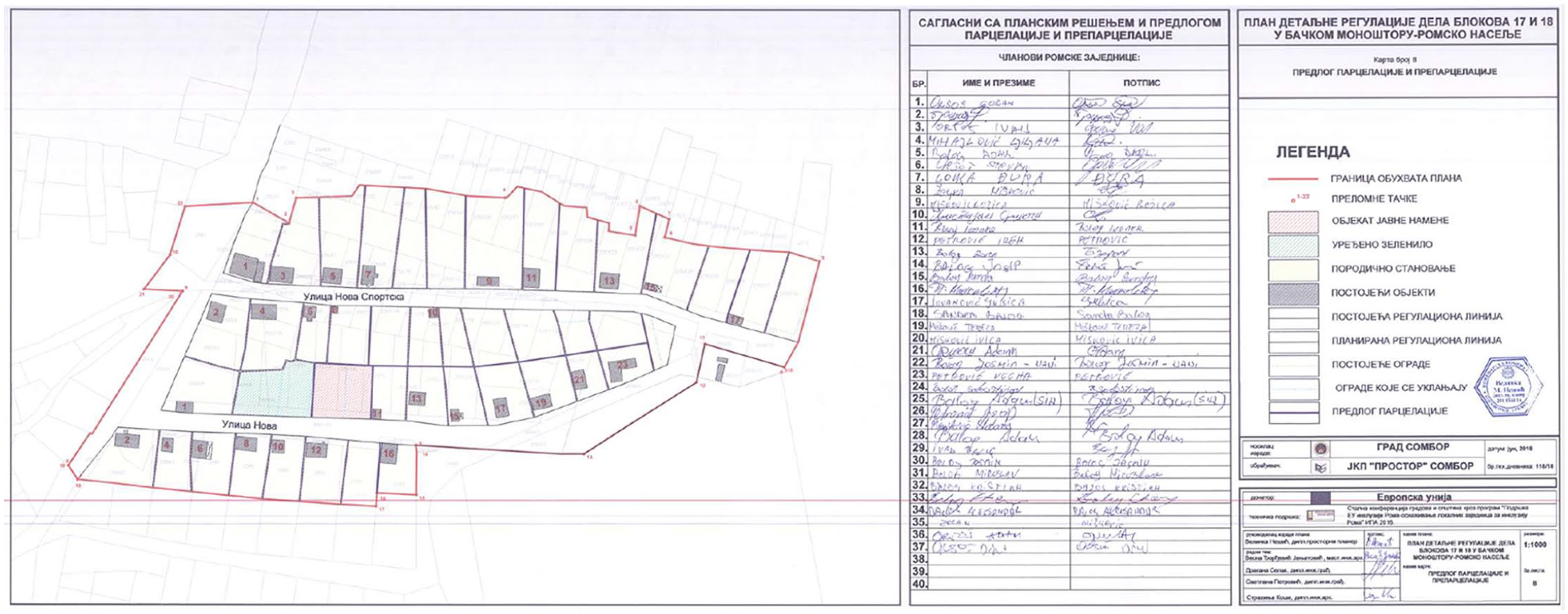
Signatures of all households’ representatives on the negotiated land parcelling and readjustment in Sombor
VI. Discussion and Concluding Remarks
As in some other post-socialist countries, the urban planning system in Serbia still does not adequately recognize the role of citizen participation in the planning process, and the legal requirements for citizen engagement are very rudimentary. In such an environment, creating opportunities for the involvement of marginalized groups in the development and adoption of urban plans that directly affect their lives is a large challenge. This especially applies to the inhabitants of informal Roma settlements, whose level of involvement in the urban planning process has been extremely low, despite the affirmative national Roma inclusion policies and extensive technical support by donors.
This paper documents the implementation of an innovative participatory approach in developing and adopting urban plans in 11 informal Roma settlements in various municipalities in Serbia, and evaluates its success. The application of this approach enabled different types of involvement (informative, consultative, active or decision-making) of the inhabitants of Roma settlements in the development and adoption of urban plans that directly affected them. It also supported cooperation among residents, urban planners, municipal officers and decision makers, to build and reach a consensus on the planned solution, resulting in its acceptance by the inhabitants of Roma settlements and the adoption of the plan by municipal assemblies. The formulation and adoption of a participatory urban plan are understood here as an initial step in further developing informal Roma settlements and addressing other housing problems and inclusion challenges faced by Roma in everyday lives. After the plan’s adoption, some of the sample municipalities and residents initiated action on plan implementation, for instance, through the legalization of houses in Sombor, Bacˇ and Bujanovac, the construction of a water and sewerage network in Lebane, the arrangement of public space (sports terrain) and the paving of streets in the Roma settlement in Leskovac.
Through the application of this innovative participatory approach, we observed several factors of importance for active citizen involvement in the process of drafting and adopting an urban plan. Continuous communication and regular meetings of the key actors – residents, urban planners and municipal officers – throughout the urban planning process were crucial to achieving the meaningful participation of the inhabitants of Roma settlements. In this regard, the residents of all the settlements were involved to some degree from the beginning of the planning process. They were part of the plan as it evolved and actually influenced the planned solution through participation.
On the other hand, municipalities, as the bodies responsible for organizing the consultation process with citizens, often lacked the capacity and political will to adequately respond to this task. The implementing agency (SCTM) played a key role in this regard, mediating among the municipality, urban planners and the inhabitants of Roma settlements and advocating for the interests of all parties. In addition, the constant monitoring of the process carried out by the SCTM was helpful in ensuring that the participatory approach was fundamentally applied in the development of all plans.
Although most initiatives in Serbia addressing Roma inclusion measures have been funded by donors (including the EU, which widely promotes participatory governance), these same donors do not impose as a condition the involvement of the Roma who are final beneficiaries in the planning and implementation of those initiatives. In addition, the application of the participatory approach depends upon the capacities and competencies of the implementing agencies to promote the principles of citizens’ participation in the project they are realizing. This suggests the need to incorporate the involvement of the final beneficiaries, i.e. the residents of the Roma settlements, into the agendas of donor and implementing agency programmes and, further, into the agreements and the terms of reference for municipalities and urban planning companies. More generally, it would be a very welcome feature of all donors’ initiatives, if they were to introduce a mandatory and measurable level of participation of Roma in all plans and projects that concern them.
As is more generally the case in these situations, the propensity of the inhabitants of Roma settlements to participate in the process of drafting the land-use plan was usually motivated by personal interests, related to their individual houses and plots. The readiness of residents to participate was also determined by their relationships with local authorities. In settlements where the needs of the residents had been ignored by either past or current administrations, a high degree of dissatisfaction and concern hindered an active involvement in the process, requiring additional mediation by the SCTM between the municipality and the Roma. On the other hand, if the development of the plan was a continuation of previous activities in which the municipality and residents participated, then the majority of the settlement inhabitants tended to be involved in the process. A high degree of motivation was present in cases where Roma communities had requested the development of an urban plan before this initiative. It was also observed that where the community had clearly articulated shared interests and goals to be achieved through an urban plan, e.g. in Bacˇ, Bujanovac and Sombor, the involvement of the residents was high.
The degree and mode of participation of the inhabitants of the Roma settlements was also influenced by the attitudes of the urban planners who worked on the plans. As we observed, if there were professional enthusiasm and empathy, urban planners fostered interaction with residents, raised new issues and sought jointly acceptable ways to solve problems. During discussions and consultations, some urban planners adjusted the technical language to make it more accessible to the Roma inhabitants. On the other hand, most urban planner teams failed to use this opportunity to apply some of the alternative tools on offer for reaching consensus, such as suggesting different solutions, or offering residents the chance to draw a map of the settlement or of the planned solution. In Sombor, the only case where urban planners used a household survey, it proved to be a powerful instrument for motivating residents to take an active part in the process, and especially for building trust. This was so because the survey was conducted in the intimate space of households, and not in an official office. One of the reasons for not carrying out surveys more widely was the poor motivation of urban planners to bring this added value to plan development and to carry out activities that are recommended but not mandatory according to the agreed terms of reference. To overcome the poor motivation of urban planners to more fully apply the participatory model, tailored training programmes are needed, as well as the engagement of professional mediators during the formulation of the plan to support more efficient communication between planners and inhabitants.
In the four larger Roma settlements where they were established, the Settlement Committees played an important role in facilitating cooperation between urban planners and residents. Here, the requests and needs of residents and communities were more adequately taken into consideration and incorporated into the adopted planning solutions. The members of the Settlement Committees mobilized and motivated residents to participate in consultative workshops. They also catalysed the participation of less articulate actors – sometimes acting, for instance, as translators from Serbian into Romani. The role of Roma coordinators who were employed by the municipality was also important. As municipal employees, responsible for matters related to Roma inclusion, they mediated between the municipality and the inhabitants of the settlements, and were much appreciated by the community. Their role as mediators in planning initiatives is welcome and should be further promoted.
The verification of the negotiated consensus on the planned solutions was adjusted in each case to the local milieu. In almost all cases, the verification consisted of the verbal consent of all persons present. Only in one case, that of Sombor, was the decision actually signed by representatives of all households in the settlement, reflecting the preferred approach here to respecting an agreement. Regardless of the form, oral or written, the universal verification of consensus reflected the high degree of trust between urban planners and residents and, importantly, the trust of residents that all agreed solutions would be incorporated into the final plan. On the other hand, signing of the land readjustment plan, an integral part of the planning documentation in Sombor, is a powerful basis for further negotiations between the residents and the municipal administration regarding security of tenure.
The involvement of the inhabitants of Roma settlements was also determined by specific cultural features of local Roma communities. This particularly applied to the participation of women in a culture where men are the dominant household representatives within the public arena. The engagement of women in the Settlement Committees, or in larger meetings, was negligible. Only one of the four Settlement Committees had a woman among its 15 members. Women were more active in direct communication, in informal conversations, and in the household survey. The involvement of Roma women in various community initiatives, including urban planning, needs to be fostered to achieve equal representation of the perspectives of all community members.
We observed that the application of an innovative methodological approach, which goes beyond the statutory minimum in the process of drafting an urban plan, helped raise awareness among urban planners about the purpose and importance of the active participation of the inhabitants of informal settlements in the process of drafting and adopting urban plans. A second long-term effect of the applied participatory approach was that it empowered urban planners to work even with residents from vulnerable and marginalized groups. The importance of applying the new methodological approach has been recognized by professional associations. The SCTM was given an award at the 28th International Exhibition of Urban Planning of the Association of Urban Planners of Serbia for this applied participatory approach and its involvement of the inhabitants in the development of urban plans for Roma settlements.
The flexibility of the designed participatory approach enabled its implementation in different planning settings with local authorities and planners of varying capacities and with local communities that varied in their motivation to get involved in the process. We perceive this as an advantage of the approach, which makes it suitable for further use in informal Roma settlements in other municipalities in Serbia and other countries in the region. In addition, the Ministry of Education, Science and Technological Development of the Republic of Serbia has accepted the approach as a scientifically based methodology, tested in practice and acceptable for further application.
Citizen participation is an established feature of Serbia’s statutory planning system. Our study of this innovative approach to participation expands on previous knowledge on this front, finding that the level and mode of citizen participation is also determined by the different local planning environments that coexist within a legislative planning system and the different planning traditions in various municipalities (northern vs. southern municipalities, large vs. small settlements, with different understandings of the role of urban planning), resulting in some differences in the application of the participatory model. We have also observed that the representatives of municipalities and planners tended to implement only the mandatory elements of the participatory model, included in the agreed terms of reference for plan development. The application of these mandatory elements was also ensured by the technical support and constant monitoring of the entire process by the SCTM. This leads us to conclude that the establishment of more mandatory elements in the relevant legislation, along with effective mechanisms for monitoring their implementation, would increase the level and quality of citizen involvement in the urban planning and decision-making process. This would certainly require working with citizens, strengthening the capacity of planners and administration at the national and local levels, as well as specially targeted funding mechanisms.
Footnotes
Acknowledgements
This work was carried out as part of the programme “EU Support to Roma Inclusion – Strengthening Local Communities towards Roma Inclusion”, funded by the European Union [IPA 2016] and implemented by the Standing Conference of Towns and Municipalities – National Association of Local Authorities in Serbia (SCTM). The contents and views of this article are the sole responsibility of the authors and can in no way be taken to reflect the views of the European Union and SCTM.
Funding
Zlata Vuksanović-Macura is supported by the Ministry of Education, Science and Technological Development, Republic of Serbia [Grant no. 451-03-68/2020-14/200172] and Serbian Academy of Sciences and Arts – SASA, Geographical Institute ‘Jovan Cvijić’, Belgrade [RS-200172]. Igor Mišcˇević is supported by the programme “EU Support to Roma Inclusion – Strengthening Local Communities towards Roma Inclusion”.
1
Lasker, R D and J A Guidry (2009), Engaging the Community in Decision Making: Case Studies Tracking Participation, Voice and Influence, McFarland, Jefferson and London, page 6.
2
The “post-socialist” context is determined geographically (Central and Southeast Europe) rather than temporally, and is meant to indicate that some phenomena originating from the socialist period are still present in urban planning.
3
Poljak Istenicˇ, S and J Kozina (2020), “Participatory planning in a post-socialist urban context: experience from five cities in Central and Eastern Europe”, in J Nared and D Bole (editors), Participatory Research and Planning in Practice, Springer, Cham, pages 31–50, available at  .
.
4
UNECE (2016), Informal Settlements in Countries with Economies in Transition in the UNECE Region, United Nations Economic Commission for Europe, Geneva, available at .
5
FRA (2018), A Persisting Concern: Anti-Gypsyism as a Barrier to Roma Inclusion, European Union Agency for Fundamental Rights, Vienna, available at .
6
There are also significant Roma communities in Western Europe, particularly in Spain and France. European Commission (2011), Communication to the European Parliament, the Council, the European Economic and Social Committee and the Committee of the Regions: An EU Framework for National Roma Integration Strategies up to 2020, COM(2011) 173 final, Brussels, available at https://eur-lex.europa.eu/legal-content/EN/TXT/PDF/?uri=CELEX:52011DC0173&from=en.
7
Vuksanović-Macura, Z and V Macura (2006), Roma Housing and Settlements in Southeast Europe: Profile and Achievements in Serbia in a Comparative Framework, OSCE/ODIHR, Warsaw, 186 pages.
8
Berescu, C (2019), “How many ghettos can we count? Identifying Roma neighbourhoods in Romanian municipalities”, in E Vincze, N Petrovici, C Raţ and G Picker (editors), Racialized Labour in Romania: Spaces of Marginality at the Periphery of Global Capitalism, Palgrave Macmillan, Cham, page 181.
10
See reference 5.
11
OSCE (2003), Action Plan on Improving the Situation of Roma and Sinti within the OSCE Area, Organization for Security and Co-operation in Europe, Vienna, available at .
12
The term municipality refers to an administrative unit of the local self-government and relates to both cities and municipalities. There are 145 local self-government units in Serbia.
13
14
The first author, Zlata Vuksanović-Macura, was engaged as a consultant at the programme. In this capacity, along with Dr Vladimir Macura, she conceptualized the innovative participatory approach and delivered training to planners and municipal officers within the programme. The second author, Igor Mišcˇević, works as the coordinator of the urban planning and housing component of the programme. In this capacity, he contributed to the formulation of a participatory approach and monitored the process of developing urban plans for Roma settlements.
15
Kelly, E D (2010), Community Planning: An Introduction to the Comprehensive Plan, 2nd edition, Island Press, Washington, DC, Covelo and London.
16
Almansi, F, J M Motta and J Hardoy (2020), “Incorporating a resilience lens into the social and urban transformation of informal settlements: the participatory upgrading process in Villa 20, Buenos Aires (2016–2020)”, Environment and Urbanization Vol 32, No 2, pages 407–428, available at https://doi.org/10.1177/0956247820935717; also Gwaleba, M J and U E Chigbu (2020), “Participation in property formation: insights from land-use planning in an informal urban settlement in Tanzania”, Land Use Policy Vol 92, Art 104482, available at .
18
Lane, M B (2005), “Public participation in planning: an intellectual history”, Australian Geographer Vol 36, No 3, pages 283–299.
19
Holsen, T (2020), “A path dependent systems perspective on participation in municipal land-use planning in Norway”, European Planning Studies, available at .
20
Mahjabeen, Z, K K Shrestha and J A Dee (2009), “Rethinking community participation in urban planning: the role of disadvantaged groups in Sydney metropolitan strategy”, Australasian Journal of Regional Studies Vol 15, No 1, pages 45–63.
21
22
Choguill, M B G (1996), “A ladder of community participation for underdeveloped countries”, Habitat International Vol 20, No 3, pages 431–444, available at .
23
da Cruz, R B C and K R de Castro Marins (2019), “Urban planning and popular participation: a diagnosis of the effectiveness of participatory processes applied to the revision of São Paulo master plan”, Habitat International Vol 88, Art 101987, available at .
24
Serbia was one of the federal republics within socialist Yugoslavia, which was never a part of the former Soviet bloc. The breakup of Yugoslavia started in 1991.
25
Peric, A (2020), “Citizen participation in transitional society: the evolution of participatory planning in Serbia”, in M Lauria and C Schively Slotterback (editors), Learning from Arnstein’s Ladder: From Citizen Participation to Public Engagement, Routledge, New York, pages 91–109.
26
See reference 4.
27
The municipality is responsible for the adoption of the urban plan, and it commissions a public enterprise or a licensed private company to develop the plan. The term “urban plan” refers to plans of both general and detailed regulation, as defined by the Law on Planning and Construction. , Law on Planning and Construction, Official Gazette of the Republic of Serbia No 72/2009 to 37/2019.
28
See reference 25.
29
See reference 3.
30
Macura, V (2017), Urbanism and Roma Settlements in Serbia, study prepared for the European Roma Rights Centre, Brussels, 86 pages, available at .
31
The estimated number varied between 250,000 and 600,000 Roma, compared to around 150,000 people who self-identified as Roma in the 2011 Census. This difference between census data and estimates exists in all European countries where Roma live; see reference 6.
32
Živković, L and A Djordjević (2015), General Characteristics of Substandard Roma Settlements in Serbia, OSCE, Mission to Serbia, Belgrade, available at .
33
Vuksanović-Macura, Z (2012), “Mapping and enumeration of informal Roma settlements in Serbia”, Environment and Urbanization Vol 24 No 2, pages 685–705, available at .
34
Macura, V, J Cvejić, M Ferencˇak and K Petovar (1997), The Concept of Sustainable Renewal of the Eagle’s Nest Gypsy Enclave and Results, Society for the Improvement of Local Roma Communities, Belgrade, 63 pages; also Macura, V (2014), “Nužnost legalizacije neformalnif romskih naselja” [“The necessity of legalization of informal Roma settlements”], in T Varady, D Djodrdjević and G Bašić (editors), Prilozi strategiji unapredjenja položaja Roma, Serbian Academy of Sciences and Arts, Belgrade, pages 55–71.
35
Divjak, L (editor) (2010), Vodicˇ kroz legalizaciju neformalnih romskih naselja [A Guide to the Legalization of Informal Roma Settlements], OSCE Mission to Serbia, Belgrade, 36 pages.
37
The Serbian government adopted the first strategy aimed at Roma integration in 2009; however, achievements in improving Roma settlement and housing conditions were very limited. Republic of Serbia (2016), Strategy for Social Inclusion of Roma for the Period from 2016 to 2015, Belgrade, available at .
38
See references 13 and 14.
39
40
See reference 22.
41
See reference 14.
42
Mitlin, D and J Thompson (1995), “Participatory approaches in urban areas: strengthening civil society or reinforcing the status quo?”, Environment and Urbanization Vol 7, No 1, pages 231–250.
43
See reference 33.
44
Makau, J, S Dobson and E Samia (2012), “The five-city enumeration: the role of participatory enumerations in developing community capacity and partnerships with government in Uganda”, Environment and Urbanization Vol 24 No 1, pages 31–46, available at .
45
Macura, V and Z Vuksanović-Macura (2018), “Proces izrade urbanisticˇkog plana za neformalna romska naselja – primer Male Gube u Prokuplju” [“The process of formulation of an urban plan for informal Roma settlements – the example of Mala Guba in Prokuplje”], in T Varady (editor), Romi Srbije u XXI veku, Serbian Academy of Sciences and Arts, Belgrade, pages 167–189.
46
Partanen, J (2016), “Liquid planning, wiki-design: learning from the Case Pispala”, Environment and Planning B: Planning and Design, Vol 43 No 6, pages 997–1018, available at .
47
Innes, J E (1996), “Planning through consensus building: a new view of the comprehensive planning ideal”, Journal of the American Planning Association Vol 62 No 4, pages 460–472, available at .
48
Mišcˇević, I (2019), “Ozakonjenje stambenih objekata u romskim podstandardnim naseljima u Srbiji – analiza stanja i izazovi” [“Legalization of residential buildings in Roma substandard settlements in Serbia – analysis of the situation and challenges”], in A Jevtić and B Drašković (editors), Urbanisticˇko planiranje u novom zakonu, Udruženje urbanista Srbije, Belgrade, pages 319–328.
49
The Municipal Assembly adopts the decision, which marks the formal start of plan formulation. , Izveštaj o realizovanoj konsultantskoj radionici za mapiranje potreba romske zajdenice u opštini Surdulica, technical report on an organized consultation workshop on mapping needs of the Roma community in the municipality of Surdulica, prepared through the programme “EU Support to Roma Inclusion – Strengthening Local Communities towards Roma Inclusion”.