




Abstract
All over the world, people suffer violence and discrimination because of their sexual orientation and gender identity. Queer theory has linked the politics of identity and sexuality with radical democracy experiments to decolonize development. Queering participatory planning can improve the wellbeing of vulnerable sectors of the population, while also enhancing their political representation and participation. However, to date, there has been limited engagement with the politics of sexuality and identity in participatory planning.
This paper identifies three barriers that prevent the integration of queer concerns. First, queer issues are approached as isolated and distinct, separated from general matters for discussion in participatory processes. Second, heteronormative assumptions have shaped two fields that inform participatory planning practices: development studies and urban planning. Third, concrete, practical problems (from safety concerns to developing shared vocabularies) make it difficult to raise questions of identity and sexuality in public discussions. An engagement with queer thought has potential to renew participatory planning.
“In all regions, people experience violence and discrimination because of their sexual orientation or gender identity. In many cases, even the perception of homosexuality or transgender identity puts people at risk. Violations include – but are not limited to – killings, rape and physical attacks, torture, arbitrary detention, the denial of rights to assembly, expression and information, and discrimination in employment, health and education.”(1)
I. Introduction
The seminar series on Queering Development, held at the Institute of Development Studies in 2000, represented a foundational moment when development studies encountered queer theory.(2) The series highlighted two contributions of queer theory that are still relevant today. First, queer theory challenges expert-assessed measures of wellbeing, particularly when applied to identity and sexuality politics. Second, queer theory destabilizes fundamental assumptions about society’s structure, and thus disturbs the representation of gender and sexual identities in development policy.(3)
The two decades since this intervention have been fruitful. Queer theory has renewed its critique of development studies, revealing the extent to which the organization of society according to Western models of gender and sexuality – heteronormativity – creates new forms of exclusion and oppression elsewhere.(4) Heteronormativity has material, social and emotional impacts on people. Recent calls for a re-examined Southern urban practice recognize the need for action and movement in postcolonial urban contexts, to acknowledge entrenched inequalities and the structural drivers of vulnerability that reproduce them.(5) This aligns with a growing focus on gender transformation that seeks structural change in gendered power relations via collective action, contestation and negotiation.(6) A vibrant queer critique of development has raised expectations about its potential to generate research methods and forms of activism and mobilization that shift heteronormative assumptions in development studies and support new forms of radical democracy.(7) However, the evidence of practical applications of queer methods in development studies is scarce.
The paucity of queer engagements with research on citizen participation in local planning processes is particularly worrying. Participatory planning, often cast as an instrument to manufacture consensus in support of technocratic perspectives, is in crisis.(8) Despite its political potential, it too often fails to address any underlying mechanisms of exclusion. In informal settlements, participatory planning may overlook the way that placemaking processes can create urban futures by challenging ill-defined stereotypes.(9) Queer theory can help renew participatory planning processes as radical democracy experiments.
Civil society organizations are increasingly mobilizing queer vocabularies to advance urban agendas for activist mobilization and inclusion in postcolonial contexts. Queer activism mobilizes “queer” as a term that invites a respectful acknowledgement of the impossibility of regulating people’s bodies, desires and social lives, rather than being an umbrella term for neatly boxed identity labels (LGBTIQ and a long list of exceptions and etceteras). Organizations that embrace queer narratives regard citizen participation as a core aspect of their ethics and practice.(10) Queering participation is imperative for postcolonial planning agendas engaged with the demands of changing societies as the external regulation of sexuality, identity and emotion has become increasingly contested.
Queer theory acknowledges the need to engage with the democratization intent that is implicit in participation in local governance and in action research that explicitly aims to facilitate it.(11) Literary criticism remains one of the primary sources of queer inspiration, and the word “queering” literally means “facilitating a queer reading” of a given text.(12) Nevertheless, a primary focus on textual criticism has not stopped queer theory from cross-fertilizing other fields such as health, social care or law in ways that generate practical, action-oriented methods. More recently, queer theorists have focused on implications for participatory research.(13) Queer engagements with urban planning demonstrate its radical democratization potential.(14) However, there seems to be a “queer participation paradox”, whereby rich theoretical discussions rarely enter participatory planning practices.
Understanding the barriers to queering participation is a small step towards addressing the crisis in participatory planning and engaging its radical democratic potential. It is, nevertheless, an essential point of departure. After describing the contours of the queering participation paradox, this essay explores three of those barriers. The first is the unnecessary separation of queer issues from issues that are generally considered part of a planning process requiring citizen participation. The second barrier is the reproduction of sexually normative behaviours in participatory and development practices, thus further entrenching sexual and gender inequalities. The third barrier is the lack of practical methods to address the queer dimensions of citizen participation in planning processes. The paper concludes by exploring the potential of queer thinking within participatory processes. Specifically, it considers troubling the “normal”, emphasizing material lived experiences, and giving participants permission to fail.
II. The Queering Participation Paradox
Queer theorists often invoke citizen participation strategies as either a political necessity(15) or a research methodology.(16) However, as explained above, queer theory seldom informs participatory planning. This section explores the contours of this paradox.
Participation is a core concern for civil society organizations that target queer issues. It is often part of the inclusion strategies of these organizations, associated with intersectionality and diversity issues. Intersectionality is central to any collective projects of emancipation and inclusion.(17) Many international organizations are developing the practical means to incorporate intersectional concerns into their practices, from humanitarian action(18) to project delivery.(19) Participation is a recurrent theme in diversity and inclusion practices – as shown, for example, in a recent comparative study of 11 civil society organizations.(20) Many organizations find that their staff members do not represent the groups they are targeting, which limits the discussions that are possible.(21) Recent efforts within civil society organizations have raised queer concerns as part of their inclusion strategies.(22) For example, CIVICUS(23) has sponsored a Diversity & Inclusion Group for Networking and Action (DIGNA) to acknowledge the broad dimensions of exclusion and to recognize multiple identity frameworks in contemporary civil society.(24) Through DIGNA, CIVICUS has made visible the work of organizations that seek to redress gender-based and sexuality-based forms of exclusion, as well as those that incorporate such concerns within broader programmes of work.
Participation is by no means limited to diversity and inclusion strategies in development organizations. It is also central to a queer ethos of mutual support. Analyses of queer activism in US cities, for example, show how strategies of care depend on enabling the participation of those who have previously been excluded.(25) Radical ideas of inclusion are central to LGBTIQ activists. For example, UHAI-EASHRI is a fund that aims to achieve equality, dignity and justice for sex and gender diverse people and sex workers across East Africa. Their main activity is giving grants to activists’ groups. They allocate these grants on a participatory basis, involving representatives of sex and gender diverse people directly.(26) UHAI-EASHRI understands participation to be its core ethos, rather than an occasional activity. Another organization – FRIDA, the Young Feminist Fund, founded in 2010 – creates participatory budgeting processes whereby eligible participants make collective decisions on funding allocations.(27) Participation is an organizational principle for funding allocation, communication and engagement with the broader society. In conclusion, not only is queer theory interested in participation, but participation is also a living practice for organizations that engage directly with queer issues.
This engagement stands in stark contrast with the timid interactions between participatory planning and queer urbanism. Participatory urban research methods of queer inspiration engage with social movements and queer activism in which researchers are themselves participants.(28) Queer theorists thoroughly criticized the exclusionary structures embedded in planning systems in North America, Europe and Australia.(29) However, participatory planning is not yet widely understood as a mechanism to create urban spaces that are safe for queer people.(30) If we take a broader view of planning, incorporating rural and peri-urban areas, queer questions recede even farther from view.(31) At best, participatory planning practices frame gender and sexuality as identity markers of vulnerable groups, rather than thinking of people interested in queer issues as having particular sensibilities and capacities that contribute to collective decision-making.(32) At worst, they just disregard questions of sexuality and gender as irrelevant.
The initial question that motivated this essay was this: “Is citizen-oriented participatory planning a heteronormative practice?” I changed the essay’s premise when I realized that, rather than characterizing participation practice as good or bad, the question is how participatory planning is co-constructed with queer realities within dynamic processes of change. In my analysis, I found that at least three barriers prevent queer participatory planning (Figure 1). First, there is a tendency to separate queer issues from the more general process of participatory planning. Second, heteronormative assumptions permeate the institutions that facilitate participatory planning, limiting what is possible. Third, there are practical challenges to a queer approach to participatory planning – the rules that delimit the queer also shape engagement practices, and this in turn influences how such practices unfold in specific settings. In that sense, these barriers can be thought of as concentric circles that must be overcome in queering participation, as suggested in Figure 1. Engaging with these barriers and the contradictions they generate is a necessary strategy if the queer is to be included in participatory planning and if participatory planning practices are to be transformed from a queer standpoint.
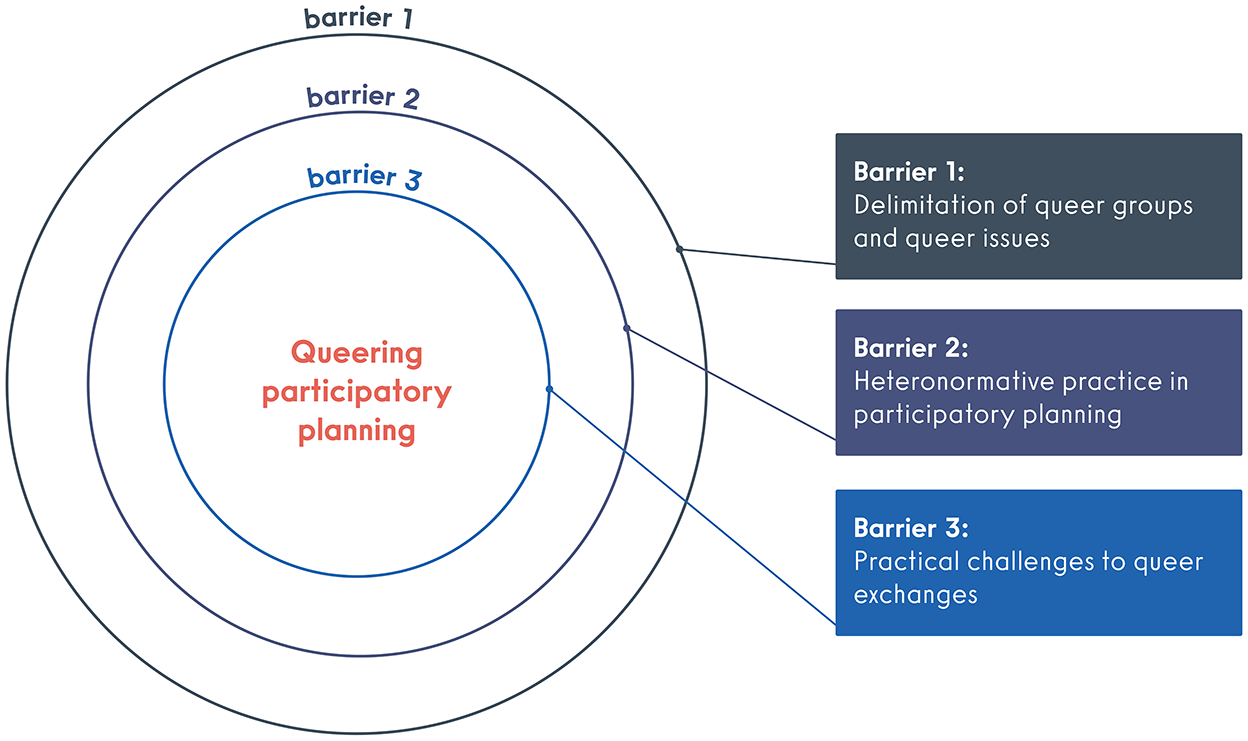
Barriers to queering participatory planning
Barrier 1: Delimitation of queer groups and queer issues
Recent work on participation in planning casts it as a means to ensure democratic citizenship and facilitate the delivery of services that people need.(33) In African cities, governments and communities use participatory planning as a tool to tackle the enormous gap in service provision in informal settlements and rapidly growing peri-urban areas.(34) Participatory planning can also be mobilized in informal settlements to respond to changing contexts of urban development, and especially, to enable urban resilience.(35) For queer communities and individuals, participatory planning may be an opportunity to question the constitution of safe spaces and safe infrastructures.(36) The concept of participatory democracy mobilized in these forms of planning is central to queer thinking.
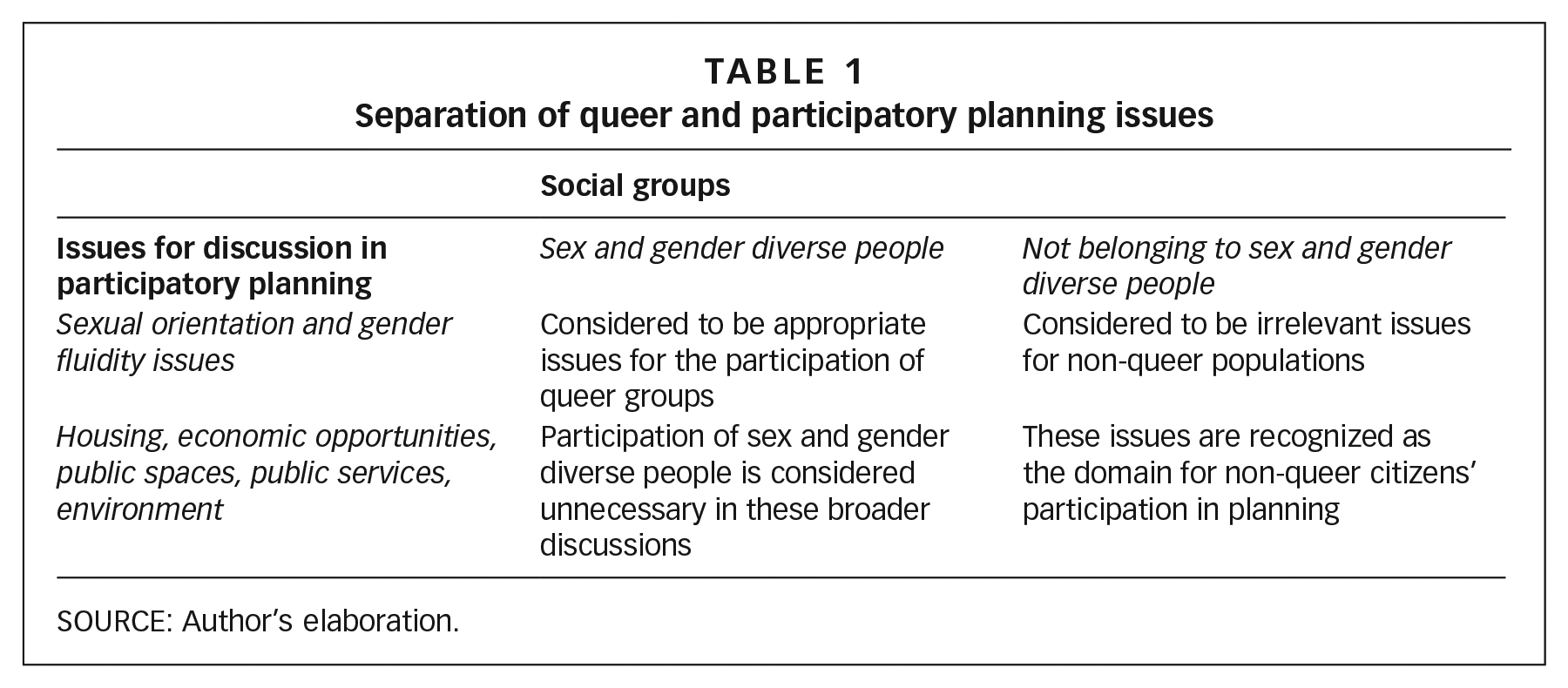
In practice, however, queer issues are almost always separated from participatory planning processes. Table 1 examines the dynamics of that separation analytically, showing it as the product of two assumptions:
First, the assumption that queer concerns are limited to specific issues (such as sexual orientation or gender fluidity) deemed less critical in the participatory process. Establishing such limits entails a narrow definition of queer issues and the assumption that non-queer problems are the fundamental priority for participatory processes.
Second, queer issues are assumed to relate to a distinct, separate group of people with a fixed identity that also acts as a vulnerability vector. This assumption requires defining those identities narrowly – LGBTIQ – before they can be attributed to sex and gender diverse people or included in any meaningful (if marginal) participatory planning process.
Separation of queer and participatory planning issues
SOURCE: Author’s elaboration.
As Table 1 demonstrates, these assumptions lead to two absurd corollaries. The first corollary is that sex and gender diverse people only ever have concerns related to sexuality and gender fluidity. The second corollary is that if people do not belong to sex and gender diverse groups, they do not have sexual and emotional needs worthy of discussion in a participatory planning process. At best, working with these assumptions, participatory planning enables sex and gender diverse people to discuss their concerns in separate groups that will report to a common meeting or plenary. Such processes constitute queer populations as passive objects for planning, adding to a seemingly endless laundry list of participatory planning issues. At worst, the planning process actively excludes sex and gender diverse people to the detriment of the process, which invariably produces unsafe spaces for everyone.
This whole theoretical construct is untenable. Queer identities are not easily defined. Hence, defining in practice who belongs to “sex and gender diverse people” is almost impossible. Moreover, delimiting the set of specialty issues that such interest groups should address (often related to health and safe spaces) invariably leaves out critical questions of concern, including housing and public service provision. Figure 2 presents a schematic representation of the challenges to both areas of critique.
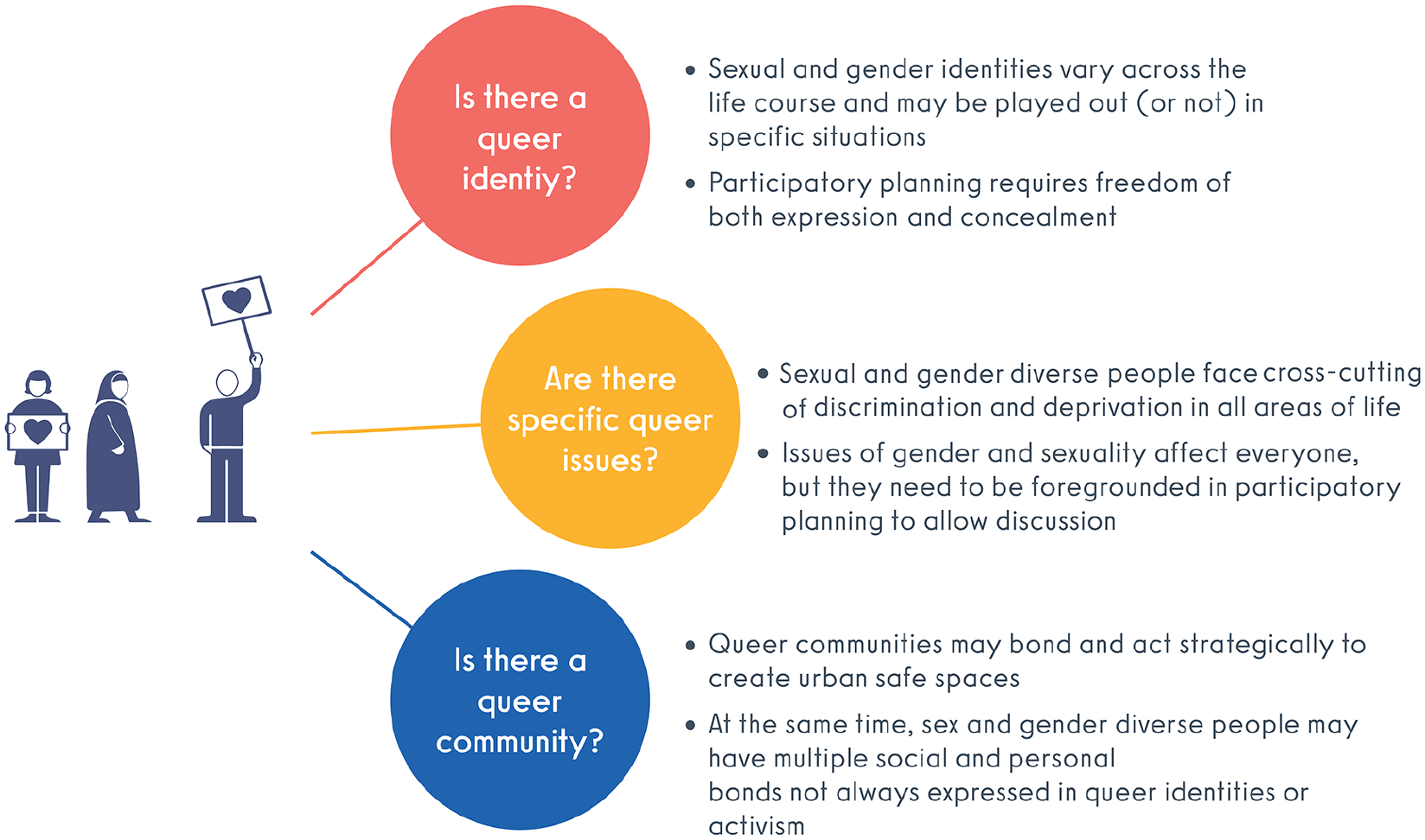
Narrowing the “queer” in participatory planning
Queer identities – if they can be defined – must be accepted as fluid, changing through the life course and in specific situations, and depending on the relationships between individuals and social groups. People may choose to identify as gay or lesbian or trans or bisexual depending on previous experiences and future expectations, as a simplified means to communicate enormously complex issues.(37) Identity is not a T-shirt that one can put on and take off. Instead, it is an intricate pattern of feelings and behaviours that have to be routinely negotiated in space.(38) Focusing on identity markers as a means for community development prevents the practical implementation of intersectional approaches to address the multiple, overlapping layers of marginalization that affect communities.(39) While participatory planning should create spaces that allow the communication of sexual and gender issues, its practice must also assume that there will often be people who choose not to express those identities – even if they find them relevant in their everyday lives. Even if such identities could be expressed coherently and with a certain degree of permanence, a sexual and gender minority cannot be constructed as an interest group that planning must serve, any more than women can be constructed as a single and undifferentiated interest group. Participatory planning implies that communities are active participatory planning makers rather than its object.(40) This principle also applies to any participatory programmes that seek to include sex and gender diverse people actively.(41)
Figure 2 provides an overview of the critique of narrowing “the queer” in participatory planning. While highlighting specific sexuality and gender issues may generate important debates in participatory processes, such processes should also incorporate the wide range of issues that affect the lives of sex and gender diverse people. Simultaneously, emotions, affections, physical interaction and a sense of the body’s situation in physical space – all topics for which the queer experience is directly relevant – are central to participatory planning. Such “queer” questions are relevant to both the collective city’s future (e.g. creating spaces where everybody feels safe) and the dynamics of communication within the participatory process (e.g. openly discussing issues perceived as being embarrassing). People who identify as sex and gender diverse live in societies and face a broader range of challenges – as much as any other community member – as they try, for example, to access public spaces, housing and services.(42) In summary, all people will be interested in a broad range of topics beyond narrowly defined questions of sexuality and gender.
Queer concerns are not marginal to planning. By separating queer issues from participatory processes, we reduce the legitimacy of sex and gender diverse people to join any attempts at making collective futures, which results in direct harm to those communities. Doan(43) documents that North American planners tried to prevent the inclusion of sex and gender diverse people’ interests in planning because their “condition” was perceived as a lifestyle issue. While published evidence is fragmented,(44) it seems that planners in different countries have struggled to incorporate “the queer” meaningfully, even within active efforts of participatory planning that could have addressed the vulnerabilities of diverse communities.(45)
The forms of discrimination faced by sex and gender diverse people in the context of urban informality relate to those addressed through participatory methods in development planning: eviction, loss of jobs, discrimination in healthcare and other public services, high levels of violence.(46) A recent review on the need to foreground sexualities in research agendas in the urban global South demonstrates the importance of opening up the participatory planning process.(47) Addressing the exclusion of sexualities from development studies,(48) Tucker and Hassan argue for a development planning agenda that embraces them. They explain the intersection between challenges faced by sex and gender diverse people and by the informal sector. For example, they argue that a larger proportion of sex and gender diverse people may find themselves working in the informal sector or living in informal settlements. Sex and gender diverse people face systematic discrimination that may limit their access to formal jobs, for instance from the educational system or the structure of access to jobs. If informality is a site of critical analysis that relates specific political economies to urban places,(49) it must also be a point of reference for understanding the constitution of safe and unsafe queer spaces. If individual and community possibilities are connected to vectors of inequality, then a queer perspective provides a pivotal view to examine this.(50) Any process that ignores queer realities will never be fully emancipatory, as queer political histories are also unique and require attention.(51) Moreover, as Tucker and Hassan carefully document, sex and gender diverse people have capabilities that can support all marginalized communities across multiple axes of exclusion (Table 2).
Proposals for queering participatory planning, based on work at the intersection of development planning and sexuality studies
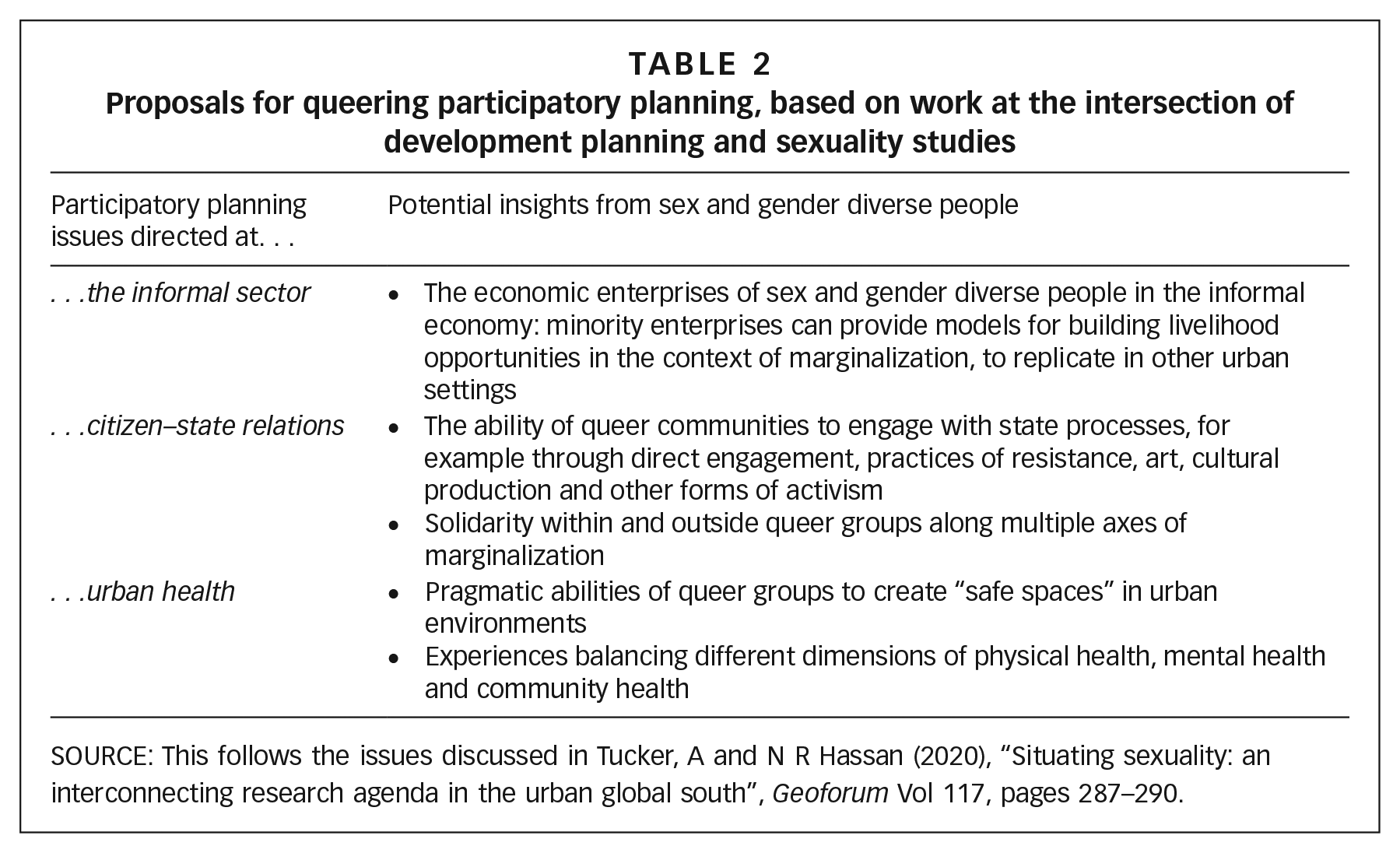
SOURCE: This follows the issues discussed in Tucker, A and N R Hassan (2020), “Situating
sexuality: an interconnecting research agenda in the urban global south”, Geoforum Vol 117, pages 287–290.
To overcome the first barrier that prevents queering participation, we need to be alert to misleading assumptions that delegitimize queer representation in participatory planning – whether they prevent the representation of people or the representation of issues. Participatory planning must tackle head-on the unjust geographies that inscribe race, class, gender and sexuality in urban space and commit to creating safe spaces for all participants, including queer populations.(52) Given how prevailing such assumptions are, participatory approaches will require considering queer inclusion explicitly to prevent the exclusion of sex and gender diverse people by default.(53)
Barrier 2: Heteronormative practice in participatory planning
The question that follows the discussion above is: “Is participatory planning heteronormative?” Heteronormativity assumes that there is a normal default of gender presentation and social interaction. Those who do not subscribe to a binary male/female gender or who do not have their sexuality defined by heterosexual encounters are seen as deviating from the norm. Heteronormativity both signals and chastises deviations from that norm, leading to the exclusion of large groups of people. When heteronormativity is not questioned, participatory planning excludes sex and gender diverse people by default. Participatory planning can only address marginalization through an intersectional perspective that addresses the layered structures of oppression and discrimination shaping human lives.(54) Challenging heteronormativity must become a central objective of participatory planning if the aspiration is to advance a radical democracy project.
However, development planning rarely challenges heteronormative assumptions. Worse, participatory practices tend to reproduce those very assumptions. Heteronormative legacies result from heterosexist histories in both urban planning and development studies.
Heteronormative discourses have long dominated urban planning.(55) Frisch explains planning as a heterosexist project intent on controlling deviation from heterosexual, binary gender assumptions.(56) Heterosexuality becomes the defined framework that codifies not only sexual desire, but also any expressions of love and affection in urban environments. Queer theory since Sedgwick(57) has analysed the complex contradictions embedded in attempts to present contemporary sexualities as modern, controlled and codified. Hawkes(58) argued that any gains in terms of sexual liberation in the 20th century have come at the expense of the codification of sexual desire, a central motif in recent studies of LGBTIQ questions in planning.(59) Codification goes hand in hand with a process of cultural erasure: any strangeness or deviation from an externally imposed norm is covered up and ignored. Excavating the details of queer lives and queer identities has been a method to resist erasure. However, cultural erasure is also performed outside the written form in the ways that communities and social groups are presented in queer-free environments. Heterosexist planners are not the only agents in the reproduction of heteronormative discussions in public spaces. Practices of diversity and inclusion can reproduce those very assumptions if they differentiate everyone against the three axes of whiteness, maleness and heterosexuality.(60)
Heteronormative assumptions also permeate practices in development studies. On the one hand, most programmes of international development practice reveal heteronormative assumptions. On the other hand, critical studies of development tiptoe around the questions of intimacy and desire,(61) failing to produce a queer alternative to sustain change in practice. Development practices often cast sexuality and gender fluidity as negative without considering their positive impact on people’s lives.(62) For example, development practice often follows misleading assumptions about communities’ social structure, the role and composition of families, and the separation of domestic spaces from queer ones, as if sex and gender diverse people did not have domestic lives.(63) Heterosexist experiences cannot be explained away as culture without acknowledging a history of colonialism and globalization that first repressed sexual expression and then blamed the colonized subjects for not modernizing their sexual practices.(64) Because sexuality always relates to people’s lived experiences in space, the erosion of queer spaces signifies an erosion of freedom for everyone.(65) Alongside systematic programmes for social analysis, there is a need to understand the emancipatory potential of queer responses. Learning from decolonization attempts in development studies, Andil argues that: “Just as anthropologists and gender and development theorists have critiqued as fictitious (and also detrimental) idealised notions of male and female roles, family structure and behaviour, so too must rights-based and participation approaches be willing to identify and also question (and change) the assumption of heterosexuality implicitly and explicitly pursued and promoted in development policy and programmes.”(66)
We can start by recognizing that queer is not a simple identity category that can be understood on its own. Queer is an intensely racialized and dispossessed category.(67) Codified heterosexual and homosexual norms are associated with middle-class conceptions of life.(68) Recent discussions on diversity and inclusion have warned against colour-blind intersectional practices that codify and record diversity without challenging the multiple forms of exclusion and oppression affecting people.(69) Legal analyses have looked into antiracist measures to prevent the racial discrimination that people experience at the individual, structural and institutional levels (Table 3). These experiences of discrimination, and the associated anti-discrimination strategies, are also relevant to understanding queer experiences and responses. Colour-blind, and its analogous queer-blind, intersectionality may reinforce discrimination within the very practices directed towards eradicating it, whether this is within communities or in international development and development planning organizations.
Forms of racial discrimination, and responses that may be relevant to the challenges of queering participatory planning
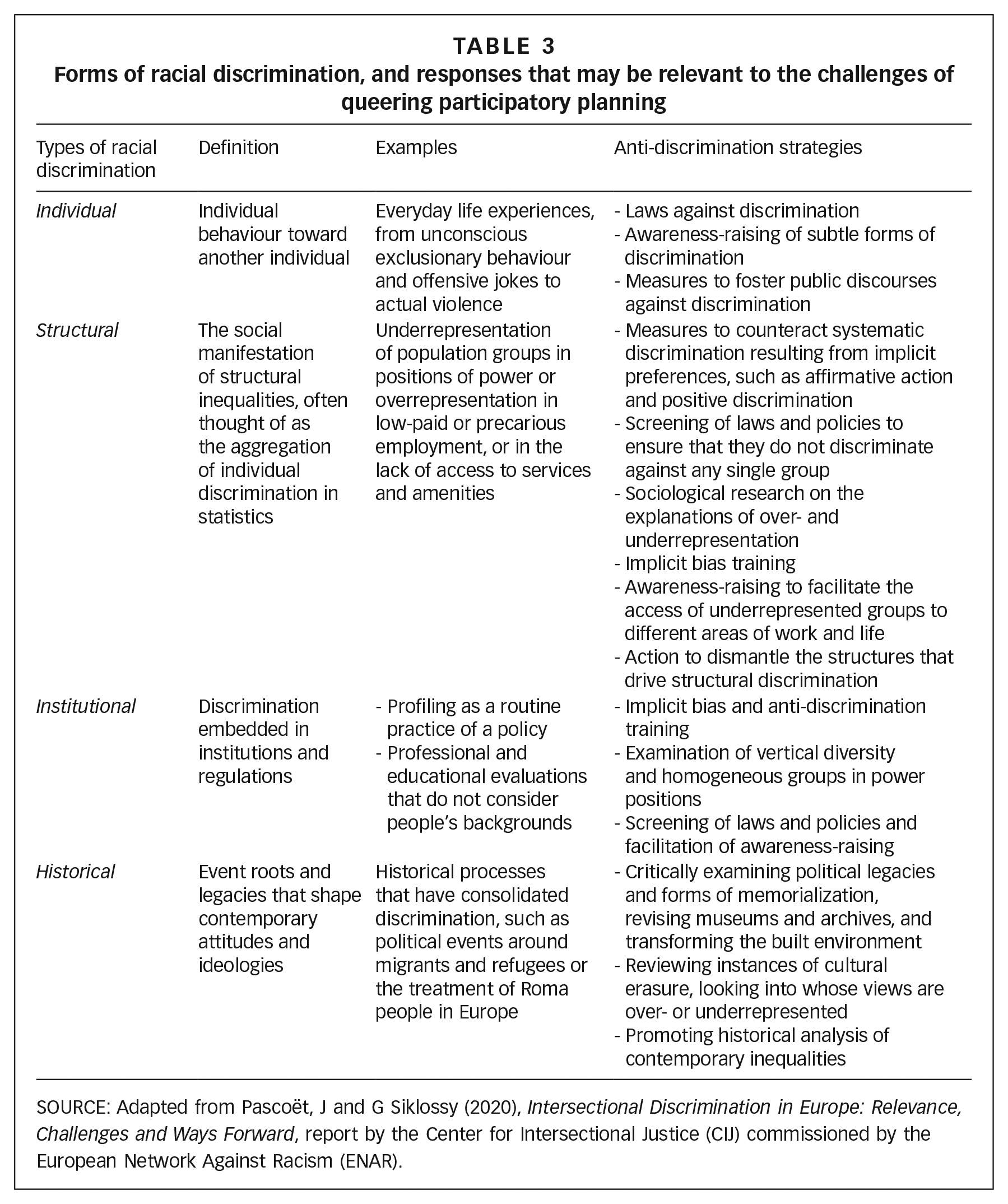
SOURCE: Adapted from Pascoët, J and G Siklossy (2020), Intersectional Discrimination in Europe: Relevance, Challenges and Ways Forward, report by the Center for Intersectional Justice (CIJ) commissioned by the European Network Against Racism (ENAR).
The history of queer liberation throws another challenge. A salient concern in the literature has been the rise of alternative homonormativities – that is, restricted cultures of same-sex relations, lesbian or gay, that are tolerated within a larger heterosexual landscape. This phenomenon is particularly relevant in urban development planning, where middle-class homosexual communities may have access to safe spaces at the expense of more disadvantaged communities.(70) In the past, the reduction of queer safe spaces to spaces for same-sex relations has obliterated more complex relations of queerness.(71)
In conclusion, queering participatory planning is a means to challenge the embedded heteronormativity of cultural norms and ways of operating in both urban planning and development studies. Participatory planning should help to advance the rights and wellbeing of people living non-heteronormative lives. Queer theory, in particular, is a tool to question the categories of gender and sexuality that shape the process at the outset. At the same time, queering participatory planning requires examining the relevance of gender and sexuality elsewhere in the community. Intersectionality theory – the idea that identity cannot be reduced to separate categories such as gender, age, sexuality, race and ethnicity but is, instead, a compound phenomenon – reminds us that simplified analyses of complex social categories misrepresent people’s individual identities and remove the political potency of any action to resist heterosexism. Queering participatory planning challenges fixed identity categories and raises more comprehensive questions about the kinds of communities that support everyone’s material, social and emotional needs.
Barrier 3: Practical challenges to queer exchanges
Participation has become a shorthand for people’s engagement in state matters. By state matters, I mean changing institutions and engaging in policy and programmes in action. Participation can be understood at different scales, from participating in general elections to developing innovative policy-making methods at the community level. Participatory planning enables more extensive political change processes at the city-wide scale and provides experiences that can potentially change capitalist cultures. Because of this potential, participatory planning is often linked to experiments in radical democracy, most often located in neighbourhood-scale processes of community development. Such processes can be extremely important to address urgent challenges, from housing to the provision of public services in informal settlements, where participation is also a means to bring multiple voices to the fore. Ridding participatory planning of the assumptions and clichés that prevent the participation of sex and gender diverse people can only improve the participatory process and the lives of everyone.
Sexuality and gender identity challenges are an urgent area of engagement in development and humanitarian policy.(72) Homophobia and transphobia are institutionalized and normalized to different degrees in most countries. The assessment of the Human Rights Committee of the United Nations is bleak, as it reports on the widespread use of legislation “to criminalize private, adult, consensual same-sex sexual relations”, which “violate(s) rights to privacy and to non-discrimination”.(73) While there has been progress in the last five years, the Human Dignity Trust reports that 72 jurisdictions criminalize private, consensual same-sex activity, of which 11 contemplate the possibility of capital punishment, and 15 jurisdictions criminalize the expression of transgender identity.(74) Constitutional guarantees to protect people from discrimination on sexual orientation grounds are rare. Transgender people struggle to gain recognition for their preferred gender, often being forced to accept sterilization treatments, gender reassignment or divorce as a condition for that recognition. The World Health Organization removed transgenderism from the International Classification of Diseases – 11th Revision (ICD-11) list of mental disorders in 2019, a significant step towards achieving full rights.(75) However, homophobia and transphobia are apparent in all regions,(76) including individual attacks, organized abuse and institutionalized violence.(77) Sex and gender diverse people suffer multiple forms of discrimination in their access to employment, healthcare and education, and freedom of expression, association and assembly.
The Yogyakarta Principles, presented at the UN in 2007 and revised in 2017, provide a systematic analysis of the application of human rights law to sexual orientation, gender identity or gender expression. While “states are obligated to protect individuals from discrimination on the basis of their sexual orientation”,(78) the assessment of current protections is bleak. The UN also documents “the community” as a site for discrimination on the basis of gender identity or sexual orientation. Even in countries with constitutional protections, sex and gender diverse people may suffer social stigma affecting their daily lives and relationships.(79) Socioeconomic differences directly influence exclusion experiences, as shown, for example, among LGBTIQ communities in Thailand.(80) All these factors will determine people’s capacity to participate in and influence participatory processes that depend on the mutual understanding and recognition of people and institutions within a given community.
The experience of young feminist organizations suggests that any gains in terms of recognition of sex and gender diverse people are fleeting and that heteronormative framings dominate. Solidarity economies and the pooling of resources enable new forms of experimentation with resources that depend on feasible collaborative, participatory processes.(81) Vulnerable populations struggle to access essential resources to gain political rights: time, space, voice. A space is safe if individuals can express themselves freely there and share non-normative experiences without physical, cultural or emotional violence. For those who suffer homelessness, finding safe spaces may signify something very concrete – such as escaping violence in the streets.(82) However, safe spaces are not entirely stable, and require active work to construct and maintain them.(83) Safe spaces are open to appropriation, and their maintenance can require engaging in long-term political struggles.(84)
There are examples of the difference that civil society organizations have made in delivering LGBTIQ equality.(85) Table 4 shows an example of a policy for the creation and maintenance of safe spaces that establishes ground rules that implicate all participants. Small gestures to suppress sex and gender diverse people’s oral exclusion may deliver more workable political environments in a given protected setting. At the same time, international development and humanitarian organizations struggle to address subtle forms of discrimination in work environments or community engagement, from unconscious bias to well-intentioned but harmful observations that make people feel unsafe.(86)
Examples of ground rules for safer spaces as laid out by the LGBT Foundation, included in their Inclusion and Safer Spaces Policy
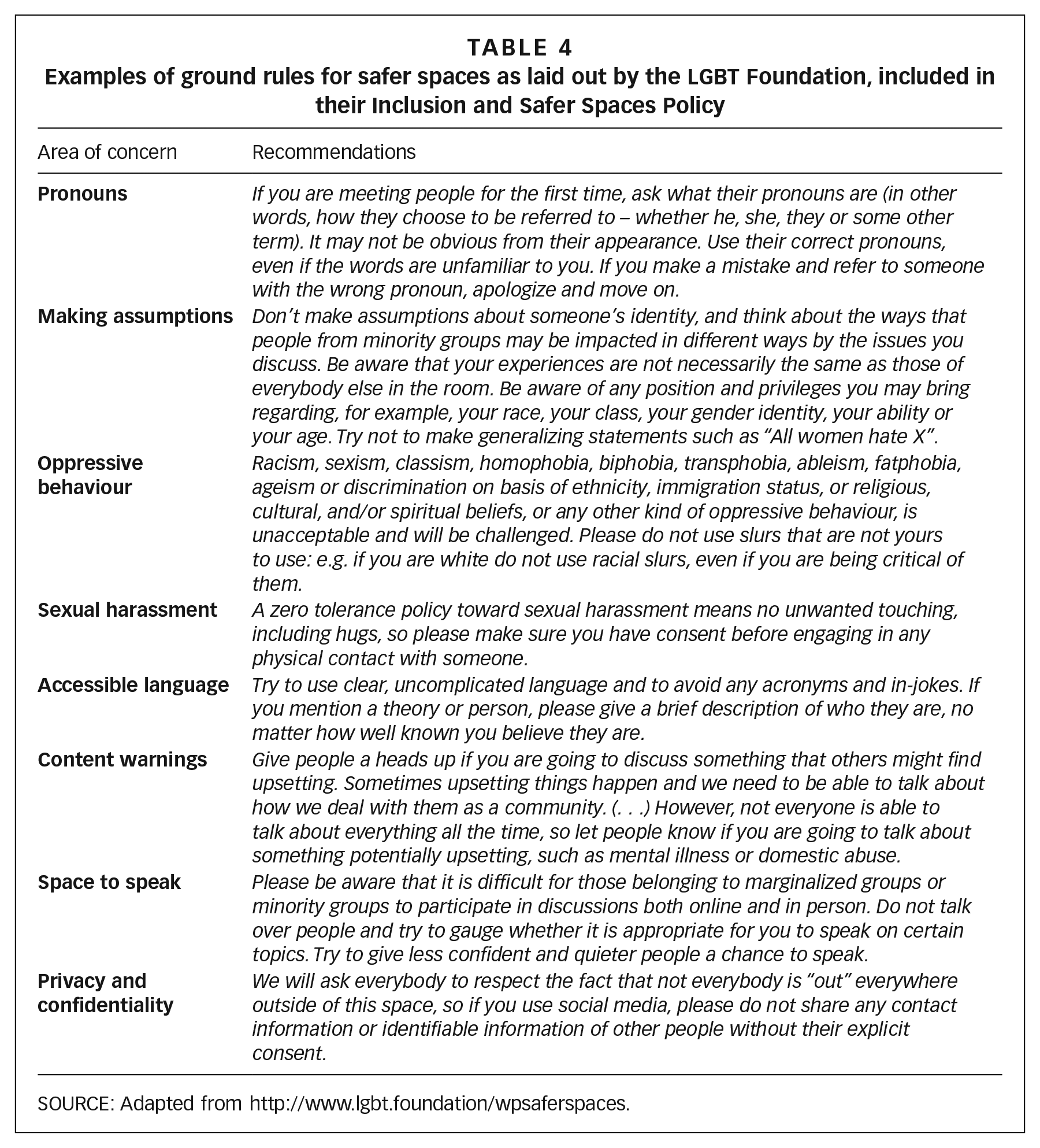
SOURCE: Adapted from http://www.lgbt.foundation/wpsaferspaces.
A big challenge is the lack of relevant data. There are no reliable estimates of the number of people identifying as LGBTIQ anywhere, let alone in rapidly urbanizing areas and changing informal settlements in cities where participatory planning can make a difference to people’s lives. Lack of disaggregated data is a barrier to tackling forms of structural and institutional discrimination.(87) Simultaneously, the right to privacy protects any person who wishes to avoid disclosing their sexual orientation or gender identity in public or to state institutions, as expressed in the Yogyakarta Principles. While participatory planning is often directed towards gaining visibility, for sex and gender diverse communities, visibility – especially for an individual – may be threatening.(88) Thus, participatory planning must move beyond a focus on LGBTIQ populations’ data to focus instead on broad interest issues that reflect queer problems. Queering participatory planning depends on moving on from identity markers and concentrating instead on the specific context and structures and how they impact individuals.(89)
There are many opportunities to mobilize participatory planning techniques to include sex and gender diverse people in the formulation of collective urban futures. LGBTIQ activists have demonstrated the importance of networks of solidarity in supporting queer lives, even in moments of great distress, such as when facing the HIV-AIDS epidemic. Creating safe spaces and building solidarity with groups facing other forms of discrimination are crucial strategies in advancing sexual and gender rights.(90) However, for participatory planning, the question is how to include everyone in a political process of liberation.(91) Queering participation calls for polyvocal processes of representation that bring together queer accounts deleted from history and maps.(92) In an urban context, this means engaging with the multiple forms of heritage and how they influence wider communities, showing how the expansion of safe space for queer communities across the city benefits everyone.
Participation remains a crucial strategy in supporting collective communities to attend to both human health and planetary health. Malena(93) describes an ever-expanding universe of participatory experiences in governance at the national and local levels, including strategies contributing to public agenda-setting and policy-making, allocation of public budgets and oversight of public expenditure, and the co-production of urban services (see also this journal’s recent special issue on this theme(94)). Malena argues that participation is a mechanism whereby citizens can intervene in decisions that affect their lives. Participation is a fundamental tool to address democratic and governance deficits in current governance, facilitating access to information and public oversight. Empowering disadvantaged communities and recognizing diversity is the core of participatory governance. Queer diversity is a central part of that equation, and cannot be ignored any longer in any radical democracy experiment.
For example, one lesson from queer theory for participation is the need to embrace failure. Halberstam( 95 ) has argued for failure as “a style” against celebratory narratives of success that invariably conform to heteronormative ideals. In this vein, Halberstam warns against representing failure as a step on the road to success within a given social setting and asks readers, instead, to embrace failure as a generative attitude that disturbs the status quo and challenges the notion of success. What would failure mean for participatory planning? It would mean accepting that participatory planning does not offer a well-packaged alternative to rationalist planning and that the participatory road may not lead to a happy ending, at least not one that can be unproblematically packaged as such. Giving participants permission to fail opens the participatory process to a wider range of alternatives and possibilities.
III. Conclusions
For many practitioners and scholars, participatory planning today is not participatory unless:
It accepts the fundamental freedom of humans to choose who they are;
It integrates this freedom into a radical political struggle to question discrimination structures in an intersectional way.
Therefore, participatory planning is already queering, already recognizing people’s emotional lives, and already challenging discrimination.
Looking into the three barriers outlined above provides some basic principles to make queering explicit and possible. Barrier 1 calls for a reformulation of queer populations and queer issues within participatory methods and development planning. Rather than seeking to identify a separate “queer population” as a node of vulnerability, the focus should be to integrate queer issues into the process of planning at the outset. This breakup of barriers should be liberating for everyone. Attention to desire is mostly absent from development studies’ literature – let alone from rationalist traditions of planning – regardless of how central it is to them.(96) We cannot discuss house upgrading without discussing domestic violence. We cannot discuss climate change adaptation without considering the creation of queer safe space. We cannot discuss opportunities for the informal economy without understanding the role of sex work in every neighbourhood. Participatory planning often depends on breaking down barriers between different understandings, sharing concerns and solving problems together. This also means that participatory planning is not about delivering success, in the sense of optimizing or completing the planning process through a common consensus, but about reorienting societies through a trajectory of multiple failures.(97)
Barrier 2 relates to prejudices that may influence the participatory planning process at the outset. First, it is vital to identify and question any norms imposed on the process and their origin. For example, normative models of the family and, particularly, models that assume that the integration of women into work will somehow liberate them, are rooted in Western liberal feminism and are by no means universal. We need to recognize the queer aspects of domestic life. Participatory planning should ideally start from a place of openness. When heteronormativities creep into participatory processes, there is a need to reflect on where they come from: Were they brought by those who organized the process? Did they emerge from people’s expectations of the process? Were they influenced by external cultural processes? Unfortunately, the potential to reproduce heteronormative assumptions is as present as the potential for queering. As there are limits to critical questioning, queer theory has often emphasized the potential of gestures to foster solidarity and social change.(98) An artistic concern with “offering a gesture” can be powerful in life settings.(99) Small body movements or polite words, even just fleeting gestures – of acceptance, of celebration – can impact people’s lives and behaviour. They may also signal a rejection of heterosexism, including jokes or other common forms of aggression.
Barrier 2 also relates to preventing the erasure of queer lives. Participatory planning will require strong alliances with queer activists and organizations that may help to make a range of practical issues visible and provide individual models of being and negotiating in collaboration processes. Queer activists can support the development of a shared language of negotiation, moving away from heteronormative formulations.
Barrier 3 relates to the practical barriers to queer participation, starting with the active prosecution of sex and gender diverse people and the routine discrimination they face in all world regions. Safety training – for being safe and keeping other people safe – should be a starting point for communities and facilitators in participatory planning. Such processes may require investing in staff and members of communities who can mediate to create safe spaces. Safe spaces are often ephemeral.(100) Flexible strategies for their continuing constitution may be necessary. Diversity in participatory planning is essential. However, rather than providing a checklist approach of “bean counting” diversity, participatory planning must engage with direct action to challenge the institutional, structural and historical basis of discrimination.(101)
Queer theory has developed an interest in failure as a strategy for social change. Failure is a means to continue living without accepting externally imposed models of relation with the self and others, and acknowledging that collective action requires multiple tryouts.(102) Participatory planning also requires permission to fail, prioritizing participants’ wellbeing and collective understanding over the generation of practical solutions (while being aware that the lack of practical solutions may create participation fatigue). Queering participatory planning relates to the potential of modular gestures and small shifts in crafting safe and shared urban worlds. Paraphrasing the feminist slogan of activists in Chile, Argentina and Spain,(103) any radical democracy experiment will be queer or will be nothing at all.
Footnotes
Acknowledgements
The author wishes to thank Professor Caren Levy, Professor Jane Rendell, Andrea Rigon, Yael Padan, Catalina Ortiz, David Heymann, Andrea de Santis, Miguel Kanai, Erika Conchis and two anonymous reviewers for their support. Thanks also to Sheridan Bartlett and Christine Ro for their enormous dedication and care in editing the final manuscript.
Funding
This research was supported by the project Knowledges in Action for Urban Equality (KNOW) (project reference: ES/P011225/1) funded by the Economic and Social Research Council (ESRC) and the Global Challenges Research Fund (GCRF).
