




Abstract
This article examines the role of public spaces like farmers’ markets in sustaining urban communities during the first two years of the COVID-19 pandemic. Drawing on research completed with the St John’s Farmers’ Market in Newfoundland, Canada, between 2020 and 2022, it demonstrates how a slow-growth economic model and cooperative governance structures effectively prepared the organization for the economic and social shocks of the pandemic. Through successive lockdowns and tightening of public health measures, the market used a range of techniques to provide a space for socially distant interactions, which included physical dividers and new modes of selling products alongside a restructuring of the organization’s operations. Into the later phases of the pandemic the St John’s Farmers’ Market was consistently identified as a place of community and belonging by research participants, which reflected the continuing importance of venues like farmers’ markets to the social life of cities. The article concludes by drawing lessons from this experience, with emphasis on the role of community-led development and the importance of community-owned assets in building urban resilience. In an instance where most public space literature captures the dimming of public space usage at the onset of COVID-19, this article demonstrates how such sites were re-imagined and ultimately re-opened, adding valuable perspectives on the rebuilding of urban public space in mid-sized cities.
This article examines the role of public spaces like farmers’ markets in sustaining urban communities during the first two years of the COVID-19 pandemic. Markets are often viewed as important social and economic infrastructure (Carson et al., 2016; Everts et al., 2021) that allow for informal socialization amongst a diversity of community members (Watson, 2009), while also supporting local food sales by connecting urban and agrarian regions (Smithers et al., 2008). Markets are part of what Latham and Layton (2019) describe as the ‘social infrastructure’ of cities – physical places that make it possible for social connections to flourish – and can be sites of connection, engagement, and vibrancy, alongside their food provisioning and economic roles (Low, 2000). The onset of the COVID-19 pandemic fundamentally altered the usage patterns of public space in many cities, with public health measures leading to social distancing stickers on the ground and curfews limiting access to streets and trails access. As Van Eck et al. (2020) demonstrate, the impacts on farmers’ markets have been uneven, with some markets closed down in an effort to control COVID-19 transmission, and others deemed an essential food service and allowed to operate with a change in format. This tension – farmers’ markets as both dangerous sites of sociability and essential sources of food in the city – and the challenge of addressing these dual functions during the pandemic has raised questions about the socio-economic role of markets (Klisch and Soule, 2020; O’Hara et al., 2021; MMP et al., 2022; Richards and Rickard, 2020). This resonates with broader discussion on the meaning of public space in the (post)pandemic city (Flynn and Thorpe, 2021), and the role that venues like farmers’ markets play in sustaining urban communities through moments of rapid change.
Drawing on a two-year research process with the St John’s Farmers’ Market, in Newfoundland, Canada, this article considers how the COVID-19 pandemic transformed a well-frequented market and reflects on what that can tell us about urban resilience. Initially, the goals of this project were to examine the shifting meaning of public space in a mid-sized city by tracing the successive lockdowns and re-openings of the St John’s Farmers’ Market. As research progressed from 2020 into 2021 and then 2022, it became evident that the market had a complex meaning for participants: a place of wellbeing and caring, a location where collaborative decision making informed pandemic responses, and a site to which vendors, customers, and market staff held deep attachments. Participants’ descriptions stretched beyond a reading of the market as a place of informal social connections (Carson et al., 2016; Smithers et al., 2008) and frequently described the St John’s Farmers’ Market as a community with responsibilities not just to its users but also to the wider urban center. For Wilson (2015) resilience is a process of constant adaptation, and for Cavaye and Ross (2019) community resilience can mean the capacity to self-organize the use of physical and social resources in response to a crisis. These points are at play in the St John’s Farmers’ Market and my aim is to examine the extent to which the concept of ‘resilience’ – a term that has ricocheted through public discourses on pandemic responses (O’Grady et al., 2022) – can be used to reflect on why some spaces became community anchors during the pandemic. A secondary goal is to draw on the St John’s Farmers’ Market as an emblematic case study for the broader role that venues like farmers’ markets played in the re-imagination of public space during the COVID-19 pandemic and to consider their continual importance to the social life of cities.
In the pages that follow, I first examine the socio-economic function of farmers’ markets before considering how such organizations responded to the profound shifts resulting from COVID-19 public health restrictions. I then situate the concept of ‘resilience’ in an urban and community setting, drawing especially on DeVerteuil et al.’s (2021: 79) framework of ‘resilience-as-experienced’ to understand how urban communities negotiate wide-scale shocks. After introducing the St John’s Farmers’ Market, I outline findings through three empirical sections. In the first, I trace the history of the market and situate it within Sekulova et al’s (2017) argument that community-led development is more likely than top-down initiatives to lead to sustainable organizations capable of navigating change. Using interview data and survey results, I then outline the range of technique used by the St John’s Farmer’s Market to navigate COVID-19 challenges and become a rare space for vending and socially distant interaction in the city of St John’s. Finally, I use interview data from the Spring of 2022 to capture the nuances of the St John’s Farmers’ Market’s post-pandemic recovery and to consider how vendors and staff conceptualize their role in rebuilding this key public space. The article concludes by drawing lessons from this experience, with emphasis on the role of community-led development and community-owned assets in creating a foundation for the urban resilience, and argues for the value of physical public spaces to post-pandemic cities.
Sustaining urban communities through vibrant public spaces
Farmers’ markets and urban public spaces
Farmers’ markets have long been viewed as important social, community, and food sites within cities. For Low (2000) and Watson (2009) outdoor markets, along with food trucks and food stands, knit together food culture, community life, and economic dynamics to encourage a diversity of users to linger in public space (Koch and Latham, 2012). Markets contribute to the sense of play in urban neighbourhoods and help to foster social connections (Smithers et al., 2008), while also building relationships between producers and consumers in a way that is rarely evident in larger grocery stores (Carson et al., 2016; Everts et al., 2021). While frequently viewed as effective mechanisms for animating public space, markets have also been critiqued for creating an exclusionary and racialized reading of what counts as ‘local’ food (Slocum, 2007; Tchoukaleyska, 2013) and drawing on cultural diversity as a promotional mechanism without necessarily leading to equitable economic or social exchange (Pottie-Sherman, 2013). Tensions around the rights of informal vendors to use public sidewalks (Hunt, 2009; Tchoukaleyska, 2015) alongside questions on the impact of gentrification on traditional vending sites (Gonzalez and Waley, 2013) speak to the complex function of markets in urban areas. In many respects, markets are a useful lens for examining the assemblage of social, economic, and political values associated with public space (Latham and Layton, 2019). They are also venues which, especially in North America, are likely to sell produce at higher price points than grocery stores and be frequented by shoppers with disposable income (Belarmino et al., 2020; Slocum, 2007), and are embedded within – rather than alternatives to – capitalist systems.
With the onset of the COVID-19 pandemic, the function of food markets and their role in supporting sociable urban space was upended. Many markets in the Global North altered their operations with a move towards social distancing, the closured of market stalls deemed non-essential (often, craft and non-food vendors), through the use of personal protective equipment and plexiglass enclosures, and by experimenting with online sales and home delivery (Klisch and Soule, 2020; O’Hara et al., 2021; Richard and Rickard, 2020; Van Eck et al., 2020). While the growing academic literature on pandemic-era markets suggests commonality across locations, there are some nuances which merit consideration. For instance, O’Hara and Toussaint (2021) note that the switch to online for Washington, DC, USA, markets created inequities in access for those without smartphones, which mirrors broader concerns for the entrenchment of a digital divide during the pandemic (Budnitz and Tranos, 2022). Although Marusak et al. (2021) argue that regional food networks proved more nimble in their response, Belarmino et al. (2020) found that in the early phases of the pandemic, shoppers at Vermont, USA, farmers’ markets were more likely to be food secure, suggesting that those most likely to benefit from local commodity chains already have privileged access to food.
While in many locations farmers’ markets temporarily switched to an online format, the market in Yellowknife, Canada, determined that doing so would not meet community needs (Radcliffe et al., 2021). As Radcliffe et al. (2021) explain, many visitors to the Yellowknife market attend as a social activity and coupled with the small scale of the market and challenges in creating a home delivery system across remote areas of the Northwest Territories, a modified in-person market was viewed as more viable. In a comprehensive study on market policies in the Netherlands, Van Eck et al. (2020) emphasize the role of local municipalities in determining the shape of market responses in the early phases of the pandemic, with some cities closing markets in the Spring of 2020 and others devising modifications that allowed a more limited version of a market to exist, despite all locations operating under the same national public health guidelines. While there was some variability in the impact of pandemic restrictions – in terms of use of online tools and extent of in-person closures – the overall effect was of a scaling-down of markets in a way that retained only the commercial transaction linked with food purchases. The hubbub of activity which has been so central to many outdoor and indoor markets (Everts et al., 2021; Watson, 2009) and the informal sociability which usually marks these as sites of connection and community (Koch and Latham, 2012; Smithers et al., 2008) was halted, leading Van Eck et al. (2020: 374) to declare a ‘temporary death of public space’ (though see Zukin, 2022, for a rejoinder).
Conceptualizing urban resilience in a pandemic context
The global reach and multi-year duration of the pandemic makes this a crisis of unprecedented scale, and I have turned to the literature on urban and community resilience to pull apart the mechanisms through which the St John’s Farmers’ Market was able to come together and (re)create a vibrant, engaged, and functional pandemic-era market space. Cavaye and Ross (2019: 182) define community resilience as the ‘adaptation of communities and societies to environmental, social, economic, or political change’ while Adger (2000: 361) described it as the ‘ability of communities to withstand external shocks to their social infrastructure’. Wilson (2015) argues that resilience should be viewed as an outcome (i.e., the ability to adapt) and a process (i.e., learning from past experiences), rather than a definitive and achievable state which can be measured and assessed (Meerow et al., 2016). In their examination of community resilience Vaneeckhaute et al. (2017) define ‘community’ as place-based and emphasize the importance of local social memory to future action, a point echoed by Erfani (2022) who argues that place-based interactions, even if informal and loosely structured (Aldrich and Meyer, 2015), are essential to building solidarity and adaptability. For Stevenson (2021), events like neighbourhood block parties or village fetes encourage local networks to solidify, provided that they are initiated by community members and present opportunities to strengthen existing relationships and create new ones. A similar point is made by Sekulova et al. (2017), who argue that a richness of connections, and what they term ‘fertile soil’ that builds on a shared history and shared physical spaces, has been important to sustaining community initiatives in Barcelona. Collectively, these works indicate that network building and social capital, collective knowledge, and having physical spaces in common are key to urban resilience.
While above I have outlined some of the elements needed to buttress community resilience, the term ‘resilience’ and its burgeoning usage in urban policy has been critiqued. Focusing on the work of the Rockefeller Foundation and their ‘100 Resilient Cities Program’, Leitner et al. (2018) argue that such collaborations between the public, private, and NGO sectors have narrowed ‘resilience’ into yet another technocratic term that moves across global locations and is taken up by municipalities with little heed to local context, needs, site-specific skills, or histories. In a similar vein, Anderson (2015) argues that ‘resilience’ has come to have so many divergent meanings that it risks becoming yet another empty signifier (Davidson, 2010), a sort of buzzword put to work by national government and intertwined with austerity measures and neoliberal policies. These critiques resonate with Derickson’s (2016) argument that the language of resilience as used in urban policy ‘fetishizes the status quo’ (p. 161). And yet, as DeVerteuil et al. (2021) have argued, ‘resilience’ can have meaning beyond the managerial language so often used in top-down policy initiatives. Advocating for more attention to ‘the actually-experienced politics of conditioning, negotiating, and surviving a shock’ DeVerteuil et al. (2021: 79) focus on the myriad everyday, individual actions and decisions that collectively shape community responses to a crisis. For Meerow and Newell (2019) this means interrogating the five-Ws – whom, what, when, where, and why – of policies using the language of urban resilience, and reflecting on how a range of actors connect, define values, and situate trade-offs in resilience-building initiatives.
In view of the above debates, the COVID-19 pandemic presents a moment that is aptly described by McGuirk et al. (2021: 188) as a sort of ‘forced experimentation’, or a situation that raises questions about the extent to which theorization of urban and community resilience – as top-down policy or ground-up community action – can frame pandemic responses. While there is a considerable literature on resilience in relation to disasters (Aldrich and Meyer, 2015), much of this work examines responses to events which have a short duration, if long-term effects, such as the Christchurch earthquakes (Berno, 2017). Focusing on the pandemic, O’Grady et al. (2022) interviewed emergency responders across 16 countries and found that in a long-duration crisis like COVID-19, community organizations and non-government actors have an outsized role in relief efforts. More particularly, O’Grady et al. (2022) argue that a de-centralized approach which takes into account local needs, is likely to lead to more comprehensive responses. In their work on the impact of COVID-19 on Dutch cities, Champlin et al. (2023) add some important qualifiers: that the willingness of a community to adapt, and not just its ability to do so, is relevant, and further, that the degree to which everyday routines change while still fulfilling social, community, economic, and personal needs could be viewed as demonstrative of resilience. Taking these works, along with Van Eck et al’s (2020) analysis of pandemic farmers’ markets, as my starting point, in the pages that follow I will consider how the idea of ‘resilience-as-experienced’ (DeVerteuil et al., 2021: 79) and resilience as a process (Meerow and Newell, 2019; Wilson, 2015) intertwine with the St John’s Farmers’ Market’s shoring-up of capacities, networks, and creativity in response to public health restrictions.
Setting the research context
The St John’s Farmers’ Market: Urban context and pandemic circumstances
The St John’s Farmers’ Market is home to around 100 vendors, and on busy summer weekends welcomes hundreds of customers and visitors. Based in a dedicated building, the market includes a dozen permanent food stalls serving prepared foods and 60 market tables where a range of vendors rotate through, selling produce, baked goods, and craft items. The market is held year-round on Saturdays, and in warmer months, some vendors set up stalls on the concrete patio surrounding the venue, where buskers and musicians also perform. In the pre-pandemic and post-2022 periods, St John’s Farmers’ Market has felt like a hub of activity, with shoppers strolling the walkways and chatting with vendors, with buskers and live music, and busy café tables. During the pandemic, much of this hubbub was tampered down, or ceased during lockdowns, and a rhythm of sanitizing, one-way circulation, reduced vendor spots, and capacity counters was put in place.
The St John’s Farmers’ Market is the largest such market in Newfoundland and Labrador. The St John’s Metropolitan Area – an urban agglomeration formed of several smaller municipalities – accounts for more than half of the province’s population of 500,000 (Statistics Canada, 2021), and is the seat of the provincial government, key medical institutions, and the main campus of Memorial University. While in many respects Newfoundland’s pandemic experience mirrors that of other parts of Canada – with contact-tracing, self-isolation following exposure, use of masks in indoor settings, and vaccine passports (Government of Canada, 2024) – the province’s island status created some distinct dynamics. For instance, between April 2020 and July 2021, Newfoundland banned entry to non-residents and deployed police and other provincial staff to monitor ferry ports and airports entries, an action that has since been challenged before the Supreme Court of Canada (CBC News, 2024). While these measures, and several similar tactics to control movement between the island the rest of Canada led to periods of low case counts, they did not insulate Newfoundland from supply chain shortages, with many vendors scrambling to find raw ingredients and supplies.
Methodology
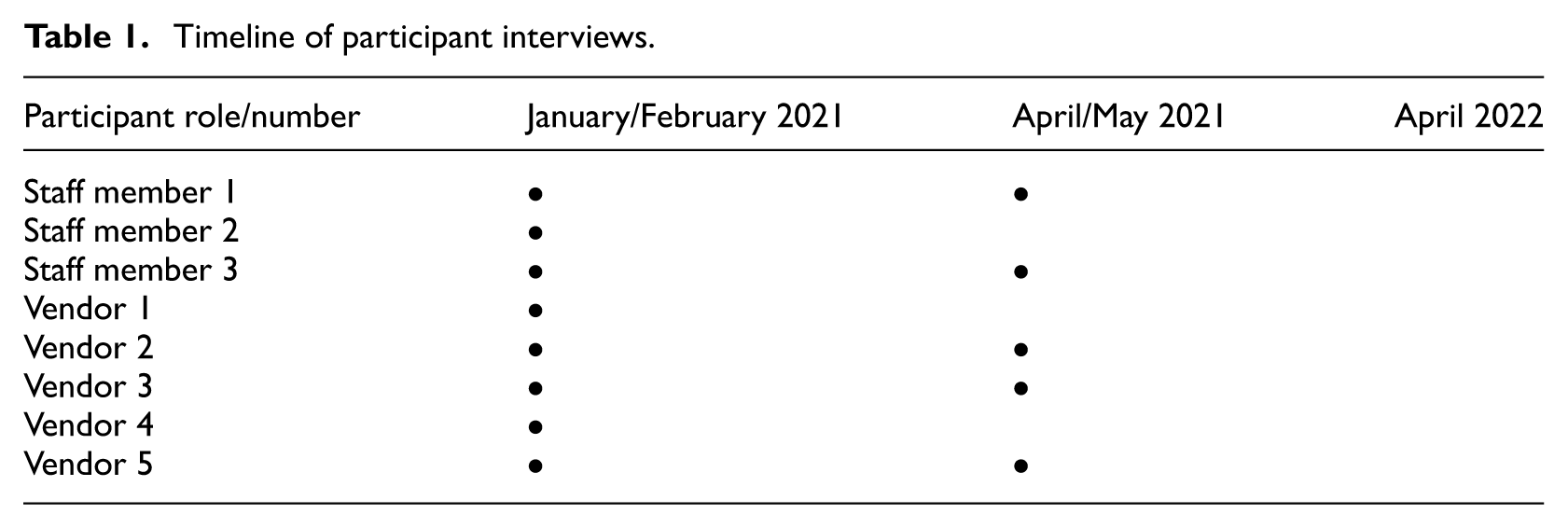
All interviews were held online via Webex or, for participants with limited internet access, over the phone, and were recorded and transcribed. The project included two visits to the St John’s Farmers’ Market – both in moments when pandemic alert levels were lower – and completed when I was a resident of the province and not constrained by entry restrictions; these visits also required a university COVID-19 risk assessment, alongside research ethics approvals. Initial conversations with those involved with St John’s Farmers’ Market in the summer of 2020 determined that research would be viable, and work proceeded in three phases. The 1st phase included a market visit in October 2020 (masked, socially distant) and online research interviews with vendors and staff in January and February 2021. The focus was on the initial pandemic experience, and the impact of the first COVID-19 lockdown and subsequent public health restrictions on the market. The 2nd phase took place in April and May of 2021 and included follow-up interviews with participants who had opted into additional conversations, and a second visit to the St John’s Farmers’ Market in May 2021. Interviews examined the impact of the spring (February and March) provincial lockdowns caused by the Alpha variant. The 3rd and final phase took place in April 2022, and included further interviews with existing participants, capturing their experience of the Omicron outbreak (December 2021 – January 2022) and perceptions of what was deemed a ‘post-pandemic’ (i.e., health restriction and travel bans being rescinded) re-opening. Interviews captured the experiences of vendors and staff members who continued to take part in the St. John’s Farmers’ Market during the study period, and a key limitation of this work is the absence of voices who had chosen to leave the market, either for health or financial considerations. As a pandemic-era project, it is possible that a desire to find a silver lining in moments of public health restrictions and socio-economic upheaval may have led respondents to provide overly positive or socially acceptable answers. To mitigate potential desirability bias, interview questions asked participants to reflect on the challenges of the pandemic-era market, alongside successes, while the multi-interview approach allowed for rapport building and deeper conversations about the complexity of market experiences. Research included a customer survey in December 2020; however, uptake was too low to include results. Research included eight participants who took part in a total of 16 interviews over an 18-month period (see Table 1).
Timeline of participant interviews.
Public space, urban resilience, and the market during COVID-19
Community and cooperatives: Building the St John’s Farmers’ Market
The first foray into creating a farmers’ market in St John’s took place in 2007, when a local farmer and community members held several ad-hoc sessions which led to a regularly-held, volunteer-run market the following year (SJFM, n.d.). By 2010, the market had formed into a dual-stakeholder co-operative where vendors and customers had the option to purchase memberships. That both customers and vendors can be co-op members and serve on the decision-making Board of Directors has proven significant. In nearly every interview, participants commented on the effect of this governance structure: they spoke about their sense of ownership of the market, their sense of responsibility to peers and to the community at large, and many noted that it was possible to raise concerns and have constructive dialogue about policies and commercial decisions. Furthermore, most used the term ‘community’ to describe the collective of customers, vendors and staff who make it possible for the market to run every week. As one participant noted, ‘they [co-op members] literally have invested in the market, it’s something they cared about and committed to getting together’ (Staff member 2).
Several participants identified the market’s 2018 move to its current location as a notable achievement and key to cementing this as an important social and commercial space in St John’s. Participants describe the pre-2018 version of the market, which was held in the local Lion’s Club, with a mixture of joy and frustration. For some, the Lion Club’s park-like setting provided lots of opportunities for customers to informally hang about and enjoy an outdoor picnic. For others, the tight indoors space, limited availability of electrical sockets (and their tendency to short-circuit), and jostling for vendor spaces made this a challenging venue in which to operate. The shift to the new – and current (Figure 1) – location in 2018 was the culmination of considerable work: negotiations with the City of St John’s for a long-term lease of a portion of the former municipal bus depot, renovating the space to match the market’s evolving needs, and grant writing, fundraising, and related activities to make this vision possible. Aside from an increase in vendor spaces and the creation of permanent hot-food stalls, the new space can be rented out for community events (i.e., a vinyl record fair, art exhibits, music events, amongst many others) and has capacity to host workshops (in the commercial kitchen) and performances or business meetings (in the community room). The market has a permanent manager, a factor that Stephenson et al. (2008) have identified as crucial to the long-term viability of famers’ markets, and a number of staff members. The St John’s Farmers’ Market is no longer just a Saturday morning event but a full-time business, with staff overseeing a wide array of commercial activities, and venue rentals augmenting the stall fees paid by vendors to support the market’s long-term financial viability. The market also operates a juried process for new vendors, who must meet criteria on quality production, and several participants argued that as a result, this has become the best venue in St John’s to test out new ideas and to meet restauranteurs (for farmers and food vendors).
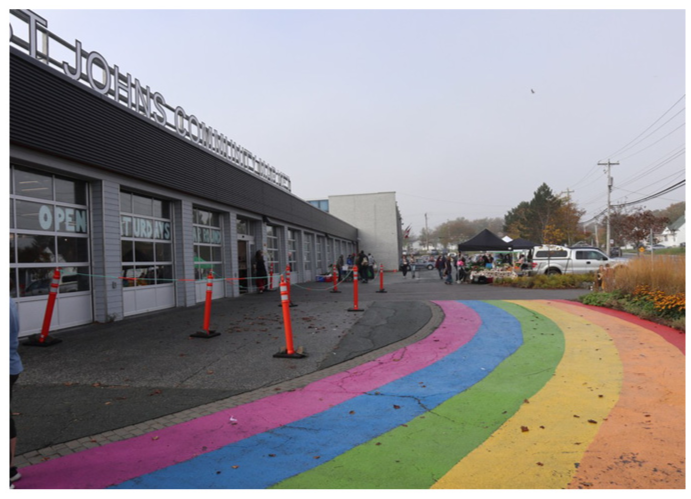
The main entrance of the St John’s Farmers’ Market (photograph by the author).
Despite this scaling-up of both business activity and market capacity, for many participants, the market is still, at its core, about community and local products. As one participant explained, ‘you can just always go and there is no onus on you to buy anything, I mean, sure, there’s people selling things, but you can also just come inside and sit down and just [be] part of like a community’ (Staff member 3). For many participants, the social and economic aspects overlap and are a driving force of the market’s popularity, as is the desire for a comfortable, dry, and safe indoor public space in a city susceptible to gales, dense fog, and harsh winter storms. A particularly debilitating multi-day winter storm in January 2020 – dubbed ‘snowmaggedon’, which led the municipality to declare a state of emergency (CBC News, 2020) – demonstrated the extent to which this market community is networked within the St John’s area. As the city began to recover, customers and vendors, along with community members with available equipment, arrived at the St John’s Farmers’ Market to dig out the building’s entrances, clear the patios and loading areas, and remove snow from the parking lots. As thanks, the St John’s Farmers’ Market sponsored a free community meal, with hot food prepared by vendors.
If, following Vaneeckhaute et al. (2017), community is defined as ‘something in common’, then the St John’s Farmers’ Market would arguably be one in several ways: for customers and vendors who form the cooperative, for the wider St John’s networks of local food and craft businesses which have grown out of the market, and for the larger urban community who shop and socialize in the space. The growth of the St John’s Farmers’ Market from an ad-hoc event to its permanent space is demonstrative of many of the elements that are foundational for resilience, including, networking, working through challenges and internal tensions, and mobilizing physical and social assets to achieve a collective goal (Cavaye and Ross, 2019; Derickson, 2016; DeVerteuil et al., 2021; Meerow and Newell, 2019).
Responding to COVID-19: Public health measures and new usage patterns
Each of these elements was also at play in the St John’s Farmer’s Market’s response to COVID-19, where problem solving and collective action were key to the organization’s response to the crisis. The last regular Saturday market session was held on March 14, 2020, and then ‘pretty much the world stopped’ (Staff member 1), as one participant put it, once the province declared a public health emergency four days later.
While the St John’s Farmers’ Market was closed to vendors and customers, the market’s physical space was deployed for a new use: a food re-distribution centre. In collaboration with local organizations and transportation companies the market became the spoke in a wider network which collected and unloaded $300,000 CDN of food originally intended for school lunches, a programme temporarily suspended as schools shut, and re-packaged that food to support individuals in need (Choices for Youth, 2020). Many participants spoke about this action with pride, noting that it demonstrated the St John’s Farmers’ Market’s dedication to their community, the creativity and spark of staff in responding to an unprecedented emergency, and the organization’s importance within the larger not-for-profit ecosystem in Newfoundland.
In May, 2020, the market was declared an essential service due to its food provision role and it re-opened on June 13, 2020. Initially, only food vendors were permitted to operate, but eventually those restrictions were altered and craft and other non-food vendors could return. During the first months of re-opening, and in keeping with COVID-19 recommendations, stall tables were set six-feet apart, leading to a significant reduction in the number of vendors who could fit into the space. To cope with these spatial constraints, the market initiated a rotation of vendors: those who wished to continue working in the market would be assigned a table, but at only a few of the Saturday markets, to ensure that the maximum number of could access the space. For some vendors, this reduction in market access impacted their financial viability, for others this was a nudge to consider online marketplaces; for a few vendors, in combination with health risks and personal circumstances, it meant a withdrawal from the market. Many vendors noted that customer dynamics also changed, with some long-time shoppers preferring curbside pick-ups or delivery, and others viewing the St John’s Farmers’ Market as an important site for breaking through pandemic social isolation.
As market staff were able to procure plexiglass and plastic sheeting, they created enclosed booths with a physical – if flexible – barrier between vendors and customers. With a comedic tone, one vendor described the effect as ‘like looking through a fun-house mirror, y’know, all the products were on the tables and people couldn’t read the labels and things like that’ (Vendor 4) while others said, tongue-in-cheek, that these new booths were their ‘personal greenhouses’. While all participants I spoke with were in support of the changes, one did indicate that while: there are vendors who are less happy about the restrictions that we have right now, we all really want to be there still, and we really want to make it work, so as a cohesive group, we’re working to, to ensure that it’s the best market we can provide right now. (Vendor 5)
Many participants spoke about a collective, cohesive, or collaborative approach and most vendors used the pronoun ‘we’ to describe this action, signaling a sense of being part of a larger community who were, together, making decisions on how to manage the public health crisis.
The sense of constant adaptation was aided by the considerable skills and knowledge held within the St John’s Farmers’ Market organization. This included staff with the carpentry skills to construct the ‘personal greenhouse’, and staff and vendors with the expertise to make engaging social media clips and posts. Several vendors recalled the 2018 move from the Lion’s Club to the newly renovated bus depot as a moment of upheaval for the market, and one which had led to collective learning about how to work together that could now be applied to managing successive months of change. At the same time, learning and adaptation seemed to happen across successive lockdowns, with nearly every participant noting that they felt more comfortable in their next steps each time they returned to the market, as illustrated by these two quotes: [After the 2021 Alpha outbreak and lockdowns] people were just less panicked, more worried, I guess because this was a reality now and not a potential, um, so yeah, it was, it felt different. […]. It’s rebuilding again, so every time we stop we have to kind of wake ourselves up again and kind of grow and grow and grow. (Staff member 1) I think, um, the first one [lockdown in March-May, 2020] it was you, know, our, we didn’t know what to expect and the second one [Alpha outbreak and lockdown, February and March, 2021] is more like, okay, yeah, here we go, it’s going to happen, we’ve been through this before, we know what we need to do. (Vendor 5)
I think, um, the first one [lockdown in March-May, 2020] it was you, know, our, we didn’t know what to expect and the second one [Alpha outbreak and lockdown, February and March, 2021] is more like, okay, yeah, here we go, it’s going to happen, we’ve been through this before, we know what we need to do. (Vendor 5)
Or as one vendor explained, ‘I think people kind of took it [Alpha outbreak and lockdown] as a break just because it’s low season anyway’ (Vendor 2). This sense of collective calm is, however, paired with lamentations about the loss of the sociability and spontaneity which used to be a hallmark of the St John’s Farmers’ Market. As these vendors explained, ‘there’s less chitter chatter at each vendor booth and more moving through’ (Vendor 1) and ‘once people are in the doors, they’re no longer able to socialize in the same way’ (Vendor 3), and: Before people would make a day of it, they’d have come to the market and spent two or three or four hours, or all day there. Whereas I have noticed a lot of customers now would just come in, do one loop around the market, pick up exactly what they came for and they’re on their way, rather than, you know, looking around and maybe finding something new that they didn’t bargain for. (Vendor 4).
This pairing of successful adaptation and yet frustration at the situation is representative of the duality found by Van Eck et al. (2020) and MMP et al. (2022) in their work on markets in the Netherlands: while vendors and market staff used a range of resources to shape pandemic responses, the necessity of social distancing and reduced contact had effectively – if temporarily – trampled the sense of an active, engaging public space (see also, Radcliffe et al., 2021).
Rebuilding community: The (post) pandemic market
The final series of research interviews took place in April, 2022. In structuring the interview guide, I faced a seemingly existential question: should I ask about post-pandemic plans? Had we reached the moment of ‘post’ in relation to COVID-19? The province of Newfoundland and Labrador declared an end to the public health emergency on March 14, 2022, and yet in the shadow of the Omicron outbreak and tightening of public health restrictions of January, 2022, this seemed like a provocative topic. Ultimately, my questions related to aspirations – how did participants want the market to feel in a year’s time? – and to experiences – what did the market feel like at this moment? The most striking trend was the systematic use of the word ‘community’ in nearly all responses, often interchangeably using ‘market’ and ‘community’. For instance, when asked about the value of the St John’s Farmers’ Market, participants responded that ‘these kinds of community hubs are really important’ (Staff member 3) and ‘for me, the market is my, my community, it’s my socializing’ (Vendor 3). For a participant, this renewed sense of community seems like an outgrowth of the pandemic-era challenges: Well, we just had our AGM [Annual General Meeting], and a good turnout. Membership is, is more active than it’s been in a long time, um, I think people are, I think in the past people took for granted the sense of community and, and the role of the cooperative, their role in cooperation. (Vendor 2).
And while for one participant this ‘doesn’t mean they come back to you in the same way that they did before’ (Vendor 1), for another, the (almost) post-pandemic market of April, 2022, had regained its previous sociability: If you walk onto the floor today, people are laughing and they’re joking with each other and they are kind of hollering across the way and they are waving and, and the visual itself is completely different because you look and you see this entire wonderful giant space full of, of chatty engaged people, but the sounds and the hubbub and just the energy is completely reverted back to where it was before. (Staff member 1)
While recapturing a sense of community and conviviality was important to most participants, many also drew lessons from their COVID-19 experiences. For instance, while all interviewees were relieved to see live music and café tables return to the market, many also wanted to retain the pandemic-era capacity counters as a way of capturing consumer flows. To aid the Market’s initial re-opening in 2020, the organization hired a number of new staff – sometimes converting volunteer positions to staff positions through provincial job creation grants – and many participants expressed a desire to retain these positions, due to the considerable work they do to clean and maintain the market. Although by the Spring of 2022, many vendors had begun to once more accept cash payments, nearly all had plans to retain their contactless debit and credit card payment tools, suggesting that the pandemic had accelerated the adoption of new business practices.
At the onset of the COVID-19 pandemic, research captured the switch from in-person markets to online sales (Mittal and Grimm, 2020; O’Hara and Toussaint, 2021), the introduction of social distancing and other public health measures (Klisch and Soule, 2020; O’Hara et al., 2021), and the challenges some markets faced in balancing social and economic needs (Van Eck et al., 2020; Radcliffe et al., 2021). In many respects, the St John’s Farmers’ Market’s trajectory is similar, with an initial closure, some flirtations with online sales (the online sales platform was ultimately less than successful), and extensive conversations about how to re-open, which social functions could be retained under public health restrictions, and how to support both customers and vendors. Although some papers have hinted at potential post-pandemic market futures (i.e., MMP et al., 2022), the actuality of such experiences have been considered less frequently. In this respect, the St John’s Farmers’ Market provides useful details on post-pandemic possibilities. At least for this market, a return to a sense of community has been paramount, with most participants emphasizing the market’s role in sociability and bolstering connections by providing a regular, open, and public space in which to meet. Interviews held in April 2022 were distant enough from those initial, frantic closures, to afford opportunities for reflection. By identifying pandemic-era practices they wished to keep, such as capacity counters and contactless payment, participants also indirectly suggested a process of innovation and change, a factor that Wilson (2015) and Cavaye and Ross (2019) identify as central to community resilience. The final April 2022 interviews also hinted at a new challenge, one reiterated in informal conversations with market community members in 2023: the cost-of-living crisis, with prices for groceries, housing, and energy surging, was starting to impact vendor profits in a seemingly more onerous way than pandemic slow-downs.
Conclusion
The onset of the COVID-19 pandemic transformed the rhythm of everyday life and precipitated a series of rapid changes for the St John’s Farmers’ Market. Initially closed entirely, the market re-opened to the public in June, 2020, with measures which soon became familiar across social and retail settings: capacity limits, more frequent cleaning, social distancing, and physical dividers. The market’s ability to pivot was helped by several factors which suggest the pandemic was both a moment of crisis and an instance of rapid innovation. First, the dual-stakeholder co-operative structure of the market, whereby vendors and customers have an interest – financially and socially – in the organization encouraged a more inclusive mode of decision making. For participants, this came through as a sense of ownership over decisions (the collective ‘we’ when speaking about the market) and statements which emphasized that they were not simply stall-holders and fee payers, but actively contributing to discussions. The co-operative structure also allowed the St John’s Farmers’ Market to apply for grants to create new staff positions, establish a re-opening committee to guide the process, and prioritize community wellbeing over financial profit by volunteering their space as a regional food re-distribution centre. The second factor is the market’s building: having a dedicated space, of which they have exclusive use, made a series of actions possible, including the ability to test out different configurations of dividers, table spacing, and socially distant programing, all of which made this a space that vendors and staff chose to return to, over and over, despite multiple outbreaks and lockdowns.
Finally, St John’s Farmers’ Market resilience was helped by the skills and knowledge held within the organization, and the market’s relatively recent (in 2018) move from a community hall to their new location. The latter had required considerable collaboration between a range of market actors, and as the scale of the pandemic became clear, this recent history of working together was a foundation on which to scaffold a response to COVID-19. Or, following Wilson (2015), social memory served as the basis for adaptation in a moment of crisis, leading to a form of community resilience that mobilizes physical assets (the market building) and social assets (the networks, connections, and know-how of the market community) to chart a path forward while ensuring the survival of the organization.
Taking a ‘resilience-as-experience’ (DeVerteuil et al., 2021: 79) approach to trace the St John’s Farmers’ Market response to the upheavals created by the pandemic, this paper suggests that the term ‘resilience’ can – and does – have meaning for communities navigating prolonged moments of crisis. Rather than challenge Anderson’s (2015) and Leitner et al.’s (2018) critiques of the idea of urban resilience, these findings instead reinforce their skepticism of top-down policies championing ‘resilience’ as a solution to a cornucopia of urban crisis. The capacity of the St John’s Farmers’ Market to respond to COVID-19 challenges was not shaped by any formal ‘resilient cities’ rhetoric nor by resilience-oriented policies at the municipal or provincial level. Instead, the lived resilience of this market community was the outcome of long-term community-led development, the building up of a ‘fertile soil’ (via Sekulova et al., 2017), and a density of individual abilities, skills, and leadership that shored up the organization through successive lockdowns and re-openings. While the closing down of markets at the start of the pandemic is well documented (Klisch and Soule, 2020; O’Hara et al., 2021; Richards and Rickard, 2020; Van Eck et al., 2020), much less has been written on how markets have reopened (see Radcliffe et al., 2021 for one example) nor on how markets have fared as cities removed public health restrictions and rebuilt economically and socially post-2021. In this sense, the St John’s Farmers’ Market contributes a valuable mid-sized city example of a how one site has grappled with pandemic-era upheavals to preserve a continuum of usage, thereby demonstrating the role of community-led development and the importance of community-owned assets in sustaining public space in moments of crisis, and emphasizing the importance of farmers’ markets as key social, economic, and community nodes in cities (Koch and Latham, 2012; MMP et al., 2022).
Footnotes

Funding
The author received no financial support for the research, authorship, and/or publication of this article.
Declaration of conflicting interests
The author declared no potential conflicts of interest with respect to the research, authorship, and/or publication of this article.