




Abstract
This paper describes the role of intergenerational processes in increasing or reducing multidimensional inequality in Indio Guayas, a low-income peripheral settlement in Guayaquil, Ecuador. It also examines the importance of family social capital, irrespective of spatial location, as against household social capital in these processes. This longitudinal case study included a dataset on trends from 1978 through 1992 to 2004, in-depth studies over the decades, and further comparative research in 2018. The anthropological narrative is provided by the voices of three women and their families over 40 years. In 2018, interviews my son and I undertook for the documentary film Calle K demonstrated the importance of family social capital in the intergenerational reciprocity among mothers, daughters, fathers and sons, while illustrating different intergenerational trajectories addressing the challenges of inequality at this micro-level. The postscript points to the likely critical importance of family social capital in the context of the appalling COVID-19 pandemic.
Keywords
I. Introduction
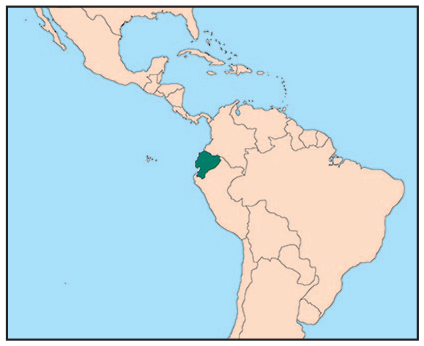
This paper describes the role of long-term intergenerational processes in increasing or reducing inequality in Indio Guayas, a low-income peripheral settlement in Guayaquil, Ecuador. Central to understanding these processes is recognizing the importance of family social capital, regardless of the location of family members, as against household social capital, which is based on socio-spatial relations. The paper draws on unique longitudinal trend data over 40 years, and the narrative voices of three women and their families over this period up to 2018. The key theme relates to the importance of the intergenerational reciprocity among mothers, daughters, fathers and sons, and the way different family trajectories address the challenges of inequality at this micro-level. This introduction poses two questions that underlie the paper.
a. Poverty or inequality?
Despite unprecedented growth in wealth in cities of the global South over the past 20 years, three-quarters of these cities were more unequal in 2016 than in 1996,(1) a situation that the COVID-19 pandemic is likely to exacerbate. Prior to the pandemic, while pockets of extreme urban poverty persisted, particularly in Asia and Africa, absolute poverty levels were generally declining.(2) Simultaneously, some cities in the global South were experiencing deepening inequality not only in traditional areas such as access to land and property, gender inequity, ethnic and racial discrimination, and informality,(3) but also in such “emerging” trends as extreme elite wealth, middle-class stagnation, privatization, immigration and insecurity. Inequalities have also been evident in voice and participation for rights and social justice.(4) As was true for urban poverty, research on inequality tends to focus on short-term “static snapshots”.(5) Just as important, however, is the role that long-term intergenerational processes can play in increasing or reducing multidimensional inequality. This paper seeks to contribute to a better understanding of such processes, with particular emphasis on the importance of family social capital.
It addresses this through a unique case study in Indio Guayas – which I undertook through some 15 research visits over the past 40 years, always living in the community. The resulting research included a 1978–1992–2004 trend dataset, in-depth studies over the decades, and a further round of research in 2018. The original case study used “narrative econometrics”, combining the econometric measurement of quantitative panel data with in-depth anthropological narratives to identify the strategies of households moving out of poverty and asset vulnerability and towards asset accumulation. In the book Ordinary Families, Extraordinary Lives,(6) I developed an asset framework that measured household capital assets relating to physical capital (including housing), human capital, financial capital and social capital. The longitudinal panel dataset allowed for trend comparisons that demonstrated the way different assets accumulated or were eroded.(7) Following in the footsteps of legendary urban anthropologist Oscar Lewis, who in the 1960s and 1970s recounted the lives of five poor families in urban Mexico on a single day,(8) the anthropological narrative from Indio Guayas was provided by the voices of five women and their families, in this case over 30 years.(9)
Further research in 2018, with three of the same families, extended the study. This introduced a new methodology in the form of the documentary film Calle K, made by my son and me. These filmed interviews provide in-depth insights into the lives of these three representative families, which live, or used to live, on the same Indio Guayas street, illustrating their different intergenerational trajectories and strategies as they address the challenges of inequality. Of the two women not included here, one was working in Barcelona, and the second was experiencing family substance abuse problems similar to those in one of the filmed families.
b. Household social capital or family social capital?
The paper also seeks to contribute to the debate concerning conceptualizations of social capital, in particular the difference between household and family social capital. While household social capital is a socio-spatial concept, family social capital concerns social relations irrespective of location. Recently the credibility of the concept of social capital has been called into question – partly because of its association with the World Bank, which perceived it as “the glue that holds society together”, (10) and partly as a consequence of a critique linking the concept to neoliberal economics and the paring down of the state.(11) It has, subsequently, been superseded by such concepts as urban social movements (revisited) and co-production.(12) This paper seeks to reaffirm the robustness of the concept, particularly in relation to family social capital.
As an intangible asset, social capital has been highly contested.(13) Its conceptualization was based on the theoretical work of such Northern scholars as Bourdieu,(14) Coleman,(15) Putnam(16) and Portes,(17) and Southern scholars such as Souza.(18) It is generally defined as the rules, norms, obligations, reciprocity and trust embedded in social relations, social structures and the institutional arrangements that enable society’s members to achieve their individual and community objectives. Social capital is identified as embedded in social institutions at the micro-level of communities and households, as well as referring to the rules and regulations governing formalized institutions in the marketplace, the political system and civil society.(19)
The Indio Guayas study further theorized the concept by differentiating between two levels: community social capital, the trust and cohesion within communities essential for mobilization for basic services; and household social capital, the trust and cohesion in intra-household structures.(20) The identification of social capital at the household rather than family level reflected that the family unit, based on kinship, marriage/partnership and parenthood, should not be conflated with the household,(21) a residential unit based on co-residence for “production, reproduction, consumption and socialisation”.(22) The longitudinal 1978–2004 research measured how household social capital had increased over time, while community social capital declined (as elaborated below).
Mercedes González de la Rocha’s longitudinal anthropological study in Guadalajara, Mexico (1980s–1990s, with further research in 2011) introduces a comparative urban Latin American perspective, also with intergenerational family data and an asset framework. She did not use the term social capital, however; nor did she distinguish between household and community. Rather, following Larissa Lomnitz,(23) she used the term social exchange, defined as the transfer of information, goods and services (favours) among friends, relatives and neighbours.(24) Within the Mexican macroeconomic “crisis” context, her research showed increasing poverty and erosion of assets within households, a shift from the “resources of poverty” to the “poverty of resources”. An associated “crisis” in social cohesion accompanied a decline in community trust and solidarity.(25) By 2011, social exchange had eroded within the family to become a commodity, with monetized favours and payments replacing the help formerly available through social relations.(26)
The 2018 research in Indio Guayas highlights comparable questions about the commodification of family social capital. It also explores distinctions between family and household social capital. Over the life course, households and families change, and kinship ties often stretch over space. Does family social capital then become more important in addressing inequality? The intergenerational narratives from Calle K examine these questions.
II. 2018 Methodology: Documentary Film as Research Data
The longitudinal Indio Guayas study was expanded by additional fieldwork in 2018, part of the longitudinal research process but also part of a long-term film process. Lewis, Rodgers and Woodlock raise the challenging issue of the relationship between research and media as forms of knowledge, maintaining, “The public learn more about cities in the global South through ‘popular’ or ‘public’ representations than through research and policy documents, or simplified news reports.”(27) This has been a methodological issue throughout my research. In 1978, undertaking the first fieldwork in Indio Guayas, then an illegal settlement on the mangrove outskirts, I lived in a four-by-eight-metre bamboo house on Calle K, with my then husband, filmmaker Brian Moser, and sons Titus and Nat. On completing research in 1980, we made a documentary film, People of the Barrio, for UK television.(28) This visual representation of the survival struggles of an urban community in the global South recorded how the Indio Guayas committee – led by its leader, Emma Torres – contested, negotiated and collaborated with the state and other institutions to obtain basic physical and social infrastructure. Using film based on anthropological research, its intention was to influence popular representations of the portrayal of urban poor people, challenging such sensationalized presentations of misery as Louis Malle’s documentary Calcutta, and debunking prevalent stereotypes of urban slum dwellers as living in a “culture of poverty”(29) and urban slums as “hotbeds of revolution”.(30) Instead, People of the Barrio portrayed the poor in Indio Guayas not as marginal,(31) although marginalized by wider structural constraints, and not as passive victims, but organized, with their own agency.(32)
In 2018, I revisited Indio Guayas with my son Titus Fossgard-Moser, his first return visit in 40 years, to see what had happened to old neighbours and their children. In a co-production with Lucy Zavala, Emma Torres’s elder daughter,(33) and community members, we produced a new documentary film, with Titus as director, and me as social anthropologist. The film Calle K provides a unique visual narrative, cross-cutting footage from People of the Barrio with 2018 footage, to show the physical transformation of the barrio from a peripheral slum to a consolidated settlement. It also narrates the remarkable stories of the three families, key protagonists in both the earlier film and the longitudinal study.(34) Calle K documents the ways they have grasped education and employment opportunities, confronted corruption and stigma, and overcome challenges like drugs and violence in a changing 21st-century city.(35) Like the earlier film, Calle K refuted popular sensationalized research representations of global South cities, epitomized by Mike Davis, who conjectured, “Perhaps there is a tipping point at which the pollution, congestion, greed and violence in everyday urban life finally overwhelm the ad hoc civilities and survival networks of the slum.”(36)
In 1978, research data had informed the film. In a reversal in 2018, issues raised by family members in the film informed the research. On-camera semi-structured and open-ended interviews by Titus and me provided the core narrative data, complemented by Lucy. Family members, who had known us since 1978, felt a high level of trust. They were often unexpectedly spontaneous on camera, revealing personal issues in car journeys and informal settings, allowing us to move from one family member to the next, instinctively following up on issues raised. The so-called “voices of the poor”(37) were heard in participatory film, and this new methodological approach to my Guayaquil research was very different from the more common participatory research approaches.(38)
III. Shifts from Poverty to Inequality in Guayaquil: 1978–2004
The “narrative econometrics” methodology of the 1978–2004 longitudinal study in Indio Guayas comprised, as noted, the two complementary components of anthropological narrative and quantitative panel data on poverty, inequality and asset accumulation. This section sets the scene by briefly summarizing the panel data. First, it shows poverty levels gradually declining over this period, and inequality becoming more important. Second, it describes asset accumulation trends, not only physical and human capital, but of particular significance, the changing relative importance of community and household social capital.
The longitudinal 1978–1992–2004 panel data tracked shifts over a 26-year period. As in González de la Rocha’s 2020 Guadalajara study,(39) the proportion of first-generation households in income poverty increased between 1978 and 1992 (from 84 per cent to 88 per cent). This was a reflection of the Ecuadorian economic crisis. Between 1992 and 2004 the trend changed, and many households climbed out of income poverty (which dropped from 88 per cent to 61 per cent of the research population). Thus between 1978 and 2004, the proportion of non-poor households more than doubled (from 16 per cent to 39 per cent). Simultaneously, income inequality began to increase. The Gini coefficient in the longitudinal panel data grew from .322 in 1978 to .437 in 2004.(40) Between 2004 and 2018, an economic boom period in Ecuador, the city of Guayaquil expanded and modernized, and Indio Guayas changed from a peripheral squatter area to a consolidated suburb in the city. No further panel survey was undertaken in 2018, but the anthropological narratives provide evidence of increasing differences between families in terms of intergenerational inequalities, as described below.
The panel data also measured how households’ accumulated capital assets changed. Housing was consolidated first, as bamboo huts on water were incrementally upgraded and land titles acquired. In 1978, 2 per cent of households had land titles; by 2004 it was 80 per cent, the majority in both men’s and women’s names. Housing was the necessary precondition for the accumulation of other assets, including educational human capital, with parents generally prioritizing children’s education over the purchase of consumer items. Both daughters and sons were better educated than their parents (6 per cent of parents had completed high school, compared to 45 per cent of their children), and daughters were better educated than sons.(41)
A third critical capital asset was social capital. Community social capital proved essential for the 20-year community contestation and negotiation process, led by Emma Torres, for both physical infrastructure such as infill for roads, water, electricity and sanitation, as well as social infrastructure, including healthcare centres and secondary schools. With the successful completion of this upgrading process and the termination of international NGO (INGO) support, community organization (and the importance of community social capital) declined by 2004, as has been common in many urban community mobilization processes. Simultaneously, household social capital increased, both as an accumulation strategy and to cope with the privatization of such social services as childcare facilities. Both required complex household divisions of labour among female members to balance reproductive and productive activities.(42)
IV. Intergenerational Family Social Capital and Inequalities
This section turns from the econometrics to the narratives of the three extended families between 1978 and 2018. It identifies their intergenerational reciprocity over time and space, highlighting how family social capital influenced pathways to address or confront multidimensional inequality.
In 1978, Emma(43) was a 26-year-old dressmaker and leader of the Indio Guayas barrio committee, living with her husband, a tailor, and two young daughters, Lucy and Mayi, on a waterlogged plot on Calle K. Directly across a perilous wooden walkway was Rosa with her husband, Julian, another tailor and informal dental technician, and their two young children, Johnny and Marie Lux. Four doors down from Emma was Carmelina, a 36-year-old washerwoman and single mother with seven children, of whom one was Patricia. Like most on Calle K, other than Carmelina, Rosa and Emma were married or in consensual unions, living in nuclear families. Their lives confirmed the importance in Latin America of the institution of marriage, the family and children as central to social and economic life.(44) These women, with their husbands, provided the narrative of what Cecile Jackson(45) termed “creative conjugality” as parents – putting their children through school, earning a living, and contesting local authorities for services.(46)
Remarkably, 40 years later, in 2018, the same families still lived on the same plots; Rosa and Carmelina lived with their children in three- or four-generation families. Emma died in 2011, and her younger daughter, Mayi, with her husband and two children, then occupied the house while the elder daughter Lucy had moved to Buena Vista, a middle-class area of the city. In focusing not only on temporal changes in physical and social infrastructure, such as streets, electricity and schools,(47) but also on family changes, the Calle K film unwittingly captured the critical importance of intergenerational family relationships, which became the film’s dominant theme. This showed that by 2018, intergenerational family social capital was the necessary precondition for second- and third-generation family members to accumulate other capital assets, simultaneously revealing the strengthening, rather than weakening, of ties among mothers, daughters, fathers and sons (Figure 1).
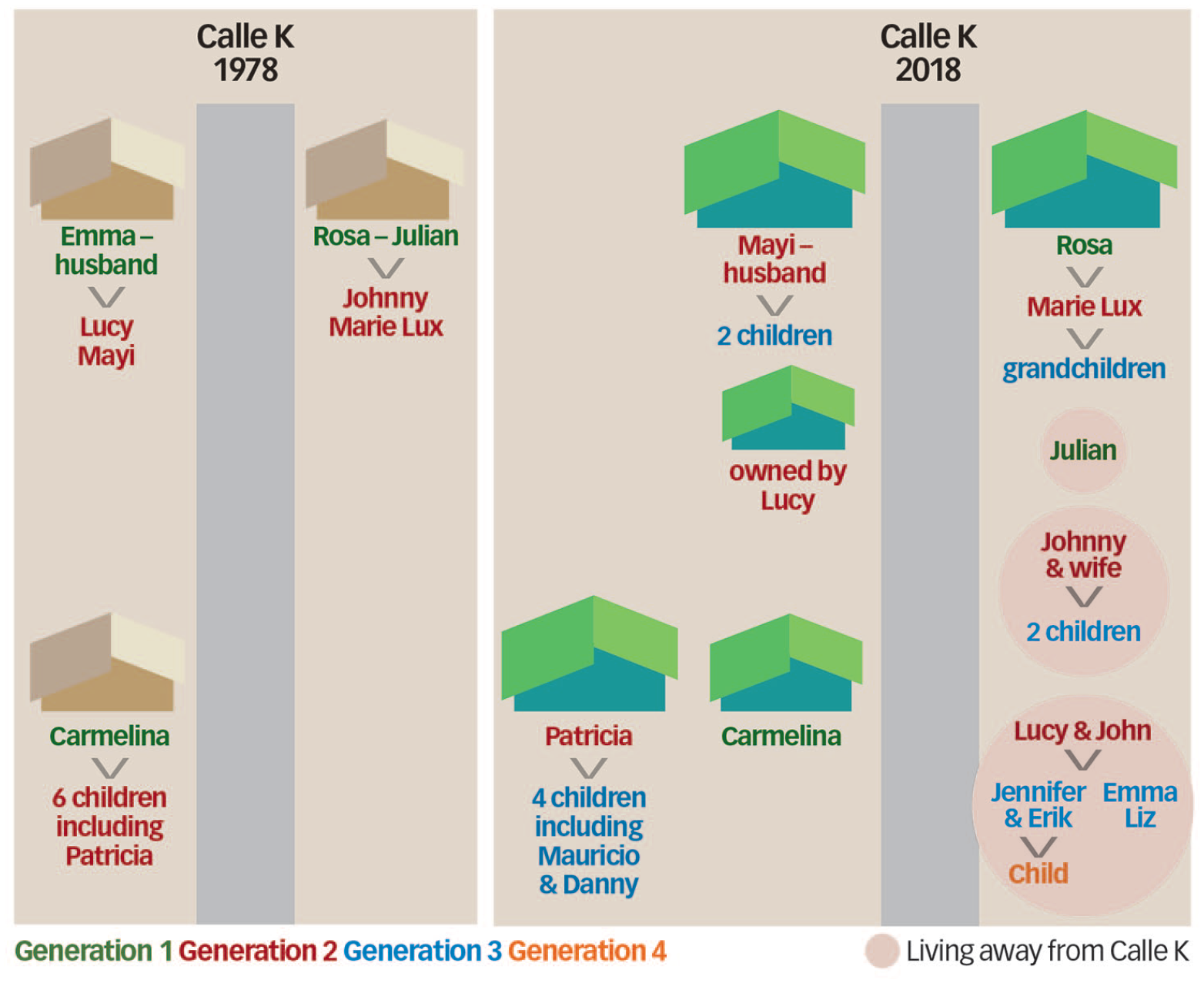
Calle K families in 1978 and 2018
a. First-generation mothers and daughters: Emma, Lucy and Mayi
As mothers, women in Indio Guayas had triple roles.(48) In their “reproductive” role they had primary responsibility for their children’s care; in their “productive” roles they undertook informal economy activities; and as “community managers”, and Indio Guayas committee members, they mobilized politicians, exchanging services for votes. Emma, as community leader, was crucial in building and sustaining community social capital to get results. However, she was criticized by some women neighbours, who felt trapped, staying at home with their children, and were envious of Emma’s political activities. “She neglects her children. . .[they] are badly brought up, they just run around the streets”.(49) Yet Emma, who had left school at 12 (gaining a night school high school diploma in the 1980s), also prioritized her daughters’ education. Both daughters completed private Catholic high school and continued on to state university. Mayi obtained an industrial psychology degree, and Lucy dropped out to get married. In 2018, both daughters remained proud of their mother’s contribution to the community’s achievements. As Mayi commented: “One has to keep going, to continue with the legacy my mother left. It’s gratifying that wherever we go they always remember how much my mother fought for the neighbourhood: bridges and water, infill on the water, sewage, everything, electricity. Everyone remembers her.” (Calle K)
Lucy took over Emma’s responsibility as an “informal” community leader, providing advice to second-generation women who were contesting claims and rights, including land titles, wills and divorce. Because numerous Indio Guayas residents migrated to Barcelona for employment in the early 2000s, Lucy and I visited there in 2005 to research second-generation kids from Calle K and Lucy’s school friends.(50) After this visit, Lucy provided transnational advice to migrant women originally from Calle K, now working in Barcelona, but with legal problems in Guayaquil.(51) Explaining the increasing importance of family social capital over the two generations, in 2018 she commented: “Mummy supported the whole community and her family. She fought not only for herself, but for the whole community. Because those were the necessities at that time. The difference now is that I have had to fight for my family.” (Calle K)
b. Second-generation mothers and their daughters: Lucy, Jennifer and Emma Liz
For Lucy’s daughters, Jennifer and Emma Liz, intergenerational family social capital fundamentally influenced their accumulation of both human capital and housing physical capital. Education was Lucy’s and husband John’s first priority, as she explained in 2018: “One of the most important things for us has been the education of our daughters. It’s the most important way of advancing. We’ve always felt that they must have a better education than we did in order to succeed in life.” (Calle K)
Both daughters completed private high school education followed by university. Jennifer graduated with a business studies degree at a private university, paid for by her parents. For younger daughter Emma Liz, who wanted to study medicine, this was not straightforward as her parents could not afford the many years of private-sector fees.
The University of Guayaquil, however, highlighted the complexities and inequalities in access to public-sector education. The challenge of accessing a place on the highly competitive medical course was overcome through Lucy’s acumen regarding the public sector, learnt from her community leader mother. She and John slept at the university’s entrance door for three days and nights, until Emma Liz finally managed to enter, take the examination and get a place. The corruption in the state tertiary education system increased the costs of studying, however. As Lucy explained in 2018: “There are corrupt professors who do not approve completion of a course and want to charge the kids. . . it’s not like school, a parent can’t come and protest. And if they do protest, the kids don’t progress to the next year. So, in order to move from one year to the next, from one course to another, you have to pay something.” (Calle K)
Lucy confirmed that even when students successfully completed a year, passing the tests, a further “monetary consideration” was required for them to move to the next year. By 2018, Emma Liz had finally reached her internship as a medical doctor and was due to complete the following year.
For Lucy, the strategic importance of housing physical capital was closely interlinked with education human capital. In her case this involved not just upgrading their house, but relocating to a “better” middle-class neighbourhood in the city because of the stigma associated with such low-income areas as Indio Guayas, given their violent reputation. As she explained in 2018: “One of the reasons we bought land here. . .to then build this house was for my daughters. My husband and I thought they needed a better place to live where they could bring their friends to visit. A place which would also offer better opportunities. If you want to look for a job, it’s much better to give this address than that of the suburbios. Because people have a belief that the suburbio is not good. Jennifer once sent an application giving that address. When she did the interview, everyone asked the address and said mmmm. . .” (Calle K)
Until her marriage, Lucy lived in her parents’ house on Calle K. Emma then gave her the adjoining smaller house (where we lived in 1978), which Lucy upgraded with an additional storey. Moving out of her childhood neighbourhood was a profoundly difficult decision for Lucy. Despite extended family, innumerable neighbours and old schoolfriends on Calle K, Lucy prioritized the status and security of her daughters over spatial proximity to support networks. Her intention, in Guayaquil’s stratified class structure, was to facilitate their entry as professionals into the clase media (middle class). This has increased the distance between her daughters and their cousins on Calle K. Jennifer now works as an economic analyst in a commercial bank, and is married to a co-operative bank official. Nearly qualified Emma Liz is married to a doctor from a prestigious family in a secondary city. Despite the move, Lucy retains close links to Calle K. She rents out her house there, visits family frequently and is involved in community activities, particularly those associated with the memory of her mother, while husband John leverages their networks as a local financier.
As in Indio Guayas, Lucy’s household is multi-generational. Along with Emma Liz, Jennifer, her husband Erik and their small baby all live there, despite buying a small house in a new gated community. While considered safe and avoiding the stigma of Indio Guayas, this house is distant from the city and family and too far away to live in, so it is rented as an investment. Like her mother a generation ago, Lucy recently has assumed childcare responsibilities for her daughter, so the higher-earning Jenifer can contribute to the family economy.
c. Four-generational families: Carmelina and her six daughters (and three sons)
If Lucy is atypical in leaving Indio Guayas to enhance her daughters’ opportunities, in 1978 Carmelina, a 26-year-old washerwoman, was atypical on Calle K as the only single mother. For over 40 years she struggled to bring up nine children alone, but then enjoyed care and financial support from her children after she ceased paid employment (Photo 1).
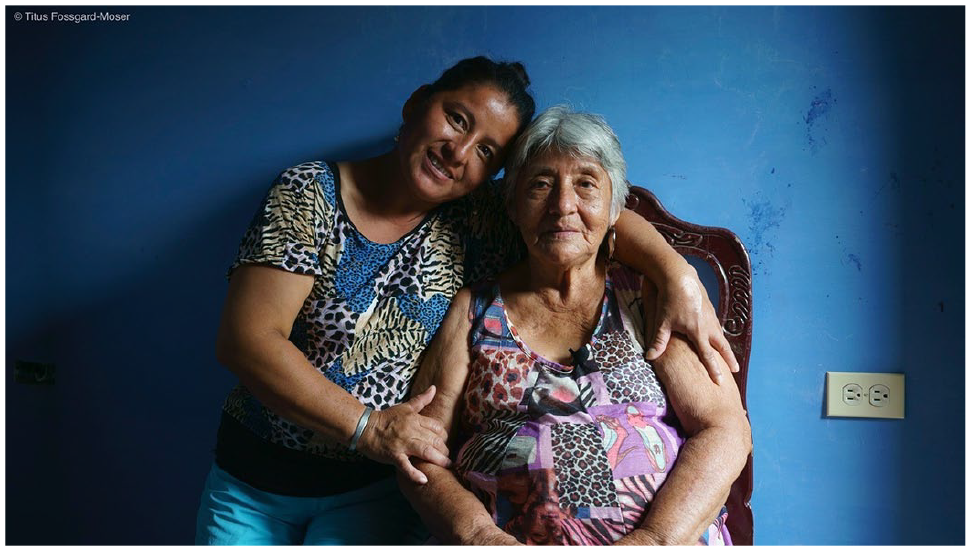
Carmelina and Carolina
Carmelina acquired her plot in 1975 when her husband abandoned her for another woman. Swapping a more valuably located plot with a fallen-down house, the move to Indio Guayas was a new start, although she subsequently had two more children by her ex-husband under coercive circumstances. As she commented in 1981: “I didn’t have those other two children through my will; it was against my will. He threatened to beat me up. He said that if I didn’t want to be with him that meant I had another man. I had those two other babies because I needed the money.”(52)
Through years of struggle, women neighbours supported her with food and clothing, while the provision of building materials from a programme of the INGO Plan International, managed by Emma and her committee, assisted her to upgrade her bamboo-walled structure to a solid larger block house. To support her children, Carmelina progressed from piecework washing to regular in-house washing for affluent families. Her children all attended local state schools but only daughter Patricia completed high school.
Over the decades her extended household expanded and contracted as children, single or partnered and with their own grandchildren, moved in and out of the family house. During the 1980s, when 18 family members lived there, Carmelina sold a section of the plot to address a financial crisis; in the 1990s, her eldest daughter returned with her three children to manage the 11-member three-generation household, with Carmelina providing the income. By 2004, Carmelina was still income poor, but asset rich in terms of the human capital endowments of 9 children and 27 grandchildren, living in separate space on her plot or nearby. Despite their own family commitments, her children began to support her. On Mother’s Day in 2005 they jointly bought her a washing machine. One daughter, Sarita, commented: “Our mother spent 30 years as a washerwoman so as to support us. Surely this is the best way we can repay her.”(53) Looking back on her life in 2018, Carmelina vividly remembered the early days in Indio Guayas, the shame of her husband’s behaviour, and her desperate poverty. “That’s the time when I didn’t have a job and the father of my children lived without shame. That’s when I began to wash other peoples’ clothes. . .My life was very hard. But after I worked, thanks to the Lord, then my life changed; then I had food for my children. Sometimes they gave me clothes where I worked. I was given what was left over. We more or less survived, but life was very hard.” (Calle K)
By 2018, Carmelina’s nine children continued to live close by, providing coordinated support for their mother. Carmelina’s house was subdivided into four separate areas for her, her two youngest adult children, Darwin and Erica, and grandson Mauricio. At the back of the plot Patricia had constructed a separate house. Erica was now responsible for daily household management, and the others, including daughter Carolina, provided financial support and visited on weekends. In 2018 Carmelina recounted the reciprocity between herself and her children.
“I kept working as long as I could and I fought for my children, who have grown up and now work. . .When they already worked, they said ‘Mummy, you are not going to work anymore because we are grown up. Now we are working to help you.’ And that’s where my life changed. I can now rest in the house while they go to work.” (Calle K)
In 2017, Carmelina survived colon cancer treatment, with the care of her daughters and financial support from all her children. In September 2019 the film premiered in Guayaquil in her presence. However, after COVID-19 struck, Carmelina did not survive what was identified as an inflammatory condition, despite hospitalization, and was buried in Guayaquil’s main cemetery just before lockdown. The film Calle K remains a memorial to her extraordinary life and resilience.
d. Second-generation mothers and sons: Patricia, Mauricio and Danny
In many respects Patricia, Carmelina’s middle daughter, despite being the only one in her family to complete high school education, repeated her mother’s cycle of single parenthood, numerous children and low-skill employment. However, Patricia’s sons, third-generation young men living in 21st-century Guayaquil, presented her with different challenges. In 2018 Patricia reflected on the difference: “For both of us life has been intense with great sacrifice. But my mother didn’t live through what I did with my last two children. The problem of drugs. This is intense. This is sad and it is very painful. When one is alone…so, I had to fight and thanks to God, moved forward.” (Calle K)
Like so many women, Patricia gave up plans for university study when her first son was born as her husband did not want her to study or work. She had four sons in quick succession while living with her husband in his mother’s house. Financial conflicts and domestic abuse led her to return to her mother’s house with her sons. She took in washing, like Carmelina before her, subsequently cooking in a local restaurant, and then in a senior citizens’ facility in the city centre. With support from a housing NGO, she constructed a separate bamboo house behind her mother’s house. When this caught fire, the local evangelical church helped out with rebuilding materials. Like her mother, she raised her sons on her own, frequently leaving them alone while she went to work.
Tragically, when her third son, Mauricio, was alone in the house aged six, a kerosene heater fell over and set alight the bamboo-walled house. Mauricio escaped, but the guilt affected his mental health, and he attributed the beginning of his drug problems to this event: “From that time onwards I stopped talking, laughing; a serious person. I took refuge in solitude; I didn’t trust anyone. My family did not know how to help me. I didn’t let them help. . .I entered the world of drugs.” (Calle K)
Whereas alcohol addiction was particularly problematic for first-generation men in Indio Guayas,(54) by the second and third generations it was drugs, particularly “H”,(55) widely and cheaply available along with cocaine paste and other chemical drugs, sold in local schools and streets. Mauricio started using drugs around 12 years old. He was not alone. In 2018, a local evangelical pastor called drug addiction “a plague”, commenting that almost every family in Indio Guayas had at least one drug-addicted member.
Mauricio described his drug addiction and treatment in the following stark terms: “I consumed until I was 17 years old until I realized. . .I was reaching the bottom. And thanks to God and my family, my mother, who is my fundamental pillar, she has helped me a lot. . .In tears I told her I want to change. So, I took the decision to find Dr Jenny and I arrived here on October 3. I was interned six months and a week. After four months my mother came for my ‘confrontation’.” (Calle K)
Mauricio overcame his addiction, with support from his mother and the drug rehabilitation centre where Dr Jenny worked. His mother and the evangelical church each paid half of the $1,000 fee. Guayaquil has experienced a rapid growth of rehabilitation centres,(56) many of them criticized as little more than prisons, locking away addicts cold turkey for extensive periods in atrocious conditions. However, some, like the state-registered centre Mauricio attended, appeared to represent, according to Bargent, “a genuine attempt to help addicts with little resources”.(57) Reflecting on his current situation, Mauricio stressed the importance of family, both his mother’s and his own new family: “I now have a family, a wife, my son. And I feel very happy because, thanks to God, I have something. In the past I lost a lot. I lost my family. Today I have my family.” (Calle K)
While Patricia’s third and fourth sons both struggled with addiction, and her second son was a local construction worker, her eldest son Danny, Patricia’s success story, became a police officer. As with other young men from modest backgrounds, this started with military service under selective conscription, followed by a lengthy entry process into police training school, in which Patricia played a critical persuasive and financial role.
Danny by 2018 was a serving policeman in Guayaquil. Ironically, one of his main tasks included policing drug use in the city, a complex issue since the 2008 Constitution of Ecuador had legalized the possession of small amounts of drugs for personal consumption as against a “trafficking amount”.(58) Grounded in his personal knowledge of his brothers’ drug consumption, and streetwise from growing up in Indio Guayas, Danny had a strong opinion about the policy.
“I believe the Correa government was wrong to legalize drugs. I think the percentage he made legal was wrong. Because some people use that amount to say they are a user. . .This has affected our work a lot. . .if we find a person that we want to take into custody. . .but he can claim he’s a user…since it’s allowed to have an amount of drugs for personal use.” (Calle K)
Danny believed the policy change gave micro-traffickers or larger-scale traffickers the freedom to expand their markets, maintaining that if it was legal to have more, they would sell more. Reflecting on his work, and the constant temptation for young men like his brothers, Danny concluded: “The sector will become more dangerous for us; and the young people will fall from the influence of drugs.” (Calle K)
e. First-generation fathers and sons: Julian and Johnny
So far, in each of the intergenerational narratives, the role of mothers has predominated. This is not surprising; mothers in Indio Guayas were close to their daughters, though also to sons, particularly in families without daughters. This was not necessarily the case for fathers and their sons. In 2009, drawing on young men’s focus groups, I commented that they considered parents to favour daughters, while sons were supposed to be independent.(59) The story of Julian and his son Johnny is thus remarkable in terms of their intergenerational reciprocity over 20 years, during which the father helped his son to become a dentist, while subsequently the son helped his father to complete his own dental training (Photo 2).
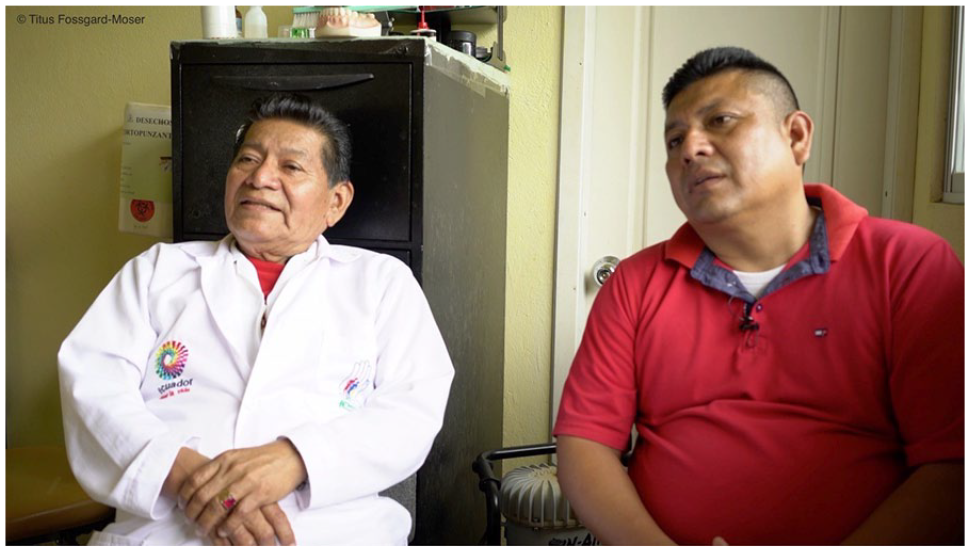
Julian and Johnny
In 1978, Julian was a tailor and informal dental technician living with wife Rosa and their two young children directly across the walkway from Emma. Julian always aspired to be a professional dentist and went to enormous lengths to succeed, completing high school at night school and starting to study dentistry at university. Forced by financial constraints to quit in 1987, he transferred his aspirations to his son Johnny, who successfully graduated from Guayaquil University as a dentist. Yet Julian did finally graduate, as he recounted in 2018: “I graduated when I was 60. To become a dentist at 60…it’s hard. Life is hard. . .I was studying, but my son started school too, so I retired from the university. He also started at the university. He was successful and graduated as a dentist. And he said, ‘Dad, now it’s your turn to study’. I feel fulfilled. People are very grateful to me because, both personally and professionally, they feel well looked after. That makes me happy.” (Calle K) Johnny recognized his modest roots and his parents’ help in his upward mobility. “One comes from below. Well, in one’s mind, it’s true, we lived in poverty. I never thought I would get ahead. With the help of my father, of my mother. They knew how to get ahead. . .and gave me the encouragement and support to continue studying.” (Calle K)
He had the strength of mind to successfully complete his studies and then repaid his father by supporting him to formalize his informal skills and complete his studies. He then found him a government position in the Rural Social Security System (Seguridad Social Campesino) in a small rural health service in the same province where he, Johnny, worked.
Julian’s wife Rosa remains in the modestly upgraded family house on Calle K with her daughter and grandchildren, while Julian, now 68, rents a room in the small village where he works, with the bus his link to Guayaquil. In contrast, Johnny has his own private dental consultancy in the small mining town of Yantzaza (population 6,000) in the Ecuadorian highlands. Working, like his father, in the public sector, he specializes in orthodontics, and lives comfortably with his professional wife and two children in a large house, driving to work in his 4x4 vehicle. Johnny is aware that both good fortune and hard work contributed to his success.
“I am very grateful to this town which opened its doors to me. I came here 20 years ago. Nobody knew me. I came as a 24-year-old. . .unmarried, no children. . .no friends, nothing. Yantzaza opened the doors and I was able to establish my consultancy. . .And I began to save. I did not waste it. I didn’t say I’m going to drink and have fun. I saved. . .and I started studying a specialty, orthodontics. Yantzaza gave me everything I needed.” (Calle K)
Johnny made some strategic decisions, not only to acquire his extra qualifications in orthodontics, but more importantly to leave Guayaquil, with its rigid social structures, stigma and employment barriers. When asked what would have happened had he stayed in Guayaquil, he summed it up as follows: “It wouldn’t have been the same. No, because there is more competition. I learnt many good things at the university. . .But Guayaquil is Guayaquil.” (Calle K)
V. Concluding Comments
It could be argued that, because it made for inspiring narratives, this paper, like Calle K, has been biased towards families with successful intergenerational stories. There were certainly other families in the same street struggling with such issues as poverty, divorce, alcoholism and the deaths of elderly family members. Yet even among these three families over the years there were challenges: not only drugs, but also unemployment, abandonment and conflicts around inheritance. Space has necessitated the contraction of complex family histories; it is sufficient to say that family members modestly recounted memories of hard lives.
At the same time, the stories behind the econometric inequality evident in Gini coefficient statistics illustrate the strategies families adopted to proactively confront the challenges and inequalities encountered. The evidence suggests that intergenerational family social capital profoundly affected their success in addressing structural blocks in their quest to accumulate the necessary capital assets to achieve professional status. In a context where student demand exceeded spaces available, second-generation mother Lucy slept outside the university to get Emma Liz into medical school. Patricia, meanwhile, applied three times before getting her son into police training school. Both dealt with the widespread corrupt practice of paying bribes to move their children through state institutions in Guayaquil.
Access to professional employment opportunities was also blocked by the stigma associated with Indio Guayas home addresses, causing Lucy to move to a middle-class neighbourhood. In Johnny’s case, he moved to a smaller town that provided the opportunity to become a middle-class professional, far beyond the possibilities in Guayaquil. With intergenerational family job reciprocity, he then assisted his father to formalize his informal skills, becoming a professional dentist.
González de la Rocha maintained that by 2011 in Guadalajara, social exchange within the family had eroded to become a monetized commodity.(60) Yet this was not the case on Calle K in 2018, even among poor families like Carmelina’s. Certainly, since 2004, Ecuador, unlike Mexico, has experienced a buoyant economy, with the astute Mayor of Guayaquil investing in urban modernization and physical and social infrastructure.(61) While this created more job stability and opportunities, it would be incorrect to attribute the strengthening of intergenerational social family capital entirely to the wider financial environment. By 2018, these three families on Calle K had produced two dentists, an economic analyst, a police officer, a social worker and an intern-level doctor. They also represented the downside of Indio Guayas: the so-called “plague” of drug addiction. At the same they demonstrated the importance of intergenerational family support structures, in which mothers like Patricia helped ensure their sons’ successful drug rehabilitation.
Learning about the complicated and crucial intergenerational reciprocities of mothers, daughters, fathers and sons has led me to reflect on my conceptualization of household social capital as a socio-spatial concept in earlier work,(62) and to recognize its limitations for long-term processes, where it is family social capital that is more likely to survive, irrespective of spatial location. This calls for the consolidation of research on transnational families that retain strong family social capital while spatially distant.
Postscript: Intergenerational Family Social Capital in the Time of COVID-19
How will coronavirus affect these families, each with its complex intergenerational relationships? Will it result in further accumulation of family or community social capital or the erosion of both as Guayaquil succumbs to the pandemic? Journalists state that in April 2020 Ecuador had the highest death rate in Latin America, primarily in Guayaquil. TV footage shows hundreds of dead bodies kept in homes or wrapped in sheets dumped on the roadside, cardboard coffins and cemeteries no longer able to bury them. This catastrophe highlights city-level inequalities, with the elite able to access services and protect themselves, while the poor, in overcrowded conditions, unable to work or maintain social distance, are far more badly affected.(63) In describing how she had to “fight for her family”, encountering corruption and bribery, Lucy unwittingly foretold the inability of a dysfunctional state, with a collapsed public health system, to cope with this appalling pandemic. Reinforcing the evidence in this paper, families have to cope with COVID-19 mostly on their own, with limited government support.(64) Yet even at the micro-level of Calle K, differences in income, information and access to medical and other resources are differentially affecting families. There are inequalities not only between the elite and the poor, but also within communities like Indio Guayas.
Just as a housing crisis in the early 1970s precipitated the development of the Committee Indio Guayas with Emma as its leader,(65) so too the current COVID-19 pandemic has witnessed community-level altruism to help those most affected – even if very limited. It remains to be seen whether such civil society organization revives further during the crisis or sustains itself once the pandemic is over.
Footnotes
Acknowledgements
My greatest thanks and appreciation to my son, Titus Fossgard-Moser, for his conviction to return to Calle K and for his direction of Calle K, as well as to Lucy Zavala, co-producer, and the Zavala Torres and Tomala families on Calle K. Special gratitude, as well as condolences, to the Gutiérrez family on the death of Carmelina during the COVID-19 pandemic. Finally, thanks to Cathy McIlwaine, David Satterthwaite, Peter Sollis and Alfredo Stein for insightful comments, as well as to the two anonymous reviewers.
2.
3.
Mitlin, Diana (2012), “Editorial: Addressing poverty and inequality; new forms of urban governance in Asia”, Environment and Urbanization Vol 24, No 2, pages 395–401.
4.
Fainstein, Susan (2010), The Just City, Cornell University Press, Ithaca, NY, 212 pages; also Levy, Caren (2019), “A response to rising urban inequality: Knowledge for Action in Urban Equality”, DPUNews Vol 64, London, Development Planning Unit, University College London, pages 2–5.
5.
Moser, Caroline (2009), Ordinary Families, Extraordinary Lives: Assets and Poverty Reduction in Guayaquil, 1978-2004, Brookings Press, Washington, DC, 360 pages.
6.
See reference 5.
7.
See reference 5.
8.
Lewis, Oscar (1961), The Children of Sanchez: Autobiography of a Mexican Family, Random House, New York, 599 pages; also Lewis, Oscar (1975), Five Families: Mexican Case Studies in the Culture of Poverty, HarperCollins, New York, 210 pages.
9.
See reference 5, page xv.
10.
Narayan, Deepa and Lant Pritchett (1997), Cents and Sociability: Household Income and Social Capital in Rural Tanzania, Policy Research Working Paper 1796, World Bank, Washington, DC; also World Bank (2001), World Development Report 2000/2001: Attacking Poverty, Oxford University Press, New York, 335 pages; and Woolcock, Michael (1998), “Social capital and economic development: toward a theoretical synthesis and policy framework”, Theory and Society Vol 27, No 2, pages 151–208.
11.
Fine, Ben (1999), “The developmental state is dead: Long live social capital?”, Development and Change Vol 30, pages 1–19; also Harriss, John (2002), Depoliticizing Development: The World Bank and Social Capital, Anthem Press, London, 162 pages.
12.
Ostrom, Elinor (1996), “Crossing the great divide: coproduction, synergy and development”, World Development Vol 24, No 6, pages 1073–1087; also Mitlin, Diana and Sheridan Bartlett (2018), “Editorial: Co-production – key ideas”, Environment and Urbanization Vol 30, No 2, pages 355–366.
13.
Bebbington, Anthony (1999), “Capitals and capabilities: a framework for analyzing peasant viability, rural livelihoods and poverty,” World Development Vol 27, No 12, pages 2021–2044.
14.
Bourdieu, Pierre (1993), Sociology in Question, SAGE Publications, London, 192 pages.
15.
Coleman, James S (1988), “Social capital in the creation of human capital”, The American Journal of Sociology Vol 94, pages 95–120.
16.
Putnam, Robert D, Robert Leonardi and Raffaella Y Nanetti (1993), Making Democracy Work: Civic Traditions in Modern Italy, Princeton University Press, Princeton, 282 pages.
17.
Portes, Alejandro (1998), “Social capital: its origins and applications in modern sociology”, Annual Review of Sociology Vol 24, pages 1–24.
18.
Souza, Jesse (2018), “Understanding the class struggle in Brazil”, in Surinder Jodhka, Boike Reubein and Jesse Souza (editors), Inequalities in Capitalist Societies, Routledge, London, pages 82–107.
19.
Narayan, Deepa (1997), Voices of the Poor: Poverty and Social Capital in Tanzania, Environmentally and Socially Sustainable Development Studies and Monograph Series 20, World Bank, Washington DC.
20.
See reference 5, page 66.
21.
The heterogeneity of household structures shows that male-headed nuclear families are not the predominant structure, with over a third of households globally headed by women. Chant, Sylvia (1997), Women-headed Households: Diversity and Dynamics in the Developing World, Macmillan, Basingstoke, 348 pages.
22.
Moser, Caroline (1993), Gender Planning and Development: Theory, Practice and Training, Routledge, New York and London, 285 pages; also Evans, Alison (1989), Women, Rural Development and Gender Issues in Rural Household Economics, Discussion Paper 254, Institute of Development Studies, University of Sussex.
23.
Lomnitz, Larissa (1976), Networks and Marginality: Life in a Mexican Shantytown, Academic Press, New York, 230 pages.
24.
Lomnitz maintained that social exchange took place between people with mutual ties, united by social relations characterized by trust, as in friendship, kinship or co-parenthood. See reference 23.
25.
González de la Rocha, Mercedes (2006), “Vanishing assets: cumulative disadvantage among the urban poor”, The Annals of the American Academy of Political and Social Science Vol 606, pages 68–94.
26.
González de la Rocha, Mercedes (2020, forthcoming), “Of morals and the market: social exchange and poverty in contemporary urban Mexico”, The Annals of the American Academy of Political and Social Science.
27.
Lewis, David, Dennis Rodgers and Michael Woolcock (2014), “Introduction: popular representations of development”, in David Lewis, Dennis Rodgers and Michael Woolcock (editors), Popular Representations of Development, Routledge, London, pages 3–15, page 3; also Harman, Sophie (2016), “Film as research method in African politics and international relations: reading and writing HIV/AIDs in Tanzania”, African Affairs Vol 115, No 461, pages 733–756; and Henley, Paul (2020), Beyond Observation: A History of Authorship in Ethnographic Film, Manchester University Press, Manchester.
28.
This 52-minute documentary was transmitted on UK network TV in 1981. It was part of a series, originated by Brian, that shifted from voiceover, or dubbing, to English subtitles and the voices of the “other”, a first for UK primetime TV. Nor did it include a British presenter as the frontman/interlocutor between the slum and the audience.
The term “slum” usually has derogatory connotations and can suggest that a settlement needs replacement or can legitimate the eviction of its residents. However, it is a difficult term to avoid for at least three reasons. First, some networks of neighbourhood organizations choose to identify themselves with a positive use of the term, partly to neutralize these negative connotations; one of the most successful is the National Slum Dwellers Federation in India. Second, the only global estimates for housing deficiencies, collected by the United Nations, are for what they term “slums”. And third, in some nations, there are advantages for residents of informal settlements if their settlement is recognized officially as a “slum”; indeed, the residents may lobby to get their settlement classified as a “notified slum”. Where the term is used in this journal, it refers to settlements characterized by at least some of the following features: a lack of formal recognition on the part of local government of the settlement and its residents; the absence of secure tenure for residents; inadequacies in provision for infrastructure and services; overcrowded and substandard dwellings; and location on land less than suitable for occupation. For a discussion of more precise ways to classify the range of housing sub-markets through which those with limited incomes buy, rent or build accommodation, see Environment and Urbanization Vol 1, No 2 (1989), available at  .
.
30.
Eckstein, Susan (1977), The Poverty of Revolution: The State and the Urban Poor in Mexico, Princeton University Press, Princeton, 383 pages.
31.
Perlman, Janice (1976), The Myth of Marginality: Urban Poverty and Politics in Rio de Janeiro, University of California Press, Berkeley, 341 pages.
32.
See reference 5, pages xvi and 10; also see Roberts, Bryan (1978), Cities of Peasants, Edward Arnold, London, 207 pages.
33.
After struggling to access healthcare, Emma Torres sadly died of breast cancer in 2010. [Moser, Caroline (2011), “Cancer note from the slums”, Environment and Urbanization Vol 23, No 1, pages 119–120.]
34.
See reference 5.
35.
The film Calle K (2019) is available on request in Spanish or English on .
36.
Davis, Mike (2006), Planet of Slums, Verso, London, 228 pages, page 23.
37.
Narayan, Deepa, Robert Chambers, Meera K Shar and Patti Petesch (2000), Voices of the Poor: Crying out for Change, World Bank, Washington, DC, 336 pages.
38.
Moser, Caroline and Cathy McIlwaine (1999), “Participatory urban appraisal and its application for research on violence”, Environment and Urbanization Vol 11, No 2, pages 203–226; also Moser, Caroline and Alfredo Stein (2011), “A methodological guideline for implementing urban participatory climate change adaptation appraisals”, Environment and Urbanization Vol 22, No 2, pages 463–486.
39.
See reference 26.
40.
See reference 5, pages 32–34; also see Moser, Caroline and Andrew Felton (2009), “The construction of an asset index: measuring asset accumulation in Ecuador”, in A Addison, D Hulme and R Kanbur (editor), Poverty Dynamics: A Cross-Disciplinary Perspective, Oxford University Press, Oxford, pages 102–127.
41.
See reference 5.
42.
See reference 5; also see Moser, Caroline (1998), “The asset vulnerability framework: reassessing urban poverty reduction strategies”, World Development Vol 26, No 1, pages 1–19.
43.
Following anthropological ethical convention, names were anonymized in the longitudinal study, despite the disappointment of community members, particularly Emma, on receiving Spanish copies of the 2009 book. [Moser, Caroline (2010), Gente del Barrio, Vidas Extraordinarias: Activos y Reducción de la Pobreza en Guayaquil, 1978-2004, Ediciones SUR, Santiago de Chile, 360 pages.] However, the 2019 film Calle K gave voice and agency to community members, making anonymization superfluous. Thus the names in this article are not anonymized.
44.
Craske, Nikki (1999), Women and Politics in Latin America, Rutgers University Press, New Brunswick, 242 pages.
45.
Jackson, Cecile (2007), “Resolving risks? Marriage and creative conjugality”, Development and Change Vol 38, No 1, pages 107–130.
46.
See reference 5, page 162.
47.
Delgado, Alina (2013), “City profile: Guayaquil”, Cities Vol 31, pages 515–532.
49.
See reference 5, page 168.
50.
See reference 5, Chapter 10.
51.
See reference 5, page 224.
52.
See reference 5, page 171.
53.
See reference 5, page 210.
54.
See reference 5.
55.
“H” consists of around 5 per cent heroin mixed with a cocktail of other substances ranging from brick dust to rat poison. The drug was originally imported by Colombian dealers, with an Ecuadorian network then implementing the distribution network. [Bargent, James (2019), “Illegal clinics and addicts fuel “H” boom in Guayaquil, Ecuador”, InSight Crime, 5 March, available at .]
56.
A review of 200 institutions in Ecuador categorized drug rehabilitation centres into three types: state health subcentres, state-registered private centres, and clandestine centres operating without permission – with the latter most likely to abuse their patients. [, Informe de Consultoria, Open Society Foundation, New York, 36 pages.]
58.
In Article 364 of the 2008 Constitution, the Ecuadorian state clarified that drug consumption was not a crime but a health concern. [Álvarez Velasco, Carla (2014), Reforms and Contradictions in Ecuador’s Drug Policy, Washington Office on Latin America (WOLA), Washington, DC, 16 pages.] The 2014 penal code distinguished quantities for personal consumption as against trafficking, with the amounts being reduced in 2015. [Castillo, Tessie (2019), “Ecuador’s drug decriminalization bid has lessons for the world”, Filter, 30 September, available at .]
59.
See reference 5, page 203.
60.
See reference 26.
61.
See reference 47.
62.
See reference 5.
63.
Borja, Maria Sol (2020), “As Ecuador struggles to control the coronavirus, economic anxiety spreads”, Washington Post, 20 April.
64.
Moser, Caroline and Olga Peek (2020), “Covid-19 in Guayaquil: from global notoriety to family responses”, Urban Matters, International Institute for Environment and Development, 20 May, available at .
65.
See reference 5.