




Abstract
The amount of rental housing in India has declined significantly over the years for various reasons, including the nature of the rent control laws. This paper assesses the impact of rent control for Mumbai, where it has created a shortfall in formal, affordable rental housing and contributed to distortions in the land market. The paper describes how “first-generation” rent control in Mumbai has led to deterioration of the existing rental housing stock, virtually halted the construction of new housing for rental in the city, and given rise to informal practices such as pagdi or key money. It also analyses the spatial concentration and composition of rent-controlled tenements in the city. It proposes reforms that would allow a gradual move towards rationalized rent controls, arguing that such second-generation controls will help incentivize investments in the rental sector and reduce the demand in the housing market at large, with implications for prices and affordable housing in particular.
I. Introduction
In Mumbai, a draconian rent control law that caps rents for protected properties contributes to the shortage in formal affordable housing and to distortions in the land market.(1) The cap, called standard rent, is fixed at the time of first letting. It allows for only restricted annual increases thereafter at rates well below the rate of inflation. There has been near universal consensus that rent controls of this kind, known as “first-generation rent control”, lead to unrelenting deterioration and degradation of the rental housing stock.(2) Rent control in Mumbai has been particularly damaging for the housing market, which is characterized on the one hand by owner-occupied dwellings constructed mainly for the upper middle class and on the other by a high incidence of slums,(3) which house the majority of the population. Rent control neglects a consideration of inflation rates, incentives for maintenance of rental property, and even minimal returns to landlords. Because the rental law applies to new construction as well as old, there has been a virtual halt to new investment in rental housing.(4)
At a broader level, rent control has exacerbated the problem of inadequate affordable housing and the immobility of tenants, and has produced a mismatch between prices for home ownership and household incomes.(5) Rent controls of this kind have a devastating impact on rental markets and, more generally, on housing and land markets in cities. Many cities the world over have either abandoned rent controls completely or have adopted more rational “second-generation” policies for regulating rents.(6)
This paper argues that there is an urgent need to reform the existing rent controls in Mumbai, with the objective of reviving the rental housing market in a manner that would be acceptable and would produce meaningful and worthwhile results. This requires strategies for freeing up and upgrading the existing rental stock, and also for incentivizing investments in new rental housing by ensuring adequate returns. For the strategies to be politically acceptable and implementable, they must, at heart, seem reasonable to all the relevant stakeholders.
The paper first discusses the types of rent control regimes that are prevalent internationally. It then examines the situation of rental housing in India and traces the rent control laws in Mumbai and the lacunae therein. A snapshot of housing in Mumbai, both rented and owner-occupied, is provided to illustrate the decline in the rental housing market. Finally the paper discusses possible ways in which the extant rent controls in Mumbai could be reformed.
II. Types of Rent Control Regimes
Rent control regimes around the world have evolved over the years from stringent regulations established during World War II to more realistic regulated forms established in the 1970s. The former are called first-generation rent controls and the latter second-generation rent controls.
First-generation rent controls were introduced in almost all major cities of Western Europe and North America during World War II to protect tenants in the face of a steep rise in rents as a result of the adverse effects of the war.(7) Although these were intended as a wartime measure, they were retained in most of these cities even after the war.(8) Similar controls were introduced around the same time in some cities in low-income and lower-middle income countries– Mumbai, Cairo and São Paulo, among others. First-generation rent controls are characterized by rents that remain the same once fixed. Only in very rare cases is any increment allowed.(9) The rents, when set, are typically kept at a level lower than the market-clearing level of rent; with time, controlled rents fall well below market rents. In addition, first-generation rent controls protect the tenant against eviction. In effect, the tenant and his or her descendants can continue to live in the rent-controlled properties forever at the rent initially agreed upon.
Most economists agree that first-generation rent controls do more harm than good. The following analysis of the adverse effects draws extensively from Arnott.(10) Tenants living in rent-controlled units pay only a fraction of market rent and the landlord cannot evict them. In effect, the controlled units are kept out of the rental housing market and, within the context of market rates, tenants living in protected units are in effect being subsidized by their landlords to the extent of the difference between the rent they pay and the market rent. Low returns make it unaffordable for the owner to maintain the property. There is also a disincentive to add value since this is not reflected in the owner’s returns. Properties become progressively more dilapidated and assume a slum-like character. Finally, low returns are a disincentive to further new investment in rental housing.
First-generation rent controls were replaced by second-generation rent controls in many cities throughout North America during the 1970s, and in the 1980s much of Western Europe adopted new and “milder” versions of rent control.(11) Second-generation rent controls permit an annual percentage increase over the rent of the previous year, with provisions for further increments where the landlord needs compensation for an increase in maintenance costs or faces financial hardship, or when the existing rate of return is deemed to be insufficient given market realities.(12) In some cities the unit may be decontrolled once the tenant has vacated the premises (“vacancy decontrol”), or once the rent reaches a certain level, allowing the controlled rent to converge with market rent over a period of time.(13) Thus, with second-generation rent controls, the landlords can earn a “reasonable rate of return”.(14)
III. International Experience of Rent Controls
While most countries have abandoned first-generation controls, many still retain some form of rent regulation, ranging from very restrictive to well aligned with market realities. This section provides a review of rent control practices in cities in lower-middle, upper-middle and high-income countries.
a. New York City, USA(15)
Rent regulations were first introduced in the city during World War II through a federal law that froze rents in order to protect tenants from galloping inflation. There was a phased decontrol between 1964 and 1968, in the course of which perhaps 7,000 units were decontrolled. Reversing this, the Rent Stabilization Law was passed in 1969 following economic hardships and escalating rents in the unregulated sector. About 400,000 apartments were newly brought under rent stabilization. To ensure that rents were fair to landlords, a maximum base rent (MBR) was set up, based on factors such as real estate taxes, water and sewerage charges, operating and maintenance costs, return on capital value, and vacancy and collection loss allowances.(16) It is revised biennially depending upon conditions in the housing market. Rents of older rent-controlled properties are revised upwards until they reach the MBR. However, in order to prevent a sudden hike, the growth rate of rents below MBR has a ceiling of 7.5 per cent per annum (this at a time when inflation is running at 1.1 per cent), and this continues even today. Given the historically low levels of inflation, this ceiling has not been a problem for landlords.
The Rent Regulation Reform Act of 1993 took some steps towards further decontrol. In particular, apartments that were vacant then or became so thereafter were decontrolled. The act also sought to decontrol apartments occupied by high-income households, upon application by the owner. Help in verifying incomes was sought from the New York State Department of Taxation and Finance. It was the first attempt in New York to apply a means test to determine eligibility of the tenant household for rent protection. The latest in the long list of adjustments to rent laws is the Rent Act of 2011, which, among other things, limits rent increases upon vacancy to once a year and increases the rent threshold for deregulating apartments to US$ 2,500 per month and the income threshold to US$ 200,000 per annum.
Today, New York City is predominantly a rental market. Around 68 per cent of units are rentals: 1 per cent are rent-controlled, 31 per cent are rent-stabilized, 27 per cent are at market rents and 9 per cent are other rental units.(17)
b. Zurich, Switzerland(18)
Rent controls have existed in Switzerland since World War I and continue to exist even today in the form of second-generation controls. These rental regulations allow for rent increases to cover maintenance costs, accounting for inflation as well as providing normal profit for owners. There is no vacancy decontrol; a new tenant can approach the courts to protest excessive rents.
Zurich has a high proportion of rented apartments – about 66 per cent in 1998.(19) The reasons for high preference for rental housing can be attributed to two factors: high house prices because of high construction quality standards, limited land for development, stringent mortgage underwriting criteria, and heavy taxation of owner-occupied houses; and the rent regulation laws that have managed to prevent exorbitant rents while maintaining the profitability of providing rental housing. Most rental units are privately provided. Consistently low inflation (below 2 per cent in the last 15 years) has been a key reason that rental markets continue to function efficiently despite rent regulations in Zurich.
c. George Town, Malaysia(20)
George Town, the capital city of the state of Penang in Malaysia, is a port city known for its urban heritage. Rent control in the city existed since after World War II, but the main relevant law was the Control of Rent Act of 1966 (later repealed). Rents were extremely low and many rental properties were occupied by tenants from low-income groups. Illegal practices of sub-letting and transferring tenancies, by paying a fee divided between the landlord and existing tenant, were extremely common. In the latter case, the fees for tenancy transfer were as high as the price for a house in the suburbs.
In 2000, the rent control law was abruptly and completely repealed, with no safeguards for the tenant population, which had been protected under the law. This resulted in rapid increases in rents and a high incidence of evictions. Over the years, many of the poorer tenants left the city. The redevelopment that was expected after the repeal did not take place since the economy experienced a downturn in the same period. Today, much of the inner city of George Town consists of commercial establishments, and low-income groups have moved out. There is talk of introducing rent controls again to attract the younger generation to live in the city.(21) The experience of George Town brings to light the damaging consequences of a sudden repeal of rent control in a city. This, incidentally, is almost exactly what the government of India in its Model Rent Act is recommending for every state in the country.
d. Manila, Philippines(22)
As in most of the world, rent controls in Manila were first introduced around World War II. The controls were phased out after the war but re-introduced in the 1970s, when a total freeze was enforced on residential rents that were less than US$ 6 per month.(23)
In 1985, the country shifted to a regime of second-generation rent controls, which permitted increases in rents to account for inflation and exempted newly constructed residences from rent controls altogether. In 1998, a survey of 3,947 households revealed that approximately 96 per cent of all renting households were protected under rent control.
The Rent Control Acts have usually been enacted for a specific duration, implying that the law may change thereafter. The latest is the Rent Control Act of 2009, applicable until 2015. It applies to residences with a monthly rent at or below US$ 200 in the National Capital Region, and below US$ 100 in other areas. Rents cannot be increased by more than 7 per cent,(24) and not more than once a year. For units without present tenants (vacant units) there is no maximum limit for increasing rent.
e. Cairo, Egypt(25)
Rent controls were first introduced in 1944 and applied to units built earlier. Over time, controls were extended to other rental units and by 1962 they were applied to both new and existing rental units. In 1981, annual rents were set at 7 per cent of land value and construction cost.(26) Incentives for upgrading of the rental stock were built into the provision, which stated that in case of renovation, the rents would be reassessed.(27) Maintenance and repair costs were to be shared by the landlords and tenants.(28) The practice of key money, or payments to the landlord and outgoing tenant before moving in, is prevalent in Cairo. The 1980s saw a construction boom in Cairo, particularly in the high-end segment, owing to high returns on investment, while the lower end remained undersupplied.(29) Rent control laws provided insufficient incentives for owners to rent and resulted in nearly 50,000 vacant units.(30) In the 1990s, nearly 70 per cent of households resided in rental units, of which one-third were in the formal market and two-thirds in the informal market,(31) where rent control laws do not apply.
According to Malpezzi, much of the new construction, rental and owner-occupied, has been in the informal market.(32) In 1996, rent control legislation ended the inheritance of rent protection, specified that contracts between landlords and tenants be for a limited period of time, and allowed for rents to be increased annually by 10 per cent(33) for five years and subsequently to be taken over by the market.(34) There was no limit on the rent that could be charged and the only condition was that it should be previously agreed upon. The law, however, largely worked against the poor since landlords typically set a contract period of one year, thereby allowing them to increase rents every year, because the law did not offer protection against eviction.(35) A study by Makary revealed that 6 per cent of the vacant houses in Cairo were owned by households themselves living in rent-controlled apartments.(36) The general experience in Cairo has been that rent controls have been excessive, resulting in an undersupply of rental housing, poor maintenance of rental units, no protection for low-income households, and informal practices such as key money, as well as informal housing. The situation of Cairo bears some similarity to the present rental scenario in Mumbai, which will be discussed in later sections.
The cases presented in this section demonstrate that second-generation rent controls work well for rental housing and that reforms in existing rental regulations – whether total repeal or a relaxation in the rental regime – must be undertaken in a way that does not adversely affect the poorer segments of society, as seen in Cairo and George Town. Another takeaway is that for reforms to the status quo to be successful, they must be gradually exercised.
IV. Situation of Rental Housing in India
Rental housing in India has undergone a considerable transformation over the years. To understand this change, we compare the rental housing situation in 1961 and 2011. We use Census of India data, with the caveat that collecting information on rental housing is difficult and that census figures could be underestimates.(37) Also, the census data do not distinguish between formal and informal rental housing. In the 1961 Census, housing tenure was classified as “ownership” or “rented” and the data were collected on the basis of a 20 per cent sample. The 2011 Census covered the entire population in regard to housing tenure, with a third category called “other”. This was defined as a housing unit provided rent free by an employer to an employee, or applying in the cases of unregularized slums or unauthorized construction where the household does not own the structure or land and pays no rent for habitation. According to the census, the share of rental housing for urban India has fallen from 54 per cent of the total in 1961 to 31 per cent in 2011, a figure that combines 28 per cent “rented” with 3 per cent “other”.
Figure 1 shows the proportion of urban rental housing at the district level for the years 1961 and 2011.(38) In nearly all parts of the country, the share of rental housing declined between 1961 and 2011. Further, in 2011 the share of rental housing in the south-eastern parts of the country was distinctly higher than in the northern and western parts, except for Himachal Pradesh, Uttaranchal and the extreme north-east. It so happens that states in southern India are performing better economically than those in the north,(39) but there is not sufficient evidence to show that high economic growth and the high proportion of rental housing in the south are linked. Investigating the underlying reasons for this north–south disparity in rental housing would be an interesting study but is beyond the scope of this paper.
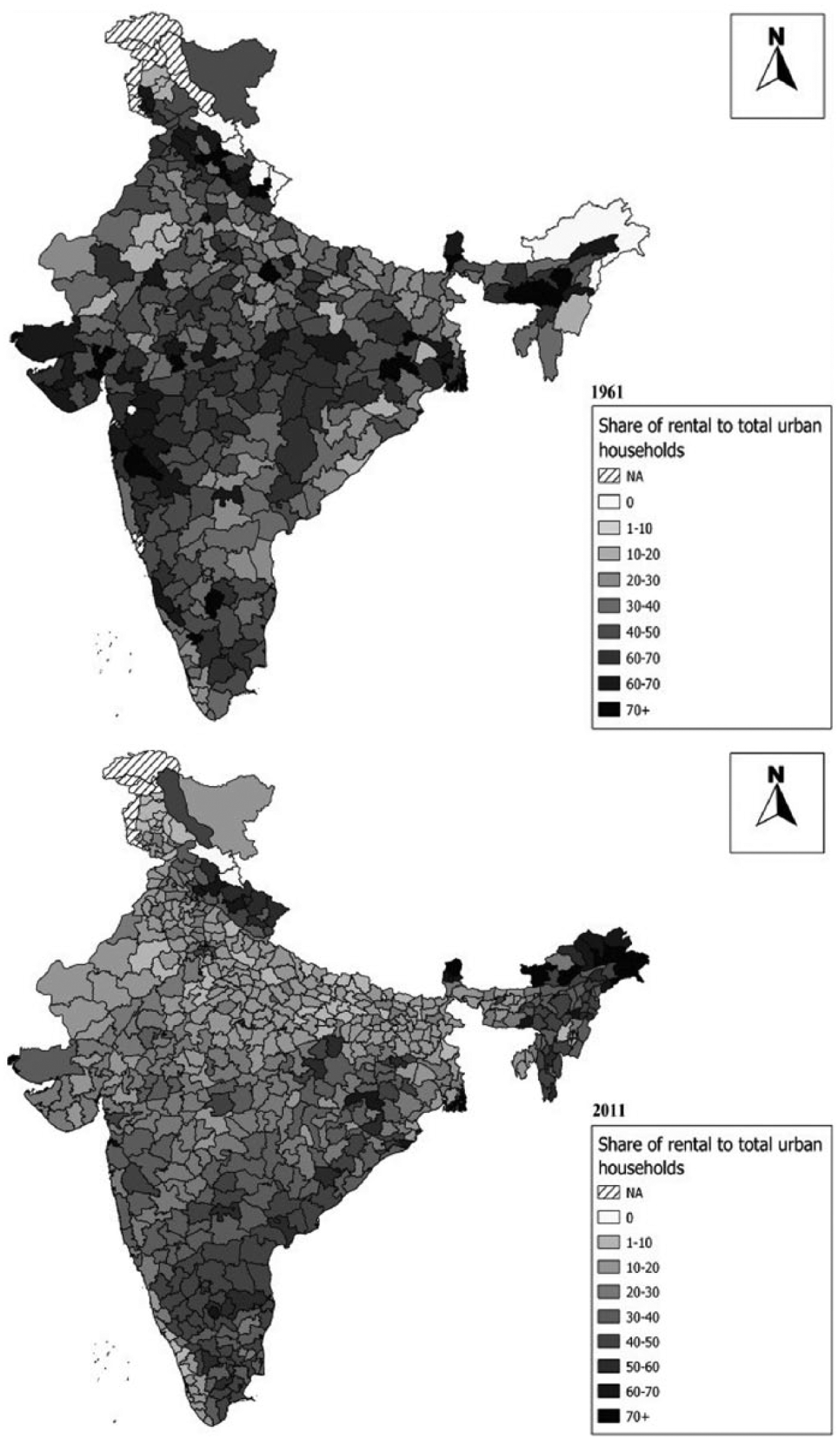
Urban rental housing in India (in per cent)
Having examined the situation in the districts, we analyse the rental housing situation in Indian cities.(40) The sample selected for representation in Table 1 includes the five cities with the highest growth in the share of rental housing between 1961 and 2011 and the five with the lowest growth.
Comparison of Indian cities with highest and lowest growth in rental housing
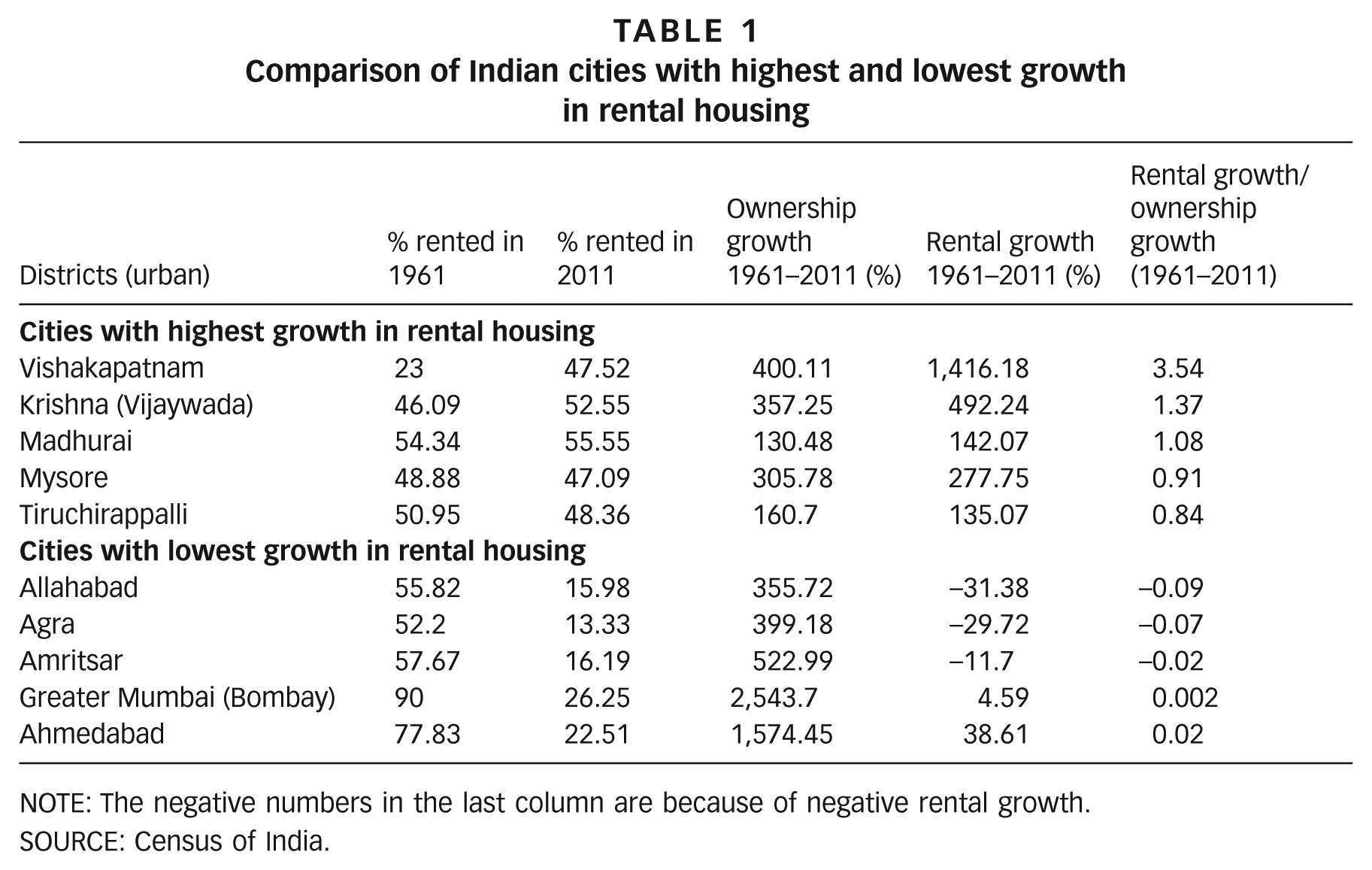
NOTE: The negative numbers in the last column are because of negative rental growth.
SOURCE: Census of India.
The five cities with the highest growth in the share of rental housing are located in the south. In India, a constellation of factors affects affordable rental housing outcomes, including rental laws, government policies related to housing, employment opportunities, what happens in the rest of the housing market, per capita incomes, migration and city size.(41)
It is interesting to note that Ahmedabad and Greater Mumbai, which are among the cities with the lowest growth (or highest decline) in the share of rental housing, were for a long time governed by the same Rent Control Act. Given the peculiar case of rental housing of Greater Mumbai and Mumbai’s historic as well as current importance in the country’s economy, the paper analyses how the existing legal framework as well as historic rental laws have affected the rental situation in the city.
V. Rent Control in Mumbai
The city of Mumbai has many singular characteristics. It has a large and densely packed population, limited availability of land, and a high concentration of business and financial activities along with a thriving service sector. It is an economic driver for the state of Maharashtra, contributing around 21 per cent to the state’s gross domestic product. Its municipal corporation (a local government body) is one of the richest in the country, with a budget larger than that of some Indian states. Its primacy as the country’s financial capital and its erstwhile status as a dominant textile-manufacturing centre have historically made it attractive for a large number of people seeking employment. Prior to independence in 1947, the city was able to cope with the housing requirements of its migrants since housing was relatively inexpensive, housing arrangements were often made by employers, and affordable rental housing was easily available. However, post-independence the increasing demand for housing was not followed by increased supply. Poorer sections of the population were crowded out and took up residence in slums. Many factors have contributed to the existing situation,(42) but the most damaging have been rules and policies regulating land supply and real estate development. We examine one such regulation – the rent control law – and the impact it has had on rental housing in the city.
a. The Rent Control Acts: past and present
Rent control has been a factor in India since the First World War, when it was introduced to protect tenants from inflation and evictions.(43) For several decades after World War II, rents in Mumbai (and the erstwhile Bombay province) were regulated by the Bombay Rents, Hotel and Lodging House Rates Control Act of 1947. It was to expire in 1973 but was extended repeatedly until its replacement in 1999. Under the 1947 Act, rents in rent-controlled properties were to remain at or below standard rents, which were determined by the court or controller or by the rents at which the properties in question were let on 1 September 1940. The Rent Act severely restricted the growth rate of rents and provided minimal increases in the case of repairs and improvements undertaken by landlords, where the increases were also determined by courts. In 1987, the Bombay Rent Act was amended to state that standard rent provisions would not apply to premises constructed or reconstructed after October 1987 for five years.(44) After the five-year period, the standard rent for such premises would be equivalent to a net return of 15 per cent on investment in land and buildings and all expenditures.(45)
The Bombay Rent Act had unintended consequences. Reluctance on the part of landlords to have their properties protected under rent control resulted in a preference for short-term arrangements (11 months) under the Indian Easement Act of 1882, by which the occupant would pay a licence fee for the easement right of occupation, thus bypassing all questions of tenancy. These “leave and licence” rental arrangements flourished and operated at more or less prevailing market rates. In 1973, realizing that short-term leave and licences were gaining popularity, and encouraged no doubt by the likely popularity of the move, the Rent Act was amended to bring all leave and licence premises under rent control. Former licencees could apply for relief and the fixing of standard rent at a fraction of the former licence fee. Another consequence of the act was a rise in the practice of key money or pagdi (which means turban in Hindi and implies honour to the person receiving it). Under this system, for a change of tenancy, the new tenant pays a lump sum that is related to the market value of the rental property (normally about 80 per cent of the market purchase price of property in the same locality). One-third of this amount is paid to the landlord to change the name on the rent receipt and the remaining two-thirds to the outgoing tenant. These proportions are consonant with the power structures that prevail under the Rent Act. Tenanted properties, incidentally, can be inherited with no payment to the landlord.
Earlier, the Rent Act could differ from city to city. In 1999, the Maharashtra Rent Control Act was passed. The act is applicable to the entire state and brings all towns and cities in Maharashtra under a single rent control law. According to this act, standard rents are to be fixed by the court. There is no radical departure from the previous Bombay Rent Act. Rents continue to be capped at the standard rent, and increases are restricted. Standard rent according to this act is defined as rent determined by the court or controller under the previous Rent Acts plus 5 per cent,(46) or the rent as of 1 October 1987 for properties that were let on or before that date, or, for those let after this date, the rent at which properties were first let. We should note that in such cases the rental at first letting became the standard rent thereafter. Courts, if asked to set the rent, normally make it 12.5 per cent per annum of the cost of construction plus the cost of land at the date of construction. The 1999 Act provides an annual increase of not more than 4 per cent(47) from the date that the standard rent is fixed. If landlords make special additions or alterations to the property, rents can be increased by 15 per cent of the expenses incurred. The act protects tenants from eviction on unfair grounds; it recognizes pagdi as legal; and it exempts leave and licence agreements from rent control.
The existing Rent Control Act has not brought relief to landlords and continues to imply the capping of rents with very low annual rates of increase. There is no attempt to create gradual parity between controlled rents and market rents or to decontrol properties whose tenants do not require protection.
b. The rental housing situation in Mumbai
To assess the impact of rent control in Mumbai, we examine the spatial patterns and composition of rental tenements in the city. Data are from the New Property Tax Cell of the Municipal Corporation of Greater Mumbai (MCGM), and cover approximately 2.45 million formal units. For each unit, the dataset provides the carpet area in square metres,(48) its subzone,(49) year of construction, type of current use and type of occupancy – that is, protected under rent control, self-occupied or other than self-occupied.(50) “Other than self-occupied” includes leave and licences and other similar arrangements. Slum tenements are excluded in this dataset since they are not covered by the property tax regime.(51)
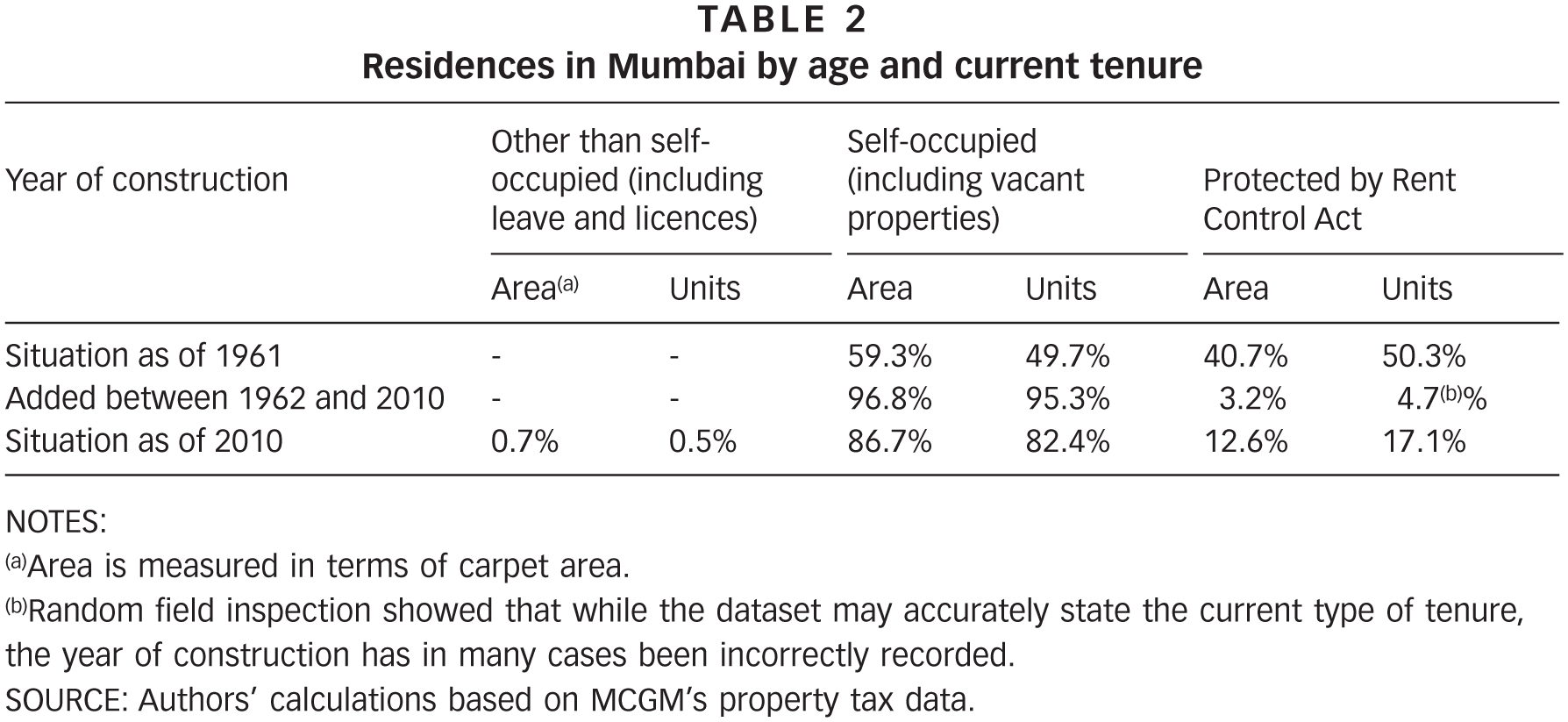
Table 2 presents the proportion of residences under different tenure arrangements over different time periods.
Residences in Mumbai by age and current tenure
NOTES:
Area is measured in terms of carpet area.
Random field inspection showed that while the dataset may accurately state the current type of tenure, the year of construction has in many cases been incorrectly recorded.
SOURCE: Authors’ calculations based on MCGM’s property tax data.
Of all the residential units built in or before 1961, 49.7 per cent are currently self-occupied. A small number of landlords, by proving in court that they need the premises for their own use, have succeeded in evicting tenants enjoying rent control. So, if anything, today’s data slightly underestimate the actual number of units that were under rental in 1961 or before.
Table 2 shows that self-occupied and tenanted units were almost equal in 1961.(52) In stark contrast, 95 per cent of new residential construction between then and 2010 was for ownership while only 5 per cent has gone to rental housing.
Figure 2 and Figure 3 illustrate the spatial distribution of Mumbai’s rent-controlled residential properties as of the year 2010.
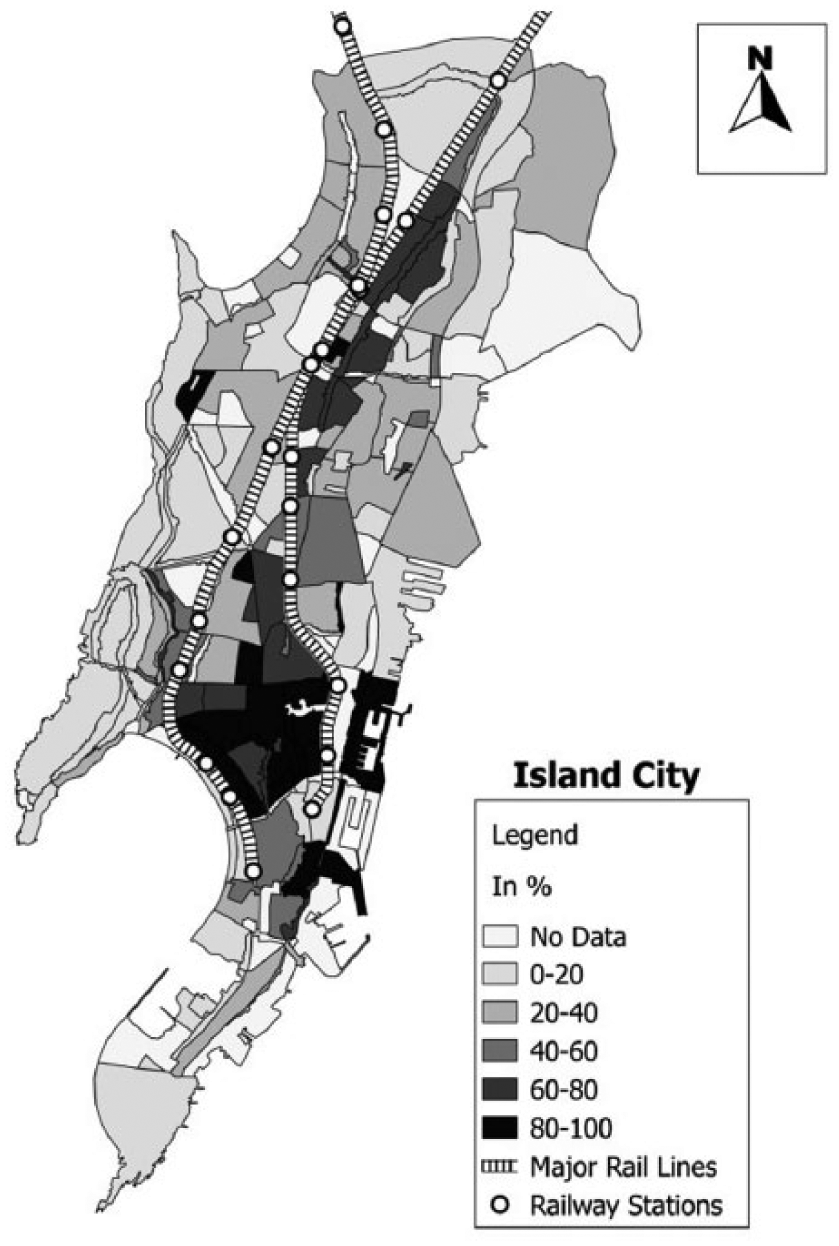
Proportion of total residential carpet area that is rent-controlled, by subzone (in per cent)
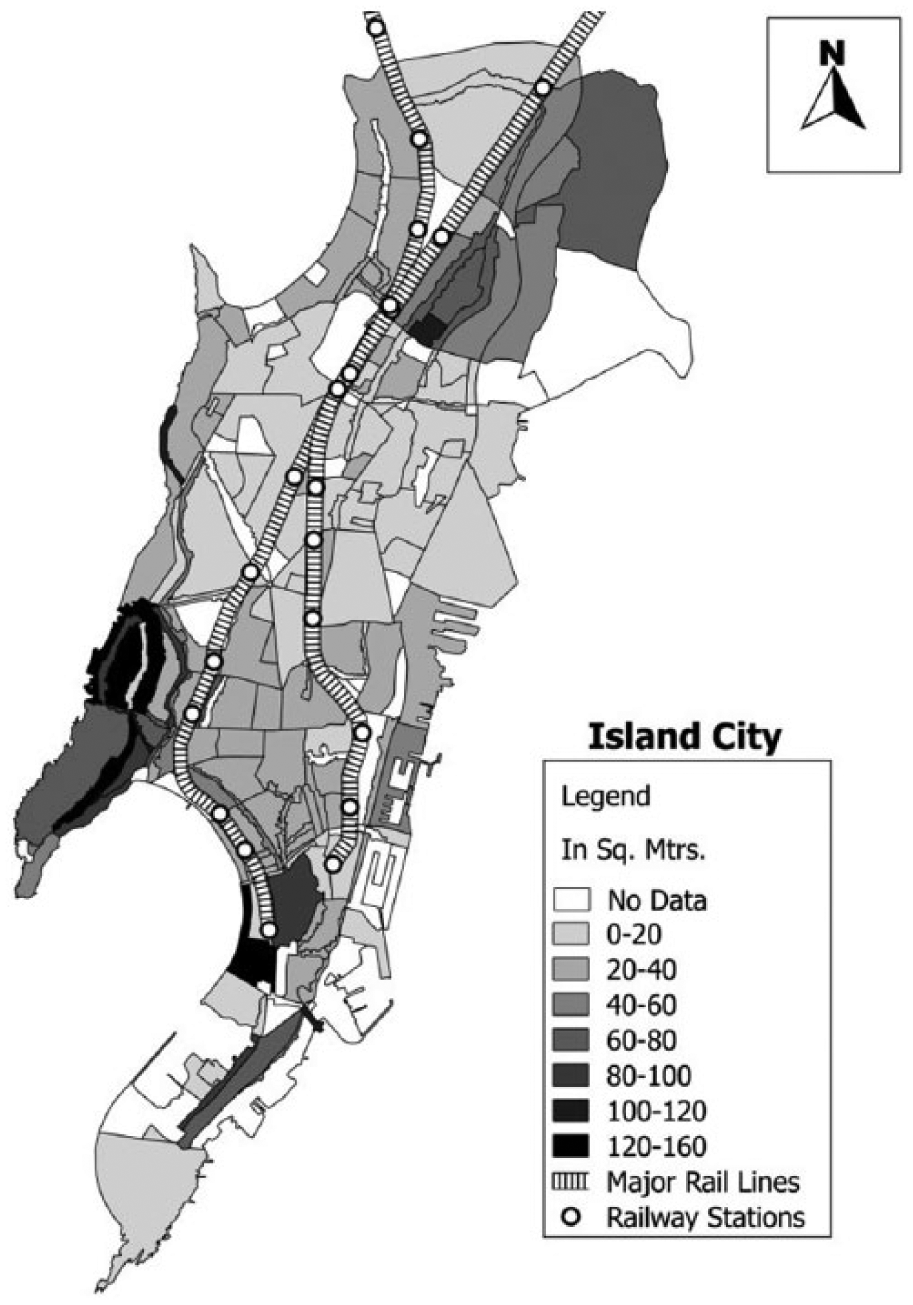
Average carpet area of residential units under rent control, by subzone
Nearly 82 per cent of the residential area under rent control is in the island city (with the rest in the suburbs located further north). Figure 2 shows that in several subzones in the island city, nearly 100 per cent of the residential carpet area is under rent control. These subzones have a large number of old and dilapidated buildings awaiting redevelopment.
In Figure 3 we find wide variation in the average carpet area of rent-controlled residential units, ranging from 5 to 160 square metres. This variation and the prevalence of the pagdi system, which has emerged as a response to market forces, makes it safe to conclude that households protected under rent control belong to a wide range of income classes.
Table 3 provides the distribution of the residential units protected by rent control in the island city as of the year 2010. Although we do not have data on household incomes, the size of units is probably a good proxy for the income classes of tenants enjoying rent control for the following reasons: before rent controls were imposed, larger dwellings were leased by higher income classes whereas smaller ones housed poorer families, typically located in poorer neighbourhoods. The imposition of rent control (which did not discriminate between rich and poor or large and small houses) and the prevalence of pagdi ensured that even the well-to-do, living in larger houses (which were located in richer neighbourhoods) continued to enjoy protection under rent control. Comparing Figures 2 and 3, the spatial pattern suggests that many of the low-income (low carpet area) residential rentals were in zones adjoining the central spine of railway tracks.
Distribution of residential units under rent control, island city
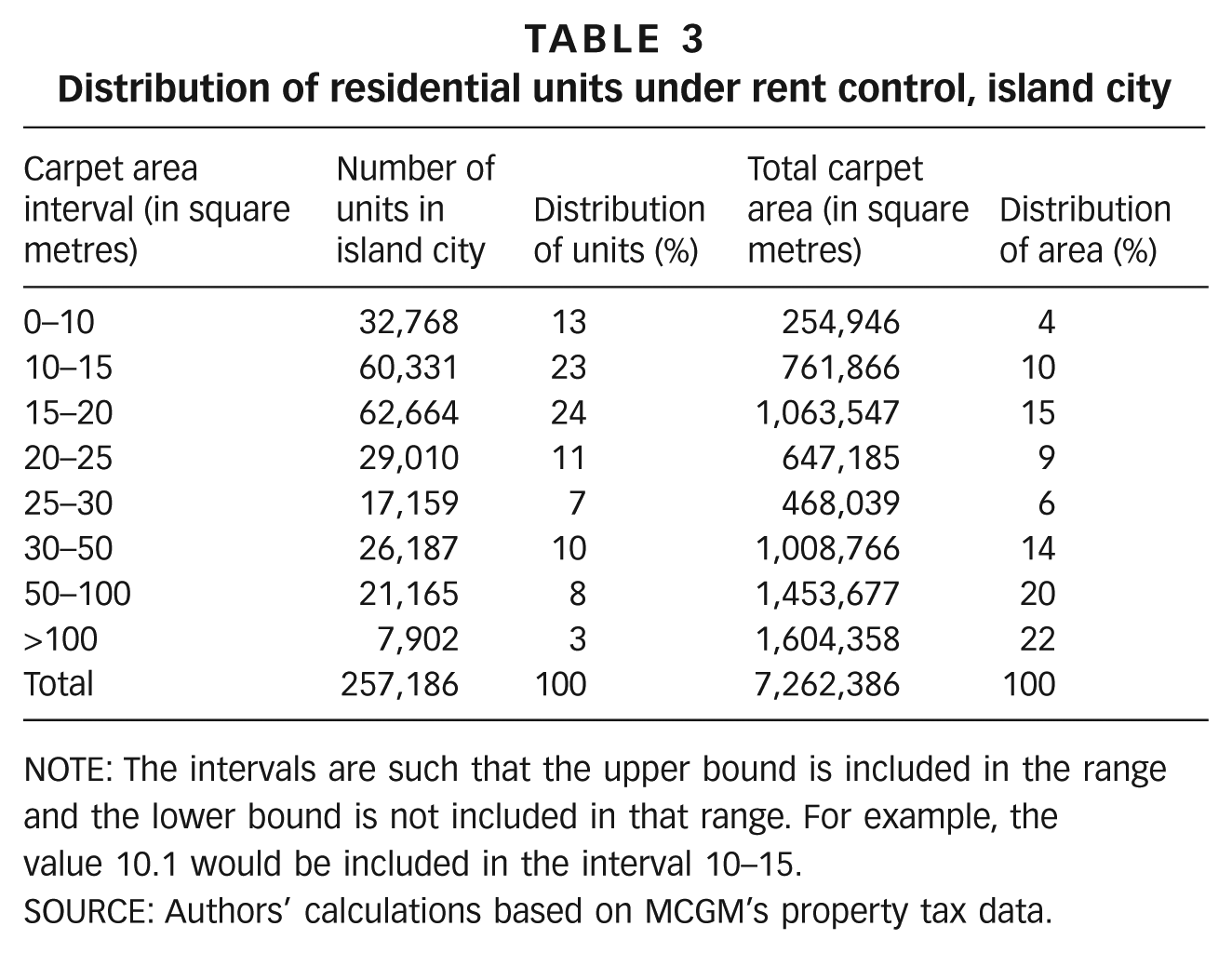
NOTE: The intervals are such that the upper bound is included in the range and the lower bound is not included in that range. For example, the value 10.1 would be included in the interval 10–15.
SOURCE: Authors’ calculations based on MCGM’s property tax data.
c. Implications of rent control
With eviction being difficult and succeeding generations of tenants living in the same rent-controlled premises, the rigid rent controls in the city have led to the continuing dilapidation of the existing rental housing stock, “muddled property rights”,(53) and no investments in new rental housing. Extremely low returns to landlords have adversely affected their incentives to maintain their properties.(54) In some cases, tenants undertake repairs and maintenance of their premises; but since repairs and maintenance are legally the responsibility of landlords, the condition of many rent-controlled properties is dismal. The continuing dilapidation of rent-controlled properties led the state government to set up the Mumbai Building Repairs and Reconstruction Board for collecting a repair cess from such properties, which came to be called “cessed buildings”, and itself undertaking the necessary structural repairs or reconstruction. In March 2008 there were around 16,000 cessed buildings in the city.(55) Ultimately, the inability of the Board to effectively execute the repairs resulted in the state inviting private developers to redevelop the cessed properties in exchange for certain real estate incentives.(56) However, apart from the damaging effect on the city of some of these incentives, these efforts have only had sporadic success, and many rent-controlled buildings continue to deteriorate.(57)
Rent controls have resulted in unclear property rights, with eviction being difficult and succeeding generations of tenants living in the same rent-controlled premises. This has prevented transfers of these units in the (formal) market. Informal mechanisms have emerged in the wake of such a lock-in, such as the system of pagdi. Landlords have an option of selling the entire property under rent control but obviously find it virtually impossible to find a buyer for their rent-controlled buildings.(58)
Diminishing profitability due to virtually frozen low rents has led to a collapse in the provision of new private rental housing.(59) From the data, we see that the building of formal rental housing has virtually come to a standstill and residential construction is almost entirely for ownership. The beneficiaries of rent control are thus the existing protected tenants, at a cost to landlords who are in effect subsidizing tenants, and, more importantly, at a cost to the growing population that is denied any kind of rental accommodation.
Although leave and licence arrangements in the formal housing market have been rising since 1999, the numbers are small and invariably cater to the upper income classes. That leave and licence has not yet taken hold more widely may be because of the fear that the government could once again, as it did earlier, declare leave and licences to be subject to rent control.
VI. Reform Agenda
International experience, as well as the literature, suggests that rigid first-generation rent controls of the kind prevailing in Mumbai have disastrous consequences for cities. Reforms, therefore, should focus on two objectives: upgrading the existing rental housing stock and providing incentives for investment in new rental housing. These two objectives require different strategies that take into account the interests of all major stakeholders. International experience also suggests that successful reforms are those that are implemented gradually. Currently, households belonging to various income classes enjoy protection under rent control. Unfreezing and upgrading existing rental housing units could begin by removing protection from those for whom it is not warranted. For this, a means test may be applied to ascertain the burden that market rent would impose on a tenant and how that relates to her income. Tenants who do not require protection may be divided into those who have and have not paid pagdi after 1999. For those who have paid pagdi, protection may continue for a specified number of years from the date of the payment, after which it would cease to exist. For the others, protection would be removed so that rents are raised gradually but steeply, through high rates of increase, until they reach market rates. Where tenants continue to enjoy protection, policies may suggest arrangements between landlords and tenants for cooperation in the maintenance and upgrading of the rental units. Policies could also be introduced to provide housing vouchers to needy tenants so that the landlord does not end up subsidizing tenants. Also, there should be a movement towards second-generation rent controls, by which rents are raised gradually, at a rate that exceeds the inflation rate, until they reach a certain, reasonable proportion of market rents. Second-generation rent controls would also mean that rents can be reset between tenancies.
For new rental housing, the returns should be lucrative enough to attract investment in rental housing. Encouraging the construction of rental housing requires credible policies so that no new rental construction would ever be put under rent control and rental housing is not discriminated against through means such as higher property tax. In addition, any redevelopment should be considered the equivalent of new construction, and as such must have rent control removed. All of this would require the passing of a new law that replaces the old one; it will not be possible through executive orders of the government, since these can easily be overturned by another government.
Any reform of the existing rent control regime needs to be relatively easy to implement. The challenge is one of political feasibility. We can expect strong opposition from potential losers – that is, from tenants protected by the present system, particularly the wealthy and influential who cannot pass the means test to qualify for a continuing and massive rent subsidy. Here, possibly the threat of putting their names in the public domain may suffice to silence their opposition to the change.
VII. Conclusions
This paper examines the situation of rental housing in India, where the share of rental housing has declined drastically from 1961 to 2011. Focusing on the case of Mumbai, it proposes reforms for revising rent control laws in the city. The literature – both theoretical and empirical – suggests that rigid rent controls, also known as “first-generation rent controls”, have a devastating impact on a housing market. On the other hand, rental laws that allow sufficient returns to landlords, in tune with market returns, while providing adequate protection to tenants, can boost rental housing.
Having studied the situation in India, we narrow our focus to the case of rental housing in Mumbai, which witnessed a significant decline in rental housing over the years while housing for ownership flourished. The Maharashtra Rent Control Act, 1999, which was supposed to open up the rental housing market, has several flaws, in particular inadequate returns to landlords. It needs to be recast in a way that ensures movement of rentals gradually towards market rents.
Finally, the paper proposes reforms in rental laws with the objective of upgrading the existing stock and providing incentives for investments in new rental units. These reforms include removing protection for those who do not require it, making arrangements between tenants and landlords for maintenance of properties, providing housing vouchers to needy tenants as subsidies and, finally, moving towards second-generation rent controls.
Footnotes
Acknowledgements
The authors would like to thank Vidyadhar Phatak for extensive comments and suggestions, and Kala Sridhar and Swastik Harish for fruitful discussions. The authors would also like to thank Sirus Libeiro for GIS support. All views expressed are personal and any errors or omissions are the responsibility of the authors alone.