



Abstract
While government housing can raise living standards for the urban poor, it has environmental impacts and contributes to urban resource consumption. In Gauteng Province, South Africa, government housing aims to improve quality of life, reduce poverty and inequality, and transform unsustainable urban forms. This paper draws on survey and interview data to explore the social justice and environmental sustainability outcomes of Gauteng’s government housing programmes. The data reveal improved access to basic services and amenities. However, the developments tend to be poorly located with regard to economic opportunities, and residents are forced to explore other income generation opportunities. This paper highlights the complex interplay between justice and sustainability, where the outcomes are aligned in some instances and conflictual in others. It points to the need to move beyond linear, reductionist relationships between justice and sustainability to further the conceptual understanding of their interlinkages.
Keywords
I. Introduction
Urbanization and population growth are two of the most significant global trends. Both are concentrated in the global South, particularly in Africa and Asia.(1) This population increase is associated with an increased demand for housing and basic services. Southern cities face the challenge of planning and implementing urban development in a way that accommodates the expanding urban populace and meets its basic service needs, but also minimizes such negative effects as environmental degradation, high resource consumption, pollution, and social and economic exclusion. In Gauteng Province, South Africa, the challenge of meeting the growing need for housing and services is compounded by existing housing backlogs, poor access to basic services (water, sanitation and electricity), high unemployment and inequality.
Recent global commitments emphasize the concurrent need to achieve a just and sustainable growth trajectory.(2) Social justice and environmental sustainability have been widely acknowledged as both ethical and practical, evidenced through the global adoption of the 2030 Agenda for Sustainable Development.(3) Despite commitments to a form of development that is both just and sustainable, such pledges are yet to translate to urban development that truly achieves these imperatives. As a consequence, poverty, unemployment, climate change and environmental degradation remain intractable global issues that are concentrated in cities in the South.
Government housing developments can play an important role in raising living standards for the poorest groups in society, and particularly for people living in informal housing.(4) Informal or auto-constructed housing is the fastest-growing form of accommodation in many cities in the global South. Particularly in informal settlements, this housing tends to be associated with poor living conditions, inadequate access to shelter and basic services, and unhealthy environmental conditions. Government housing provides an important means of addressing these social and environmental issues. However, these developments do not necessarily align social justice and sustainability imperatives. Not only do government housing developments directly affect the ability of the urban poor to access adequate services and opportunities, they also have broader environmental impacts and implications for resource consumption. Without careful planning, government efforts to address the housing crisis exacerbate existing inequality, unsustainable resource consumption and environmental degradation.(5)
South Africa’s government housing programmes, while successful in providing nearly 3 million houses and benefitting around 10 million people,(6) have faced significant critique in the post-apartheid era(7) both for their inability to truly address poverty and inequality, and for exacerbating unsustainable urban growth trajectories.(8) This paper draws on survey and interview data to gain insight into the lives of people living in government housing developments in Gauteng, South Africa, and to explore the interplay between social justice and environmental sustainability outcomes of these developments.
The paper specifically engages with a range of factors to determine the success of government housing programmes in achieving justice imperatives. These factors include housing, living conditions, access to basic services and income generation opportunities of people living in different areas in Gauteng. This analysis also explores the implications of these housing developments on sustainability and the interaction between just and sustainable outcomes. The results provide evidence that government housing developments in Gauteng have contributed to material improvements in residents’ quality of life, despite not addressing all aspects of poverty alleviation or environmental sustainability. The case further identifies ways some residents have made alterations to their houses and pursued economic opportunities – using government housing to enhance their poverty alleviation efforts. The paper also focuses on a number of elements related to sustainability, including resource consumption, density and location, with its impact on access to services and commuting distance. This paper avoids simplistic conclusions, and uses this case to provide nuance on the successes and failures of government housing in Gauteng and to explore the complex interplay between social justice and environmental sustainability.
Section Ia provides an introduction to government housing in Gauteng, South Africa. This is followed by an account of the relevant literature in Section II, a description of methodology in Section III, an assessment of Gauteng government housing in Section IV, and a discussion of findings in Section V.
a. Government housing developments in Gauteng
Urbanization patterns in Gauteng mirror many global patterns. It is South Africa’s smallest province, but its population growth is the fastest in the country.(9) This compounds the region’s housing backlog, levels of informality and challenges in ensuring access to basic services. In addition, the legacy of apartheid racial segregation continues to influence spatial inequality, poverty and unemployment.(10)
During apartheid, South African cities were deliberately designed to create spatial separation between racial groups and functions (separating business and residential areas). This resulted not only in structural inequality with disproportionately worse access for black people to resources and opportunities, but also in cities with segregated residential and commercial areas. This type of development has resulted in sprawling suburbs, long commutes that depend on motor vehicle travel, inequality and unsustainable resource consumption.
The post-apartheid government placed significant emphasis on building fully subsidized low-cost houses for poor South Africans, through the 1994 Reconstruction and Development Programme (RDP).(11) Government housing programmes are targeted at people who currently lack access to adequate housing and meet a number of requirements, including monthly household income below a certain threshold. The dual aims of these programmes are to provide improved living conditions and the necessary support to allow these citizens to rise out of poverty.(12) In South Africa, the provision of low-income houses is seen as an opportunity for people to get onto the housing ladder,(13) with the key intention of changing the ownership profile of property.(14)
Government housing developments in the early post-apartheid years, tending to be low-density and located on the urban edge, have been criticized for exacerbating spatial segregation, inequality, exclusion and urban sprawl, and entrenching inefficient land-use patterns with high resource consumption trajectories.(15) Haferburg posits that the government’s housing policy has created “vast RDP archipelagos that sit in a kind of peri-urban limbo like loosely-associated satellites”.(16)
In light of critiques of RDP, the government released the 2004 Comprehensive Plan for Housing Delivery: Breaking New Ground (BNG), to address and realign low-income housing policy.(17) The BNG policy reframed the housing delivery approach as one that systematically addressed wider-ranging impacts of apartheid – focusing on “sustainable human settlements”. (The government interprets this in a number of ways, including support for sustainable livelihoods, ensuring affordable housing in sufficient quantities, and concern for environmental sustainability regarding density and proximity to services.(18)) This focus shifted towards housing as an enabler for improving quality of life, reducing inequality, and using residential development as a tool in spatial restructuring.(19) An important acknowledgement was the need for integrated housing developments in well-located areas, where needs beyond just housing could be met – specifically focused on urban areas.(20) In line with these principles, the Gauteng government envisioned public housing programmes as an important instrument for building inclusivity, by providing basic services and enabling access to economic opportunities.(21)
Although the BNG policy attempts to maximize the benefits of compact urban form, Jenks(22) flags a possible negative consequence of increasing density and land-use efficiency of government housing developments, in that reduced plot sizes in more compact areas or units in multi-storey buildings can limit or prevent low-income groups from generating income through rental and home businesses. A significant proportion of the growth in informal housing in South Africa, and Gauteng in particular, has been in the form of self-build backyard dwellings (Photo 1). Backyard dwellings provide additional housing opportunities with better access to basic services and infrastructure than informal settlements, as well as opportunities for owners to generate income through rental.(23)
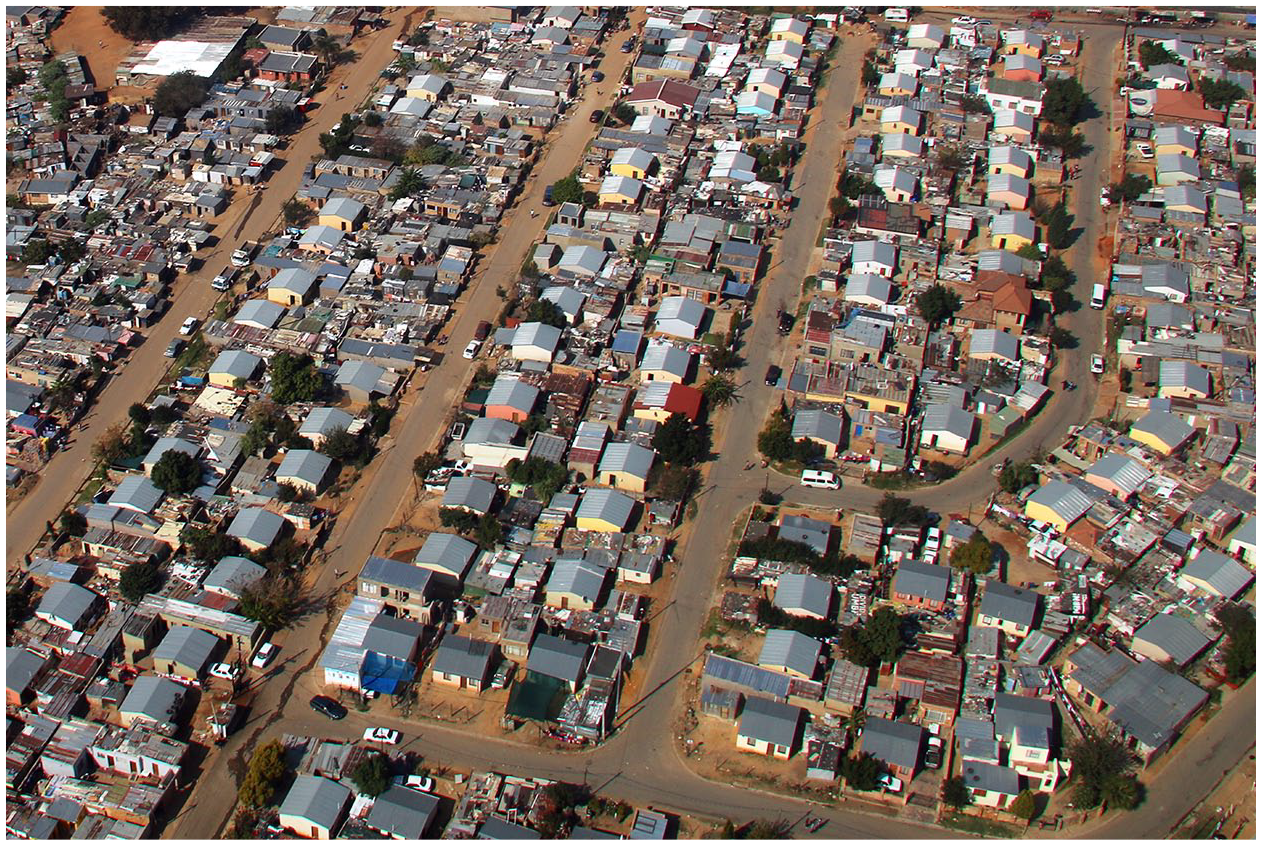
Government housing with informal backyard dwellings, Zandspruit, Johannesburg
Although the government espouses a planning approach to urban spatial form that emphasizes integration, efficiency, sustainability and quality of life for all, scholars note that publicly funded housing projects continue to be poorly situated for a number of reasons. A significant driver of housing projects on the urban edge of Gauteng is the urgent need for housing, and the perception that land on the periphery is cheaper and less contested than land in the urban core.(24) Hunter and Posel,(25) however, critique housing programmes that emphasize access to basic services over proximity to job opportunities, noting that many informal dwellers choose to live in substandard conditions to allow easier access to work.
Map 1 shows the locations of government housing programmes in Gauteng (blue) relative to the region’s urban footprint (grey). Information on this set of housing programmes (2014) was obtained from the Gauteng Department of Human Settlements, and includes planned and completed projects and those under construction.(26) While the map shows that some of these developments are located within the existing built-up areas in relatively close proximity to economic centres (e.g. Johannesburg and Pretoria central business districts [CBDs], Sandton, Germiston), the vast majority and the largest government housing developments are located on the urban edge. It is likely that some of the older housing developments are better located now than when they were first constructed, as urban and economic development has subsequently taken place in the surrounding areas.
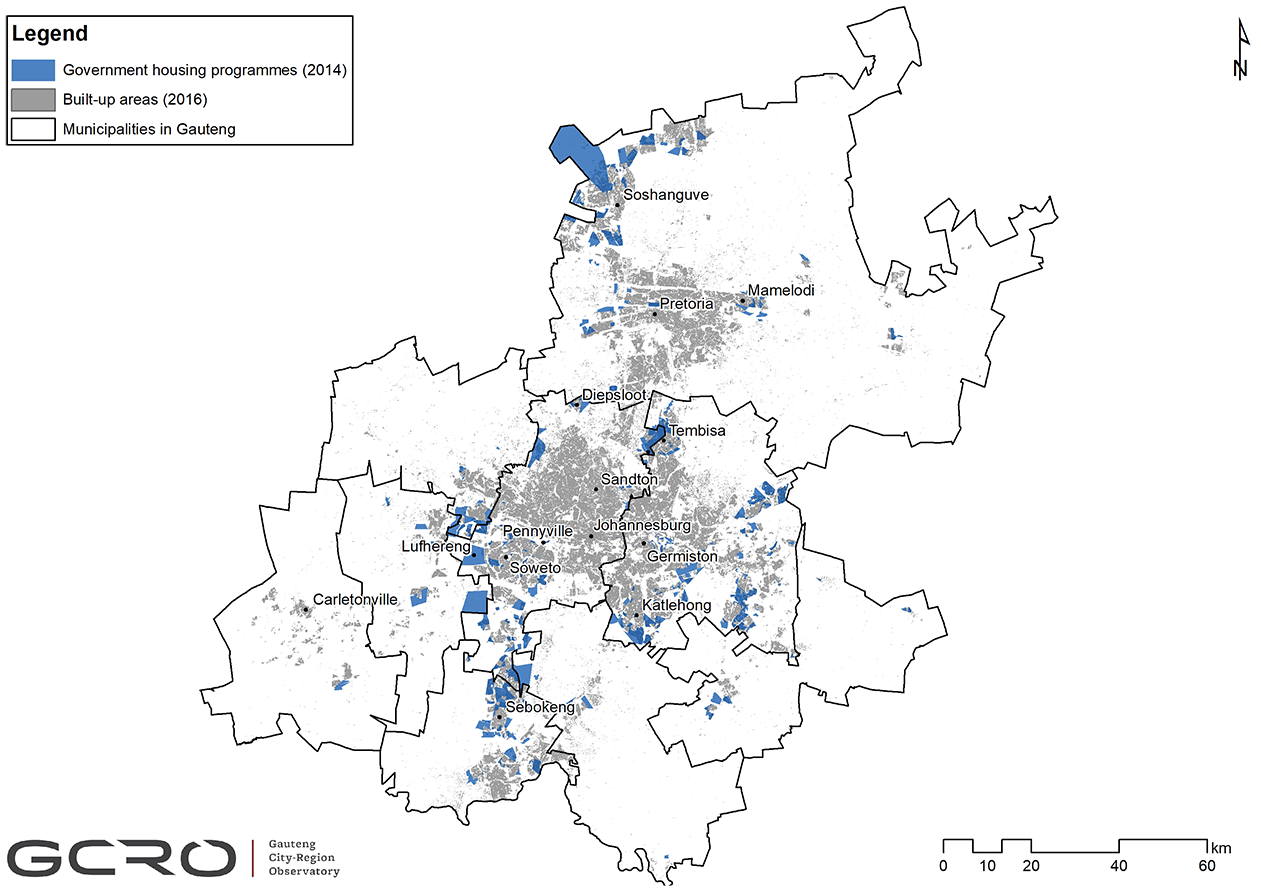
Planned and built government housing programmes in Gauteng (2014)
This paper provides an overall assessment of government housing projects in Gauteng, and draws detailed insights from two housing projects in Johannesburg: Lufhereng and Pennyville. Both were greenfield sites, designed as part of the national government’s integrated residential development programme. This programme explicitly seeks to build housing developments in “well-located” areas in a way that provides access to services and economic opportunities. Pennyville, constructed between 2006 and 2011, is a medium-density housing development, located between Soweto and the Johannesburg CBD within the mining belt. It is well located with regard to a range of public transport options, including train, bus rapid transit (BRT) and minibus taxis. The first set of recipients received houses in 2007/2008. Lufhereng is a large development on the western edge of Soweto. Although the broader project is still under construction, Phase 1 was completed and the first set of recipients received their houses in 2010. Because Lufhereng is on Johannesburg’s urban development edge, all necessary infrastructure and services (including transport and retail) have been included in the design of the broader development, but most have not yet been developed. The final settlement design includes extending the existing train line and bus routes to service the settlement. However, these extensions are still pending and there is a concern that the train line might not materialize due to the dire state of the Passenger Railway Agency of South Africa (PRASA).
II. Background: Conceptualizing Just Sustainability in the Context of Government Housing
This paper engages with the practices, interconnections and disjunctures around justice and sustainability through the case of government housing. This section provides background on the concepts with which this paper engages. It first explores in Section IIa what is meant by social justice and environmental sustainability (from here on referred to as “justice” and “sustainability”), and how their interaction can be conceptualized as “just sustainability”. Then Section IIb goes on to consider these features with reference to government housing.
a. Interactions between social justice and environmental sustainability
Despite wide acknowledgement of the interconnectedness of social and ecological systems, and in particular the imperatives of enhancing sustainability and justice, Leach et al.(27) highlight the paucity of systematic research into the ways these imperatives are interlinked.
In this paper, justice is defined to incorporate the principles of equity and fairness, which focus on ensuring wellbeing for everyone rather than treating everyone the same way (equality).(28) Expanding on Campbell’s(29) definition with respect to sustainable development, social justice refers to striving towards a fair or equitable distribution of resources and the benefits and costs of development, while taking into account the natural resource implications and limits. This definition must include efforts to reduce or redress existing inequities in distribution. Although this definition (and this paper) focuses primarily on distributive justice, both recognitional and procedural justice are necessary components of justice.(30) Sustainability is underpinned by the need to conserve the natural environment, minimize the use of resources and limit waste production. Climate change has encouraged a particular emphasis on the need to minimize greenhouse gas emissions and build developments that are resilient in the face of climate disasters. Sustainability approaches draw on principles of maximum efficiency, where the needs of society are met through the least possible impact on resource and land consumption.
Since the emergence of the “sustainable development” agenda in the 1980s, the literature on the areas of commonality among environmental, social and economic systems has grown. Much of this literature embodies an assumption that justice and sustainability are mutually attainable if they are considered and planned for carefully enough. Despite emphasis on the nexus of these imperatives, there has been great difficulty in translating this theoretical alignment into reality.(31) In practice, justice and sustainability have a complex relationship – they can stand in opposition to each other or have non-linear interactions.(32) There are numerous examples of progress towards one of these imperatives undermining the achievement of the other.(33) Just sustainability explicitly refers to interconnected space between justice and sustainability.(34)
While much scholarship acknowledges that social, environmental and economic systems are interconnected, there is a spectrum in terms of how their interaction is conceptualized.(35) At one end of the spectrum, these different systems are considered independently, while at the other, the achievement of either justice or sustainability is posited to depend on the achievement of the other. Scholars on the latter side argue either that justice is a precondition for a sustainable society, or that attention to environmental issues, which are primarily borne by the poor, is necessary for attaining social justice.(36) This paper balances these two ends of the spectrum. It emphasizes that addressing the current environmental crisis and achieving sustainability cannot be done without attention to the imperatives of justice, while acknowledging that these two objectives are not always mutually beneficial.(37)
This paper contributes to the literature on just sustainability through an exploration of empirical evidence on government housing, how it can further both sustainability and justice, and where particular actions might further justice but not sustainability and vice versa.
b. Just and sustainable government housing
Government housing projects play an important role in enhancing the quality of life for poor urban dwellers(38) (a key justice imperative), but they also have broader implications on spatial form, resource use, and access to opportunities and services.(39) Many studies have explored different elements of government housing projects related to either sustainability or justice, such as the cost implications of housing developments based on their location,(40) the inclusivity of the house allocation process,(41) and the impact of housing developments’ location and type of settlement on just spatial form.(42) Other studies have deliberately engaged with both environmental and social implications of government (and low-income) housing developments.(43) However, most of these studies do not analyse the interaction between justice and sustainability outcomes.
Assessments of the social or environmental impact of housing often consider the associated access to services, amenities and economic opportunities. The longer the average trip distance, the greater is the environmental impact associated with transport infrastructure and the ongoing resources used and pollutants emitted. From a sustainability perspective, it is preferable to have shorter commutes and greater reliance on public and non-motorized transport modes. Longer commutes also tend to increase residents’ time and expenses to access services and economic opportunities. Suzuki et al.(44) assert that “[o]ne of the major social ramifications of ill-conceived spatial development is the burden placed on residents who cannot afford to purchase a private vehicle or are unable to live close to work and schools. Many of the poor must consequently endure long-distance commutes to make ends meet.” However, Aquino and Gainza(45) contend that simplified location-based assessments are insufficient to measure the overall impact of development. They argue for a deeper engagement with issues related to quality of life, access to economic opportunities and urban amenities across different groups in society.
Chiu(46) engages with the interplay between the justice and sustainability imperatives of housing developments, and the fact that access to accommodation and basic services has unavoidable environmental impacts, including land transformation, ongoing use of resources and energy, and waste production. However, as Goebel(47) highlights, the increased resource consumption of poor households as they gain access to basic services is very small compared to the resource consumption of elite households.
A typical objective of land use and transformation planning for sustainable urban development is a reduction in the amount of land required per household.(48) Turok(49) highlights that housing has the largest impact on urban land transformation. If it is developed in a way that entrenches “sprawling” and “haphazard” urban growth, it can be difficult to service with infrastructure, public transport and other public services (e.g. schools and hospitals), thus increasing the financial and environmental costs of development. Many scholars emphasize that compact urban development has significant environmental and social benefits because it means shorter travel distances, better accessibility to services, amenities and opportunities, and more compact public infrastructure networks.(50) Despite these potential benefits, compact development alone is insufficient to ensure just and sustainable outcomes,(51) and can instead contribute negatively to both justice and sustainability, leading to land transformation, exacerbated heat island effects, encroachment on urban green spaces, and exclusion through land and housing price escalation.(52)
Both the literature and government policies emphasize that for government housing developments to raise quality of life, they need to ensure access to social services and economic opportunities.(53) Turok and Borel-Saladin(54) identify a range of features that influence the impact of housing, including the structure of the house and property, ease of access, core services, location and the local environment. Understanding the influence of this set of features contributes to a broader understanding of the overall outcomes of housing on both social and environmental systems.
Although numerous studies explore the different outcomes of government housing, there is a paucity of research that explores the interaction and trade-offs between justice and sustainability. This paper draws on a large dataset together with more detailed case study evidence to arrive at a more nuanced assessment of government housing developments. While it explores a range of aspects related to government housing programmes and their social, environmental and economic implications, this paper does not attempt to provide a comprehensive report on government housing programmes. Rather, it focuses on the interactions between different justice and sustainability outcomes.
III. Methods
This paper draws on empirical evidence on government housing in Gauteng: both the results from the Gauteng City-Region Observatory’s Quality of Life V (2017/18) (QoL) survey and interviews with residents of the Lufhereng and Pennyville government housing developments. The QoL survey data provide an aggregated picture of government housing developments in Gauteng Province, and the Lufhereng and Pennyville interviews allow for more detailed insights into the lives of residents of these developments. Table 1 provides a summary of the two datasets, including the number of interviews conducted in each.
Breakdown of Quality of Life V (2017/18) respondents within government housing developments, informal settlements and the rest of Gauteng, plus the interviews with residents in Lufhereng and Pennyville
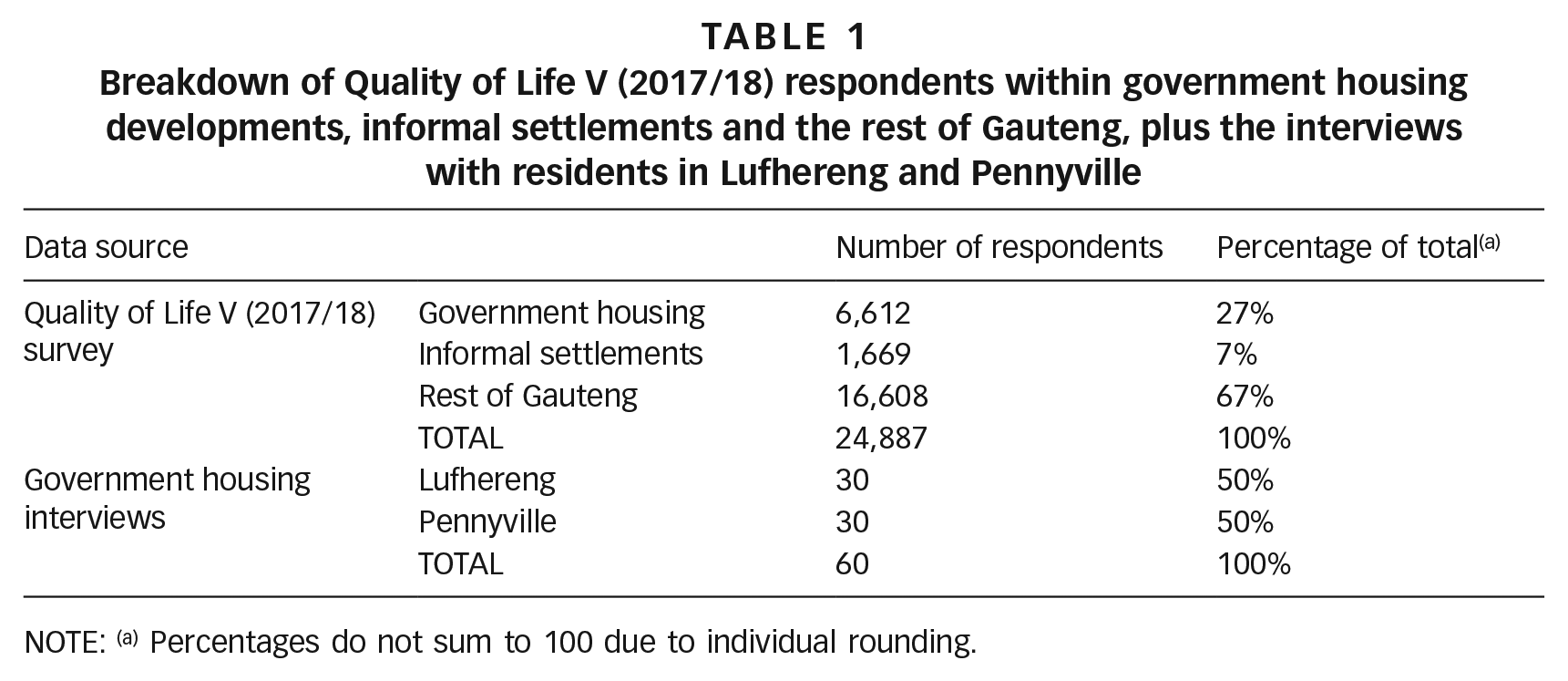
NOTE: (a) Percentages do not sum to 100 due to individual rounding.
Respondents to the QoL survey included a total of 24,887 adults, selected to be a representative sample of the Gauteng population. This sample included respondents who live within areas defined by the Gauteng provincial government as public housing projects, and also those outside these areas in Gauteng – some in informal settlements, and some in formal residential areas.(55) The sample frame was based on a building-based land-use layer generated by GeoTerraImage (GTI) using updated satellite imagery for Gauteng. This provides the best available understanding of buildings in the province, particularly new developments and informal settlements. The survey respondents were selected using a multiple-stage randomization process, which randomized the selection of the dwelling unit, household and respondent for each interview. The survey included 248 closed-ended questions on a range of topics including demographics, household services and needs, transport, employment, neighbourhood, personal opinions and satisfaction, which are all important components of or proxies for sustainability and justice.(56)
Interviews were conducted with 30 residents each in Lufhereng and Pennyville. Interviews were not restricted to recipients of government housing, and included people who are renting from the government or a private landlord. To ensure statistical representativity,(57) interview respondents were selected using the same sampling methodology (based on updated multi-stage randomization) as the QoL survey. However, the person who was interviewed in each household was either the head of the household or another household member who had an understanding of the household’s income and monthly costs. The interview included a set of closed- and open-ended questions focusing on household services, resource use, employment and reflections on current living conditions compared to where people lived before moving into the government housing developments.
Both datasets were analysed using IBM SPSS software.
IV. Assessing Government Housing in Gauteng
The analysis of government housing projects in this section begins with a general overview of demographics and access to basic and other services (e.g. healthcare and schools). The analysis then delves into an overall assessment of access to goods, services and work opportunities. The analysis concludes with an exploration of residents’ strategies for enhancing the quality of life through improving their dwelling and creating opportunities for income generation. This is followed for each topic by an examination of how it plays out for people who live in Lufhereng and Pennyville.
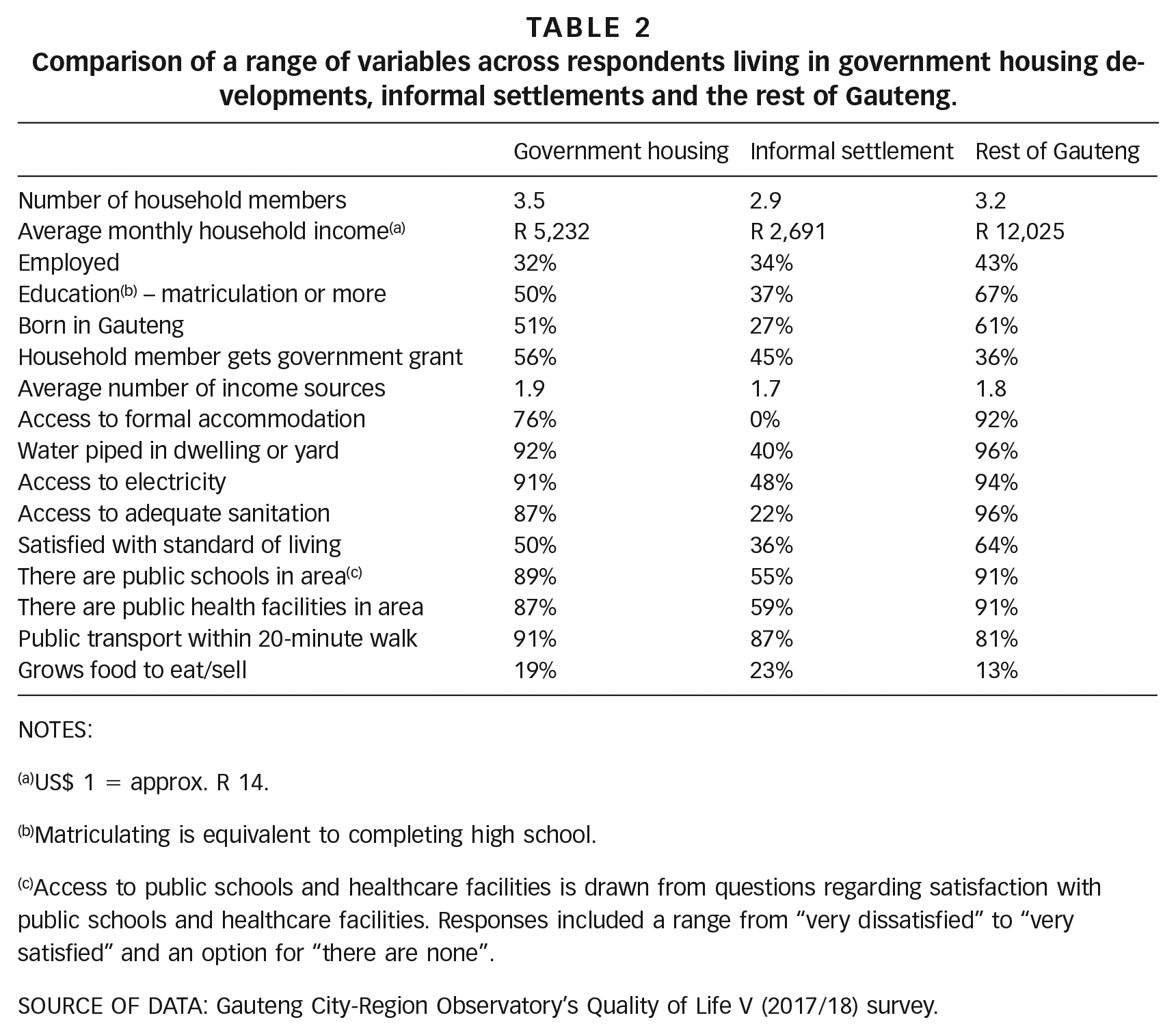
Table 2 provides some general results from the QoL survey, comparing respondents who live within the three different housing typologies in Gauteng: government housing, informal settlements and the rest of Gauteng. In overall terms, these results reveal that people living in government housing are substantially better off than those who live in informal settlements, but they are worse off than residents in the rest of the province. The group categorized as the “Rest of Gauteng” primarily includes people living in middle-income and affluent areas. Table 2 shows that people living in government housing are more educated than people in informal settlements. This is likely because informal settlements have a higher proportion of migrants (local and international) than government housing, and the QoL survey highlights that people born in the province have higher education levels.
Comparison of a range of variables across respondents living in government housing developments, informal settlements and the rest of Gauteng.
NOTES:
US$ 1 = approx. R 14.
Matriculating is equivalent to completing high school.
Access to public schools and healthcare facilities is drawn from questions regarding satisfaction with public schools and healthcare facilities. Responses included a range from “very dissatisfied” to “very satisfied” and an option for “there are none”.
SOURCE OF DATA: Gauteng City-Region Observatory’s Quality of Life V (2017/18) survey.
a. Access to services
Access to basic services is a critical component of government housing programmes, and Table 2 demonstrates the success of government housing in enhancing access to basic services such as water, sanitation and electricity. Although access to formal accommodation and adequate basic services among respondents within government housing developments is worse than in the “rest of Gauteng”, it is substantially better than among those who live in informal settlements. The vast majority of people who live within government housing developments (92 per cent) have access to adequate water (piped into their dwelling or yard), compared to fewer than half of people in informal settlements (40 per cent). These results are mirrored for electricity and adequate sanitation.
The interviews in Lufhereng and Pennyville allowed for an analysis of the change in access to basic services between the places where respondents lived before and the government housing developments where they now live. All interviewees in Lufhereng and Pennyville now live in formal accommodation and have adequate access to basic services (formal electricity connection, flush toilet and water piped into their dwelling). Some 63 per cent of residents reported that they had lived in either an informal or a traditional dwelling before moving into the government housing development. Half of those interviewed said that previously they had accessed water from beyond their yard (e.g. from a street tap, water tank or river). Only 30 per cent had access to a flush toilet where they lived before coming to Lufhereng or Pennyville; 32 per cent relied on a chemical toilet, 20 per cent on a pit latrine and 15 per cent on a bucket toilet. More than half of people interviewed (55 per cent) said that previously they had no access to electricity. However, further probing revealed that many of these people likely had izinyoka-nyoka access (illegal electricity connections).
b. Accessibility
In addition to basic services, people must be able to access goods, services and opportunities such as shops, healthcare facilities, schools, parks and public transport. An accessibility index was derived from the QoL survey to give an overall sense of access to a range of services. The index combines 13 variables into a single accessibility score, which is scaled out of 10:
Living within a 15-minute walk of somewhere to buy groceries
Living within a 15-minute walk of financial services/banks
Living within a 15-minute walk of an internet café
Living within a 15-minute walk of business services (printing, photocopying, etc.)
Living within a 15-minute walk of a post office
Living within a 15-minute walk of a park or green space
Living within a 15-minute walk of a library
The most frequent trip takes 30 minutes or less
The closest public transport access point is within a 20-minute walk
If there are children in the household, it takes them under 30 minutes to get to school
The personal monthly transport cost is R 250 (US$18) or less
There are no public schools in their area
There are no government health services in their area
The combined accessibility index score (out of 10) was grouped into categories: “very low” (index score <2), “low” (index score 2–3.9), “moderate” (index score 4–5.9), “high” (index score 6–8), and “very high” (index score >8). Figure 1 shows that accessibility is lowest among people in informal settlements, followed by those living within government housing, and is highest among people in the rest of Gauteng. People within government housing developments are as likely to have low or very low accessibility (35 per cent)(58) as high or very high accessibility (38 per cent).
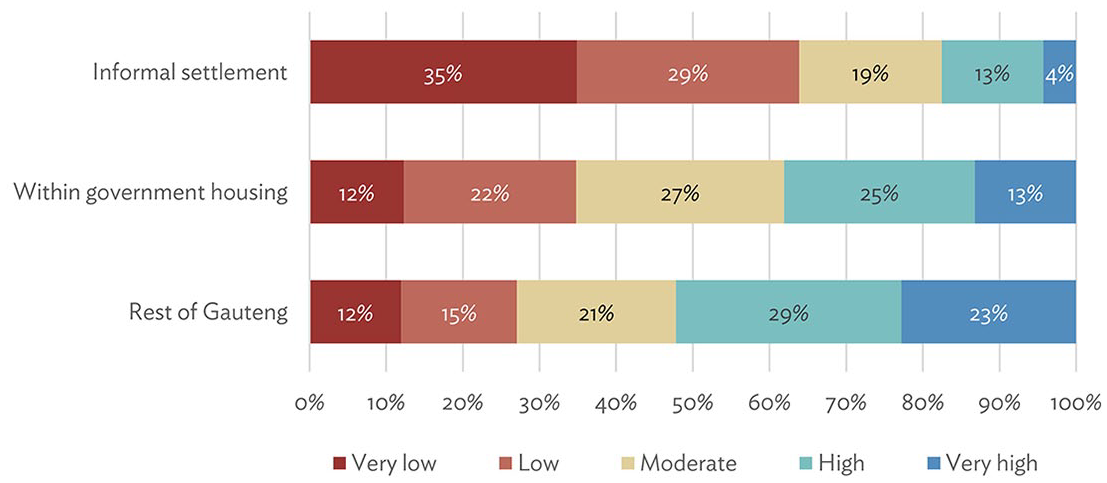
Accessibility index categories for people within government housing, informal settlements and the rest of Gauteng
Accessibility index scores differ widely between different government housing developments across the province.(59) Settlements such as Alexandra and Cosmo City (Johannesburg) have high average accessibility, whereas settlements such as Hammanskraal West (Tshwane) and Alliance Extension 9 (Ekurhuleni) have very low access to goods and services. Although the QoL results highlight that overall access is better in government housing developments than informal settlements, the Lufhereng and Pennyville interviews reveal that access has not necessarily improved for individuals after moving from an informal settlement to subsidized housing. Located immediately adjacent to an industrial area and a major retail outlet, the Zamimpilo informal settlement is arguably better located with regard to work opportunities and services than Pennyville. Likewise, Lufhereng respondents lamented that services and opportunities are harder to access than from where they lived before, particularly for those from Protea South, which was close to a train station, retail outlets and work opportunities in Lenasia.
Despite low accessibility scores in some government housing developments, the QoL survey results show that people within government housing developments on the whole have the best access to public transport. Some 91 per cent of government housing respondents live within a 20-minute walk of public transport, compared to 87 per cent of informal settlement residents and 81 per cent of the rest of Gauteng (Table 2). The contrast between Lufhereng and Pennyville in this regard, although not great, is indicative of the differences within this category. Interviews indicated that 100 per cent of people in Pennyville lived within a 10-minute walk of public transport, but only 83 per cent of those in Lufhereng did. Importantly, different areas have access to different types of public transport, including trains and buses subsidized by the government, and privately run minibus taxis. Pennyville is located within immediate proximity to a train station and a bus rapid transit station, and straddles a main taxi route between Soweto and the Johannesburg CBD. From Pennyville, the cost to travel to the CBD is R 7.50 (US$ 0.52) by train, R 11.80 (US$ 0.83) by BRT and R 12 (US$ 0.84) by taxi. A number of Pennyville interviewees highlighted that they rely on the weekly train ticket (R 46 [US$ 3.22] per week) as a cheap option for looking for jobs.
Lufhereng is currently only serviced by minibus taxis. Transport was highlighted as a significant concern for many Lufhereng residents. A taxi ride to the CBD from Lufhereng costs R 16 (US$ 1.12), and R 18 (US$ 1.26) for the other direction. The closest train station to Lufhereng is Naledi, where a taxi to the station costs R 9 (US$ 0.63) and the train ticket into town is R10 (US$ 0.70). Sandile,(60) a Lufhereng resident, flagged that it is hard to find work from Lufhereng because there is no train station close by. Despite the distance, some Lufhereng residents like Enzokuhle will walk 45 minutes to the train station to benefit from the cheaper fare. For poor households, the cost of transport, and particularly privately run public transport, is prohibitively high. Despite being more expensive than other modes of public transport, minibus taxis (privately run public transport) are the dominant mode of transport among people living within government housing developments in Gauteng.
Notwithstanding their generally better access to public transport, government housing developments tend on the whole to be poorly located with regard to work opportunities. Figure 2 compares the average distance (straight-line) travelled from home to work or to look for work, among the three groups. People living within government housing developments travel on average 23 per cent further than people in informal settlements and the rest of Gauteng. While averages can hide the range of individual experiences, the spread of data confirms that commutes from government housing developments tend to be longer than in either of the other categories. Commutes from informal settlements have the smallest range (86 kilometres), compared to 97 kilometres for government housing and 124 kilometres for the rest of Gauteng. Despite a few very long commutes, the majority of respondents in the rest of Gauteng commute under 10 kilometres (median), whereas the majority of commuters from government housing developments travel over 14 kilometres. These results confirm previous analyses highlighting that government housing programmes are situated far from traditional economic centres.(61) The QoL survey shows that people in government housing are the least likely of all respondents to arrive at work within 30 minutes of leaving home. They are also the most likely to take over an hour to get to work. The distance and time taken to reach economic opportunities is likely to contribute to the lower employment rate among people living within government housing compared to those living in informal settlements and the rest of Gauteng (Table 2). Despite the vast differences between Pennyville and Lufhereng, the interviews revealed no significant difference between commuting time from these settlements. There was also no significant difference in employment between the settlements. This could reflect the broader economic environment where jobs are hard to find or potentially the small sample size in these areas. A number of interviewees in Lufhereng lamented that it was harder to find jobs now than where they lived before.
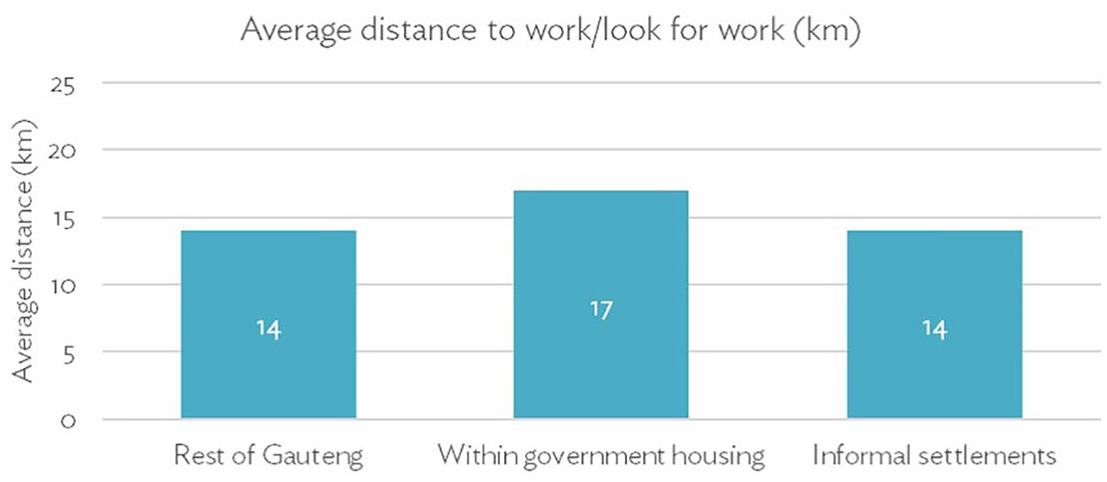
Comparing the average straight-line distance to work or to look for work for people living within government housing, informal settlements and the rest of Gauteng
c. Income and employment
Despite similar employment levels in government housing (32 per cent) and informal settlements (34 per cent), monthly income is higher in government housing. This could be influenced by the higher education levels among government housing residents and their higher likelihood of benefitting from government grants and rental as sources of income (Table 2). The majority of people in Gauteng draw on a range of income sources, possibly because no individual source of income is sufficient for their needs. Government housing provides an opportunity for recipients to supplement their income through rental. Figure 3 demonstrates that a greater proportion of households in government housing rely on rent as a source of income compared to people living in informal settlements and the rest of Gauteng. Much of this rental income is from self-built backyard dwellings (sometimes using “informal” construction methods). The QoL survey reveals that 16 per cent of people within government housing developments live in informal backyard dwellings. Rental income from backyard dwellings provides a real opportunity for people in government housing to improve their economic circumstances. However, this typically requires that owners invest in their properties.
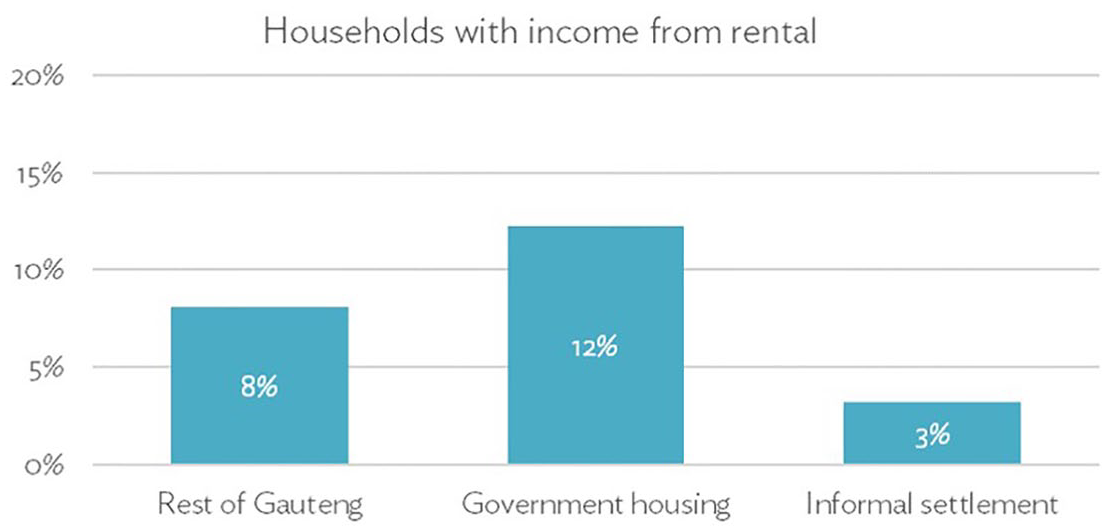
The proportion of households where rental income is a source of income
The Lufhereng and Pennyville interviews revealed that the vast majority of people have made improvements to their houses or properties (79 per cent). Some 21 per cent of these people have added ceilings to their homes, and 47 per cent have built additional rooms onto their properties. These additional rooms are used for a range of reasons, including to house family members, to run businesses and to rent out. Rent is a source of income for 22 per cent of Lufhereng and 44 per cent of Pennyville homeowners who have built additional rooms.
The cost of food and the additional burden of accessing retail outlets increases the need for people to use a range of food strategies, including growing vegetables and fruit. Some 19 per cent of people living in government housing grow food to eat and/or sell (Table 2). This is significantly higher than in the rest of Gauteng, but lower than in informal settlements. Less dense housing developments are more likely to facilitate informal agriculture. Lufhereng, an area specifically designed as a potential urban agriculture hub, has significantly higher prevalence of food growing than Pennyville. Some 43 per cent of interview respondents in Lufhereng grow food, compared to only 10 per cent in Pennyville, likely because of the greater amount of space available in Lufhereng.
The following section uses these empirical findings to explore the extent to which justice and sustainability outcomes are produced through government housing developments.
V. Building Just and Sustainable Cities Through Government Housing
The data reveal that government housing developments have substantially improved living standards for residents in Gauteng. The majority of residents in Lufhereng and Pennyville previously had inadequate access to accommodation and basic services, whereas every person interviewed now has adequate access to basic services and formal accommodation. This reveals a tangible improvement in quality of life because of the government’s investment in housing developments. Many people like Elsie (in Lufhereng) explain that because of their improved living conditions they “can’t complain” about other issues they might be facing. Although issues of accessibility remain, government housing developments have addressed some basic justice imperatives.
However, these housing developments have negative implications for the environment because of land-use transformation, embedded resource requirements of infrastructure and housing, and the likely higher daily use of resources (e.g. water and electricity) because of improved access to basic services. However, compared to elite groups, resource consumption remains low. For example, QoL data show that the majority (76 per cent) of households in the rest of Gauteng, with an income of R 25,600 (US$ 1,790) per month or more, spend over R 500 (US$ 35) per month on electricity, whereas only 15 per cent of people in government housing spend this much.
Despite the literature critiquing government housing developments for being poorly located,(62) this analysis shows that, although some government housing developments do indeed have low access to goods and services, in overall terms, accessibility is higher than in informal settlements. This indicates positive outcomes for both sustainability and justice. The greater the overall accessibility, the shorter the distances people must travel to get the things that they need. This reduces the environmental impacts as well as the time and financial costs of travel.
It is likely that older housing developments have higher access to goods and services because these have had time to establish in new areas. Lufhereng is an example of a government housing settlement that was built in an area without existing services or opportunities. The housing development is being built in phases, and the first phase was built long before any of the social or economic services that are planned for the overall settlement. The next phases are currently under construction, and it is likely that it will still be a number of years before the associated services are completed. Many Lufhereng residents, like Solly, lament that “it’s hard to get things from Lufhereng”. Lethabo emphasized that “you have to travel if you want something”. Government housing developments that have poor accessibility place a significant burden on residents. This not only has negative justice implications, it also increases the environmental footprint of people living in these areas due to longer commutes that are reliant on motorized transport.
This locational disadvantage is at the centre of many justice and sustainability concerns with government housing developments. Long commutes and trips to look for work by people living in government housing developments contribute to high financial and time costs that undermine people’s ability to move out of poverty. These long commutes also reflect carbon-intensive and environmentally unsustainable travel patterns. Although this mirrors the general transport system in Gauteng, where people live far from where they work, the results suggest that this pattern is slightly worse for people living within government housing developments. While it is important to draw a distinction between proximity to work opportunities and securing work, anecdotes from interviews confirmed the challenge of finding jobs from government housing developments. Dorothy highlighted that “you waste that small amount of money you have looking for money”. This also affect’s people’s ability to find work. Samuel reflected that “[i]f you came to Pennyville not working you are still not working”. The interviews highlighted that many residents limit the number of trips in search for jobs because of the cost of transport, while others will walk long distances to the train to benefit from subsidized fares.
Interviews with residents in Pennyville, who have much better access to trains than Lufhereng residents, flagged the importance of the weekly and monthly train tickets in enabling people without jobs to go out and look for work. Government-provided public transport such as trains and buses are important for the poorest groups in society, as they provide a means for the government to subsidize travel. However, few of the government housing developments in Gauteng are close to existing train or bus stations.
The data highlight that access to public transport is highest among people who live in government housing developments. Although it is likely that areas within the “rest of Gauteng” also have high access to public transport, many of the middle-class and affluent areas are poorly served by public transport. Comparatively high access to public transport can be primarily attributed to the prevalence of private taxis. The private minibus taxi industry has been highly successful in ensuring access to public transport for the majority of people in Gauteng in the absence of effective government-led public transport. Unlike government-provided public transport, which can take many years to respond to travel needs in new areas, the private taxi industry is flexible and responsive to new market opportunities. This analysis suggests that the private taxi industry has proved invaluable in ensuring that people in government housing developments can access goods, services and opportunities that are not located within or close to these developments.
However, taxis are more expensive than trains and buses, and there are limited options for saving money through buying weekly or monthly tickets. As Dorothy from Lufhereng reflected, “we pay the money we don’t have” because they have no other option than to use taxis. This reflects a complex interplay between improving and undermining justice and sustainability. Taxis increase access to goods, services and opportunities through public transport and enabling people to rely on public transport rather than private vehicles – both positives for justice and sustainability. However, their cost places a burden on household resources, undermining the justice imperatives of reducing poverty and inequality. And taxis that facilitate long-distance daily commuting contribute to entrenching the existing unsustainable transport system in the province. Taxis are also less resource efficient and produce more emissions per potential rider than buses and trains.
The analysis revealed that many recipients of government housing subsidies have built additional rooms and backyard dwellings to either supplement their income through rental, or provide additional accommodation for their household. More than half of people who live in informal backyard dwellings in Gauteng reside in government housing settlements. Turok and Borel-Saladin(63) argue that self-built backyard structures “provide more flexible accommodation to rent; greater proximity to economic opportunities than dormitory townships; better access to essential services and more safety than informal settlements; a regular source of income to poor homeowners acting as landlords; higher residential densities, and a more compact urban form enabling more cost-effective public transport and community infrastructure”. These benefits enhance the justice imperatives of providing additional accommodation, with better access to basic services, and providing opportunities for income generation. From a sustainability perspective, higher densities can minimize the impact of development on land and resource consumption. The results in Table 2 highlight that government housing developments do indeed have higher average household sizes than other groups in the province.
Despite the possible benefits for justice and sustainability of backyard dwellings, there are a number of potential issues that need to be taken into account in this particular situation. While backyard structures may provide greater proximity for more people to economic opportunities in some situations, as Turok and Borel-Saladin suggest,(64) this is not the case within these poorly located government housing developments. Furthermore, self-build developments can pose potential risks. Lufhereng, for example, is built in a dolomitic area and thus great care needs to be taken in extending water networks and adding weight to areas with high risks of developing sinkholes. Government support and deliberate planning could help maximize the benefits of rental and individual investment, while minimizing the negative consequences of self-built developments such as overloaded infrastructure, increased fire and health risks, environmental impacts, poor aesthetic quality, and the potential for aggravated social tensions and tenuous access to basic services for tenants.(65)
A further concern regarding increasing densities is the reduction of potential land for agriculture. Small-scale farming provides low-income communities with locally grown food, which is positive from an environmental sustainability perspective. It also improves access to food at a lower cost and with the potential to generate income through selling – both positives for social justice. The data suggest that although residents of government housing are more likely than the rest of Gauteng to grow food, this differs between settlements and is influenced by where space is available (e.g. Lufhereng and not Pennyville).
VI. Conclusions
Global urban growth trends place significant pressure on cities to accommodate the increasing urban populace and ensure sufficient access to basic services and economic opportunities. This challenge is further compounded by the need to reduce unemployment and inequality, while minimizing resource use and the negative environmental consequences of development.
This paper used survey and interview data from Gauteng, South Africa to assess some of the justice and sustainability implications of government housing developments. The analysis reveals that government investment in housing developments has improved justice imperatives through the improvement of access to adequate accommodation and basic services. Although these housing developments tend to have slightly lower access to economic opportunities than the rest of Gauteng, the private taxi industry has enhanced access to goods and services for residents in these areas. Taxis play a critical role in bridging the distance between government housing developments and work opportunities, but this comes at a cost that can be prohibitive for many poor households. Despite sometimes living in poorly located settlements, residents in government housing developments have been able to improve their earning potential, through building and renting out backyard rooms. This has had the additional benefit of increasing the density of government housing developments, which improves the efficiency of infrastructure investment. This study has demonstrated that government housing developments have contributed to enhancing justice and sustainability for residents. However, there are also instances where outcomes have been negative for one or both of these imperatives.
For government housing developments to help achieve both justice and sustainability imperatives, it is necessary to consider the broader implications of housing – not merely housing as access to adequate accommodation and basic services, but the associated access to goods, services, work opportunities and income generation options. The importance of affordable public transport in facilitating access to amenities, services and economic opportunities has been demonstrated. The outcomes of government housing developments would be significantly improved in Gauteng if government-led public transport were developed in parallel with the housing developments, to support residents in accessing job opportunities affordably. Furthermore, government assistance and incentives for economic opportunities in and around government housing programmes could support both environmental sustainability and social justice imperatives, particularly for settlements with low accessibility scores and long average commutes.
This paper highlights the complex interplay between justice and sustainability imperatives. In some instances, justice and sustainability outcomes are aligned (e.g. improved access to goods and services), whereas in other instances the outcomes are conflictual (e.g. improving access to basic services has resource-use implications). This empirical evidence highlights the theoretical stance put forward by Leach et al.,(66) that linear, reductionist relationships between justice and sustainability are not adequate in furthering a conceptual understanding of the interlinkages between these imperatives. Rather, different elements of justice and sustainability interact in complex ways.
A point of emphasis in the paper is the importance of decision-making that takes multiple criteria into account and engages with trade-offs between different decisions and the associated outcomes of government housing. This requires assessing both the direct impacts of these developments and the ongoing implications. Addressing the current multifaceted crisis of meeting the basic needs of a growing urban population and reducing poverty and inequality, while protecting environmental resources, requires thinking differently about this set of challenges. Creating an enabling environment for multiple systems to coexist can provide an important way for a range of actors across government, society and the private sector to help build cities that are both more socially just and environmentally sustainable.
Footnotes
Acknowledgements
We would like to acknowledge a number of people who have provided guidance, thoughts and constructive comments through the development of this paper. In particular, Richard Ballard, Margot Rubin, Graeme Götz, Nothile Ndimande, Alexandra Appelbaum, Tshepiso Monnakgotla and the three anonymous reviewers. We would also like to acknowledge Bonolo Mohulatsi’s help in developing the Accessibility Index and Christian Hamman for mapping government housing programmes in Gauteng. Errors and omissions remain our own.
Funding
The authors disclosed receipt of the following financial support for the research, authorship, and/or publication of this article: National Research Foundation (NRF) and the Gauteng City-Region Observatory (GCRO).
1.
Pieterse, Edgar and Susan Parnell (2014), “Africa’s urban revolution in context”, in Susan Parnell and Edgar Pieterse (editors), Africa’s Urban Revolution, Zed Books, pages 1–17; also UN-Habitat (2016), The New Urban Agenda, United Nations Human Settlements Programme, accessed 21 November 2017 at http://habitat3.org/the-new-urban-agenda; and UNFPA (2007), State of World Population 2007, United Nations Population Fund, page 108, accessed 21 November 2017 at  .
.
4.
Turok, Ivan and Jackie Borel-Saladin (2016), “Backyard shacks, informality and the urban housing crisis in South Africa: Stopgap or prototype solution?”, Housing Studies Vol 31, No 4, pages 384–409; also Shapurjee, Yasmin and Sarah Charlton (2013), “Transforming South Africa’s low-income housing projects through backyard dwellings: intersections with households and the state in Alexandra, Johannesburg”, Journal of Housing and the Built Environment Vol 28, No 4, pages 653–666.
5.
Turok, Ivan (2016), “Housing and the urban premium”, Habitat International Vol 54, pages 234–240.
6.
See reference 5.
7.
Charlton, Sarah (2017), “Poverty, subsidised housing and Lufhereng as a prototype megaproject in Gauteng”, Transformation: Critical Perspectives on Southern Africa Vol 95, No 1, pages 85–110; also Biermann, Sharon (2005), “The sustainable location of low-income housing development in South African urban areas”, WIT Transactions on Ecology and the Environment Vol 84, pages 1165–1173.
8.
Goebel, Allison (2007), “Sustainable urban development? Low-cost housing challenges in South Africa”, Habitat International Vol 31, No 3, pages 291–302; also Crane, Wendy and Mark Swilling (2008), “Environment, sustainable resource use and the Cape Town Functional Region – an overview”, Urban Forum Vol 19, No 3, pages 263–287.
10.
van Wyk, Jeannie (2015), “Can SPLUMA play a role in transforming spatial injustice to spatial justice in housing in South Africa?”, Southern African Public Law Vol 30, No 1, pages 26–41; also Haferburg, Christoph (2013), “Townships of to-morrow? Cosmo City and inclusive visions for post-apartheid urban futures”, Habitat International Vol 39, Supplement C, pages 261–268.
11.
Visser, Gustav (2004), “Social justice and post-apartheid development planning: reflections on moral progress in South Africa”, International Development Planning Review Vol 26, No 4, pages 359–376.
12.
Venter, Christoffel Johannes and Catherine Cross (2011), “Location, mobility and access to work: a qualitative exploration in low-income settlements”, Southern African Transport Conference 2011, Pretoria, 11–14 July, accessed 18 September 2013 at .
13.
Newton, Caroline (2013), “The Peoples Housing Process . . . getting the quality in the quantity?”, Journal of Housing and the Built Environment Vol 28, No 4, pages 639–651.
14.
Rubin, Margot (2014), Negotiated Settlements: The Case of Fleurhof Integrated Housing Development, Johannesburg, Centre for Urbanism and Built Environmental Studies, University of the Witwatersrand, Johannesburg.
15.
See reference 10, Haferburg (2013); also Mubiwa, Brian and Harold Annegarn (2013), Historical Spatial Change in the Gauteng City-Region, Gauteng City-Region Observatory (GCRO), Johannesburg, accessed 6 July 2015 at .
17.
18.
DPME (2014), Sustainable Human Settlements, background paper, Department of Performance Monitoring and Evaluation, accessed 3 January 2019 at .
19.
Parnell, Susan and Owen Crankshaw (2013), “The politics of ‘race’ and the transformation of the post-apartheid space economy”, Journal of Housing and the Built Environment Vol 28, No 4, pages 589–603.
20.
See reference 18.
21.
Charlton, Sarah (2010), “Inclusion through housing: limitations and alternatives in Johannesburg”, Urban Forum Vol 21, No 1, pages 1–19.
22.
Jenks, Mike (2000), “Conclusion: the appropriateness of compact city concepts to developing countries”, Compact Cities: Sustainable Urban Forms for Developing Countries, Routledge, London and New York, pages 343–350.
23.
24.
Charlton, Sarah (2014), “Public housing in Johannesburg”, in Philip Harrison, Graeme Gotz, Alison Todes and Chris Wray (editors), Changing Space, Changing City: Johannesburg after Apartheid, Wits University Press, Johannesburg, pages 176–193.
25.
Hunter, Mark and Dorrit Posel (2012), “Here to work: the socioeconomic characteristics of informal dwellers in post-apartheid South Africa”, Environment and Urbanization Vol 24, No 1, pages 285–304.
26.
The dataset includes a few housing developments that have been abandoned subsequent to the dataset being finalized in 2014.
27.
Leach, Melissa, Belinda Reyers, Xuemei Bai, Eduardo S Brondizio, Christina Cook, Sandra Díaz, Giovana Espindola, Michelle Scobie, Mark Stafford-Smith and Suneetha M Subramanian (2018), “Equity and sustainability in the Anthropocene: a social–ecological systems perspective on their intertwined futures”, Global Sustainability Vol 1, No 13, pages 1–13.
28.
See reference 27.
29.
Campbell, Scott (1996), “Green cities, growing cities, just cities?: Urban planning and the contradictions of sustainable development”, Journal of the American Planning Association Vol 62, No 3, pages 296–312.
30.
See reference 27. Distributive justice refers to the ways resources, costs and benefits are distributed across society. Procedural justice refers to processes of decision-making and conflict resolution that are fair and equitable and that allow all affected people to influence the process. Recognitional justice refers to the acknowledgement of identity and values, and explicitly reacts against discrimination based on cultural or political bases.
31.
See reference 11; also Patel, Zarina (2006), “Of questionable value: the role of practitioners in building sustainable cities”, Geoforum Vol 37, No 5, pages 682–694; and Vogel, C, D Scott, C E Culwick and C Sutherland (2016), “Environmental problem-solving in South Africa: harnessing creative imaginaries to address ‘wicked’ challenges and opportunities”, South African Geographical Journal Vol 98, No 3, pages 515–530.
32.
33.
See reference 31, Patel (2006); also see reference 32, Marcuse (1998); and Culwick, Christina (2015), “Social justice and sustainability transitions in the Gauteng city-region”, presented at the RC21 International Conference, Urbino, 27–29 August, available at .
34.
Agyeman, Julian and Tom Evans (2003), “Toward just sustainability in urban communities: building equity rights with sustainable solutions”, The ANNALS of the American Academy of Political and Social Science Vol 590, No 1, pages 35–53.
35.
See reference 27.
36.
Agyeman, Julian (2005), “Where justice and sustainability meet”, Environment Vol 47, No 6, pages 10–23; also Swilling, Mark and Eve Annecke (2012), Just Transitions: Explorations of Sustainability in an Unfair World, United Nations University Press, 448 pages, accessed 5 July 2015 at http://unu.edu/publications/books/just-transitions-explorations-of-sustainability-in-an-unfair-world.html#overview; Agyeman, Julian, Robert D Bullard and Bob Evans (2002), “Exploring the nexus: bringing together sustainability, environmental justice and equity”, Space and Polity Vol 6, No 1, pages 77–90; Heynen, Nik (2013), “Urban political ecology I: the urban century”, Progress in Human Geography Vol 38, No 4, pages 598–604; and McDonald, David A (2002), Environmental Justice in South Africa, University of Cape Town Press, Cape Town, 360 pages.
37.
See reference 27.
38.
See reference 4, Shapurjee and Charlton (2013); also see reference 5; and Chiu, Rebecca L H (2000), “Environmental sustainability of Hong Kong’s housing system and the housing process model”, International Planning Studies Vol 5, No 1, pages 45–64.
39.
See reference 5.
40.
See reference 7, Biermann (2005); also Biermann, Sharon M and Mark Van Ryneveld (2007), “Improving the location of low income housing delivery in South African urban areas”, presented at the Computers in Urban Planning and Urban Management 10th International Conference, Iguassu Falls, 11–13 July, page 14, accessed 20 August 2018 at .
41.
See reference 14.
44.
Suzuki, Hiroaki, Robert Cervero and Kanako Iuchi (2013), “Transforming cities with transit: transit and land-use integration for sustainable urban development”, page 165, accessed 18 June 2013 at .
45.
Aquino, Felipe Livert and Xabier Gainza (2014), “Understanding density in an uneven city, Santiago de Chile: implications for social and environmental sustainability”, Sustainability Vol 6, No 9, pages 5876–5897.
48.
IRP (2018), The Weight of Cities: Resource Requirements of Future Urbanization, International Resource Panel, United Nations Environment Programme, Nairobi, Kenya, accessed 23 May 2018 at .
49.
See reference 5.
50.
See reference 48.
52.
Mueller, Elizabeth J, Thomas W Hilde and Marla J Torrado (2018), “Methods for countering spatial inequality: incorporating strategic opportunities for housing preservation into transit-oriented development planning”, Landscape and Urban Planning Vol 177, pages 317–327.
55.
The individual developments in the spatial dataset are not aligned accurately with the edges of settlements. To ensure that all relevant QoL V (2017/18) respondents were included in the analysis, respondents located within 250 metres of the boundary of each housing development polygon were also included in the analysis. The respondents in the “government housing” group are not necessarily recipients of government-subsidized housing, but live within the areas defined as government housing developments, and might for example be renting from the government or a private landlord or living rent free.
57.
For a sample of 30 respondents, the 95 per cent confidence interval for a binary yes/no question is 18 per cent. To significantly improve this, substantially more interviews would have been required (e.g. 100 interviews provide a confidence interval of 10 per cent). The QoL survey provides very high precision to balance the lower precision of the case study interviews. The GCRO Quality of Life V (2017/18) survey data can be accessed from the GCRO –
59.
This analysis excludes any housing programme in the QoL V (2017/18) dataset where there are fewer than 15 respondents. Lufhereng is included in this subset due to insufficient respondents.
60.
All names have been changed to protect the identities of interviewees.
61.
Wray, Chris, David Everatt, Graeme Götz, Richard Ballard, Christina Culwick and Samy Katumba (2015), The Location of Planned Mega Housing Projects in Context, Gauteng City-Region Observatory (GCRO), Johannesburg, available at .
62.
See reference 10, Haferburg (2013); also Landman, K (2010), “A home close to opportunities in South Africa: Top down vision or bottom up demand?”, Town and Regional Planning Vol 56, pages 8–17.
65.
Lemanski, Charlotte (2009), “Augmented informality: South Africa’s backyard dwellings as a by-product of formal housing policies”, Habitat International Vol 33, No 4, pages 472–484.
66.
See reference 27.