




Abstract
This article interrogates how temporary housing in the Netherlands is shaped by informal governance. It argues such practices enable a new state-led paradigm, termed LEGO urbanism, which transforms housing from place-bound infrastructure into modular, relocatable assets. Drawing on a qualitative analysis of the Dutch flexwonen policy, the study shows how LEGO urbanism is realized through three key mechanisms: trust-based networks, discretionary flexibility, and the public absorption of private risk. By theorizing the link between modularity, temporariness, and informal governance, this work extends theories of urban informality to the Global North. It raises urgent questions about the role of the state in temporary urbanism, modularization within urban development, and the normalization of housing impermanence.
Introduction
Temporary use plays a central role in urban change (Martin et al., 2020; O’Callaghan, 2024), affording planners greater flexibility and adaptivity (Madanipour, 2017, 2018). While it is celebrated as a catalyst for regeneration (Berwyn, 2012; Németh and Langhorst, 2014), scholars increasingly question its relationship to neoliberal transformation and capital accumulation (Bragaglia and Caruso, 2022; Madanipour, 2017).
Housing, however, has remained largely absent from debates on temporary urbanism. Exceptions include the temporary occupation of vacant properties through squatting or anti-squat arrangements (Huisman, 2016; Vasudevan, 2015). This omission is significant because public actors such as planners in the Global North turn to temporary dwellings to cover critical public housing needs (Debrunner and Gerber, 2021; Druta and Fatemidokhtcharook, 2024; Wallace et al. 2025). This is enabled by a growing interest in prefabricated and modular construction as cost-efficient and sustainable modes of housing delivery amid escalating costs and stagnant productivity in the residential construction sector (Da Rocha et al., 2015; Dorignon et al., 2024; Green, 2022; Parisi and Donyavi, 2024).
Still, temporary urbanism is often framed as a reactive market response to oversupply during economic downturn (Colomb, 2012; Madanipour, 2017). This perspective, however, insufficiently accounts for how public actors turn to temporary urbanism, mediated by new modular and prefabricated construction technologies, to deliver critical public services such as housing. Moreover, modularity broadens the locus of temporariness from flexible land use to the material object itself. Spatial flexibility becomes not only a corollary of temporary use but also a feature of the object, underlining the polyvalence of temporariness. This raises the question of how governance arrangements are reworked to accommodate these new modes of temporary housing.
To confront these issues, we explore how temporary housing hinges on informal governance modes (Saaristo, 2022), through which the state leverages deregulation and circumvents legally binding plans and territorial fixity to expedite approval processes (Roy, 2009). Specifically, we examine the practice of flexwonen (literally, “flexible housing”) in the Netherlands, a national policy involving the deployment of prefabricated, modular units as temporary housing for young people, newly formed households, refugees, and other groups (Groot and Ronald, 2024). Flexwonen encompasses various forms of temporary rental housing defined by flexibility at the level of tenancy, planning procedure, or housing unit (Druta and Fatemidokhtcharook, 2024), generally through purpose-built prefabricated modular homes. While flexwonen follows logics of temporary urbanism by offering flexibility to fill in gaps, stakeholders wager that such “temporary” solutions will become permanent, a tension we explore in this article.
In this article, we interrogate these developments and tensions by asking: how is temporary housing in the Netherlands shaped through practices of informal governance? We present a qualitative analysis of temporary housing projects in the Netherlands, from which we identify and scrutinize the key modes of informal governance that enable their realization. This article asserts that the emergent modes of informal governance enabling temporary housing constitute a form of LEGO urbanism, a state-sanctioned approach whereby housing shifts from place-bound social infrastructure into modular, disassemblable, and relocatable assets. This housing paradigm normalizes impermanence through modular construction, allowing housing to be deployed and relocated in response to shifting socio-economic or regulatory conditions. By theorizing these hyper-flexible and mobile modes of housing governance, our critique of residential development in the Netherlands illuminates the strategic relations between informal governance and temporary housing in the Global North (Jaffe and Koster, 2019).
The remainder of this article is structured as follows. Following a discussion of the research design used for this article, we engage with the underexplored position of housing in temporary urbanism. We then explicate the notion of informal governance to ground our analysis. Subsequently, we present our analysis of flexwonen implementation in Utrecht and Rotterdam, from which three key modes of informal governance emerge: trust-based networks, discretionary flexibility, and public risk absorption. We conclude by highlighting the need to critically interrogate temporary housing as an emergent urban practice.
Research design
We employ a qualitative case study approach to investigate the governance of flexwonen in the Netherlands. This methodology allowed us to investigate this emergent phenomenon and identify critical discrepancies between planning frameworks and implementation. While analyzing multi-scale governance processes, we focused on projects in Utrecht and Rotterdam initiated since 2019. Both cities face acute housing shortages and are implementing flexwonen within highly regulated, densifying urban peripheries. As two municipalities in one of Europe’s largest metropolitan regions, they provide ideal contexts to examine how temporary housing manifests in cities with dense spatial regulations.
The analysis draws from several sources. We collected policy documents, including national planning frameworks, provincial guidelines, and municipal strategic plans, from 2019 to 2025, the period when flexwonen gained national momentum. We identified documents using keywords related to temporary housing (flexwonen, tijdelijke woningen, flexibele woningbouw) and additional materials recommended by interviewees. We also conducted nine semi-structured interviews between November 2023 and May 2024 with municipal planners, provincial policymakers, developers, bankers, legal experts, and housing associations, who were recruited through purposive and snowball sampling. 1 The interviews lasted 60–90 minutes and followed topic lists tailored to each stakeholder group to cover policy goals, governance arrangements, business cases, and perceived risks, including site selection. With informed consent, we recorded and transcribed all interviews. We triangulated these data through participant observation during site visits, factory tours, and government events, which provided additional context on the relational dynamics and personal interaction between public and private actors. Finally, we created a database of all flexwonen projects in Utrecht and Rotterdam up to 2024, cataloguing their number of units, building status, initiator, land ownership, target demographics, and temporal characteristics. This database allowed us to analyze how national flexwonen policies materialize in specific development projects.
The analysis followed an abductive logic, moving iteratively between empirical data and theory (Timmermans and Tavory, 2012). Our inquiry began with informal governance as a sensitizing concept, which provided an initial theoretical lens. Concurrently, we inductively coded interview transcripts and policy documents to allow emergent patterns to appear from the data. This iterative process allowed us to identify recurring patterns, such as planners using personal relationships to bypass bureaucracy, and then to return to the literature to conceptualize them. The process led to the refinement of the three modes of governance we identify. The three modes presented in our analysis—trust-based networks, discretionary flexibility, and public risk absorption—were constructed through this abductive process of iterative comparison between empirical material and theory.
The position of housing within temporary urbanism
Following the 2008 global financial crisis, temporary uses of urban space flourished as vacancies surged, projects stalled, and public budgets shrank. Madanipour (2017) argues that temporary urbanism stems from fluctuating patterns of urban investment and disinvestment. As Németh and Langhorst (2014) suggest, it can rekindle economic interest and generate small income streams while future development plans unfold. For Madanipour (2018: 1105–1106), this “image of flexibility” helps planners adapt to open-ended futures, yet it also normalizes inequality by masking uneven socio-spatial impacts. Conversely, the creation of clear spatial and temporal boundaries through planning provides the stability and predictability essential for capital investment (Savini et al., 2015). Building on such discussions, we understand temporary urbanism as the reprogramming of urban space through flexible arrangements that accelerate development cycles and accommodate capital flows under urban change (Madanipour, 2018). This reprogramming can manifest in different ways, such as open-ended development strategies (Bossuyt, 2021; Van Karnenbeek and Janssen-Jansen, 2018), anti-squat arrangements, or modular housing.
Temporary housing hinges on specific combinations of regulatory frameworks and material qualities. It includes various practices, such as container homes, tiny houses, and repurposed office spaces, that are characterized by limited occupancy durations (Debrunner and Gerber, 2021). The mechanisms enabling temporariness vary. In some cases, dwelling practices face legal restrictions against permanent habitation (Hilbrandt, 2021). In others, the units are physically unsuited for year-round living due to their material properties (Severinsen and Howden-Chapman, 2014).
Within the Dutch context, flexwonen fits this definition through a layering of regulatory, material, and contractual dimensions. First, temporariness is primarily established through regulatory conditions: projects are granted temporary land-use exceptions that legally limit their placement on a site, typically for 10–15 years. Second, the material conditions reinforce this, as the physical units are modular and designed for disassembly or relocation once land permits expire, aligning with principles of reuse and circularity. This modularity permits their reuse after initial deployment. Third, these regulatory and material conditions necessitate contractual limits, with tenants renting under fixed-term contracts (Druta and Fatemidokhtcharook, 2024; Groot et al., 2022).
Temporary housing sits at the intersection of vacancy and flexibility, potentially filling underused space in anticipation of future development (Friendly, 2025). O’Callaghan (2024) argues that temporary use flows from a pro-growth mindset that perceives any unoccupied space as wasteful, even though property cycles always feature vacancies. Enabling this spatial flexibility requires specific governance arrangements, which are often informal (Debrunner, 2024b). Transitory housing arrangements may create uneven consequences for residents, considering how time-limited contracts compromise tenure security (Huisman, 2016). Even residents in durable structures can suffer from residential insecurity when subjected to precarious tenure (Sullivan, 2017). While residents may value the flexibility of temporary accommodations, shifting economic realities can quickly transform this arrangement into enduring precarity (Hilbrandt, 2021). Still, the specific governance practices that mediate this polyvalent image of flexibility (Madanipour, 2018), particularly in highly regulated residential property markets, remain underexplored.
Flexwonen through the lens of informal governance
Informality, originally conceived to understand urbanization in the Global South (Roy, 2005), is now a crucial concept for describing urban governance in multiple contexts (Devlin, 2018). Scholars have moved beyond legalistic definitions to emphasize informality as a relational practice involving both state and non-state actors in urban development (Haid and Hilbrandt, 2019). Roy (2005, 2009) demonstrates how the state actively uses informality as a flexible tool to exert authority, create states of exception, and accelerate urbanization.
From this perspective, the state can strategically relax spatial regulations to accommodate densification pressures by accepting temporary housing as a policy innovation. This application of informality is increasingly relevant for understanding planning in highly regulated contexts like the Netherlands (Meijer and Ernste, 2022). The concept connects directly to debates on flexible planning (Debrunner, 2024a), which seeks to make urbanism more adaptive to changing social dynamics (Savini, 2017). Flexible planning then involves “the strategic activation of informal planning instruments that are not formally regulated in the law” (Debrunner, 2024a: 3), such as “informal” master plans, test-planning procedures, and temporary use (Debrunner and Gerber, 2021).
At the regulatory level, temporary housing depends on informal modes of governance (Saaristo, 2022). This informality often manifests as deregulation, where public bodies sidestep legally binding urban plans and approval processes. Planners employ territorial flexibility to “informalize” urban development, often to meet developers’ needs (Roy, 2009). As Roy (2009: 83) suggests, this is a “calculated informality, one that involves purposeful action and planning, where the seeming withdrawal of regulatory power creates a logic of resource allocation, accumulation, and authority.”
In the Global North, planners often repackage these informal governance approaches as policy innovations, whereas similar practices in the Global South may be perceived as clientelist or corrupt (Jaffe and Koster, 2019). In a context like the Netherlands, the perception of a highly organized state can conceal such informal agreements. As Jaffe and Koster (2019: 563) note, the state may use “strategic, uncodified, and non-transparent deviation from legal procedure to achieve compliance and/or effectiveness.” This selective enforcement of rules may benefit some groups at the expense of others.
To guide our analysis, we began with the sensitizing concept of informal governance. Through an iterative process of moving between this concept and our empirical data, we developed an analytical framework positing three specific modes of informal governance. The first mode is trust-based networks, which operate through informal, trust-based coordination. Drawing on Tilly (2005), we understand these as informal institutions built on strong interpersonal connections, where actors risk valued resources on the reliability of others (Goodfellow, 2020). Such trust networks concern strong ties fostered through interpersonal connections “within which people set valued, consequential, long-term resources and enterprises at risk to the malfeasance, mistakes, or failures of others” (Tilly, 2005: 12). While Tilly (2005: 12) applied this idea to democratization, trust networks are crucial in cities for everything from business (Clemens, 2010) and irregular armed forces (Davis, 2010) to the governance of housing provision. While there is an implicit idea in the Global North that governance only occurs through formal networks, formal and informal practices often coincide (Jaffe and Koster, 2019; Van De Pas et al., 2022). The idea of trust networks allows an understanding of how networks are formed and the conditions under which networks are integrated into urban development (Hanagan and Tilly, 2010).
The second mode includes reforms granting planners discretionary flexibility to bend or adapt rules. As Healey (1992) notes, discretionary systems can be dominated by those with the power to define the terms of that discretion. This does not imply boundless flexibility; rather, planners must “mediate between the rules and structure of a planning system while leveraging flexibility to shape decisions” (Biggar and Friendly, 2023: 1586).
In the Netherlands, deregulation has encouraged state actors to strategically use informality by partially enforcing rules in everyday problem solving (Jaffe and Koster, 2019). In planning, reforms have spurred development-led approaches and codified discretionary flexibility. At the same time, public–private development contracts are applied with strong interpretive flexibility for the sake of sustaining relations between actors (Van Den Hurk and Tasan-Kok, 2020). While this has led to fragmentation, it also opens up space for informal practices.
The third mode, which we term public risk absorption, shifts development risk from private actors to public entities (Harvey, 2005). This diverges from traditional risk distribution, as public entities strategically provide relocation guarantees, fund builders, and reduce private sector exposure to incentivize investment in temporary housing.
Public risk absorption reflects broader trends in public–private partnerships and entrepreneurial governance (Savini, 2017). It is not inherently informal. Here, the framing of such public–private cooperation is critical. In the Global North, these arrangements are often celebrated as innovative policy, whereas similar practices in the Global South might be dismissed as clientelist and corrupt (Jaffe and Koster, 2019). Such dichotomies overlook the prevalence of informal practices in the North. Aalbers (2022: 9) points to the Bouwfraude scandal in the Netherlands, a massive case of collusion and bribery in the construction sector mediated by informal networks, which is often forgotten as opposed to its Brazilian equivalent. Far from being anomalous, informal practices are embedded in the very structure of residential property development in the Netherlands, which is characterized by oligopolistic market structures, high interdependence, and close professional networks between developers and politicians (Bossuyt et al., 2018; Buitelaar et al., 2024). Following this logic, we consider public risk absorption to be a key component of informal governance in the case of flexwonen. The risk or uncertainty being absorbed through flexwonen directly emanates from its “informal” character of discretionary flexibility, the uncertain residual value of modular units, and their potential mobility. It is also legitimized through the very discourse of innovative cooperation described above. By absorbing risk in this way, public entities enable investment in modular, standardized housing units, laying the groundwork for the emergence of LEGO urbanism.
As we demonstrate next, these three complementary modes of informal governance mediate LEGO urbanism, as they provide the necessary flexibility and discretion of governance and planning for such new, modular, hyper-flexible, and mobile modes of housing production to emerge. Our analysis builds on debates about temporary urbanism hinging on flexible governance (Madanipour, 2018; Saaristo, 2022) but adds a crucial layer through modularity and mobility. LEGO urbanism extends temporary urbanism beyond temporariness by adding modularity, the ability to reassemble and relocate components. While the governance enabling this is not inherently informal, we show that these specific informal modes are instrumental in implementing such novel housing practices. In the following sections, we apply this abductively derived framework to our case studies of flexwonen policy in Rotterdam and Utrecht. Next, we outline flexwonen as a national policy, suggesting how it encapsulates aspects of housing informality, rebranding the policy as an innovative solution.
Flexwonen in contrast to informal housing in the Netherlands
In the Netherlands, flexwonen refers to temporary rental housing defined by flexibility in tenancy, planning procedures, or the housing units themselves (Druta and Fatemidokhtcharook, 2024). Flexwonen homes come in two varieties: purpose-built modular units and “transformation homes” created from vacant buildings like offices or schools (Groot et al., 2020). The analysis focuses on the former, as it is the more common type and central to current policy.
This model operates on multiple temporal layers. The modular units are placed on land for 10–15 years under temporary land-use permits. Tenants, in turn, hold short-term rental contracts, usually for between two and five years. 2 Although the units are designed for temporary placement, improvements in quality mean they are expected to last 30–40 years. Once a land permit expires, they can potentially be moved to a new site or incorporated into a permanent development. The national government primarily initiates and facilitates flexwonen on underutilized public land, framing it as a means of boosting housing construction by easing the regulatory conditions that hinder permanent development.
The adoption of flexwonen is underpinned by concerns about meeting the housing needs of specific social groups. The policy first emerged in response to the influx of labor migrants in the mid-2000s (Druta and Fatemidokhtcharook, 2024). Over time, its scope has expanded to include other groups—such as students, divorcees, caregivers, and refugees—who struggle to find housing due to the restricted availability of social housing and the high cost of the private rental market. To address this, the Dutch government plans to create 15,000 flexwonen homes annually, aiming for a total of 900,000 new housing units by 2030 (VRO, 2022).
Over time, the national government’s attention has shifted toward industrialized modular construction, reframing flexwonen from a targeted social policy to a mainstream technological solution for the “housing crisis” (Druta and Fatemidokhtcharook, 2024; Hofman, 2023). Moreover, the government frames flexwonen as a tool to solve the “qualitative mismatch between supply and demand, preventing demolition and value depreciation of permanent housing stock” (Tweede Kamer Der Staten-Generaal, 2019: 3). Flexwonen has shifted into a packaged policy solution to address various unmet housing needs through factory-based industrial construction, allowing for development where permanent housing is not yet possible or allowed: Because [flexwonen units] are movable and demountable, they can be placed in places where permanent housing construction is not [yet] possible … It is also possible to build in places where this is not [yet] permitted … or to build in places where this will no longer be desirable in the future … [Flexwonen] can also help to develop an area intended for permanent construction [placemaking] by starting with good-quality flexible housing at that location. (Ministry of the Interior and Kingdom Relations, 2023: 1)
Flexwonen has received significant public investment, with the national government spending over €977 million by 2022 and taking an active role in providing financial guarantees and acquiring units directly from builders (Ministry of Housing and Spatial Planning, 2023). The objective is to rapidly expand the housing stock with a “flexible layer” of relocatable houses (Groot et al., 2022: 7). Despite these efforts, implementation has been slow: only 7440 of the 37,500 projected units were completed between 2022 and 2024 (Obbink, 2024). While around 50,000 existing units were classified as flexwonen in 2023, the term’s broad definition suggests these numbers should be interpreted with caution (Van Elburg, 2023).
Building on literature suggesting that informal governance is prevalent in the Global North (Jaffe and Koster, 2019; Van De Pas et al., 2022), we consider how the implementation of flexwonen in the Netherlands is a core example of selective legitimization. According to Van De Pas et al. (2022), when states are confronted with informal practices that challenge established norms, they may opt to exclude, dismiss, or selectively incorporate them into the dominant order. Flexwonen represents a clear strategy of this selective incorporation, which involves a degree of functional mimicry. The state rejects uncontrolled informal housing, such as the inhabitation of holiday homes or vacant offices, yet promotes its own technologically and state-sanctioned equivalent. This distinction is clearly explicit in early government publications, which present flexwonen in contrast to these “unsuitable informal housing arrangements,” framing them as deplorable living situations (Ministry of the Interior and Kingdom Relations, 2019: 2). In contrast, the state displays, legitimizes, and actively promotes modular units as a regulated and appropriate form of temporary housing. Various modes of temporary housing, such as squatting (Vasudevan, 2015), repurposed holiday homes (Sgolacchia, 2023), and inhabiting allotment gardens (Hilbrandt, 2021), are direct responses to the housing system’s failures. 3 In this context, the emergence of flexwonen represents a state strategy of selective formalization that seeks to address immediate housing shortages while neutralizing this critique.
Flexwonen in Utrecht and Rotterdam
To understand how the informal governance of flexwonen operates locally, our analysis focuses on Utrecht and Rotterdam. Both cities are situated in the Randstad, a dense, polycentric metropolitan region in the Netherlands. Facing substantial population growth, both cities have urgent housing affordability and accessibility challenges, particularly for groups who do not qualify for social housing and cannot afford the private market (Gemeente Rotterdam, 2024a; Gemeente Utrecht, 2019b, 2021). Consequently, Utrecht and Rotterdam actively support the construction of temporary modular units as part of their strategic spatial plans and housing visions. Both cities are undergoing substantial population growth due to increased single-person households, international migration, and internal demographic shifts. Rotterdam’s population is projected to grow from 620,000 in 2020 to 700,000 by 2035. Meanwhile, Utrecht anticipates its population will increase from approximately 360,000 in 2020 to 400,000 by 2029.
Figure 1 shows the spatial distribution of 19 flexwonen projects in both cities that were planned, approved, or realized between 2017 and March 2025. Project sizes vary, typically between 30 and 162 units. Municipalities either initiate the projects directly or provide public land through a lease, often in public–private collaborations with housing associations, non-governmental organizations, or private developers. All projects are designated for specific target groups, including young residents, “starters” (newly formed households), students, refugees, and emergency housing seekers.
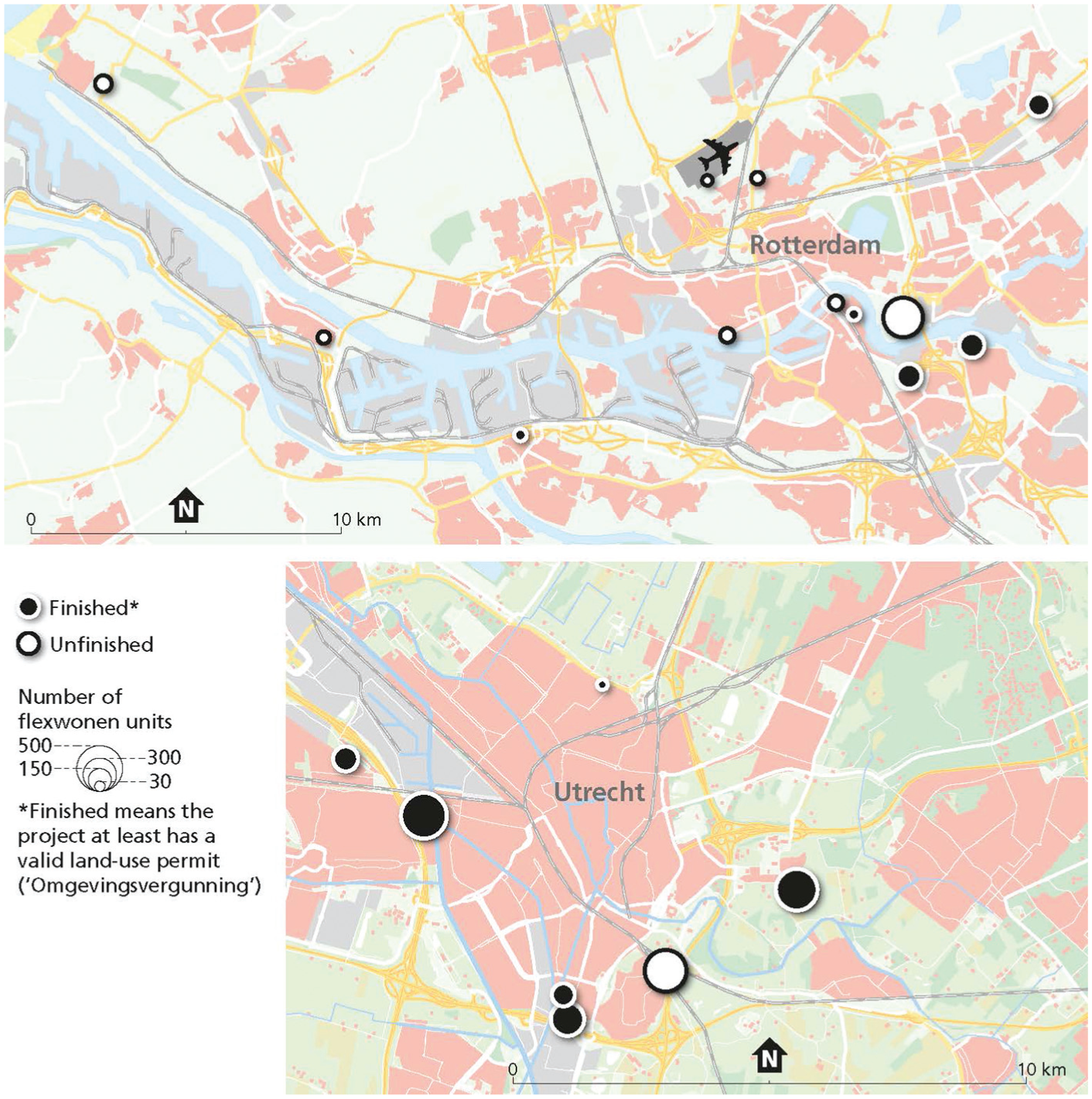
Distribution and status of flexwonen projects in Rotterdam (top) and Utrecht (bottom).
The analysis shows that flexwonen projects in Utrecht and Rotterdam are primarily located on urban brownfield sites and in interstitial zones (see Figure 1). These sites, often former industrial land or areas adjacent to infrastructure, typically feature fragmented urban functions. Temporary uses are attractive here because they can bypass spatial and environmental regulations, enabling municipalities to build housing where it would normally be disallowed or where future plans are uncertain. As a result, these areas are often underserviced and have poor public transport connections (Groot et al., 2024). Despite these locational disadvantages, public bodies promote flexwonen with a narrative of speed and innovation. Projects in these areas tend to encounter less local opposition and can serve as a strategy for future “placemaking.” It is touted as a “smart use of space” that can rapidly address housing needs (Provincie Utrecht, 2021: 5) by providing “high-quality, reasonably priced housing” with “circular features” (Gemeente Rotterdam, 2024b: 29). According to this official narrative, these qualities allow flexwonen to alleviate housing shortages quickly and efficiently.
As Figure 1 shows, seven sites in Utrecht are designated for flexwonen: six are nearly finished, whereas one will be realized in the coming years. Many of these are close to infrastructural networks like highways or railroads. These temporary housing projects were initiated and developed by multiple actors, including the municipality (most frequent), private builders, the university, and housing associations, often in public–private partnerships (Ministry of the Interior and Kingdom Relations, 2022a). In Rotterdam, six sites are nearly finished, and another six are planned, showing the densification of interstitial zones. Rotterdam’s projects are smaller in scale, with private actors and housing associations playing a more prominent role than in Utrecht. The city’s largest project, Toepad in De Esch, exemplifies this collaborative approach. Located on the city’s eastern periphery amidst allotment gardens and adjacent to the A16 ring road, the project involves constructing 380 rental apartments in five- to eight-story buildings. The development is a public–private–civic partnership: Daiwa House Modular Europe, a large construction company, is the builder, while the housing organization Woonstad will act as the landlord.
While flexwonen does not require public land, our analysis shows that the majority of projects in both cities are situated on publicly owned land, which contrasts with temporary uses on private property discussed elsewhere (Debrunner, 2024b; Madanipour, 2017). In Utrecht, five of the seven projects are on public land; in Rotterdam, this figure is eight out of the 12. The two cities also differ in their promotion and legitimation strategies. Utrecht tends to emphasize social mix and community integration, whereas Rotterdam primarily frames its projects as a solution to housing shortages for young people, granting priority access to local neighborhood youth.
Informal governance: Analysis along three dimensions
Through an iterative analysis of the implementation of flexwonen, we identified three distinct yet complementary modes of informal governance: trust-based networks, planning reforms for discretionary flexibility, and public risk absorption.
Trust-based networks
While the national government mandates flexwonen, its implementation depends on collaboration between provinces, municipalities, housing associations, and developers through trust-based networks (Tilly, 2005). These actors sign agreements called woondeals, which outline housing targets and use national funding as an enticement for private builders (Provincie Utrecht, 2022; Provincie Zuid-Holland, 2021). The national government believes that these non-binding, multi-level partnerships will enhance housing delivery (Volkshuisvesting Nederland, 2022). Municipalities create similar arrangements, such as Rotterdam’s Construction Agreement and Utrecht’s Housing Agreement, which detail land costs, target groups, and developable properties (Gemeente Rotterdam, 2023b; Gemeente Utrecht, 2019a). Rotterdam, for example, plans to build 2000 flexwonen units by 2026 through these partnerships.
While municipalities often prefer permanent housing, they consider flexwonen a good option when sites do not permit permanent development (Interview, March 18, 2024; Gemeente Utrecht, 2019b: 18). Finding suitable land relies heavily on this network-based collaboration, requiring trust-based coordination between public and private actors to navigate regulations and resolve potential citizen resistance (Interview, November 9, 2023). As a project developer noted: The municipality of Utrecht was initially uncertain [due to a lack of clear regulations regarding newly built temporary housing]. We had extensive discussions about quality standards, questioning why certain standards should differ between temporary and permanent situations. Then we collaboratively developed a standard framework to evaluate and approve the plan, which ultimately proved successful. (Interview, March 29, 2024)
While networked coordination is not new to the Dutch construction sector (Van Den Heuvel, 2005), the flexwonen policy intensifies these dynamics with its emphasis on urgency, flexibility, and speed. This is particularly evident in how municipalities navigate the political challenges of migrant housing. A combination of xenophobia and NIMBYism often confronts efforts to house asylum seekers, and the association between flexwonen and migrants can lead to legal challenges that stall projects. As a housing corporation employee noted, overcoming neighborhood resistance, euphemistically termed “participation,” is crucial for finding viable locations (Interview, May 1, 2024). One instructive example comes from Rotterdam, where the municipality emphasizes that housing allocation will partly focus on “local youth” to pre-empt criticism (Gemeente Rotterdam, 2023a).
The rush to implement flexwonen highlights an ad hoc process where actors negotiate standards on a project-by-project basis. This reliance on informal collaboration was evident at a recent flexwonen conference, where officials and stakeholders used phrases like “we’re in it together,” “creatively deal with the rules,” and “work on the basis of trust and goodwill” to describe their approach. In one case, when several projects in Utrecht Province faced regulatory hurdles due to environmental legislation, the province subsequently amended the rules to expand the exemption criteria for temporary housing (Interview, March 6, 2024), demonstrating the trust-based negotiation processes of flexwonen implementation.
Discretionary flexibility
The strategic relaxation of planning frameworks and building regulations creates the discretionary flexibility needed to implement flexwonen (Jaffe and Koster, 2019). Beginning in 2010, the Crisis and Recovery Act allowed temporary deviations from land-use plans for up to 15 years, enabling buildings to bypass the stricter regulations applicable to permanent structures under the 2012 Building Code (Bouwbesluit). The Environment and Planning Act (Omgevingswet), which replaced this act in January 2024, continues to allow for such deviations through special environmental permits. These regulatory conditions make flexwonen particularly viable for vacant land or zones undergoing transformation (Groot et al., 2022: 31). On paper, such temporary exemptions allow governments to avoid lengthy zoning processes or provide interim housing while sites await permanent redevelopment.
The cases of Utrecht and Rotterdam show how municipalities use these temporary permits to bypass regulatory obstacles and address long-term strategic uncertainties. For instance, limitations posed by water and electrical infrastructure, noise pollution from highways, or poor air quality from industrial activities often prevent permanent residential development. In Rotterdam, one such project is proposed for an old shipyard in Ijsselmonde where local objections have stalled permanent plans. For the Toepad project, the city of Rotterdam similarly reinterprets land-use designations, such as cemetery land, to accommodate housing. Utrecht’s flexwonen sites, including Pagelaan and Befu-terrein, are located near highways and railroads. Here, noise regulations would normally prevent permanent housing. To overcome this, spatial regulations for temporary permits are eased for flexwonen. Similarly, for the Tussen de Rails site, long-term uncertainty over future infrastructure plans makes the area viable only for temporary dwellings (personal communication, June 28, 2024).
The Ministry of the Interior and Kingdom Relations actively encourages municipalities to use the discretionary powers enabled by recent planning reforms. In a handbook, the Ministry explicitly instructs municipalities to use their flexibility and selectively enforce regulations, citing the “temporary” nature of flexwonen (Bosch et al., 2023). This involves applying lenient standards for noise, pollution, and smells. As the handbook states, “sometimes a strict application is possible and sometimes a more flexible, considerate assessment” (Bosch et al., 2023: 7). The handbook even suggests that for regulations with fixed spatial standards, assessing authorities like environmental agencies should adopt more flexible norms to account for the “social urgency and temporary nature” of the projects (Bosch et al., 2023: 8). Furthermore, it notes that formal aesthetic reviews (welstand) are often not legally mandatory for temporary projects (Bosch et al., 2023: 9). In short, the implementation of flexwonen relies on a state-endorsed narrative of urgency and customized solutions (maatwerk), which legitimizes directly circumventing standard spatial regulations, even when fixed spatial standards exist.
Still, this state-sanctioned flexibility is constrained by a significant factor, which is citizens’ right to appeal. Municipalities can issue fast-track land-use permits for temporary housing in eight weeks instead of the usual six months, but legal challenges from residents can eliminate these time savings (Interview, March 15, 2024). This became apparent in Rotterdam’s Oud-Ijsselmonde, where resident objections delayed a temporary housing project on a former shipyard by two years. Even under the new Omgevingswet, judicial appeals can cause project delays of up to six months (Van Karnenbeek, 2023). Legal challenges may systematically undermine the theoretical advantages of these planning reforms, exposing the limitations of these so-called fast-track processes.
The reality of lengthy permit procedures and legal appeals, affecting both regular and temporary housing projects, worries politicians and developers alike, undermining the promise to deliver housing quickly. Despite these potential delays, developers remain drawn to temporary permits. They view them as shortcuts for “placemaking” activities, which they believe can smooth the “participation” process and ease the eventual approval of permanent development. By using these fast-track processes, developers hope to significantly reduce project timelines, compressing what would normally be a 10–20-year process for permanent development into a much shorter period (Interview, April 24, 2024).
Public risk absorption
Temporary urbanism posits accelerated urban investment cycles, smoothing associated risks (Madanipour, 2017). The promise is that change will allow private actors to capitalize quickly on spatial transformation processes. The reality of flexwonen presents developers and investors with unstable business cases and shifting risk assessments. Developers, in particular, express concern over the cost of relocating units and their uncertain residual value after initial use. As one developer summarized the financial conditions necessary for private investment: Basically, you have two main financial conditions that allow a private actor to do this. First, the land must be free. There cannot be a land value under flexwonen … paying a realistic land price upfront is very complex. Unless there’s a guarantee that at the end of the duration you can reuse the flexwonen elsewhere or develop something else. (Interview, March 29, 2024)
In contrast, banks and investors are cautiously optimistic, viewing the disaggregation of modular housing into individual building components or movable assets as a potential risk mitigation strategy. Some interviewees believe high-quality modular units could retain over 50% of their value after 30 years. However, the wider financial sector remains cautious, citing market uncertainty and the unproven track record for modular housing (Interview, May 8, 2024). Financial institutions refuse to accept theoretical valuations because the market for reused building components is underdeveloped, leaving no established reference points (Alba Concepts et al., 2024). The expected value of modular units depends heavily on their end-of-life scenario: relocation preserves far more value (36%–39%) than disassembly for component reuse (13%–14%). Consequently, banks prefer to fund high-quality modular units that can be leased or sold to more affluent demographics after their initial deployment. Such uncertainties, regarding upfront land costs, unclear end-of-life scenarios, and an undeveloped market for reusable building components, hinder private investment. It is precisely this gap that public risk absorption is designed to fill. To make flexwonen viable, public entities must step in to cover these financial risks, for example by providing cheap land or offering relocation guarantees.
Consequently, to attract private capital, the flexwonen sector has begun to drift away from addressing urgent housing needs and toward a more commercial approach. This trend is evidenced by the involvement of major financial institutions like Rabobank through its “Rabo SmartBuilds” initiative, which funds the construction of modular units for middle-income groups and assumes the role of landlord (UVTH, 2024). This commercial turn extends project timelines from 10–15 years to potentially 30–40 years and risks further marginalizing the vulnerable groups, like labor migrants, that flexwonen was originally intended to serve (Druta and Fatemidokhtcharook, 2024).
The substantial investment risks of flexwonen, concerning its durability, longevity, and uncertain residual value, have prompted the national government to absorb these private risks. To do so, it has implemented three distinct mechanisms. First, the state implemented a financial relocation guarantee, the Regulation on Compensation for the Relocation of Flexwonen (RTHF). This program sets aside €220 million (2023–2028) to cover 85% of the investment costs for 22,000 housing units if no replacement site is found after their initial use (Ministry of Housing and Spatial Planning, 2023). While this allows developers to recoup investments, some practitioners argue the relief is limited, as the compensation often falls short of potential losses (Interview, March 6, 2024). Second, to provide a physical replacement assurance, the government committed to incorporating “flex cities” into national plans, creating designated areas for relocated units should other sites be unavailable (UVTH, 2024). Third, the state began actively procuring and subsidizing units. The Central Real Estate Agency has financed 2000 units worth €245.3 million, incurring €8.2 million in storage costs, while the government has subsidized thousands more at approximately €12,000 per unit to mitigate development risks directly.
These three mechanisms amount to what we term public risk absorption: the state-led transfer of investment risk from private to public entities to encourage temporary housing. This intervention reflects a narrow definition of the housing crisis as merely a unit shortage, a view that prioritizes construction speed while overlooking the critical precondition of available land (Bressers, 2023). In a rapidly changing field of hyper-mobile and flexible housing, amounting to LEGO urbanism, such risk absorption strategies are crucial for institutionalizing new types of residential impermanence.
Discussion and conclusion
This article analyzed the implementation of Dutch flexwonen policy through three modes of informal governance. The cases of Utrecht and Rotterdam reveal how trust-based networks, discretionary flexibility, and public risk absorption combine to enable the deployment of modular housing on underutilized urban land. This process establishes what we term LEGO urbanism, a state-led development model where housing consists of movable, prefabricated components that can be assembled, disassembled, and relocated to create temporary housing zones in metropolitan interstices. LEGO urbanism provides a material extension of theories of bifurcated urban integration, which describe a selective dis- and re-assembly of urban data and resource flows (Macrorie and Marvin, 2019). Within LEGO urbanism, the state leverages novel institutional arrangements, such as informal networks and planning flexibility, to bypass comprehensive planning and consolidate bifurcation. Yet unlike the premium spaces associated with bifurcated urban integration, LEGO urbanism establishes temporary enclaves for vulnerable populations, raising critical questions about the risk of their further precarization. Moreover, this underlines tensions between the normative aspiration of plug-and-play housing provision, enabled by prefabrication and modularization, and the political realities of infrastructural integration (Monstadt and Coutard, 2019). The very implementation of LEGO urbanism is made possible through informal governance, where public actors rebrand clientelist practices as policy innovations to bypass hurdles in planning systems (Jaffe and Koster, 2019). By integrating theories of informality with temporary and modular housing, we thus extend Roy’s (2009) work to a highly regulated and formalized planning system in the Global North.
As our analysis showed, trust-based networks underpin flexwonen implementation through non-binding housing deals between governments, housing associations, and developers (Tilly, 2005). These networks enable exemptions through direct negotiation, allowing developers to approach municipalities with potential sites. While financial institutions like Rabobank have begun to join these ventures, creating specialized vehicles to integrate financing, development, and landlord functions, public land ownership and publicly initiated projects remain the norm.
Discretionary flexibility manifests as the selective application of spatial regulations, complementing trust-based networks. Indeed, flexwonen policy is largely built on this flexibility in decision making. In Utrecht and Rotterdam, temporary permits and land-use exemptions allow municipalities to bypass the regulatory conditions for permanent development and address long-term uncertainties, a practice actively encouraged by the national government (Ministry of Housing and Spatial Planning, 2023). Such temporal flexibility is a legislative construct rather than a fixed reality, defined by municipalities through environmental permits. Concomitantly, the boundary between temporary and permanent housing is highly porous, with durations extending from 10 years to 20 or 30 at a municipality’s discretion.
Finally, the Dutch state’s approach to flexwonen demonstrates public risk absorption (Harvey, 2005). Through financial guarantees, relocation assurances, and direct procurement, the state actively assumes private sector risks to cover the uncertainties of property development, which are intensified with temporary purpose-built housing units. This allows politicians to portray themselves as proactively addressing the housing crisis while facilitating densification. Public risk absorption, consisting of central state policies and practices, is therefore essential to the other two modes. It works to underwrite and “formalize” the multi-scalar collaborations in trust-based networks and the local practices generated by discretionary flexibility. By covering the private financial risk, a risk that emerges directly from flexwonen’s “informal” character and modularity, the state makes the entire model viable.
Moreover, the analysis reveals a strategic rebranding of flexwonen from an emergency measure to a mainstream housing strategy, evident in policy that reframes “container housing” as “modular units,” while delegitimizing other informal practices like squatting (Druta and Fatemidokhtcharook, 2024). Aided by a vague definition, this selectively legitimized model now applies to diverse groups, from labor migrants to young households, and possibly even to middle-income groups. While temporary housing is typically associated with stigmatized populations (Sullivan, 2017), this trajectory normalizes housing impermanence, raising critical questions about how legal protections mediate residents’ lived experiences of precarity.
The notion of LEGO urbanism contributes to urban studies literature through two further theoretical insights. First, it underlines the critical yet underexplored relationship between construction technologies and informal governance. By framing modular construction as a “technological fix” for the housing crisis, the state creates a political justification for informal governance practices. The narrative of innovation and urgency is used to legitimize circumventing regulations through discretionary flexibility, favoring negotiation within trust-based networks, and justifying public risk absorption for an “unproven” technology. This ties into ongoing debates regarding the transformation of landed property relations under technological change (Fields, 2024). In the case of LEGO urbanism, the home is physically disaggregated into movable, reconfigurable components. This physical disaggregation creates the potential for a new secondary market in housing components, separate from the land itself. For such a market to function, property relations must be reordered. Future research should therefore investigate how modularization reorders landed property relations and with what political-economic consequences.
Second, our analysis reframes temporary urbanism as a potentially state-led strategy, challenging the dominant view of it as a market-led response to spatial-temporal fluctuations in urban development (Madanipour, 2018; Oswalt et al., 2013). In contrast to temporary uses emerging on private land when market downturns create an abundance of vacant space, flexwonen demonstrates the state acting as a primary agent. The Dutch state attempts to produce a flexible housing supply to address critical public needs, utilizing modular housebuilding technology and informal governance mechanisms. A key consequence is that the line between temporary and permanent becomes blurred, as these modular structures often resemble permanent buildings and may be consolidated accordingly. This ambiguity, in turn, creates new opportunities for developers, who view temporary housing as a precursor to long-term development and use the flexibility of modular units to cope with changing regulatory conditions. As governance arrangements accommodate modular and prefabricated housebuilding, we must critically interrogate their consequences for people and places.
Footnotes
Acknowledgements
We thank the anonymous reviewers and editors of Urban Studies for their constructive feedback and the respondents for their participation in this research. We are also grateful to Gabriela Debrunner, David Kaufmann, and Justin Kadi for their guidance in preparing the Special Issue. We thank our colleague Ton Markus for helping out with the maps. Finally, we extend our gratitude to our colleagues in the Spatial Planning section and the Utrecht Housing Roundtable at Utrecht University for their invaluable comments on earlier iterations of this article.

Funding
The authors received no financial support for the research, authorship, and/or publication of this article.
Declaration of conflicting interests
The authors declared no potential conflicts of interest with respect to the research, authorship, and/or publication of this article.