




Abstract
This paper focuses on struggles for land by ordinary people in globalizing cities. By drawing on three cases in Istanbul, it explores the circumstances under which these struggles can be successful. It analyses the evolution of the self-built settlements of Ayazma, Yakacık and Hürriyet and their varied outcomes, from legalization to razing. Three conditions seem to explain why land titling was obtained in Yakacık and proved impossible elsewhere. One is specific to land ownership. The second reason revolves around the mediating role and political commitment of a district municipality, primarily through the engagement of one of its decision-makers in favour of poor residents. The third reason relates to the nature and form of Yakacık residents’ mobilization and organizations. All of these conditions are essential; none is sufficient individually. The difficulty of bringing all these conditions together at one time and in one place explains the exceptional nature of the case in point.
Keywords
I. Introduction
This paper focuses on struggles for land by ordinary people in globalizing cities. By drawing on a case in Istanbul, it explores the circumstances under which these struggles can be successful. Most theoretical work on the subject considers how and why land evictions take place: their extent, their different forms, their brutality, their dramatic impact, and the forms of resistance. It seldom focuses on the rare victories, or the conditions underpinning their emergence. This paper seeks to bring to the international debate on land and evictions in globalizing cities an understanding of why some efforts succeed, while most end with demolition.
It could be argued that a 10-year-old study is obsolete, especially given that the situation in Istanbul has changed profoundly over the intervening years. What makes this paper relevant in 2020 is precisely that in Istanbul, no other land legalization has taken place since the fieldwork for this study was conducted in 2008–2010.
This case study was part of multi-city research on land competition and access to housing in North Africa and the Middle East – in Amman, Beirut, Casablanca, Damascus, Istanbul, Cairo, Tehran and Tunis.(1) A common thread was the assumption that public authorities act as intermediary, guide, facilitator and mediator between investors and the inhabitants of precarious informal settlements, for whom they intend to implement public housing policies. This might occur through the rehabilitation of these settlements, rehousing or social housing – in short, what we refer to in this paper as public mediation. In the course of this process, land becomes the subject of competing objectives of investors, public authorities and residents.
II. Competition for Land in Istanbul as a Globalizing City
Competition for land among residents, investors and public authorities can become intense. Residents seek a secure and liveable place to live; investors want prestigious, highly profitable operations; and public authorities want urban planning and renovation as part of a more general strategy for the city’s development. Both public and private investors covet territory that would allow Istanbul to become a genuine “global metropolis” with the associated attributes: a new airport, an Olympic stadium, a Formula 1 race track, international golf courses, a Walt Disney theme park, a central business district (CBD), a technopole (high-tech hub), marinas, a museum-like historical quarter, and an intricate transport system heavily focused on cars and linking the various global city landmarks. In the course of pursuing these objectives, public authorities are no longer mediators between external actors, but instead become involved in the balance of power, which moves partly inside the public sphere.
Three factors must be considered to understand the crushing land pressures on Istanbul over the last 50 years.
Strong, sustained population growth. The city comprised 1.1 million inhabitants in 1945, 4.75 million in 1980 and around 15 million in 2008.(2) Between 1995 and 2002, Istanbul recorded the highest rate of urban growth of all OECD metropolitan areas.
An exceptional economic growth rate accompanied by strong social inequities. This growth rate in Istanbul has been greater than its population growth rate and considerably higher than the average expansion rate in OECD metropolitan areas from 1995 to 2002. Twenty per cent of the Turkish population is based in Istanbul but 38 per cent of the country’s industry and over half its services.(3) Wealth accumulation among a new class of citizens has created heavy pressure on land in some parts of town, sometimes even in the self-built settlements, or gecekondus.
An unyielding political will to turn Istanbul into a “global city” in a very short period of time, particularly since the rise of the AKP,(4) with the prominent role of President Erdoğan as the dominant political force. This has contributed to a dramatic increase in land pressure.
Neoliberal policies and practices, with the city’s rapid integration into the global market and transnational networks, have dictated and reshaped Istanbul’s urban space. This has meant the emergence of globalized spaces with shops and leisure activities adjacent to “protected” residential areas of the higher classes as well as poor and often old neighbourhoods, scarred by social exclusion and ethnic conflict.(5) The rapid increase in land prices and land speculation now renders the self-building of settlements (gecekondu) totally impossible. Finally, new “urban transformation projects” (UTPs), as part of the AKP government’s urban transformation policy, have ramped up the privatization and commodification of urban land, which in turn has meant the emergence of new types of displaced populations.
There are similar processes in many metropolitan areas around the world: spatial segregation and inequities are emphasized and become more acute. These new “ghettos” are profoundly influenced by internal and international migration. Most excluded people are primarily migrants, both old and new, and people displaced from one neighbourhood to another in Istanbul, or from other areas, in particular from the Kurdish region. With 63 per cent of its current population born elsewhere, Istanbul is still a city of migrants.(6)
The large-scale transformation of the city gives rise to massive forced evictions and the demolition of historical and suburban quarters. In 2009, the report on forced evictions prepared by the UN Advisory Group on Forced Evictions (AGFE) concluded(7): “In terms of scale, and for the Metropolis of Istanbul as a whole, the figure of one million people who are under serious threat of having their houses demolished is a conservative one.” Since that date, demolitions and evictions, either forced or driven by uncontrolled market dynamics, have continued.
In this worrying context, a little corner of the city attracted our attention: the area of Yakacık, the only neighbourhood in Istanbul to be even partly legalized in the last decade. Data collected prior to our research revealed that over 100 households in this neighbourhood had obtained land titles, following a perfectly legal procedure in keeping with urban regulations. However, this procedure commonly appears to serve as the legal basis for forced evictions. How was it possible that this neighbourhood managed to achieve legality and land security, especially given its location in the Kartal District, crossed by a main public highway connecting the new airport and CBD to the town centre, as well as linking with fast-expanding areas, and sports and leisure hotspots? How did Yakacık residents obtain land titles while their neighbours from Hürriyet did not? And what has been the role of the government mediation? By following the events in Yakacık, Hürriyet and a third site, Ayazma, which was ultimately demolished (Maps 1A and 1B), we attempt to answer these questions and then place them in a larger context.
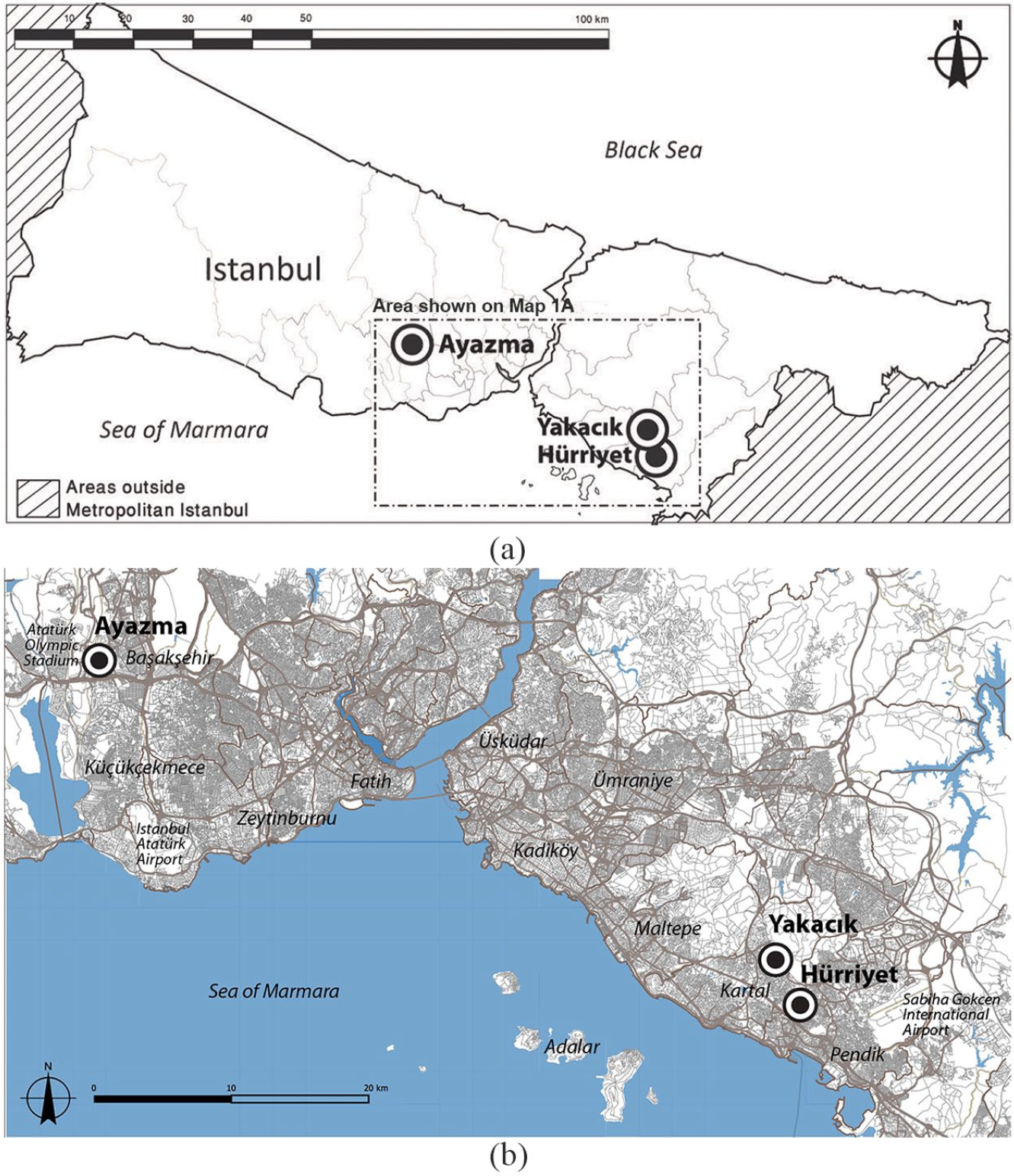
Locations of the three studied sites in Istanbul: Ayazma, Yakacık, Hürriyet
III. Positioning this Study and Istanbul’s Land Titling Struggles within International Debates
From a theoretical and conceptual point of view, this paper, and the revisiting of this 2008–2010 study, is informed by various works that provide insight into Istanbul and the logics underpinning it. Sassen’s work on expulsions(8) combines multiple fields and perspectives to describe how the global economy is supporting an unprecedented level of eviction processes. Rolnik’s War of Places,(9) building on her experience as UN Special Rapporteur on Housing, illuminates the role of financialization in what she calls the colonization of land and housing. The works of David Harvey and those referring to accumulation by dispossession(10) as the hallmark of the new imperialism(11) constitute another reference point. Hyun Bang Shin’s work on the speculative urbanization in Chinese cities(12) and on the politics of displacement in Seoul,(13) showing that displacement of poorer owner-occupiers and tenants was requisite for the success of speculative accumulation, make it possible to draw interesting parallels with Turkey, as a ruthless developmental state. This research also gives continuity to previous research and works involving one of the present authors: How People Face Evictions(14) and Cities in Asia by and for the People,(15) which examine the active role of urban citizens in constructing alternative urban spaces as tangible resistance to capitalism, placing people at the centre as mediators of city-making.
Since 2000, the struggle for permanent land titles in Istanbul and other large Turkish cities, as a way to avoid demolitions and mass evictions, remained a clear objective for neighbourhood organizations, mass movements and non-organized citizens.(16) Unfortunately, these demands on the whole have not been successful, despite huge campaigns. While these struggles raged on the ground, internationally a significant number of articles and reports were questioning the benefits of individual land titling. Rolnik(17) summarizes the various arguments and hypotheses by different authors that underpin the perspective:
There is a lack of evidence on the economic benefits of land titling programmes.
Land titles have little impact on access to formal banking loans.
Formal land titling does not mean an increase in security of tenure.
Titling programmes do not seem to improve quality of life in low-income settlements.
There are, of course, differences of opinion. The Asian Coalition for Housing Rights (ACHR), for instance, in a manual prepared for UN-Habitat,(18) reinforces the centrality of access to land for Asian cities, and proposes strategies to make land more accessible to the poor. A central strategy is regularizing the tenure of existing informal settlements: “It is the most economical way to preserve investments which people have already put into their housing; it unleashes a wave of investment; it entitles people to get basic services at the legal, metered rates; it gives people and communities a credential to negotiate loans; it enables governments to extend basic services.”(19)
Another debate at the international level refers to collective land use and ownership as a more robust approach to security of tenure than individual titles. A worldwide desk review one of the authors carried out on collective, communal and cooperative forms of tenure(20) gathered compelling evidence on this. Within Istanbul itself, various meetings, debates and conferences on the topic have taken place since 2006 with grassroots organizations, scholars and public sector representatives. Despite the interest raised, no concrete implementation has occurred so far in Istanbul. However, a cooperative founded in 2003 by Homeless and Tenant Earthquake Victims (Düzce Hope Homes), retains the basic principles of collective land tenure and has pioneered this approach on the ground over the last decade.
IV. Methods and Tools
The three sites where the study took place are all illustrative of gecekondus or self-built neighbourhoods that flourished in the town’s expanding suburbs from the 1950s onwards (Photo 1). Yakacık, as already noted, provided an interesting anomaly, as the sole example of gecekondu legalization in Istanbul in recent decades. Hürriyet and Ayazma, which are similar in some respects, offer contrasting outcomes that provide a context for the Yakacık experience.(21)
Yakacık covers two official neighbourhoods (mahalle) with closely connected backgrounds. The site under study, “Area A” in the Planning and Development Map, is located within Yakacık Yeni, the older of the neighbourhoods. It covers about 1,500 acres, on which 2,000 buildings stood at the time of our research.
The Ayazma gecekondu is part of the Ziya Gökalp mahalle. Prior to its demolition, Ayazma contained approximately 1,800 dwellings and was home to 7,800 residents.
Hürriyet is one of the oldest and most densely populated official neighbourhoods in the Kartal District, with just under 50,000 inhabitants. The site under study, “Area B”, covers approximately 116 acres and comprises 1,300 dwellings housing over 7,000 residents.
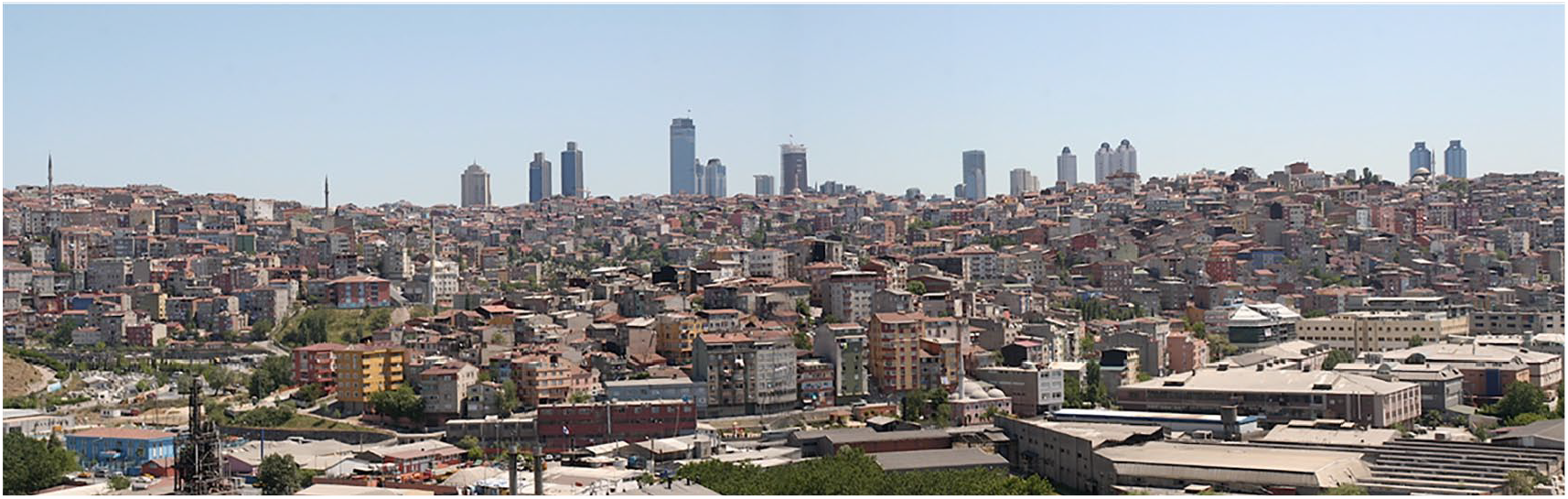
Typical gecekondu perspective, against an Istanbul skyline with recent skyscrapers
In 2009 the authors developed a research protocol with the following elements:(22)
Guidelines for documenting and reflecting on how people faced evictions were applied in the three sites, exploring transformations and eviction processes, changes through time, land security, resistance movements, residential strategies and the land regime in each neighbourhood. It drew on scarce secondary sources, previously unpublished university reports and meetings with citizens’ groups, and it generated one monograph for each site.
A semi-structured survey was used with public developers on the massive rehousing process for families displaced from Ayazma.
In-depth interviews were conducted with 10 families and community leaders in each of the three neighbourhoods (30 in total), focusing on relationships, disputes, alliances and vested interests.
Group meetings were conducted in each neighbourhood, focused on issues including resistance practices, legal fights and negotiations, perceptions of rights, and the impact on public policies and legal and institutional frameworks.
Interviews were conducted with three resource people involved in work with residents and social organizations at the city level.
Respondents in all cases were purposefully selected to provide representative perspectives on the issues at hand. Surveys and interviews were conducted in Turkish and translated into English for analysis.
V. Background: Exploring Public Mediation on Land in Istanbul
This section explores the role of public mediation in suburbs under heavy, competitive land pressure due to the large-scale transformation in Istanbul.
From the 1950s, when imports were replaced by industrialization, to the beginning of the neoliberal period in the 1990s, many migrants moved to large cities, in particular Istanbul, creating an industrial workforce and contributing to the emergence and growth of gecekondus. The state chose to tolerate these informal settlements rather than building costly social housing requiring basic services and infrastructure. Thus, gecekondu residents had to fight for such amenities as electricity, water and public transportation.(23)
A feature of the import substitution period was the 1966 Law No 775 on gecekondus, which provided the basis for legalization. For the first time, gecekondu neighbourhoods were officially named and the central authorities acknowledged their responsibility for providing basic services for their residents.(24)
Some gecekondus were granted amnesty in response to various amnesty laws. The most important of these, Law No 2981 (1984), was the basis for the legalization of the Hürriyet and Yakacık neighbourhoods. It granted gecekondu owners provisional title deeds (tapu tahsis belgesi)(25) and gave them the right to construct buildings of up to four storeys on their land. In order to implement these provisions, district municipalities had to formulate improvement and development plans (IDPs) at the 1/1000 scale (ıslah imar planı). According to Turan, these were aimed at “improving and legalising informal settlements which had been built in an unlawful and unsafe way. . . [and] at providing a safe, balanced and regular environment through the demarcation of property boundaries”.(26) Inhabitants had to apply to private technical bureaus to obtain their provisional titles, which could be subsequently formalized following the implementation of these improvement and development plans.(27) This law in theory allowed the legalization of thousands of housing units in informal settlements.
Radically different urban policies were then adopted during the rule of the AKP, the conservative, neoliberal party in power from 2003. These represented a major shift from previous policies, which had been fairly populist and allowed the uneven legalization of gecekondus. The AKP was from the start well positioned on the issue of gecekondus. As a party claiming to represent people on the city margins, it aimed to gain the votes of gecekondu neighbourhoods via networks of clientelism and nepotism, and political rhetoric sensitive to their demands. At the same time, the AKP’s broader developmentalist, technocratic and privatization orientation fuelled its zeal for urban transformation projects, which constituted the core of its urban policy for the “modernization” of gecekondus.(28)
Policy changes need to be related to the vision of Recep Tayyip Erdoğan, absolute leader of the AKP and a growing authoritarian power in the country. As Bora explains,(29) Erdoğan played a dual role in gecekondu transformation. As self-proclaimed protector of the disadvantaged, he was, from the perspective of his voters, committed to the empowerment of Istanbul’s popular neighbourhoods. As the omnipotent leader of Turkey, however, he insisted on the immediate rehabilitation of gecekondus, emphasizing the role of the construction sector for Turkey’s economy. Initially, these two aspects of his political vision seem not to have appeared contradictory to his voters.
Abundant Turkish literature clarifies the role of the AKP on land and housing policies, the underpinning logics at work, and the intricate links among party politics, Istanbul as a globalizing city, and the consequences for land.(30) Tuğal(31) argued that the AKP was able to circumvent popular explosions in gecekondus, despite regular violent and massive demolitions and evictions: “The AKP, it seemed, had found a way to square breakneck Third World urbanization with the demands of global capital, financial speculation with the Islamic world city: combining the construction of high-rise office buildings and shopping malls with a proliferation of domes, minarets, Islamic clothes shops, reconstructed Ottoman neighborhoods, Ramazan festivities and Qur’an schools; retaining the votes of the poor while remaking Istanbul to cater to the whims of global finance. In the mid-90s there had been serious concern about popular explosions in the squatter neighborhoods. Thanks to their integration into the market, mediated by the Islamist parties, that explosion never came.”(32)
Aslanalp(33) clarifies the evolution of the AKP and TOKI,(34) the powerful Public Housing Development Administration, in relation to the new urban transformation policy. This is essential to an understanding of gecekondu transformation in general and of the three sites analysed in this paper: “As part of its “urban transformation” agenda, which originally meant the renewal/redevelopment of the physically dilapidated existing building stock but today signifies almost any urban spatial intervention, the new government criminalized gecekondu construction and enacted series of laws that permitted district and metropolitan governments to implement urban transformation projects (UTP).”(35)
TOKI, its authority much expanded, became the market’s prime public real estate developer. The massive and free transfer of public land to TOKI is central to the changes that occurred with the AKP.
Significant legal developments were Metropolitan Municipality Law No 5216 and District Municipality Law No 5393, both enacted in 2004. These laws strengthened Istanbul’s central authorities and significantly enhanced the mayor’s powers. The notorious Article 73/Law 5393 entitled municipalities to transform “obsolete parts of town” into urban transformation projects (UTPs) in order to build housing estates, gated communities, industrial areas, and commercial and business centres. To become a UTP, the area had to lie within the municipality and cover at least 50,000 square metres. The law implicitly stated that once declared a UTP, demolitions and evictions could easily take place.
The new legal context significantly increased TOKI’s power. Founded in 1984, the TOKI administration suffered financial constraints following the 2001 economic crisis and prior to its renovation and restructuring under the AKP government.(36) TOKI obtained the right, according to Kuyucu,(37) to: “(i) regulate the zoning and sale of almost all urban plots belonging to the State; (ii) create construction companies and/or sign partnerships with existing private companies; (iii) build profit-generating housing by subsidising construction companies or through public-private partnerships in order to increase the funds available for the construction of public housing; (iv) sell mortgage debts to private mortgage brokers; (v) implement UTPs through public-private partnerships; and (vi) draw up detailed plans, as part of UTP and evict people from grounds located within UTP area.”
Hence, many gecekondus, falling under a UTP, and usually composed of individual houses and/or three- or four-storey buildings, were being replaced with formal dwellings constructed by both public and private sectors.
VI. Ayazma, Hürriyet and Yakacik: Land Rights, Legitimacies, Claims, and the Dynamics of Resistance and Negotiations in the Three Neighbourhoods
a. Ayazma’s resistance and demolition
The Ayazma site is located close to two major industrial areas, which largely explains why it emerged as a gecekondu at the end of the 1970s and 1980s, as an affordable and handy location for the workers from the factories. Its population dramatically increased during the 1990s, when hundreds of thousands of Kurdish people were internally displaced as a result of the conflict between the Turkish army and armed Kurdish guerrillas, and flocked to large cities. At the same time, the swiftly expanding traffic at the Atatürk airport, a major urban highway to the south, and the building of an Olympic stadium close by, part of the Turkish hope to host the 2008 Olympic games, turned Ayazma into highly valuable land. This poor workers’ neighbourhood became a sore spot in the eyes of authorities aspiring to create a global city. This is a paradigmatic case of public mediation, where local and metropolitan authorities, allied with a housing authority, used newly designed planning instruments and legal frameworks, as well as a police force, to repress responses. This erased an entire neighbourhood, rehousing most of its inhabitants in public mass housing developments in order to free the land for investment by private developers. A couple of years later, once the land was “cleaned up”, Ağaoğlu private developers built a gated community (My World Europe) for upper- and middle-income residents in the very same place. As the developer described it, “My World Europe neighbouring Atatürk Olympiad Stadium. . .is designed to meet all your needs. It faces TEM highway and makes it easy to commute to all business, industrial and residential centres with the underground connection. There are 17 blocks with 3080 residences and 20 twin villas.”(38) This development is one of the unfortunate Istanbul examples of the “war of places” described by Rolnik(39) or “accumulation by dispossession” as coined by Harvey.(40)
In 2004, the Istanbul Metropolitan Municipality (IMM), Küçükçekmece (District) Municipality and TOKI signed an agreement to turn Ayazma gecekondu into a UTP. Under this protocol, all existing construction in the gecekondu should be demolished and replaced by multi-family units.
Ayazma had a complex landownership system. From a technical and administrative viewpoint, it belonged to the Ziya Gökalp mahalle. According to Kuyucu, it was composed of 102 plots – 19 of which, covering about half the total area, belonged to the state or to religious foundations. The 83 remaining plots “belonged” to over 1,000 individuals, of whom 223 possessed definitive titles (tapu), while the remainder were informal owners.(41) Some residents held a provisional title (tapu tahsis) but this did not grant them ownership rights. For the UTP, a residents’ sworn statement was required in order to identify owners and tenants, although an additional document could also help ascertain ownership rights.
So who were the “true landowners” in this situation? Under the 2004 UTP agreement, only residents settled on private land were “rights holders”. The neighbourhood included 1,244 buildings held by 1,174 individuals, of whom 602 on private plots were designated as “rights holders” on the basis of their sworn statements, despite their lack of permits. Another 572 were on public land, also lacking permits, and were termed “occupants” rather than rights holders.(42) This public land consisted of three large plots belonging to the Treasury (Milli Emlak), Küçükçekmece Municipality and Istanbul Metropolitan Municipality. The complex nature of land tenure for gecekondu residents and the constant split between “occupants” and “rights holders” throughout the process brought about an almost arbitrary divide between these two categories.
Residents themselves had a radically different conception of their rights, dependent on use and on the fact that they had been living in the neighbourhood for many years: “The very first time we came here, we lived in a house which belonged to one of my husband’s relations. The house was made up of two rooms and only had one door. There were no panes in the windows, no bathroom and no toilets. We lived there for four months and put up with these conditions, using our neighbours’ toilets. Then we built our own house; it had toilets and a bathroom. We created a beautiful garden ornamented with several trees: a walnut tree, a fig tree and an apricot tree. Over time, it became really beautiful and we built our own patio.”(43)
The story of how this house was built exemplifies the residents’ perception of “legitimate right”. They are under the impression that building a house and enhancing a vacant plot constitutes the basis of a legitimate right that no reference to legal documents could grant.
Rumours regarding demolitions started early on in Ayazma. The long struggle can be broken into two periods: the struggle prior to demolitions and the fight following the demolition led by tenants, especially by 18 remaining families (Photo 2).
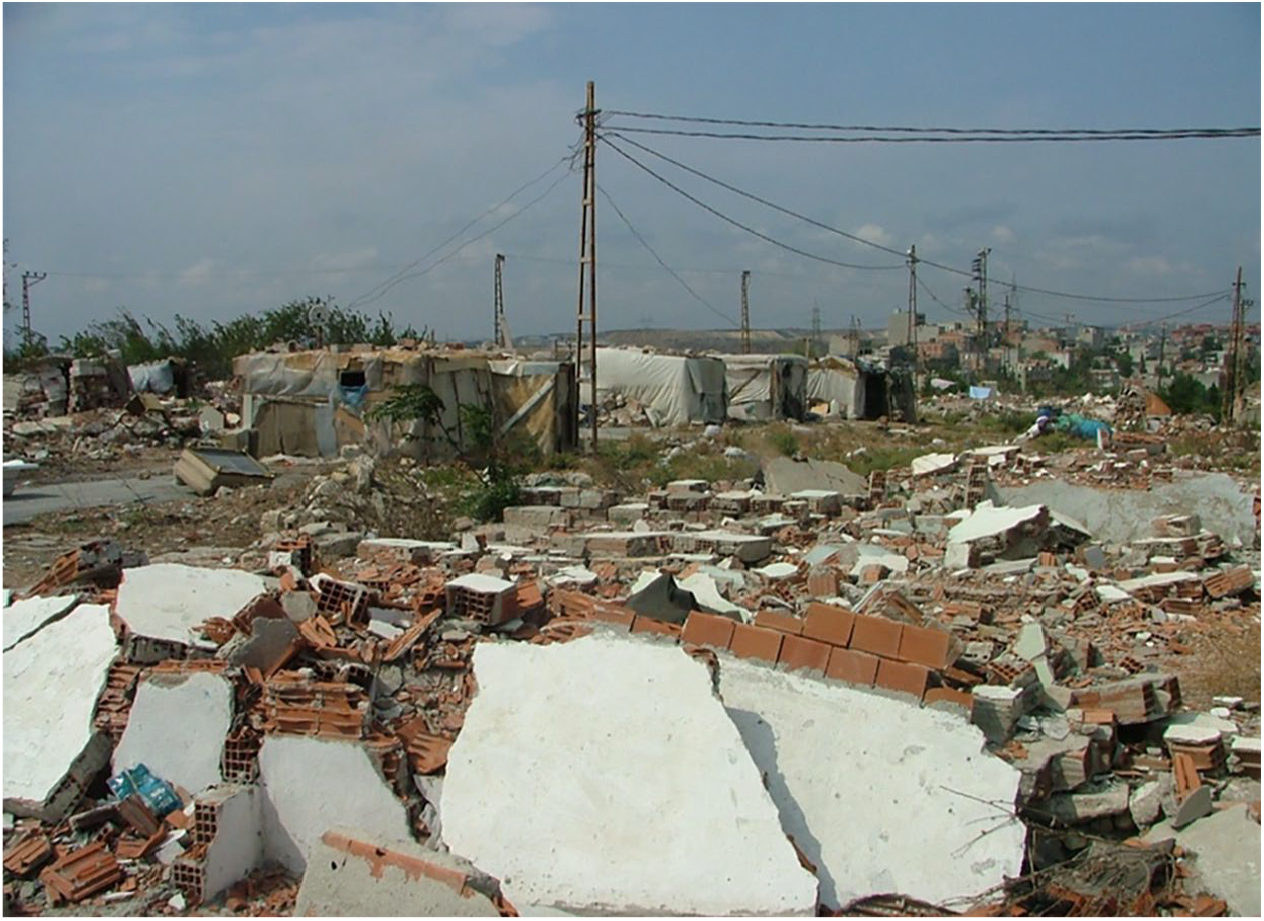
Razed Ayazma neighbourhood and makeshift housing for the 18 remaining families
During the first period (2004 to early 2007, when the neighbourhood was demolished), most Ayazma gecekondu residents attempted to resist, with Osman Özdemir(44) as their spokesperson. Following the demolition, Yasar Aydın, the spokesperson for the 18 families that refused to leave, provided key information that allows us a better understanding of both the potential and the structural limitations of this neighbourhood, among others.
First, Ayazma was a fairly new neighbourhood, not as well established as Hürriyet nor as ancient as Yakacık. It was originally built primarily by Kurdish people, forced to flee repression and violence in Turkish Kurdistan in the 1990s. Interviewees insisted also on the impact of the economic situation on residents and their ability to resist. Ayazma residents were among the poorest in Istanbul and it was difficult for them to create a formal association, maintain it, and pay all associated taxes and rent. All the same, they did manage to create the Ayazma People’s Committee (Ayazma Halk Komitesi).
In 2006, Ayazma residents sent a petition, signed by 470 families, to the district and Istanbul municipalities demanding free in-situ rehabilitation. The residents we interviewed stated that at that time, many party members, in particular far-left revolutionary militants, belonged to the Ayazma People’s Committee. Throughout this first period, Özdemir was persistently criminalized by the state authorities.
“They used to say that I was a member of the PKK(45) and it was the reason why I wanted to stir up trouble in order to radicalize the neighbourhood. People from the Küçükçekmece municipality used to say to the gecekondu residents that I wanted the demolitions to take place as part of a pro-PKK propaganda stunt, and that I belonged to this terrorist organization. They said that if they followed my ideas, they would die owning nothing because of my evil intentions. And most people believed this cheap and nasty propaganda. Can you credit it?”
Residents received some support from the Chamber of Architects of Turkey, at that time a major external player, bringing general knowledge and legal support to gecekondu residents. While its contribution was essential, the bureaucratic structure of the organization did not allow for the necessary regular, multifaceted assistance. The chamber was able to convene architects, urban planners and lawyers and get them working together on gecekondus, but its members were extremely cautious and took care not to become involved in “radical” activities.
Despite the persistent resident resistance, the demolitions went ahead. Displaced families were rehoused in recently built TOKI blocks in Bezirganbache (Photo 3). Families considered to be rights owners received compensation for their houses, and interviewees indicate that the process was quite arbitrary, in favour of those close to AKP, the party in power.
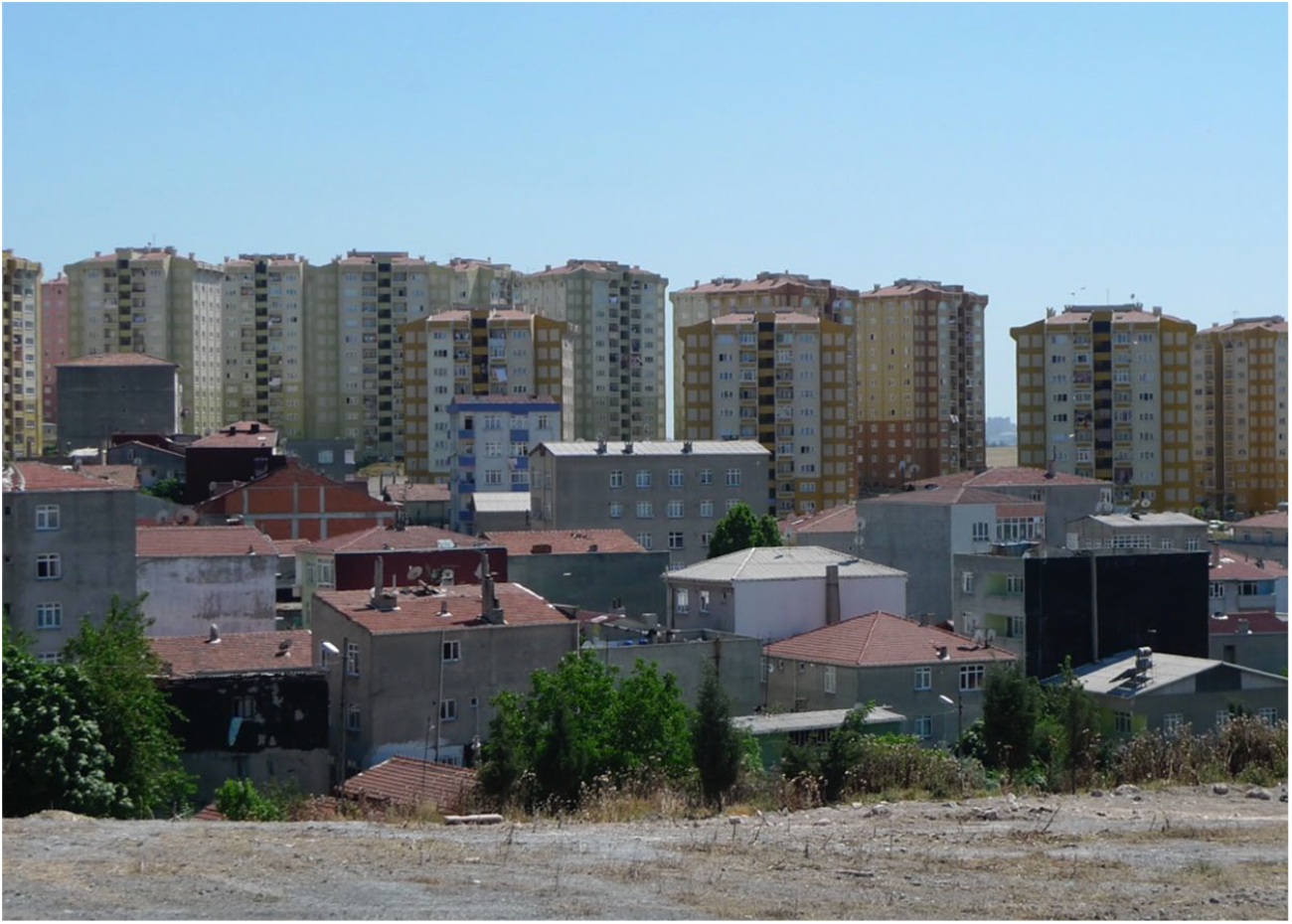
TOKI blocks in the back and a gecekondu in the front
After the demolition, 18 tenant families continued to resist, and their situation was radically different from that in the earlier resistance. They resisted because they had nowhere else to go and “no other means of escape”. They found it odd even to use the term “struggle”, claiming they had no choice but to set up their tents and resist.
b. Yakacık’s and Hürriyet’s initial common struggle
The Yakacık and Hürriyet neighbourhoods were both declared urban regeneration areas, a category within the urban transformation projects that allowed for the demolition of existing buildings and housing. The Yakacik site was identified as site A and Hürriyet as site B. This was made official by the Istanbul Metropolitan Municipality (IMM) Council on 16 April 2005 and no objection was raised during the statutory appeal period. Once this appeal period lapsed, responsibilities were transferred from the IMM to the Kartal District Municipality to draw up improvement and development plans for the implementation stage.
A Kartal municipal leader explained that all decisions were made very discreetly. A similar “discretion” was found in the case of Ayazma’s UTP. The reason for this underhanded silence was to stop gecekondu inhabitants from objecting during the strict legal 30-day appeal period: “if you do not object within the time limits stated by the law, then you lose your right of objection”. The issue of access to information for residents on the nature of the UTP is important to underline: the positive attitude of some elected officials in the Kartal District and the proactive role of social organizations to get information to residents in time allowed Hürriyet and Yakacik to mobilize against decisions during the process, even after the legal objection period. Faced by pressure from the residents of both neighbourhoods, the municipality did not fully complete the detailed plans for the implementation stage.
Between 2005 and 2007, associations and residents in both neighbourhoods continued to fight the improvement and development plan. Finally, in February 2007, residents’ demands were taken into account, integrated into a revised improvement and development plan (IDP) and approved by the Kartal District Municipality Council. This IDP had also to be approved by the IMM Council. IMM’s Planning Department gave it a negative assessment, but a march of about 100 residents from Hürriyet and Yakacık gecekondus was successful in finally getting it approved by the IMM Council in July 2007, although the council made many attempts to introduce minor amendments. On each occasion, the neighbourhood residents filed another lawsuit against the process, resulting in the administrative court annulling each modified plan submitted.
c. Underlying reasons for resistance and the struggle for land: legal rights vs. legitimate rights
Residents are well aware that an elite group influences the interpretation of the law. Gecekondu residents perceived the urban transformation project not as a legal procedure as much as an eviction from a settlement with a high commercial value. As a resident put it: “Do you know what the Municipality truly wants? They want to take this area away from ordinary citizens and sell it to the rich. AKP has been wanting this from the start and I think that CHP(46) wants the same thing. Nothing changes.”
Residents, as noted, generally base their right to legalization on their extended residency and what they see as a customary right to the land. A resident from Hürriyet, a leader of the anti-eviction movement, insisted: “In this neighbourhood, everywhere you look you can see signs of our struggles, signs of the efforts made by the residents of the gecekondus. I strongly believe that we deserve our ownership title because we have worked so hard for it. We were already here when nobody wanted to live here. So, we also deserve to be allowed to remain here. This is the origin of our rights. I strongly believe this is consistent with housing rights in general.”
d. Hürriyet’s success in organizing and resisting
Hürriyet, a typical gecekondu built in the 1950s (Photo 4), at the time of the study was well established and benefitted from robust social relations. Many landowners were involved in small businesses and trades, and the community’s economic situation was much improved compared to the previous period. In 2006 they created a formal neighbourhood association.
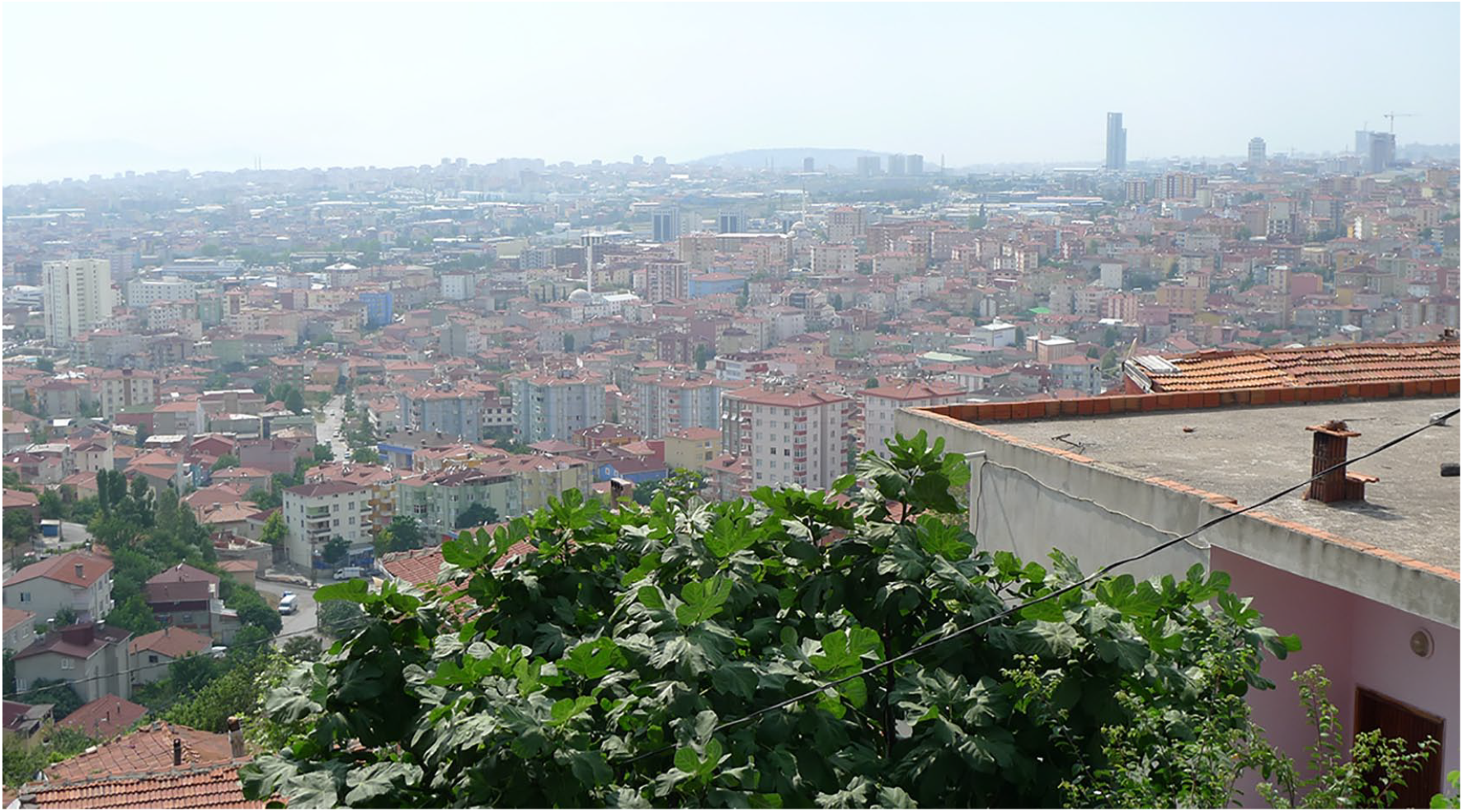
Overview of the Kartal District and gecekondu
Right from the start, though, there were tensions between the two political parties, the AKP and CHP, and neighbourhood residents over the urban transformation project. Some radical left-wing groups supported the struggle against the UTP, but never had any real influence. The fight appears to have been monopolized by the CHP, and as soon as this party won the Kartal District Municipality elections, major mobilization against the projects just disappeared.
In addition, the poorest residents in the community found it extremely difficult to spend time on association activities. Association board members were primarily small businessowners who formed a small elite group within the neighbourhood. Although they insisted they were not involved in politics, residents perceived the association to be distanced from most gecekondu inhabitants and to be serving the CHP.
Attending an ordinary meeting of the Hürriyet association as an outside observer provided a useful sense of its dynamics. Initially delayed because the statutory quorum could not be reached, the meeting was held the following week. Participants said little, while the chairman spoke for at least two hours, explaining the situation. Following his speech, some participants asked questions regarding their own houses and others criticized the association very harshly. All were ill at ease, however, because of the presence of an outsider and all attempted to cut the discussions short, which highlighted the lack of trust between residents and the board.
Despite the complexities and the lack of mobilization following the CHP electoral victory, the Hürriyet neighbourhood association did achieve some significant results. Residents considered that the massive mobilization throughout 2006 and 2007 had a significant impact on decisions pertaining to land legalization. The association managed to set itself up as an institution and became an important means for gecekondu residents to be heard. This institutionalization never existed in Ayazma, which may explain the difference in terms of processes and the results achieved.
e. Yakacık and the struggle for legalization
An improvement and development plan was drawn up on the basis of amnesty laws that remained in place despite the new urban transformation policy, which provides that: “public land which belongs to the Metropolitan Municipality, the governorate, the Treasury (milli emlak), or any other State institution (except for land belonging to Turkish military forces), must be granted free of charge to the Municipal Districts upon application, if they intend to distribute the land to gecekondu residents through the implementation of an IDP.”(47)
In this instance, on transfer of landownership to the Kartal District Municipality, the latter became responsible for implementing the improvement and development plan and for issuing land titles.
In Yakacik, as in Hürriyet, there were challenges to inclusion in the neighbourhood association. However, in Yakacık, the situation was complicated by a large Kurdish population that kept its distance. A representative of the Kartal town hall regrets that Kurdish people were not more actively encouraged to take part: “We made a mistake. We did not try to set up a robust coalition against the urban transformation project with the BDP, Peace and Democracy Party.(48) It goes without saying that there were good reasons for this mistake. You are aware that CHP is a highly conservative party and that its members are very chauvinistic; the vast majority of CHP members did not even want to hear the word ‘Kurdish’. This is why, instead of working with members of the BDP who are truly revolutionary, we work with opportunistic people such as neighbourhood association chairmen. This is shameful!”
The BDP’s stance with regard to this struggle is complex. As a party member explained: “BDP is forever fighting to defend Kurdish interests, which is a good thing of the utmost importance. The Kurdish movement gave us back our pride, our honour and our integrity. However, this is no longer Kurdistan; we live in Istanbul. This is a gigantic metropolis. The BDP is not able to find solutions to metropolitan problems. They sing about Kurdistan as if we were still there, but we are no longer there.”
Despite these difficulties in formally attracting Kurdish residents to the association, it was capable and sufficiently well connected with the Kartal authorities to obtain land titles.
f. Major reasons that Yakacık was successful and Hürriyet was not
Beyond the capacity to organize and set up residents’ associations in both neighbourhoods, two major differences between Yakacık and Hürriyet explain why, after their joint success in resisting the UTP imposed by Istanbul municipality, legalization took place in one but not the other. First, about 80 per cent of Yakacık Yeni land belonged to the Kartal District Municipality, which could therefore start issuing ownership titles to the gecekondu residents. In contrast, land in Hürriyet mainly belonged to the IMM and the Treasury (Milli Emlak), both of which refused to transfer ownership to the Kartal District Municipality, despite being legally bound to do so.
Second, a major part of the Hürriyet site had been declared by IMM to be an “area for preservation”, a classification that made it impossible to implement any improvement and development plan. Two steps therefore would have been needed to issue title deeds: a) a transfer of landownership from the metropolitan level to the Kartal District Municipality and b) a repeal of the “area for preservation” status. Given that, as yet, the Metropolitan Municipality had taken no steps to that effect in Hürriyet, the legalization process was confined to Yakacık.
VII. Conclusions
a. Public mediation for the benefit of public operators as well as national and international private interests
Analysing applicable land tenure and the refusal by IMM to transfer land to district authorities brings us to the core of a “vertical governance” issue and of public mediation over land. IMM refusal to transfer land to district authorities, even when it would be possible, makes any land legalization impossible. At central and metropolitan levels, public mediation has opted for the massive transfer of land:
To public operators, primarily TOKI, responsible for large so-called social housing initiatives intended in part to resettle residents displaced from gecekondus. These operations were required for the “modernization” of Istanbul and to ensure the fastest possible admission into the select club of global cities.
To national or international private operators and investors who, once the gecekondus are demolished, are in charge of completing major projects such as commercial centres, stadiums, marinas or “gated communities” on bare plots and “freed up” land.
With regard to national, metropolitan and most district levels, mediation tends to favour the public and private sectors, as described above, at the expense of popular neighbourhoods. Even at district level, it is rare that mediation favours the residents and legalization, as it has done in the Kartal District, where Yakacık Yeni’s legalized plots are located.
In Istanbul, as in other cases, planning and legal tools are paired up with less refined ones, such the use of assault armoured trucks, locally known as panzers, to ram the gates of areas to be demolished, along with the use of armed police, intimidation tactics, disappearances, or more simply the exploitation of potentially divisive rifts between local residents (as described in the three cases). These groups in tension included landowners versus tenants; residents with definitive ownership title versus those with provisional title; Kurdish versus Turkish communities; and political parties with historical divisions.
b. A narrow and rocky path towards land security
One of the major achievements of this research is its documentation of the one and only case of land legalization and acquisition of land titles by residents of self-built neighbourhoods in Istanbul over the last two decades. It also highlights the conditions that made this unique land legalization case possible. This finding is all the more valuable as it coincides with large-scale demolitions and brutal and forced evictions from other historical neighbourhoods and gecekondus.
Three conditions seem to explain why land security was achieved in Yakacık and, in contrast, why it proved impossible elsewhere.
A first and key condition revolves around the
Political changes in Istanbul in 2019, with the end of the reign of an AKP mayor over the Istanbul Metropolitan Municipality,(50) open up a time of uncertainty – and hope? – in relation to land access by gecekondu dwellers without permanent titles. As highlighted by Adanali and Baysal,(51) Sariyer District communities organized into a union, along with the district authorities, and prepared for all gecekondu improvement and development plans as Yakacık did. Technically speaking, just one step was left for communities to obtain their title deeds: the approval of these plans by the IMM Assembly. Given IMM rejection, the case was filed in court. What needs to be seen is whether or not the legalization process unlocks with political changes. As AKP still holds the majority in the IMM Assembly, the future remains uncertain, and Yakacık titled land remains a unique reference case in this context.
A second reason revolves around the
A third reason relates to
These three conditions make up a systemic unit: none is more important than any other and each is necessary, without any one of them being sufficient in itself. The difficulty of bringing them together in the same place for any length of time explains the exceptional nature of the case in point. The case demonstrates that no boilerplate solution is available, and that a fine-grained analysis of local conditions and opportunities needs to be made. The case indicates as well that victories can be obtained even in a difficult environment, and a lot can be learned about the limited, non-linear ways to achieve success. On both grounds the paper complements the international literature explaining how and why disheartening evictions are taking place. And such victories, however limited they might be, remain a source of hope for all those resisting and struggling for a safe piece of urban land to live upon.
Footnotes
Funding
This paper is one of the outcomes from the research programme “Public mediation in metropolis from North Africa and the Middle-East: land competitions and access to housing” that was co-financed by l’Agence universitaire de la francophonie (AUF, MeRSI Program), l’Institut de recherche sur le Maghreb contemporain (IRMC, Tunis), le Centre d’études et de documentation économiques juridiques et sociales (Cedej, Cairo), l’Institut français recherche en Iran (IFRI, Theran), l’Institut français d’études anatoliennes (IFEA, Istanbul), and l’Université Paris 8 Vincennes Saint-Denis, in collaboration with l’École nationale supérieure d’architecture de Paris - La Villette, l’Université de Damas, l’Université Galatasaray (Istanbul), the Development Planning Unit (DPU) at University College of London and Centre SUD (Paris).
1.
Research programme “Public mediation in metropolis from North Africa and the Middle-East: land competitions and access to housing”.
2.
Population figures vary considerably depending on the sources but do not alter the analysis findings. The OECD suggests a figure of 15 million in 2008 [ , Territorial Reviews: Istanbul, Turkey, policy brief, page 2], whereas local urban planners that the figures were closer to 12.5 million for that year.
4.
AKP: Adalet ve Kalkınma Partisi – Justice and Development Party.
5.
Keyder, Ç (2005), “Globalization and social exclusion in İstanbul”, International Journal of Urban and Regional Research Vol 29, No 1, pages 124–134.
6.
7.
See reference 6, page 29.
8.
Sassen, S (2014), Expulsions: Brutality and Complexity in the Global Economy, Harvard University Press, Cambridge.
9.
Rolnik, R (2015), Guerra dos Lugares: A colonização da terra e da moradia na era das finanças [War of Places: The Colonization of Land and Housing in the Financial Era], Editora Boitempo, São Paulo.
10.
Harvey, D (2004), “The “new” imperialism: accumulation by dispossession”, in C Leys and L Panitch (editors), The New Imperial Challenge, Socialist Register, pages 63–87.
11.
Harvey, D (2003), The “New” Imperialism, Oxford University Press, Oxford.
12.
Shin, H B (2014), “Contesting speculative urbanisation and strategising discontents”, City Vol 18, Nos 4–5, pages 509–516.
13.
Shin, H B (2015), “The developmental state, speculative urbanisation and the politics of displacement in gentrifying Seoul”, Urban Studies Vol 53, No 3, pages 540–559.
14.
Cabannes, Y, J Guimarães Yafai and C Johnson (2010), How People Face Evictions, DPU/UCL-BHSF, London.
15.
Cabannes, Y, M Douglas and R Padawangi (editors) (2018), Cities in Asia by and for the People, Amsterdam University Press, Amsterdam.
16.
Exchanges and correspondence between the authors and Yasar Adalani, a Turkish activist, blogger and scholar, September 2019.
17.
See reference 9.
18.
19.
See reference 18, page 31.
20.
Cabannes, Y (2013), Collective and Communal Forms of Tenure, background paper prepared for the United Nations Special Rapporteur on Adequate Housing, UNHCR, Geneva.
21.
It is important to understand the various government levels in the Turkish system that pertain to these gecekondus. The Istanbul Metropolitan Municipality (IMM), under the authority of the elected mayor, is made up of 35 district municipalities that also elect their own mayor. Each district is made up of neighbourhoods (mahalle), which vary in number from one district to the next. These neighbourhoods are administered by an elected muhtar. The term for a neighbourhood (mahalle) requires clarification, as it can be made up of multiple areas that might be called “neighbourhoods” in other countries. This is why we use the term “site” when referring to the case study locations.
22.
Cabannes, Y and O Özgür Sevgi Göral (2010), “Guide méthodologique pour le travail de terrain à Istanbul”, working document, 21 pages, page 8. The analysis of interviews, which were all transcribed and translated from Turkish to English, was partly used in this publication. It was also used in a PhD thesis [Göral, Ö S (2017), Enforced Disappearances and Forced Migration in the Context of Kurdish Conflict: Loss, Mourning and Politics at the Margin, École des Hautes Études en Sciences Sociales] and in a book published in French, English and Turkish [Cabannes, Y and C Uzuncarsili Baysal (2012), When National Policies Stand against Human and Housing Rights: Lessons from Istanbul, Passerelles, pages 122–127].
23.
IŞık, O and M Pınarcıoğlu (2001), NöbetleŞe Yoksulluk, İletiŞim, Istanbul.
24.
Mühürdaroğlu, A (2005), De-Regulatory Urban Redevelopment Policies in Gecekondu Areas in Turkey: The Case of Dikmen Valley, master’s dissertation, Middle East Technical University, page 67.
25.
Tapu tahsis belgesi: land allocation certificate.
26.
Turan, M (2009), Türkiye’de Kentsel Rant: Devlet Mülkiyetinden Özel Mülkiyete, Tan, Ankara, page 41.
27.
The provisional land title (tapu tahsis belgesi) states that the land belongs to the person who owns it. It is not a property title but a document that confers a personal right. However, once they meet a series of conditions that vary with each amnesty law, individuals who hold a provisional title may convert it into a definitive title (tapu), and this document gives them a property right.
28.
Akça, İ, A Bekmen and B Alp Özden (editors) (2014), Turkey Reframed: Constituting Neoliberal Hegemony, Pluto Press, London.
29.
Bora, T (editor) (2016), İnŞaat Ya Resulullah, İletiŞim, Istanbul.
30.
Aslanalp, M (2018), Coalitional Politics of Housing Policy in AKP’s Turkey, POMEPS Studies; also Göral, Ö S (2016), “Urban anxieties and Kurdish migrants: urbanity, belonging, and resistance in İstanbul”, in C Özbay et al. (editors), The Making of Neoliberal Turkey, Aldershot.
31.
Tuğal, C (2008), “The greening of Istanbul”, New Left Review Vol 51, pages 65–80.
32.
See reference 31, page 65.
34.
TOKI: Toplu Konut İdaresi BaŞkanlığı (Housing Development Administration).
36.
This restructuring was conducted through a series of laws passed between 2002 and 2008 (Law 4966/2003, Law 5162/2004, Law 5609/2007, Law 5582/2007, Law 5793/2008).
37.
Kuyucu, T (2010), Poverty, Property and Power: Making Markets in Istanbul’s Informal Low-Income Settlements, PhD thesis, University of Washington, page 178.
39.
See reference 9.
40.
See reference 10.
41.
See reference 37, page 228. These data have been cross-checked against those from the Küçükçekmece municipality, and published in a book and a brochure. Yeniay, A (2007), Ayazma ve Tepeüstü Kentsel Dönüşüm Projesi. Küçükçekmece Belediyesi, Istanbul.
42.
See reference 37, page 230. These figures and percentages have also been cross-checked against those from the Küçükçekmece municipality, published in a book and in a brochure.
43.
Interview with a resident of Ayazma, January 2010.
44.
The names of all interviewees have been changed for ethical and safety reasons.
45.
PKK: Partiya Karkeran Kurdistan (Kurdistan Workers’ Party). This was an armed movement that, from 1983, initially fought for separatist reasons and then stood for the “democratic autonomy of Kurdistan”.
46.
CHP: Cumhuriyet Halk Partisi (People’s Republican Party). This republican, secular party is the oldest political party and the main opposition one in Turkey.
47.
Interview with an officer of the Kartal District Municipality, December 2009.
48.
BDP: Barış ve Demokrasi Partisi (Peace and Democracy Party). This is a Kurdish party in Turkey, created in 2008, that changed its name to the Democratic Regions Party in 2014.
49.
See reference 9.
50.
IBB: Istanbul Büyüksehir Belediyesi.
51.
Communication and email exchanges with Cihan Uzuncarsili Baysal, an anti-eviction activist, urban specialist and scholar, and Yasar Adanali, a Turkish activist, blogger and scholar, September 2019.