




Abstract
Climate adaptation literature vocalizes the need for transnational municipal networks (TMNs) to expand activities in vulnerable medium-sized cities, but little work has examined the granular extent of city participation and processes constraining TMN growth. This study explores the effectiveness of TMNs in reaching adaptation outcomes and how financial, material, and knowledge exchanges of TMNs tend to exclude adaptation in high-priority intermediary cities. Nearly 40 semi-structured interviews with Indonesian city actors and a preliminary catalogue of cities participating in TMNs reveal that risk-averse selection criteria, insufficient impact assessments, and duplicative institutional efforts reinforce disparities between primary and intermediary cities. To effectively build adaptive capacity in the most vulnerable regions, TMNs should remove participation barriers for intermediary cities, improve incentives for institutional collaboration, and adopt more rigorous evaluative metrics. These results directly inform the governance, resource allocation, and operational goals of TMN stakeholders to advance distributive climate justice.
Keywords
I. Introduction
A key prerequisite for individuals, communities and institutions to adapt to climate change impacts is the ability to learn from experiences and available information.(1) Yet because diverse climate impacts are difficult to manage across large expanses, comprehensive adaptation efforts depend on the applied and situated learning of local institutions.(2) While local governments have long participated in institutional networks to learn and exchange technical knowledge,(3) transnational municipal networks (TMNs) have in recent decades grown, become more formalized, and emerged as dominant forces informing on-the-ground adaptive actions.(4) Now, 70 per cent of the world’s municipalities, large and small, participate in at least one of these city-to-city networks.(5) But despite the burgeoning scale and influence of TMNs, little if any research traces the accessibility and effectiveness of network adaptation opportunities for hundreds of medium-sized intermediary cities.
It is easy to understand why transnational municipal networks exert global power and motivate local participation, especially in the context of climate adaptation. Networked cities form like-minded political coalitions in pursuit of mutual goals. TMNs enhance these goals by fostering relationships advantageous to economic investment, promoting reputation-building achievements and facilitating access to valuable investment capital.(6) The C40 network, for instance, has considerable clout because it collectively represents over 600 million inhabitants, a quarter of global GDP, and thus a sizable proportion of global carbon emissions.(7) Such TMNs, which predominantly frame goals around a sustainable development agenda, influence local adaptation processes whether or not their development activities explicitly consider learning and social–ecological changes as adaptation. Precisely because of the diffuse and unpredictable nature of networks, characterized by voluntary membership and negotiated procedures, TMNs create powerful non-linear means to address complex issues and what are increasingly referred to as “super wicked” climate impacts.(8) In the continued absence of swift, locally influential global climate agreements, TMNs can in theory make all the difference in leveraging multi-scalar, polycentric, governmental and nongovernmental climate action.(9) However, TMN member benefits remain unevenly distributed,(10) illustrating how effectiveness varies by local context, allocated project funding and represented interests.
One core weakness of many TMNs, including C40 and Metropolis, is that they exclude smaller cities, spending their time and money on megacity members. Networks and their donors presume that strategically building the adaptive capacity of vocal, influential “global cities” effectively targets sources of social and economic vulnerability and inevitably informs the actions of intermediary cities – in Indonesia, cities of between 100,000 and 3 million residents (see the notes to the online supplement for a discussion of “intermediary cities” and related terms). This approach fails to address sources of social and economic vulnerability particular to intermediary cities, and extends few if any indirect benefits to these cities, which broadly serve as global or regional hubs for rural-urban exchange. Megacities (cities of over 10 million inhabitants) only house 14 per cent of the urban population in rapidly developing Asia.(11) Contrary to popular belief, most urban dwellers in the region actually live in cities of fewer than one million people. Birkmann et al. argue that decisions to prepare for climate impacts in megacities with the highest concentrations of people and economic assets do not consider intermediary cities’ existing capacity to cope with shocks.(12) Though intermediary cities serve as economic lifelines for the surrounding rural population and can reduce future economic costs by adapting before or during rapid growth, they lack megacities’ market access, investment potential and sector diversity to respond to economic shocks.(13) For these reasons, global actors discount the future social and economic consequences of a failure to adapt on the part of intermediary cities.
Global decision makers also underestimate the social vulnerabilities of intermediary cities because they lack comparable data, political capital and resources.(14) Rapid population growth makes intermediary cities more vulnerable than megacities.(15) As well, intermediary cities:
1) Less frequently own problem framings(16) of local adaptation challenges
2) Have poorer access to networks and flows of information
3) Lack the material, human and financial resources that megacities possess to experiment with adaptation solutions
4) Govern to a greater extent through intimate relationships, which limit the number of transparent and often reform-oriented interactions that can take place(17)
In sum, intermediary cities deserve at least the same attention garnered by megacities in order to more strategically and proactively invest in urban adaptation.
While the scale of intermediary cities makes their adaptation challenges wholly unique, they are also well suited to the networked governance of TMNs. TMNs potentially offer vital opportunities to learn through shared knowledge, improve technical capacity, and collectively assert local interests. They also create access to financial resources that can more markedly boost existing adaptation efforts. By transnationally connecting intermediary cities to each other and larger primary cities, TMNs foster decision making at multiple independent government tiers (multi-level, NGO-partnered network governance), which flexibly restructure traditional state-centred and megacity-centred power hierarchies.(18) With this effect, TMNs comprised of multiple nodes could begin effectively reducing the high but diffusely scattered social and economic vulnerabilities of intermediary cities, while still increasing the adaptive capacity of networked megacities. Scholars arguing for spatially distributive climate justice have already recognized the role of TMNs in furthering such an agenda to serve vulnerable and resource-limited intermediary cities.(19) Yet many TMNs insufficiently leverage their potential to expand participation among megacities, well-resourced intermediary cities, and under-resourced ones simultaneously, which would allow them to spread out the risks of investing in resource-constrained cities.
While a first core weakness of many TMNs is, as noted, their exclusion of intermediary cities, there are in fact TMNs that do prioritize services for such cities. These TMNs share with the megacity-dominated TMNs a second core weakness. This is the capacity to adequately assess the nebulous impact of goal-driven knowledge sharing. International development organizations (including TMNs) frequently misstate or misattribute the impact of their knowledge-sharing activities because: (1) donors emphasize evidence of an individual institution’s value, not collaborations toward common outcomes; (2) time, money, and technical capacities constrain rigorous execution of impact evaluations; and (3) third parties do not challenge the transparency or accuracy of monitoring and evaluation activities. Knowledge-sharing activities deserve greater scrutiny, given their demonstrated potential to create maladaptive outcomes and widen knowledge and investment gaps between model cities and resource-poor cities.(20) If the unstated goal of TMNs is to increase adaptive learning and capacity in the most vulnerable communities, not just in the megacities assumed to be most influential, then more detailed assessment is needed of whether TMN-funded activities actually overcome knowledge exchange barriers to directly or indirectly reach intermediary cities.
Several analytical frameworks provide different approaches to determine the outcomes that knowledge sharing and learning in fact lead to. One way to understand how the “pathway of learning” affects the diffusion of a practice involves assessing whether the practice inspired network-centric or systems-centric learning.(21) Another way to understand impact involves “what is learned”: cognitive knowledge (facts); normative knowledge (values and norms that inform decisions); and relational knowledge (network and trust building that affect information flows).(22) Three types of learning specific to organizations help clarify the effective impact of these classifications: single-loop learning (small changes that do not question underlying assumptions); double-loop learning (questioning those basic assumptions); and triple-loop learning (recognizing structural factors and norms that must be transformed for greater impact).(23) Alternatively, understanding how policies travel and transform through individual and collective imaginations helps contextualize the adaptive learning process. Roy and Ong lay out three ways in which Asian city actors create and implement best practices.(24) Actors can replicate, or “model”, exemplary concepts in a different context (e.g. copying Singapore’s blueprint for affordable housing). They can “inter-reference” or indirectly modify their aspirations and expectations by noting successful actions in other cities (e.g. competing with the idea of Singapore’s affordable housing). Lastly, they can form transnational partnerships or “associations” (e.g. joining “world-class” TMNs that help attract foreign capital for service provision). Though researchers have begun exploring the role of institutional learning in adaptation,(25) the application of these analytical frameworks to knowledge-exchanging intermediary cities included in and excluded from TMNs remains understudied.
II. Methods
In response, this research begins to quantitatively and qualitatively evaluate why TMNs tend to exclude smaller cities and how effective TMN-funded programmes are in influencing adaptive learning in Asian intermediary cities, specifically in Indonesia. The fourth most populous nation globally, Indonesia was chosen because of its large number of rapidly growing intermediary cities. By 2030, 64 per cent of Indonesia’s population and 63 per cent of its GDP will come from intermediary cities and their surrounding urban districts, with populations smaller than Jakarta’s but greater than 150,000.(26) Additionally, Indonesia faces high exposure to such threats as sea level rise and extreme precipitation events,(27) extends significant political and financial autonomy to local governments,(28) and remains the headquarters for the Asian Cities Climate Change Resilience Network (ACCCRN). A uniquely prominent regional TMN with nearly a decade of experience, this network illuminates the challenges of building adaptive capacity in intermediary cities.
This study uses two methods to assess TMN impacts: an inventory of TMN member participation and informant interviews. These methods are supplemented by document analysis. The TMN inventory measures the inclusion of intermediary Indonesian cities in TMN networks and, by extension, the associated financial or in-kind investments and opportunities that member cities receive from TMNs. Eighteen prominent nongovernmental city networks comprise the sample (Table 1). The study used network websites to identify the member cities of each TMN. For websites that listed pilot projects instead of member cities, member cities were equated with pilot project locations.
List of selected transnational city networks active in Indonesia
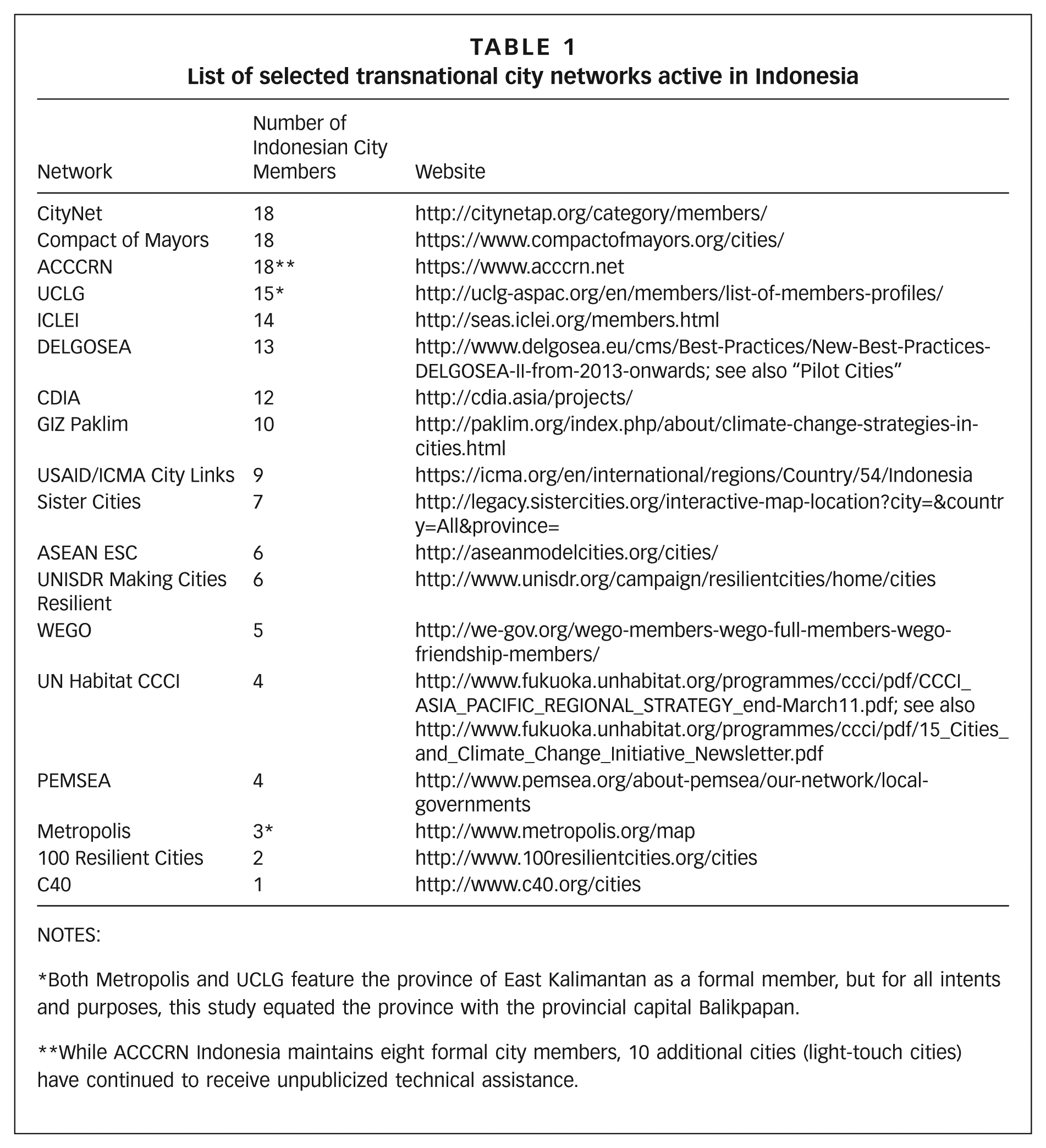
NOTES:
Both Metropolis and UCLG feature the province of East Kalimantan as a formal member, but for all intents and purposes, this study equated the province with the provincial capital Balikpapan.
While ACCCRN Indonesia maintains eight formal city members, 10 additional cities (light-touch cities) have continued to receive unpublicized technical assistance.
I systematically identified these listed networks by reviewing: (1) the professional affiliations of more than 1,000 publicly registered ACCCRN practitioners, (2) the network partners of TMNs advertised on institutional websites, (3) the organizations present at the Habitat III conference’s third preparatory committee meeting in Surabaya, and (4) informant interviews. TMNs were included in the inventory if the implementing organization: (1) was nongovernmental or a foreign entity, (2) operated both in Indonesia and transnationally, (3) satisfied Taschereau and Bolger’s six network functions,(29) and (4) conducted activities mentioned online that entailed city-scale climate adaptation.(30) While certainly not an exhaustive list, the member inventory is likely the first publicly documented attempt to identify the total number of TMNs that are active in a given region, with the specific intent of quantifying intermediary city membership.
In addition to creating the inventory as a preliminary indicator of total TMN membership in Indonesia, I conducted nearly 40 semi-structured interviews between June and August 2016 to provide insight into barriers limiting knowledge, finance and resource exchange, and to shed light on the consequences of TMNs’ “will to improve” and their “anti-politics” discourse of knowledge provision as they affected intermediary cities.(31) Informants were city officials, nongovernmental actors, and private stakeholders, all representing more than a dozen networks working in Indonesia. Interviews took place in person, by email, and by phone; when necessary, ACCCRN Indonesia’s implementing NGO provided translating services. Many in-person interviews occurred during field visits to four ACCCRN member cities. Notes taken by hand were then transcribed, although not word for word. Thirty-four different labels structured the manually coded field notes, comprising various barriers to participation and exchange, motivating factors, and emergent themes.
One of those emergent themes, institutional competition, laid the groundwork for a dedicated case study on a particular best practice for waste management in Yogyakarta, which employed community-based recycling and drew on the model of community-based waste banks.
I focused on this best practice, which was implemented in cities throughout Indonesia, for several reasons. First, waste management remains a key development issue in Indonesia, but also a prime adaptation concern since solid waste clogs drainage systems and routinely magnifies flooding.(32) Second, the specific concept of community-based recycling relied on knowledge transfer and learning, not large financial inputs or existing technical capacity. Third, two accessible and identifiable TMNs initially documented and disseminated the model of community-based waste banks more thoroughly than other best practices, spreading the idea to a wide range of cities with conflicting narratives. Without these characteristics, it would not have been possible, given time constraints, to comprehensively trace the replicability of a single TMN practice and thus the implications of TMN knowledge sharing.
In addition to the interviews and field visits already described, this case study required document analysis, which captured information gathered from roughly a dozen sources: academic studies, news articles, interviews with representatives of the two major institutions as well as other stakeholders, a field visit to a recently established waste bank, and a host of institutional reports and publicly available web content. The analysis drew from the policy mobility and diffusion literature,(33) as well as work on Asian urban modelling and “inter-referencing,”(34) in order to “follow” the mobile transformations of knowledge and to shed light on different barriers and influencing factors.(35) The collection of documents selected also discussed the origins of a “waste bank,” the operational details of a pilot waste bank project (largely publicized by two TMNs), and the spread of waste bank practices. Lastly, several key codes categorized content: intellectual ownership, institutional competition and cooperation, and the presence of facts and figures inconsistent with other sources.
There are limitations to this study that underscore the need for further research. The preliminary inventory is not exhaustive because it relies on online documentation, and TMN websites do not always list all their member cities. Formal partnerships may also be short-lived due to changes in local politics. The TMN selection process likely overlooks smaller TMNs as well, and a more thorough investigation would interview informants from each city directly to identify TMN partners. Even then, TMN membership does not reliably indicate a city’s actual network involvement and outcomes – successfully acquired project funds, improved local technical capacity, or application of shared ideas. As this study illustrates, cities and institutions themselves face difficulties in monitoring and evaluating the impact of knowledge exchange activities – the task requires intensive follow-up and even then seldom establishes causation.
Some, but not all, of these information gaps are resolved through informant interviews and publicly accessible documents, though larger interview samples per city and TMN would strengthen this. While this study may leave out unlisted city partners or overstate TMN impact in formally participating cities, it nevertheless illustrates a distinct pattern of city network distribution and pinpoints where institutional duplication exists.(36)
III. Results
Maps 1 and 2 depict the number of networks, of the 18, that each Indonesian city has formally joined. The supplementary data available online include a full accounting of the participating networks in each Indonesian city.
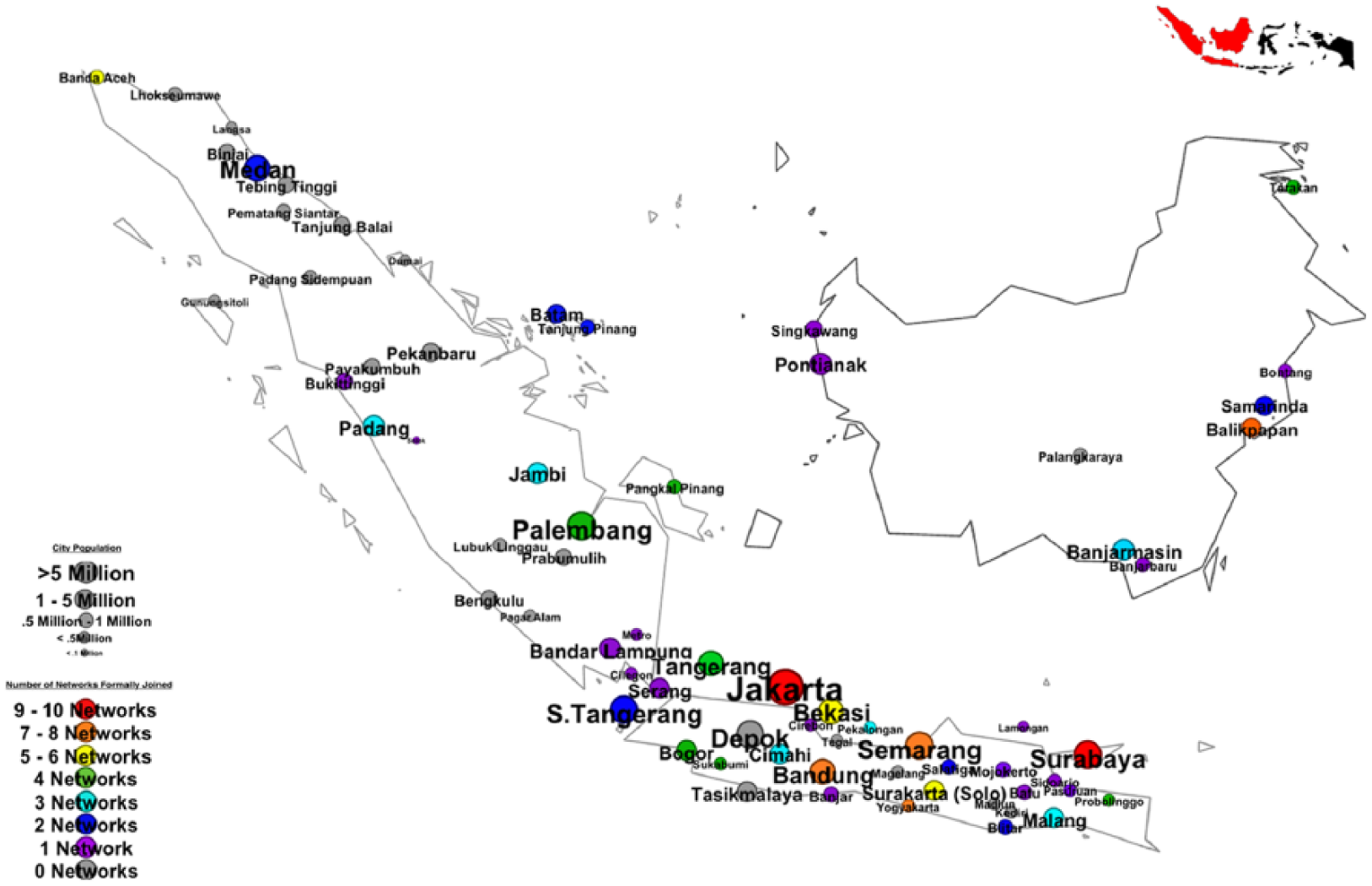
City network participation in western Indonesia (Sumatra, Java and Kalimantan)
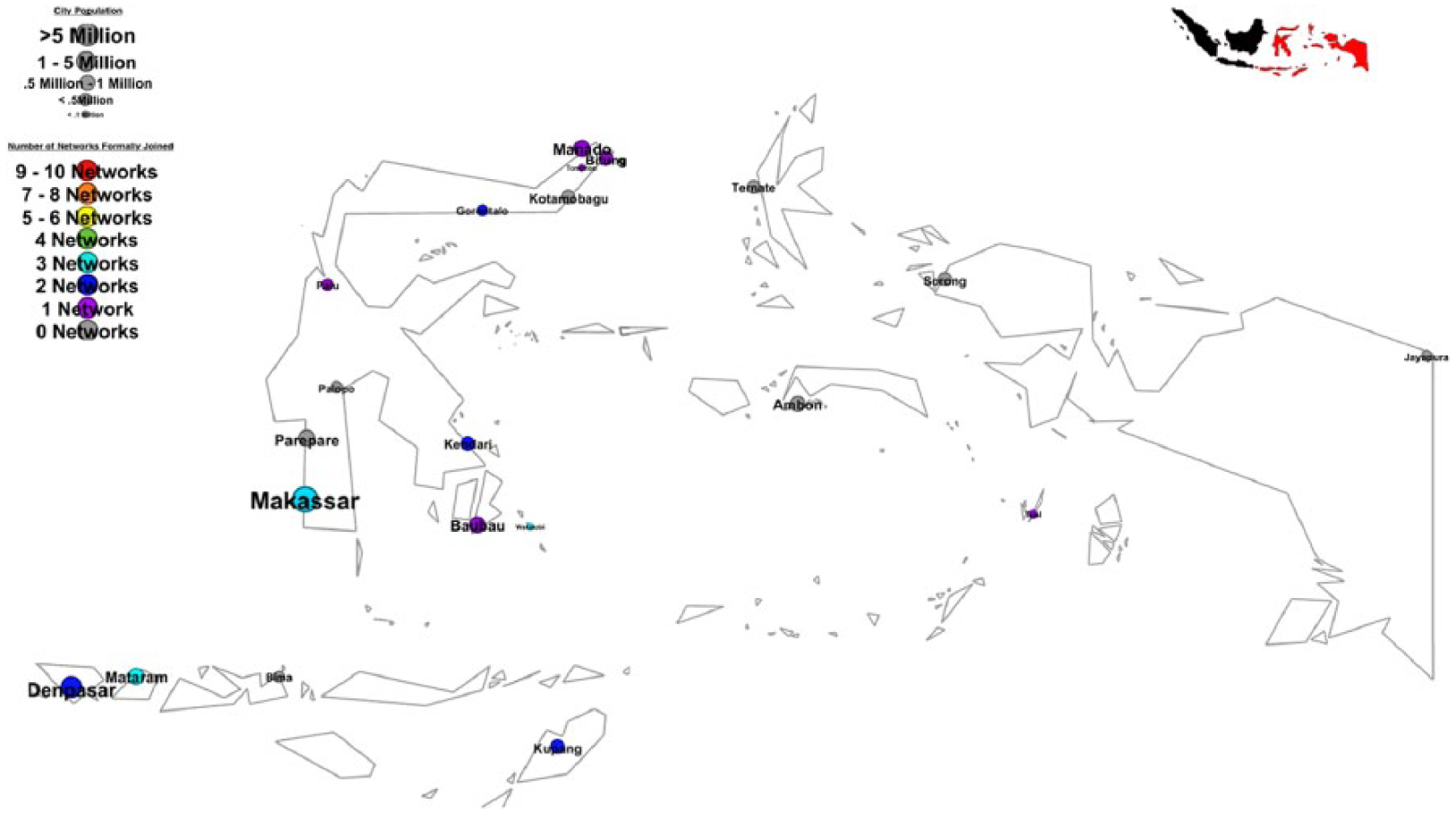
City network participation in eastern Indonesia (Sulawesi, Nusa Tenggara, Maluku and Papua)
These maps reflect uneven city participation, but also reveal that excluded intermediary cities are generally those that lack political and financial power. More than half the intermediary cities in Sumatra, among those most rapidly growing nationwide, remain excluded from the selected networks. For example, Pekanbaru in Riau Province (Map 1), expected to double its population by 2030 and maintain 7 per cent annual GDP growth, is not a formal member of any of the listed TMNs.(37) It is not surprising that the politically and economically dominant Javanese cities (with the exceptions of Depok and Tasikmalaya) demonstrate greater connectivity. Notably stark divisions emerge between western and eastern Indonesia. Aside from Sulawesi’s largest city, Makassar, and the small but significant tourist hub of Wakatobi (Map 2), eastern Indonesia lacks the political and resource access of Java, Kalimantan, and even Sumatra. For example, the regional centre of Denpasar in Nusa Tenggara (Map 2) participates in fewer networks than several peripheral cities in Sumatra (such as Map 1’s Banda Aceh, which was assisted following the 2004 tsunami), although Denpasar has over twice as many people. In fact, only one major knowledge-sharing network, the World Bank-supported BaKTI,(38) operates exclusively in eastern Indonesia to improve the region’s knowledge and financial gaps. The inventory therefore reveals that the selected TMNs collectively isolate already marginalized intermediary cities.
The intermediary cities excluded from Table 1’s TMN networks are also among the least likely to adapt to climate impacts. Given Indonesia’s generally high current and forecast exposure to coastal inundation, flooding, and decreased water availability,(39) defining the “most vulnerable” communities in the nation arguably means focusing on the socioeconomic side of adaptive capacity. Recent, highly localized research indicates that the districts most socially vulnerable to natural hazards overlapped with 16 of the small or intermediary cities mapped in this study.(40) All but one of these participated in just one or two networks, 10 did not participate in any, and nine were in eastern Indonesia. Furthermore, cities with few network connections but lower social vulnerability still rank among urban areas with the least household access to sanitation infrastructure.(41) In sum, the flows of knowledge and financial resources that TMNs offer are not directly improving the adaptive capacity of the most vulnerable intermediary cities.
Interviewees, discussing the member selection process of individual TMNs, confirmed why networks in practice excluded certain cities. TMNs generally sought to work with municipalities with fewer inherent risks. Networks typically selected cities only with supportive leadership, membership in other prominent knowledge networks, technical experience, and sufficient budgeted funds, all concerns for project sustainability and completion.(42) For example, the first round of invitations to join ACCCRN emphasized existing partnerships and project feasibility in order to meet a “rushed” and “haphazard” grant timeline.(43) The process effectively valued certainty of outcomes – resource-abundant cities with strong track records of implementing internationally funded projects that could reliably achieve and expand upon a measurable impact. This explains why many networks (such as C40, 100 Resilient Cities, and Metropolis) only include larger or better-connected cities. Yet even knowledge networks like ACCCRN – which embraced traditionally excluded cities, possessed more unique core cities, and explicitly emphasized adaptation needs in intermediary cities – still tended to favour cities with existing resources and connections in order to minimize institutional costs.
Informant interviews, centred on the challenges of knowledge and resource exchange, pointed to five main types of barriers: political, financial, linguistic, technical and attribution-related.
TMN representatives consistently argued that political factors played a role in replicating best practices and exchanging resources, but did not always recognize the limits to their capacity to influence local political will. They assumed that articulating network benefits to key actors would ultimately influence a city’s interest in exchanging and acting on knowledge, if not in this administration then the next. Several city representatives, however, observed that TMNs frequently failed to overcome the lax accountability standards and patron–client relationships responsible for stagnant network project outcomes.(44) According to one official in Palembang (a Sumatran city with supportive leaders and participation in half a dozen TMNs), many projects still awaited implementation because of “all talk, no action”.(45) TMN interviewees tended to assume that all city actors should want to participate in multiple networks to maximize funding and information. But not all cities want reputations as cutting-edge early adopters, or choose to adopt best practices from larger globally connected neighbours. Leaders in the small West Javanese city of Cirebon, for instance, were committed to adaptation but chose not to join more than one TMN.(46)
A second barrier identified by participants across the board was funding. Again, there was a disconnect between TMN staff and other city actors. TMN representatives were measured yet optimistic about their donor-funded knowledge exchange activities and channels for circulating project funding opportunities. However, the experiences of various member and non-member cities in need tempered assumptions about constructive outcomes. For instance, the Central Javanese city of Pekalongan relied on two TMNs to circulate external grant opportunities, but officials still felt limited by their local budget, only 10 per cent of which actually funded local development projects.(47) A nonprofit sector informant noted that the overarching state budgetary framework was a limiting factor in local project implementation, regardless of expected TMN financial contributions.
Third, some TMNs recognized the role of language and documentation barriers in restricting the flow of network knowledge to intermediary member and non-member cities. A few informants from internationally managed TMNs struggled with the tendency to prioritize working with city representatives proficient in English. ACCCRN, which includes a number of typically excluded intermediary cities, estimated that fewer than a quarter of engaged Indonesian city officials speak the fluent English necessary to fully engage with the network.(48) Several TMN representatives also referred to the TMN bias towards documenting and disseminating only successful outcomes, concealing potentially instructive failures.(49) Most informants who recognized language and documentation biases as challenges did not seem willing or able to comprehensively assess or adequately confront this barrier.
Fourth, TMN practitioners often would not assume that both online and offline knowledge sharing produced equally positive outcomes. This was partly because TMN representatives knew more participants taking part in offline activities than online activities, and partly because the results of both were not easily visible or traceable, qualitatively or quantitatively. Many TMN representatives certainly understood their target audience’s behaviour and continued developing strategies to improve their network’s reach and impact. However, most evaluators – aside from Indonesia’s local government association – could not consistently determine the number of times and extent to which a practice had been shared and applied between members and non-members.(50) Impact evaluations for both online and offline activities depended on voluntary survey responses, indirectly obtained anecdotes, or insufficiently rigorous proxies due to the time-consuming, laborious and difficult nature of measuring learning outcomes. Such practices did not always validate the TMN assumption that stakeholder access to online knowledge resulted in stakeholder uptake of knowledge in intermediary cities.
In the end, networks relied to varying extents on online information and communication technology (ICT) to supplement their offline knowledge sharing activities such as workshops, conferences and training sessions. One informant expressed how in-person meetings actually remained a more strategic way for higher-echelon government or nongovernment officials to exchange information, since many did not effectively manage public email accounts or have time to spare for web activities.(51) Another online administrator pointed out that while ICT platforms could potentially attract large numbers of visitors, they frequently lacked the sustained funding to be effective and failed to empower key intermediaries such as media or political party representatives, let alone vulnerable groups.(52) But overall, networks lacked sufficient evidence to determine whether the outcomes of online knowledge sharing in fact rivalled the outcomes of offline knowledge-sharing activities or even those of no knowledge exchange at all.
The limitations of monitoring and evaluation, paired with donor incentives and lack of third party verification, frame the final barrier to knowledge and resource exchange. This is the ease of potentially misrepresenting institutional impact, which can enable and conceal duplication of efforts, and which explains why TMN resources often fail to reach the smaller city beneficiaries that need them the most. While the act of intentionally or unintentionally miscommunicating information regarding a TMN’s impact is different from misattributing the role of other involved stakeholders in a TMN outcome, they stem from similar causes and possess similar consequences.
Institutions fail to rigorously trace their impact due to three specific causes: donor-driven competition, resource and capacity restraints that prevent adequate impact assessment, and lack of external verification of impact assessments. The following case study explores the rise of Indonesian waste banks, a best practice circulated online and offline, as an example of how two TMNs (Association of Southeast Asian Nations Environmentally Sustainable Cities – ASEAN ESC and Unilever Peduli Foundation – UPF) erased each other’s role in knowledge creation and diverted adaptation resources from intermediary cities. Because many organizations besides UPF and ASEAN ESC tend to overstate their estimated impacts, the patterns of institutional duplication and diversion of resources observed with waste banks (and their associated effects on local flooding) likely exist for other practices relevant to urban adaptation efforts.
Yogyakarta’s first waste bank
The extent to which the first organization of interest, UPF, influenced the dissemination of waste banks remains debatable. UPF acts as the British–Dutch company Unilever’s corporate social responsibility branch in Indonesia. Its biennial waste reduction competitions in the city of Surabaya initially began as a way to improve water quality in communities it operated in, but these “Green and Clean Programs” also mobilized more than 100,000 volunteers in cities like Jakarta and Yogyakarta.(53) Among those influenced was Bambang Suwerda, a public health lecturer in Yogyakarta. According to the national newspaper Kompas, Suwerda saw television coverage of UPF communities using a “waste bank” to store trash and recycle it into useful products.(54) This inspired him to conceive of a waste collection facility where community members could exchange recyclables for cash. Motivated by the promotion of environmental health in his community, he founded what is considered Indonesia’s original waste bank, Bank Sampah Gemah Ripah, in the district of Bantul in 2008.(55) The bank has since diverted more than 1,000 pounds of inorganic waste each month, retaining 15 per cent of collected revenue to cover operating costs.(56) Suwerda soon won nationwide fame for the model’s success, which took on a life of its own outside Yogyakarta.
As a key organization already educating communities about recycling, UPF and its campaigns became a primary means for waste banks to proliferate. In the same year that Suwerda founded Gemah Ripah, UPF’s Green and Clean Program in Surabaya incorporated waste banks into its competition criteria.(57) As new cities joined the programme, they also gained the institutional resources to mobilize hundreds of waste banks. By 2015, UPF’s programme alone claimed considerable impact in 17 cities and 12 provinces, supporting 1,258 waste banks, recruiting 55,558 customers, recycling more than three tons of inorganic waste, and exchanging more than Rp 3 billion (US$ 200,000).(58) Yet, as illustrated below, the claims of each organization around its own role in disseminating knowledge and skills failed to adequately acknowledge the contribution of the other organization.
The Environmentally Sustainable Cities Model Program – the second notable initiative of interest, supported by ASEAN ESC – complements and challenges UPF’s role in disseminating waste bank knowledge. Administered by the Japanese-based Institute for Global Environmental Strategies (IGES) and funded in part by the Japanese government, ASEAN ESC, like UPF, works to scale up local-level pilot projects and facilitate city-to-city exchanges. In 2011, three years after waste banks became part of UPF’s Green and Clean Program, Indonesia’s Ministry of Environment, wanting to replicate Yogyakarta’s Gemah Ripah model throughout 250 cities, partnered with ASEAN ESC to hold waste bank training workshops in Surabaya.(59) Initially, ASEAN ESC and Surabaya’s local government claimed there were only six existing waste banks in the city, all operating under a model different than Yogyakarta’s.(60) This assertion conflicts with statements by UPF and independent researchers.(61) In 2008, UPF had helped already existing Surabaya waste banks integrate Gemah Ripah’s money-saving concept into their operations,(62) and in 2010, Wijayanti and Suryani reported 15, not six, waste banks in Surabaya.(63) Rather than representing an intention to mislead observers, these inconsistent accounts underscore broader concerns of institutional coordination and evaluation of impact.
When knowledge leaves no trace
As evidenced by the temporal and numerical discrepancies in their claims, the manners in which ASEAN ESC and UPF promoted their goals and achievements involve two fundamentally different accounts of how Indonesian waste banks developed and spread. UPF’s online summary of its environmental achievements, which included launching the Green and Clean Program and dozens of waste banks in Surabaya, erases Yogyakarta’s innovative role in developing the model: “Under the name of ‘Green and Clean’, we collaborate…closely together with government, NGOs and community [sic]…The success of this [community waste bank] programme can be seen from the total unit of waste bank [sic], number of people involved and also the total of waste [sic] that is collected and sold…[T]his concept has been learning and developing [sic] since 2008. We are sharpening the model….” [emphasis added](64)
While UPF should not be expected to dwell on the origins of the model it promotes, the credit it assumes for founding over 1,000 waste banks leaves the impression that it did not duplicate existing efforts. Unlike UPF, ASEAN ESC clarified the observed role of another institution, yet its account of its own influence remains unclear. In the Model Cities initiative’s first annual report, ASEAN ESC acknowledges UPF’s work and asserts, “Although the waste bank concept was already known among the local community, this programme [ASEAN ESC] provided the catalyst to formally train communities and establish pilot waste banks on a wider scale.”(65) Failing to report the extent of UPF’s influence, ASEAN ESC effectively erased critical pieces of information. The 2010 Kompas interview(66) presents reasonably strong evidence that UPF’s widely publicized Green and Clean activities influenced Bambang Suwerda’s establishment of the first recognized waste bank. This influence, which diminishes ASEAN ESC’s claimed status as a catalyst, remains unmentioned in ASEAN ESC’s story of waste bank expansion.
These failures to fully represent their knowledge-sharing roles do not imply shortcomings in the quality of these organizations’ knowledge exchange. The widespread replication of the Suwerda waste bank model throughout Indonesia attests to the success of UPF and ASEAN ESC’s crucial offline transfer of skills and information. UPF replicated a low-cost and culturally appropriate practice, ultimately mitigating local flood impacts, by leveraging three factors: the power of each city’s reputation for cleanliness, the chain reaction of neighbourhood competitions and waste collection trainings (propagated by the Green and Clean Program), and a willing audience of women and students whose values and capacities aligned with UPF’s goals. While some Indonesian cities learned about waste banks from study tours to ASEAN ESC-supported communities (like Balikpapan), others established waste banks as part of UPF’s programme (like Makassar).(67) Some waste banks likely grew out of inspiration from both ASEAN ESC and UPF (Surabaya, Yogyakarta), and still others were likely created independently through networks of informal waste collectors and private companies (Jakarta).(68) TMNs played a key role in shaping the replication of the waste bank model, though each community tailored its waste bank procedures to local needs, and successful outcomes depended on the actions of unrecognized networks of businesses, nonprofits, and civil society representatives.(69)
Yet, however strong the substance of the knowledge exchange is, the misstated and misattributed impacts of knowledge sharing can still carry profound consequences. Relevant projects not directly related to UPF and ASEAN ESC demonstrate how selectively represented institutional narratives critically delayed, duplicated or prevented distribution of services to intermediary cities in greatest need. More than one implementing organization of interest has linked the actions of particular donors to duplicated and delayed city services. Donor representatives may feel they understand the strengths and concerns of their partners, but, if they are far removed from conditions on the ground, they can be unaware of how beneficiaries working on different projects generate turf wars hidden from full view of the donor. The narratives of beneficiary achievements can downplay the role of these turf wars in delaying completion of city service projects, instead attributing these delays to other plausible factors (e.g. lack of capacity) and reinforcing their individual value to donors. Insufficiently traced and verified impact assessments can conceal such critical political dynamics and thus delay important adaptation services for cities through misrepresentation and misattribution.
This was illustrated in this case study. Just as networks of actors can selectively exchange knowledge to the detriment of marginalized cities, ASEAN ESC replicated waste bank knowledge to a handful of large local governments including Surabaya’s, where waste banks had already been operating for years through UPF’s Green and Clean Program.(70) By claiming credit for the spread of waste banks in 2011 from Yogyakarta to Surabaya, ASEAN ESC effectively erased UPF’s relevant actions and directed knowledge and resources to a city where those assets already existed. In doing so, it showcased impressive institutional outputs to increase donor funding, but at the cost of perpetuating financial and technical gaps in under-resourced cities.
IV. Discussion
By shedding light on factors driving unequal representation in TMNs, this study’s preliminary inventory and interviews pose new questions for governance and international development in cities unable to adapt to climate impacts. Neo-Marxists have long argued that the global economic system perpetuates the unequal distribution of resources.(71) The notion that TMNs have played a significant role in structuring the unequal distribution of adaptation resources is not new, nor is the call for greater adaptation support in vulnerable cities that lack technical and financial capacity.(72) Yet several findings carry novel implications that force TMNs to critically reconsider their strategies for advancing urban adaptation and development outcomes: (1) TMNs do not lack the ability to reach currently excluded vulnerable cities, (2) TMNs tend to overestimate or distort the effects of knowledge exchange activities, and (3) TMNs insufficiently coordinate actions to minimize inefficient competition and address beneficiary needs.
First, TMNs collectively exclude a large number of intermediary cities, where – as argued earlier – socioeconomic vulnerability is far underestimated and capacity needs are highest. In large part, this pattern persists because networks still seek relatively low-risk places to invest resources: either megacities with concentrated social and economic assets, or the least vulnerable among vulnerable cities. Because one institutional network alone can only contribute finite resources to a limited number of cities, TMNs wish to exchange knowledge for a greater impact. Take 100 Resilient Cities, “a 100-city cohort [or smaller] that creates compelling best practice examples, compelling champions who go out and teach the partners how they can better interact with the 9,900 cities not in the network”.(73) With member and non-member engagement, this approach, whether it provides equal resources for a broad but exclusive global network, or conversely more substantial resources for a smaller network of cities, should collectively reach and equally benefit the most vulnerable cities in Indonesia. Yet this study’s results suggest otherwise.
TMN models have underutilized their network functions towards advancing socio-spatially just adaptation. Maps 1 and 2, city selection criteria, and the marginalization of networks like BaKTI reflect how TMNs generally restrict rather than cultivate network breadth and depth. A more effective strategy would prioritize increasing the number of participating intermediary cities and collaborating networks, then secondarily investing more resources and engaging in select targeted cities. Cirebon’s political agenda demonstrates why network breadth matters and why network depth must be selective. The city did not lack network connections because of resource constraints, exclusion, or even political support for adaptation. It resisted external ideas and resources because it was already satisfied with one TMN’s work and did not aspire to become “global.”(74)
Greater TMN resource investment may not be warranted in Cirebon or in cities limited by macroeconomic factors that one TMN alone cannot remedy. Indonesia’s national fiscal decentralization policies largely account for why cities like Pekalongan lack adequate funds for adaptation, as more than 90 per cent of local government budgets originate from national grants and tax revenues, which do not preferentially allot resources based on need.(75) Since Indonesia’s symmetric financing leaves under-resourced districts at a disadvantage, more extensive city membership would promote bargaining for national-scale economic reforms and enhance access to technical resources. Additional targeted investments in intermediary cities certainly would not offset specific factors limiting adaptation, such as national economic policies and patronage politics, but would likely mitigate them. These network governance strategies should distribute the risks associated with investing in vulnerable cities, increase the bargaining power of cities, and stimulate greater knowledge exchange to deal with technical and financial deficits, especially if intermediary cities are paired with megacities.
The second major finding is that knowledge-sharing activities, lacking rigorous impact evaluations, tended to overstate or misattribute outcomes, primarily aiming to prove their value to donors despite limited resources. UPF and ASEAN ESC illustrate the consequences of engagement by TMNs in distorted or misleading communication.(76) Both claimed they influenced waste bank creation and knowledge dissemination – accurate claims in the sense that the evolution of waste banks involved multiple back-and-forth innovations. However, written reports of their achievements concealed crucial context, both known and unknown, about each other’s influence. UPF’s 2008 Green and Clean Program arguably did not need to found additional waste banks in the area where Suwerda’s waste bank model began and had already spread, acquired resources, and assumed different variations; and ASEAN ESC replicated the model in cities where UPF had already been active. While there is certainly some merit to expanding capacity within a model city, competition between UPF and ASEAN ESC to conserve institutional resources and prove their worth to donors ultimately resulted in denying capacity-building resources to intermediary cities equally recognized for their environmental leadership. Just as TMN averseness to high-risk investments conflicted with goals to reach vulnerable communities, TMN institutional considerations did not necessarily align with the resource desires of intermediary city beneficiaries.
Online platforms made the exchange of nebulous knowledge appear more concrete, even though most practitioners knew that populations of interest needed access to relevant technology, knowledge of how to use it, and a culture attuned to utilizing data.(77) In contrast, despite knowing the identities of participants engaging in cheaper, more effective and more efficient in-person knowledge exchange,(78) TMNs encountered insufficient incentives to trace the impacts of hosted offline activities any more rigorously than those online. This study suggests three main factors explaining why: a lack of external pressure to transparently and accurately represent impacts, financial and technical constraints to tracing impacts, and donor incentives valuing individual over collective achievements. It adds greater insight into the ways TMNs attempt to meet the municipal need for information and capacity, compete as individual institutions, both misstate and misattribute achievements, and ultimately duplicate and divert TMN adaptation resources away from those in greatest need. To begin evaluating the full impact of knowledge exchange activities, the online platform Evidence and Lessons from Latin America (ELLA) illustrates a relatively cheap and feasible model.(79)
Lastly, many TMNs do not adequately address beneficiary needs or cooperate with other TMNs to reduce system inefficiencies. Language and documentation barriers to knowledge exchange illustrate the mismatch between the needs of city beneficiaries and the financial constraints and preferences of TMNs. For example, unless intermediary cities with few English speakers hire fluent environmental specialists or launch language-learning programmes,(80) TMN knowledge-sharing activities will not reach desired beneficiaries. Likewise, TMNs often overlook their bias in choosing to disseminate only institutionally familiar practices.(81) Critics argue that TMNs that only advertise technological solutions provided by business partners overlook locally significant practices and “hijack sustainability for increased exports”.(82) Yet while many observers now recognize the value of a “needs-led” approach that prioritizes knowledge demands of users and not preferences of suppliers,(83) the novelty and uncertainty of user-led approaches make prospective implementers hesitant. If leaders in the low-income communities of intermediary cities played a key role in defining local conceptions of vulnerability and adaptive capacity, TMN outcomes would be better connected to recipient needs.(84)
Ultimately, more rigorous goal-oriented metrics and cooperative incentives on the part of TMN donors are essential if networks want to reduce duplication and maximize the effectiveness of development assistance in vulnerable intermediary cities. Borrowing from Miliband and Gurumurthy’s lessons of fragmented cooperation in the humanitarian relief sector,(85) TMNs need sector-wide goals so that institutional efforts further a collective outcome, rather than micro-level outputs. Since most progress toward the UN’s Millennium Development Goals transpired in locations already close to achieving international goals,(86) the Sustainable Development Goals should be broken down into TMN indicator objectives at subnational levels in order for knowledge and resources to flow to cities with fewer comparative advantages. Actions could then be determined, not assumed, if TMNs pooled funds with other TMNs, donors flexibly allocated outcome-driven funds according to cost-effectiveness, and lead entities favoured local organizations over international implementers to compete for quality service provision.(87) Lastly, institutions must push back on norms that limit spending on monitoring and evaluation staff and costly but rigorous approaches (such as randomized impact evaluations). If a greater number of trained locals and institutions with similar functions to local government associations – not international consultants – were able to trace and verify whether network funds directly translate into adaptive outcomes, then TMNs would likely achieve more meaningful results.(88)
V. Conclusions
In review, risk-averse and duplicative TMNs have yet to sufficiently include a large proportion of Indonesia’s most vulnerable intermediary cities, or to address the knowledge and resource gaps that currently prevent TMNs from realizing their adaptation goals. Though TMNs have proliferated in number, the selection, documentation, replication and exchange of best practices have often only generated the appearance of collaboration with other networks and the appearance of more informed decision making at the municipal scale. In this way, TMN interests in proving their value to donors directly conflict with the interests of beneficiary cities, which want adaptation outcomes, not institutional outputs. For example, both UPF and ASEAN ESC took credit for establishing waste banks in cities that already had waste bank funds, knowledge and resources. By withholding context or failing to acknowledge the role of the other organization, UPF and ASEAN ESC cultivated the appearance of synergistic knowledge sharing, while concealing the competitive incentives responsible for perpetuating resource gaps. Knowledge and resources did not in fact reach many intermediary cities in need because of political, financial, capacity and language barriers. The admitted difficulty for institutions to actually trace their own impact, as they attempted to demonstrate value to their donors, effectively allowed them to erase competitor actions and slow efforts to achieve distributive climate justice. However, challenges to evaluation do not mean that distorted or overblown TMN claims should go unquestioned, that their knowledge-sharing activities should be expected to change policies or implementation without evidence, or that their existing network breadth is sufficient to improve local adaptive capacities.
TMNs should focus on improving the adaptive capacity of intermediary cities; too often these organizations vastly underestimate the implications of the social and economic vulnerabilities of these cities in the context of rapid growth and regional importance. Risk-averseness, insufficient monitoring and evaluation, and institutional duplication all lead TMNs to continue perpetuating barriers to resource transfer in intermediary cities that exacerbate such vulnerabilities. Only through widespread adoption of rigorous evidence-based impact evaluations, revised selection criteria for vulnerable cities (a larger risk pool), and a new networked geography of collaborative incentives (cost savings from efficiency and shared resources) can TMNs maximize their potential for improving capacity and resource constraints. These results have profound implications not only for TMN stakeholders, but also for all environment and development practitioners seeking to advance socio-spatial equity by means of institutional collaboration, monitoring and evaluation, and network governance.
Supplemental Material
geldin-supplement – Supplemental material for Advancing urban adaptation where it counts: reshaping unequal knowledge and resource diffusion in networked Indonesian cities
Supplemental material, geldin-supplement for Advancing urban adaptation where it counts: reshaping unequal knowledge and resource diffusion in networked Indonesian cities by Samuel Geldin in Environment & Urbanization
Footnotes
Acknowledgements
The entire ACCCRN team of Mercy Corps Indonesia provided key resources and guidance as I investigated institutional knowledge exchange, and I am particularly indebted to Aniessa, Ratri, Yoga, Iman, Fanni and Farraz. I also want to thank my advisor at Yale, Amity Doolittle, and my graduate colleagues for their tireless insight throughout the writing process.
Funding
I would like to thank the Yale Tropical Resources Institute, the Yale Center for Southeast Asia Studies, and the Yale Center for East Asia Studies for supporting this research.
Notes
References
Supplementary Material
Please find the following supplemental material available below.
For Open Access articles published under a Creative Commons License, all supplemental material carries the same license as the article it is associated with.
For non-Open Access articles published, all supplemental material carries a non-exclusive license, and permission requests for re-use of supplemental material or any part of supplemental material shall be sent directly to the copyright owner as specified in the copyright notice associated with the article.
