



Abstract
This article analyses participants’ reasoning for their city’s membership in transnational municipal networks and the extent to which this changes over time. Theoretically, we build on new-institutional theory and conclude that although parts of the members’ reasoning have rational components, a discursive institutional perspective improves the understanding of cities’ membership of transnational municipal networks. This perspective uncovers how important aspects of transnational municipal network participation are motivated by a different logic than that of measurable output. Cities use transnational municipal networks as sources of internal and external legitimacy, to legitimatise their position in domestic politics and their international position among other ‘global’ cities.
Introduction
Scholars have long been interested in the particularities of city governance by studying network organisations that assemble cities across national borders, often labelled transnational municipal networks (TMNs) (Kern and Bulkeley, 2009; Lee and Koski, 2014). Until recently, most studies on TMNs have focussed on their functions (Andonova et al., 2009; Niederhafner, 2013), results of their activities (Bansard et al., 2017; Busch, 2015) and cooperation with other international actors (Kern and Bulkeley, 2009; Toly, 2008) somewhat losing sight of their members. In the words of Payre (2010: 263) ‘[TMNs] represent a kind of “black box” that is only rarely opened’. Our aim in this article is to open this black box by shedding a light on cities’ reasoning for becoming and remaining members of TMNs. The degree of independent authority to engage in TMN activities varies greatly among city governments (Stehle et al., 2020). Even when city governments have the autonomy to set standards and develop independent initiatives, they have limited resources to spend on activities other than delivering core services. When they still choose to do this, it is interesting both for the research community as well as for practitioners to understand how participants reason around their city’s membership in TMNs and the extent to which their reasoning changes over time.
The article has two theoretical aims: First, we argue in favour of using new-institutional theories in TMN research instead of the often implicit functional explanations that are much used. Second, we argue that important aspects of cities engagement in TMNs cannot be explained solely by reference to rationally motivated action. A discursive institutional perspective is necessary to pinpoint how cities engage in TMNs because of the ideas and practices they represent.
New-institutional theory points to the importance of rational and normative behaviour rules to guide, decide and constrain members’ behaviour and thus provides an obvious, yet remarkably absent, theoretical framework to analyse cities’ TMN engagement. One exception is Huggins (2018) who directly applies new-institutional theory to understand cities’ motivation for TMN participation. Based on rational and sociological new-institutional theories, he concludes that participation in TMNs is rationally motivated. While some of his findings are confirmed by our study, we argue that a fine-tuned set of institutional theories give a more nuanced picture of TMN enrolment and participation. Although parts of the members’ reasoning around TMN membership have rational components, a discursive institutional perspective is useful to display the search for a normative, process-oriented type of legitimacy.
Empirically, our contribution lies in analysing the reasoning among participants from two TMNs that ‘belong’ to different research traditions. Eurocities has played a prominent part in the Europeanisation literature (Hamedinger and Wolffhardt, 2010), while Resilient Cities 1 (hereafter 100RC) belongs to the sustainability tradition (Leitner et al., 2018). We argue that it is nevertheless possible to draw some general conclusions about TMN participation. Our point of departure is therefore a multi-sited case study of six cities and their membership of the regional and European TMN, Eurocities and the global TMN, 100RC. We show how participation is justified both at point of entry and over time across these networks that are both active in the same time period and how reflections about the participation are similar in six different cities. 2
In the following, we will discuss how previous research has theorised TMNs and present our new-institutional framework. Then, we will discuss the methodological limitations and the implications of our theories on the members’ justifications for their participation. Eventually, we will sum up with conclusions.
Theoretical framework:New-institutional perspectives
Although city networking is an old phenomenon, the number of TMNs has been growing over the past 20 years (Bansard et al., 2017; Van der Heijden, 2010). Today, TMNs are engaging in most policy areas relevant to cities, both with a regional and a global reach (Mocca, 2018). TMNs accommodate complex interconnections between local actors, global politics and transnational networks, which are not bound to a particular space nor a particular context.
Following a host of researchers (Fünfgeld, 2015; Kern and Bulkeley, 2009; Niederhafner, 2013), we define a TMN as a form of organisation constituted of cities (but often also with other associated actors) that is horizontal, polycentric and with voluntary participation. As it is transnational, it also means that cities are involved directly at an international level (Busch, 2015). TMNs cooperate with each other and with other actors at international or regional levels without having to consult national governments (Kern and Bulkeley, 2009). Furthermore, some form of organised cooperation and communication is required, often in the form of a secretariat (Fünfgeld, 2015) . Kern and Bulkeley (2009: 310) also add that members of TMNs directly implement the decisions that are reached. Niederhafner (2013) stresses that TMNs have low exit costs and that instruments to supervise and enforce the implementation of decisions are not always available. This last trait varies from TMN to TMN; however, recent studies show that formal and club-like steering mechanisms are implemented in some TMNs (Haupt and Coppola, 2019; Nielsen, 2019).
Beneath a magnitude of articles analysing TMNs based on their functions, a functionalist explanation is often implied. The literature suggests five overarching functions that TMNs may have: First, representing cities’ interests internationally as well as more general agenda-setting (Andonova et al., 2009). Second, formulating policy or taking joint initiatives (Andonova et al., 2009; Rashidi and Patt, 2018). Third, a capacity building function, such as attracting funding, offering advice or finding partners (Andonova et al., 2009). Fourth, exchange of knowledge (Bulkeley and Newell, 2015; Kern and Bulkeley, 2009). Fifth, to help cities promote and brand themselves (Busch, 2015).
These functions of TMNs are often seen as incentives for cities to participate (Mocca, 2018), however, this does not necessarily have to be the case. Huggins (2018: 1267) stresses that although we often know what the stated purposes of TMNs are, we do not necessarily know the logic and motivation for participation on the subnational level, as these might not match. Operating only with the very tangible functions given by the TMNs themselves, it is sometimes hard to explain why some cities become and remain members. In addition to this critique, other theoretical frameworks also have limitations. Mocca (2019) argues that Multi Level Governance (MLG), focussing on the interlevel, overlooks the dynamics that take place at the municipal level (the intralevel), thus downplaying local agency. Although network governance frameworks are sometimes combined with institutional frameworks, on their own they are less apt at analysing expectations, perceived output and change (Betsill and Bulkeley, 2004).
The number of articles studying the logic of TMN participation from an institutional framework is low compared to those using MLG or Network Governance. One explanation could be that the networked organisation is typically described as being based on non-hierarchical coordination and the exchange of trust or resources (Börzel and Panke, 2007). This is what separates networks from other forms of governance, such as hierarchy, which use command and control mechanisms, or markets, which use self-coordination (Powell, 1990). In this article, we follow Ansell (2006) as well as Peters (2019) in arguing that it may well be fruitful to view many types of networks as institutions. Although this may seem contradictory because, in the words of Ansell (2006: 75) ‘the term “network” tends to imply informality and personalism, while “institutionalism” suggest formality and impersonalism’, he argues that a network may well be considered an institution if it has a ‘[…] stable and recurrent pattern of behavioural interaction or exchange between individuals or organizations’. Consequently, TMNs can be understood as institutions (Acuto and Leffel, 2021) because of the stability of their interactions and organisational structures. A sense of common values also seems to be present, as we will return to towards the end of this article.
We seek to add to this line of research by analysing participation according to two common but different variants of new institutional theory: a rational choice variant and a discursive variant (Peters, 2019).
A rational choice institutional perspective on TMN participation
As being a member of a TMN can be a costly affair, both in terms of membership fees and in lost working hours and travel, it is reasonable to assume that member cities have clear thoughts of why they want to join and that they also evaluate their membership. Rationalist approaches embody a ‘logic of consequentialism’ (March and Olsen, 1989) where actors are treated as goal-oriented and strategic. This implies that actions are based on a cost/benefit analysis. Actors hold a prominent position in the rational choice institutional framework. Especially in the actor-centred perspective of Scharpf (1997), individual actors have a certain degree of agency and try to maximise their gains although restrained by the institutional setting.
From this perspective, TMN engagement is largely seen as an opportunity to access additional resources and to exert influence outside the strictly local municipal sphere. For cities to enter and remain in TMNs, they must therefore meet their goals, and outputs from TMN membership are weighed against efforts and costs (Börzel and Panke, 2007). Consequently, the rational choice perspective draws on what Scharpf (1997) terms output legitimacy, defined as effectiveness. This may be internal output legitimacy (Raube and Tonra, 2018), implying measurable outputs for internal use in the member city, for instance in the shape of new tools, resources or policies. Alternatively, it may be external output legitimacy (Raube and Tonra, 2018), implying that cities are able to affect policies in other member cities or shape the TMN as a whole. In this perspective, preferences are formed exogenously, so that participants know what it is they want to achieve from being a member of a TMN, and these preferences are not affected by the institutional involvement (Peters, 2019). However, rules or changed incentive structures may lead to changes in behaviour. Seen in this perspective, we can assume that cities join a TNM because they want to realise specific aims and that participants evaluate the gains of their participation building on the ‘logic of consequentialism’ Thus, cities remain members if the membership leads to outputs and gains outweigh the costs.
A discursive institutional perspective on TMN participation
In supplement to rational choice institutionalism, we also draw on what is referred to as discursive institutionalism. This framework points to the value of collective identities (Finnemore and Sikkink, 1998). Discursive institutionalism considers institutions as a process of shared communication patterns rather than a settled structure (Peters, 2019; Schmidt, 2015). As with rational choice institutionalism, it is assumed that cities enter TMNs with some degree of predefined preferences, however, because participants are exposed to other members, they will modify or change these preferences (Schmidt, 2015). Ideas are the product of interaction among the members and large diversity of members may lead to large diffusion of ideas. The interactive character of this approach implies that different members may value aspects of the activity differently because of variations in commitments (Peters, 2019).
Frames affecting behaviour are created and forwarded by norm entrepreneurs or social agents (Finnemore and Sikkink, 1998; Keck and Sikkink, 1998). Norm entrepreneurs engage actors in social learning processes, which essentially persuade them to redefine their identities and values. Scholars basing their analysis on this framework are therefore concerned with how policies change norms and build identities and how policies resonate with citizen values (Koopmans, 2004; Risse, 2010). Seen from this perspective, we can assume that cities join TMNs not because of the measurable results, nor the functions that TMNs advertise, but because of the community and what they represent. In other words, the throughput legitimacy (Schmidt, 2013) that TMNs offer. According to this discursive institutional view, measuring success therefore depends more on a legitimate process than on outputs (Schmidt, 2013).
This may be internal throughput legitimacy (Raube and Tonra, 2018), which means that TMN participation is used to legitimise practices and policies in the member city, meeting the norms of the city’s own constituents. However, it may also be external throughput legitimacy (Raube and Tonra, 2018) when network proceedings and what goes on in the ‘black box’ of the TMN are judged as valuable and fair. Consequently, legitimacy can be associated with normative and moral justifications (see Greenwood et al., 2008 for an elaborate discussion). Invocations of collectively valued purposes and suppositions about the meaning of a city’s TMN activities provide a basis for TNM membership and may protect cities’ decisions to remain members despite the lack of immediate outputs.
TMN participation and the diverging features ofnew-institutionalism
In Table 1 below, we have summarised the main features of the two strands of new-institutional theory that we use to inform the analysis.
Features of rational choice and discursive institutionalism.
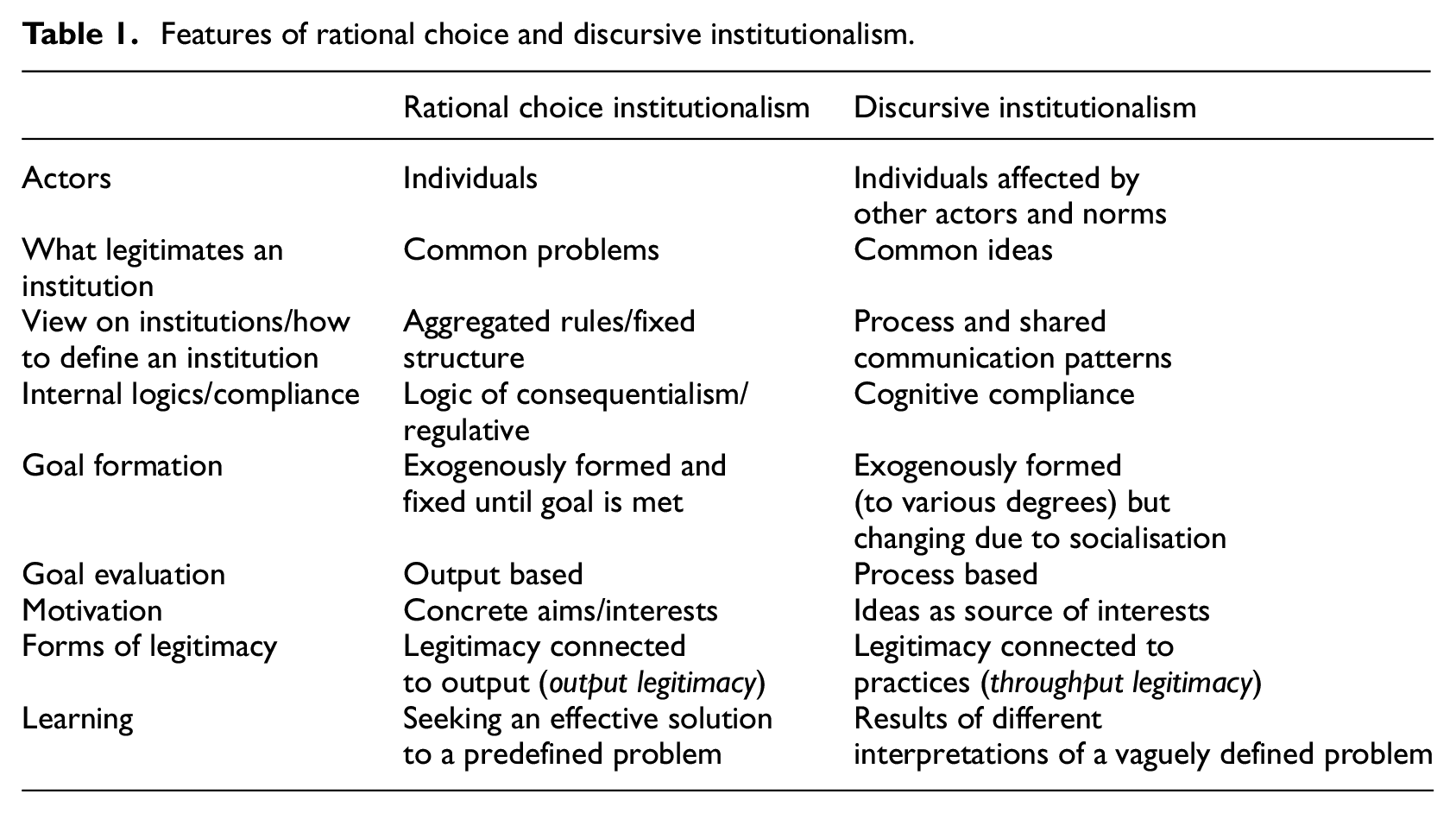
Our two frameworks have different views on actors within institutions. While the rational choice institutional framework stresses the role of individual action, the discursive framework focuses on both individuals and their normative context (Peters, 2019). In addition to individuals within the six cities, the cities themselves can be viewed as actors, although composite (Scharpf, 1997).
Learning in TMNs also takes different shapes in these two perspectives. The rational choice perspective harbours a definition of learning in line with Hakelberg’s (2014: 114). Here learning in TMNs is defined as an active, rational practice that occurs ‘when policy-makers in a given jurisdiction react to dissatisfaction with the regulatory status quo by looking elsewhere for a more effective solution to a policy problem’. In this view, learning is ‘rational lesson-drawing’, with a focus on outputs and the ability to improve regulation (Hakelberg, 2014: 114). Conversely, in the discursive perspective (Lee and van de Meene, 2012: 204) learning is the result of discussions of ‘the nature and interpretation of the policy problem’. Thus, in this perspective, learning is a commitment to a process, and problems are not readily defined in advance.
Huggins (2018) applies a rational choice and a sociological version of new-institutionalism to understand why British and French cities participate in European city networks and find little explanatory power in sociological drivers for engagement. Along with Huggins (2018), a few TMN researchers have touched upon elements of new institutionalism: Caponio (2018) and Mocca (2018) have both studied motivations of strategic and symbolic nature for TMN participation. Caponio (2018) concludes that TMN participation mainly serves a symbolic function, while Mocca (2018) finds most support for rational drivers. Most of the research literature however points to the strategic aims, concrete outputs, and common problems as central for cities’ motivation to join a TMN and to stay members. These drivers contrast with our findings of the importance of throughput legitimacy, which is better explained by the discursive institutional perspective.
Methodology
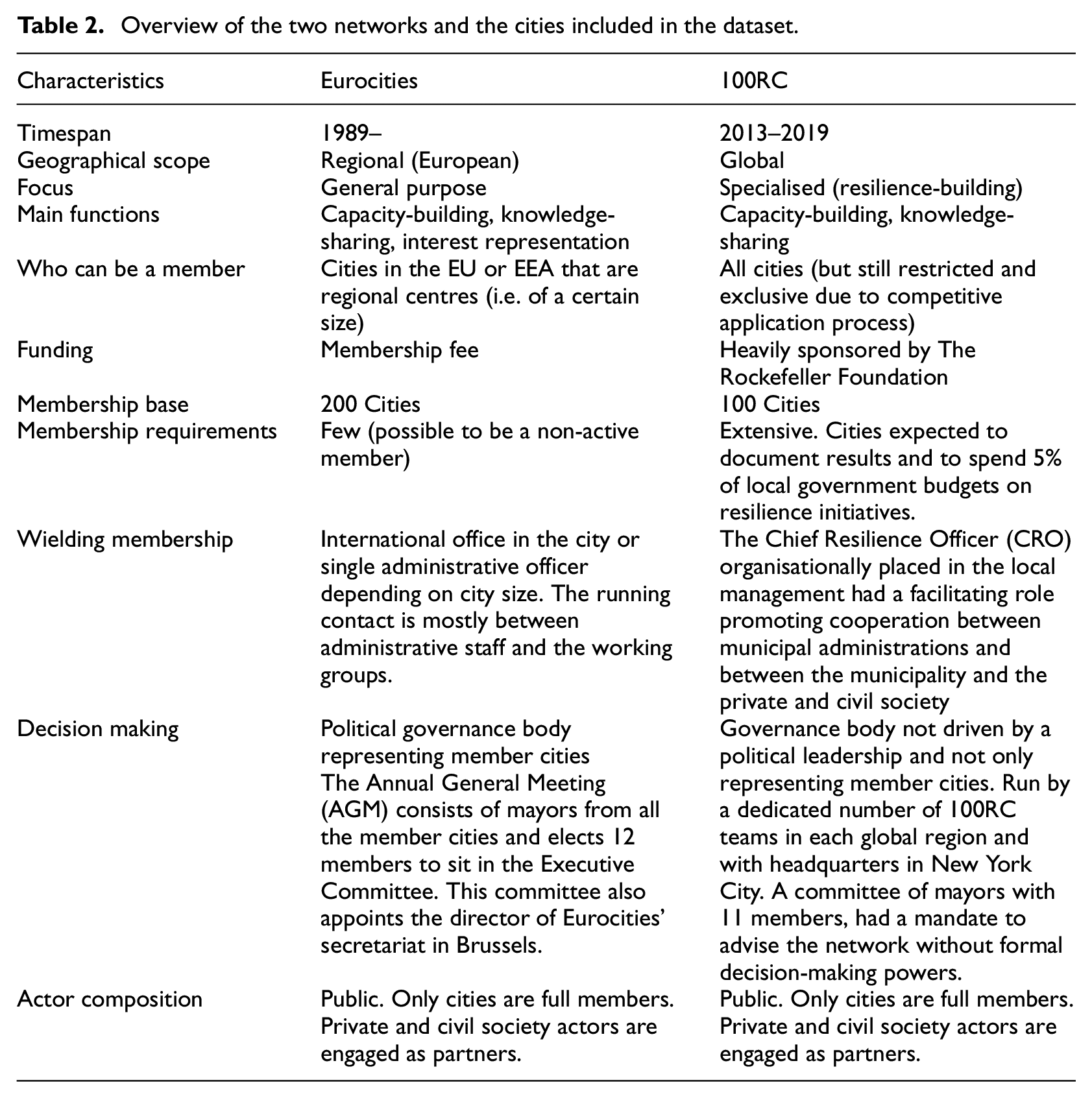
The profound changes in global politics make multiple scales and levels of analysis important for social qualitative research (Bartlett and Vavrus, 2016). In this article, we study the reasoning and processes associated with TMN engagement by examining the interconnections through a processual approach with several units of analysis comprising two networks and six different cities. The two TMNs were part of two different research projects, which is why the cities also differ on a few parameters (see Table 2). We have merged two different datasets building on semi-structured interviews, observations and documents. One dataset comprises the cities Vejle (Denmark), Chennai (India) and Porto Alegre (Brazil), which are all members of the global TMN, 100 Resilient Cities (100RC). The other comprises Copenhagen (Denmark), Oslo (Norway) and Stockholm (Sweden) who are members of the regional TMN, Eurocities. The fact that these three Eurocities-members are all Scandinavian cities and therefore quite similar does admittedly put a restriction on the number of generalisations that can be drawn.
Overview of the two networks and the cities included in the dataset.
Following Ragin and Becker (1992: 1) our cases are both ‘similar enough and separate enough to permit treating them as comparable instances of the same general phenomenon’. Our goal is to develop a thorough understanding of the rationalisation of TMN engagement at the city scale. We seek to capture a large amount of empirical complexity, to generalise, theoretically rather than statistically, from qualitative work and to challenge some of the profound assumptions around TMN participation currently existing in the scholarly work on TMNs. We do not seek to find out which of the six cities offer the best fit with each of the two new-institutional frameworks. For that, our case selection is not systematic enough. Although some differences between cities and TMNs are commented upon, our aim is not to conclude that one city is more rationally oriented than the other. Rather, by raising the level of abstraction, we treat them all as data and try to discover some general tendencies that hold across very different TMNs and very different cities.
As illustrated in Table 2, the two networks are different in terms of type, purpose, membership conditions and decision-making processes. However, both networks are contemporary and part of the TMN landscape from 2015 to 2019 when all data were collected. For all the selected cities, across the two datasets, they are similar in the sense that all the cities were members from early on in the networks’ history providing us with the opportunity to look at the rationalisation of TMN participation over time. Furthermore, all cities were actively engaged in network activities indicating explicit reflections on participation. The cities do however vary when it comes to city size, geography, autonomy to make decisions and the number of TMNs they are engaged in.
Altogether, we draw on 51 interviews from different representatives from the six cities, as well as employees from the TMNs’ secretariats. Informants were primarily city staff responsible for the city’s participation, however, informants also comprise policymakers, NGOs and private sector actors who were directly involved in the city’s TNM membership. We applied a snowball sampling method for locating relevant informants within the municipal administration after having the initial conversations with contact officers for the network in each city. The interviews were semi-structured and centred around the following topics: motivation to join, ambitions for continued membership, evaluation of outputs, functions filled by the TMNs, legitimacy and cities’ roles, branding and changes over time.
Analysis
The rationale for TMN enrolment and participation
When studying motivations for joining and remaining in TMNs, Huggins (2018) finds a link between documents and stated motivations in interviews, which he sees as indicative of a rational choice institutional approach. Our findings are different in that these do not always harmonise. Joining seems best explained by the rational choice institutional perspective while remaining is best explained by the discursive institutional perspective. One reason for this might be that only arguments of a certain character (rationally oriented) are considered appropriate when arguing in favour of joining a TMN. This is not the same as claiming that these were the true or only reasons. Identification with other members and a wish to be a part of the club might also motivate enrolment, even if our data does not strongly indicate this. Nevertheless, both the documents we studied and shorter conversations about the rationale for participation tended to stress output-based (rational choice) arguments. At the surface, rational choice seemed to best capture the reasoning for joining the TMNs. However, when we asked about the internal dynamics and workings of the TMN engagements, such as the Eurocities working groups, and what participants thought about their actual role as participants in both TMNs over time, answers were less problem based and output focused. 3
For both Eurocities and 100RC, and following the rational choice institutional perspective, the reasons given in strategical documents for TMN participation were tied to concrete aims for cities and the presence and influence of certain enthusiastic individuals trying to maximise the utilities of the city within their field. The three Eurocities-members, Copenhagen, Stockholm and Oslo had very similar motivations for joining or taking on positions in the network. The exchange of information on developments in the cities and the EU, as well as possibilities for interest representation towards the EU were highlighted (Copenhagen City Council Case, 2006; Copenhagen Note to the Economy Department, 2010; Oslo City Council, 1993; Stockholm City Council, 1992). 4
Similar rationales are found within Chennai, Porto Alegre and Vejle when interviewees were asked to reflect on the reasons for joining and being a member of 100RC. Access to funding, expertise (e.g. consultants) and information exchange were all highlighted as functions that make the TMN attractive to members. In Chennai, for example, the 100RC application was tied to risk management as the city is facing various risks from climate change, urbanisation and globalisation trends and the tools and network expertise that 100RC membership could bring seemed like a good way to develop and share experiences. In Porto Alegre, the funding potential and access to network partners were emphasised and in Vejle, the city-to-city exchange and capacity building activities were listed as the main reasons for participating in 100RC activities.
Despite these rather specific functions described above, when asked in more detail, continued participation was not always tied to issues that the participants sought solutions to. For many informants, the network was most important in that it served as a safety net and a source of potentially important information. Keeping the conversation going was often more important than direct solutions to predefined problems, which characterises a discursive mode of action. Several informants focussed on personal relations, the role the TMN played as a meeting place and the importance of knowing the culture of the working group in the context of Eurocities. They stressed the value of the process as much as, or even more than, the outputs: The older one gets, the more one realizes that the informal advantage is quite significant […] like talking to others on one’s own level other places in Europe (Stockholm 2018, civil servant, translated by authors.).
Moreover, while Huggins (2018) argues that the sharing of best practice serves a rational function in that it is mainly about improving cities’ positions (as a form of external output legitimacy), we also find that in both 100RC and Eurocities members share experiences where projects were less successful or even considered an outright fiasco (Oslo 2018, civil servant). This is hard to explain from a purely rational choice perspective.
Goal formation, evaluation and change
How goals are formed in connection to TMN participation varies in our data. Here, the two institutional frameworks pull in the same direction in that they assume some degree of predefined preferences but may also both allow change of some kind. New goals may be developed because one has reached one’s initial goals (Scharpf, 1997), or because one changes one’s goals without reaching them (Peters, 2019). In our cases, the goals, even if strategically formulated, were vague and had to be concretised by the individuals attending meetings and network activities. Thus, even the decision to become a member is only on a very general level based on a rational calculus, as also stressed by Mocca (2018: 212).
Although there are some overarching goals stated in the international strategies of the cities, they only mention types of activities or functions they expect TMNs to fill, such as those TMNs advertise on their websites. Therefore, at a very general level, goals are formed exogenously, but they are made concrete by the individuals attending the meetings and participating in network activities. These participants did come to the networks with expectations but were also often influenced by the dynamic within them so that they found themselves involved in projects they had not planned. One example is when a member of staff from Porto Alegre went to a 100RC workshop on the value of cryptocurrency together with other 100RC cities and partner organisations. The outcome of this workshop was a pilot project on the integration of digital currency in the city development plan for one of the boroughs selected for the resilience strategy.
While the rational choice framework takes as given that utility maximisation is the primary motivation of individuals, we see that goals are often vaguer and when asked about utility, some informants found it hard to give examples. The quote below illustrates this conflict between the two competing logics that nevertheless exist simultaneously: I actually like the resilience concept. But we had expected the actions coming out of the membership to be more oriented towards concrete solutions and initiatives. But when we have visits and events [within the TMN] we talk big words about resilience. And that is fair enough. Just not what we expected it to be (Vejle 2018, local business representative, translated by authors.).
The interviewee is conflicted about the outcome of the city’s membership when asked to evaluate it and points to a discrepancy between the expected and actual outcome of network participation. However, the quote also shows how participants sometimes do strategically reflect around their membership and judge relative gains and costs using logic of consequences in line with the rational choice assumption. Moreover, cities that do not find TMN membership useful do change behaviour in the sense of leaving some working groups or downscaling their activities. This was the case for the Southern European cities in Eurocities after the financial crisis hit in 2008. Because of the membership fee in Eurocities, a few cities had to withdraw from the whole network when city budgets got tighter (Eurocities’ secretariat 2018, civil servant). A parallel in our data is that Copenhagen used to be a very active member of Eurocities and was president of the Executive Committee from 2010 to 2012 but has downscaled its effort the past few years. The following quote sums up the general sentiment: For a long time, we have felt that we have shared a lot of our knowledge about sustainable growth in cities. That was ok because we got to promote Copenhagen. Now, the management also demands that we learn something. But if you cooperate with a city that doesn’t have any solutions, there is not much to learn. Lately, we feel that we have given more than we have received (Copenhagen municipality 2018, civil servant, translated by authors.).
Because of this, the city has prioritised putting more effort into another TMN, namely the global environment network C40 (Copenhagen 2018, civil servant). Today, only a handful of people from Copenhagen attend one or two Eurocities-meetings a year.
In the context of 100RC, the network only sponsors staff and activities for a maximum of 3 years. Afterwards, the programme is supposed to sustain itself in each of the cities.
In all three 100RC cities activities were downscaled to suit the public purse in each of the cities, and to meet the level of ambition in changing governments. In Porto Alegre, for example, projects and goals in the resilience strategy were adjusted to the wishes of a new local government, and the possibility of attracting external investments to fund the projects.
With the number of TMNs available, cities are in a good position to choose between different providers of functions (see also Bansard et al., 2017; Mocca, 2018). Despite this, none of the six cities in our study report having considered leaving their TMNs. All six cities have remained members when governments have shifted. The cities have adjusted their behaviour within the network rather than quit, as illustrated by the following quote: It goes a bit up and down for most cities. For instance, Stockholm has not been so active in the mobility group for a few years, but then suddenly they are there and do things (Copenhagen 2018, civil servant, translated by authors.).
To this observation, a rational choice theorist would add, as Scharpf does, that even a rational choice institutional perspective allows membership despite few returns over a short time or in some areas for the purpose of reaching more overarching goals, described as the ‘[…] ability to forgo present satisfaction for future gains’ (Scharpf, 1997: 58). Thus, remaining is rational and necessary for the cases where they suddenly need TMNs to lobby on their behalf or push through their interests (see Van Bever et al., 2011). We have examples of such reflections in our data (Stockholm 2018, civil servant), however, this is not the main message. While TMN participation is dynamic for all the cities in this study, we clearly see that there is a core of general commitment that is hard to explain only with reference to strategic long-term thinking. Copenhagen has not been interested in withdrawing its membership in Eurocities altogether. Having a foot in the door still seems valuable.
While cities do not remain in TMNs they have no use for, the idea of what is useful is also shaped by their involvement in TMNs. For these informants, the network was not primarily about getting new ideas or representing their interests, but just as much about legitimating policies and ideas within the city administration, a form of internal throughput legitimacy. Therefore, some informants even saw it as valuable or felt obliged to attend all meetings in cases where they did not have much to contribute or expected much in return. Cities have different challenges, and therefore sometimes have little to learn and little that can be directly implemented in their administration, as the following quote indicates: When one represents Oslo, Helsinki or Stockholm, places with strong welfare societies, where most services are well structured, provided by the state and tax financed, it may be hard to get excited about innovative ideas that other cities have been forced to come up with because there is no welfare system in their state. So, we do not always have the same challenges (Stockholm 2018, civil servant, translated by authors.).
Yet, participants seem to hold on to the idea that it is demanded that they learn how things are done elsewhere. This same informant stressed how she nevertheless valued meetings to see how other cities solved their own, specific problems.
Forms of legitimacy in TMN participation
Although the rational choice perspective sees concrete output as the foundation for legitimacy in an organisation, in both Eurocities and 100RC, several city staff had no clear expectations as to what they would achieve as a TMN member, other than gaining knowledge and seeing how ‘things are done elsewhere’ (Copenhagen 2018, civil servant). Despite this, both TMNs were highly regarded by almost all participants. Remaining (irrespective of goal attainment) could be a non-decision for withdrawal (Mocca, 2018), a FOMO-argument (Huggins, 2018) or organised learning (Lee and van de Meene, 2012). Learning and a fear of missing out on potentially important information, coupled with a general fear of not being on the same platforms as other important cities, were repeatedly mentioned by our informants. In addition, many also have a fear of appearing self-righteous. It is not necessarily easy to distinguish between a wish to learn and a fear of missing important information. In the interviews, they tended to overlap, as explained by the following: Hearing about what other cities have done is important. We are not necessarily the best at everything here. We can always do our work better and propose new solutions. We would just encapsulate ourselves if we did not participate internationally. You cannot get too much cooperation in my field (Copenhagen 2018, civil servant, translated by authors.).
Whether these are the same or different phenomena depends on how learning is defined. As discussed in the theory section, it may be of a rational type or a more cognitive type. We did see learning of the rational, output-oriented type in our data. One example of this was Oslo’s engagement in the work on age-friendly cities, where they sought solutions on how to help the elderly to use and travel around in the city. However, most of the learning was of a cognitive/discursive type where issues need to be defined in the TMNs to be grasped and solved (see also Finnemore and Sikkink, 1998; Peters, 2019). Thus, the TMNs also provide both the language and tools to deal with issues cities face. Cognitive/discursive learning is in our data connected to throughput legitimacy (see also Schmidt, 2013) in the sense that adding legitimacy to various practices seem to be at least as important as having common problems.
In addition to participation as organised learning, the value of the association with other important cities contributes to explain continued membership. This is an example of external throughput legitimacy where interaction with other cities is seen as valuable in itself.
A Eurocities informant said that the city agenda is very ‘in’ at the moment and that there is a hype around cities that they should ‘do something’ (Copenhagen 2018, civil servant). This, ‘something’ is rather unspecified. Membership seems important because the TMNs are often not open to any city, giving the impression of belonging to an exclusive ‘club’ and a position of power. Cities care about international attention since it boosts local perceptions of internal throughput legitimacy (see Finnemore and Sikkink, 1998). This type of legitimation is illustrated in this quote from a Eurocities working group member: To know how other cities work can help us show the politicians how they work like or different from other cities. And then the heads of office might think ‘aha’, that is exciting. Because you know, it brings status when you can show that what you suggest is not something that you or a single administrative officer in the city have thought up, but that they do it in other cities as well. (Stockholm 2018, civil servant, translated by authors.).
Cities do not choose solutions against their better judgement only because they are considered appropriate, nor do norms stop cities from leaving TMNs. Yet, norms shape how members engage and make leaving the TMN appear unattractive. In the case of 100RC there generally seems to be a normative component in the cities’ membership. Holding on to ideas of building city resilience is important both within and outside city administrations when the political and economic surroundings are constantly changing. 100RC provides a legitimate base for discussing city resilience when political realities change. This has been the case in Vejle as well as in Porto Alegre where the political steering has changed during 100RC membership. In Porto Alegre, the city government changed completely from a far-left-wing government to a far-right-wing government in late 2014. However, due to the reputation of the Rockefeller Foundation as well as the ‘association’ with big and prestigious cities such as New York City, the new administration decided to stay in 100RC and continue with the resilience programme.
According to the discursive institutional perspective, norm entrepreneurs play an important role in shaping TMN membership. One example of such were from the Eurocities working group on Waste. In this group there was a selection bias, as member cities tended to have a pro-environment attitude. This might not be unexpected in other environment working groups, but waste management does affect most cities and is heavily regulated by EU law. Cities irrespective of their stance on environmental issues would therefore be expected to have an interest. However, the cities that were frontrunners in waste management, would often dominate, and tended to resemble an environmental lobby organisation in the words of one informant (Civil servant, Oslo municipality, 12.07.2018). Thus, there were very clear role models, which could make it difficult to put forward diverging interests.
The fact that some cities have a position that far exceeds what could be expected considering their economic role or population size, could also be seem as a form of norm entrepreneurship (Toly, 2008). In the TMNs, normative ‘currency’ is sometimes redistributed. These cities do not force their experiences on others, but they gain a reputation and have the ears of much bigger cities. They thus get an audience that they would not otherwise have, as illustrated by these informants: It doesn’t always depend on the size of the city. Guimaraes in Portugal has for instance been very active on biodiversity and green areas. So, it shows that with the right policies and priorities, even a small city can make itself heard among the big cities such as Frankfurt or London (Stockholm 2018, civil servant, translated by authors.).
And further: Athens, Copenhagen, Barcelona are all capital cities, and they all have branding. But cities like Vejle or Thessaloniki are the second-tier cities, the cities which actually characterize most cities across the world, or at least here in Europe. For them, 100RC is a window to the world (100RC regional office, 2018, programme manager, translated by authors.).
Being present at the international stage and being visible among other important cities creates both external and internal legitimacy. Although some informants stressed that legitimacy is a currency that can be rationally traded to reach concrete goals (as a form of external output legitimacy), we also see that it is valued in itself. As Acuto (2010: 441) points out, cities connect the local sphere with the international and TMNs provide a space for cities to become international actors. Most people have heard the story of how global issues should be solved locally and that cities have a role to play here: a narrative which is also mirrored in the Paris Agreement from 2015 and in the UN’s Sustainable Development Goals (United Nations, 2015: Article 7, 2020). This was also a recurrent message in our material. Being a member of a TMN could therefore also be viewed upon as being a part of a ‘trend’ in the international society.
Conclusion and final remarks
In this article, we have analysed six cities’ justifications for joining and remaining in the TMNs Eurocities and 100RC. Seen against the assumptions drawn from two new-institutional perspectives, joining TMNs seems best explained by the rational choice institutional perspective, while remaining is both explained by the rational and discursive institutional perspectives. The formal explanation for why the cities join TMNs is different from the one that emerges over time. A similar conclusion is reached by Fourot et al. (2021) in a recent study of urban transnational activism in French cities. In line with our observations of the six cities’ engagement in Eurocities and 100RC, they argue that TMN memberships in French cities are increasingly characterised by different forms of ‘passivism’ over time. While the concept of passivism is different from concepts found in discursive institutionalism they both help us uncover cities’ reasoning for joining and remaining in network activities over time. Decisions based on throughput legitimacy are, however, not to be misunderstood as disengagement or disappointment. Our data show that for some participants, satisfaction with the process can count just as much as the measurable outputs in valuing TMN membership. TMN membership is a way for cities to foster specific identities and to legitimatise their position in an increasingly urban world as also pointed out early on by Griffiths (1995). No matter how dynamic the attachment to TMNs might seem, there is nevertheless a general commitment to the idea of cities as norm entrepreneurs and the importance of keeping the conversation going.
Membership over time does not automatically mirror the functions advertised by the TMNs (e.g. lead to visible tangible outputs or fulfil the expectations that participants had upon entry). Nor does it automatically lead to a membership justified exclusively by discursive notions of legitimacy. Instead, we argue that we should pay attention to the diverse, co-existing and sometimes competing institutional logics that evolve.
These findings are likely to have implications for the study of membership of other TMNs. First, it affects the type of actions we can expect from cities as members of TMNs. Second, it changes what type of outputs cities can expect to achieve. Our article indicates that students of TMNs must consider the discursive aspects when judging their value or studying results. Further research is needed to fully grasp the consequences of how different logics legitimises decisions and actions connected to TMN membership. This includes research into the explanative power of the institutional framework between cities in the same TMN and between different TMNs. Further research is also needed on the dynamic processes of joining, remaining in and leaving a TMN and what condition these actions have.
Footnotes
Acknowledgements
The authors are grateful for the comments from three anonymous reviewers and the editors of this journal. We are also thankful for the effort of Arild Aurvåg Farsund in reading and commenting upon this work.
Funding
The authors received no financial support for the research, authorship, and/or publication of this article.
