



Abstract
We assess socio-political challenges for urban heat island (UHI) mitigation in greenspace planning, focusing on Taipei Metropolis, Taiwan. Through analysis of articles from two newspapers, we suggest that attention to greenery and heat tends to reflect immediate weather or planning considerations, and that there is a persistent perception of greenspace as a barrier to economic development. Broad-based, durable rationales extending beyond climate adaptation benefits may be required to sustain support for greenspace planning in Taipei. There is also a need to raise decision makers’ awareness of the specific actions required to realize cooling benefits via greening. We argue that the Taipei case demonstrates the potential for policy messaging based on greenspace functions to attain cross-sectoral buy-in for greenspace development or preservation, but that planners and policymakers must ensure that consensus-based governance actually delivers cooling benefits to citizens. Our results also indicate that greenspace planning policy could more explicitly address community-level greening specifically targeted at cooling or other climate adaptation challenges.
Keywords
I. Introduction
This paper assesses social and policy challenges and opportunities for urban heat island (UHI) mitigation within strategic greenspace planning, focusing on Taipei Metropolis, Taiwan. Whilst cooling is of course only one of a number of services greenspace may deliver, the UHI effect – higher temperatures in urban areas than their rural surroundings – is a key issue for urban climate change adaptation, especially in tropical and subtropical cities and low- to middle-income countries.(1) Greening within cities is increasingly considered an effective response,(2) but an understanding of the climate adaptation potential of greening is still emerging in many low- to middle-income city contexts.(3)
In this paper we analyse the UHI mitigation potential of greenspace in Taipei, a higher-income city, but one where there remain challenges to climate adaptation via greening. We use this UHI potential as a focal point for elaborating pathways and barriers to climate adaptation actions via urban greening. Indeed, although urban heat has been researched in Taipei,(4) within the city’s urban plan and its climate adaptation measures an understanding of heat is still emerging. This is particularly concerning given the significant warming trend within Taipei. Moreover, whilst greenspaces are recognized for their cooling potential in Taipei, they rarely appear in the development debate. Taipei is therefore a city where greenspace provision has the potential to address climate change issues, but where the social and policy milieu may frustrate planning initiatives. Evaluation of the socio-political context around greenspace deployment in Taipei can thus identify barriers that planners working in similar cities elsewhere may face, as well as policy frameworks and messages to surmount these challenges. Our aims are therefore: (a) to assess the socio-political landscape around UHI mitigation within greenspace governance in Taipei; and (b) to use the Taipei case to describe challenges for addressing UHI issues and broader climate adaptation responses in greenspace planning.
Our evaluation draws on analysis of two major English-language newspapers in Taiwan – the Taipei Times and the China Post. Press reporting is a channel for observing governance priorities and reflecting societal discourse, and can thus help identify reasons that heat mitigation related to greenspace provision may or may not succeed in Taipei. Our findings indicate that heat mitigation could act as one of several arguments emphasizing the value of greenspace to Taipei, which may work together to build political traction for strategic greenspace planning. More broadly, we argue that the Taipei case demonstrates the potential for messaging about greenspace function to galvanize diverse actors in the common direction of greenspace preservation or deployment, and also the need to further explore municipal collaboration with communities, targeted at specific strategic actions such as heat mitigation.
II. Background And Context
a. Conceptual framework
Whilst cities are recognized as significant sites for climate change actions, and as an appropriate scale for this action,(5) there remains the question of how different actors (e.g. developers, policymakers, scientists) interpret and engage with climate change. Not everyone involved in environmental governance debates will engage with “scientific” rationales for action.(6) A decline in trust has been observed in “expert” scientists and policymakers previously entrusted to make decisions on behalf of society.(7) Coupled with this, top-down governance processes based on technical or scientific arguments alone may struggle to encompass the range of concerns at play for issues like climate change.(8)
In an urban context, these issues become even more pronounced. Cities are complex systems(9) where systematic urban greening requires the support of governmental, private sector and civil society actors – each with their own motivations and value positions.(10) The complexity of environments and ecosystems themselves means that a range of specializations and knowledge needs to be brought together to develop and initiate truly “sustainable” planning.(11) Moreover, the social implications of sustainability involve a concern with equity. Yet there are challenges around enacting interventions that primarily benefit vulnerable sectors of society,(12) and it can be difficult to retain a focus on the underlying structural causes of inequality and vulnerability.(13)
In short, when responding to climate change, the range of strategies open to urban planners is influenced not only by what is technically and scientifically appropriate, but also by what is socially and politically perceived as acceptable. Policymaking for planning climate adaptation actions hence necessitates environmental governance. Adger et al. in 2003 defined environmental governance as the resolution of conflicts through institutional arrangements that may facilitate or limit the use of natural resources.(14) This definition was later elaborated in the urban environmental context as the coordination of multiple actors involved in steering society towards low-carbon, resilient or sustainable objectives.(15) There has been increasing interest in messaging that can bring together a diverse and potentially conflicting range of interests early in the planning process, to work in the common direction of developing planning outcomes that address both technical and societal concerns.(16) Strategic actions in urban governance that link climate adaptation with socioeconomic imperatives, it has been argued, have a better chance of taking root and transcending sectoral interests than actions justified in terms of climate change adaptation alone.(17) In this paper, we assess the range of value positions around greenspace planning in Taipei, and what opportunities this might give for strategic messaging around greenspace policy in Taipei and other localities, in order to work towards such planning-based adaptation actions as UHI mitigation.
b. UHI and the role of greenspace in cooling
Multifunctional greenspace may serve many purposes – recreation, biodiversity, water management and air quality among others – of which cooling is only one. However, to assess the socio-political dimensions in sufficient depth within the confines of a paper, we focus on UHI mitigation as one specific greenspace planning objective relevant to Taipei. Increasing the abundance and cover of vegetation can counter the UHI effect through the lower radiance, increased evapotranspiration and greater shading provided by vegetated surfaces.(18) Increasing thermal comfort is also a benefit of “green infrastructure”, defined as an interconnected network of natural areas and open spaces conserving natural ecosystem values and delivering benefits to humans.(19) Greenspace may cover a range of scales, from urban street trees to private gardens to city parks.(20) Whilst more research is arguably needed to understand how effective different greening actions are in delivering cooling,(21) recent research in Taipei suggests that creating connections between greenspaces and/or enhancing greenery at greenspace edges may maximize cooling benefits.(22)
Heat and greenspace access are socio-political as well as techno-scientific issues. Heat vulnerability and access to greenspace vary within cities, usually in accordance with socioeconomic and demographic factors.(23) Due to its cost-effective nature, greening may be one way of providing cooling to communities with lower adaptive capacity, thus reducing such “thermal inequity”.(24) Greenspace preservation or deployment is also increasingly framed in terms of economic development and municipal or regional policy.(25) As such, the provision of greenspace – and its role in mitigating UHI effects – is likely to reflect a complex range of interests, as discussed in Section IIa.
c. Taipei, climate change adaptation and heat
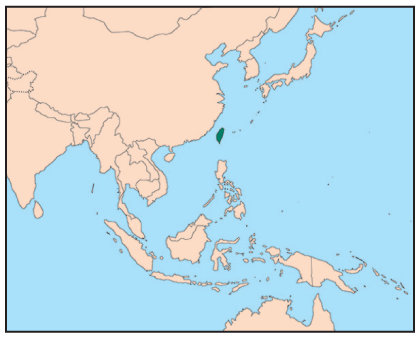
Taipei Metropolis, situated in north Taiwan, encompasses Taipei City and New Taipei City. The urbanized area covers approximately 2,726 square kilometres, with a population estimated at 6.67 million in 2014. The climate is humid subtropical and influenced by monsoons. Due to global warming and rapid urbanization,(26) temperatures in Taipei are rising at a faster rate than the global average. The number of extreme hot days (defined as above 35.5°C) has increased by four days per decade over the last 30 years.(27) The Representative Concentration Pathway 8.5 scenario is one of four future greenhouse gas concentration scenarios developed by the Intergovernmental Panel on Climate Change (IPCC) for modelling and research purposes, and represents a “business as usual” rise in emissions throughout the 21st century.(28) Under this scenario, average annual temperatures in Taiwan are predicted to rise between 1.66°C and 5.01°C by the 2080s, with mean summer temperatures expected to increase 2.7°C by 2050.(29)
Extreme heat is therefore a serious issue for Taipei, with concerns over deterioration of air and water quality, spread of disease, change of precipitation, and such public health impacts as increased mortality among the elderly.(30) Taiwan is among the fastest ageing countries globally, and nearly 15 per cent of the Taipei population is over 65 years old – an age group highly vulnerable to heat.(31) Extreme urban heat could thus increase the burden on Taiwan’s national health care system. Warming enhances the demand on air conditioning and cooling systems, increasing the risk of electricity shortages. This may intensify in coming decades as Taiwan replaces its current coal and nuclear electricity base with renewable sources. This transition could (in the short term at least) be costly and affect capacity, with knock-on effects for consumers in electricity pricing (and hence affordability of air conditioning) and availability at times of high demand.(32)
To improve urban thermal comfort, urban greening has been considered in the Adaptation Strategy to Climate Change in Taiwan.(33) However, due to the lack of evidence-based guidelines, low policy priority, and limited integration into existing urban planning systems, this strategy has to date been addressed to only a limited extent. Recreational greenspaces, officially defined as parks, sports venues, greeneries, squares and playgrounds, are controlled by land zoning regulations and designed to reach 10 per cent of the city.(34) Yet by 2015, green coverage in Taipei City only reached 5.08 per cent. The Taipei City Government aims to provide every citizen with up to 7.48 square metres of greenspace.(35) By the end of 2015, greenspace per capita in Taipei had reached 5.04 square metres.(36) More than 80 per cent of official greenspaces (excluding riverside parks) in Taipei are less than one hectare. Large greenspaces (greater than 4 hectares) are primarily located in the less accessible city outskirts. The area–distance standard is not explicitly included in planning documents, but most areas in Taipei have greenspaces accessible to residents within 400 metres. The limited greenspace size in the urban core and the challenge of balancing greening with development pressure is not dissimilar to that in other densely populated Asian cities such as Hong Kong(37) and Singapore.(38) Exploring ways to develop multifunctional greenspace in Taipei may contribute to a more general understanding of common problems and solutions, and facilitate mutual learning for urbanizing tropical and subtropical cities.
III. Methods
We draw on and analyse news articles to identify stakeholders and arguments around UHI mitigation within greenspace debates in Taipei. Similar to Pulver and Sainz-Santamaria,(39) we use newspaper content interpretively to assess the societal events and issues that are described, rather than the substance of the reporting per se. News sources have been used to map out an issue in this way across a number of climate change-related contexts.(40)
a. Data
We sampled the online versions of two of Taiwan’s largest English-language newspapers (and the last two producing print versions at the time of data collection): the Taipei Times and the China Post. These newspapers provide balanced and in-depth reporting on social issues in Taipei and Taiwan as well as editorials, regular columns and opinion pieces that provide different perspectives on current issues. The Taipei Times has a more pro-Taiwan editorial stance, whereas the China Post is considered to lean towards greater linkage with China. Both newspapers are, however, viewed as providing English-language representation of broader views in Taiwan.(41)
Articles were selected from 1 December 1999 (the earliest year that online articles were available) to 31 March 2016. Each publication’s website (http://www.taipeitimes.com and http://www.chinapost.com.tw) was searched for the terms “heat”, “heat island”, “greenery”, “greenspace” and “green space”. This choice of terms encompassed the wider context in which greenery and greenspace is discussed in Taipei beyond heat mitigation, as well as the interface between heat and greenery. Articles unrelated to the research focus or not relevant to Taiwan (such as syndicated news articles relating to heat in locations other than Taiwan) were excluded. However, we included articles discussing heat and greenery in other Taiwanese cities such as Kaohsiung, or in Taiwan generally, as they provided analogous cases or contextual background that might reflect and/or feed into greenspace discussions in Taipei.
First, information on the date, authorship, topic and tone, as well as the type of greenery involved, was recorded for each identified article (n=90; 33 China Post, 57 Taipei Times). Second, for articles within this sample engaging specifically with heat or greenspace (n=57, 14 China Post, 43 Taipei Times), information on the speaker, type and tone of each statement reported within the article was recorded. 215 statements were identified through this process, giving a broader representation of the argumentation used in these articles than would have been available from their authors’ perspectives alone.
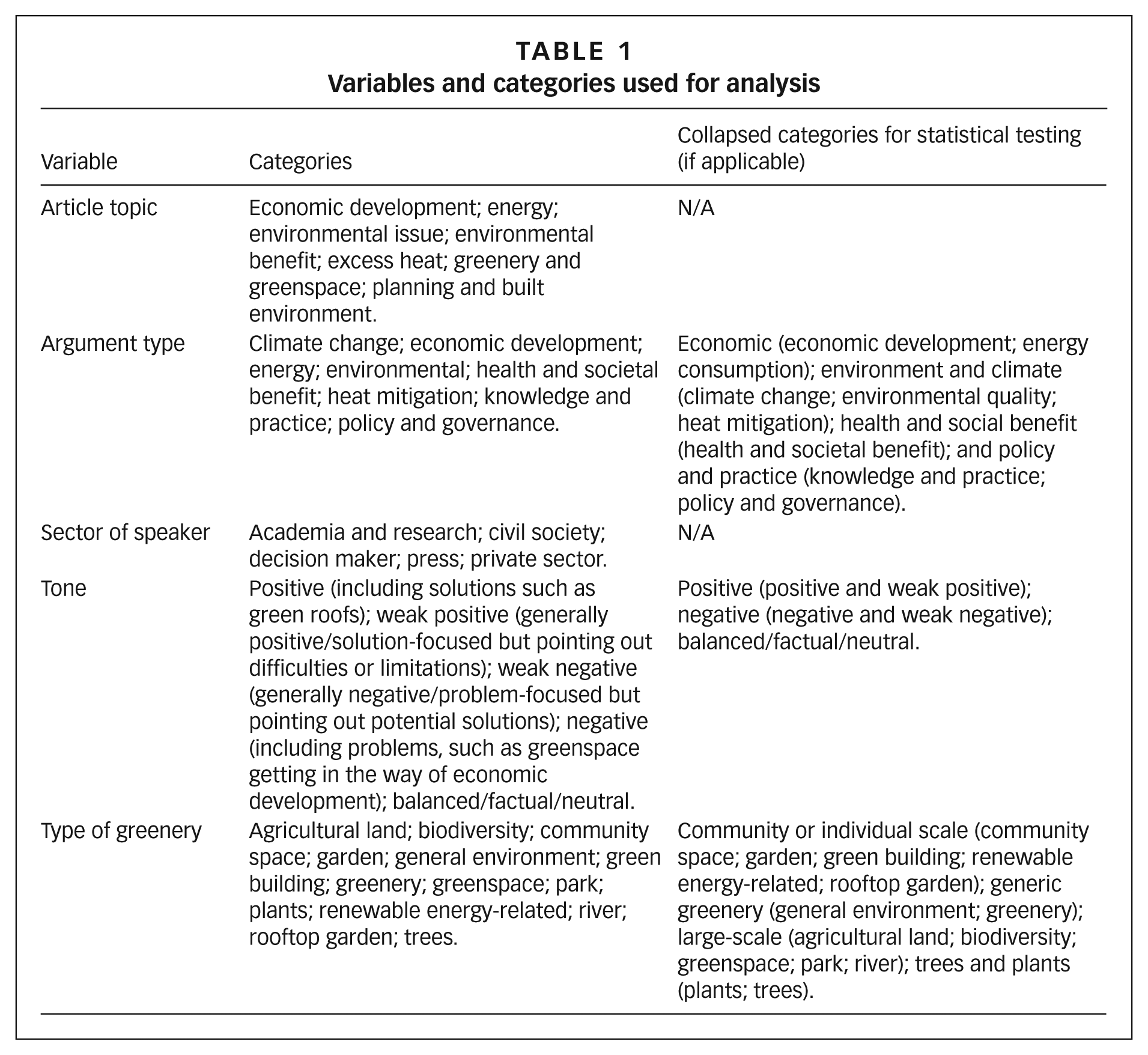
Table 1 shows the coding scheme for article topics, argument types, article/argument tones, speaker sectors, and types of greenery. The categories were developed iteratively through discussion by the researchers during initial reading, based on the language used in the articles themselves and guided by the researchers’ pre-existing knowledge of urban greening. Due to the larger number of statements and their particular value in assessing perceptions of the role of greenery in heat mitigation, argument types were further assessed through argument mapping.(42) This involved the identification of individual arguments within articles, and their grouping into similar clusters under eight main themes, providing as noted a more nuanced picture of the different kinds of arguments deployed in the governance landscape. The map is a heuristic tool to represent the data in visual form and aid in the interpretation of the quantitative and qualitative results, rather than a precise or exhaustive overview. A version of the map showing the two highest levels of argument is presented in Figure 3. A full map down to the level of individual statements is available online in the supplementary data (Supplementary Data 1).
Intercoder reliability (consistency of coding by different people) was calculated for both the first stage (identifying themes in articles overall) and the second stage (identifying themes in individual arguments) on a 20 per cent data sample (20 articles and 58 arguments, considered appropriate for a small dataset).(43) The categories used for the analysis on which this paper is based – theme/argumentation and tone, collapsed into positive/negative/balanced – return scores consistent with good intercoder reliability.(44)
b. Analysis
Quantitative analysis was undertaken via SPSS. To assess trends in reporting on heat and greenery over time, the number of words per season written about heat and greenery was calculated (winter/Q1 was taken as December of the preceding year, plus January and February; spring/Q2 as March–May; summer/Q3 as June–August; and autumn/Q4 as September–November). To understand the context in which heat and greenery were discussed, by whom, and in what way, frequencies were calculated: for the distribution of article themes, topics and tones; for the distribution of argument by type, tone and sector of speaker; and for the type of greenspace/greenery mentioned and the tone in which it was discussed at both the article and argument levels.
Relationships among the tone of article, sector of speaker and type of argument were assessed through chi-square tests. The objective was to give deeper insight into the governance landscape for heat and greenery in Taipei, by evaluating whether certain types of argument tended to be viewed more positively or negatively than others; whether certain groups viewed greening and heat mitigation more positively than others; and whether some types of argument were more engaging to some groups than others.
The relationship between tone and type of greenery was also assessed through chi-square testing at both the article and individual argument levels, to evaluate whether different types of urban greenery were viewed equally favourably. The purposes of these analyses were (a) to understand which groups of people were likely to oppose greening in Taipei and for what reasons; and (b) to identify greening solutions and rationales likely to be supported across the different sectors in the governance process.
Chi-square is an appropriate measure for assessing the relationship between nominal data of this nature.(45) To meet validity criteria or enhance intercoder reliability, some variables were collapsed for analysis, as indicated in Table 1. Neutral or factual statements were excluded from statistical analysis, but in any case only made up a small proportion of the dataset (n=2 for arguments; n=32 for greenery by article tone; n=1 for greenery by argument tone). Full statistical tables and analyses (Supplementary Data 2) – plus an inventory of sampled news articles (Supplementary Data 3) – are included in the supplementary data online.
Variables and categories used for analysis
The trends identified in quantitative analysis were used as a basis for further qualitative assessment of the sampled news articles through thematic coding. This involved rereading the articles to identify places where the themes and arguments identified during data collection were raised, with the aim of thinking holistically about the articles and assessing the wider context behind the trends identified in statistical analysis. Indicative quotes that refine, add nuance to or explain the statistical findings are reported in Section IV, alongside the quantitative results.
IV. Findings
Our findings inevitably focus on governance challenges for urban greenspace in Taipei, which are reflective of the local complexities and context. In Section V we discuss the implications for UHI mitigation and strategic urban planning more broadly.
a. Seasonality and attention cycles in greenspace planning debates
We first assess when heat and greenery are discussed in Taipei. Figure 1 shows the number of words written about heat and about greenery in Taipei per season between winter 2000 and spring 2016. Two points are noticeable: that the number of words written over time on the topics of greenery and heat in Taipei has increased, and that peaks in the number of words written tend to come in spring (Q2), summer (Q3) and autumn (Q4). For years where complete data is available (2000–2015), the highest number of words is written in Q1 on only two occasions, compared to five for Q2, five for Q3 and three for Q4 (plus one year where no words were written). Of the ten highest peaks, four fall in Q2, three in Q3 and three in Q4, with none in Q1. The increase in words over time points to the increasing prominence of both extreme heat and greenery in debates in Taipei; however, the comparatively limited discussion in winter suggests that attention to the issue may not be consistent throughout the year. This is reflected in the article content: “Over the last few days the temperature in Taiwan has shot up and the media has been awash with articles of how people can avoid the worst of the heat wave. The papers have also been full of stories about the number of heat-related deaths. Questions have been raised as to the potential health risks posed by the scorching heat.” (Academic, writing in the Taipei Times, 14 July 2010) “The Taipei City Government announced yesterday that it will send out water sprinkling vehicles whenever the temperature reaches above 37.5 degrees Celsius to reduce the persistent heat. Taipei’s temperature reached 38.3 C on Wednesday […] According to local media reports, the continuous heat is believed to have killed four people in Taipei so far.” (Staff reporter, China Post, 13 July 2012)
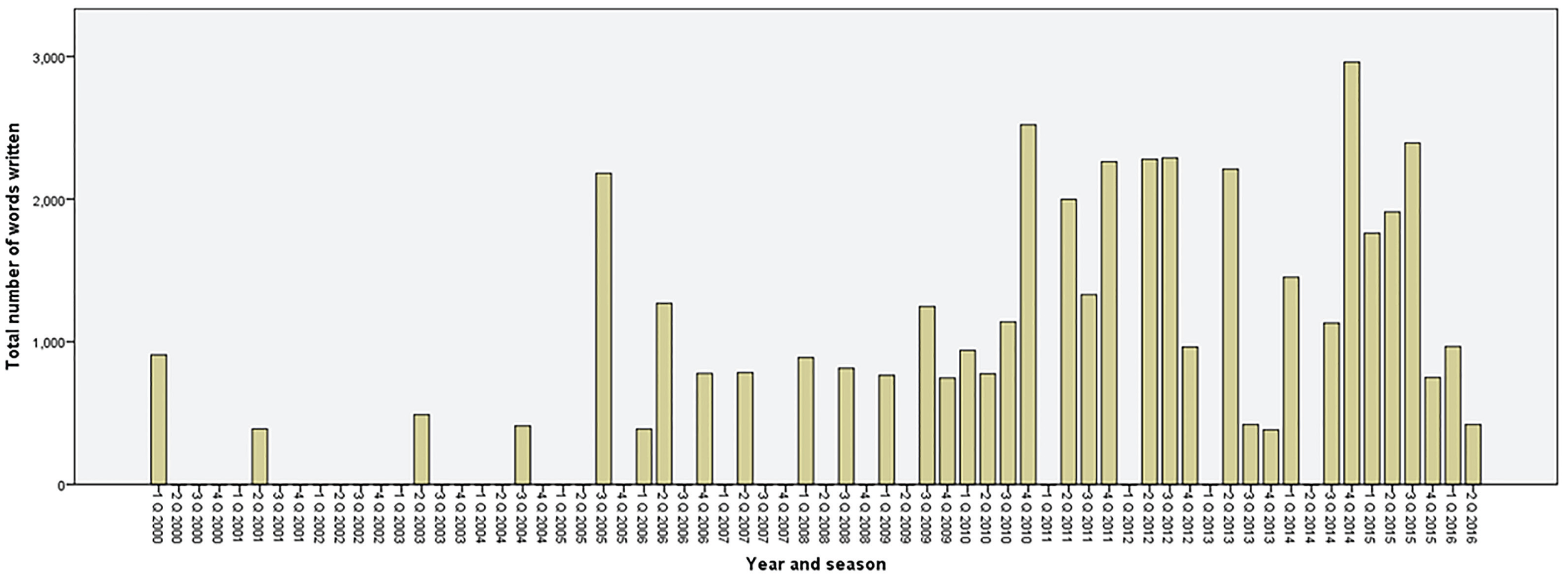
Word count per season for articles about heat and/or greenery in Taipei
The rarer discussion of heat and greenery in winter is not surprising. The negative effects of extreme heat on humans become “newsworthy” when the temperatures are highest and the risk to people is greatest, which likely happens in and around summer. Time markers such as “over the last few days” and “Taipei City Government announced yesterday” indicate that discussions on extreme heat take place in response to events that have either just happened, or are about to happen. However, UHI mitigation interest also rises around bigger debates on greenspace provision in Taipei, for instance the Taipei Dome development and Songshan Airport renewal: “The group called for the creation of a green space at the dome site to prevent an increase in the urban heat island effect, modulate sudden rainfall and maintain biodiversity.” (Environmental NGO, reported in the Taipei Times, 31 August 2011) “The ambitious plan would make the airport a park connected with a number of other parks along the Keelung River […] The proposed park, which would be larger than the 260 hectare Hyde Park in London and the 340 hectare Central Park in New York City, could change the microclimate and the urban heat island phenomenon in Taipei, he said.” (Politician, reported in the Taipei Times, 24 February 2014)
Heat mitigation gains attention here as one dimension of larger Taipei planning controversies – namely, the removal of trees and loss of greenspace related to construction of the new Taipei Dome, and proposals to close Songshan Airport and replace part of it with a park. Although not statistically confirmable with the data available, the word count peaks in late 2010 and mid-/late 2012 (Figure 1), respectively, correspond to the run-up to approval of Taipei Dome’s urban design review, and the launch by the Ministry of Transportation and Communications of an expansion and development plan for Songshan Airport (which reignited political debate on the future of the airport area). The highest peak in late 2014 (Figure 1) corresponds to the passing of contested plans to develop the Taipei Railway Workshop open space site, and to elections where the issue of public space was raised.(46) More attention may hence be drawn towards heat mitigation potential when controversy over the future and value of greenspaces in Taipei flares up for other reasons.
The possible relation of heat mitigation and greenery reporting, in Taipei at least, to immediate weather considerations and larger planning controversies reflects the attention cycle concept.(47) Both the realist (physical reality of the situation) and narrative (wider social context and stories around an event) components of attention cycles elaborated for climate change by McComas and Shanahan(48) can be seen in Taipei. The realist dimension comes through the fact that extreme summer heat is a growing concern in Taipei,(49) making it logical to expect that discussion and coverage will increase during summer. The narrative dimension comes through the connection of UHI to a bigger social narrative about the role and value of greenspace in the city, reflected in site-specific controversies like Songshan Airport or the Songshan Tobacco Factory/Taipei Dome site. However, the development of greening and spatial planning decisions at the municipal level, and also greenery planting/maintenance at the local level, requires sustained and long-term action.(50) For urban greening actions to deliver benefits like UHI mitigation in Taipei, sustained social momentum is required. There may thus be a need for those with specialist knowledge about greenery and climate, for instance urban planners or academics, to stimulate politicians’ and citizens’ attention to the role of greenery in UHI mitigation (or, indeed, other functions) beyond peak points in attention cycles. What these arguments might be – and which might be the strongest – is the focus of the rest of this section.
b. The breadth and vagueness of greenspace planning discussion
Figures 2A and 2B summarize the themes of articles mentioning heat and/or greenery, and the distribution of arguments (that is, the number of times arguments relating to each of the categories are made), within the articles themselves. Figure 3 further represents this diversity (of the distribution of arguments) in argument map form. It is perhaps not surprising to note that over half of the articles focus on planning (29 per cent, n=26) or greenery and greenspace (23 per cent, n=21), and that no single kind of argument dominates within the articles. Moreover, the two most frequent argument categories in the articles are the more generic categories of health and societal benefit (20 per cent, n=40) and environmental issues (18 per cent, n=35). These appear rather more frequently than articles with a narrower focus on climate change (11 per cent, n=21) or techno-scientific knowledge (7 per cent, n=13). In our qualitative analysis too, statements or reports about heat and greenery in Taipei are limited in specificity: “OURs [Organization of Urban Reformers] added in a press release that the average nighttime temperature in metropolitan Taipei was about 3°C higher than the global average, and that the number of days in downtown Taipei where temperatures rose above 35°C was also increasing.” (Environmental NGO, reported in the Taipei Times, 31 August 2011) “Temperatures above 36 degrees are expected in the Greater Taipei area due to the urban heat island effect.” (Central Weather Bureau, reported in the China Post, 7 July 2013)
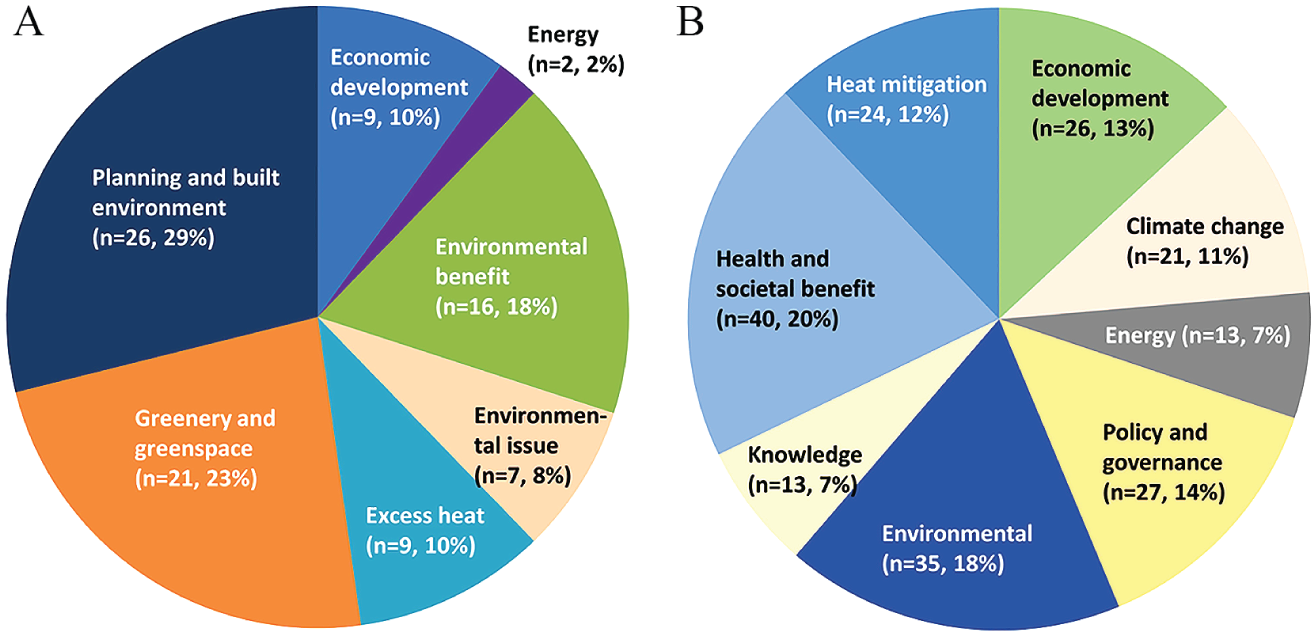
Main theme of articles referring to heat or greenery (A) and distribution of arguments within articles by category (B)
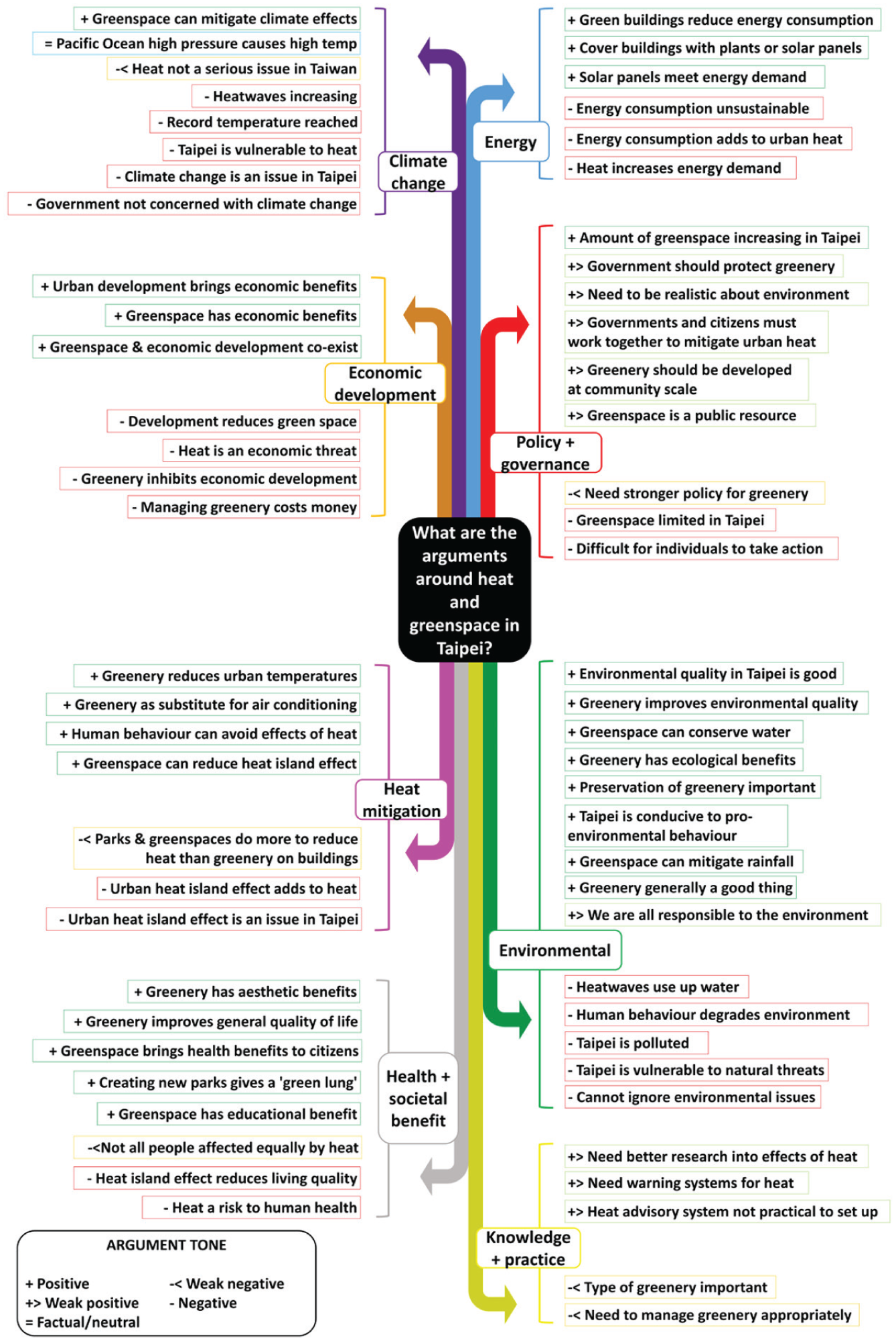
Argument map for heat and greenery in Taipei, showing the two highest levels of argument
Temperatures are reported as an average for Taipei as a whole, referring to “Greater”, “metropolitan” or “downtown” rather than specific districts or areas where temperatures may be higher. There is likewise only limited discussion of the cooling effects to be gained from different types of “greenery”: “The popularity of the greening projects is partly due to the use of landscape technology that does not damage the structure of buildings. The vegetation’s cooling effect, which helps reduce energy consumption, is another factor.” (Borough chief, reported in the China Post, 20 August 2009) “Yao suggested that [Songshan] airport be relocated so that a riverside park can be developed on the land along the Keelung River (基隆河). More green space in the urban area would not only reduce the “heat island effect” in the city, but also expand the space city residents have to engage in leisure activities, he said.” (Politician, reported in the
Taipei Times
, 18 November 2012)
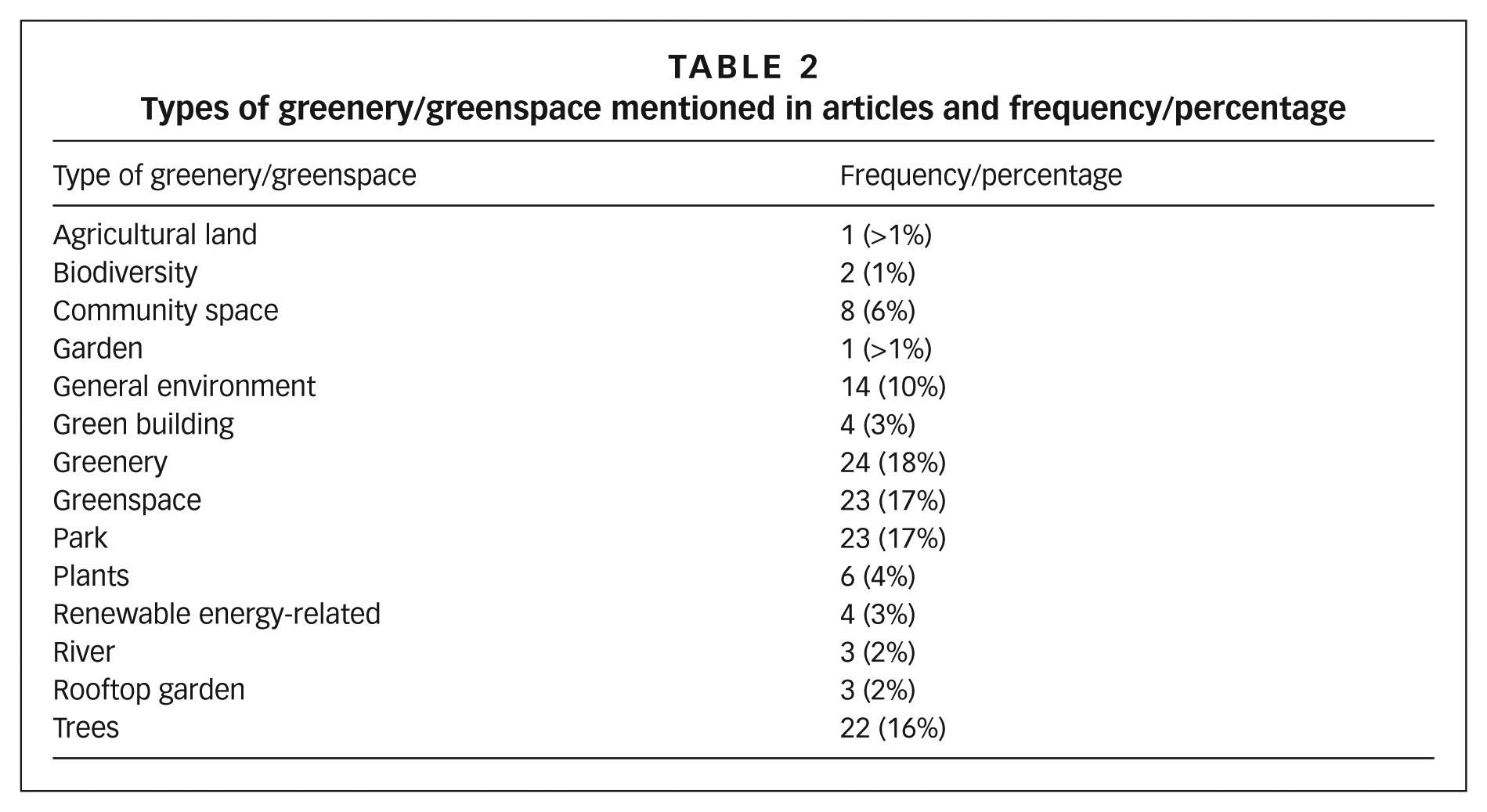
Whilst some sampled articles touch on the comparative cooling effects of green roofs, trees, plants and parks,(51) the majority use the kinds of descriptions seen above: “green space”, “greening” and “vegetation”. Table 2 records the frequencies and percentages of all instances of greenery or greenspace mentioned across all the news articles in the sample. The most frequent are either the most generic (“greenery” [18 per cent, n=24], “greenspace” [17 per cent, n=23]) or those used in common parlance (“park” [17 per cent, n=23], “trees” [16 per cent, n=22]). Newspaper articles intended for the public are of course not expected to go into the same kind of depth as technical documents for heat vulnerability or the cooling effects of greenery. But the statements above report the speech of actors who shape the social and political context within which planners work – governors, NGOs and government institutions.
Types of greenery/greenspace mentioned in articles and frequency/percentage
By contrast, the heterogeneity in heat effects in cities like Taipei(52) and possible differences in cooling provided by different kinds of greenery(53) mean that specific and detailed knowledge is required to understand which planning decisions and actions can deliver the most effective cooling via greenery in urban areas. The generic language used by decision makers and opinion shapers when discussing heat and greenery in Taipei indicates that more specificity is needed. Policy inputs from planners or academics need to raise awareness of the complexity of heat and greenery across Taipei – and of the kinds of greenspace planning actions that can deliver cooling – if effective heat mitigation is to be attained.
Heat mitigation is but one of many benefits that may be derived from greenspace. Finding ways to connect with broader rationales for urban greenery may help to bring strategic actions like heat mitigation into mainstream planning debates. These rationales may be combinations of arguments working in the same practical direction of greening in Taipei. Potential messages identified in our analysis that planners could link with heat mitigation arguments may include flood mitigation (especially important for Taipei); preserving historically or culturally meaningful spaces such as Songshan Tobacco Factory Park and wetlands at 202 Munitions Works in Nangang District; or economic benefits, provided either directly or indirectly by open spaces and greenery (see Section IVc). Yet there may be a simultaneous need to build understanding across all sections of society as to how the UHI effect differs within the city, and to ensure that greening is undertaken strategically in ways and in locations that will deliver heat mitigation.
We now look in more depth at which of these wider arguments for greening may get the most support, and how an understanding of “functional greenspace” may be developed.
c. Towards greenspace function as common ground?
To further elaborate what pathways to building heat mitigation understanding in greenspace governance might look like for Taipei, relationships among different sectors, types of arguments made, and the tone of these arguments are assessed. The aim is to understand which kinds of arguments – and which kinds of greenery – are perceived positively and by whom, in order to identify messaging for greenspace planning policy that could be engaging to a range of constituencies. Relationships between the nature of arguments made and who makes them are assessed through chi-square tests. These focus on the sector of the speaker and theme/tone of their argument, as well as the kinds of greenery referenced.
There is a weak connection between sector and theme. Private sector statements are distributed more towards economic arguments, whereas academic, decision maker and civil society arguments are distributed more towards the environment and climate change. However, this distinction is not statistically significant (df=12, χ2=14.37, p=0.28). Likewise, there is a weak connection between sector and tone. Private sector statements are more negative or problem-focused, and civil society statements are more positive or solution-oriented. Again, this connection is not statistically significant (df=4, χ2=6.95, p=0.14).
However, there is variation in how different arguments – and types of greening – are perceived. A significant relationship exists between argument type and tone (df=3, χ2=8.73, p=0.03). This becomes even stronger when type of argument is disaggregated from the four collapsed categories into the eight initial categories identified (df=7, χ2=28.91, p=<0.001). Economic arguments are mainly negative and problem-oriented, whereas arguments based on health and society and environmental grounds are more positive and solution-focused. Moreover, a moderately significant relationship exists between type of greenery and the general tone of the articles (df=3, χ2=8.34, p=0.04). Articles focusing on community-scale greenery (rooftop gardens, community spaces) carry a more positive tone than those focusing on large-scale parks, greenspaces or ecosystem-level features like rivers and wetlands. A more positive view of smaller-scale “greenery” is observable in the individual arguments, although this is not statistically significant (df=3, χ2=3.71, p=0.30). The fact that the tone of the individual arguments gives a more mixed picture than the tone of the articles overall demonstrates that even within “balanced” or “factual” articles, a range of different arguments can be reported.
The first point to take is that greenery – especially large-scale greenspace – tends to be seen negatively in Taipei with regard to economic development. The qualitative article content reflects this: “Development and environmental protection must go hand-in-hand. Taiwan’s economy cannot afford to get bogged down by people who aren’t seeing the big picture.” (Editorial staff, China Post, 26 May 2010) “Farglory Land Development Co chairman Chao Teng-Hsiung (趙藤雄), who is eager to get on with the project, then held a press conference at which he asked for a meeting with Ko and said that “frankly speaking, these trees are ugly … more beautiful trees could be planted there later,” adding that it seemed “human life is worth less than the life of a tree.” (Taipei Dome developer, reported in the Taipei Times, 16 January 2015)
Protection of the “environment” or “trees” is positioned as a potential barrier to “development” (short for economic development), something that gets in the way of enhancing the economy. By contrast, the second point to take from the chi-square analysis – again backed up by the qualitative content analysis – is that there is some emerging awareness in Taipei that greening can deliver “value” in ways beyond recreation and intrinsic value. This is especially so when working at smaller scales: “In sweltering concrete jungles like Taipei, rooftop gardens are often touted as an effective means of bringing nature back into the city and addressing ecological issues […] A green roof costs more to build and maintain than other roofs, but the potential energy savings may be able to offset those costs.” (Staff reporter, Taipei Times, 12 June 2005) “Taipei City is trying to build its image as a garden city with an emphasis on a balanced ecosystem, but [a municipal government official] also indicated it could have a strong stimulative effect on a number of sectors […] help Taiwan’s horticulture sector boost its production value by 23 percent […] the tourism sector is also expected to benefit.” (Municipal government official, reported in the China Post, 30 August 2009) “The “big tree” brand air conditioner does not add a single New Taiwan dollar to your electricity bill and in addition, it produces oxygen. This is well worth the money spent on trees and one can only hope that local academics would be able to produce a study to make the calculations on how valuable they are.” (Environmental political party, writing in the Taipei Times, 13 August 2015)
“Value” here extends beyond the mere aesthetic benefit described in the second quote to also encompass energy savings and health benefits from cooling effects. Discussion in other articles of loss of worker productivity due to heat(54) shows another way in which cooling effects of greenery may indirectly have economic benefits.
Developing stronger messaging in Taipei around the services and functions (such as cooling) that urban greenspace at all scales provides(55) may be one way to balance competing developer, municipal government and civil society interests within the city. Lessons in this regard may be learned from urban climate research in Singapore, where the involvement of policymakers from the outset in assessment of greenspaces for UHI mitigation helped translate urban ecology-related findings into policies and guidelines.(56) Our findings indicate that greenery – when understood as providing functions across a range of scales – can be perceived as an asset to Taipei, but that large-scale greenspaces may still be viewed as a barrier to economic development. It is also important to note, however, that cooling is only one service among several, and that trade-offs(57) may be required when thinking in terms of function – within which cooling benefits may not always win out.
V. Discussion
The obstacles faced in considering UHI mitigation within greenspace planning in Taipei, and the opportunities identified around consensus and greenspace function, may be discussion points for urban planners working in other locations. First among these obstacles and opportunities is the role of evidence in greenspace planning. A recurring theme in our Taipei findings is the important role for environmental planners and practice-focused academics in ensuring that planning for climate adaptation is supported with technical knowledge about greenspace functions and the nature of climate effects, rather than being at the mercy of attention cycles or sites of high-profile controversy. Challenges to enacting such “evidence-based planning” are of course not new,(58) and decision-support frameworks for integrating scientific findings into planning – including for heat mitigation specifically – do exist.(59) However, pathways to incorporating such knowledge into planning policy may not be clear in practice. Bristow believes that environmentally focused policymakers and planners in Taiwan already possess the required competencies to respond to climate issues but face political and institutional barriers.(60) Indeed, the breadth of sectors engaging with greenspace debates in Taipei indicates that which benefits win out in decision-making processes will likely depend on social relations as well as techno-scientific evidence. In comparable content analysis-based research in Singapore, debates over management of secondary forests are likewise informed not only by ecological knowledge, but by social relations between interest groups.(61) Governance of greenspace, including the appropriation of knowledge about ecosystem function, is thus a social process. The complex socio-political landscape around greenspace planning in Taipei reminds us that the social sciences have a crucial role in climate change adaptation research – not only in assessing vulnerability and keeping a check on justice concerns, but also in identifying figures, points and framings in decision-making processes where the scientific evidence base for effective UHI mitigation via greening might be able to get traction.
The second issue is the importance – but also the potential limitations – of governance based on pragmatism and consensus. For urban greening there are at least two routes – urban planners focusing on people, and biologists or landscape ecologists focusing on environmental issues. Building on extant literature on collaborative governance and strategic action,(62) throughout the paper we have argued for the need to develop broad-based durable rationales for urban greening with the potential to appeal to a range of constituencies, if specific actions such as UHI mitigation are to be realized. Given (a) the importance of private sector developers in shaping the built environment (including greenspace) in Taipei and cities like it,(63) and (b) the need to initiate action relatively quickly given the urgency of climate issues, using framings such as greenspace function to galvanize different actors could offer the best chance of realizing tangible cooling benefits within a short timeframe. This may be especially appealing if the alternative is polarized debate and paralysis on practical action. Previous experience in Taipei suggests, however, that cross-sector engagement may backfire if not undertaken sensitively. The Regulations of Bulk Reward for Urban Renewal (deployed by the Construction and Planning Agency of the Ministry of the Interior) and the “Taipei Beautiful” programme (run by Taipei City) both gave additional building capacity or floor area to developers whose projects made ecological contributions to the city. However, these initiatives arguably lost the municipality support from civil society, after being perceived as shifting the focus of greening too far from environmental benefits and towards developer profits.(64)
Given that interest is growing in finding ways to transcend sectoral interests and gather broad support for urban climate adaptation actions,(65) our Taipei findings raise a challenge for planners and municipal governments. If they are to make tangible progress on climate adaptation and reduce harm to citizens, they need to be able to balance the potential for consensus-based decisions grounded in greenspace function with the more fundamental risk of reinforcing inequality or losing focus on environmental outcomes that may come from inviting a wide range of actors into the planning process.
This leads to our third point: the need for planning policy to support community- or household-scale greening actions intended to realize specific strategic benefits. Partnerships between communities and municipalities with a focus on social sustainability have already been advocated in scholarship on equitable urban greening,(66) and could be evaluated further for application to heat mitigation and similar climate adaptation contexts. In city contexts where greenspace is at a premium, attaining the necessary mass for functionality from limited available greenery – including community spaces and “aboveground” greenspace such as rooftop gardens – becomes even more important.(67) Our Taipei data indicate that these smaller-scale greenspaces are perceived more positively than their larger counterparts. Technically too, extending greenery at greenspace edges and connecting “cool islands” – both of which may be achieved with small-scale greenery undertaken at the community or household level – has been suggested to extend greenspace cooling effects in Taipei.(68) A policy focus on community-level greening might thus make quicker practical gains on issues such as UHI mitigation in cities like Taipei, where greenspace close to the population is limited, sidestepping some of the contestation and challenges associated with provision of larger greenspaces.
Elsewhere in subtropical and tropical Asia, it has also been argued that such neighbourhood-scale greening helps social cohesion and responds to communities’ geographically and socially specific needs.(69) However, related research suggests skill and knowledge gaps may be a barrier to fully realizing neighbourhood-scale greening – whether there is a lack of skilled practitioners to maintain trees, as in Jim and Chan’s evaluation of Hong Kong,(70) or limited citizen understanding of appropriate strategies, as in Canadian and US cases.(71) The vague language around urban greening reported in our Taipei findings reflects this too. Some greening actions at the local scale are also more effective than others.(72) Ensuring that small-scale greening translates into cooling benefits requires context-specific technical knowledge from municipalities or associated experts, with systematic planning across space, good technical understanding of greening strategies, and awareness of how heat exposure varies across a city.(73) As a means of maximizing benefit, municipal urban greenspace planning policies intended for strategic planning on issues like heat might therefore include provision for education, funding, and technical support for communities and individuals, alongside efforts to understand functions at the city scale. This provision could be particularly effective if targeted at communities with high exposure and vulnerability, or proximate to greenspaces where further greening may be able to extend cooling.
VI. Future Directions And Limitations
Based on our analysis and subsequent discussion, we suggest that the following actions may help to realize greenspace benefits in Taipei and could form the basis for further enquiry in future:
1) Raise understanding of greenspace functions by facilitating decision maker engagement with academics and scientifically aware environmental planners.
2) Expand the municipal government’s definition of greenspace beyond the current narrow focus on “parks and recreation”. Many types of greenspace (such as rooftop gardens or community spaces) that have the potential to deliver cooling benefits are currently not included in urban plans in Taipei.
3) Reconceptualize municipal greenspace planning in Taipei along the lines of green infrastructure. This may bring these smaller or informal greenspaces – which are viewed more favourably, as our dataset shows – into planning processes.
4) List multiple pathways to delivery of UHI mitigation via greening in Taipei – e.g. energy saving from aboveground greenspaces, aesthetic benefit from street tree preservation, building of social relations via collaboration on functional greening of neighbourhood parks – to attain buy-in across sectors.
We have focused on articles from two English-language newspapers as a means of mapping out different positions and their implications for greenspace governance in Taipei. One extension of this research, perhaps branching out into social media where societal interaction with news stories can be more easily traced, would be to evaluate how news sources report heat and greenery/greenspace development and assess how this reporting might itself shape societal awareness and opinion. A second development would be extending beyond English-language coverage – which is nevertheless useful in identifying key actors and arguments – to include Chinese-language sources. Third, comparative studies in other cities where formal green infrastructure planning and/or UHI considerations are further developed could identify how differences in the social and policy landscape influence the success or otherwise of greening initiatives. Lastly, further enquiry into places where cooling benefits may have to be traded off against other benefits in Taipei would give a richer sense of the complexity around greenspace for climate adaptation in the city. Nevertheless, this paper has illustrated that using newspaper sources can give an accessible and high-level overview of the range of viewpoints around urban planning debates, and may – at limited cost – help planners to identify possible framings or messages to gain traction for greenspace decisions.
VII. Conclusions
The cooling potential of greenspace has to date received only limited attention from decision makers and developers in Taipei. Nonetheless, the potential for greenspace to reduce the need for air conditioning, coupled with the potential for municipal greening actions to be extended or complemented at the household or community scale, means it has significant potential as a cost-effective and attainable climate adaptation strategy for tropical and subtropical cities like Taipei. However, our findings indicate that to realize these benefits, at least in Taipei, policy messaging on UHI mitigation via strategic land use needs to be packaged with broader-based rationales that include the social, cultural and economic values delivered by greenspace, and its potential to engage a range of constituencies, including developers, communities and non-specialist policymakers. Moreover, the experience in Taipei reminds us that although building cross-sectoral consensus could well help to make tangible gains on greening, this should not lead to uncritically viewing all greening through any means as intrinsically “good”. It remains imperative to retain a critical check on whether pragmatic greening processes do deliver benefit to the people – and locations – that are most vulnerable to climate risks.
Supplemental Material
mabon-supplement – Supplemental material for Mapping the socio-political landscape of heat mitigation through urban greenspaces: the case of Taipei Metropolis
Supplemental material, mabon-supplement for Mapping the socio-political landscape of heat mitigation through urban greenspaces: the case of Taipei Metropolis by Leslie Mabon and Wan-yu Shih in Environment & Urbanization
Supplemental Material
mabon-supplement – Supplemental material for Mapping the socio-political landscape of heat mitigation through urban greenspaces: the case of Taipei Metropolis
Supplemental material, mabon-supplement for Mapping the socio-political landscape of heat mitigation through urban greenspaces: the case of Taipei Metropolis by Leslie Mabon and Wan-yu Shih in Environment & Urbanization

References
Supplementary Material
Please find the following supplemental material available below.
For Open Access articles published under a Creative Commons License, all supplemental material carries the same license as the article it is associated with.
For non-Open Access articles published, all supplemental material carries a non-exclusive license, and permission requests for re-use of supplemental material or any part of supplemental material shall be sent directly to the copyright owner as specified in the copyright notice associated with the article.
