




Abstract
Drawing upon examples of street vendors in Hanoi, this study explores gendered strategies to adapt to rapid urbanization, and how street vendors’ responses, in turn, shape the current informal food systems. The findings show that Hanoi’s informal food system is organized based on social, as well as economic, interactions and therefore the system’s power hierarchy and gender relations are different from those of formal systems, while providing livelihood opportunities for poor people in both urban and rural spaces. Women operate based on social relations rather than economic interactions, while men’s activities tend to be more capital-based and similar to the formal systems. As a result, men and women encounter different challenges in sustaining their activities in the face of policy and/or economic changes. The study concludes by highlighting adaptation capacity built upon social relations and describing the implications of integrating gender aspects for urban planning toward building more inclusive cities.
I. Introduction
Lụa,(1) 50, sells green vegetables grown on her small plot of land. She always sits on the same place on the corner of a street in Hanoi, because her business is located on the pavement where she has regular customers and fellow vendors who support her in times of need. She has been engaged in this business for 10 years, since the vast majority of her family’s land was taken by a private development agency to build new villas under the municipal government’s urban plans. This was the biggest change that her family members experienced in their lives. The compensation fees she received for the expropriated land ran out quickly as her husband started drinking, playing cards and gambling with his neighbours in their village. Lụa explains that her husband could not cope with the change: he had been a farmer for a long time, and he feels extremely ashamed at having to start learning new things and work under the supervision of somebody in the city. The vegetables she grows are local varieties of quick-growing species that are tolerant of heat and cold, and that require little labour and financial input. Although profits are minimal, this low-risk, low-return business enabled Lua and her family to cope, “bounce back” and somehow adapt to the new lifestyle of rapidly urbanizing Vietnam.
Like Lụa and her husband, many poor rural women and men end up further marginalized in the processes of rapid urbanization taking place in many parts of the world. In Hanoi, as in many other cities in Vietnam, the macroeconomic reforms, đổi mới, of 1986, and the subsequent land privatization programme implemented in the 1990s, induced important transformation of land uses, new marketing systems(2) and rapid economic growth.(3) These dramatically changed the lives of millions of people in rural and peri-urban Vietnam. Nearly 1 million hectares of farmland were converted to non-agricultural uses between 2001 and 2010.(4) Land conversion took place not only around big cities but also in the countryside through the process of industrialization.(5) Over the 2004–2009 period, 6.6 million people migrated to urban areas.(6) Many of those who lost part or all of their farmland, as well as smallholders from remote areas, are now concentrated in informal sectors in towns and cities.(7) In peri-urban areas, on the other hand, new agricultural opportunities emerged in response to the needs of growing urban populations, particularly in the areas of non-cereal production and the trading of such products as meat, fruits, vegetables and flowers.(8)
These changes led to the creation of a range of formal and informal economic spaces, but – as shown in the case of Lụa and as discussed in greater detail below – the extent to which individuals take advantage of these opportunities varies with their capacity to deal with changes and to adapt.
This study uses the case of street vendors who support Hanoi’s informal food economy and play a key role in feeding a growing non-farming population, to explore those questions of adaptation to urban changes. Using gender analysis drawn from critical social theory,(9) the objective of this research is to explore and rigorously document the role of gendered social norms and practices in adaptation to the many changes related to the rapid urbanization of Vietnam, examining how men’s and women’s adaptation strategies are shaped by gendered agency and gendered social relations.
II. Background on Informal Food Systems in Vietnam
Hanoi’s food system can be divided into two distinct sub-systems, described by various contrasting terms such as: the formal and informal food systems; modern retail services and traditional markets; and supermarkets and local wet markets selling fresh food. In Hanoi, the informal food system/wet markets are the primary access points of fresh vegetables, fruits, fish and meat for city residents, and over 95 per cent of the vegetables consumed are distributed through those channels.(10)
In addition to local wet markets, fresh food is sold on streets by street vendors. In this paper, the term “street vendors” refers to food sellers who do not have a fixed legal space in the local wet markets, and who can either be mobile within certain neighbourhoods (using a bicycle or a motorbike) or sell from pavements along the streets. Street food vendors sell a variety of agricultural produce including vegetables, fruits, pork, live fish and seafood, live poultry, fresh rice noodles, tofu, boiled or roasted maize, ground nuts and dried fish. Their contribution to the food supply is hard to estimate with accuracy since they are not officially registered and their activities are often seasonal. According to a 2013 survey, there are around 12,000 street vendors of fruits and vegetables – the number nearly doubled in four years from 2009.(11) In the literature, the sellers who have a fixed place are referred to as “retailers”. In Hanoi, retailers tend to be Hanoian women whose families have lived in the city for a few generations at least. In contrast, street vendors tend to be migrants from rural areas, especially women, who stay temporarily in Hanoi, or peri-urban residents who visit Hanoi on a daily basis.(12)
As is the case in many other cities in Asia, the Vietnamese municipal governments have various concerns about informal food systems, including street vending activities. For example, there are difficulties in controlling food safety,(13) concerns about the creation of traffic jams and even worries about ruining the fine city views.(14) Many municipal governments view street vendors as a symbol of underdevelopment,(15) and in Hanoi, recent urban policy supports the formalization of food systems.(16) Street vendors will be affected not only by the complete ban on vending activities on many more streets (including sales by vendors walking along streets), but also by the ongoing municipal policy to formalize food systems. As a result, it may become more difficult for vendors to sustain their relationships with food producers, wholesalers and consumers.
III. Conceptual Basis
In many cities in low- and lower-middle income countries, poor people depend mainly on the informal economy to secure their livelihoods. The recent literature defining the informal economy has shifted the focus from distinguishing it from the formal one to identifying the relationships between these two economies.(17) In the structuralism literature, for example, the informal economy is understood as being subordinate to the formal economy operated by, for example, powerful capitalist firms.(18) In recent literature, Phillips(19) suggests that this concentration of poor people in the informal economy is created through the power of capitalist economies, but also results from the strategies of poor households themselves, which rely on informal systems to access economic opportunities and fulfil their short-term practical needs. As a result, poor people are incorporated into markets on adverse terms, rather than being excluded from them.
To explore the highly gendered strategies of engaging with the informal economy, this study employs critical social theory as a conceptual base. Critical social theory helps us to “see” hidden, invisible power dynamics based on gender (among other influences) and offers a framework to explore the way power influences the processes of adaptation and transformation. Power in gender is not fixed, however, simply based on sex or on the economic status of individuals. Rather, it is discursive, constructed, and sustained through the everyday gendered practices that create perceptions of what men and women should be and do.(20)
In Vietnam, Confucian beliefs and practices influence the current social behaviours of women and men. Women are expected to play a caregiving role, to be obedient to all men including their father, husband and sons, and to be self-sacrificing in order for the family to maintain its harmony.(21) This role allows men to maintain their power over women in conjugal negotiations.(22) On the other hand, the socialist notion of gender equality was applied to women even after the economic reforms, đổi mới, and women were equally involved in a new capitalist market economy. Khuat et al.(23) call this change “the rapid feminization of [the] labour force”, in which women are assigned additional tasks of income-generating activities in the capitalist framework.
Women’s involvement in street vending activities is a good example of this shift. In Vietnam, in the past, trading was perceived negatively as an easy way to make money through being dishonest to customers, and thus had a low social status. Therefore, men let their wives do this work.(24) This status persists to some degree, but the rapidly increasing demand for traded goods has created an opportunity for women in this emerging sector, given that many other formal and informal sectors were already dominated by men.
In this way, power in gender plays out in the process of adaptation as a result of intra-household negotiations and relocation of labour. In consequence, women are not only assigned an additional task to their domestic responsibilities, but are also allocated socially less respected work. These women are then further marginalized as the informal economy does not offer proper social protection, unlike the (male-dominated) formal sectors and legal private companies.(25)
On the other hand, gendered power relations are not fixed and are rather negotiable, as relationships between men and women are interdependent.(26) In everyday practices, men also depend on women’s labour in some domestic domains. Women are active agents who exercise agency to mobilize resources, taking advantage of these interdependent relationships to ensure access to resources.(27) Although women may not have their own assets, they can draw on material and non-material resources from male kin through negotiations, which is a strength of informality in women’s economic activities.
IV. Data Collection and Research Methodology
Fieldwork was undertaken from late September 2015 to early January 2016 in a selection of Hanoi’s street markets. The field study consisted of four activities: the initial observation of Hanoi’s markets for site selection and sampling; in-depth interviews with 50 vendors; the observation of activities; and additional interviews with 10 selected vendors along with visits to their homes and/or farms. These field activities were conducted by the first author with the help of a female interpreter.
Interviewing street vendors is a sensitive issue. Many vendors are scared of policemen and market managers and are reluctant to talk about their work. Therefore, we needed to approach them very carefully, having identified the best times and locations to talk with them. We first visited the potential interviewees a few times to buy their food items and to chat with them to build relationships of trust. We took time to explain the purposes of the study and the issue of confidentiality before obtaining verbal informed consent from them. We then carefully determined the times for interviews. Despite this care, in several cases we had to stop the interviews. Some vendors agreed to be interviewed but then started to suspect that we were newspaper reporters, Chinese spies, fraudulent customers or even swindlers. In such cases, we simply gave up since we were less likely to get reliable information. In other cases, the interviewees suddenly ran away after receiving an alert from some colleagues that policemen were approaching – we had to rearrange the interviews for another date. Our respondents were sometimes upset with their customers or passersby who had mistreated them. In such cases, we waited and chatted with them briefly before continuing the interviews, or otherwise we rearranged the interviews.
These examples indicate the sensitivity of vending activities when it comes to social interactions and everyday experiences. To protect the anonymity and privacy of the respondents, we did not record their full names, nor do we provide here the exact addresses and street names of the locations where they work.
A variety of food vendors was selected in order to capture their diversity. The literature on street vendors has often focused on female vendors. Our fieldwork, however, found that male vendors are not uncommon. We therefore included some men as a minority gender group in our sample. A total of 50 vendors – comprising 28 females, 13 males and 9 couples – was selected from eight different sites. In the case of the couples, although the wives sell the produce, their husbands are often sitting behind them, or the men sell in the off-peak hours when their wives take a break. We interviewed the wives and husbands separately since their roles are different.
As well as gender and age, the means of transport was a selection criterion. Some street vendors carry their fruits or vegetables by bicycle or motorbike, while others sit on a pavement or walk around the streets carrying two baskets hanging from a bamboo pole. In addition to these mobile street vendors, the study included five retailers who have a fixed legal space in a wet market for a comparison purpose. These five retailers were all Hanoian women whose families have lived in the city for at least three generations.
The interviewees included a variety of fresh food vendors (Table 1). The majority of mobile vendors we interviewed visited their selling sites on a daily basis. The distance of travel varied from 1.5 kilometres to 110 kilometres each way. Twelve respondents were migrants from different provinces who were renting a room in Hanoi and were going back to their villages occasionally.
Number and gender of respondents by agricultural products
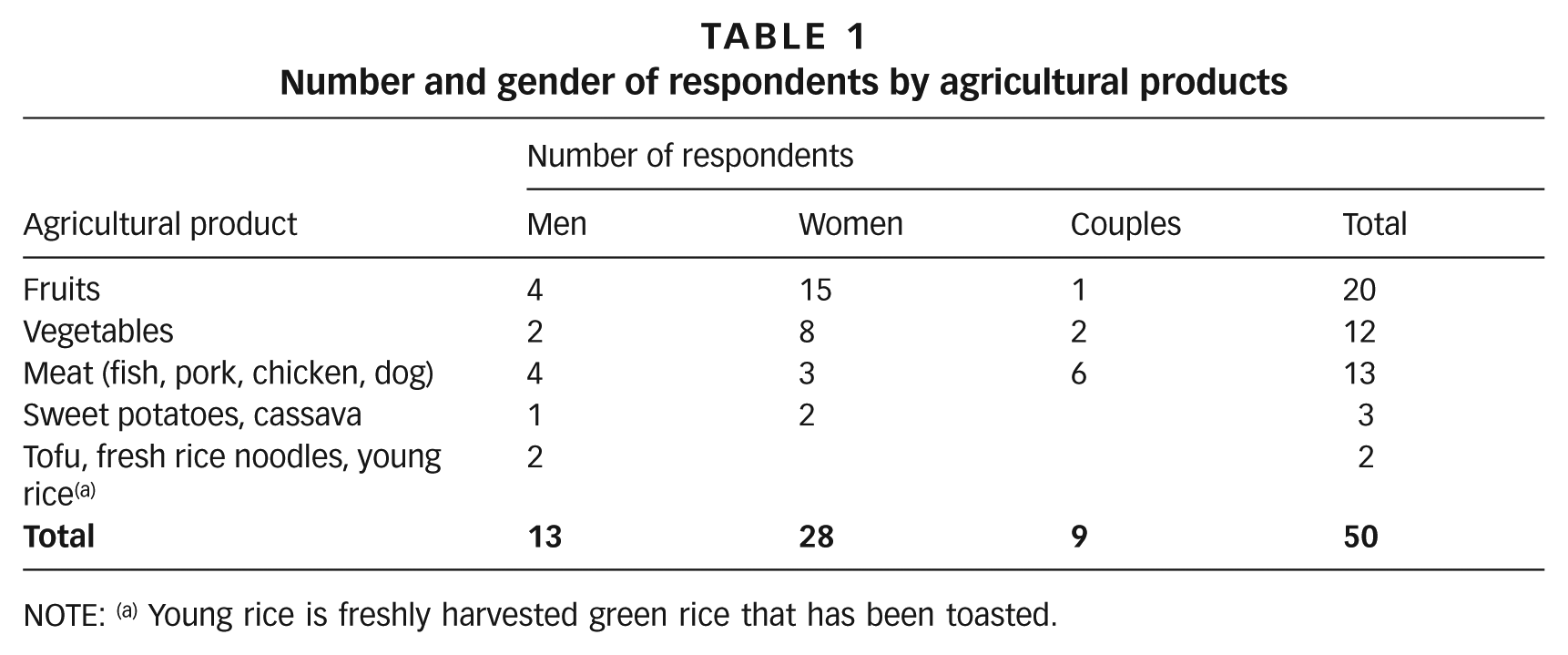
NOTE: (a) Young rice is freshly harvested green rice that has been toasted.
Each interview lasted around one hour. The interviews were framed and structured around the initial objective of the research and influenced by the conceptual elements discussed above. Although those elements were set as a guide, the actual interviews were conducted in an informal and flexible way so that the respondents could feel at ease and we could collect more in-depth information, not just superficial answers.
After conducting the in-depth interviews, we identified 12 vendors who were very open to talking about their work and asked them to participate in a series of additional interviews. Ten interviewees agreed (five females, three males and two couples). We adopted a life-history approach(28) to structure the discussion, asking more personal questions relating to their families, their lives and future goals, gender relations and negotiations.
V. Main Findings
a. Entering the informal food system: gendered responses to urban change
Street vendors’ various strategies rely essentially on their ability to seize the opportunities and respond to the various challenges that have emerged in the Hanoi urban context. Some women and men take advantage of the expanding population of the capital city by turning their land from subsistence farming to cash crop farming and/or selling their produce to an increasing number of urban residents. Others have a narrow adaptation strategy for coping with their difficult situations due to their family’s limited social connections and financial capacity. We now begin with the former cases.
Seizing the opportunities: better-off smallholders’ positive adaptation
Lan sells 150 pomelos (a large citrus fruit) per day. The business was initiated in 2005 with joint investment by her seven siblings to take advantage of the increasing demand for fruits among the growing middle-class population in Hanoi. The pomelos are purchased by her brother, who has a direct connection with producers in South Vietnam. Lan sells them in the area where her sister-in-law lives. Six of her siblings also sell pomelos in different areas of the city. In Lan’s case, connections with family and friends play a significant role in obtaining the raw material, entering vending activities and being a successful vendor.
Similarly, Thảo has been engaged in fruit selling for around 10 years, since many households from her village started cultivating fruits such as guavas, sapodillas and papayas. Her family does not engage in fruit farming themselves. Instead, they rent their farmland to a relative who grows fruits there. Thảo buys sapodillas from the relative and from a villager who is a close friend of her husband. She sells around 30–35 kilograms per day on streets and continues this trading for six months of the year. During the remaining months, she sells guavas. However, she does not have a direct connection with guava producers within the village: the producers refuse to sell her their products, or sell them at very high prices. She therefore relies on a connection established by her brother-in-law, who introduced her to two producers. Her trading has been very successful so far, as the demand for fruits is growing in Hanoi.
While fruit cultivation is considered a positive adaptation strategy for peri-urban farmers, it requires support from male kin as well as enough capital and alternative stable income sources. Lan and Thảo are just two examples of members of these better-off families that could afford to invest in the fruit trade, which requires higher investment than other agricultural products and can be slightly risky. In this study, seven female fruit vendors were selling fruits grown in their village. Interestingly, all of them have male relatives who earn cash income from off-farm employment, which enables the households to take a risk in fruit cultivation, which greatly depends on favourable weather conditions.
There is an increasing demand for meat in the city, and livestock rearing and meat trading are growing production areas, which some smallholders in peri-urban areas engage in. In fact, the livestock sector in Hanoi is primarily operated by individual smallholders and traders in informal food systems.(29) However, not everyone can easily enter the sector since the relationships between producers and traders are built mainly on men’s social networks. Trúc’s parents and her brother’s family shifted their livelihoods from subsistence farming to pig farming and trading a few years ago. She buys pork from her brother, who always keeps for her the cuts that are most popular with customers – in this way she manages to avoid purchasing parts that may remain unsold. She then sells the product in the area where her married sister lives.
Similarly, Cường, a vendor from Hòa Bình, carries 10–15 live chickens every day to sell in Hanoi, a 70-kilometre drive away. In his village, some households invested in raising a local species of chickens, but he did not have sufficient money to do the same. He therefore became a trader, purchasing chickens from his neighbour on credit on a daily basis. Meat trading appears to be dominated by men throughout its value chain processes, and the connection with men is important for a stable supply, even through the sellers on the street are their wives or female kin.
Entering part of the formal economy: strategies for Hanoians with social connections
While many of the successful adaptation strategies described above remain at the level of informal sales to individuals, some Hanoian female vendors have been able to act as informal suppliers to restaurants, selling their products to places that are part of the formal economy. Loan, a tofu and fresh rice noodle seller, and Hồng, a bamboo shoot seller, now trade their products on credit to local restaurants, as well as selling to their regular customers and passersby. Since the volume of food ordered by the restaurants each time is very high, this business helps to increase their income but it also involves a higher risk. Local restaurants only pay every three to six months, and so vendors only sell to the restaurants whose owners they know very well. Loan once had a bad experience of being unable to collect the US$ 2,000 she was owed from a restaurant owner. Her husband blamed her for this loss. Since then, she has only sold to restaurants connected to her husband’s friends and relatives so that he cannot blame her in case of future losses.
This group of female Hanoian vendors is relatively rich and their living standard is high. Their children go to universities, their husbands have proper stable businesses and they have their own houses. Selling their produce to restaurants is therefore a good option for those who have family connections and enough financial capacity to sell a significant amount of food on credit and take a risk of no return.
Poorer smallholders’ responses to urban change
In contrast to the stories of relatively successful women who have better access to resources through their family support and connections, those who have limited social connections and/or lack capital have a narrower set of adaptation strategies for coping with their difficult situations.
Amongst both male and female vegetable sellers who grow and sell vegetables, several do so because they have neither the family connections nor the capital to invest in other cash crops. Growing vegetables is relatively easy as it can be initiated with little input and support in terms of labour, capital and market access. Thắng, 60, one of the poorest men among our interviewees, grew up in a destitute family and had health problems, which delayed his marriage. Because he still has three school-aged children, he cannot retire. His wife has been weak since the birth of their third child. He started this job around five years ago, when he lost his factory employment because of his age.
Ngân has also had a difficult time in the past 10 years: her husband passed away two years ago after being sick for seven years. She and her husband had moved from Nam Định Province in 1996, following their relatives’ success in migrating to Hanoi. After her husband became sick, she quit her full-time job in a factory to look after him. She was able to start growing vegetables in empty lots in the city, gaining access by negotiating with the security guards. These lots were part of the land in, Mễ Trì near her house, which had been taken over by the state for residential development. The quantity and quality of vegetables vary with weather conditions, and her income increases or decreases accordingly, but she is always close to the buyers. To diversify her income and offset the challenges of growing vegetables in urban areas, she also sells boiled sweet potatoes. Another person from the same village as Ngân also sells sweet potatoes on a street, and gave Ngân half of her space. She even helped Ngân to sell vegetables when Ngân was busy caring for her husband. After her husband died, Ngân did not return to her full-time job since she realized that growing and selling vegetables was more profitable and allowed for more autonomy.
Women from rural areas also seek opportunities to sell their agricultural produce in Hanoi.
Hương, a mother of three, sells fish caught and dried by her husband in a coastal village in Thanh Hóa, 150 kilometres from Hanoi. In her village, employment opportunities are extremely limited, and wives are expected to earn money in Hanoi during the farming off-season. Hương stays in Hanoi for seven months while her husband and mother-in-law look after her children in the village. She stays in a Hanoi hostel with other migrants from her village, and they carry dried fish from her family when they travel from the village to the city. She skips her lunch when her earnings are low so that she can deliver a stable income every month to her family.
In sum, these cases show that although Hanoi’s growing markets and land use changes created economic opportunities for smallholders in the informal food system, these opportunities are not equally distributed. The capacity of smallholders to benefit from these changes is not straightforwardly associated with individual economic conditions or geographical locations. It also depends on gendered social connections and support, shaping hierarchal structures within the informal food system in many different ways.
b. Gendered livelihood strategies and negotiations
There are distinct gendered practices in trading and selling agricultural produce. Women are embedded in the social structures of their family and village, based on which they gain access to resources and share risks and rewards. Men, on the other hand, prefer capital-based access and have more limited social interactions with fellow villages, family members and/or peer vendors. This sub-section explores and illustrates this difference.
Women’s gendered strategies, opportunities and challenges
Hoa, 60, from Nam Định Province (around 150 kilometres south of Hanoi along the coast), has been sitting on the same pavement for more than 20 years to sell vegetables. There are some vendors around her who sell shoes, clothes and fruits, and all of them come from the same village. Village members have occupied this part of the street for at least 25 years. The villagers’ collective support system, which has evolved over the long history of rural–urban migration, protects her business. Hoa reports that agriculture in her village is always affected by typhoons and floods, and there are no cash crops that could lead the village’s economic growth. Responses to these unstable weather conditions are not impromptu. Villagers have rather solid social ties through which rural–urban migration works well to help people cope with uncertainty and change in their agriculture-based livelihoods. It is common in Hoa’s village, for instance, for a husband and wife to migrate to Hanoi together while their parents look after their children. In Hoa’s case, because her husband was physically very weak, she migrated alone while depending on people from the same village who now live in Hanoi.
Hoa’s capacity to respond to life challenges is not determined by her economic condition or her household’s, but by intangible resources gained through her village networks and villagers’ experiences. News from the village travels fast and the migrants from the same community support each other when a member needs to return to the village for urgent family obligations, such as funerals. The pavement is a place where Hoa can nurture her relations with other people from her village, which is a foundation of her social identity and social relationships. Currently, 70 per cent of her customers are regulars, who she allows to buy vegetables on credit. Poor consumers, in particular migrant workers in casual jobs, benefit from this system as their incomes are often unstable. She has no plans to move from her spot – not because she lacks the money to pay for a legal wet market space, formally recognized by the authorities, but because her relations within this “society” and her pool of customers serves as a foundation for her economic, physical and social security.
Female street vendors also access resources by utilizing social connections with family members or friends. For example, Quỳnh buys dog meat from her brother and sells it on a busy street. She started this work after she gave birth to her second child and was urged by her husband to start earning an income. She said that in her village women who only do housework and farming are considered useless. Her husband might beat her if she did not go earn money in Hanoi. However, she had a very limited amount of time for work as she was also in charge of farming and caring for her children and parents-in-law. She asked her brother, whose work is catching stray dogs and slaughtering them, to provide meat for her. He always secures the largest dog for her and prioritizes her over other traders, even during high-demand periods. She sells the meat on the pavement near the house of her husband’s relative. Her vending activities are thus fully supported by her relationships with her brother and her husband’s relatives.
Female vendors usually know very well how to deal with the police. Trang, for example, a woman selling vegetables from her own farm, was stopped by the police four times in 10 years, and each time, her vegetables and sales equipment, such as baskets and a scale, were taken. However, she managed to get them back by begging, pretending to be a miserable widow to arouse their sympathy. Trúc, a pork seller, hides with her big table in one of her regular customers’ houses when the police approach. Vân Anh sells apples by bicycle. She knows all the narrow alleys where she can hide. When she cannot escape, she begs the police for mercy and pays a small fine to get her bicycle back.
These cases (as well as those presented in the previous sub-section) demonstrate the extent to which women’s resource mobilization strategies are partly collective, grounded in family and village relationships. Labour and time, as well as risks and rewards, are shared with each other. These examples also show that street vendors’ activities are implicitly regulated, since access to streets and pavements is not free, but requires social affiliations and connections. The choices of agricultural products, the locations at which to sell, and the scale of business are not simply driven by consumer demand and financial capacity, but embedded within the social networking available to the vendors, shaping an informal food trading sector through implicit rules and invisible regulations. Many women feel that their livelihoods in the informal food system are successful. Income is obviously a necessary outcome of those activities but it is not always sufficient; the safety nets provided by their social relations appear to be an even more important factor in determining the success of their business.
Men’s gendered strategies, opportunities and challenges
As compared to women, our data suggest that men take different approaches to gaining a livelihood in the informal food systems. We identified three key characteristics of male vendors: capital-based activities; limited negotiations over access to streets; and particular investment and expenditure patterns.
First, unlike female vendors who depend on their families’ labour support and connections to enter the informal food systems, men tend to start their business without any collaboration or mutual support relationships. Thắng, 60, grows green vegetables alone on his farm in the Gia Lâm district and sells them by travelling by bicycle to central Hanoi, which is approximately 15 kilometres from his house. When we first met him, he was pushing his old bicycle with 50 bunches of green vegetables in a narrow and crowded street near the Đồng Xuân market. When we stopped him to greet him, a female shopkeeper asked him not to stop in front of her store because it disturbed her business. When he tried to move, his bicycle knocked against a motorbike and the driver blamed Thắng for his carelessness. Later, during the interviews, he said, “I am an ugly short man so I am often bullied by both men and women on streets. I had lots of bad experiences, but I now know how to manage it.” He learned the vending business by observing neighbours who did similar work.
Similarly, Đức is another man who sells green vegetables grown on his farm, 25 kilometres from central Hanoi. His wife is weak and cannot work in the city. He purchases additional vegetables from his village market to add some variety and sells them at a higher price in the city. He does not tell his villagers where he goes to sell his vegetables, to avoid many other men from the same village copying him.
Men’s vending activities are also more similar to the formal food trading system in the sense that trading takes place based on economic interactions rather than social connections and negotiations. Định, for example, hires a man who purchases fruits for him and delivers them to his hostel every morning. Sáng, a sugarcane seller, does the same. He pays for the delivery service to save time in the morning. Unlike female vendors, men in our sample depend fully on their own labour or on hired labour, and on capital, knowledge, information and skills, without any collaboration or mutual support relationships. Đức even keeps his business confidential from fellow villagers. Such behaviours may be associated with masculine traits – a topic that is beyond the scope of this study. However, the gendered behaviours of our respondents clearly create gendered strengths and challenges in this informal food trading sector.
Second, the men in our sample did not seem to seek access to pavements and streets the way women did. They tended to decide on their selling location based on demand and economic considerations, choosing the streets with fewer vendors and more consumers. Cường, for instance, parks his motorbike with chickens on a wide street where no permission and negotiation are required. He does not want to sit on the pavement, as this is considered feminine behaviour. He instead sits on the saddle of his motorbike. In fact, he would not even know how and with whom he should negotiate if he decided to get a space. Tuệ stands in front of a school gate near a wet market and sells around 100 kilograms of oranges per day. His negotiated fees with policemen to secure his current place are three times higher than those paid by the women we interviewed, and even higher than the rental fees for a legal wet market. Unlike women, who often beg policemen for mercy and negotiate a bribe, men do not beg the police and they have to pay a standard bribe.
Third, based on our observation, men tend to invest in more sophisticated equipment for selling, as using bamboo baskets makes them look like poor women. Sáng carries sugarcane on a tricycle, which tends to block narrow streets, causing traffic jams and making it difficult for him to run away from policemen. A typical male fruit seller sets an iron basket on his motorbike to carry fruits. By so doing, he may distinguish himself from female vendors and sustain his masculine identity. Migrant men spend more money on accommodations, food and drinks compared with women migrants, who share a room with other migrants from the same village to save as much money as they can. Men return home less frequently than the women migrants and do not necessarily live close to fellow villagers. Định, 38, for example, left his wife and children in his home village in the Thanh Hoá province, 140 kilometres away. He has been working in Hanoi since he was 14, and only returns home three times per year. Sáng comes from the Hòa Bình province, around 90 kilometres from Hanoi. He only travels to his home once every two to three months.
Thus, men’s marketing activities tend to be more capital-intensive than women’s, and men rarely ask for support from peer vendors or family members. They are more mobile than female vendors and therefore they can change locations at any time if any new regulation is issued. At the same time, their activities are vulnerable, in the sense that they depend heavily on their own capital and labour with little support from family, fellow villagers and friends. They have a limited buffer capacity to cope with shocks. It may be their wives who then seek alternative livelihoods for their husbands, as shown by the cases of Lụa, Hoa and Ngân. The data thus confirm that men and women use different types of resources as capital and, accordingly, encounter different challenges in sustaining their activities.
VI. Discussion
The findings of our study illustrate how poor men and women involved in Hanoi’s informal food system pursue strategies to satisfy short-term livelihood needs.(30) The strategies deployed exhibit different degrees of individual and collective agency, creating gendered patterns in the way the informal food system operates and sustains itself.
Our analysis shows in particular that the marginalization of Vietnamese women in vending activities in the informal economy paradoxically creates space for their independence, giving them a certain autonomy that allows them to dominate this sector in a way that would not be possible in a formal setting. However, female street vendors are not a homogeneous group, and their capacity to “benefit” from Hanoi’s urbanization varies considerably. Seizing opportunities and responding to these new challenges requires reallocating labour and time among household members. Implementing strategies to adapt to radical change involves risks, and it is essential to have men’s support, labour and social power to access resources, as well as sufficient financial assets. This capacity to adapt to rapid urban change is, however, often not explicit, but implicit. Access to producers, wholesale markets, streets and pavements is in fact determined by a vendor’s gendered social position. This is what White(31) describes as the politics of social “embeddedness”, in which various forms of social, cultural and gendered ideological power play out in the processes of accessing markets, and shape the ways in which markets are operated.
We argue that the street vendors’ capacity to respond to urban change and subsequent changes in gendered livelihood opportunities is influenced not only by an individual’s own assets, but by social networks within their family and village, and that this capacity is highly gendered. We also argue that the expanding informal spaces that are characteristic of urban change in a city like Hanoi provide opportunities for the poor, especially for women, to leverage their limited capacity to adapt.(32) Our research, however, also highlights the power hierarchy that is embedded in the relationships and associated negotiations within the informal sector. Although some women’s businesses are very successful, men’s power facilitated their business, indicating that this system also creates or maintains some forms of gender-based marginalization and hierarchy, which materialize in different ways from the relations within the more formal social structure. Overall, this finding is therefore in line with other recent studies on gender and informal economy that highlight heterogeneity and hierarchy among female vendors.(33)
At the same time, however, there are many ways in which marginalized people negotiate over the power to change their circumstances.(34) An individual’s capacity to resist or adapt to change in the urban context is therefore not straightforward. Concepts such as interdependency in gender relations(35) are useful to identify gendered resource mobilization strategies, and hence how marginalized groups adapt to urban change and take advantage of emerging livelihood opportunities. Poor people often access resources through developing social relations with those who have resources. Social relationships take various forms, such as friendship, trust, reciprocity, patronage, dependence and obligation. These interdependent social relations are subject to continuous negotiation processes; therefore, the ability to access resources is also subject to the ever-changing complexities of power within these social relationships.(36) In this respect, gendered interdependent relationships can be a powerful negotiation tool for women. In a patriarchal society (like in Vietnam), women access finance and assets through marital institutions. In that context, marital cooperation enables women to negotiate with their husbands to utilize their assets to fulfil their own material needs and ensure their long-term security.(37) In this respect, adaptation consists partly of collective and joint actions.
Our findings also show that in informal systems, women and men use different types of resources to access and sustain their trading activities. Women who are successful in their vending activities are negotiating over access to resources through their gendered cooperative relationships at a household and/or a village level. Lan’s earnings from the family-operated pomelo trading business are around two to three times higher than those of fruit traders whose fruits come from wholesale markets. With these higher profits, her children study at universities. Trúc can get the best cuts of pork from her brother’s slaughterhouse, while other pork sellers have no choice. Hoa and Quỳnh get the most profitable places on the pavement not because they pay the “right” amounts of money, but because they have good connections. These findings support the empirical studies that show women’s gender identities, norms and relationships to be central to sustaining their livelihoods in the informal economy.(38)
On the other hand, men’s vending activities tend to be capital-based, and they rarely ask for support from peer vendors or family members. Men’s activities are vulnerable in the sense that they depend heavily on their own capital and labour with little support, having limited buffers to cope with shocks. However, men may be more adaptable than women to the formalization of the informal food sector, as their activities are already based on capital and, as such, closer to the formal trading systems. Men are also adaptable to potential change in regulations such as the ban of vending activities on some streets, since many of them can move to other streets and engage in their activities at any location. Female vendors, on the other hand, may be more able to cope with economic shocks and recover from shocks quickly since they have support and connections through which they could restart their business without capital. However, they will have more difficulties adapting to changes in policies, as their business is operated and sustained by gendered social relationships grounded on a particular street or pavement, which differs considerably from the formal food trading systems. These findings on men’s gendered strategies shed light on the gendered processes of marginalization in the informal economy and add value to the literature on street vendors, most of which has focused on women.(39)
VII. Conclusions
In Hanoi, agricultural production and trading systems have changed dramatically, following the đổi mới reforms of the late 1980s and the subsequent urbanization of the city. However, the impacts of those changes were unevenly distributed. Some smallholders were able to take advantage of the rapid evolution of the country and turned it into great economic opportunities, while others had fewer options in their adaptation. The capacities (or lack thereof) of these different households to respond to change rapidly exacerbated the differences that were already at work among those different people.
Using gender analysis, grounded in critical social theory, this study has sought to conceptualize the roles of gendered agency and gendered relationships in the processes of adaptation. While issues of access are often considered in relation to economic resources, our study moves beyond economic notions to consider social relationships. We argue that people in marginalized social positions negotiate these gendered social relationships in order to benefit from those who have greater access to resources and assets. This approach differs from conventional gender research on adaptation, which often assumes conflicting binary relationships between men and women. Instead the present approach facilitates an exploration of individual adaptability built upon social organization of the family and village, as well as economic transactions.
Through this specific analysis, the paper shows that street vendors are not a homogenous group of poor people, and that their scale of business varies with their social and prevailing economic conditions. As a result, men and women encounter different challenges in sustaining their activities in the face of policy and/or economic changes. This adds value to the recent studies on urban livelihoods that highlight everyday strategies of street vendors who leverage public space for their economic activities,(40) and confirms that social relationships are central to negotiations for sustaining livelihoods in the informal economy.(41) In line with those findings, this study shows that street vendors are active agents who adjust their adaptive strategies in various ways and that their behaviours are highly gendered, based on socially expected gender roles and conjugal relationships. This indicates that adaptation is not only a gendered process, but is also context-specific.
More generally the qualitative gender research undertaken in this study offers notions of diversity and differences, thus illuminating more nuanced processes of adaptation, which the inferential statistics of quantitative analysis would have difficulties showing. Gender analysis enabled us to see social power and gendered agency play out in the processes of adaptation – an important first step in the understanding of vulnerable people’s responses to change.
Footnotes
Acknowledgements
The authors are grateful to the street vendors of Hanoi who kindly agreed to participate in this study and to Ms Nguyễn Thị Ngọc Diệp for her assistance during the fieldwork. The paper benefitted from useful comments from Diane Archer and Paolo Cravero from the International Institute for Environment and Development (IIED), Ann Tickamyer from Pennsylvania State University, Gordon McGranaham from the Institute of Development Studies, and Brice Even and Dindo Campilan from the CIAT Hanoi Office. This paper is based on a working paper published by IIED with support from the Rockefeller Foundation, and available at  . Additional support was also received by the CGIAR Research Program on Roots, Tubers and Bananas (CRP-RTB).The views expressed here and any errors therein remain ours.
1.
All the names of the informants who contributed to this research have been changed.
2.
Quang, N and H D Kammeier (2002), “Changes in the political economy of Vietnam and their impacts on the built environment of Hanoi”, Cities Vol 19, No 6, pages 373–388.
3.
Tuyen, T, S Lim, M Cameron and V Van Huong (2014), “Farmland loss, nonfarm diversification and inequality among households in Hanoi’s peri-urban areas, Vietnam”, International Development Planning Review Vol 36, No 3, pages 357–379.
4.
World Bank (2011), Vietnam Urbanization Review Technical Assistance Report, Hanoi, 263 pages.
5.
Phuc, N Q, A C M Van Westen and A Zoomers (2014), “Agricultural land for urban development: The process of land conversion in Central Vietnam”, Habitat International Vol 41, pages 1–7.
6.
7.
Tuyen, T Q (2013), “Livelihood Strategies for Coping with Land Loss among Households in Vietnam’s Sub-Urban Areas”, Asian Social Science Vol 9, No 15, pages 33–46.
8.
9.
Connell, R (1987), Gender and power: Society, the person and sexual politics, Polity, Cambridge, 352 pages; also West, C and D H Zimmerman (1987), “Doing gender”, Gender & Society Vol 1, No 2, pages 125–151; Butler, J (1990), Gender trouble: Feminism and the subversion of identity, Routledge, New York, 272 pages; and Jackson, C and R Pearson (editors) (1998), Feminist visions of development: gender analysis and policy, Routledge, London, 304 pages.
10.
Wertheim-Heck, S C, G Spaargaren and S Vellema (2014), “Food safety in everyday life: Shopping for vegetables in a rural city in Vietnam”, Journal of Rural Studies Vol 35, pages 37–48.
11.
Nguyen, T T L, P Moustier, N T Le and T H Le (2013), “Inclusive urban development? Making space for street vending in Hanoi, Vietnam’’, Sustainable Markets working paper, International Institute for Environment and Development, London, 38 pages.
12.
Jensen, R, D M Peppard and Vu Thi Minh Thang (2013), Women on the Move: Hanoi’s Migrant Roving Street Vendors, Women’s Publishing House, Hanoi, 164 pages.
13.
Cadilhon, J J, P Moustier, N D Poole, P T G Tam and A P Fearne (2006), “Traditional vs. modern food systems? Insights from vegetable supply chains to Ho Chi Minh City (Vietnam)”, Development Policy Review Vol 24, No 1, pages 31–49; also Wertheim-Heck, S C, S Vellema and G Spaargaren (2015), “Food safety and urban food markets in Vietnam: The need for flexible and customized retail modernization policies”, Food Policy Vol 54, pages 95–106.
14.
See reference 10.
15.
Lincoln, M (2008), “Report from the field: street vendors and the informal sector in Hanoi”, Dialectical Anthropology Vol 32, No 3, pages 261–265.
16.
See reference 10.
17.
Meagher, K (2013), “Unlocking the Informal Economy: A Literature Review on Linkages Between Formal and Informal Economies in Developing Countries”, WIEGO Working Paper No 27, 39 pages.
18.
Moser, C (1978), “Informal sector or petty commodity production: dualism or independence in urban development”, World Development Vol 6, Nos 9/10, pages 1041–1064; also Portes, A and S Sassen-Koob (1987), “Making it underground: comparative material on the informal sector in Western market economies”, American Journal of Sociology Vol 93, No 1, pages 30–61.
19.
Phillips, N (2011), “Informality, global production networks and the dynamics of ‘adverse incorporation’”, Global Networks Vol 11, No 3, pages 380–397.
20.
See reference 9, Connell (1987), West and Zimmerman (1987), and .
21.
Schuler, S R, H T Anh, V S Ha, T H Minh, B T T Mai and P V Thien (2006), “Constructions of gender in Vietnam: In pursuit of the ‘Three Criteria’”, Culture, Health & Sexuality Vol 8, No 5, pages 383–394.
22.
Horton, P and H Rydstrom (2011), “Heterosexual masculinity in contemporary Vietnam: Privileges, pleasures, and protests”, Men and Masculinities Vol 14, No 5, pages 542–564.
23.
Khuat, T H, T H Bui and B D Le (2013), “‘To be good at public and domestic work, I need three heads and six hands’: Dilemma of Vietnamese ‘modern’ women”, pages 167–188, in E Ochiai and K Aoyama (editors), Asian Women and Intimate Work.
24.
Thao, V T and J Agergaard (2012), “‘White cranes fly over black cranes’: The longue durée of rural–urban migration in Vietnam”, Geoforum Vol 43, No 6, pages 1088–1098, page 1093.
25.
See reference 19.
26.
Connell, R (2009), Gender in World Perspective (Second edition), Polity Press, London, 192 pages.
27.
Kabeer, N (2000), The power to choose, Verso, London, 464 pages.
28.
Thompson, P (2000), Voice of the past: Oral history, Oxford University Press, Oxford, 384 pages.
29.
Van den Berg, L M, M S Van Wijk and P Van Hoi (2003), “The transformation of agriculture and rural life downstream of Hanoi”, Environment and Urbanization Vol 15, No 1, pages 35–52.
30.
See reference 19.
31.
White, G (1993), “Towards a political analysis of markets”, IDS Bulletin Vol 24, No 3, pages 4–11, page 10.
32.
Roever, S and C Skinner (2016), “Street vendors and cities”, Environment and Urbanization Vol 28, No 2, pages 359–374.
33.
Steel, G (2012), “Whose paradise? Itinerant street vendors’ individual and collective practices of political agency in the tourist streets of Cusco, Peru”, International Journal of Urban and Regional Research Vol 36, No 5, pages 1007–1021; also Thara, K (2016), “Protecting caste livelihoods on the western coast of India: an intersectional analysis of Udupi’s fisherwomen”, Environment and Urbanization Vol 28, No 2, pages 423–436.
34.
See reference 27.
35.
See reference 26.
36.
Ribot, J C and N L Peluso (2003), “A theory of access”, Rural Sociology Vol 68, No 2, pages 153–181.
37.
Jackson, C (2007), “Resolving Risk? Marriage and Creative Conjugality’’, Development and Change Vol 38, No 1, pages 107–129.
38.
See reference 33, Thara (2016); also Kusakabe, K (2016), “Women’s work and market hierarchies along the border of Lao PDR”, Gender, Place & Culture Vol 11, No 4, pages 581–594.
39.
For a recent review, see Chen, M, S Roever and C Skinner (2016), “Editorial: Urban livelihoods: reframing theory and policy”, Environment and Urbanization Vol 28, No 2, pages 331–342.
40.
See references 32 and 39.