




Abstract
Spontaneous responses by self-organizing, “emergent” voluntary groups and individuals are a common feature of urban disasters. Their activities include search and rescue, transporting and distributing relief supplies, and providing food and drink to victims and emergency workers. However, informal actors are rarely incorporated into formal disaster and humanitarian planning. This paper reviews the current state of knowledge concerning the nature and scale of emergent activity around the world, its impact in the short and long terms, challenges associated with it in different contexts, and lessons for future urban humanitarian practice.
I. Introduction
The need to identify and support the skills and capacities of local people and organizations in disaster response and recovery (for reasons of proximity, speed, efficiency, accountability and empowerment) is increasingly acknowledged.(1) It has yet to be widely adopted into formal disaster and humanitarian response, although recent disasters such as the earthquake in Port-au-Prince, Haiti in 2010 have demonstrated the important role of informal aid such as remittances from family members in other countries.(2)
Disasters stimulate spontaneous responses – before formal organizations are able to mobilize – by self-organizing, voluntary groups and individuals from within and outside disaster-affected communities. These “emergent” groups and spontaneous volunteers are a common feature of disasters.(3) They form part of a wider range of responses by different organizations and groups, which often have to improvise in crises.(4) Emergence also occurs in other disaster and hazard contexts, such as opposing initiatives believed to increase risk (e.g. building on floodplains) and planning and preparing for potential events (e.g. setting up early warning systems, raising awareness of hazards).(5)
Informal voluntary action, in the form of individuals and emergent groups, is an important resource and capacity for emergency response. It is likely to become even more important in the future, with growing urban centres and populations, and in view of the high densities and proximities of urban people, buildings and infrastructure. Local people are important actors in urban disaster response. When a disaster strikes, the immediate response – search and rescue; dealing with the injured, the traumatized and the homeless – is carried out mostly by family members, friends and neighbours. It might be many hours or even days before professional emergency teams arrive, depending on the location of the disaster, the extent of physical disruption to transport and communications, and the capacity of official organizations to respond. In densely built urban environments, a further obstacle to external emergency services’ response is building and infrastructure collapse, particularly as the result of major hazard events such as earthquakes or hurricanes. Streets and roads are flooded or blocked with debris; bridges and railway lines are destroyed or damaged; power, water and communications systems break down.
For example, in Kathmandu after the April 2015 earthquake, local residents were the first responders: rescuing family members and neighbours from collapsed buildings; erecting temporary tent shelters for those who had lost their homes; providing food to survivors; distributing relief packages (when these arrived); and raising funds online.(6) In the first days after the 1999 Marmara earthquake in Turkey, which killed more than 17,000 people and caused widespread damage and disruption, state and other official agencies were initially unable to deliver or coordinate humanitarian assistance. Relief and rescue activities were carried out mainly by neighbours, relatives, spontaneously formed volunteer groups and some NGOs. In one survey, 34 per cent of earthquake victims interviewed said that they received most help immediately after the earthquake from family members and neighbours, as well as through their own efforts; only 10.3 per cent mentioned help from state authorities.(7)
There is also evidence of such emergent activity in several countries after the 2004 Indian Ocean tsunami. Surveys in Indonesia and Sri Lanka showed the predominant influence of private citizens and local communities in relief assistance such as rescue, burying of the dead, and provision of food, water and clothing. In Sri Lanka and Thailand, almost all life-saving and immediate relief activity in the first one–two days after the tsunami was by local people from neighbouring areas. Communities and local authorities in the Maldives sent boats to rescue people from islands that were no longer habitable; rescued people were rehoused with host families or in community buildings and given food from local shops. It took three–five days before external aid arrived.(8)
Although the mass media regularly highlight panic, looting, and other forms of antisocial or exploitative activity in disasters (and emergency planners often assume this will take place), extensive research into human responses to disaster in different contexts has shown consistently that such behaviour, while not unknown, is not typical. Groups and individuals typically become more unified, cohesive and altruistic in such events. It is also a myth that affected communities are essentially passive in disasters, wait for help from emergency organizations and are unwilling to become involved in response work.(9) Disasters put enormous strain on societies and organizations, but they also stimulate citizens to halt their everyday activities and take on new roles and responsibilities in response and recovery. The desire to help in a crisis is very strong: it is often “a compelling need to do something”.(10) This outpouring of individual and collective efforts by members of affected and unaffected communities on behalf of disaster victims is a feature of disasters; it is sometimes referred to as the “therapeutic community”.
Emergence has been researched since the 1950s. Most of this research has been on urban disasters (the great majority of examples cited in this paper are urban). The findings, which are outlined below, appear to be relatively consistent, but the research is uneven in its geographical coverage, with a bias towards a relatively small number of higher-income countries; and individual case studies predominate in the literature. More empirical and comparative research is needed from a much wider range of geographies, socioeconomic contexts and governance regimes.
This paper is a state-of-the-art survey of current knowledge and thinking on emergent groups and spontaneous response. Our primary aim is to raise awareness amongst urban decision-makers, disaster planners and humanitarian agencies of the phenomenon of emergence and its value in crisis response. We discuss the scale and characteristics of emergent activity, factors relating to its effectiveness, relationships between emergent groups and formal actors in disaster response, and the implications of emergence for broader and longer-term participation and civic engagement. We also identify lessons for improved coordination between formal and informal responders.
Peer-reviewed and grey literature was identified through online searching (principally Google Scholar), using a range of search terms relating to emergent groups, self-organization, and spontaneous volunteering in disasters, emergencies and crises: 120 documents, mostly academic papers, were selected for detailed review. We made a particular effort to identify research relating to disaster events and emergence in middle- and lower-income countries. International humanitarian response evaluations were also examined, but these were mostly unhelpful since they focus on the results of formal agencies’ own interventions.
II. Emergent Groups
Emergent groups are individual citizens coming together to deal collectively with disasters, forming new and informal groups to do so. Many different local groups and organizations (formal or informal) that are not normally involved in emergencies may respond to a disaster by extending their regular tasks: for example, a restaurant giving out meals to disaster victims, or a women’s group providing a safe space for displaced children. The key characteristic of emergent groups in disasters, however, is that they are new forms of collective activity, in terms of their structure and their actions: the group did not exist before, so the relationships between the individuals are new; and the individuals in the group are carrying out tasks that are new to them, working in ways that are unplanned and unanticipated.(11)
Emergence takes place in and across organizations as well as between citizens.(12) Here, though, we focus on citizen action. Emergent groups can take a variety of forms, ranging from groups of local people who gather spontaneously at a disaster site to give whatever help they can, to streams of individual volunteers bringing relief supplies, to ad hoc groups of professionals from different formal organizations coming together to coordinate response.(13) Their volunteering is entirely spontaneous, unlike formal or organized volunteers who are recruited, trained, and given instructions by government and non-governmental organizations, although in a crisis the two types of volunteers often work alongside each other.(14) Emergent groups are typically formed by individuals from an affected area, but spontaneous volunteers and supplies will also arrive from neighbouring areas and even from long distances away, often in large numbers (this is known as “convergence”). Emergence and convergence are unpredictable and difficult to plan for, but they are inevitable in crises.(15)
Emergent groups will appear if people see a need for urgent action that is not being taken by others, especially official organizations. Emergence is most likely to occur when people believe that existing emergency management organizations cannot cope with all the problems and needs generated by a disaster, or their structures and capacities are insufficient to respond adequately, and that citizens themselves should respond. This is often the case immediately after a disaster event, before emergency agencies have mobilized; where response is hindered by problems with inter-agency coordination; where decision-making is delayed or indecisive; or where the needs created by the disaster are too great for existing formal organizations to manage effectively.(16)
Emergent activity is based on improvisation and creativity, since both the groups and the tasks are new to those taking part. Emergent groups are not governed by bureaucracies and procedures: they think and adapt quickly in response to emergency situations.(17) Formal organizations aim at stability, but emergent groups are unstable. Emergent groups frequently show the following traits:
Group activities may alter as needs and priorities change during a crisis.
Groups may form and disband suddenly (some may exist only for a few days or even a few hours), and probably most will cease to exist once the crisis is over.
Membership is constantly changing as members come and go.
Groups usually have little or no leadership structure (which makes it difficult for outside groups to identify who they need to speak to).
Groups give priority to short-term decision-making rather than long-term planning.
Activities by individuals are often intermingled with those of groups and organizations.(18)
III. Emergent Activity
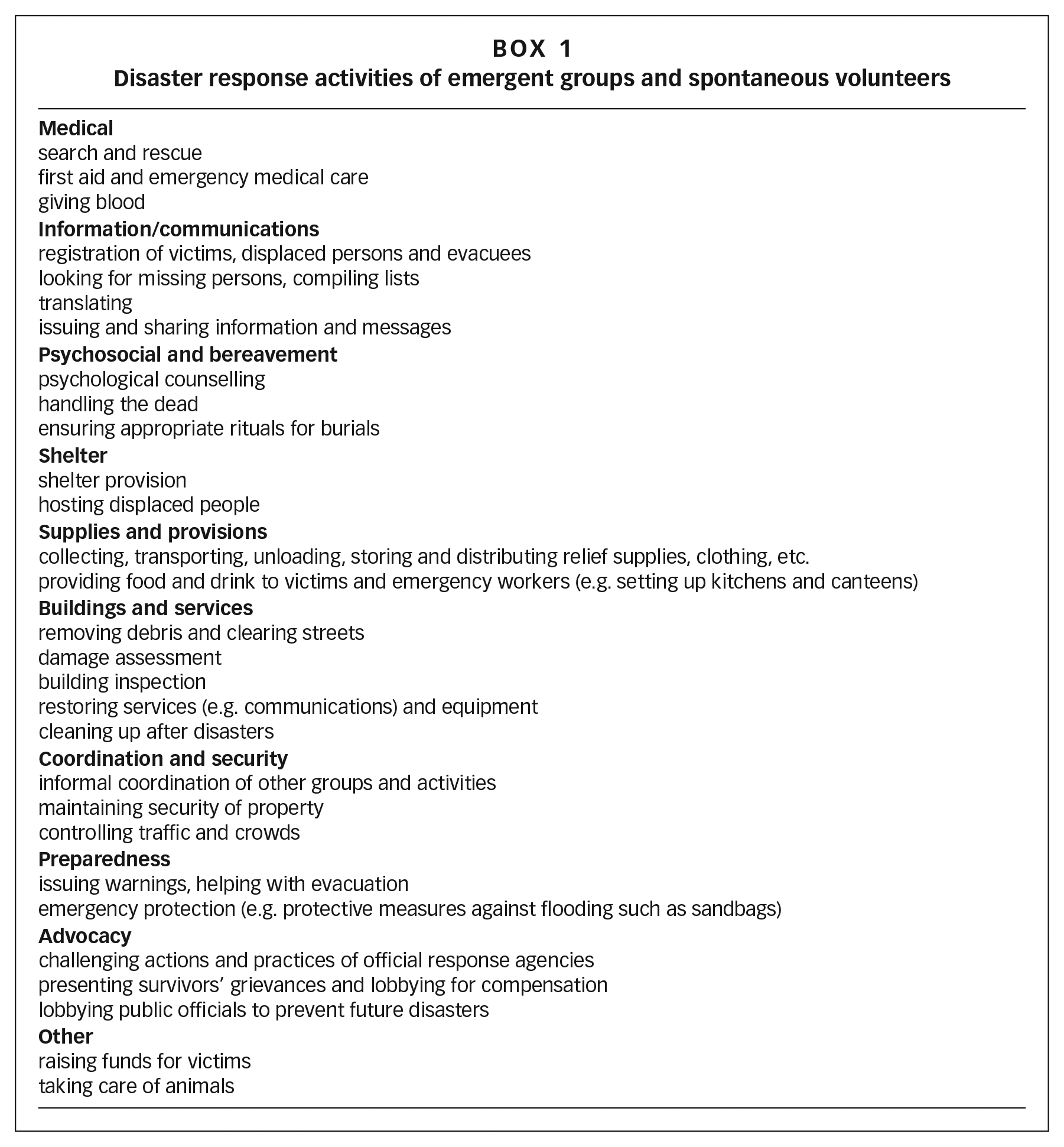
Research reports from disasters over many years have identified a wide range of activities in which emergent groups and spontaneous volunteers are involved in disasters (Box 1). The main activities seem to be search and rescue; collecting, transporting and distributing relief supplies and clothing; and providing food and drink to victims and emergency workers. Their involvement may be brief, but they may also contribute many hours or days to the relief effort.
Disaster response activities of emergent groups and spontaneous volunteers
Many of these are non-skilled tasks, which many people can take part in, such as Mumbai residents providing food, water, medicine and temporary accommodation to large numbers of people stranded during severe floods in July 2005.(19) By carrying out basic, simple activities (e.g. filling sandbags), spontaneous volunteers free up emergency management staff to carry out more specialist and skilled response activities.(20) But volunteers are sometimes recruited for more challenging roles where there are not enough professional staff available to cope with the scale of a crisis. An example of this is the use of local volunteers to support psychological recovery after the 2003 earthquake in Bam, Iran. Volunteers were given training to identify individuals in their communities in need of psychological support and refer these to professionals, as well as taking part in public education work relating to mental health.(21) In the 2005 Mumbai floods, informal-sector technicians played a vital role in maintaining formal-sector business continuity by repairing office equipment and restoring communications systems.(22)
Search and rescue (SAR) by emergent groups and spontaneous volunteers has received most attention in the literature, notably in the case of urban earthquakes. This is not surprising, since earthquakes occur without warning, which means that emergency services are unable to activate preparedness plans and mobilize ahead of the event. In addition, in a town or city affected by a severe earthquake, there may be many collapsed buildings dispersed over a wide area, requiring hundreds of separate search and rescue teams. Clearly, it is difficult for teams to mobilize and find their way along damaged roads and through streets blocked with rubble. In such situations, it is inevitable that neighbourhood efforts will dominate the immediate response period.
A typical pattern or sequence for SAR in such sudden-onset events is as follows. Immediate response in the minutes following the event is by individual survivors who are close to buildings when they collapse. Then, over the first few hours, they are joined by other individuals who have pre-impact connections with one another or the affected locality or community. The following hours and days see continuing efforts by local citizens, but also the increasing involvement of more formal organizations and specialists. Emergent group SAR activity is particularly valuable in earthquakes, because the probability of survival for people trapped in collapsed buildings declines sharply over time.(23) The great majority of lives are saved in the first 24 hours, which may be before formal SAR services can arrive (especially international SAR teams). For example, following an earthquake in Southern Italy in 1980, a study of seven affected settlements found that 90 per cent of the victims rescued from collapsed buildings were saved by untrained survivors from their own village.(24) After the Kobe, Japan earthquake in 1995, a significant proportion (estimates vary from 60 to 90 per cent) of people trapped inside collapsed buildings were rescued by local people before emergency services arrived.(25) Smaller studies in other disasters show similar findings.(26) It has been claimed that survivors rescued approximately half of those trapped in buildings by the 1976 Tangshan, China earthquake (i.e. about 300,000 people),(27) although this has not been verified by research.
IV. Scale Of Emergent Response
Although it is impossible to obtain exact numbers, it is clear that emergent activity can take place on a huge scale, depending on the location and scale of the disaster. After the Mexico City earthquake disaster in 1985, the response was dominated by the independent actions of many hundreds of groups: an estimated 10 per cent of the city’s population (i.e. 2 million people) took part in voluntary work of some kind at some time.(28) Estimates of the number of volunteers arriving in Kobe in the months after the 1995 earthquake range from 630,000 to 1.4 million. The scale of involvement was attributed to several factors, including the severity of the disaster, the obvious needs of affected people, intensive media reporting, and the fact that the earthquake occurred during a break in the academic year, allowing many students to take part in response efforts.(29) In two counties around San Francisco, USA, affected by the Loma Prieta earthquake in 1989, an estimated 60–70 per cent of local citizens (approximately 650,000 people) took part in emergency response activities.(30) After the 9/11 terrorist attacks, some 30–40,000 spontaneous and unaffiliated volunteers arrived at Ground Zero in New York to help; the American Red Cross received 22,000 offers of assistance during the first two and a half weeks after the disaster. In addition, hundreds of thousands of people were evacuated from the disaster zone on 9/11 by a fleet of boats of all kinds that came to help, including commuter boats, tugboats, tour boats and private yachts; the same boats also brought rescue workers and supplies to the disaster site.(31) Emergent efforts launched by a small group of young Sudanese men and women in 2013 in response to severe flooding around Khartoum mobilized more than 7,000 volunteers, as well as financial and in-kind support said to be worth hundreds of thousands of dollars, within a few weeks.(32) The migrant and refugee crisis in Europe in 2014–15 led to spontaneous volunteering on a huge, though so far unquantified, scale in towns and cities across Europe.(33)
V. Participation
There is no such thing as a “typical” spontaneous volunteer in a disaster. Their profile seems to vary according to each particular event and its social, economic, cultural and political context, although more detailed studies of this are needed.(34) The proportion of men and women among spontaneous volunteers varies between events and locations. There is some evidence that age is a factor, with a higher proportion of younger people involved (perhaps because older people are less able or willing to undertake the physical demands of response work). Motivation seems to be a product of shared values and a culture of responsibility to one’s community and society. Previous experience of disaster events or awareness of risks also appears to stimulate greater involvement in voluntary response activities.(35)
Social capital – and its associated features of trust, norms of behaviour and mutual obligations – has been linked with emergence. It has been argued that it is “the primary base for community response”, with emergent activities both reinforcing existing social capital and creating new social capital, although this issue remains under-researched.(36) Social capital also plays a central role in facilitating recovery(37) – indeed, most research on social capital and disasters has focused on the recovery phase. Pre-existing social relationships and organization (particularly family, neighbourhood and workplace) appear to influence how emergent groups are created and organized; they may also influence what types of activities are undertaken and how they are carried out. People may feel personally affected by disasters that affect their neighbourhoods or localities, even if they themselves, or their personal property, are not directly affected; and high levels of damage seem to stimulate more people to take part in response. Nevertheless, as new and spontaneous forms of organization, emergent groups can also transcend more regular social networks and groupings.
Neighbours, relatives and friends involved in extracting people alive in the first few hours of a disaster know the usual activities and habits of individuals and their probable whereabouts, as well as knowing the layouts of local streets and buildings. Rescuers’ concerns are likely to be first for their family members, then for their close neighbours and then for other people in their locality.(38) Co-workers within organizations may join together in spontaneous work brigades, as happened in Mexico City in 1985, and in Sakhalin, Russia in 1995, where miners and workers from oil and gas plants brought equipment to help rescue earthquake victims from buildings.(39)
Involvement in disaster events stimulates further engagement in disaster response and social work. There is evidence from many countries of spontaneous disaster response leading to longer-term involvement in more organized volunteering.(40) In Australia 22,000 people registered as volunteers with emergency organizations after bushfires in 2009; following severe flooding in another part of the country in 2010–11, more than 80,000 registered as community volunteers.(41) Such formalization of volunteer response capacity can complement spontaneous, emergent activity but does not replace it.
The massive individual response to the 1995 Kobe earthquake is seen in Japan as a renaissance of volunteerism or the start of a volunteering revolution. Although the country has a history of volunteering, traditionally through neighbourhood associations, nothing on this scale had been seen before. Many of the responders were students or young people who were volunteering for community service for the first time. Recognition of emergent groups’ contribution to the Kobe response is said to have stimulated positive changes in state–civil society relationships for disaster planning in Japan. Before 1995, Japanese civil protection had a particularly high level of dependence on government agencies and public involvement was correspondingly low. Kobe may have stimulated greater volunteer involvement in subsequent disasters: for example, thousands of people responded to clean up an oil spill in the Sea of Japan and Tokyo Bay in 1997. It certainly led to the creation of a national volunteer network, the Nippon Volunteer Network Active in Disaster (NVAD), which has continued to play an active role in emergency response, including following the 2011 East Japan (Tohoku) earthquake and tsunami.(42)
In China, a country with historically low rates of independent volunteering, it has been suggested that the efforts of tens of thousands of individuals in voluntary relief groups during the Wenchuan earthquake disaster in 2008 contributed to the development of civil society organizations by building trust with local governments, which previously had been ignorant or distrustful of civil society.(43) In Myanmar, the spontaneous relief response of local groups and individuals to Cyclone Nargis in the same year crossed ethnic, class and religious barriers, to the surprise of many observers. It provided assistance to an estimated 350,000 survivors and opened up new space for civil society.(44)
Literature on psychological issues relating to emergent groups and spontaneous volunteering is very limited. There can be positive emotional and psychological benefits to individuals from being involved in response activities. Involvement often has a transformative effect on volunteers, stimulating feelings of self-esteem, interconnection, healing and empowerment; supporting individual recovery from trauma; and helping volunteers to build new relationships in their communities. It may also lead to greater involvement in community and voluntary work, and a stronger sense of community solidarity, as well as to changes in individual life choices such as seeking work in more caring and community-oriented professions.(45)
However, voluntary involvement in disaster response – and thereby being a witness to death, destruction and suffering, in addition to facing intense work pressures – can generate stress responses such as depression, difficulty sleeping, and feelings of grief, anxiety and vulnerability: these may not appear until some time after the event. High stress levels, including post-traumatic stress disorder (PTSD), require support from mental health professionals. Relief workers and volunteers who do not have prior disaster experience or training may be at higher risk of PTSD.(46) Where government and other agencies recruit and train volunteers to work in disasters, support and training needs to be put in place to address the volunteers’ mental health needs.(47)
VI. Challenges
The scale of spontaneous volunteering can present significant coordination, integration, communication, logistical, and health and safety challenges to emergency managers.(48) These include the following:
The arrival of large numbers of people, equipment, supplies and vehicles at the disaster site causes congestion and obstructs formal emergency response.
Coordinating and communicating with many different informal groups and individuals diverts emergency professionals and resources from other urgent needs. A Chinese government official interviewed after the 2008 Wenchuan earthquake observed, “All these volunteers, money and materials flooded into the disaster zones. Anyone who had a van was trying to deliver materials to these places. It got very chaotic as the troops who were supposed to be doing relief efforts ended up taking care of the unorganised volunteers.”(49)
Volunteers are very eager to help, but they are unused to official decision-making processes and service delivery methods. They may become impatient at delays or lack of information and coordination when assisting formal agencies, and are more likely to act independently and break the rules.
Emergent groups and volunteers take a “learning by doing” approach, in sharp contrast to the formal planning and procedures of trained emergency personnel. Constant changes in group membership mean group instability as well as loss of newly acquired knowledge, experience and skills. This adds to the difficulty of incorporating them into response efforts.
Spontaneous volunteers often arrive without appropriate shelter, food and water supplies, equipment or protective clothing. This puts a drain on resources that are needed for disaster victims.
Volunteers may put themselves at risk of injury and even death in trying to rescue others from collapsed buildings. In Mexico City a local Red Cross official reported, “the chair of our committee had ordered me not to go to the Red Cross, but instead to head for the disaster zone, to prevent our young people from attempting rescues because they were for the most adolescents and the situation was too dangerous.”(50)
Interventions by SAR volunteers lacking proper equipment and technical understanding may make it harder to extricate disaster victims from collapsed buildings: this happened in the 1995 Sakhalin earthquake, for example.(51)
Volunteers may be unskilled, and they rarely have formal disaster response training or field experience; there is little or no opportunity to provide additional training. On the other hand, formal organizations and other groups may not know how to make best use of individual volunteers’ skills.
Response agencies have difficulty verifying volunteers’ training and skills and knowing where to deploy them most effectively. Agencies do not have time to carry out background checks on volunteers and their credentials (e.g. professional qualifications, criminal records).
Volunteers coming from outside the disaster-affected region may not be culturally sensitive to the needs, practices and preferences of the communities they assist.
There may be uncertainty about legal liability of volunteer responders (or official organizations they assist) for deaths, injuries or damages suffered by volunteers, or by disaster-affected people as a result of their actions. A related issue is lack of insurance cover for volunteers.
However, the core problem is that emergency planners and plans rarely take emergent groups and spontaneous volunteering into account. They do not understand the nature and characteristics of emergence or the strong motivations behind it. Emergence is an implicit challenge to the “command and control” approach of most official disaster management and emergency response agencies, with their top-down bureaucratic systems and standard operating procedures. Agencies may regard emergence as an obstacle to efficient emergency management because of its informality; they may resent citizen involvement, because of the perceived implication that professional responses are inadequate; and as a result they may try to prevent it.(52) In consequence, ordinary citizens, existing groups and organizations, and emergent groups are often underutilized or even rejected during emergencies.(53)
In practice, formal systems will have to improvise to deal with emergence. Often there will be a variety of working relationships between different official organizations and emergent groups and volunteers: this was noted in the Kobe disaster, for example.(54) Following the Guadalajara gasoline explosion in 1992, official agencies did assist informal and emergent activity by providing equipment and other forms of technical support, and by organizing citizens into more structured, semi-formal, groups as part of the response effort.(55) However, a survey in Sri Lanka after the 2004 tsunami showed that local people were generally dissatisfied with the way their skills and capacities had been utilized by external agencies, while in New Orleans after Hurricane Katrina the following year, some emergent group members felt the need to challenge perceived racial bias by local law enforcement officials.(56)
Political systems and structures that do not encourage independent action by civil society are less likely to support or facilitate its efforts, even in disasters, and may seek to restrict its activities. Following its slow initial response to the Marmara earthquake in Turkey in 1999, the state intervened firmly to control independent organizations’ activities and voice.(57) In China in 2008, official distrust and ignorance of civil society groups led to uncertainty about which groups to work with; in some cases, local government was unwilling to give permission to enter disaster sites, share information or collaborate on relief efforts. Although lessons about the need for better collaboration mechanisms were learnt, more restrictive measures were taken against bereaved parents seeking information about the construction quality of school buildings that had collapsed.(58)
Emergent activity in disasters is mostly altruistic and in the public interest. However, people can self-organize spontaneously for private interests, such as obtaining emergency supplies for their own use or protecting private property. It has been suggested that after the earthquake in Concepción, Chile in 2010, some emergent group activity may have been directed towards looting, whilst fear of looting and antisocial activity certainly stimulated members of some communities to close off access to the streets where they lived.(59)
In-group loyalty can also exclude others from assistance. For example, in Port-au-Prince, Haiti, after the 2010 earthquake, strong social networks enabled some groups to make connections with aid agencies to obtain access to shelter resources, whilst other, less well-connected and poorer people were overlooked. Similarly, in Tamil Nadu, India, after the 2004 tsunami, social capital and connections speeded up recovery processes for some, but reinforced barriers to recovery for those already marginalized in society: women, migrants, Dalits and Muslims.(60)
VII. Digital Volunteering And Convergence
Recent advances in information and communications technologies have enabled the rapid expansion of new forms of emergence and spontaneous volunteerism in disasters by groups and individuals far away from the disaster site. Such “digital” or “virtual” volunteering and convergence (which is too large and fast-moving a topic for detailed discussion here) focuses on data gathering and exchange in support of crisis response and decision-making, deploying a variety of tools and methods, including online platforms and mapping, crowdsourcing data, microblogging, wikis and social media. The value of such efforts in making response more effective, and in creating and maintaining connections between volunteer responders, is evident. Formal humanitarian or emergency management organizations are keen to use crowdsourced information in a disaster, but they seem to be less comfortable about working with social media tools and far less willing to engage or develop more substantive relationships with groups of virtual volunteers.(61)
VIII. Lessons
The work of emergent groups and spontaneous volunteering should be seen as “a significant coping response in times of crisis, augmenting the capacity of established organizations to meet shifting demands”.(62) Every disaster is different and disaster planning cannot predict every situation: real conditions will almost certainly differ from what was planned for, to some extent. This means that disaster managers need to be able to adapt or improvise in a crisis to solve new problems collectively, building on their skills, experience, training and knowledge.(63) Dealing with emergent groups is one aspect of this improvisation, although disaster management agencies have generally been reluctant to include emergent groups and spontaneous volunteers in their counter-disaster plans. Disaster response plans and procedures need to be adapted, not only to acknowledge that voluntary action by citizens will inevitably take place, but also to integrate those citizens into the response effort.
Improvisation and creativity are required to build networks and relationships between organizations and incorporate volunteers within organized initiatives.(64) For example, in the Kobe earthquake, initial problems regarding duplication of effort were overcome by creating an umbrella group, the Nishinomiya Volunteer Network, to coordinate the work of emergent groups and collaborate with the government on distributing food and other goods, collecting information about survivors’ needs from temporary shelters, and liaising between survivors and government.(65)
Practitioners should understand the urge to volunteer and the positive impacts of voluntarism. They should consider the intrinsic benefits to helpers and reframe their thinking about spontaneous volunteers – from problem to community resource.(66) Functions can be shared between disaster professionals and volunteers, or specific functions can be allocated to volunteers. Examples of how this has already been done include incorporating fishing boats into maritime search and rescue; getting public organizations or businesses to release staff (or students, in the case of schools) to help with disaster preparedness and response activities; planning for schools, places of worship, and other public and private buildings to be used as emergency shelters, with use of volunteer staff; and arranging for volunteers to collect and deliver certain supplies in emergencies.(67)
Experience of disasters can stimulate formation of volunteer response organizations. The 1999 Marmara earthquake in Turkey revealed the need for more organized and well-equipped response capacities: a neighbourhood disaster support project was initiated the following year to improve community response capability by recruiting and training earthquake survivors.(68) Experience of mass volunteering in Kobe led to reform of Japan’s national disaster legislation and planning, with volunteers explicitly recognized as a resource, and to the establishment of an annual national disaster prevention and volunteer day.(69) Emergency volunteerism offers longer-term opportunities for more structured citizen response, for example through training and creating community preparedness and response teams, and through formal voluntary organizations for emergency response, which already exist in many countries,(70) although effort is necessary to maintain volunteer motivation.(71)
Finally, we should note that most research into emergent groups and spontaneous volunteering has focused on rapid-onset disaster events triggered by natural or technological hazards in politically stable countries. Very little is known about the nature and forms of urban disaster emergence in long-running crises, or in urban settings where there are governance failures, conflict (political, social, ethnic), violence and criminality. Humanitarian and disaster management agencies increasingly recognize the need to engage with a wider range of non-state actors involved in urban governance, including community organizations, and even gangs in some situations, although they are usually unsure how to go about this.(72) The significance of informal hosting of forcibly displaced people and shelter self-recovery have also been recognized and are becoming subjects of research.(73) Nevertheless, agencies continue to focus on existing groups and organizations: the value and potential of emergence and spontaneity in such contexts is yet to be fully explored or utilized.
Footnotes
Funding
This paper is funded by the UK Department for International Development (DFID) through the Urban Crises Learning Fund. The fund is part of DFID’s Urban Crises Programme on the urban aspects of humanitarian action, which involves IIED and the International Rescue Committee (IRC).