




Abstract
International agencies responding to humanitarian crises in cities are increasingly faced with urban armed groups controlling neighbourhoods where the most vulnerable sections of society are located. In such settings, it is not clear how to deliver aid to those who need it the most without further strengthening predatory armed actors. Drawing on extensive fieldwork in Haiti, this article contributes to the emerging debate on the engagement of non-state armed groups in the context of disaster-stricken and conflict-affected cities, by presenting new empirical evidence on how humanitarian and development actors negotiate safe access in Port-au-Prince’s gang-ruled neighbourhoods in the aftermath of the 2010 earthquake. While some major development agencies have struggled to minimize the unintended – yet potentially harmful – consequences of their activities for beneficiaries, the approach of the Brazilian NGO Viva Rio offers important lessons for more effective humanitarian response to urban crises in comparable contexts.
Keywords
I. Introduction
Over the past decade, an urgently needed debate about the challenges of providing development aid and humanitarian assistance in urban areas has emerged on the pages of Environment and Urbanization, notably with regard to conflict-affected and fragile cities such as Port-au-Prince.(1) A 2004 special issue provided a conceptualization of different types of urban violence(2) as well as an introductory roadmap to better understand the causes, costs and consequences of urban violence and insecurity.(3) Ten years later, a follow-up special issue shifted the debate towards the “symbiotic relationship between urban conflict and violence”,(4) the increasing blurring between gangs and other non-state armed groups (NSAGs),(5) and efforts by international agencies (IAs) to respond to conflict and violence in 21st-century cities.(6)
Nevertheless, our understanding of the real-life challenges of dealing with urban armed groups (UAGs) in the aftermath of disasters and during conflict is limited by a paucity of evidence-based case studies on the actual behaviour of development organizations and humanitarian agencies on the ground. To move the debate forward on the engagement of NSAGs in the context of urban areas, this article presents new empirical data gathered through semi-structured interviews conducted over a six-month period of fieldwork in Port-au-Prince from June to December 2013. The main focus of these interviews was efforts by international agencies to deliver humanitarian relief and development aid to gang-ruled neighbourhoods in Port-au-Prince in the three years between the earthquake of 12 January 2010 – which had increased the scale of humanitarian intervention in Haiti – and the end of 2013, by which time the collection of primary data had been completed.
My research shows that IAs often find themselves in situations where it is extremely challenging to adhere to their own institutional standards or to those of their donors regarding their engagement, or non-engagement, with UAGs. After discussing the peculiar challenges of dealing with UAGs, this article traces the origins of Haiti’s UAGs and analyses different approaches IAs have taken to gain safe access to gang-ruled neighbourhoods in Port-au-Prince in the aftermath of the 2010 earthquake. More specifically, the strategies range from avoiding work in gang-controlled areas or simply paying off criminals to entering quartiers populaires (poor neighbourhoods) with “genuine” civil society organizations or sidelining UAGs while including them in community platforms. Viva Rio’s Tambou Lapè project in Bel Air serves as a concrete example of an innovative approach to dealing with UAGs, and recommendations are given for improved engagement with UAGs in disaster- and conflict-prone cities.
II. Methods
Interviews with local and international experts were the primary method of data collection. An examination of academic articles, grey literature and internet sources gave an initial overview of potential interview subjects. Subsequently, snowball sampling was applied based on the networks and recommendations of initial contacts. The number of interviews I conducted depended on the point of saturation, which was reached as soon as neither desk research, nor snowball sampling, nor personal contacts pointed to additional experts with significant knowledge that could contribute substantially to the study. In this case, the point of saturation was reached after I had conducted 37 interviews with community leaders, religious leaders, local NGOs, civil society organizations, peace initiatives, current and former members of UAGs in the neighbourhoods of Bel Air and Cité Soleil, and employees of numerous international agencies, most of which were working in communities where UAGs were present (Concern International, International Committee of the Red Cross [ICRC], International Organization for Migration [IOM], International Rescue Committee [IRC], Médecins Sans Frontières [MSF], US Agency for International Development [USAID], Viva Rio, UN Development Programme [UNDP], UN-Habitat, UN Office for the Coordination of Humanitarian Affairs [OCHA], and the civilian and military sections of the UN Stabilization Mission in Haiti [MINUSTAH]).
III. International Agencies and Urban Armed Groups
After a decline in the number of interstate wars and following a temporary spread of civil wars, armed conflict in the 21st century is increasingly taking place in urban areas among rival gangs, militias and law enforcement agencies.(7) Homicide rates in crime-affected cities have long been exceeding the body count in countries plagued by civil war.(8) As Graham suggests, warfare is increasingly “being urbanized [and] urban areas are now the ‘lightning conductors’ for the world’s political violence.”(9) Explanations for the urbanization of armed conflict have focused on various shifts, for instance from sovereign and civil conflicts to “civic conflict”,(10) or from rural insurgencies to urban “slum wars of the 21st century”.(11)
In line with this trend, the academic literature has given increasing importance to the role of IAs in urban conflict settings.(12) An abundance of policy-oriented research sheds light on different approaches to respond to armed violence committed by UAGs, be it by way of humanitarian action,(13) development aid(14) or conflict resolution.(15) What is more, the debate about the prospects and perils of engaging non-state armed groups(16) – traditionally with a focus on rebel groups and extremist groups in fragile and conflict-affected states – has been expanded by studies investigating how IAs operating in cities respond to the challenge posed by UAGs.(17)
Still, most literature on humanitarian diplomacy in the urban realm – including MSF’s account of negotiating safe access with Al Shabaab in Mogadishu(18) and Pottier’s “roadblock ethnography” of NGOs’ negotiations with various militias in Bunia, in the north-eastern Democratic Republic of the Congo(19) – focuses on NSAGs that are not endemic to the city. Strictly urban gangs or UAGs in cities such as Port-au-Prince, however, warrant customized responses as they are characterized by a number of features that set them apart from rural NSAGs.(20)
a. The peculiarities of urban armed groups
To begin with, the trend towards armed violence in urban settings has been linked to a general shift from political violence to criminal violence.(21) Hence, UAGs tend to be seen as having a more parochial raison d’être.(22) This is especially true when they are compared to rural guerrillas and religious extremists, who are – at least rhetorically – motivated by the belief in universal principles. Still, UAGs do have a political dimension, even though they tend to be pulled into the political sphere by external sponsors rather than being internally motivated.(23)
Second, UAGs are usually located in slums(24) around the capital or main commercial cities, close to the economic and political heart of a country.(25) This proximity allows economic and political elites to instrumentalize UAGs for their own vested interests. At the same time, it gives UAGs the option to effectively shut down megacities or to disrupt a country’s main artery roads, affecting millions of people and paralysing the economy.(26)
Third, armed groups in urban areas inevitably need to fulfil a function for their host community – typically that of protection against external threats and local forms of social control – since scorched earth tactics or purely abusive behaviour will backfire sooner or later. In Mancur Olson’s terms,(27) “roving bandits”, such as Joseph Kony’s Lord’s Resistance Army, plunder their way through the Central African countryside, whereas gangs in Brazil’s favelas or ethnic militias in Nairobi are “stationary bandits” – that is, they remain embedded within their respective communities.(28) Potentially, this leads to a better treatment of the civilian population – at least for those living within the group’s turf – to the detriment of those living in adjacent neighbourhoods under the control of rival groups.(29)
Lastly, the logistical hurdle of accessing non-state governed areas is considerably lowered by the fact that UAGs are often located in capital cities in geographical proximity to national head offices of IAs and by the possibility of teaming up with a multitude of local NGOs within gang-controlled areas. At the same time, however, the problem of negotiating safe access persists with armed groups that control poor urban areas; it might in fact be even more problematic than with rural insurgents of the ilk of FARC in Colombia.(30) Before exploring in more detail the problem of gaining safe access to gang-ruled neighbourhoods in Port-au-Prince, it is important to understand the drivers behind the emergence of Haiti’s UAGs.
IV. Haiti’s Urban Armed Groups
The use of non-state armed groups by those in power to intimidate or attack the opposition is not a new phenomenon in Haiti’s history. Faustin Soulouque used his zinglins, or political thugs, as early as the mid-19th century.(31) More than a century later, but inspired by Soulouque, François Duvalier’s rule relied heavily on the use of an oppressive paramilitary force in the form of Tonton Macoutes.(32) In the post-Duvalier and pre-Aristide period, Duvalierist elements equally resorted to the violence of ex-military and former Macoutes.(33) Yet the most infamous example of the instrumentalization of urban armed groups occurred during Jean-Bertrand Aristide’s second presidency from 2001 to 2004.(34)
Aristide became the country’s first democratically elected president in 1991, five years after a popular uprising had ended the dynastic dictatorship of François “Papa Doc” Duvalier and his son Jean-Claude “Baby Doc”.(35) However, his term was cut short after eight months by a military coup d’état led by General Raoul Cédras, who presided over a regime of terror until Aristide was reinstated by the US-led Operation Uphold Democracy in 1994.(36) After his re-election in 2000, parts of the Haitian army that Aristide had disbanded in 1995 started a paramilitary campaign to oust the newly re-elected president.(37)
In the face of armed domestic opposition and a lack of external support amidst allegations of electoral fraud, widespread corruption, and involvement in drug trafficking, Aristide tried to consolidate his rule with the help of UAGs.(38) The origins of these UAGs can be traced back to neighbourhood organizations that had emerged as “pockets of tacit resistance” to the Duvalier dictatorship, ultimately leading to the fall of Jean-Claude Duvalier in 1986.(39) The groups aimed for the violent dechoukaj or uprooting of Duvalierism.(40) This entailed not only the overthrow of Duvalier himself, but also the seeking of revenge against everyone linked to his dictatorial rule, most notably his Tonton Macoutes.(41)
Thus, during his second presidency, Aristide tried to avert another coup d’état by expanding his clientelistic network – the organisations populaires – to which he was linked through the Fanmi Lavalas movement, while arming their criminal wing – the chimères – as a powerful irregular force to silence the opposition.(42) Yet, he soon lost control over the Pandora’s box he had opened. In 2004, Aristide was forced out of power by an unlikely alliance of rural paramilitaries and factions of the UAGs that had formerly constituted his support base.(43) Even though the UN’s MINUSTAH was established shortly after Aristide’s second ouster, with the explicit mandate to disarm, demobilize and reintegrate “all armed groups”,(44) UAGs continue to be hired by politico-criminal entrepreneurs of all types, including the more recent government of Michel Martelly and the main opposition parties.(45)
On top of fulfilling a political function for their patrons, UAGs in popular neighbourhoods such as Bel Air and Cité Soleil – locally referred to as baz (Haitian Creole for “bases”) – serve various purposes in the areas they control. In addition to executing “street justice”, baz tend to present themselves as defenders of their community against real and perceived external threats, be it MINUSTAH, the Haitian state, or rival baz.(46) Numerous respondents underlined the fluidity and blurriness between the different functions baz fulfil. According to Viva Rio’s security coordinator, “there’s a social aspect, a political aspect, and then there’s armed violence. Within a sole baz, you can find these three groups. And it’s difficult to find a baz that doesn’t combine these three elements.”(47) Most baz in Haiti combine political, criminal, and security-related aspects, have both an “intellectual” and an “armed” wing, and are open to external manipulation.(48)
V. To Engage or Not to Engage Haiti’s Urban Armed Groups?
The uncharted territories of Haiti’s urban slums are inherently difficult to navigate for IAs because it is almost impossible for external actors to gain safe access to gang-ruled quartiers populaires without direct contact with gang leaders; otherwise the security and, indeed, lives of aid workers would be put on the line. While humanitarian actors such as MSF and the ICRC engage UAGs in Haiti for the sake of safe access, they agree that these groups are markedly different from NSAGs in more conventional war zones.(49) Having gained vast experience elsewhere in educating armed groups in international humanitarian law and after engaging in regular dialogue with UAGs in Haiti,(50) the ICRC came to the conclusion that urban gangs in Haiti are not comparable to political NSAGs in other contexts. According to an ICRC representative in Haiti:
“If you take the FARC for example, the claims are different. They are highly political. But here, it’s really criminal groups. They want to earn big money. So the best thing for us is that they know who we are when we are working there and so they can avoid shooting on us. You have to be really pragmatic.”(51)
The Civil Military Coordination Officer of UN OCHA in Haiti argued that humanitarian actors do not give legitimacy to UAGs by talking to them, “because what they discuss with them is humanitarian activities, humanitarian assistance.”(52) Indeed, the contact between purely humanitarian actors and UAGs appears to be less problematic than that between other IAs and UAGs because of the profits the latter expect to be able to reap from the former. In this regard, a governance and rights manager with the International Rescue Committee (IRC) told me that he did not experience problems with gangs imposing control over community committees he organized, “because this whole thing [is] about human rights and child protection, because there is no money in principle involved, it doesn’t appeal that much.”(53) By contrast, issues of safe access tend to be more complicated for the implementation of large-scale development projects that bring along considerable financial resources.(54)
As with humanitarian NGOs, UN agencies in Haiti can hardly avoid contact with armed groups when attempting to work in territory under their control. As a programme coordinator of UNDP told me, “before entering the districts, you have to meet the gangs. You have to meet the gang leaders, negotiate with them.”(55) Safe access for staff implementing projects is usually the main reason that IAs choose to cooperate with UAGs. For example, a grants manager working on behalf of USAID explained to me, “that is actually a large criterion of who we work with, to get safe entry and access into areas.”(56)
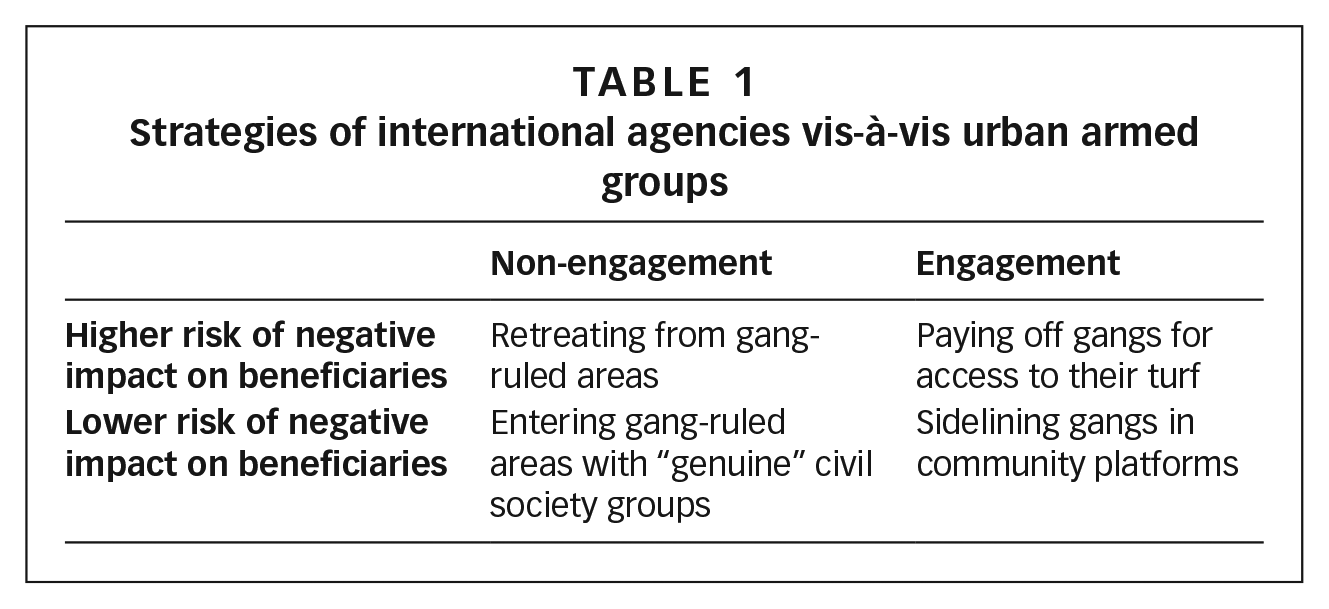
IAs employ numerous strategies regarding their engagement – or non-engagement – with UAGs. Table 1 presents four ways of dealing with UAGs, which have been classified by the level of risk they pose for beneficiaries and whether IAs engage or avoid UAGs. While paying off gang leaders and refraining from working in gang-controlled areas entail potentially negative implications for the supposed beneficiaries of development projects, entering districts under the control of UAGs with “genuine” CSOs and sidelining gang leaders by integrating them into community platforms have the potential to minimize the risks both for beneficiary communities and for the staff implementing projects. Still, as Sections Va–Vd will reveal, all four strategies have serious shortcomings.
Strategies of international agencies vis-à-vis urban armed groups
a. The worst option: Paying off gang leaders
Bribing gang leaders or hiring them as informal security providers is perhaps the least well-thought-out option. Nevertheless, staff members of a number of major IAs with operations in Haiti told me that their organizations simply paid off gang leaders in order to ensure the security of their staff when carrying out projects within the gangs’ turf. This problem was particularly pronounced when massive relief efforts streamed into the country in the aftermath of the devastating earthquake of 12 January 2010. This had killed tens, if not hundreds of thousands, of people – including almost one-third of Haiti’s civil servants – and destroyed much of the infrastructure and institutional capacity in the capital region.(57) At the same time, more than 5,000 criminals had escaped from prisons that were destroyed during the earthquake, undoing much of the modest progress that had been made in the previous years towards reducing violence and curbing crime.(58)
The combination of escaped gang leaders fighting to regain control over their former turf and the large-scale influx of recovery assistance – in many cases delivered by IAs that had not been accustomed to working in gang-controlled areas – made the post-earthquake environment especially conducive to bad practices regarding the engagement of UAGs.(59) According to a programme manager working with Concern Worldwide, “a lot of organizations arrived here after the earthquake without truly knowing the reality on the ground. Everybody wanted to help without really knowing how to.”(60)
A typical example of well-meant reconstruction efforts coupled with an ill-conceived strategy towards UAGs is that of UN-Habitat, which implemented a number of rehabilitation projects in quake-stricken areas of Port-au-Prince, some of which had been under control of UAGs. As an urban reconstruction advisor with UN-Habitat told me, “we were confronted by a problem with gang leaders, who generally have authority over a corridor … And in certain areas our technical staff was threatened at gunpoint. So we had to stop and review our mode of operation and we contracted leaders who were really influential in the neighbourhood – gang leaders – who permitted us to work in a more secure manner … But despite all efforts there were still problems with access to certain corridors, so we hired two additional gang leaders as community mobilizers.”(61)
While the UN-Habitat advisor was indeed aware of the implications of financing criminal elements, the decision was retrospectively justified by the fact that the engagement had been temporally and spatially limited:
“It’s true that in the beginning, we did not want to finance gang leaders. We thought we will never be able to get out of this and the message [to the population] will not be good. But in the end, we recruited these people and it’s true that this facilitated our work. And it was during a few days only, because it was in quite specific areas. There, we really needed someone to open the doors for us. And they did open the doors for us.”(62)
Still, such over-hasty deals struck with UAGs during the post-earthquake period to gain access to affected neighbourhoods have had a devastating long-term impact on the delivery of aid in Haiti. As a seasoned international aid worker in Haiti observed, “after the earthquake, NGOs made the mistake that they entered the districts with armed groups or pseudo-community leaders, while the genuine community leaders were left aside … On top, they started to pay in a disproportionate manner, so that money became like a drug. And now, it has become very, very complicated to work in the poor neighbourhoods, because of the money of the earthquake of January 12th; because there were people who could afford to pay [the gangs] – the huge structures, we’re talking about UN agencies that accepted to pay.”(63)
Unsurprisingly, the practice of paying off gang leaders to gain safe access has received scathing criticism.(64) By way of example, a project manager of Concern Worldwide, who works directly with gang leaders as part of a peacebuilding project, told me: “When you work in these neighbourhoods, you will be directly approached by members of gangs who ask for money or whatever to let you implement this project. But this way you reinforce the gangs indirectly, because with the money they can buy more ammunition and will become much stronger.”(65) The fear that gangs might be empowered is shared by local leaders, who are equally critical of IAs paying UAGs to gain safe access.
For example, a religious leader in Cité Soleil complained to me that “sometimes NGOs working in Cité Soleil appear like villains … They came to help us, but they help us very badly because they make contact with bandits.”(66) In fact, the contact with presumed criminals can lead to the spread of further accusations and conspiracy theories levelled against IAs within beneficiary communities, for instance involving corruption and money laundering. In this respect, the religious leader claimed that “NGOs arrived with a project, but they chose to cooperate with the bandits for money laundering. When there was a project to construct four community toilets, they built two, and they shared the rest of the money between themselves. NGOs took one half, and they gave the other half to the bandits. It’s with this money that bandits buy their weapons and ammunition.”(67) Even if unfounded, such claims can aggravate the “legitimacy issue” many IAs face in Haiti.(68)
While acknowledging the short-term benefits of safe access that facilitates the implementation of projects without major delays, most IAs are aware that in the long term, financing criminal groups can have negative impacts on their reputation as well as on the security situation on the ground. Indeed, most respondents disclosing that their agencies paid UAGs to gain access describe the moral dilemma of having to trade off abandoning communities in need of help against empowering criminal gangs. For one, the advisor for UN-Habitat told me that “one has to be prudent enough to find the middle way between integrating gangs that represent one part of the population, and, on the other hand, working for the success of the project for the beneficiaries. It’s always a bit like walking on eggshells.”(69)
In a similar vein, a contractor for USAID who admits cooperating with gang leaders told me, “I’m sure that it exacerbates the situation even more, but it’s the downs in the trade-off that you have to take as an aid worker. Do you put your security at risk or do you work with these groups that might be empowered even more?”(70) Likewise, a monitoring and evaluation expert opined, “I don’t know what’s worse here, like it’s a choice between the two bads. Maybe you’re improving sanitation for the community, but you’re also feeding the gangs, so … what are you choosing here?”(71)
b. Against the humanitarian imperative: retreating from gang-ruled areas
Given the harmful implications for beneficiaries of hiring of gang leaders, several respondents mentioned that organizations that lack the ability to implement projects without backing bandits should consider not working in gang-ruled neighbourhoods at all. As a MINUSTAH community violence reduction (CVR) coordinator suggested, “I think that in those cases, if you cannot work there, you just don’t work there. If you pay them, you are doomed.”(72) Some IAs deliberately made this choice.
However, this approach poses a serious moral dilemma: While the principle of do no harm(73) forbids the implementation of projects that risk exacerbating exploitation and criminal violence by financing bandits, abandoning the most vulnerable parts of the population is surely a type of harm as well. While refraining from working in gang-controlled areas might be a wise choice for IAs that cannot guarantee the safety of their staff without backing bandits, not all IAs should choose this option lest aid might fail to reach the sections of society that need it the most. And this would be a grave violation of the humanitarian imperative.
c. A grey area: entering with “genuine” civil society
Instead of abandoning communities under the rule of UAGs, IAs can also try to enter the area with “genuine” civil society, in other words the civil society groups that do not have a criminal wing and that are not linked with criminal elements. In this regard, a religious leader in Cité Soleil argued that “NGOs coming here to implement a project must choose an organization or a political or cultural association to accompany them to ensure their safety. Then the bandits will not dare to attack this NGO.”(74) In the same vein, an international consultant explained to me that “arriving in a district where there are armed elements is different from entering with them … If you enter directly with an element of the armed group, it’s over. So you have to enter with the community group, under their protection so to speak.”(75)
There are multitudinous and often obscure social groupings in Haiti’s slums. A number of interviewees stressed the need for evidence-based mapping of the different actors in the neighbourhood before projects can be implemented.(76) However, even when intelligence on the different actors is available, in practice it is not easy to cooperate only with “genuine” civil society groups because there is no clear-cut distinction between peaceful community groups and armed criminals. To the contrary, Haiti’s UAGs are multifaceted and regularly contain both an armed wing and a civil society front to get access to funds from IAs.(77) As one respondent put it, “in the end, here nothing is white, nothing is black, everything is grey.”(78)
One potential solution to reducing the risks of backing bandits is to work only with properly registered NGOs. The MINUSTAH CVR coordinator indicated that they had never had problems with gangs posing as NGOs to gain access to funds “… because for us it’s mandatory to be recognized by the Ministry of Planning and External Cooperation, which is the ministry in charge of registering NGOs. For a gang it’s very hard to get to this level. It’s a long process.”(79)
d. A balancing act: sidelining through community platforms
In Haiti, most IAs operating in neighbourhoods under the control of UAGs have created some kind of community platform. These platforms are typically made up of either elected or selected local representatives across multiple sectors who meet to identify the needs of the community, to discuss the actions that should be taken in order to address issues at hand, and to facilitate the implementation of projects. A difficult yet crucial question regarding community platforms is whether gang leaders should be integrated into these structures, thereby possibly elevating their status and giving them legitimacy; or whether they should be excluded, which potentially endangers the implementation of projects because of the threat posed by armed elements that feel snubbed on their own turf.
Expressing concern over the inclusion of UAGs in community platforms, an international aid worker with experience in community mobilization for MINUSTAH, UNDP and UN-Habitat advised me, “Ideally, one should not bring them into community platforms. For me, community platforms should have no political connotation and also no bandits, no armed elements.”(80) Yet the same expert recalled that in practice, “it was difficult to not integrate them into the platforms.” Accordingly, the IAs with projects in gang-ruled areas whose representatives I spoke to – including MINUSTAH’s CVR section, UNDP, UN-Habitat, IOM, Concern Worldwide, and Lakou Lapè – acknowledged that gang leaders are indeed part of their community platforms.(81)
However, this need not be a sign of capitulation to armed bandits, nor does it amount to directly facilitating criminal activities, as distinct from paying off gang leaders. In fact, integrating UAGs into community platforms is a common strategy to give gang leaders the impression that the rule they exercise over their territory is respected, while actually trying to sideline them within these platforms. By way of illustration, a Haitian programme manager said that “we created a platform where all the sectors – business, education, health, culture, religion, gangs – everyone is part of that platform … Gangs are present, but they are insignificant. They are minimal within the platform, which has other leaders, too, who have the capacity to decide, to make a choice for the community.”(82)
Some respondents stressed the importance of making sure that gang leaders are effectively sidelined since incorporating them into platforms risks elevating them to the status of de facto community leaders while alienating the rest of the inhabitants. As a regional coordinator of MINUSTAH’s CVR section suggested, “You have to find the boundary between gangs and notable citizens. If you devote 80 per cent of your time to gangs and 20 per cent to notable citizens, the citizens will say ‘well, you come here to protect the gangs only’.”(83) Likewise, the director of Lakou Lapè explained that “we don’t focus on the gangs; we don’t give them a leadership position. [They] are a reality in that community, so when we are doing the dialogues, they are invited to join. Because we’re not able to do anything in the community without them anyways, so it’s no use ignoring them. You don’t want to give them the leadership of the community, but you include them.”(84)
More disapprovingly, a project coordinator with the CVR section of MINUSTAH raised strong objections against IAs treating UAGs like civil society groups:
“NGOs that are transforming gang leaders into community leaders are doing the worst mistake ever in my opinion. [This] does not mean that we don’t have to invest in people involved – which is our mandate – in gang activities that want to change. But it makes a big difference to provide equal opportunity to everybody and to take a criminal and transform him into a leader. That in my opinion is criminal. Whoever does this – it’s a very dangerous approach.”(85)
An additional dilemma is the fact that the creation of parallel structures such as community platforms contributes to the weakening of already fragile state institutions.(86) This rings especially true in Haiti, which has earned the nickname “Republic of NGOs” because a vast number of the most basic services are provided by institutions that do not belong to the state.(87) Perhaps unsurprisingly, then, the creation of parallel structures has been strongly criticized by the Haitian government, which stated that it is “fiercely opposed” to the creation of “parallel structures within our communities” that would “weaken state structures with the support of the internationals”.(88)
All in all, IAs choosing to hire gang leaders or to avoid working in gang-controlled areas exacerbate risks for beneficiaries by strengthening the grip of criminal elements over their turf and by neglecting their most basic needs, respectively. While the other two strategies discussed above are potentially less harmful for beneficiaries, they also entail certain risks. On one hand, civil society organizations will only be able to protect IAs from armed elements with whom they are on good terms themselves – and this proximity might call into question their very classification as “genuine” civil society. On the other hand, gang leaders who feel snubbed on their own turf as soon as they see through IAs’ attempts to sideline them within community platforms might pose a serious risk for beneficiaries and aid workers alike.
VI. Engagement as an End vs. Engagement as a Means
As evidence from Haiti has shown, some large IAs decided to make use of the security dimension of UAGs in order to gain safe access to neighbourhoods under their control. They did so for instrumental reasons, not because they were convinced of the inherent value of a cooperative strategy vis-à-vis UAGs, but because they understandably wanted to ensure the safety of their own staff while implementing their projects. It is difficult, however, not to see the inherent contradiction in strengthening UAGs by using their security dimension in order to implement projects that are aimed at replacing the functions the UAGs fulfil within their neighbourhood – including informal security provision. What is worse, there is a huge difference between IAs consciously cooperating with UAGs because their work is based on the cooperative logic of conflict resolution, and IAs that try to avoid cooperating with UAGs but often end up doing so anyway. The problem is that in practice, even IAs that have established clear rules on how to deal with UAGs do not always live up to their own policies.
A case in point is USAID’s Haiti Stabilization Initiative (HSI). Initially it had been reported that HSI “explicitly avoided the option to ‘negotiate’ directly with so-called gangs and criminal actors, preferring instead to focus on undermining their source of legitimacy”.(89) Yet I interviewed one former HSI staff member who had directly negotiated with gang leaders, a claim backed by another former HSI employee in a subsequent interview.(90) To make matters worse, different sources confirmed that gang members were involved in the selection of beneficiaries for cash-for-work projects, which enabled them to favour their own family members, while other community members had to pay in cash or sex for a place on the list.(91) This strengthened gang members to the point that Haitians started to complain that “you have to be a gang member to get a job as a supervisor”.(92)
In contrast to USAID, the Brazilian NGO Viva Rio works with liaisons who “speak several languages” – that of the gangs as well as that of the donors, as its director, Rubem César Fernandes, explained to me.(93) Viva Rio has thus been able to establish itself as an indispensable intermediary in the Bel Air neighbourhood of Port-au-Prince, negotiating between international agencies and Haitian politicians with resources at their disposal on the one side, and local groups that can grant access and credibility on the other side. While still running the risk of bypassing the state and further strengthening certain illiberal local actors, relying on such gatekeepers whose behaviour can be at least partly monitored by implementing agencies is perhaps the least bad option; it certainly is preferable to ad hoc payments forced at gunpoint.
VII. Viva Rio’s Approach to Engaging Haiti’s Urban Armed Groups
A closer look at the experience of Viva Rio in Haiti can provide important lessons for engaging armed groups within the urban environment. Executive director Rubem César Fernandes explained to me that Viva Rio was first invited to Haiti by MINUSTAH in 2004 when the mission leadership came to the conclusion that UAGs in Port-au-Prince have more in common with drug factions in Rio de Janeiro’s favelas than with largely rural rebel groups in sub-Saharan Africa, the main theatre for conventional UN peacekeeping operations.(94) With more than 20 years of experience working in some of Brazil’s most inaccessible urban areas, Viva Rio’s approach is based on the cooperative logic of conflict resolution, as evidenced by its focus on “the role of mediation, dialogue and communication to neutralize prejudice and misjudgements, which are often the source of conflict”.(95)
Since 2007, Viva Rio’s flagship initiative in Haiti has involved the signing of peace accords locally known as Tambou Lapè, which have been renewed almost yearly.(96) For every month without violent deaths occurring in a specific neighbourhood, children living in the area can take part in a lottery draw from a “peace drum” (Tambou Lapè in Creole) with the chance of winning scholarships covering the expenses for one school year.(97) When no violent death occurs during a two-month period, one gang member in each of the 11 participating quartiers is allotted a scholarship to study a subject of choice, including languages and fine arts.(98)
According to Viva Rio’s director Rubem César Fernandes, “[t]he idea is to stress that in peace everybody wins and with violence everybody loses”.(99) Thus, Viva Rio’s purposeful cooperation rewards non-violence and allows investment in the education of gang members with the prospect of providing them with alternative ways to make a living. This is in stark contrast to the efforts of other IAs such as USAID, which inadvertently rewarded violent behaviour and financed the criminal activities of bandits when staff members were forced to pay protection money at gunpoint.
The Tambou Lapè peace accords can be seen as an attempt to introduce an aspect of self-regulation into the behaviour of UAGs, based on observing self-imposed rules. For instance, according to Viva Rio’s security coordinator, an informal agreement has been struck with inveterate thieves to steal outside their own community: “in our second peace accord we said, ‘if you want to steal, go steal elsewhere. Don’t steal from your neighbour; don’t steal in your community. It’s not good in any case to steal, but if you’re a natural thief, if you can’t stay without stealing, go someplace else’.”(100)
Such guidelines evoke difficult moral dilemmas as they might contribute to tensions between adjacent neighbourhoods, ultimately aggravating violent turf wars between rival gangs. Nevertheless, their appeal to Viva Rio appears to lie in the modesty of their objectives: highly localized changes in collective behaviour are much easier to achieve than overambitious efforts at state- or nation-building.(101) A case in point is a decline in the number of kidnappings since this type of crime has been included in the peace accords. As Viva Rio’s Liaison Officer explained to me, “one can say that in the case of Bel Air, since we’ve had our fifth peace accord, there are no more kidnappings. You simply can’t find a place to hide someone anymore in Bel Air. The community is very clear on this.”(102)
However, Viva Rio’s Tambou Lapè remains a controversial issue in Haiti. In a 2009 poll, 47 per cent agreed that “peace accords between armed groups would make my community safer”, while 51.6 per cent disagreed.(103) An evaluation prepared by Canadian and Finnish donors noted that while the community of Bel Air could be better integrated into Viva Rio’s organizational structure, the local population appreciates the alternatives offered to youth at risk of joining UAGs. On the other hand, a report by the Small Arms Survey criticized the “piecemeal nature” of Viva Rio’s projects.(104) Moreover, while giving an overall positive assessment of Viva Rio’s work, an evaluation by the Norwegian Agency for Development Cooperation notes that residents of adjacent neighbourhoods questioned whether Tambou Lapè could actually incentivize violent behaviour, describing the programme as placing “a premium [on] violence”.(105) Likewise, the practice of distributing resources through lottery draws directly to gang members has been criticized by local commentators and NGOs, especially since highly desirable motorcycles and laptops have been added to drawings in which only gang leaders can partake.(106)
Still, in recent years, the scope of the programme has been extended considerably. The number of people signing a peace accord increased from initially 12 gang leaders in 2007 to more than 150 community leaders in 2013. The reason for this increase is that the peace accords evolved from a truce between rival gangs into a community platform in which gang leaders constitute only one of the represented sectors, alongside cultural, religious, educational and business leaders, as well as state actors such as the Haitian National Police and the National Commission for Disarmament, Demobilization and Reintegration. Thus, today, the peace accords fulfil two purposes at once: first, the overall reduction in violent crimes committed in the project area; second, the establishment of a community structure that facilitates the implementation of other projects by Viva Rio and other IAs operating in Bel Air.(107)
Therefore, in addition to the direct outcome of Tambou Lapè in terms of violence reduction, it is important to take into account the role Viva Rio plays as a gatekeeper for other IAs, which can use the community platform that has been formed on the basis of the peace accords. In this respect, Moestue and Muggah observe that “Viva Rio is now a clear gate-keeper for engaging projects in Bel Air”.(108) Indeed, Viva Rio sees itself as an intermediary between community leaders, on one hand, and other IAs as well as Haitian politicians, on the other. As Rubem César Fernandes put it, “We negotiate a lot. And in these negotiations, there is something that politicians want, which is credit, which is contact and prestige – and something that the local guys want, which is projects, resources.”(109)
The example of USAID’s HSI has shown that even when headquarters formulate clear policies against support to criminals, their guidelines are bound to be ignored when those implementing the projects face a very different reality on the ground. Viva Rio’s use of liaisons, by contrast, is itself a precarious balancing act between the constructive and destructive dimensions of Haiti’s UAGs. While the liaisons have to maintain their ties to criminal actors in order to fulfil their mandate as “guards of the crossroads” between donors and gangs, their behaviour is easier to control than that of moonlighting protection rackets, and their vulnerability to financial incentives offered by criminal third parties can be reduced by a regular salary.(110) Positive results in the Bel Air neighbourhood and many years of successful cooperation with the same liaisons strengthen the impression that this approach is working better than paying off the next best bandit who demands “protection fees”.
VIII. Recommendations
Haiti is a textbook example of the contemporary conflict environment in which armed violence is increasingly committed by urban gangs, militias and vigilantes. By way of conclusion, it is possible to draw a number of lessons from engaging UAGs in Haiti that might facilitate future endeavours in similar settings. To begin with, IAs should closely monitor how projects are implemented and beneficiaries are chosen. This especially applies to short-term quick impact projects (QIPs), which should ideally be supplanted by more sustainable long-term programmes. In the same vein, humanitarian relief agencies should coordinate more closely with development and peacebuilding actors in order to address the underlying drivers of violence. Efficient efforts to reduce violence committed by urban armed groups require an integrated strategy that addresses the structural causes for the formation of such groups, while at the same time facilitating desistance for those seeking to leave them.(111)
Sexual exploitation in exchange for aid is a prevalent malpractice that must be reined in not only among gang members posing as civil society, but also with regard to the staff of IAs, as evidenced by repeated accusations of this nature against UN peacekeeping troops.(112) For IAs to reduce the risks of sexual exploitation in cash-for-work schemes, women-led NGOs such as Mouvement des Femmes de Cité Soleil (MOFECS) should be responsible for the recruitment of female workers. Moreover, all beneficiaries of QIPs and all peacekeepers should receive training on anti-corruption and exploitation on the work site.
When it comes to the question of whether to engage or not to engage urban armed groups, it is imperative for IAs to ensure that everyone involved in implementing projects sticks firmly to the rule of not simply paying off bandits to gain access to their turf. In order to make sure that aid reaches the most vulnerable parts of the population, donors could try to enter the strongholds of UAGs with representatives of what could be described as “genuine” civil society, as these actors frequently command considerable respect even from criminal groups. While it is often difficult for external actors to distinguish between a country’s “civil” and “uncivil” society, working only with NGOs registered with the ministry in charge of their authorization could be a first step in this direction.
Another approach could be to include UAGs in community platforms as representatives of one sector among many others – such as business, education, health, culture and religion. By doing so, one could give gang leaders the impression that the rule they exercise over their territory is respected, while other community leaders dominate decision making within the platforms. In this regard, NGOs informed by the cooperative logic of conflict resolution can facilitate safe access so that other IAs can implement development projects and deliver humanitarian aid. By way of example, Viva Rio plays an important role as gatekeeper in Bel Air. The broad community platform it has set up could serve as an entry point for other IAs, such as USAID or UN-Habitat, that have in the past financed criminals in order to gain access to their turf.
Footnotes
1.
17.
20.
On the debate on whether gangs should be analysed within the conceptual framework of NSAGs, see Krause and Milliken (2009); Jütersonke et al. (2009); Hazen (2010); and  . In this respect, Haiti is in a contradictory position. Whereas the country has not been subject to a civil war in the conventional understanding of the term, a UN peacekeeping mission has been mandated to disarm NSAGs – primarily urban gangs. To account for this paradoxical situation, the terms “urban armed groups” and “gangs” are used interchangeably in this article to refer to a subtype of NSAGs.
24.
The term “slum” usually has derogatory connotations and can suggest that a settlement needs replacement or can legitimate the eviction of its residents. However, it is a difficult term to avoid for at least three reasons. First, some networks of neighbourhood organizations choose to identify themselves with a positive use of the term, partly to neutralize these negative connotations; one of the most successful is the National Slum Dwellers Federation in India. Second, the only global estimates for housing deficiencies, collected by the United Nations, are for what they term “slums”. And third, in some nations, there are advantages for residents of informal settlements if their settlement is recognized officially as a “slum”; indeed, the residents may lobby to get their settlement classified as a “notified slum”. Where the term is used in this journal, it refers to settlements characterized by at least some of the following features: a lack of formal recognition on the part of local government of the settlement and its residents; the absence of secure tenure for residents; inadequacies in provision for infrastructure and services; overcrowded and sub-standard dwellings; and location on land less than suitable for occupation. For a discussion of more precise ways to classify the range of housing sub-markets through which those with limited incomes buy, rent or build accommodation, see Environment and Urbanization Vol 1, No 2 (1989), available at .
26.
Arana (2005); .
30.
32.
33.
35.
Dupuy (1997); .
36.
38.
Fatton Jr (2005), page 11; .
39.
Muggah (2013), page 301; , page 677.
46.
Neiburg et al. (2011), page 25; , page 26.
47.
Author interview with Viva Rio, Pétion-Ville, 22 October 2013. Translated from French by the author.
48.
Based on author interviews with former gang members and staff of international NGOs in Haiti, October and November 2013. It is important to note that many, though not all, baz are armed. Moreover, given the fluid nature of these groups, it is often difficult to distinguish between those that are armed and those that are unarmed. Therefore, the term UAGs is used in this article to include only those baz that are armed.
49.
Interviews with ICRC and MSF, Haiti, November 2013.
50.
Florquin et al. (2010), page 308; , pages 319f.
51.
Interview with ICRC, Port-au-Prince, November 2013.
52.
Interview with UN OCHA, Port-au-Prince, November 2013.
53.
Interview with IRC, Pétion-Ville, October 2013.
55.
Interview with UNDP, Pétion-Ville, October 2013.
56.
Interview with the private international development consultancy Chemonics, Pétion-Ville, September 2013.
57.
Estimates of the number of victims of the earthquake vary greatly, ranging from as low as 65,000 to the official number of 316,000. See Schwartz et al. (2011), page 3; , page 1.
60.
Interview with Concern Worldwide, Pétion-Ville, October 2013. Translated from French by the author.
61.
Interview with UN-Habitat, Port-au-Prince, October 2013. Translated from French by the author.
62.
Interview with UN-Habitat, Port-au-Prince, October 2013. Translated from French by the author.
63.
Interview with an international aid expert, Pétion-Ville, October 2013. Translated from French by the author.
65.
Interview with Concern Worldwide, Pétion-Ville, October 2013. Translated from French by the author.
66.
Interview with LIVOCS (Ligue Des Vodouisants de Commune de Cité Soleil – a collective that brings together Vodou practitioners from across Cité Soleil for social and community development work), Cité Soleil, October 2013. Translated from Creole by the author.
67.
Interview with LIVOCS, Cité Soleil, October 2013. Translated from Creole by the author.
69.
Interview with UN-Habitat, Port-au-Prince, October 2013. Translated from French by the author.
70.
Interview with Chemonics, Pétion-Ville, September 2013.
71.
Interview with a monitoring and evaluation expert, Haiti, October 2013.
72.
Interview with the CVR section of MINUSTAH, Port-au-Prince, October 2013.
74.
Interview with LIVOCS, Cité Soleil, October 2013. Translated from Creole by the author.
75.
Interview with an international aid worker, Pétion-Ville, October 2013. Translated from French by the author.
76.
Interviews with UNDP, MINUSTAH and UN-Habitat, Haiti, 2013.
77.
78.
Interview with an international aid worker, Pétion-Ville, October 2013. Translated from French by the author.
79.
Interview with the CVR section of MINUSTAH, Port-au-Prince, October 2013.
80.
Interview with an international aid worker, Pétion-Ville, October 2013. Translated from French by the author.
81.
Interviews with MINUSTAH CVR, UNDP, UN-Habitat, IOM, Concern International, and Lakou Lapè, Haiti, 2013.
82.
Interview with Concern Worldwide, Pétion-Ville, October 2013. Translated from French by the author.
83.
Interview with the CVR section of MINUSTAH, Port-au-Prince, October 2013. Translated from French by the author.
84.
Interview with Lakou Lapè, Port-au-Prince, October 2013.
85.
Interview with the CVR section of MINUSTAH, Port-au-Prince, October 2013.
90.
Interviews with USAID HSI, Port-au-Prince, October and November 2013.
91.
Interviews, Haiti, September to November 2013.
92.
Interview with a Haitian development worker, Port-au-Prince, November 2013.
93.
Interview with Rubem César Fernandes, Pétion-Ville, November 2013.
95.
Yazdani and Charles-Voltaire (2014), page 461.
96.
Between 2010 and 2012, the peace accords were put on hold, due to the aftermath of the earthquake as well as the lack of support from the Martelly administration, which suspected that agreements with criminals might reinforce impunity. Interview with Viva Rio, Pétion-Ville, October 2013.
98.
Yazdani and Charles-Voltaire (2014), page 465.
100.
Interview with Viva Rio, Pétion-Ville, October 2013. Translated from French by the author.
102.
Interview with Viva Rio, Pétion-Ville, October 2013. Translated from Creole by the author.
104.
CIDA, DFAIT and NCA (2011), pages 6f; , page 24.
106.
Moestue and Muggah (2009), page 58; , page 454.
107.
Interview with Viva Rio, Pétion-Ville, October 2013.
109.
Interview with Rubem César Fernandes, Pétion-Ville, November 2013.
110.
Interview with Viva Rio, Pétion-Ville, November 2013.
111.
In this respect, literature on gang desistance in the US has shown that geographical separation and the availability of alternate support systems are key for successfully disengaging from gangs. See Bolden (2013); and .